🔥 Would you like to save this?
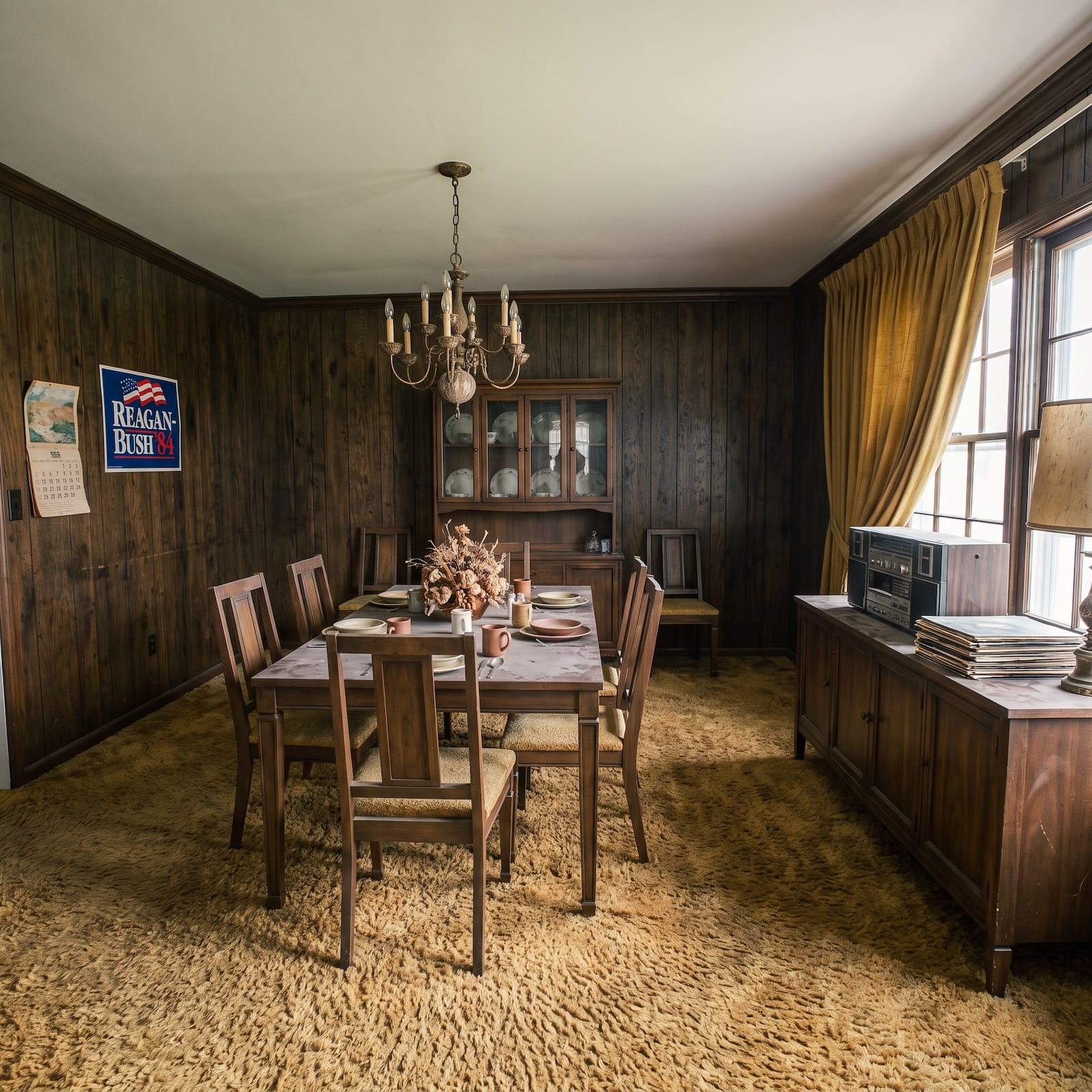
The china hutch is still there. So are the dark wooden walls, the drapes that have outlived several decorating movements, and the chandelier that makes every family gathering feel like a compulsory holiday dinner. Somewhere along the way, this 1970s dining room stopped being a destination and became a room everyone walked through to get somewhere more interesting. Its furniture stayed formal long after the family gave up on formality.
In order to come up with the very specific design ideas, we create most designs with the assistance of state-of-the-art AI interior design software. Also, assume links that take you off the site are affiliate links such as links to Amazon. this means we may earn a commission if you buy something.
Now imagine handing that same stubborn room 37 completely different identities. Begin with a gilded emerald dining room that looks ready to receive royalty. Follow it with marble walls and a glowing ceiling, then a table threaded with illuminated onyx. Just when the renovation budget seems to have acquired its own line of credit, the possibilities swing toward pale oak, daylight, concrete, fearless color, and rooms that make dinner feel more like an evening out. Some even find room for a bar. The old china hutch may need a moment.
These are alternative design concepts inspired by the same dated starting point, not photographs of 37 documented renovations. The surprises come from what each design chooses to change: a ceiling becomes the star, dark paneling gives way to light, an awkward corner becomes a drinks station, or the seating invites people to stay after dessert. The most dramatic transformation isn’t necessarily the most expensive-looking one. It’s the room that makes you wonder why anybody ever stopped eating there.
A little inspiration can turn into a serious renovation plan. If financing is on your mind, check today’s home equity rates before you start ordering stone slabs.
37. Gold on the Ceiling, Emerald on the Walls: The Old Dining Room Goes Full Château
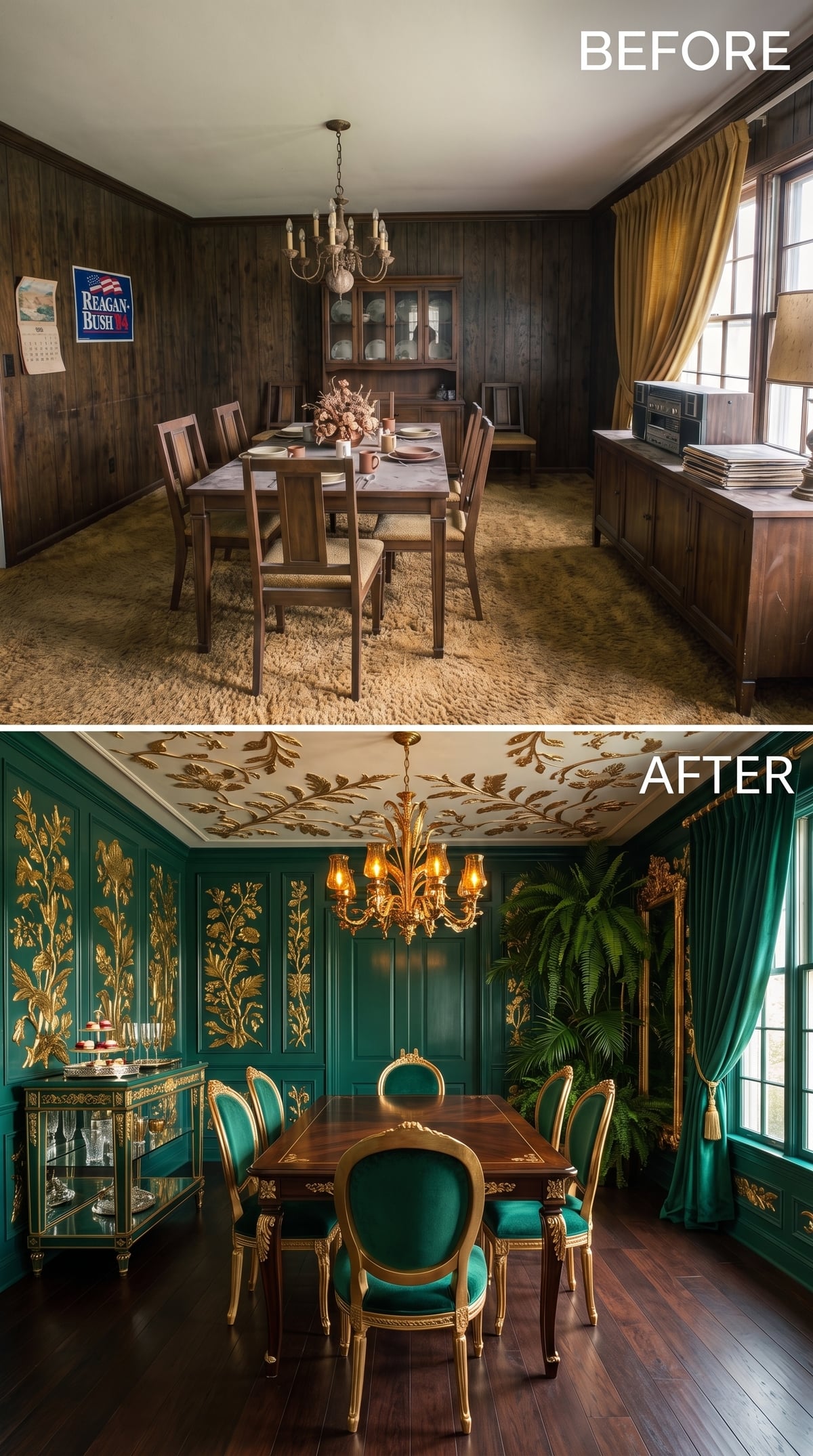
Green lacquered panels framed by gold botanical ornament make this the gallery’s most unapologetically formal interpretation. Gilded foliage continues across the cream ceiling toward a brass chandelier, while a walnut table with fine metallic detailing introduces another layer of ornament at dining height.
The upholstered chairs reference Louis XVI-era neoclassical furniture through their more disciplined outlines; the lavish green-and-gold treatment belongs to this contemporary design concept, not to a documented historical room. It’s an exuberant remix of historical vocabulary rather than an attempt at faithful restoration.
36. Marble Walls and a Glowing Tray Ceiling Take Luxury in Another Direction
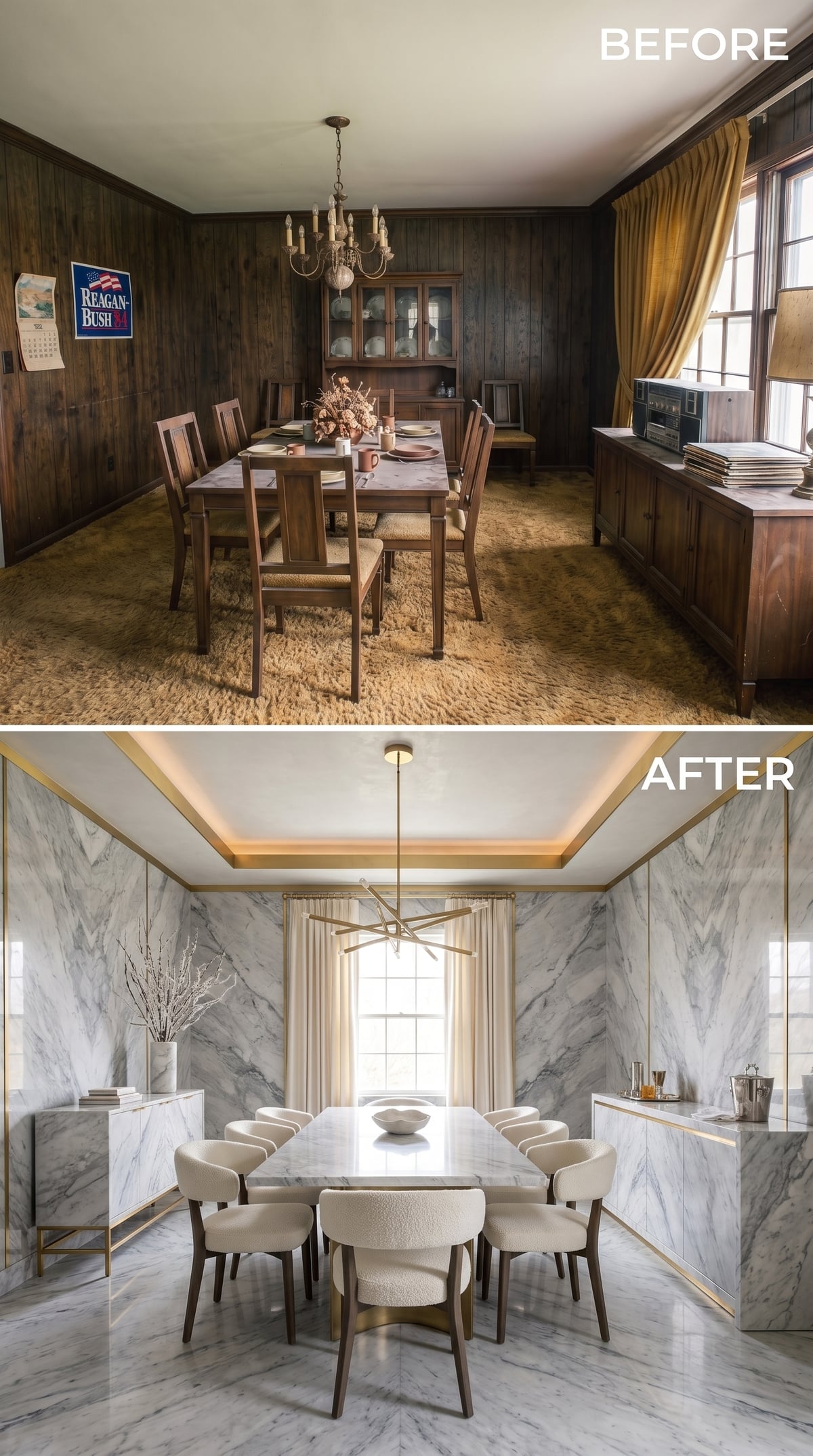
Veined stone covers the walls, a marble-topped table stands at the center, and the sideboard continues the mineral theme. Without some relief, that much patterned surface could swallow the architecture. Warm perimeter lighting around the tray ceiling provides exactly the visual pause the room needs.
Gold trim marks the ceiling boundary, while bouclé chairs add a tactile material that doesn’t repeat the stone. Large-format porcelain with carefully matched veining could produce a related look without covering the room in natural stone.
35. Even the Dining Table Glows in This Backlit Onyx Fantasy
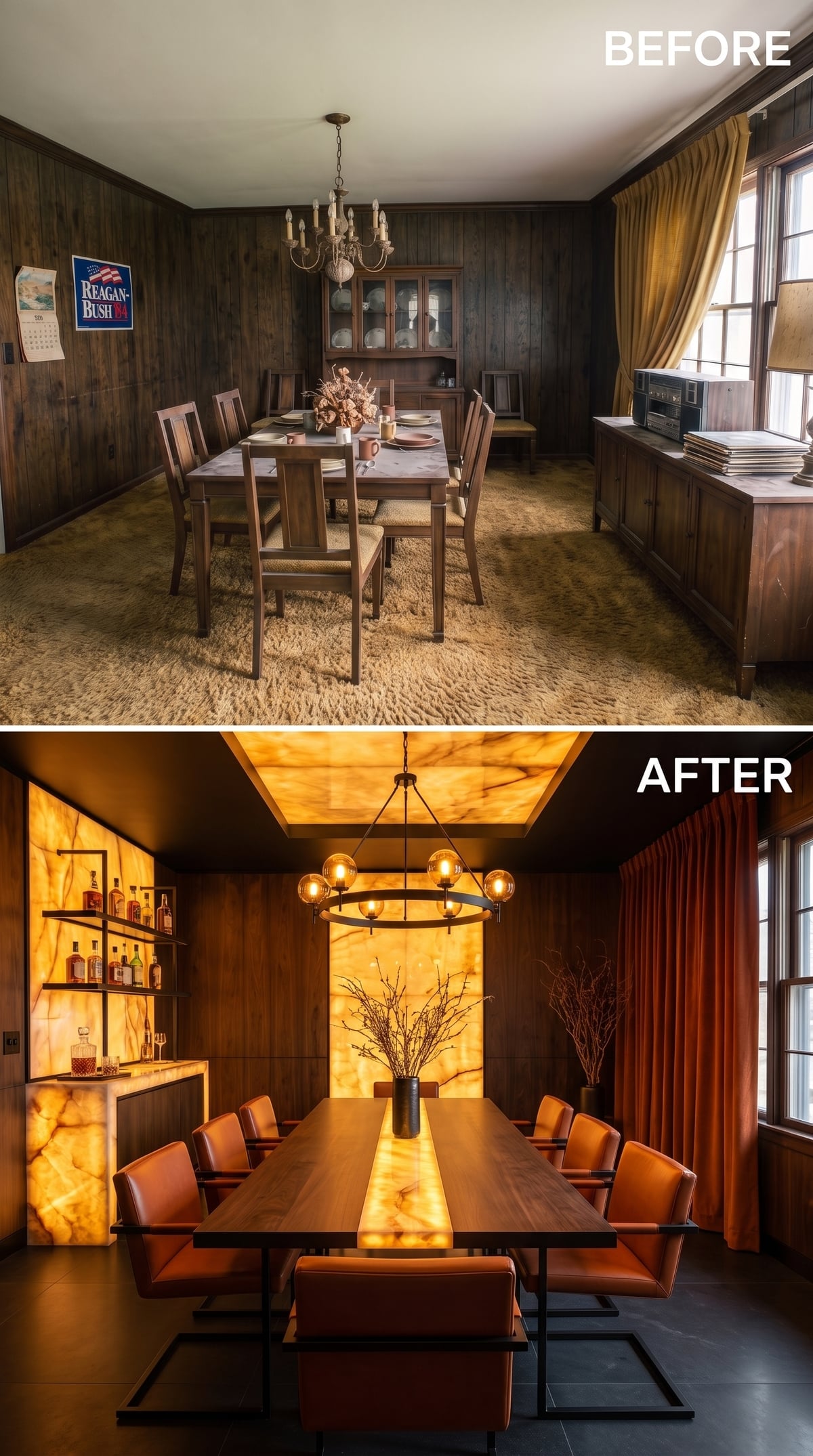
Backlit onyx panels turn one wall into a luminous amber surface. Then the table joins in: an illuminated stone insert runs through the walnut top, turning dinner into part of the lighting scheme. The light isn’t merely above the diners; it’s integrated into the furniture.
Cognac leather chairs on black cantilever frames reinforce the warm, graphic contrast. The ring chandelier and amber globe bulbs offer a more familiar kind of illumination, giving the glowing stone company rather than leaving it to illuminate dinner single-handedly.
34. Blush Lacquer and a Gilded Ceiling Refuse to Be Background
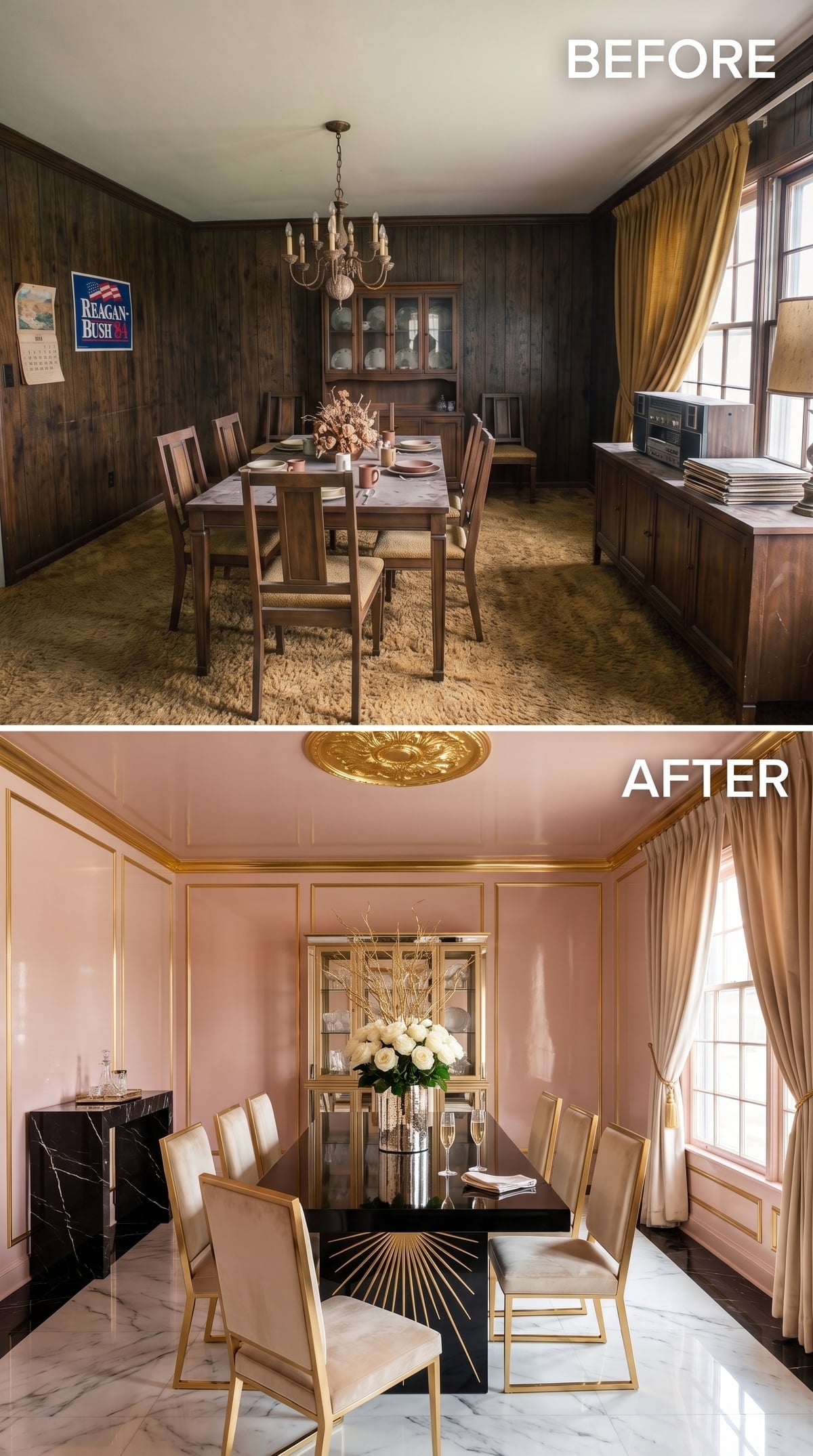
Glossy pink walls framed with gold rectangular molding make the room’s ambition clear long before anyone reaches the table. A gilded ceiling medallion repeats that geometry overhead, while pale marble flooring gives the eye somewhere to rest.
Cream upholstered chairs and a black lacquer table with a gold sunburst create the decisive contrast. If you’re borrowing the look, remember that the preparation matters as much as the paint: high-gloss finishes tend to reveal imperfections that a matte wall can conceal.
33. Dark Walnut Lacquer Turns the Ceiling Into Part of the Chandelier
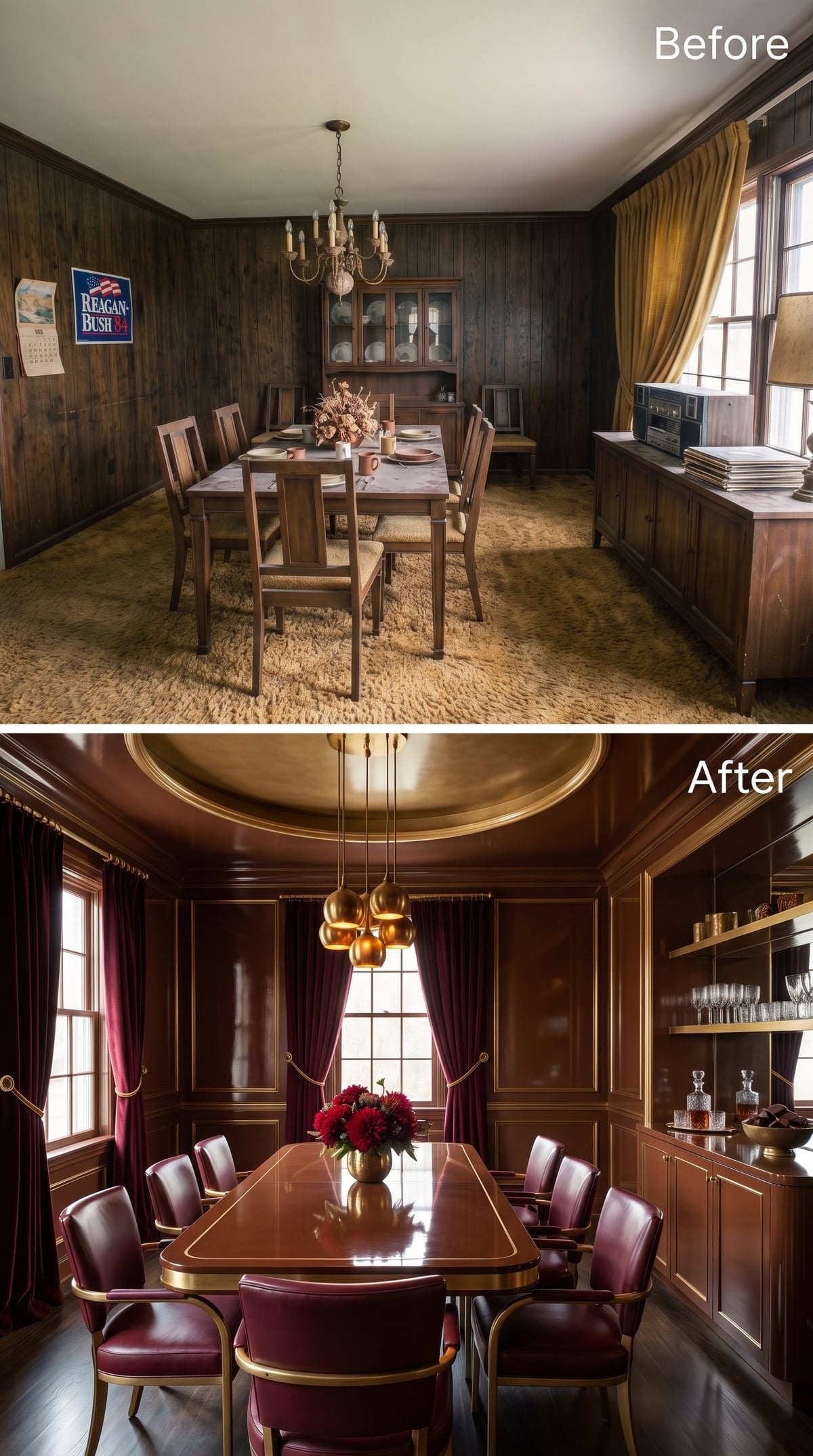
The lacquered walnut walls catch glints from the pendant cluster, but it’s the gilded coffered ceiling detail that completes the lighting composition. Rather than leaving the chandelier isolated in the middle of an anonymous ceiling, the design gives it an architectural setting.
Burgundy leather chairs repeat the warmth without imitating the wall finish, and the table retains a conventional form beneath the overhead extravagance. Open bar shelving makes entertaining practical. This room has kept the old dining room’s formality and given it a considerably more interesting ceiling.
32. A Pale Oak Dining Room Clears the Visual Palate
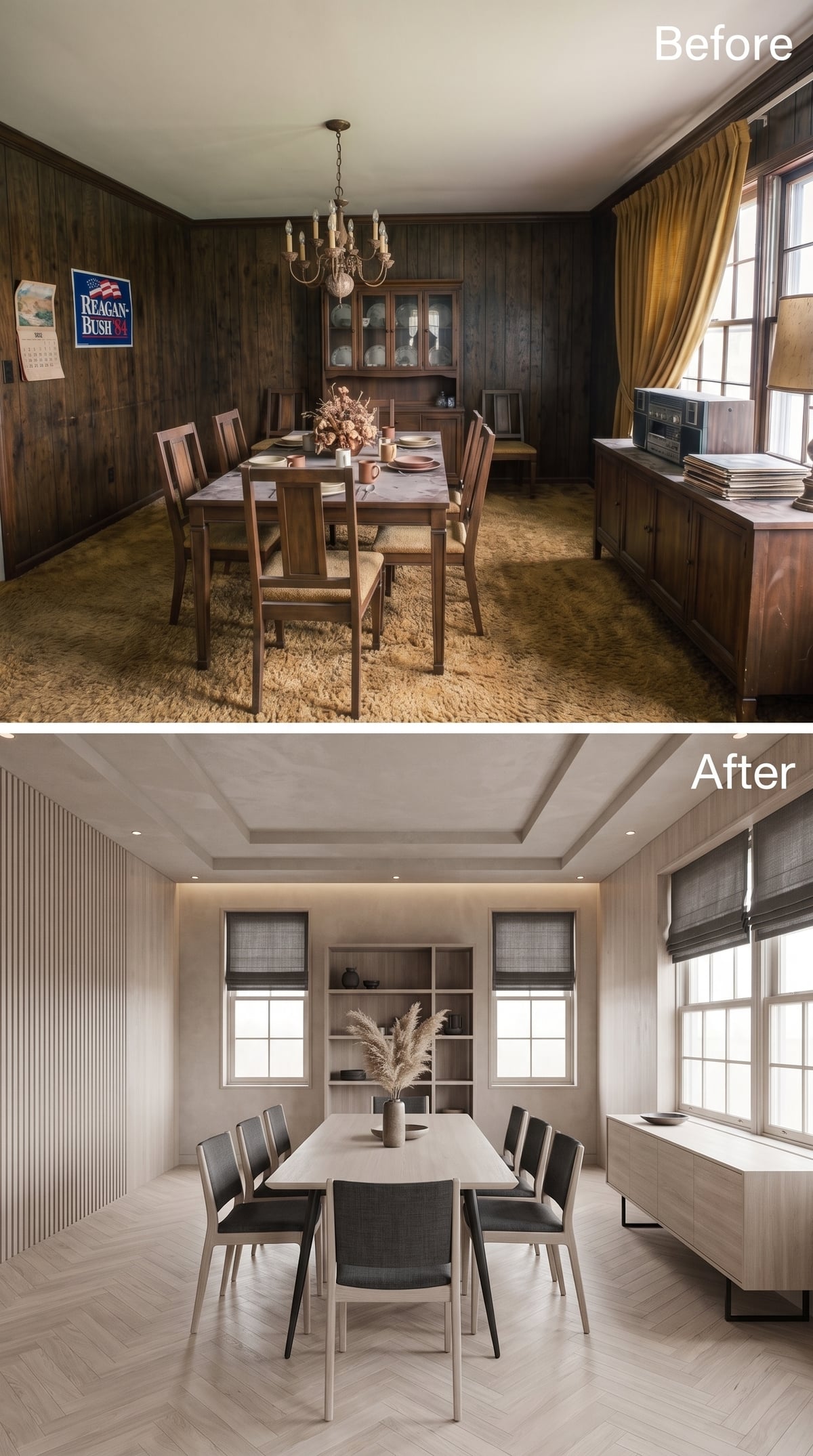
Pale herringbone flooring changes the pace after all those gilded ceilings and lacquered walls. Its precise pattern uses almost no color, and vertical slats on one wall introduce another quiet rhythm. The tray ceiling has concealed lighting rather than a chandelier announcing its presence.
Charcoal upholstered chairs and dark woven Roman shades provide enough contrast to distinguish the table and windows. The crisp floor pattern and subtle ceiling lighting make restraint feel like a genuine design decision, not an absence of ideas.
31. Botanical Wallpaper and a Mirrored Bar Make Dinner an Occasion
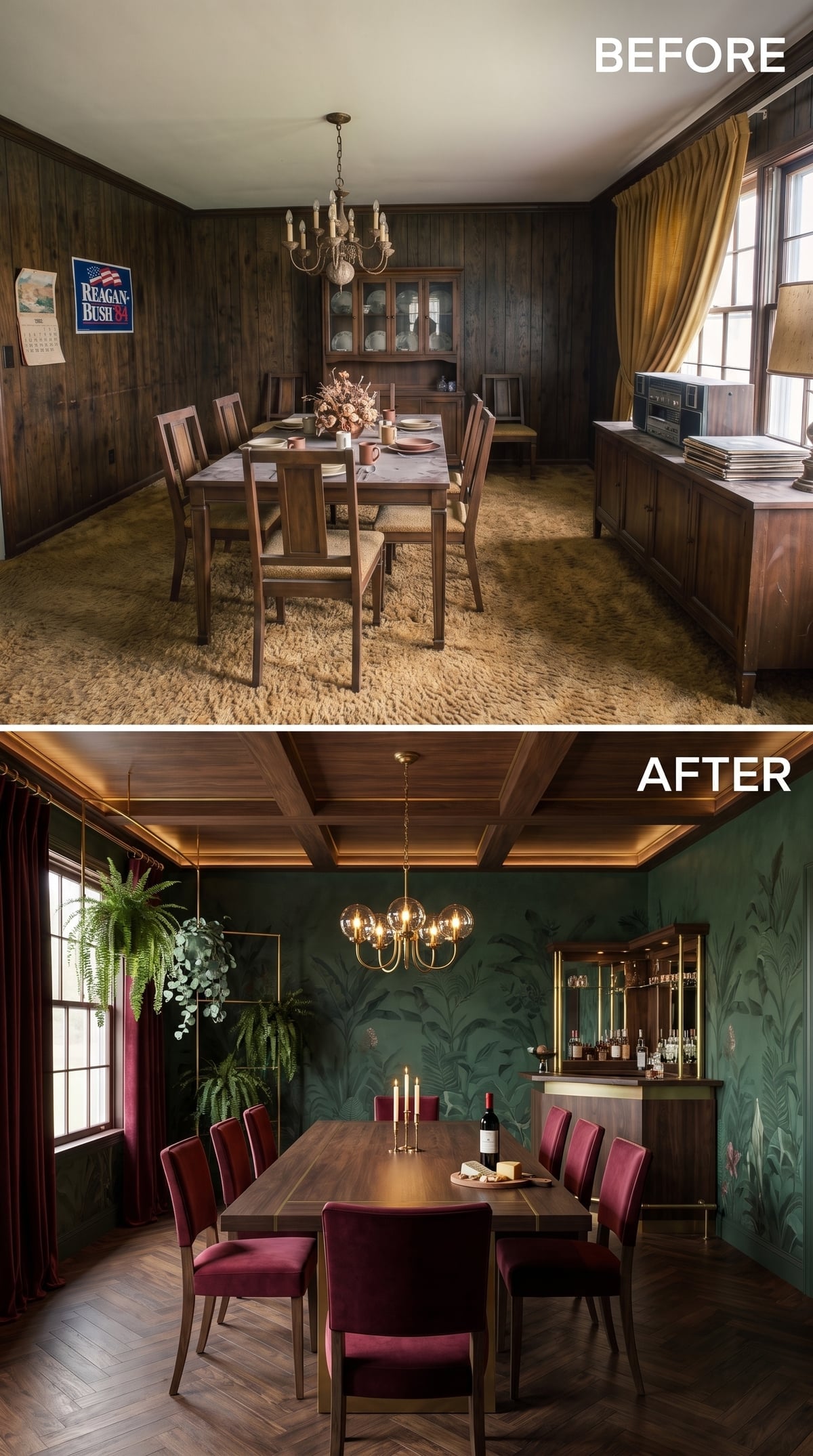
Forest-green botanical wallpaper supplies an enveloping backdrop for crimson velvet chairs and a table edged with brass. A coffered timber ceiling brings the room back to its architectural roots, balancing the intricate wallpaper below.
The built-in bar occupies a corner that might otherwise collect another cabinet. Its mirrored back and interior lighting put the glassware on display without requiring a separate drinks room. Dinner and the first round can finally share an address.
30. White Shiplap and Monumental Windows Let the Daylight In
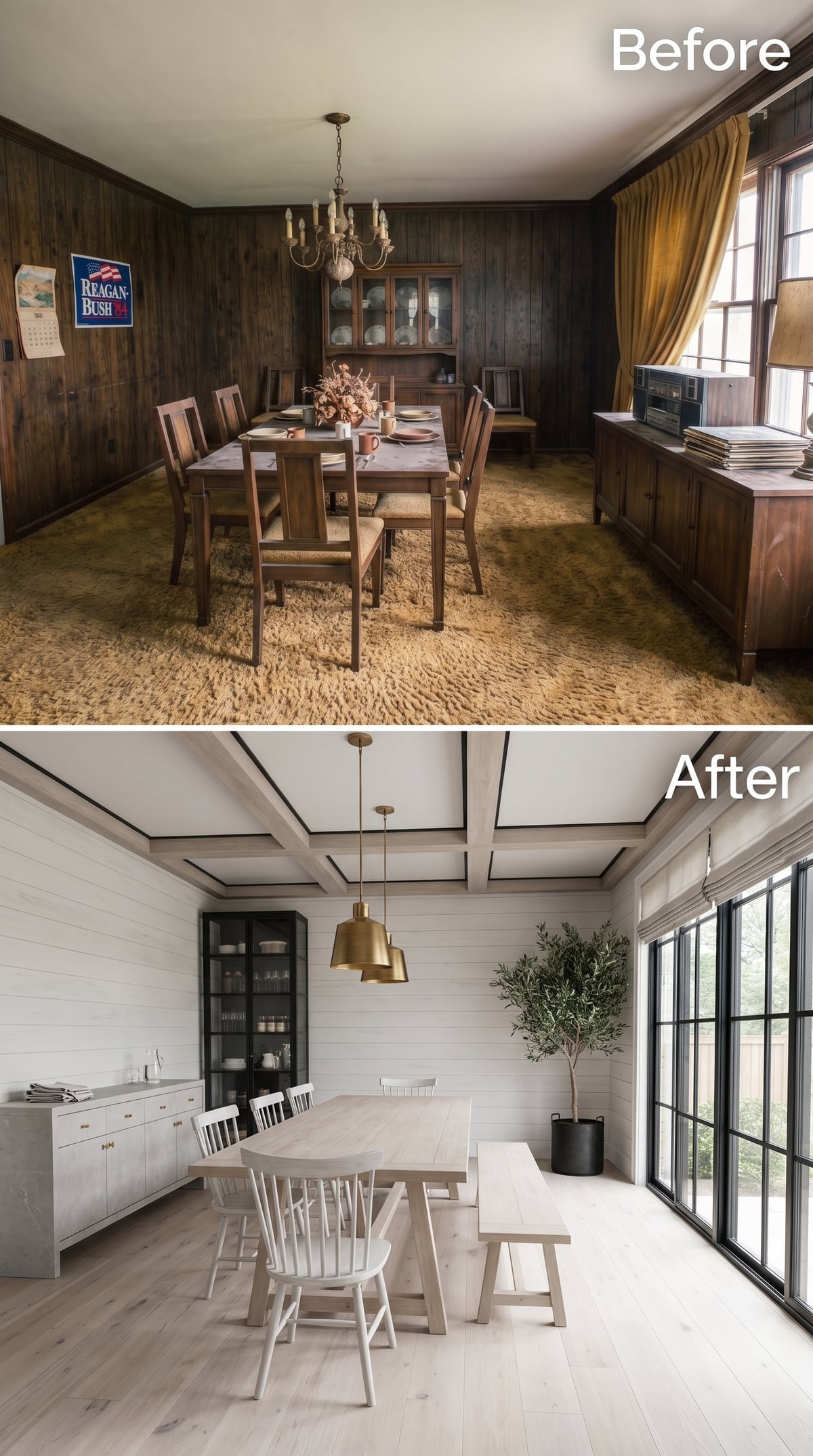
Whitewashed shiplap changes the entire temperature of the room, but the enormous steel-framed windows deserve equal billing. Black outlines in the pale coffered ceiling repeat their geometry, while brass dome pendants add warmth above the oval dining table.
A raw-wood bench opposite white spindle chairs prevents the furniture from looking like a matching dining set bought in a single afternoon. The olive tree and natural light finish the job, leaving the architectural contrast between black metal and pale timber to carry the room.
29. Emerald Lacquer and Cognac Leather Reimagine the Dining-Room Bar
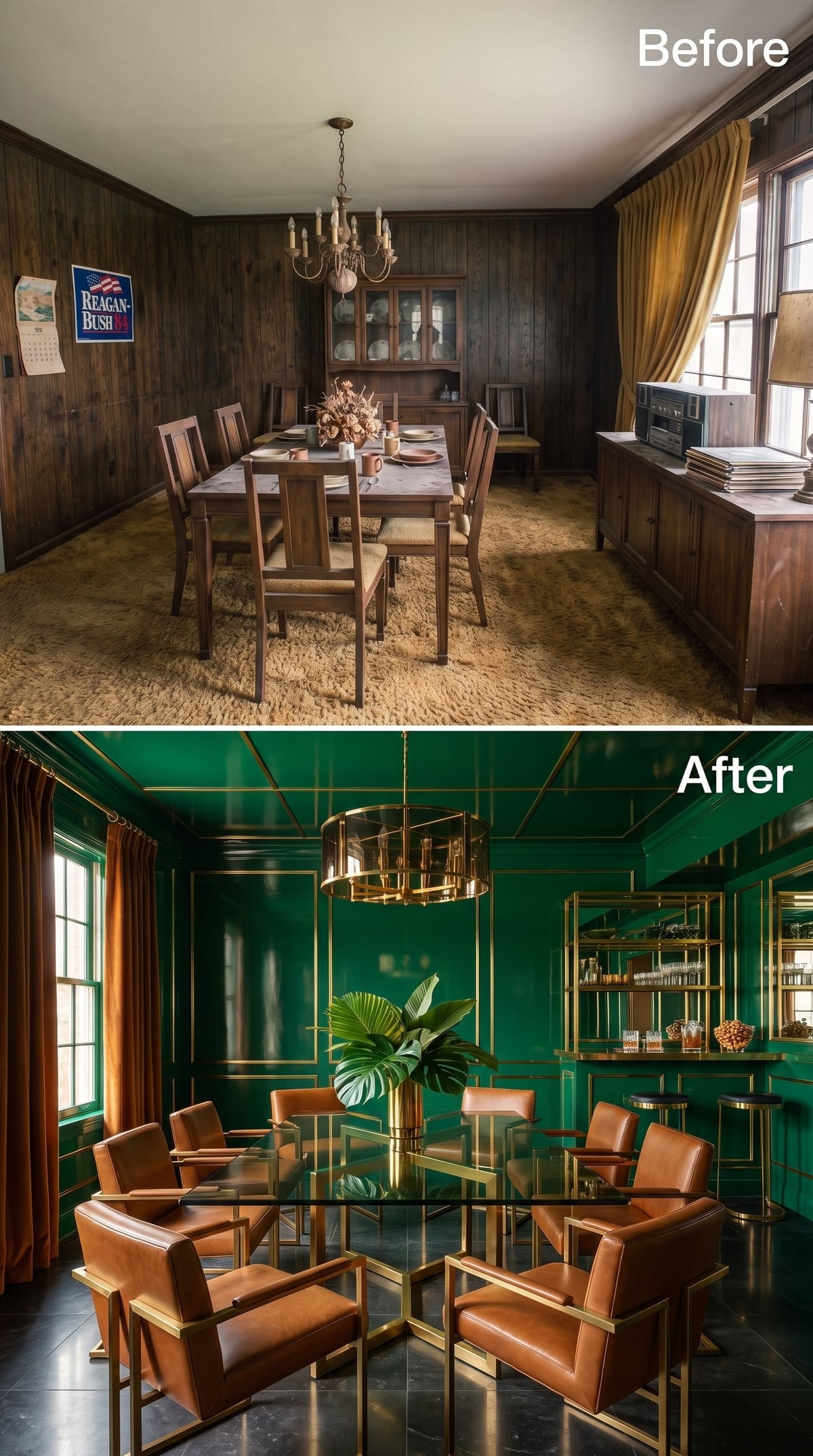
A flush brass grid gives the glossy emerald walls crisp edges, and cognac leather armchairs supply a warmer counterpoint. The glass dining table is deliberately transparent, allowing the brass frame and dark floor to register without crowding the composition.
A drum-shaped brass pendant concentrates light over the table, while open shelving along one wall keeps the barware in plain sight. Unlike the gilded historicism of the opening room, this version relies on crisp geometry and a relatively short list of materials.
28. An Ice-Blue Dining Room Puts Mirrors Where the Ceiling Should Be
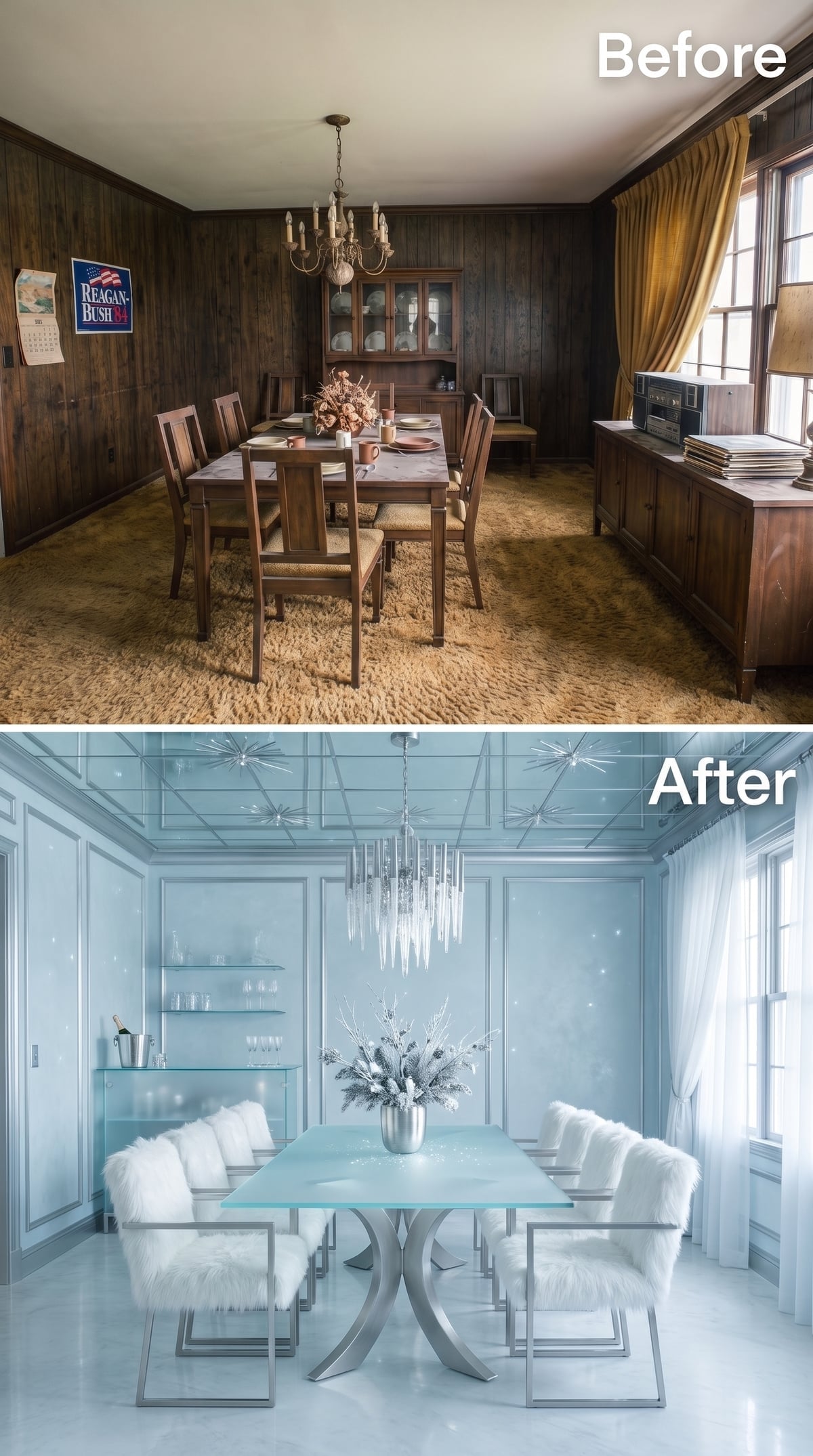
The surprise is overhead: mirrored panels contained within a coffered ceiling grid. Rather than an uninterrupted reflective expanse, the individual panels frame smaller glimpses of the room. The effect becomes architectural, even though the material is pure nightclub temptation.
Frosty walls, sculptural chrome table supports, and white faux-fur chairs keep the color palette cool and consistent. The mirrored panels multiply those shapes without introducing another pattern. If anything here requires restraint, it’s what gets placed on the table beneath all those reflections.
27. Cobalt and Purple: A Dining Room That Won’t Lower Its Voice
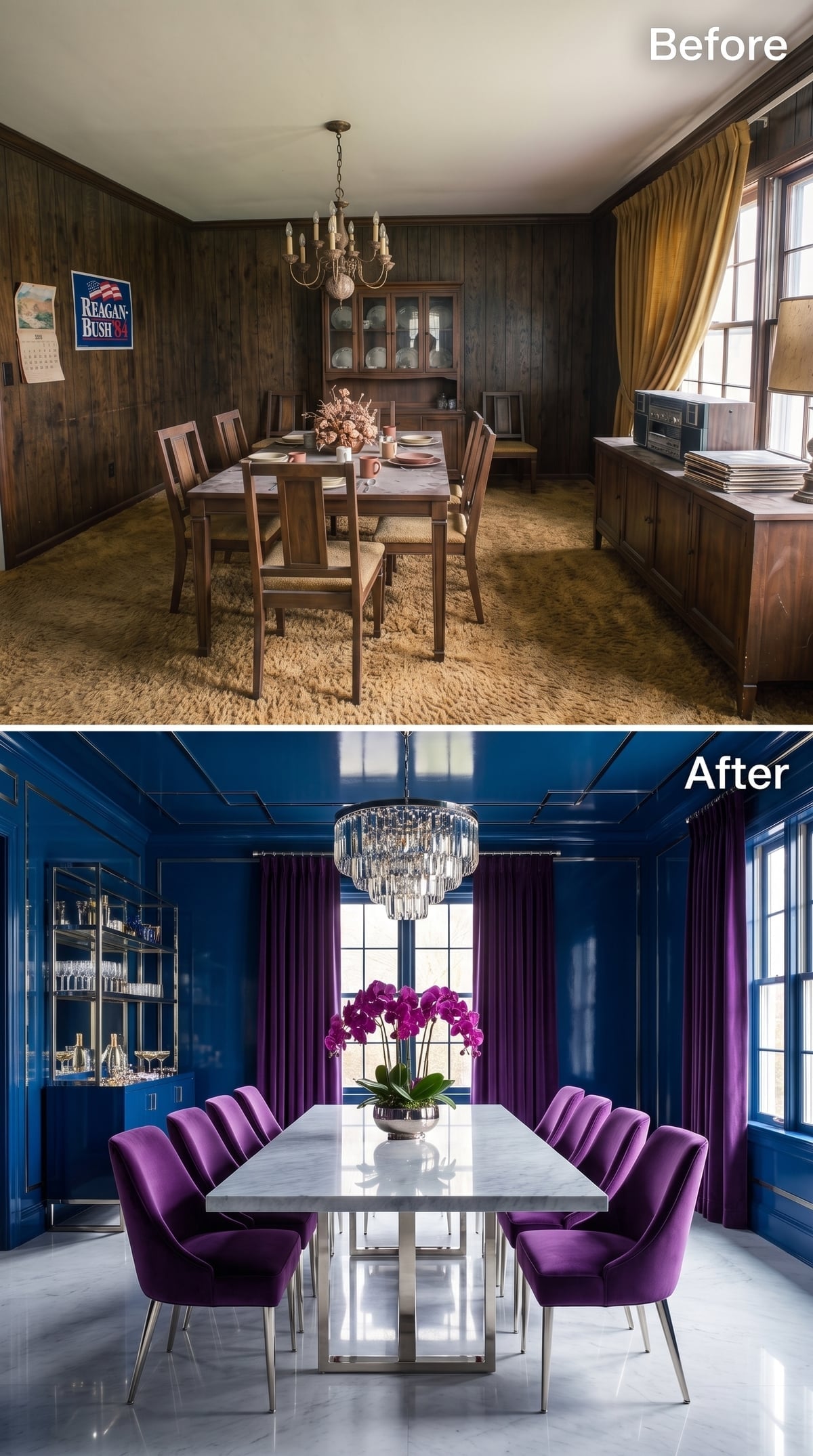
High-gloss cobalt covers both the walls and ceiling, interrupted by gold trim and a chandelier full of sparkling tiers. Purple velvet chairs, plum drapery, and magenta orchids refuse to act as supporting characters. Amazingly, the pale marble tabletop still finds room to register.
The practical lesson isn’t that every room needs this much color. It’s that large areas of one dominant hue can provide a coherent backdrop even when the furniture introduces another saturated family. Sample upholstery under the room’s actual lighting; velvet can change appearance dramatically as its pile catches the light.
26. Adobe Plaster and Live-Edge Oak Bring the Heat Back to the Table
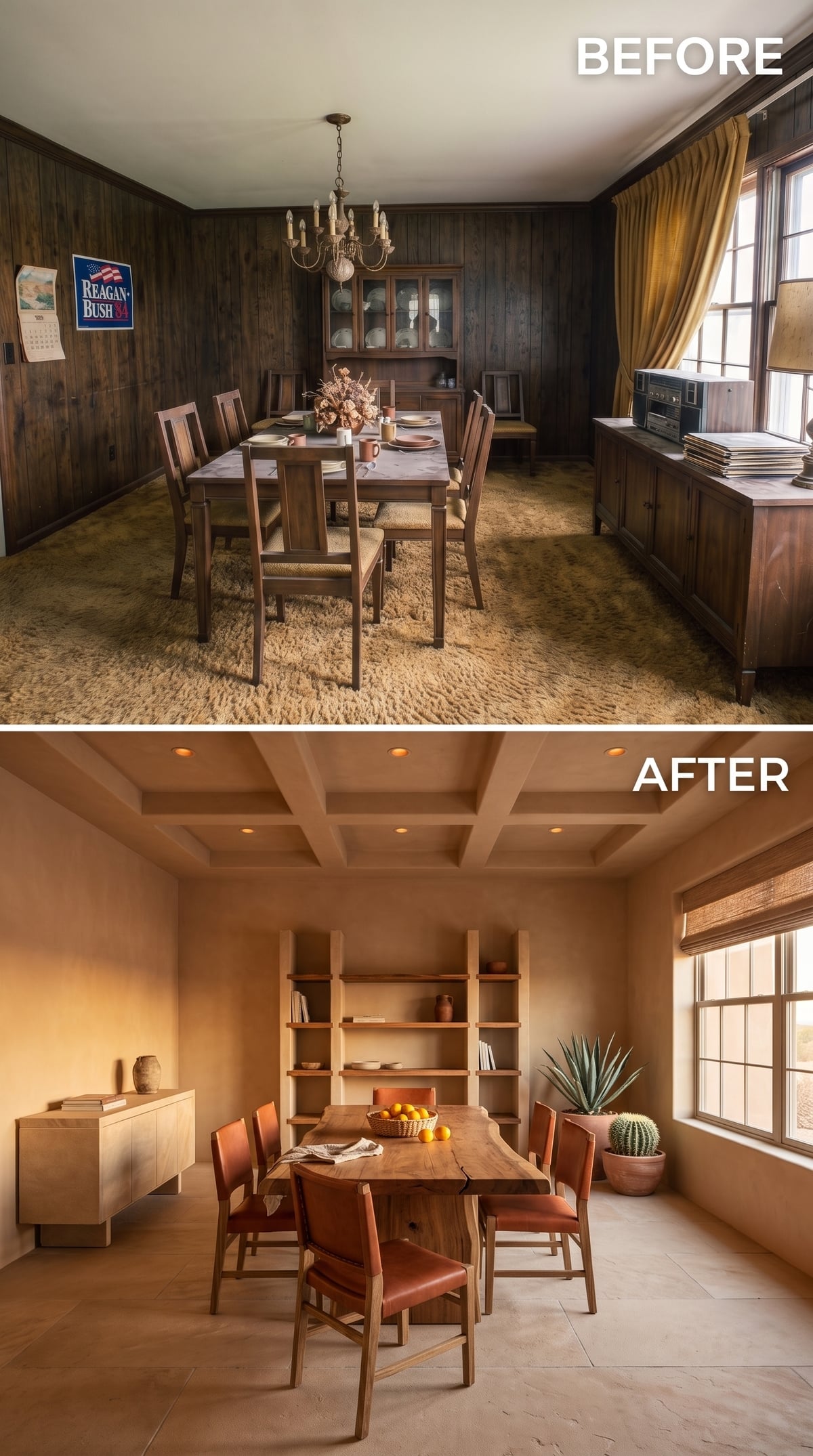
Warm adobe-colored plaster changes the room before any furniture enters. A live-edge oak table adds irregular natural geometry, while terracotta leather chairs echo the walls without disappearing into them. The palette feels sun-warmed rather than artificially golden.
The coffered ceiling is finished in a similar tone to the walls, creating continuity instead of a contrasting overhead ornament. Recessed lighting defines the coffers after dark. Open shelves and a barrel cactus introduce a casual note, as if the old formal dining room has finally discovered it doesn’t need to dress for every meal.
25. Dark Botanical Wallpaper Meets a Sputnik Chandelier
🔥 Would you like to save this?
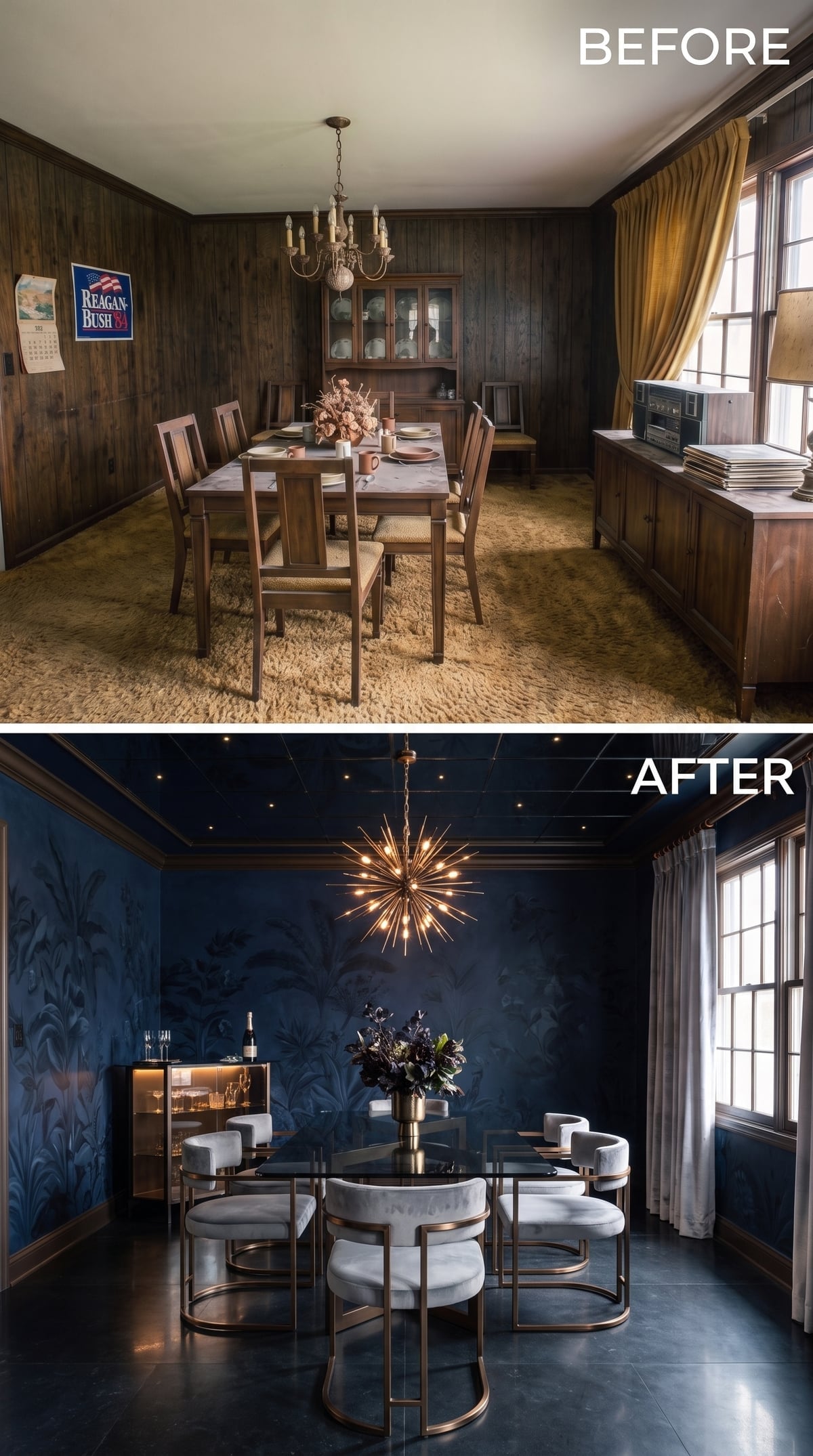
In this version the botanical pattern nearly disappears into navy darkness until the brass Sputnik chandelier lights up its metallic branches. It’s an amusing collision: traditional, densely patterned walls under a fixture with distinctly midcentury ambitions.
A glass-topped round table reflects the chandelier, effectively giving it a second appearance. Pale velvet chairs on curved brass frames provide contrast at table height. The wallpaper’s pattern also brings variation to the dark walls, though the room’s apparent size will ultimately depend on its lighting and proportions.
24. Forget the Walls. This Dining Room’s Plaster Ceiling Has Stolen the Show
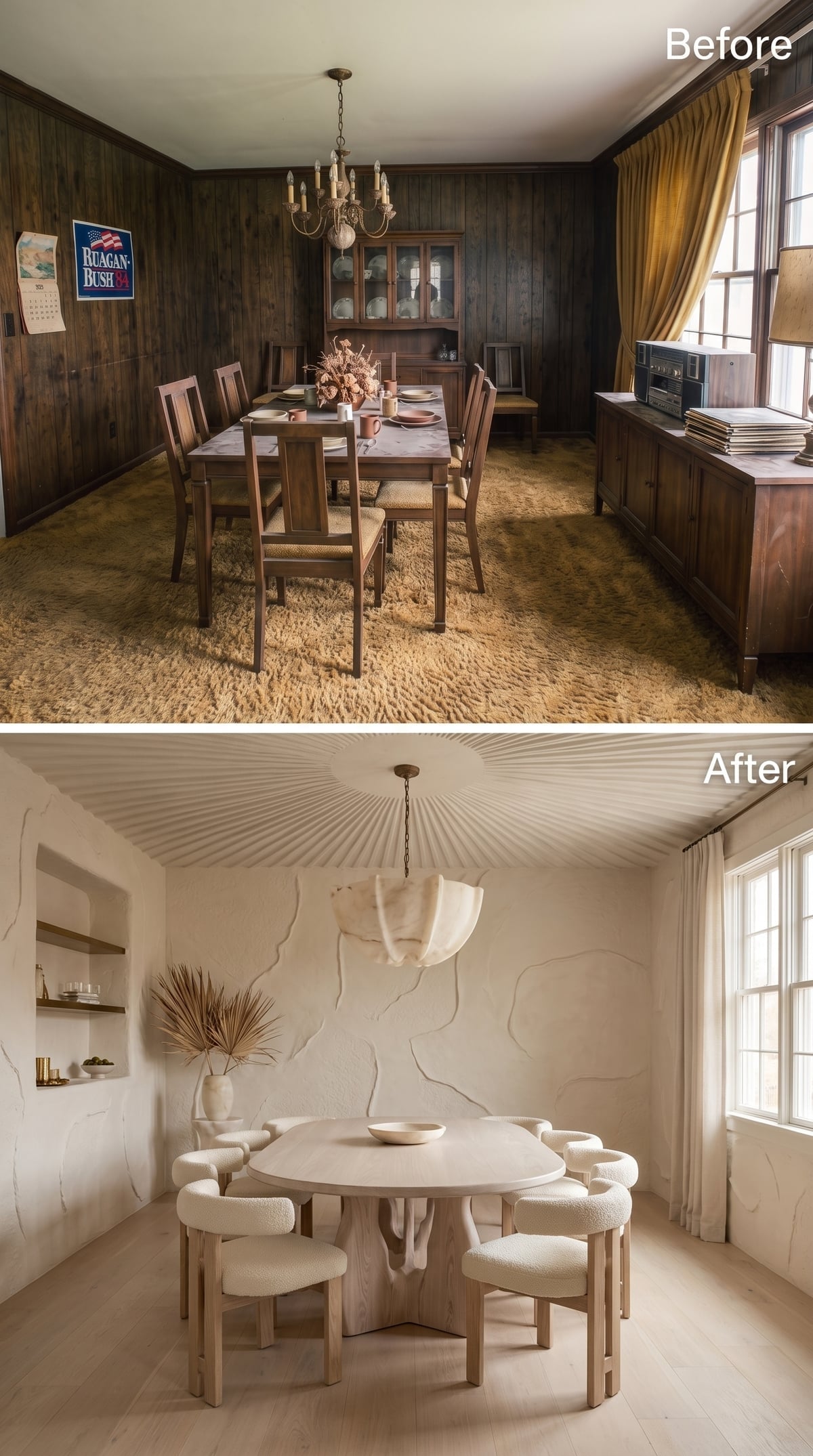
Ribs of plaster radiate from the ceiling’s center like an enormous frozen sunburst. It’s the sort of architectural intervention that changes where you look first: upward, not toward the table, window, or former paneled walls. The dining furniture wisely declines to start a competing performance.
A round, travertine-look table and cream bouclé barrel chairs echo the ceiling’s curves. A built-in niche provides open display space without introducing a large freestanding cabinet, and sheer curtains keep the room bright enough for those plaster details to register.
23. Navy Lacquer, Chrome, and the China Hutch Reconsidered
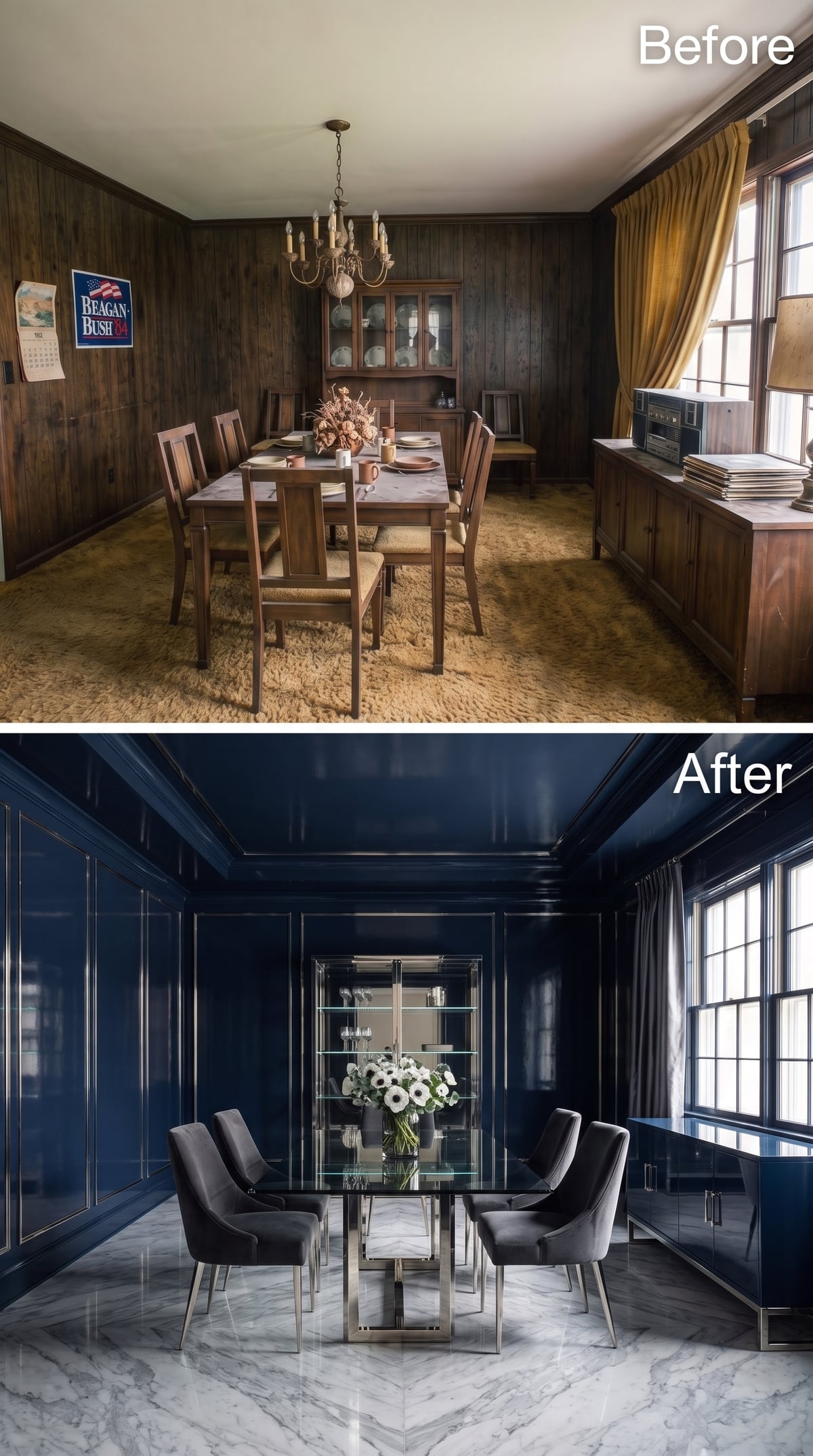
Glossy navy covers the walls, ceiling, and fitted millwork, creating a dark continuous background for chrome and glass. The table’s reflective frame is visually light; charcoal velvet chairs supply solid shapes beneath the precise cabinetry.
White-and-gray marble flooring breaks up the deep blue, but the cleverest reference to the original room is the glass display cabinet. It occupies the role of the old china hutch without inheriting its visual weight. Familiar function, entirely different manners.
22. Gray-Washed Oak Proves Architectural Detail Doesn’t Need to Shout
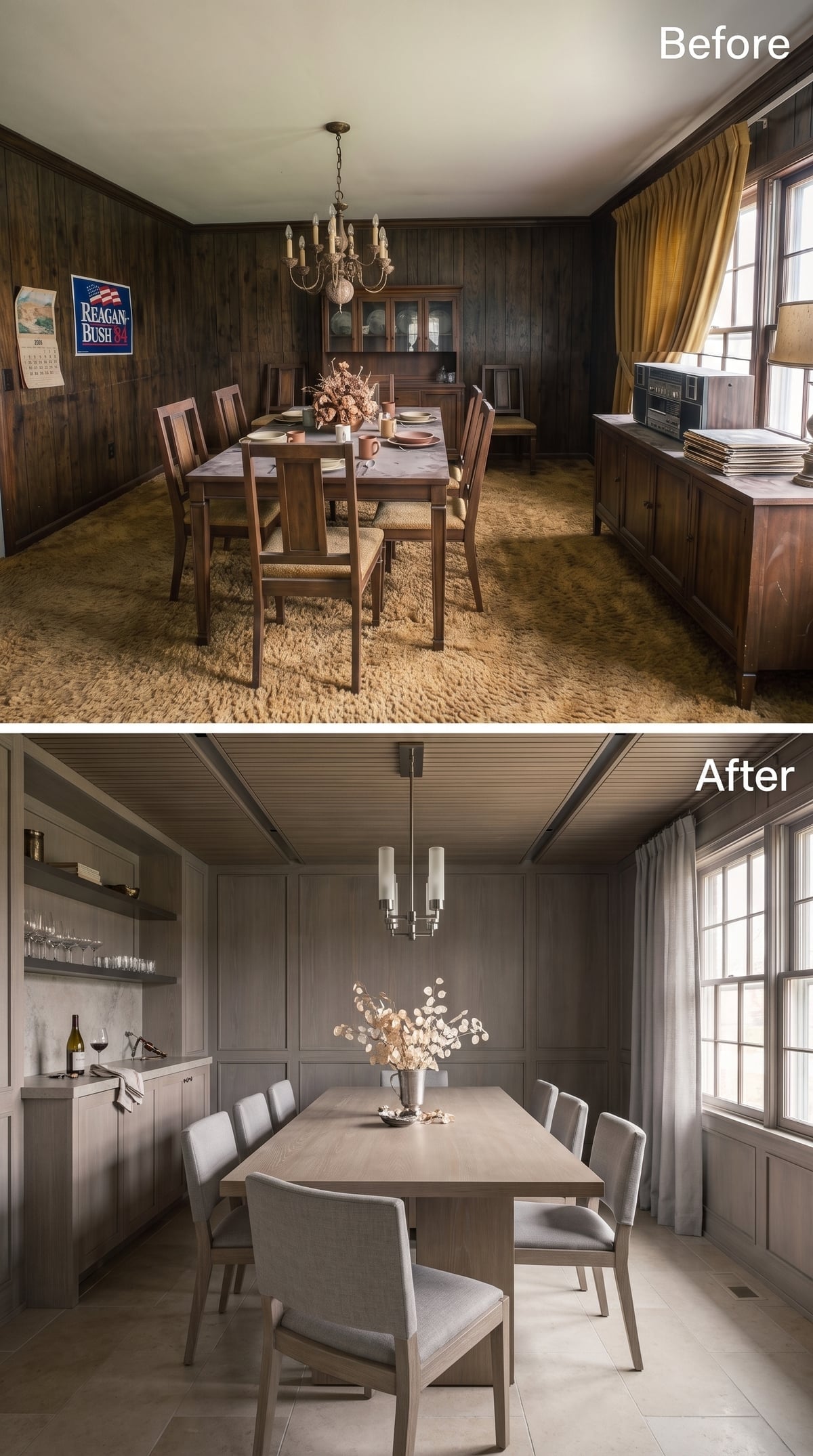
Gray-washed oak cabinetry and a matching table make this a study in restrained repetition. Applied panel molding establishes a disciplined grid across the walls and ceiling, replacing the original room’s heavy vertical rhythm with something more measured.
Greige upholstered chairs leave the woodwork undisturbed, and a chrome fixture with frosted cylindrical shades offers a crisp finish above the table. Continuing the molding overhead makes the ceiling feel considered without requiring another imposing chandelier.
21. Hunter Green and Gilded Boiserie Take the Formal Route
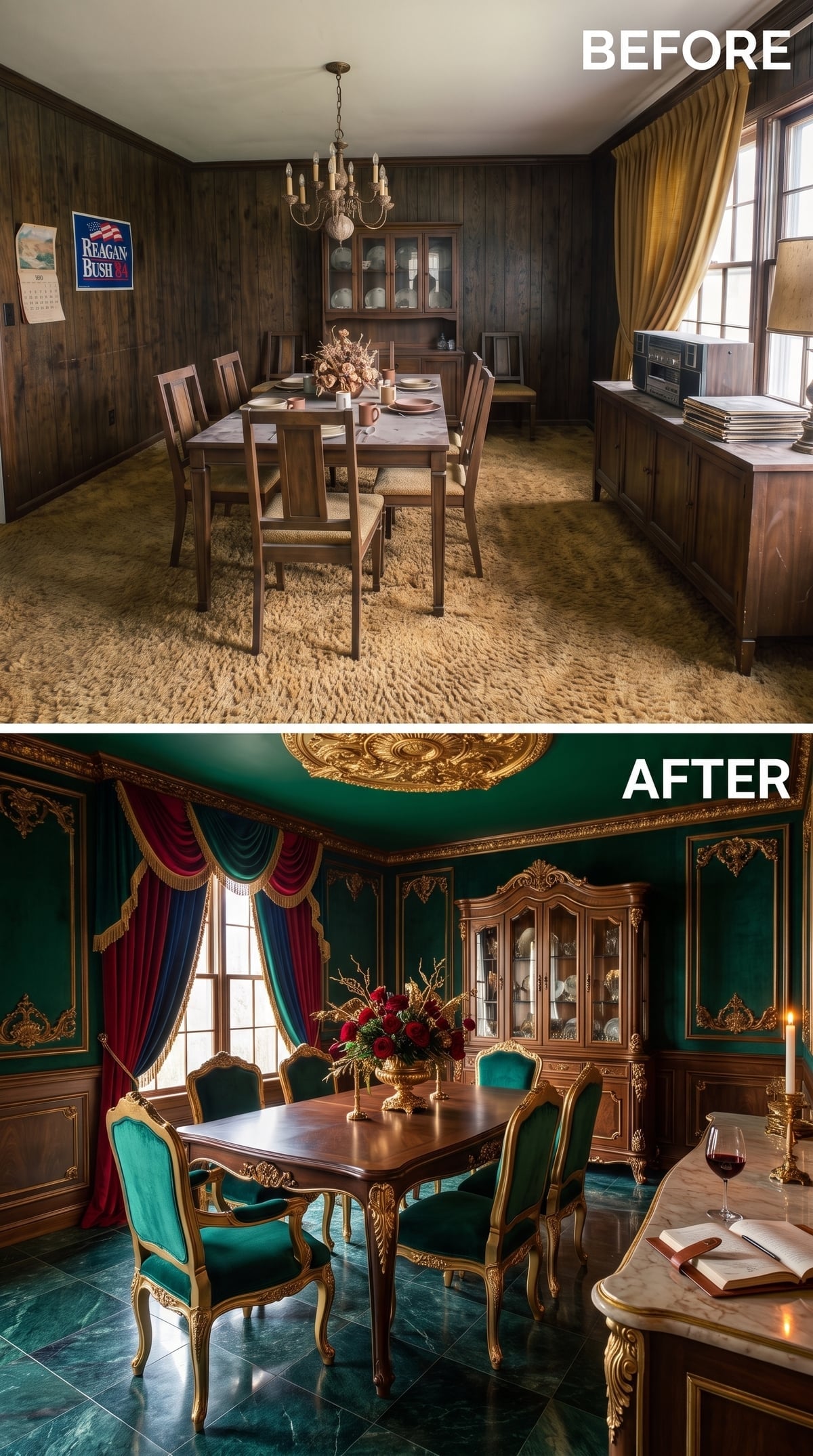
Nothing in this version is interested in understatement. Gilt decorative wall panels frame deep hunter green, ornate chairs wear teal velvet, and a gilded ceiling medallion repeats the metallic detailing above the table. Even the elaborate window treatment has been invited to the party.
The green-and-gold palette runs from wall paneling to furniture and ceiling ornament, giving all that extravagance a coherent decorative language. It is a historically inspired fantasy rather than an example of period restoration.
20. A Copper Lantern Gives Sage Green a Surprisingly Sociable Side
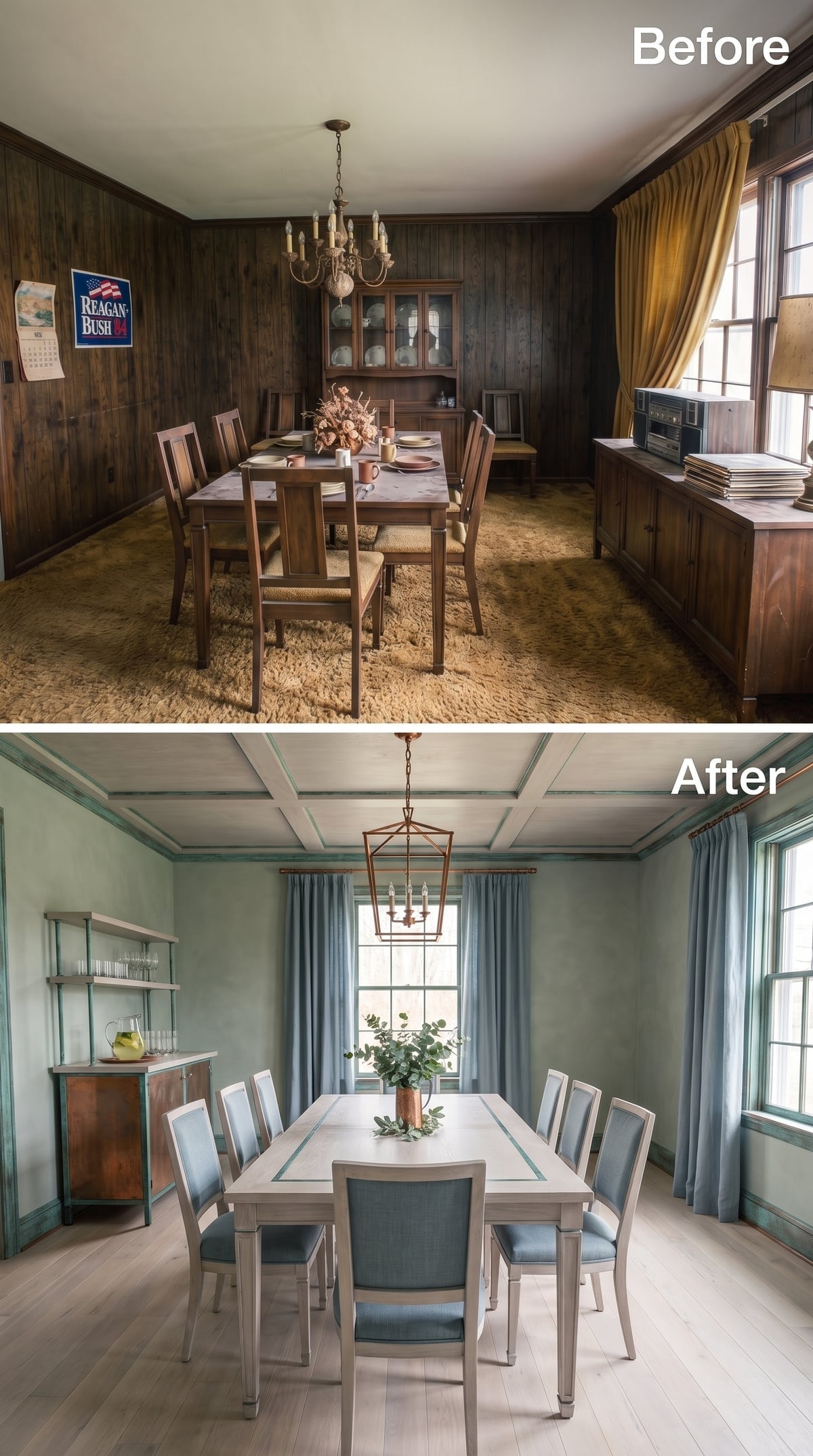
Sage plaster and teal-edged ceiling coffers establish a quieter architectural framework, but the copper lantern above the table supplies the character. Its angular silhouette stands against the softer blue linen of the dining chairs and draperies without turning the room into a showroom of coordinated accessories.
A whitewashed table and pale oak flooring prevent the green from becoming too enveloping. The open shelving keeps glassware within reach, making this a particularly practical interpretation for a room that needs to accommodate both dinner and the preparations beforehand.
19. Charcoal Walls Make a White Table the Main Event
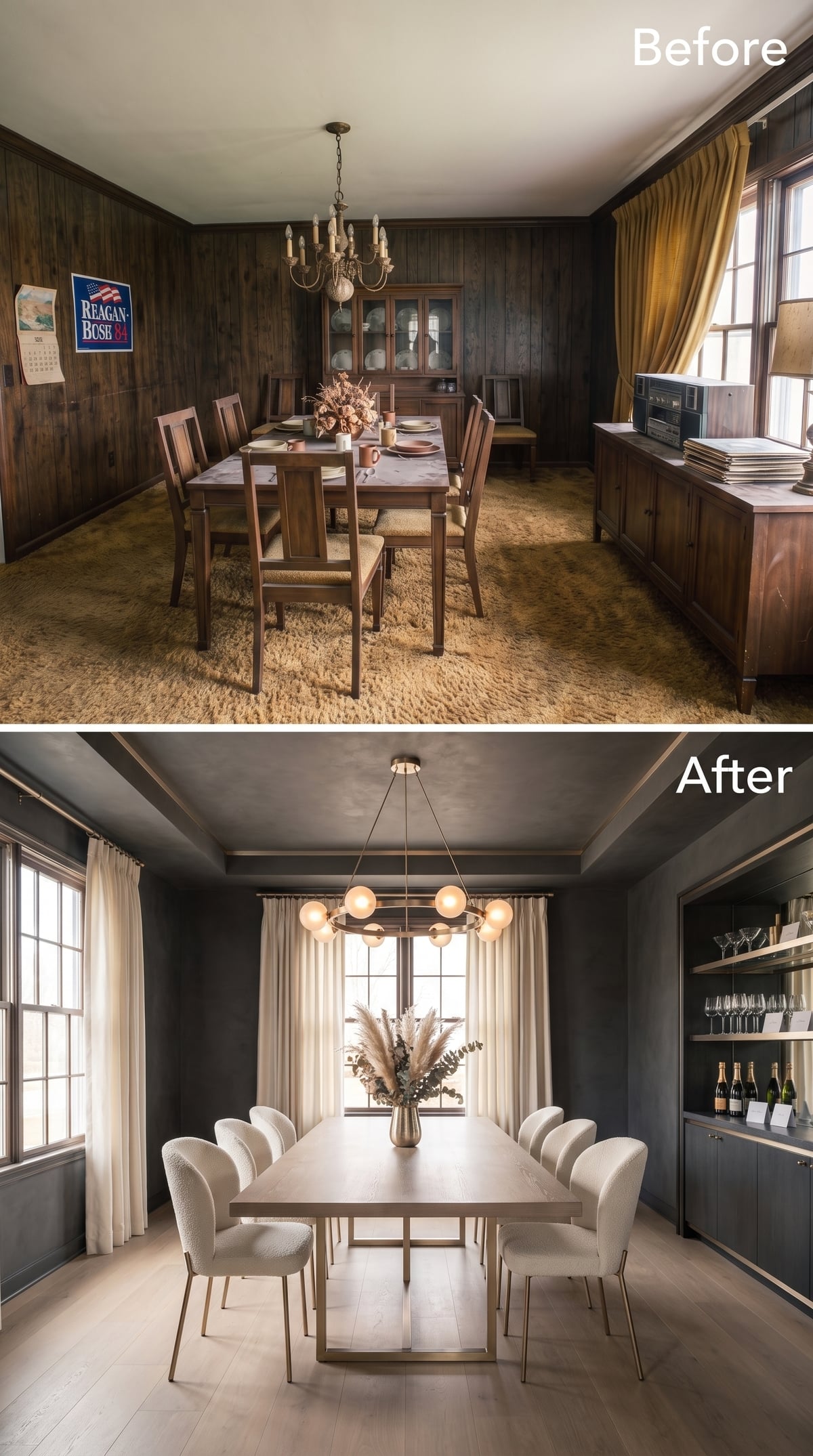
Charcoal plaster covers the walls and ceiling, but the pale, elongated dining table interrupts the darkness in one clean gesture. Cream bouclé chairs with brass legs repeat that contrast at seating height, while the ring chandelier delivers a warm halo overhead.
The recessed bar shelving along one side makes the room useful beyond scheduled dinners. Textured upholstery adds warmth, though bouclé’s suitability for dining chairs depends on fiber, weave, cleanability, and the individual fabric’s snag resistance—not on its popularity alone.
18. Mondrian Comes to Dinner: Red Beams, Primary Colors, Zero Apologies
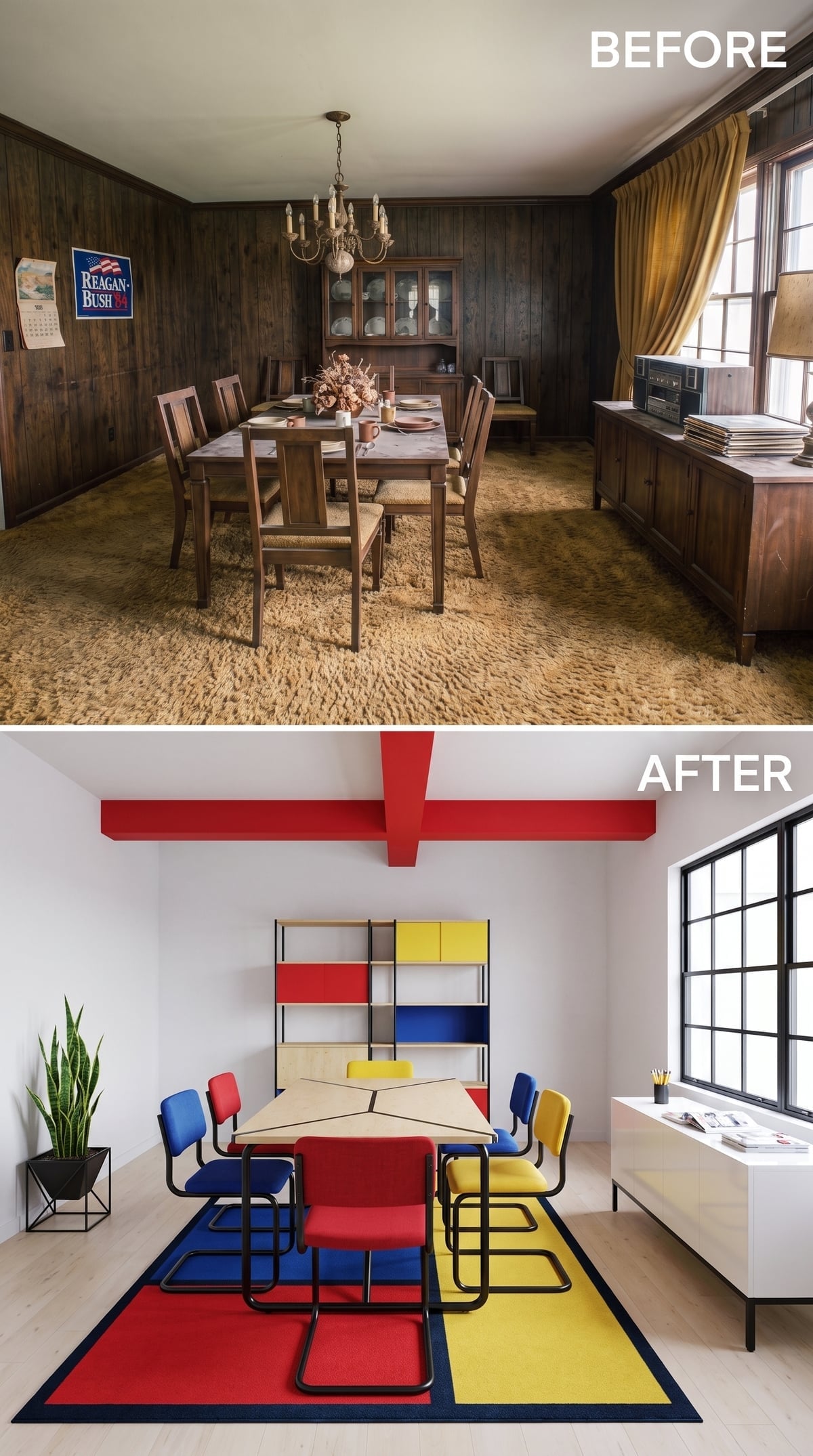
Red-painted ceiling beams draw a strict grid overhead. Below, white walls and pale floors become the canvas for cantilever chairs in red, yellow, and cobalt blue. The rug repeats that hard-edged primary palette with such enthusiasm that Piet Mondrian would recognize the reference immediately.
A colorful shelving unit continues the geometry behind the pale timber table. The black planter and snake plant introduce the only conspicuously organic line. This is a terrific answer to the question of what happens when a former wood-paneled room stops taking itself quite so seriously.
17. The Wood Paneling Moves Overhead in This Forest-Green Room
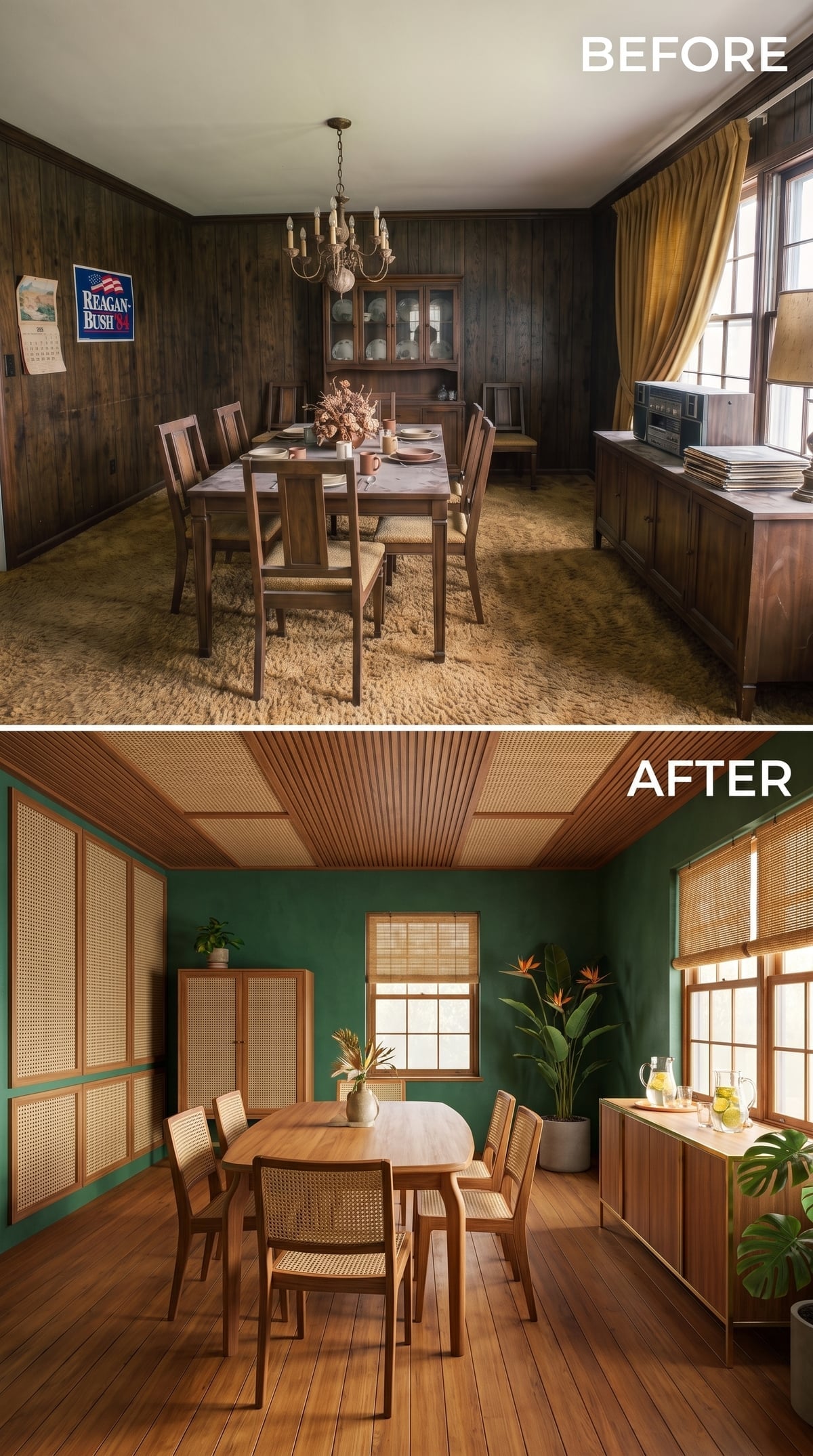
What survives of the room’s affection for timber has moved overhead. Linear wood slats give the ceiling a strong direction, while forest green walls and honey-toned floors create an earthy setting below. The result is richer than the original wall-to-wall paneling without repeating its visual weight.
Cane-backed chairs, an oval pale-wood table, and bamboo shades introduce three distinct woven and grained textures. A cane-front cabinet continues the idea at the perimeter, leaving the central floor open for the dining set rather than yet another imposing hutch.
16. Pink Terrazzo Takes Over, but the Lighting Knows When to Stop
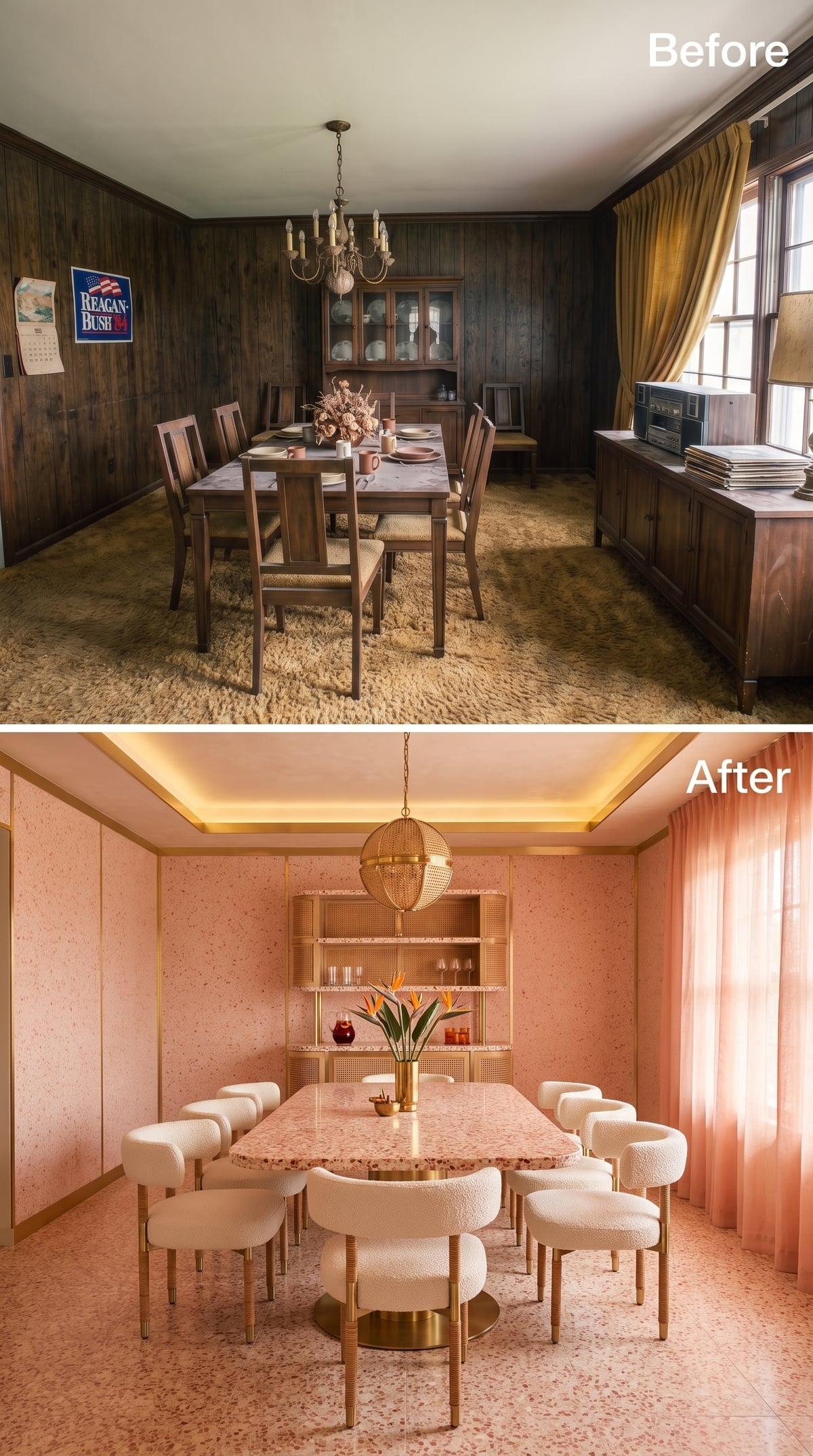
The terrazzo floor and oval tabletop share the same blush-speckled treatment. That’s a substantial commitment to one material, especially with rounded white bouclé chairs completing the soft-edged composition. Brass legs offer just enough contrast to keep the pink from dissolving into a single uninterrupted wash.
Cove lighting concealed around the tray ceiling gives the room its nighttime personality. Instead of another decorative layer at eye level, the light traces the architecture and lets the terrazzo do what it came here to do: be noticed.
15. Copper Pipes Draw the Lines in This Concrete Dining Room
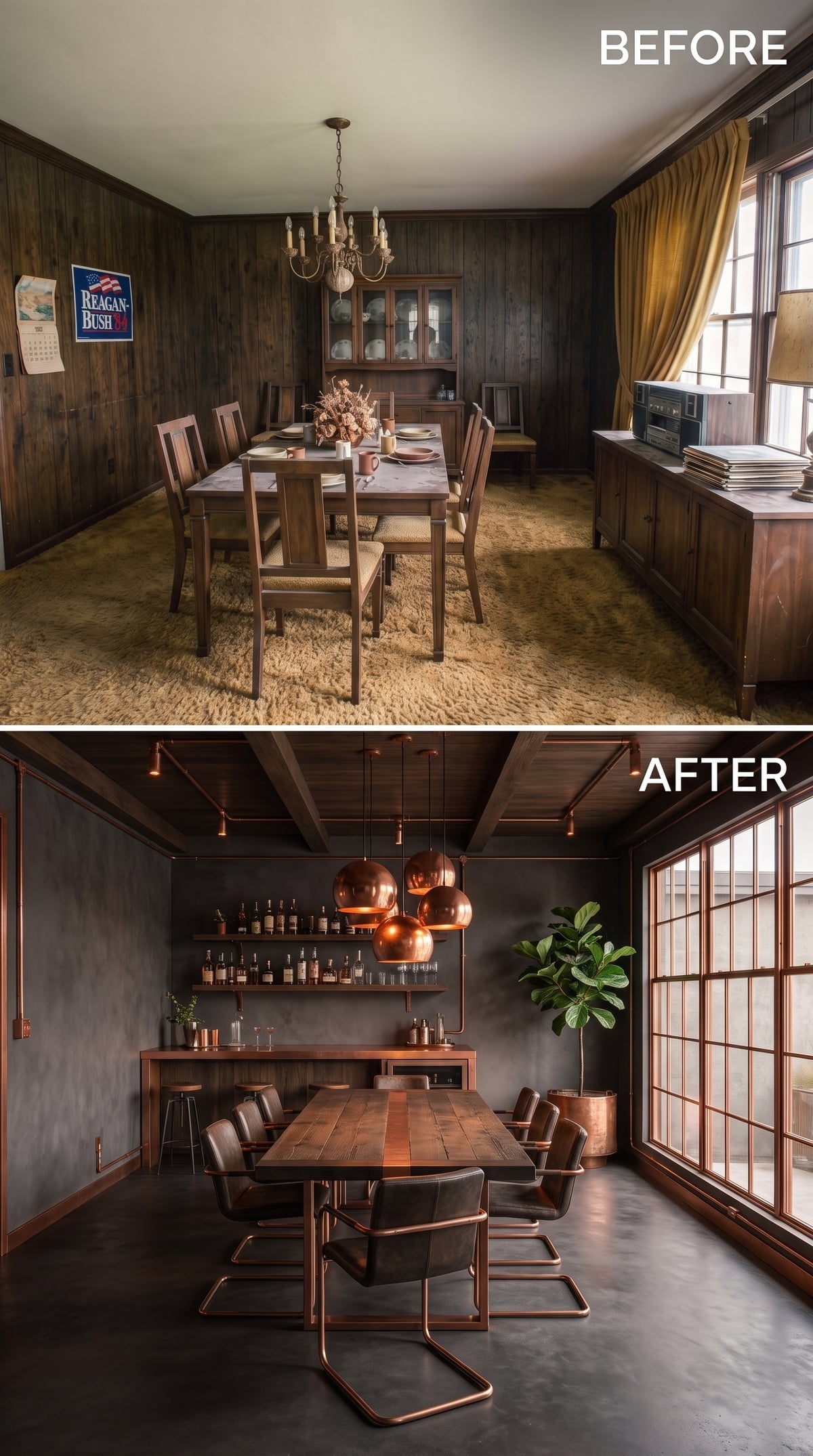
Exposed copper-colored pipework follows the ceiling and wall edges, giving the dark plaster interior its defining lines. Pendant globes echo the warm metal, while reclaimed timber at dining height prevents the room from feeling like an industrial equipment catalog.
The copper-framed cantilever chairs reinforce those outlines, and concrete underfoot completes the harder material palette. Some copper finishes will develop patina while protected surfaces stay brighter. The point here is consistency: the pipework and furniture echo one another until the exposed services look deliberate.
14. A Single Blue Sideboard Changes a Quiet Wood-and-Stone Room
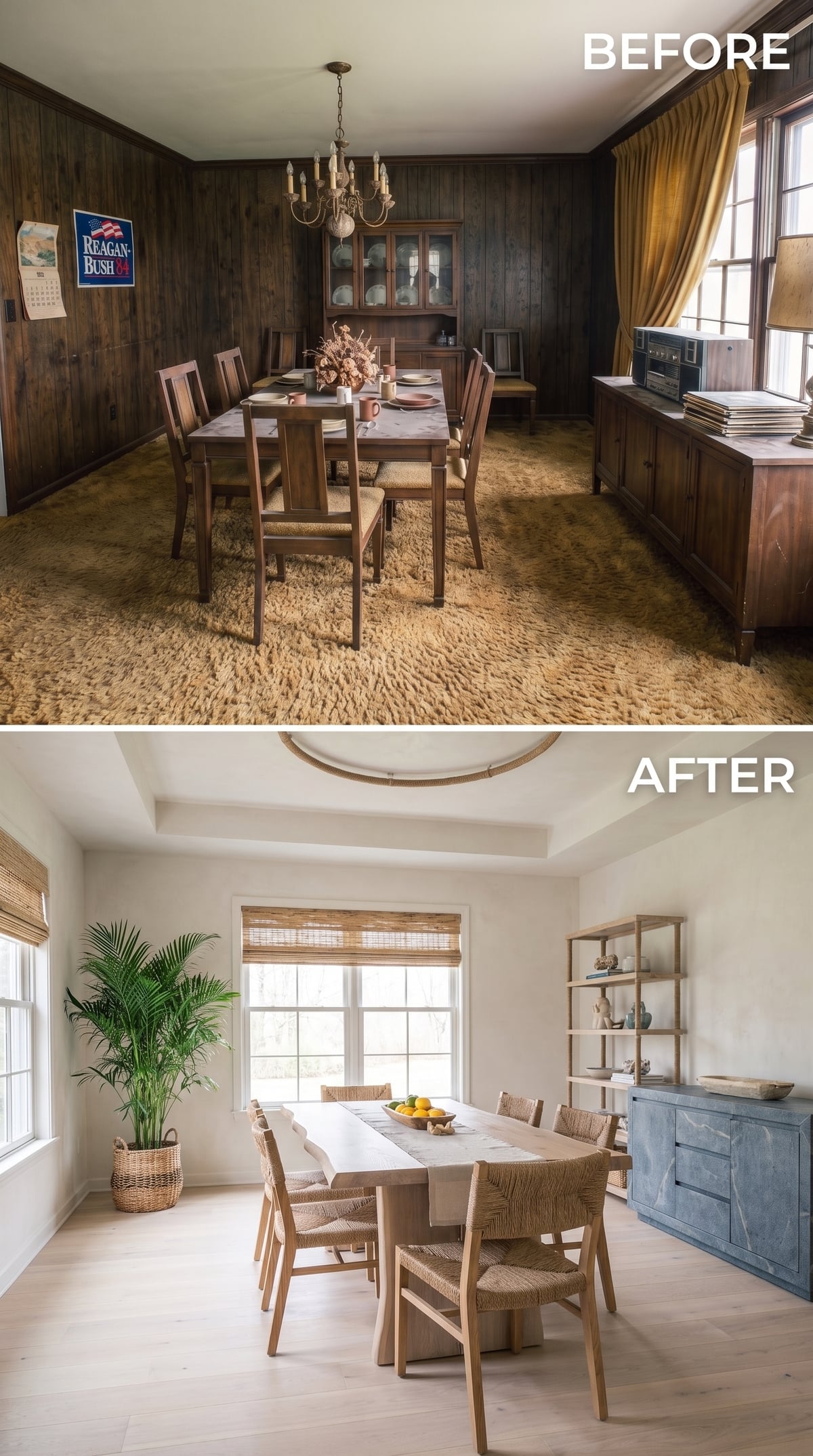
Bleached oak floors, woven rush-style seating, and a pale stone-topped table could easily become a wall of pleasant neutrals. The blue-gray sideboard prevents that, introducing one concentrated patch of color where the old china hutch might once have stood.
The tactile contrast matters just as much: woven seats against smooth stone, pale floors against a colored cabinet. Natural rush, paper cord, and other woven seating materials have different care and durability characteristics, so the practical choice depends on the particular chair rather than the look alone.
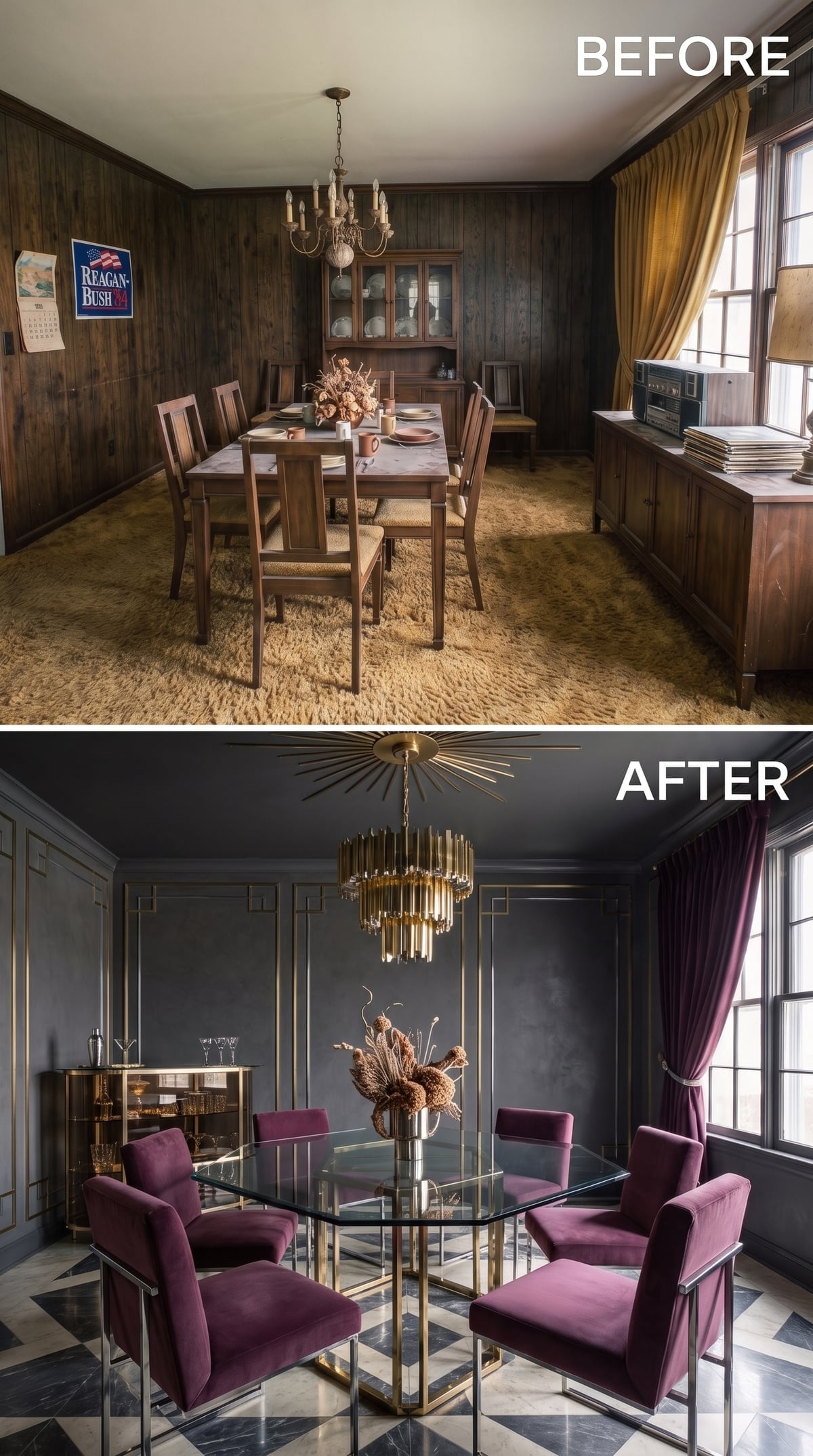
13. A Harlequin Marble Floor Gives Plum Velvet Some Competition
🔥 Would you like to save this?
Charcoal walls with gold geometric trim might suggest another jewel-box dining room, but the harlequin marble floor changes the terms. Its sharp black-and-white pattern brings graphic energy to a scheme otherwise dominated by plush fabrics and metallic ornament.
A glass table on a brass frame keeps the center relatively transparent, letting the floor remain visible. Plum chairs and burgundy curtains provide the softer contrast. The wall trim borrows from the idea of boiserie; unlike traditional carved wood paneling, this streamlined effect can also be interpreted through applied molding.
12. Pink Marble and Transparent Chairs Pull Off a Balancing Act
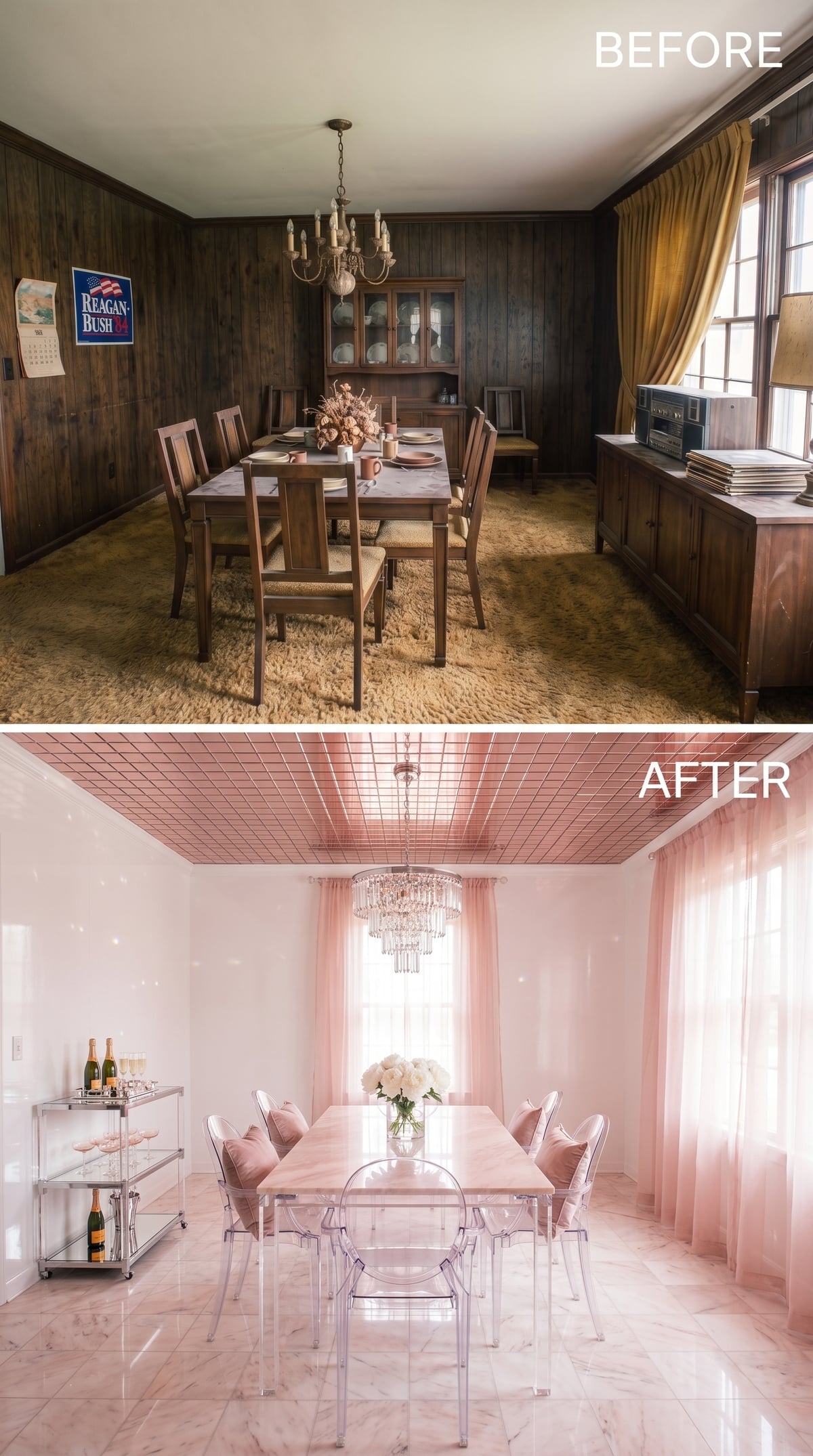
Rose marble runs across the floor, and a pink ceiling grid repeats its color overhead. A chandelier with crystal drops could have tipped this toward an all-out confection. Instead, transparent ghost-style chairs visually open the space around the equally pale table.
Their clear shells are a useful counterpoint to opaque stone, although transparent seating isn’t maintenance-free and individual materials vary. The clear seating allows the veined flooring and pink ceiling to remain visible instead of adding another block of opaque furniture.
11. A Black Industrial Ceiling Makes Reclaimed Wood Feel at Home
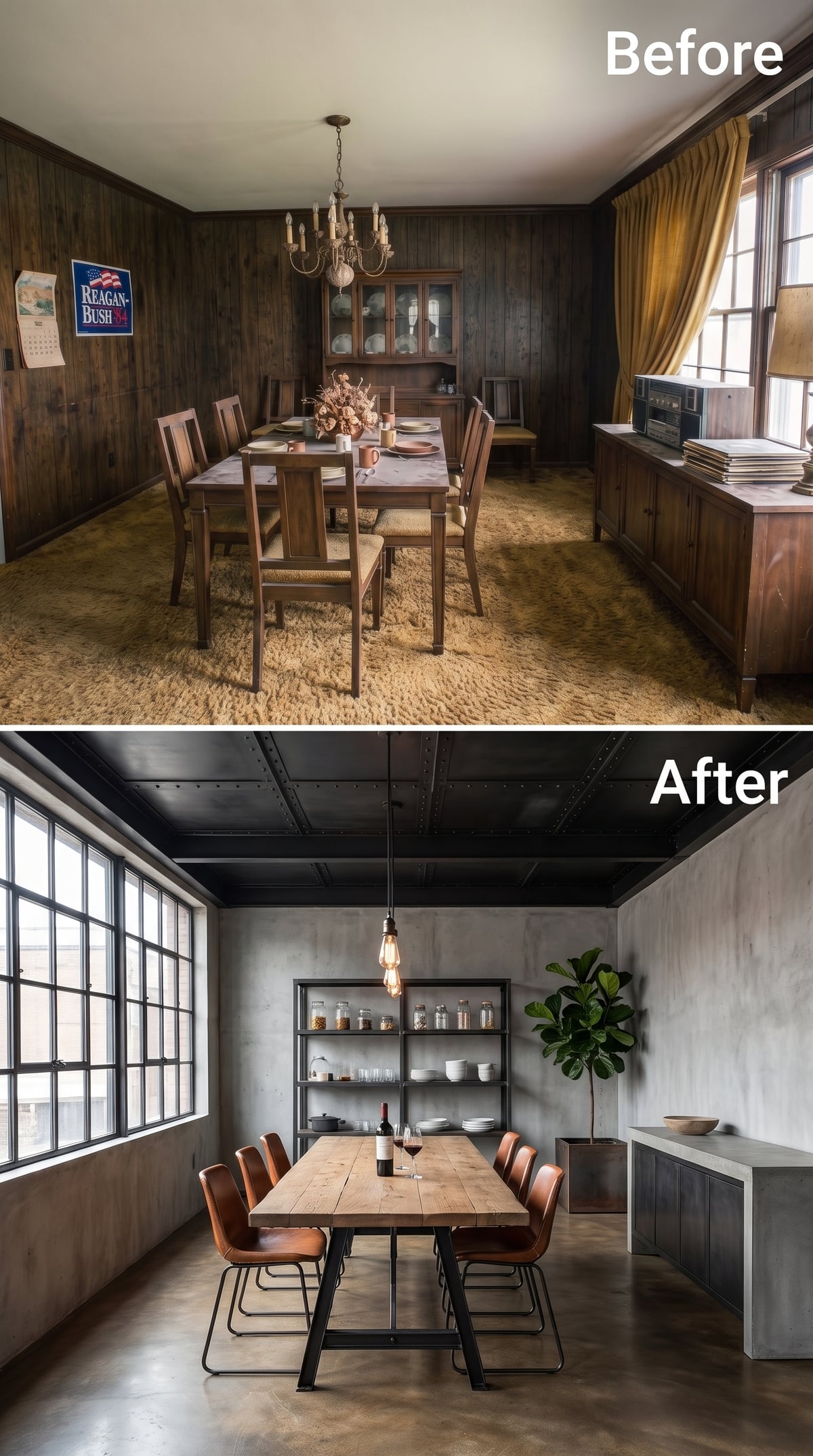
Concrete walls and a matte-black ceiling grid exchange the old domestic formality for something closer to a converted workshop. The black-painted overhead framework defines the room, while factory-style windows pour light onto the materials below.
Reclaimed timber on steel legs gives the table a reassuringly substantial presence. Tan leather chairs and open metal shelving complete the industrial vocabulary, with a fiddle-leaf fig providing one conspicuously nonindustrial shape. The palette is strict; the room doesn’t have to feel severe.
10. Curved Plaster and a Stone Bar Turn Corners Into an Afterthought
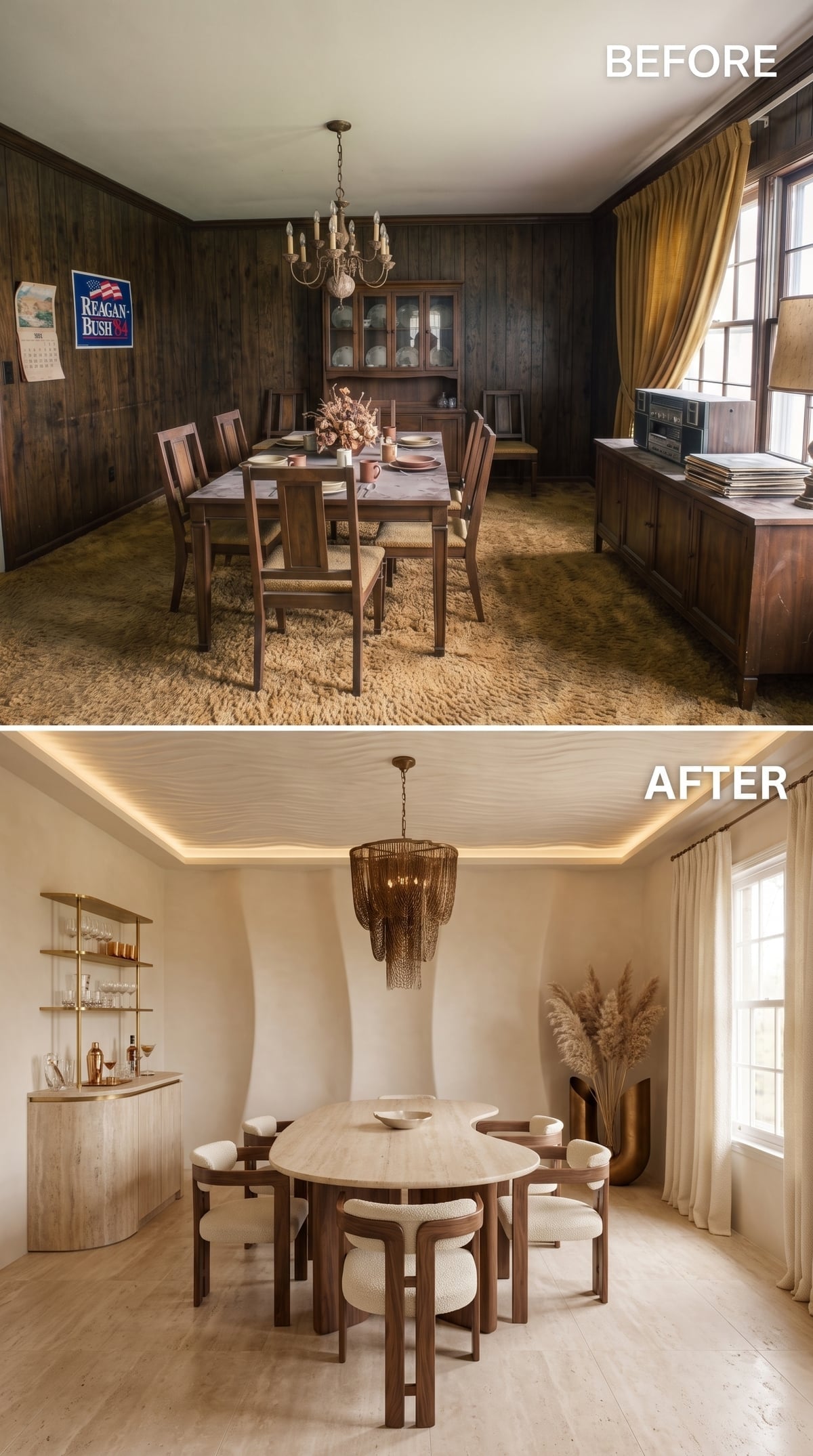
Cream plaster appears to sweep into the floor instead of stopping at a conventional baseboard. Whether achieved through decorative plaster detailing or a purpose-built coved transition, that curve immediately makes the room feel more sculptural. A circular table and barrel-backed walnut chairs pick up the same softened geometry.
The surprise is the curved, travertine-finished bar along the wall. Brass shelving handles the glasses and decanters, while a beaded bronze chandelier provides a finer texture overhead. This isn’t simply a neutral dining room; it’s an argument for making the bar part of the architecture.
9. Cobalt Walls, Magenta Terrazzo, and a Ceiling That Refuses to Behave
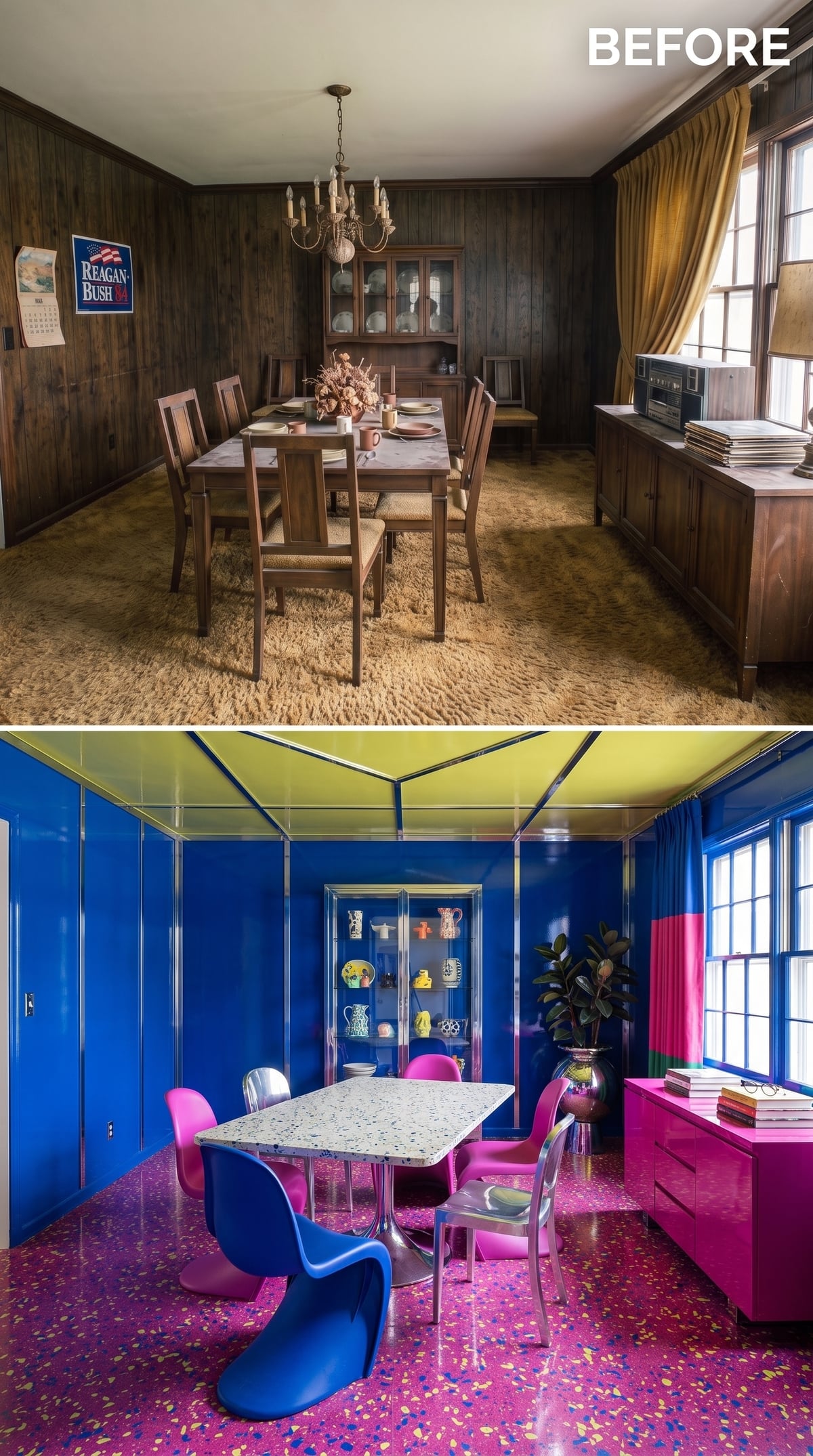
Here cobalt has abandoned any interest in subtlety. The blue lacquer meets a yellow-green ceiling, and magenta terrazzo throws cobalt and gold flecks back into the argument. Chrome seams divide the wall panels so the saturated color doesn’t appear as one undifferentiated block.
Sculptural chairs in blue and pink face each other across a terrazzo pedestal table. An acrylic display cabinet adds more vivid ceramics, proving that the room’s strategy is controlled repetition, not restraint. Even the old brown paneling might have to admit defeat.
8. Concrete Walls Get a Softer Counterpart in Bouclé and Wood
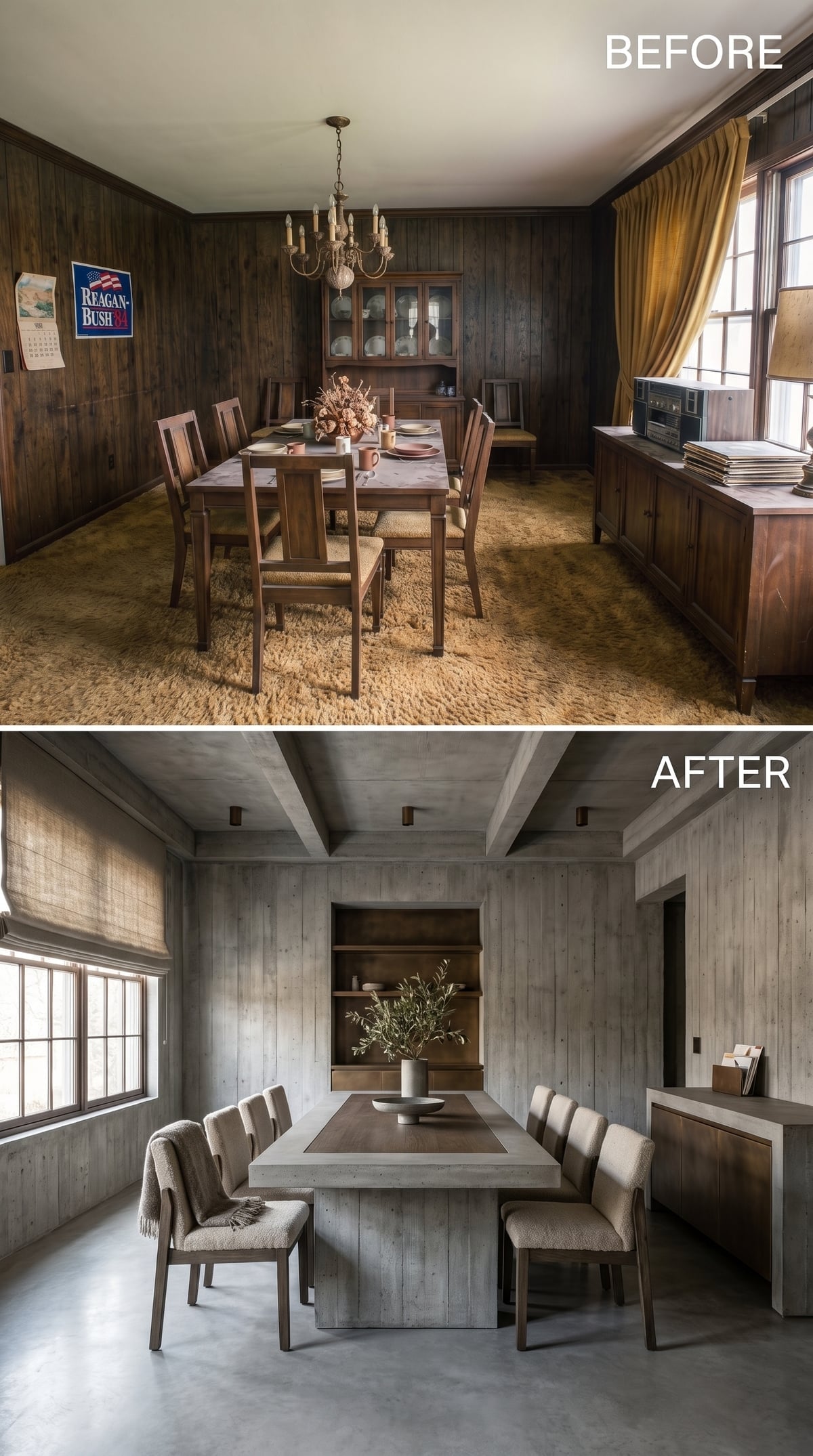
Board-formed concrete brings the imprint of timber formwork to the walls, its horizontal lines giving the room a strongly tactile surface. Instead of hiding that texture behind art and cabinets, the scheme carves out a recessed niche for a small arrangement and practical shelving.
Cream bouclé chairs soften the substantial concrete table base, while a wood insert on the tabletop and linen shades supply the warmth that the walls deliberately withhold. The niche breaks up the long concrete surface and gives the eye an obvious place to pause.
7. Emerald Walls, Checkerboard Marble, and a Sunburst Parquet Table
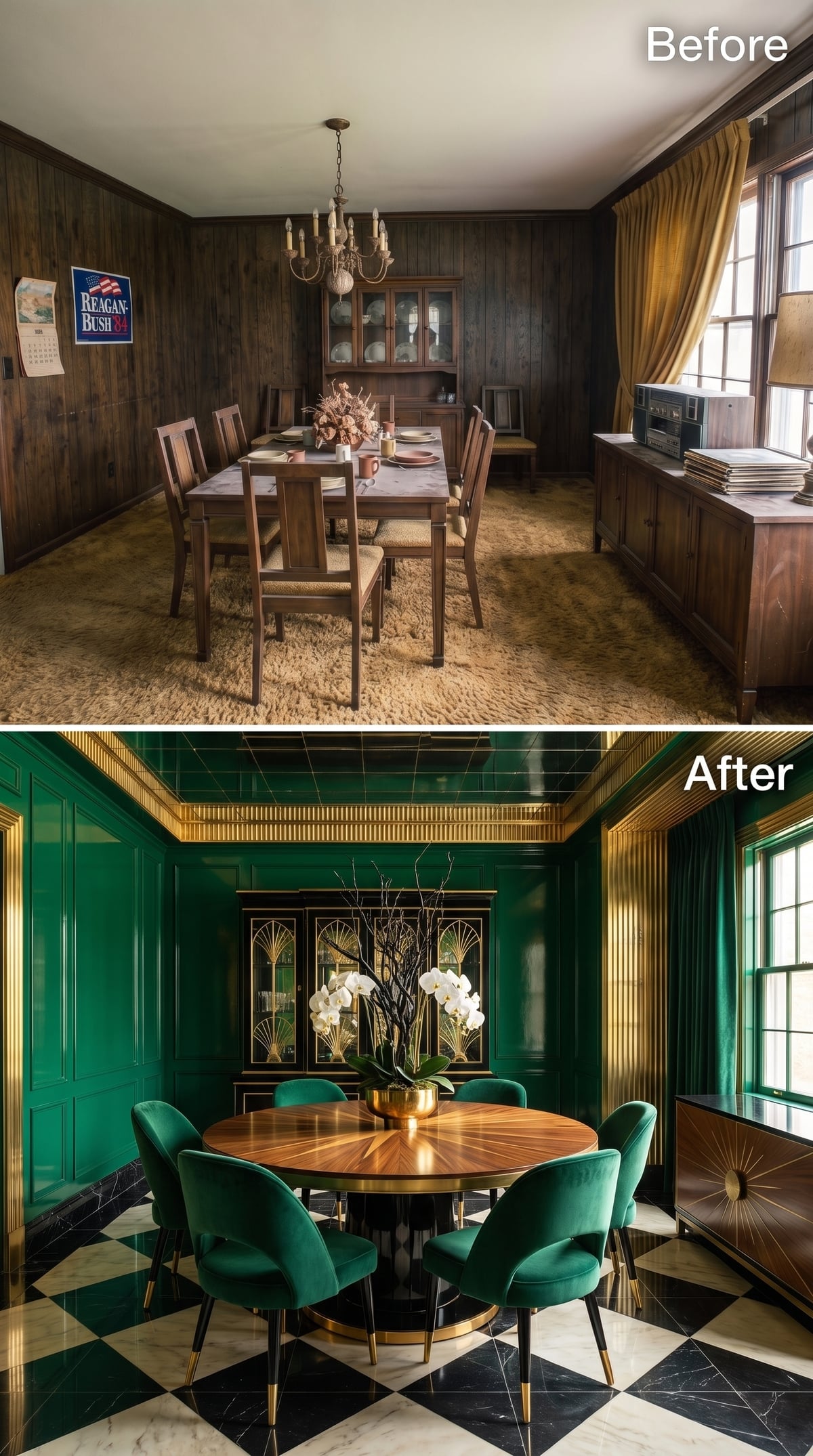
Deep emerald lacquer and gilded cornice trim make a vivid backdrop, but the round table supplies a second spectacle at the center. Its radial parquet top draws the eye inward, giving the room a decorative feature that has nothing to do with paint or ceiling height.
Matching velvet chairs lean into the green instead of contrasting with it, while black-and-cream checkerboard flooring prevents the palette from feeling uninterrupted. It’s maximalism organized around two strong patterns: the table’s radiating timber and the floor’s precise squares.
6. Mauve Lacquer and Copper Throw Formality a Curve
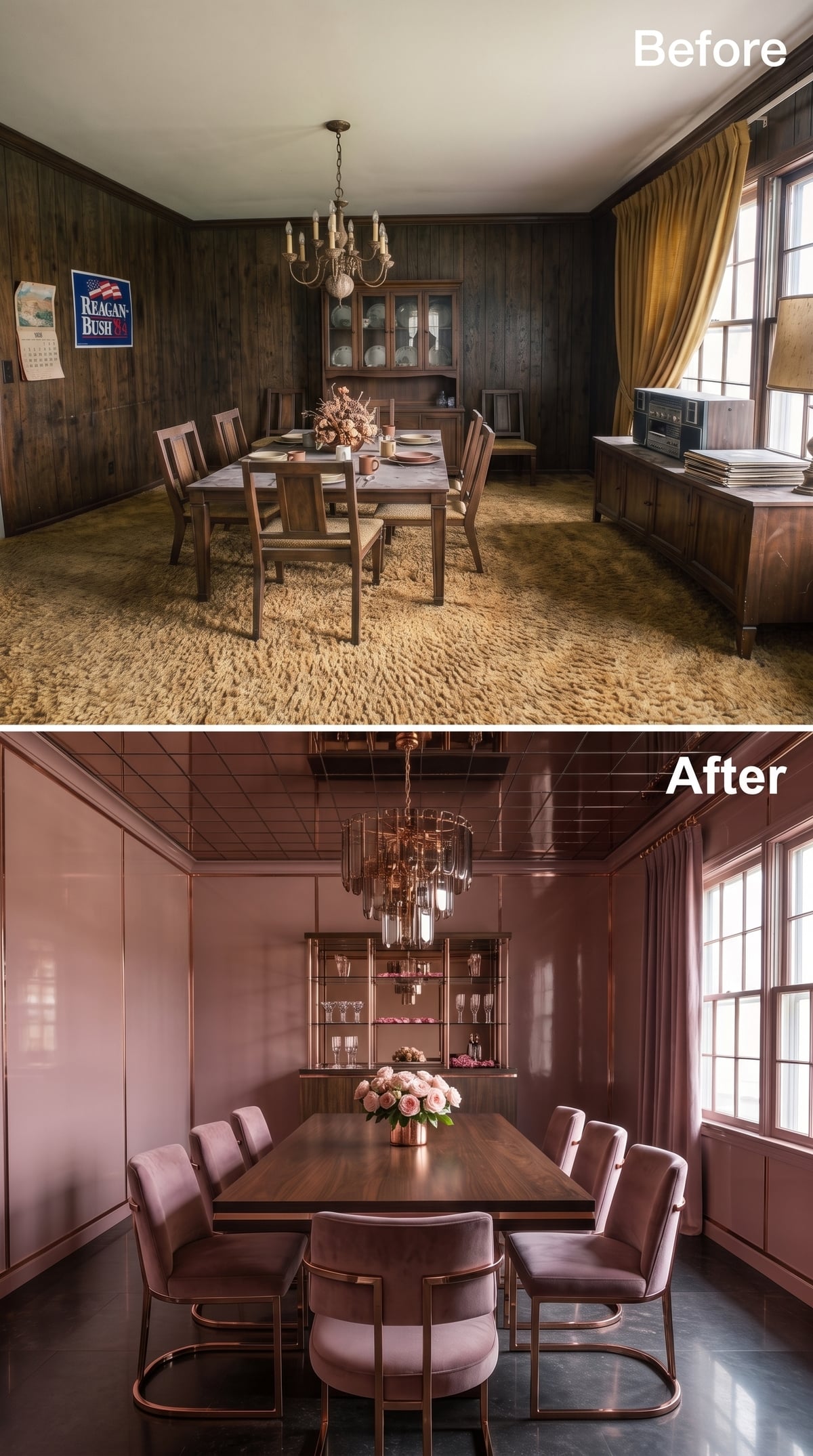
The wall panels haven’t vanished; they’ve been given a glossy mauve identity and a ceiling grid to match. That continuation of the geometry is the interesting move. Rather than disguise the room’s formality, the design makes it theatrical, right down to the tiered crystal chandelier.
Copper-finished cantilever chairs repeat the metal in the lighting, while dusty-rose velvet prevents the scheme from becoming a collection of shiny surfaces. A walnut table and open glassware shelves provide the necessary dark notes. Nobody here is calling for a beige rescue operation.
5. Cobalt Lacquer, Gold Ribs, and a Chandelier With No Interest in Restraint
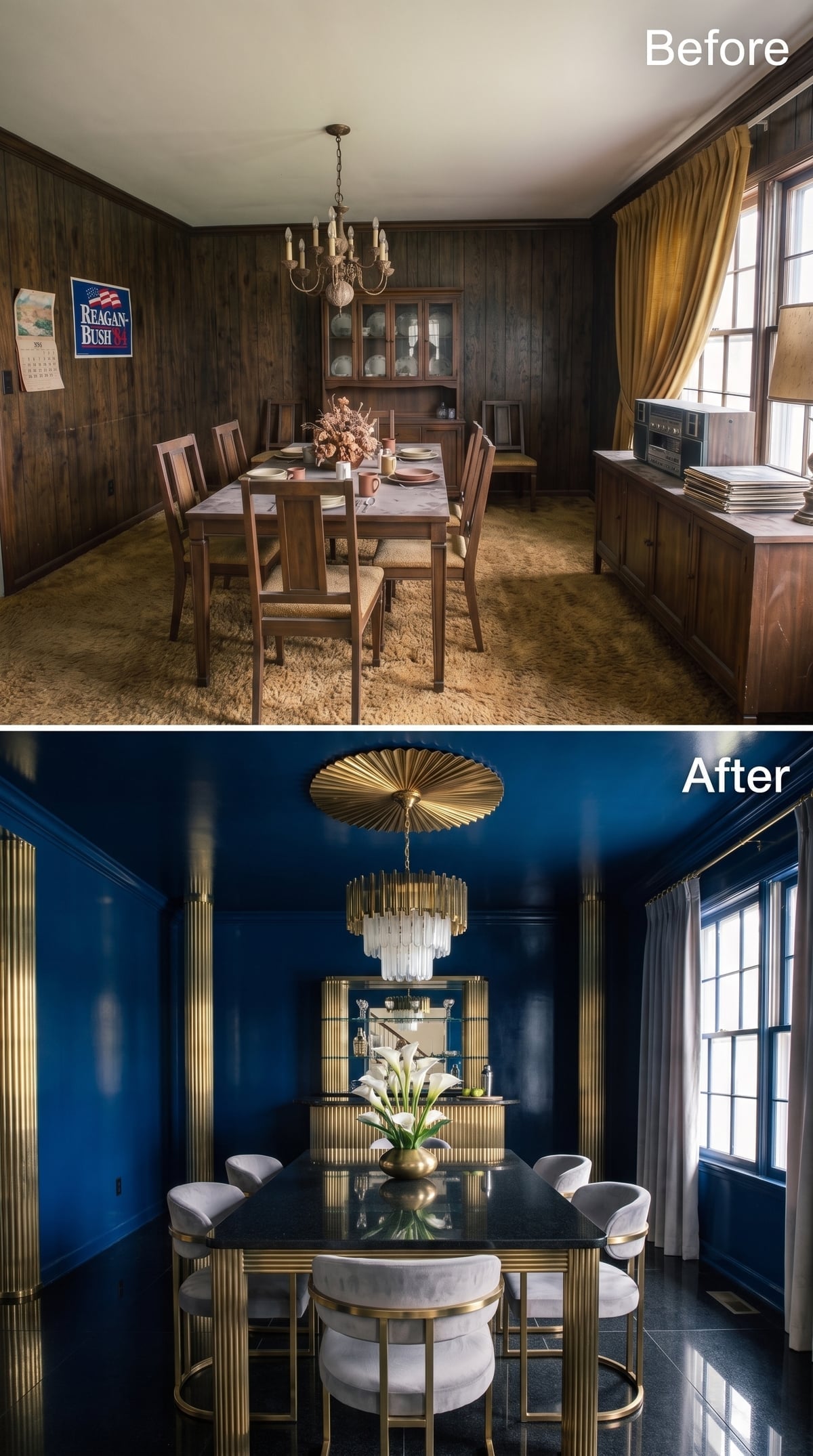
Glossy blue wraps the walls and ceiling in one continuous sweep, turning the old dining-room box into a jewel-colored enclosure. Gold ribs on the table and column-like details introduce strict vertical lines, a necessary counterweight to all that saturated color.
White velvet chairs create space around the table without requiring a pale wall in sight. The chandelier gets to be extravagant because the furniture keeps its shapes relatively simple. High gloss will also emphasize surface imperfections, so a finish this assertive calls for careful preparation.
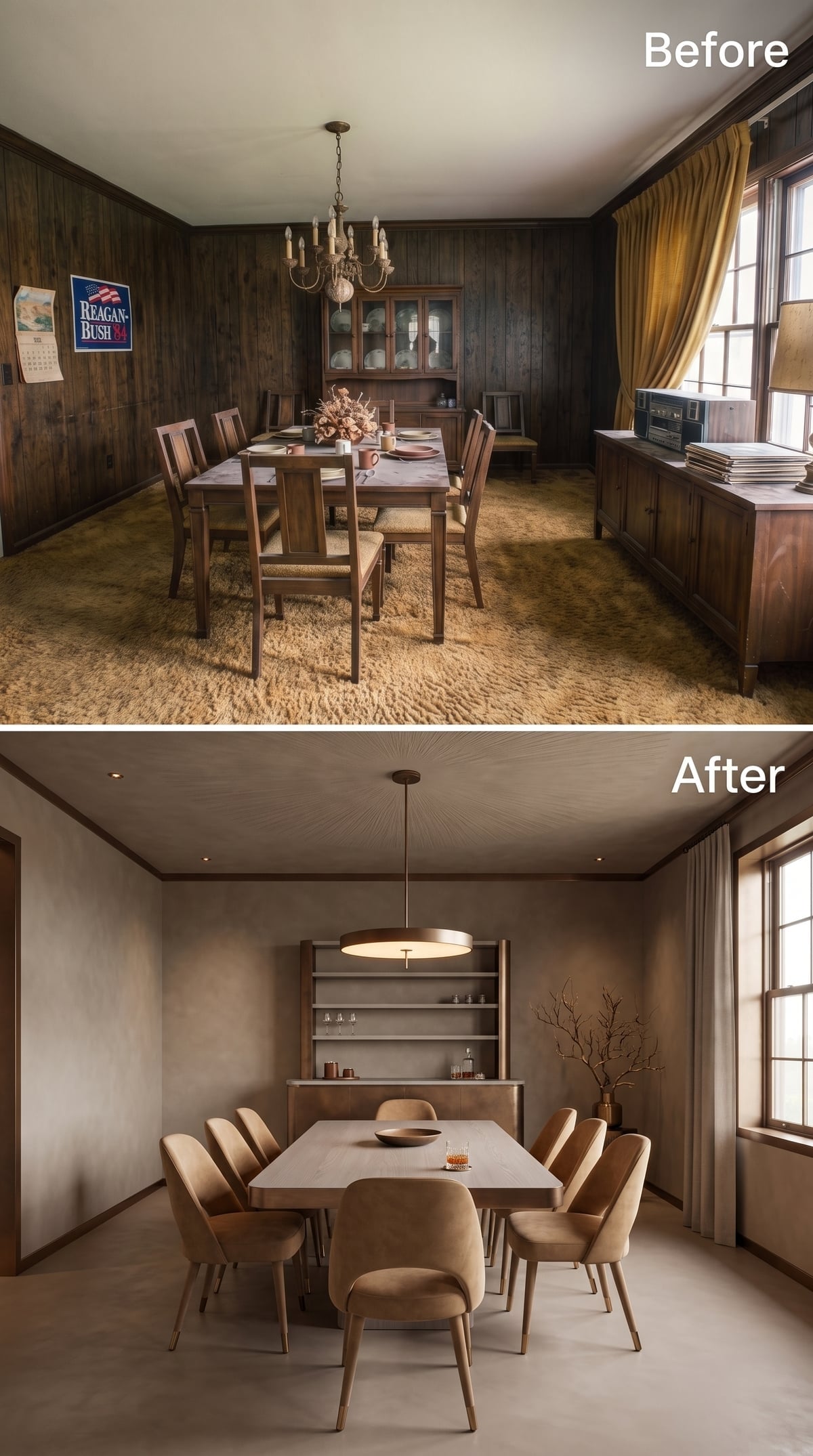
4. Venetian Plaster and Camel Velvet Let the Room Relax
🔥 Would you like to save this?
Taupe Venetian-style plaster catches the light gently without wallpaper or a conspicuous pattern. The flat disc pendant is an equally deliberate refusal of chandelier drama: it provides a clear focal point without asking everyone to discuss the light fixture before dinner.
Eight camel-colored velvet chairs surround a rectangular stone-topped table, while open shelving offers a contemporary replacement for the traditional china cabinet. Bare branches beside the window add height. This is a room in which the materials, rather than accessories, get the last word.
3. Midnight Blue Gives the Dining Room a Proper Drinks Station
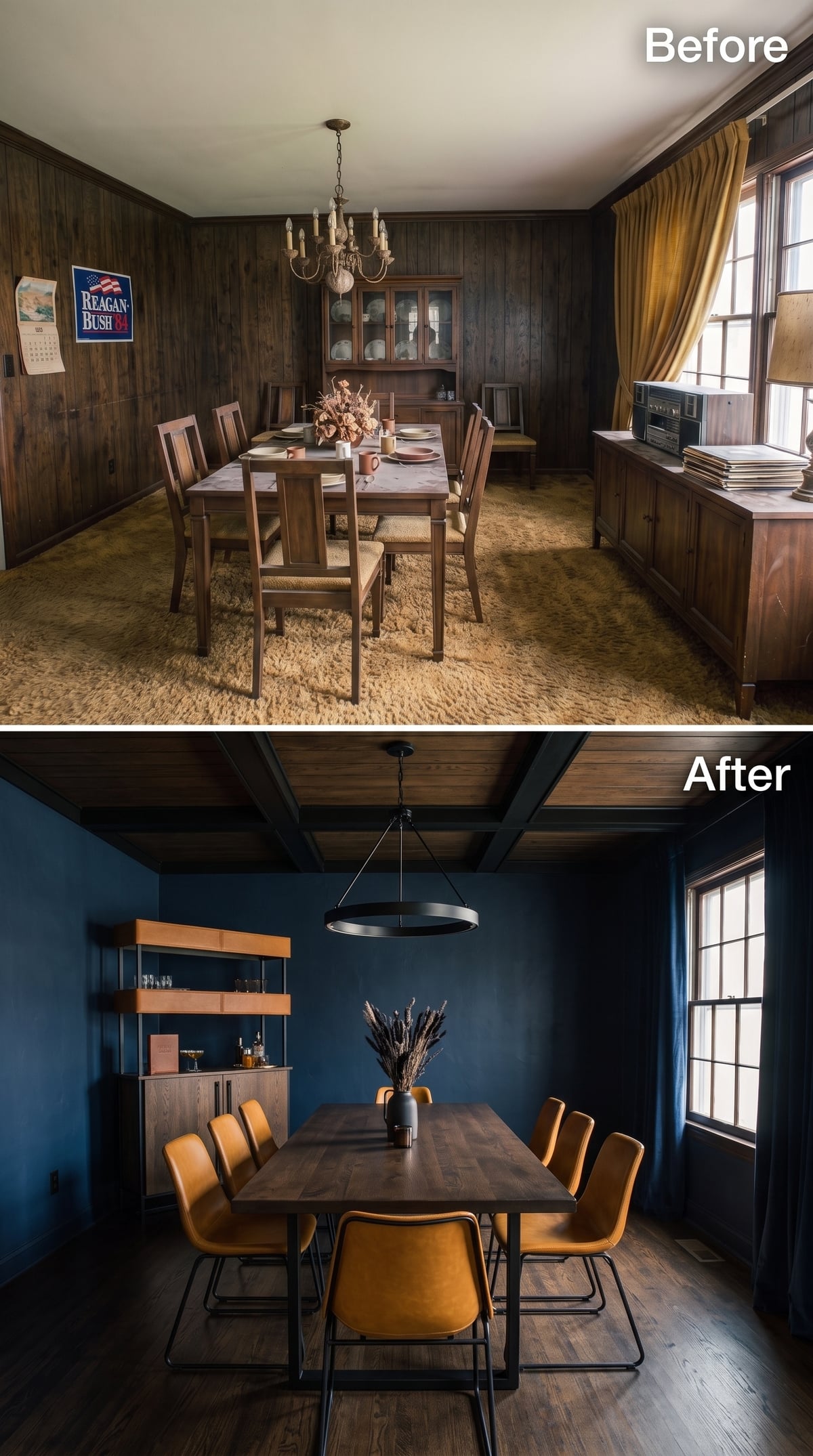
Painting the walls, ceiling, and exposed beams in related dark blues creates a coherent backdrop for amber leather dining chairs. The matte black ring pendant avoids adding yet another metallic flourish to an already rich palette.
The useful move is the bar shelf rather than the paint alone. Keeping glasses and bottles accessible along one wall allows the room to host drinks before anyone sits down. Dark paint creates the atmosphere; the bar gives guests a reason to linger.
2. Charcoal, Dusty Rose, and a Dinner Table Lit Like a Film Scene
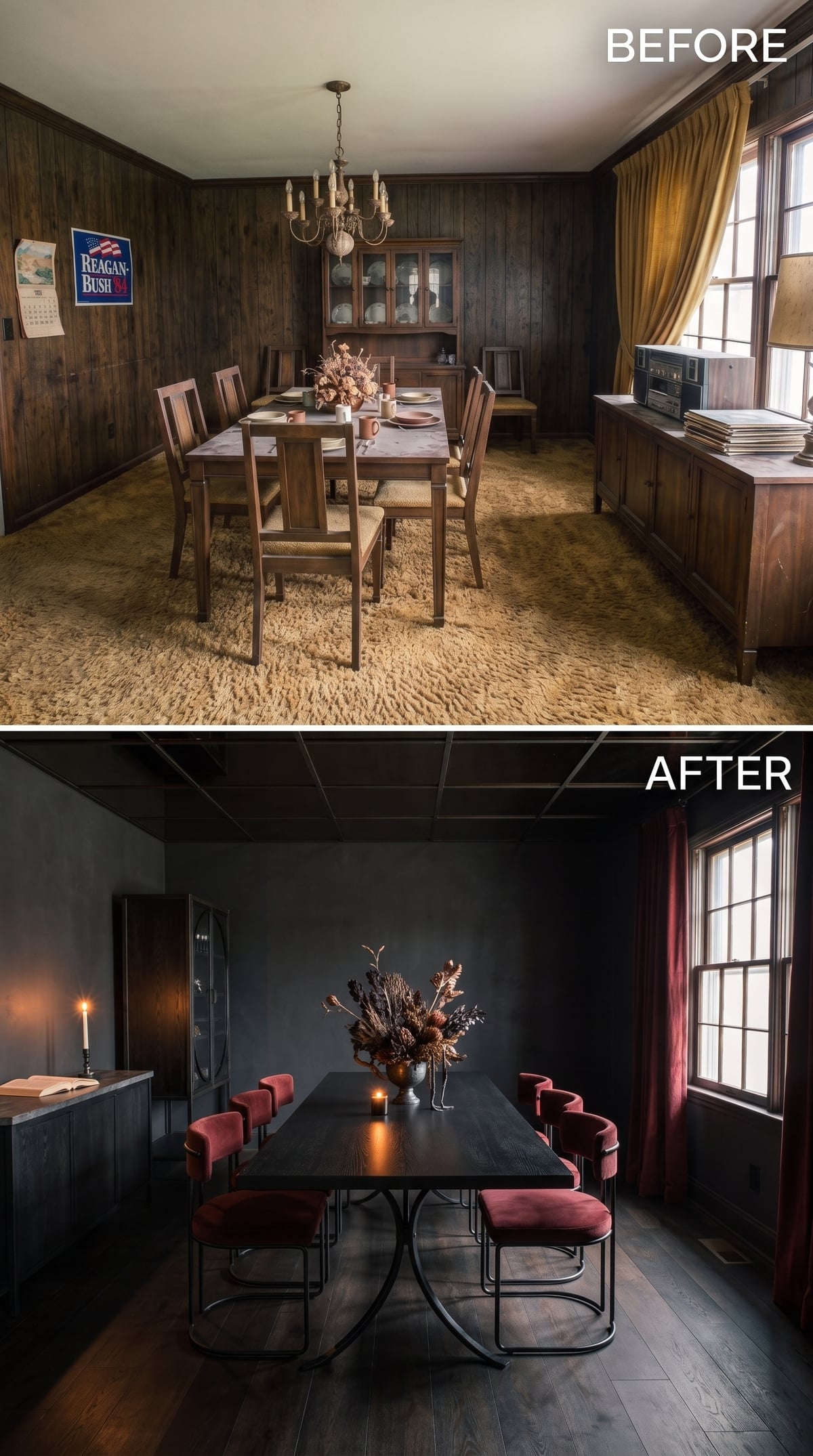
The curved black table and dusty-rose velvet chairs supply almost all the color in this charcoal room. Burgundy drapery and dark flooring deepen the scene, while candles pick out details that might disappear under a bright overhead fixture. This is intimate dining taken seriously.
Candles deliver atmosphere, but everyday dining also needs enough light for serving and moving safely. Concealed, dimmable lighting can provide it without spoiling the theatrical effect. Dried botanicals bring texture to the sideboard without insisting on a weekly trip to the florist.
1. The Last Dinner Party: Backlit Onyx and a Banquette Made for Lingering
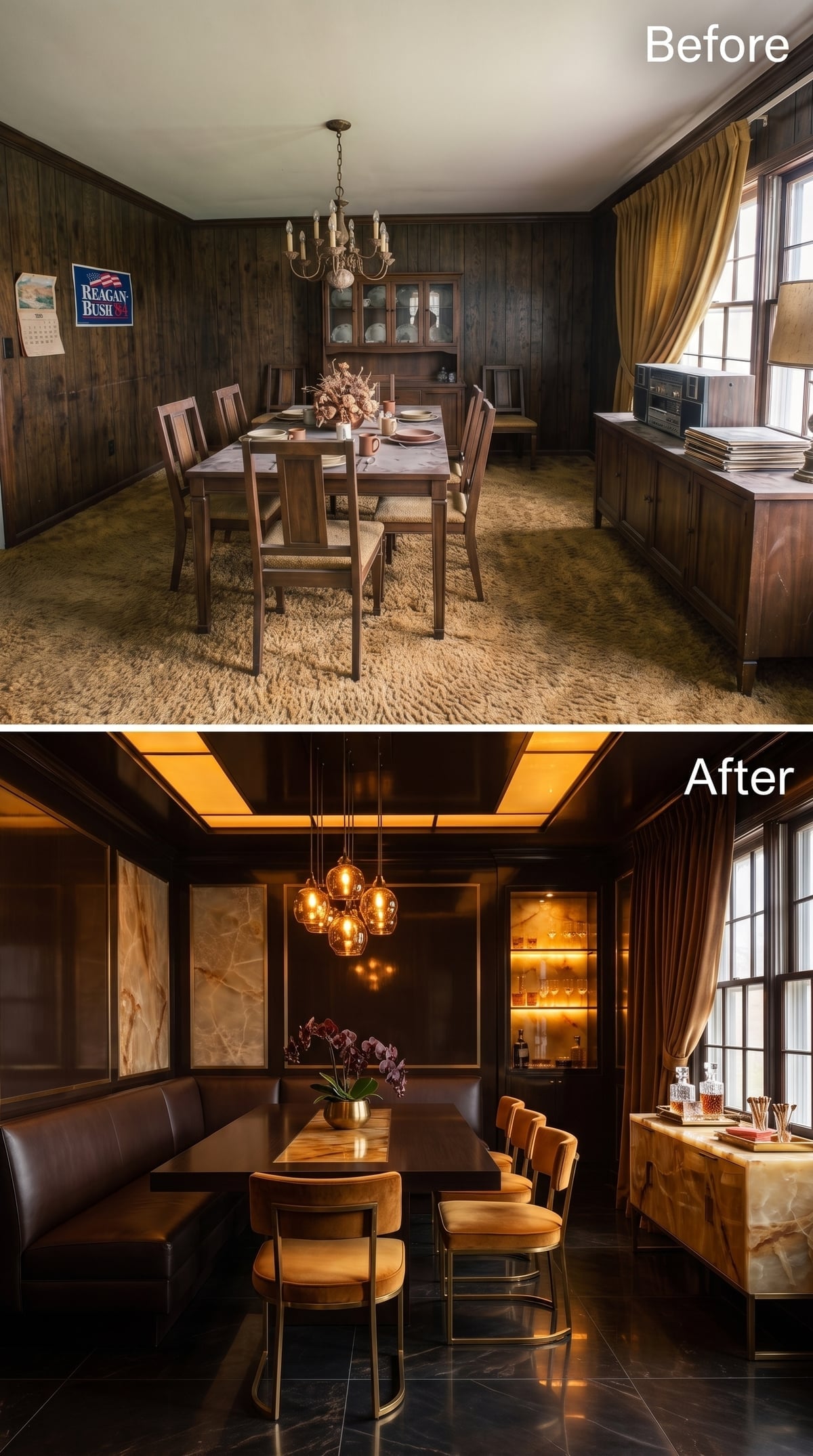
The earlier onyx concept illuminated the table; this one brings the glow to the walls. Backlit amber stone surrounds the diners while clusters of warm pendant globes hover above the walnut table.
More importantly, the transformation changes how people gather. A chocolate-leather banquette turns one side of the room into a place to settle in, with burnt-gold velvet chairs opposite and dark marble beneath. For a space once defined by a formal hutch and obligatory holiday dinners, a comfortable corner that encourages people to stay seems like a fitting final act.