
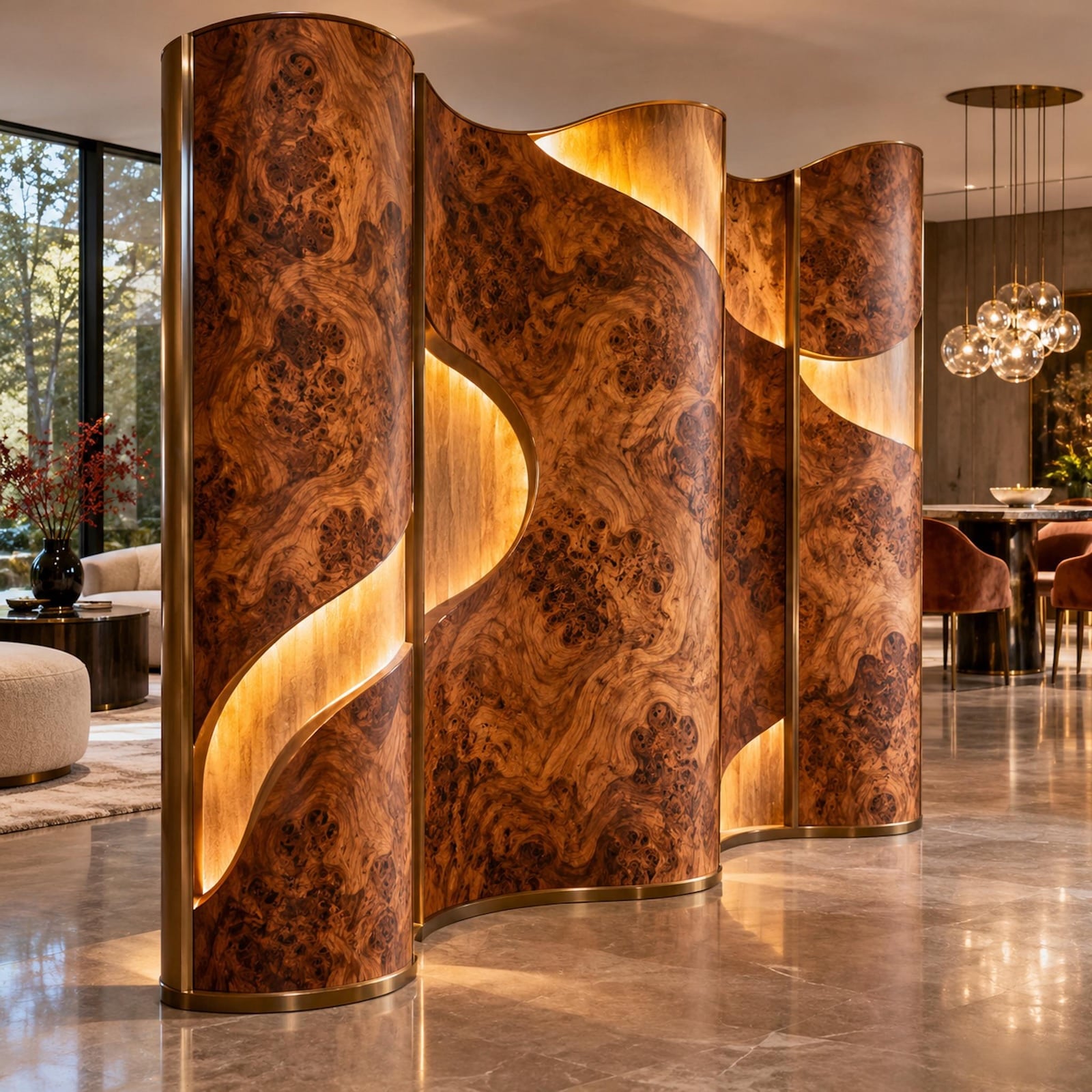
Some woods are content to provide a handsome background. Others seem determined to become the entire conversation. Knots multiply into eyes, grain twists into elaborate swirls, and polished surfaces reveal patterns resembling storm clouds, flowing water or geological formations. The most extravagant examples can make a single cabinet door more visually compelling than an entire wall of immaculate oak.
In order to come up with the very specific design ideas, we create most designs with the assistance of state-of-the-art AI interior design software. Also, assume links that take you off the site are affiliate links such as links to Amazon. this means we may earn a commission if you buy something.
Burl is the star of this particular show, but it isn’t the only wood capable of such theatrics. Curly, quilted and other highly figured grains bring their own visual complexity, while bookmatching can turn irregular patterns into astonishing symmetry. The designer’s challenge is knowing when to indulge that natural extravagance and when to impose a little architectural discipline. Pale stone makes amber walnut appear richer. Dark lacquer sharpens its theatrical edge. Straight-grained cabinetry gives the wild stuff something to rebel against.
Across these 34 designs, spectacular wood moves well beyond conventional cabinetry. It sweeps across an indoor bridge, wraps around a staircase, frames hidden storage and transforms a freestanding room divider into sculpture. Elsewhere, the drama is concentrated into a single chair, table or pivot door. The finest examples don’t simply display extraordinary grain. They make it an integral part of the architecture.
34. The Picture Lights Have No Pictures. Walnut Burl Is the Exhibition
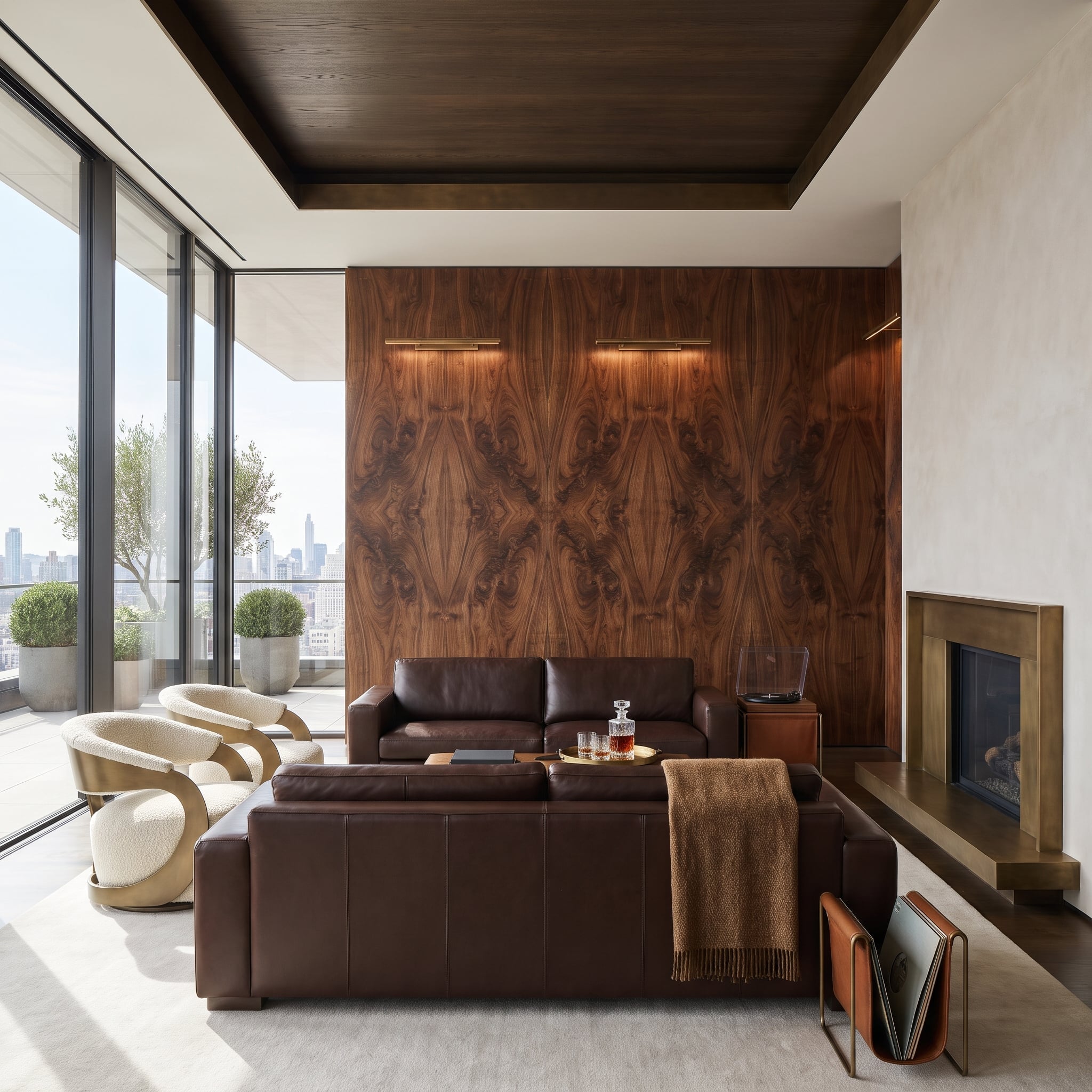
Three brass picture lights illuminate an entire wall of bookmatched walnut, with not a painting in sight. The mirrored veneer leaves produce an extravagant Rorschach of eyes, flames and branching forms, their near-symmetry imposing order on the wood’s unruly figure. Low leather sofas leave the composition unobstructed, while bronze fireplace detailing and a dark ceiling deepen the gallery-like atmosphere. The lighting makes the point beautifully: when the material is this expressive, hanging art over it would be an act of vandalism.
33. Two Little Islands of Burl Refuse to Touch the Bedroom Floor
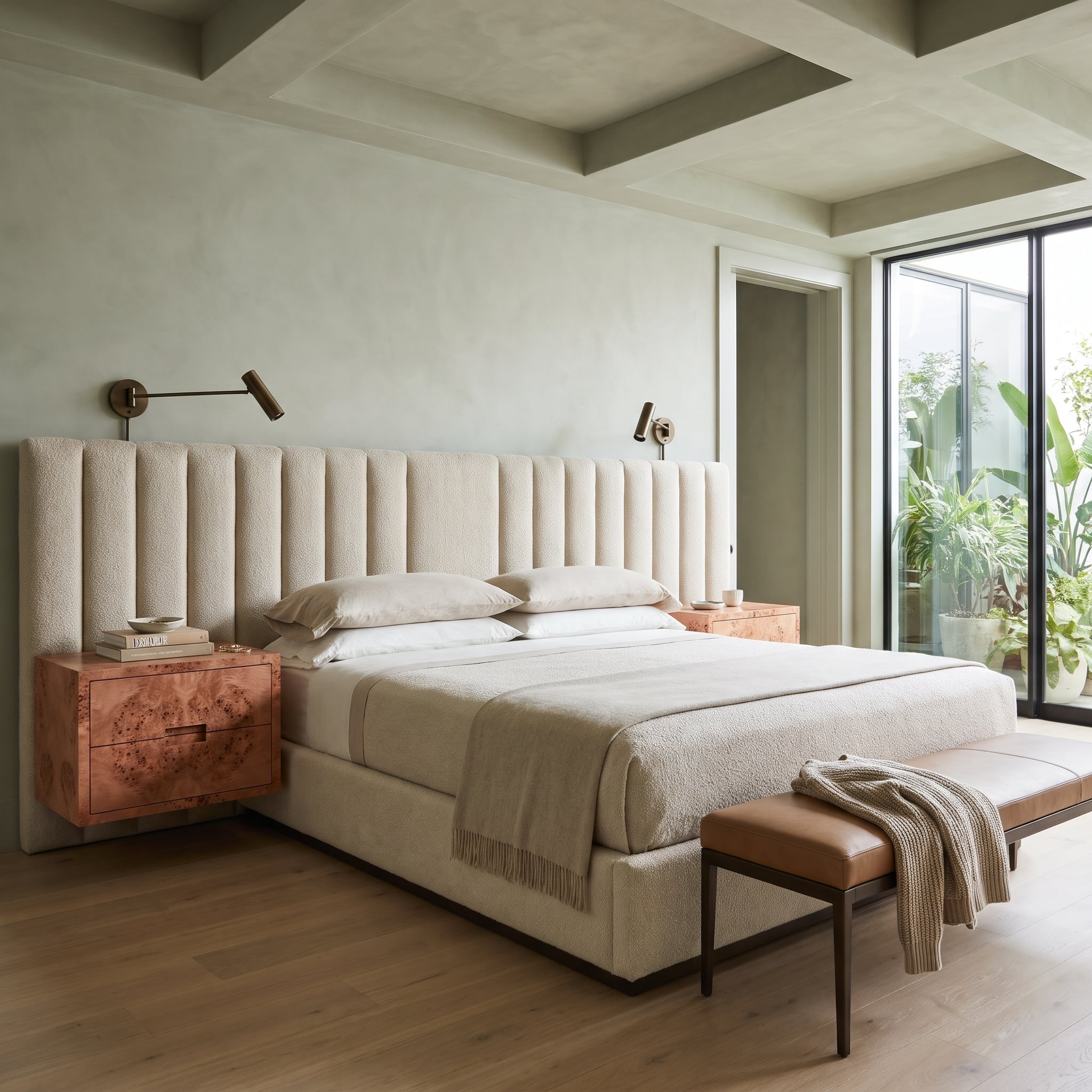
Two compact poplar burl nightstands appear to float against an upholstered headboard, their rounded forms interrupting the disciplined vertical channels of the bouclé. The orange-brown figuring is concentrated into small, jewel-like surfaces, allowing the wood to command attention without overwhelming the bedroom. Sage plaster cools the surrounding palette. Leaving the floor visible beneath the cabinets is a particularly deft move: the arrangement gains the visual lightness of suspended furniture while retaining the warmth of richly figured timber.
32. A Kidney-Shaped Burl Bar Brings Back the Art of the Grand Gesture
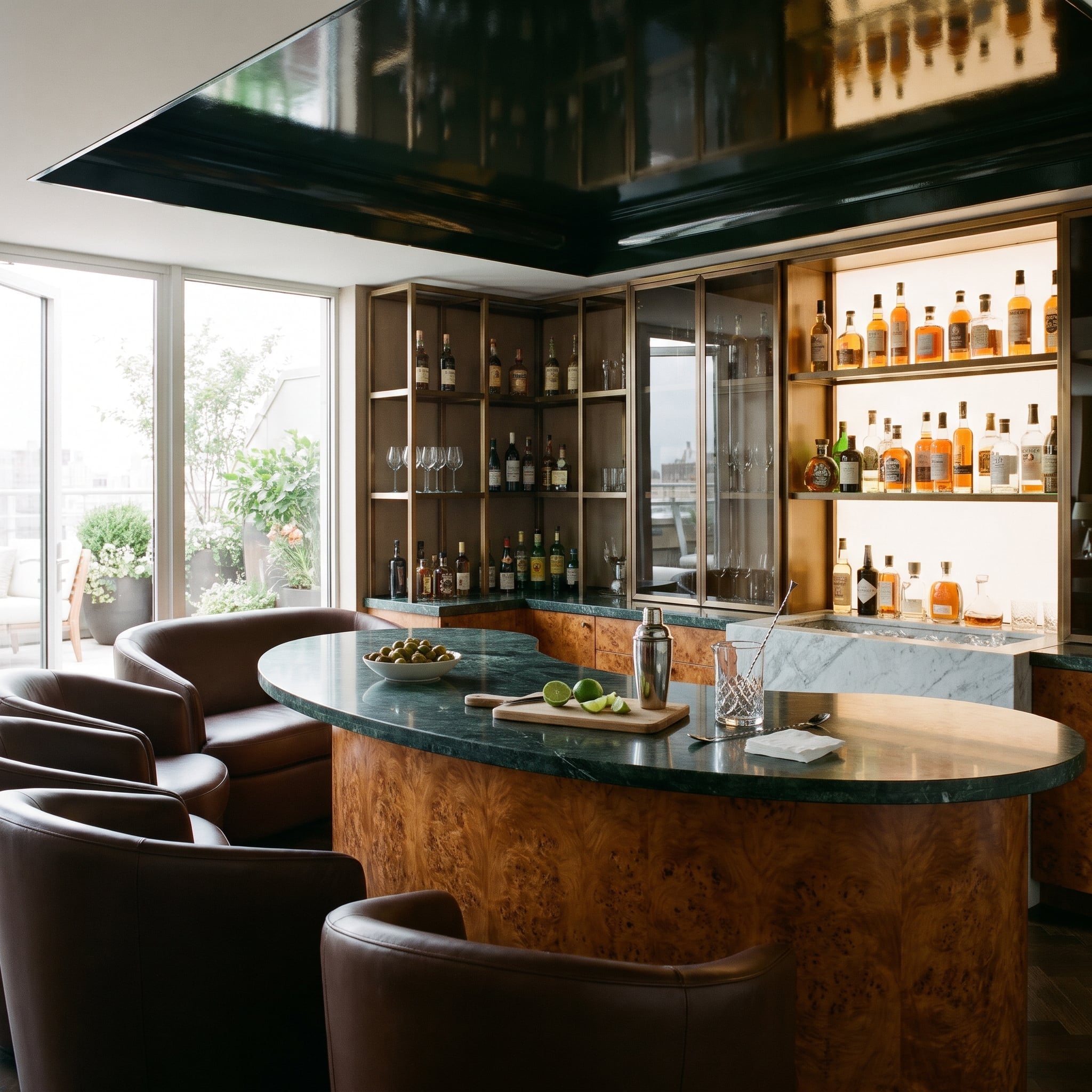
With its sweeping kidney-shaped counter, glossy burl frontage and deep green marble top, this bar has the glamorous confidence of a midcentury cocktail lounge without becoming a period reproduction. Leather barrel chairs follow the counter’s curve, encouraging conversation around its perimeter. Overhead, dark lacquer catches fragmented reflections of illuminated bottles and glassware. The organic geometry is crucial: a straight bar would make the same materials feel considerably more conventional. Here, the entire room seems to revolve around the counter.
31. An Ivory Burl Bridge Turns a Structural Crossing Into a Ribbon of Grain
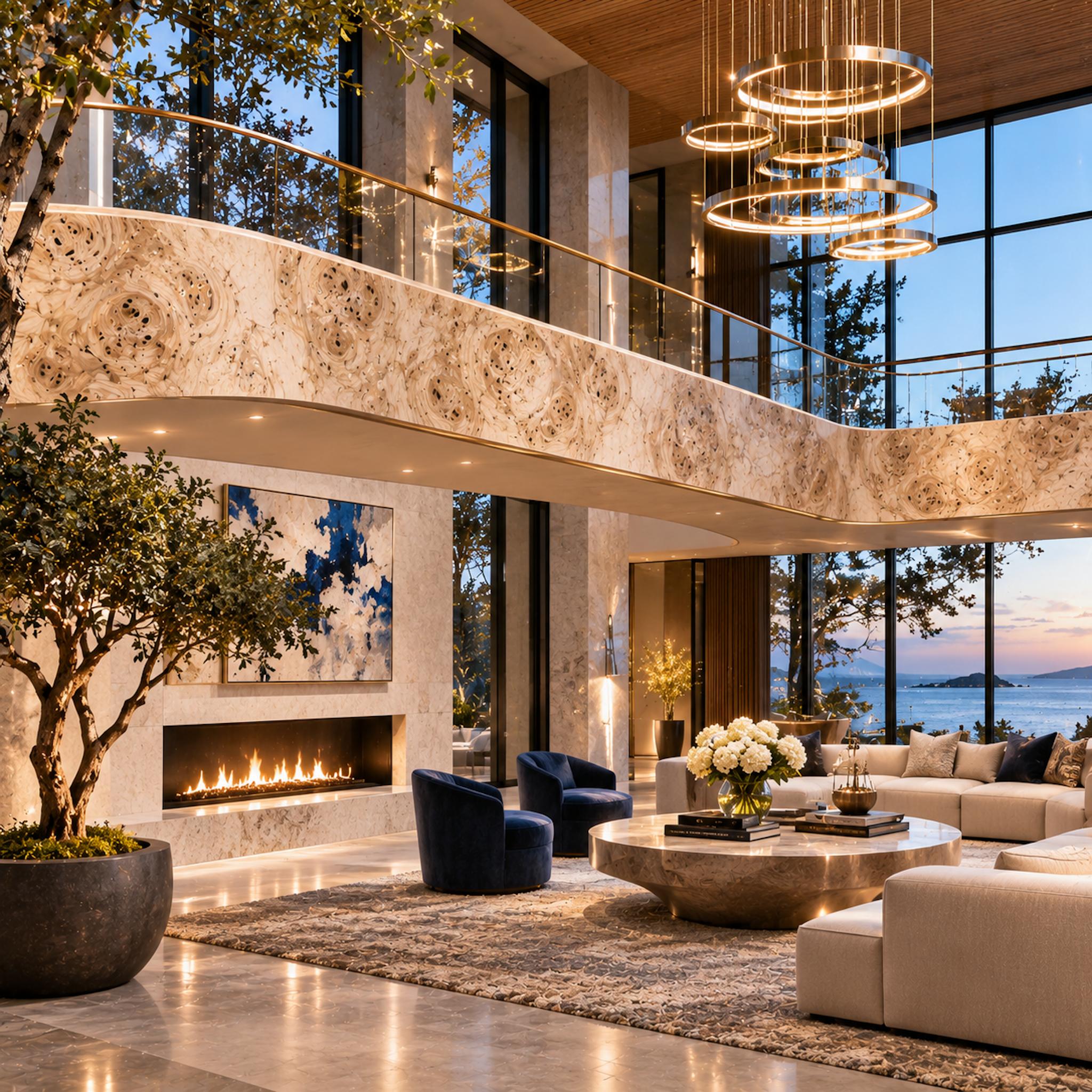
Across a double-height atrium, a sweeping bridge carries pale burl veneer along its curved outer face, transforming a circulation route into the room’s defining architectural line. The wood’s silver-gray knots and delicate whorls read almost like fossil markings against the surrounding stone. Transparent glass guards and a slender bronze handrail preserve views through the space, while the bridge’s substantial underside gives the crossing convincing visual weight. Navy chairs, a long fireplace and an indoor tree anchor the living area below. Furniture-scale ornament has been enlarged to architectural proportions, and the result is spectacular.
30. One Kitchen Island Gets the Wild Grain. Everything Else Knows Better
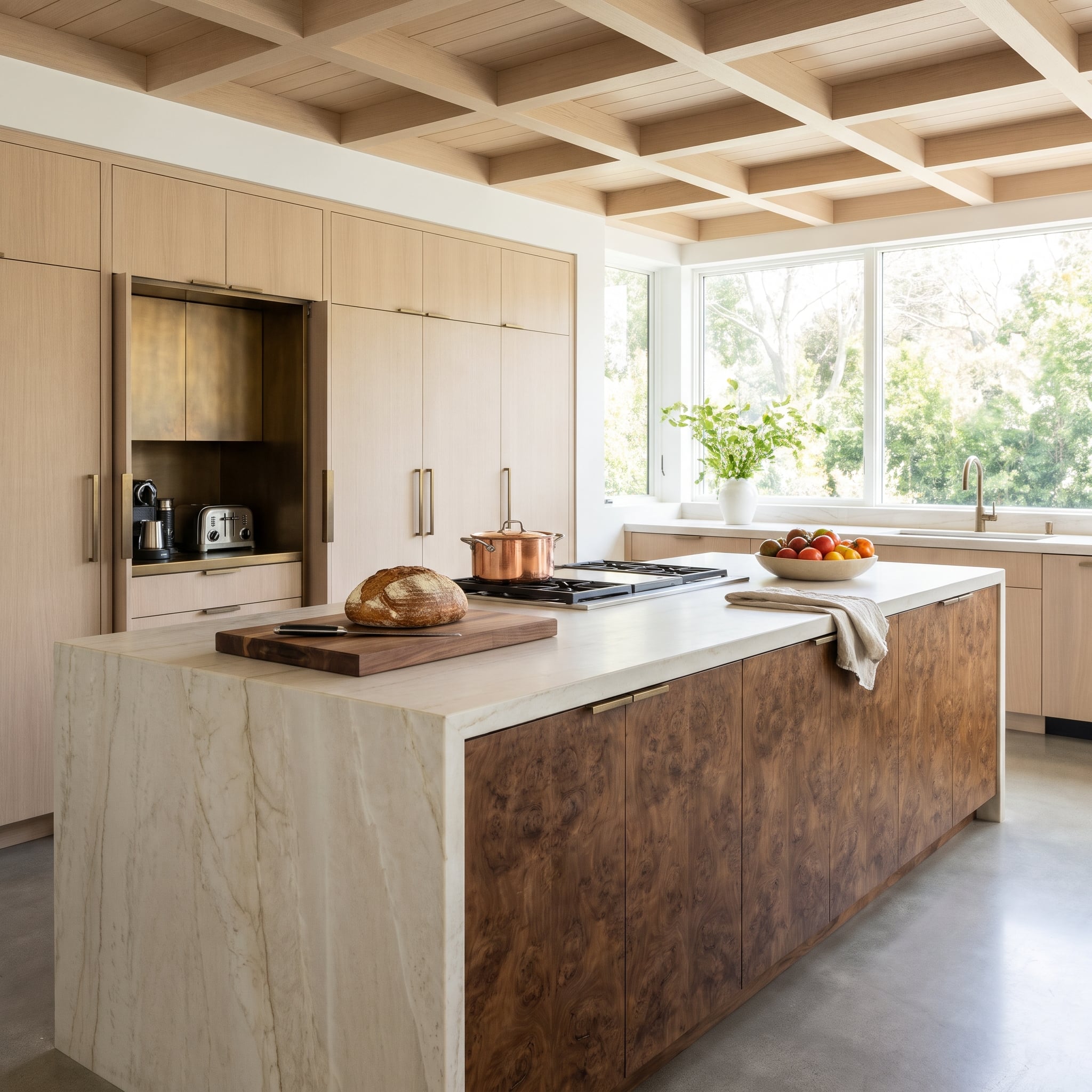
Pale oak cabinetry and a coffered ceiling establish an orderly architectural framework. The island promptly breaks ranks, its walnut burl fronts erupting in densely packed swirls beneath a softly veined stone waterfall. Restricting the expressive veneer to one freestanding volume is the smartest decision here; covering the perimeter cabinets would dilute its impact. Brass pulls provide continuity, while a pocket-door appliance garage reveals a metallic interior. The kitchen balances visual extravagance with practical restraint, allowing one piece of millwork to carry the entire performance.
29. A Garden Window Becomes a Room Within a Room
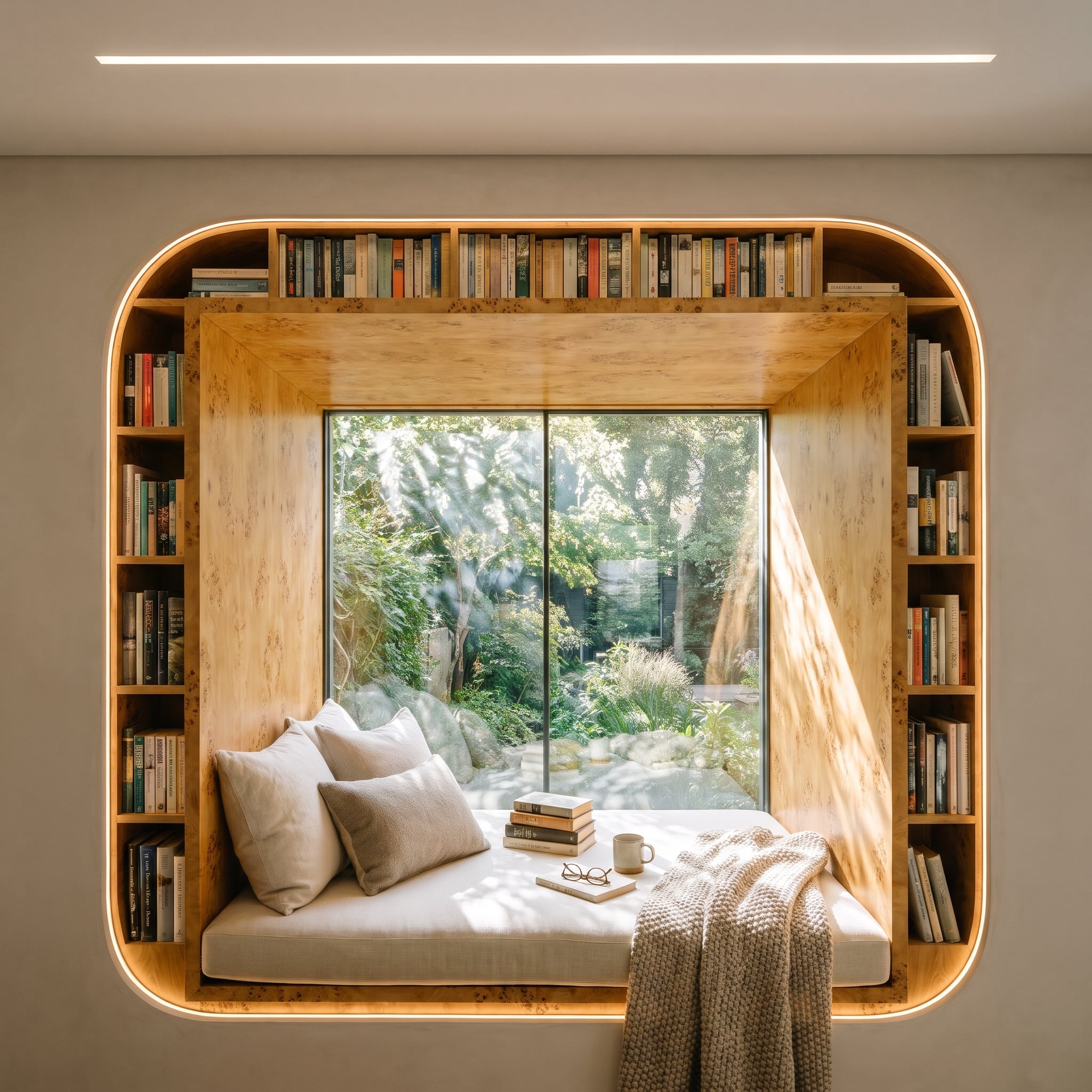
Books line the surrounding shelves, but the real attraction is a deep window recess wrapped in pale poplar burl. Its softly rounded opening creates a distinct architectural enclosure, with the veneer continuing around the interior like a finely crafted wooden shell. A cushioned seat brings the grain close enough to appreciate its minute variations, while concealed lighting accentuates the transition from plaster to timber. The niche makes a compelling case for using figured wood where it can be experienced intimately rather than admired from across a room.
28. These Swivel Chairs Save Their Best Side for the Back
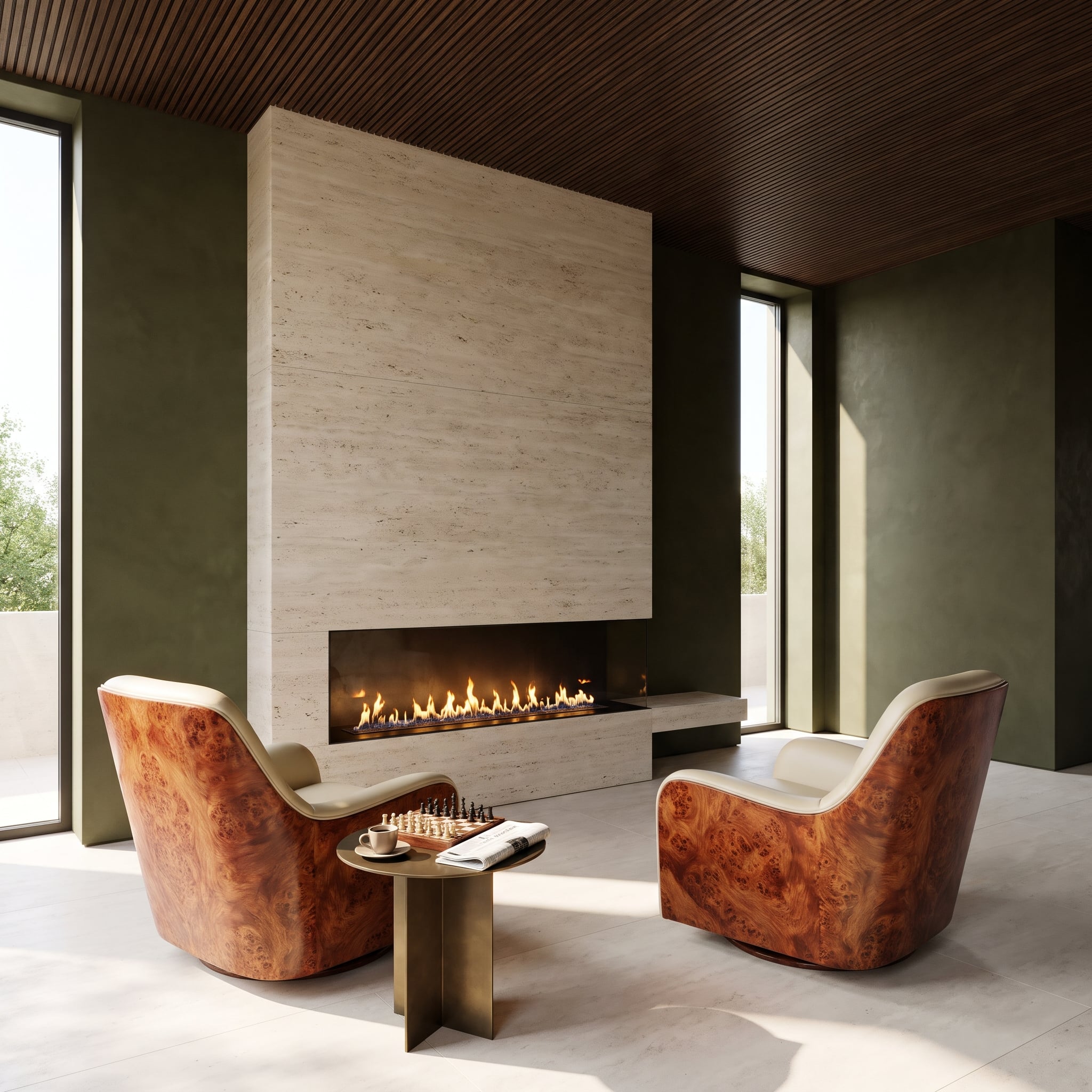
Most upholstered chairs reserve their design interest for the seat. These swivel chairs make the opposite argument, wrapping cream leather interiors in glossy wooden shells alive with orange, oxblood and near-black figuring. The curved backs provide an uninterrupted canvas for the burl, their sculptural silhouettes emphasized by the surrounding pale stone. A bronze chess table occupies the space between them, with a long travertine fireplace beyond. The chairs are attractive from the front, but their real architectural presence emerges when viewed from behind.
27. A Checkerboard Ceiling Puts Wild Burl Under Strict Geometric Control
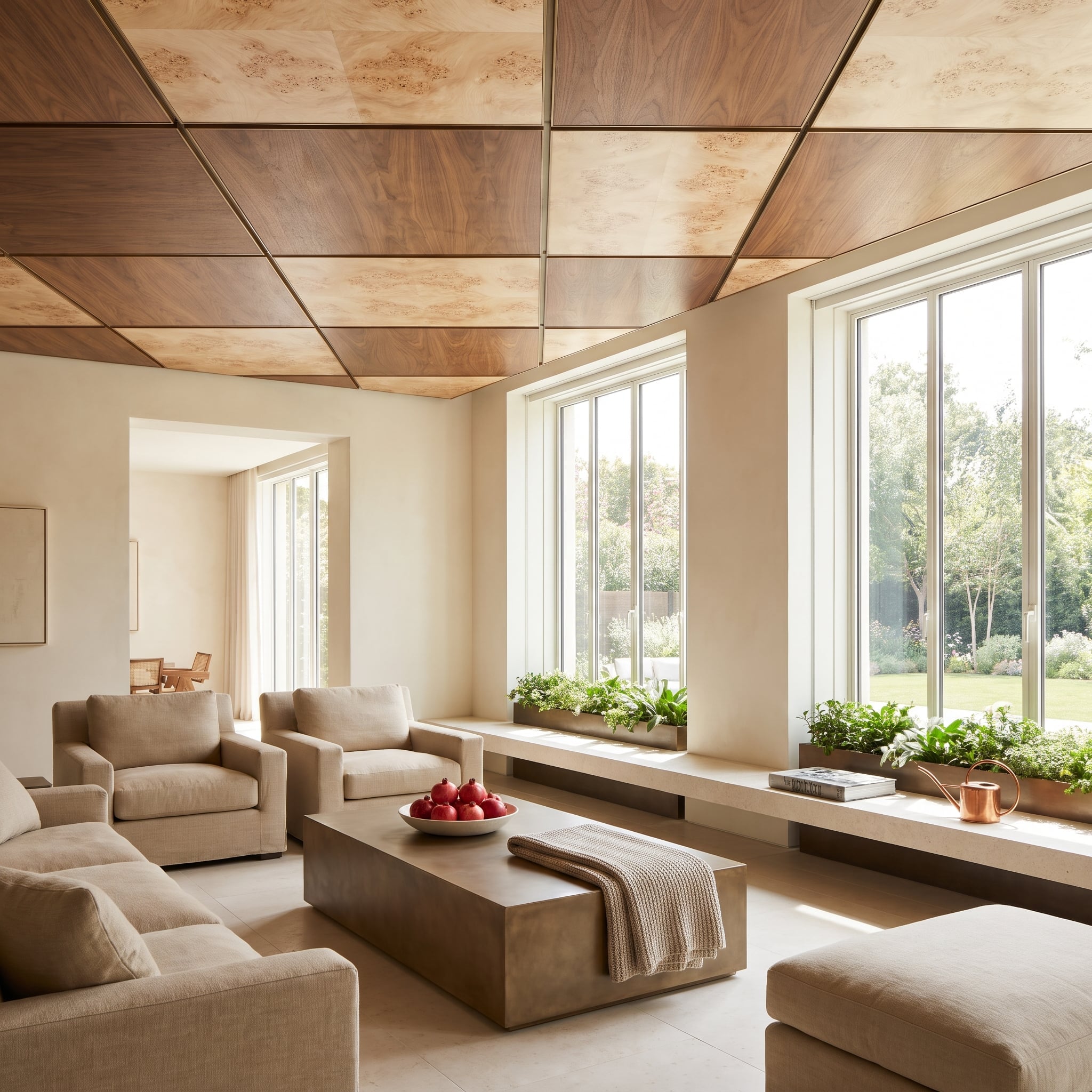
Alternating squares of pale burl and straight-grained walnut transform the ceiling into an exercise in controlled disorder. Narrow bronze dividers establish an exacting grid, while each figured panel supplies a completely different pattern within its boundaries. The juxtaposition is more sophisticated than a conventional coffered ceiling because the materials offer competing visual rhythms. Below, linen seating, stone flooring and a long window bench keep the room relatively quiet. The architectural discipline is overhead; the natural exuberance is contained within it.
What Our Readers Say
- Home Stratosphere readers who want their home to feel cosy and moody were far more likely to pick wood ceilings, 46% of the time versus 10% of other readers.
From Home Stratosphere reader polls and votes.
26. A Blue Bedroom Partition Develops an Unexpected Burl Curve
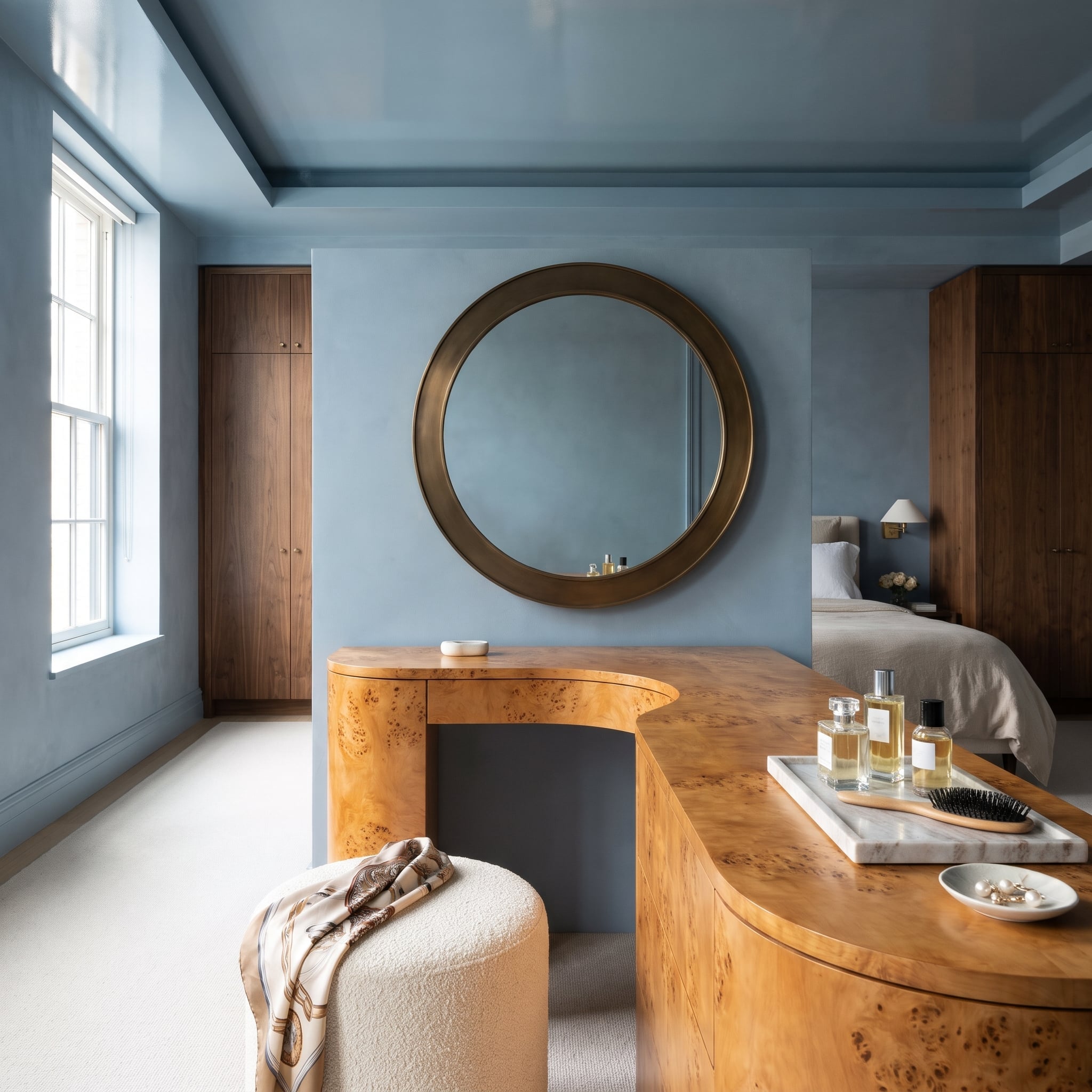
Against saturated blue plaster and lacquer, a honey-colored burl dressing table curves around the edge of a freestanding partition. The rounded drawer bank softens the wall’s emphatic geometry, while an open knee space accommodates a bouclé stool. A bronze-framed mirror adds a vertical accent, and darker straight-grained wardrobes beyond establish another layer of contrast. The vanity does more than supply storage: it gives the dividing wall a purposeful termination, turning an awkward architectural edge into a carefully composed piece of joinery.
25. Someone Took a Sunburst Seriously Enough to Make It a Dining Table
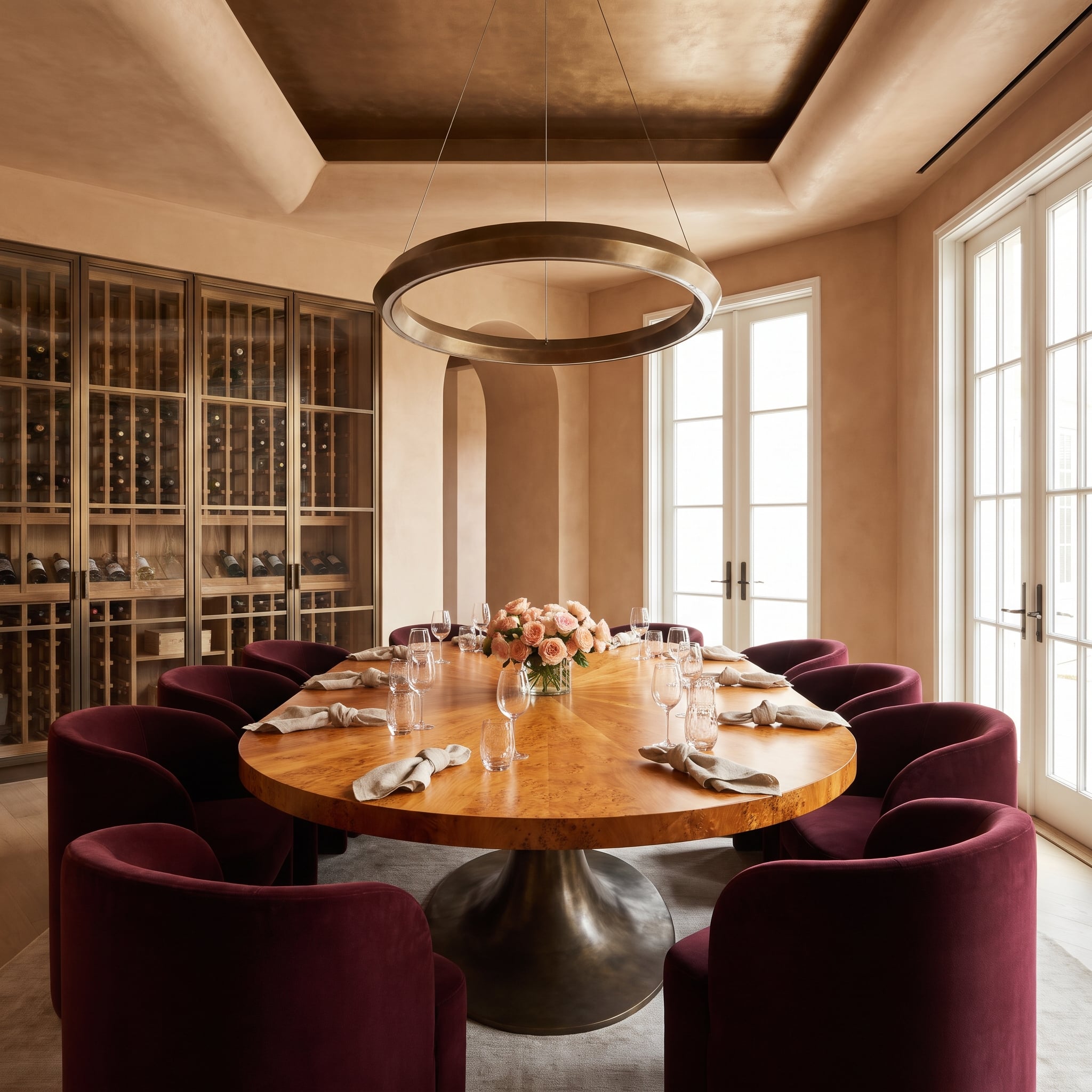
Radially arranged sections of burl veneer transform an oval tabletop into a disciplined sunburst, directing the eye toward a central point rather than allowing the grain to wander unchecked. The technique exploits the difference between the wood’s chaotic figure and the precise geometry of its layout. A bronze pedestal supports the broad top without crowding the chairs, while plum velvet upholstery adds saturated color. The circular brass fixture overhead reinforces the radial composition. Natural irregularity has been turned into something approaching mathematical theater.
When our readers were asked which dining table they would buy, wood won easily at 69%, well ahead of stone and glass at 12% each.
24. Wild Burl Below, Unruffled Cabinets Above
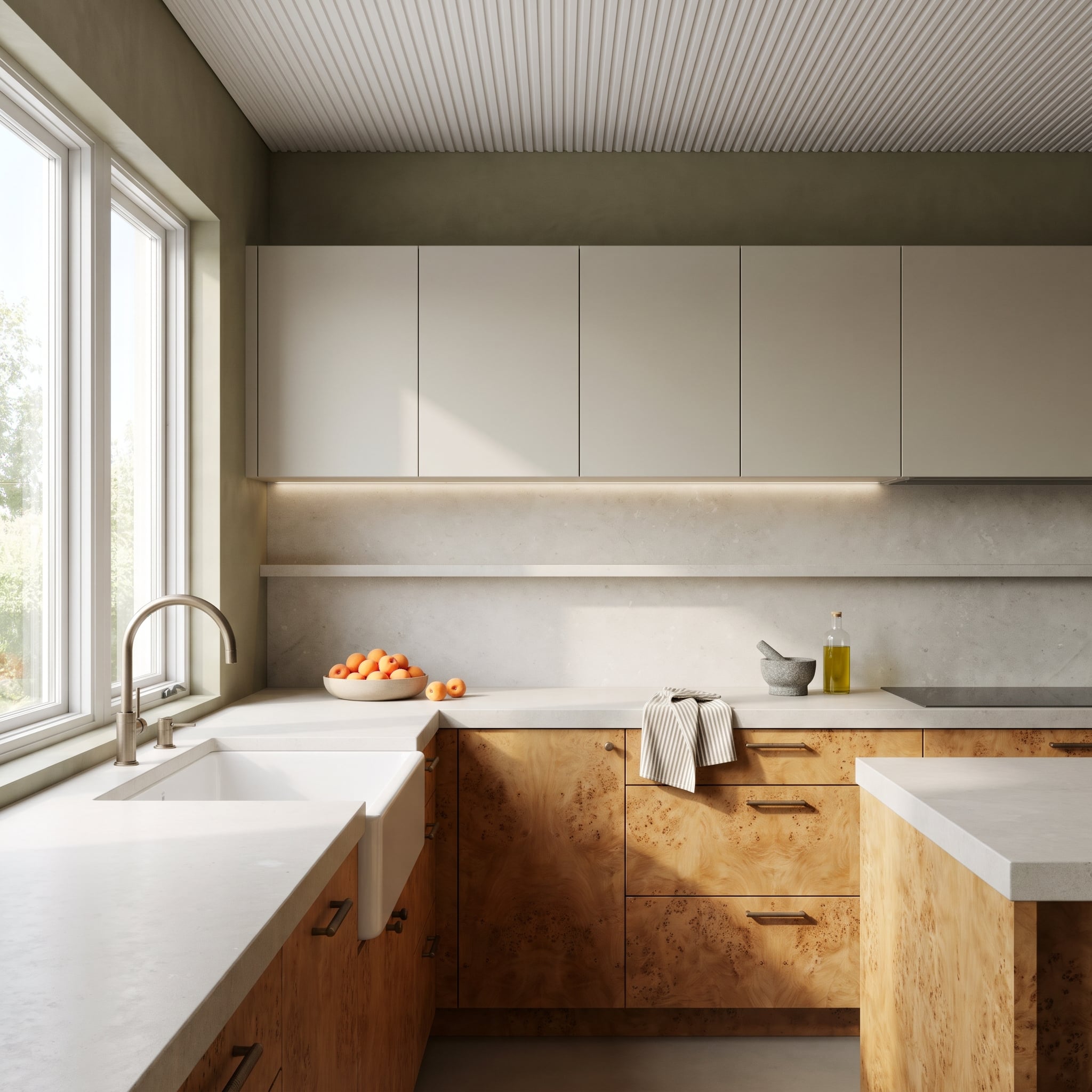
The kitchen divides its personality neatly at countertop height. Below, burl fronts display densely knotted figuring across drawers and cabinet doors. Above, handleless greige cabinetry presents long, uninterrupted planes, with a slim stone backsplash providing a clean horizontal break. A white apron-front sink interrupts the lower run beneath the window, while restrained bronze hardware echoes the wood’s darker markings. This is a useful lesson in visual hierarchy: elaborate grain becomes far more effective when the surrounding joinery resists the temptation to compete.
23. Pale Burl and a Japanese Maple Compete for the Bathroom’s Best Pattern
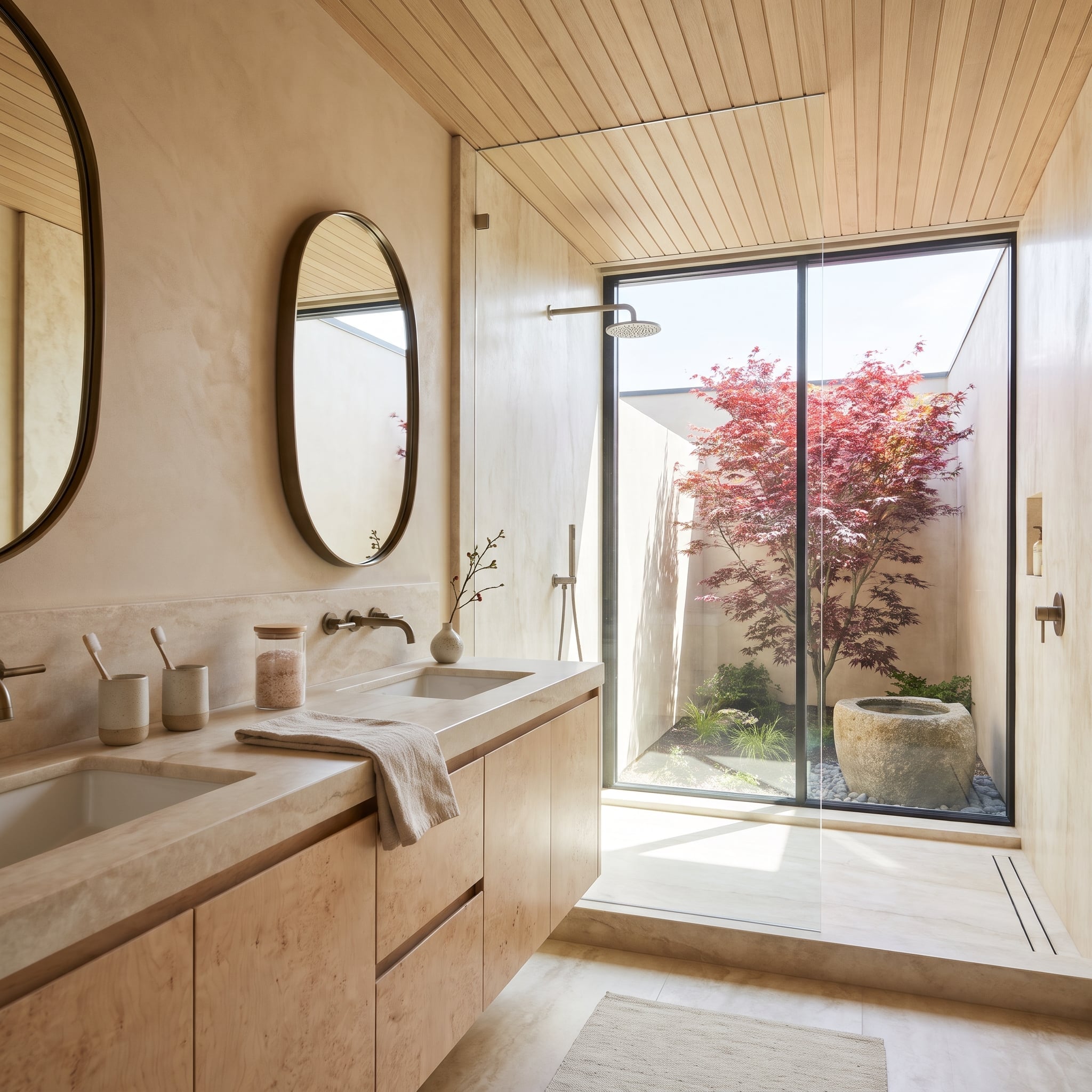
Beyond the shower glazing, a red Japanese maple provides an intricate network of branches and brilliant foliage. Inside, the pale burl vanity offers a subtler botanical counterpoint, its fine knots and flecks echoing the tree’s organic complexity without matching its intensity. Recessed finger pulls leave the drawer fronts uninterrupted, and wall-mounted bronze faucets preserve the substantial stone countertop’s clean edge. The pairing works because the two natural patterns occupy different visual registers: one vivid and expansive, the other delicate and closely observed.
22. This Entrance Lets the Wood Grain Climb the Walls and Cross the Ceiling
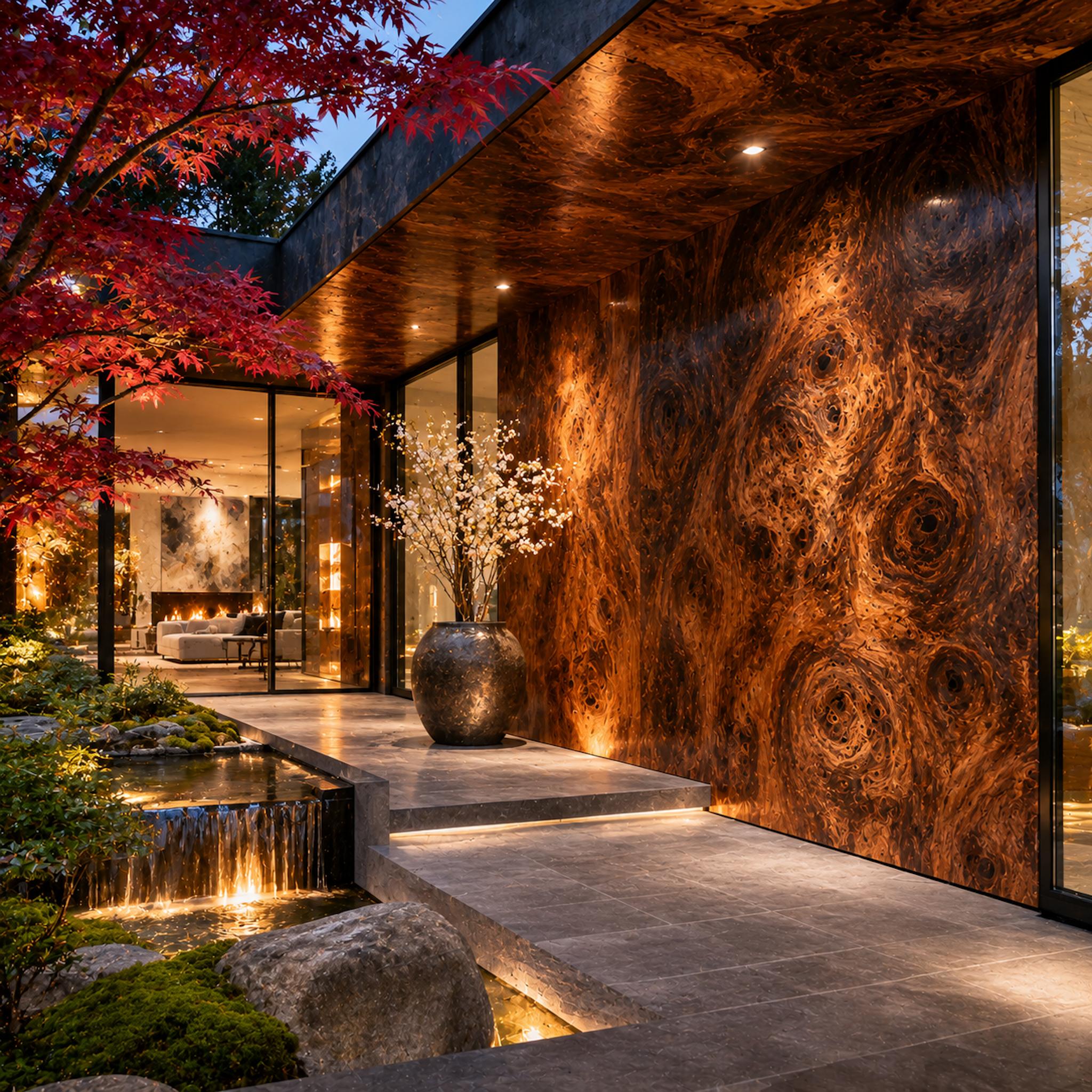
Richly figured burl runs along the sheltered entrance wall and continues overhead, creating an enveloping architectural surface whose knots and whorls seem to expand beyond the building’s edges. Warm recessed lighting exaggerates the depth of the grain, while pale stone paving supplies a cool, disciplined counterweight. A brilliant red Japanese maple rises beside a shallow reflecting pool and planted rock garden. The strongest move is the continuity between wall and canopy: rather than treating wood as decorative cladding on one plane, the design makes it an entire spatial experience.
21. A Wall of Poplar Burl Has a Working Pantry Up Its Sleeve
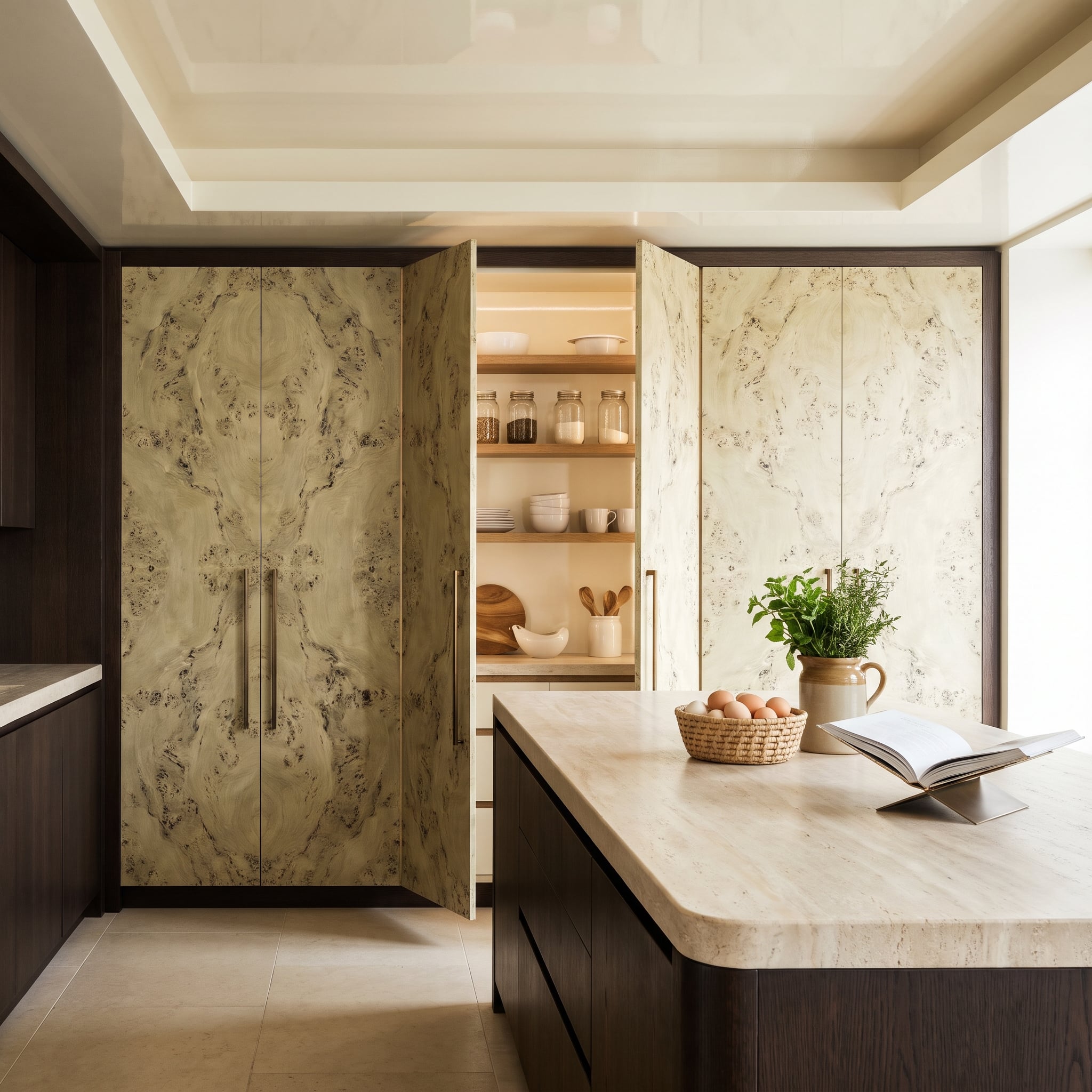
At first glance, the tall poplar burl doors form an almost uninterrupted composition of mirrored grain, their slender bronze handles establishing a regular rhythm. Open the central panels and an illuminated pantry appears, complete with shelves, jars and serving pieces. The contrast between elaborate decorative frontage and practical working storage gives the kitchen its appeal. A dark oak island with a rounded travertine top anchors the foreground. The veneer makes the cabinetry read as architecture, while the opening reveals the thoroughly useful machinery behind the spectacle.
20. A Burl Desk Rests on Two Pieces of Stone That Refuse to Be Polished
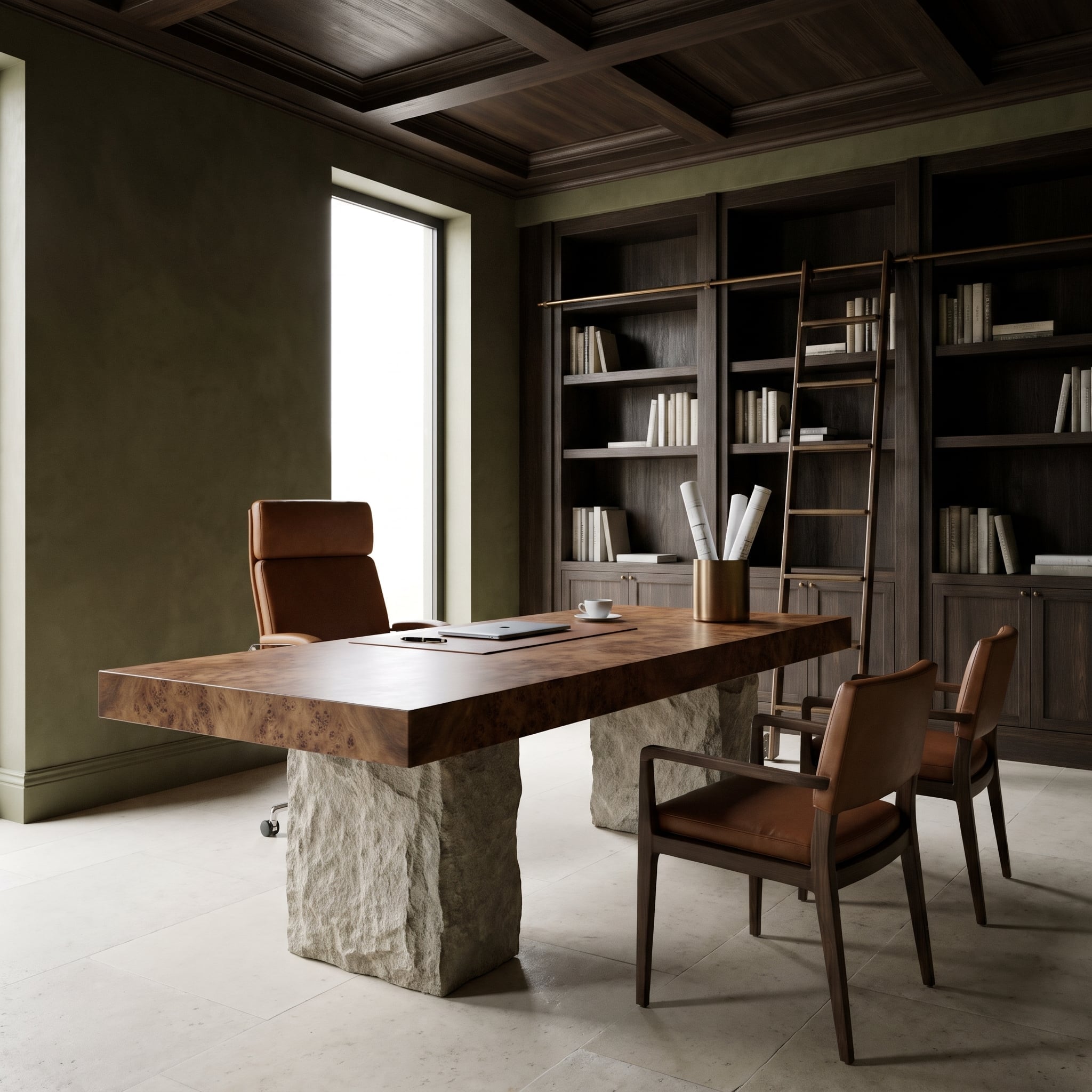
A broad, polished burl desktop spans two rough-split stone pedestals, creating a striking confrontation between precision and geological irregularity. The wood’s glossy surface reveals every knot and eddy, while the stone retains a deliberately fractured appearance. Neither material is subordinate to the other; their differences provide the entire composition. Olive plaster and a coffered ceiling establish a restrained study around the desk. The result has the presence of a sculptural installation, although its broad working surface remains entirely practical.
19. A Burl Bed Borrows Its Curves From the Dunes Overhead
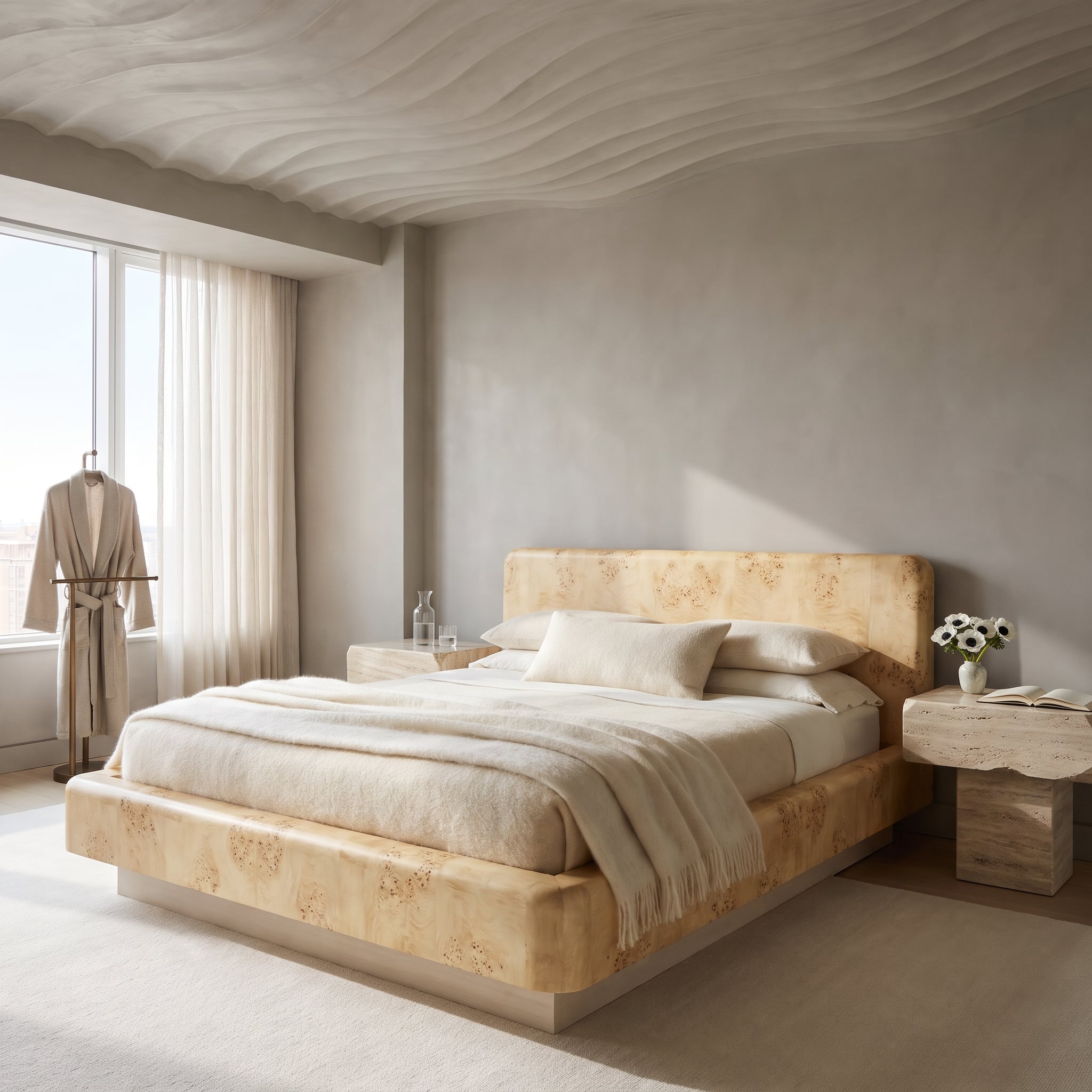
The bed’s pale poplar burl frame wraps around softened corners, creating a continuous-looking wooden enclosure that sits low above a recessed base. Overhead, sculpted plaster undulates like wind-shaped sand, repeating the furniture’s flowing geometry at architectural scale. Rough-edged travertine nightstands provide a necessary interruption, their fractured surfaces resisting the room’s otherwise smooth curves. The design draws its character from three different expressions of nature: intricate timber figure, eroded stone and dune-like plaster. The shared organic language makes the composition coherent without making it predictable.
18. Behind Those Bookmatched Doors, Cocktail Hour Turns Green
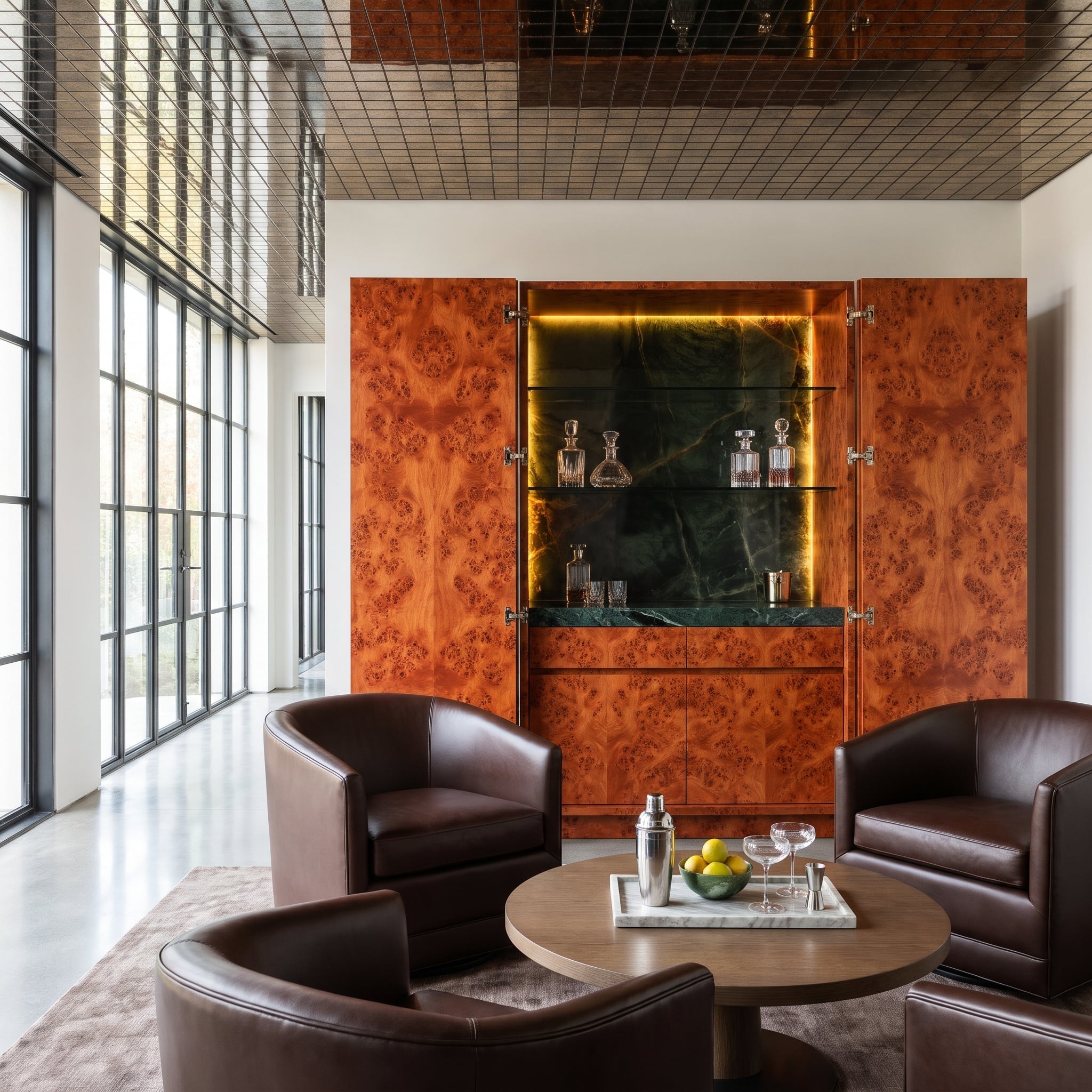
Closed, this cocktail cabinet presents an imposing arrangement of bookmatched burl, its mirrored knots creating an almost kaleidoscopic pattern. Open, the doors reveal a luminous green marble interior with illuminated shelving and glassware. The transition is unusually satisfying: one expressive natural material gives way to another, each with an entirely different kind of figure. Leather seating and a reflective ceiling reinforce the lounge atmosphere. The cabinet succeeds because the reveal is as carefully considered as the exterior, giving the furniture two distinct visual identities.
17. Two Stone Basins, One Floating Slab of Wild Walnut
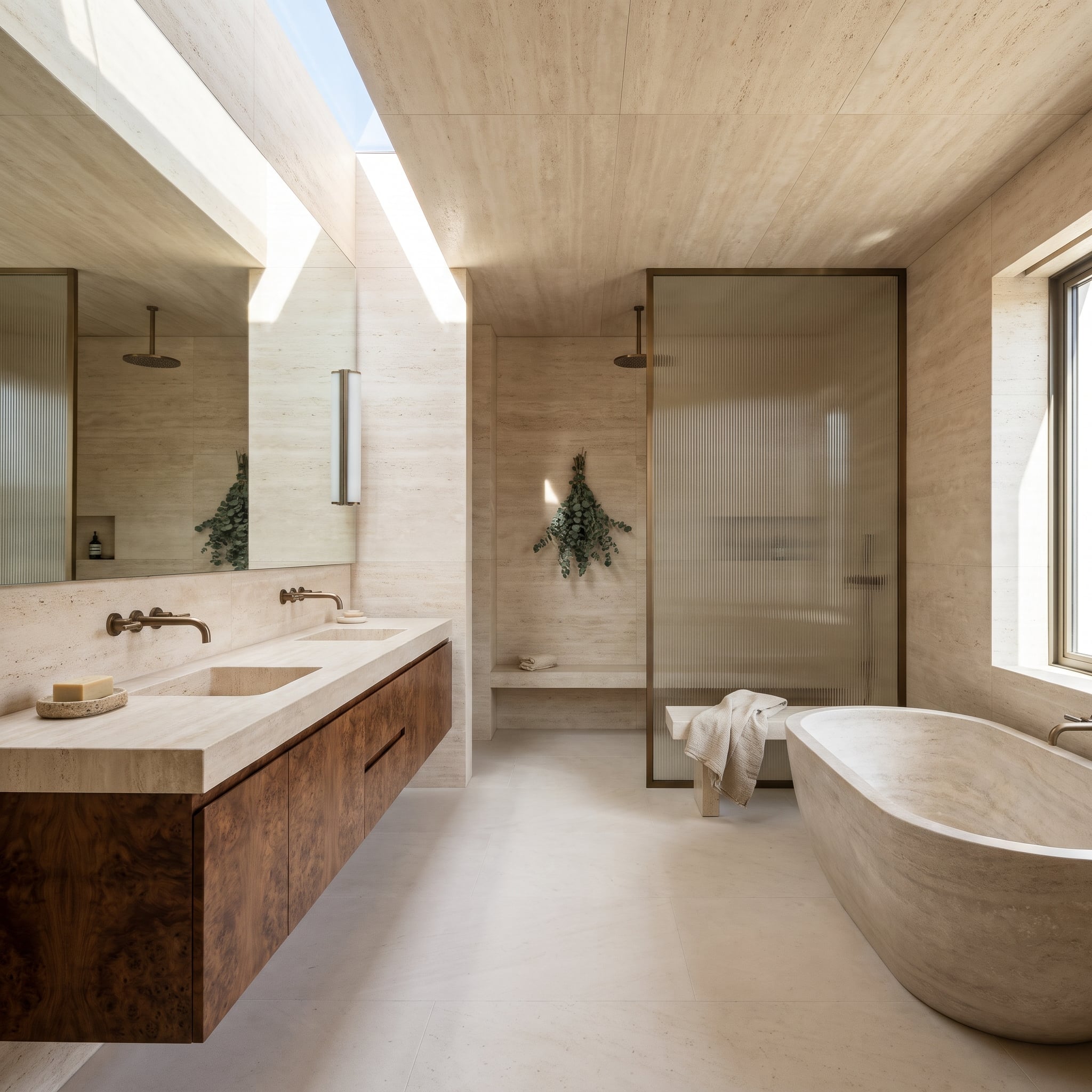
A narrow skylight directs daylight across a thick travertine counter and two carved basins, revealing the stone’s subtle tonal variations. Beneath, a floating walnut burl vanity introduces a dense, dark band of swirling figure against the bathroom’s pale mineral surfaces. The open floor below prevents the substantial cabinet from appearing excessively heavy. Wall-mounted bronze faucets preserve the countertop’s clean geometry. The arrangement depends on a simple but powerful distinction: stone provides the mass, wood supplies the movement, and the space beneath gives both room to breathe.
In our reader polls, 63% said they would install a floating vanity, compared with 28% who would choose a furniture-style one.
16. Burl Climbs the Staircase While Amber Glass Comes Tumbling Down
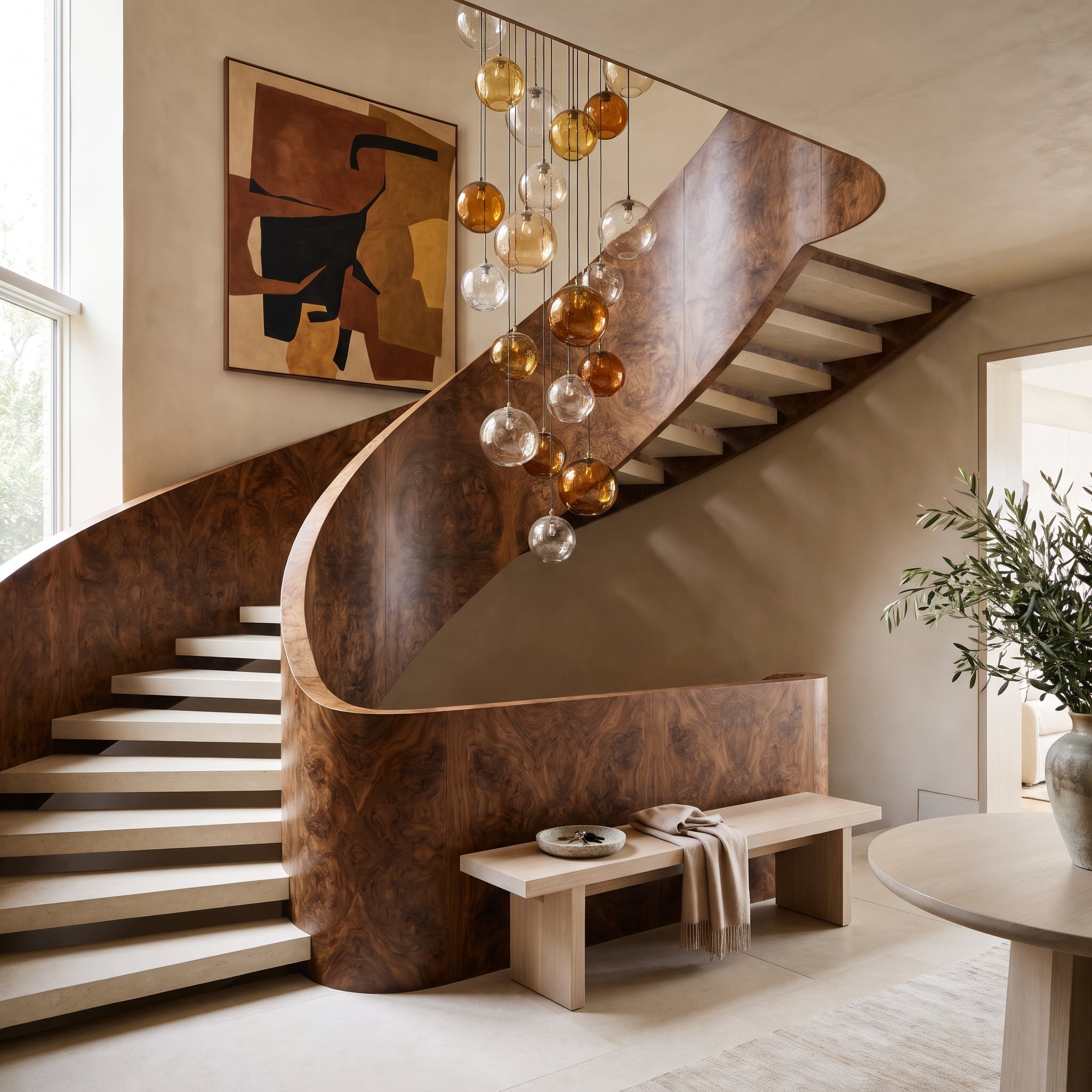
The staircase rises behind a sweeping enclosure of richly figured burl, its curved surface following the ascent like an enormous ribbon of wood. Pale stone treads establish a calmer rhythm, while suspended amber glass pendants cascade through the central void. The contrast between solid architectural mass and delicate hanging glass gives the space much of its drama. A simple pale oak bench at the foot of the stairs provides a useful counterpoint. The staircase is no longer merely a route between floors; its enclosure has become the principal sculptural element of the interior.
15. Mint Plaster, Blush Art and a Burl Sideboard That Refuses to Be Subtle
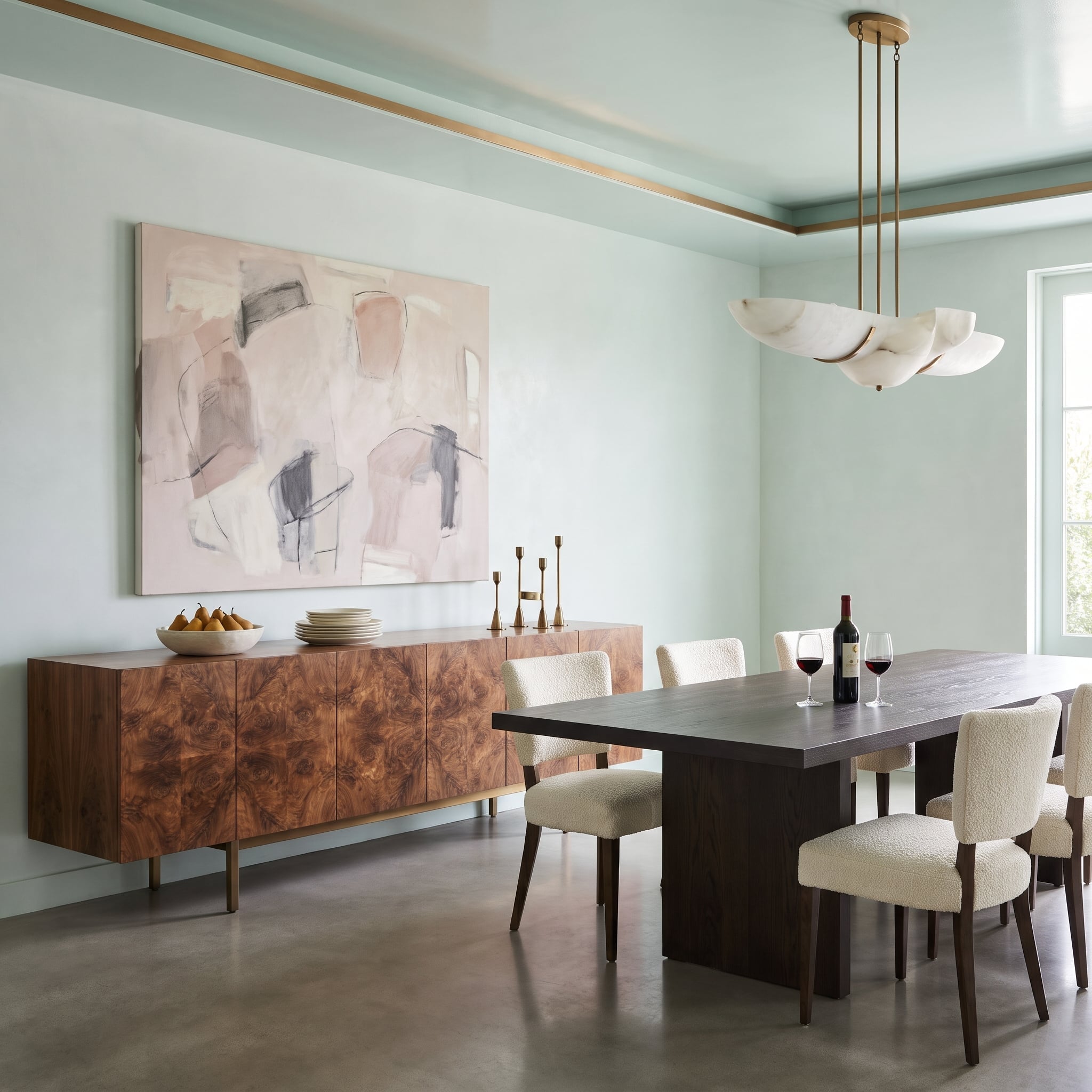
Pale mint plaster creates an unexpectedly fresh backdrop for a long amber burl sideboard, whose restless figure contrasts with the room’s otherwise measured surfaces. An espresso-toned dining table introduces a darker, straighter wood grain, while bouclé chairs soften the geometry. Overhead, an alabaster pendant contributes a cloudy mineral pattern; a blush canvas adds another restrained color note. The combination avoids the predictable brown-on-beige treatment often associated with heavily figured timber. Cool plaster and delicate pink give the wood a decidedly contemporary setting.
14. A Burl Dressing-Room Island Has a Secret Worth Opening
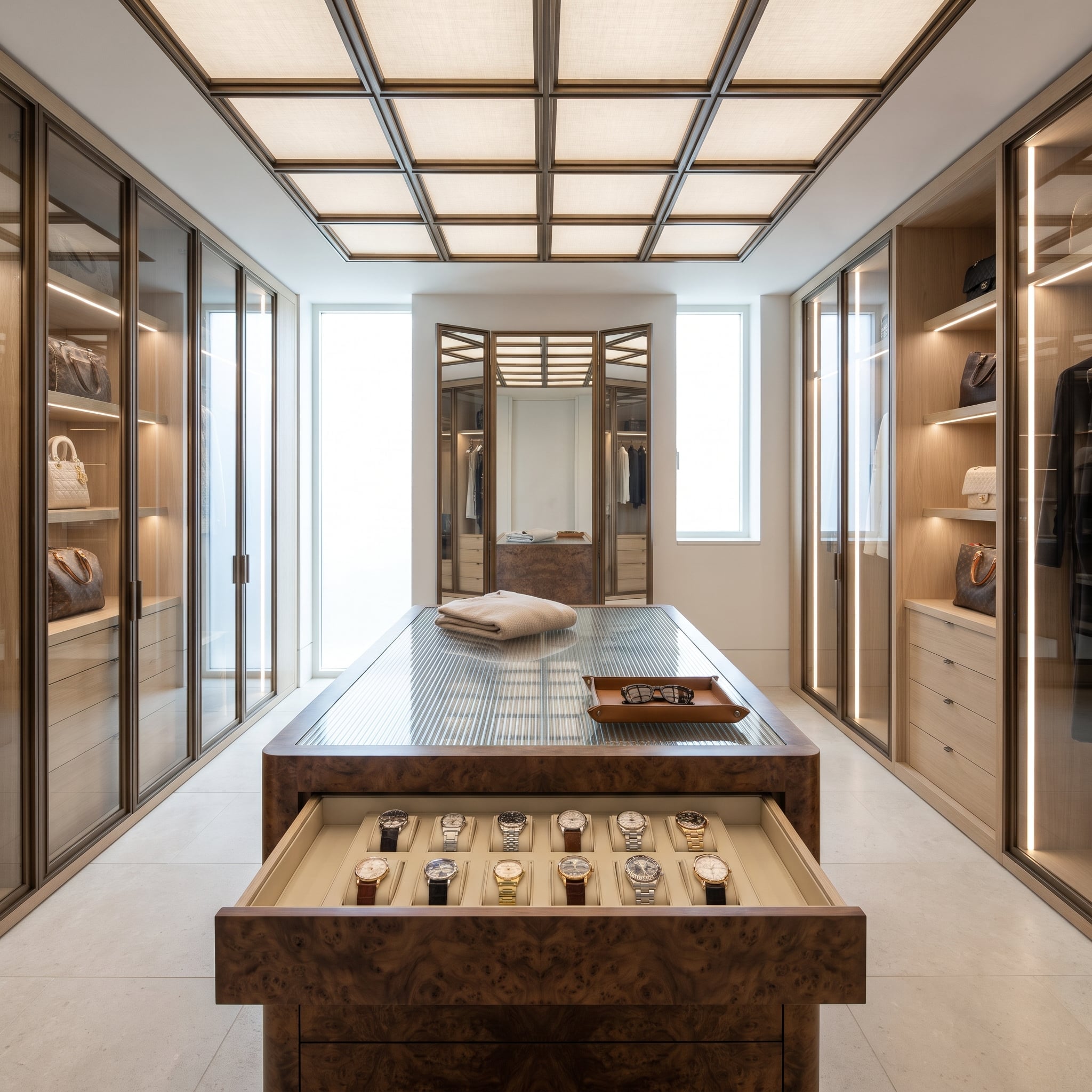
Rounded burl fronts wrap a central dressing-room island beneath a reeded-glass top, creating a pleasing collision between organic figuring and disciplined linear texture. The glass diffuses reflections from the illuminated ceiling, while the veneer carries the richer pattern around the cabinet’s curved edges. An open drawer reveals watches arranged on pale cushions, turning everyday storage into a discreet display. Bronze-framed wardrobes complete the tailored setting. The island borrows the precision of fine jewelry cabinetry without sacrificing the generous proportions of a substantial piece of furniture.
13. Two Towers of Bookmatched Burl Give the Fireplace Some Competition
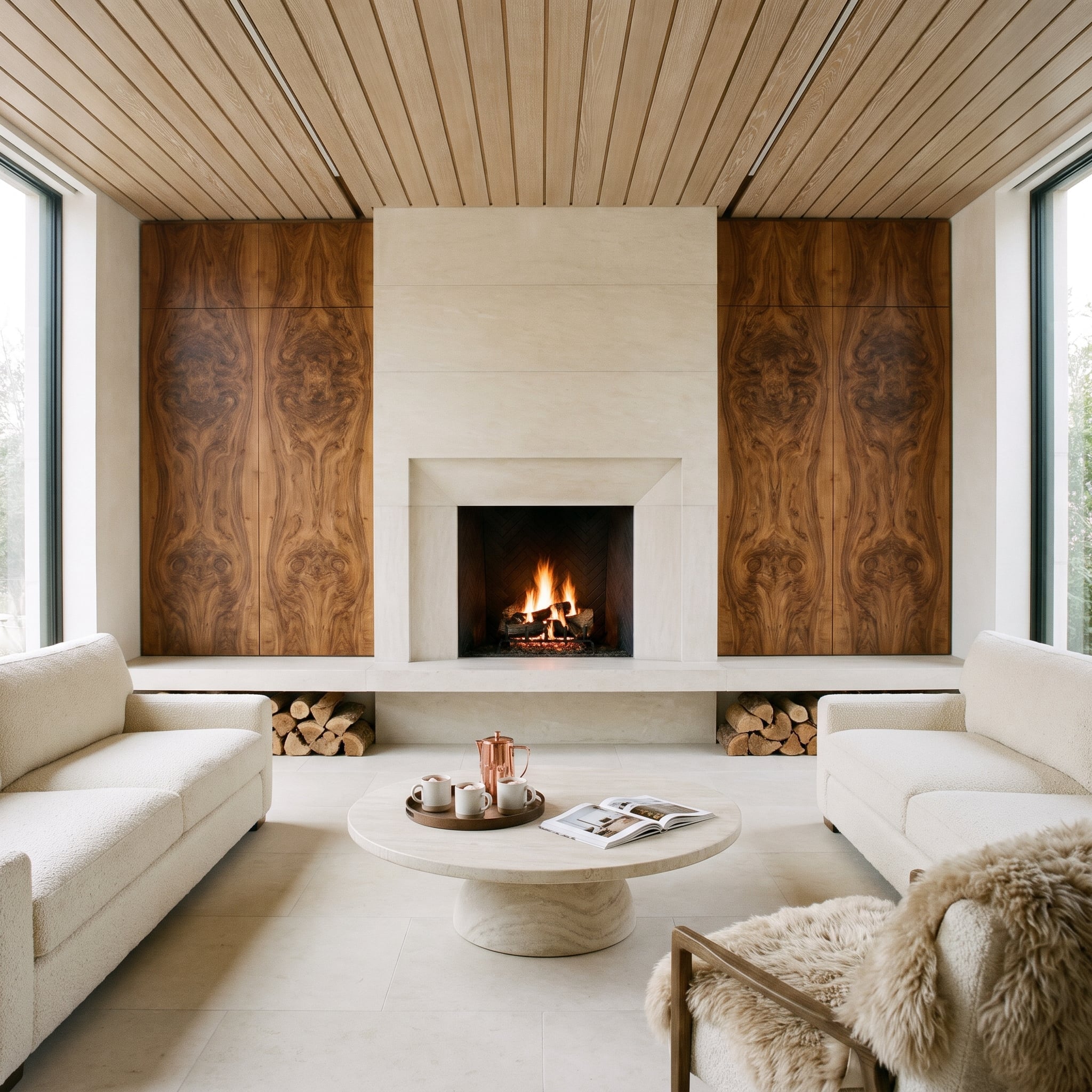
Tall bookmatched walnut panels flank the fireplace, their mirrored figure forming two imposing vertical compositions. A continuous limestone ledge cuts across the base, introducing a strong horizontal line above open firewood cubbies. The stacked logs contribute rough, linear texture beside the polished veneer, while slatted oak overhead adds a third expression of timber. The success lies in the hierarchy: figured burl supplies the ornament, limestone establishes the architectural order, and the firewood introduces a deliberately unrefined note.
12. A Curved Burl Banquette Makes Breakfast Feel Like a Private Club
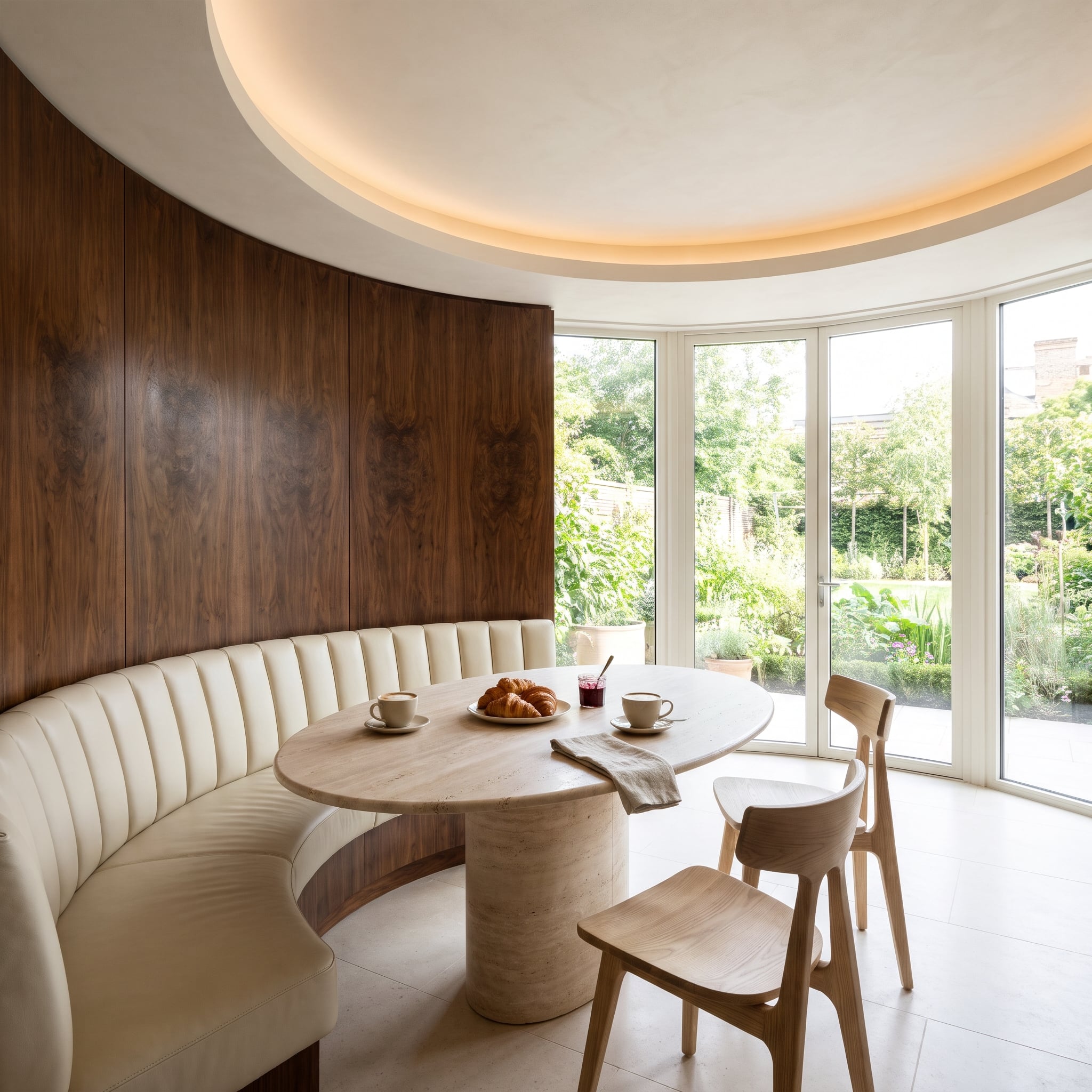
Walnut veneer sweeps around a rounded wall behind a channel-tufted cream banquette, giving the breakfast area the intimacy of a beautifully appointed restaurant booth. The upholstery’s vertical channels counter the wood’s horizontal enclosure, while a travertine pedestal table leaves the center uncluttered. Burl detailing along the recessed bench base strengthens the sense of integrated craftsmanship. Every major element follows the same generous curve, avoiding the abrupt junctions that can make built-in seating feel awkward. The result is compact, sociable and architecturally assured.
11. Four Wardrobe Doors Turn Veneer Matching Into Wall-Sized Art
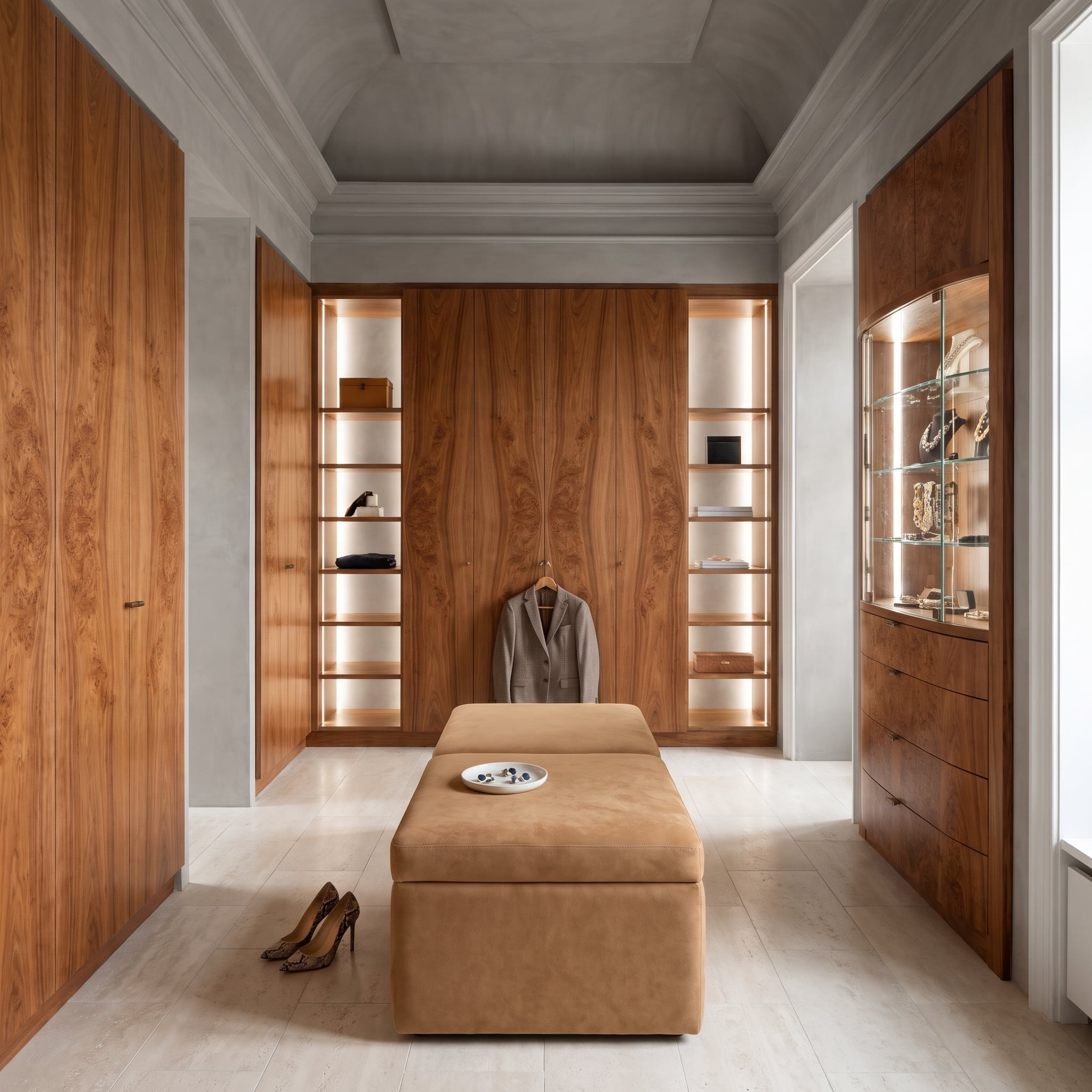
Four tall wardrobe doors form an expansive field of matched burl, their repeated knots and mirrored shapes creating a composition that changes with every panel. Illuminated display niches flank the cabinetry, breaking up the wall’s considerable mass and adding depth to the dressing room. A simple suede ottoman provides a quiet center, while closed storage beneath the displays keeps smaller objects out of sight. The architectural achievement is scale: the wardrobe reads less like a collection of doors than a single, carefully orchestrated surface.
10. A Shaft of Sunlight Makes Walnut Burl Look Almost Liquid
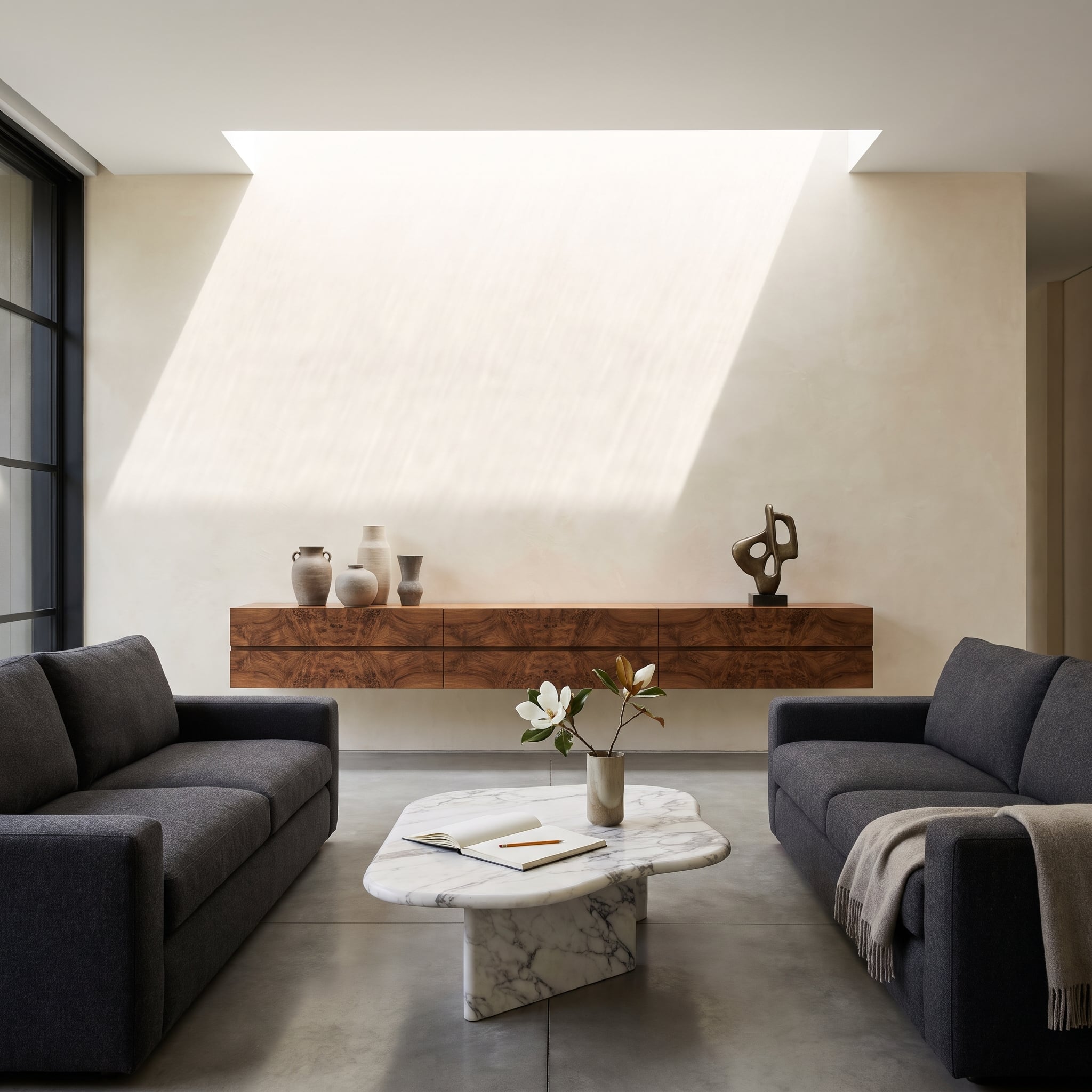
A recessed skylight throws a sharp diagonal of daylight across pale plaster, establishing the room’s strongest architectural gesture. Below, a walnut burl credenza sits in softer illumination, where its deep amber figuring appears almost liquid against the surrounding stone. Facing charcoal sofas create a restrained seating arrangement, allowing the cabinet and changing light to command attention. The design demonstrates how effective natural illumination can be without falling directly on the featured material. The bright wall creates the contrast that makes the darker wood feel richer.
9. Brass Reading Lamps Make Themselves at Home on a Burl Headboard
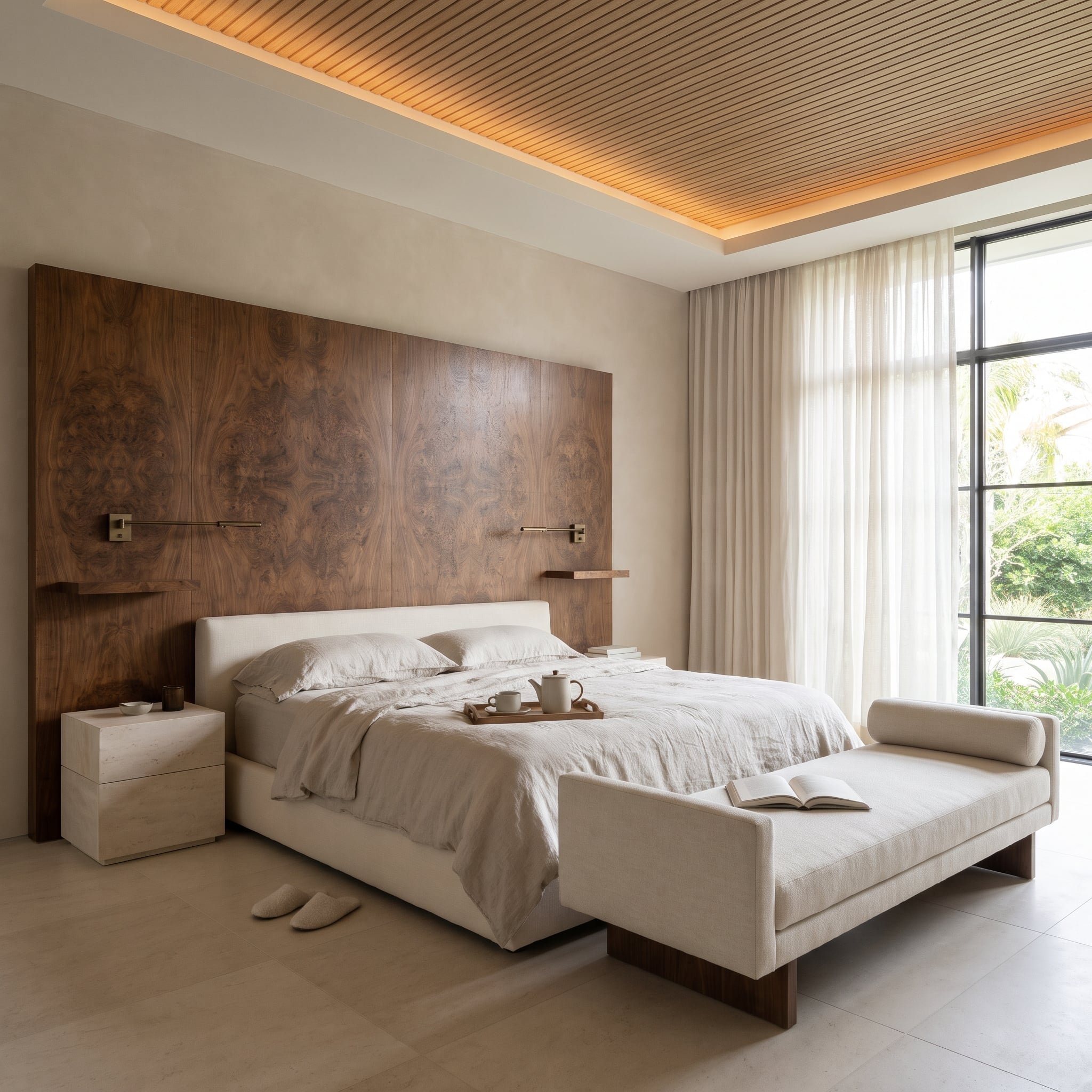
A broad walnut burl headboard extends beyond the bed to accommodate brass swing-arm lamps and slim integrated shelves. The symmetry of the fittings establishes order across the wood’s highly irregular figuring, while the shallow ledges reduce the need for conventional bedside furniture. A pale travertine cube introduces a deliberately blunt geometric counterpoint. The headboard succeeds as a piece of integrated joinery: lighting, storage and decorative veneer occupy the same architectural plane, giving the bedroom a carefully resolved focal wall.
8. Backlit Onyx Meets Burl in a Bathroom With No Shortage of Drama
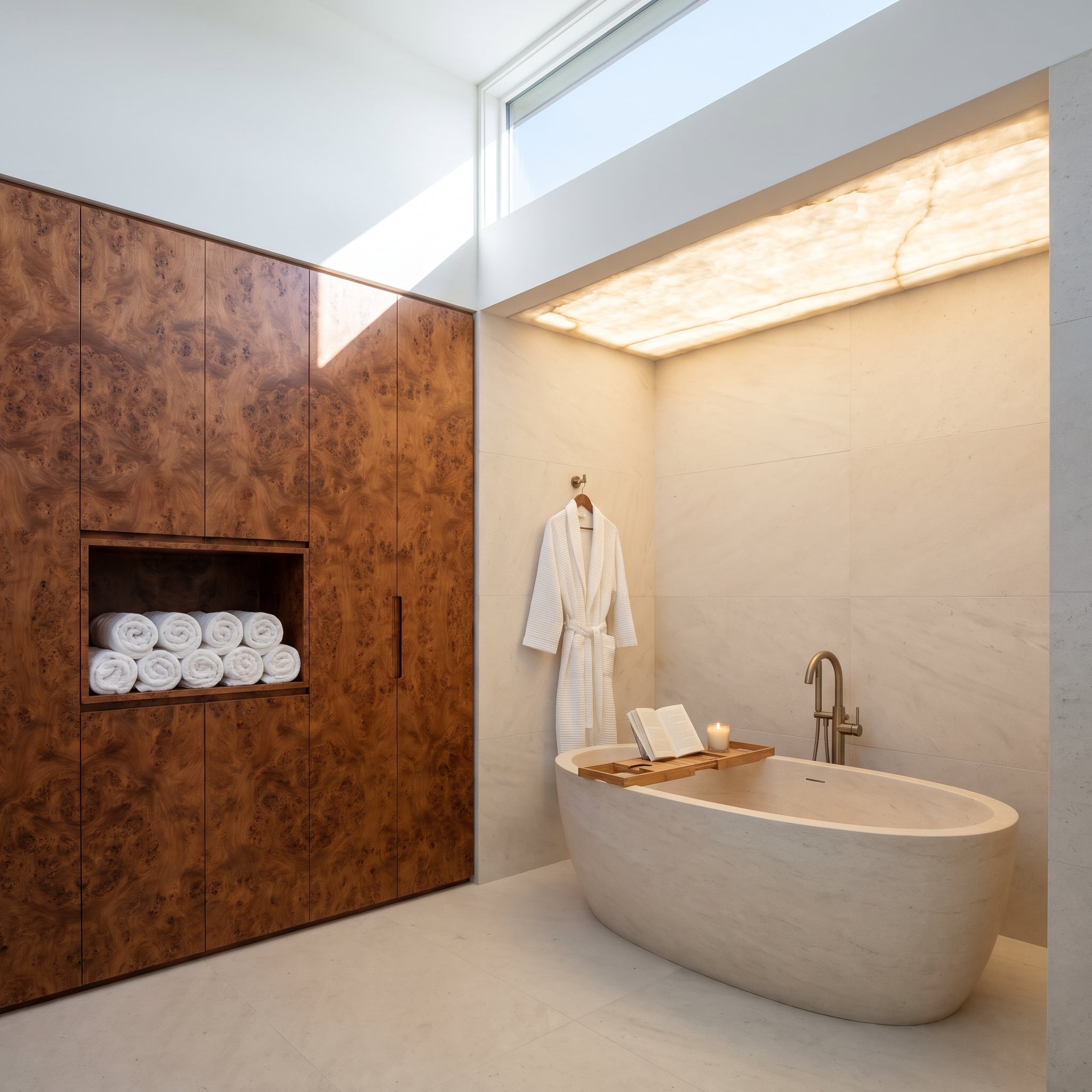
The bathtub occupies a luminous onyx alcove, its broad mineral veining amplified by concealed backlighting. Across the room, a wall of burl cabinetry introduces a completely different natural pattern, dense with knots and tightly wound figuring. A single open niche of rolled towels interrupts the storage wall, giving the eye a brief rest. Cream stone flooring and brushed brass fixtures connect the competing surfaces. Rather than relying on one luxurious material, the bathroom stages a conversation between two, each extravagant in its own way.
7. The Bathroom Door Has Disappeared Into the Walnut Wardrobes
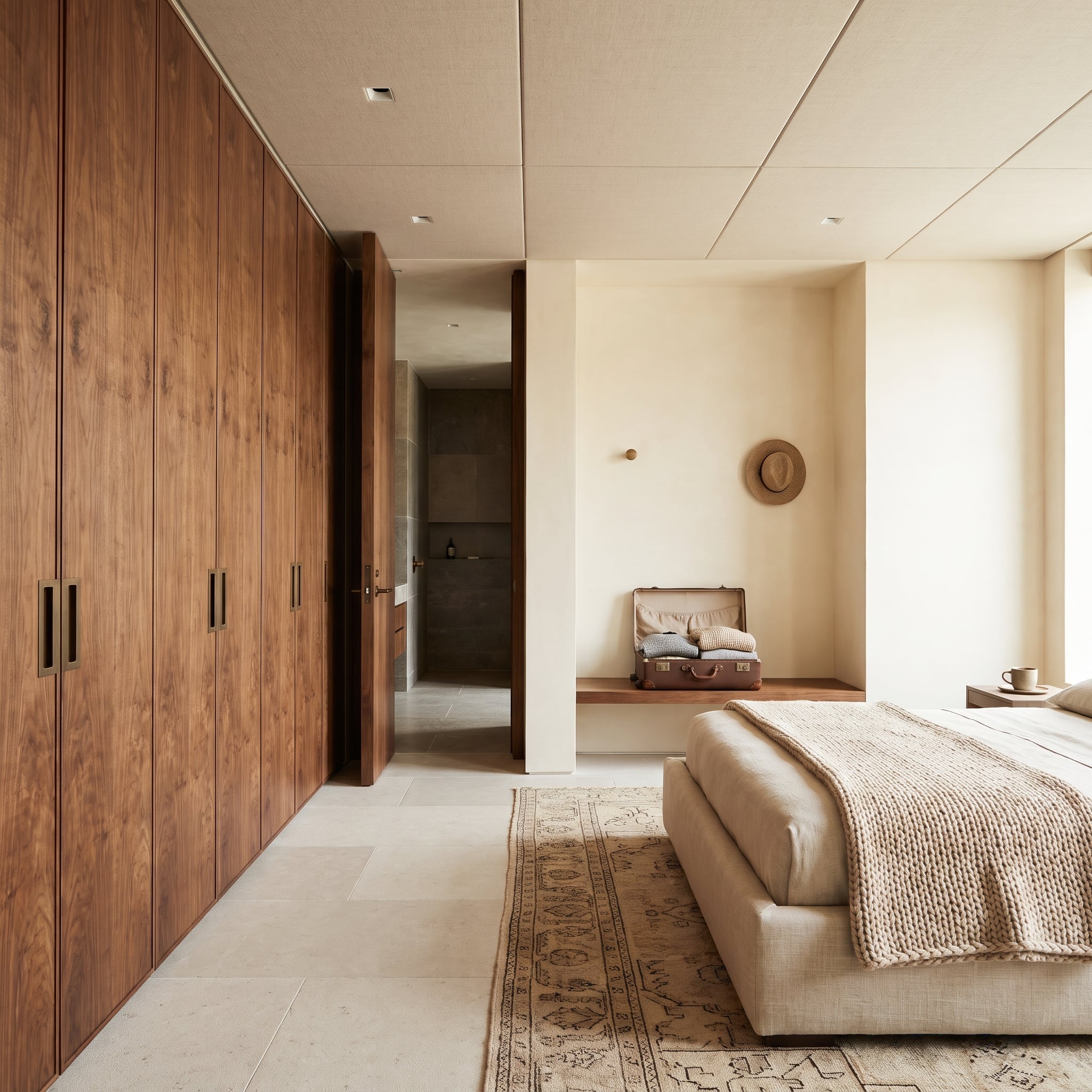
A continuous run of ceiling-height walnut wardrobes turns the bedroom wall into an expansive display of figured timber. One panel conceals the bathroom entrance, using matching veneer and carefully aligned proportions to maintain the composition. Slim bronze hardware establishes a measured rhythm across the doors, while a simple plaster niche opposite provides a quieter architectural counterweight. Concealed doors are often treated as minimalist tricks; here, the technique serves a more decorative purpose, preserving the uninterrupted sweep of the wood’s elaborate grain.
6. An Upper-Level Library Finds Room for Burl, Brass and a Little Restraint
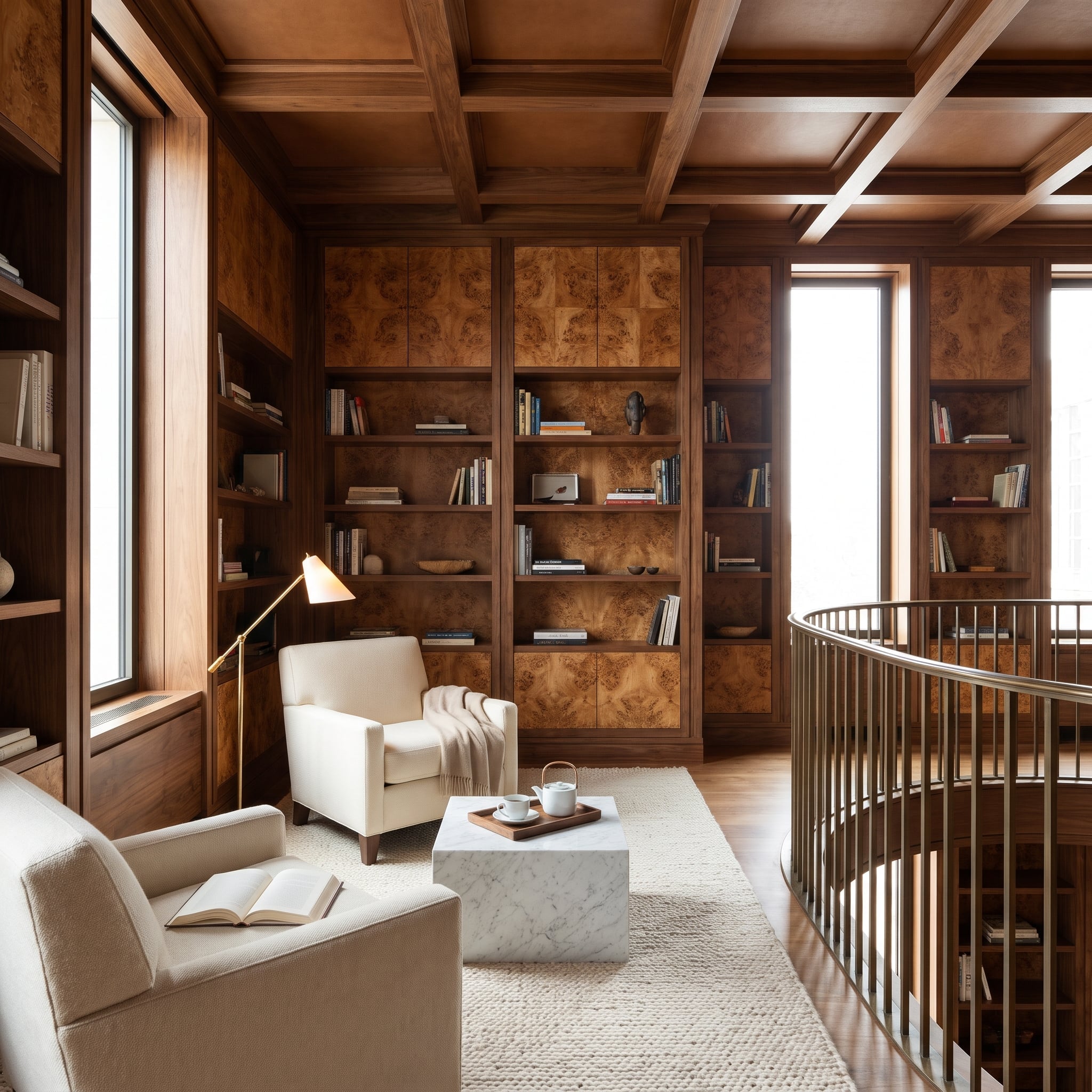
Figured burl cabinet doors anchor the ends of a built-in library, framing open shelves that deliberately resist overcrowding. A brass balustrade follows the adjacent stairwell, while the coffered walnut ceiling introduces a straighter, more disciplined grain overhead. Cream chairs and a pale marble cube soften the room’s center. The composition works through controlled variation: ornate veneer occupies selected panels, linear walnut establishes the architectural framework, and metallic detailing provides a precise finishing note. Nothing needs to compete for the entire room.
5. A Ribbon of Fire Separates Floating Burl From Travertine Below
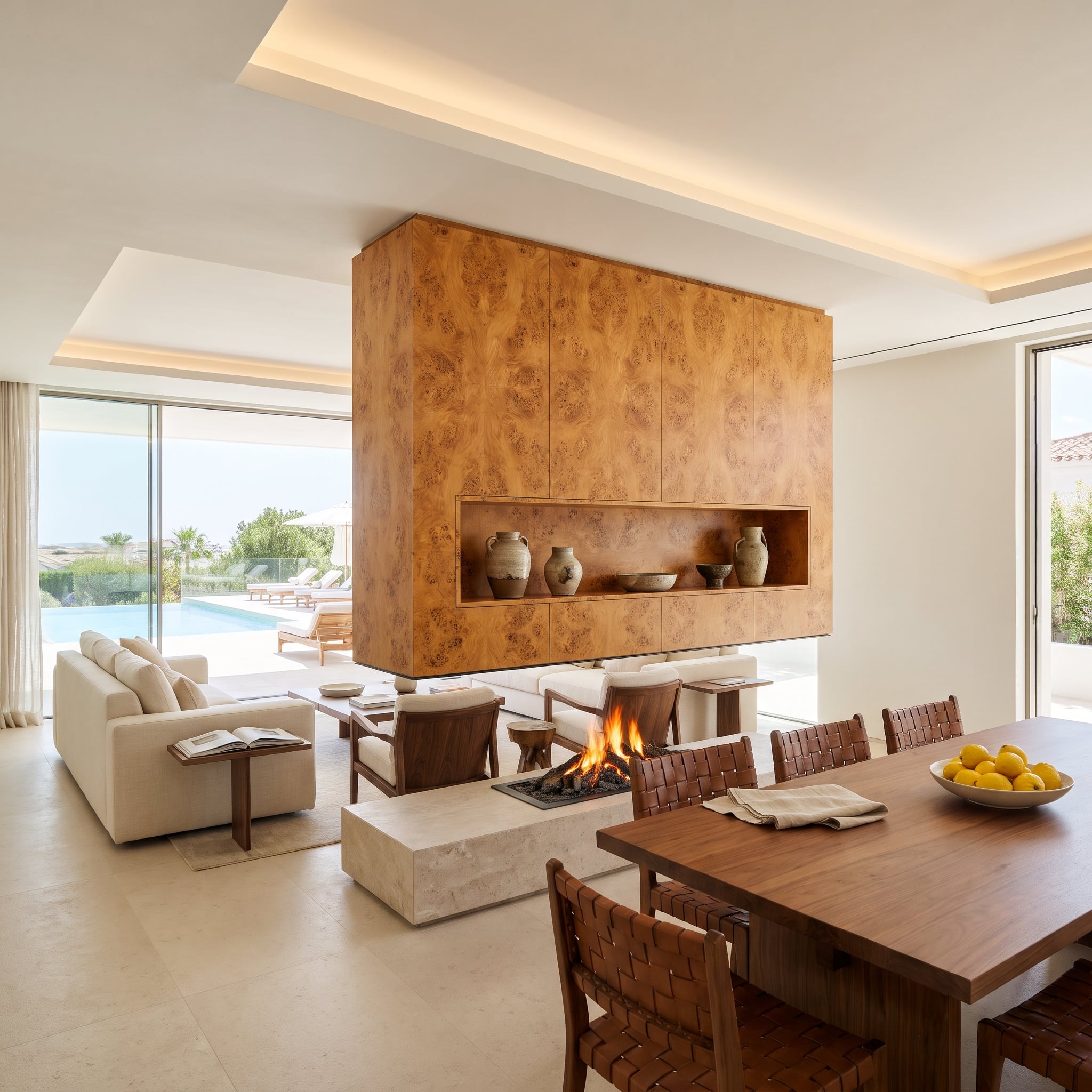
Between living and dining areas, a substantial burl-clad volume appears suspended above a long horizontal fireplace. The flame creates a brilliant separation between dark, intricately figured wood and the travertine base beneath, giving the upper mass an unexpected sense of weightlessness. The two-sided arrangement allows the fireplace to serve both spaces while maintaining a degree of visual division. Rather than treating the hearth as a conventional opening in a wall, the design uses fire as an architectural joint between contrasting materials.
4. A Sculptural Burl Room Divider Makes the Open Floor Plan Behave Differently
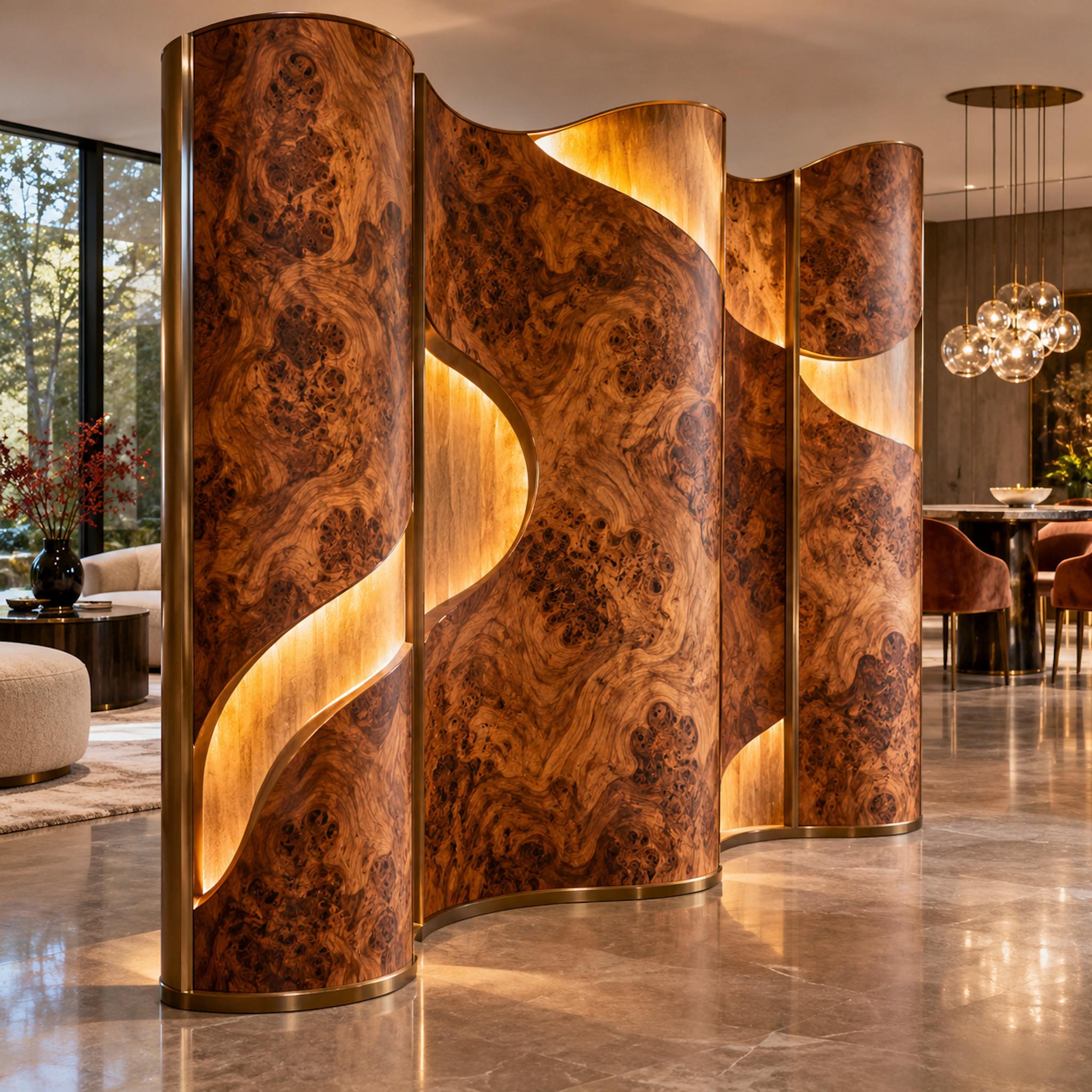
Four towering curved panels form a sculptural screen between living and dining areas, their walnut burl surfaces crowded with intricate whorls, knots and amber figure. Bronze edging follows the changing silhouettes, while illuminated openings cut broad ribbons through the wood. The arrangement screens selected views without closing off either space, producing a sequence of changing compositions as the observer moves around it. The distinction matters: this is not decorative timber placed in an open room, but an architectural intervention that reshapes how the room is experienced.
3. A Record Player Gets Its Own Burl-Framed Stage
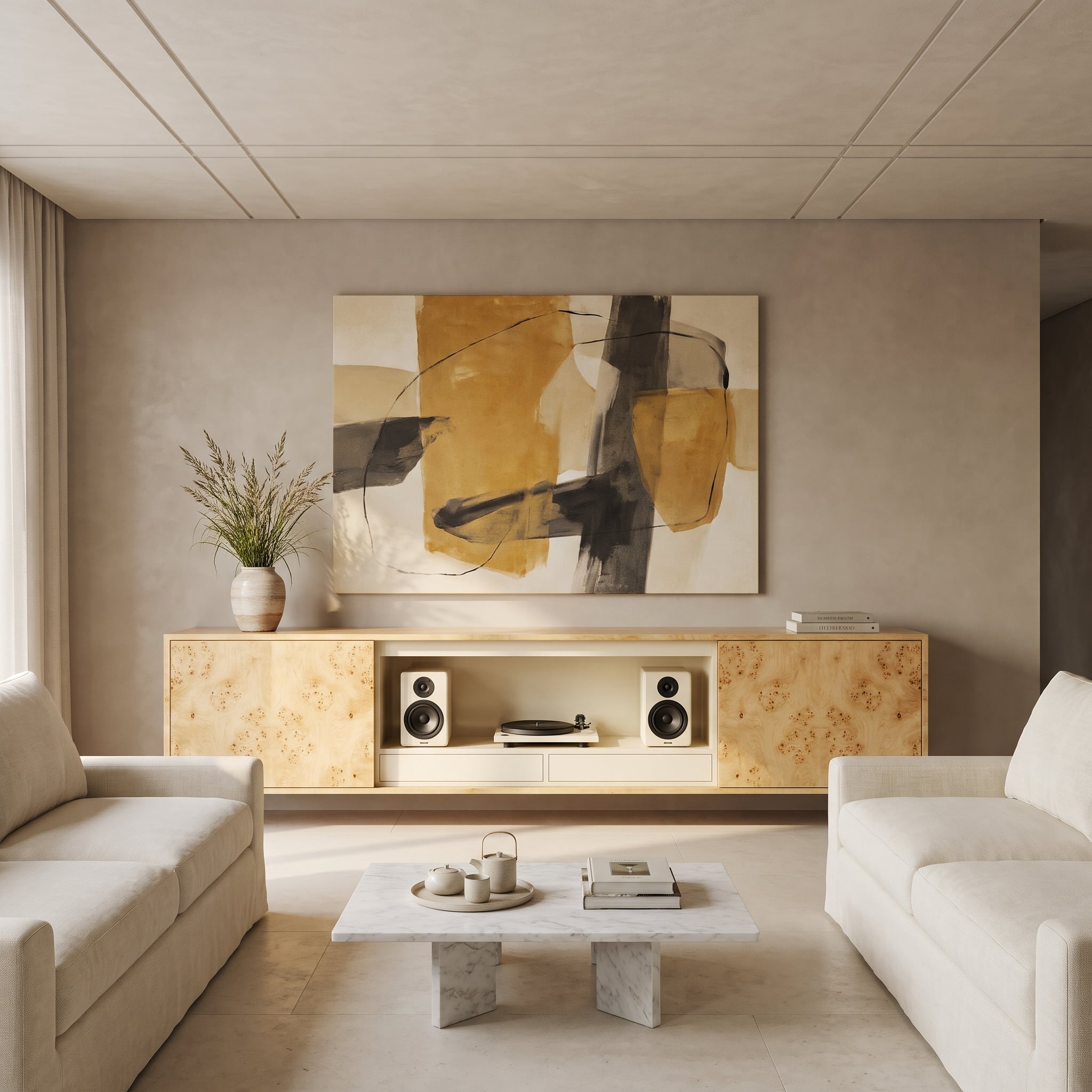
A floating credenza reserves its richest burl veneer for two doors flanking a cream-colored equipment niche. The turntable and white speakers introduce clean, familiar shapes against the wood’s densely knotted figure, while an ochre painting reinforces the cabinet’s warm palette. Opposing sofas and a marble coffee table complete the listening area. Elevating the credenza above the limestone floor gives the long piece a lighter silhouette. The arrangement celebrates the record player without allowing the technology to dominate the furniture.
2. One Burl Pivot Door Interrupts an Entire Room of Travertine
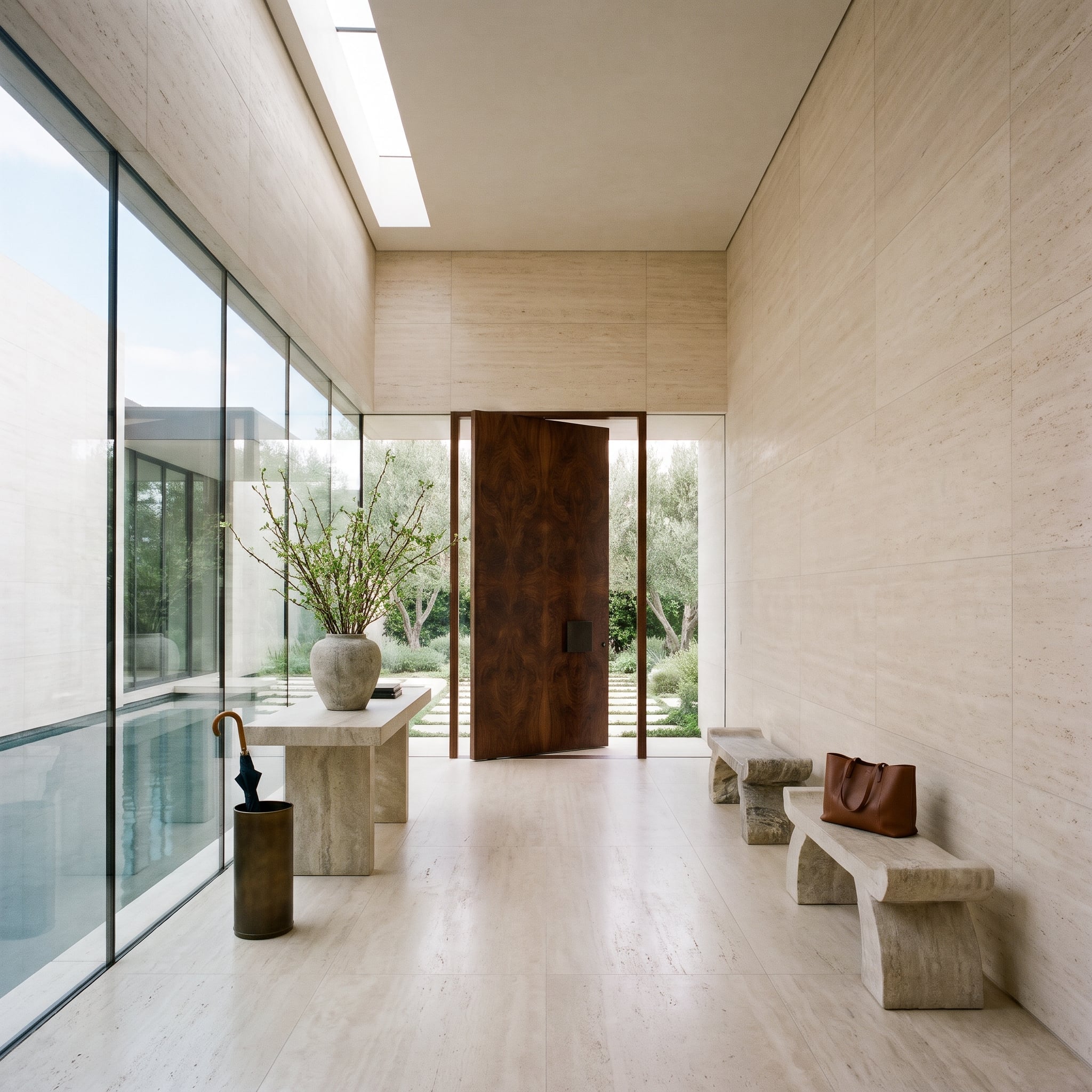
Pale travertine covers the surrounding walls and floor, establishing a nearly continuous mineral envelope. Against that disciplined background, a single bookmatched burl pivot door becomes an extraordinary interruption, its mirrored knots and swirling figure commanding the entire opening. The pivot mechanism allows the panel to occupy the space as a distinct architectural object when open, framing glimpses of olive trees beyond. A restrained dark surround sharpens the contrast between timber and stone. The design needs no additional ornament: one beautifully figured door supplies more than enough.
1. One Monumental Burl Coffee Table Takes Over a Travertine Conversation Pit
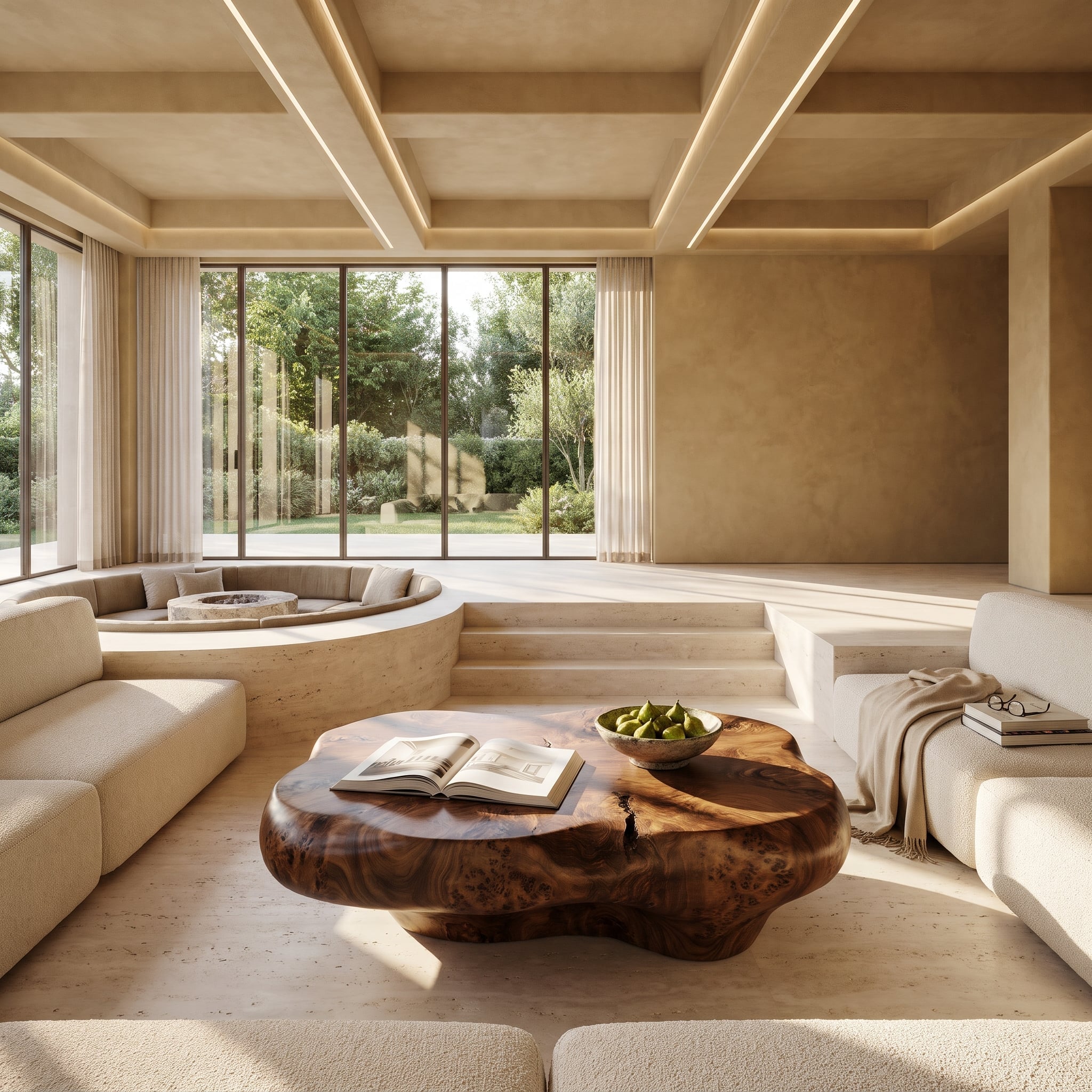
Stepped travertine, cream bouclé seating and pale plaster create an almost monochromatic conversation pit, every surrounding surface carefully composed. At its center sits an enormous dark burl coffee table, its softened outline resembling a river-worn boulder. A dramatic split cuts through the polished surface like a geological fault, interrupting the densely swirling grain with a rugged, irregular edge. The contrast is magnificent: an immaculate architectural setting built around a piece of wood that looks as though nature had the final say.
Asked which coffee table they would buy, Home Stratosphere readers picked solid wood most often at 44%, ahead of upholstered at 35% and glass at 13%.