🔥 Would you like to save this?
Rustic is the only kitchen style that gets better as it wears out. Every other look in the house is fighting entropy — the gloss that scratches, the white grout that stains, the handleless door that shows every fingerprint. Rustic is the one that was designed to absorb all of it, which is why it has outlasted every trend that was supposed to bury it.
Below are thirty rustic kitchens, running from the heaviest stone-and-fire rooms through timber and metal, into the ones that use colour, and finishing light. Twenty-eight of the thirty are photographs of real rooms. What connects them is a much smaller set of decisions than the variety suggests.
In order to come up with the very specific design ideas, we create most designs with the assistance of state-of-the-art AI interior design software. Also, assume links that take you off the site are affiliate links such as links to Amazon. this means we may earn a commission if you buy something.
What actually makes a kitchen read as rustic
It is not the wood. Plenty of kitchens are full of timber and read as contemporary, or Scandinavian, or simply beige. What separates rustic from all of them is that the materials are allowed to show their own history — and that almost always comes down to two of them arriving together.
Carry stained or reclaimed timber as a primary material
Carry stone — and most of those carry both at once
Split almost evenly between grand and intimate rooms
Two heavy materials, not one. Timber appears in nineteen of these thirty kitchens and stone in eighteen, and the overlap is most of both. A timber-only kitchen reads as a cabin; a stone-only kitchen reads as a cellar. The style lives in the contrast between them — one warm and grained, one cool and mineral — and almost every room here is built on that single pairing.
Something has to be genuinely old, or genuinely rough. The most reliable failure in this style is manufactured distressing. Real reclaimed timber wears unevenly: heavier at the edges, around old fixings, on one face and not the other. Factory distressing is even, and the eye catches it instantly even when it cannot say why. One authentically unworked surface will carry a whole room.
The metal is warm, and usually copper. Where these kitchens use metal, it is overwhelmingly copper or aged brass rather than chrome or stainless. Copper is the only common kitchen metal that visibly ages instead of merely tarnishing, which puts it on the same side of the argument as everything else in the room.
It divides almost exactly in half. Fourteen of these rooms are grand and dramatic; thirteen are small and cosy. That split is the most useful thing in the data, because the two halves want opposite things. Lodge rustic needs scale, height and oversized fittings. Cabin rustic needs the opposite, and shrinking one or inflating the other is how this style goes wrong.
30 rustic kitchens
Stone and fire first · lightest last
1. The Fire Is the Floor Plan
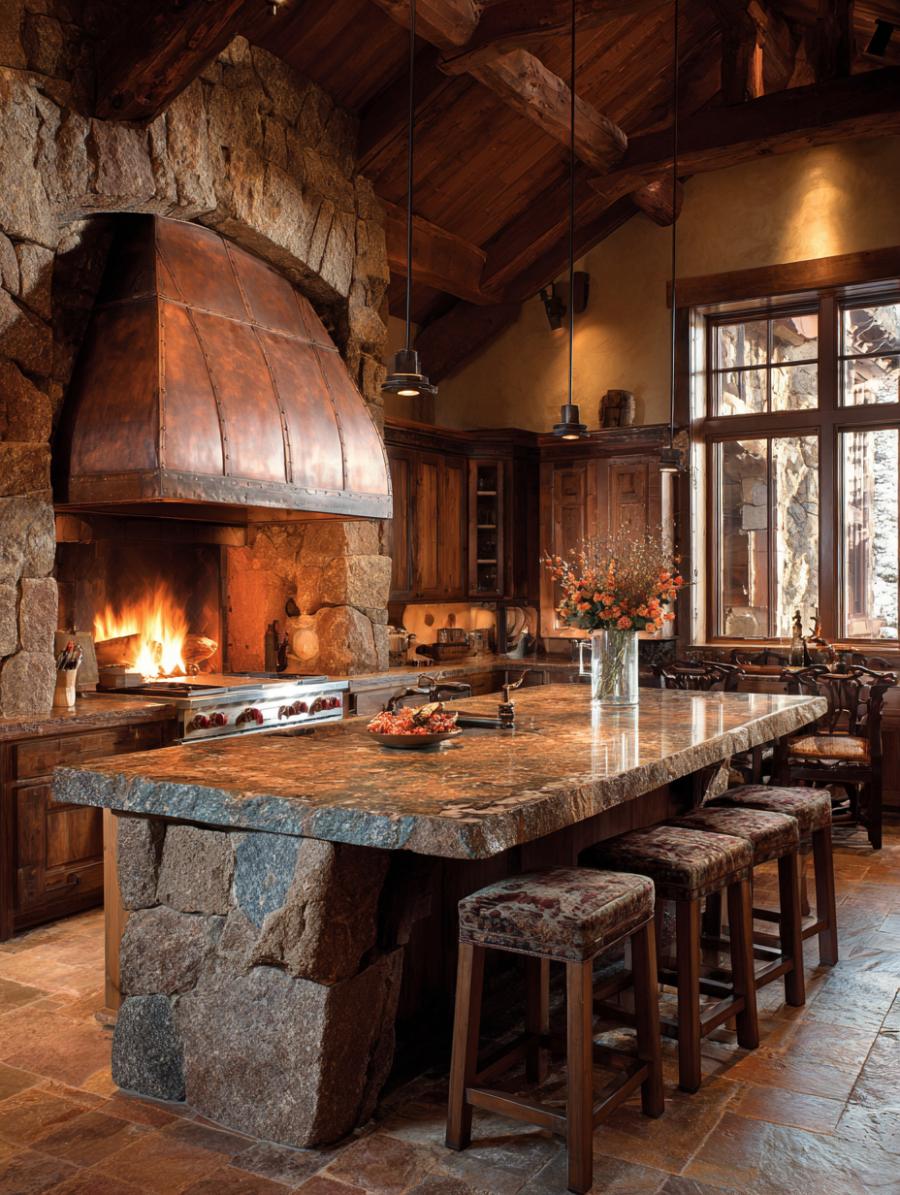
The look: Stone fireplace · granite slab island on a stone base · vaulted timber ceiling
A working fireplace set into the cooking wall, a granite slab on a boulder base, and a vaulted timber ceiling overhead. This is rustic at its most literal: the room is organised around an open flame rather than around an appliance run, which is how kitchens were arranged for most of human history.
Note the island base. It is not cabinetry with stone veneer, it is stone doing structural work, and the difference is visible instantly. Rustic rooms fall apart when the heavy materials are decorative rather than load-bearing.
dramatic
granite
stone
brown
rust
tan
2. Copper Over Stone
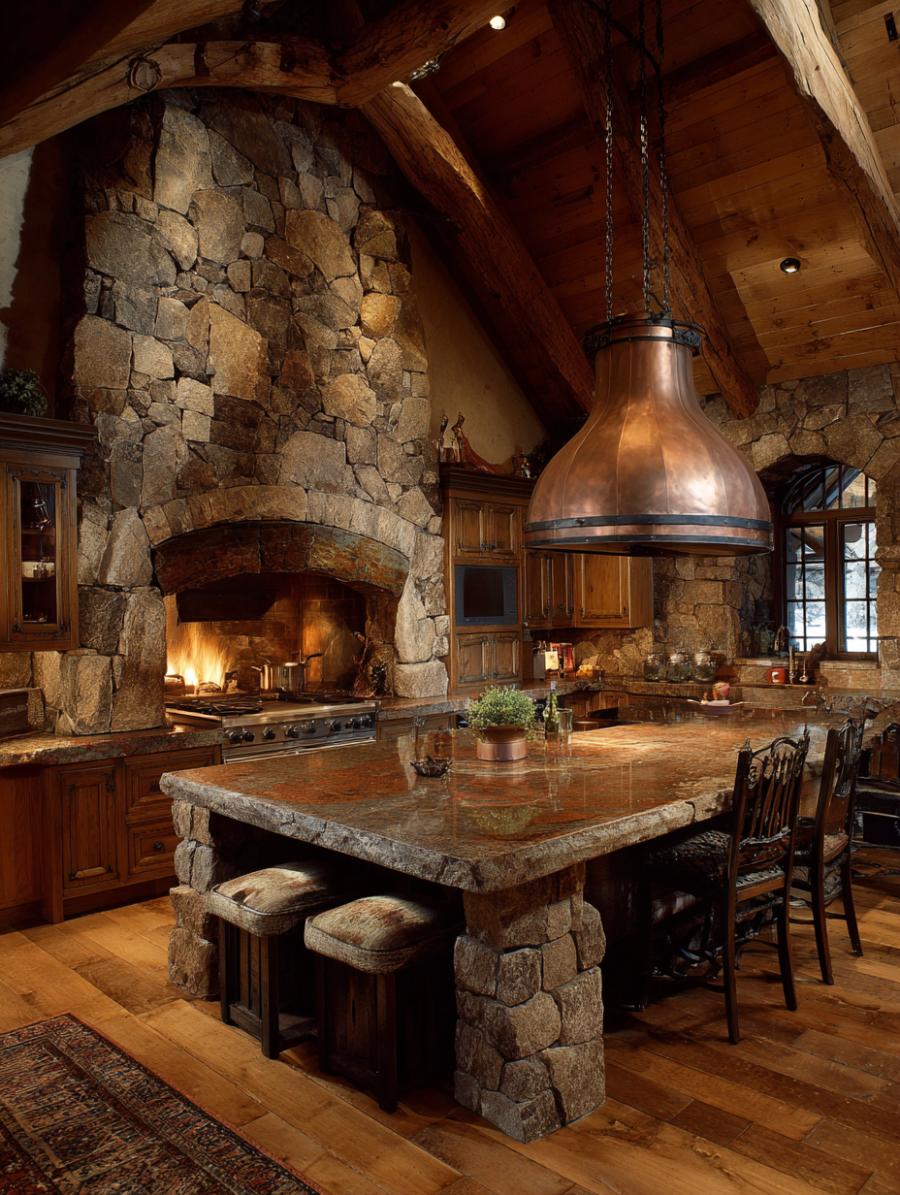
The look: Stone fireplace surround · copper range hood · built-in island bench seating
A copper hood is the single most effective thing you can put in a stone kitchen. Stone is cool, grey and matte; copper is warm, red and reflective, and it is the only common kitchen metal that visibly ages rather than simply tarnishing.
The seating bench built into the island is the other quiet move here. Benches read as furniture rather than as fittings, which is exactly what a rustic room wants from its island.
cozy
stone
brass
brown
tan
gold
3. Three Copper Domes
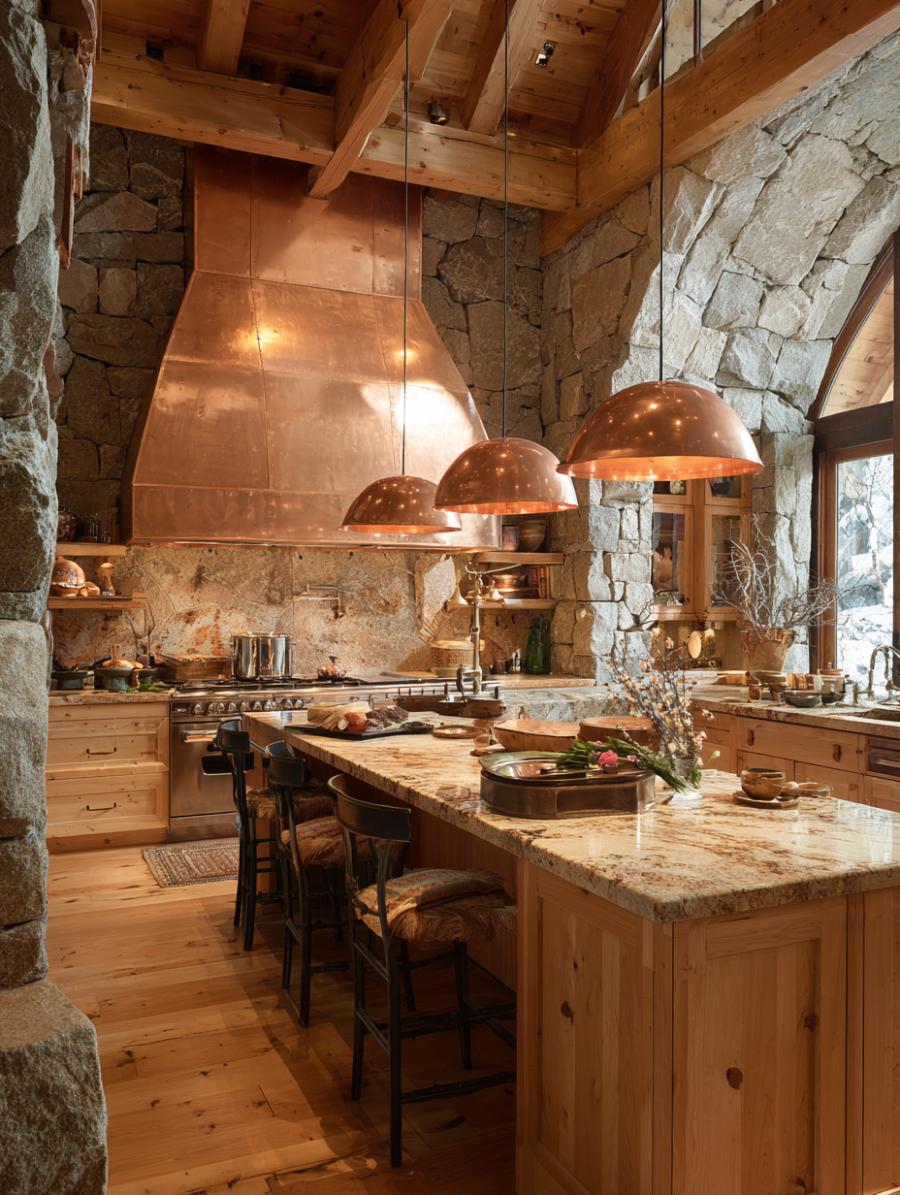
The look: Rough stone walls · copper dome pendants · granite island · arched window
Oversized copper dome pendants over a granite island, with rough stone on two walls and an arched window pushing daylight into the middle of the room. The pendants are enormous, deliberately, because a stone kitchen will swallow anything timid.
This is the scale lesson that separates convincing rustic from a themed one. Heavy materials need heavy fittings; hang three small lanterns in this room and it reads as a cave with jewellery.
dramatic
stone
brass
terracotta
brown
tan
4. The Red Range
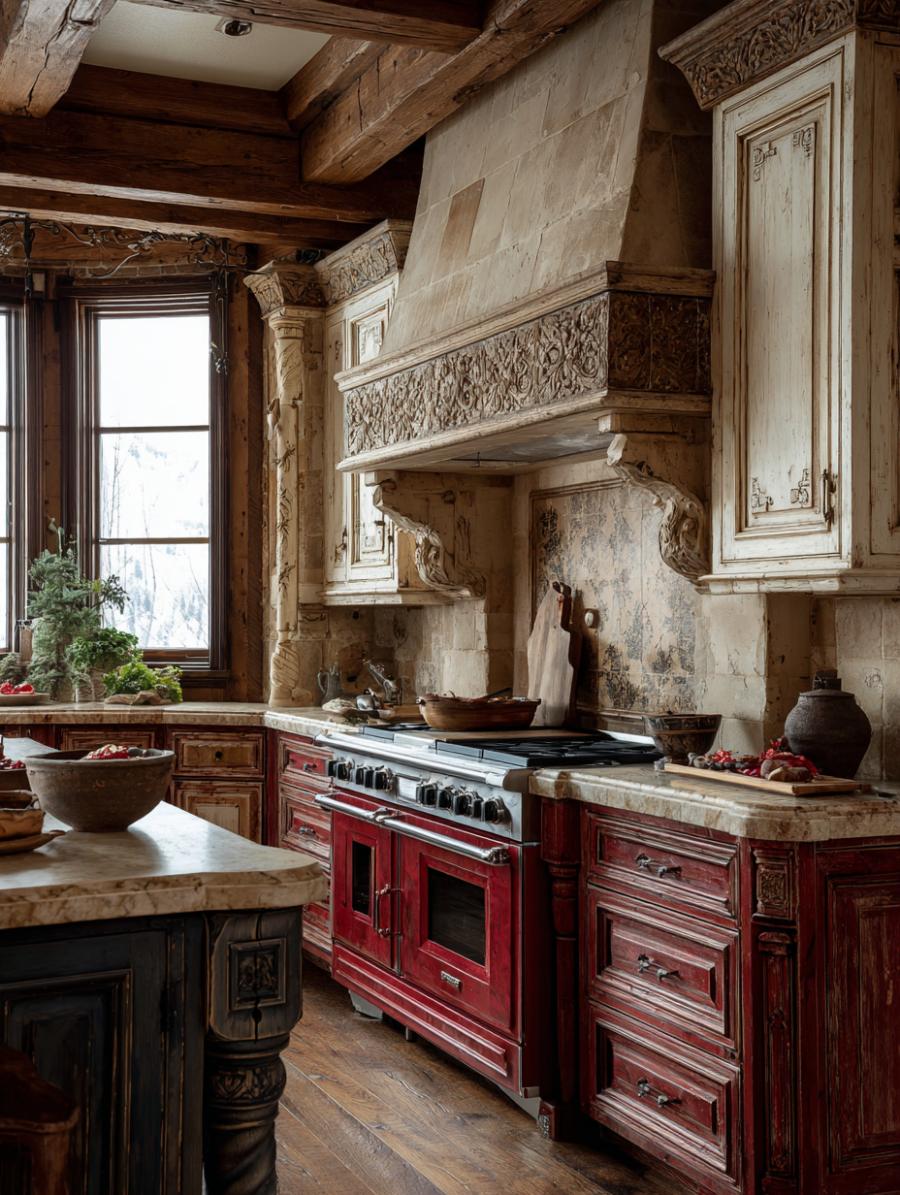
The look: Distressed stone walls · carved timber detailing · red enamel range cooker
Distressed stone, carved timber, and a red enamelled range cooker doing all the colour work in the room. A range in a strong colour is the cheapest possible focal point in a rustic kitchen, because the surrounding palette is so restrained that a single saturated object carries enormous weight.
It also solves the problem of where the eye goes. Stone and wood rooms have no natural focus; one bright object supplies it.
dramatic
stone
stained wood
red
brown
cream
5. Beams, Stone, and a Long Island
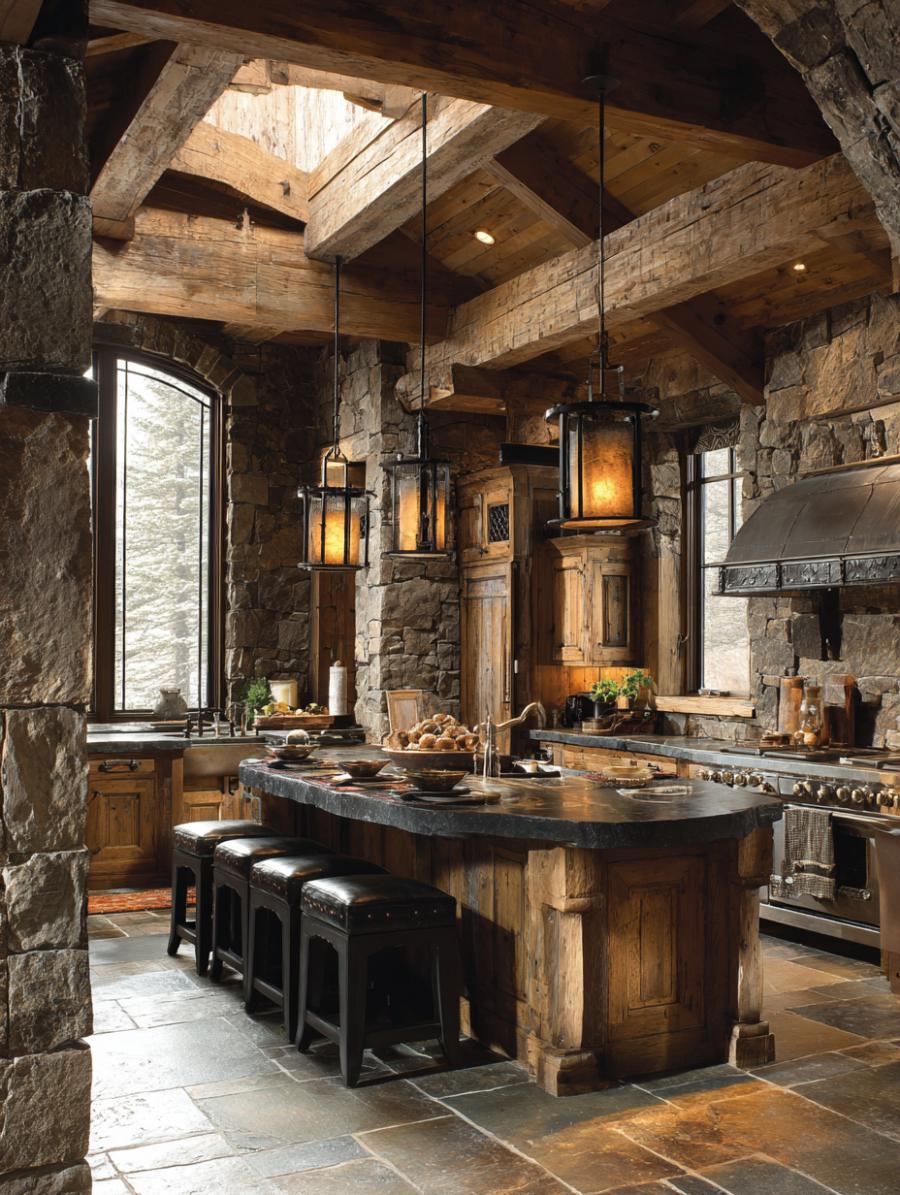
The look: Stone walls · exposed beams · long island with pendant lighting
Stone walls, exposed beams, a long island with seating along one side and pendants above it. There is nothing unusual in this room, which is rather the point: it is the standard vocabulary of rustic executed without a single wrong note.
If you are trying to work out what the base version of this style is before you start deviating from it, this is the reference. Everything else in this list is a variation on this arrangement.
dramatic
stone
stained wood
brown
black
gold
6. Dark Wood Against Pale Stone
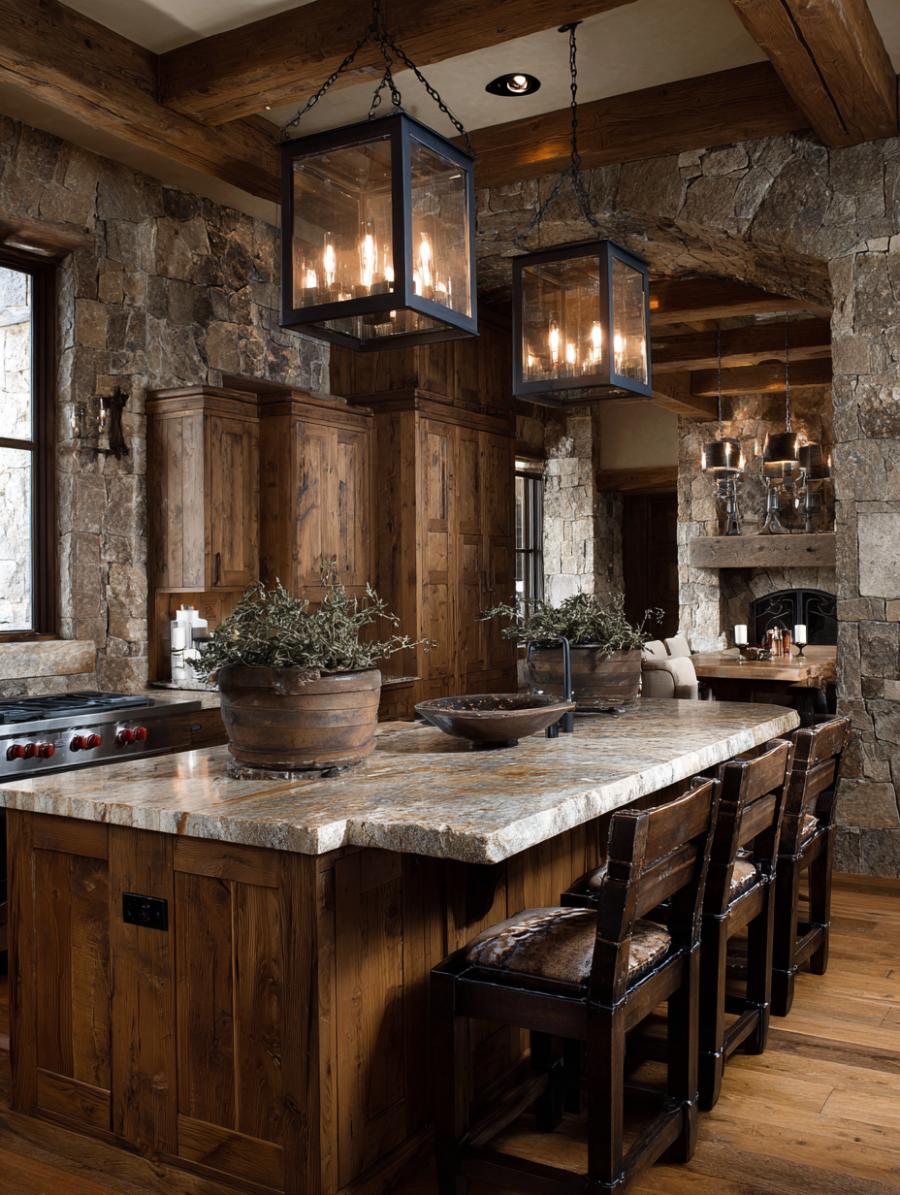
The look: Pale stone walls · dark stained cabinetry · marble island
Dark stained cabinetry against pale stone walls, with a marble island bridging the two. Rustic kitchens usually run warm and mid-toned throughout, so pushing the cabinetry considerably darker than the walls is a departure, and it gives the room a depth that all-timber rooms rarely achieve.
The marble is doing reconciliation work. It picks up the grey of the stone and the darkness of the wood in the same slab, which is why it does not read as an intrusion from a different kitchen.
dramatic
stone
marble
brown
tan
gold
7. Reclaimed, Not Distressed
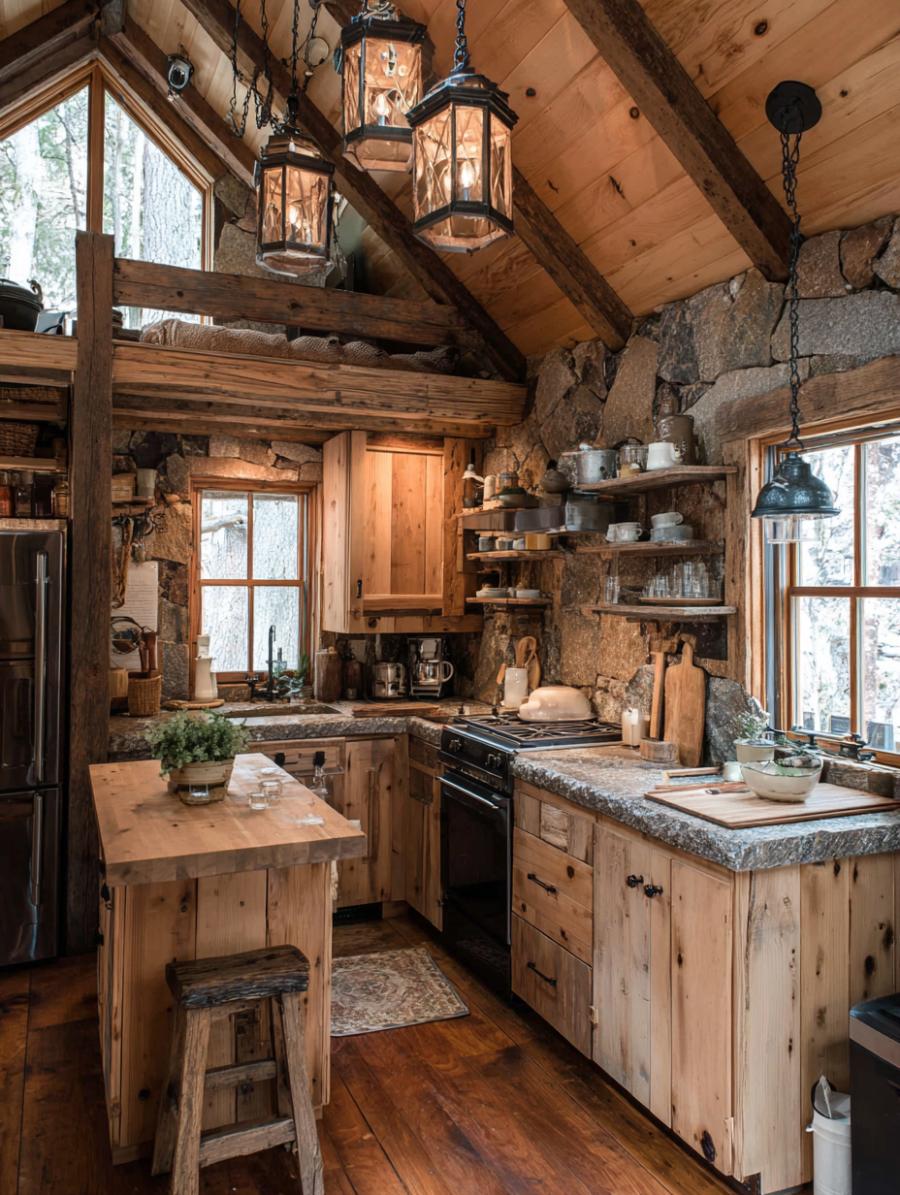
The look: Reclaimed timber cabinetry · stone walls · exposed beams
Reclaimed wood cabinetry against stone, under exposed beams. The distinction that matters here is between wood that has genuinely been used and wood that has been distressed to look as though it has.
Real reclaimed timber has inconsistent wear: heavier at the edges, around old fixings, along one face and not the other. Manufactured distressing is even, and the eye picks up on it immediately even when it cannot say why. This is the single biggest tell in the whole category.
cozy
stone
stained wood
brown
tan
grey
8. Raw Stone, Black Cabinets
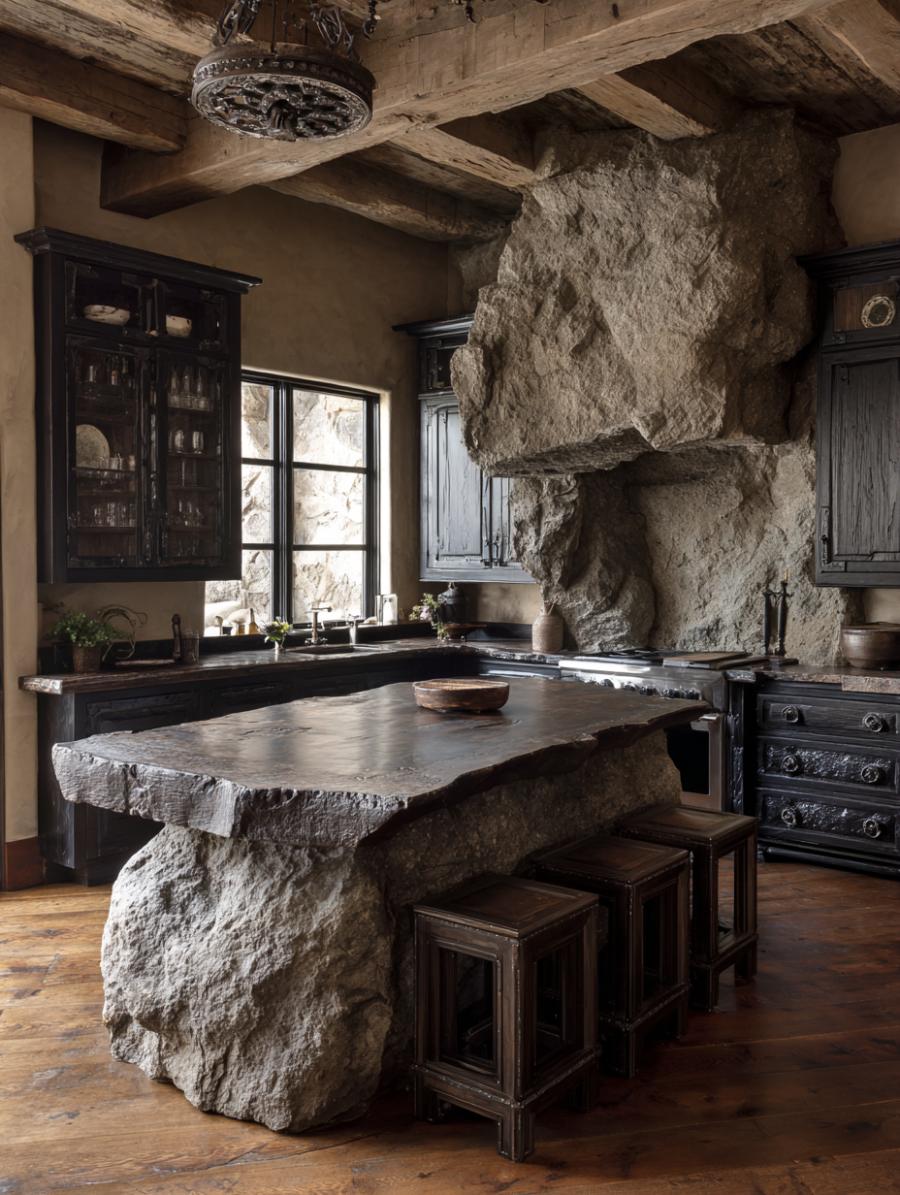
The look: Raw stone island base · black cabinetry · exposed timber ceiling
A raw stone island base beneath black cabinetry, under exposed timber. Black is an unusual choice in rustic and it works because the stone is left genuinely rough — the contrast between an unworked natural surface and a flat manufactured one is the entire idea.
Try this with smooth stone and it collapses. The room needs one surface that clearly was not made in a factory.
dramatic
stone
black metal
tan
brown
charcoal
9. The Stone Vault
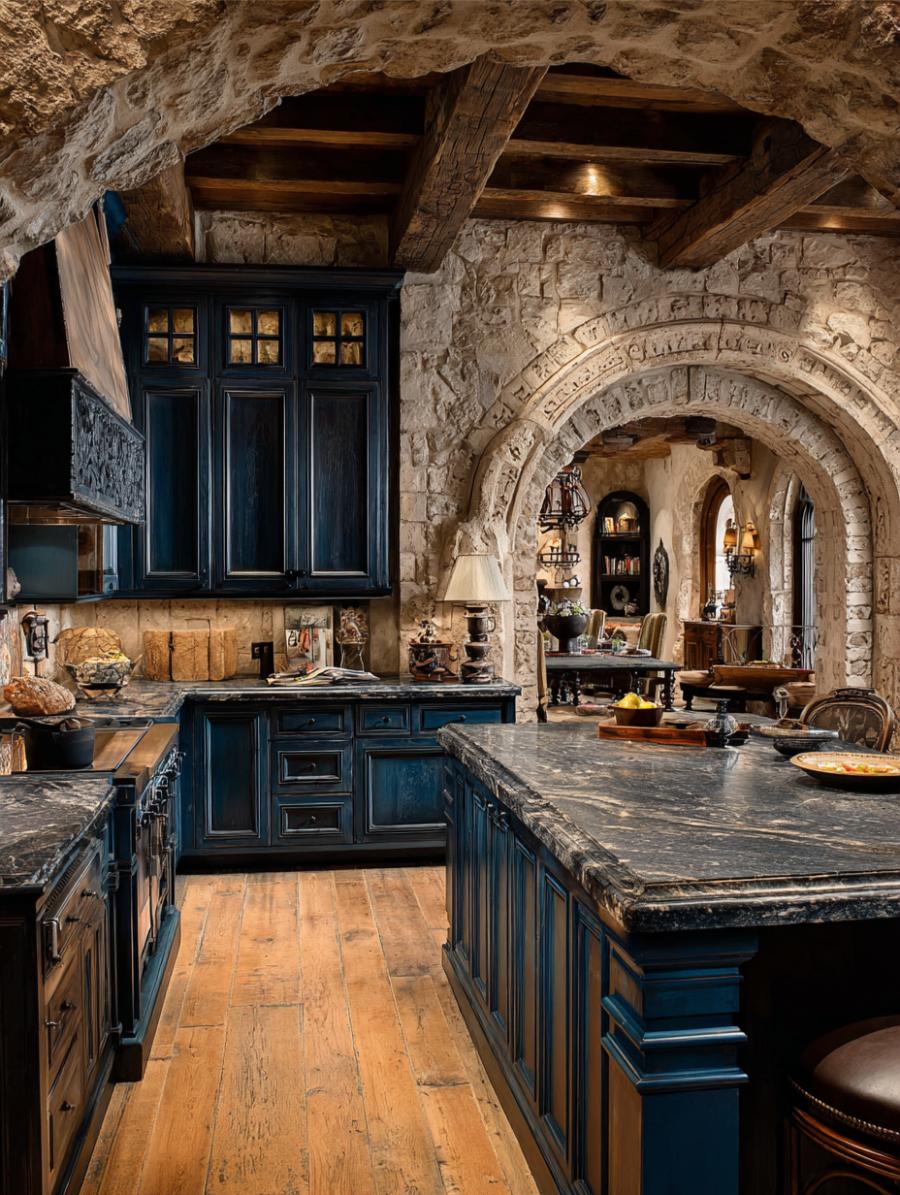
The look: Barrel-vaulted stone ceiling · arched stone opening · navy cabinetry · plank floor
A barrel-vaulted stone ceiling, an arched opening through to the next room, navy cabinetry and a wide plank floor. Mediterranean rustic rather than alpine, and the difference is the arch: northern rustic builds in straight timber, southern rustic builds in curved masonry.
The navy is what makes it feel current. In its traditional form this room would have timber or cream cabinetry, and it would read as a restoration rather than as a kitchen someone lives in now.
dramatic
stone
painted cabinetry
navy
charcoal
gold
10. Cooking on an Open Fire
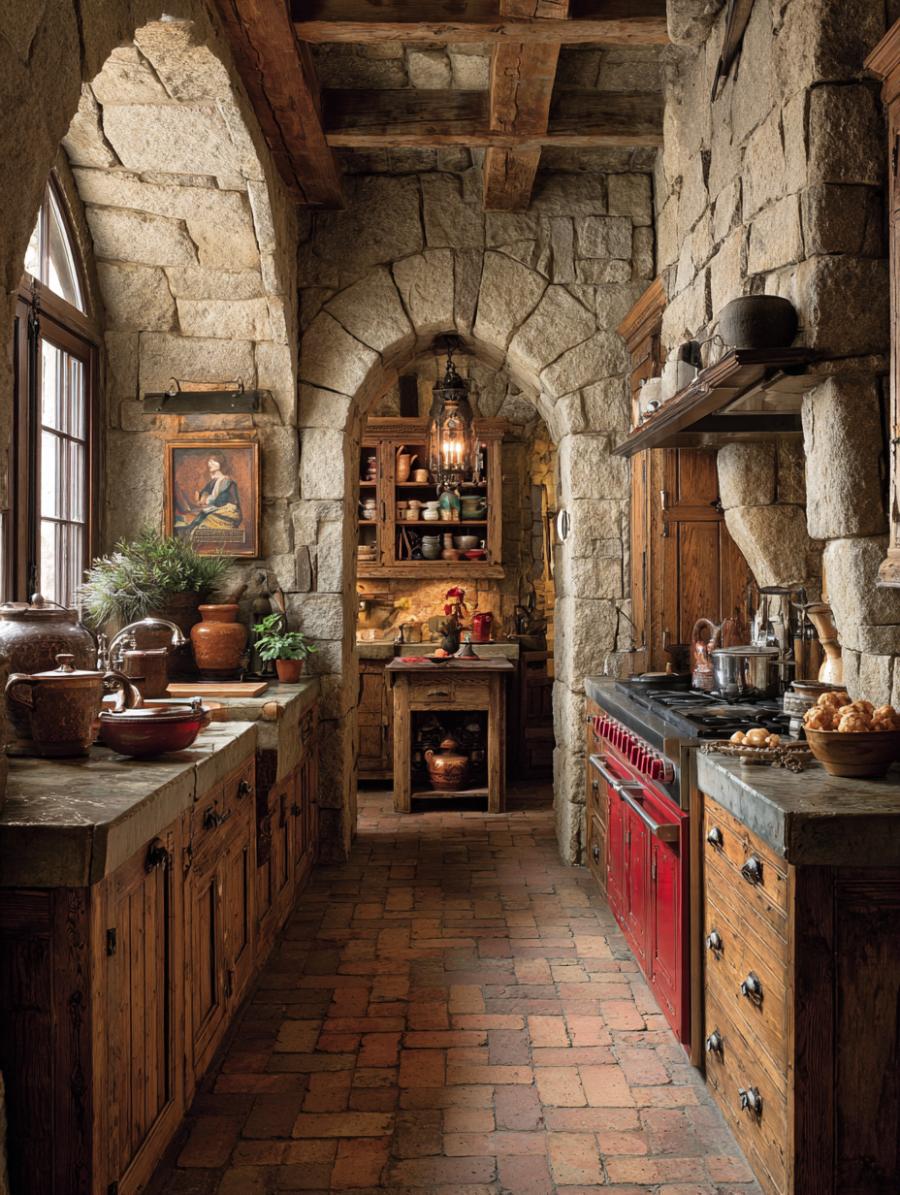
The look: Arched stone doorway · timber cabinetry · open cooking hearth
An arched stone doorway, timber cabinetry, and an open hearth used for actual cooking. This is the oldest version of the room in the entire list and the one furthest from how most people cook, but it is worth including because everything else here is a diluted memory of it.
Every rustic kitchen is quoting this room. Knowing what is being quoted makes the quotations easier to get right.
cozy
stone
stained wood
brown
tan
terracotta
11. Barnwood and Slate
The look: Weathered barnwood cabinetry · honed slate counters · copper range hood
Weathered barnwood cabinetry, honed slate counters, and a copper hood. Three materials, no fourth, and each one of them carries obvious texture — which is why the room reads as rich rather than as brown.
Slate is underrated in this style. It is dark enough to anchor a timber room, matte enough not to fight the wood grain, and considerably more forgiving than marble in a kitchen that is genuinely used.
dramatic
stained wood
brown
black
12. Dark Wood and Copper
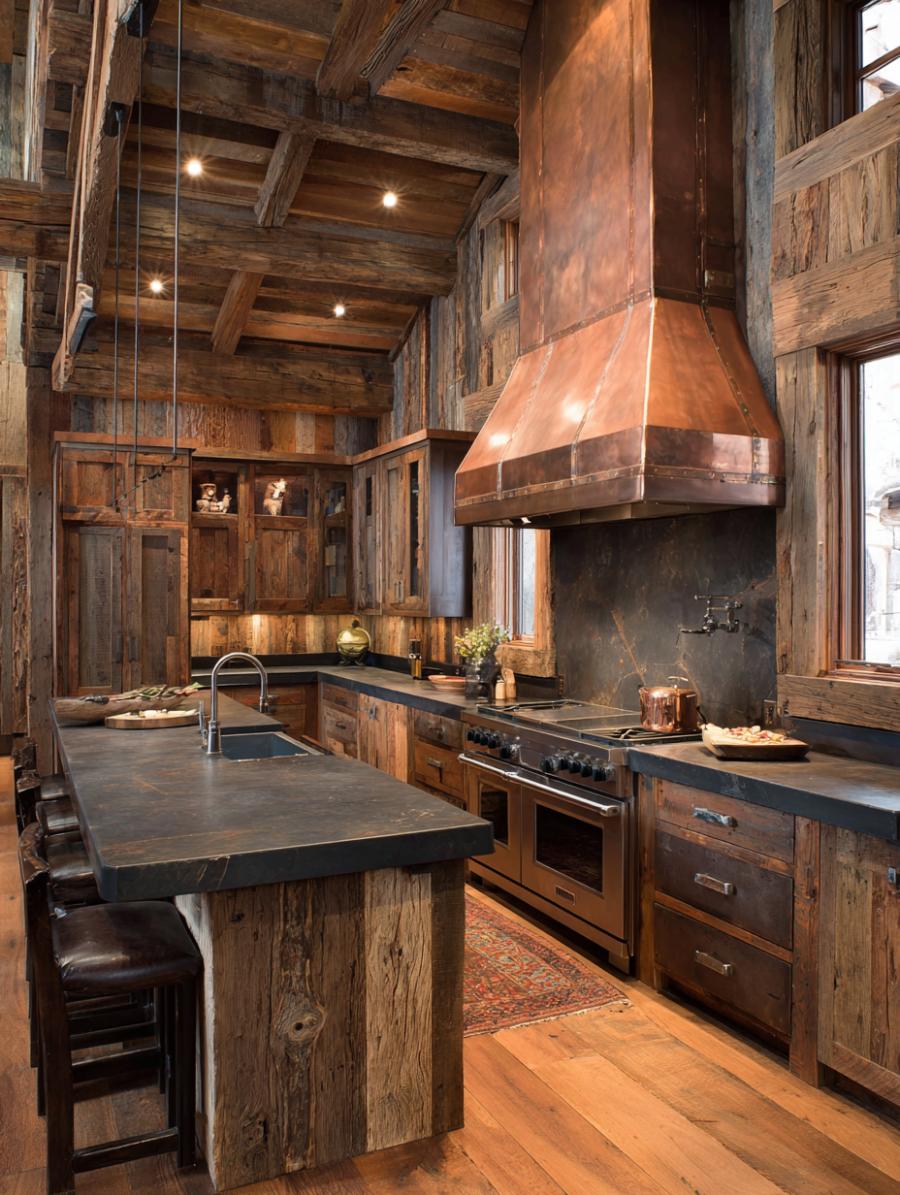
The look: Dark timber cabinetry · copper range hood · exposed ceiling structure
Dark timber cabinetry with a copper range hood and exposed structure overhead. This is the mountain-house default, and it is the arrangement most people picture when they hear the word rustic.
Its weakness is light. A room this dark needs either serious glazing or serious artificial lighting, and the most common failure in this style is a beautiful dark kitchen that nobody can see to cook in. Budget for more light than feels necessary.
dramatic
stained wood
black metal
brown
rust
black
13. Clay Plaster and an Open Cooking Wall
🔥 Would you like to save this?
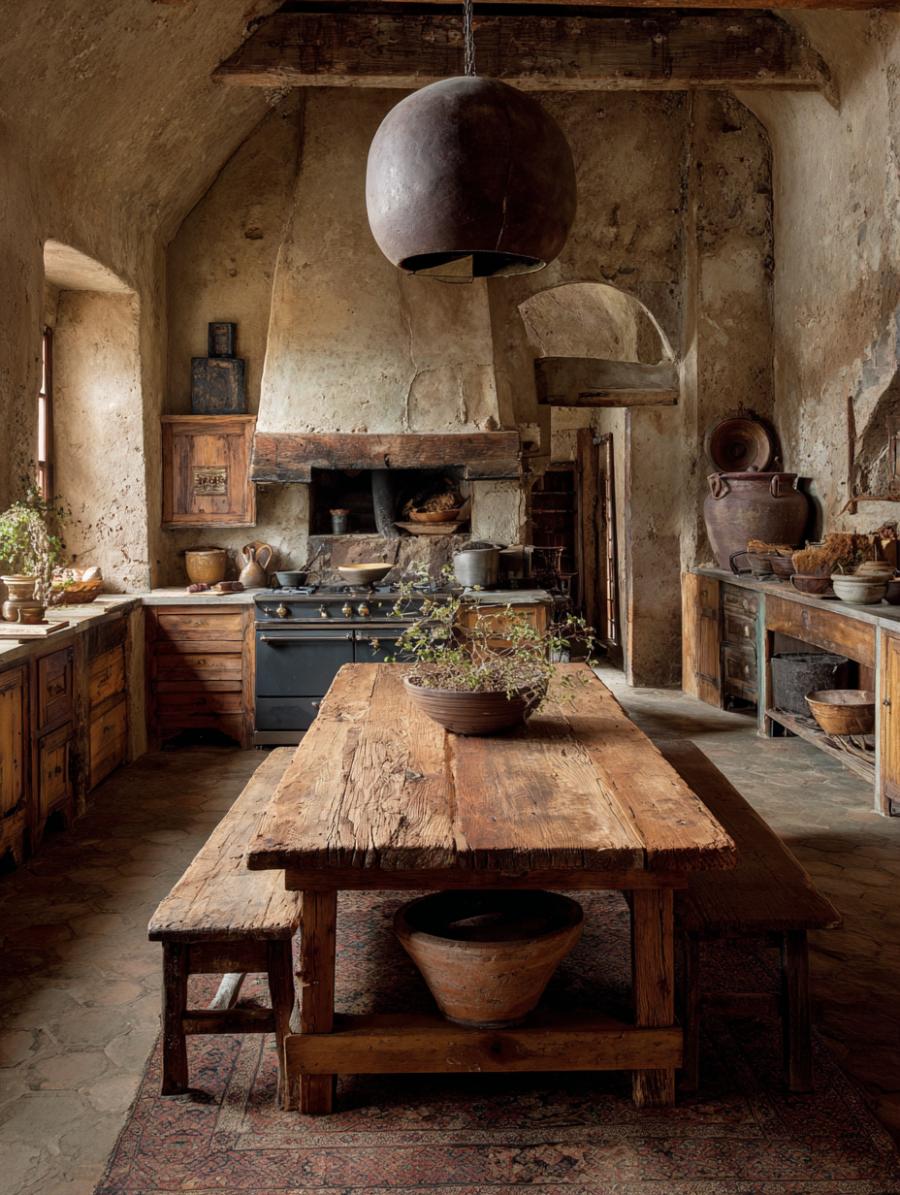
The look: Hand-applied clay plaster · freestanding wood work table · open cooking wall
Clay plaster walls, a wooden work table instead of an island, and an exposed cooking wall. The plaster is the thing to notice: it is a hand-applied finish with visible variation across the surface, and it does something no paint can do at any price.
Substituting a table for a fitted island is the other departure, and it is more practical than it looks. A table can be moved, re-purposed and replaced; an island is a permanent decision made before you have lived in the room.
dramatic
stained wood
stone
brown
tan
terracotta
14. Terracotta Underfoot
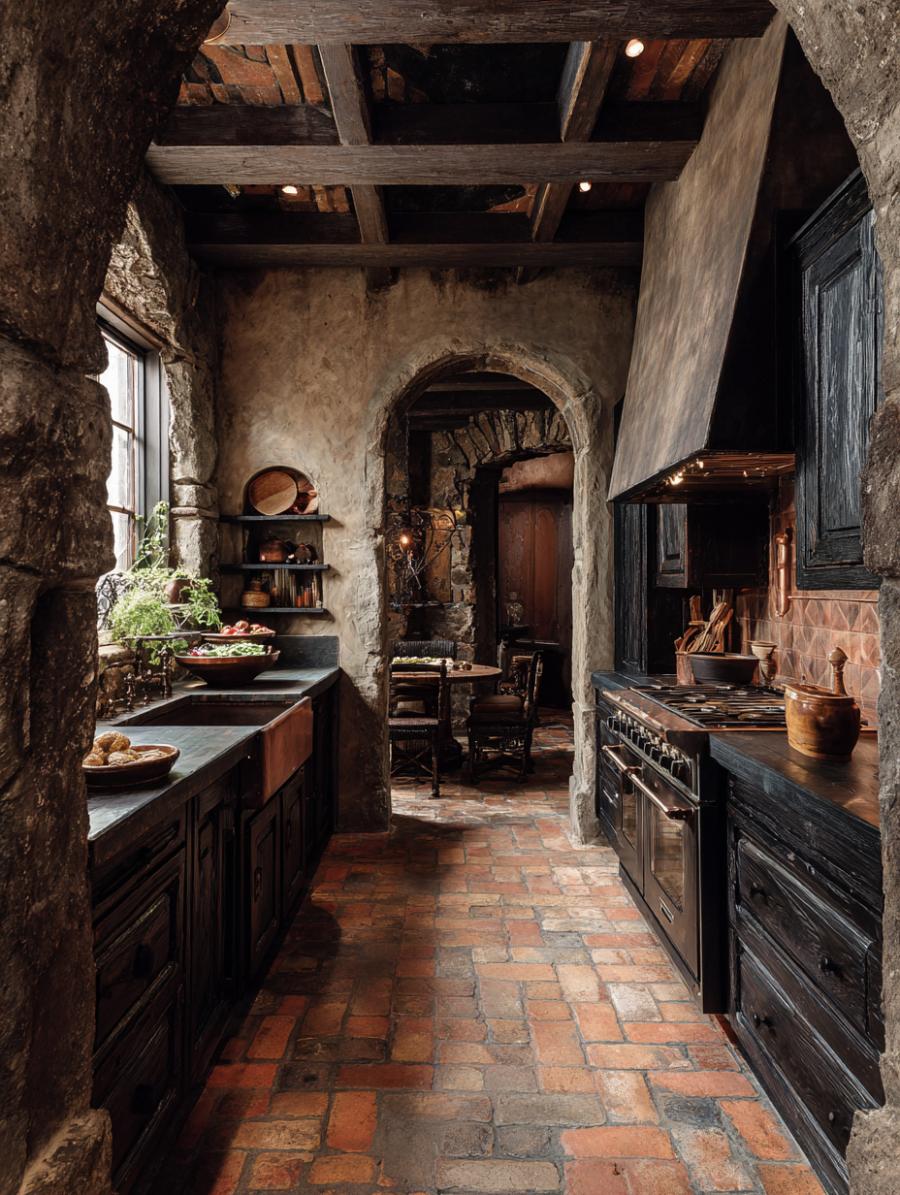
The look: Terracotta tile flooring · aged stone walls · narrow galley plan
A narrow kitchen with terracotta tile flooring and aged stone walls. Terracotta is the warmest floor available and it is the reason this room feels generous despite being tight — the colour temperature is doing the work that square footage usually has to.
It is also nearly indestructible and improves with wear, which makes it one of the few genuinely rustic materials that is also a sensible practical choice.
dramatic
stained wood
terracotta
brown
black
15. Stone Walls in a Galley
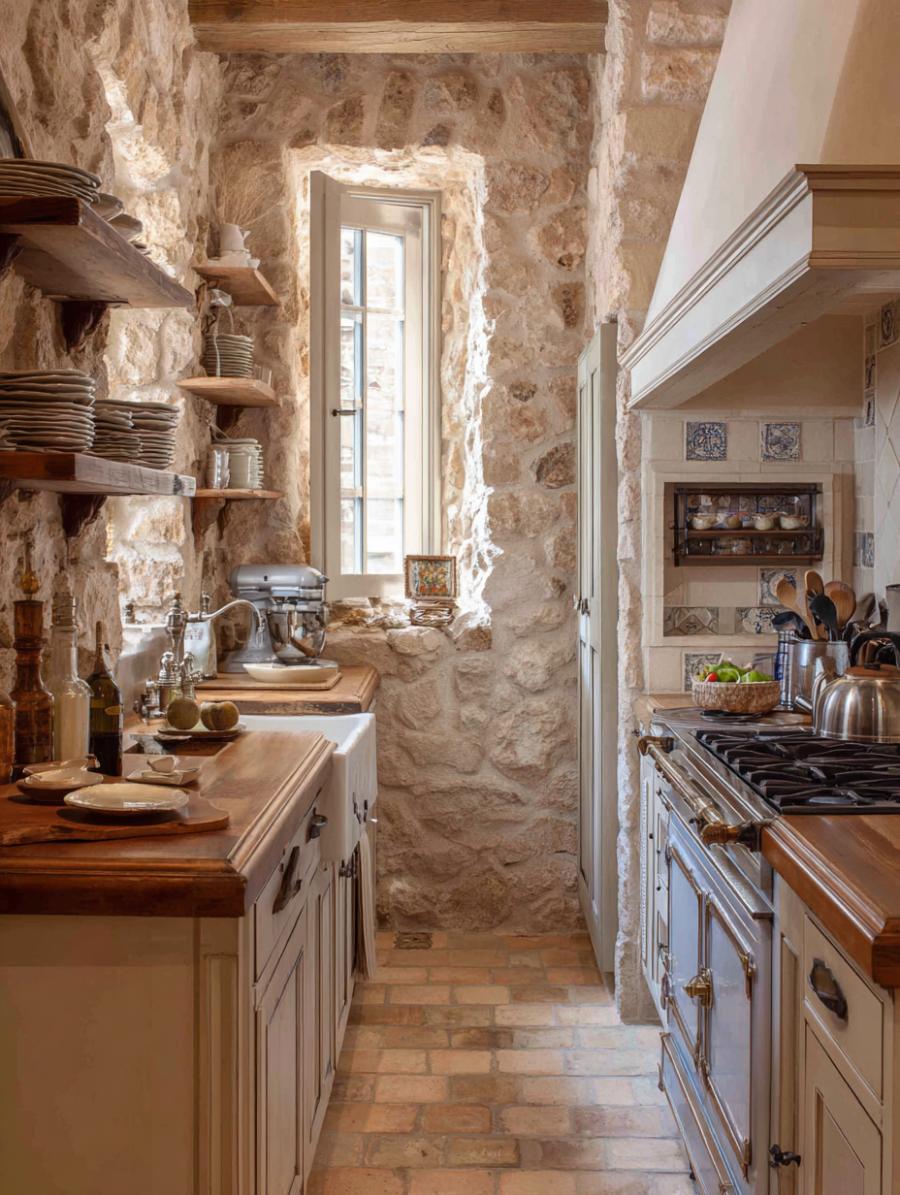
The look: Exposed stone walls · solid timber counters · galley layout
Exposed stone the full length of a narrow galley, with timber counters and tall storage at the end. Most people would have plastered these walls to make the room feel wider. Leaving them is the braver call and the better one.
The trick is keeping everything else quiet. One heavily textured surface reads as character; two competing ones read as clutter, and in a space this narrow you feel it immediately.
cozy
stone
stained wood
cream
tan
brown
16. Dark Timber, White Counters
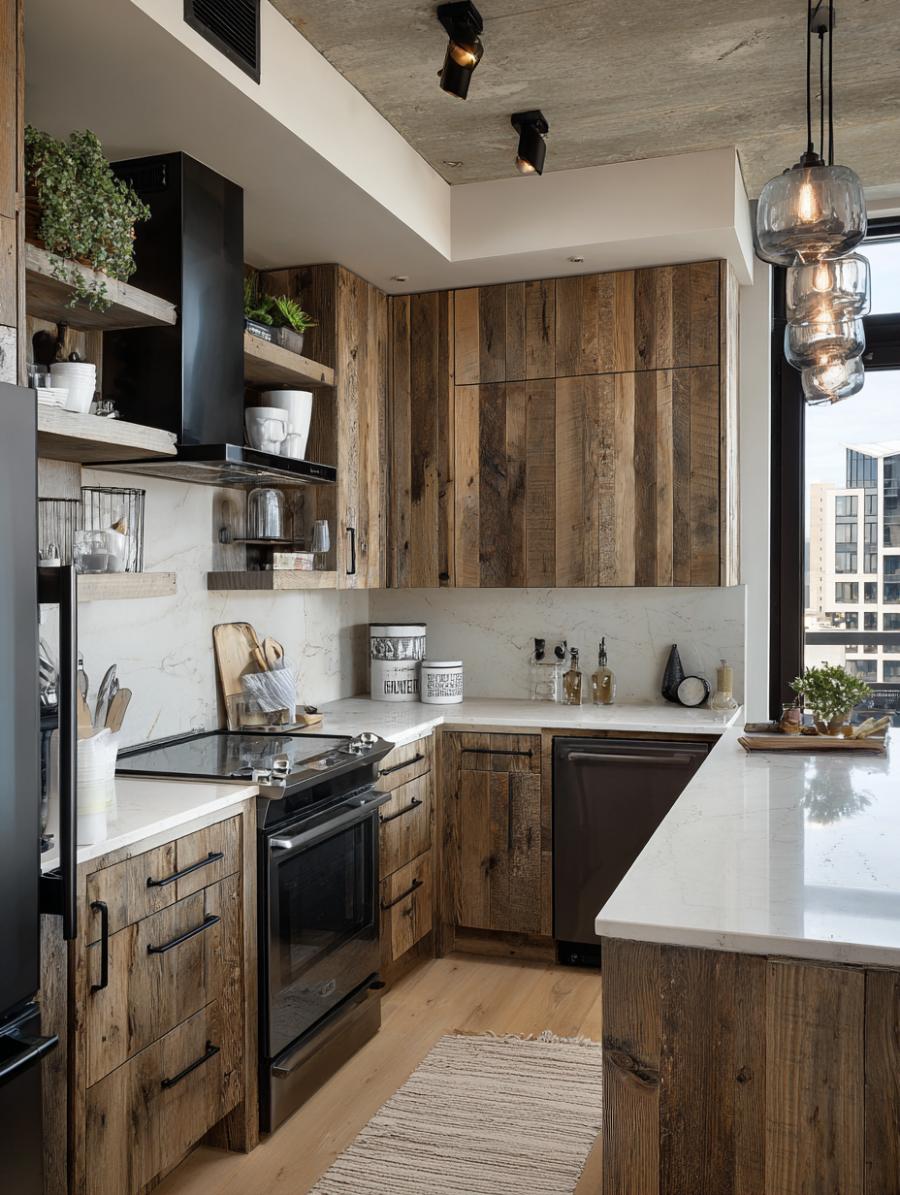
The look: Dark stained cabinetry · white countertops · galley layout
Dark stained cabinetry with white countertops in a galley. This is the most transferable room in the collection, because the arrangement works in a standard house with standard ceilings and no stone anywhere.
White counters against dark timber is also the version that stays legible in a small room. Rustic usually asks for volume it cannot have in an ordinary house; this one does not.
cozy
stained wood
black metal
brown
white
black
17. Light Wood, Black Counters
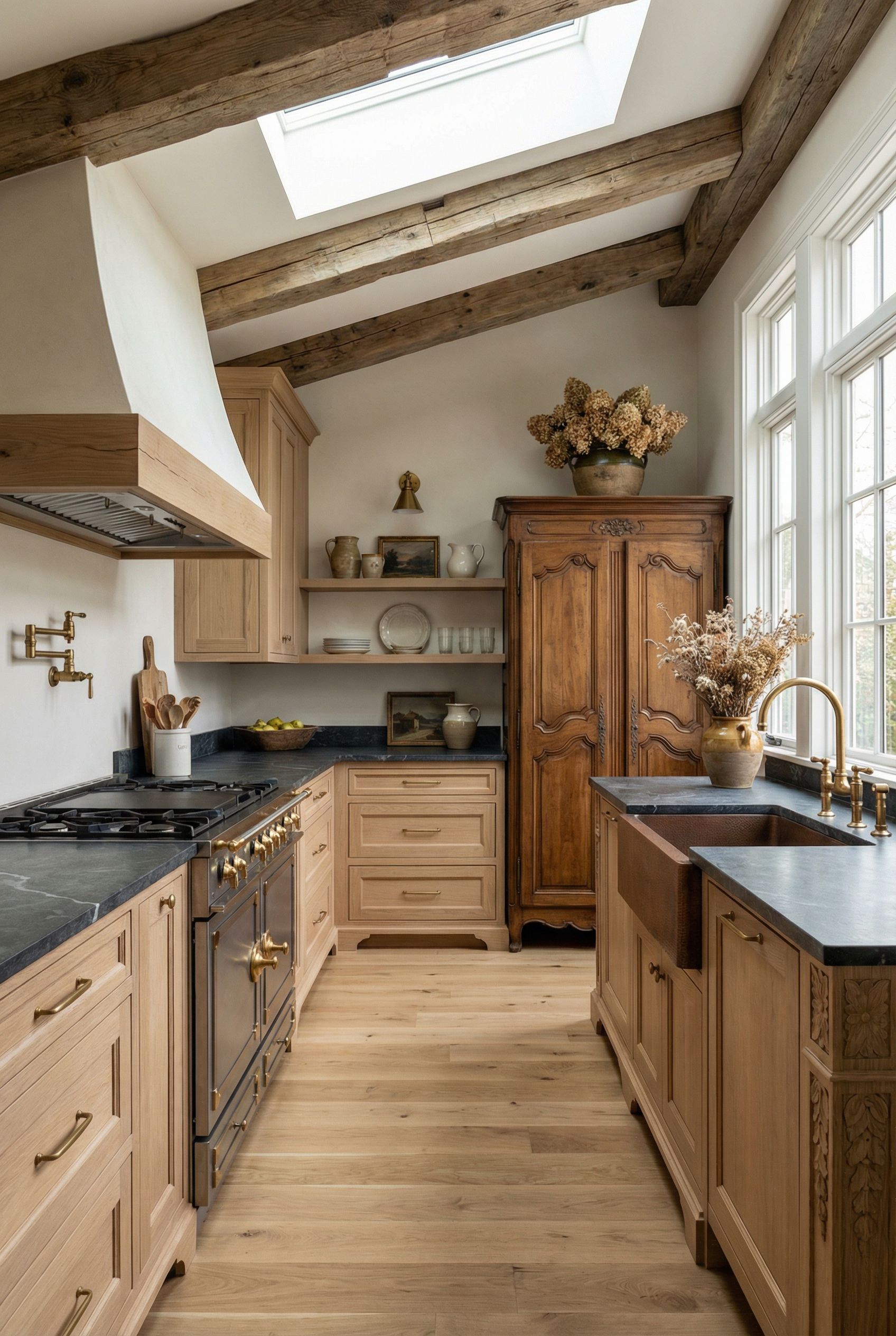
The look: Pale timber cabinetry · black countertops · exposed beams
The inverse: pale timber cabinetry under black countertops, with beams overhead. Rustic does not have to be dark, and this is the proof — the room is unmistakably in the style while being brighter than most contemporary kitchens.
Worth knowing if you like the vocabulary but not the gloom. Keep the timber pale, put the weight in the counter, and the room stays light without losing the texture.
airy
stained wood
black metal
tan
cream
black
18. Leather at the Island
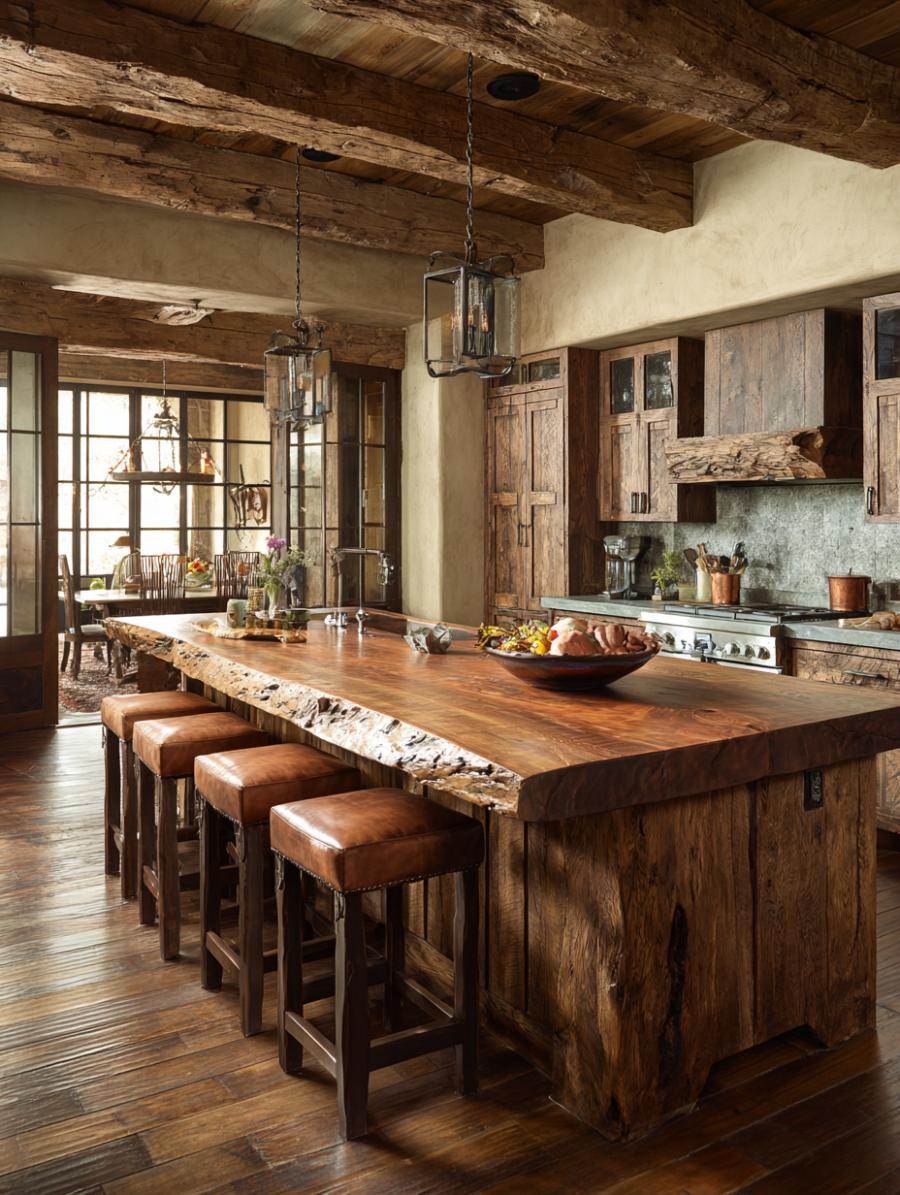
The look: Dark wood island · leather stools · open plan to dining
An open-plan kitchen and dining area with a dark wood island and leather stools. Leather is the detail worth stealing: it ages the way timber and stone age, so it belongs in this style in a way that upholstery and moulded plastic never will.
It is a small decision that does a disproportionate amount of work. Most rustic kitchens are let down at the seating, not at the cabinetry.
cozy
stained wood
leather
brown
cream
tan
19. The Live-Edge Island
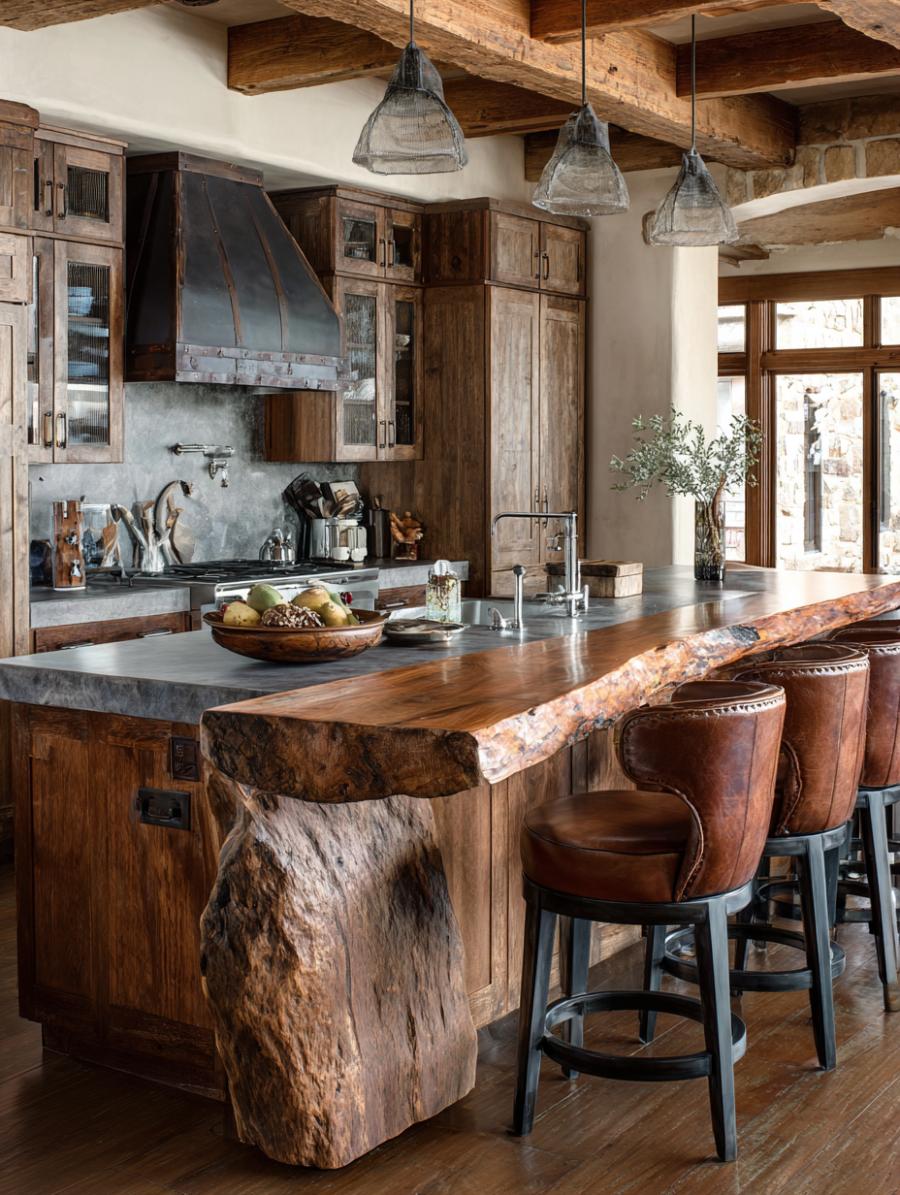
The look: Live-edge slab island · exposed beams · pendant lighting
A live-edge slab as the island top, under exposed beams and pendants. One irregular natural edge in a room of straight lines is the most reliable way to stop a timber kitchen looking manufactured.
It is also the single most repeated high-end move in this entire category, which is worth knowing before committing to it. Common does not mean wrong, but it does mean it will not read as unusual for much longer.
cozy
stained wood
marble
brown
cream
grey
20. The Log Cabin Version
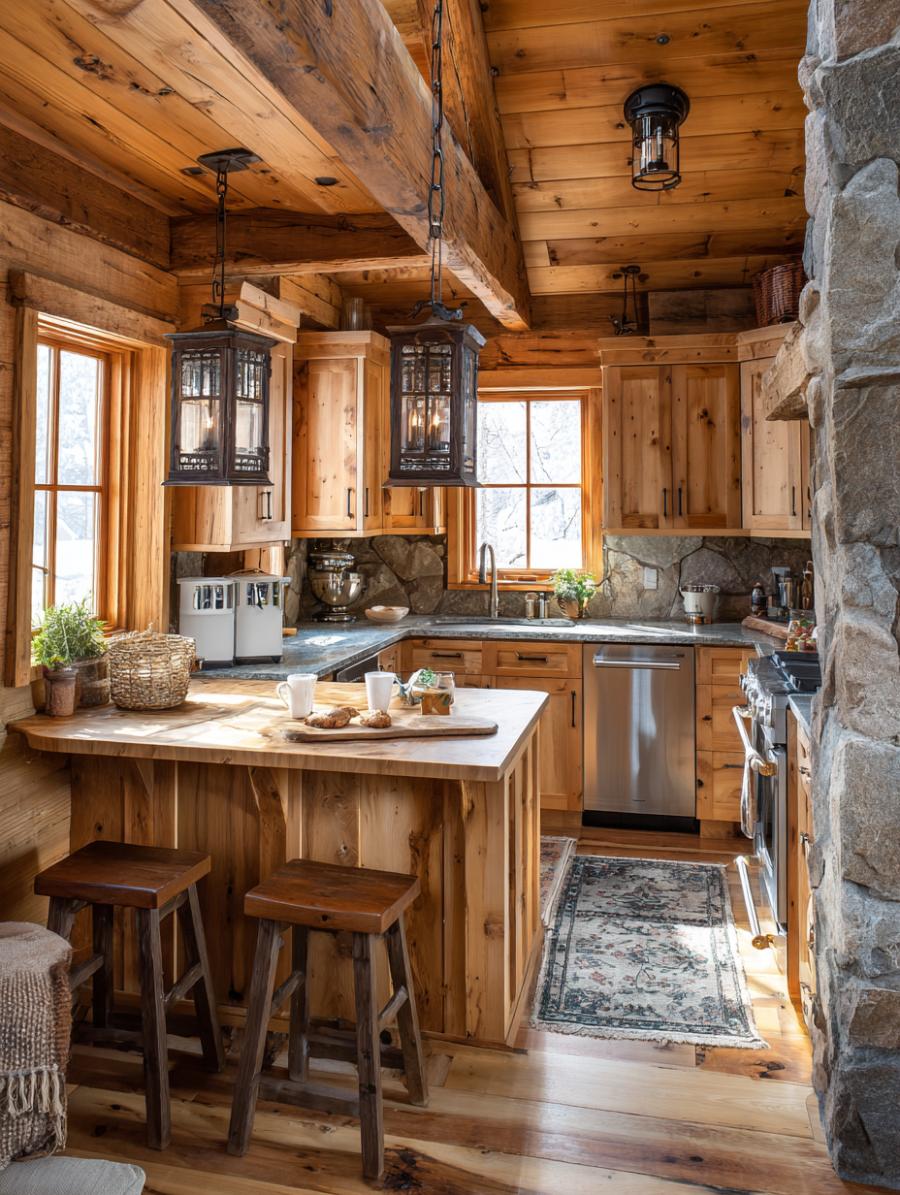
The look: Knotty pine throughout · stone chimney breast · lantern fixtures
Knotty pine walls, ceiling and cabinetry, a stone chimney breast, and lantern fixtures. Every surface is timber, which by every normal rule should be overwhelming, and the room is charming instead.
It works because the scale is genuinely small. Rustic at cabin size is a different proposition from rustic at lodge size — the intimacy is the appeal, and trying to reproduce this in a large room produces something closer to a sauna.
cozy
stained wood
stone
brown
tan
grey
21. Terracotta Walls, Arched Doors
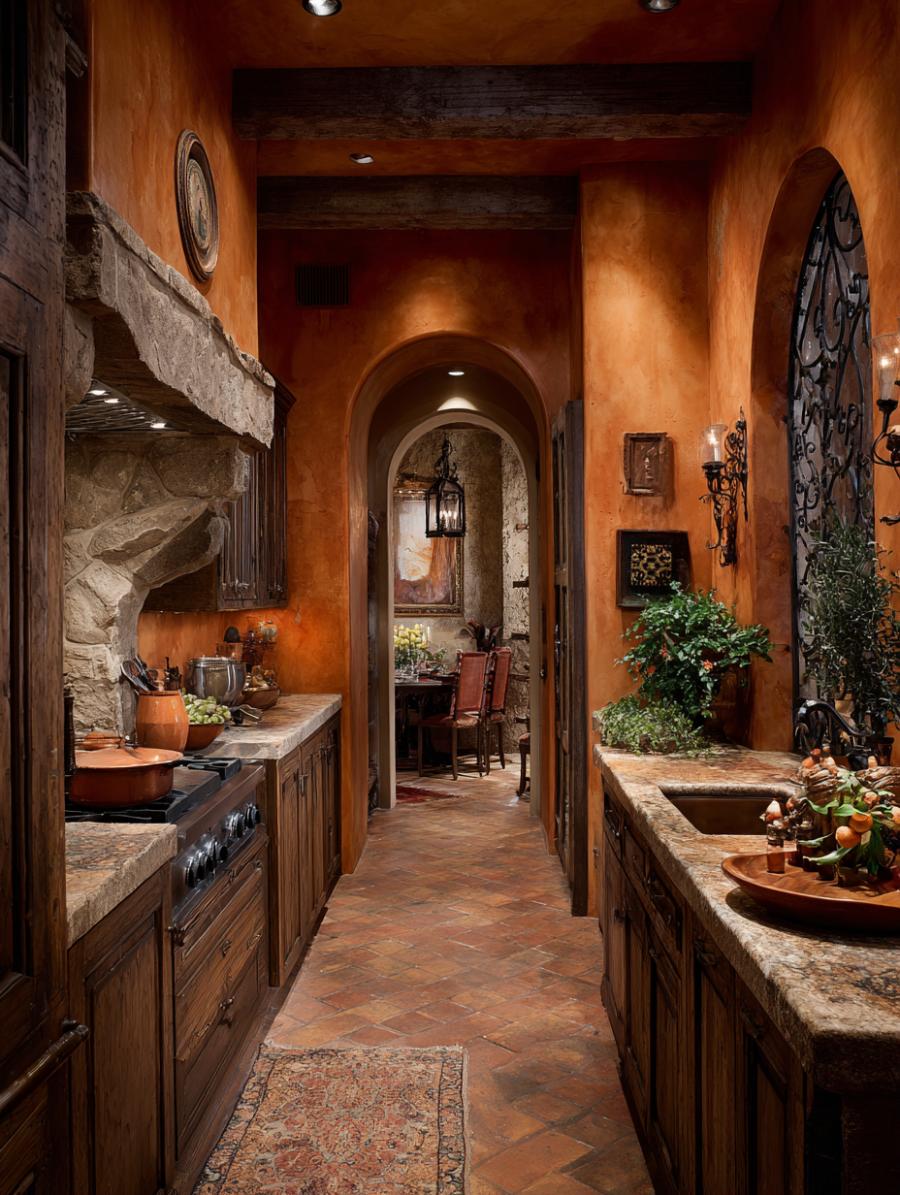
The look: Terracotta-washed walls · arched openings · stone counters · galley plan
Terracotta-washed walls with arched openings and stone counters in a narrow plan. Terracotta is the warmest wall colour available, and it does something timber cannot: it puts the warmth at eye level rather than underfoot or overhead, which is why a room this narrow does not feel like a corridor.
The arches matter as much as the colour. A curved opening reads as masonry construction even when there is nothing structural about it, and it remains the cheapest way to buy a kitchen architectural history it never had.
dramatic
stone
stained wood
terracotta
brown
cream
22. Deep Green Against Stone
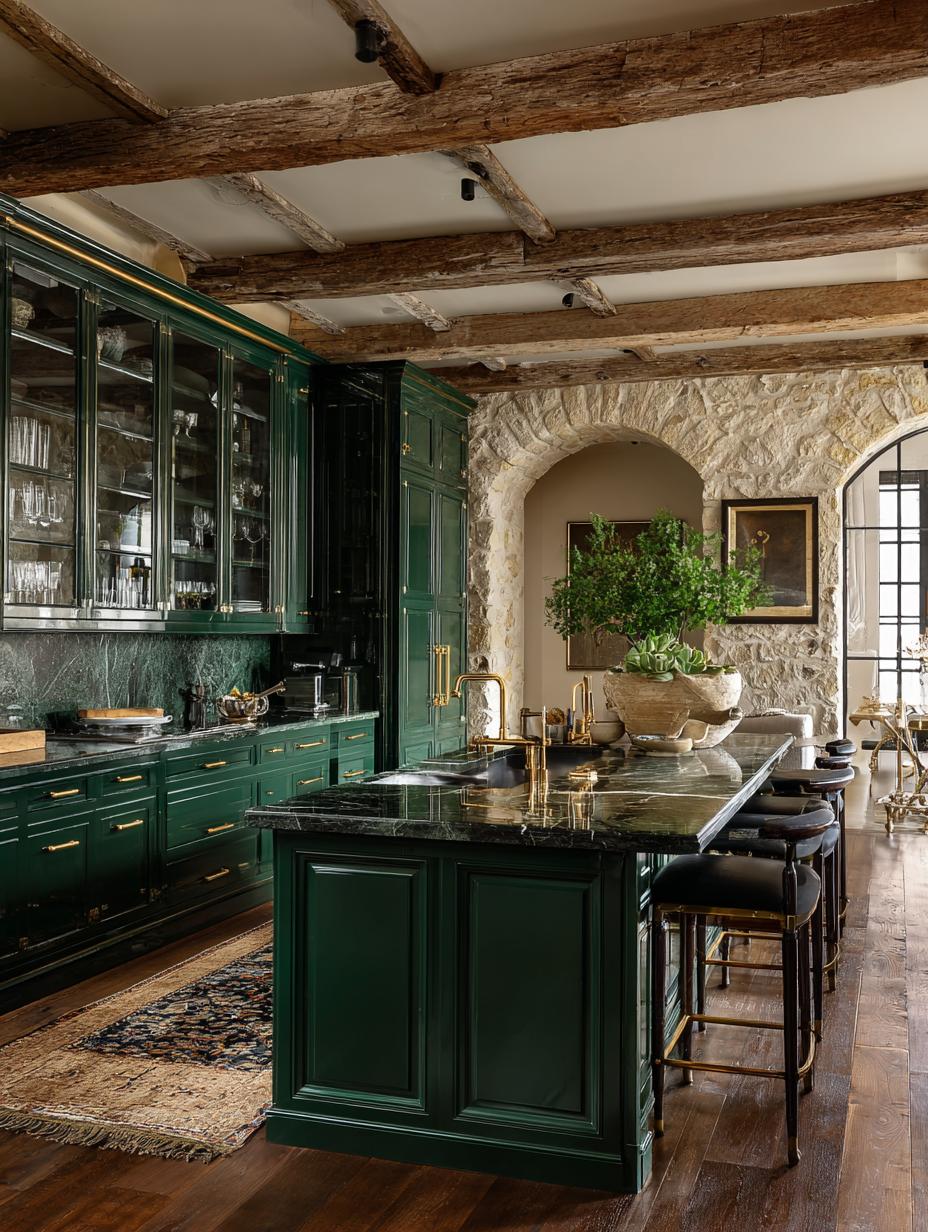
The look: Deep green cabinetry · exposed wood beams · stone backdrop
Deep green cabinetry under exposed beams with stone behind. Green against grey stone is a cooler, more restrained pairing than green against brick, and it produces a considerably more formal room.
This is the version that suits a house without a strong regional character. It is rustic in material and texture without committing to alpine, Mediterranean or farmhouse specifically.
cozy
stone
painted cabinetry
green
cream
brown
23. Forest Green and Granite

The look: Forest green cabinetry · figured granite island · reclaimed beams · stone arch
Forest green cabinetry, a heavily figured granite island, reclaimed beams and a stone arch. This is the most expensive-looking room in the list and almost none of that impression comes from the finishes — it comes from the stone arch and the ceiling height behind it.
The granite is worth studying. A slab with this much movement functions as artwork, and it is the reason the room needs no other pattern anywhere.
cozy
stone
granite
green
brown
cream
24. Red Cabinets in a Galley
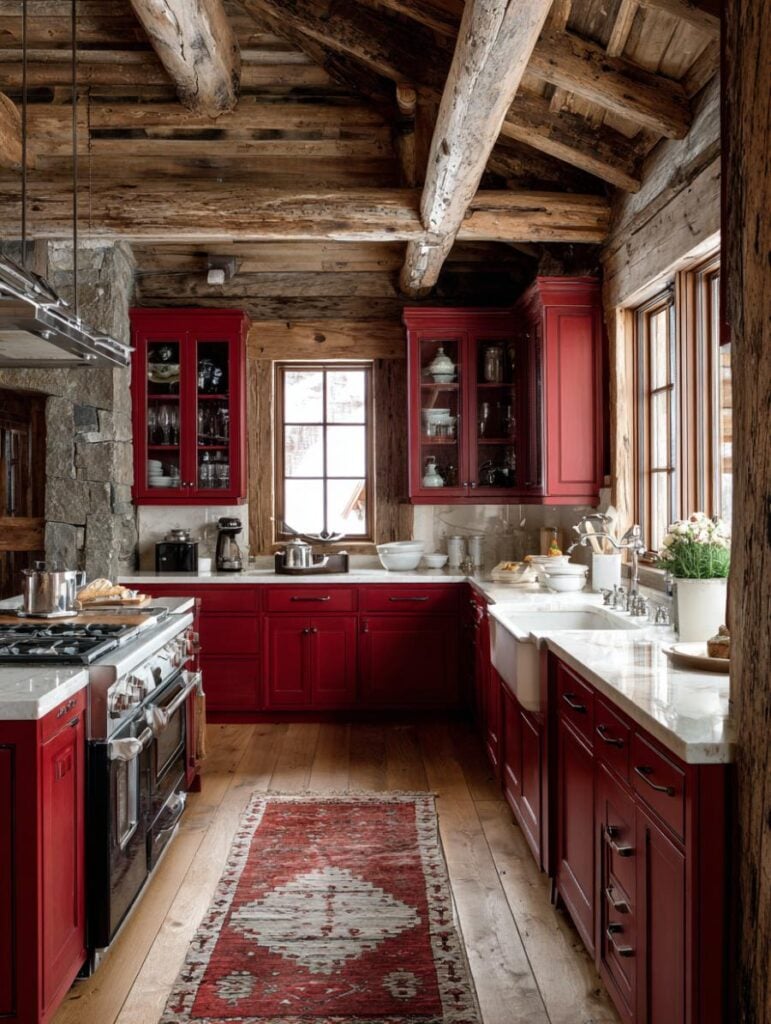
The look: Red cabinetry · exposed beams · marble counters · galley plan
Red cabinetry with exposed beams and marble counters in a narrow plan. Red is the boldest colour anyone puts in a kitchen and it survives here because the beams and the marble are both quiet — the room can afford exactly one loud element.
Deep, slightly browned reds work in rustic; bright ones do not. The colour needs to look like it has been oxidising for a century.
cozy
marble
stained wood
red
brown
cream
25. Burgundy in the Mountains
🔥 Would you like to save this?
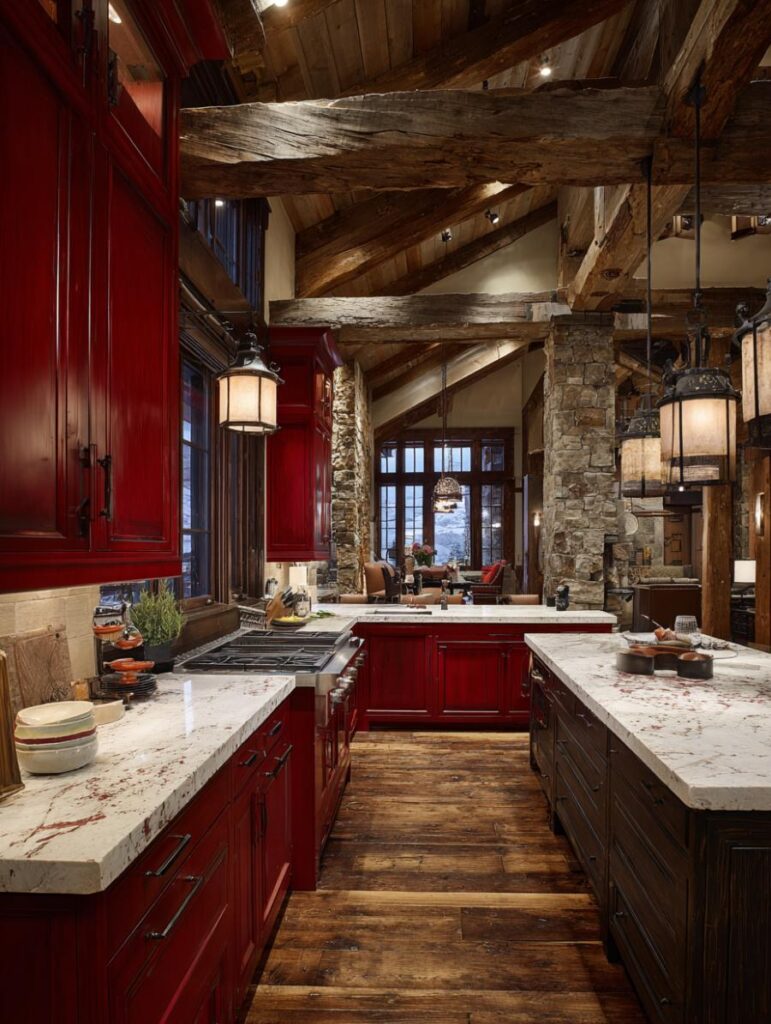
The look: Burgundy cabinetry · heavy timber structure · lodge proportions
Burgundy cabinetry under heavy timber in a mountain lodge. Burgundy is red with the brightness taken out of it, which makes it one of the few saturated colours that genuinely belongs in this style rather than merely surviving in it.
It also does something useful at night. Under warm artificial light burgundy goes almost brown and the room closes in, which in a mountain house is precisely the effect you want.
dramatic
marble
stained wood
burgundy
brown
cream
26. Navy Under Timber
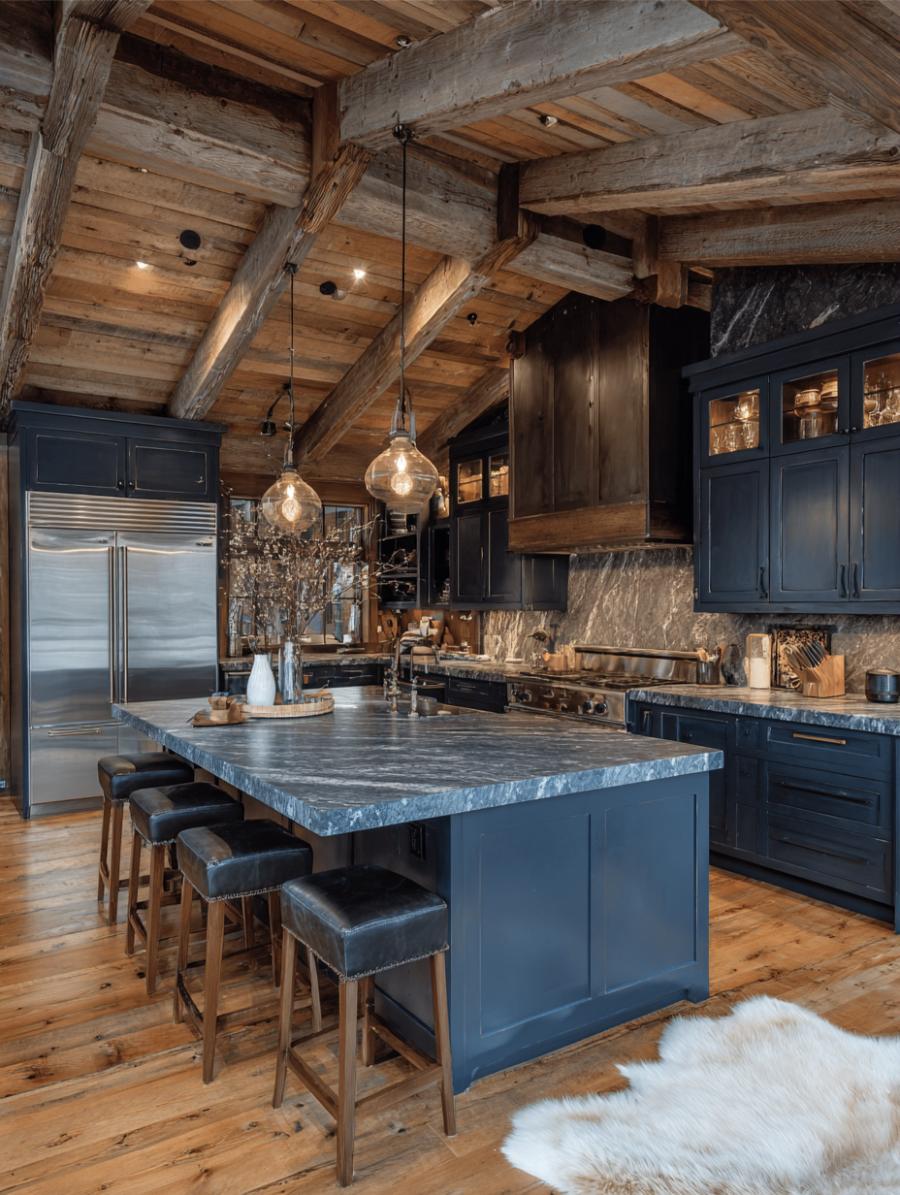
The look: Navy cabinetry · rough exposed beams · marble island
Navy cabinetry, exposed timber beams and a marble island. Navy is the contemporary intruder in rustic and it has become the default modernising move, largely because it is cool enough to stop a timber room feeling like a theme.
The risk is that it reads as a contemporary kitchen with beams added. Keeping genuinely rough timber overhead is what prevents that, and it is why this room stays on the right side of the line.
cozy
marble
stained wood
navy
brown
grey
27. Navy, Stone and Marble
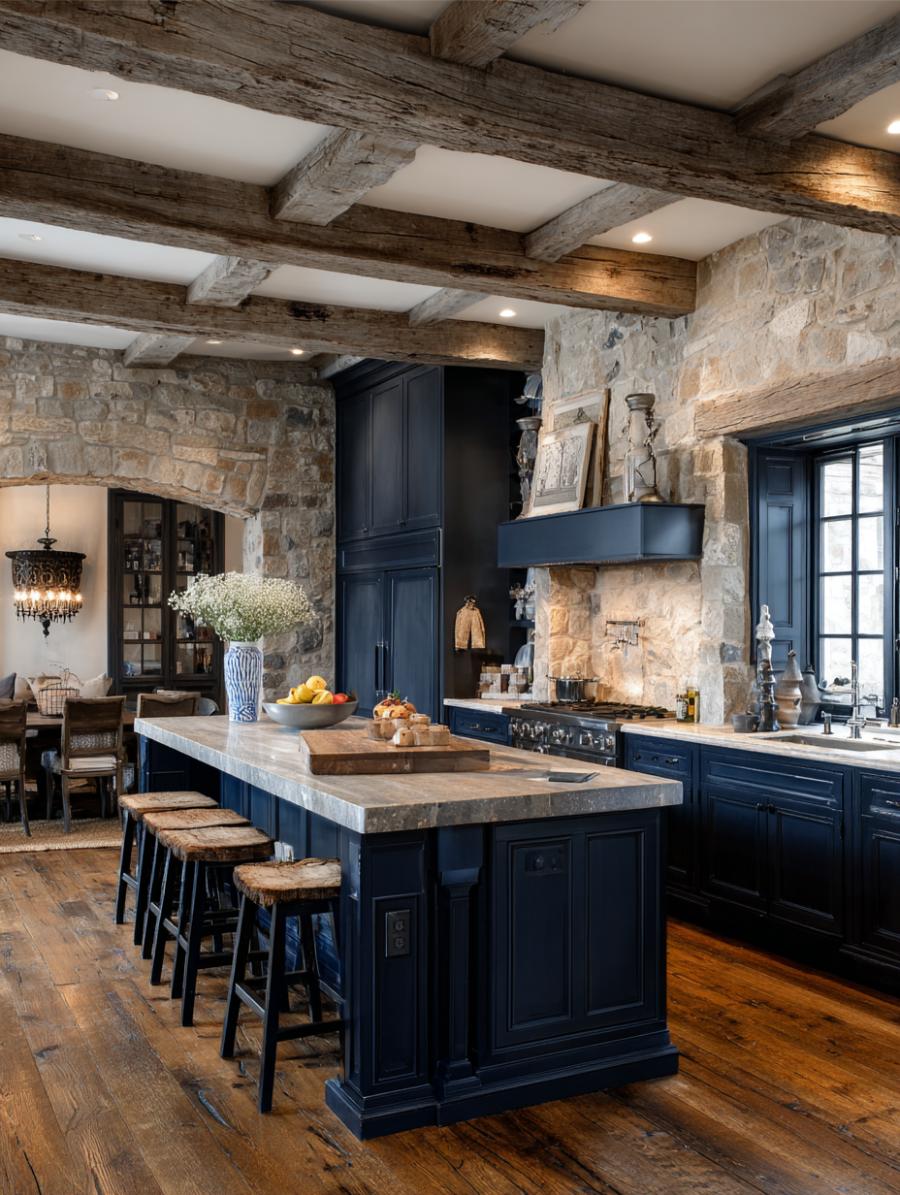
The look: Navy cabinetry · stone walls · marble counters · timber ceiling
The same navy idea with stone walls instead of plaster, and considerably more of it. Three cool materials in a row, with timber restricted to the ceiling, which produces the most contemporary-feeling room in the collection.
Push it any further and it stops being rustic. This is roughly the boundary of the style.
dramatic
stone
marble
navy
cream
brown
28. Arched Beams, Dark Blue
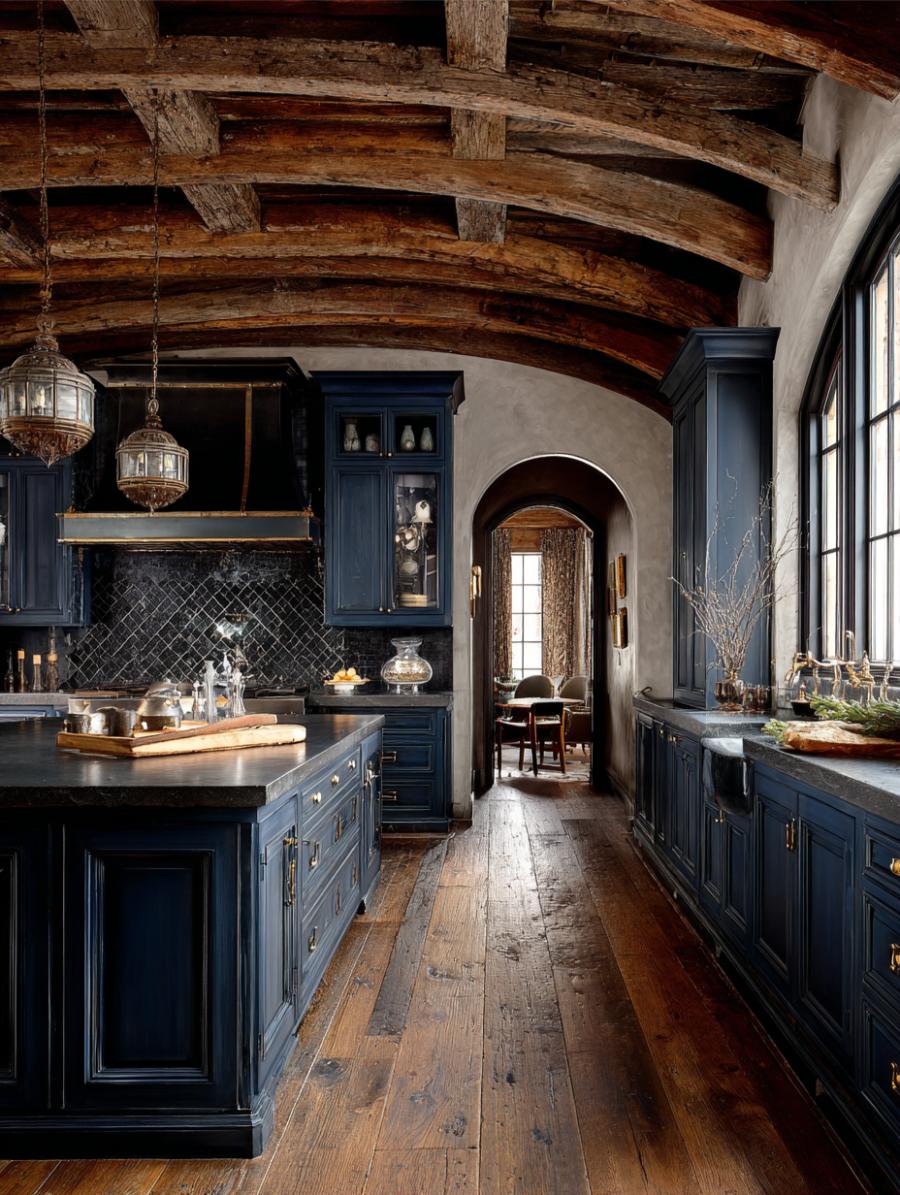
The look: Curved timber beams · dark blue cabinetry · full-height glazing
Dark blue cabinetry beneath curved timber beams, with a wall of glazing beyond. Arched structural timber is expensive and rare, and it is doing something no straight beam can: it makes the ceiling read as a single continuous form rather than as a grid.
The glazing is what makes the darkness survivable, which returns to the recurring lesson in this list. Dark rustic rooms live or die on their light.
dramatic
stained wood
black metal
navy
brown
black
29. Cream and Stone
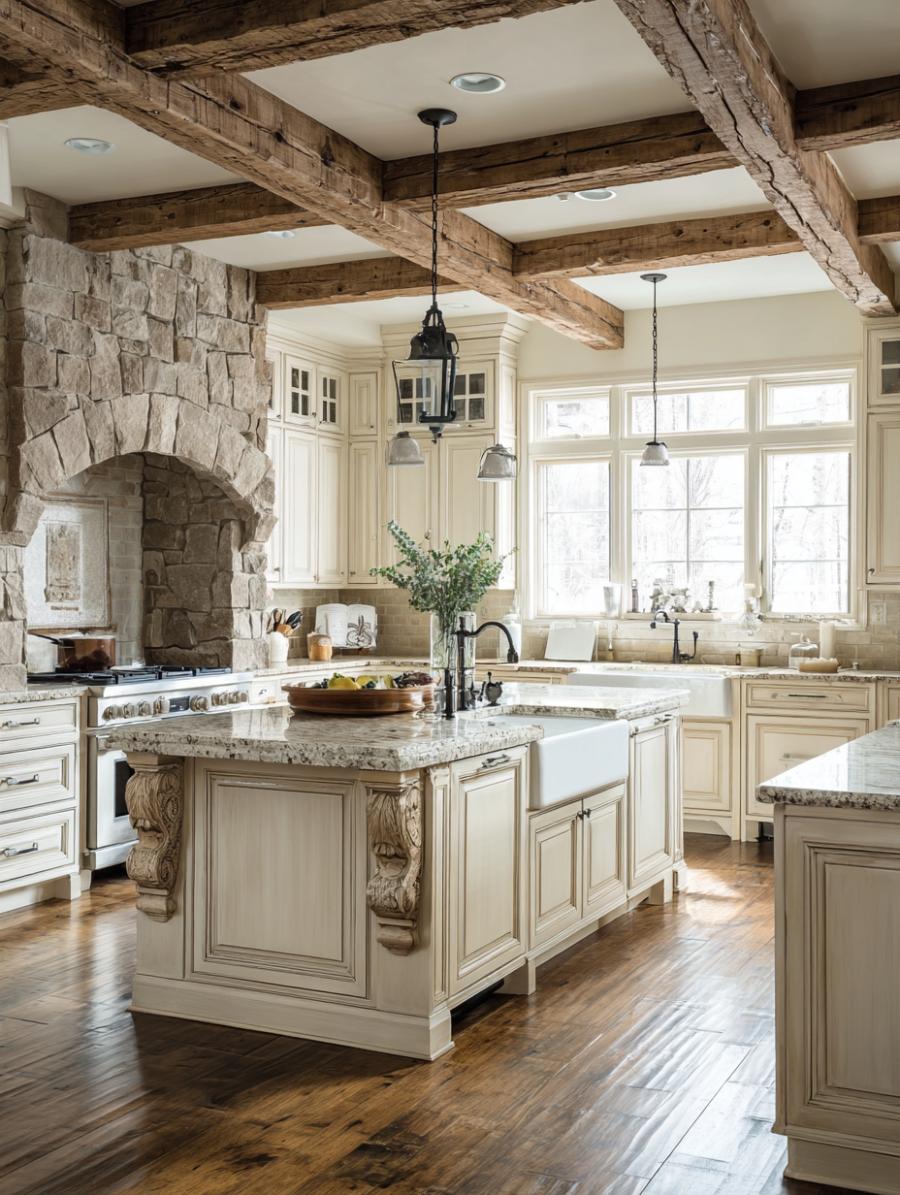
The look: Cream cabinetry · stone fireplace · exposed beams · granite island
Cream cabinetry, a stone fireplace, exposed beams and a granite island. The lightest genuinely rustic room here, and evidence that the style does not require darkness — only texture.
Everything rough in this room is architectural: the stone, the beams, the granite. The joinery is smooth and pale, which is what keeps it from tipping into farmhouse pastiche.
airy
stone
granite
cream
tan
brown
30. The Window Seat
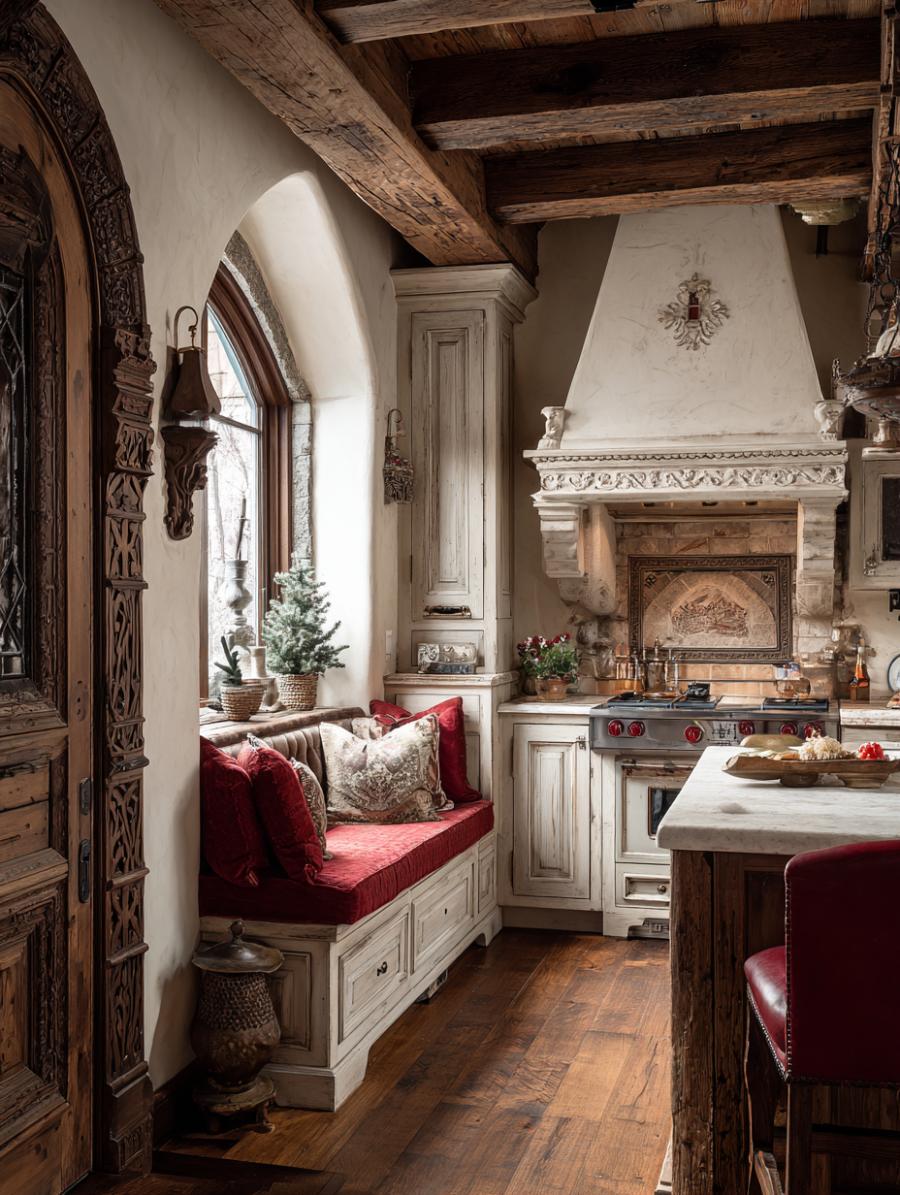
The look: Cream cabinetry · corner fireplace · built-in burgundy window seat
Cream cabinetry, a fireplace, and a burgundy window seat built into the corner. Ending here deliberately, because the window seat is the detail that separates a rustic kitchen from a rustic-looking one.
The point of this style has never really been the materials. It is that the kitchen is somewhere people sit rather than somewhere people work, and a bench under a window says that more clearly than any amount of reclaimed timber.
cozy
stained wood
stone
cream
burgundy
brown
How to actually get the look
Pick your two heavy materials and stop there. Timber and stone is the pairing nearly every room above is built on, and the moment a third heavy texture arrives — brick as well as stone, tile as well as both — the room stops reading as considered and starts reading as busy.
Spend the money on one genuinely old surface rather than spreading it across several new ones that imitate age. A single wall of real reclaimed timber, or one unworked stone face, will carry a kitchen full of ordinary cabinetry. The reverse never works.
And decide early whether you are building the grand version or the intimate one, because they are not the same style and they do not scale into each other. If your ceiling is eight feet, build the cabin. Oversized lanterns and a boulder-based island in a standard room do not read as a lodge — they read as a room that is trying to be one.