🔥 Would you like to save this?
Most Halloween front yards fall somewhere between two extremes: three plastic skeletons dropped onto the lawn ten minutes before dinner, or a production so elaborate it appears to require its own stage manager. The most memorable yards usually have something else going for them — an actual idea.
In order to come up with the very specific design ideas, we create most designs with the assistance of state-of-the-art AI interior design software. Also, assume links that take you off the site are affiliate links such as links to Amazon. this means we may earn a commission if you buy something.
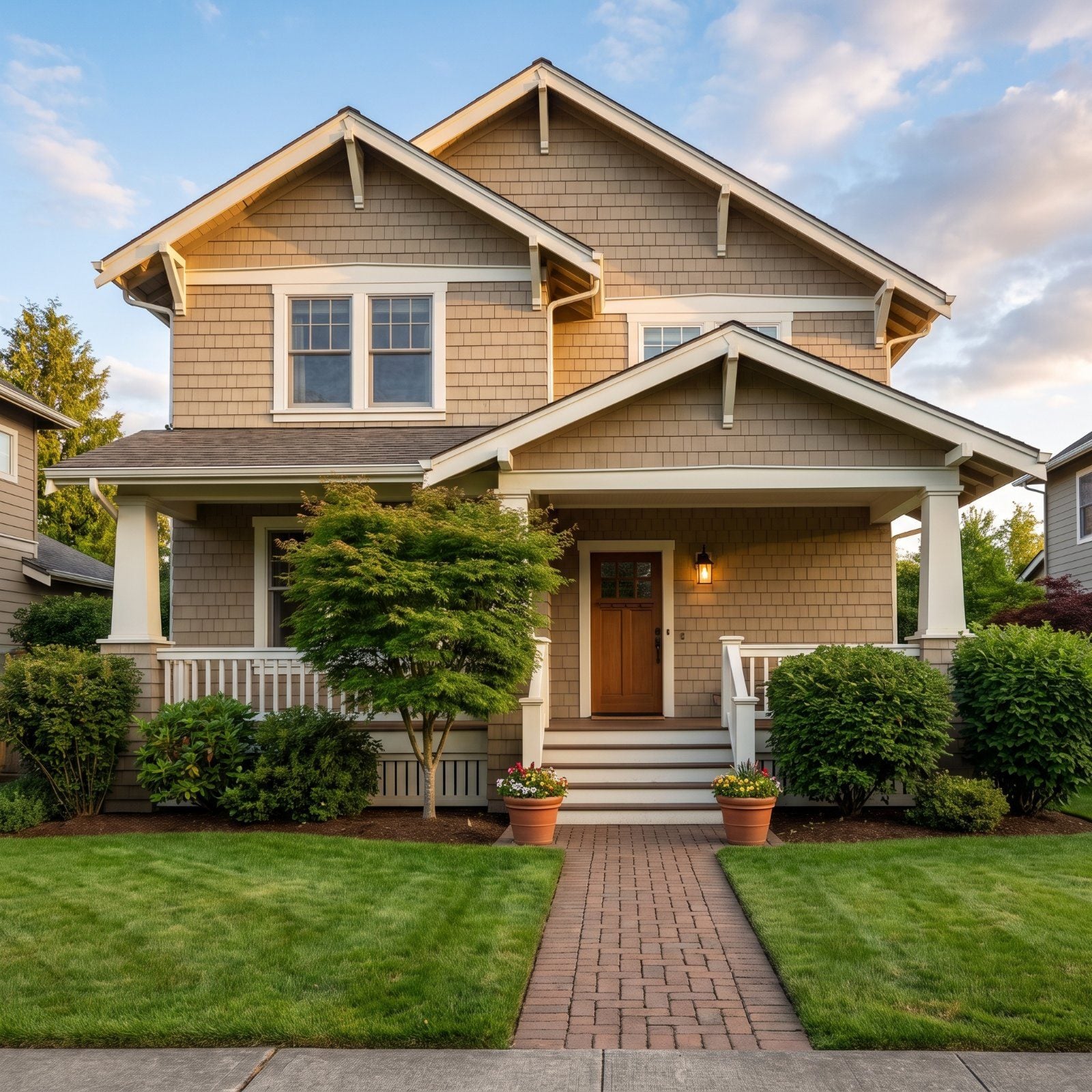
That’s what makes these before-and-afters fun. Every concept starts with the same ordinary suburban house: beige siding, patchy lawn, concrete walk, young tree, nothing remotely supernatural. Then the AI redesigns start piling on fog, graveyards, spiders, scarecrows, witches, shipwrecks, carnival tents, crypts, and enough jack-o’-lanterns to create a municipal pumpkin shortage.
Thirty front yards take the same blank canvas in completely different directions, from quietly creepy to gloriously unreasonable. The test is simple: can the transformation still make an impact from the street?
30. From Subdivision Staple to Full-On Haunted House in One October Weekend
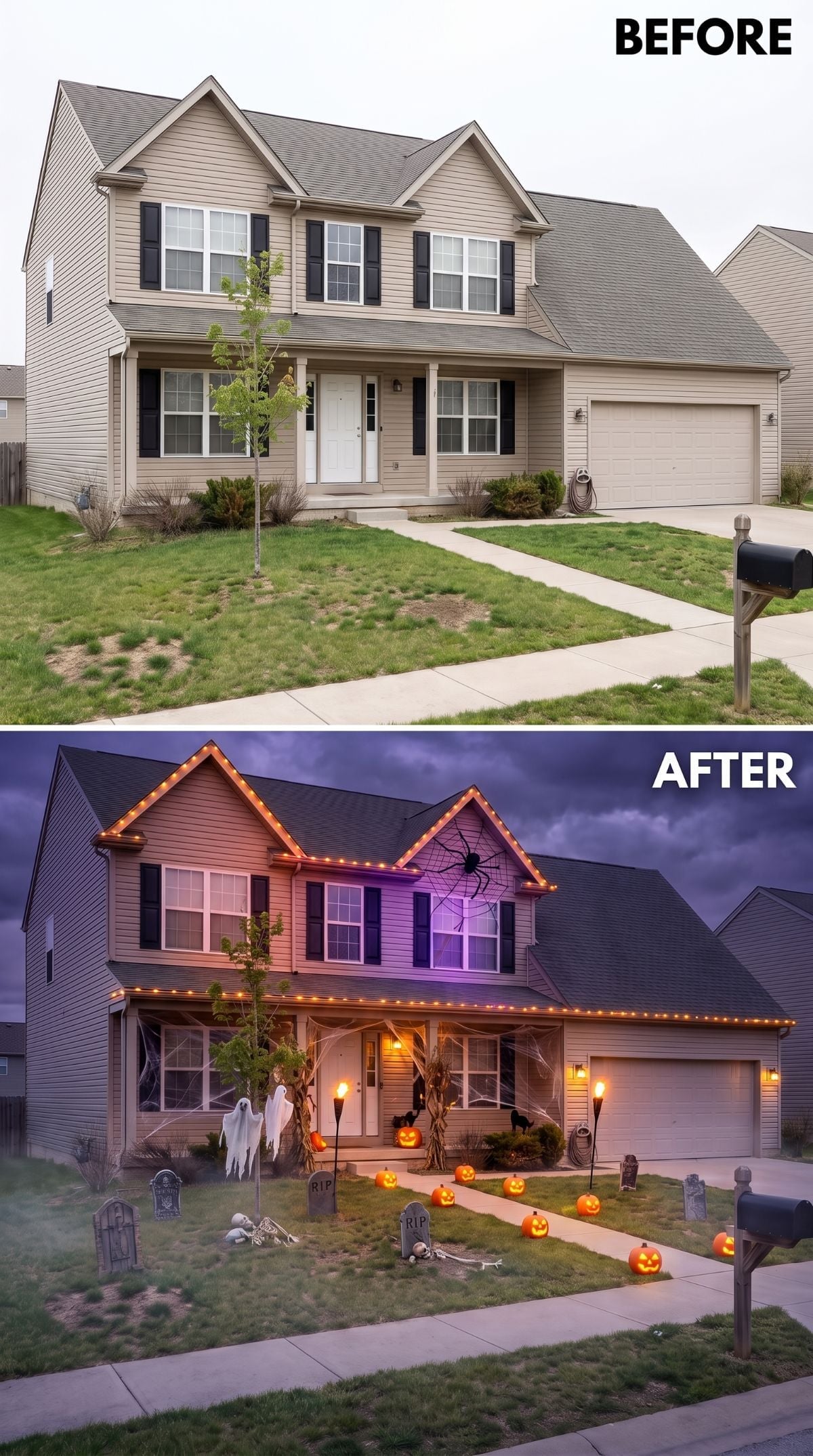
Orange string lights trace the roofline at dusk, turning the familiar gables into the outline of a stage set. Giant spiderwebs stretch across the upper facade, with an oversized black spider planted high on the front gable while purple light glows through the windows below.
Jack-o’-lanterns run along the walkway, tombstones break up the lawn, and two gauzy ghosts stand near the porch among dried stalks and flickering torch-style lights. The house itself remains recognizable — same siding, shutters, windows, driveway — which makes the transformation more convincing rather than less.
The architecture hasn’t disappeared. Halloween has simply taken possession of it.
29. Warm Yellow, Black Mulch, and a Much More Controlled Kind of Halloween
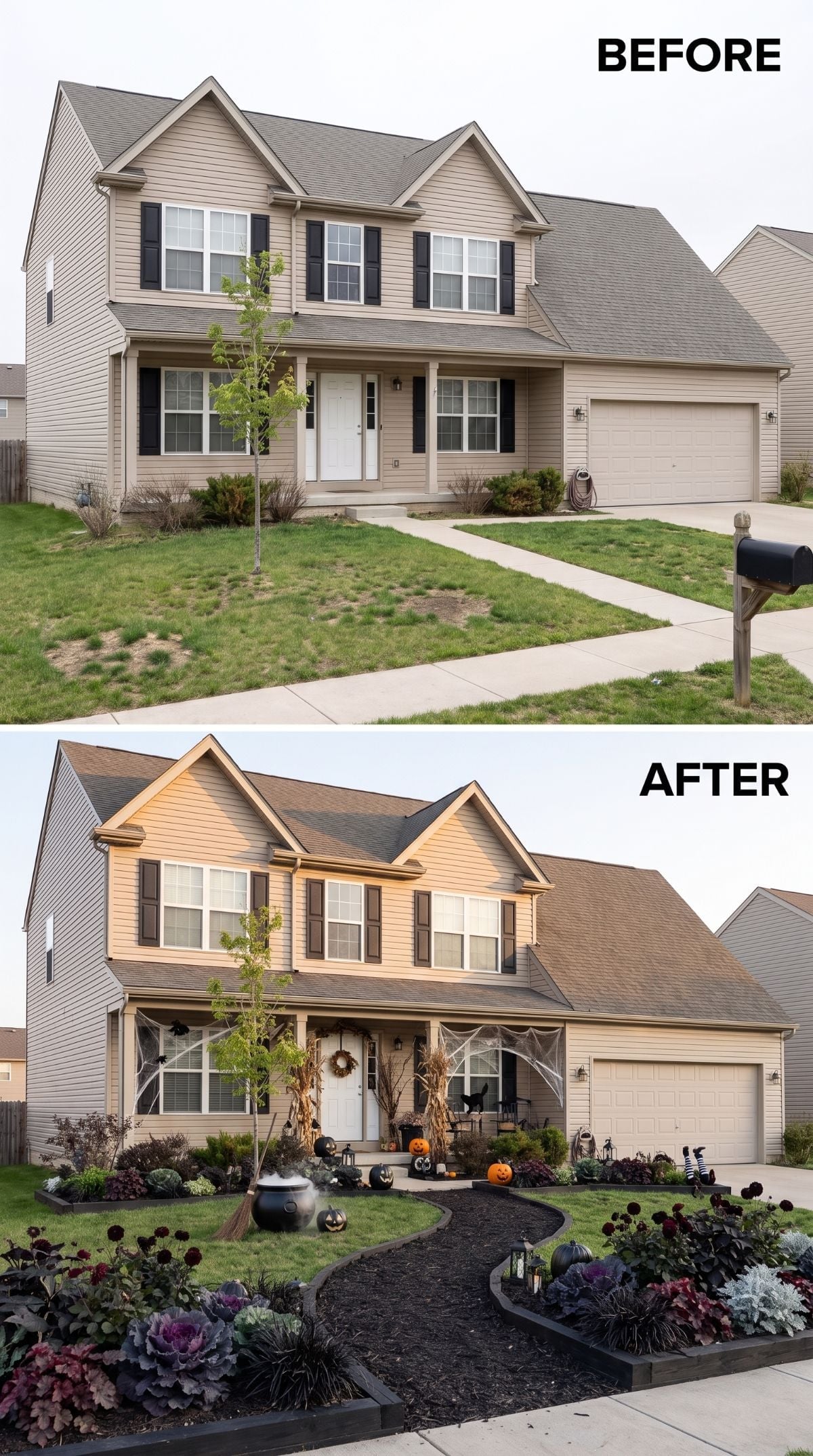
The AI treatment warms the facade toward buttery yellow and shifts the shutters into a softer brown, immediately changing the mood before a single pumpkin arrives.
Dark mulch creates deep bands around the foundation plantings, where ornamental cabbage, dark flowers, and silvery foliage give the yard a surprisingly polished October palette. A bubbling cauldron and carved pumpkins bring in the Halloween cues, while stretched webbing around the porch keeps the planting from looking like ordinary fall landscaping.
Compared with the bigger haunted-house productions, this one knows when to stop.
28. A Graveyard Grows Out of the Lawn and Takes the House With It
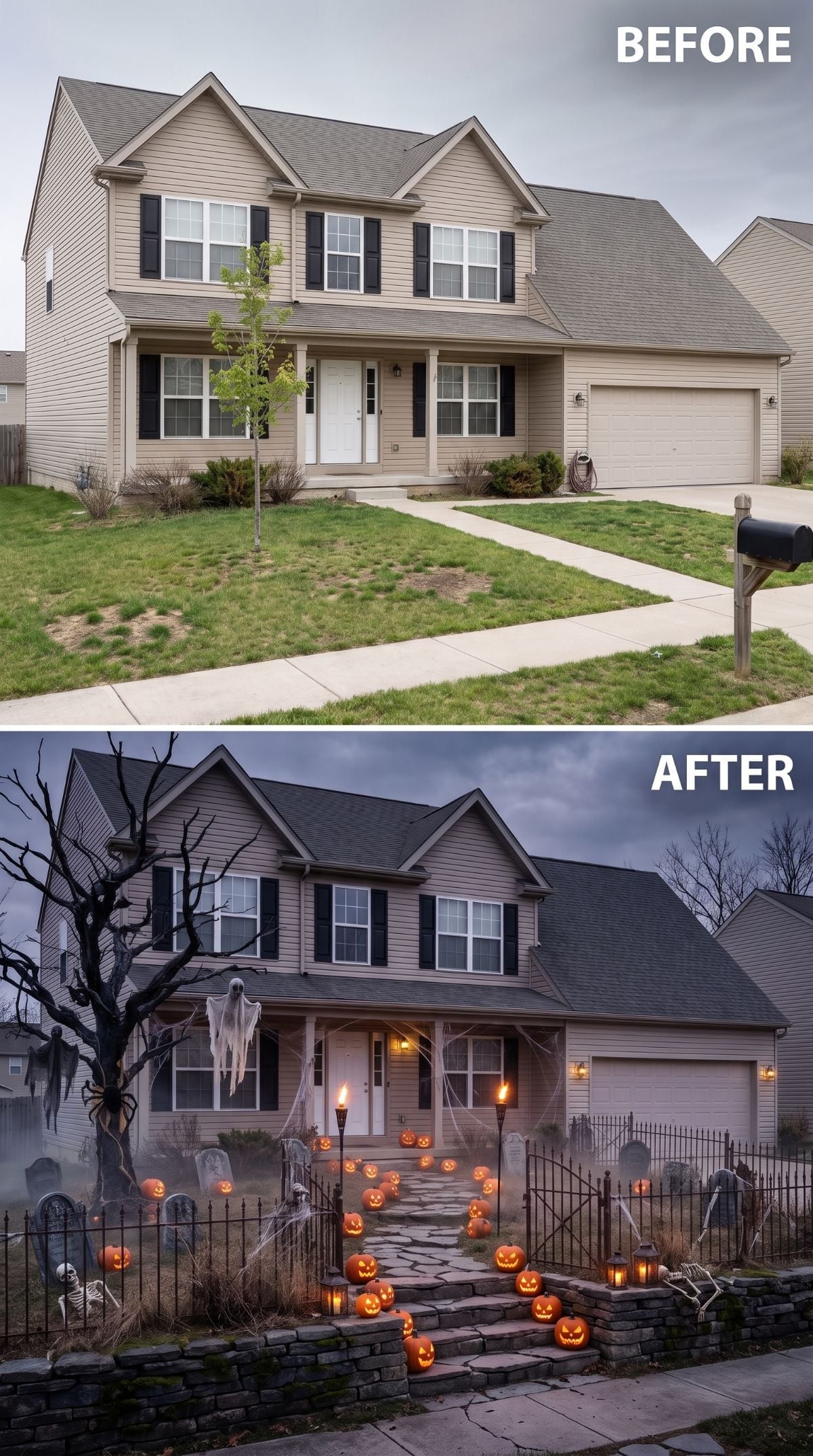
The AI concept replaces the lonely young tree with taller bare branches that immediately change the scale of the front yard. Mist catches around them, while tombstones spread across the patchy grass like the neighborhood cemetery expanded without consulting zoning.
A stone-look path winds toward the door between glowing jack-o’-lanterns and torch-style lights. Wrought-iron fencing and a low stone edge add the kind of structure that makes the temporary graveyard feel less like scattered props and more like a place with boundaries.
A gauzy ghost hanging from the porch is almost an afterthought. By then, the lawn has already become the story.
Scene Builder: The strongest element here isn’t any individual tombstone. It’s the path, fence, and lighting working together to give the graveyard an entrance, an edge, and a destination. Those larger lines make the smaller props feel connected.
27. What Used to Be a Driveway Is Now Apparently a Haunted Swamp
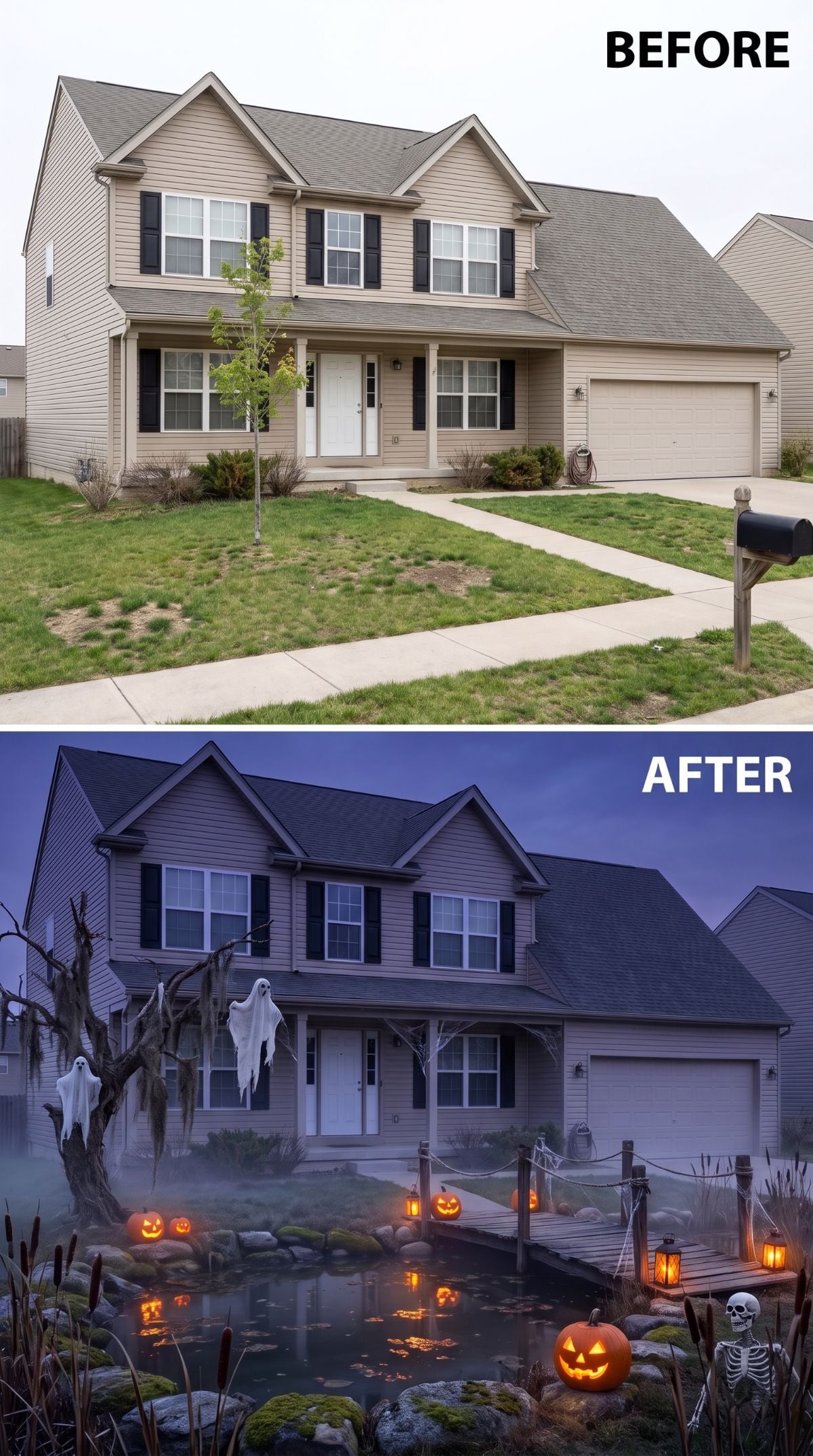
The AI took one look at the concrete driveway and decided it needed a pond.
Dark water now occupies the foreground, edged with mossy rocks and cattails. A weathered dock pushes into it beneath hanging lanterns, while jack-o’-lanterns appear reflected in the still surface.
Two draped ghosts hang at different heights from a gnarled tree, and a skeleton waits near the dock as if this is a perfectly ordinary place to spend an evening. Low fog blurs the boundary between lawn, water, and walkway.
Is any of this remotely practical for one night in October? Absolutely not. As a transformation, though, it is magnificent.
26. Black Gates and a Murder of Crows Give the House a Proper Entrance
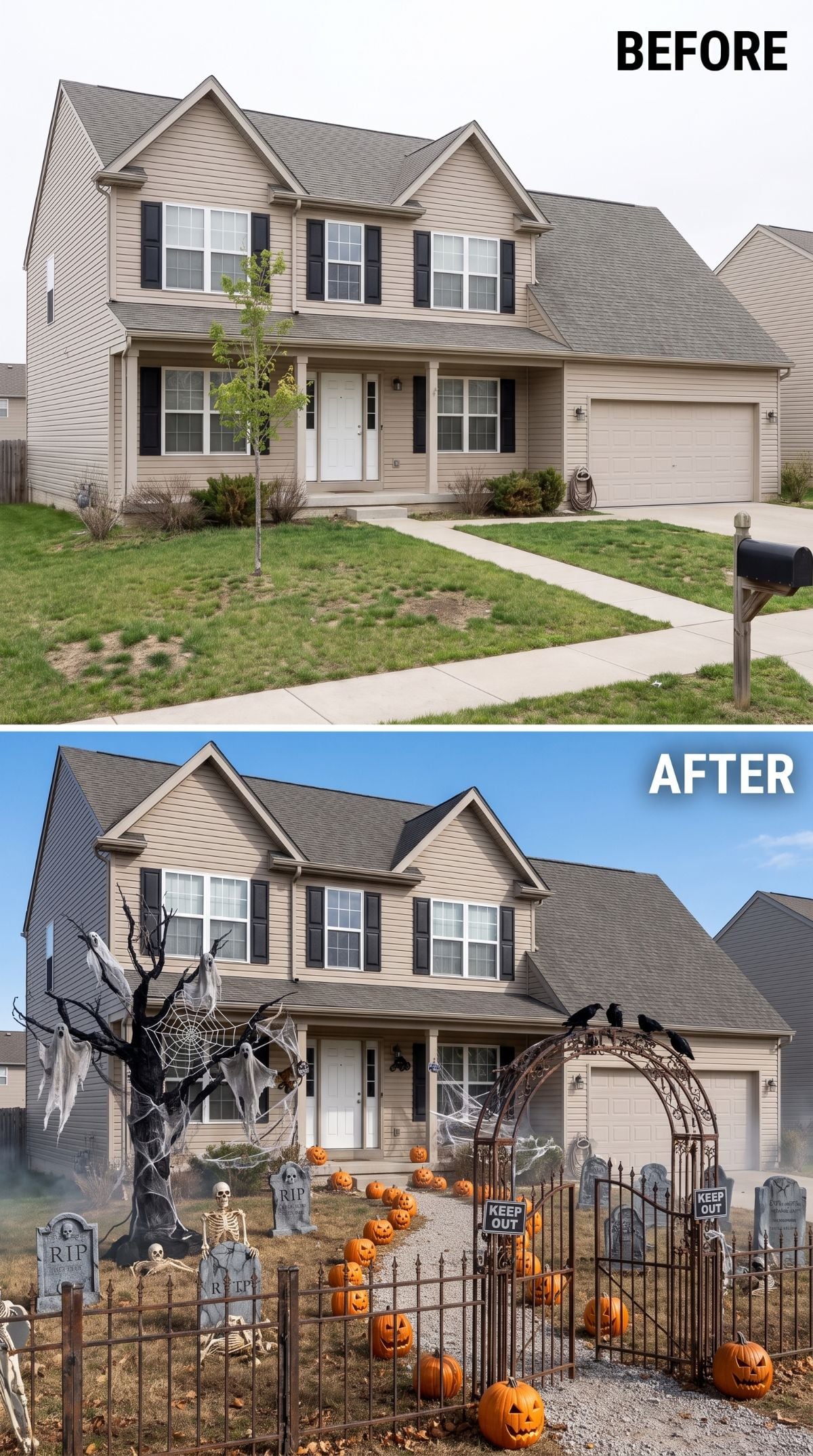
Few things change an ordinary front yard faster than giving it a gate nobody particularly wants to walk through.
The beige siding stays familiar, but a wrought-iron-style fence and arched entry create an immediate cemetery perimeter. Black bird props line the top like an audience waiting for something unfortunate to happen.
Skeletons crouch among tombstones below, a black bare-tree prop fills one side of the yard, and webbing stretches through its branches. Jack-o’-lanterns draw a glowing line toward the front door.
The gate is the important move. Once the yard has an entrance, everything behind it feels like part of the same sinister little world.
Of course, skeleton sentinels aren’t the only way to make the same front lawn feel unwelcome.
25. A Weathered Picket Fence Somehow Makes the Skeleton Worse
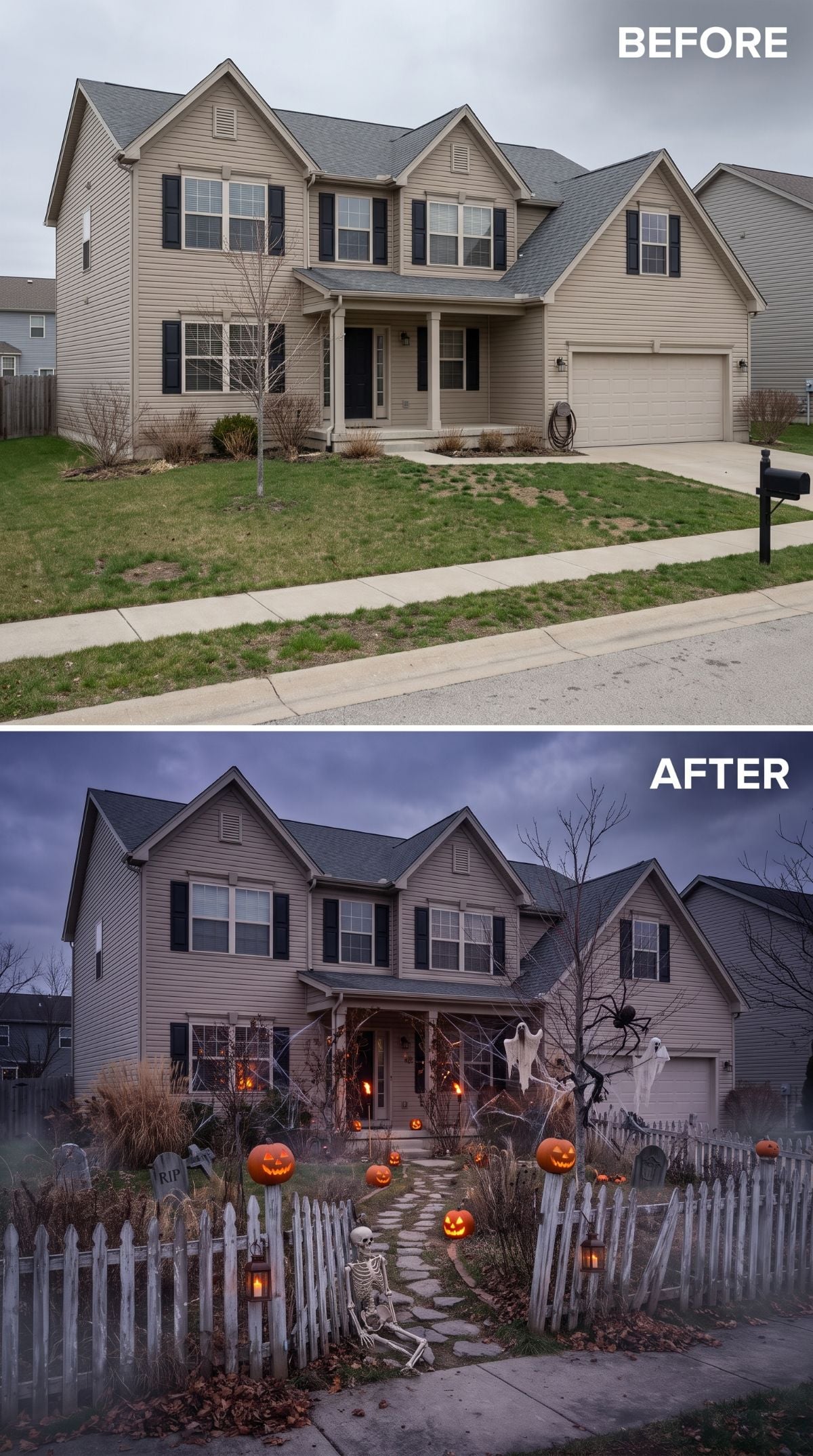
Glowing jack-o’-lanterns follow a stone path through a layer of fog and dead-looking grass. Then comes the detail that turns the scene: a skeleton slumped against a weathered picket fence as if it has been waiting there substantially longer than October.
Ghosts hang from bare branches near the garage, but the yard doesn’t need much more. The contrast between familiar suburban fencing and something distinctly less alive leaning against it is creepy enough.
24. Scarecrows Turn the Front Lawn Into a Harvest Scene With Bad Intentions
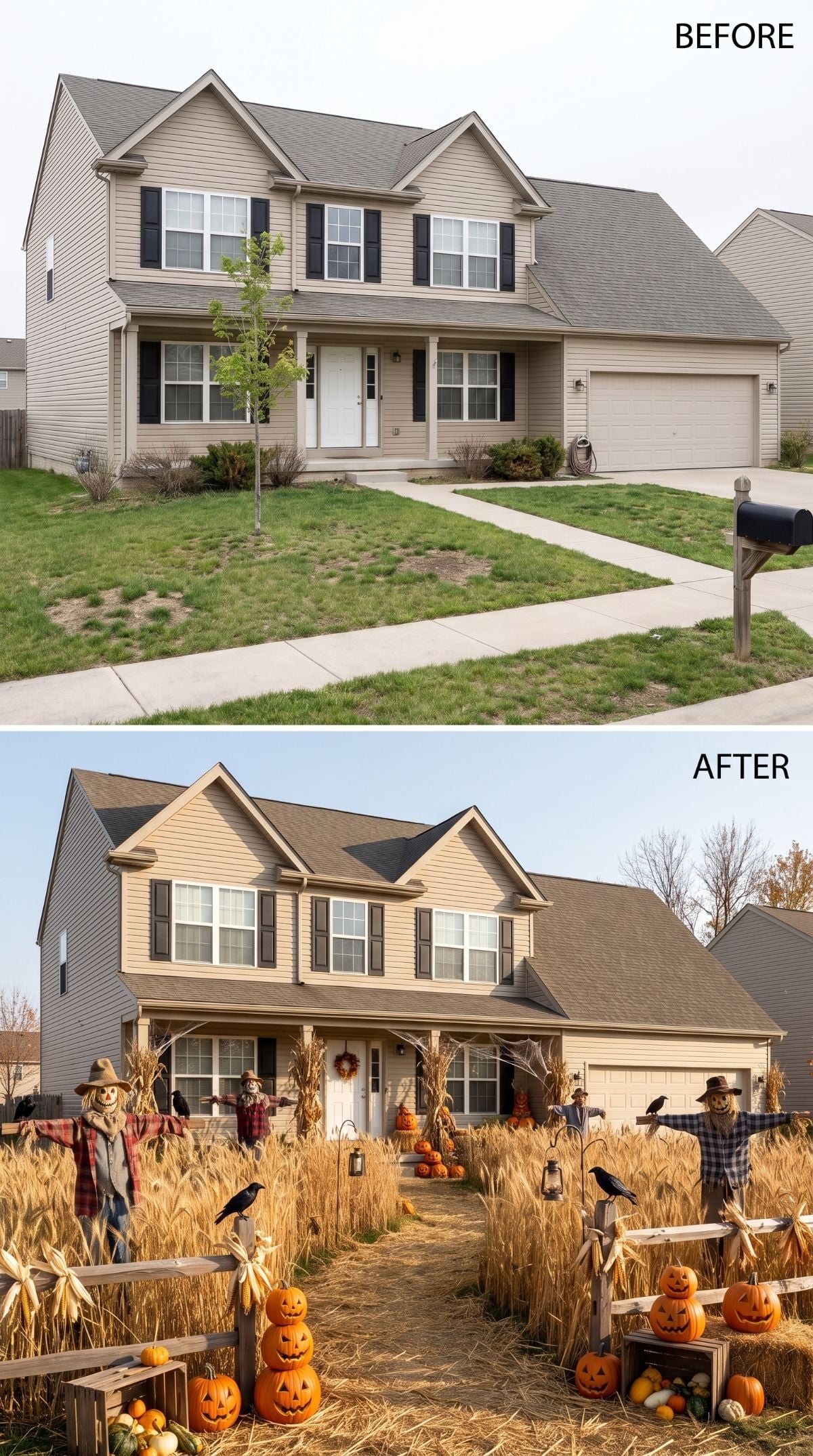
Dried stalks swallow most of the lawn, replacing green grass with something much closer to an abandoned field. Scarecrows in flannel and burlap stand at irregular intervals, and black bird props along the fence make the whole arrangement feel watched.
Hay bales, weathered crates, and stacked jack-o’-lanterns gather along the walkway. Corn stalks frame the door, while a simple wreath keeps the porch connected to the harvest theme without making everything friendly again.
- Varying the scarecrows’ spacing makes the figures feel less like a lineup and more like inhabitants of the scene.
- Stacked pumpkins introduce height where an ordinary row would stay flat against the ground.
- Dried stalks give the lawn a completely different texture without relying on another graveyard.
23. One Giant Web Makes the Entire House Look Like Dinner
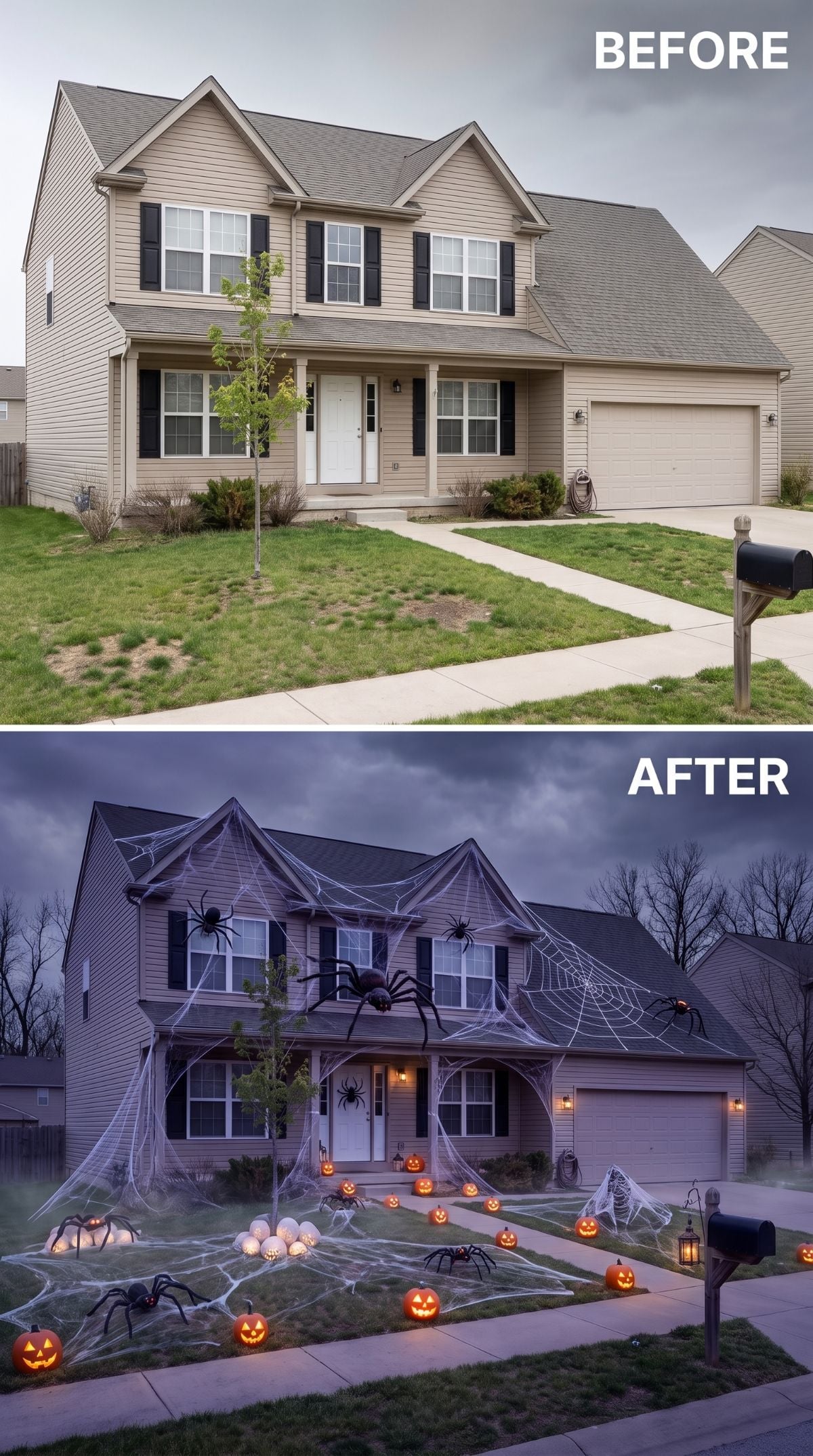
Unlike the first spider transformation, which scatters horror across the entire yard, this concept lets the web become the architecture.
White strands stretch across the roof and front elevation in huge sheets, with oversized black spiders positioned at gables and window corners. The beige siding becomes little more than backing material for the invasion.
Pumpkins line both sides of the concrete walk while fog settles across the lawn. The simplicity is useful: one enormous visual gesture up high, one glowing path below.
Scale Matters: Stretching webbing across an entire gable has a very different effect from wrapping it around a shrub. The larger span lets the house itself become part of the prop, while the spiders provide dark focal points against all that white.
22. A Pumpkin Stand Turns the Patchy Lawn Into Its Own Roadside Attraction
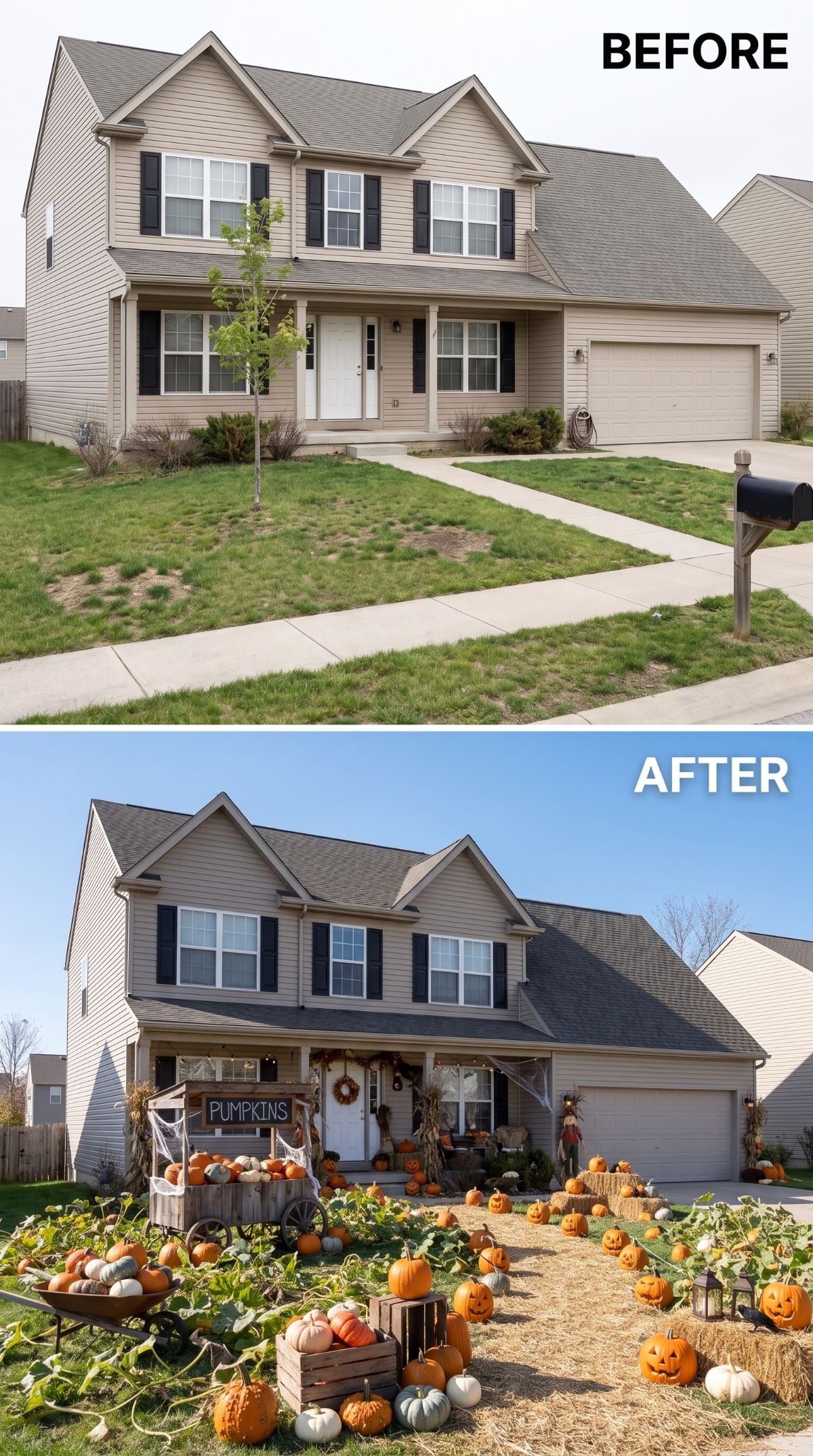
This time the plain lawn becomes an advantage. Dozens of pumpkins spill across hay-covered ground with enough density to make the house feel as though a farm stand has quietly expanded onto the property overnight.
A rustic wooden cart marked “PUMPKINS” gives the scene a center, while a scarecrow guards the porch steps and dried corn stalks bracket the front door.
The mix of carved and uncarved pumpkins keeps it from becoming a wall of glowing orange faces. Some are decoration. Some look like inventory. All of them appear to have won the yard.
Display Idea: Mixing pumpkins by size, color, and height gives a harvest setup more depth than lining identical orange pumpkins along a single edge. Crates, hay bales, and a cart create additional levels without requiring every pumpkin to be carved.
21. A Creepy Carnival Doesn’t Decorate the Yard. It Occupies It.
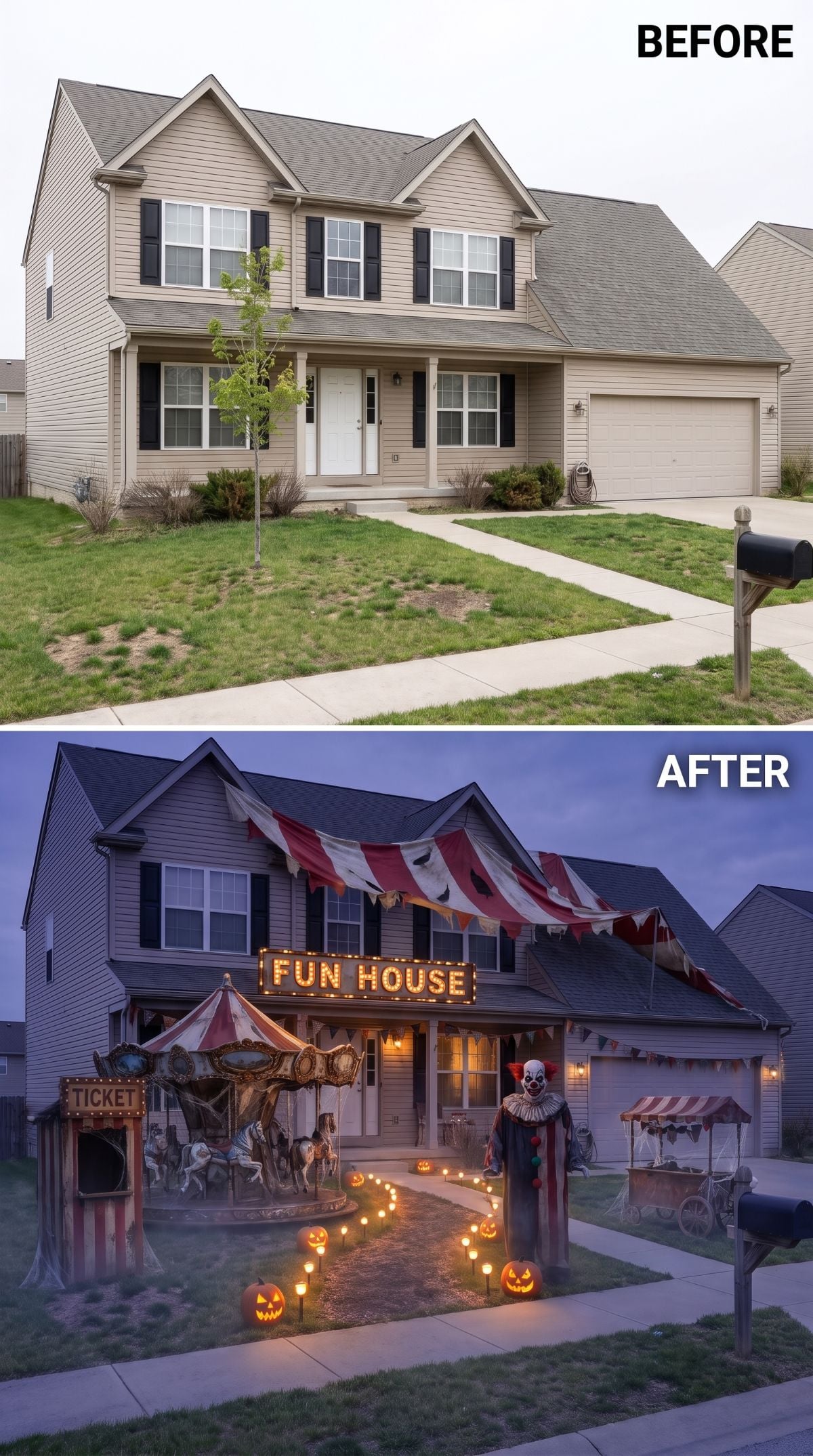
Red-and-white striped canvas spreads across the roofline before dropping into a full carnival scene below. A carousel with painted horses fills one side of the lawn, while a ticket booth makes the transformation look less like Halloween decor and more like a traveling attraction that chose the wrong subdivision.
Jack-o’-lanterns appear in clusters along the walk, and fog stays low enough to leave the major props visible.
Why the Theme Lands: The carousel, striped canopy, and ticket booth all tell the same story. Remove two of those elements and the scene becomes a collection of carnival references; together, they turn the yard into a destination.
20. Skeletons Throw a Cookout and Become the Best Neighbors on the Block
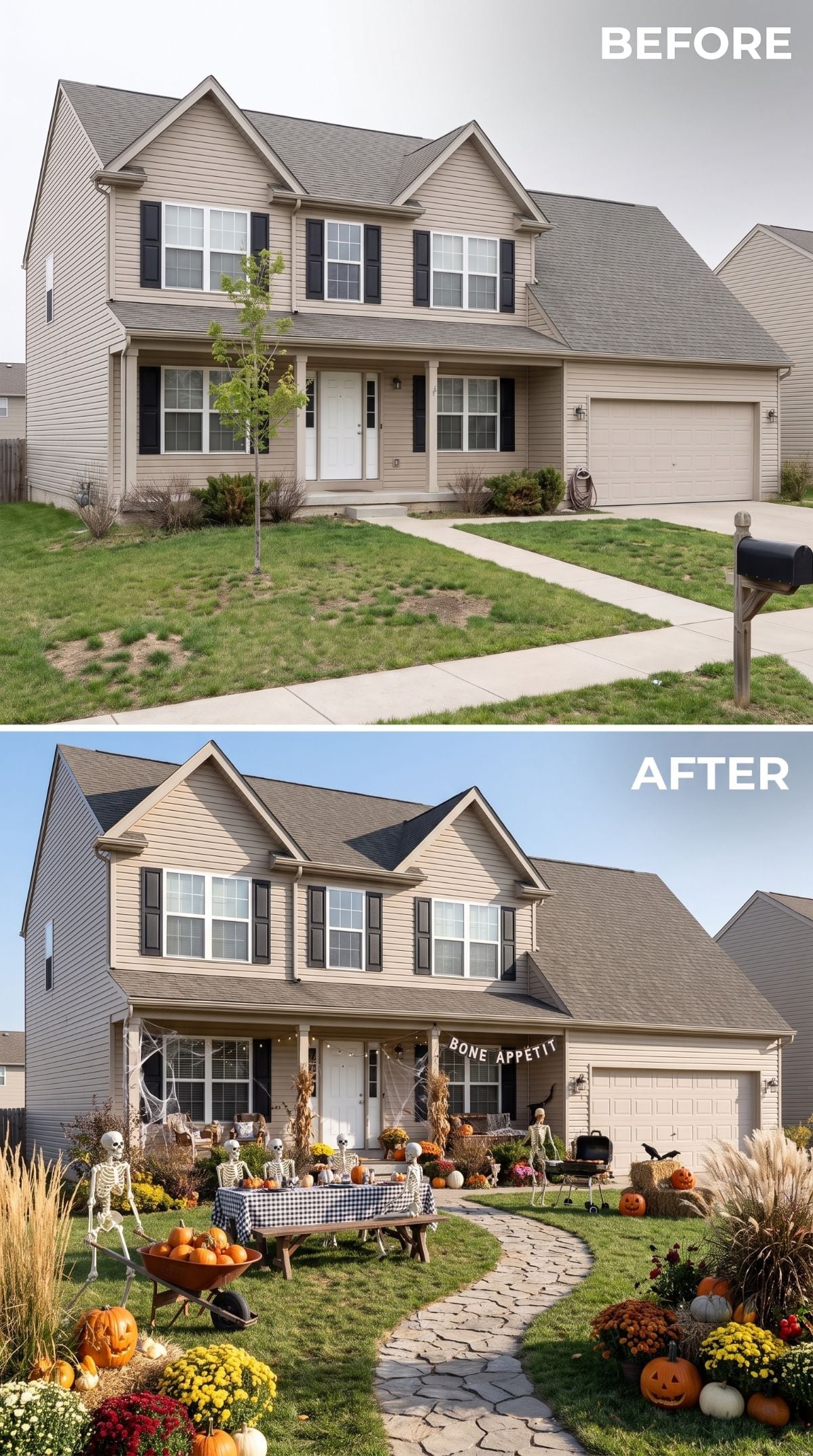
A navy-and-white checked tablecloth covers a picnic table where skeletons are apparently halfway through dinner. Another skeleton stands beside a charcoal grill wearing an apron, while the porch announces “Bone Appétit” in case the joke somehow escaped anyone.
What makes this more than a one-liner is everything around the gag. Yellow mums, orange pumpkins, ornamental grasses, and a wheelbarrow bring real fall color into the scene. Cobwebs stretch across the windows, but not enough to hide the house behind them.
The AI concept also swaps the plain concrete approach for a rougher stone path, adding another layer of texture beneath all the comedy.
In the Details: Poseable skeletons work especially well in scenes like this because the humor comes from body language. Sitting, grilling, reaching, and slouching make the figures feel like characters rather than identical props placed around a yard.
19. Sleepy Hollow Arrives With a Horseman Nobody Wants to Meet Halfway
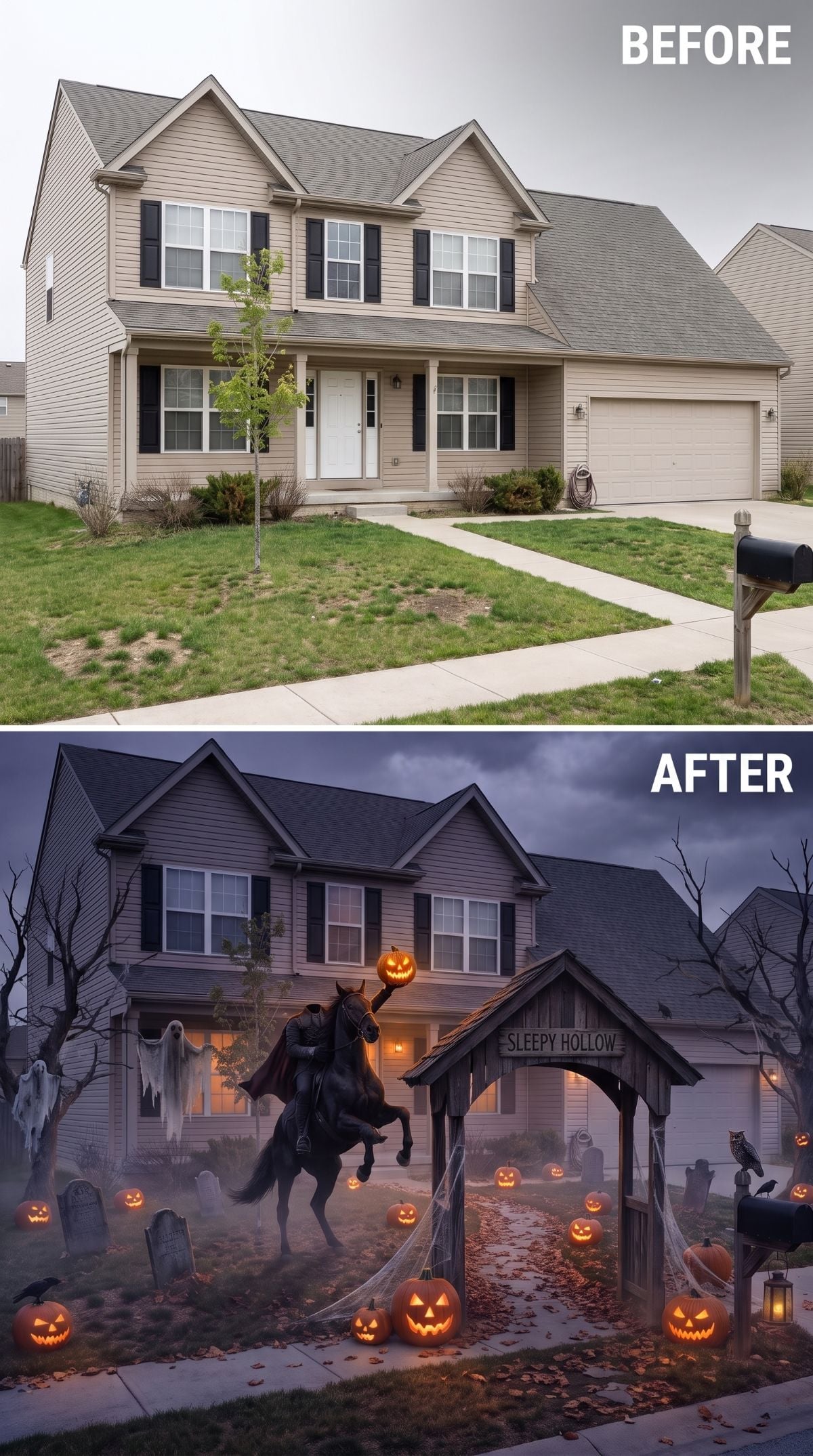
A hand-lettered “Sleepy Hollow” arch establishes the reference immediately, but the Headless Horseman makes sure nobody misses it.
The black horse rears near the center of the yard while pumpkins gather in staggered clusters along the approach. Bare branches frame the roof, ghosts hang near the entry, and fog obscures enough of the ground to let the horse and rider dominate the middle distance.
This works because it doesn’t merely borrow spooky props. It stages a recognizable story.
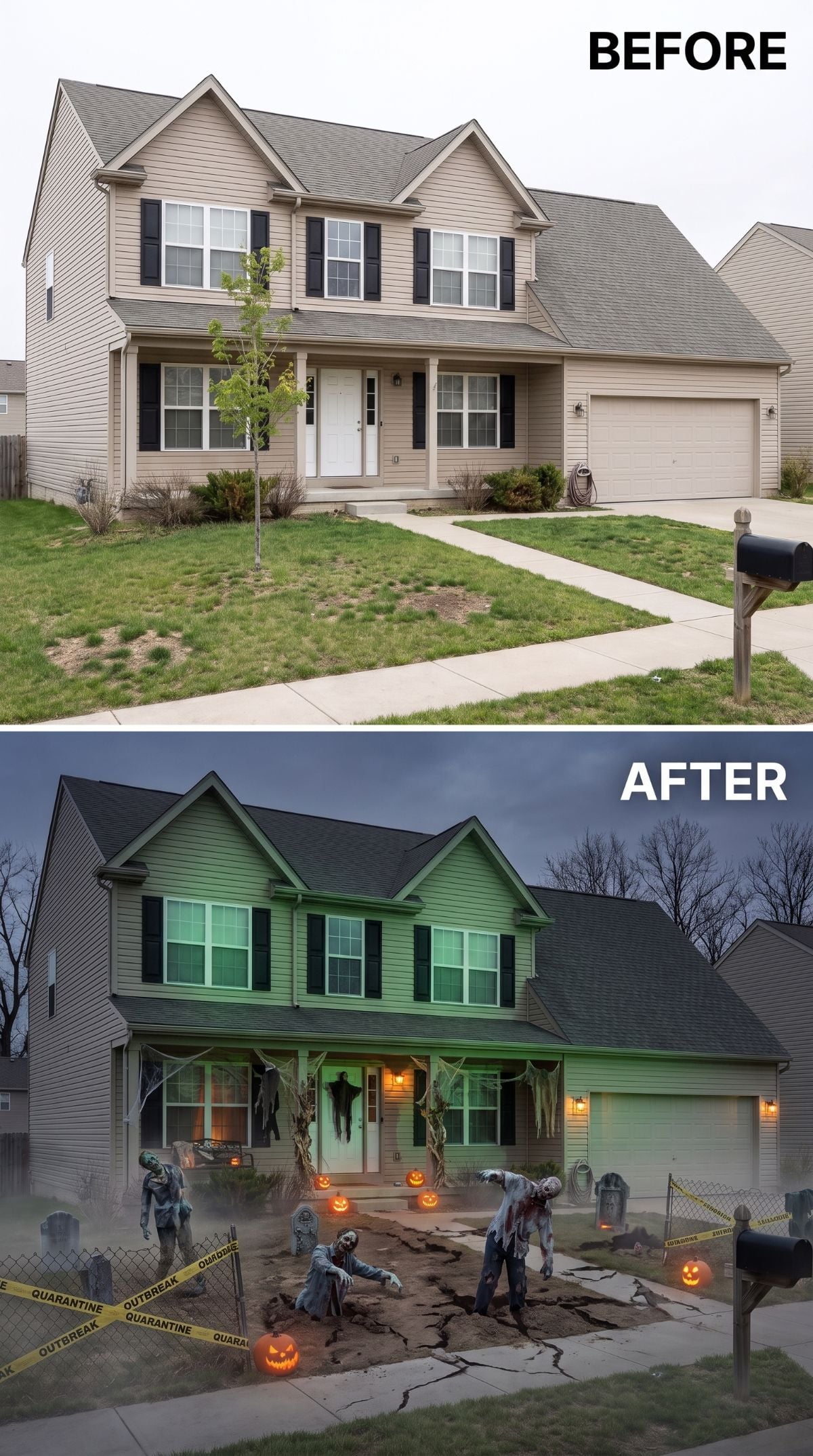
18. The Zombie Outbreak Starts Right Where the Lawn Used to Be
🔥 Would you like to save this?
Cracked-earth effects, quarantine tape, and figures clawing their way out of the lawn turn the familiar front yard into the opening scene of a zombie movie.
Green uplighting changes the color of the siding after dark, while jack-o’-lanterns mark the path through the chaos. Instead of decorating the house itself, the concept concentrates most of its action at ground level, as though whatever went wrong started beneath the grass.
Atmosphere Note: Low fog is especially effective around figures emerging from the ground because it hides the points where props meet the lawn. The less clearly you can see how everything is supported, the easier it is to buy the illusion.
17. Three Witches Turn the Front Lawn Into a Cauldron Scene
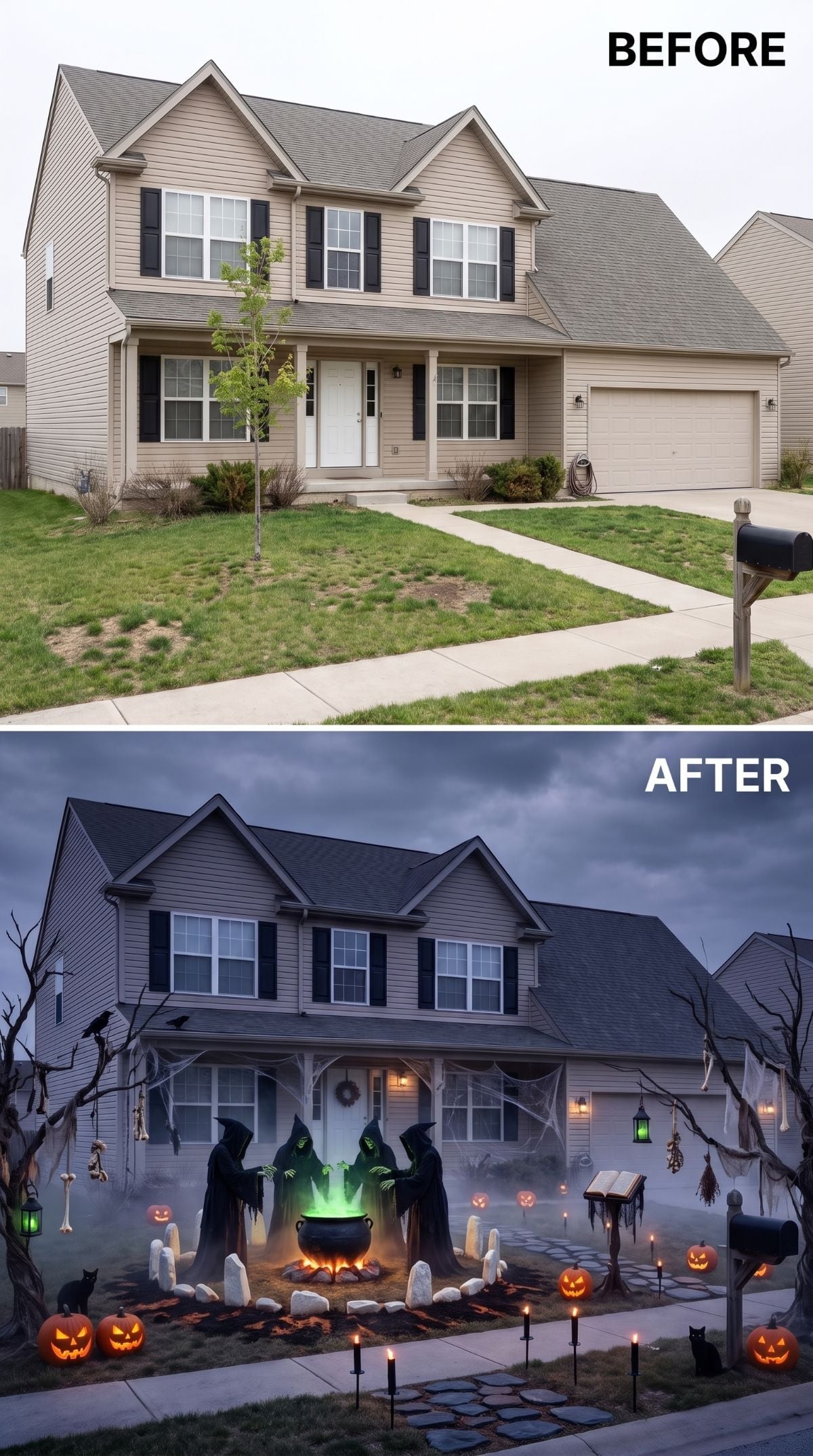
Three dark-robed witches lean toward a green-lit cauldron in the middle of the lawn, creating a single focal scene rather than spreading equal-weight props from curb to garage.
Tombstones form a loose outer ring, while jack-o’-lanterns arc toward the front door. Bare trees wrapped in webs extend the composition upward, with black cat props and green-and-amber lantern light filling the darker corners.
The warm pumpkins and amber lights punctuate an otherwise murky green-and-black palette. The effect feels less like a collection of Halloween merchandise and more like something the viewer interrupted.
Scene Builder: The three witches work because their poses face inward toward the cauldron. That simple orientation creates interaction between the figures and gives the viewer one obvious event to notice before exploring the rest of the yard.
16. Dead Trees Turn the Walk to the Front Door Into the Scary Part
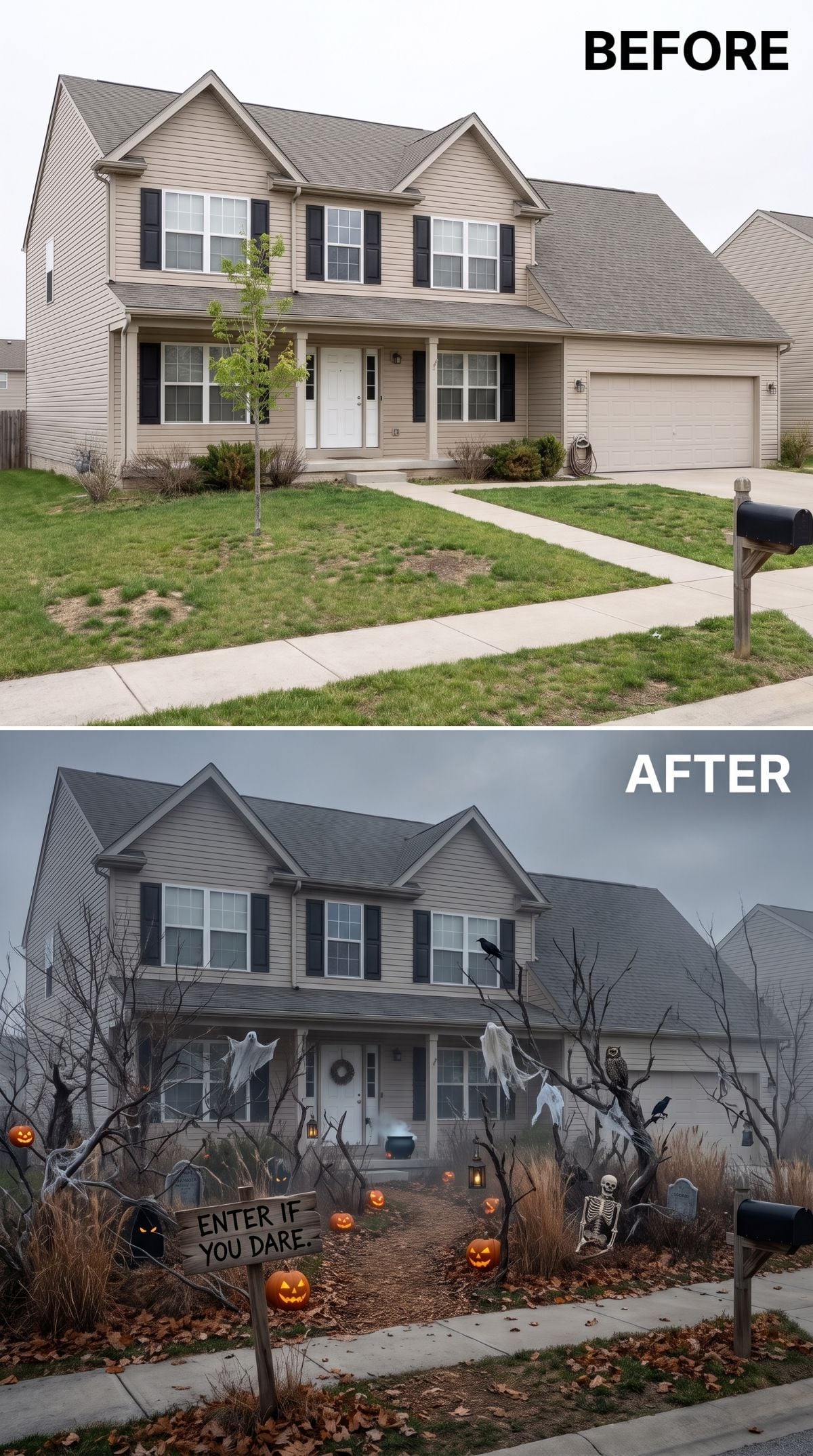
Bare tree props now crowd both sides of the front path, moving the Halloween scene away from the perimeter and directly into the route trick-or-treaters would have to follow.
Gauzy ghosts hang from the branches while pumpkins cluster along the dirt-darkened approach. A wooden “Enter If You Dare” sign sits near the street, with a crow above and a crouching skeleton beside a weathered headstone farther into the lawn.
The fog hides the clean suburban edges of the walkway. The trees do something even better: they make the path feel enclosed.
The Placement Matters More Than the Trees Themselves
Put tall bare branches around the outside of a yard and they become a backdrop. Put them close to the walkway and they become something visitors have to pass beneath. Here, that turns the approach into part of the experience rather than leaving all the Halloween action safely off to the sides.
15. An Iron Gate, Open Coffin, and Candelabras Build a Gothic Estate From Scratch
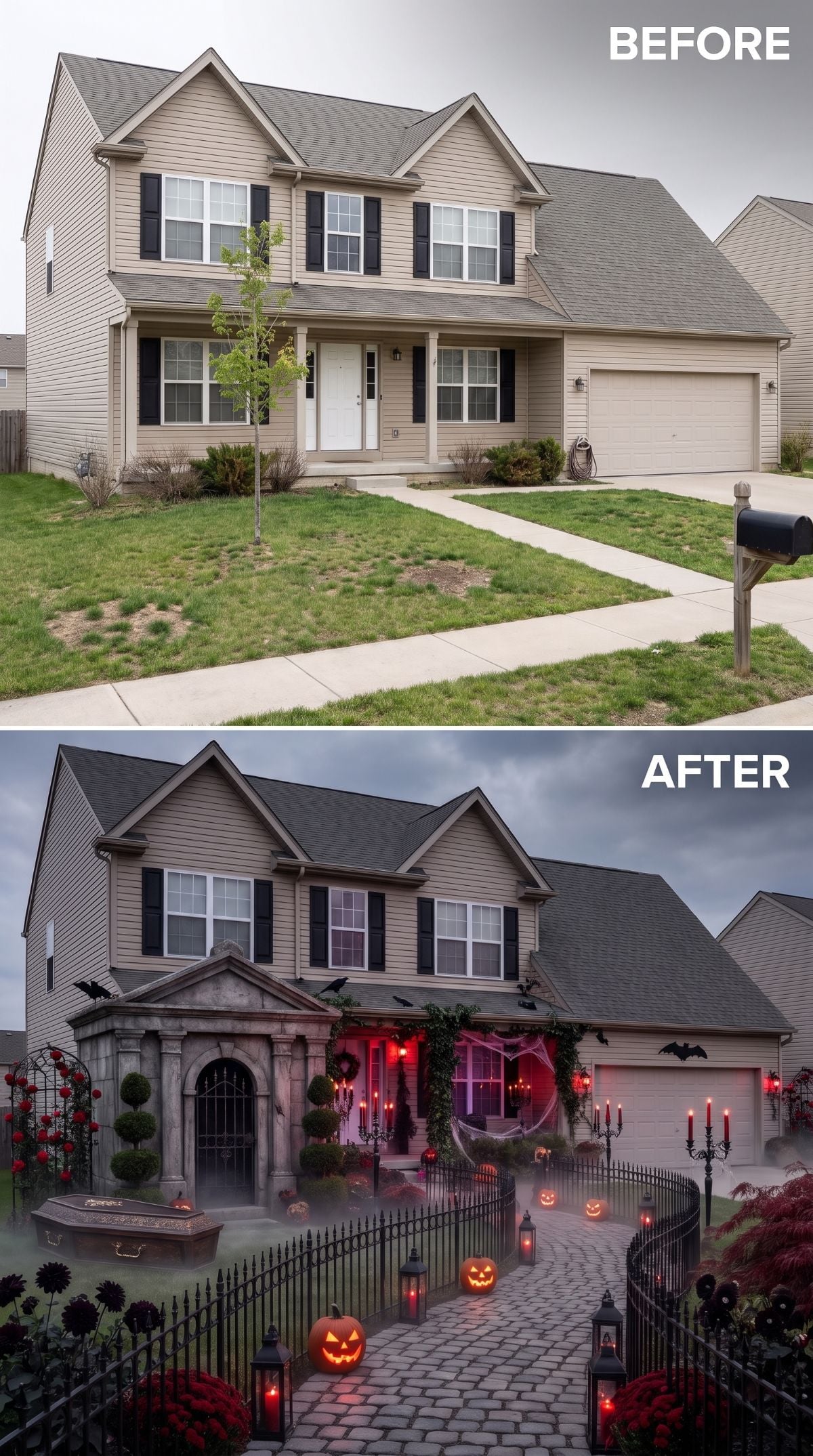
Wrought-iron-style fencing stretches across the property, giving the yard a formal edge before the props behind it start misbehaving.
A stone-look path runs between glowing pumpkins and tall candelabras toward an ivy-covered arch at the front door. Purple light glows through a giant web across one window, an open coffin waits on the lawn, and crow props gather along the roofline.
The underlying beige house suddenly looks less bland than appropriately faded — exactly the sort of respectable facade a Gothic estate would use to hide whatever is happening behind the gate.
Historical Echo: Gothic Revival architecture drew heavily on medieval European forms such as pointed arches, elaborate tracery, towers, and carved ornament. This Halloween concept borrows only fragments of that vocabulary — the arch, ironwork, candelabras, and cemetery imagery — but they are enough to shift the suburban house toward Gothic fantasy.
14. The Corn Maze Starts at the Sidewalk and May Never Give You Back
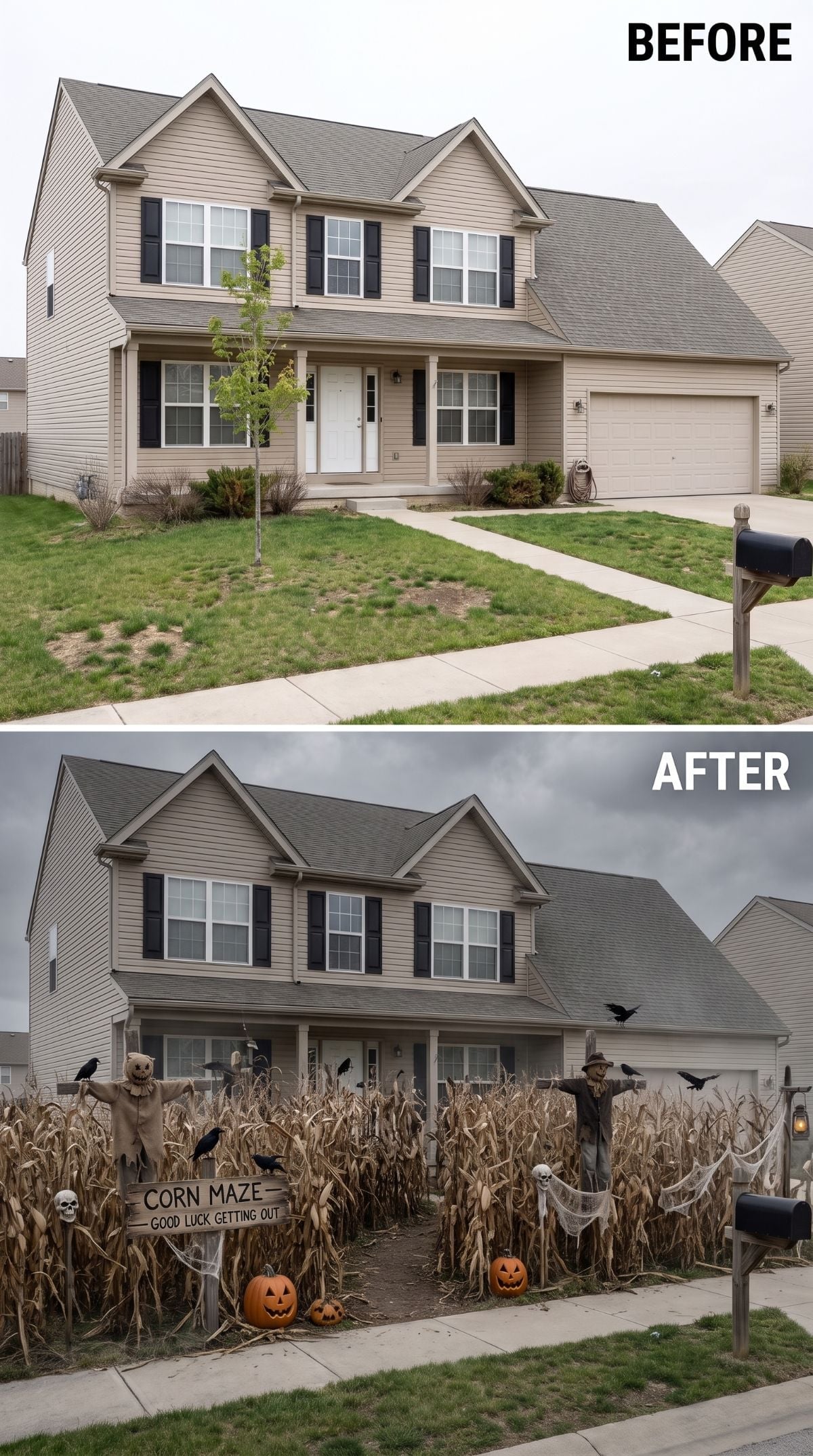
Dried cornstalks pack the yard so densely that the normal front walk nearly disappears. A hand-painted “Corn Maze — Good Luck Getting Out” sign removes any remaining ambiguity.
Scarecrows stand at opposite sides like sentries while pumpkins glow near the ground and black birds perch through the stalks. Spiderweb sheeting reaches toward the mailbox, with a lone lantern marking one of the few visibly open corners.
The clever part is how completely the vertical stalks erase the lawn. The house is still there. Getting to it has become the problem.
Layout Note: Overlapping rows of dried stalks create the impression of much greater depth than a single decorative bundle beside the porch. Scarecrows at opposite ends reinforce the idea that there is an entrance and an exit somewhere inside all that corn.
13. A Ghost Ship Runs Aground in the Most Inconvenient Yard Possible
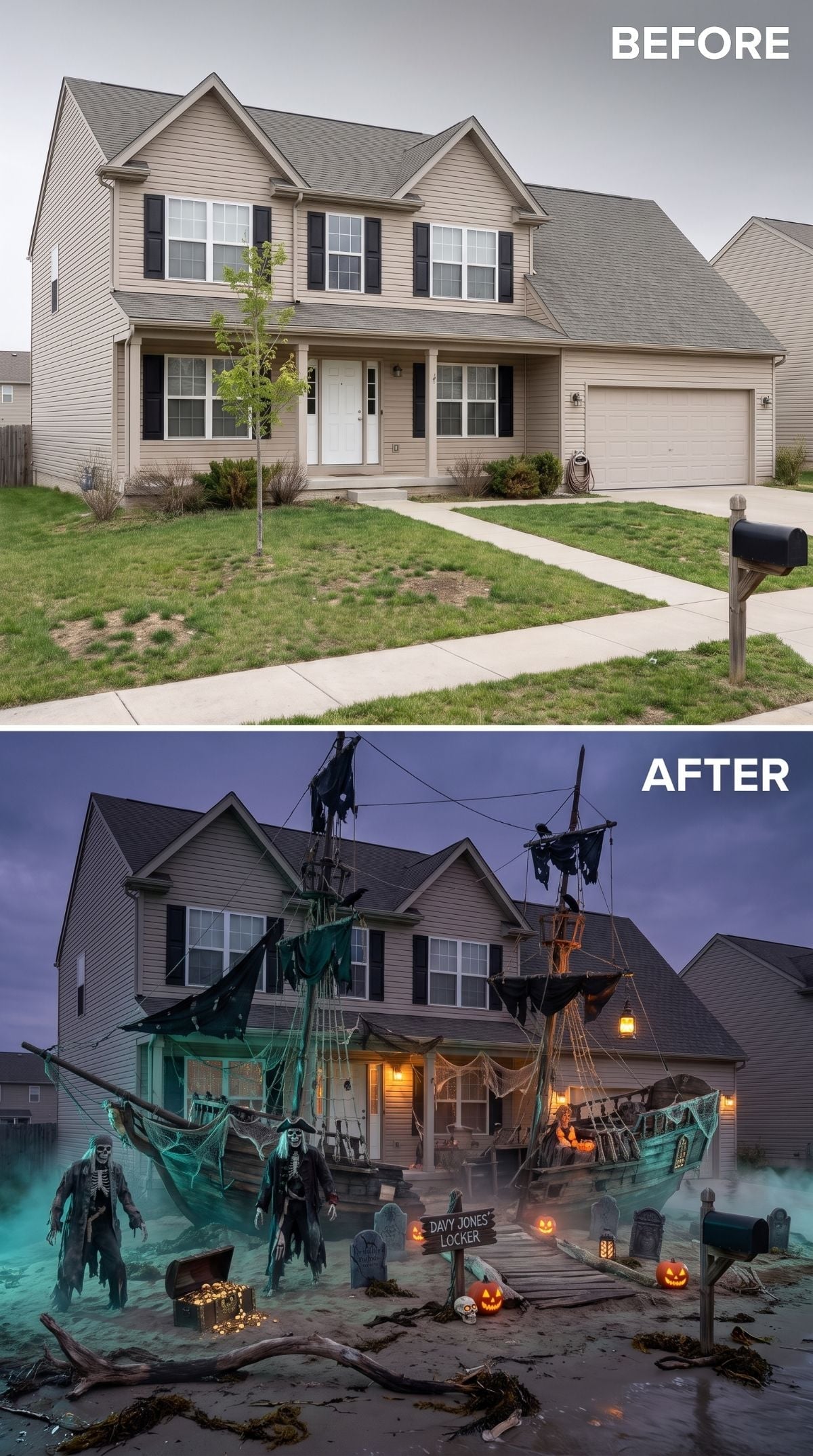
This is where the gallery stops pretending anyone is merely “decorating.”
Tall masts rise above the roofline under tattered black sails. Weathered planking creates the suggestion of a ship’s hull across the yard, while rigging stretches overhead and skeleton pirates hang from netting.
A treasure chest spills gold beside the walkway. Jack-o’-lanterns surround a “Davy Jones’ Locker” sign, teal-green light floods the lower scene, and amber lanterns glow higher on the deck.
The mailbox remains untouched in the foreground, which may be the funniest detail in the entire thing. Apparently the ghost ship respects federal property.
Teal Light Makes the Ship Feel Submerged Without Any Water
The blue-green wash suggests underwater light and separates the spectral figures from the warmer lanterns above. That two-color contrast gives the yard layers: cold, ghostly light below; warmer shipboard light higher up. The props are extravagant, but the lighting is what turns them into one scene.
12. An Abandoned Quarantine Ward Moves Onto the Front Lawn
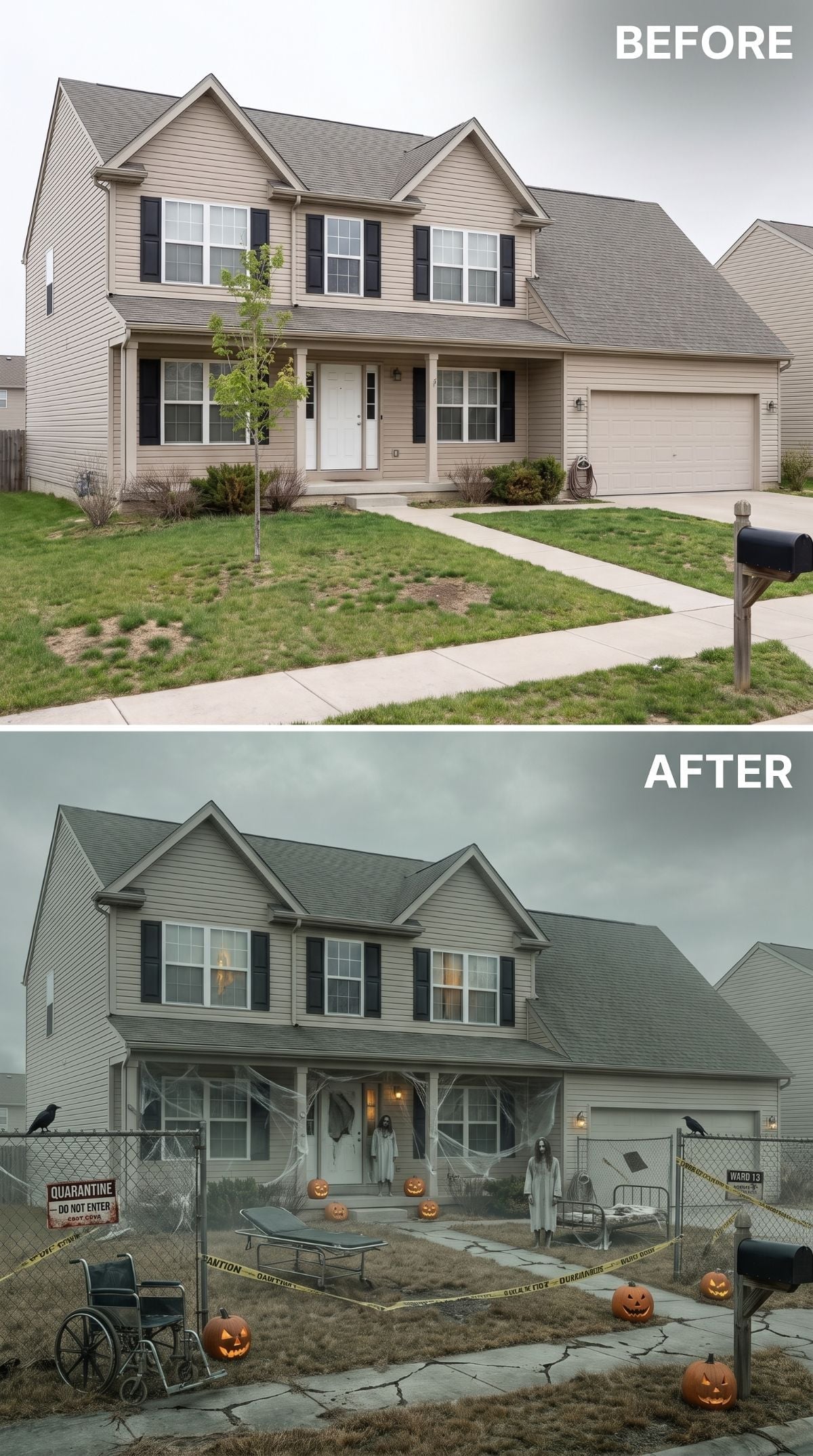
Chain-link fencing and caution tape create an immediate barrier between sidewalk and house. Beyond it, tattered ghost figures flank a porch buried in webs while jack-o’-lanterns glow at several different heights.
A wheelchair and hospital gurney sharpen the abandoned-medical-ward narrative, helped by “Ward 13” and “Quarantine: Do Not Enter” placards fixed to the fence.
The specificity is what separates this from another generic graveyard. Everything points toward the same abandoned-facility story.
Narrative Trick: A wheelchair, gurney, fencing, and quarantine signs all describe the same imaginary place. That consistency lets a few specific props tell a clearer story than a lawn filled with unrelated Halloween figures.
11. The Clowns Have the Porch Now, and Negotiations Are Going Poorly
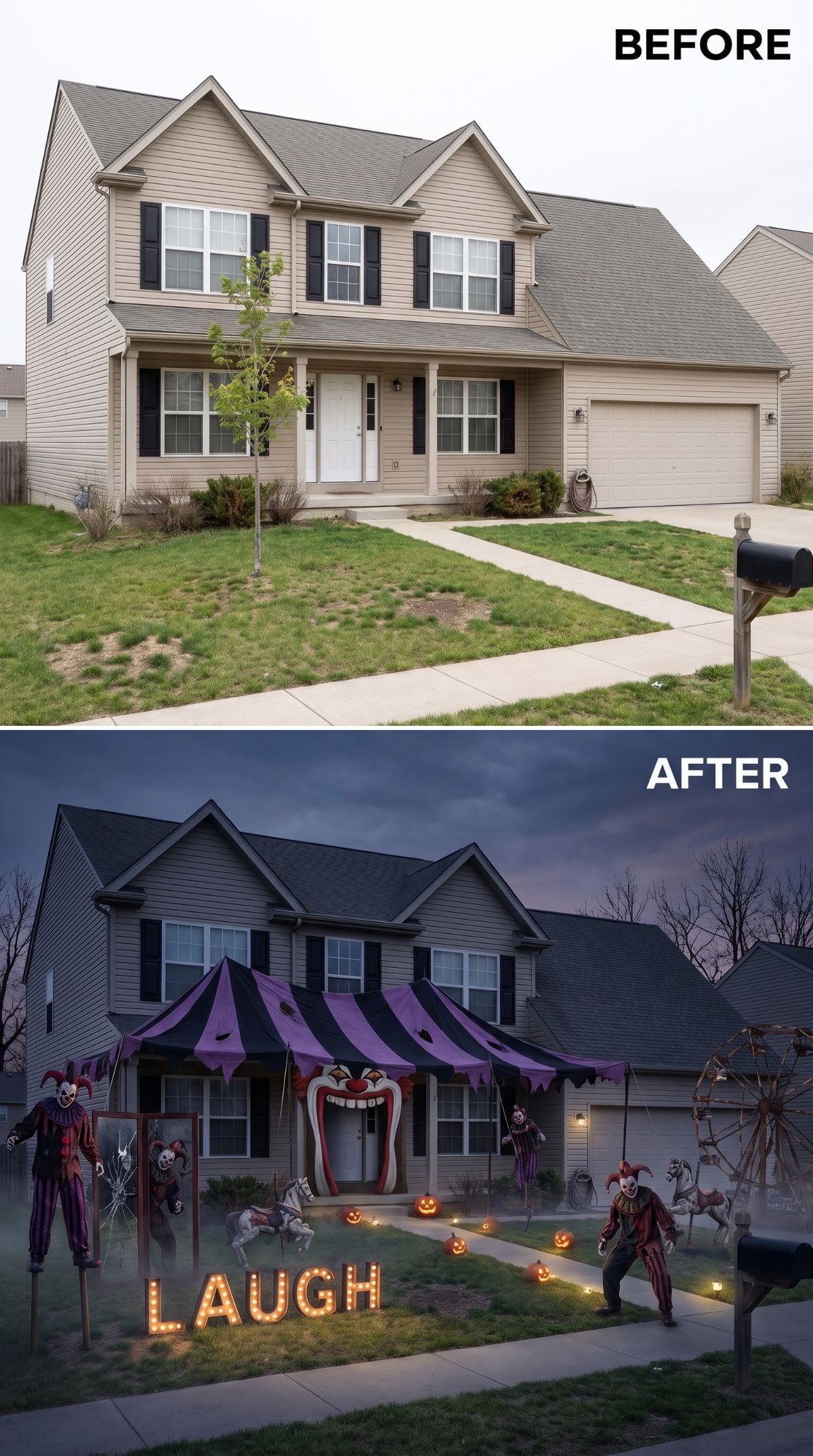
Where the earlier carnival concept spread across the whole lawn, this one concentrates the nightmare at the entrance.
Purple-and-black striped canvas turns the porch into a big-top canopy. The front door vanishes inside an enormous screaming clown face, with the open mouth serving as the way in. Illuminated letters spelling “LAUGH” sit on the lawn while jesters flank a foggy walkway lined with pumpkins.
The message is technically an invitation. The presentation strongly suggests otherwise.
Big Move: Turning the doorway itself into the clown’s mouth makes the architecture part of the joke. Instead of placing a scary figure beside the entry, the concept makes visitors physically pass through it.
10. Gargoyles and Stone Arches Turn the Walk Into a Gothic Procession
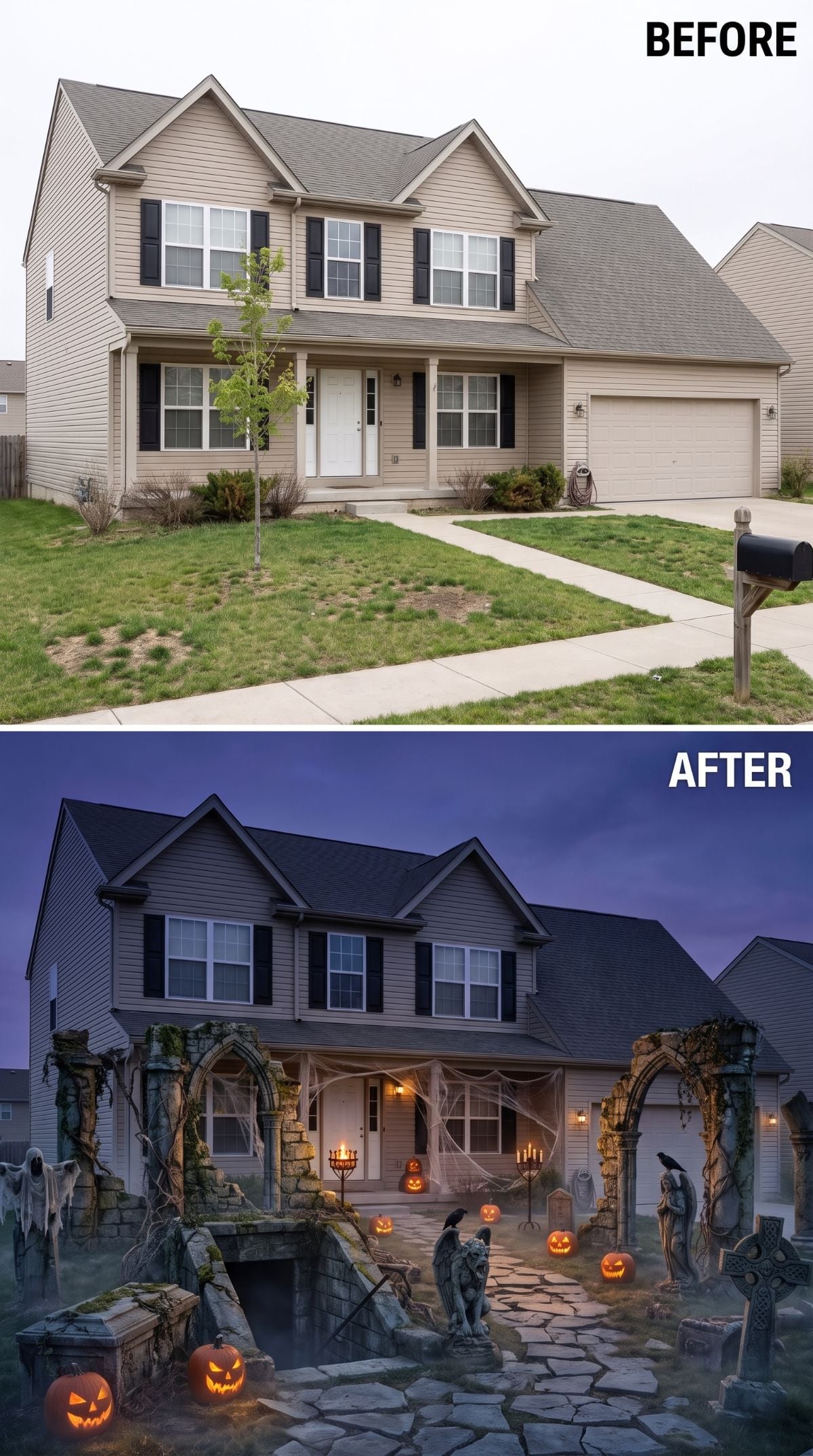
Fog runs across a flagstone-style approach lined with pumpkins, while stone arches rise on either side beneath ivy and webs.
Gargoyle figures guard the path and tall candelabras add amber light closer to the ground. A crow prop adds one small dark punctuation mark among all that stone.
Color Story: The amber pumpkins and candelabras stand out strongly against the cool twilight and pale facade. That warm-cool contrast makes the path legible through the fog while leaving the rest of the yard comparatively shadowy.
9. The Manor of the Damned Gives the Same House an Entire Backstory
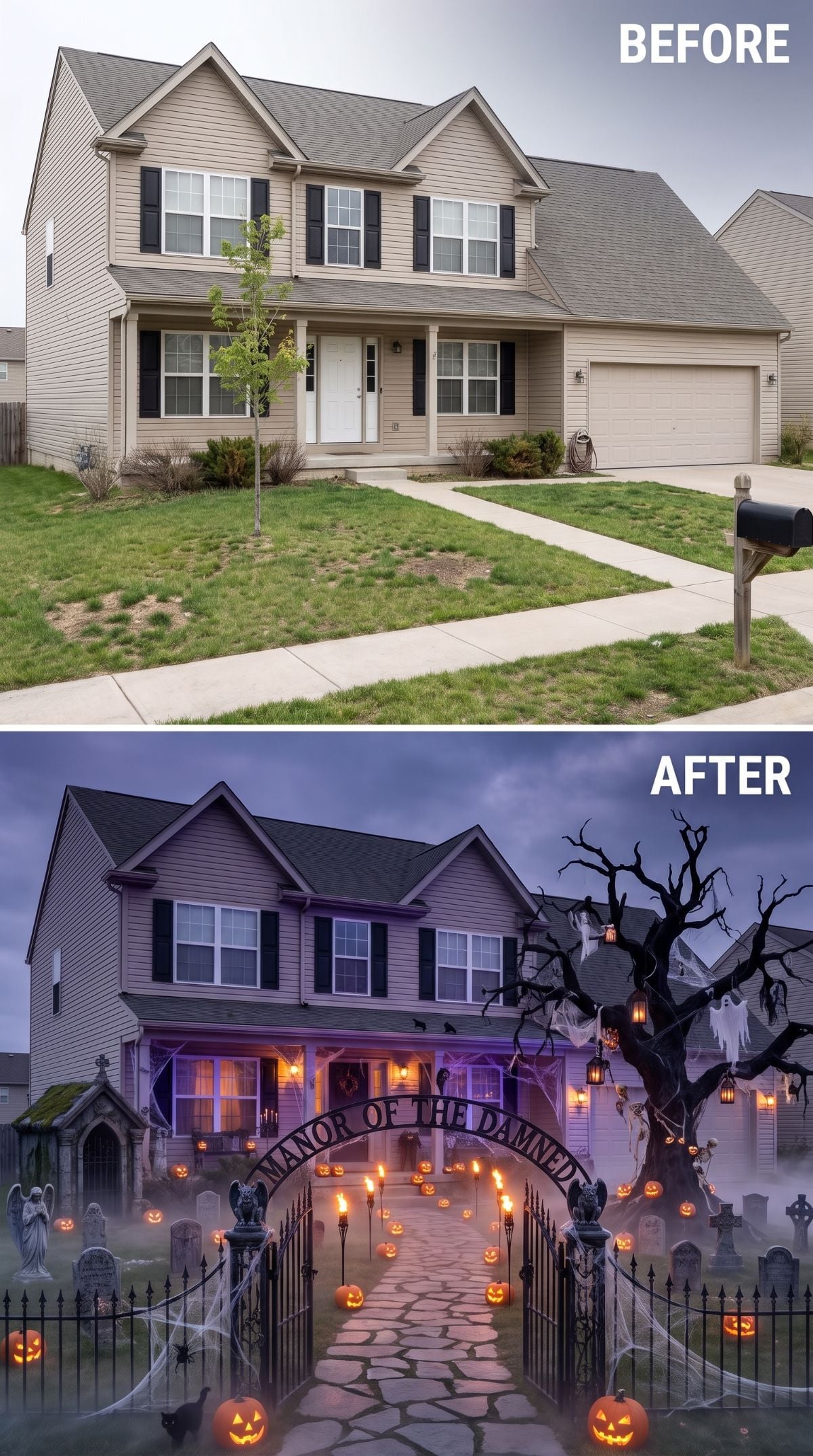
An iron-look arch spelling “Manor of the Damned” announces the premise before anyone reaches the property.
Pumpkins gather along the stone path in uneven clusters rather than regimented rows. A black tree holds lanterns and hanging ghosts on one side, while angel statues and Celtic-cross-style headstones crowd the opposite lawn.
Purple uplighting turns the beige siding violet after dark, with torchlight supplying warmer pockets closer to the ground. Fog occupies whatever visual space is left.
- The lettered gate gives the yard a name and immediately establishes the story.
- Uneven pumpkin clusters keep the path from looking too formal.
- Large cemetery figures add height between low tombstones and the roofline.
8. Three Werewolves Turn the Front Walk Into a Very Bad Shortcut
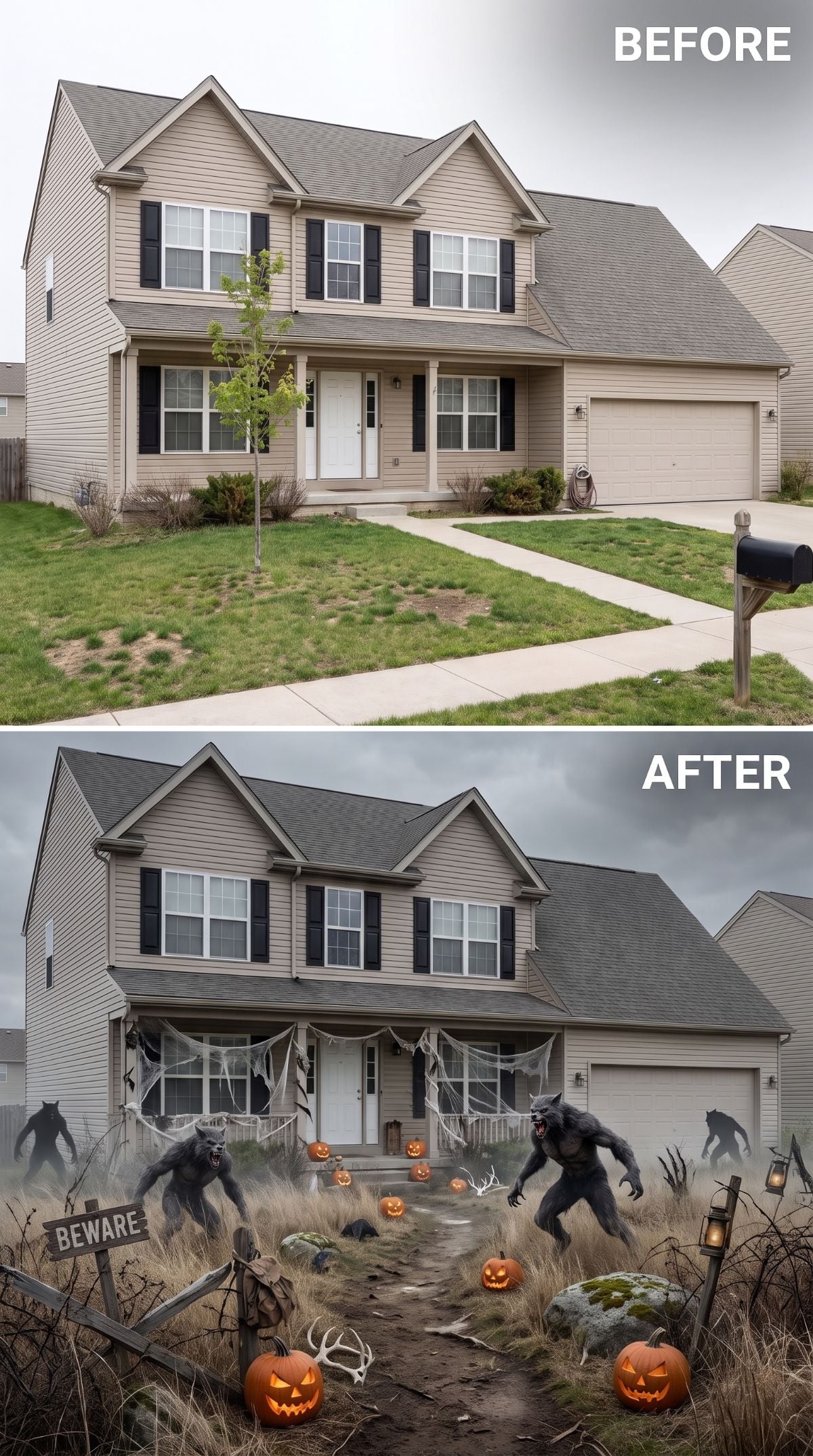
Heavy webbing covers the lower windows while pumpkins crowd the front walk closely enough to make the route feel narrower than it really is.
Two snarling werewolf figures crouch in the foreground, with a third emerging farther back through the fog. That staggered placement gives the scene depth instead of arranging all three monsters along one flat line.
A weathered “Beware” sign provides information nobody at this point particularly needed.
Placement Note: Setting one figure farther back makes the yard feel occupied beyond the foreground. The eye finds the first two werewolves immediately, then discovers the third through the fog.
7. A Bayou Hex Turns the Suburban Walk Into Something Much Murkier
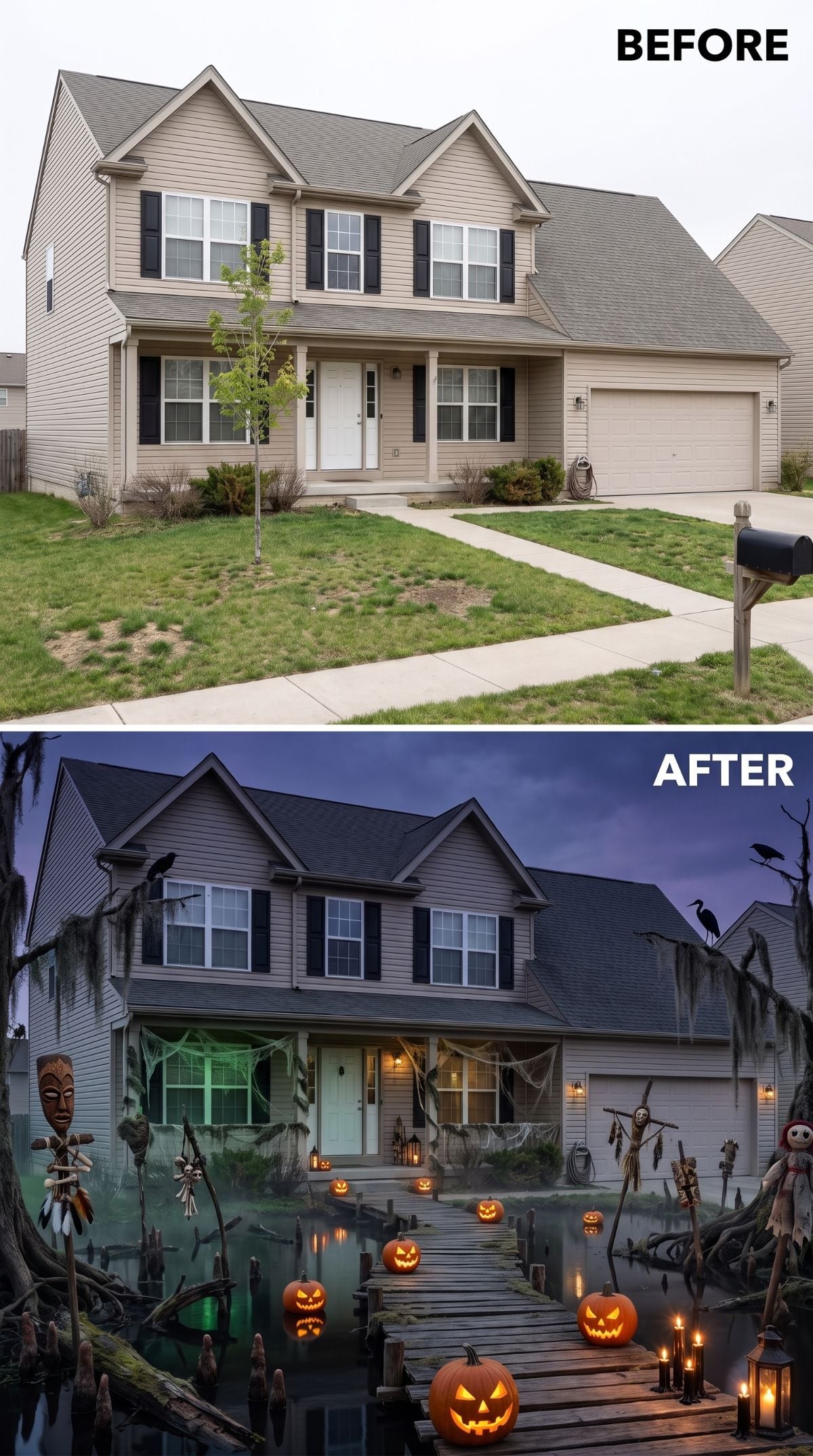
A weathered plank walkway replaces the clean suburban approach, with carved jack-o’-lanterns glowing along its edges. Webs hang from the porch while a green-lit window gives the house an appropriately unhealthy glow.
Mask-like props, scarecrow figures, candle lanterns, and rough natural materials push the scene toward swamp folklore rather than another conventional cemetery.
It’s a compact concept compared with the shipwreck or carnival, but the change in texture — plank walk, webbed porch, murky green light — gives it an identity of its own.
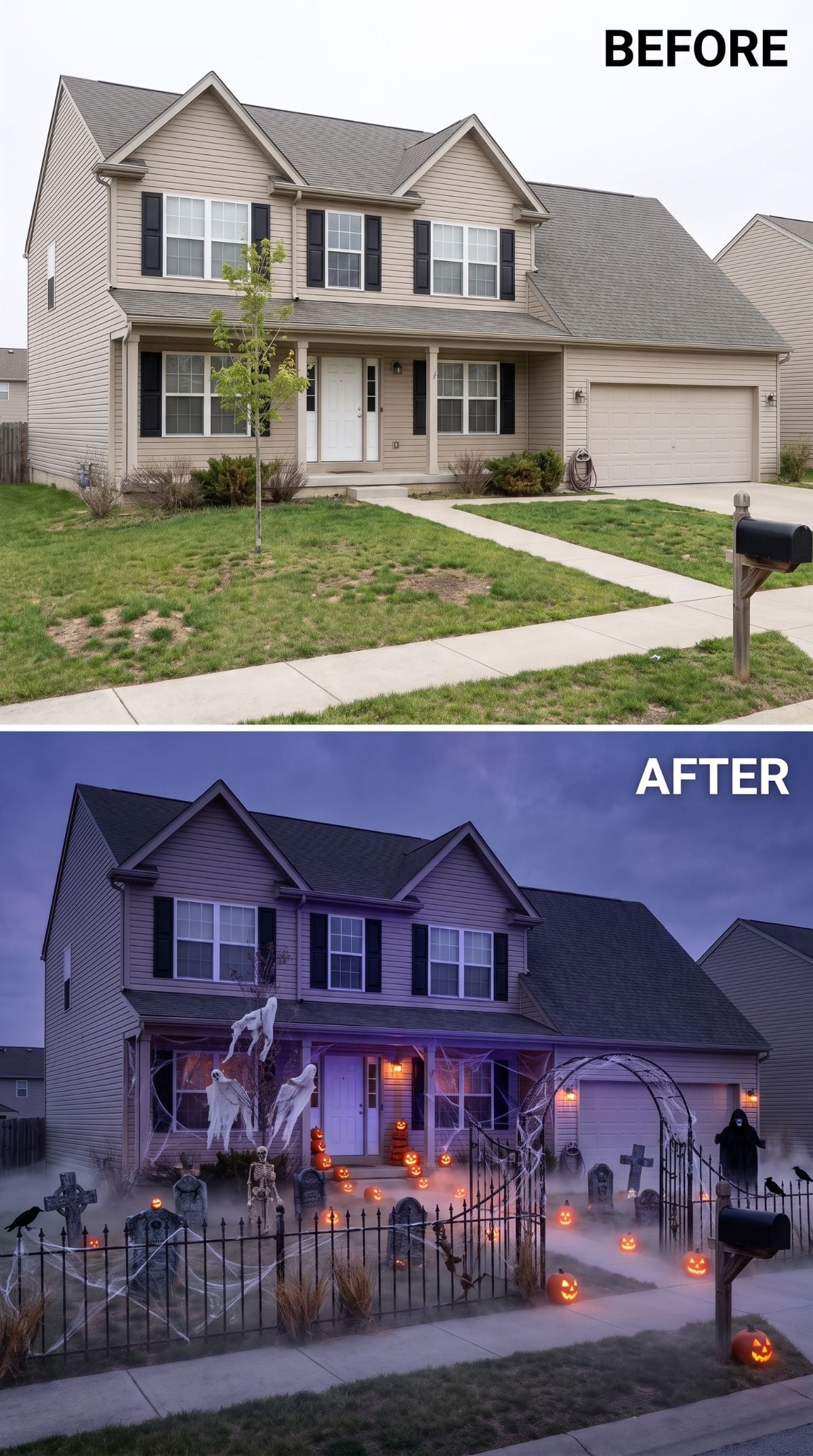
6. Floating Ghosts Make the Cemetery Fence Feel Almost Secondary
🔥 Would you like to save this?
Several ghost figures hang above the porch at different heights, pulling attention toward the second story instead of concentrating every prop on the lawn.
A wrought-iron-style fence creates a cemetery boundary at street level, while pumpkins glow around the steps and dense ground fog obscures much of the walkway.
Other graveyard concepts in the gallery build their drama from tombstones and gates. This one gets most of its personality from what’s floating above them.
5. The Grim Reaper Has Been Given the Most Inconvenient Possible Address
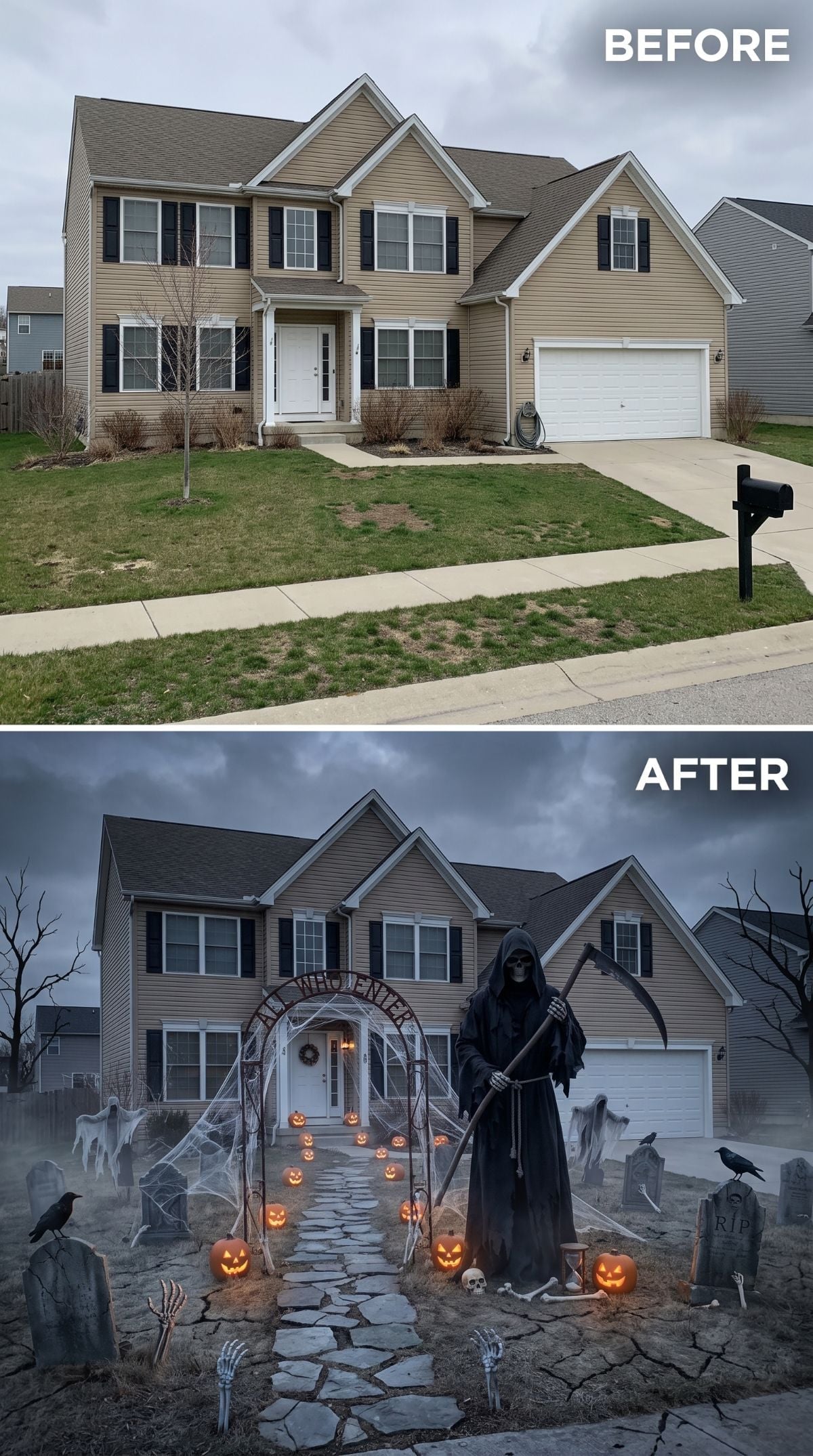
Jack-o’-lanterns follow the stone path from sidewalk to porch, but there is one fairly significant obstacle in the middle.
A skeletal arch marked “All Who Enter” frames the doorway while the Grim Reaper stands directly on the approach. Moving the figure into the circulation path instead of parking it beside a shrub makes the threat harder to treat as background decoration.
This front door is open in the same technical sense that a crocodile’s mouth is open.
4. The Witches Return, but This Time the Cauldron Is the Entire Show
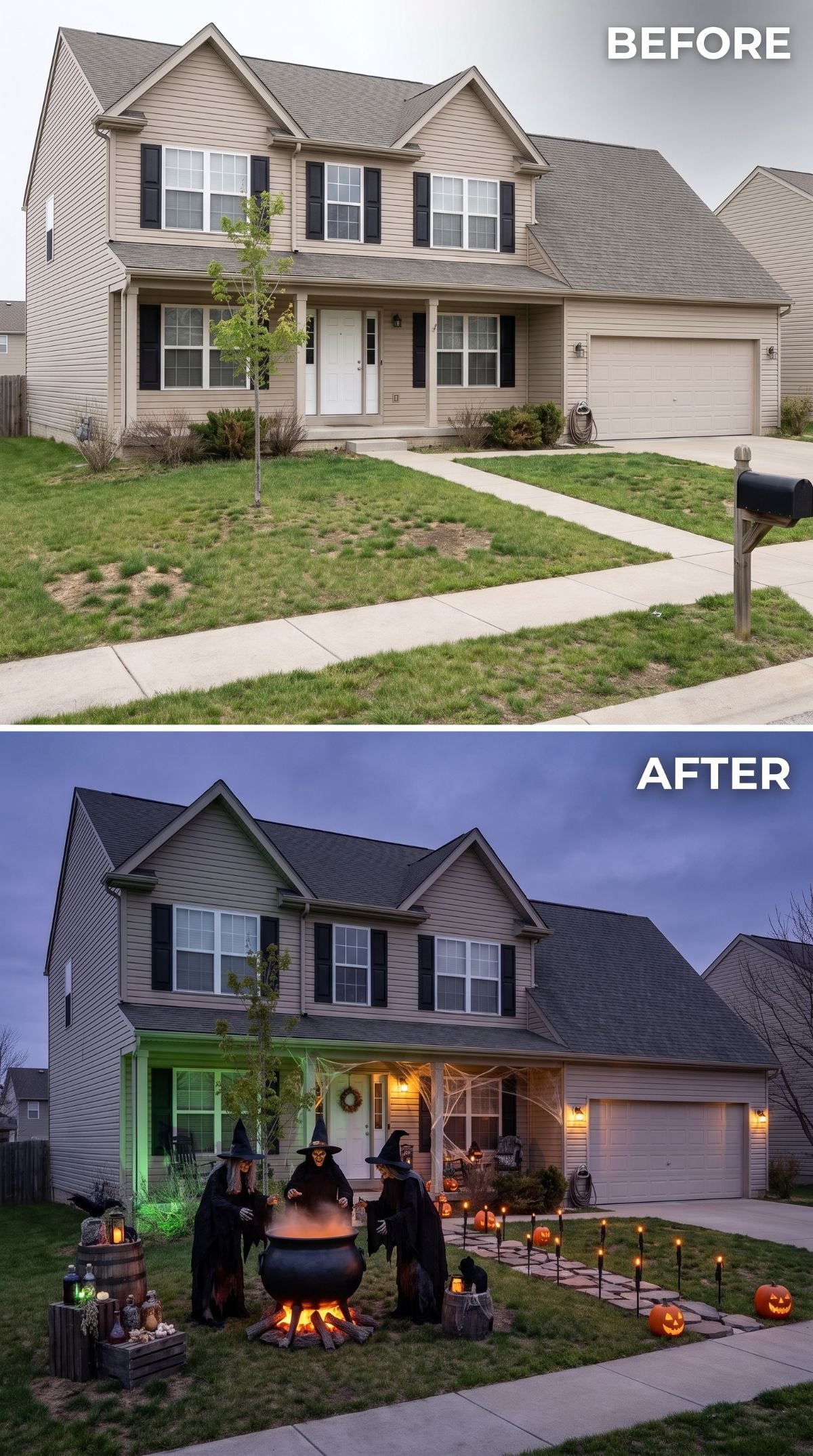
The earlier witch yard builds a whole graveyard around its coven. This version strips the idea down much further.
Three robed figures huddle tightly around a fiery bubbling cauldron, turning one compact scene into the undisputed center of the lawn. Torch stakes line the approach and jack-o’-lanterns gather to one side, but there is much less competition around the witches themselves.
That restraint is what separates it from the other coven. One ritual, one circle, nowhere else to look.
3. A Line of Scarecrows Makes the Yard Feel Uncomfortably Occupied
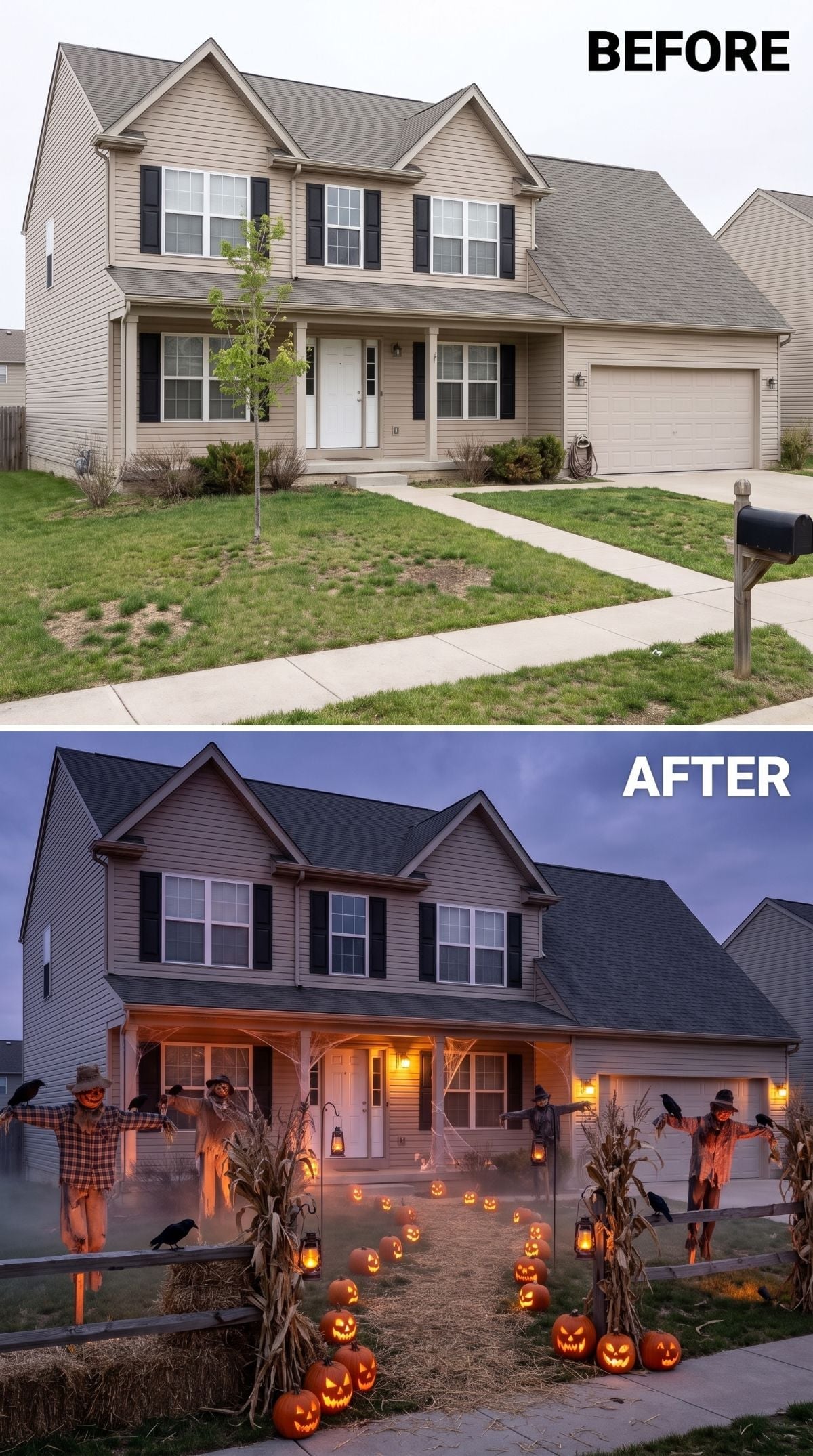
Four scarecrows in plaid shirts and straw hats spread across the fence line with their arms extended, turning the harvest theme into something closer to a silent audience.
Crows gather near their feet while dried cornstalks fill the gaps. Lanterns and carved pumpkins lead toward the house through amber light.
Hay and low fog cover enough of the driveway to soften the suburban concrete, while the porch lighting catches the siding in a fiery orange wash. The corn-maze concept hides the house behind stalks; this one leaves the house visible and fills the space in front of it with figures.
2. A Witch’s Apothecary Cart Finally Gives the Yard Something Nobody Else Has
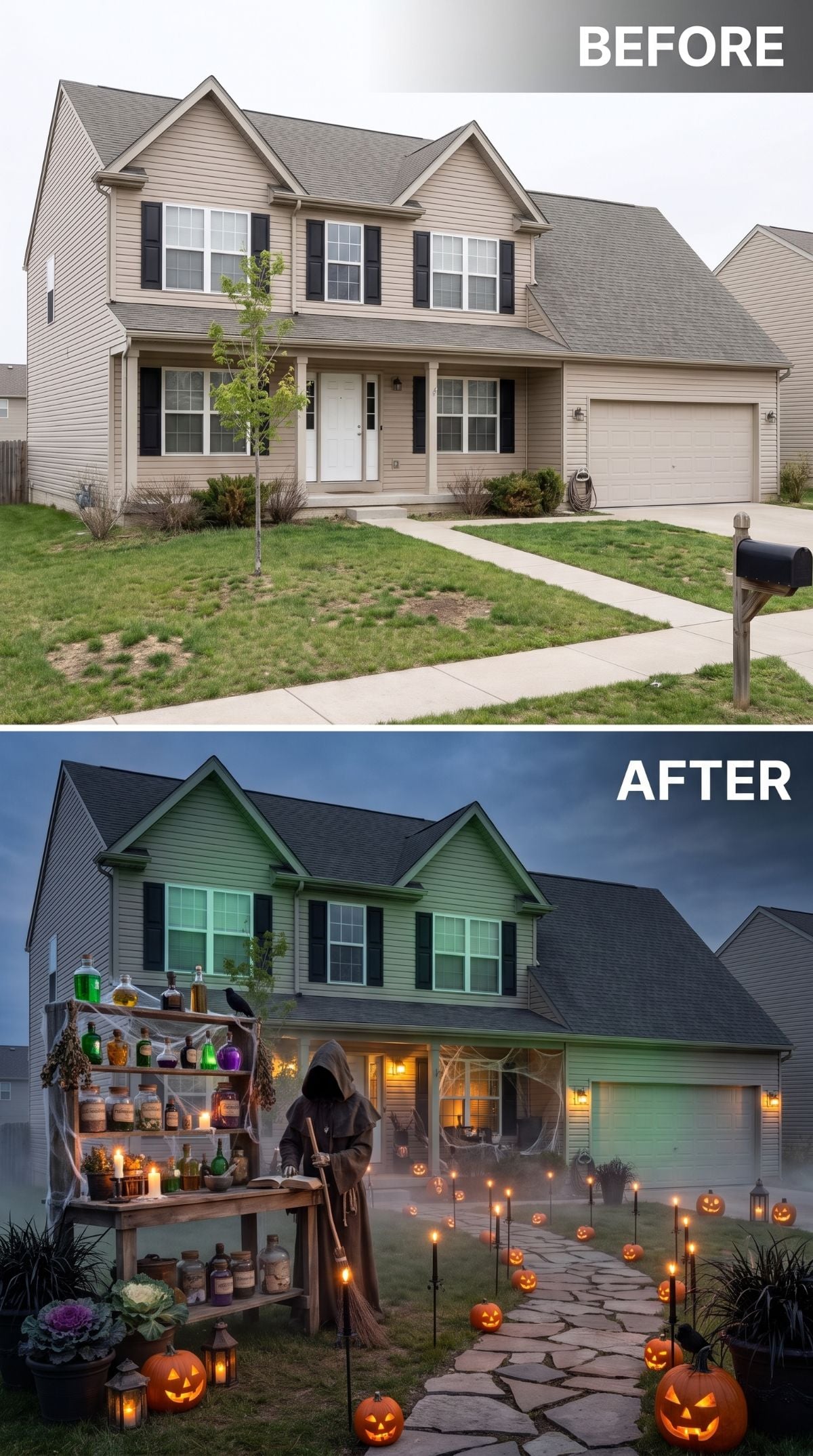
The AI treatment cools the beige facade toward sage green, creating a murkier background before the props arrive.
The real attraction sits beside the walkway: a weathered wooden apothecary cart filled with amber, green, and violet bottles, pillar candles, webs, and mysterious little containers that definitely should not be sampled. A robed figure waits beside it holding a broom.
Pumpkins gather in irregular groups along the stone-look path while torch stakes fill the darker spaces between them.
Lighting Shortcut: Colored exterior lighting can shift how neutral siding appears after dark without changing the siding itself. A green wash behind an apothecary or witchcraft theme can give the whole facade a cooler, stranger cast for the evening.
1. A Crypt Portal Finally Makes the Front Door Disappear Completely
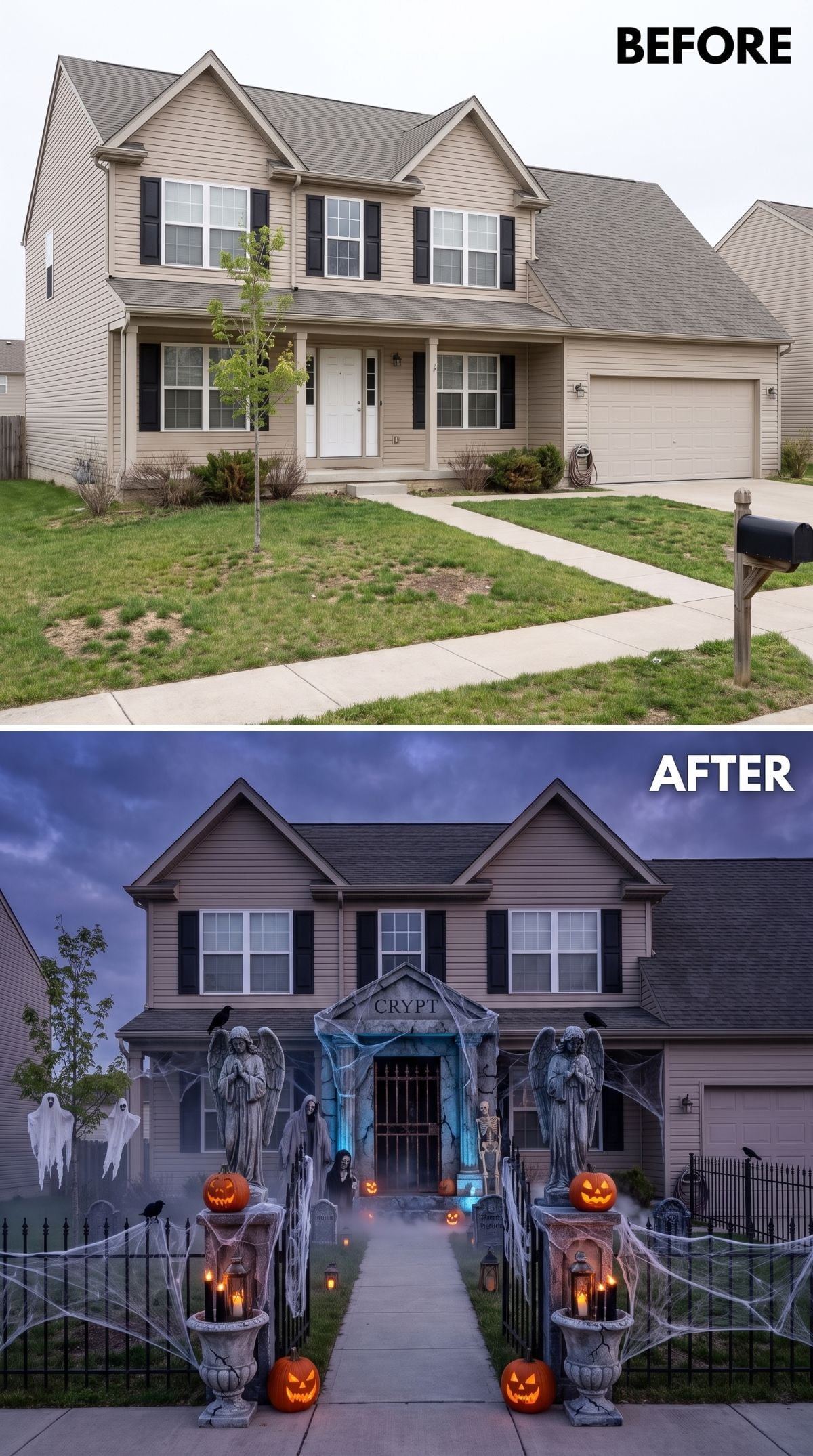
Stone urns wrapped in webbing flank the walkway, with candle lanterns and jack-o’-lanterns arranged at different heights around them. Angel statues stand farther in, each carrying a raven figure on the shoulder like a very bad omen with wings.
Then the front door vanishes.
A full crypt-style portal has been built around the entry, complete with a wrought-iron gate and blue-lit fog spilling through it. Instead of decorating the porch, the concept replaces the visual idea of a suburban doorway altogether.
After 29 other transformations, that’s a fitting place to finish. The beige siding, driveway, lawn, and familiar gables are still hiding somewhere behind the production, but they barely matter anymore. The best concepts in the gallery all figured out the same trick: don’t scatter Halloween across the yard. Build a world in front of the house and make the house belong to it.