🔥 Would you like to save this?
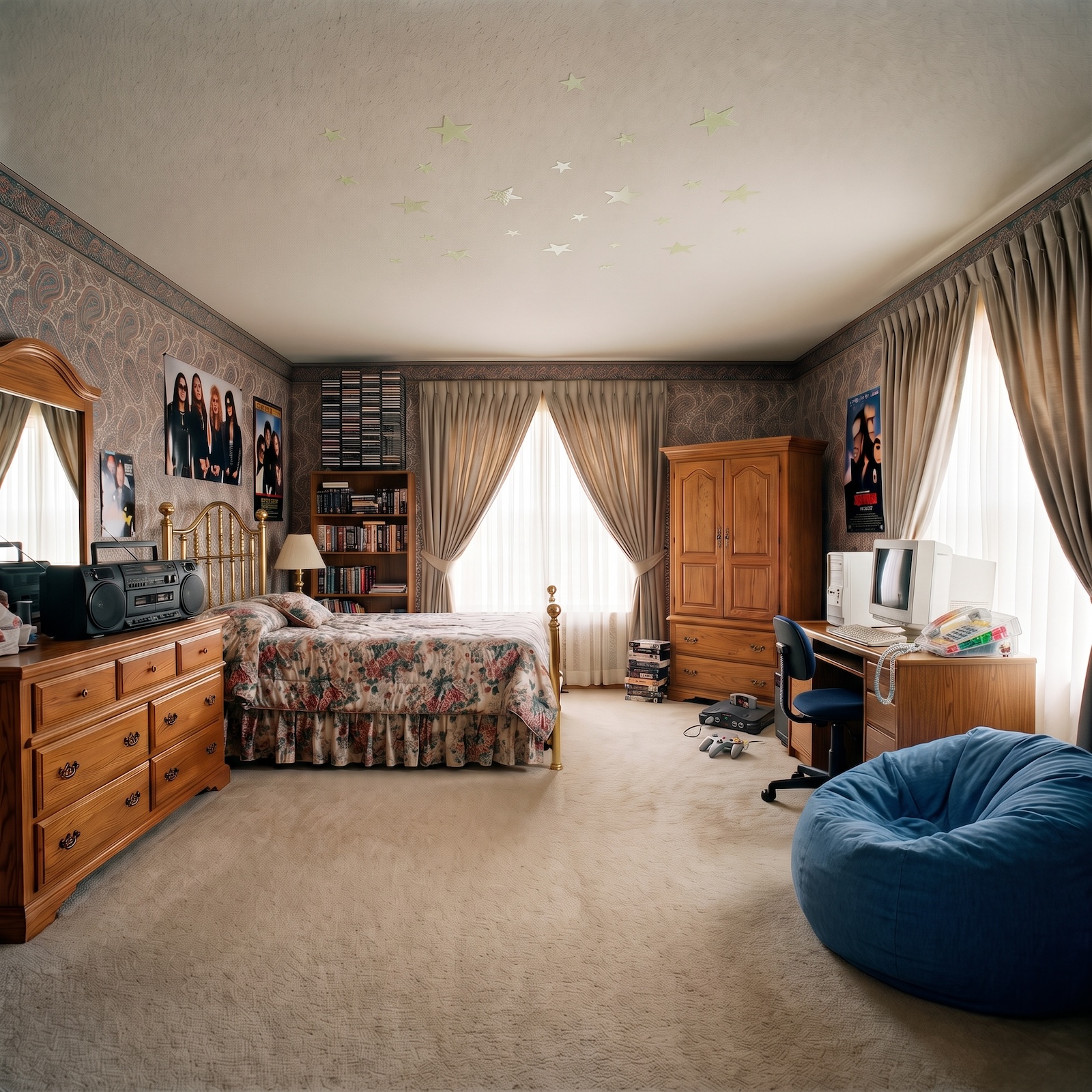
The 1990s spare bedroom was a peculiar little kingdom: floral comforter, particleboard dresser, maybe a bean bag, and enough unused floor space to suggest nobody had quite decided what the room was for. Three decades later, that indecision suddenly looks like an opportunity.
In order to come up with the very specific design ideas, we create most designs with the assistance of state-of-the-art AI interior design software. Also, assume links that take you off the site are affiliate links such as links to Amazon. this means we may earn a commission if you buy something.
The challenge isn’t squeezing in a desk. Anyone can do that. The interesting question is how far a former bedroom can travel before the desk becomes almost incidental—absorbed into walnut millwork, tucked beneath a window, surrounded by books, pushed beside a fireplace or quietly outmaneuvered by a motorcycle sitting on a pedestal.
These 33 transformations take that problem in wildly different directions. Cedar and stone give way to lacquer and cobalt; Gothic paneling runs straight into moss walls, terrazzo and constellation ceilings. Some rooms whisper. Others have apparently never heard of whispering.
What connects them is less a style than a shift in hierarchy. Work gets a place, but not necessarily the best seat in the house. The architecture, materials, collections and places to sit get to have ambitions of their own. Somewhere along the way, the spare room stops feeling spare.
33. Stone, Cedar, and a Fireplace That Has No Business Being This Good
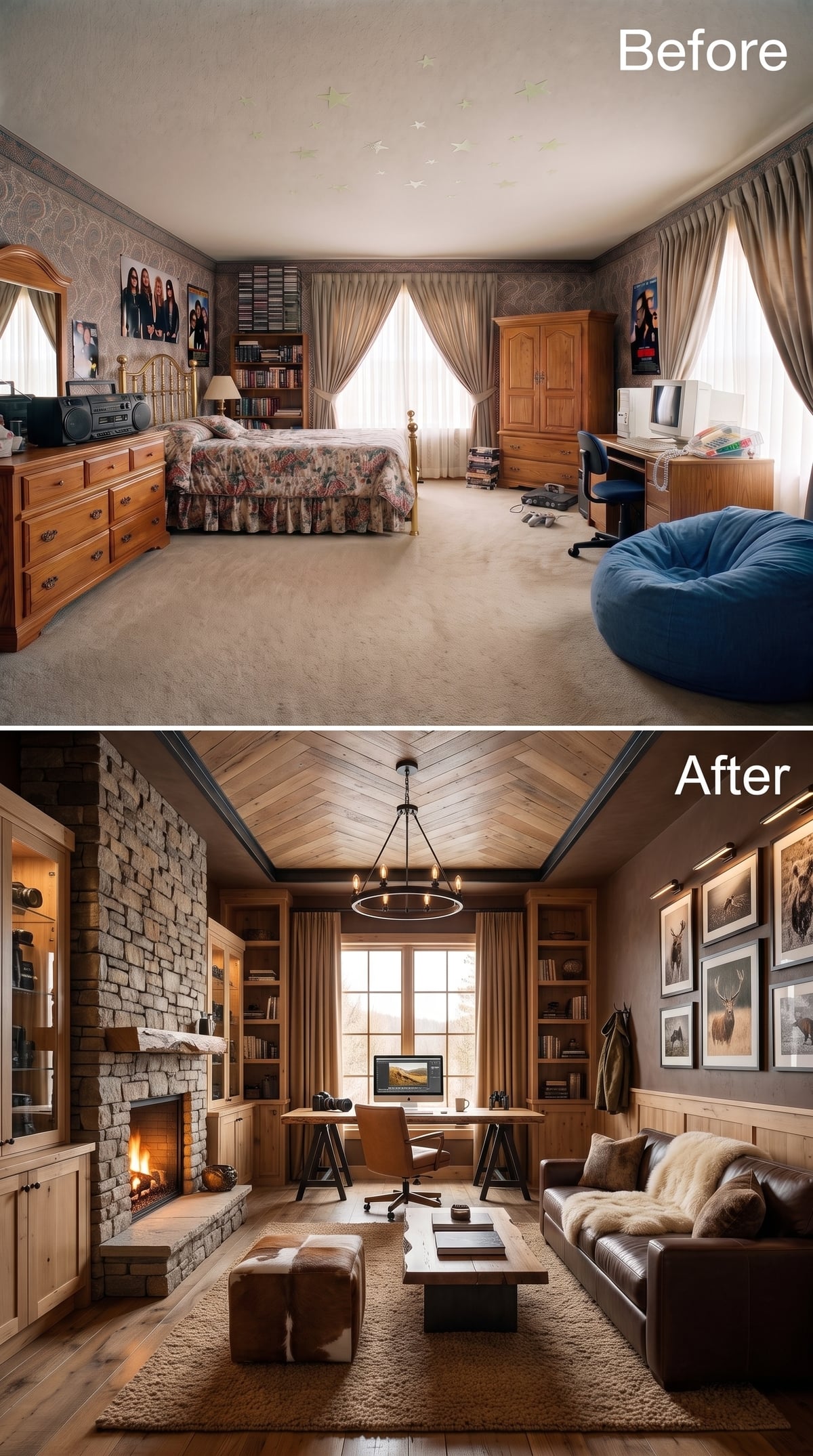
Tongue-and-groove cedar turns the vaulted ceiling into a warm architectural canopy, while the nearly floor-to-ceiling stone fireplace gives the opposite plane enough mass to answer it. Built-in shelving flanks the window, pushing the room toward library territory before the furniture even arrives.
The desk takes advantage of the window wall without becoming the center of the composition. A dark leather sofa, cowhide ottoman and fur-draped throw pull the room firmly toward retreat rather than corporate workspace, while the industrial ring chandelier introduces just enough metal to keep all that timber from becoming too polite.
32. Cobalt Ceiling, Terrazzo Desk, and Coral Arches Refuse to Behave
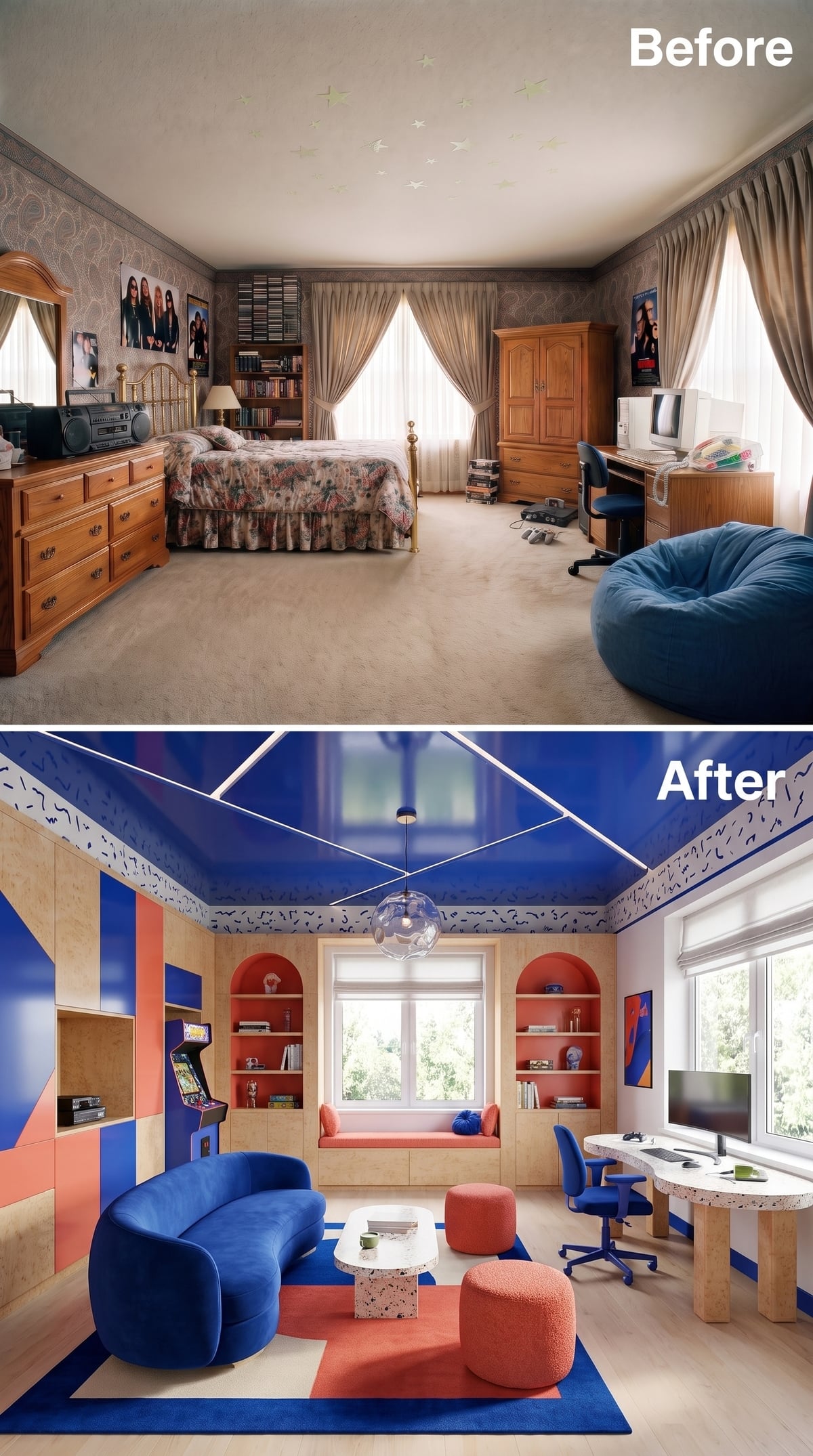
From cedar cabin to cobalt gloss: subtlety has left the building. A high-gloss blue ceiling crossed by inset linear lighting immediately changes the scale of the room, while coral-orange arched shelving gives the walls an equally assertive rhythm.
The terrazzo-topped desk picks up that architectural confidence with rounded edges rather than standard office geometry. A curved velvet sofa and window seat create competing destinations, so the workstation becomes one component in a much larger composition. Cobalt, coral and stone shouldn’t be shy together. They aren’t.
31. Rattan, Raffia Ceilings, and a Desk That Doesn’t Ruin the Room
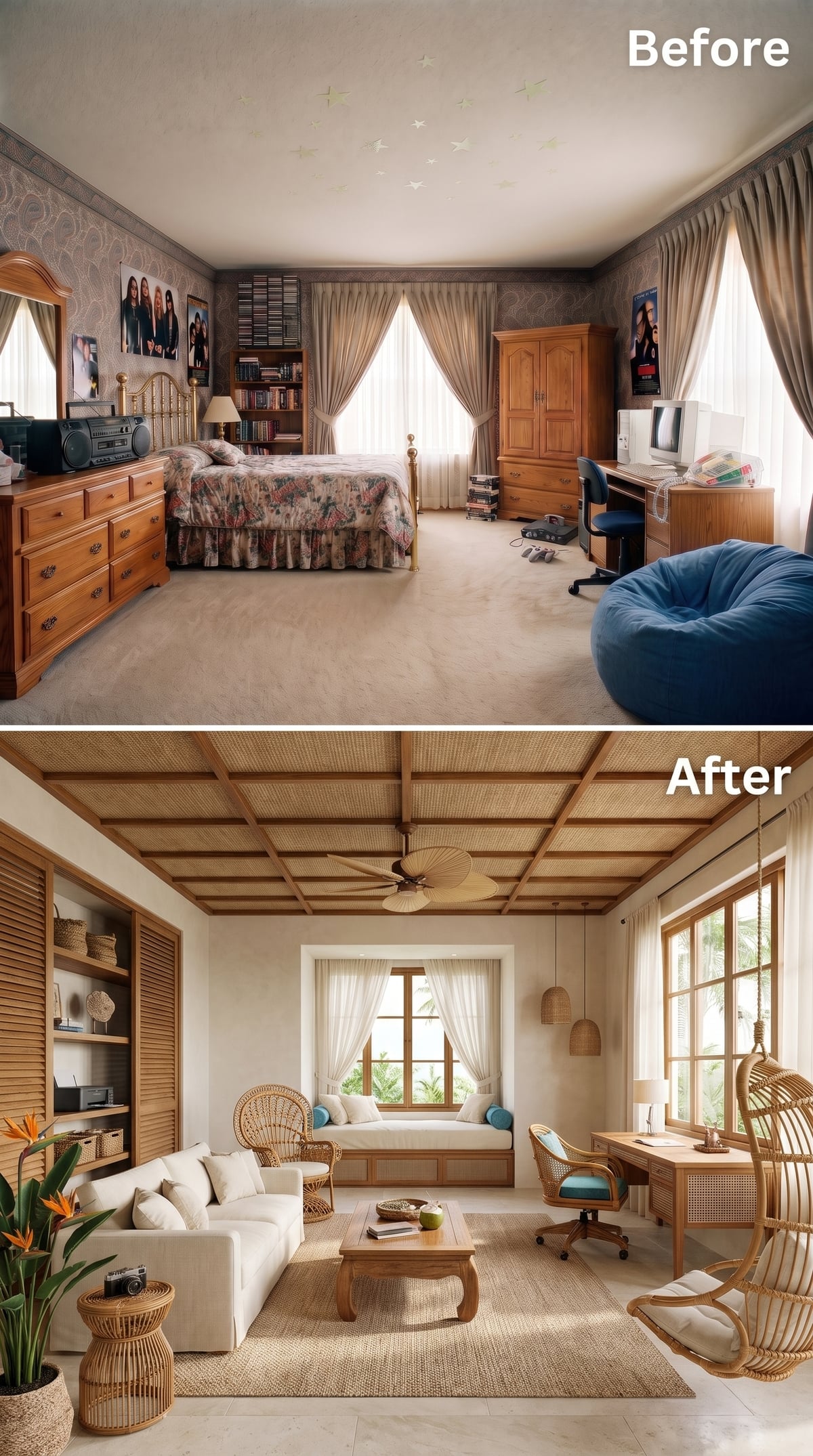
Woven rattan panels set into a wood-beam ceiling grid bring warmth overhead without adding visual weight. Cane, linen and sisal continue the natural-material story below, with a hanging egg chair beside the window providing the room’s most playful curve.
The desk stays against the wall rather than claiming the center. A white linen sectional takes that job, turning the floor plan toward conversation and lounging while the arched window supplies the strongest vertical element. Work has a foothold here, not a headquarters.
30. Steel Ceiling, Quilted Leather, and a Motorcycle That Makes the Desk Irrelevant
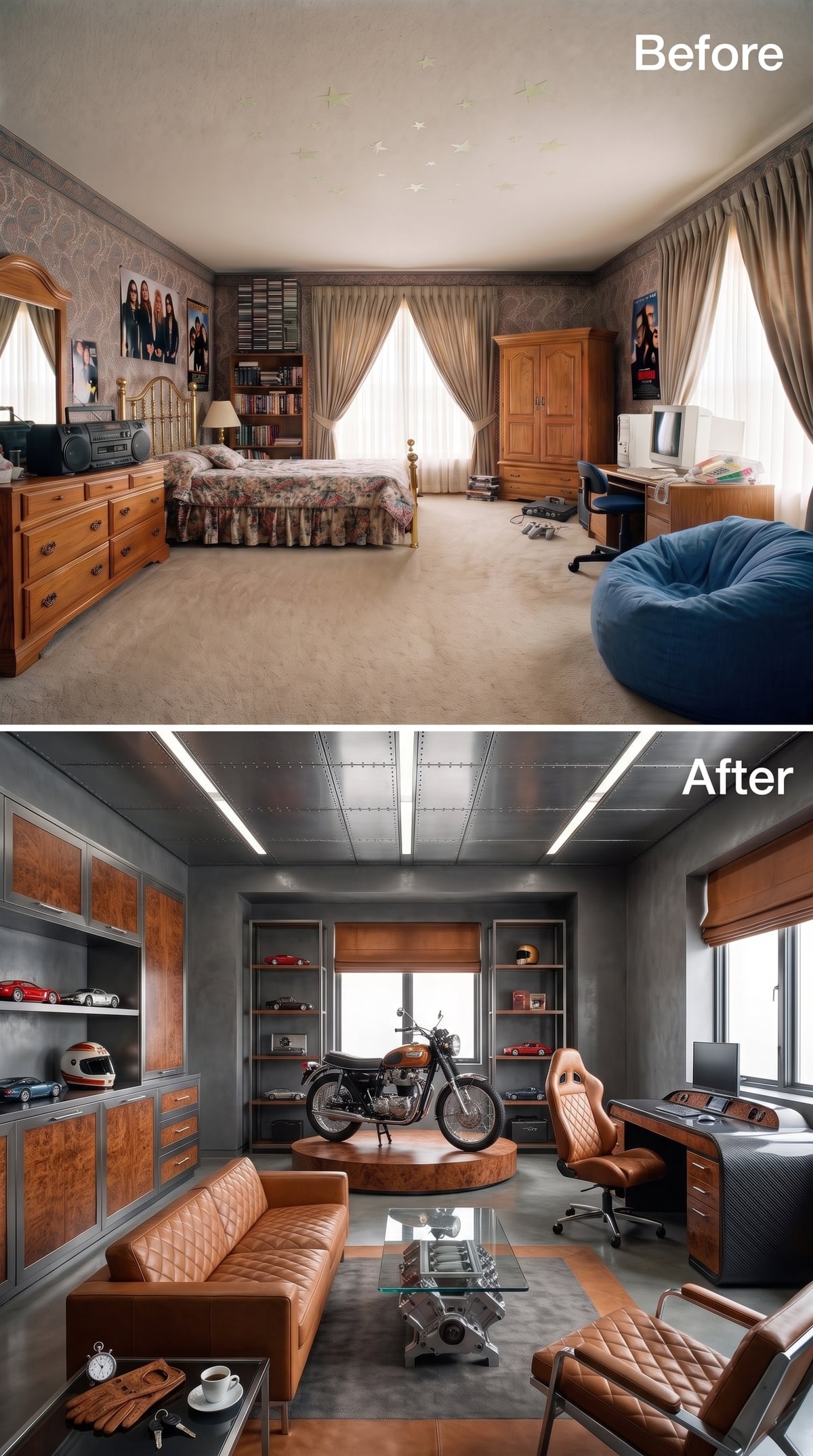
Riveted steel overhead, cognac leather below, and a motorcycle elevated on burl wood in the middle: the room establishes its priorities quickly. Diamond-quilted seating gives the lounge zone the richness of a private club, while the metal ceiling pushes in the opposite direction toward workshop and hangar.
Warm burl cabinetry prevents the industrial materials from turning cold. Scale cars and a racing helmet reinforce the automotive character, while the carbon-fiber desk occupies the far corner with remarkable restraint considering the company it’s keeping.
When a motorcycle occupies the pedestal, a desk doesn’t need to pretend it’s the main event.
29. Wavy Plaster Walls, Lavender Accents, and a Desk That Melts Into the Millwork
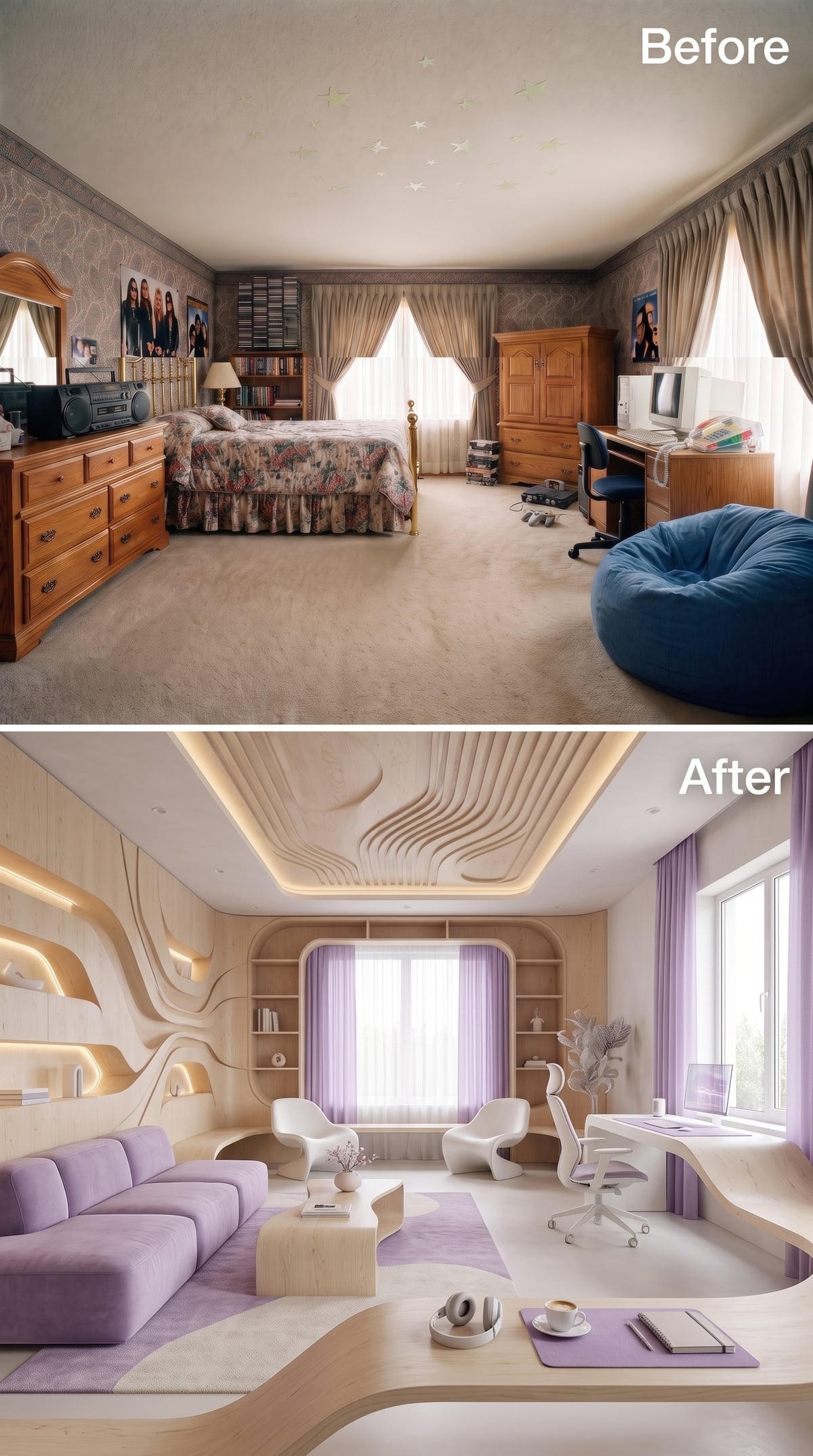
Pale birch and lavender give the room an almost weightless quality. Curved wall paneling sweeps upward toward a concealed band of light, turning storage into something closer to sculpture.
The low lavender sectional keeps the center soft and horizontal, while the desk continues the cream-toned built-ins along the right wall instead of introducing another material. White molded chairs, lavender curtains and restrained shelving give the eye several quiet repetitions to follow.
Design Move: The lavender isn’t confined to one conspicuous statement piece. It moves through upholstery and window treatments while the desk borrows its finish from the surrounding millwork. Repeating materials and colors in different roles gives the room continuity without requiring matching furniture.
28. Hunter Green Lacquer, Tin Ceilings, and a Bar Wall Worth Staying Late For
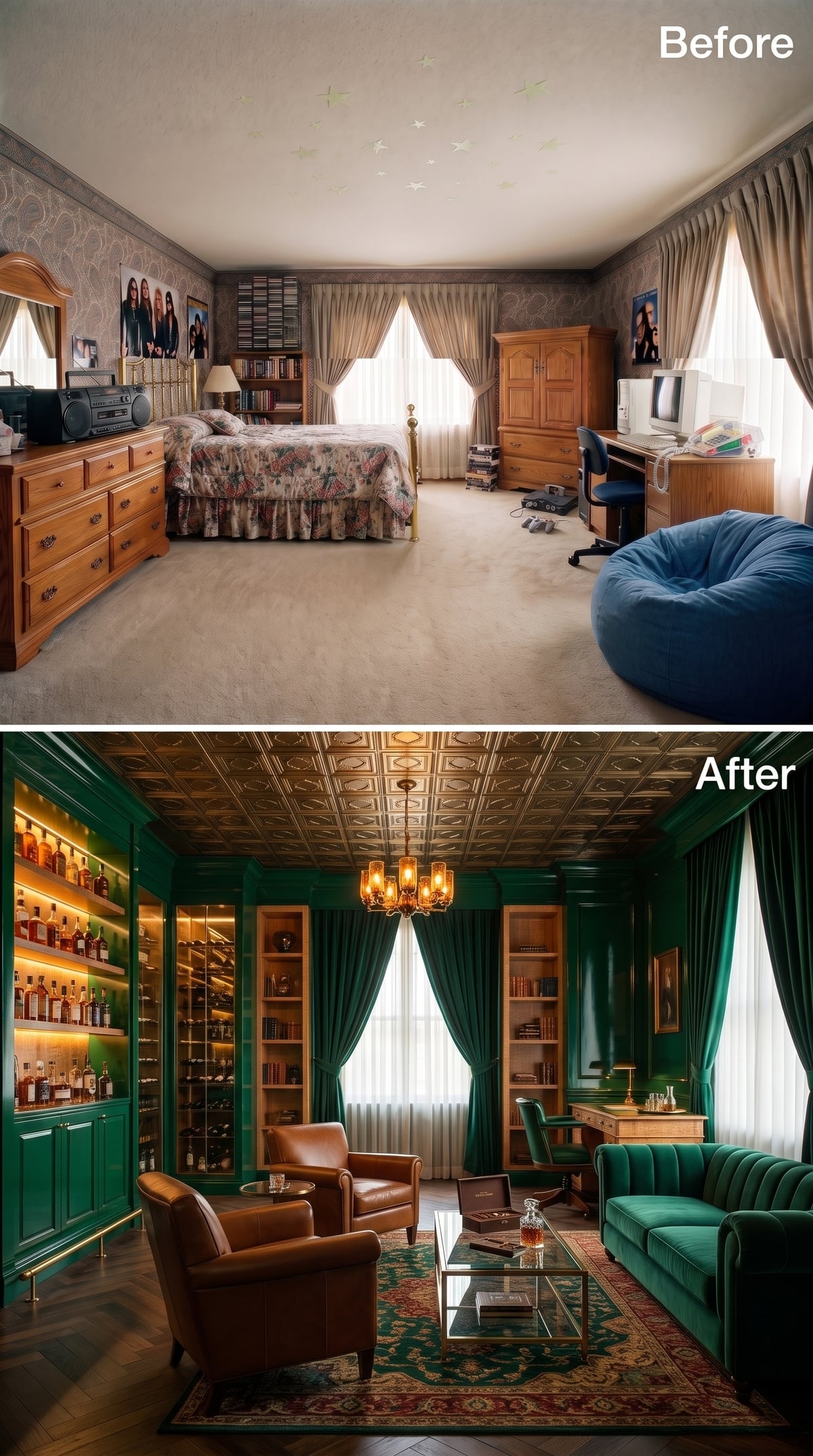
Deep hunter green lacquer wraps the millwork with almost club-like intensity, while an antique-gold pressed tin ceiling sends warm metallic light back into the darker palette. The bar collection occupies illuminated shelving on one side; books and a wood-topped desk balance it on the other.
Cognac leather chairs provide exactly the warm interruption the green needs. A matching green velvet sofa nearly disappears into the cabinetry behind it, while an Oriental rug introduces enough pattern to loosen the symmetry. The office function is present, but the room has far more interesting plans after five.
27. Floral Wallpaper Climbs the Ceiling and Takes the Laptop With It
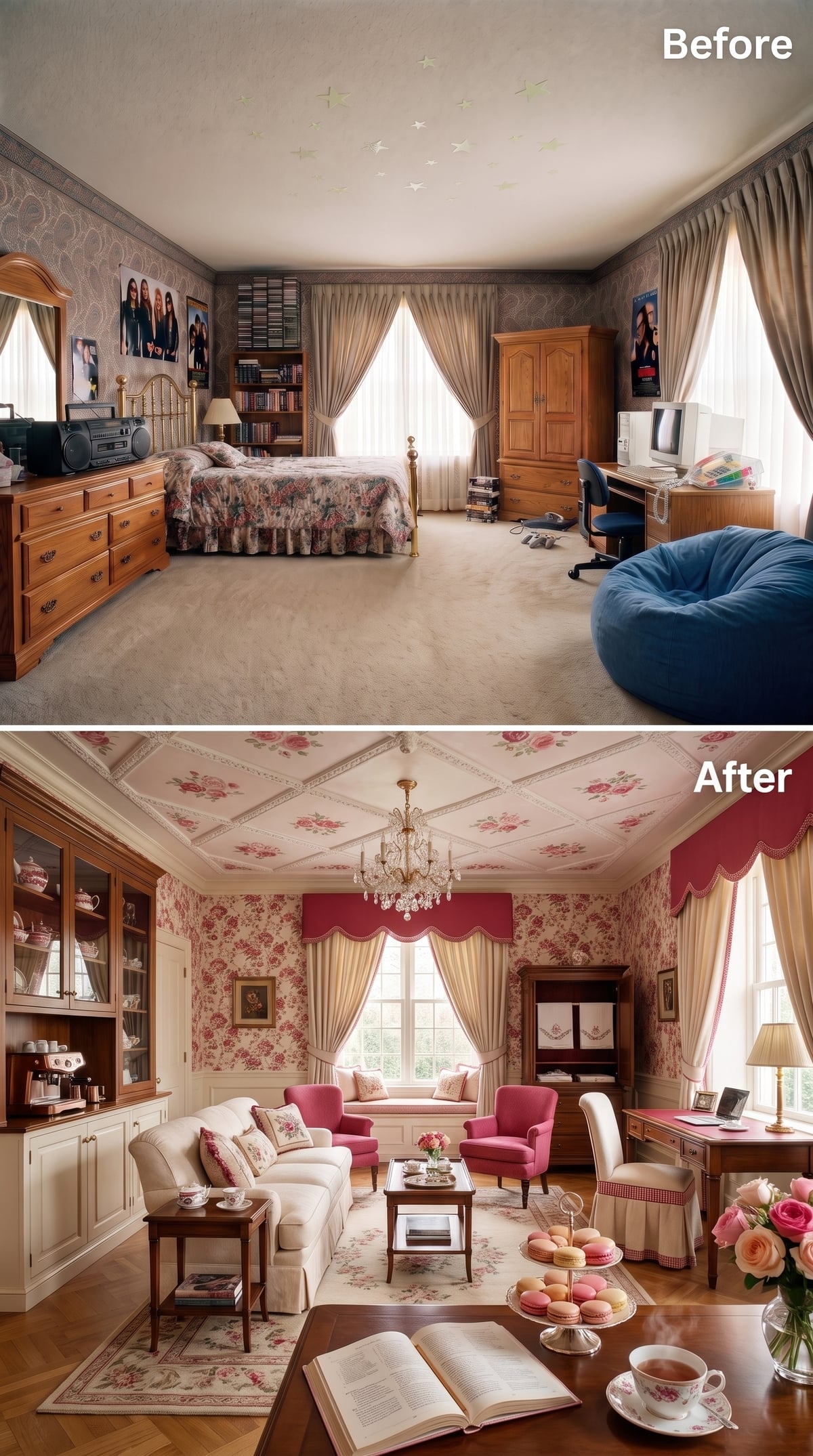
Rose-printed wallpaper covers the walls and continues overhead inside the coffered ceiling, creating a decorative envelope rather than a conventional wall-and-ceiling divide. A crystal chandelier supplies the sparkle; the pattern supplies almost everything else.
Against that much floral activity, the compact corner desk becomes remarkably quiet. Upholstered seating and traditional detailing push the room toward a modern interpretation of a parlor, while the laptop remains simply another object in a composition already full of things to look at.
Worth Noticing: Extending pattern overhead changes the room far more dramatically than stopping at the crown. Here the ceiling becomes part of the decorative field, allowing a small work surface to remain visually secondary without hiding it.
26. Charcoal Concrete, Mustard Yellow, and a Tool Wall That Earns Its Spot
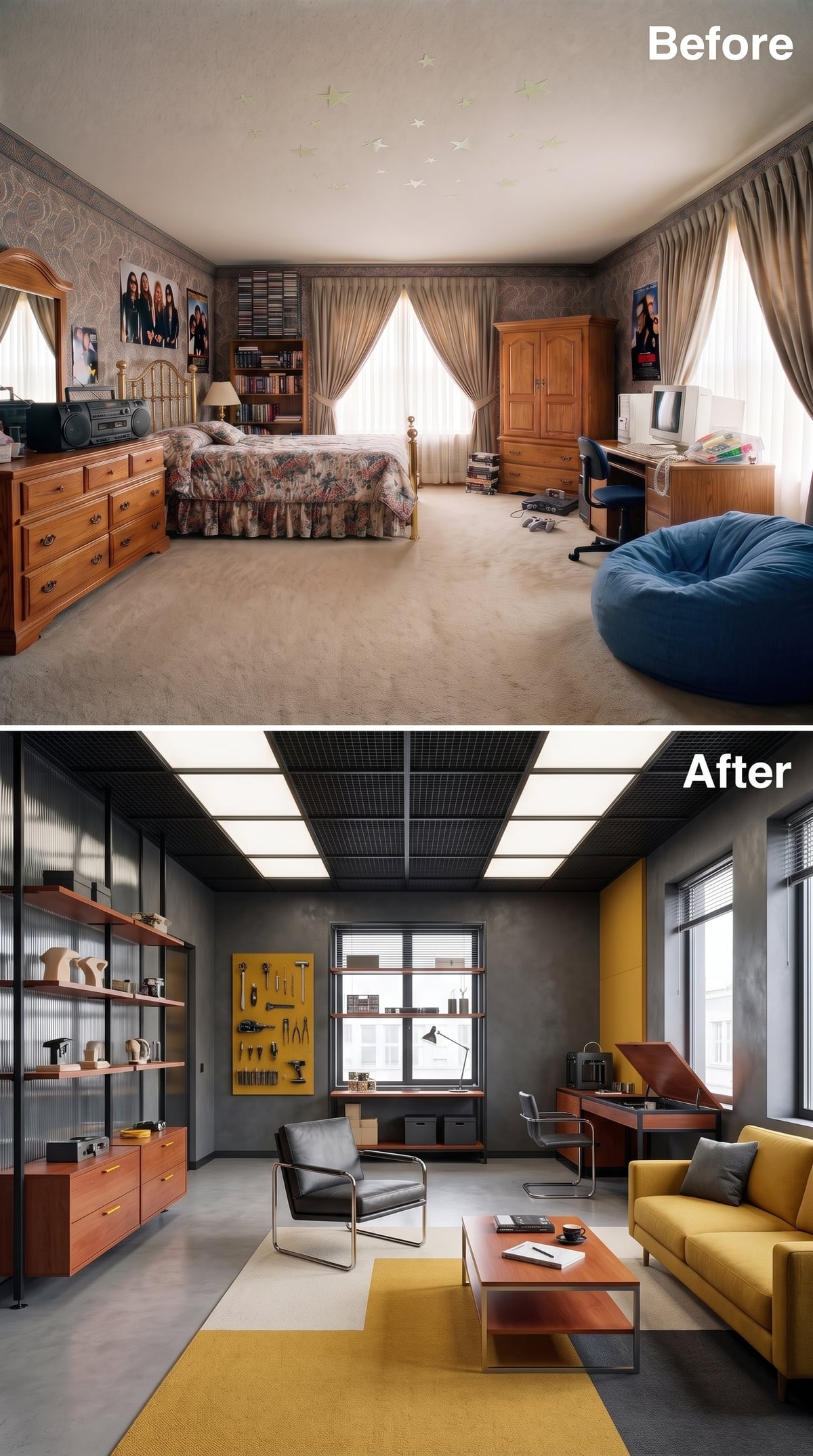
Dark ceiling panels and concrete-finish walls give this room a harder industrial shell, but walnut cabinetry immediately complicates the story. Open metal shelving holds useful objects rather than pretending storage doesn’t exist.
Mustard yellow takes control at floor level through the rug and sofa, warming the concrete without disguising it. The pegboard-style tool display could easily have pushed the room toward garage territory; framed by the walnut and dark walls, it becomes part of the studio character instead.
Why It Works: Concrete, black metal and dark ceiling panels establish the industrial side of the room. Walnut and mustard answer with warmth. Neither side wins completely, which is why the contrast feels deliberate rather than like a workshop furnished with a sofa.
25. Teal Damask, a Sky Ceiling, and Enough Gold to Make Restraint Nervous
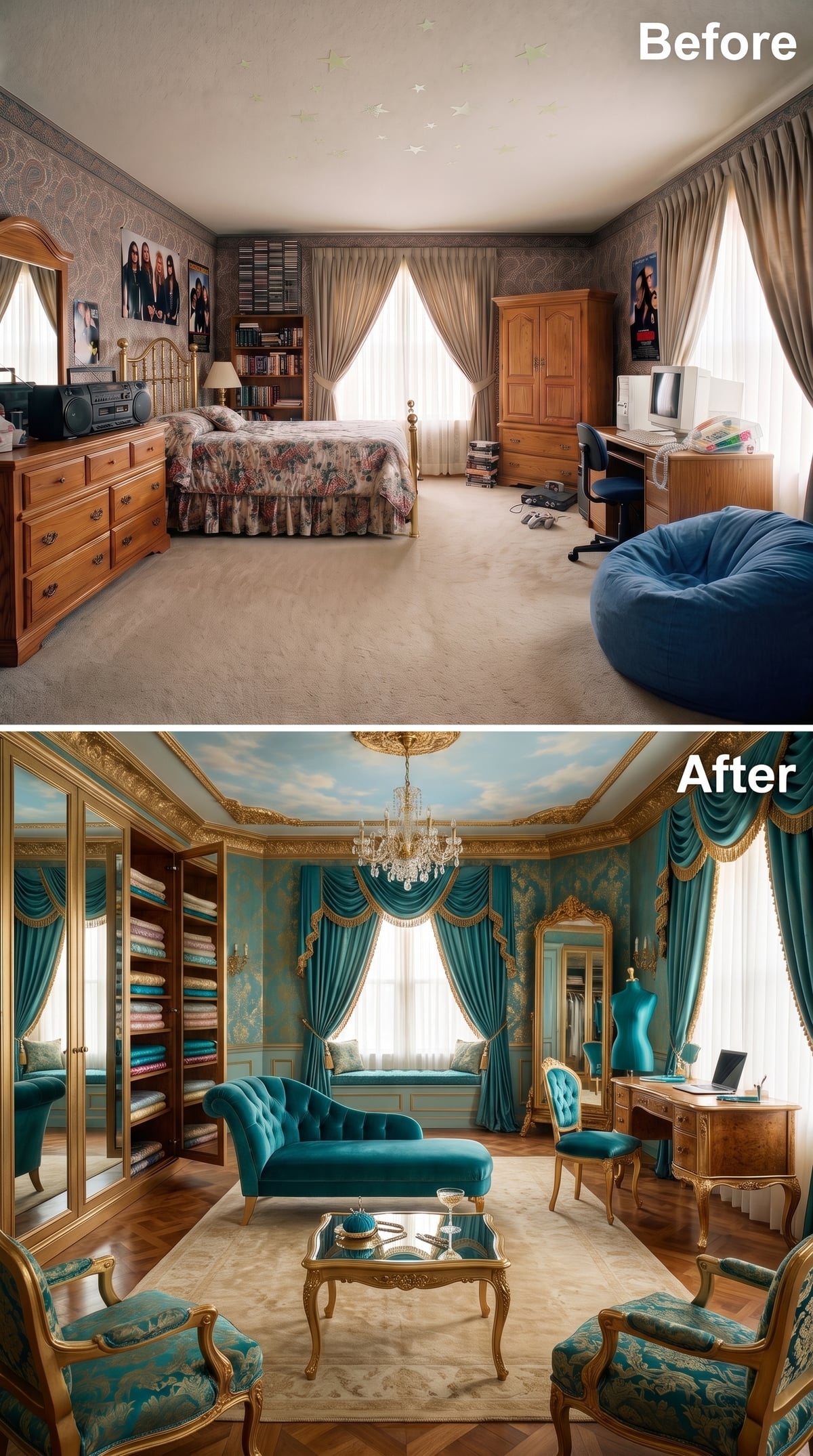
This much gold molding could have gone spectacularly wrong. Here it earns every inch.
Teal damask runs from floor to crown, then hands the ceiling to a painted sky framed in gilt plasterwork. A crystal chandelier occupies the center medallion, while a tufted teal chaise and carved armchairs claim the floor below with equal confidence.
The walnut desk sits at the edge near open wardrobe shelving, sharing its material rather than introducing a new visual language. A mannequin torso adds another sculptural vertical. Nothing here is trying to disappear; the trick is that no single functional object can overpower a room already operating at this volume.
24. Moss Wall, Sculpted Plaster, and an Olive Tree Rewrite the Spare-Room Brief
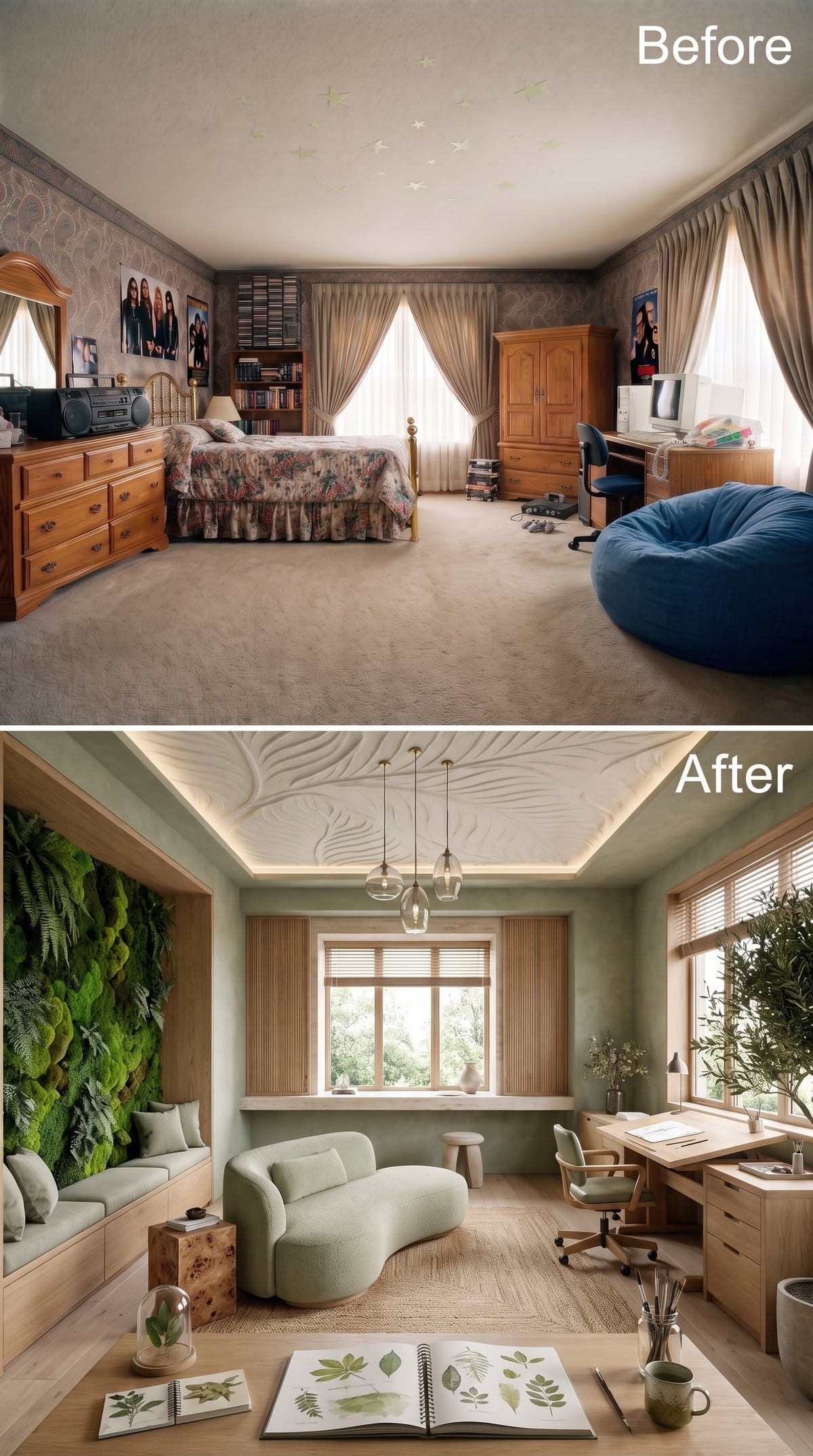
Sage plaster establishes the calm background, but the moss wall changes the room’s character completely. Its irregular texture works against the smooth built-ins and sculpted ceiling, giving the space a tactile focal point without adding another piece of furniture.
An olive tree brings height and a looser organic silhouette beside the cleaner desk geometry. Cream upholstery and pale surfaces keep the greens from becoming overly thematic. Instead of decorating around the workstation, the room builds a landscape around it.
23. Lacquered Red, Greek-Key Trim, and a Chess Table That Closes the Deal
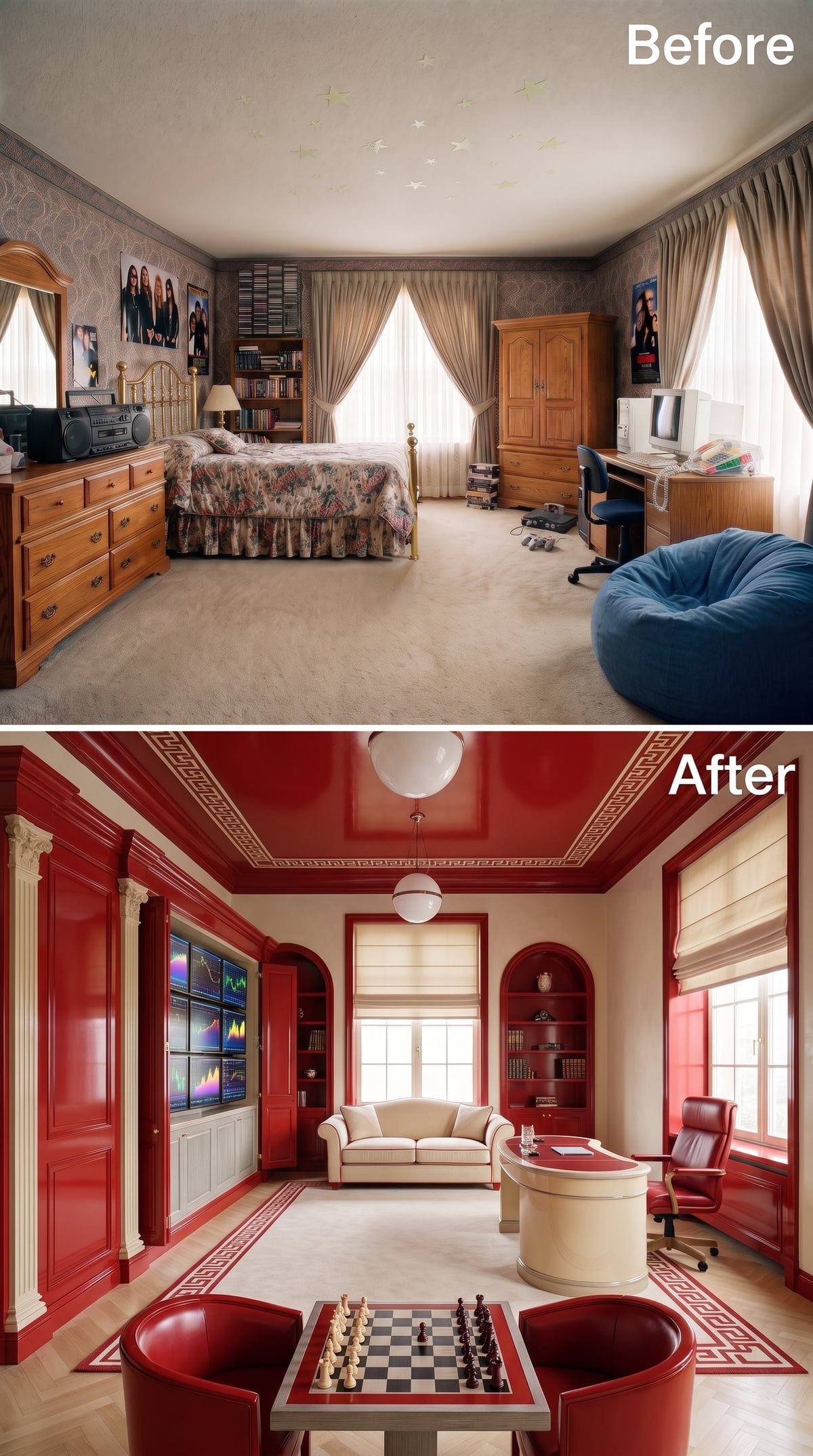
Red lacquer covers wall panels, door frames, shelving and ceiling with complete commitment. Cream Greek-key trim gives all that crimson a strict geometric boundary, preventing the room from dissolving into one glossy red field.
A rounded cream desk occupies the center without looking remotely corporate. Red leather armchairs gather around an inlaid chess table, while multiple monitors sit recessed into the wall rather than floating on furniture. Roman shades calm the windows. Excess, in this case, has excellent posture.
22. Limestone Walls and Rough Beams Make the Desk Look Almost Delicate
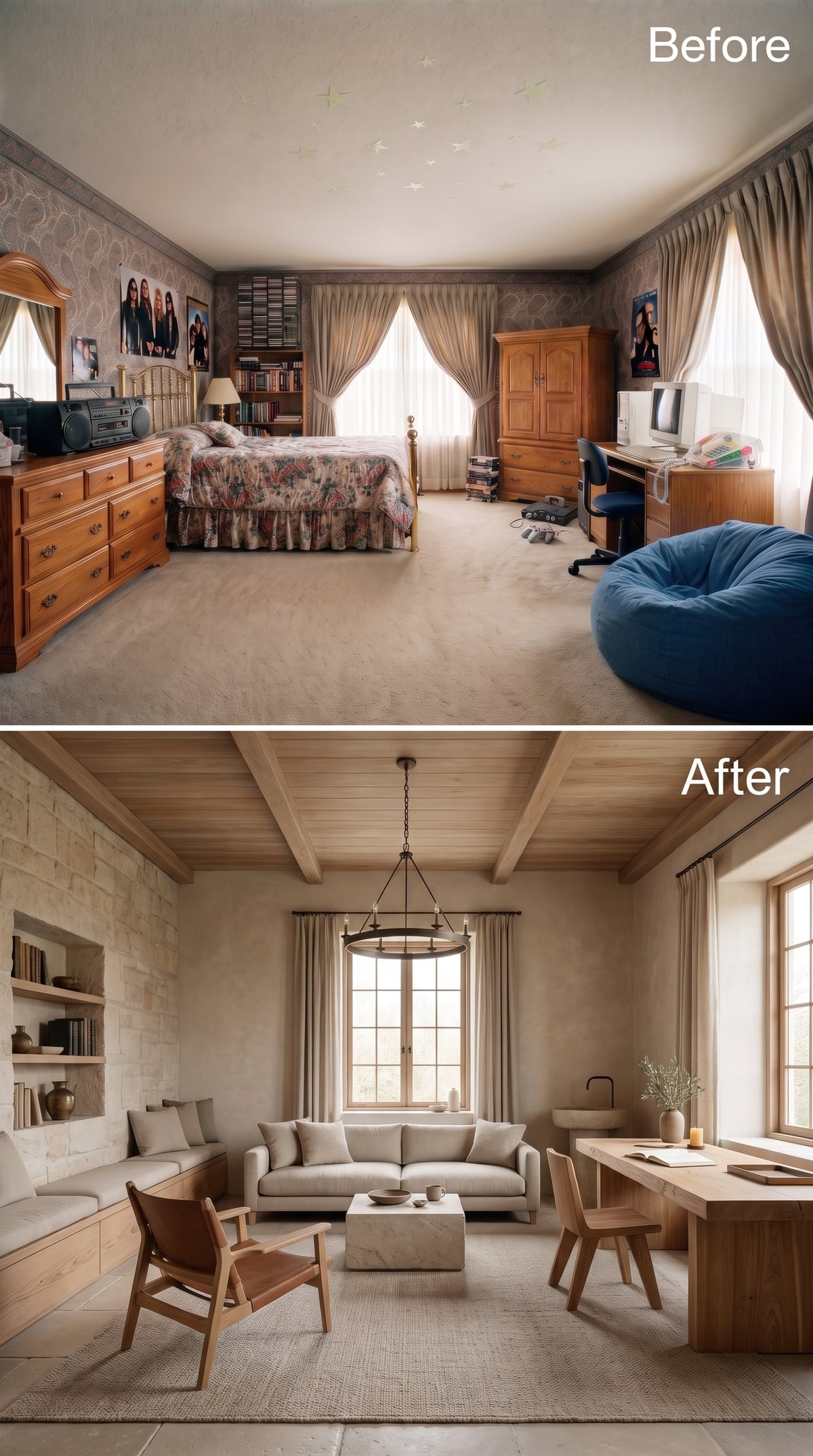
Warm limestone cladding runs the length of the back wall, while exposed beams bring a rougher texture overhead. Both stay within the same earthy temperature, letting the contrast come from surface rather than color.
A linen sofa and wood-framed chairs hold the middle of the room. The long desk occupies the window wall, and shelving recessed into the stone keeps storage from requiring another freestanding mass. Against limestone and timber this substantial, the work surface looks almost lightweight.
Material Lesson: Stone, timber and linen all operate within a restrained natural palette here, but their textures are radically different. That lets the room feel layered without relying on extra colors or decorative clutter.
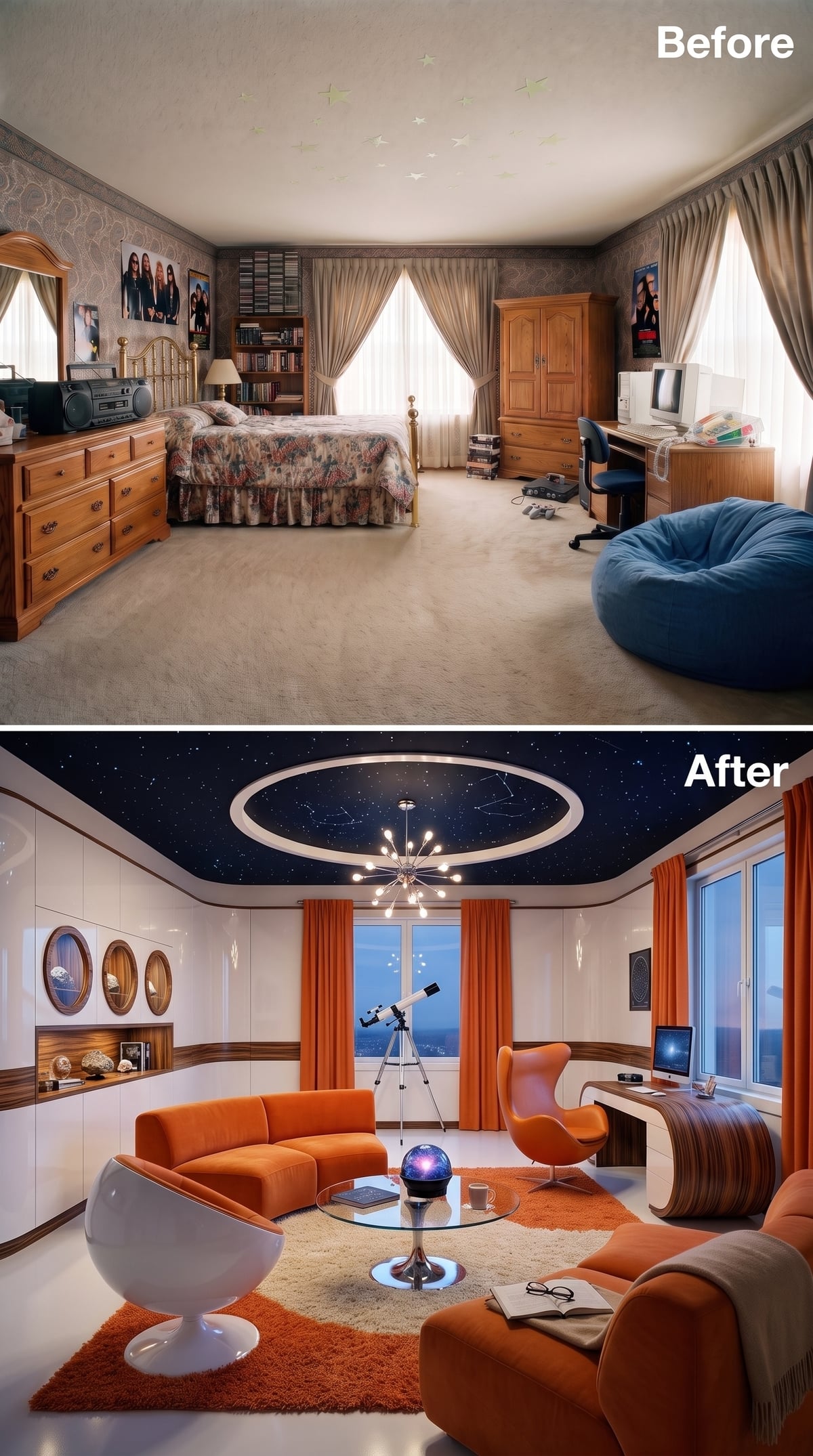
21. Constellation Ceiling, Orange Velvet, and Mission Control Without the Fluorescents
🔥 Would you like to save this?
A deep navy ceiling mapped with constellation lines establishes the room’s orbit before the furniture gets a vote. The curved desk and monitor pick up the mission-control suggestion, but the materials remain decidedly residential.
Orange velvet repeats across the sectional, egg chair and curtains, creating a strong warm counterpoint to the blue overhead. A telescope beside the window and a Sputnik-style chandelier extend the celestial language without turning the room into a literal set. The plasma globe gets away with being a plasma globe because subtlety departed several light-years ago.
20. Adobe Plaster, Terracotta Floors, and a Desk Built Into the Bones
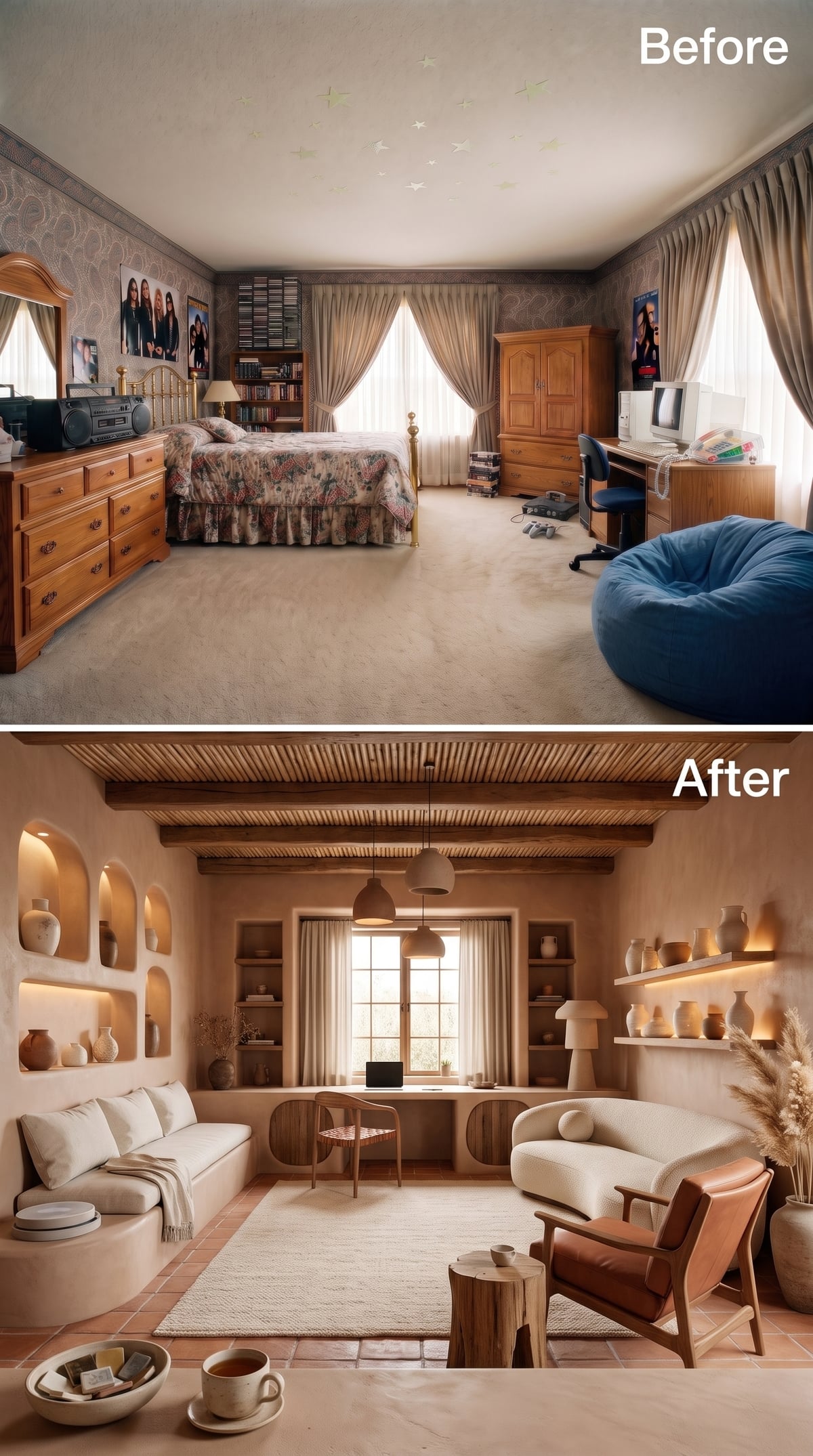
Hand-troweled plaster, terracotta tile and exposed ceiling beams give this room a completely different kind of weight. Arched niches along the wall hold ceramic vessels beneath warm accent lighting, turning storage into a sequence of recessed architectural moments.
The desk sits beneath the window as part of the built-in composition. A low cream sofa and cognac leather chair face each other across a wool rug, while a raw-clay pendant reinforces the earthy material palette overhead. Nothing needs to be concealed when the functional pieces speak the same language as the room.
19. Marble Checks, Mirrored Ceilings, and a Sofa With Salon Ambitions
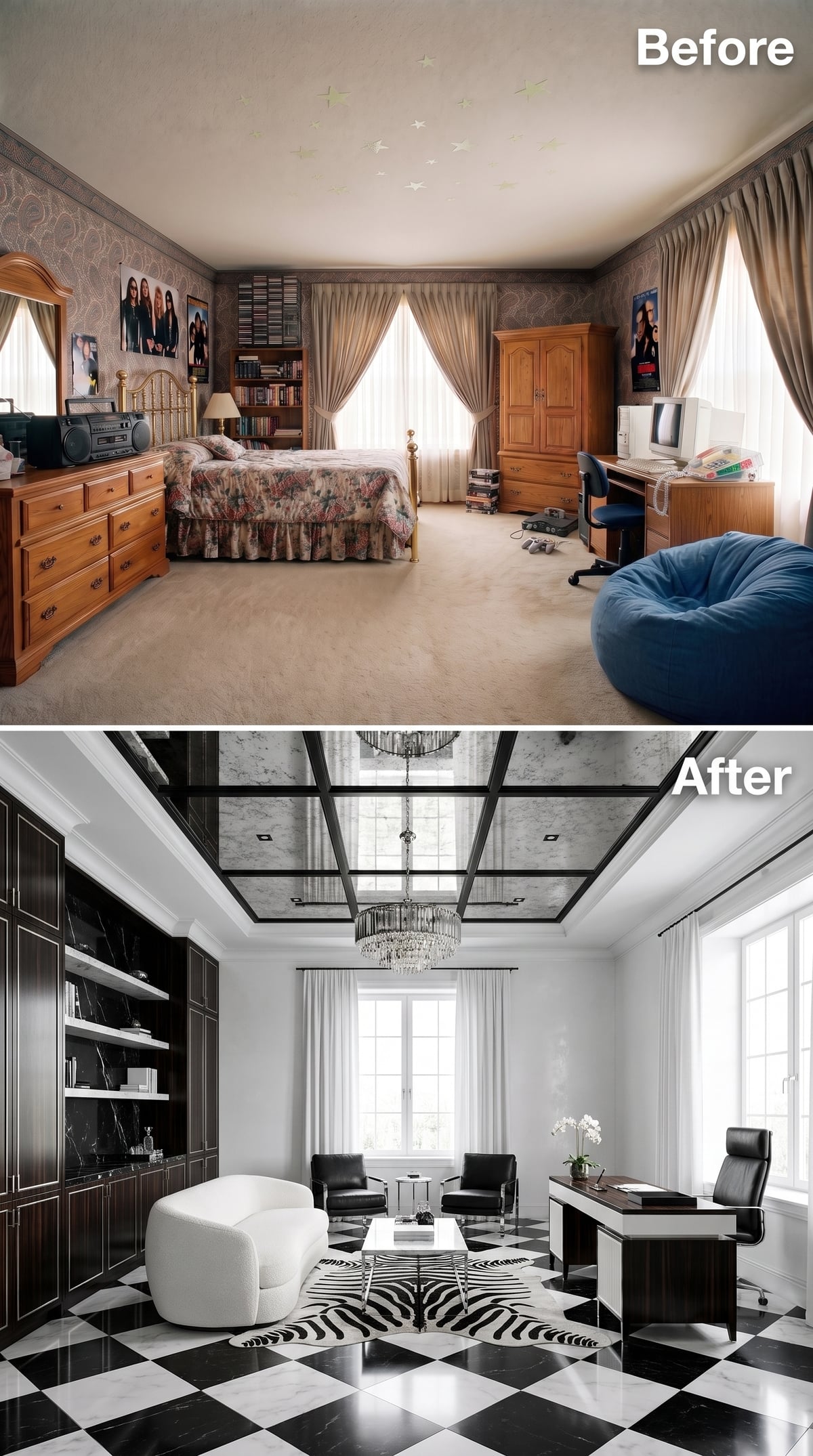
Black-and-white checkerboard marble establishes the floor’s hard geometry, and mirrored ceiling panels answer it overhead inside a black grid. A crystal chandelier interrupts all those straight lines with unapologetic sparkle.
The curved white boucle sofa provides the necessary softness, while a zebra-patterned rug adds a second, less disciplined kind of black and white. Dark built-ins with marble insets continue the architectural rhythm around the perimeter. The desk near the window participates without having to organize the room around itself.
Composition Check: The desk sits at the edge while the curved sofa occupies the visual center. That hierarchy lets the room announce itself through seating, pattern and architecture first, even though a fully usable workspace remains in plain view.
18. Olive Walls, a Wood Slat Ceiling, and a Typewriter That Sets the Tone
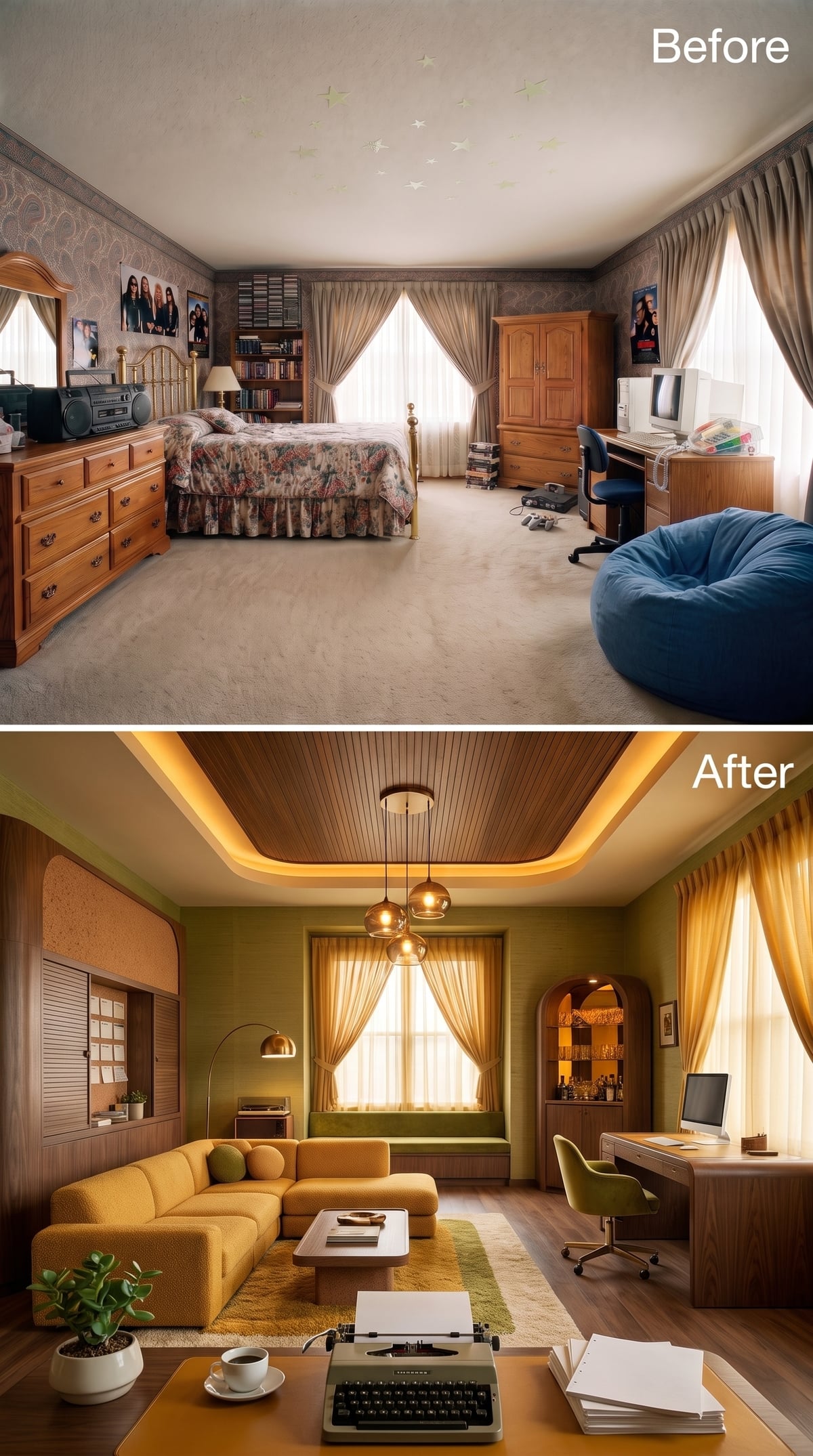
Olive walls create the envelope; warm wood slats overhead keep it from becoming visually dense. Amber glass globes hang low above the seating area, while a mustard sectional introduces a brighter note without leaving the autumnal palette.
A desk runs along the right wall beneath a wide monitor, close to an arched bar niche. The typewriter in the foreground adds a wonderful analog counterpoint to that screen. Old work and new work coexist, while the sofa and bar make sure neither gets complete control of the room.
17. Pink Plaster and Walnut Turn the Work Zone Into a Side Plot
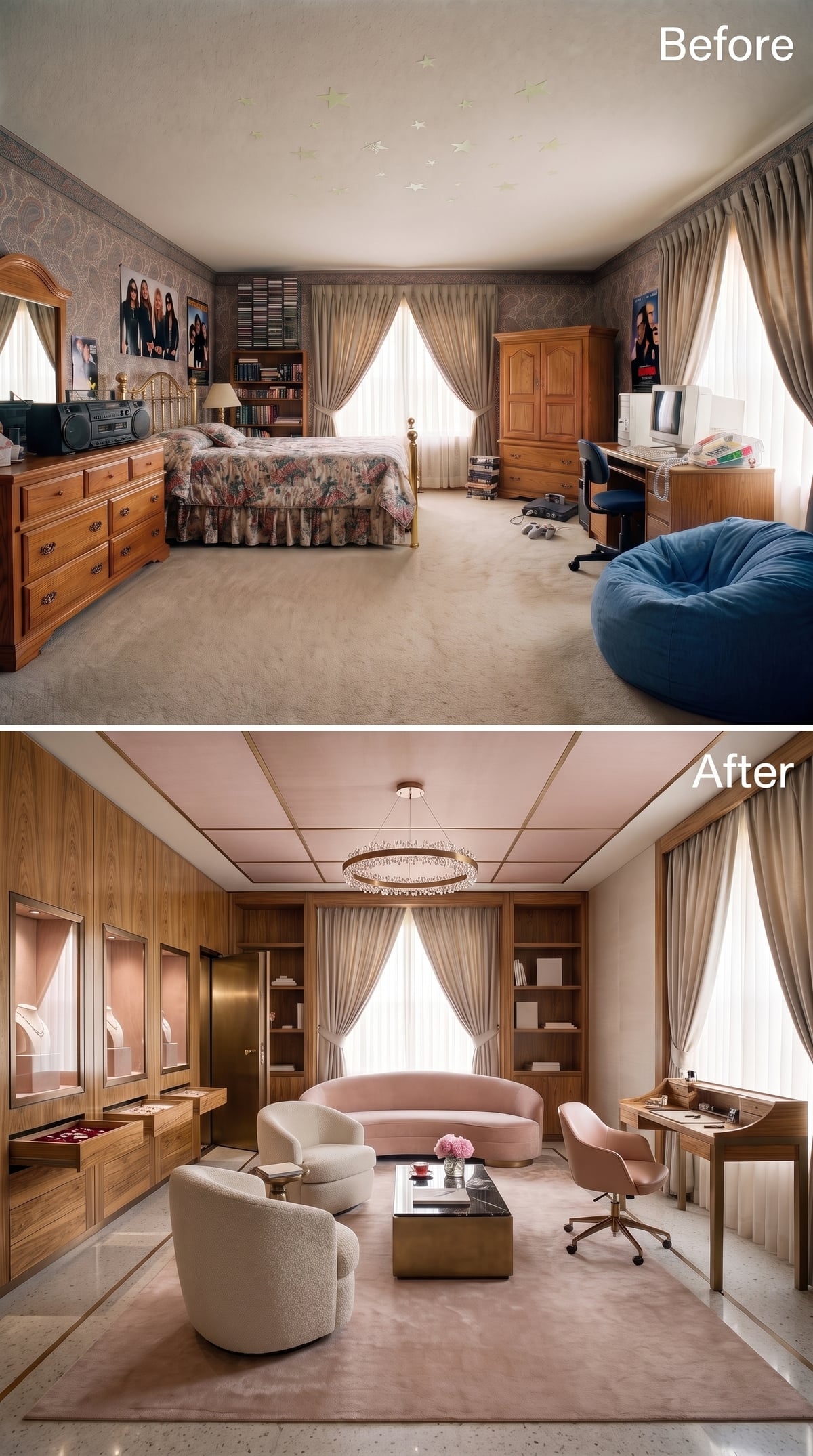
Blush ceiling panels sit above warm walnut millwork, an unexpectedly good pairing that feels richer because neither color is pushed toward its sweetest extreme. A dusty-rose curved sofa continues the warmth at floor level, with boucle adding a paler, nubbier countertexture.
The compact desk occupies the window edge and shares the walnut language of the display cabinetry. Rather than disguising its function, the room simply gives stronger architectural roles to everything around it.
Detail to Steal: Carrying one wood tone through the desk and surrounding cabinetry makes separate elements feel related. The blush ceiling then becomes the surprise rather than the workstation.
16. Gothic Paneling, Green Leather, and a Fireplace Bright Enough to Break the Spell
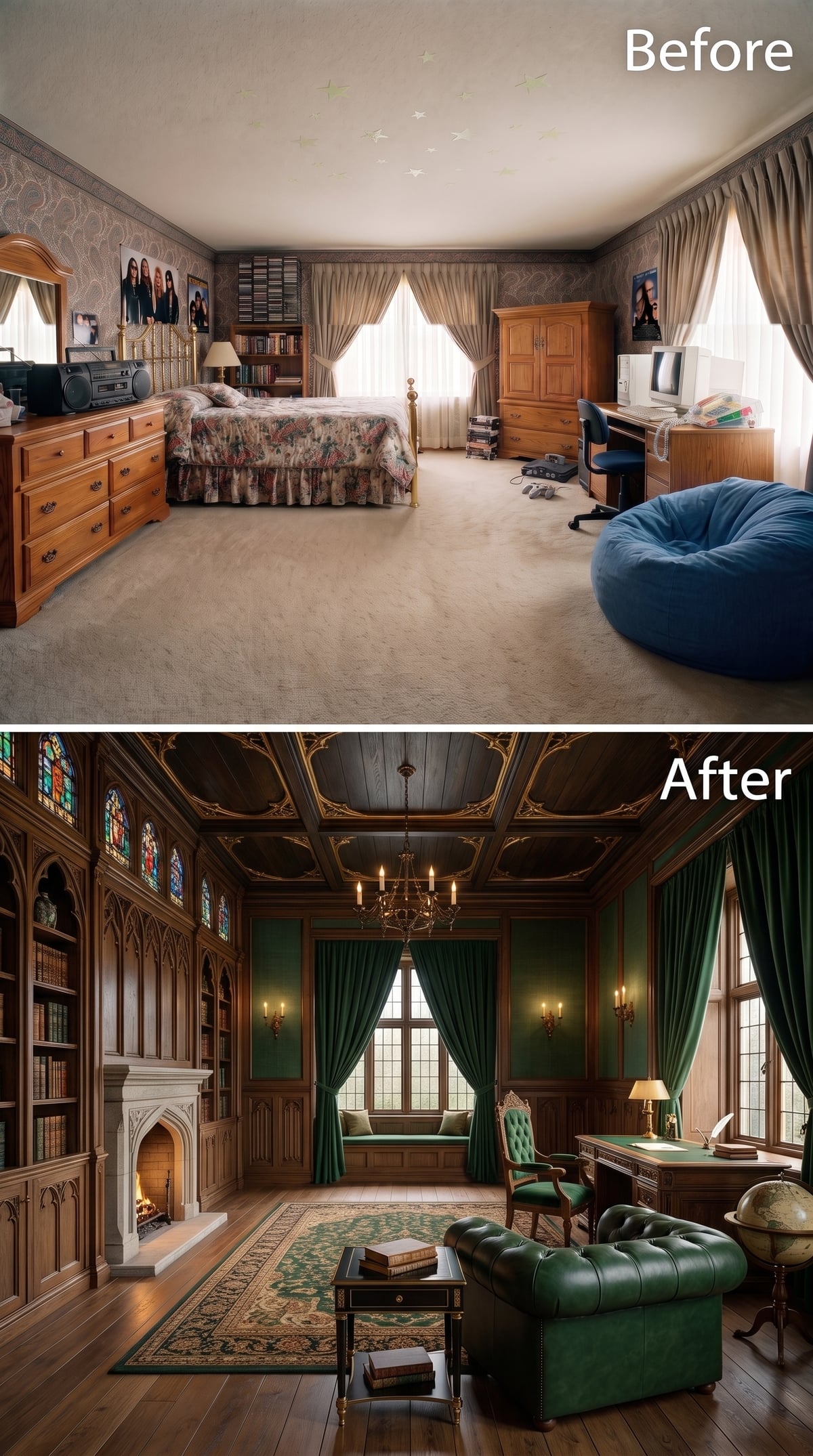
Deep walnut paneling rises into pointed arches, while stained glass above the shelving throws color into a room already committed to Gothic drama. A forest-green tufted sofa gives the center enough saturated color to stand against all that wood.
Gold detailing picks out the coffered ceiling, but the white marble fireplace delivers the sharper interruption. Its pale surface breaks the dark envelope in a single stroke. The desk, globe and brass lamp settle naturally into the library-like architecture without needing a separate visual identity.
15. Wavy Ceiling Fins Make Dusty Blue Look Almost Architectural
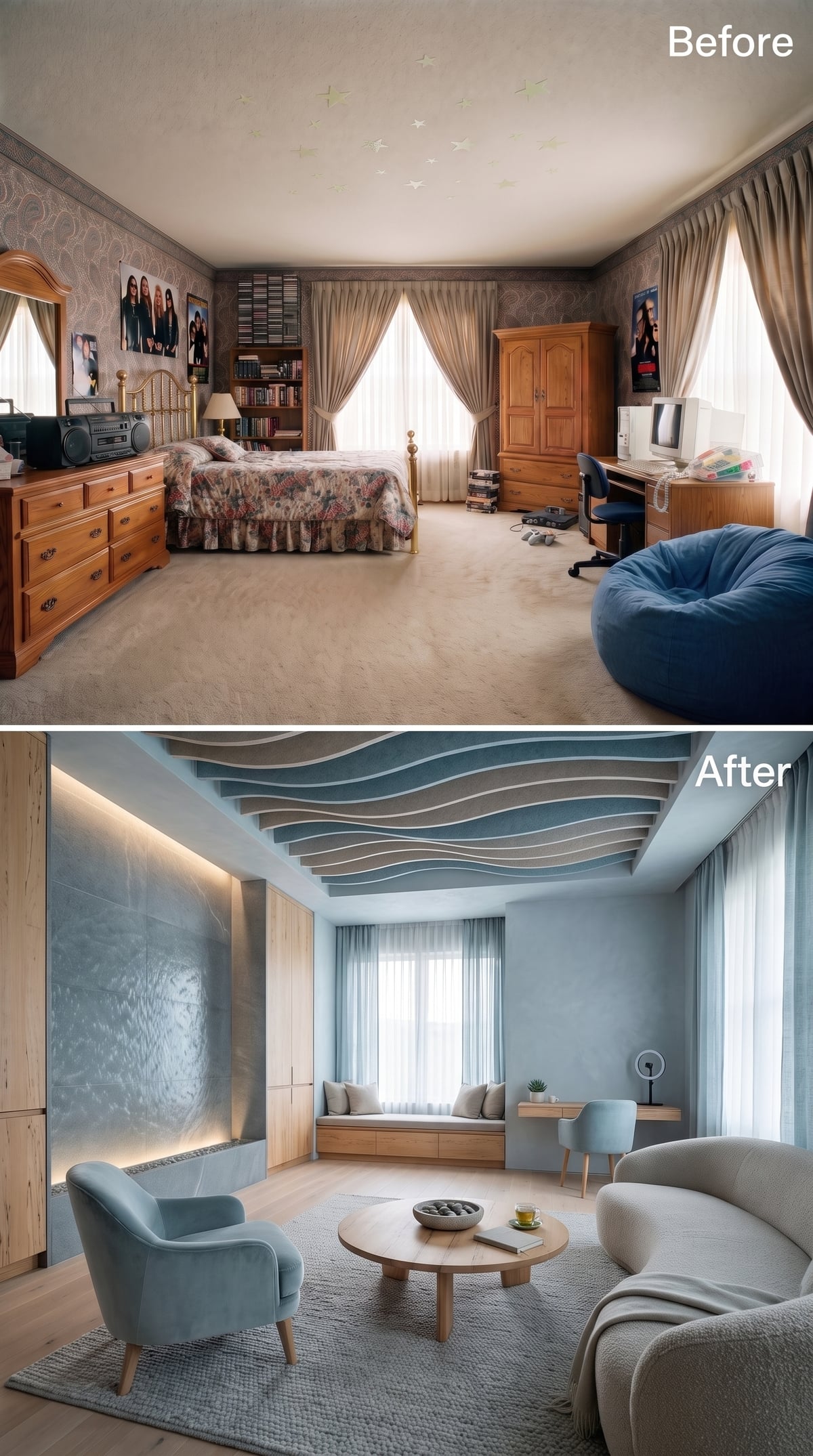
Sculptural plaster fins ripple across the ceiling in dusty blue and white, replacing the usual flat overhead plane with movement. Below, a built-in window seat turns a corner into useful seating and storage without adding another bulky piece.
The desk stays deliberately compact, leaving the ceiling and window architecture to establish the room’s character. Soft blue walls keep the sculptural work connected to the rest of the space rather than letting it float overhead as a decorative stunt.
Ask Yourself: Does the desk really need to be the largest object in a hybrid room? Here the compact work surface leaves enough visual and physical space for the window seat and ceiling treatment to establish a much broader identity.
14. Walnut Paneling, Crimson Velvet, and a Chandelier With No Interest in Business Hours
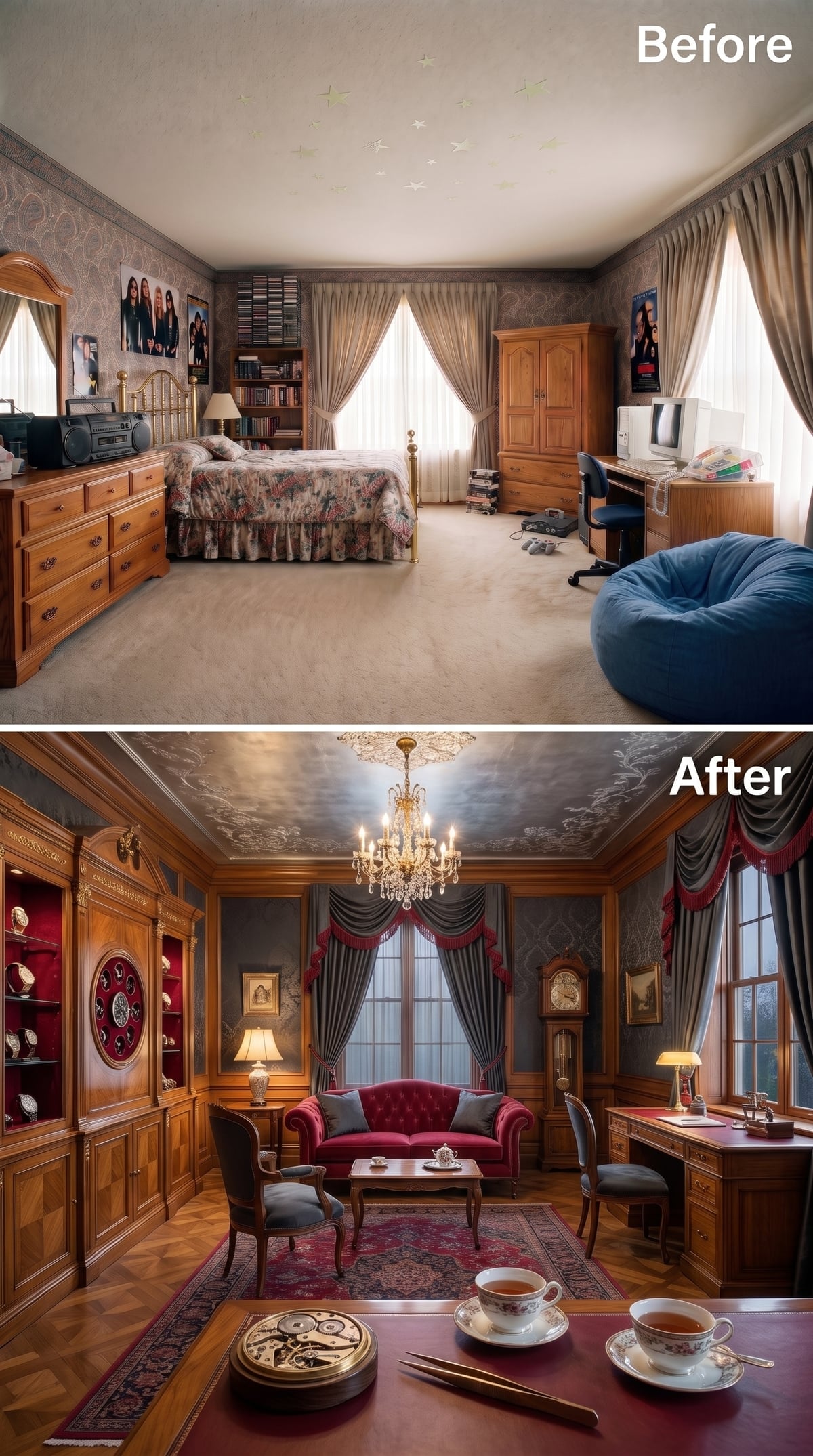
Dark walnut millwork, herringbone parquet and ornate plasterwork build a formal shell before the crimson loveseat arrives to seize the middle. Grey curtains edged in red repeat the upholstery color vertically without coating the entire room in it.
A crystal chandelier supplies ambient light, while the writing desk gets its own smaller lamp in the corner. Display cases backed in red velvet turn another wall into a place for objects rather than equipment. The effect is closer to a collector’s study than a conventional home office.
13. Concrete Coffers and Rust Velvet Find Common Ground
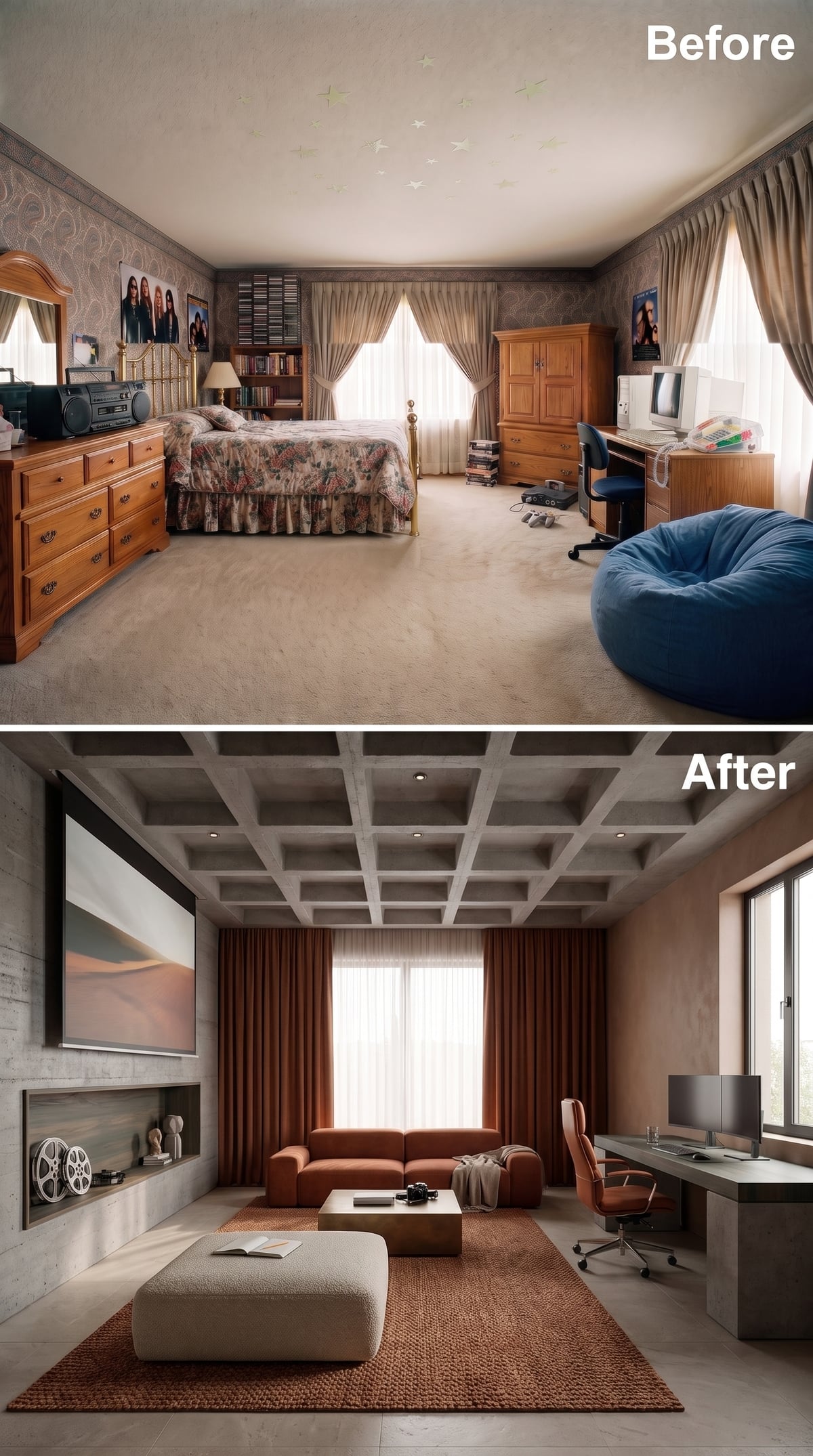
Raw concrete coffers bring weight and repetition overhead, with recessed lights sitting flush inside the grid. Below, rust velvet supplies the softness and color the ceiling deliberately refuses to provide.
The desk becomes a long matte-grey slab along the wall, paired with a rust chair that connects it to the seating area. Terracotta curtains, jute underfoot and a boucle ottoman gradually warm the concrete rather than trying to disguise it.
Contrast Lesson: The ceiling is hard, grey and deeply geometric; the seating is soft, warm and saturated. Repeating rust at the desk chair links the work surface to the lounge without forcing both zones to use identical furniture.
12. Art Nouveau Paneling and Stained Glass Turn the Ceiling Into the Main Event
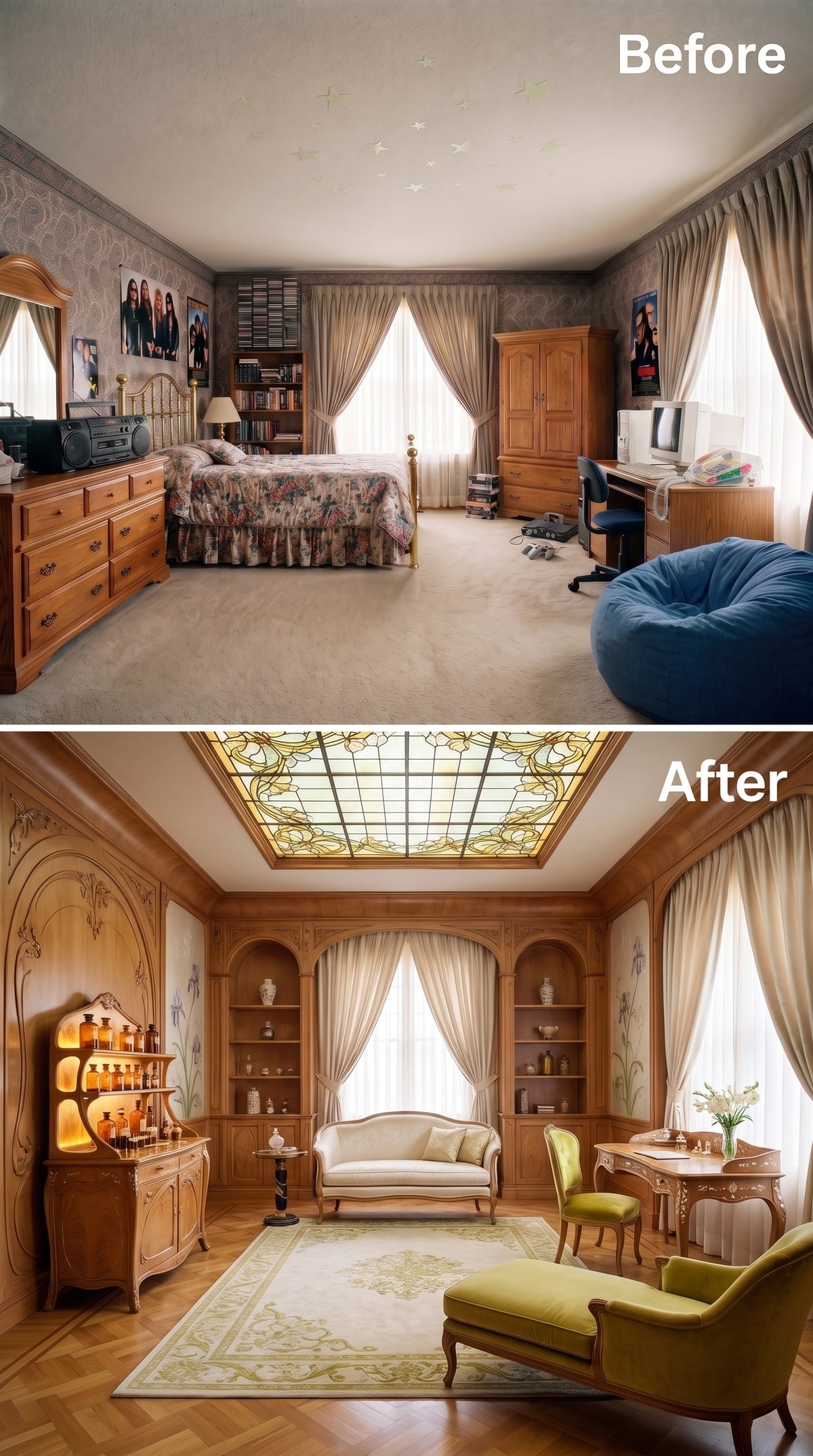
Carved wood paneling wraps the walls with botanical motifs, but the leaded stained-glass ceiling takes the argument further. Greens and ambers overhead echo the timber below, producing a room that feels unusually complete without relying on dozens of unrelated finishes.
A cream settee and chartreuse armchair lighten the center, while built-in shelves hold objects and books around the perimeter. The writing table near the window is modest enough to coexist with architecture this expressive rather than challenge it.
Scale Matters: The writing table stays visually light against highly articulated walls and ceiling. A heavier workstation would introduce another focal point into a room that already has several excellent ones.
11. Recording Booth, Raw Brick, and a Chesterfield Walk Into a Spare Room
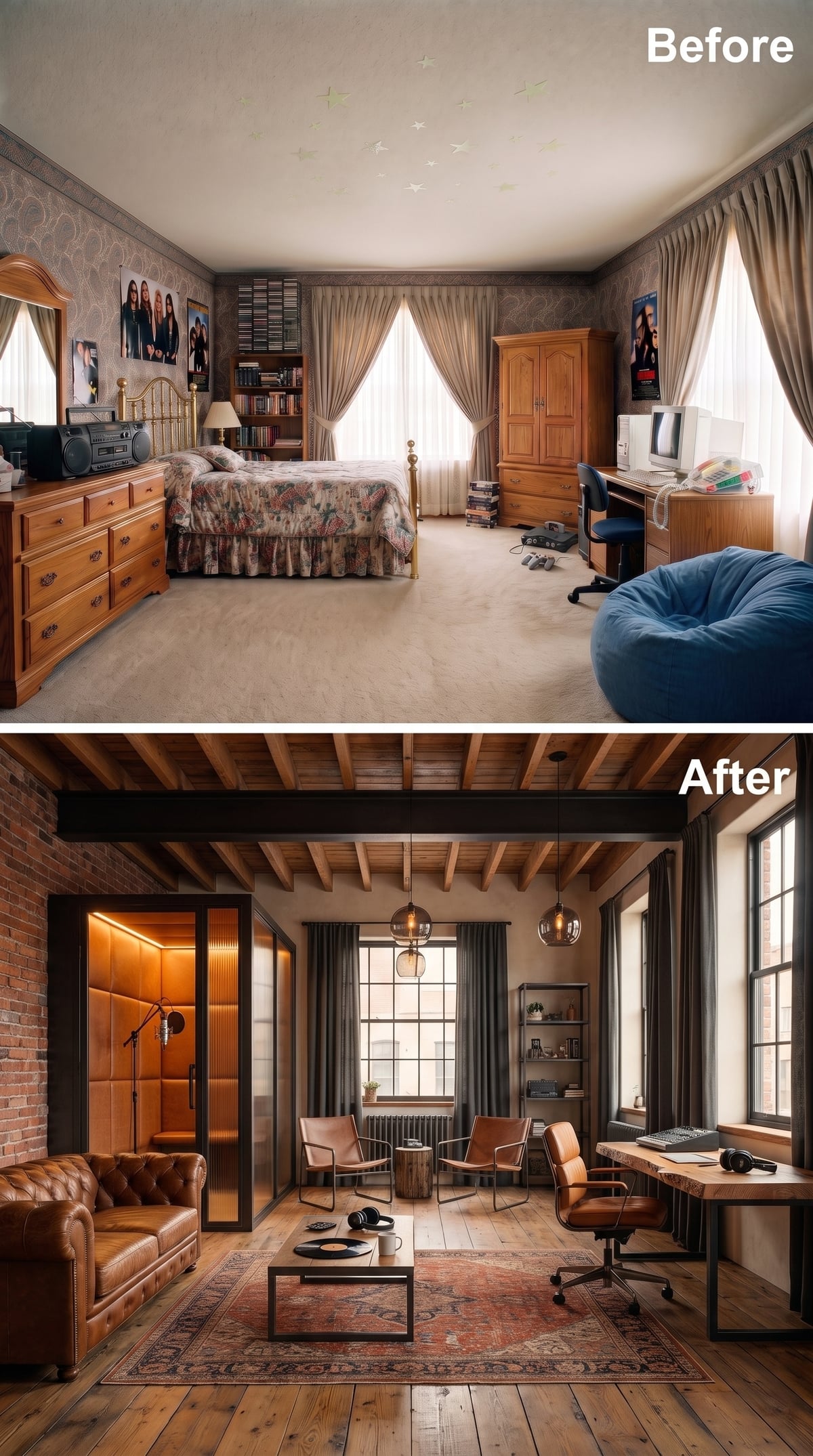
Raw brick, wide-plank oak and deliberately rough ceiling beams establish the industrial shell. Then a recording booth appears behind sliding glass panels, adding a highly specific function without requiring the rest of the room to imitate a studio.
A cognac Chesterfield and two slim mid-century chairs keep the center social. The live-edge desk follows the natural irregularity of the timber rather than the geometry of the glass booth. Low pendants warm the scene and keep the technical equipment from determining the atmosphere.
Design Principle: Specialized equipment doesn’t have to dictate every finish around it. Here the glass enclosure contains the technical zone, while brick, leather, oak and warm lighting give the larger room a distinctly residential character.
10. Plaster Medallion, Bergère Chairs, and a Writing Room That Knows Exactly What It Is
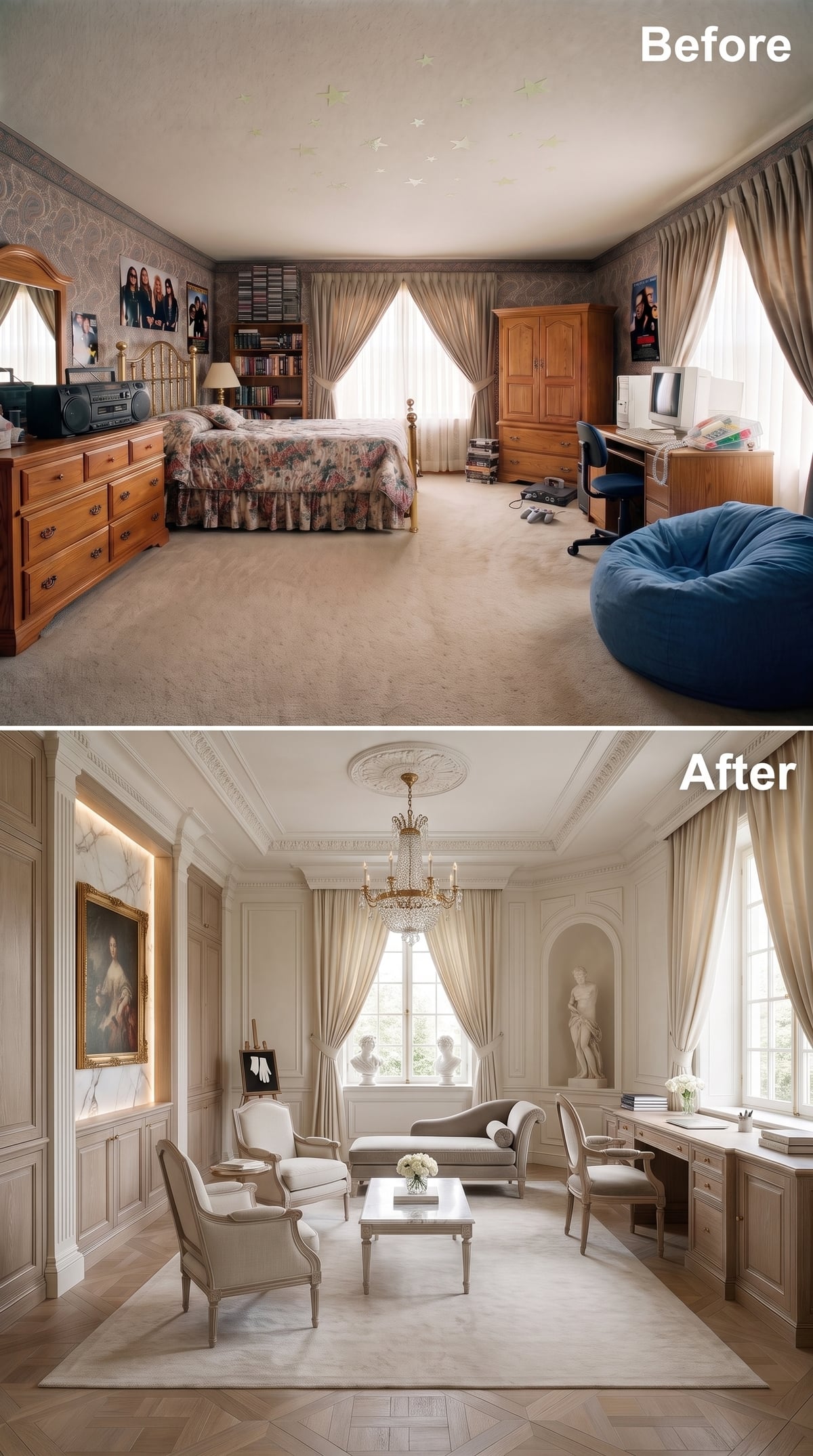
Ornate crown molding and raised wall paneling give this room a formal architectural frame, crowned by a plaster medallion and crystal chandelier. The effect is traditional without becoming visually crowded because the palette stays pale.
French bergère chairs face a marble-top coffee table rather than a screen, establishing the center as a place to sit and read. Classical busts on the windowsill add sculptural weight, while the built-in desk follows the wall line instead of projecting into the room. The arrangement feels less like an office with nice chairs than a writing room that happens to have excellent Wi-Fi.
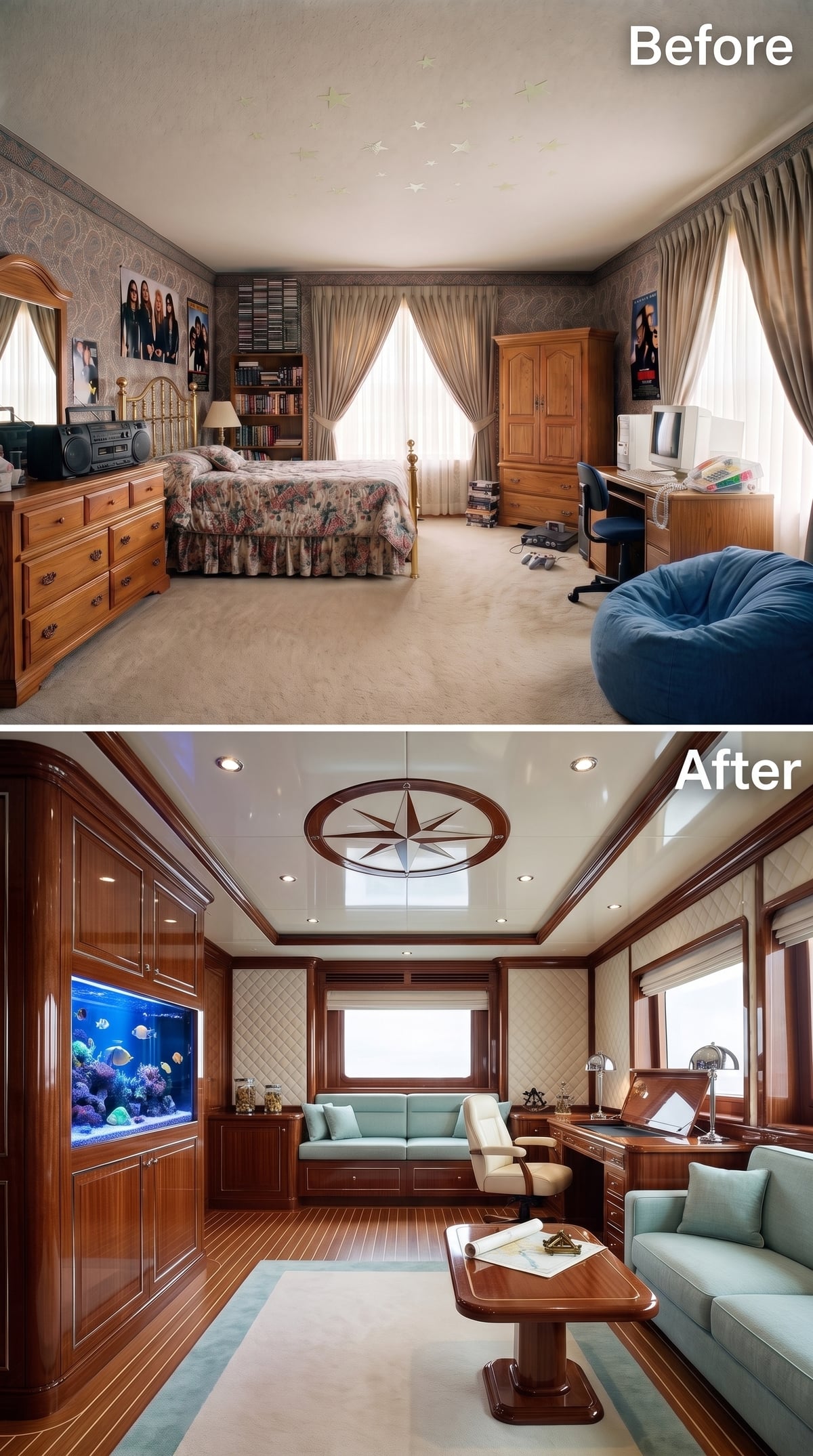
9. Compass Rose Ceiling, Aquarium, and Enough Mahogany for a Small Yacht
🔥 Would you like to save this?
Rich mahogany millwork wraps the room with the density of a yacht interior, while the compass-rose medallion overhead makes the nautical reference unmistakable without resorting to anchors on the wall.
A built-in aquarium brings movement and cool color to one side. Opposite it, the curved desk borrows the broad proportions of a navigation table, while seafoam upholstery breaks up the darker timber. The room commits to the reference deeply enough that the functional furniture feels like part of the architecture rather than an interruption.
Theme Without Costume: The compass rose, curved desk, mahogany and seafoam upholstery all point in the same direction, but none relies on novelty décor. Materials and geometry carry the nautical idea more convincingly than a collection of literal symbols would.
8. Blue-Grey Walls, Knotty Pine Floors, and a Writing Desk That Earns Every Inch
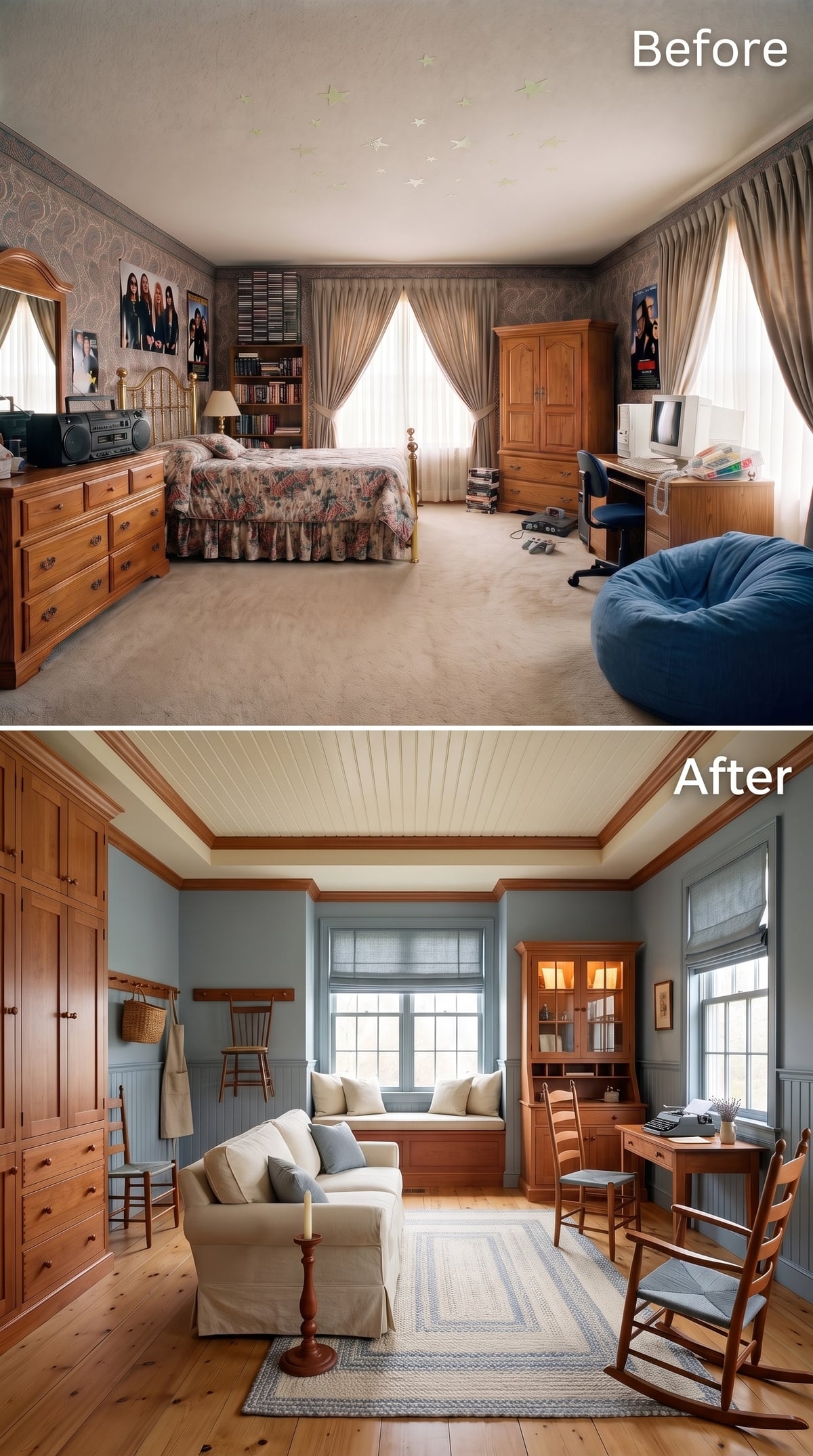
Soft blue-grey walls cool the room while honey-toned pine floors and cabinetry pull it back toward warmth. Floor-to-ceiling storage occupies one wall, and an illuminated corner hutch turns another potentially awkward area into a useful vertical feature.
A cream slipcovered sofa and braided rug keep the center informal. The writing desk occupies the opposite corner with a ladder-back chair and typewriter, while Roman shades leave the window trim exposed. Nothing here depends on spectacle; proportion and material temperature do the work.
Storage Move: Tall cabinetry uses vertical wall area while leaving the middle of the room open. The smaller writing desk then has room to remain furniture rather than becoming a storage system of its own.
7. Navy Velvet, Walnut Shelves, and a Library Ladder That Steals the Scene
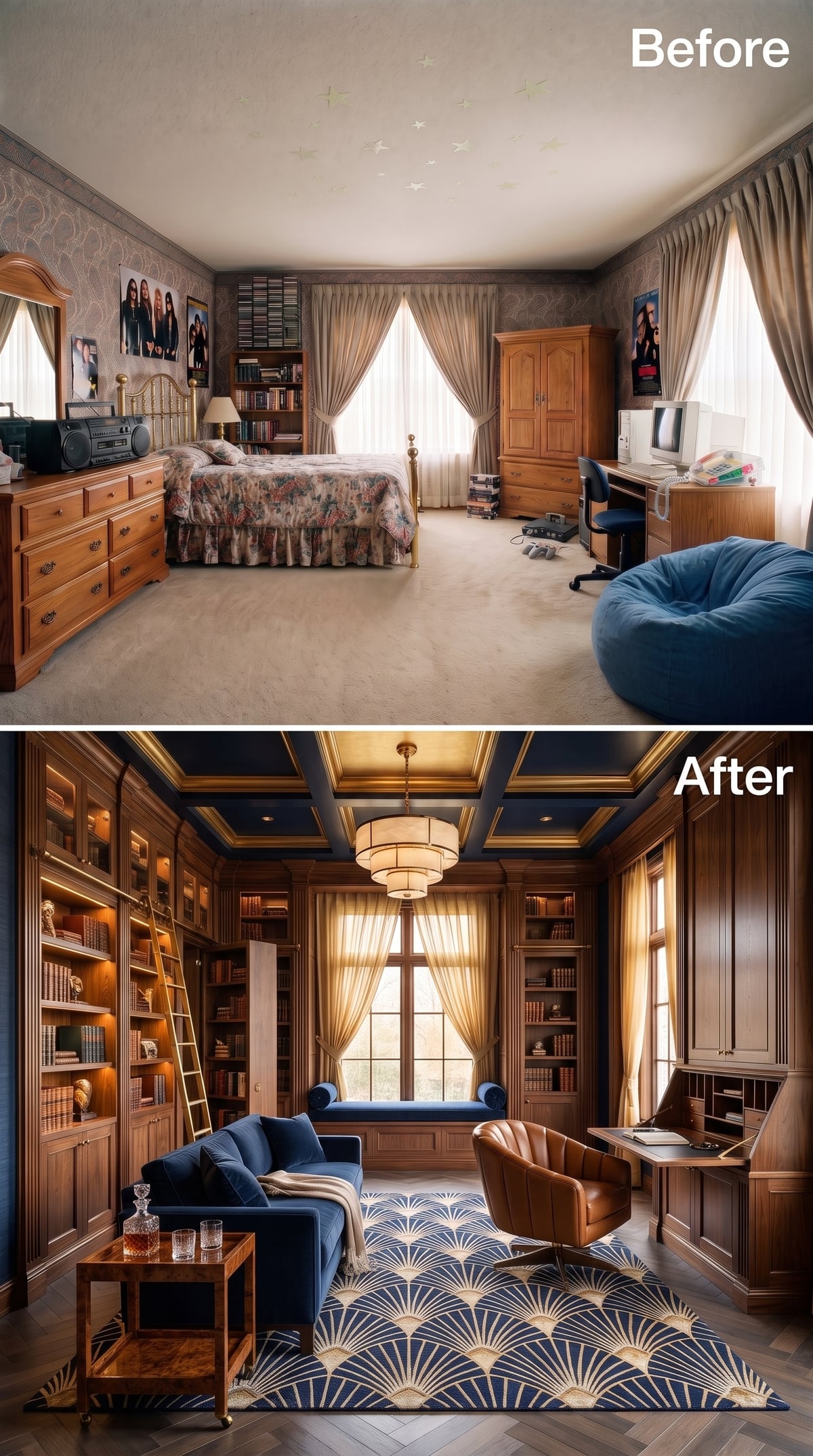
Floor-to-ceiling walnut shelving, a rolling library ladder and a navy sectional make the room a library long before anyone notices the workstation.
The coffered ceiling doubles down in deep navy with gold trim tracing each recess. A drum pendant hangs at the center, while an Art Deco rug repeats cream and indigo below.
Books fill the built-ins instead of binders, and the desk slots directly into the cabinetry with a leather chair beside it. The rolling ladder adds height and movement to the shelving wall, giving a functional storage system considerably more architectural swagger than a row of office cabinets could manage.
6. Moroccan Lattice Overhead Turns Warm Plaster Into Something Cinematic
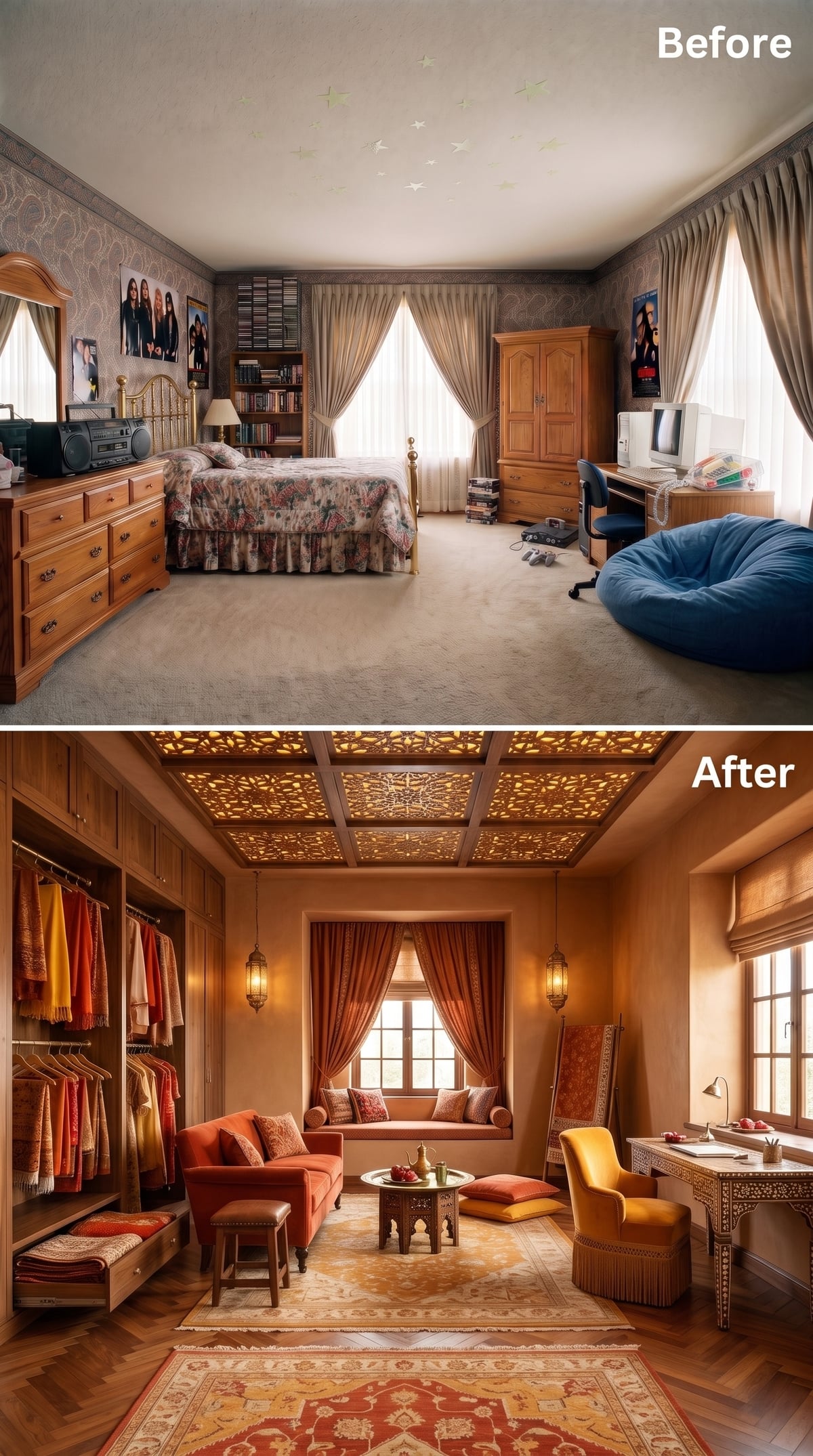
Backlit carved panels grid the ceiling, sending warm light through repeating geometric openings and giving the entire upper plane a lantern-like quality. Against that detail, the plaster walls stay deliberately quiet.
An inlaid desk along the wall picks up the craftsmanship without copying the ceiling pattern literally. Low seating and warm textiles keep the room grounded, while the illuminated lattice provides enough ornament that the rest of the space can afford restraint. The ceiling isn’t decoration added at the end; it sets the room’s entire rhythm.
5. Equestrian Library Energy, Slate Blue, and Woodwork With Serious Presence
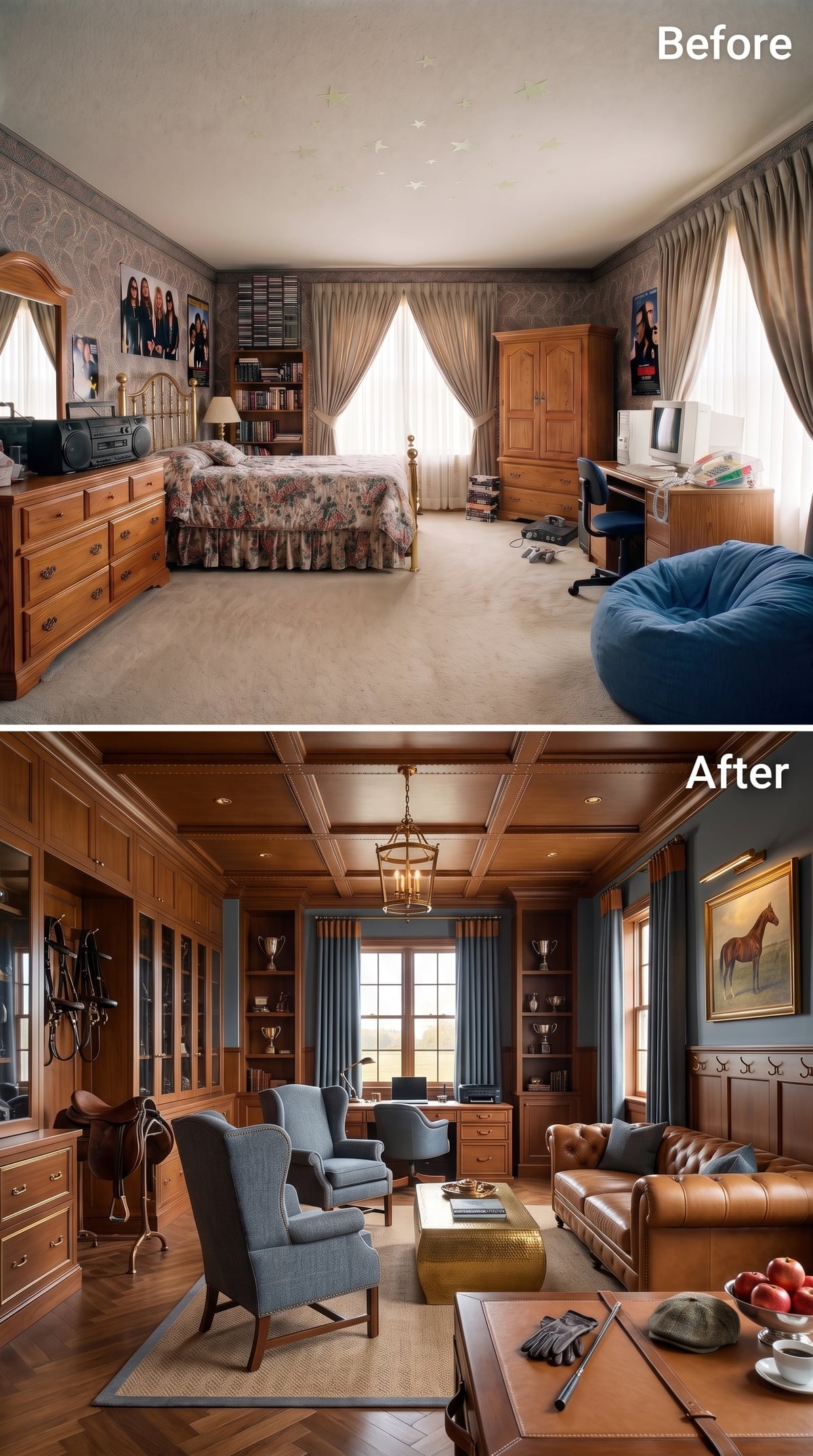
Honey-toned paneling covers the walls and continues into a coffered ceiling, giving this room an enveloping club-room quality. Slate-blue wingbacks provide the cool counterpoint, while a leather Chesterfield introduces a darker, glossier texture.
A brass lantern chandelier marks the center. Equestrian objects and a horse portrait give the shelving a strong identity beyond storage, while the desk shares the surrounding wood finish and settles naturally into the paneled architecture.
Why the Display Shelves Matter
Books, trophies and equestrian objects create a varied wall rather than a bank of uniform storage. Different heights, shapes and finishes break up the cabinetry and give the eye somewhere to wander. The desk becomes one element in that larger composition instead of the automatic destination.
4. Coffered Oak, Damask Walls, and a Leather Desk That Refuses to Look Corporate
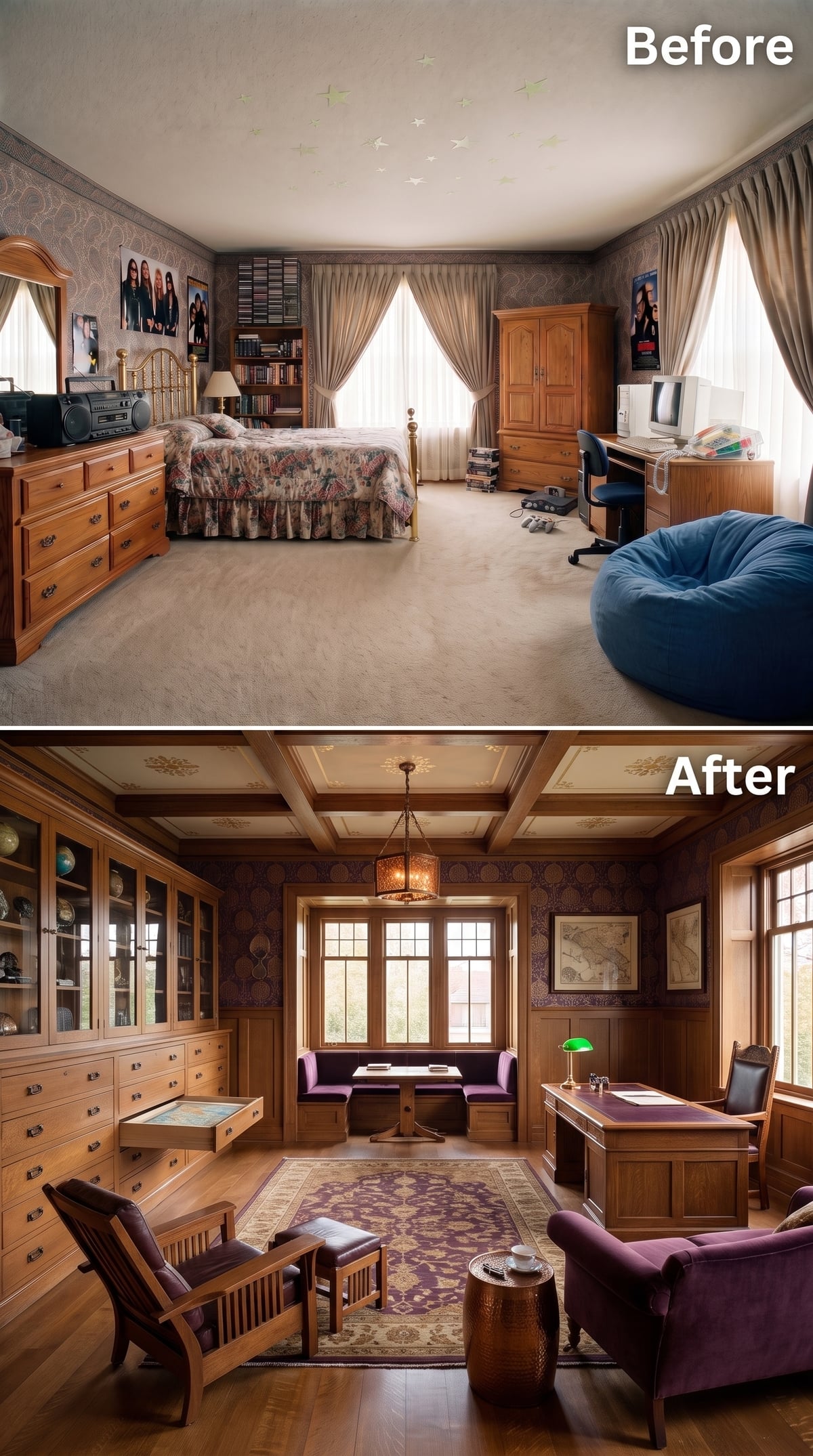
Quarter-sawn oak runs through the coffered ceiling and built-in cabinetry, establishing a continuous architectural framework around the room. Damask wallcovering brings pattern into the spaces between all that timber, preventing the composition from becoming one uninterrupted brown envelope.
The leather-topped desk belongs to the same material family but introduces a smoother, darker surface at working height. Upholstered seating softens the heavier woodwork, while the ceiling grid gives the room a formality that a freestanding desk alone could never supply. This is less about hiding work than giving it better surroundings.
3. Charcoal Walls, Crimson Leather, and a Roll-Top Desk With Better Manners Than Most Offices
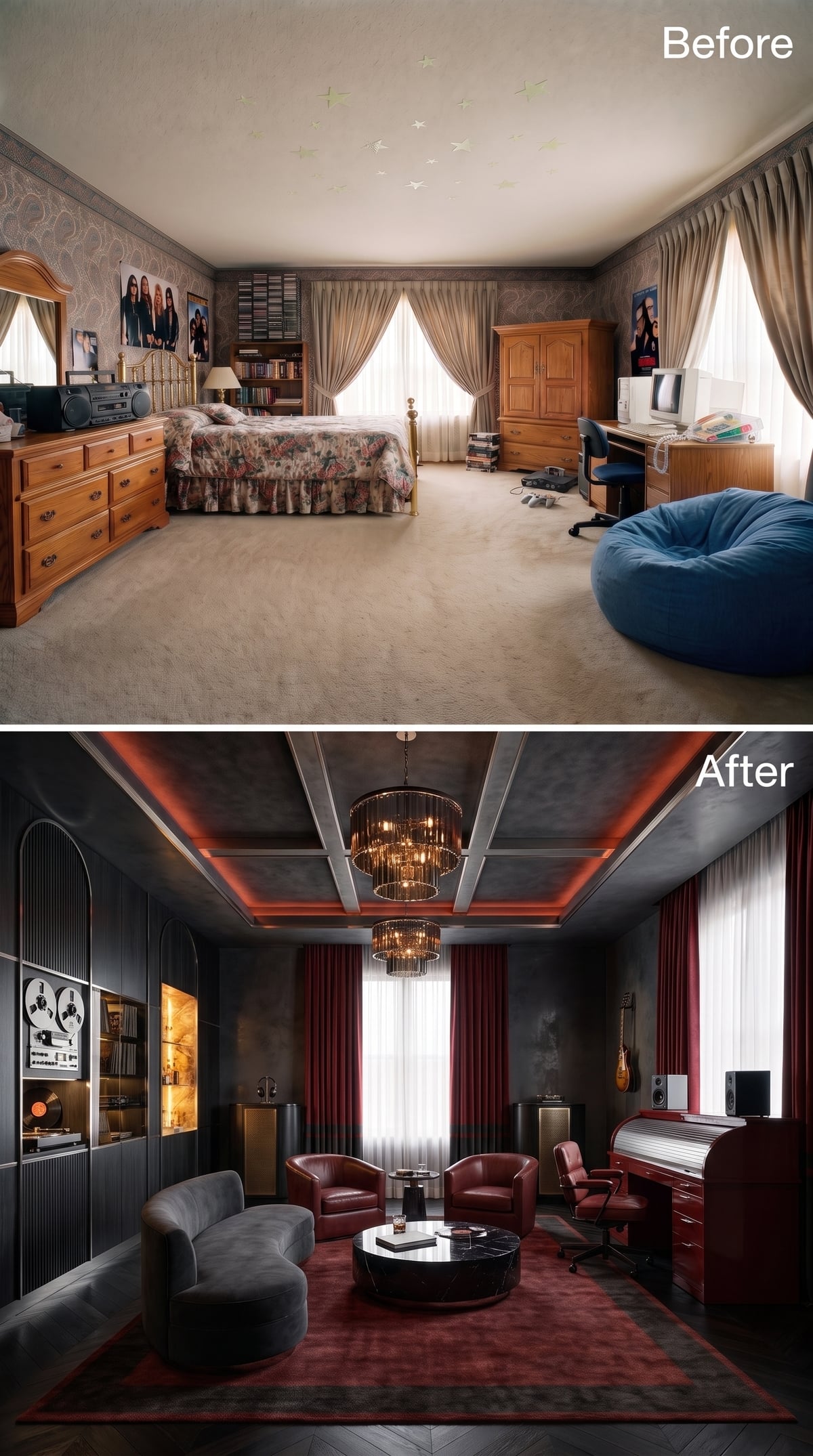
Graphite plaster walls create a dark envelope, then crimson leather chairs and matching curtains cut through it with concentrated color. Overhead, a recessed ceiling coffer glows amber around its edges while a tiered chandelier adds a looser cluster of exposed bulbs.
The roll-top desk is an unusually good fit because its curved wooden case looks substantial even without office paraphernalia surrounding it. Against charcoal walls and red leather, the piece reads as furniture with history rather than equipment waiting for Monday morning.
2. Slatted Walnut Runs Up the Walls and Takes the Ceiling With It
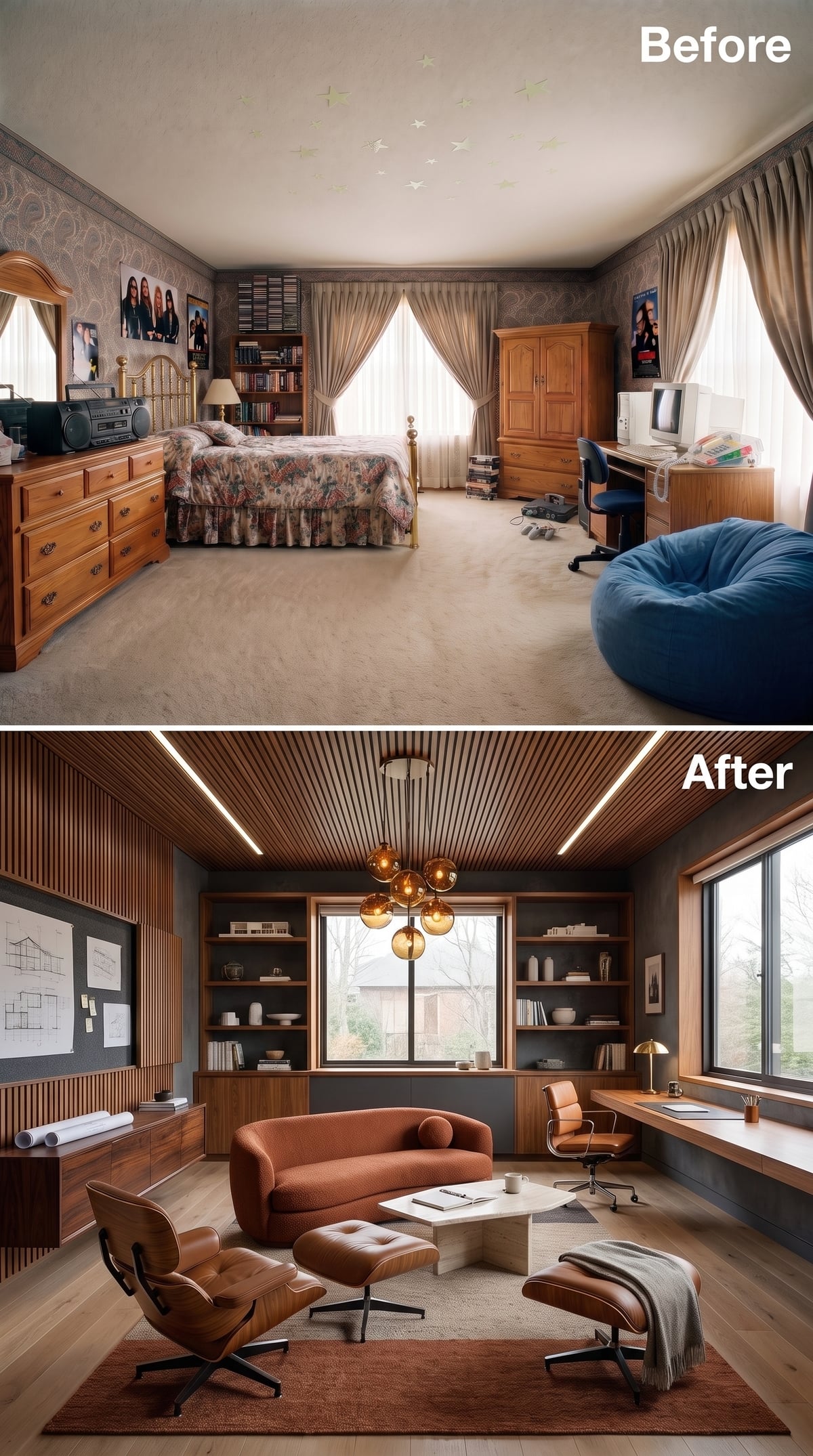
Vertical walnut slats climb the walls and continue across the ceiling, blurring the usual boundary between the two. The repeated lines give the room tremendous directional energy without requiring pattern or bright color.
A floating desk fits flush against the window ledge, keeping the center completely open. Amber globe pendants drop through the timber rhythm with warm pools of light, while charcoal panels provide a darker background for the built-ins. Then the terracotta sofa arrives and changes the temperature of the entire room.
The result is contemporary without becoming sterile and architectural without becoming austere. The work surface is fully present, but the room’s identity comes from the envelope around it.
1. Yellow Silk, Coffered Ceilings, and a Desk That Almost Gets Away With Being an Afterthought
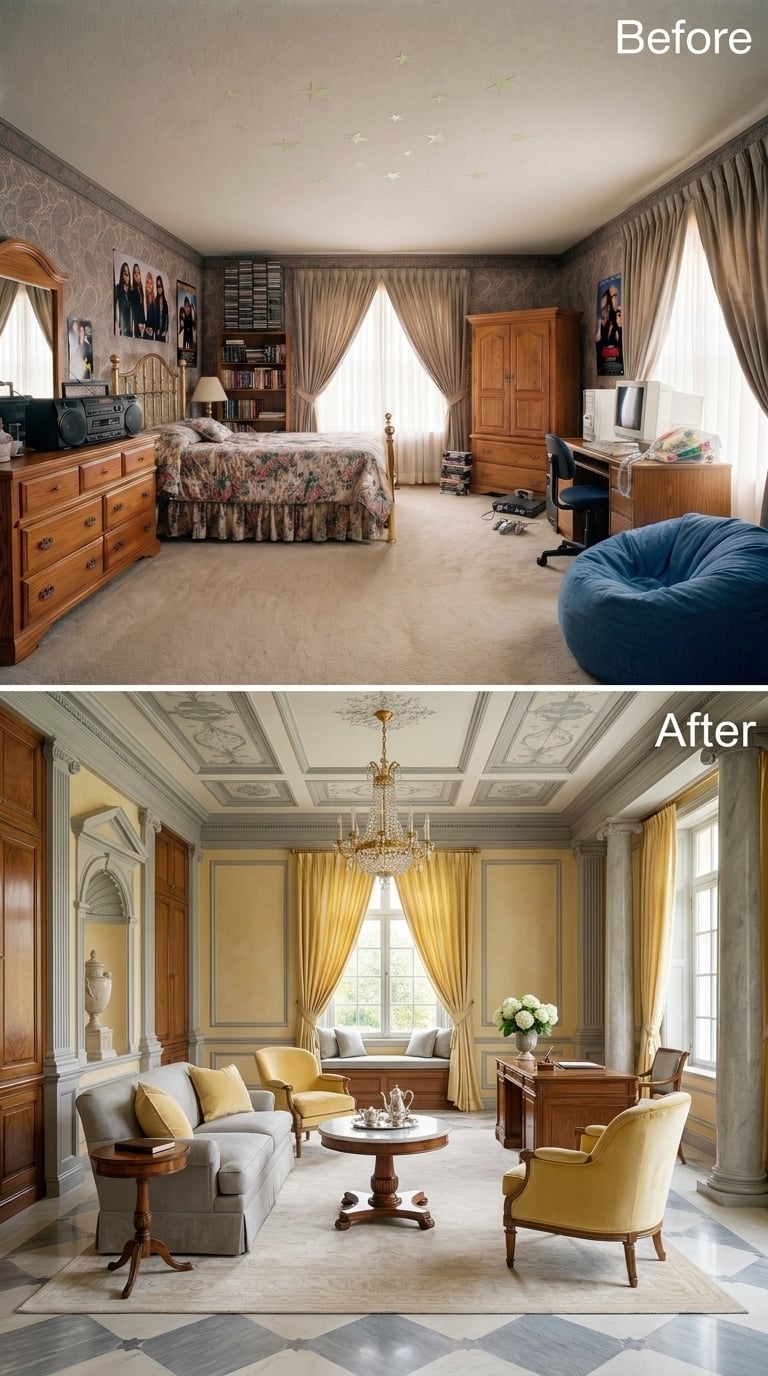
Coffered ceilings and painted plaster relief establish a formal register overhead, while soft yellow walls and curtains keep all that ornament from becoming too solemn.
A grey upholstered sofa, yellow armchairs and marble-top pedestal table organize the center as a sitting room. The writing desk stays near the window, useful but decidedly unwilling to run the meeting.
A spare room doesn’t become sophisticated because the desk disappears. It becomes sophisticated when the desk is no longer expected to supply the room’s entire reason for existing.