
At noon, a plaster wall looks like chalk. By five, it has turned the color of baked apricots. A green marble backsplash flashes mint where sunlight strikes it and sinks toward spruce a foot away. Glass can make a white staircase blush pink; lacquer can put the garden on the wall; a black pool can send moving light across concrete overhead. Same materials. Entirely different room.
In order to come up with the very specific design ideas, we create most designs with the assistance of state-of-the-art AI interior design software. Also, assume links that take you off the site are affiliate links such as links to Amazon. this means we may earn a commission if you buy something.
The trick lies in the collision between surface and light. Matte plaster scatters it. Polished stone sends it elsewhere. Ribbed glass breaks it apart, while colored panes filter it before it reaches the furniture. Even the direction matters: light grazing a wall from the floor exaggerates every ridge and trowel mark, while a broad wash from above can make the same finish look almost smooth.
Then the sun moves, the sky darkens, and the lamps take over. The walls haven’t changed, yet the room has acquired another palette. That’s the architectural opportunity: choose materials for what they do under changing light, and one interior can have several personalities without changing a thing.
32. Tinted Glass Throws Pink and Teal Across a White Staircase
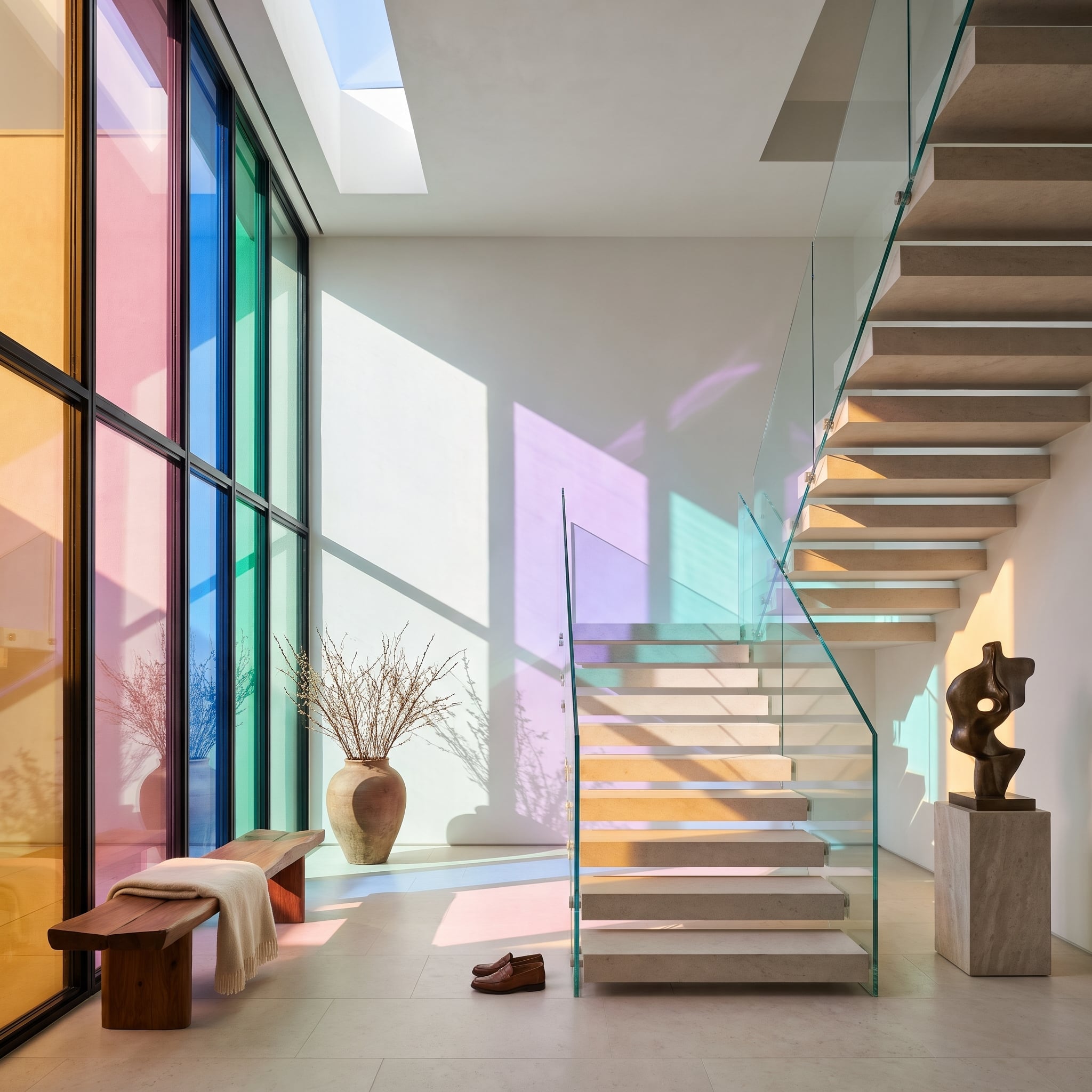
White plaster provides the canvas; amber, rose, blue and green glass do the painting. Sunlight passing through the tinted panes lays overlapping blocks of color across the walls and cantilevered stone treads. The glass balustrade leaves the composition largely uninterrupted. What would otherwise be a disciplined exercise in pale stone and sharp geometry becomes a shifting arrangement of pastel light.
The choice of receiving surface is crucial. Pale, matte plaster makes the projected colors easy to see, while darker materials absorb more light and generally show less of the effect. The staircase gets its color from the windows, not from a single painted wall.
31. Misty Forest Light Turns Slate Blue Almost Silver
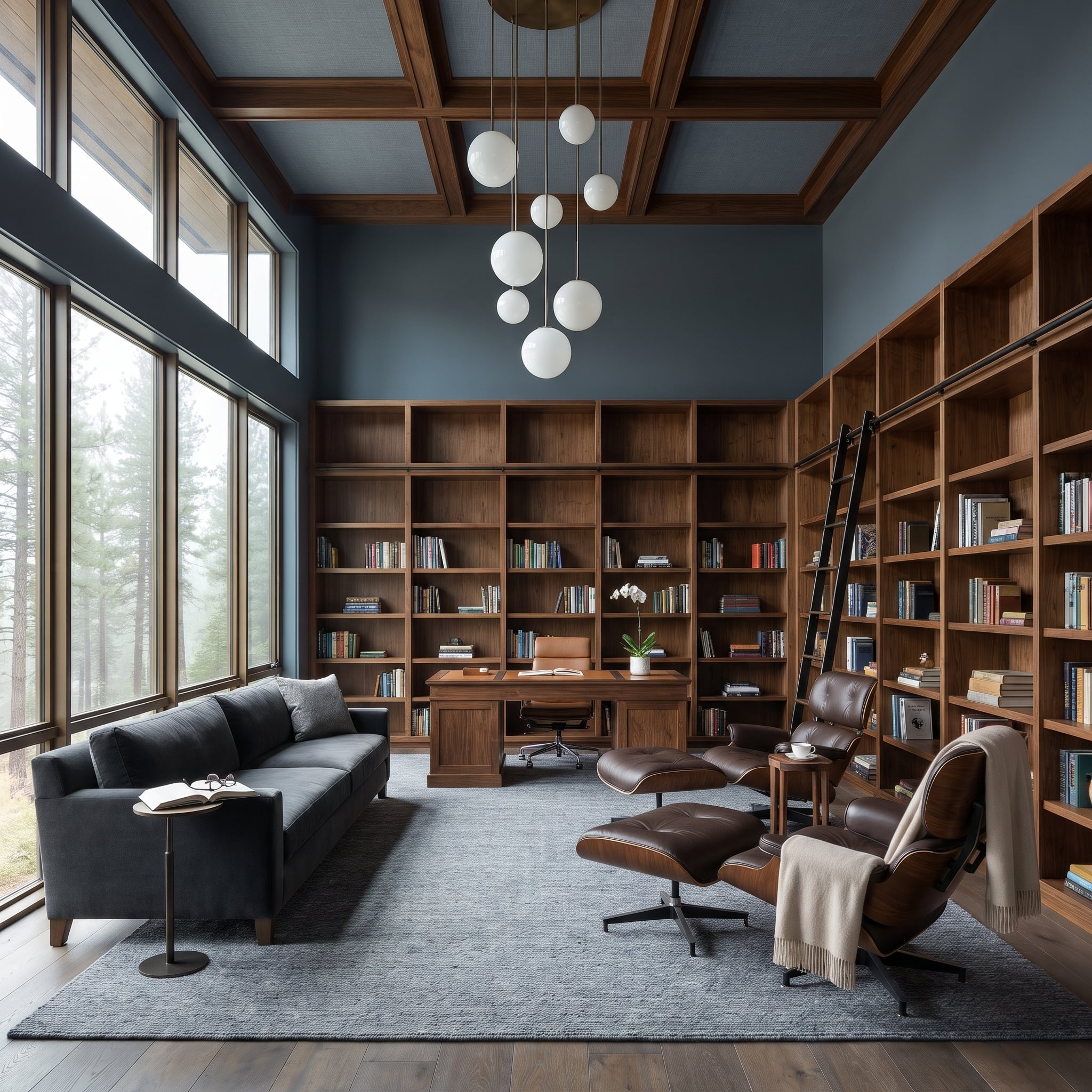
Floor-to-ceiling glazing admits the cool, diffuse light of a misty forest, pulling the slate-blue walls toward silver. Across the room, walnut shelving climbs to a coffered ceiling, its deep brown tones giving the pale daylight something substantial to play against.
When the exterior light fades, staggered globe pendants become the room’s principal illumination. Their warm pools of light pick out the shelving and soften the height of the space. The same blue walls that looked nearly metallic in daylight acquire a darker, more enveloping character after dusk.
What Our Readers Say
- In our reader polls, readers who would buy bright lighting were more likely to choose a white ceiling too: 75% did, compared with 44% of readers who went another way.
- Home Stratosphere readers who picked a cosy, moody feel for their home were more likely to choose wood window frames, 34% versus 10% of everyone else.
From Home Stratosphere reader polls and votes.
30. One Oxblood Lacquer Wall, Two Reds and a Garden in the Reflection
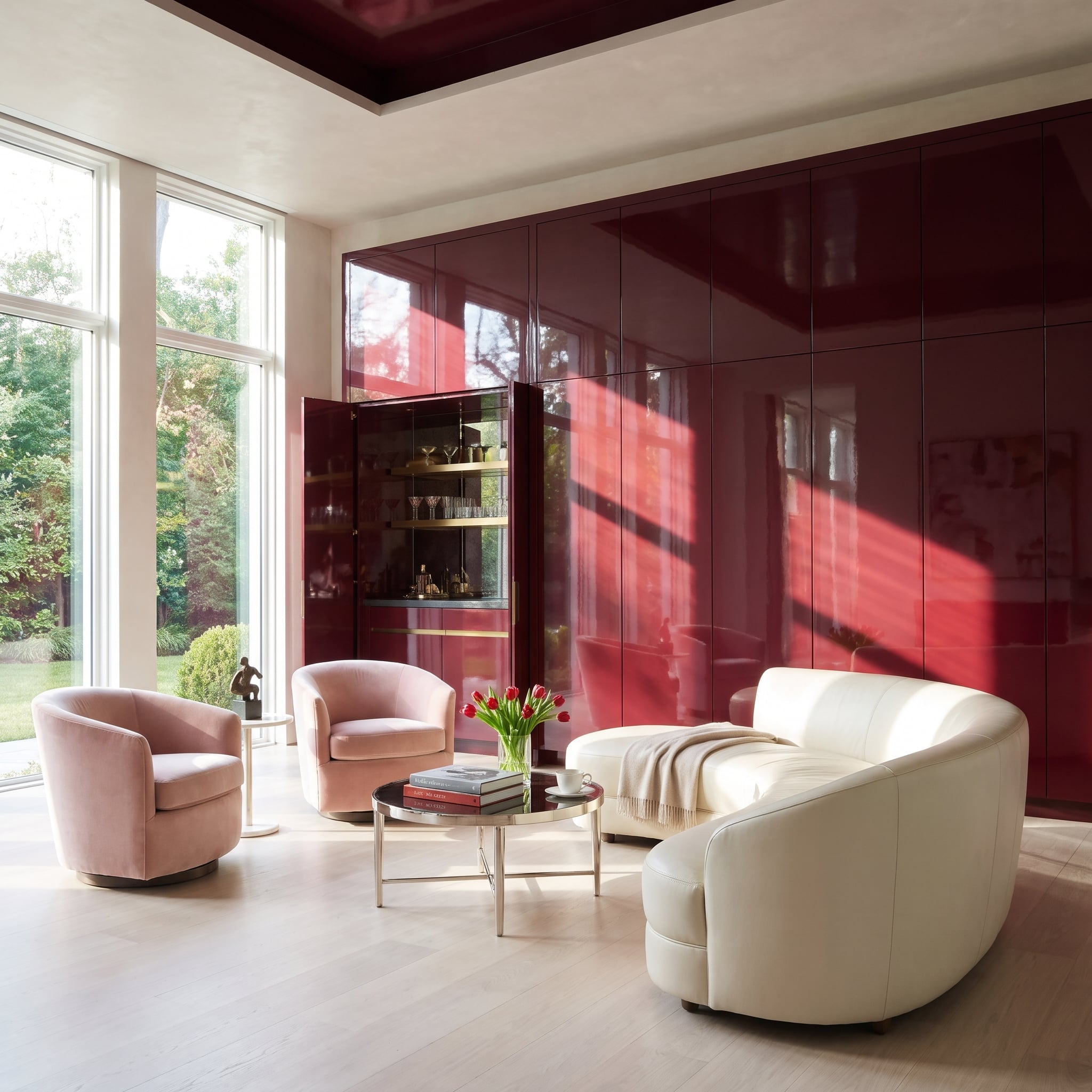
Sunlight strikes one band of the oxblood lacquer and pulls it toward cherry red. Beyond the brightest section, the panels deepen to wine. One painted finish delivers two emphatically different readings, and the high-gloss surface adds another complication: reflections of trees and window mullions appear across the doors.
Blush velvet swivel chairs sit nearest the glass, providing a softer version of the wall’s saturated color. Gloss is doing more than making the lacquer shiny. Its reflected highlights and surroundings alter the apparent depth of the red as the light and viewing angle change. A matte wall could never stage quite the same performance.
29. Late Sun Makes a Plaster Kitchen Hood Look Almost Gilded
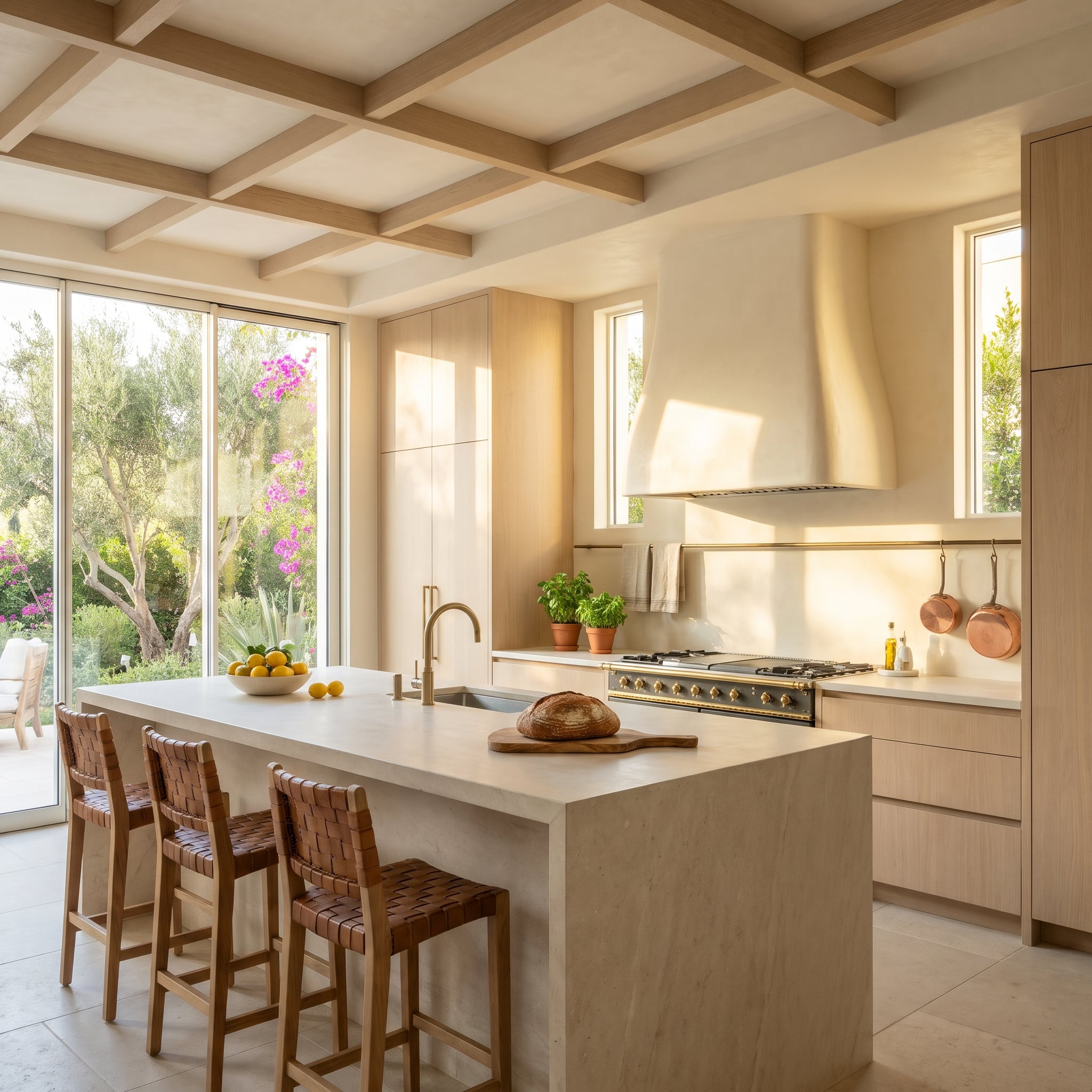
Two narrow windows admit low afternoon sunlight, sending a concentrated wash of gold across the plaster range hood. The limestone waterfall island catches a gentler version of the same warmth. Copper pans suspended from a brass rail contribute their own reddish reflections, giving the kitchen a palette that looks far richer than its neutral finishes might suggest.
The hood is the decisive surface. Its broad, uninterrupted plaster face lets the change in illumination register clearly, while the surrounding stone and metal provide different responses to the same sunlight. Three materials, one light source, three distinct effects.
28. A Bottle-Green Skylight Gives Travertine a Mint-Colored Afternoon
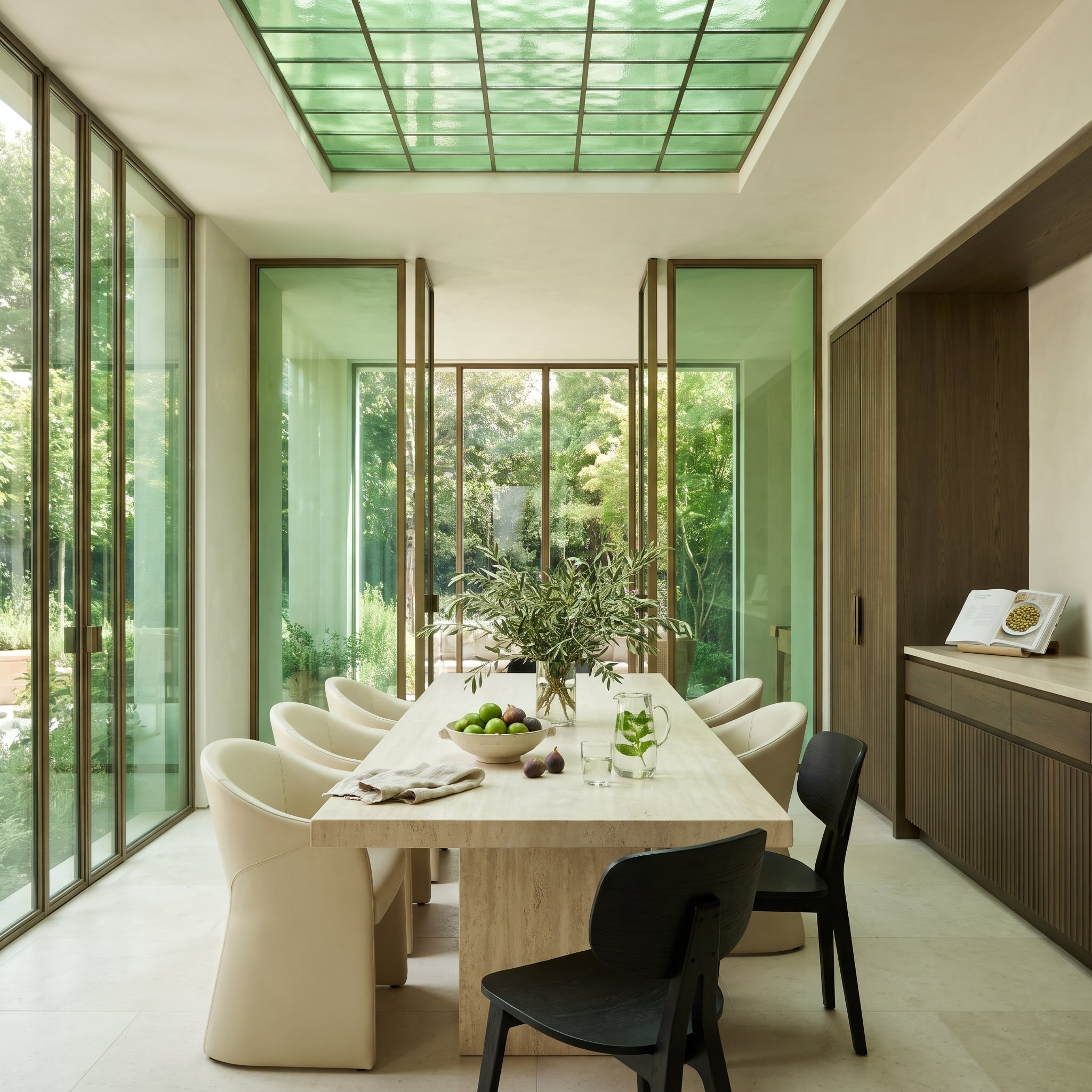
Overhead, a grid of rippled bottle-green glass filters daylight before it reaches the dining table. The honed travertine and cream leather chairs pick up a faint mint cast, while the fluted oak cabinetry retains enough of its natural brown to keep the room grounded. Two black chairs at the near end sharpen the contrast.
The rippled glazing softens and breaks up transmitted light, although the exact pattern depends on the glass texture, sun angle and distance to the surfaces below. Bronze muntins give the skylight a strong geometric framework, echoed by the glazed partitions. The color may be borrowed from the ceiling, but the architecture makes it feel integral to the room.
27. Mirror-Lined Soffits Borrow the Sky Twice
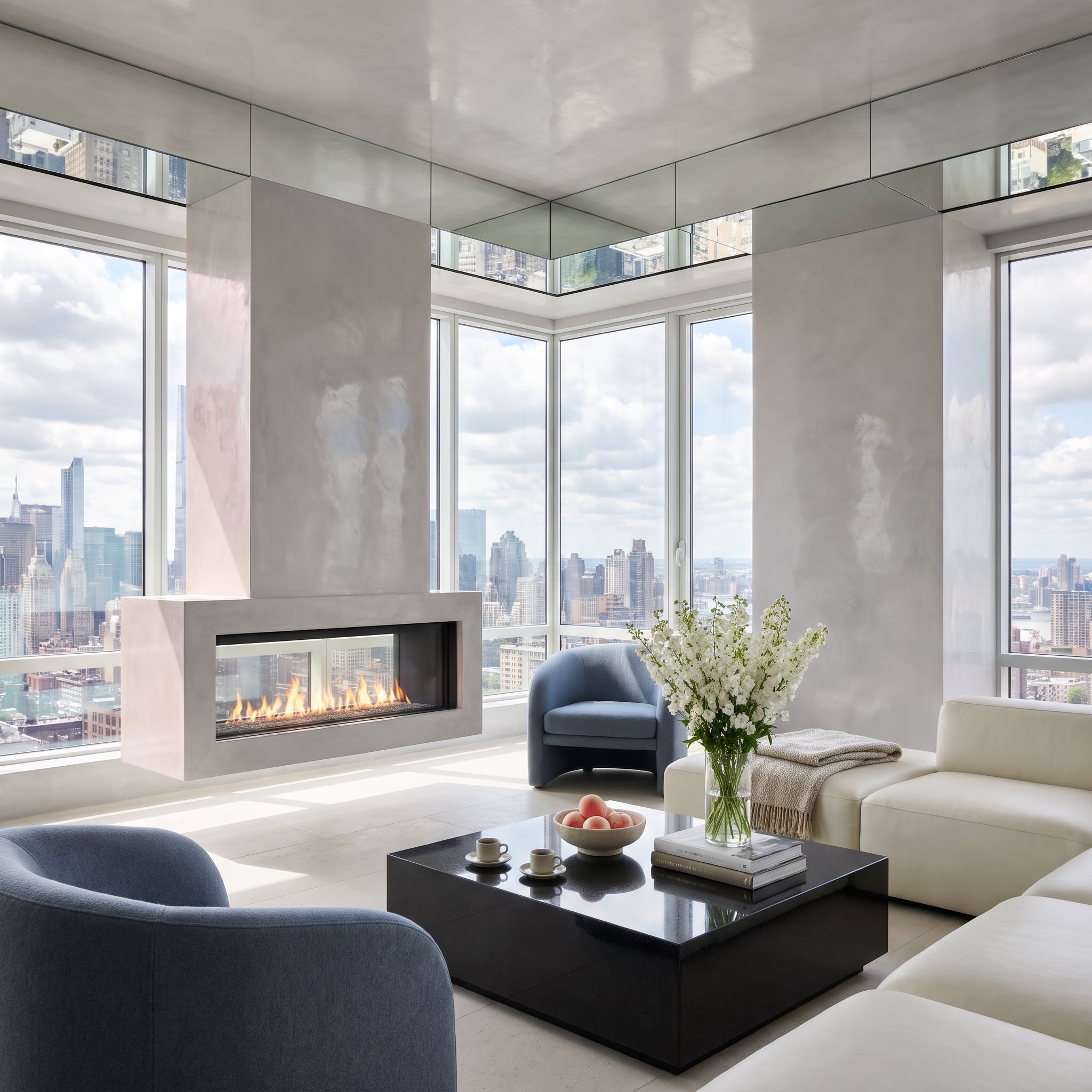
Mirrored soffits carry fragments of the outside world around the ceiling: pale cloud, gray sky, illuminated buildings at dusk. The reflection turns an architectural edge into a second window, one that changes its appearance whenever the view changes.
The polished plaster columns perform a quieter trick. Surfaces facing the warm fire and daylight acquire a pinkish cast; shaded faces read closer to dove gray. A black stone coffee table catches reflections from above, while the blue chairs provide a comparatively stable point of color. Between the mirrored ceiling, glossy stone and changing sky, the room has almost no interest in standing still.
26. Vineyard Sunset Turns a Dining Room Terracotta
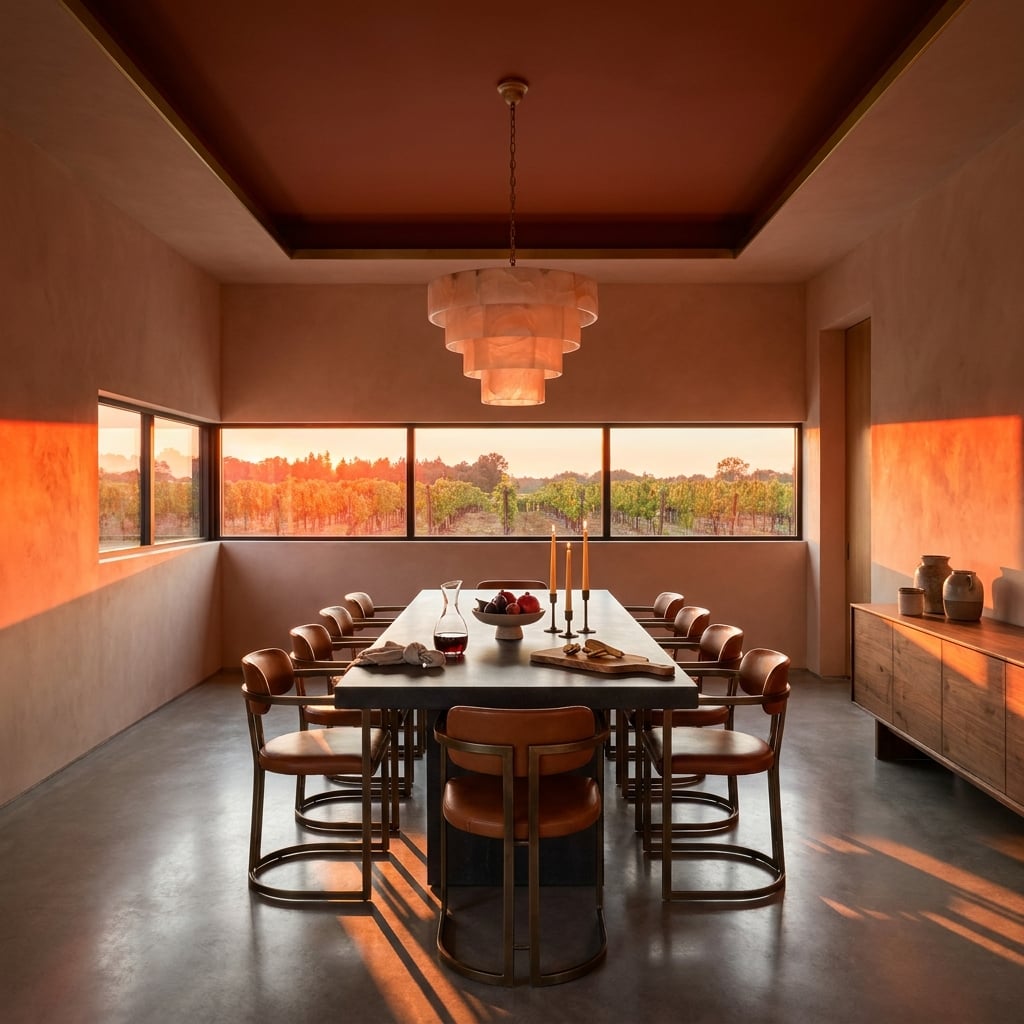
Ribbon windows run at seated eye level, framing the vineyard as a long horizontal landscape. At sunset, bands of warm light intensify the clay-colored plaster, while saddle-brown leather seating answers with a deeper, quieter tone.
Above the table, a recessed terracotta ceiling with brass trim reinforces the palette. The alabaster pendant adds a soft central glow, although the evening sun is already doing much of the visual work. The room’s warmth comes from several sources at once: its materials, the landscape beyond the glass and the angle of the setting sun.
25. Sunlight Turns Green Marble From Spruce to Mint
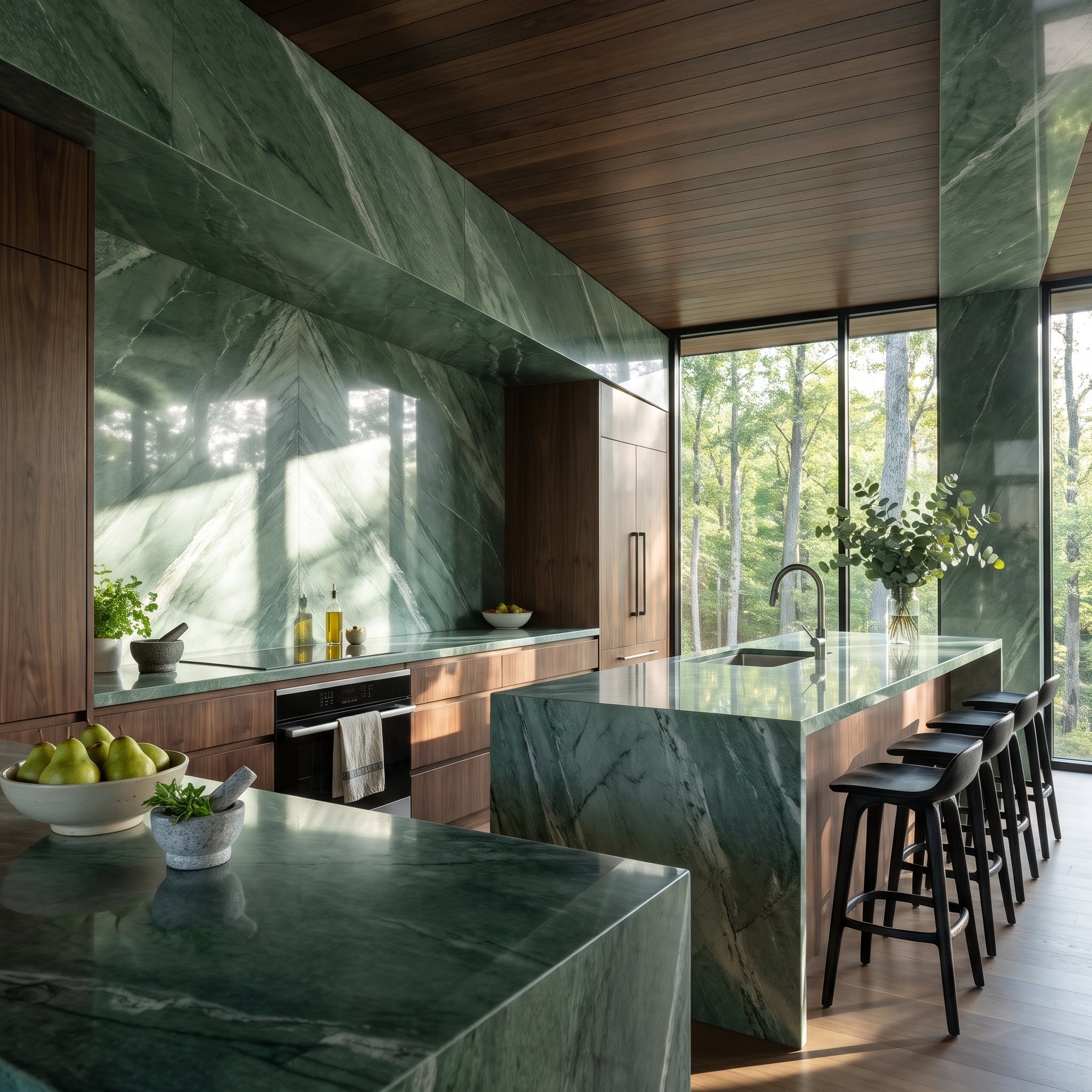
Green marble climbs from the countertop to the soffit, providing an uninterrupted field for the sunlight entering through the windows. Illuminated sections appear pale mint; neighboring areas in shadow retain a much deeper spruce tone. The window mullions draw a crisp grid across the stone, making the difference impossible to miss.
Walnut cabinetry and a slatted timber ceiling bring warmth to the composition, while the polished island reflects the trees outside. The marble hasn’t changed color in any permanent sense. Different illumination reveals different parts of its already complex green, and the window shadows supply the graphic pattern.
24. Cove Lighting Gives Bookmatched Marble a Split Personality
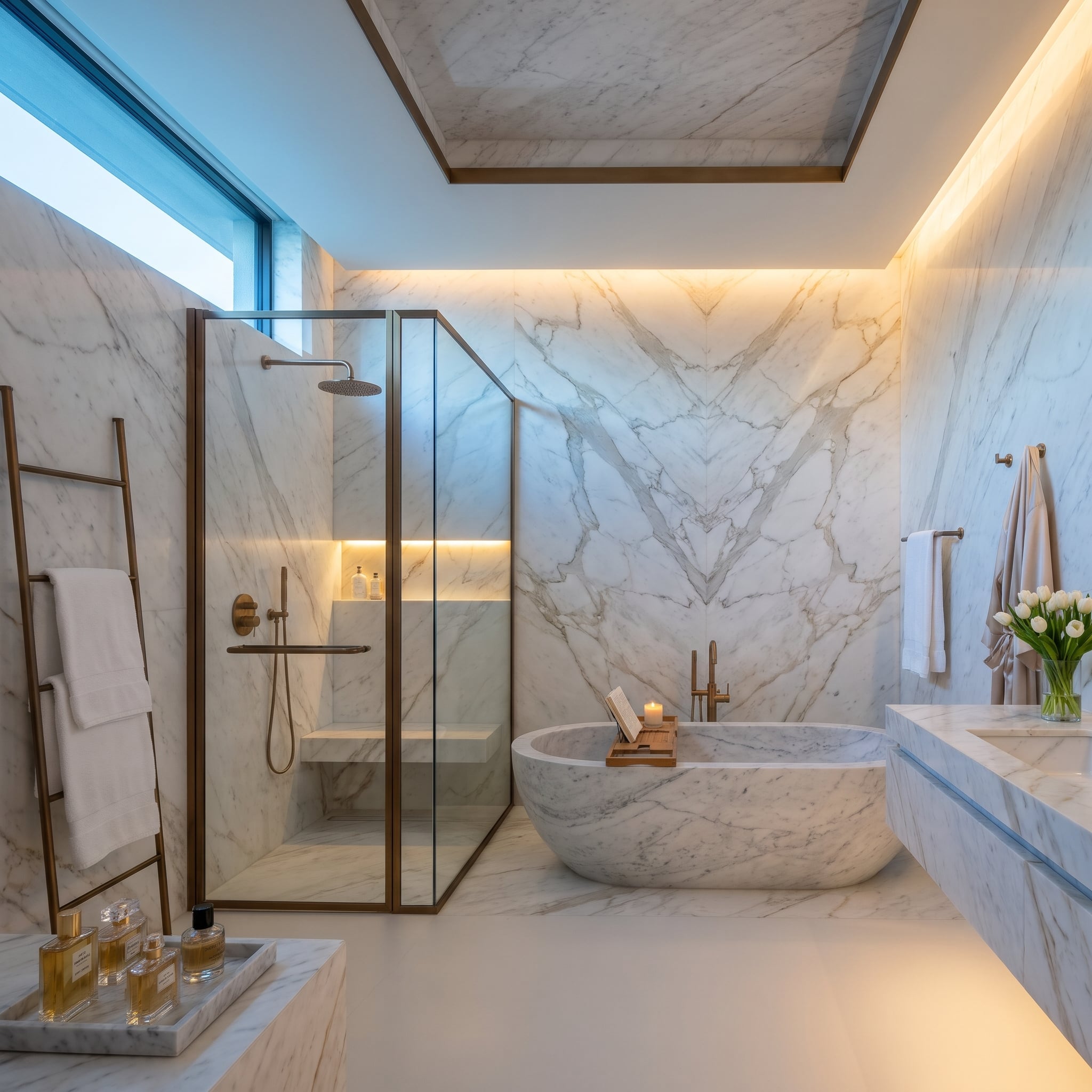
Warm concealed lighting illuminates the bookmatched marble behind the bathtub, bringing cream and honey tones forward in its veining. Near the window, cooler daylight gives the stone a distinctly blue-gray appearance. The contrast is especially striking because the material continues across both areas.
Bronze shower trim and fittings reinforce the warmer side of the composition. Concealed linear lighting can emphasize stone veining and surface relief, particularly when its placement produces light across the face of the slab. Here the two light sources offer different readings of the same marble, making the bathroom feel more layered than its restrained material palette suggests.
23. Amber Glass Changes the Courtyard Without Touching the Plants
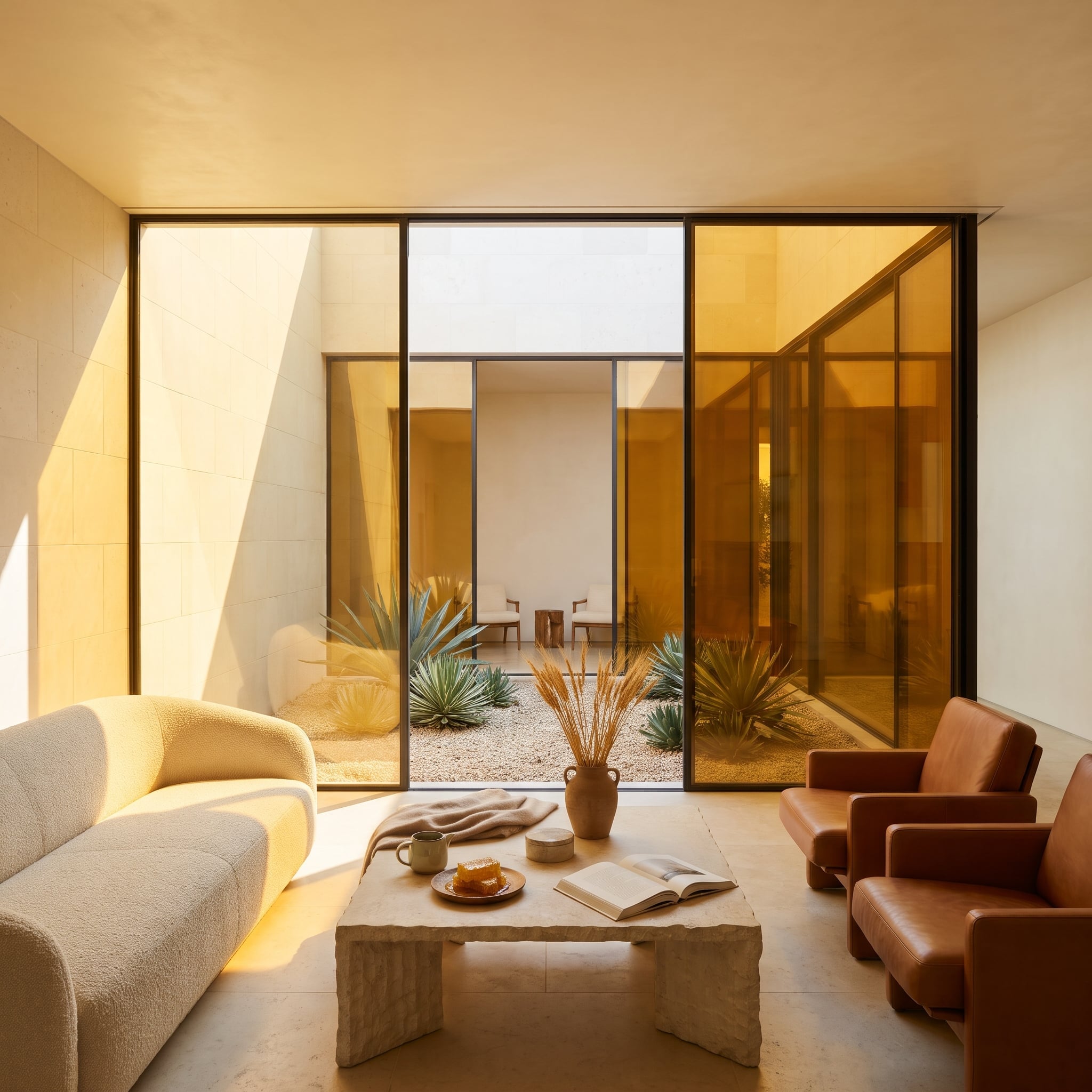
The clear central opening presents the courtyard in relatively neutral daylight: pale gravel, white plaster and blue-green agaves. On either side, amber glazing filters the view, pushing the plants toward olive and the far wall toward honey. The same courtyard appears to have acquired a different color scheme depending on which pane frames it.
Inside, bouclé upholstery catches some of the warm cast, while cognac leather chairs already occupy a similar part of the palette. A rough-edged limestone table anchors the arrangement. The most compelling detail remains the glazing: one transparent opening beside two tinted ones, demonstrating how strongly the window itself can influence what a room appears to contain.
22. Brass Coffers Keep the Dining Room Golden Against a Blue Skyline
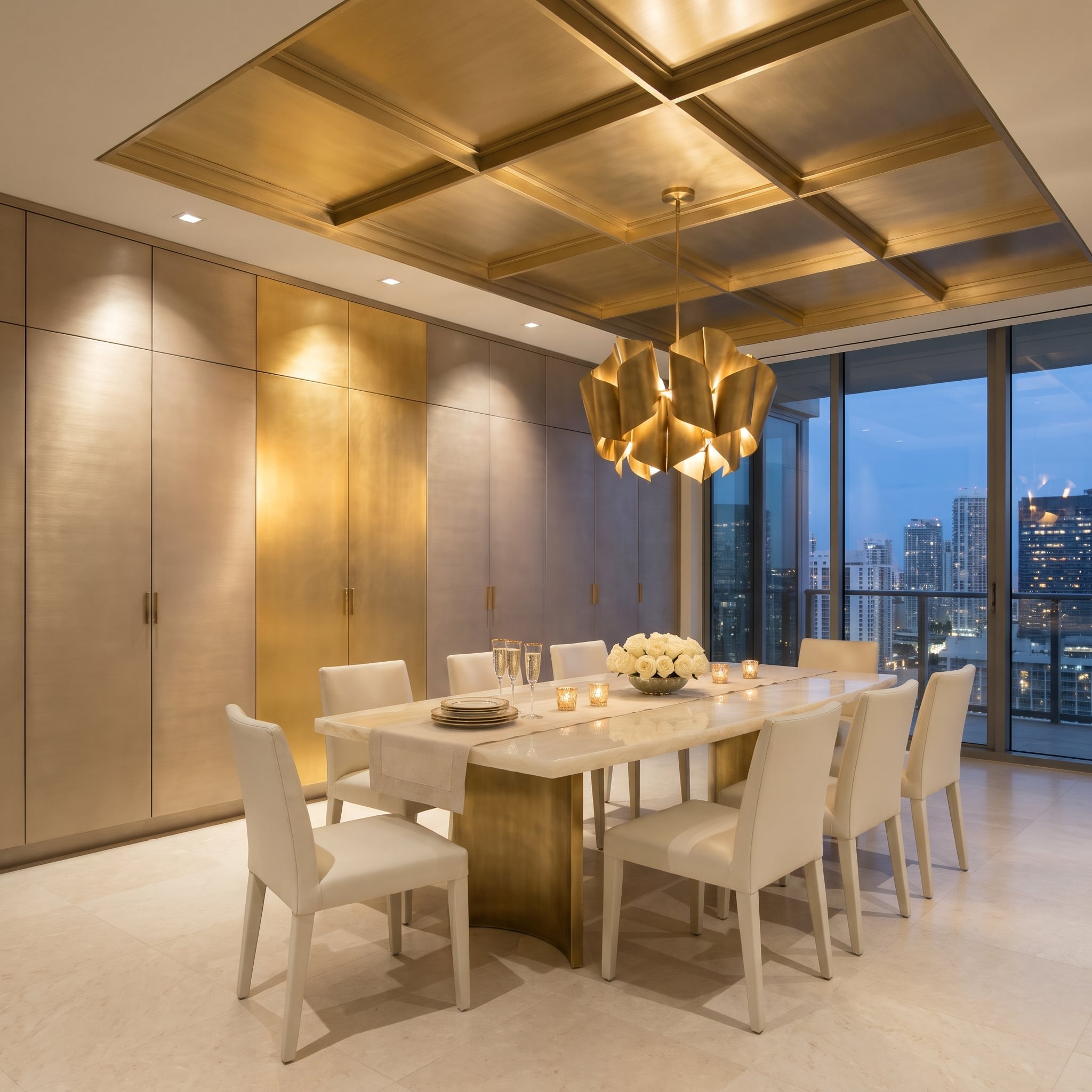
Brushed-metal cabinet doors run the length of the wall, catching arcs of warm light beneath the recessed downlights. Between those illuminated sections, the metal reads cooler and more subdued. The result is a sequence of gold and pewter-like tones across a single architectural elevation.
Above, brass coffers and a folded pendant reinforce the warmth, while the onyx tabletop takes on a honeyed glow. Cream leather chairs provide a quieter counterpoint. Beyond the windows, the skyline has turned deep blue. That cool exterior backdrop makes the metallic interior look more saturated, almost as though the city has supplied the room with its complementary color.
21. Sage Walls Turn Mint at the Windows and Olive Across the Bedroom
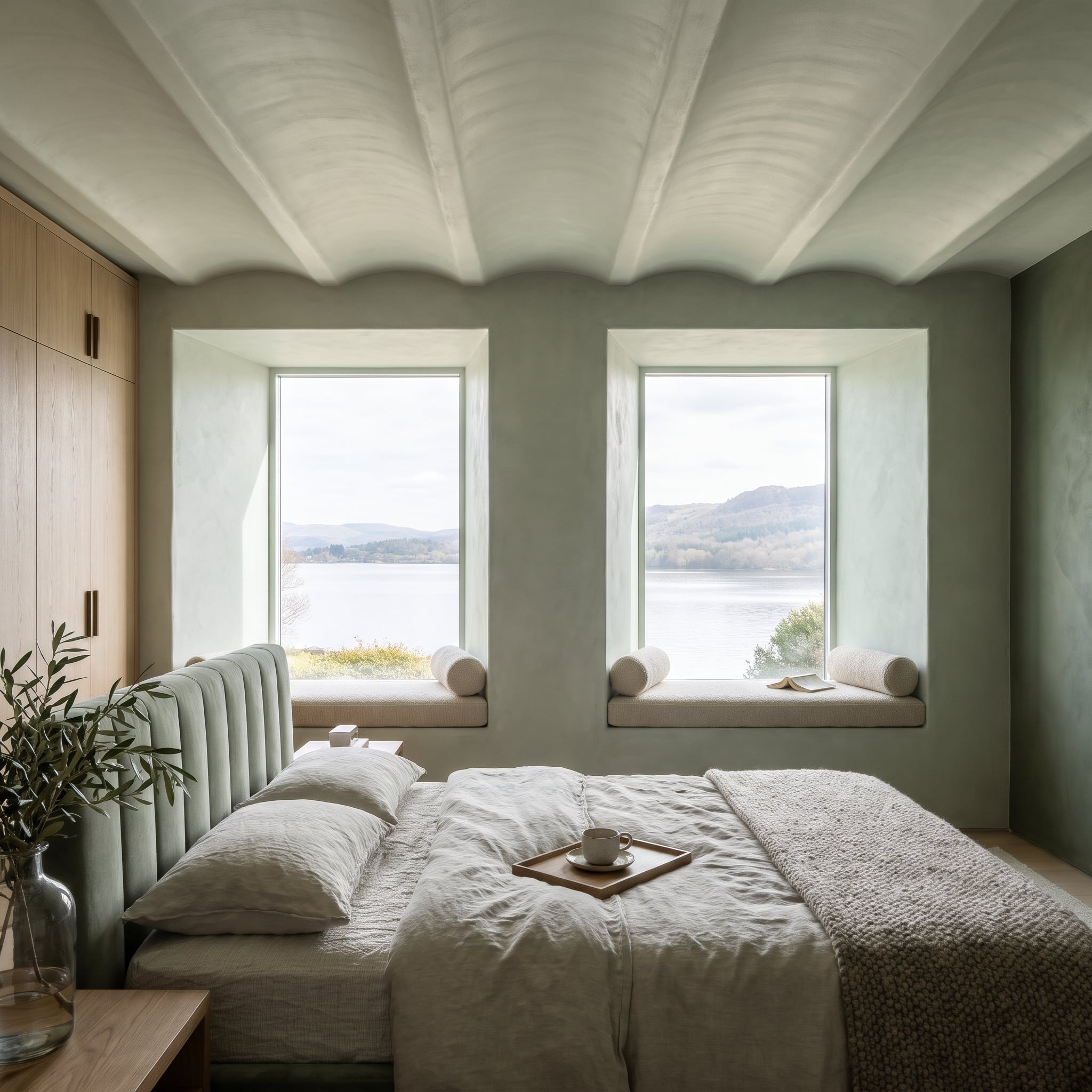
Overcast daylight reaches the sage plaster through two deep window openings. The reveals appear almost mint where they receive stronger sky illumination, while the wall farther into the bedroom settles toward olive. The thick openings also become usable alcoves, furnished with cushions and bouclé bolsters.
Above, scalloped vaults catch light across their curved profiles. Bright crowns alternate with shaded troughs, giving the white ceiling the softness of pleated fabric. The walls demonstrate why a paint sample viewed beside a window can tell a very different story from the same color on the opposite side of the room. Light distribution, not a collection of different green paints, creates the apparent variation.
20. Backlit Onyx Turns a Bar Into Its Own Light Source
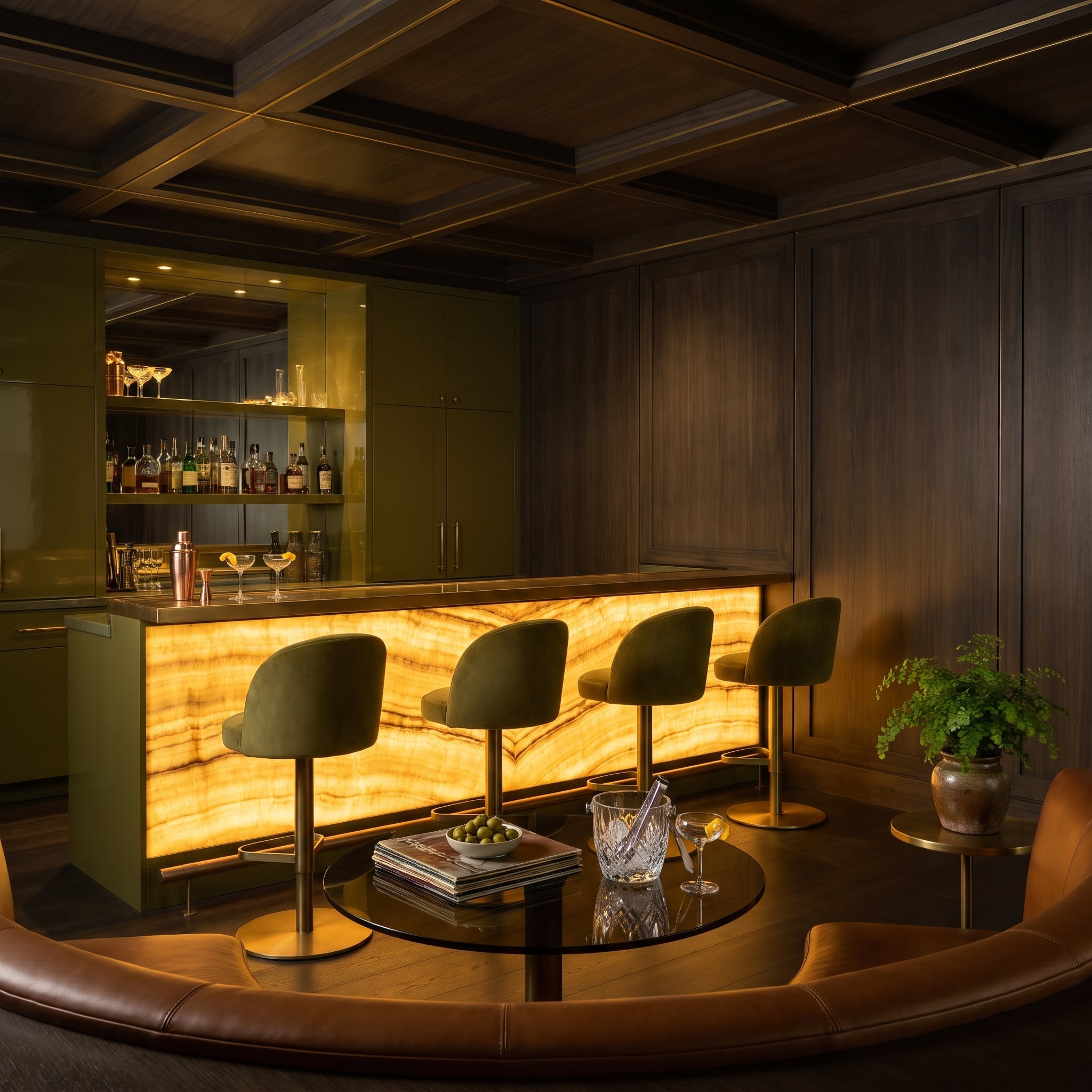
Light passes through the translucent onyx bar front, illuminating its banding like ribbons of poured honey. Nearby olive lacquer picks up the warm glow and appears brighter around the counter, while the upper cabinets retain a deeper mossy cast. Brass inlays catch smaller highlights across the dark wood coffers.
The bar front serves as an illuminated architectural surface rather than a conventional lamp. Its contribution is atmospheric: color, pattern and a pool of warm light concentrated at the room’s center. The effect demonstrates how a material can become part of the lighting scheme instead of remaining a passive finish.
19. A Skylight Slot Sends Cool Daylight Across a Warm Wood Bedroom
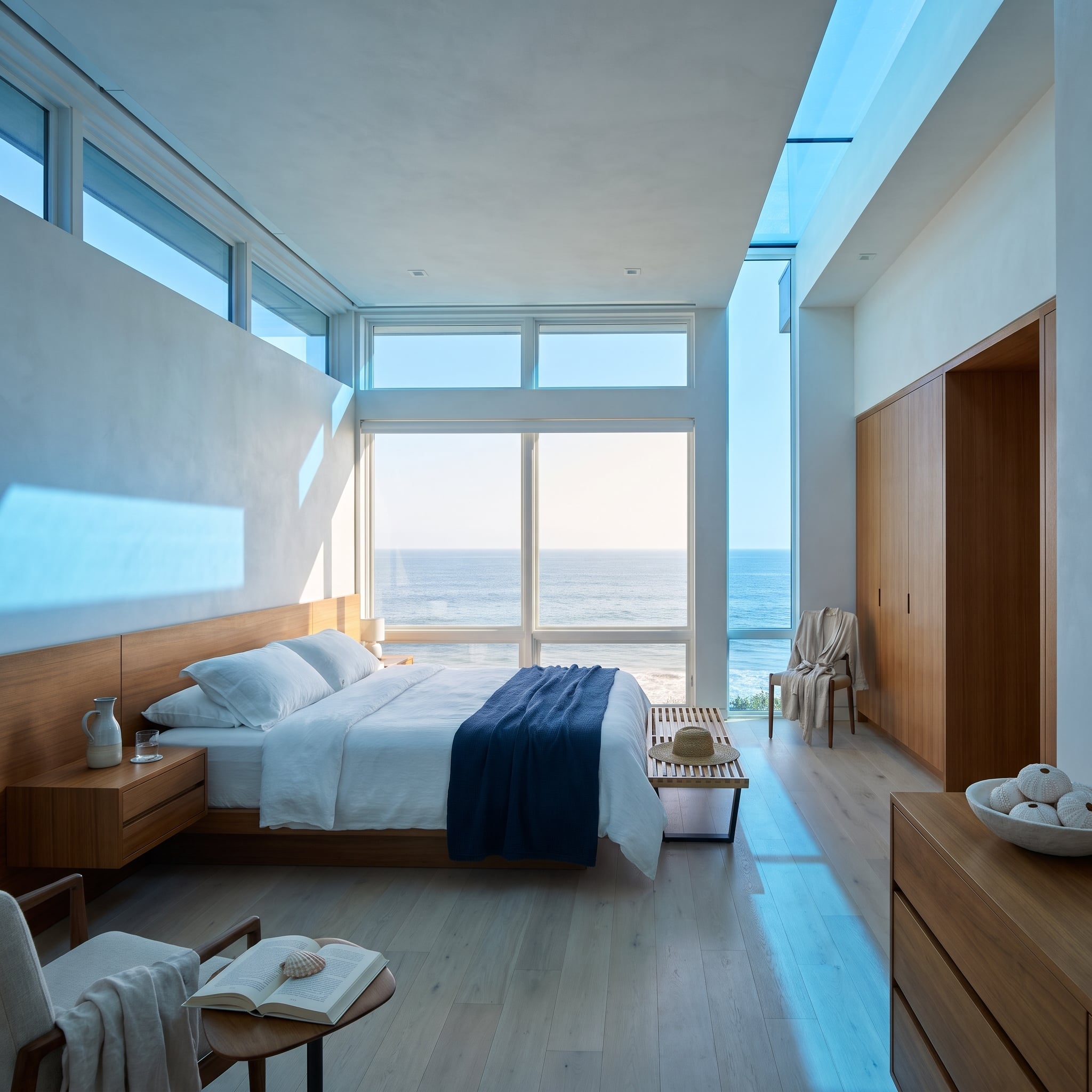
A narrow skylight delivers a pale, cool-toned patch of daylight onto the timber floor. The surrounding wood retains its honey-colored appearance, creating a contrast between the illuminated area and the warmer surfaces beyond it.
The headboard wall and wardrobe carry similar golden-brown tones, keeping the bedroom from feeling cold. A single overhead opening is enough to establish two distinct readings of the interior: blue-leaning daylight across the floor and warm timber around the bed. The room’s character depends less on the number of materials than on where the light is allowed to land.
18. Reeded Glass Deepens From Milky Green to Jade
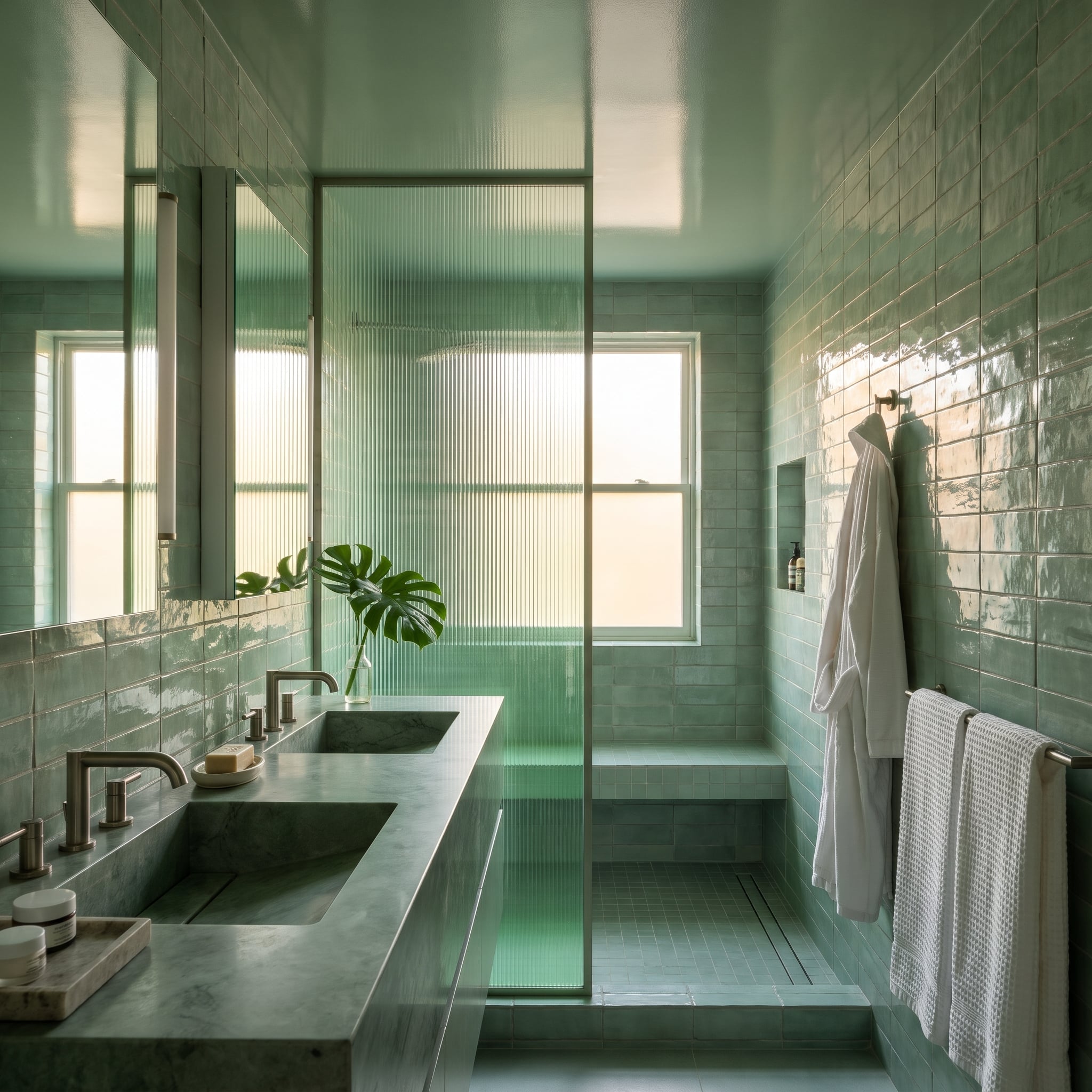
Handmade glazed tile covers the wall in subtly uneven faces, catching window light as a scatter of small reflections. The pale green lacquered ceiling adds a broad sheen overhead, while the green marble vanity introduces a more substantial, patterned surface.
The reeded glass partition provides the sharpest optical surprise. Against the bright window, it appears milky and relatively pale. Where it overlaps the green tiled bench, the same fluting takes on a much stronger jade appearance. The glass distorts and transmits what lies behind it, so its apparent color changes with the background. A white robe and waffle towels supply the neutral reference points that make the difference so obvious.
17. A Clerestory Window Paints Orange Bars Across a Dining Room
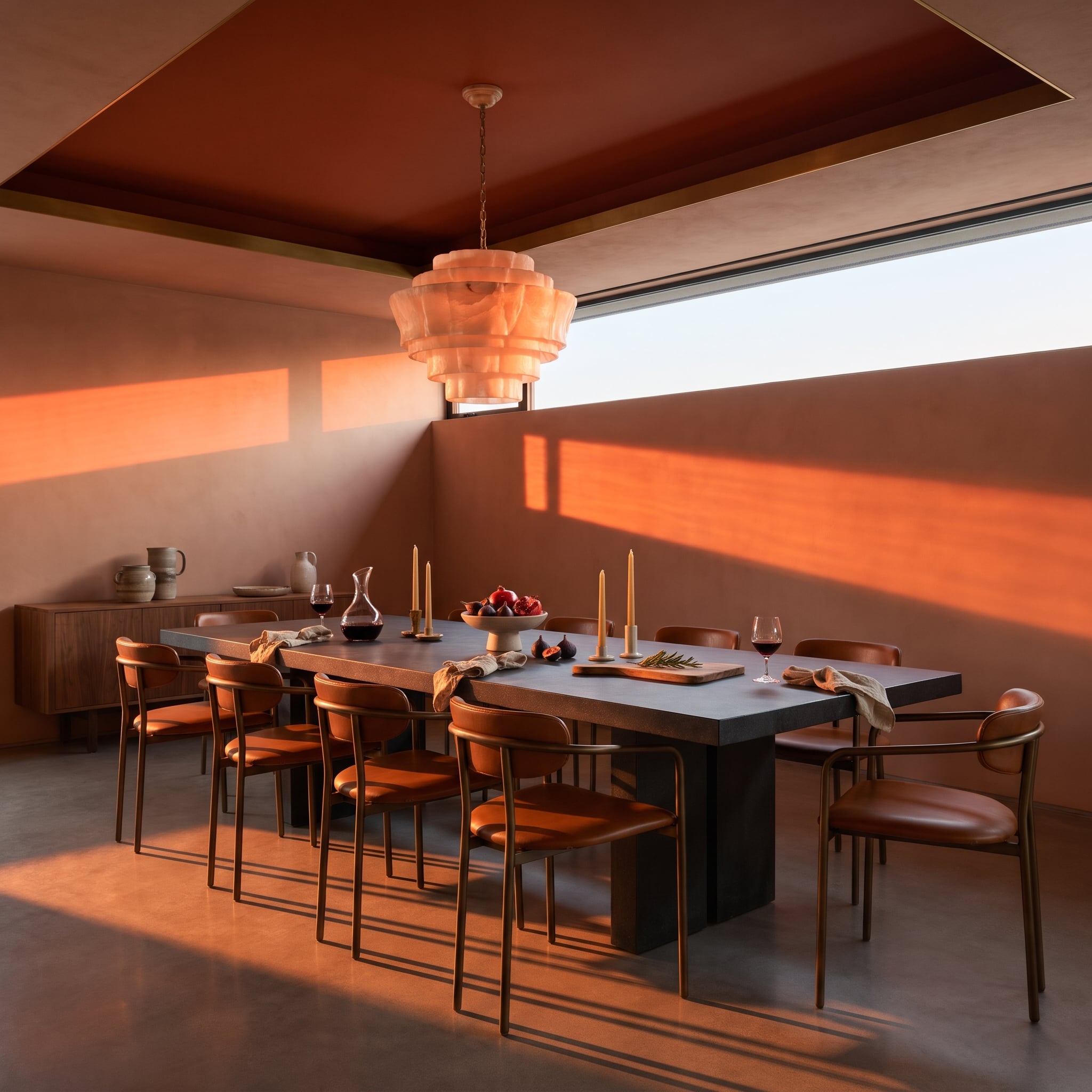
A long clerestory window admits sunlight above the solid wall, projecting orange bands across the plaster and concrete floor. The opening preserves the room’s sense of enclosure while allowing the sun to create a dramatic composition of light and shadow.
An alabaster pendant introduces a second, softer source of illumination. Its stacked tiers echo the peach tones on the walls, while the rust-colored coffered ceiling and brass edging deepen the palette overhead. A dark stone dining table interrupts the warmth, giving the eye a necessary patch of visual weight. The architecture controls the daylight; the pendant gives the room a different character when the sun disappears.
16. One Stairwell, Two Temperatures of Plaster
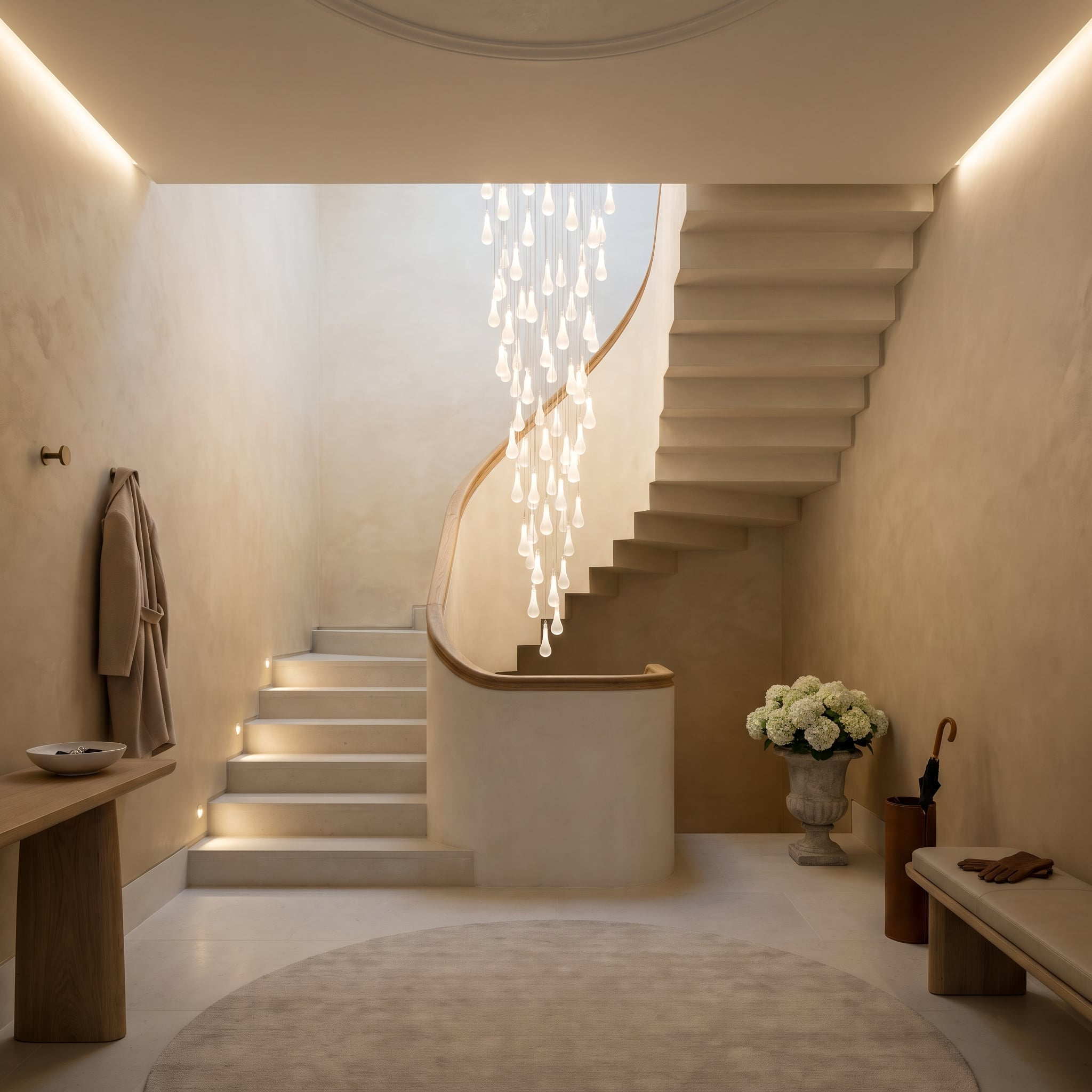
At the bottom of the staircase, concealed ceiling lighting washes the plaster a warm biscuit color. Higher up, cooler illumination from the overhead opening pushes the same finish toward near-white. The transition happens along the route of the stair, making the change in apparent color part of the architecture.
An oak handrail curls around the half-wall and rises through both lighting zones, providing a continuous warm line. Frosted glass pendants occupy the meeting point, while recessed step lights offer a lower-level source after dark. The stairwell uses light to distinguish its levels without requiring a different wall finish at each landing.
15. Navy Lacquer Puts the Library on the Ceiling
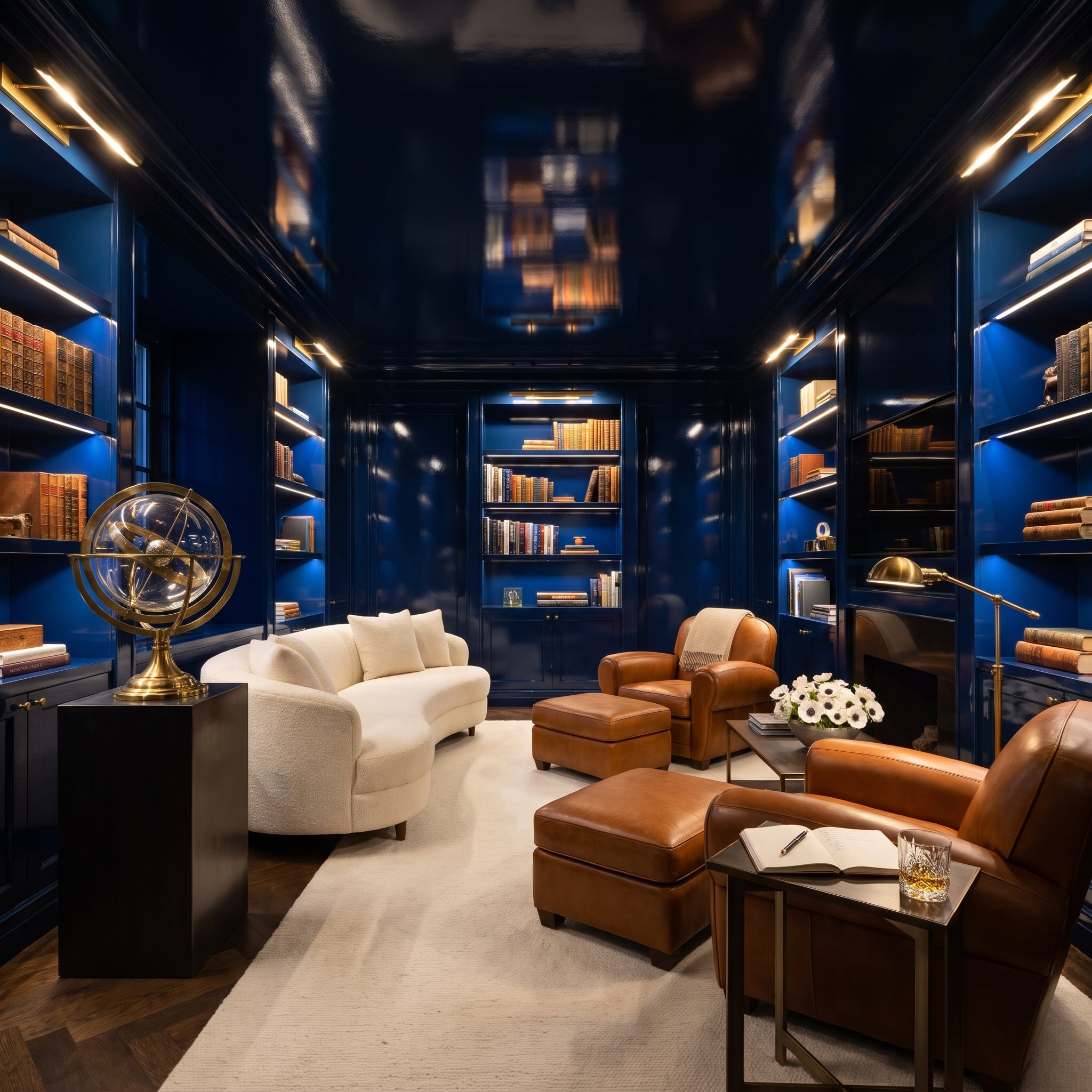
Two glossy finishes perform different tricks. Integrated shelf lighting brightens the lacquered bookcase backs toward cobalt, making the books stand out against a luminous blue field. Above, the highly reflective navy ceiling catches images of the shelving and repeats portions of the library overhead.
The effect depends on both illumination and finish. A matte ceiling would absorb and scatter the light instead of producing recognizable reflections. The lacquer turns a relatively dark room into something far more theatrical, with blue appearing as pigment, reflected light and mirrored image at once.
14. Desert Dusk Appears Twice in a Travertine Bathroom
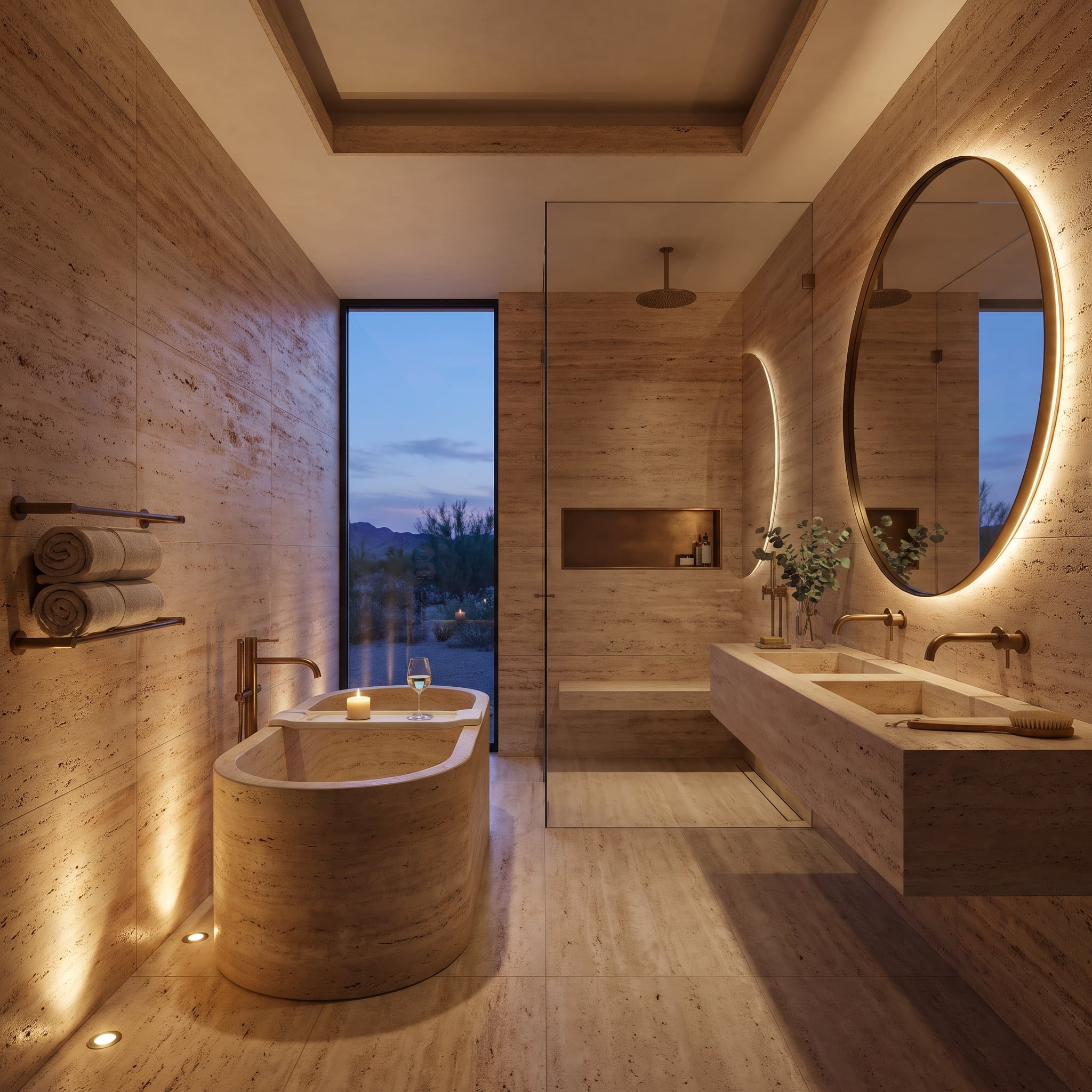
Travertine covers nearly every surface, leaving the lighting to provide much of the variation. Uplights beside the bathtub graze the stone from below, exaggerating its pitted texture with apricot highlights and deeper shadows. A recessed shower niche adds a concentrated bronze-colored glow.
Against that warmth, the tall window frames the desert in violet-blue dusk. An oval mirror catches a second view of the cool exterior, while its backlit halo adds a warm outline. The reflection creates another apparent opening in the room, making the evening sky part of the bathroom’s composition twice over.
13. Vertical LEDs Make Glass Decanters Glow Against Blackened Oak
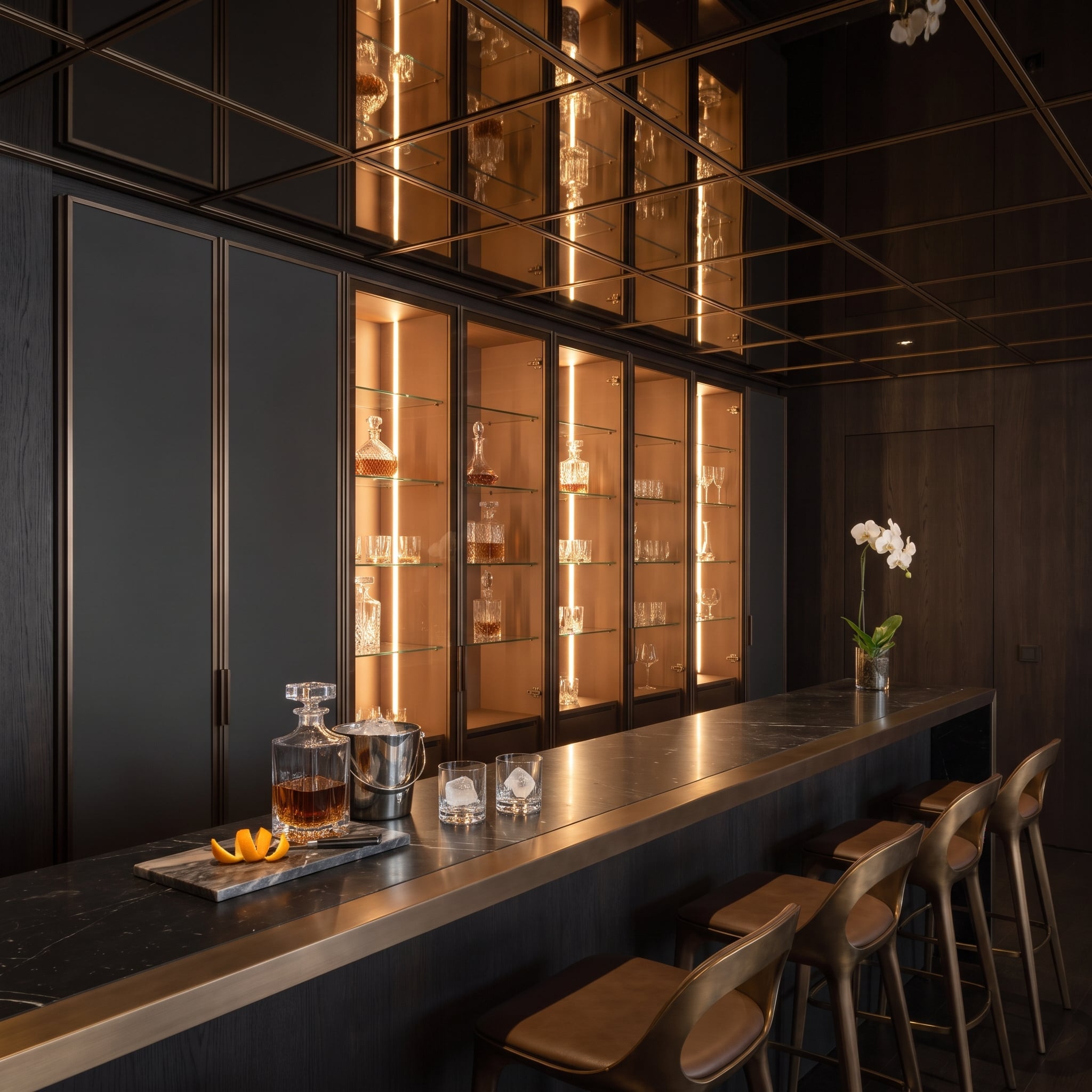
Almost all the light is concentrated inside the display cabinets. Vertical LED strips illuminate the glassware and warm-toned back panels, turning the compartments amber while the surrounding oak remains close to black. A bronze counter edge catches enough spill to connect the bright display with the darker cabinetry.
Side lighting can reveal the edges and facets of cut glass, producing highlights that frontal illumination might flatten. Against a pale, warmly lit backing, the decanters become the room’s brightest objects. The surrounding darkness isn’t an omission. It’s what gives the glass its presence.
12. Cool Cove, Warm Cove, One Gray Wall Caught Between
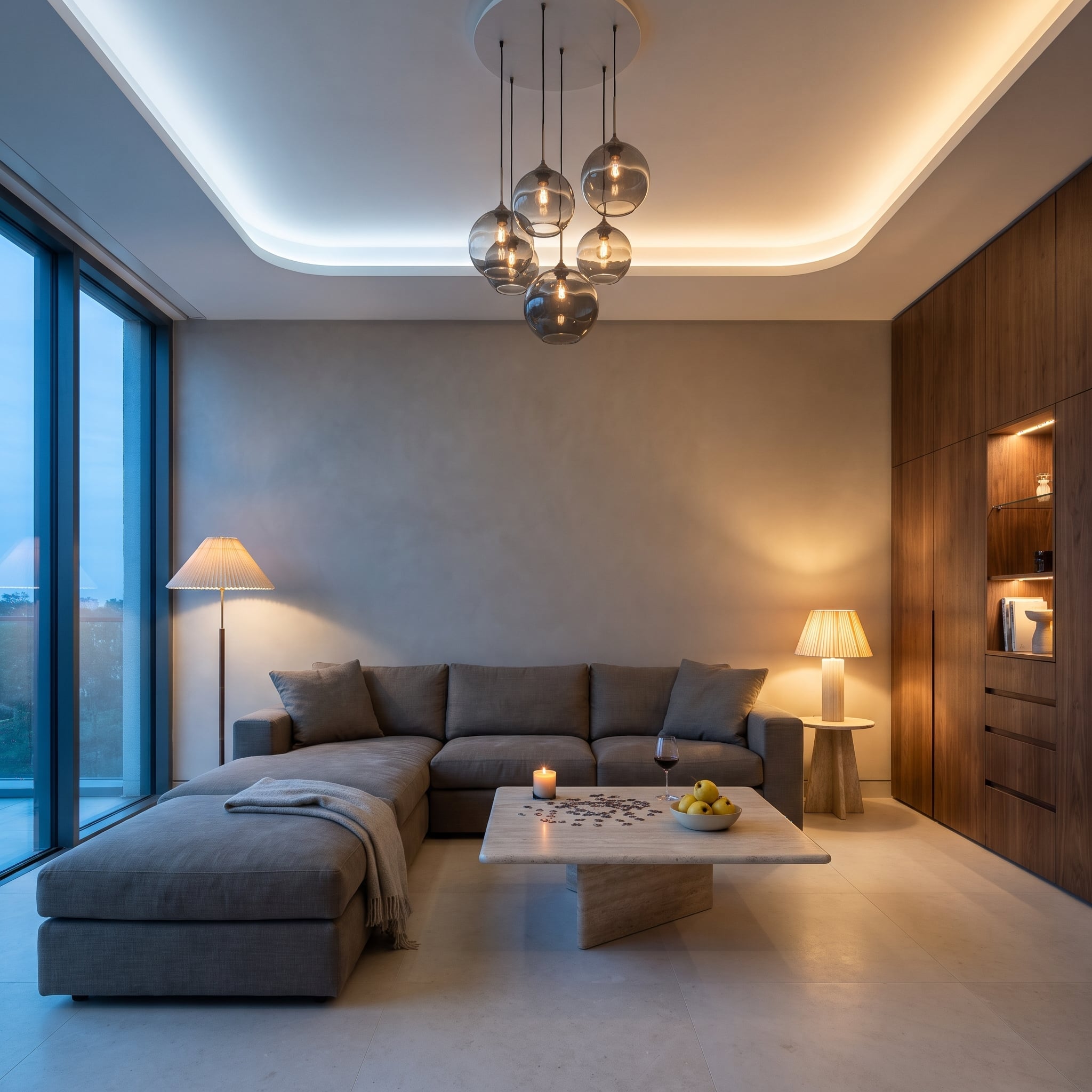
Along the window edge, the recessed ceiling light reads cool white. Toward the walnut wall, the cove shifts to amber. Below, gray plaster takes on a blue cast near the glazing and a honeyed one beside the pleated table lamp. A neutral wall becomes a meeting place for several different light sources.
Smoked glass globes soften the brightness of exposed bulbs, and the illuminated walnut niche gives the warmer side a strong visual anchor. The two lighting temperatures divide the room without a partition, with gray plaster registering every shift. The split becomes part of the composition, giving each side its own atmosphere while the finishes remain continuous.
11. A Black Pool Sends Moving Light Across a Concrete Ceiling
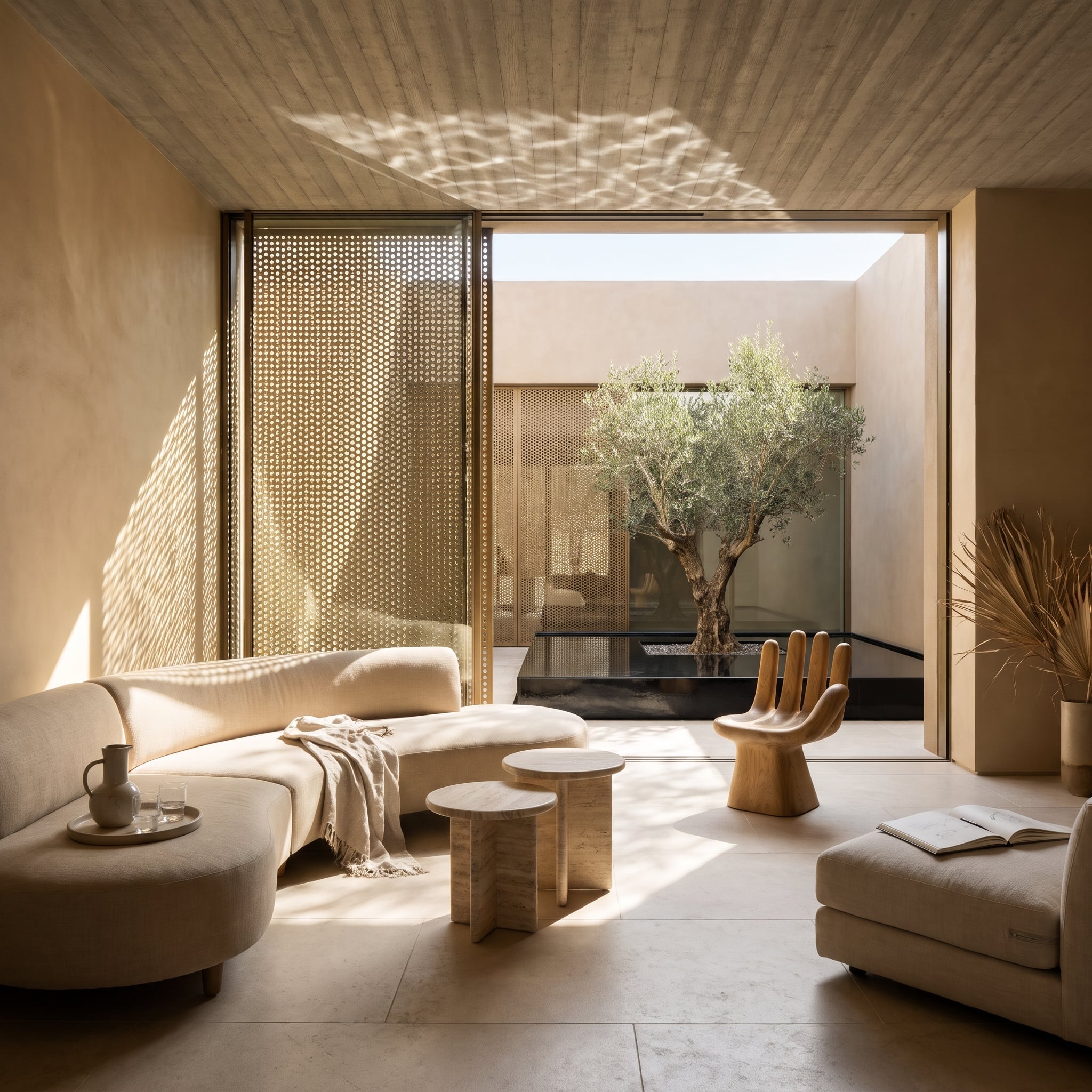
Water can turn sunlight into a moving architectural finish. Where the angle is right, reflections from the black pool travel upward onto the board-formed concrete ceiling, introducing rippling patterns across its otherwise rigid texture.
Across the room, a perforated brass screen breaks incoming light into smaller spots, scattering them across the plaster. One effect is fluid and constantly changing; the other follows the precise geometry of the metal. The contrast between water, concrete and perforated brass gives the room two very different kinds of projected light.
10. A Brass Sconce Turns an Arched Walnut Nook to Ember
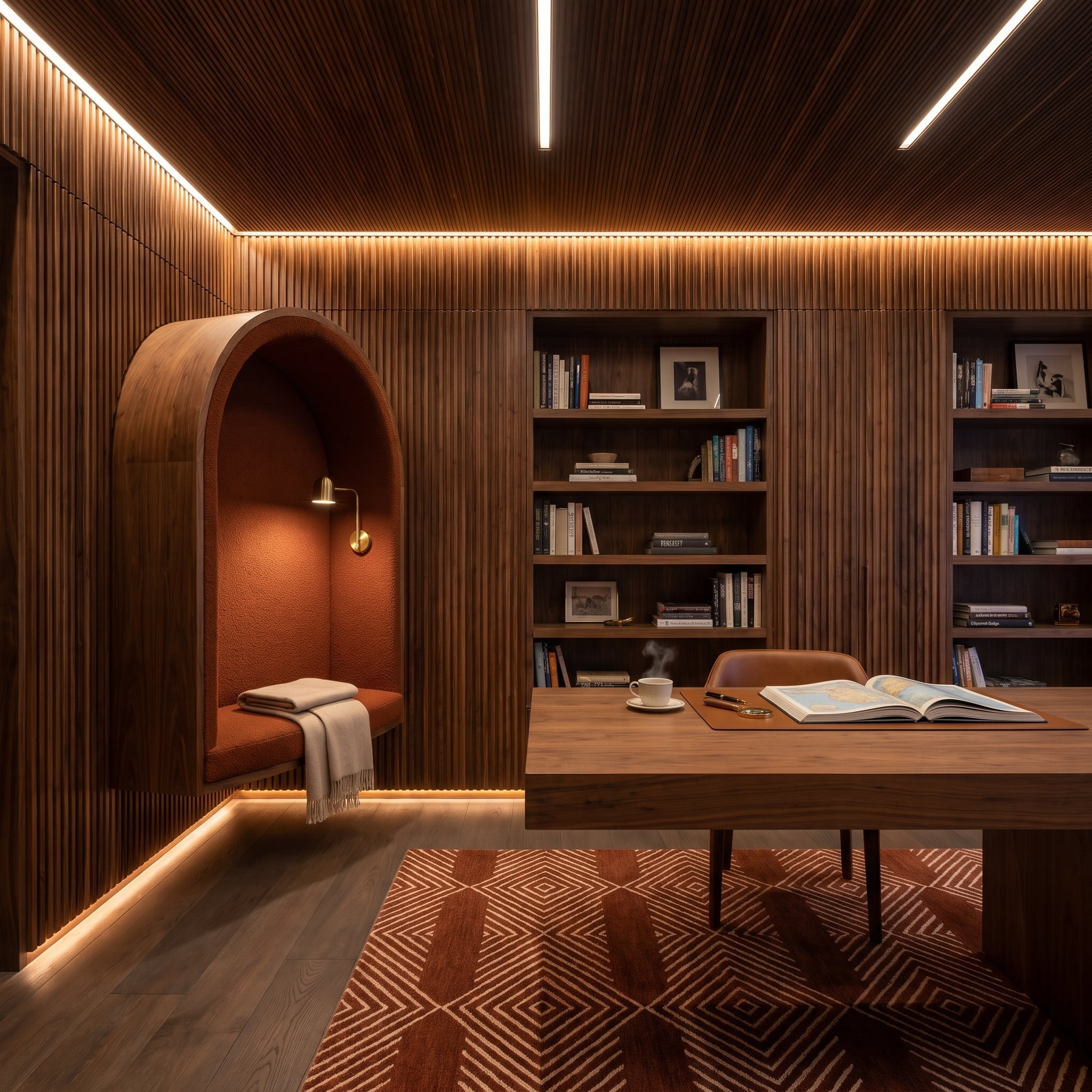
Concealed LEDs where the walnut slats meet the ceiling illuminate the upper timber in amber. Lower down, the same wood falls into a richer chocolate shadow. Inside the arched alcove, a brass sconce picks out the rust-colored bouclé upholstery, making its nubby texture more pronounced.
A second concealed strip lights the floor beneath the cantilevered bench, giving the seating a subtle floating effect. The warm fabric scatters light across its textured surface, while the darker walnut establishes depth around it. The alcove feels intimate because the illumination is concentrated exactly where the seating is.
9. Amber Candlelight Makes the Evening Sky Look Cobalt
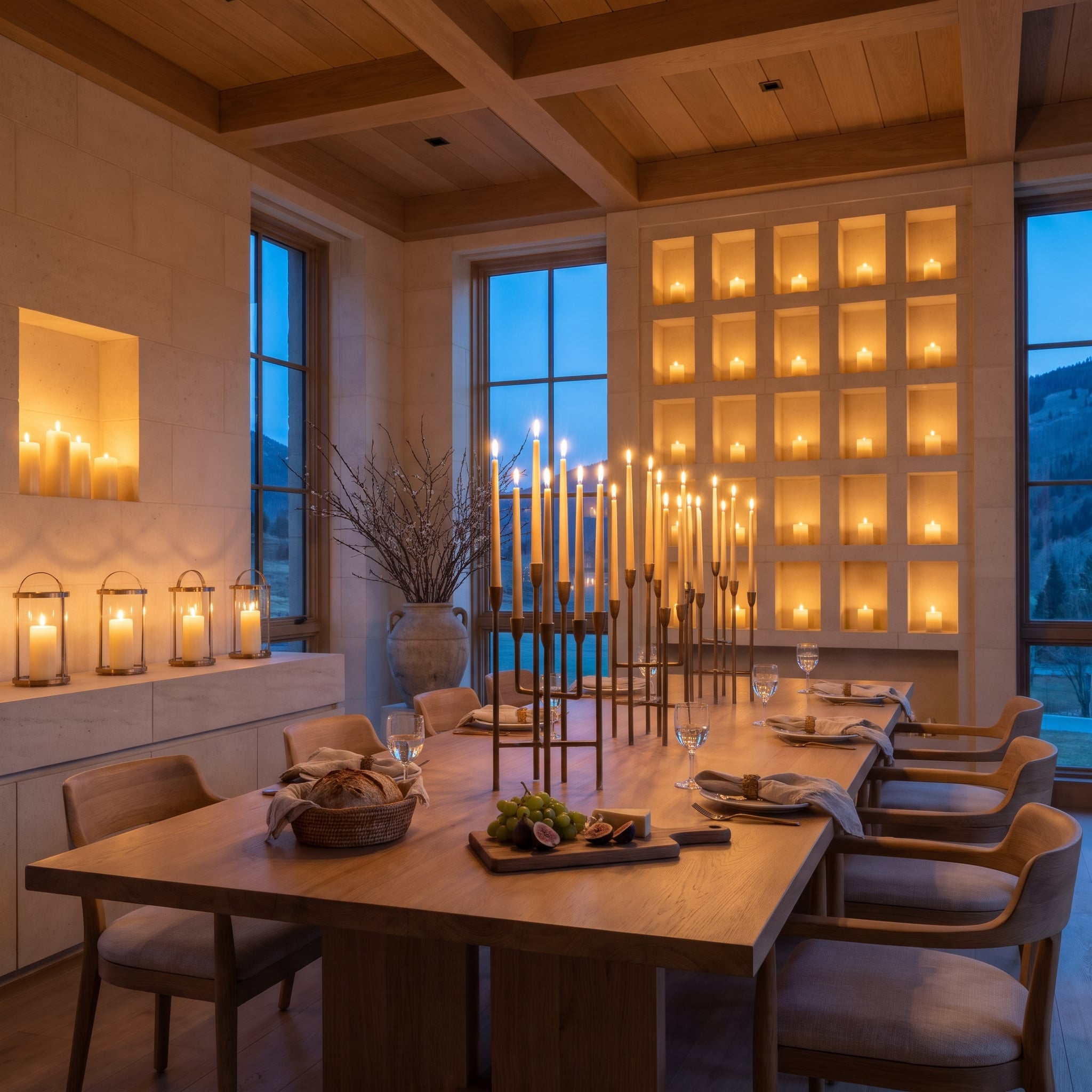
A grid of limestone niches holds individual candles, each flame introducing a small amber glow against the pale stone. Together they form a broad field of warm points of light. Beyond the glazing, the evening sky appears intensely blue by comparison.
The contrast is as important as the candles themselves. Warm illumination indoors makes the cool exterior more pronounced, while the repeating limestone grid gives the flickering light a disciplined architectural framework.
8. Ceiling Slats Turn Amber Above the Table and Pale Beside the Lake
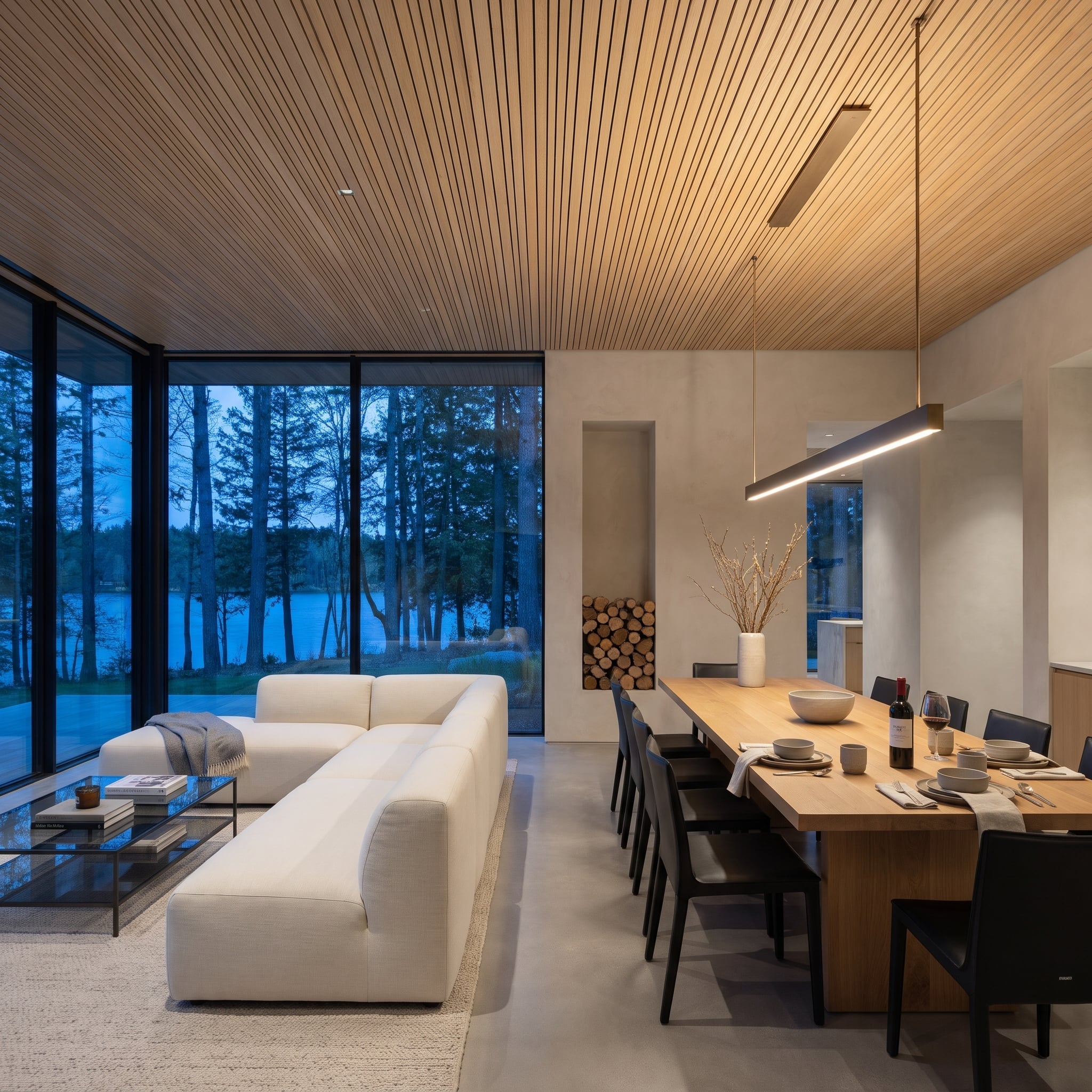
A linear pendant sends light upward as well as down, illuminating the timber slats directly above the dining table in amber. Toward the windows, the ceiling receives more of the cool exterior light and appears paler. The same timber finish registers differently across the room.
That division gives the dining area a distinct center without a change in ceiling material or height. The warm zone gathers around the table; the cooler edge belongs to the lake and the evening sky. Lighting, rather than a partition, establishes the boundary.
7. Four Downlights Make a Stone Wall Look Like Drapery
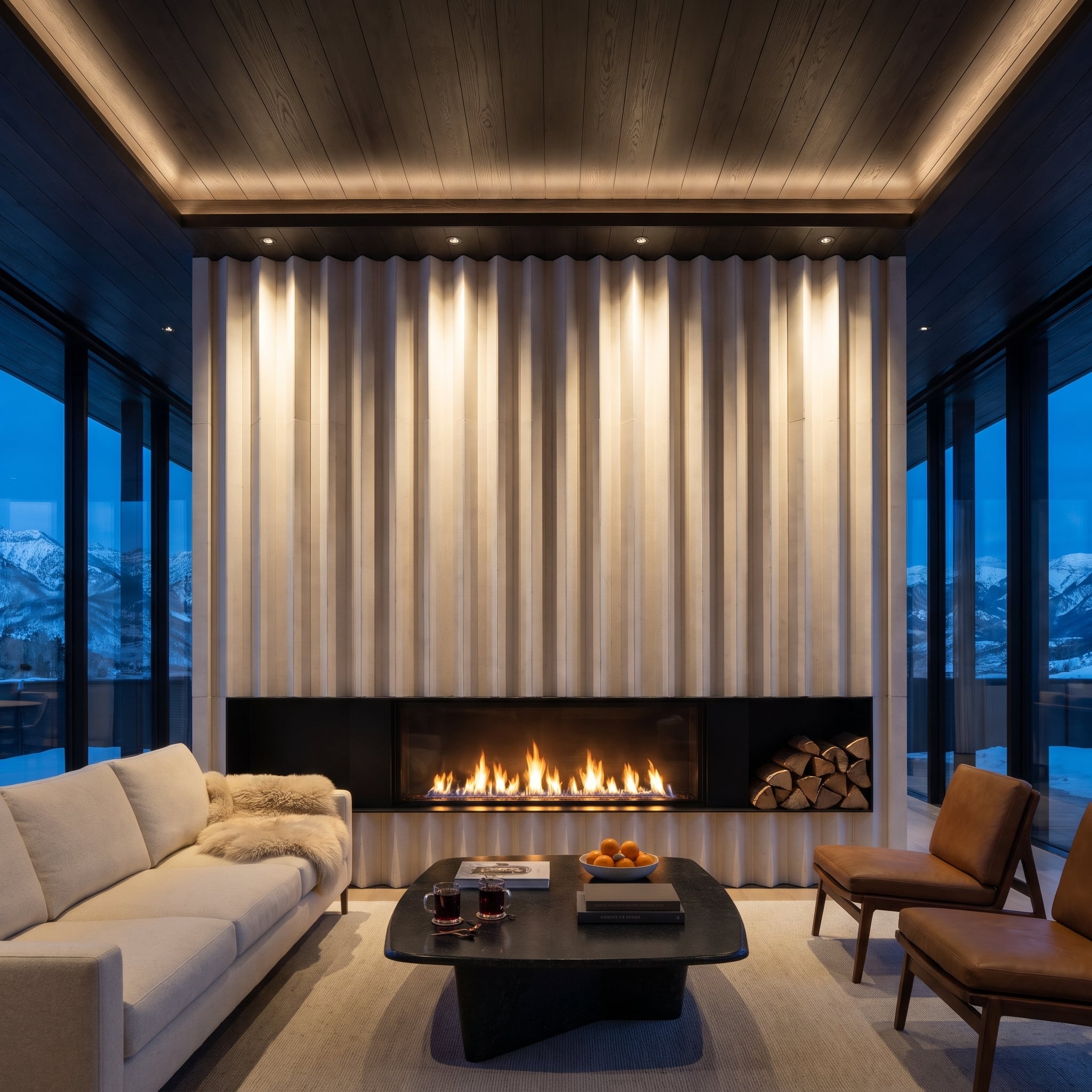
Pale stone pleats rise from floor to ceiling, their ridges illuminated by four downlights positioned close to the wall. Bright stripes alternate with deep gray troughs, making the rigid surface resemble heavy folded fabric. The effect depends on the angle and spread of the light: too broad a wash would reduce the relief that gives the wall its drama.
Below, a linear fireplace introduces a narrow orange band. Blue dusk fills the flanking windows, making the whiskey-brown leather armchairs and softly lit oak ceiling appear warmer. The stone wall supplies the texture, the fire supplies the accent, and the sky completes the contrast.
6. A Floor-Recessed Light Draws a Golden Line Around Curved Plaster
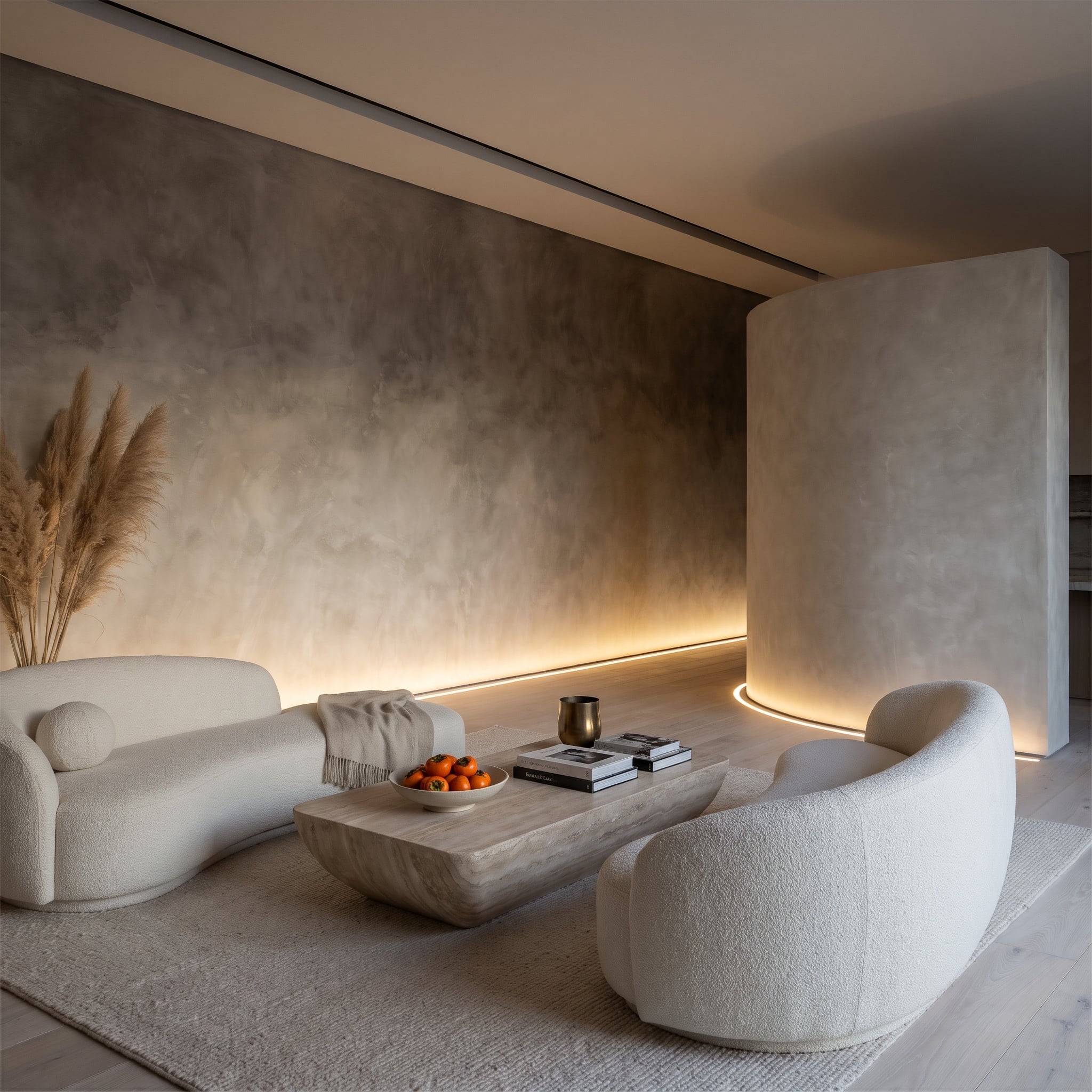
A strip of light recessed into the floorboards follows the curve of the plaster partition, grazing its troweled surface from below. Every swirl and irregularity becomes more visible near the floor, where the finish glows honey-gold. Higher up, the wall settles into a quieter ash tone.
Bouclé sofas maintain the muted palette, leaving a bowl of persimmons to provide the most saturated natural color. The furniture also stands clear of the illuminated wall, allowing the light to travel upward without being blocked. A narrow architectural detail has an outsized effect on the entire room.
5. Burgundy Plaster Goes Rose Above and Wine Below
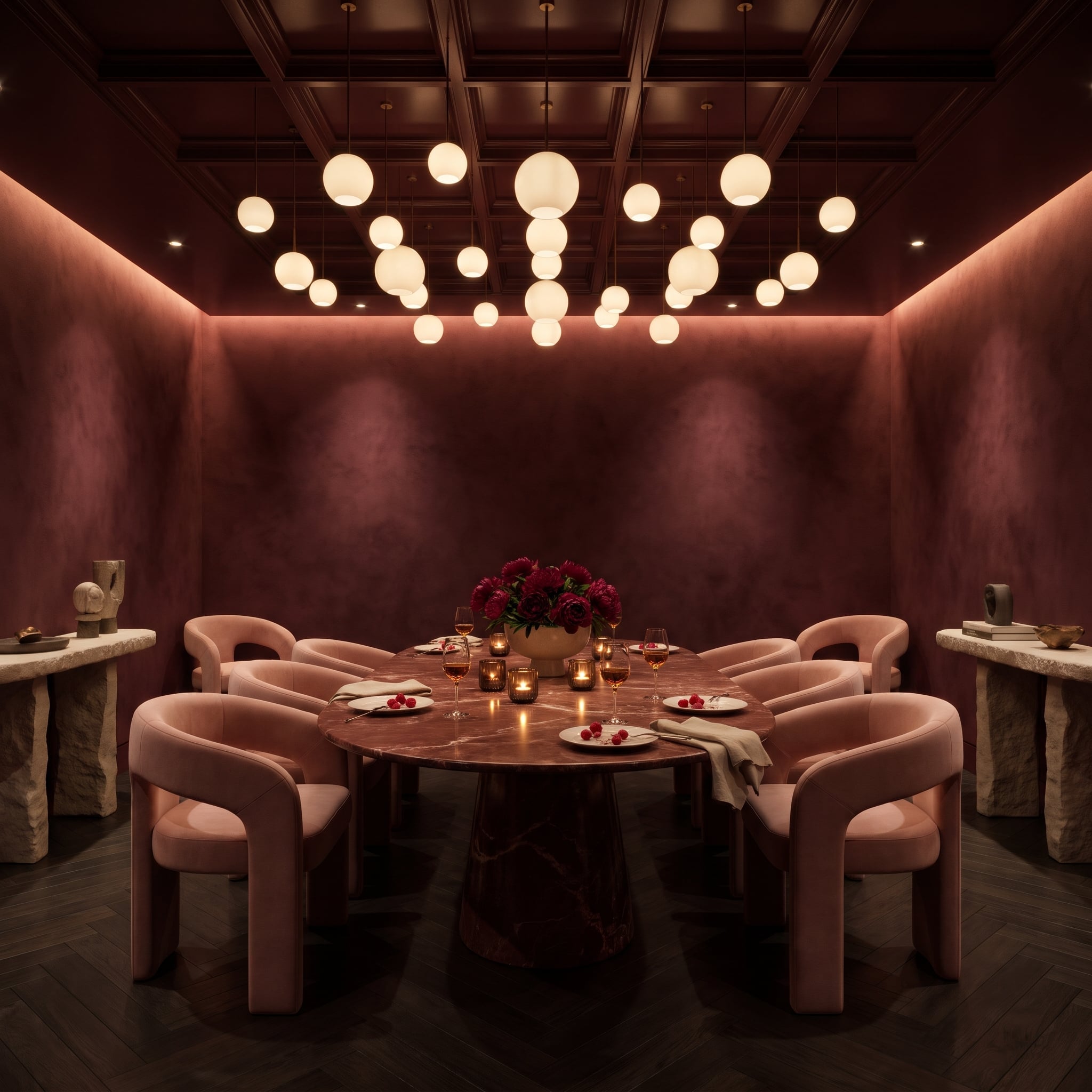
Warm cove lighting brightens the upper portion of the burgundy plaster toward rose. Farther down, where less light reaches the wall, the color deepens into wine. The transition is gradual enough to look almost like a deliberate gradient, although the changing illumination is doing much of the work.
Opal globes add soft highlights, and velvet chairs pick up different notes from the surrounding reds. The plaster provides the saturated foundation; the lighting gives it variation and depth.
4. Gold Leaf Makes a Bedroom Glow While the Ocean Goes Navy
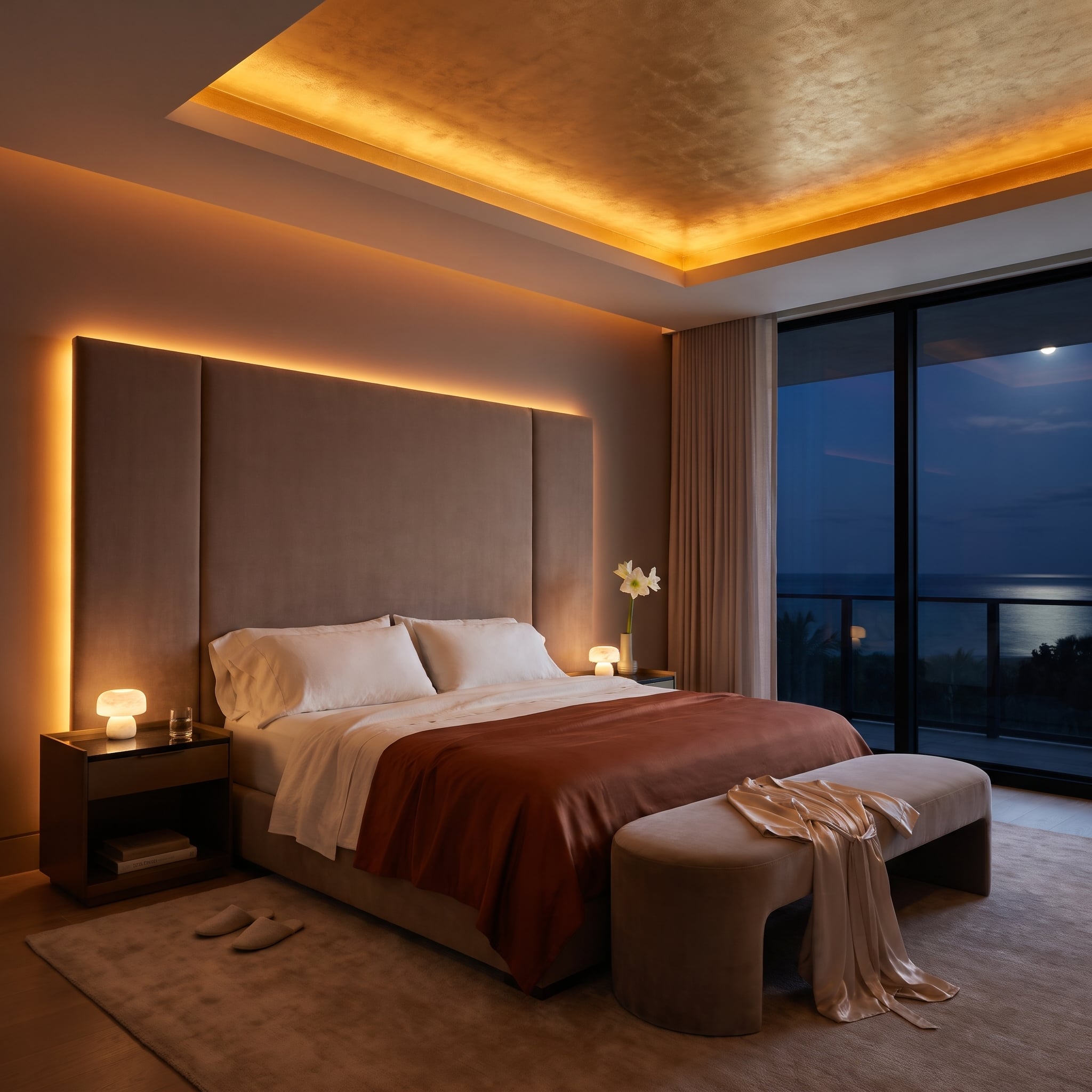
Gold leaf across the ceiling catches the concealed cove lighting and returns it as a broad metallic glow. A second strip traces the velvet headboard, lifting its outline away from the wall, while alabaster bedside lamps introduce smaller pools of light.
Outside, the ocean reads deep navy beneath the evening sky. The cool view provides a striking counterweight to the gold overhead, making the bedroom’s warm finishes appear even more saturated. The room is built around one emphatic contrast: luminous metal within, blue darkness beyond.
3. Pleated Lamps Reappear as Reflections in a Toffee-Lacquered Ceiling
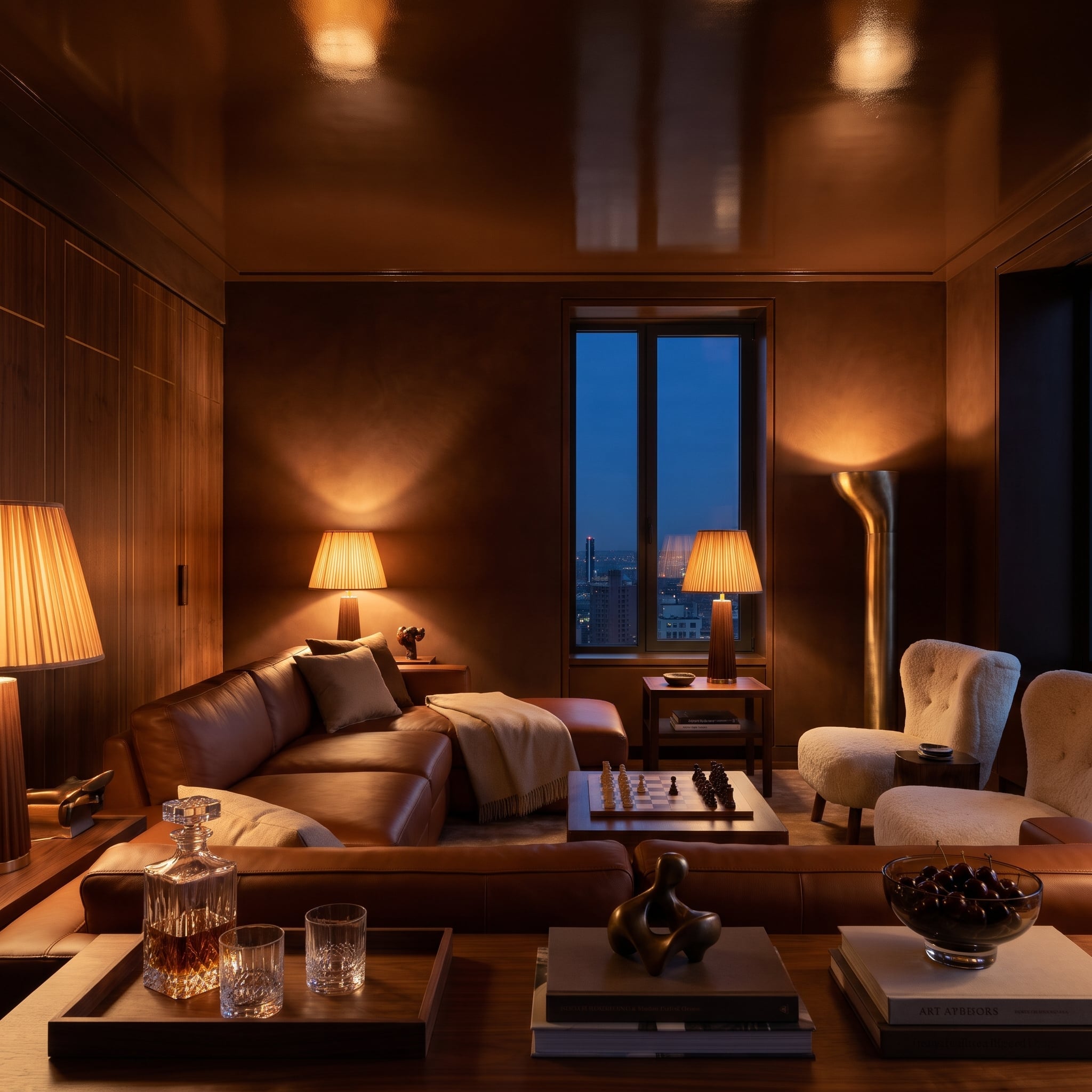
The deep toffee lacquer overhead is reflective enough to catch the shapes of the pleated lamps below. Their shades appear again as softened images across the ceiling, joined by the upward glow of a brass floor lamp. The result gives the room a second, less sharply defined layer of illumination.
Amber tones dominate the furniture and ceiling, while the window supplies a narrow rectangle of cool dusk blue. The reflected lamps turn an otherwise flat overhead plane into an active part of the composition. The ceiling doesn’t simply receive the light; it sends the room back to itself.
2. Peach Sunlight and Glass-Rod Rainbows Compete on One Plaster Wall
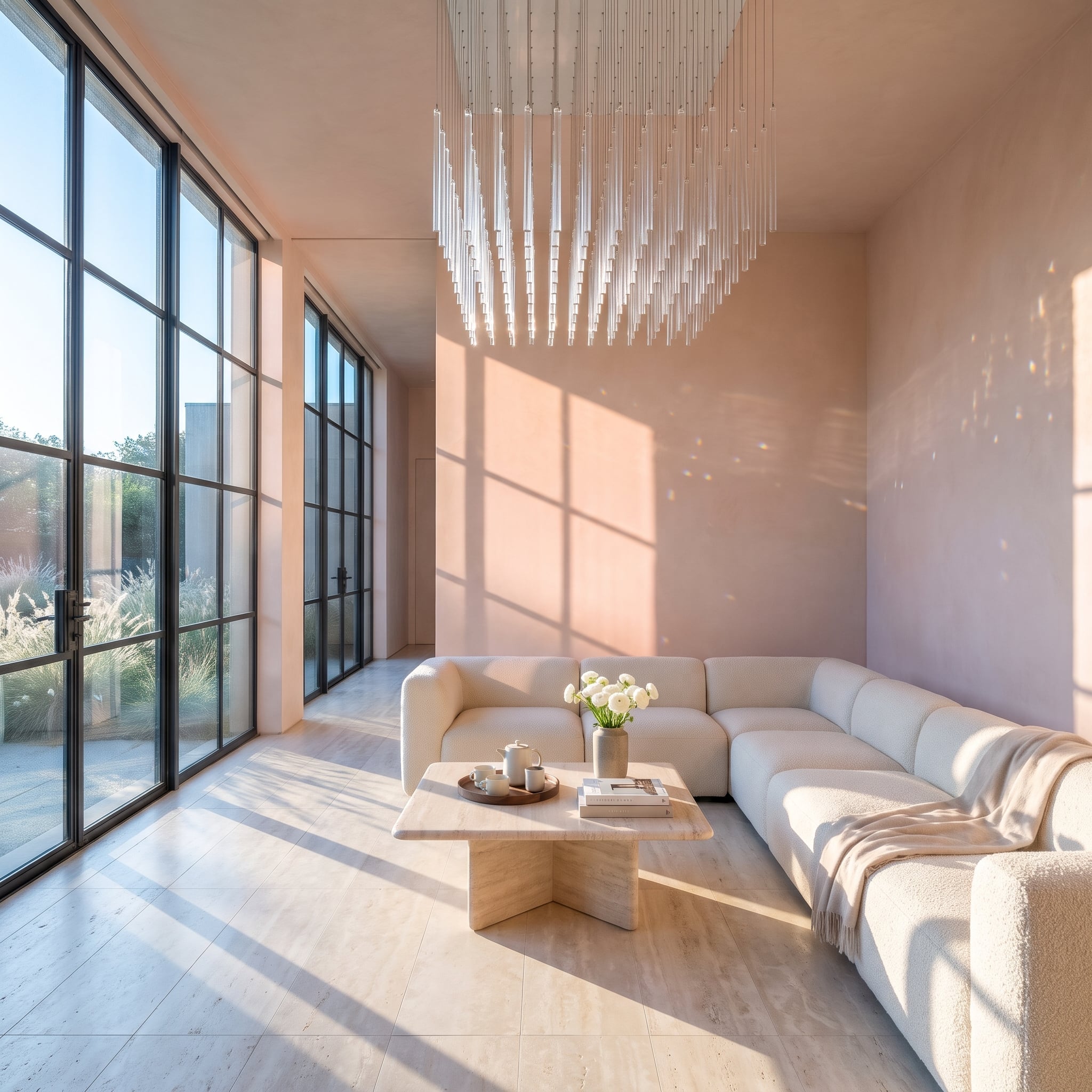
Low sunlight enters through steel-framed doors, turning the plaster apricot and projecting a crisp mullion grid across the wall. Beyond the brightest patch, the same surface appears cooler, approaching lilac. The difference is pronounced enough to make the wall look as though it carries two separate finishes.
Then the chandelier complicates the picture. Hanging glass rods refract and reflect light, introducing small rainbow-colored highlights across the far corner. Pale bouclé upholstery and a travertine table keep the furniture quiet, leaving the shifting light to provide the spectacle. Geometry, color temperature and refraction all arrive on the same wall.
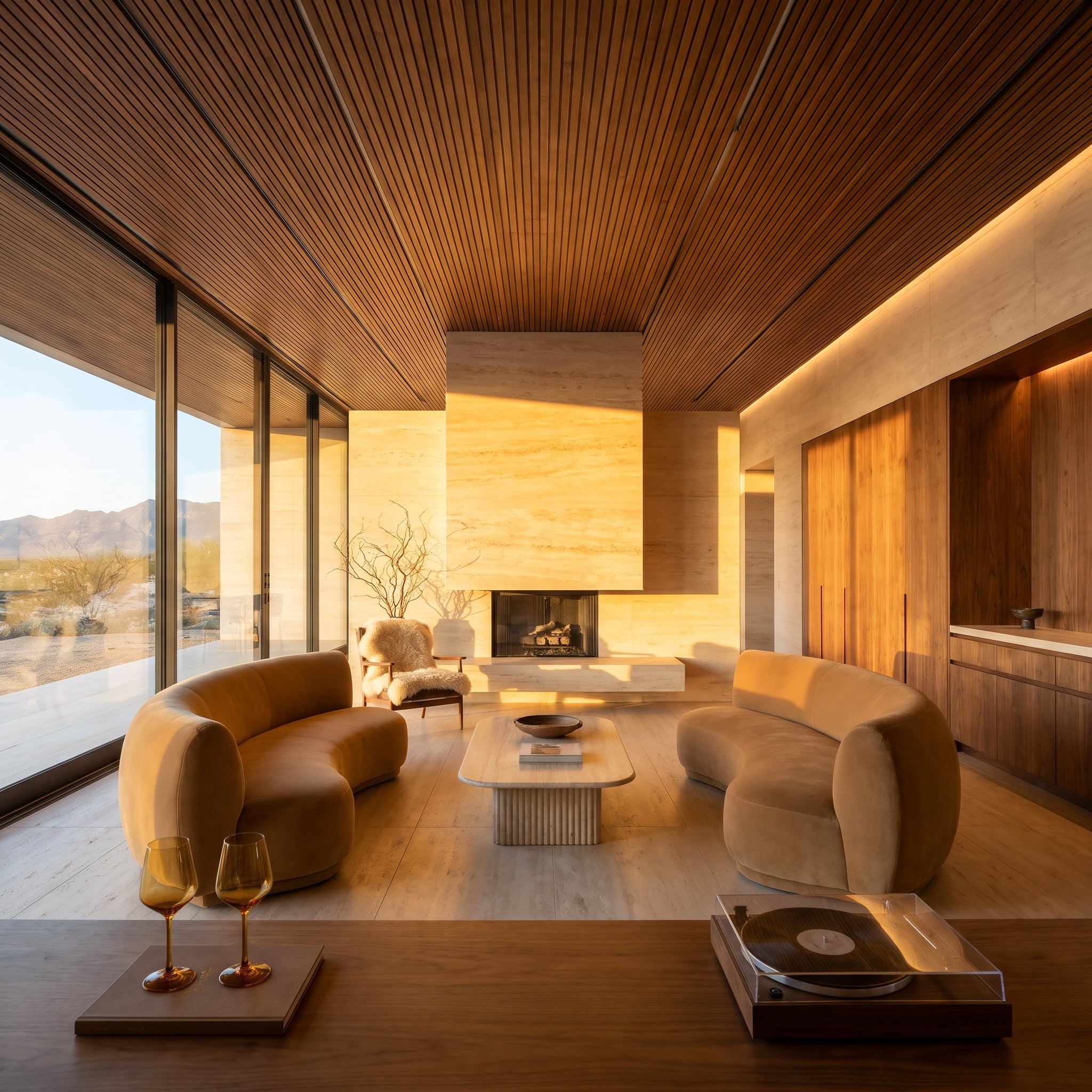
1. Golden-Hour Sun Turns a Travertine Fireplace Butter Yellow
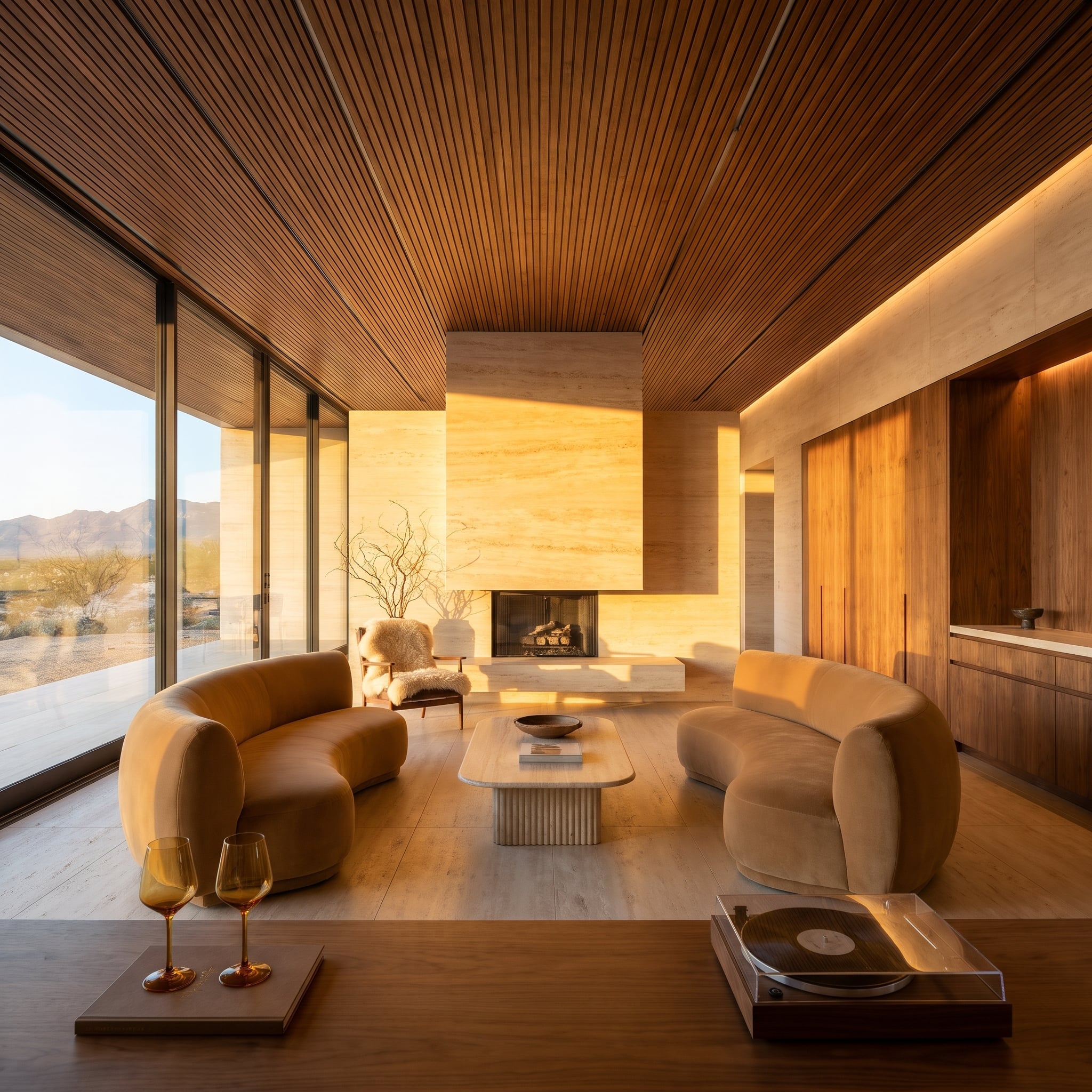
Late sunlight strikes the travertine fireplace at a low angle, drawing buttery yellow from stone that would appear comparatively beige under neutral midday light. The broad face of the fireplace catches the warmth, while its edges and recesses retain enough shadow to give the block its monumental weight.
Two curved camel velvet sofas face each other across a fluted stone table, their upholstery reinforcing the golden palette. Above, the slatted timber ceiling stays dark, providing a firm visual limit to the brightness below. The room’s most memorable color isn’t a new finish or a daring paint choice. It’s the afternoon sun finding exactly the right piece of stone.