
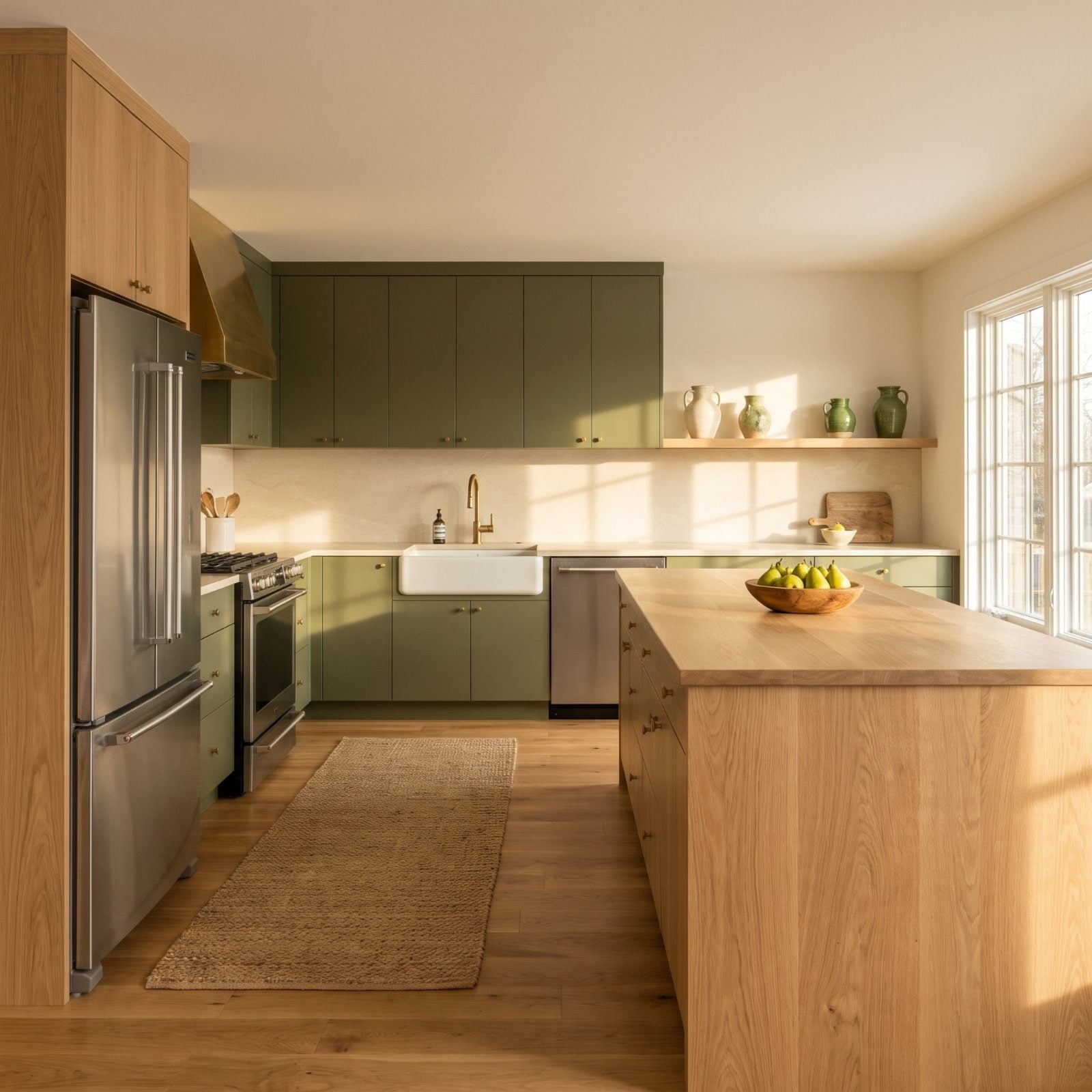
Gray had a good run. It walked into every kitchen a decade ago, sat down, and refused to leave. But the color forecast for 2027 has already picked its favorite, and it’s wearing moss and loden and herb-garden tones with a side of honey-grained oak. Olive warms a room without shouting — something gray never managed. Pair it with natural white oak and you get a kitchen that feels like late-afternoon light coming through a window. The kitchens below show the pairing drenched, balanced, and used as a quiet accent, and every one of them is buildable right now.
37. Rift-Sawn Oak Cabinets Wrapped Around an Olive Island
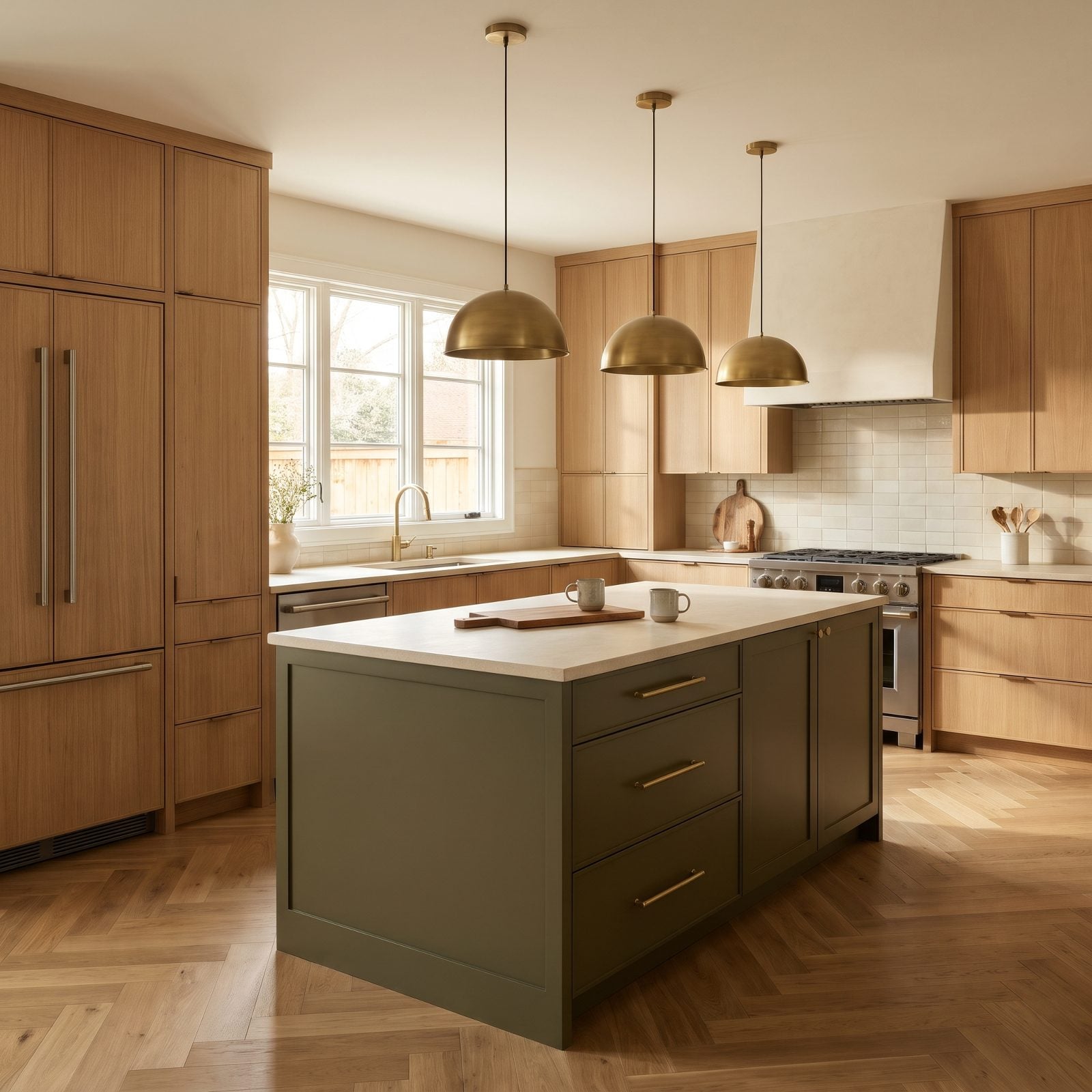
The island earns its loden coat by standing alone. Oak runs the perimeter in tight rift-sawn grain, quiet and continuous, which lets the olive block in the middle become the one decision that matters. Give the color one job and let the wood handle everything else.
In order to come up with the very specific design ideas, we create most designs with the assistance of state-of-the-art AI interior design software. Also, assume links that take you off the site are affiliate links such as links to Amazon. this means we may earn a commission if you buy something.
Brushed-brass pulls keep the olive from going flat. And the plaster hood over the range softens the room so it never feels built from hard edges.
36. Shaker Olive Lowers, White-Oak Shelves Doing the Talking
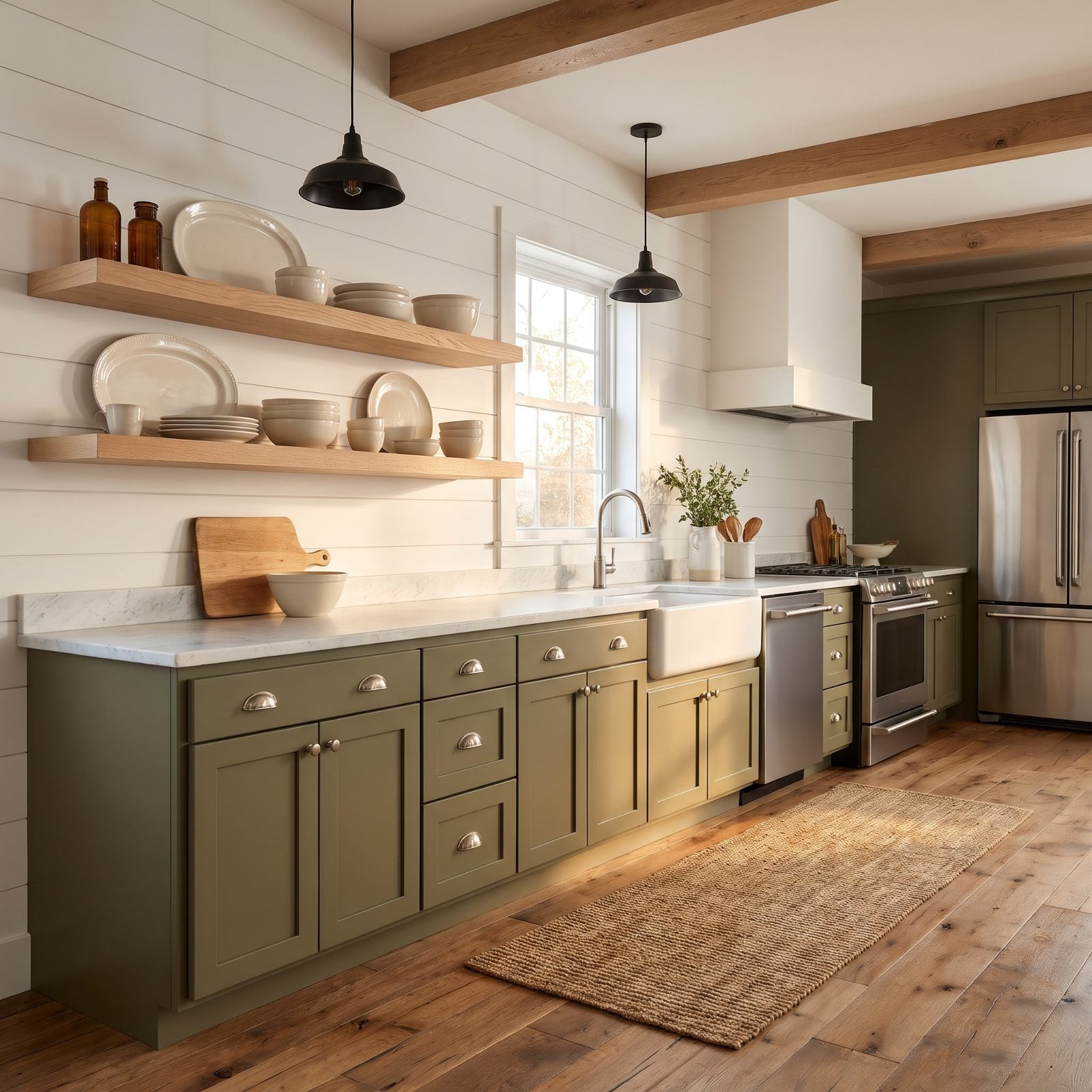
Skip the upper cabinets, hang two slabs of white oak, and suddenly the olive shakers below have somewhere to breathe. The white-oak floating shelves carry the warmth up the wall so the color never sits in a heavy band at counter height.
Honed white marble keeps the whole thing from going too rustic — the dressed-up note in an otherwise casual room.
What Our Readers Say
- Not everyone is ready to give up upper cabinets: asked which uppers they would hang, 74% of our readers picked solid doors, with open shelves at 12% and glass fronts at 11%.
- For a new kitchen faucet, chrome still leads in our reader polls at 47%, with brass and black each picked by 25% of readers.
From Home Stratosphere reader polls and votes.
35. Deep-Olive Cabinetry Beneath Exposed Oak Beams
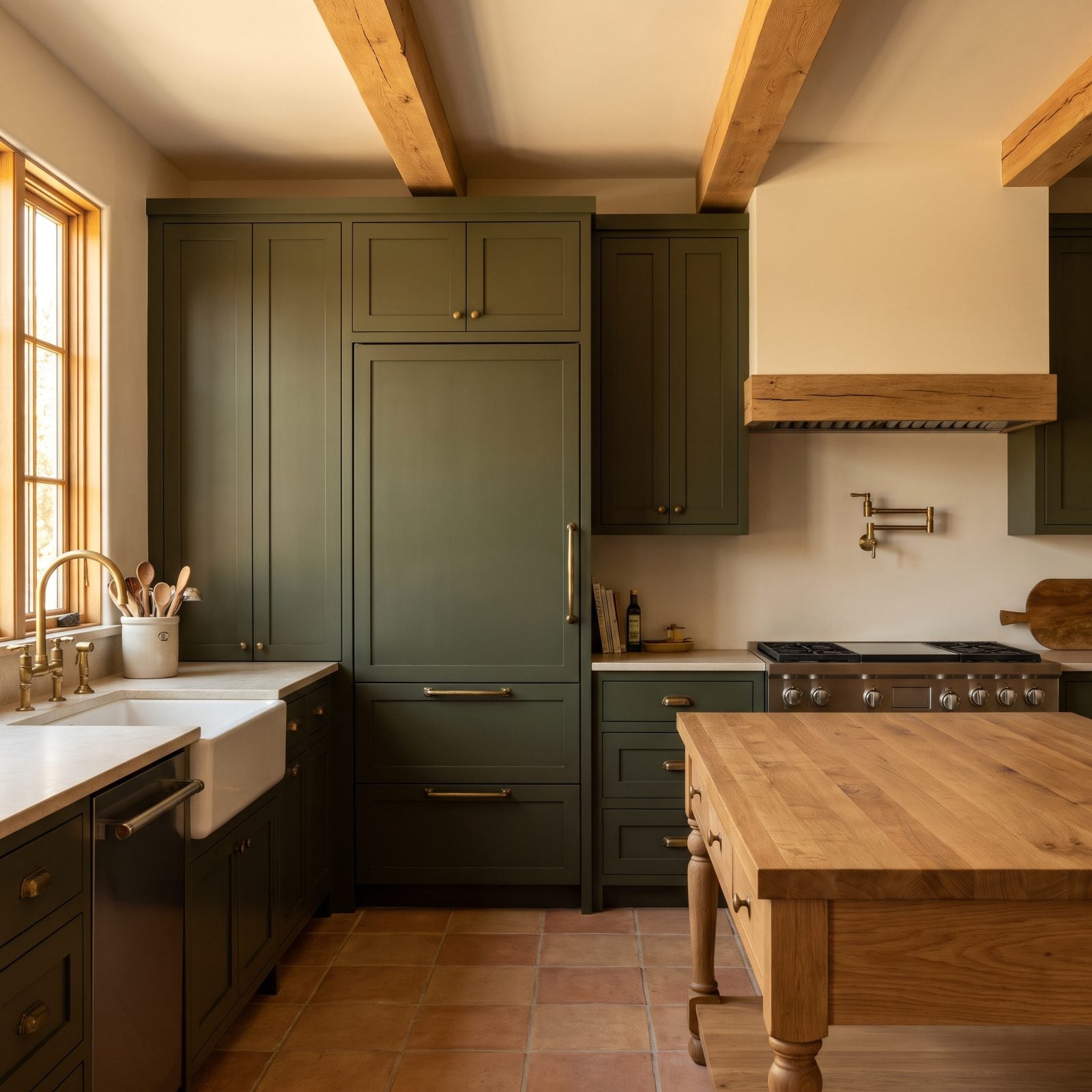
Those oak beams overhead and the forest-olive cabinets below are having a conversation about depth. The wood draws your eye up, the dark cabinetry anchors it down, and the room ends up feeling taller than it measures.
Deep olive is a confident choice. It reads almost black in shadow and goes green in the light, so the room changes personality from morning to dusk.
34. Olive Slab Cabinets Framed by Pale Oak Panels
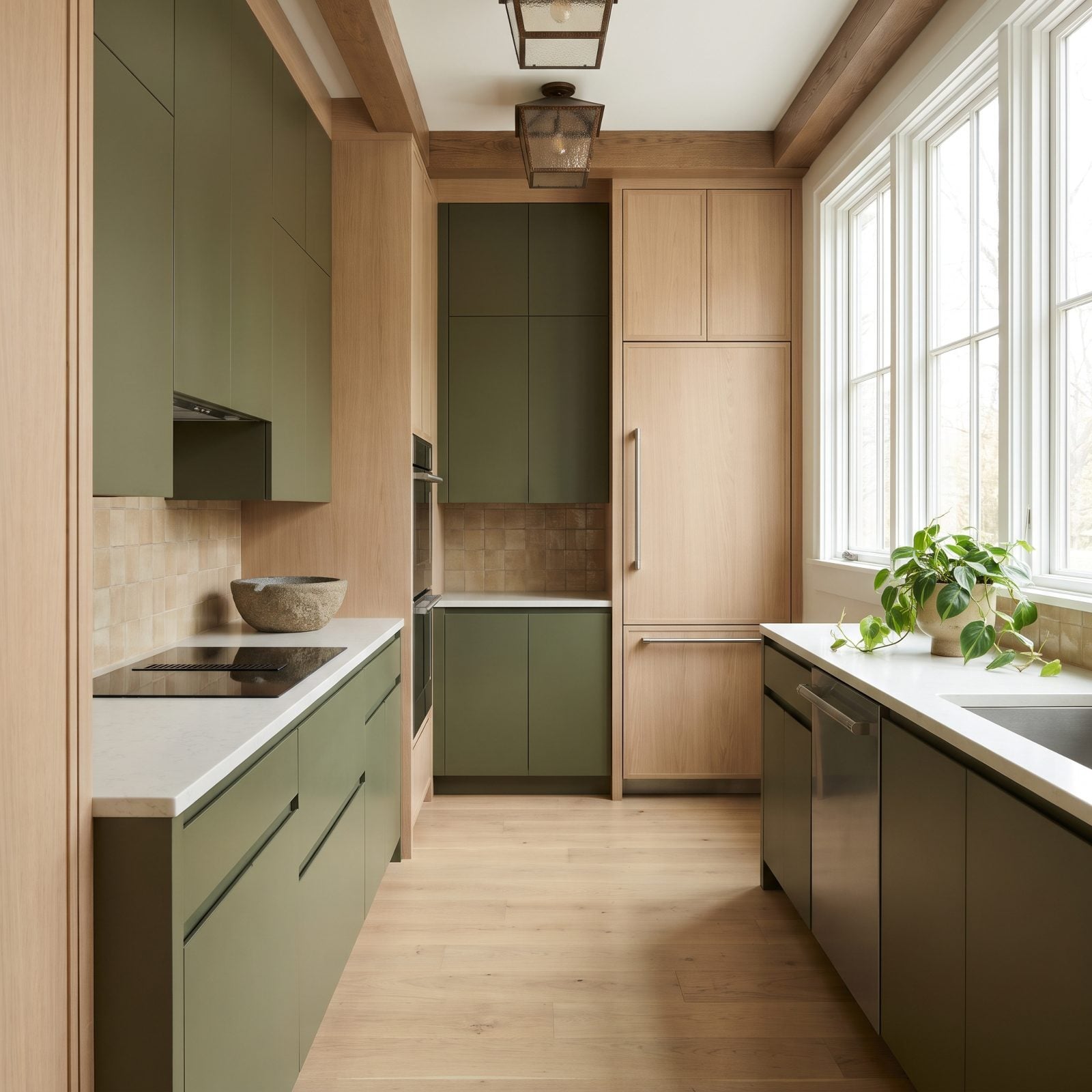
Pale oak frames the olive cabinets like matting around a print. It’s a European joinery move, and it makes the whole wall read as one considered piece rather than a lineup of boxes.
The handleless fronts keep it calm. Nothing interrupts the oak-to-olive rhythm.
33. Two-Tone Galley: Olive One Wall, Oak the Other
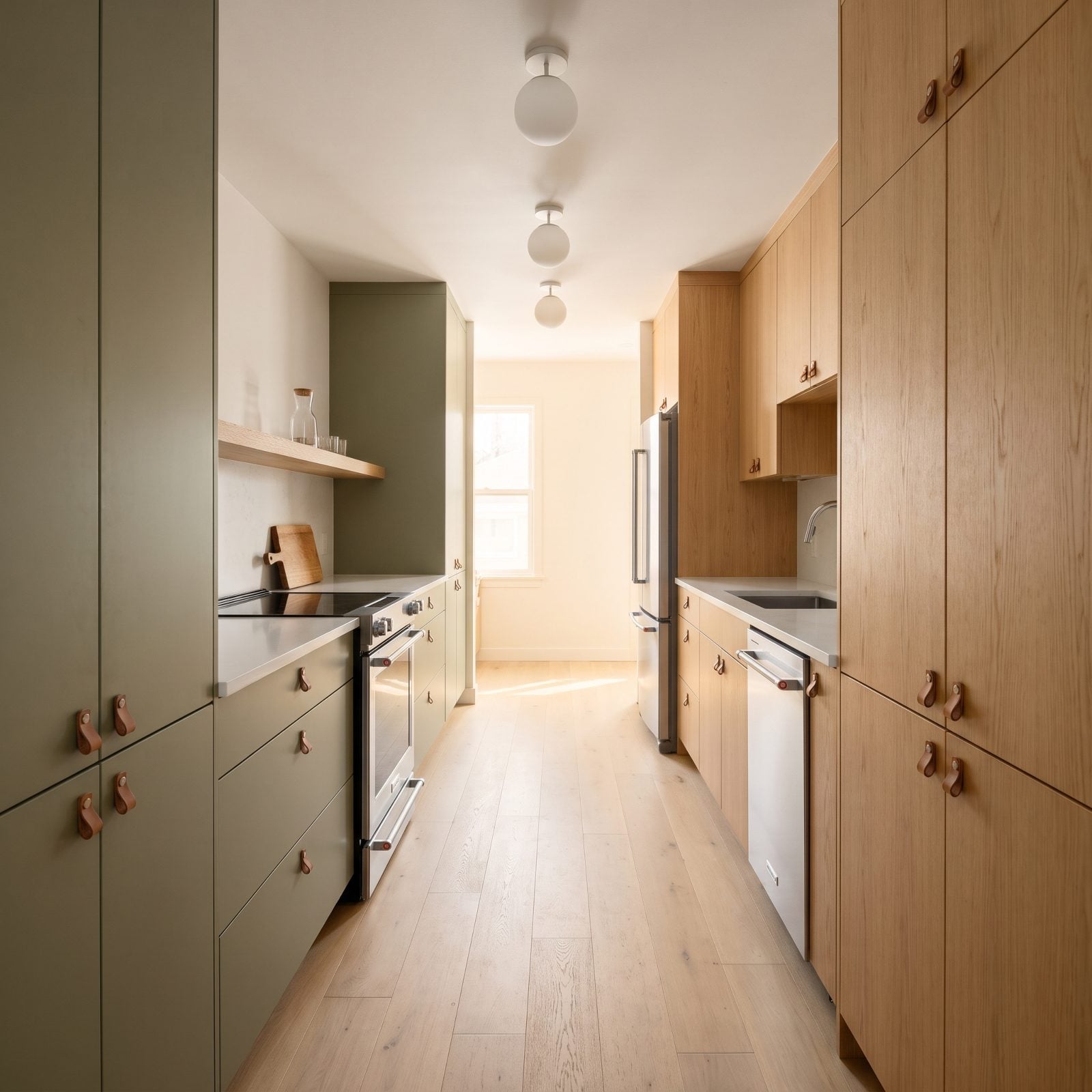
Galley kitchens live or die on how you handle the two facing walls. Here one wears sage-olive, the other wears white oak, and the matching leather pulls stitch the pair together so it reads as a single room instead of two competing runs.
Splitting the color across the corridor keeps a tight space from feeling top-heavy. Neither side dominates, which is the whole point in a space this narrow.
32. An Olive Butler’s Pantry Hiding Behind Oak Pocket Doors
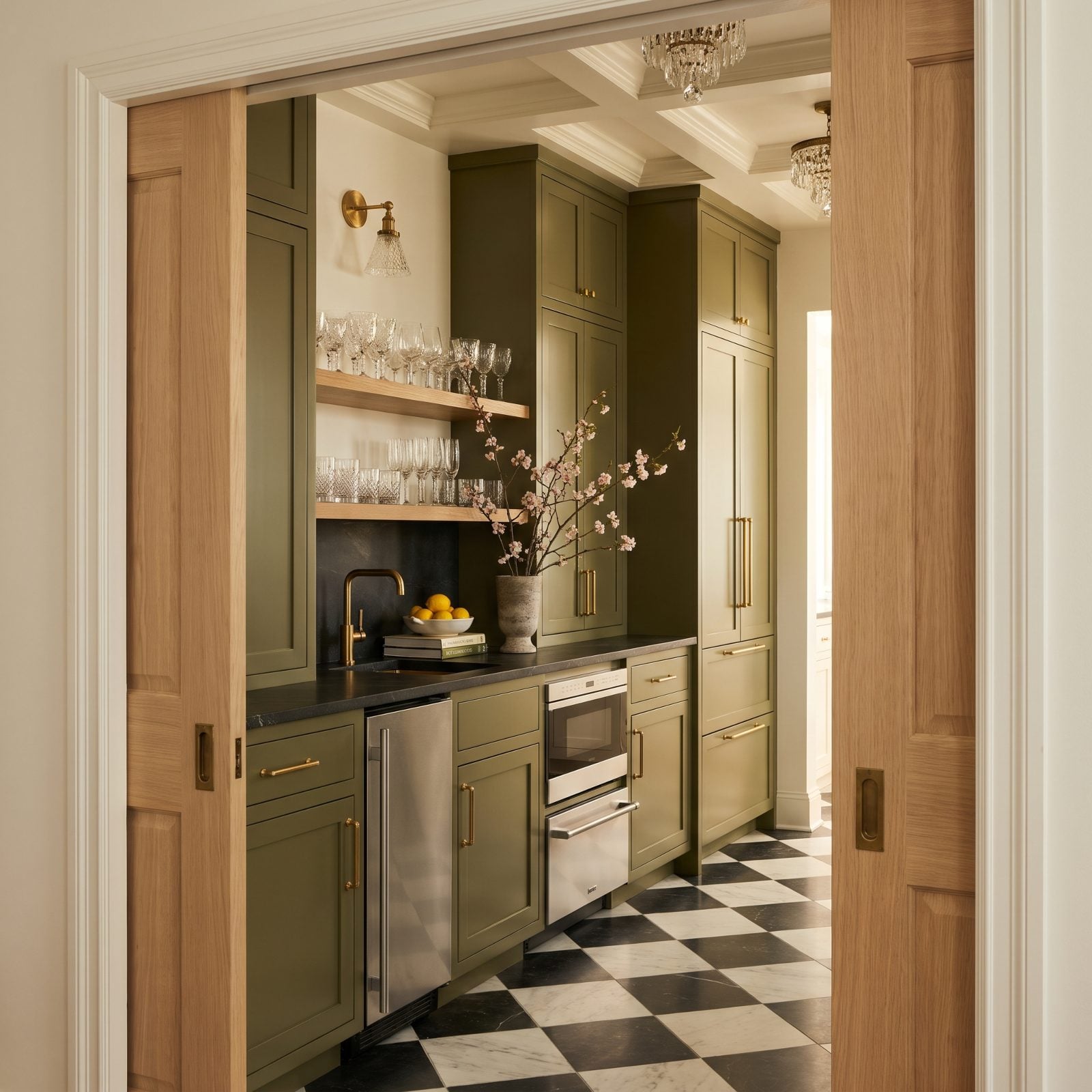
Slide the oak pocket doors open and the olive pantry behind them feels like a secret the kitchen was keeping. Honed soapstone, a brass bar faucet, glass on open shelves. This is where the mess goes to hide.
Pocket doors save the swing space a room this size can’t spare, and the oak keeps the reveal warm rather than utilitarian.
31. Oak Appliance Wall, Olive Prep Island Front and Center
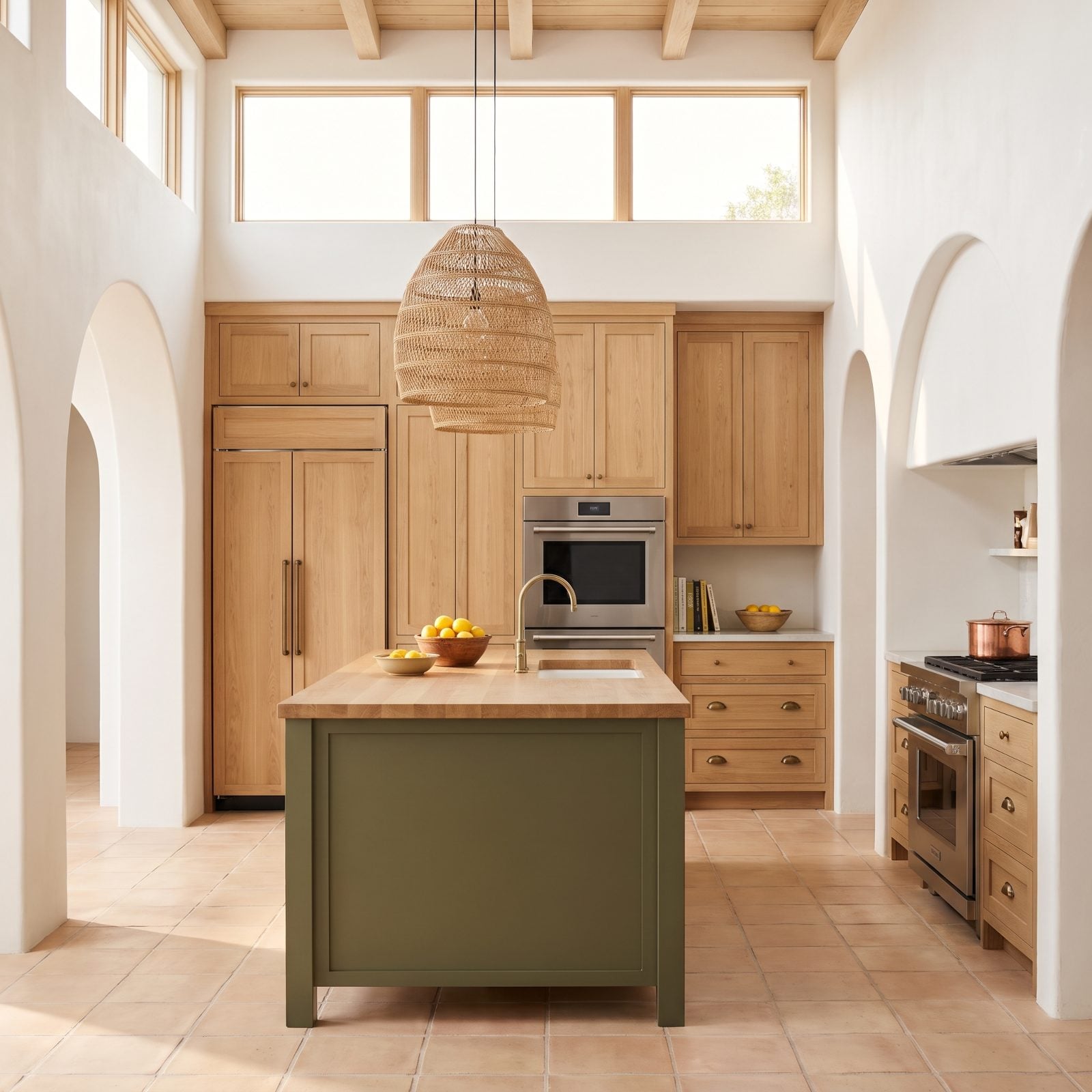
Everything functional disappears into one oak wall, which leaves the olive prep island free to be the social center of the room. Smart planning disguised as a style choice.
The warm bench ideas that usually crowd a kitchen get skipped here in favor of two rattan pendants and a clear island top. Less stuff, more room to actually cook.
30. Olive Cabinets Meeting a Waterfall Oak Breakfast Bar
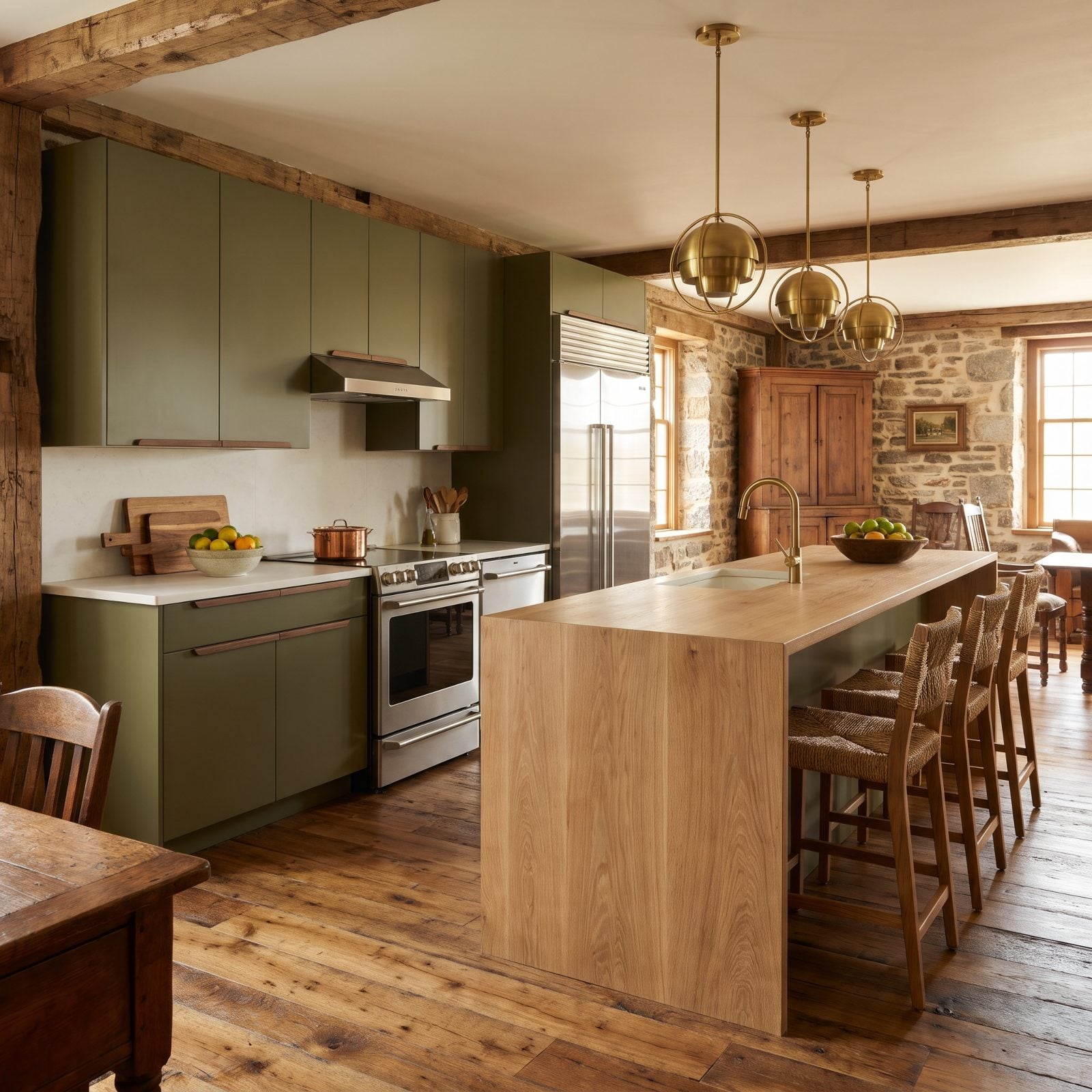
That oak waterfall edge is the move, full stop. The grain runs up and over and down to the floor in one unbroken sheet, so the breakfast bar looks carved from a single block.
Against the olive cabinets it reads as a piece of furniture that wandered into the kitchen and decided to stay. The brass globe pendants keep the mid-century line honest.
29. Oak-Framed Olive Cabinets With Reeded-Glass Doors
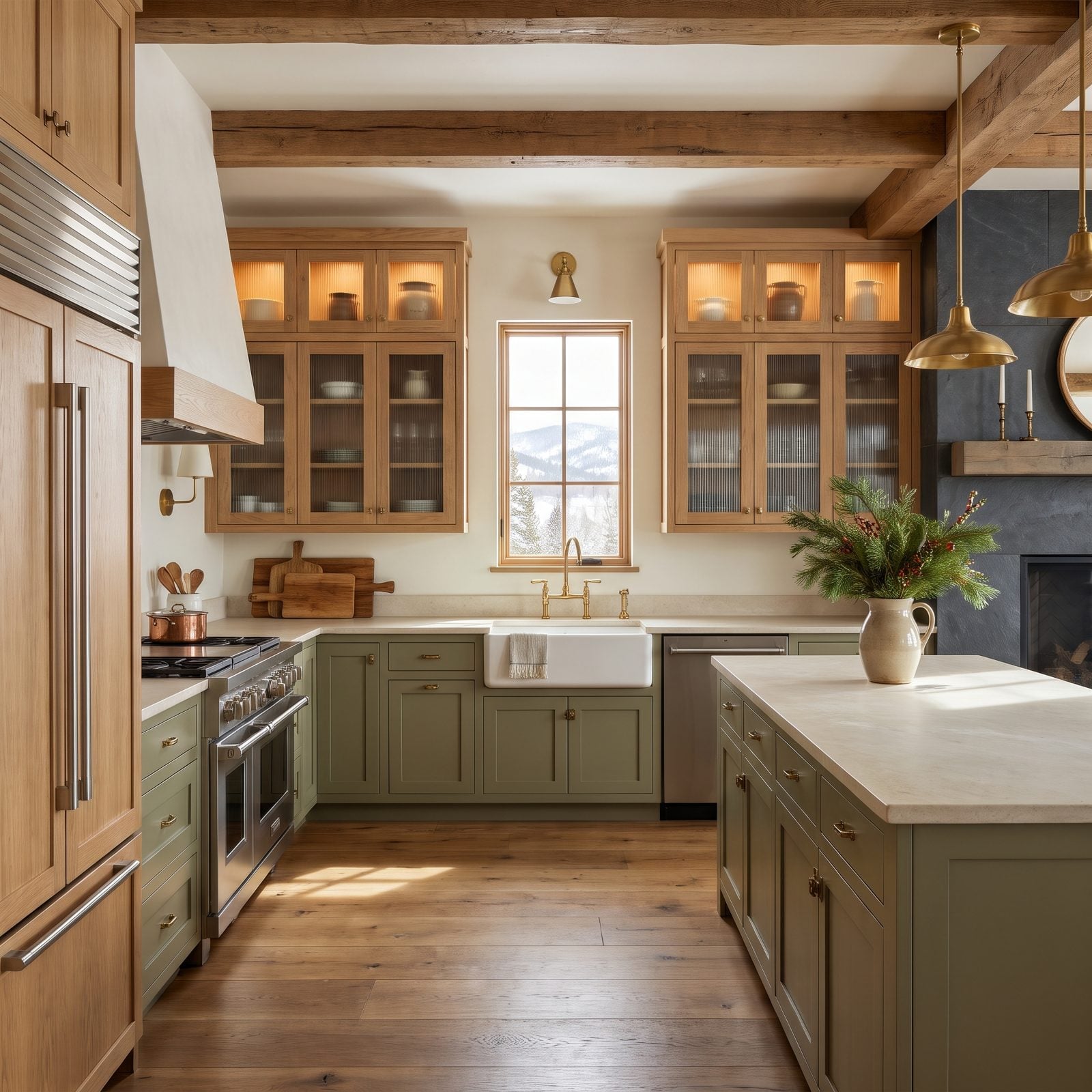
Reeded glass is the detail that tips this one from nice into memorable. It blurs whatever sits behind it, so your everyday dishes turn into a soft abstraction instead of a stack of plates.
Oak frames the glass, olive carries the lowers, and the aged-brass latches do the small-pleasure work your fingers notice every single day.
28. Olive Lower Cabinets Beneath a Built-In Oak Plate Rack
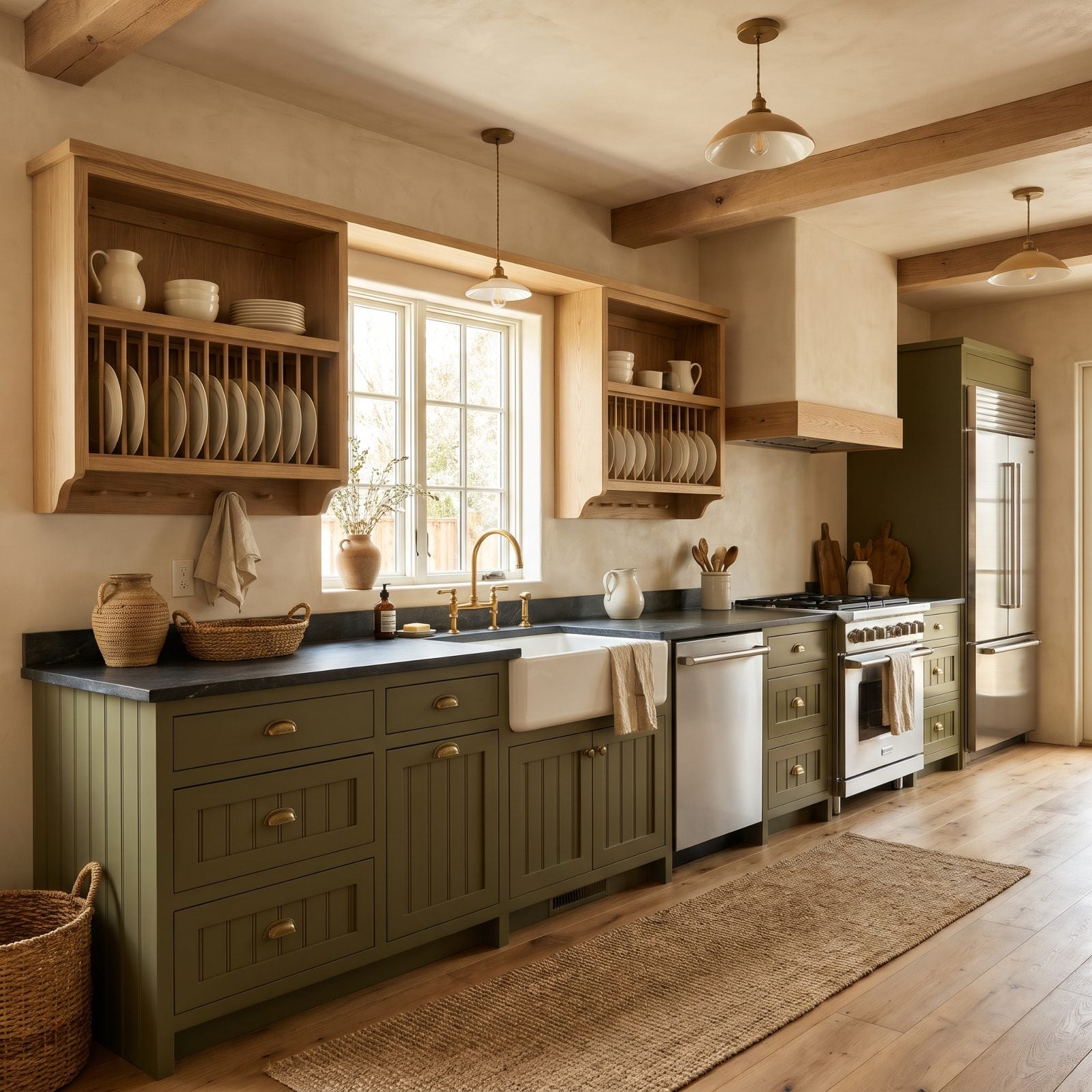
The oak plate rack is pure function dressed as charm. Dishes dry in plain sight, slot in after washing, and the vertical wood lines break up the olive run below with something your eye wants to follow.
Moss-olive beadboard keeps the cottage feeling without going twee, and soapstone counters age into the look instead of fighting it. This is the kitchen that gets better with use, not worse. Go build it.
27. European Oak Cabinets With an Olive Range Alcove
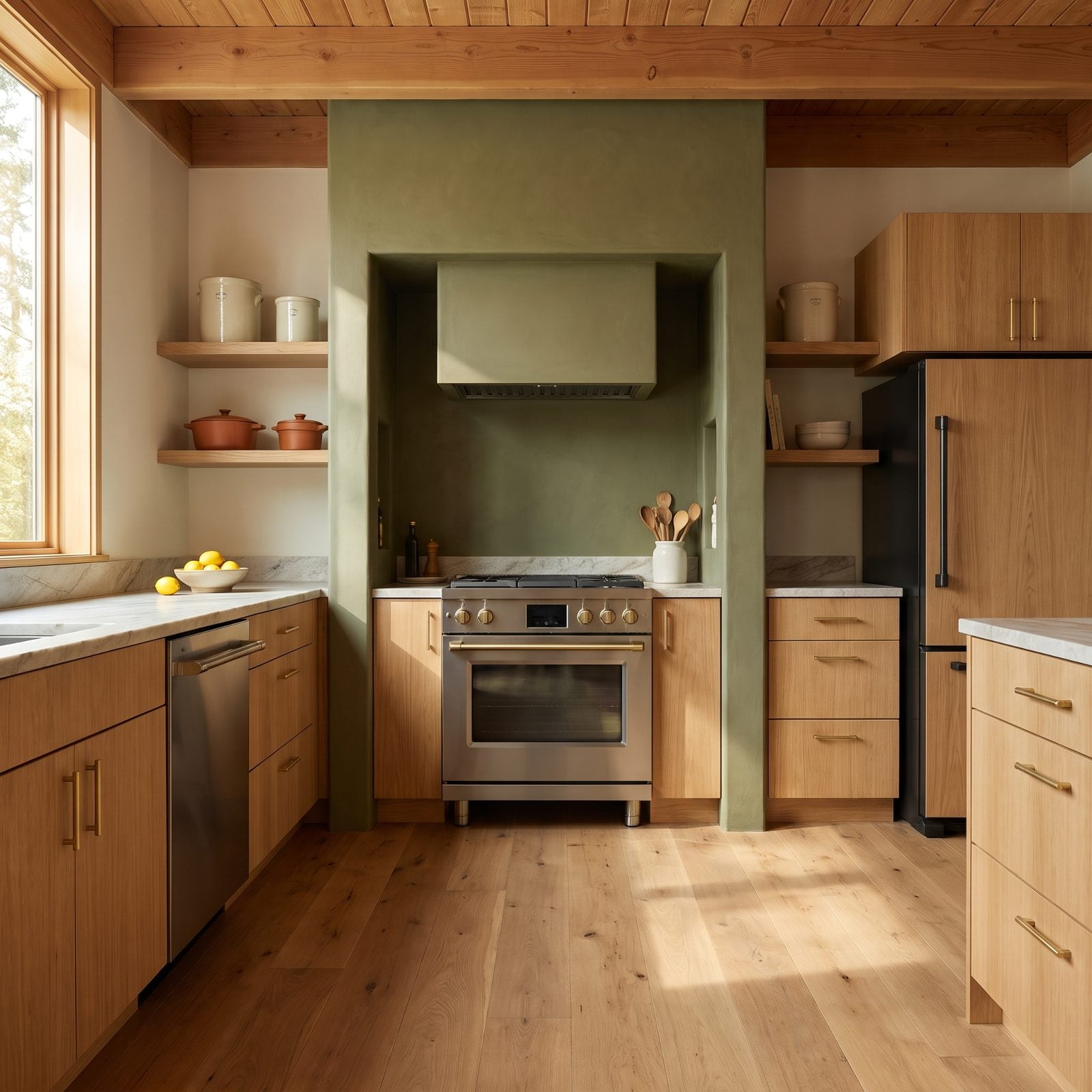
That plastered olive alcove is the whole trick here. It carves out a focal point without a single upper cabinet fighting for the spot, so your eye lands where you want it while the pale oak stays quiet and warm.
The appliances play along. A stainless range tucks into the moss recess, a black fridge wears oak panels only on its right door and freezer drawer, and a stainless dishwasher sits plainly in the left run. Nothing shouts. The brushed brass bar pulls do the only glinting.
26. Olive Cabinetry With a Freestanding Oak Worktable
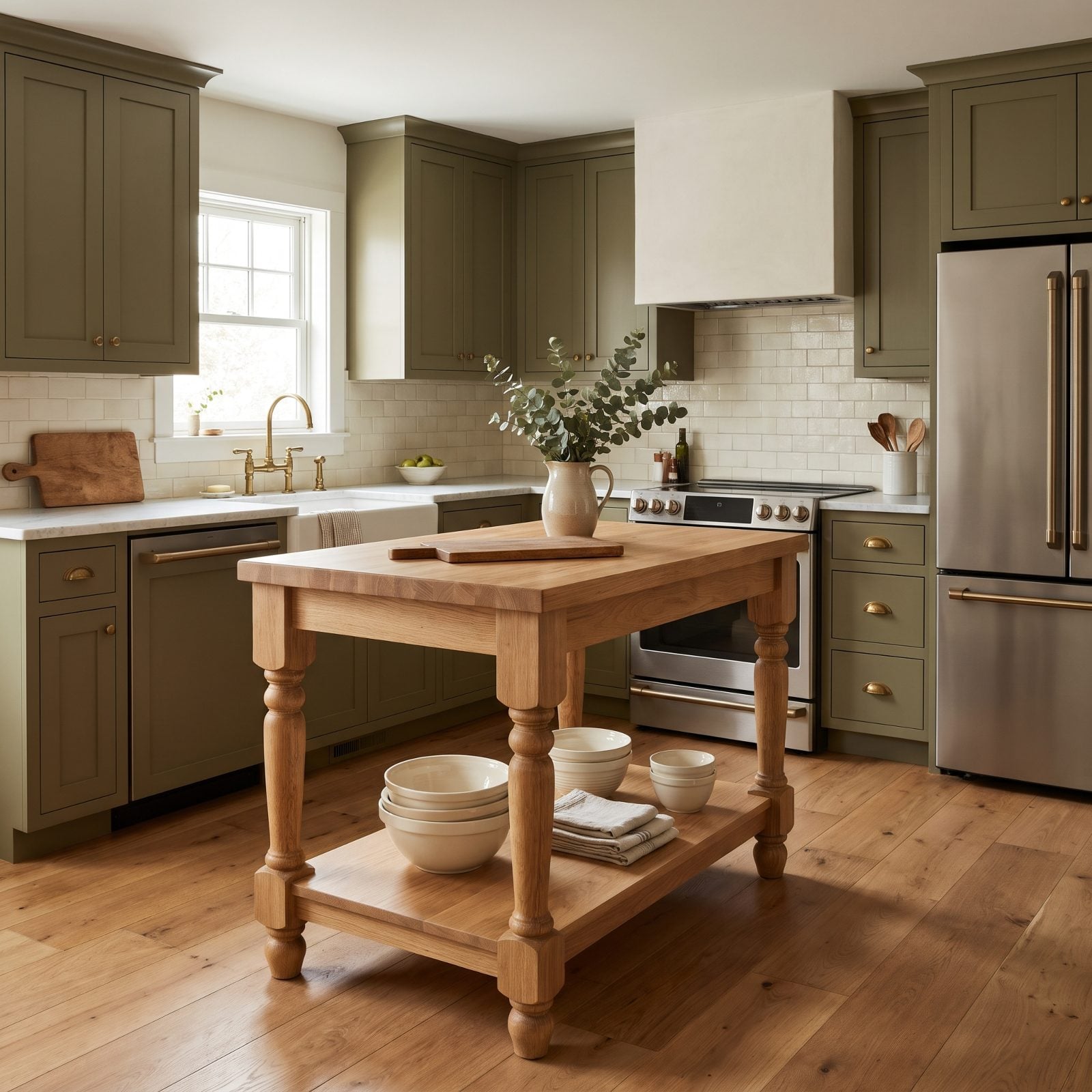
Skip the built-in island. A freestanding oak worktable gives you the same prep surface with none of the boxy permanence, and it reads like a piece of furniture that wandered in and decided to stay.
Against loden-olive shaker fronts, the raw oak top warms the room from the middle out. Fans of the warm bench ideas school will appreciate that lower shelf stacked with cream bowls and folded linen. All three appliances stay in the olive run: stainless range, panel-front dishwasher, brass-handled fridge.
25. Oak Pantry Towers Flanking an Olive Window Seat
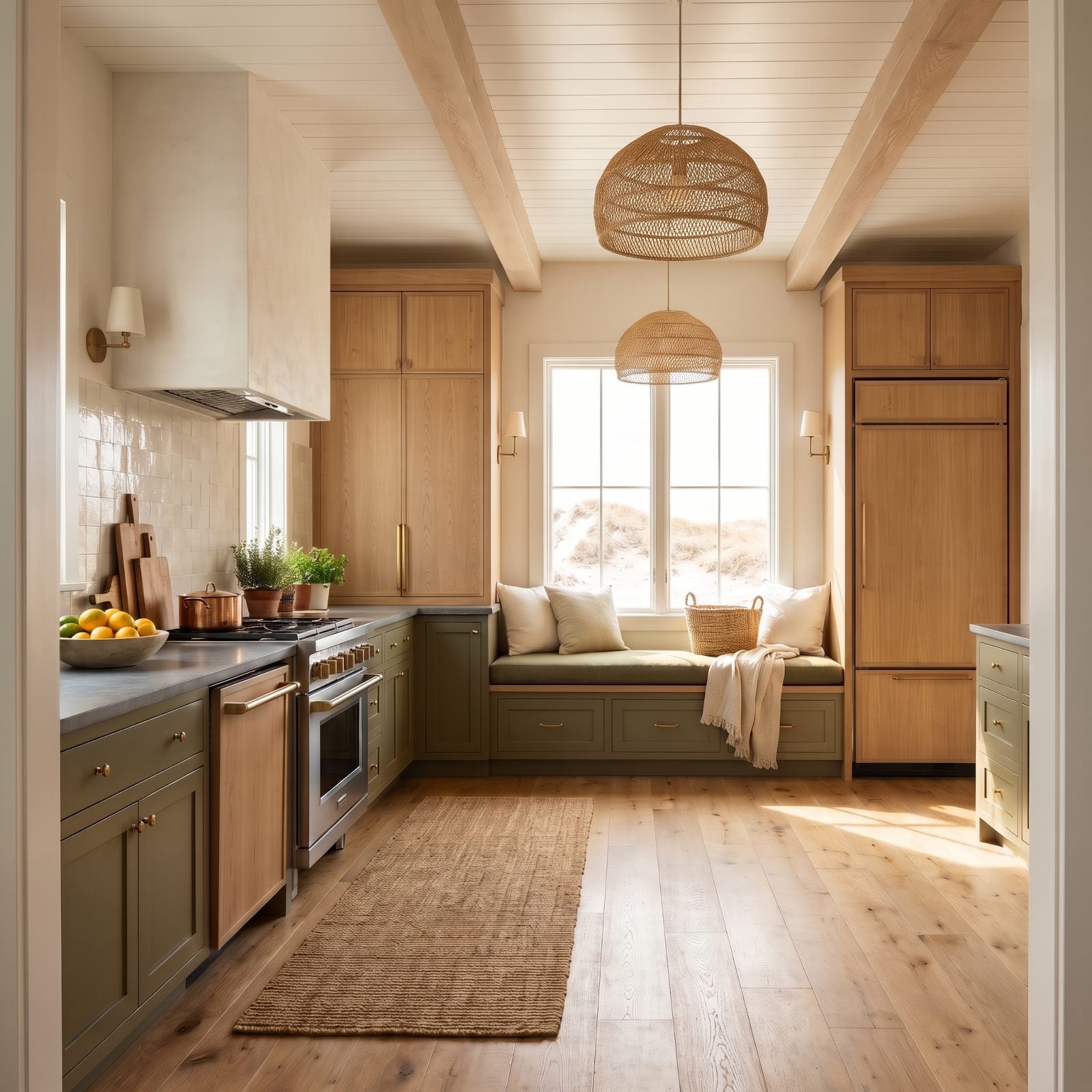
Twin oak pantry towers do something sneaky. They turn plain storage into structure, and framed between them, the olive-linen window seat becomes the quiet heart of the room instead of an afterthought wedged under the glass.
The machines vanish into the scheme. One tower swallows an oak-paneled fridge, the range sits in the herb-olive run, and the dishwasher hides behind an oak front. You’d never count three appliances in a room this calm.
24. Olive Cabinets Beneath an Oak-Clad Barrel Ceiling
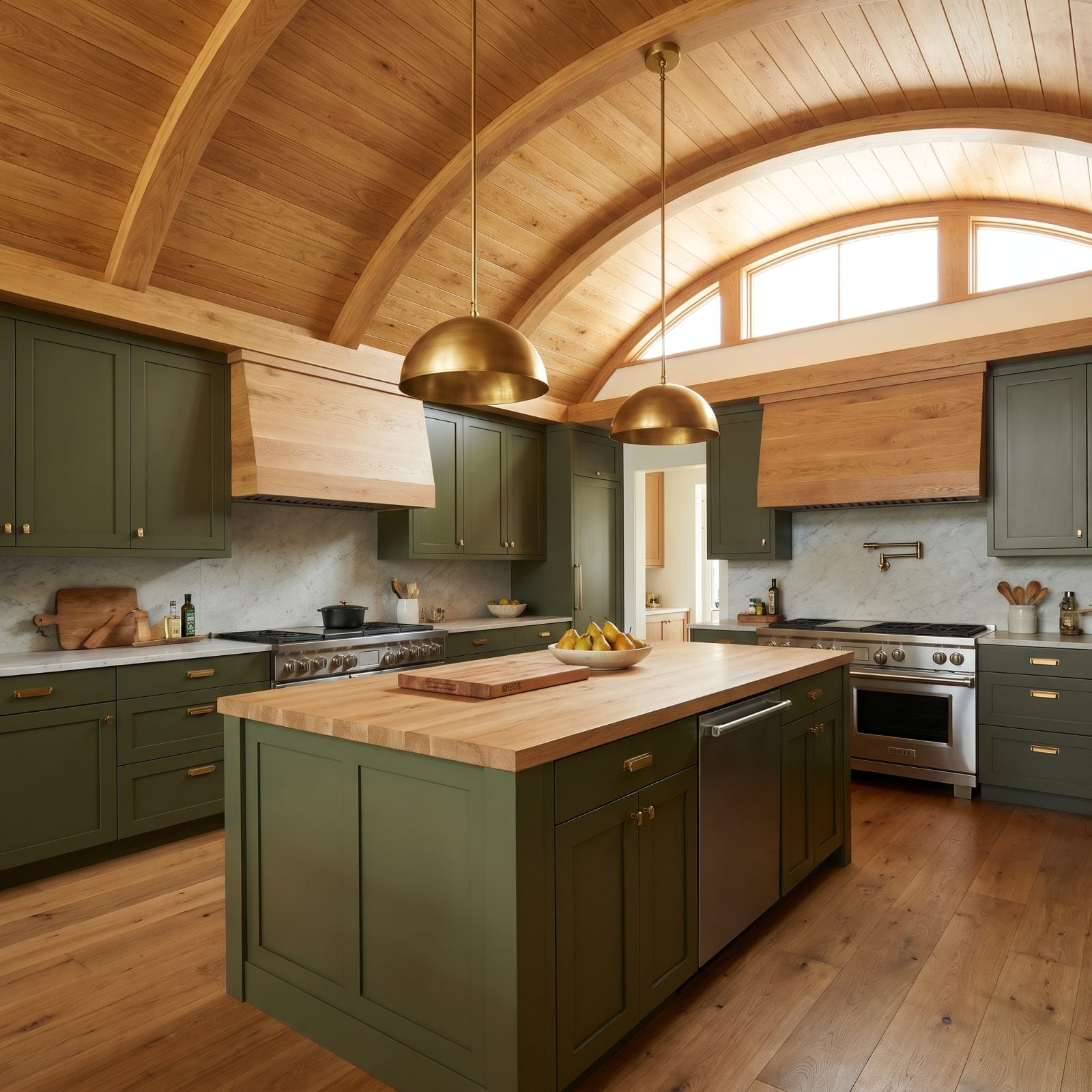
The barrel ceiling is the flex here, and it earns it. Oak planks curving overhead catch the daylight and throw a honey wash down onto the forest-olive cabinets, so the whole room feels lit from above even on a flat day.
Everything else stays grounded. The professional range sits under an oak hood that rhymes with the vault, the brass dome pendant lights hang low, and the fridge and dishwasher tuck into the olive run. A curved ceiling wants restraint everywhere else, and this room listens.
23. Olive and Oak Kitchen With Terracotta Flooring
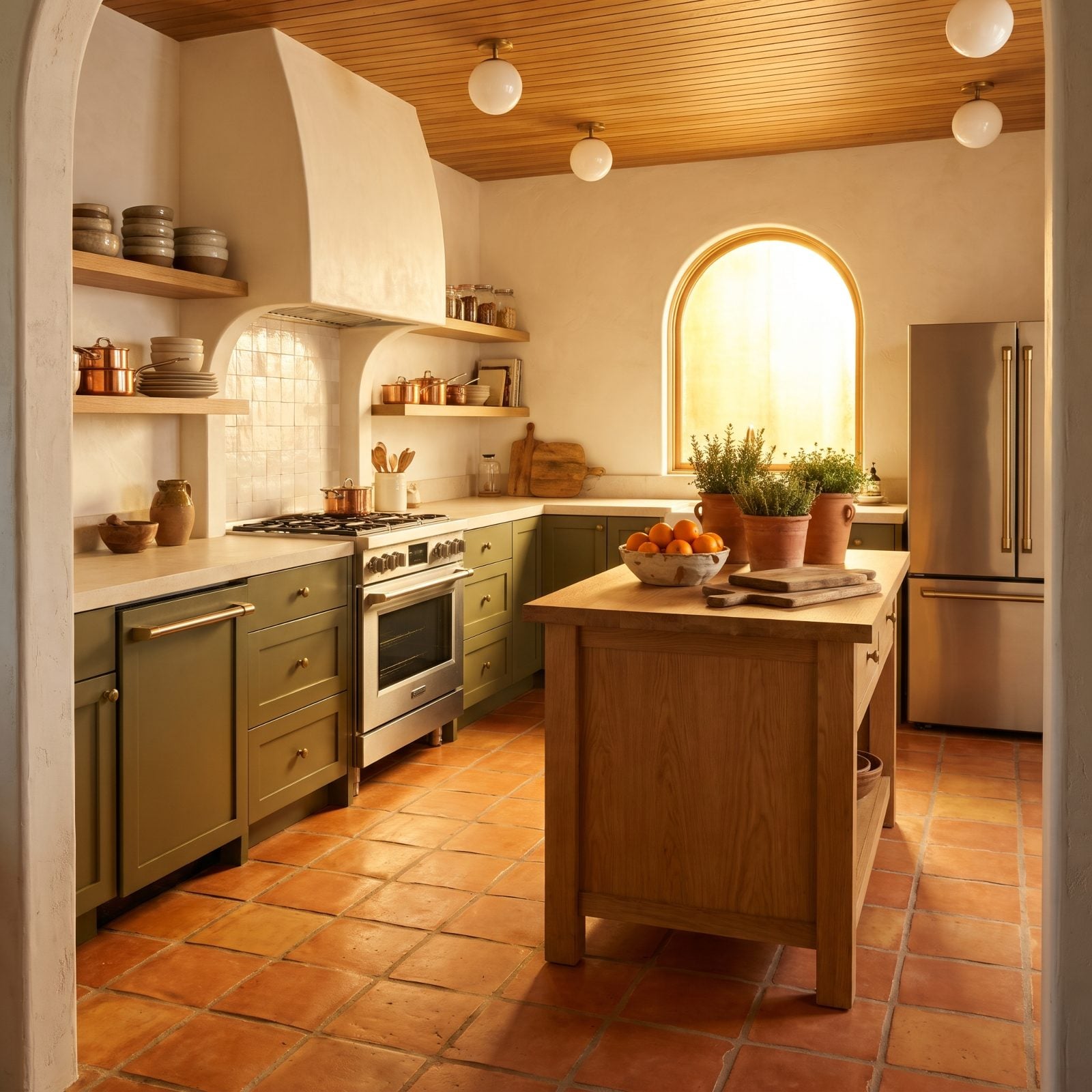
Terracotta underfoot is the unsung hero of this palette. The rust floor pulls the warm notes out of both the herb-olive cabinets and the oak shelving, so the room glows instead of cooling off the way grey tile always does.
Arched plaster softens the edges. The range nests under a curved hood, fridge and dishwasher sit in the olive run, and cream zellige keeps the backsplash light. It’s a villa kitchen that didn’t need a villa to pull it off.
22. Olive and Oak Kitchen With Cream Zellige Tile
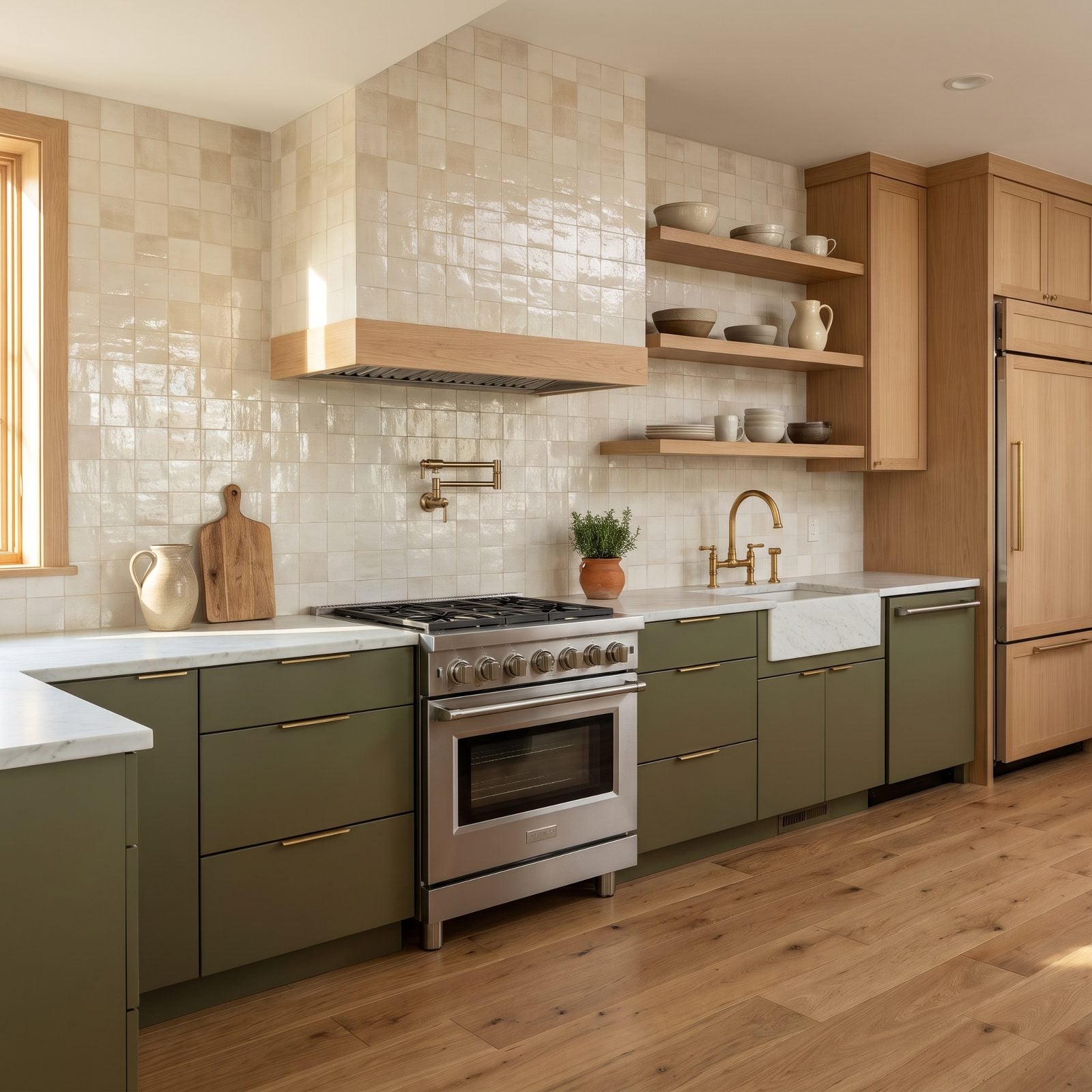
Cream zellige is the quiet overachiever. Each handmade tile catches light at a slightly different angle, so a plain backsplash wall shimmers all day without a single bold color.
Set against moss-olive lowers and white-oak uppers, that cream glaze reads like morning light made permanent. Range against the tile, oak-paneled fridge anchoring the run, dishwasher tucked beside the sink.
When we asked readers which backsplash they would install themselves, zellige drew 22% of the votes, behind slab at 36% and subway tile at 29%.
21. Olive and Oak Kitchen With Honed Soapstone Counters
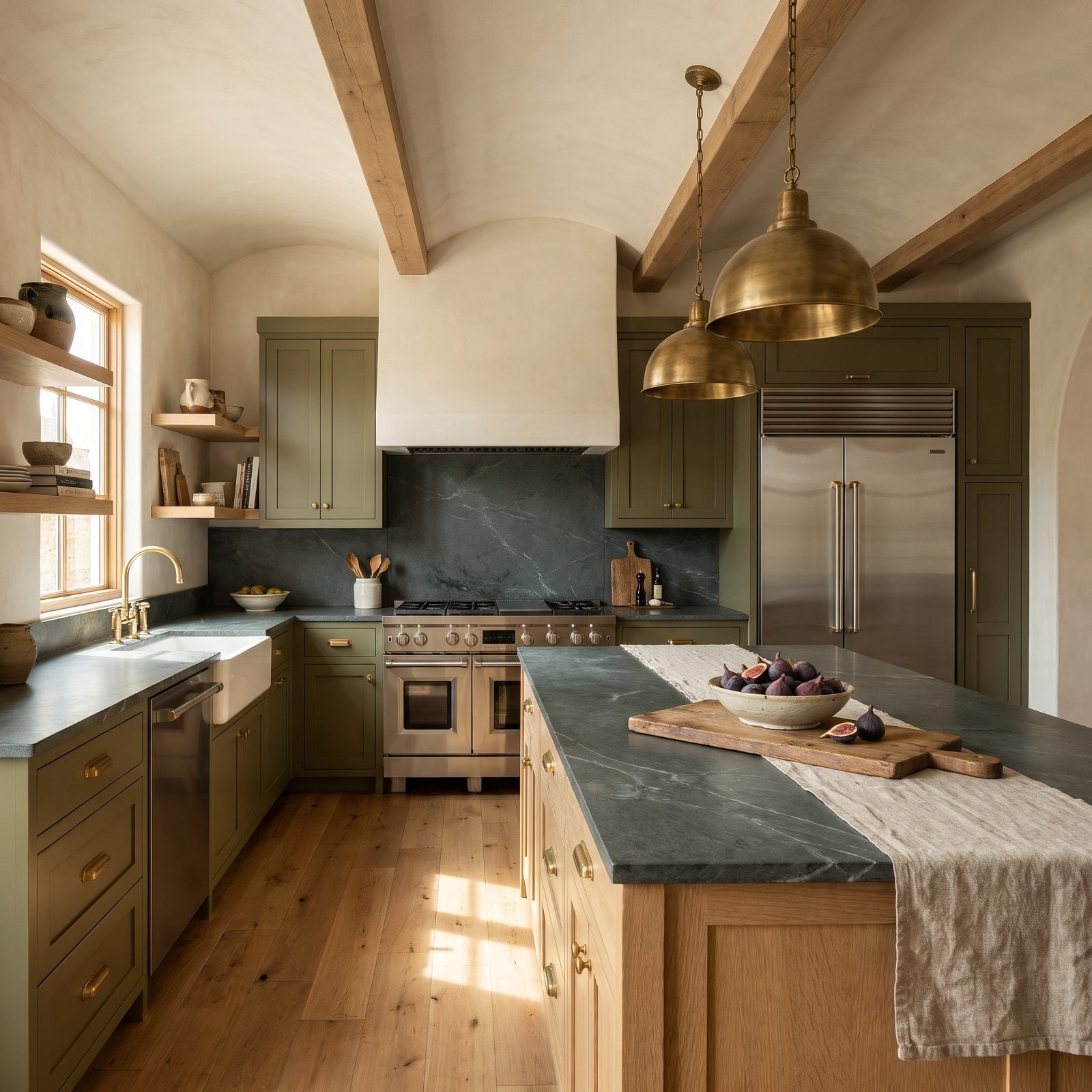
Soapstone is what grey wishes it could be. That deep charcoal-green honed surface has real depth to it, a wet-stone richness flat quartz never manages, and it ties the olive and oak together without picking a side.
The room leans handsome rather than pretty. Brass bin pulls go patinated, the oak island top matches the soapstone perimeter, and the professional range holds down the olive run with fridge and dishwasher close behind.
20. Olive and Oak Kitchen With an Aged-Brass Backsplash
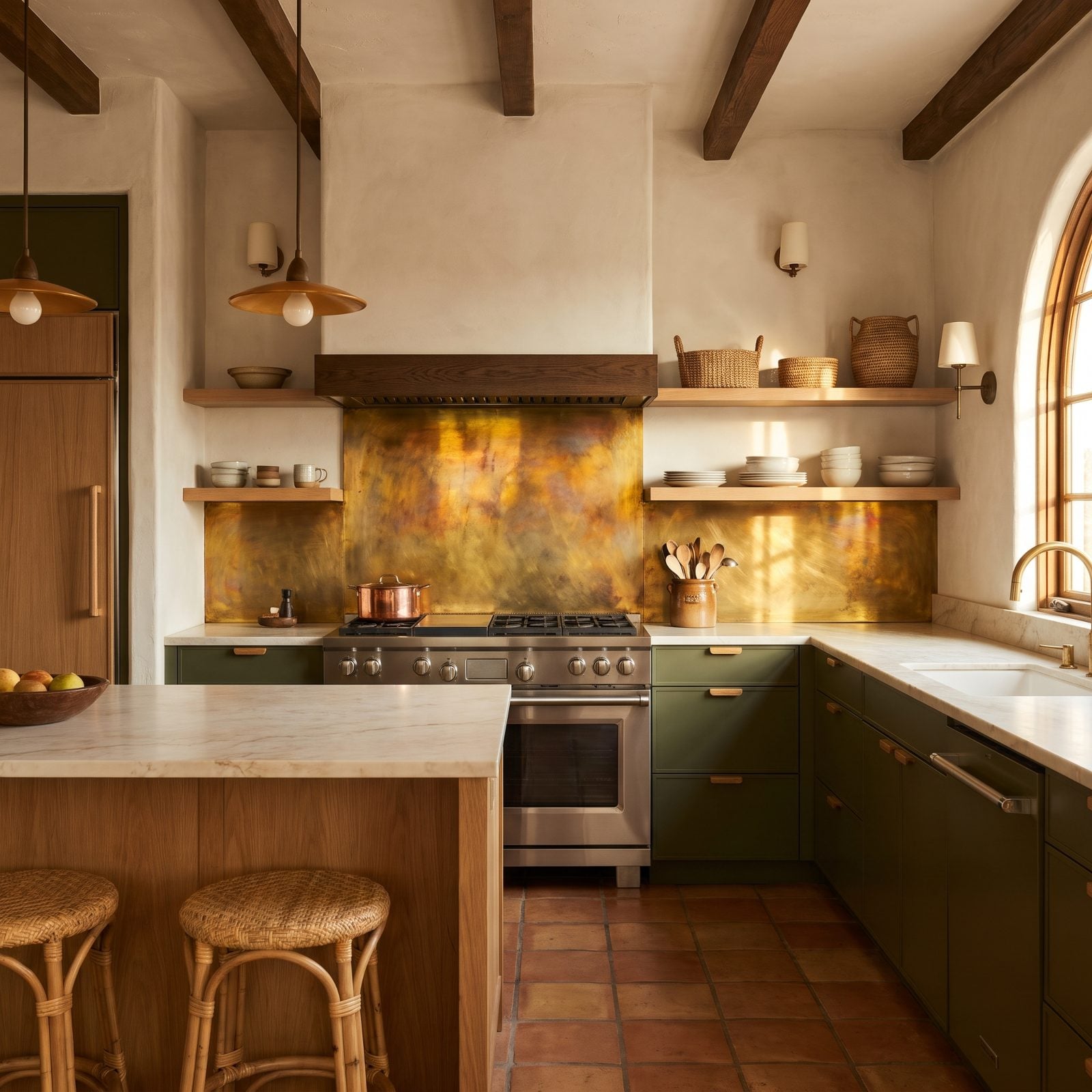
A brass backsplash is a gamble that pays off here. The aged sheet metal glows like banked embers behind the range, and its gold-bronze patina is already in conversation with the olive cabinets before you add a single accessory.
Oak keeps it from tipping into bling. Floating oak shelves and an oak-fronted island cool the shine, the range sits dead center against the metal, and fridge and dishwasher stay paneled and quiet.
19. Olive and Oak Kitchen With Handmade Brick Walls
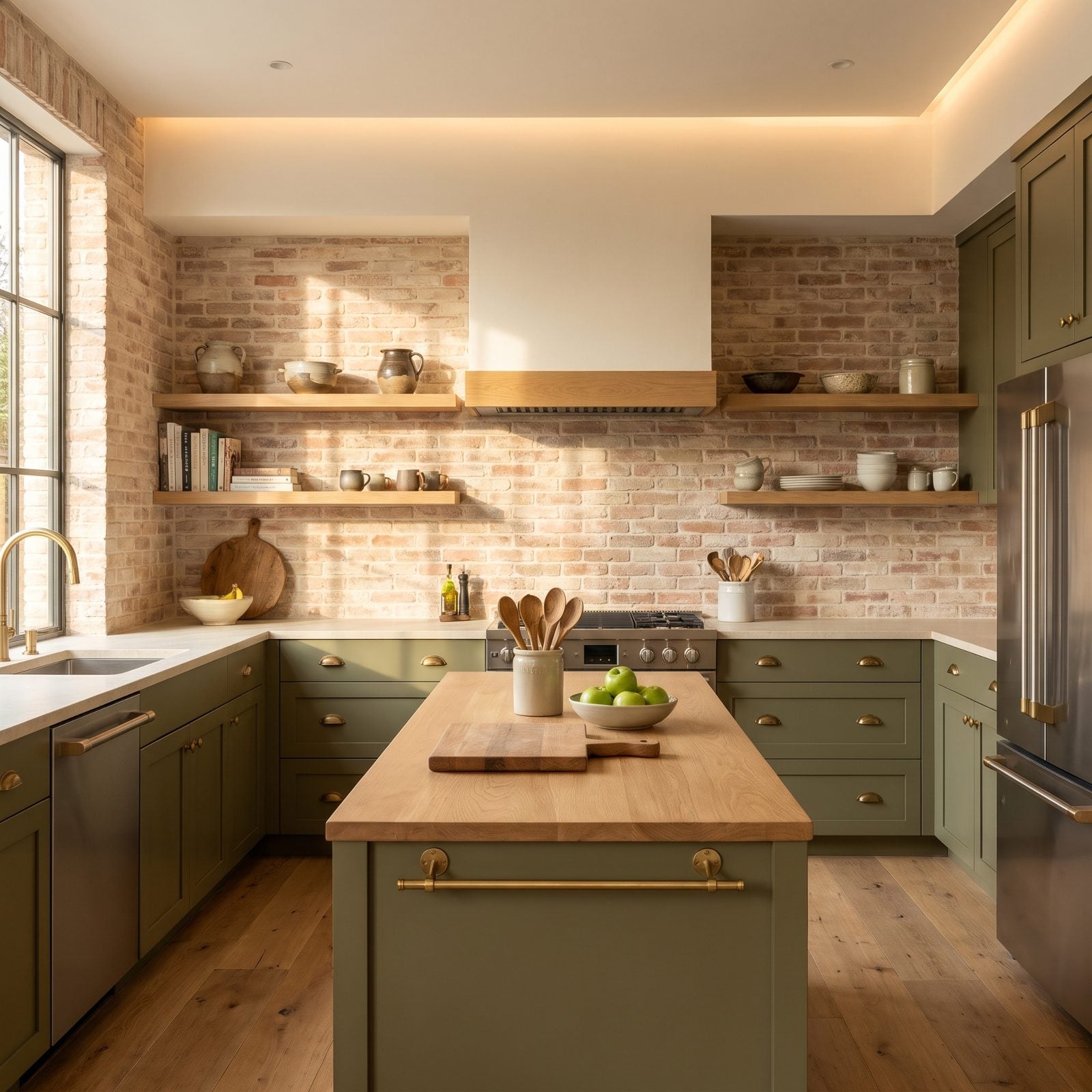
Exposed brick gives olive and oak something to push against. The handmade terracotta-and-cream wall brings texture and age no new material can fake, and the lime-washed patches soften it just enough to stay modern.
Moss-olive cabinetry reads richer against rough masonry than it ever would against drywall. Oak shelves bracket off the brick, the range sits against it under a hood, and brass cup pulls catch the raking afternoon light. Fridge and dishwasher hold the olive run.
18. Olive and Oak Kitchen With Blackened-Steel Windows
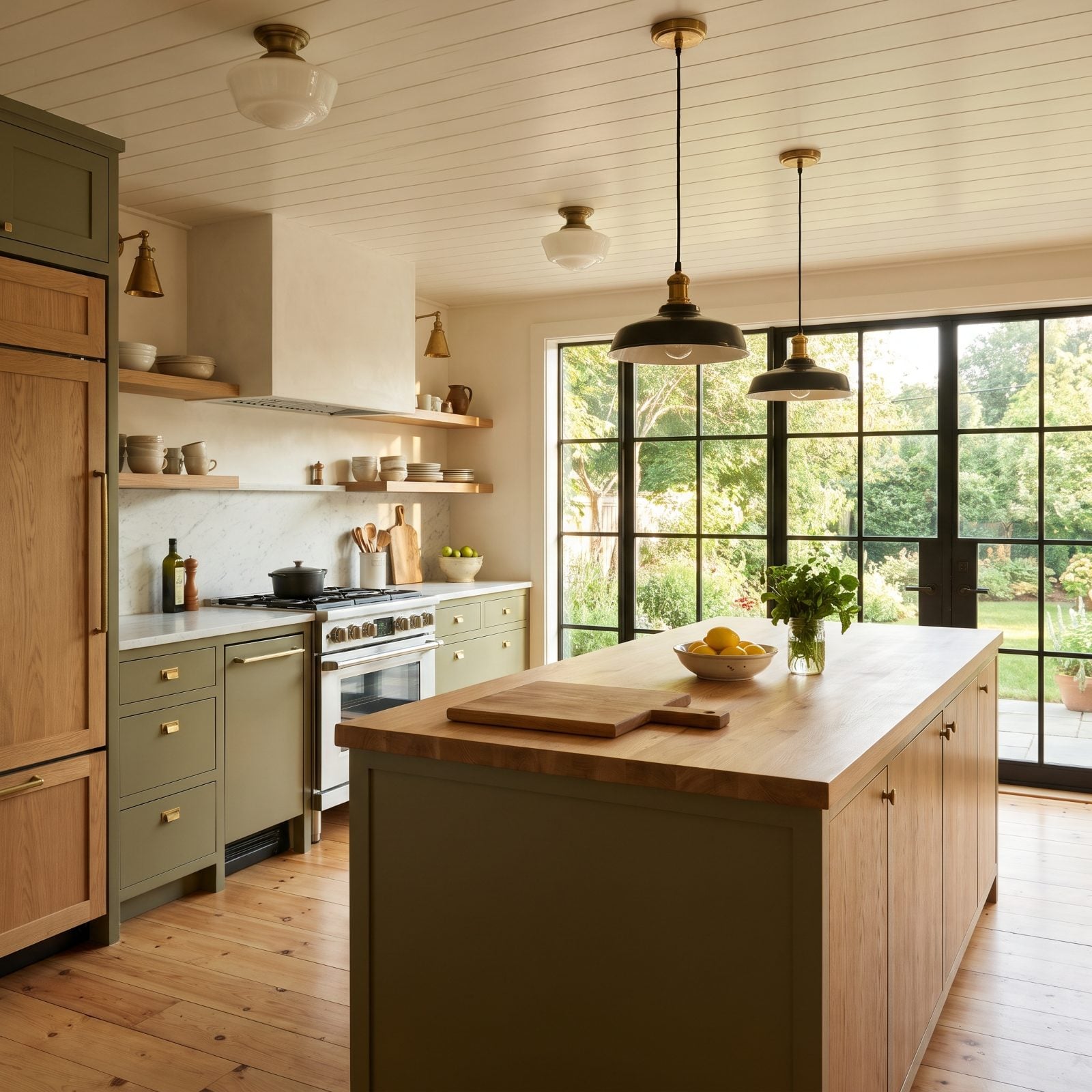
Everything in this kitchen points at the light. A wall of slim blackened-steel windows frames the garden like a grid of paintings, and that thin black line is the only dark note the whole scheme needs.
The contrast carries the room. Loden cabinets and a warm oak island look even warmer with cool black steel for company, the range sits off to the side under a plaster hood, and the fridge and dishwasher stay paneled so nothing competes with the view. Grey finally gets shown the door here, and good riddance.
17. Woven Rattan Pendants Over Olive and Oak, the Modern Organic Way
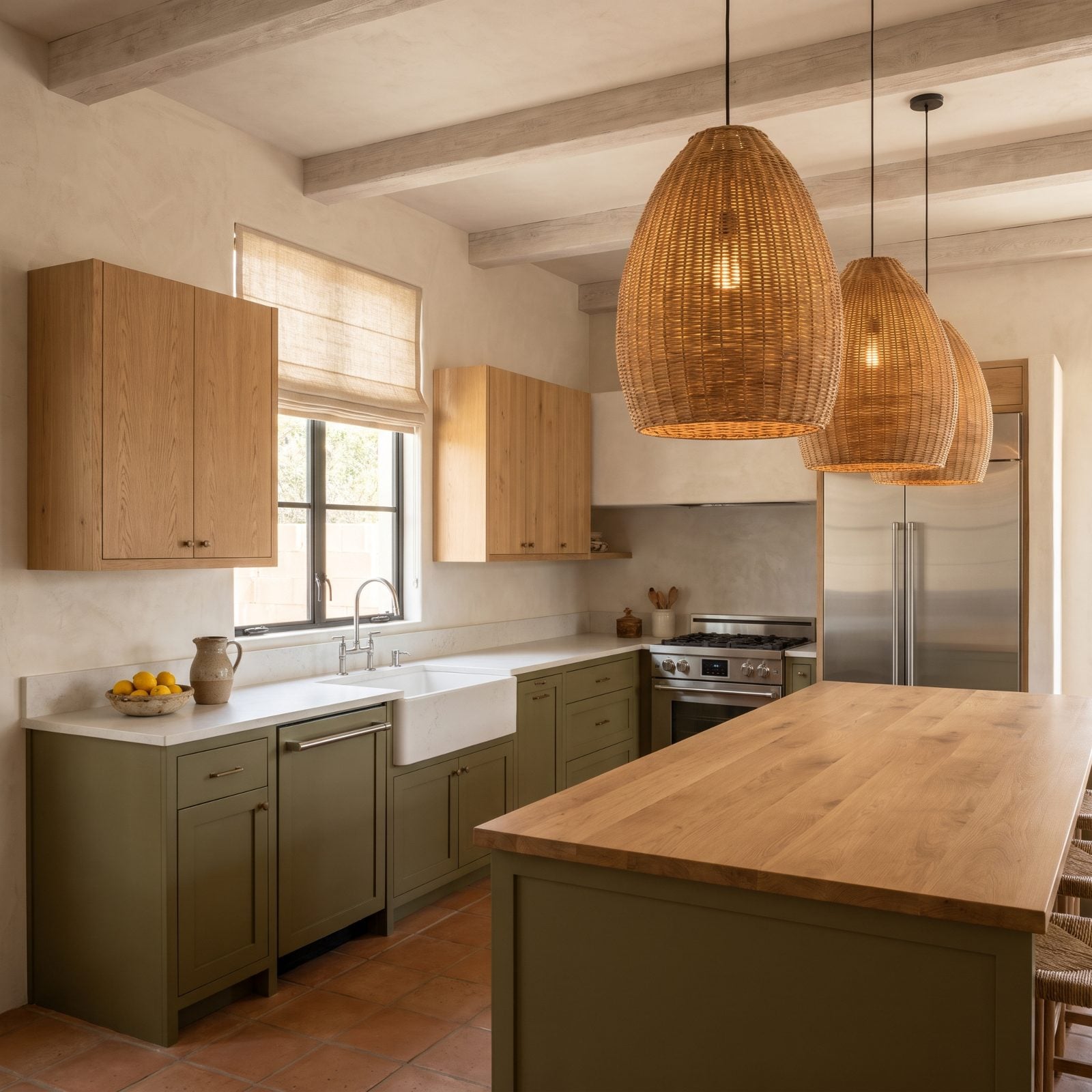
Those three woven rattan pendants are the whole mood here. They pull the olive cabinetry back from serious and hand the oak island something soft to answer to. A sleek metal shade would bounce light straight back at you, but rattan catches it and scatters it around the room, warm and uneven.
Moss-olive on the lowers, slab rift-sawn oak up top, honed white quartz in between, and nothing fights for attention. The woven rattan pendants carry the personality while the cabinets just hold the room steady.
16. An Oak-Slat Vent Hood Steals the Show in a California Modern Kitchen
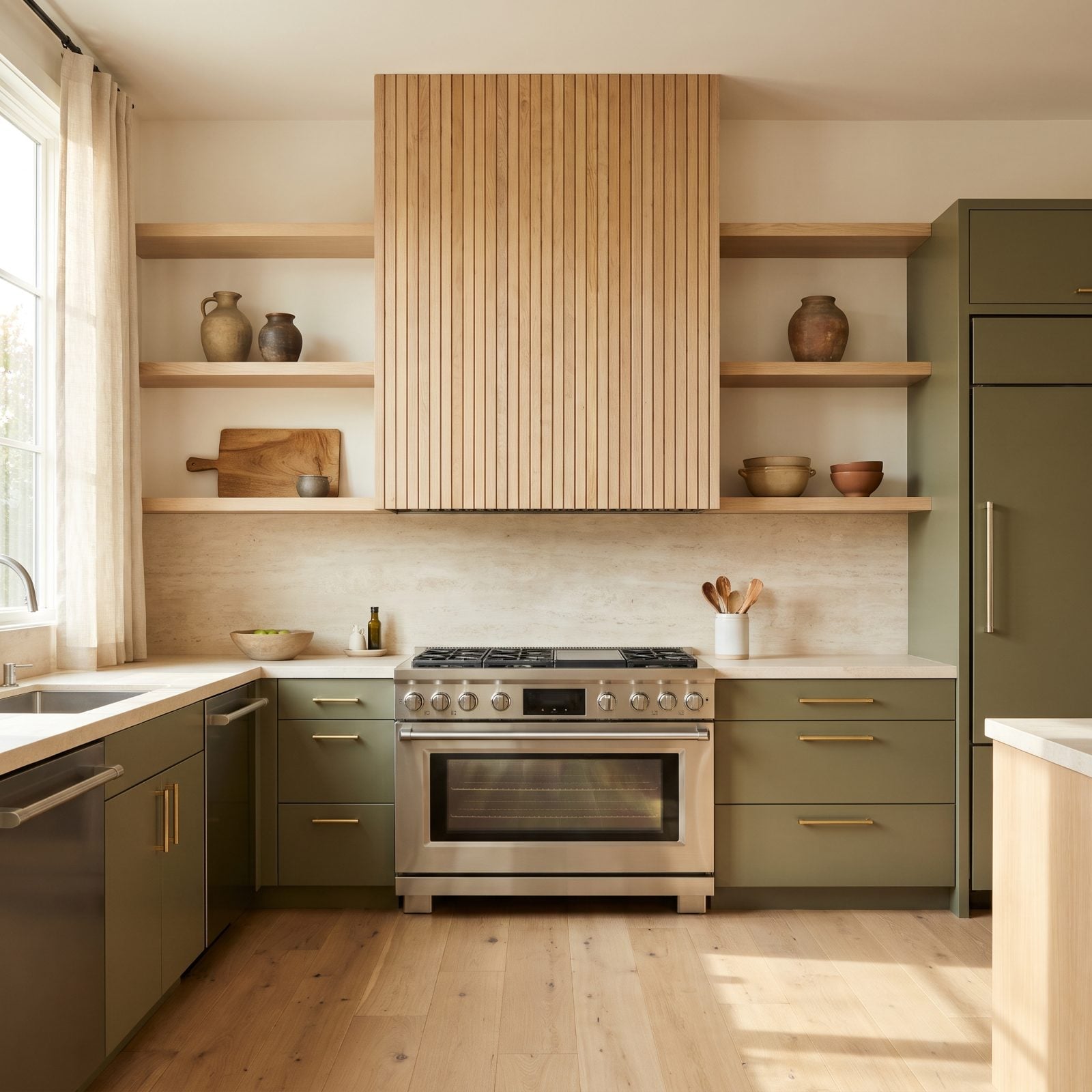
The oak-slat hood is the hero, and it knows it. Vertical slats over a stainless range take the one thing most kitchens try to bury and make it the first thing you look at.
Loden-olive cabinets sit underneath with brushed brass pulls, calm enough to let the slats run the show. Travertine on the counters and backsplash keeps the whole thing warm instead of clinical. Slatted wood near a stove can sound like asking for trouble. Properly sealed and set back, though, it’s fine, and it looks like nothing else on the block.
15. A Fluted-Oak Island Anchors This Contemporary Olive Kitchen
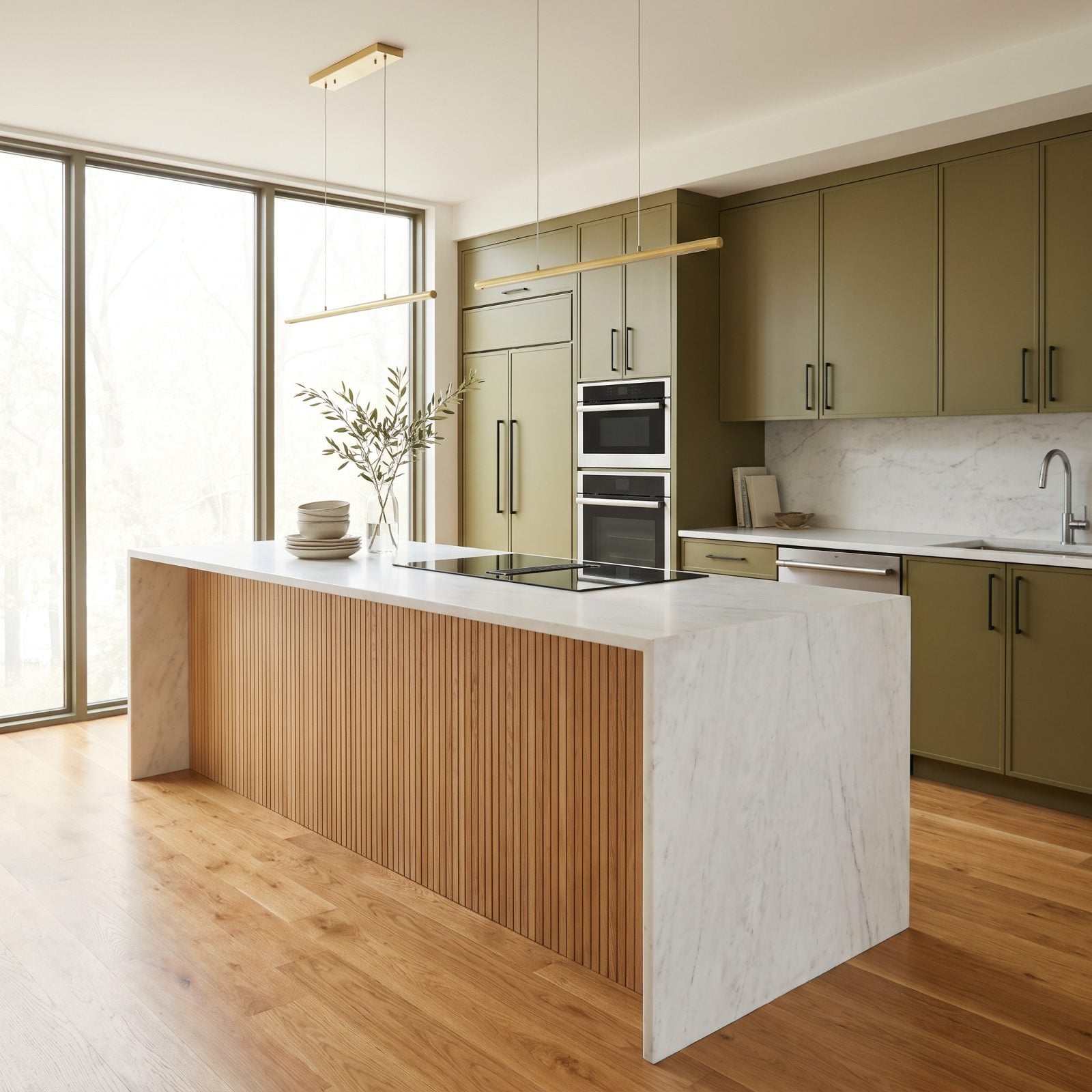
Run your eye along that fluted-oak island and the whole room softens. Vertical reeding breaks a big slab into rhythm, so the island reads as furniture instead of a block parked in the middle of the floor.
Herb-olive perimeter cabinets stay flat and quiet, which is exactly the point, because one textured surface per room is plenty. The brass linear pendants keep the sight lines open across the marble.
14. Classic Farmhouse, Grounded by an Oversized Oak Table
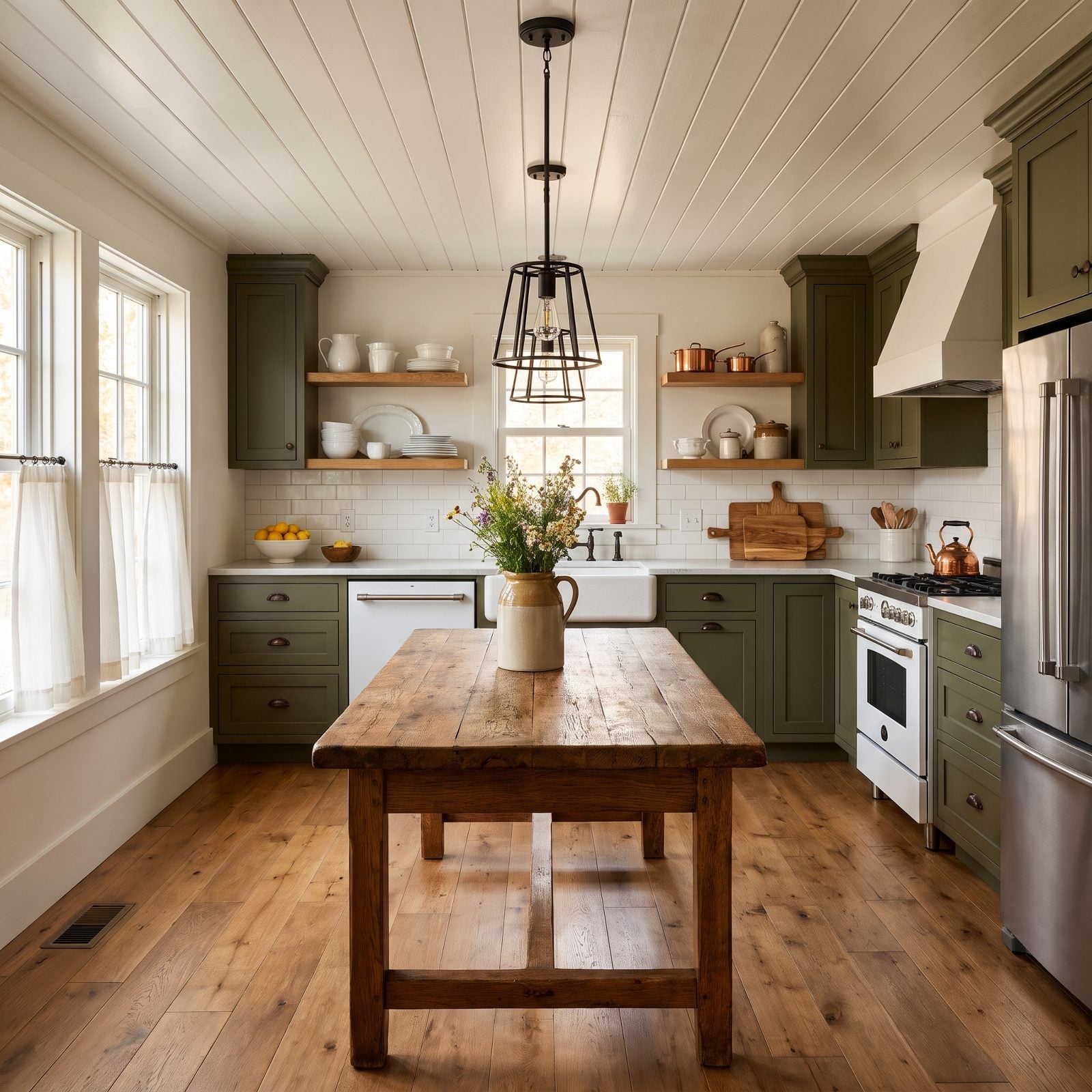
No island. Just a long oak table doing the work of one, and honestly doing it better. You prep here, you eat here, you park a laptop here, and the table earns its square footage three times over.
Forest-olive shaker cabinets with oil-rubbed bronze cup pulls set a deep, grounded backdrop. Those black iron cage pendants pull the eye down to the table where it belongs.
13. A Built-In Banquette Tucks Breakfast Into the Corner
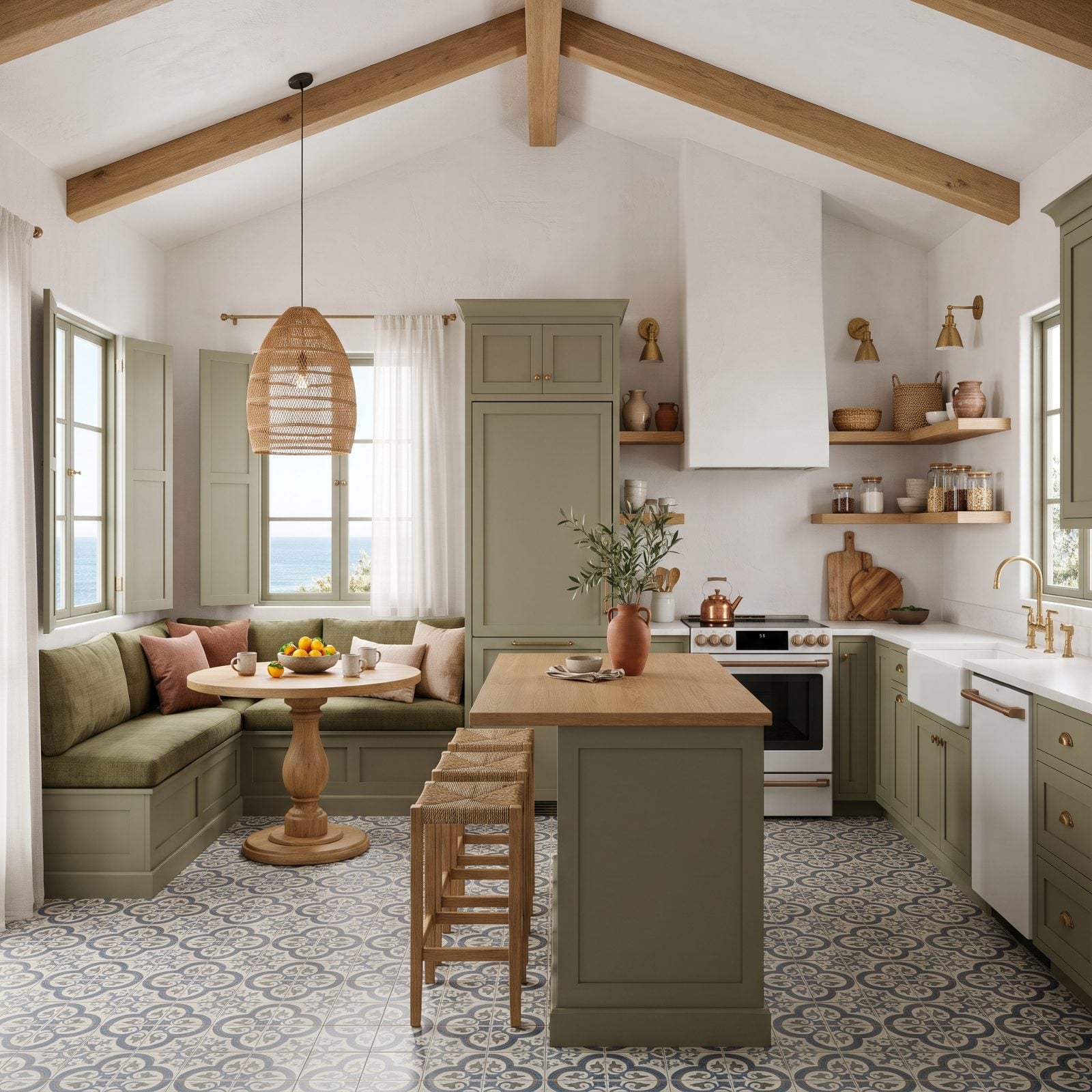
A banquette in olive linen, tucked under two windows, is the smartest move in this kitchen. Corners usually go to waste. This one became the seat everyone fights for.
Sage-olive cabinetry and oak shelves keep the main run light, so the deeper olive on the olive linen bench cushions reads as a reward you only find once you’ve wedged yourself into the corner. Want more built-in seating ideas? These warm bench ideas are worth a look.
12. A Glass-Fronted Scullery Keeps the Mess Where You Can’t See It
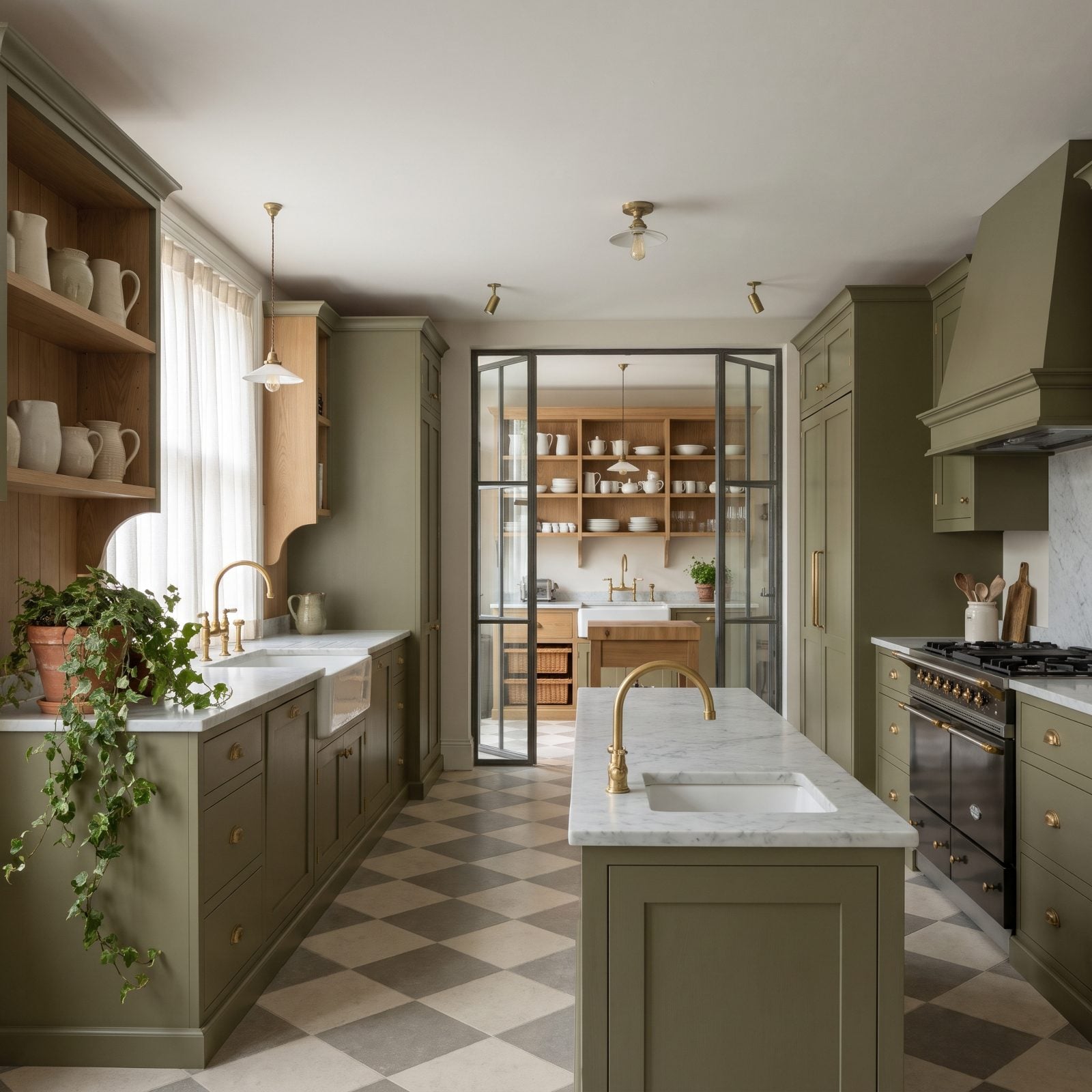
Steel-framed glass doors into a working scullery, this is how you keep a showpiece kitchen and still cook a real dinner. The pretty room stays pretty. The chaos has somewhere to go.
Up front, olive shaker cabinets, white marble and unlacquered brass carry the English cottage mood, while the glass lets you glimpse the scullery’s oak shelving without having to keep it staged. A grey-and-cream checkerboard stone floor runs through both rooms and ties them into one story.
11. Through the Arched Pantry Doorway in a Mediterranean Villa Kitchen
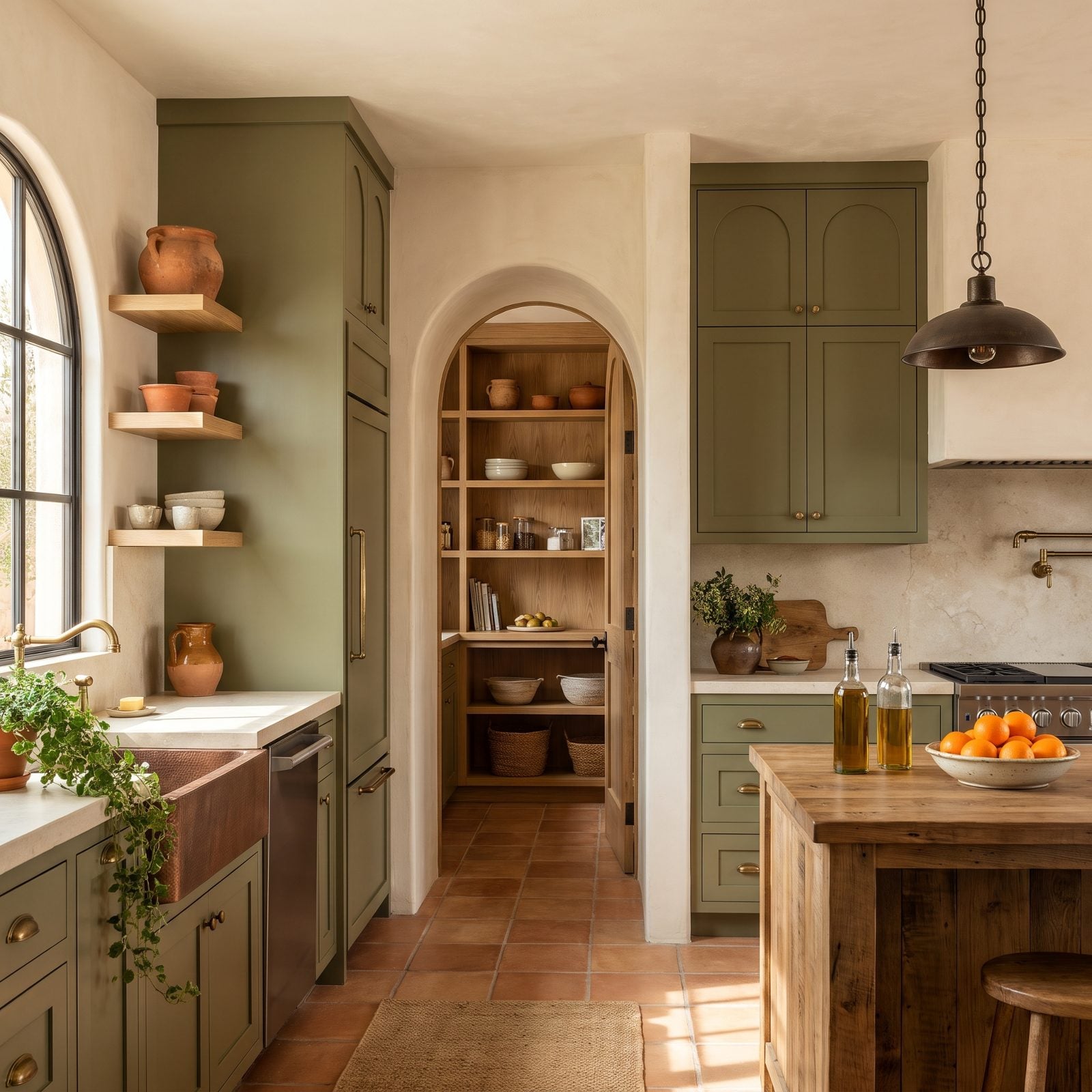
That plaster arch framing the pantry doorway sets the tone before you’ve seen a single cabinet. Curves soften a room full of straight lines, and this one leads your eye straight into oak shelving stacked with terracotta.
Herb-olive cabinetry with aged brass and arched upper doors keeps the Mediterranean thread running. Limestone counters and a hammered copper sink add the sun-washed weight the style needs. And the arch isn’t decoration. It’s the room telling you where to go.
10. A Herb-Filled Garden Window Brings the Green Indoors
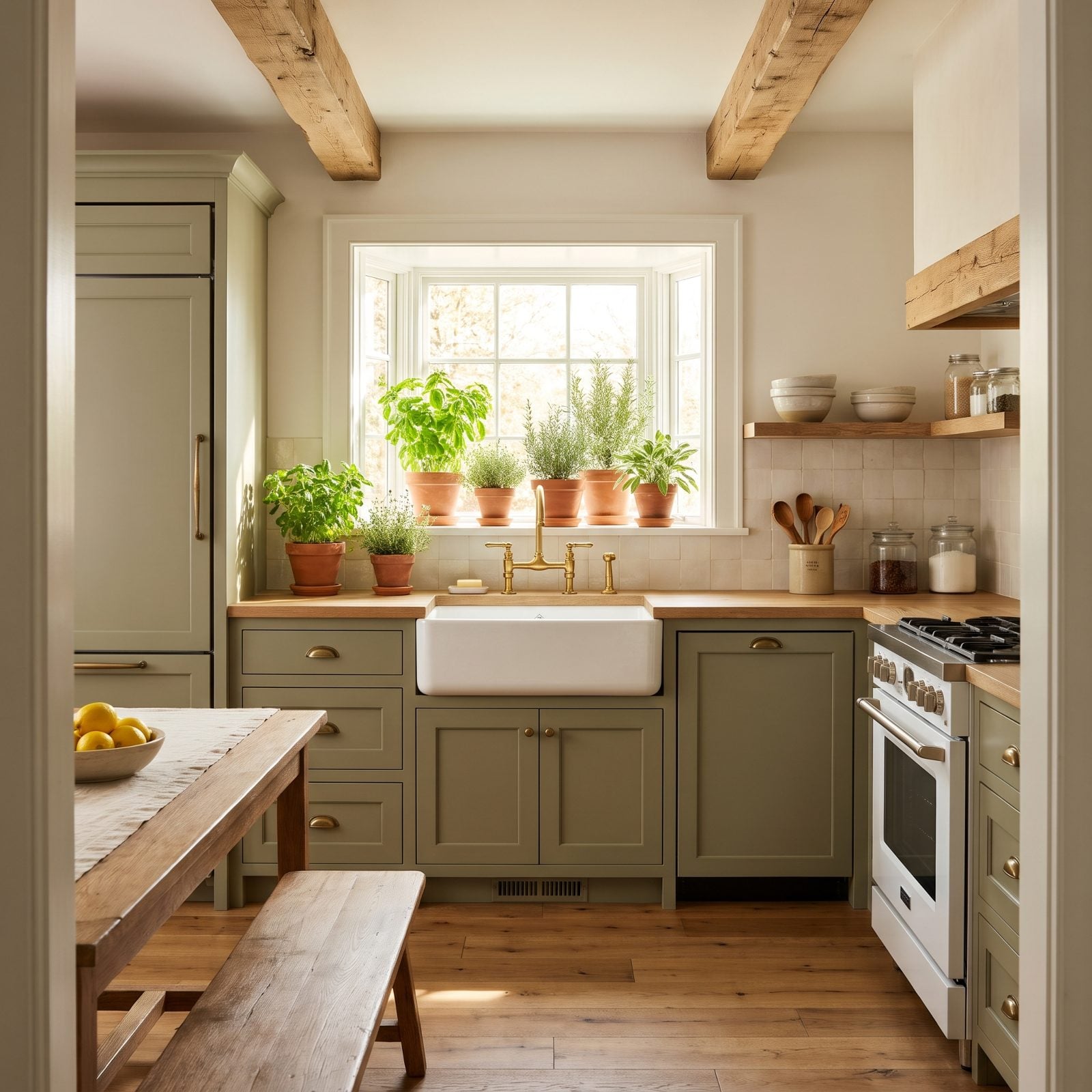
A garden window packed with basil, rosemary and thyme over the sink. Of all the ways to bring green into a kitchen, this is the one that actually feeds you.
Sage-olive shaker cabinets and oak counters echo the plants in the window, so the living green and the painted green talk to each other. A brass bridge faucet and cream zellige keep it from going twee. Even if half the herbs don’t make it, a scrappy pot of thyme in that window earns its spot.
9. A Freestanding Vintage Hutch Does the Talking in This Rustic Kitchen
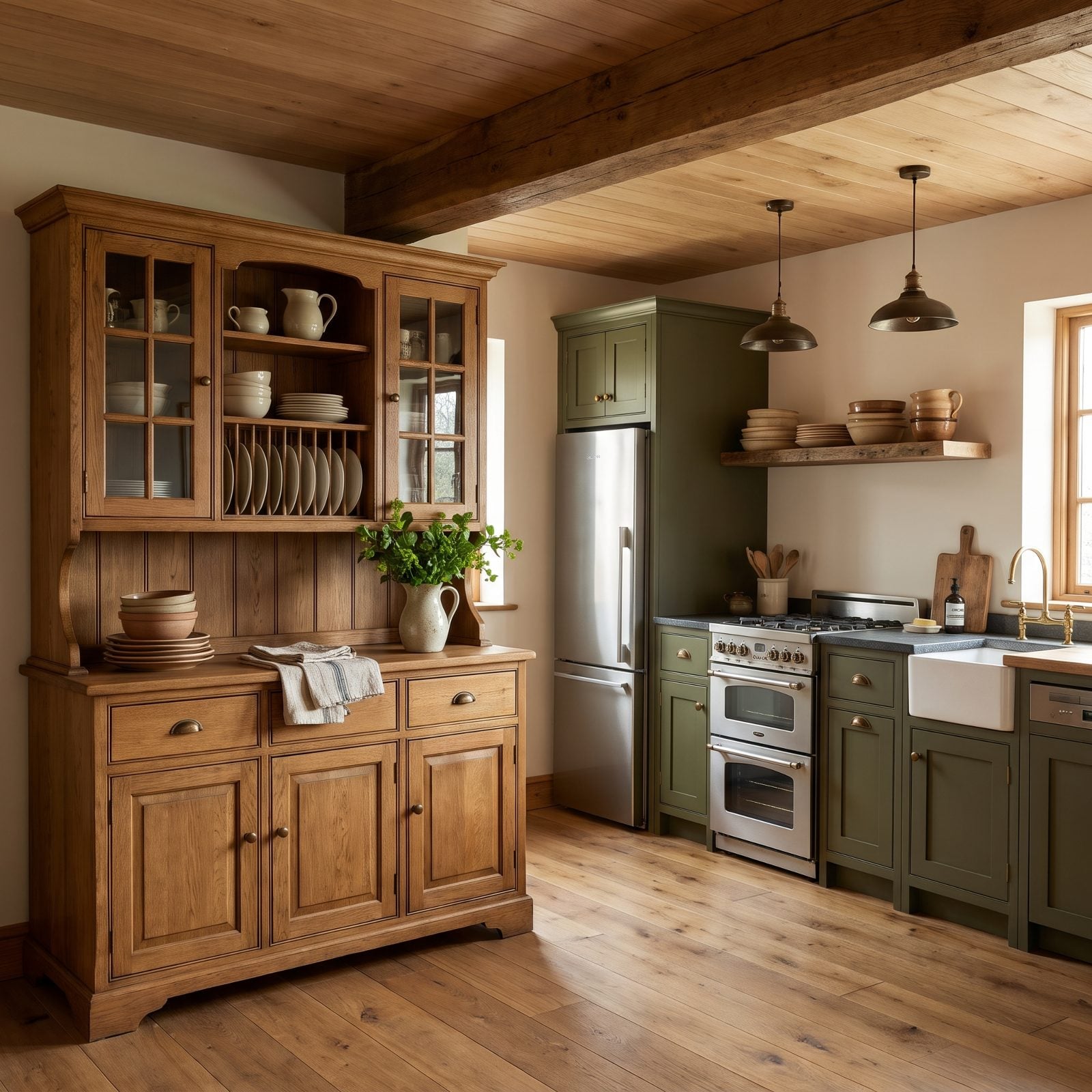
Skip the matched run of upper cabinets and let a freestanding oak hutch carry the wall instead. Glass fronts, a plate rack, decades of patina you couldn’t fake in a new build if you tried.
Forest-olive fitted cabinets ground the room while the hutch brings the history. That’s the whole trick with rustic. You want one piece that clearly wasn’t bought last year. An exposed beam overhead and soapstone by the range finish the thought.
8. When Oak Panels Swallow the Refrigerator Whole
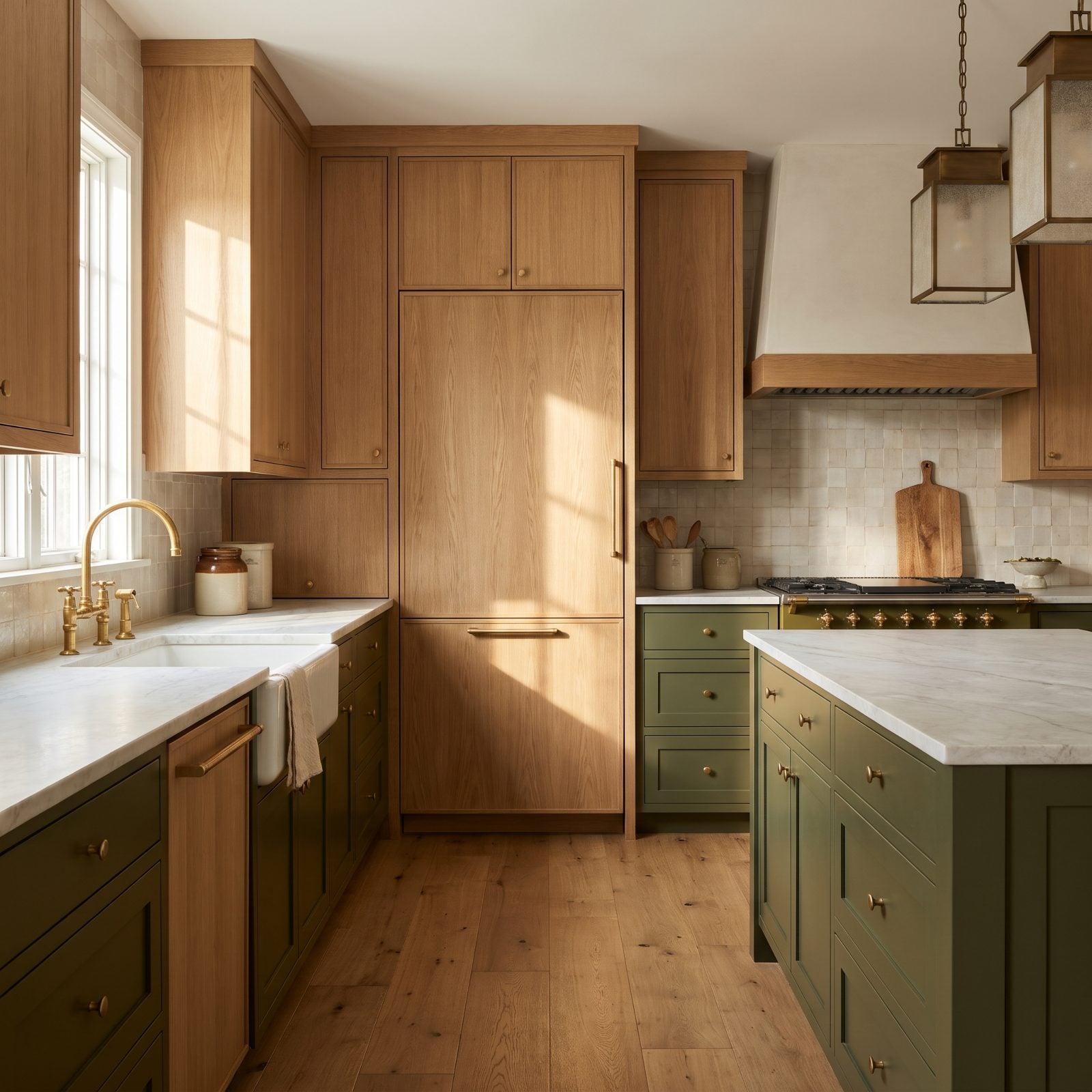
The whole trick here is disappearance. That refrigerator wears the same rift-sawn oak as the cabinets beside it, grain running unbroken across the doors, so your eye slides right past it and lands on the moss-green island instead. Hiding the big appliance behind wood panels is the oldest move in luxury kitchens, and it still reads as money because it buys you an uninterrupted run of warm oak.
The olive lowers anchor everything so the pale cabinetry doesn’t float. Brass tab pulls, an unlacquered brass bridge faucet, and a brass-trimmed olive range with stainless rails, echoed by the steel insert under the hood. Enough.
7. Display Niches Painted Olive From the Inside Out
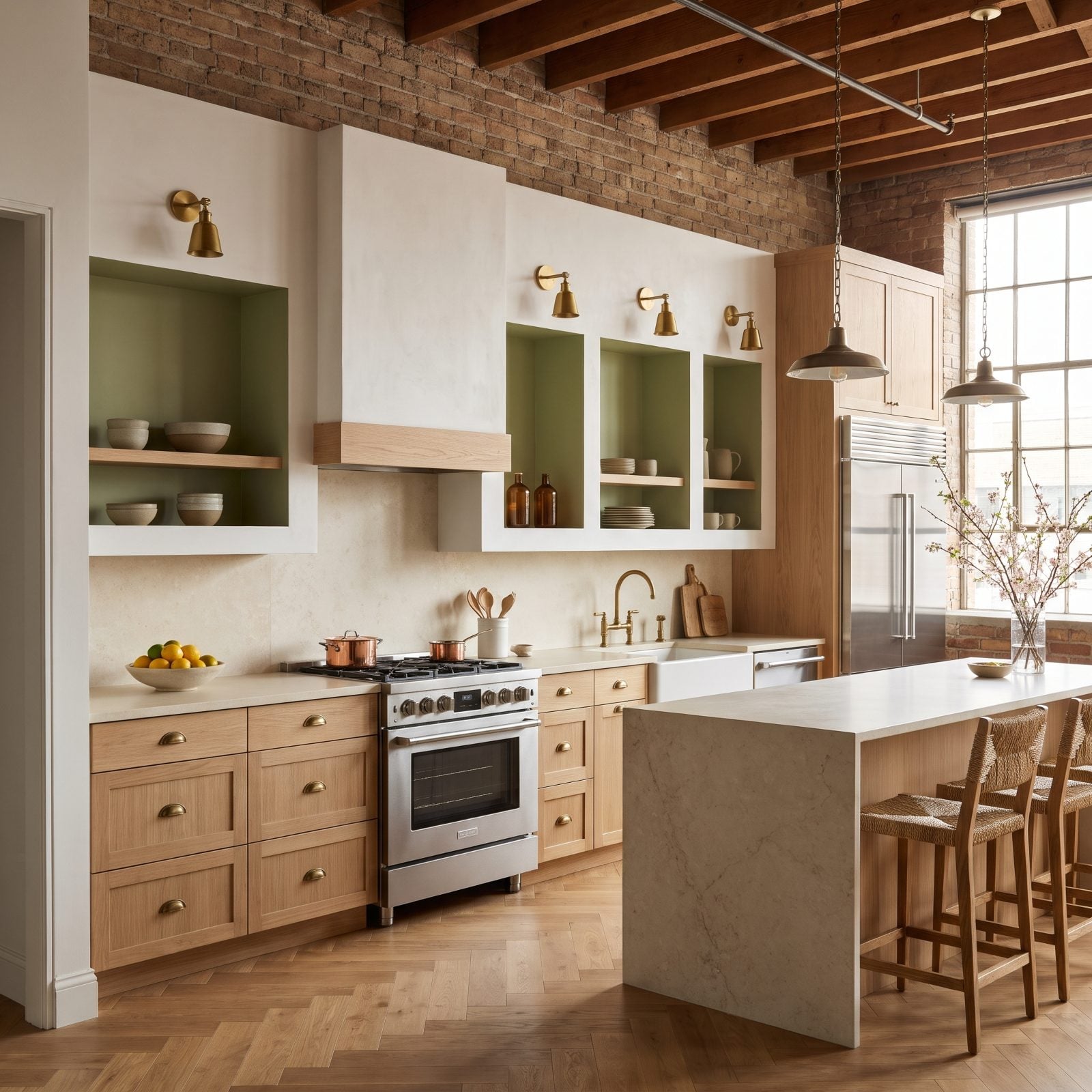
Olive doesn’t have to cover a single cabinet to run the room. Here it lives only inside the display niches, lining the back of each recess so the green glows out at you like light through a leaf. The oak stays pale and quiet while the niches do all the talking.
Backing open shelving in color instead of painting the whole wall is a smart move. You get the saturation without the commitment, and those stoneware bowls pop against it.
6. An Oak Peg Rail Does the Work of Upper Cabinets
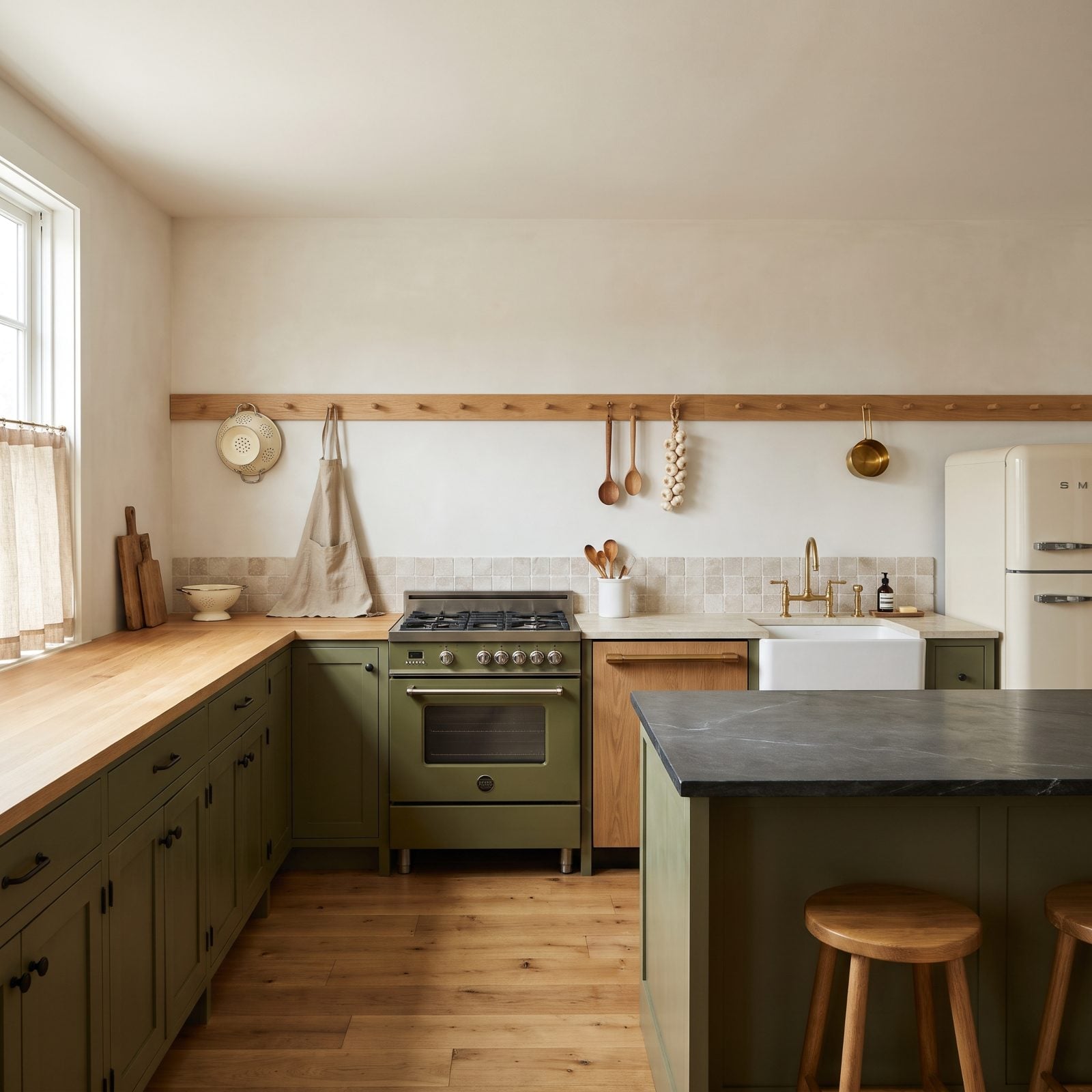
Lose the upper cabinets. Hang a peg rail instead. This oak rail runs the length of the wall and carries the daily stuff — a colander, a linen apron, a braid of garlic — so the plaster above can just breathe. The Shakers thought of it first, and the Shakers were right about almost everything to do with a kitchen.
Loden lowers ground the whole thing, and the cream enamel fridge keeps it from going too earnest. Warmer than any run of gray boxes. Cheaper to build, too.
5. Olive and Oak Settle Into an English Cottage
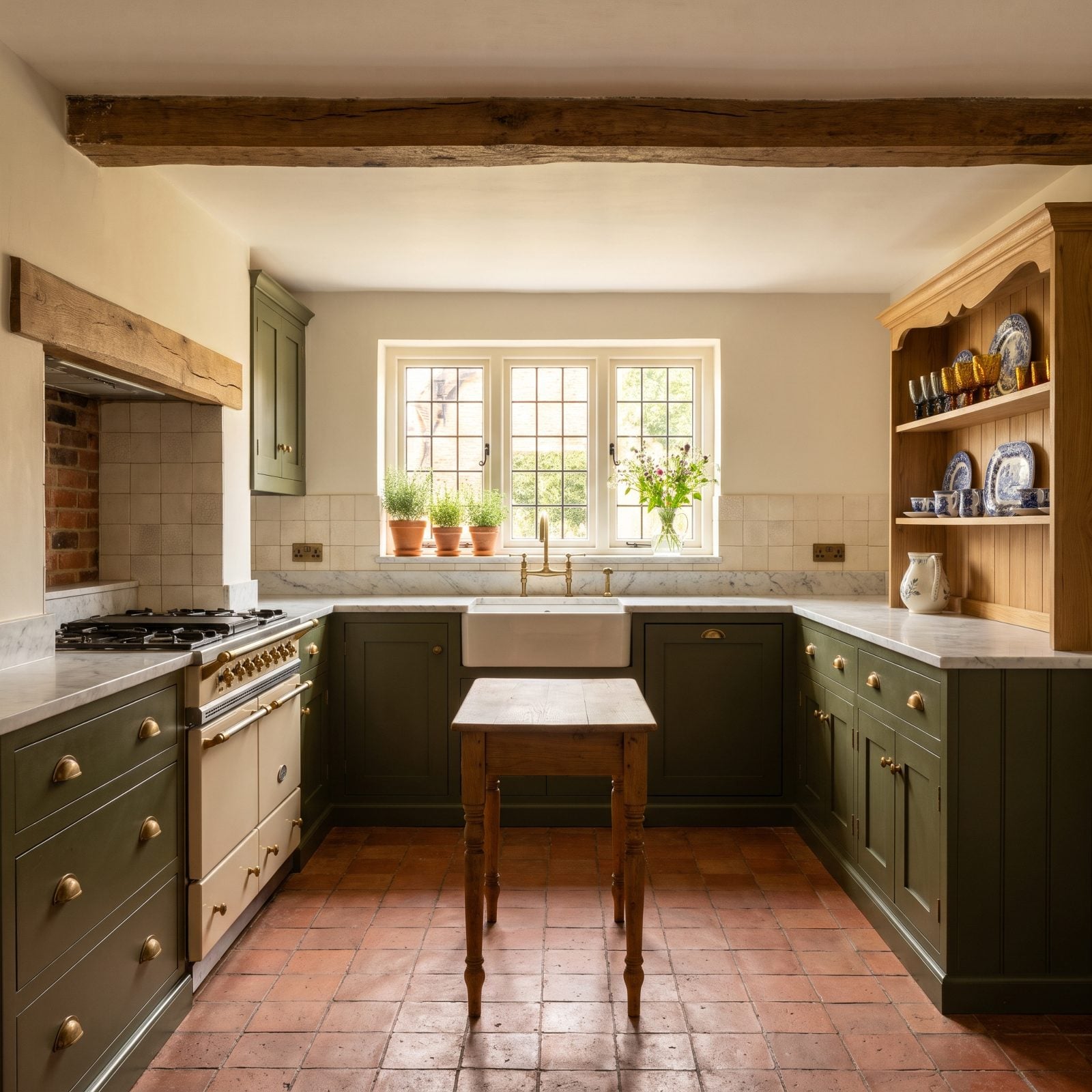
Forest-olive cabinets, an oak dresser stacked with blue-and-white transferware, a cream range tucked into a brick alcove. This is the cottage kitchen doing what it does best, which is looking like it grew there over fifty years rather than getting installed last spring.
Low beamed ceiling. Honed marble worn soft. A terracotta floor that’s clearly seen some things. The oak hutch breaks up the green so the room never tips into gloom, and the afternoon light through the leaded glass does the rest.
Olive green is the color an English garden turns in late summer, which is exactly why it feels at home under a low oak beam.
4. Low, Long, and Warm: The Midcentury Ranch Version
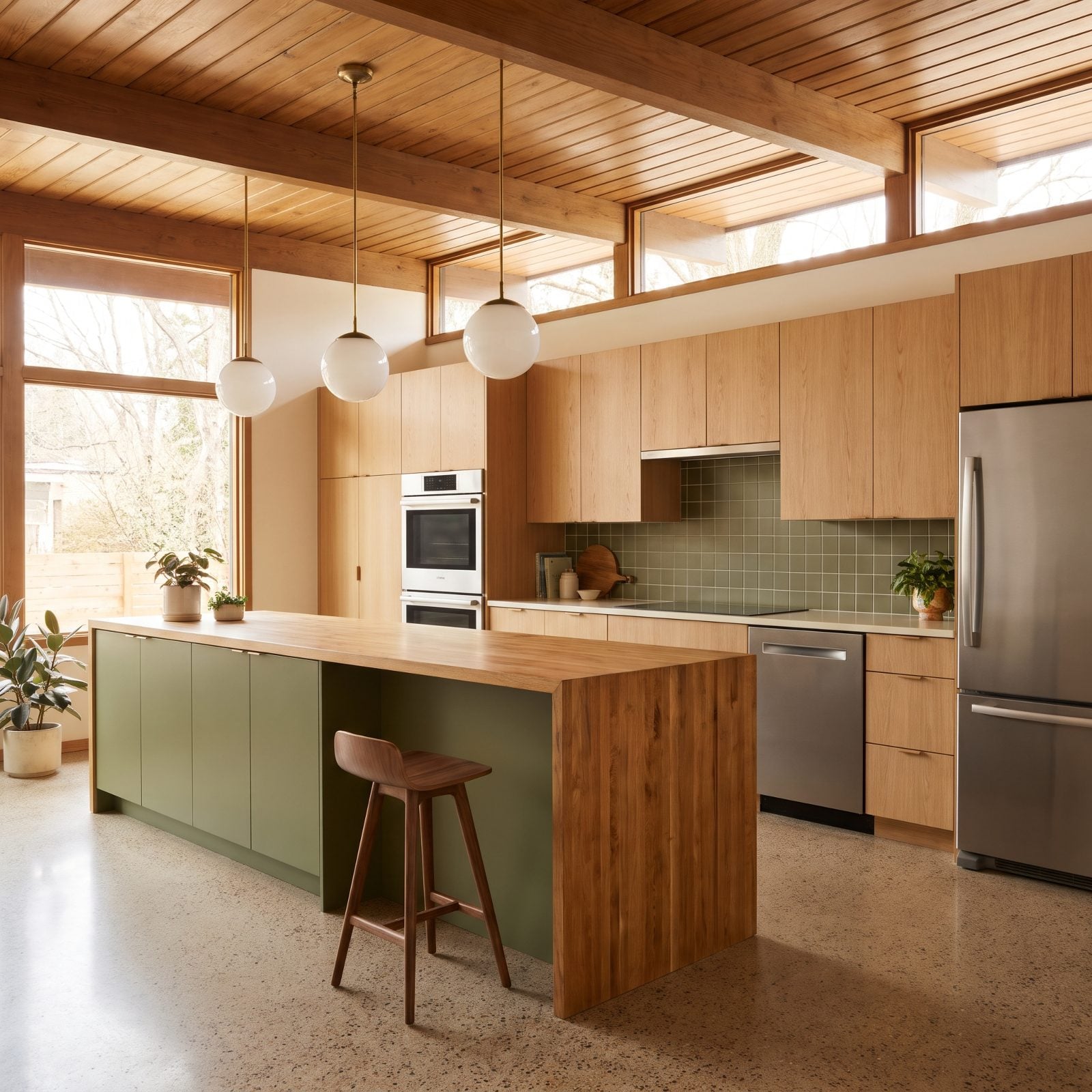
Flat oak slabs, finger-pull edges, not a knob in sight. The midcentury ranch wants horizontal lines and warm wood, and the olive island here is the single hit of color — a low matte-lacquer block with an oak waterfall end.
Clerestory windows up top flood the oak with daylight, which is exactly what that era built them to do. The stacked olive tile backsplash keeps the palette tight. Those brass globe pendant lights hit the right period note without trying too hard, and a terrazzo floor with warm aggregate ties the green and oak together underfoot.
3. Skylights, a Vaulted Ceiling, and Oak Reaching Upward
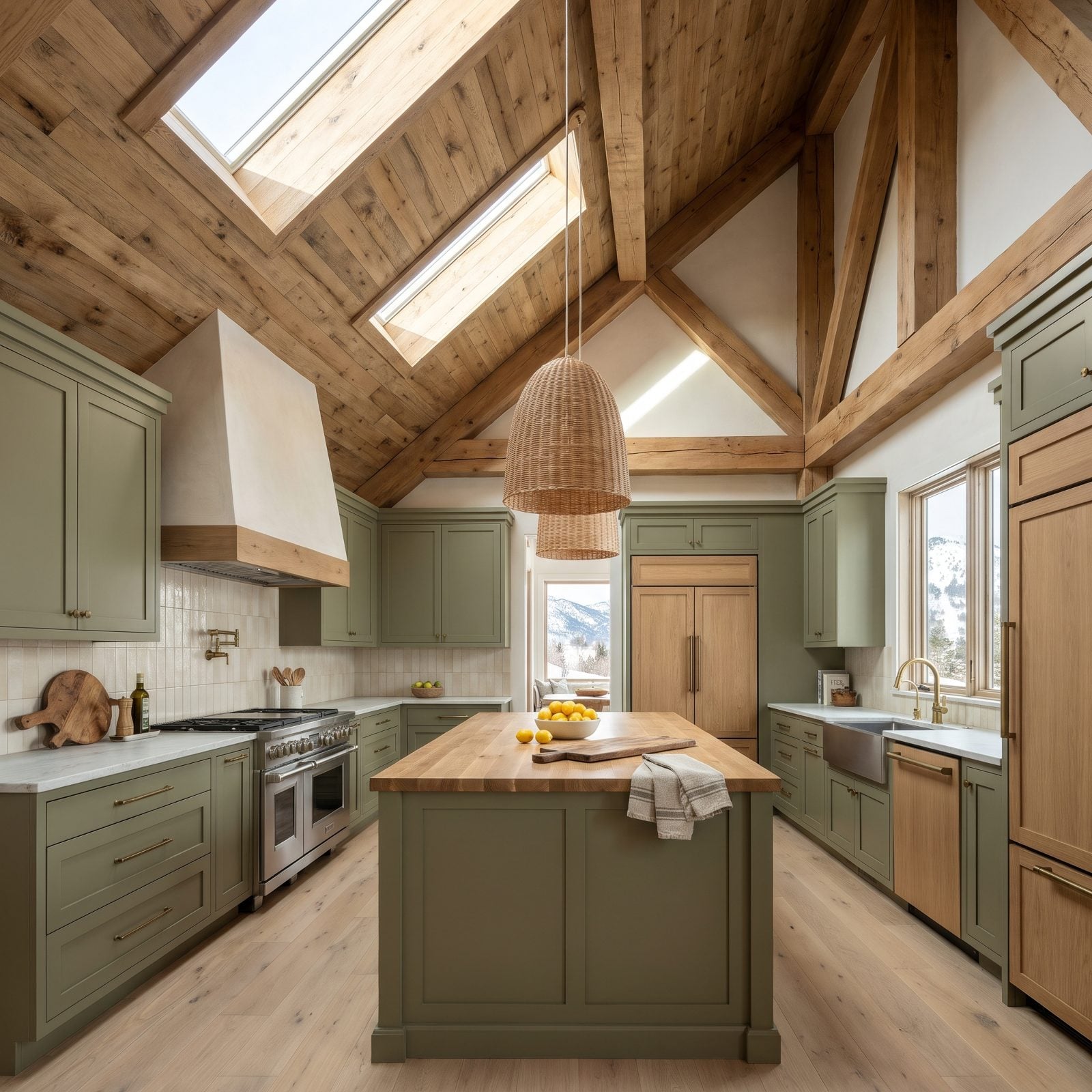
That vaulted oak ceiling is the entire argument. Planks climbing to a ridge, two skylights punched into the slope, and suddenly the room has volume and light to burn. Olive cabinets stay low and grounded so the eye travels up.
There’s logic to it. A tall ceiling can feel cavernous and cold, but clad it in warm oak and it stays intimate even at that height. The green anchors you at counter level while the wood lifts you.
2. Olive and Oak, Pared Back the Japanese Way
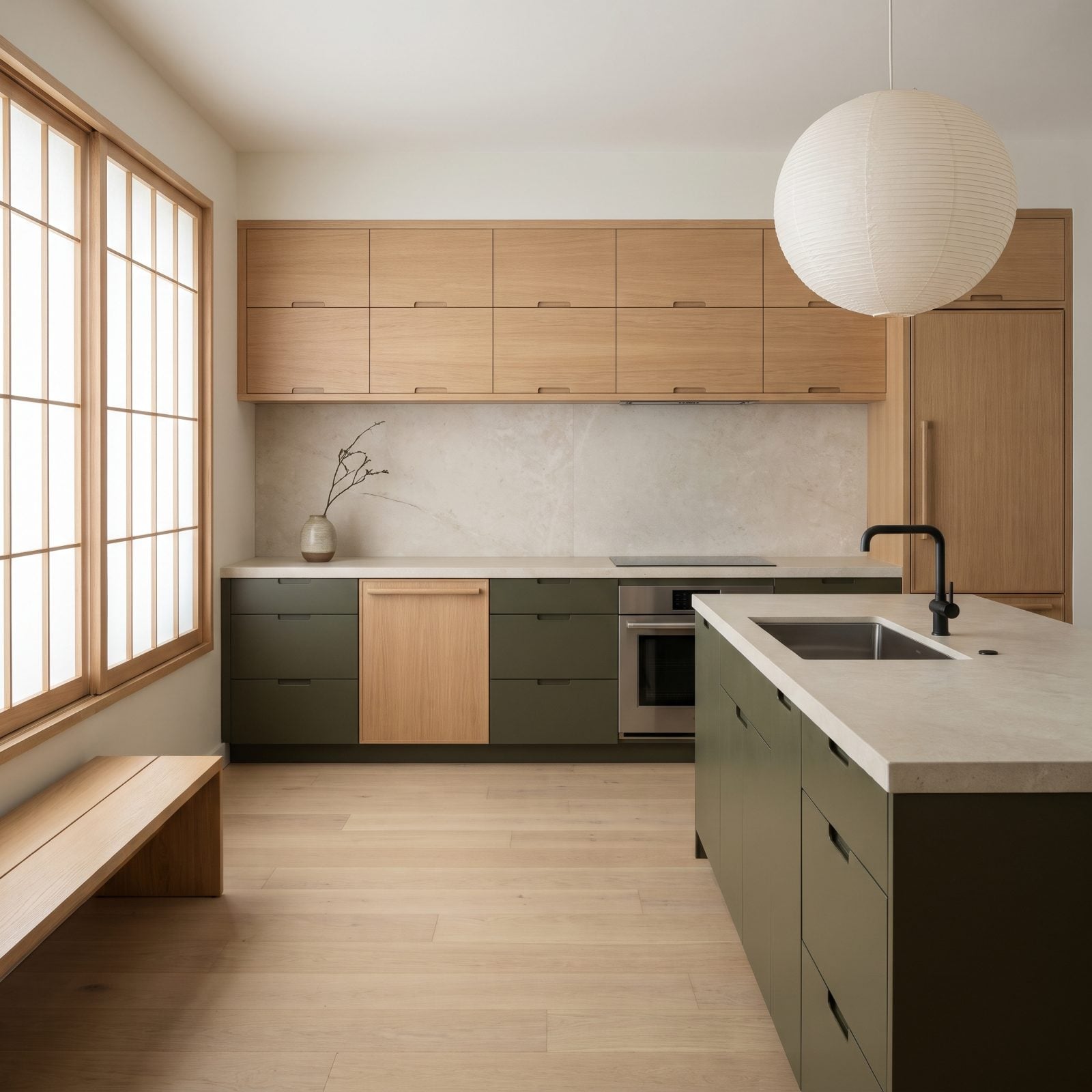
Restraint is the whole flex. One branch in a vase, a shoji screen softening the light, nothing else asking for attention. The oak runs flat and continuous with recessed finger pulls, and the olive lives only on the low base cabinets — a single band of moss along the floor.
Everything flush, everything hidden, surfaces bare. That paper lantern over the counter is the only soft shape in a room full of straight lines.
1. Rosso Levanto Marble Against Olive and Oak
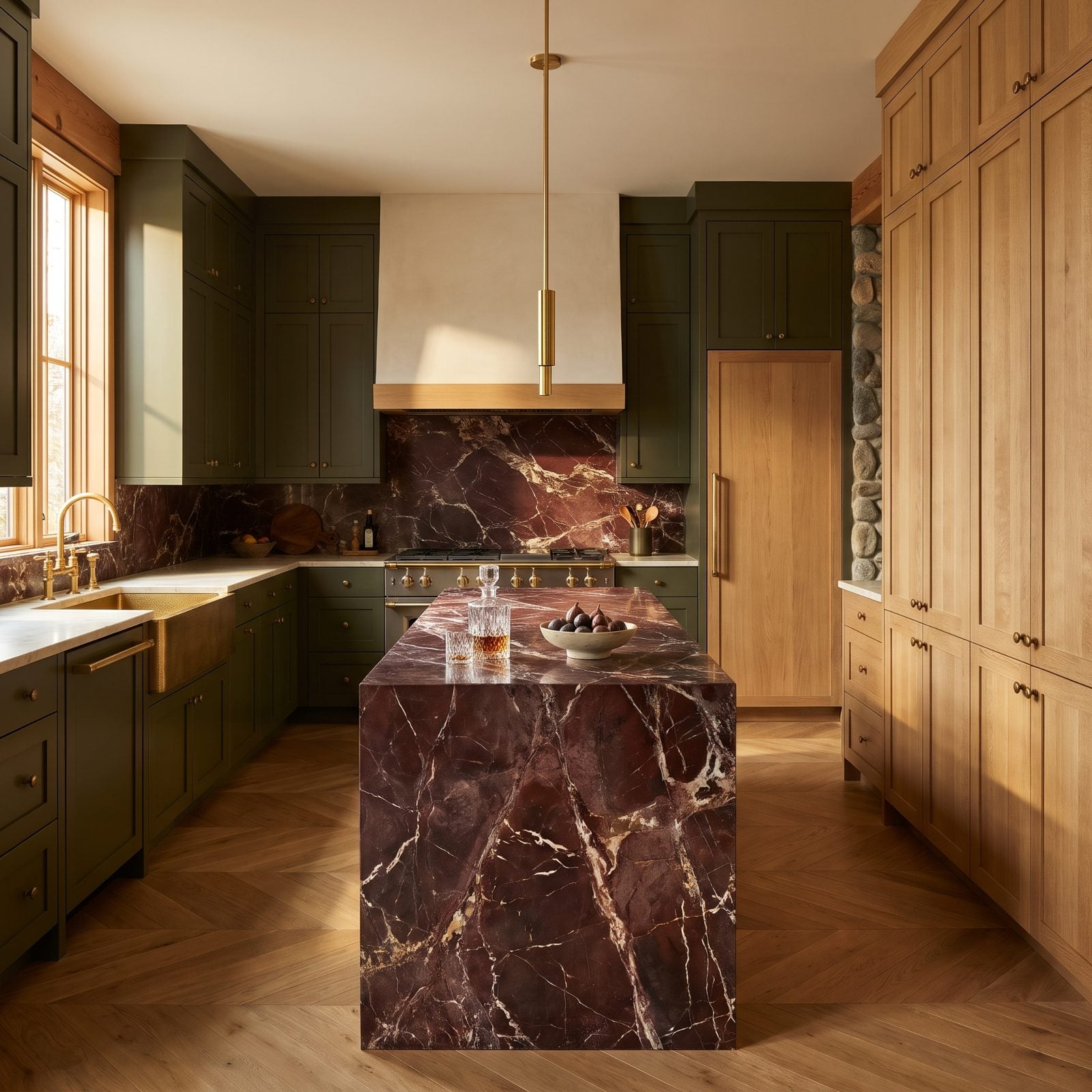
Most people pair olive with cream marble and call it a day. This room reaches for Rosso Levanto instead — that deep burgundy-red stone with white and gold veins running through it like lightning — and runs it full-waterfall across the island.
The gamble pays off because red and olive sit opposite each other on the wheel in the muddiest, most sophisticated way. Loden cabinets, rift-sawn oak towers, a hammered brass sink. Nothing here is loud on its own, yet together the room hums. And the honed cream perimeter counters know their job is to shut up and let the island win.