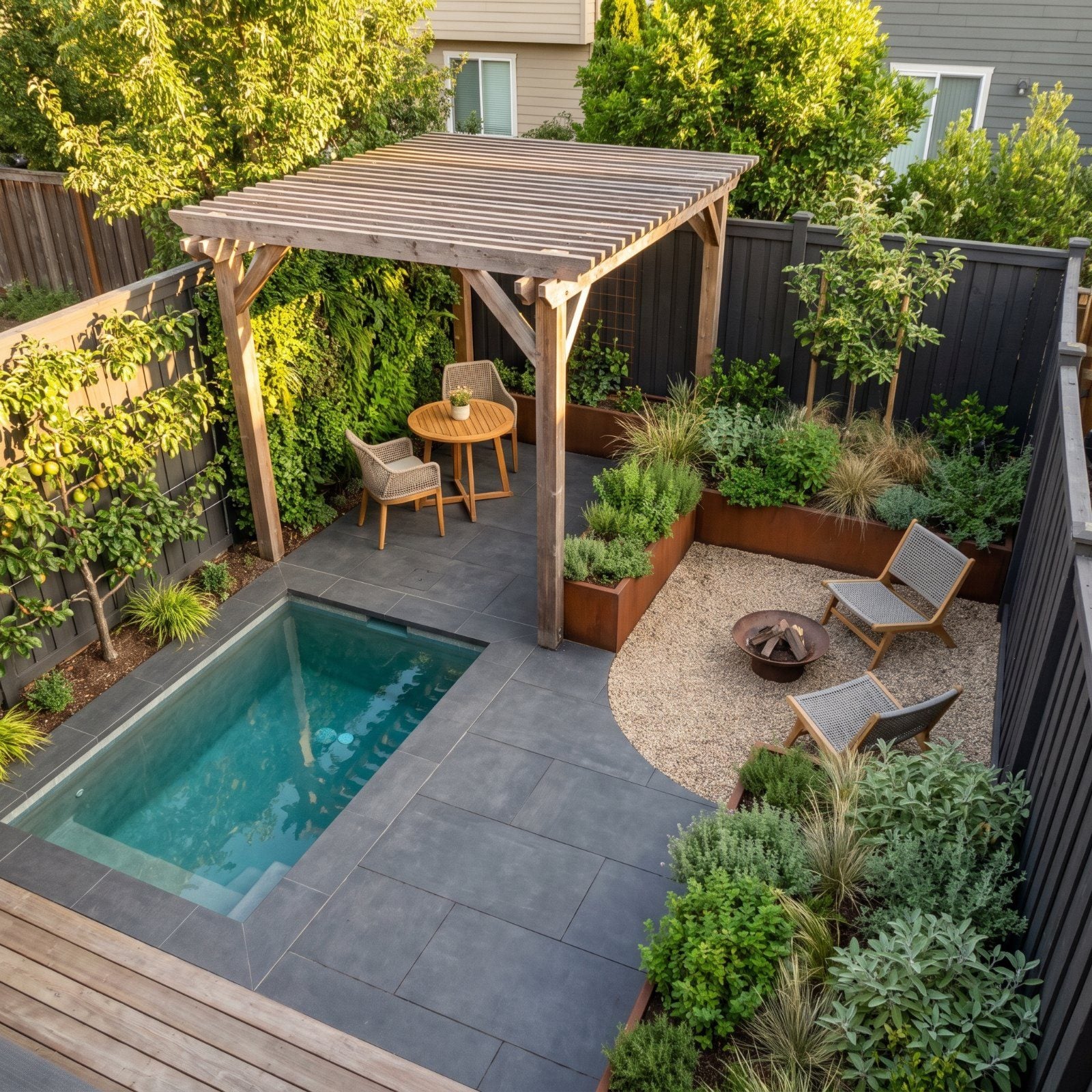
🔥 Would you like to save this?
A lawn is the laziest thing you can do with a small yard. It eats the whole space, gives nothing back, and asks you to mow it every Saturday for the privilege. The yards that actually get used look nothing like that — they pack a pool, a dining spot, a bar, and real privacy into the footprint of a parking space. Every feature below earns its square footage twice over and turns a cramped lot into somewhere you’d rather be than inside. Here’s what to build instead of grass.
In order to come up with the very specific design ideas, we create most designs with the assistance of state-of-the-art AI interior design software. Also, assume links that take you off the site are affiliate links such as links to Amazon. this means we may earn a commission if you buy something.
38. Compact Plunge Pool
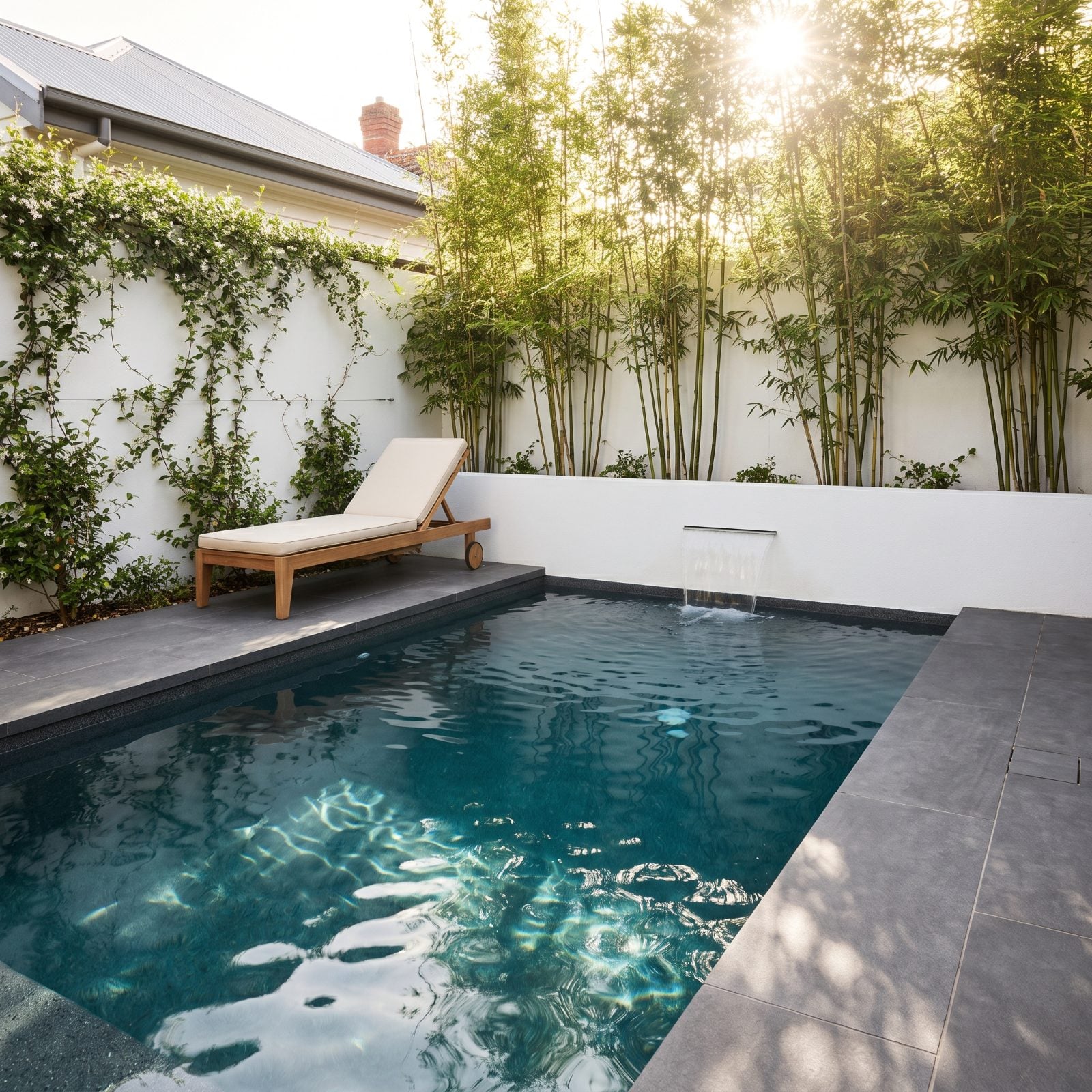
A plunge pool asks for the footprint of a dining table and gives you a vacation. Seven by thirteen feet is enough to sit, cool off, and float on your back on a brutal afternoon. You don’t swim laps here. You soak.
The dark grey plaster is the quiet trick. It drops the water to a deep teal and makes a shallow pool read like something far deeper and more expensive than it actually is.
37. Wall-Mounted Fold-Down Garden Bar
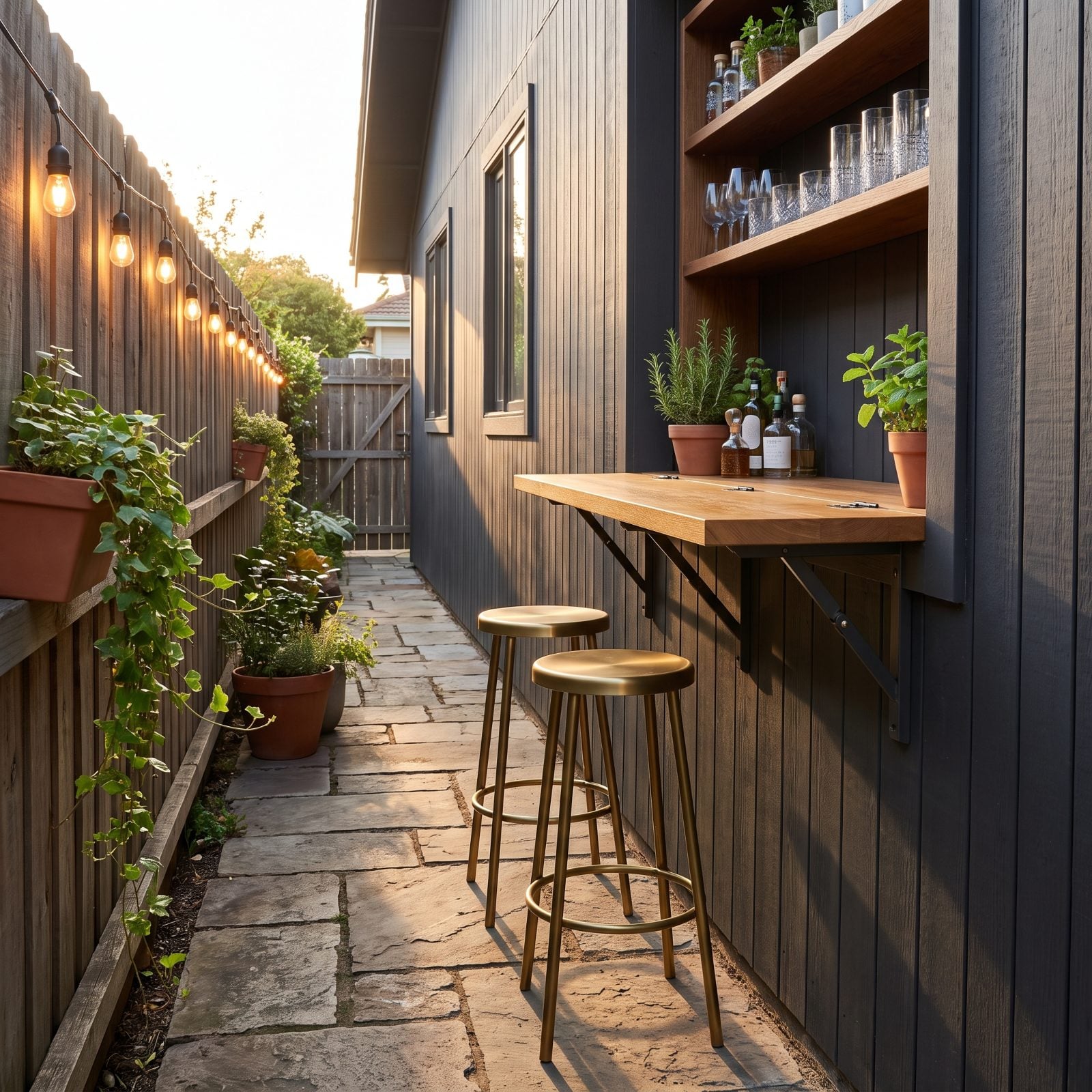
That dead strip between your house and the fence is usually where bins go to be forgotten. Bolt a fold-down bar to the wall and the narrowest, most useless channel on your property becomes the spot people won’t leave.
Folded up, it’s a flat panel a few inches deep. Folded down, it’s a counter deep enough for drinks, a cutting board, and two elbows. The brass bar stools slide away underneath when you’re done. Run a line of Edison bulb string lights overhead and the whole alley changes character after dark.
36. Espalier Fruit-Tree Privacy Screen
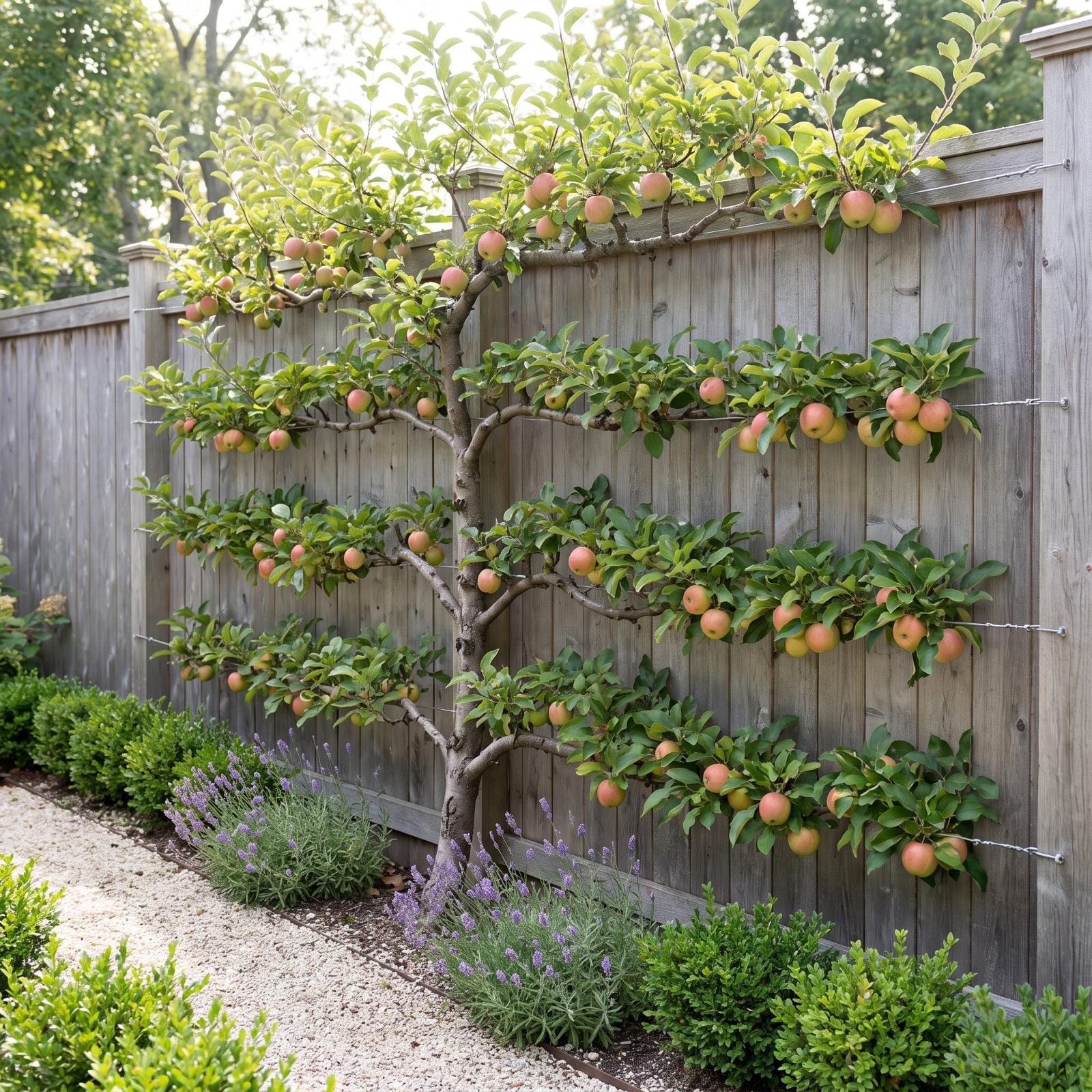
Espalier is the oldest space-saving trick in the book. Monks were training fruit trees flat against monastery walls centuries ago because they had no room to waste and fruit to grow anyway.
You train the branches along horizontal wires until the whole tree lives in a plane four inches deep. The payoff is a living privacy screen along the fence, blossom in spring, and apples you can pick standing up.
35. Narrow Pergola Dining Nook
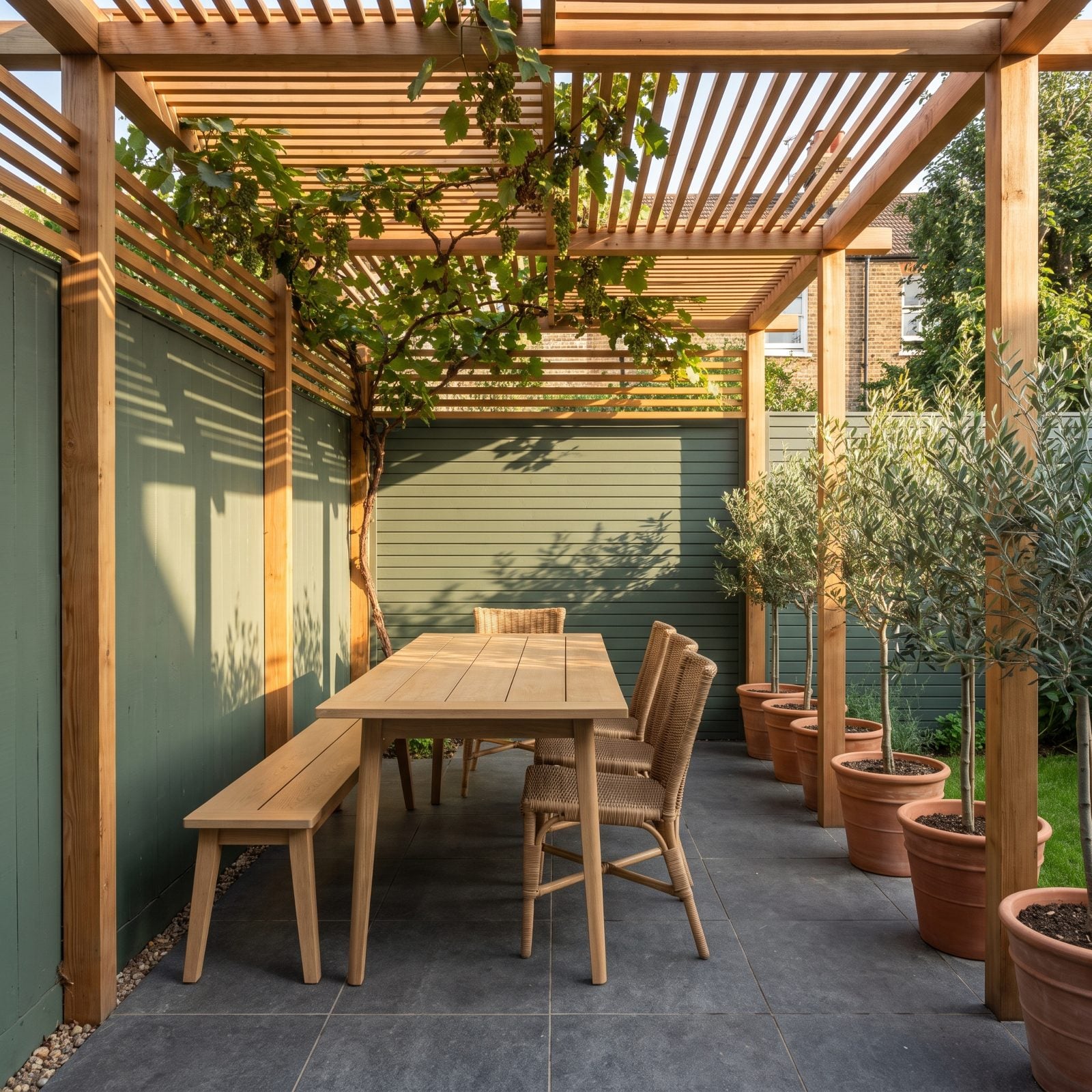
You don’t need a patio to dine outside. You need six feet of width against a fence and something overhead.
A narrow pergola slotted along the boundary turns a leftover strip into a proper dining room — bench on the wall side, chairs on the other, a table built long and thin to match. The grapevine over the slats drops the temperature a few degrees and throws the kind of striped shade that makes everything look better. Paint the fence behind it deep sage and the whole nook reads as a destination instead of an afterthought.
34. Outdoor Kitchen Built Against the House
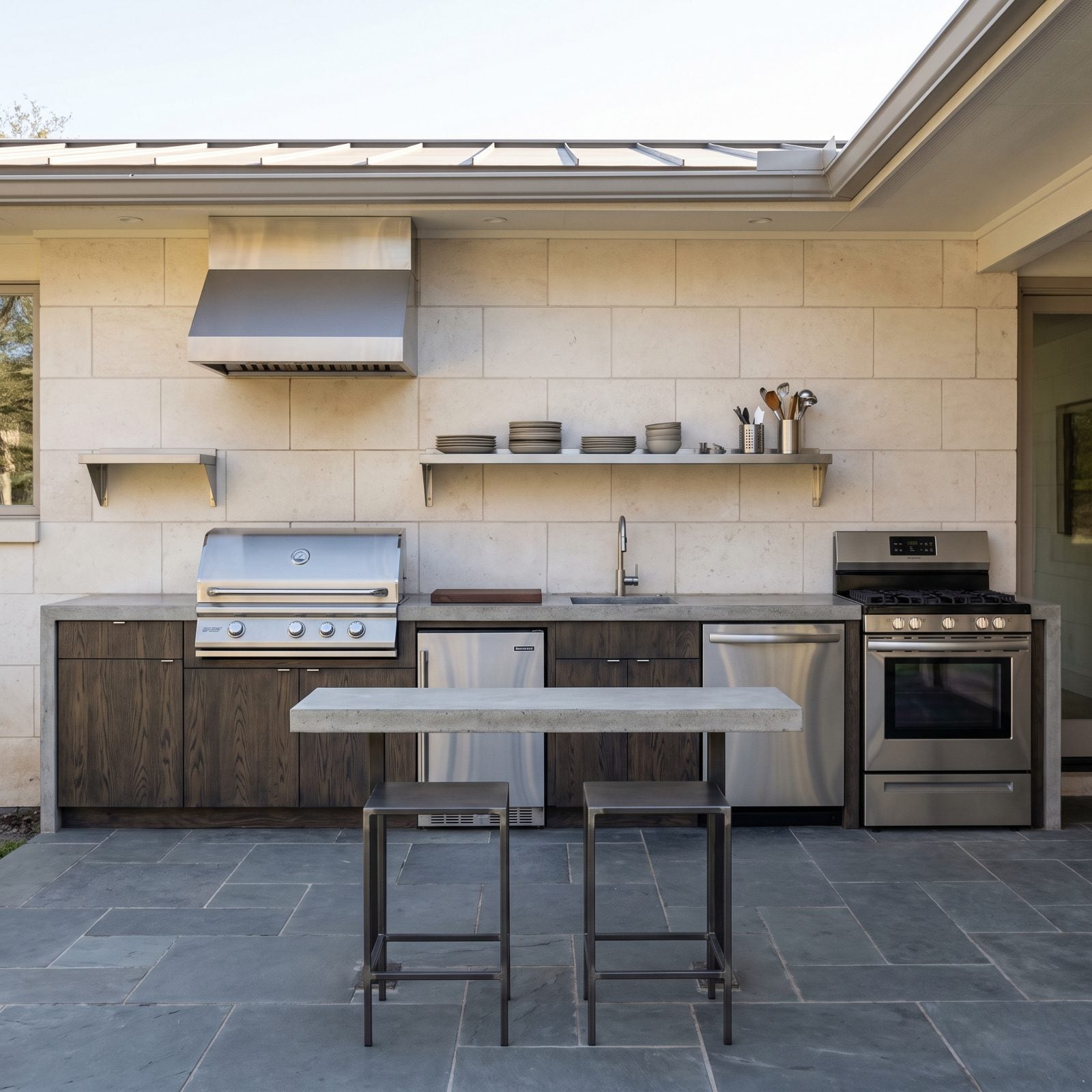
Running an outdoor kitchen along the back wall of the house is the move that frees up the most yard. You tap into existing water, gas, and power lines right there, and you keep the whole cooking operation in one straight line instead of a bulky island eating the middle of the space.
This run holds everything a real kitchen needs: a built-in grill, a stainless refrigerator, a dishwasher, and a freestanding stove and oven at the end. The concrete counter gives you prep space, and the limestone wall behind takes the heat and the splatter without complaint. If you’ve been pricing a compact kitchen makeover indoors, an outdoor run against the house often costs a fraction and gets used far more in summer.
33. Circular Gravel Conversation Patio
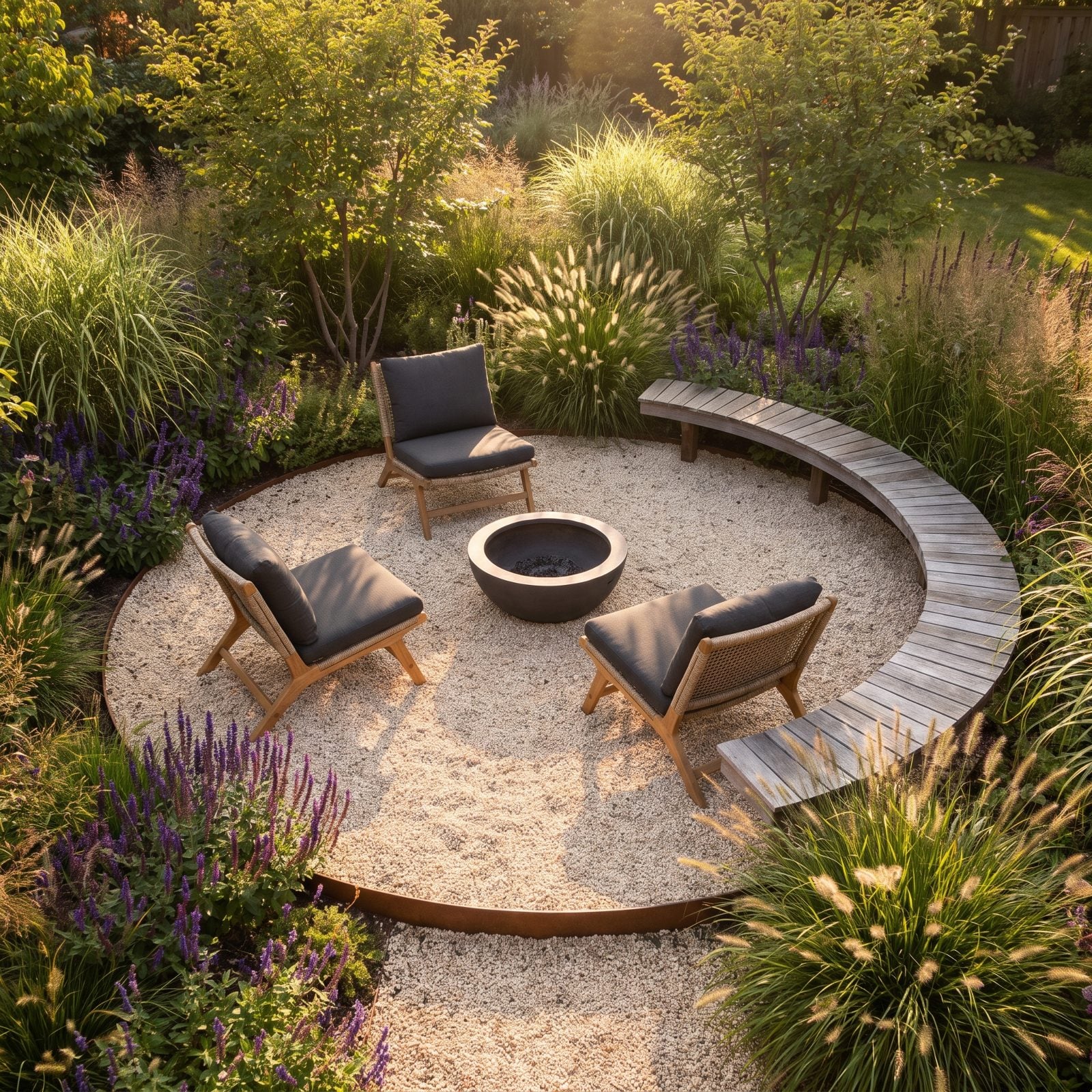
A circle has no bad seat. That’s the whole reason this works.
Pea gravel is the cheapest usable surface you can lay, it drains instantly, and a corten-steel ring holds it in a shape that reads as intentional rather than a pile of rock dumped in a corner. Drop three low chairs and a curved wooden bench around a firepit and you’ve built a conversation pit that pulls people in and keeps them there past midnight.
32. Low Deck That Doubles as Extra Seating
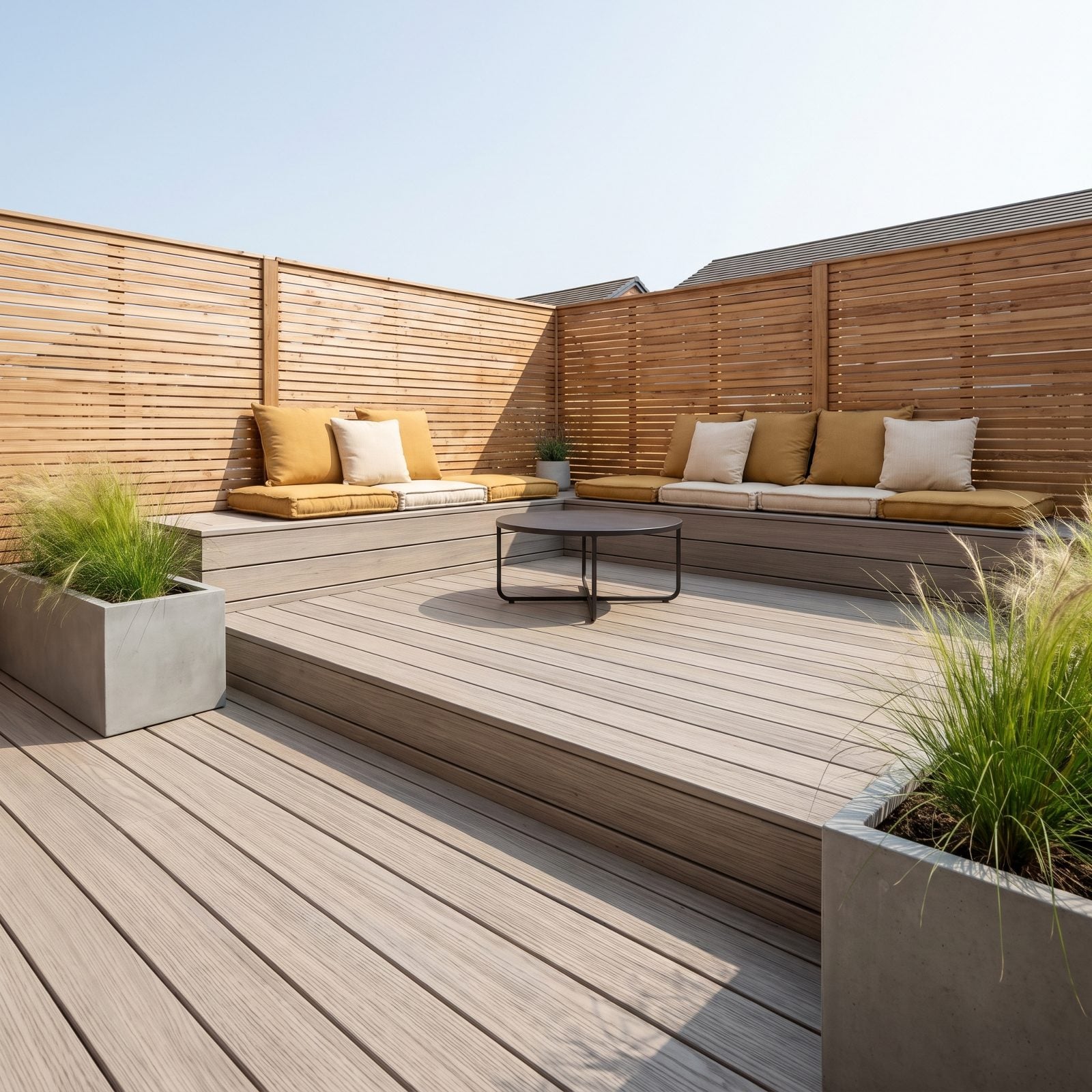
Every chair you add to a small deck steals floor you actually need. Build the seating into the deck itself and the problem disappears.
Step the perimeter up a level and that raised lip becomes a bench running the whole edge. Throw down a few mustard yellow outdoor cushions and you’ve got seating for eight without a single bulky chair to trip over or store.
31. Raised Herb Bed Along a Fence
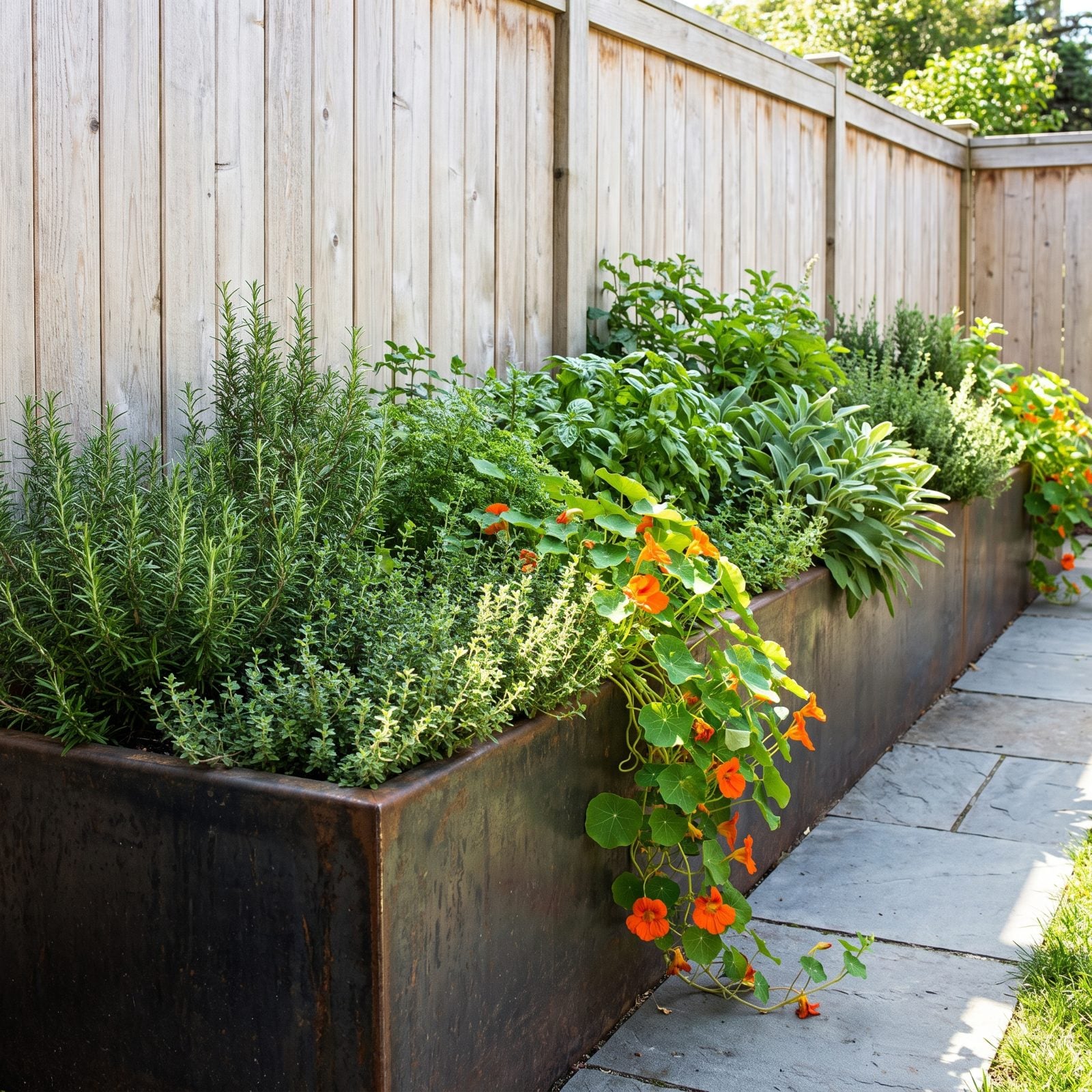
The fence line is prime growing real estate everybody wastes.
A raised bed eighteen inches deep, run tight along the boundary, keeps the whole center of your yard open while still feeding you all summer. Raise it to counter height and you harvest without crouching, which your knees will thank you for in about ten years. Rosemary and thyme at the back, basil and sage in the middle, nasturtium spilling over the corten edge. The rusted steel looks sharp and heats the soil a touch earlier in spring.
30. Vertical Strawberry Growing Tower
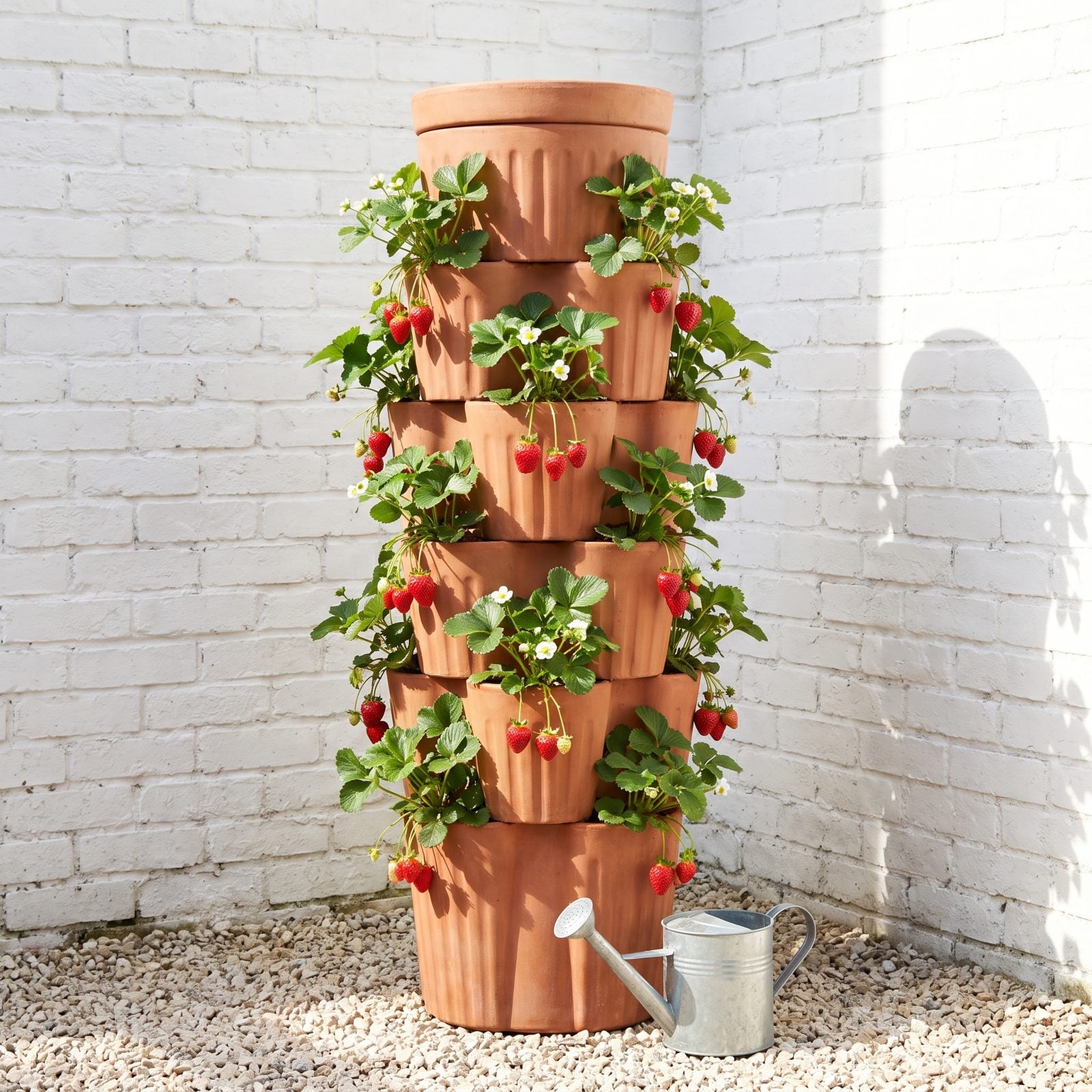
Strawberries sprawl. That’s the problem. A single healthy plant will throw runners clear across a square meter and still give you only a handful of fruit for the trouble.
Stack them vertically instead. A five-foot tower with spiraling pockets grows twenty or more plants in the footprint of a dinner plate, keeps the berries off the soil and away from slugs, and puts the whole thing at picking height. It belongs in the one corner of a tiny yard that nothing else will fit into.
29. Living Green Wall
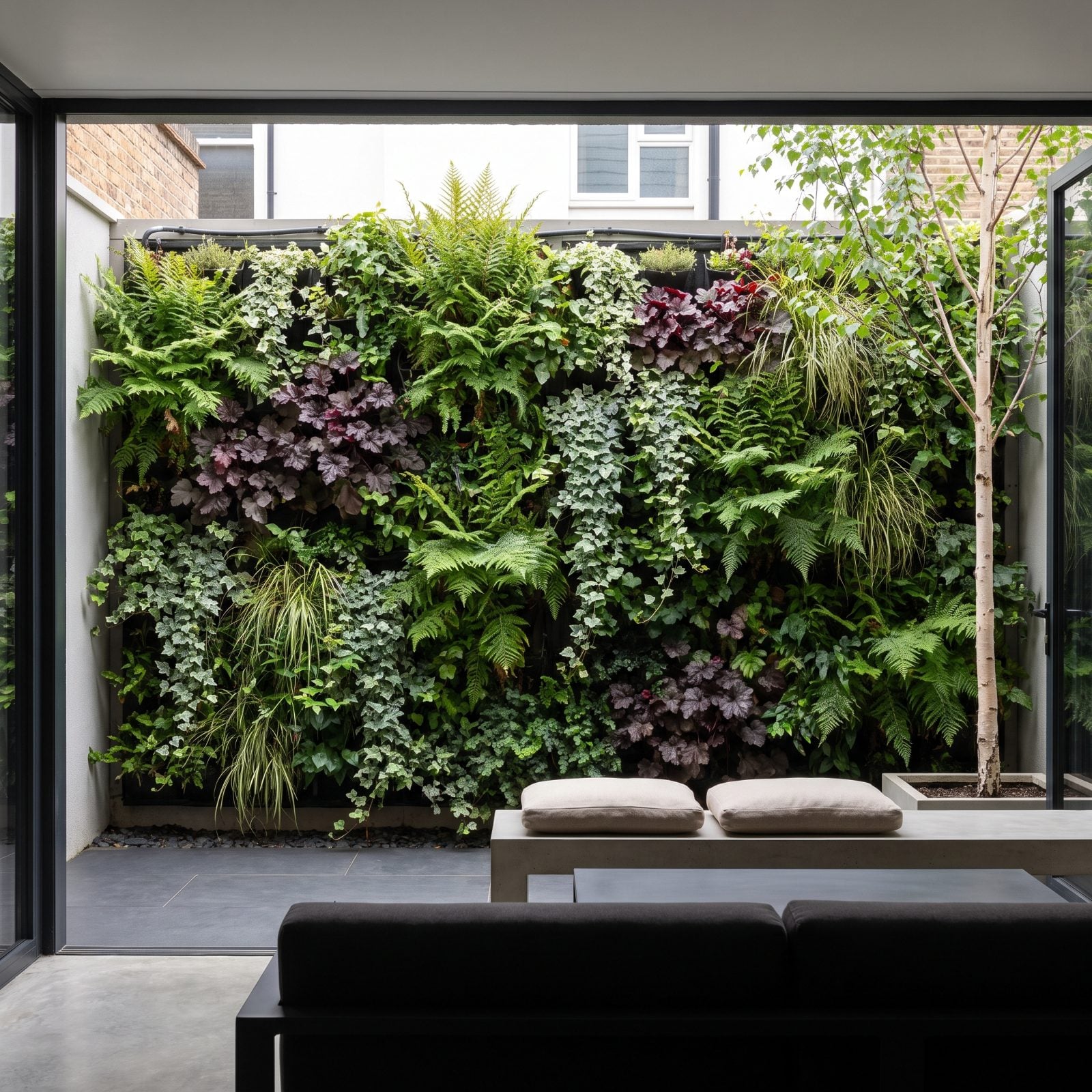
A bare fence is a wasted wall. Cover it in plants and you turn a flat boundary into the best feature out there.
A living green wall grows up instead of out, so it takes nothing from your floor while filling the whole vertical plane with ferns, heuchera, and trailing ivy. In a cramped courtyard it does the heavy lifting: hides the fence, muffles street noise, cools the air, and gives you something alive to look at from every window. Done well, it reads less like a garden feature and more like a bright living room wall that happens to breathe.
28. Slim Recirculating Wall Fountain
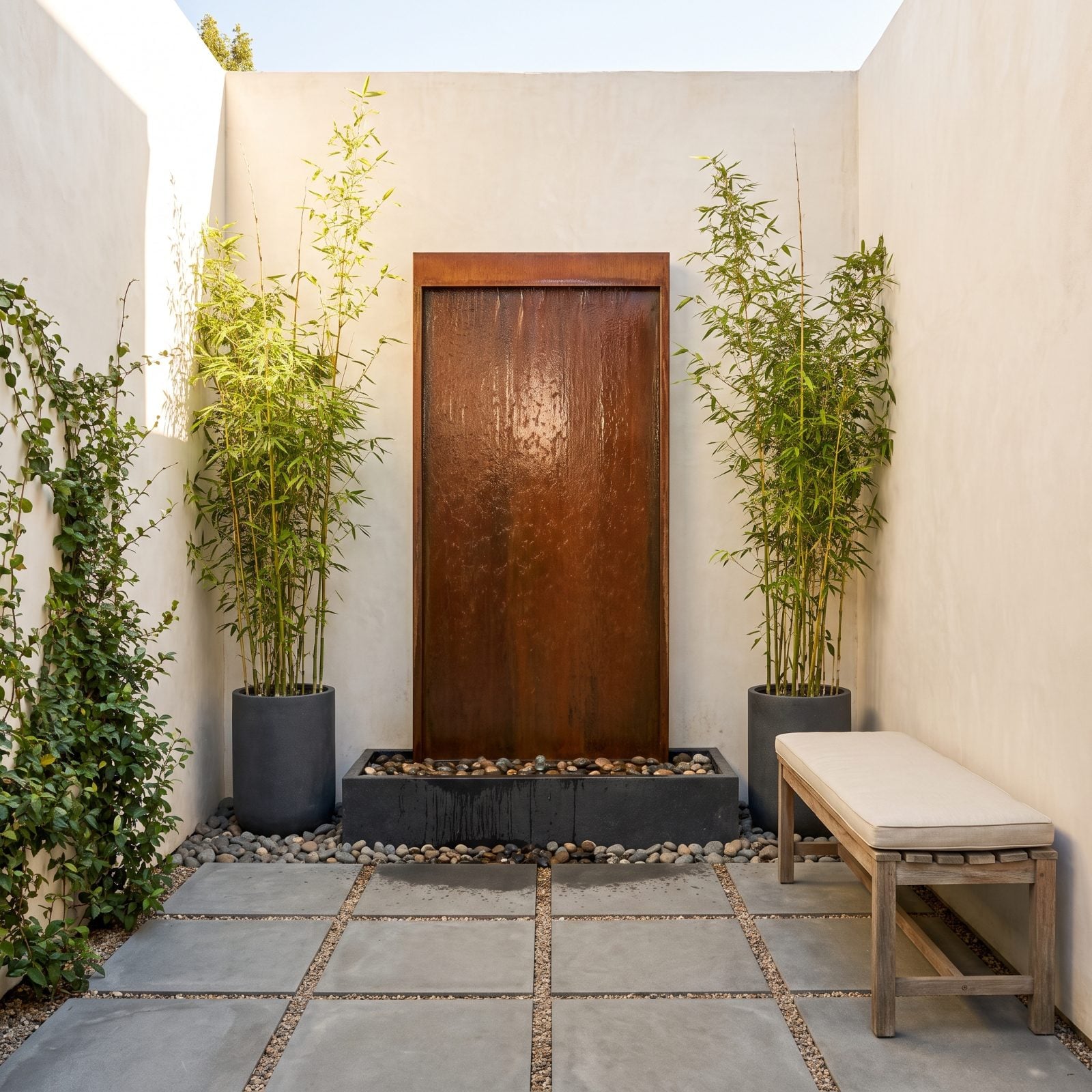
A fountain doesn’t need a pond. This corten panel runs on a hidden pump that recirculates the same few gallons all day, and it fits flat against a wall you were ignoring anyway.
The sound does the real work. Water over steel masks street noise and traffic so a courtyard pressed up against the neighbors suddenly feels like it’s yours, and the corten steel fountain rusts to a soft copper tone that plays against the pale stucco without shouting for attention.
27. Stepping-Stone Path Through Ground Cover
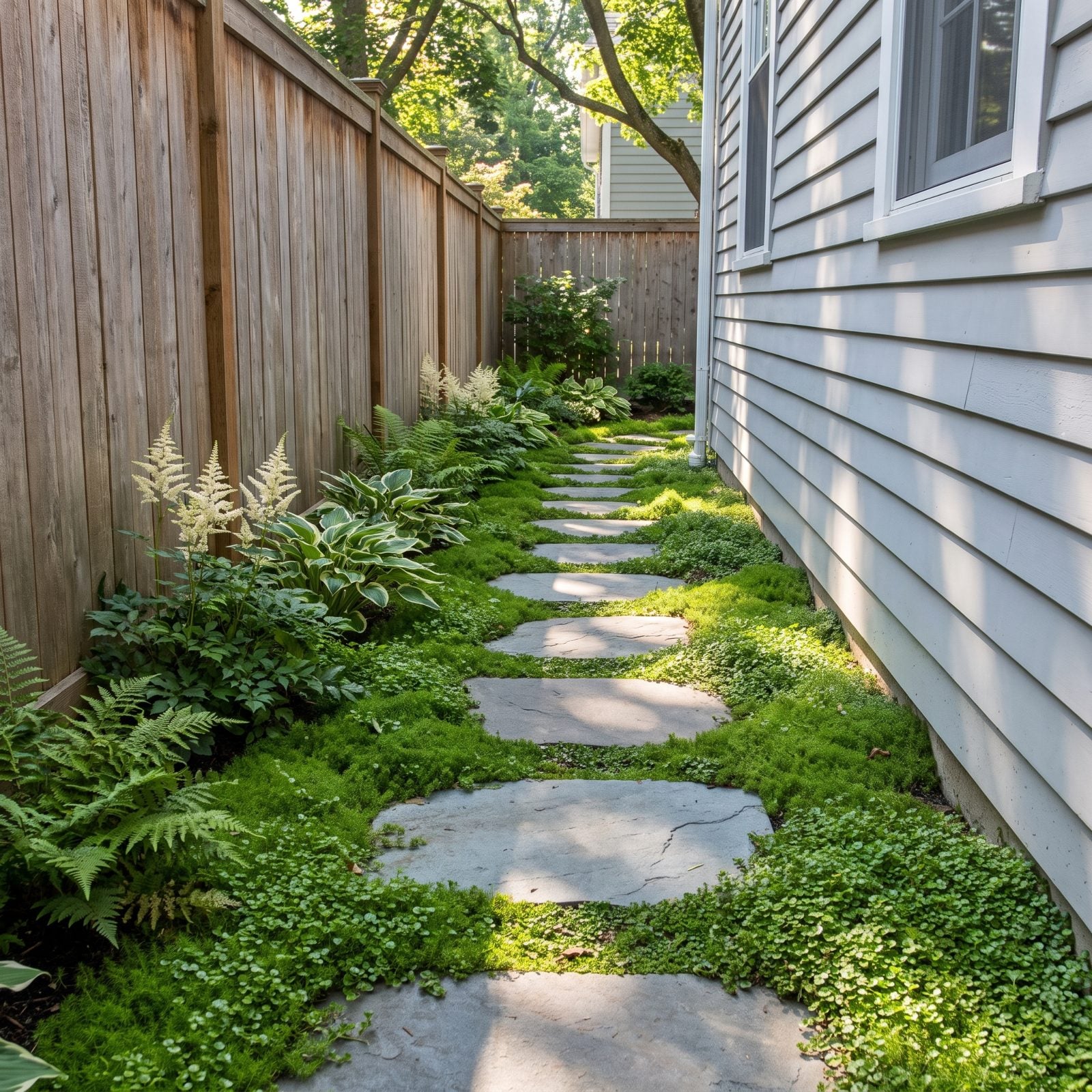
Grass in a narrow side yard is a losing battle. You can’t mow it properly, it goes patchy in the shade, and you walk the same line every single time anyway.
So pave that line. Bluestone steps set into creeping moss give you the one route you actually use, and the ground cover handles the rest. No mower required.
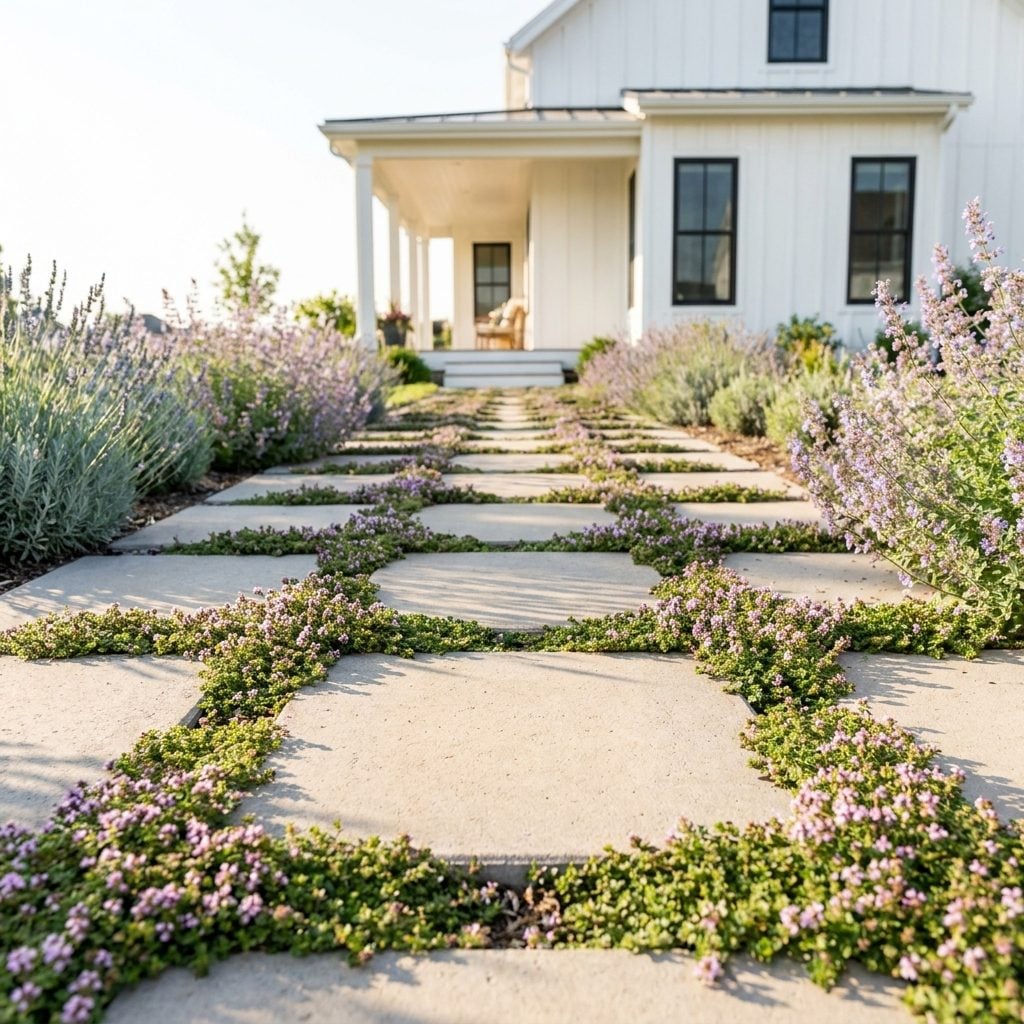
26. Geometric Paver-and-Thyme Patio
🔥 Would you like to save this?
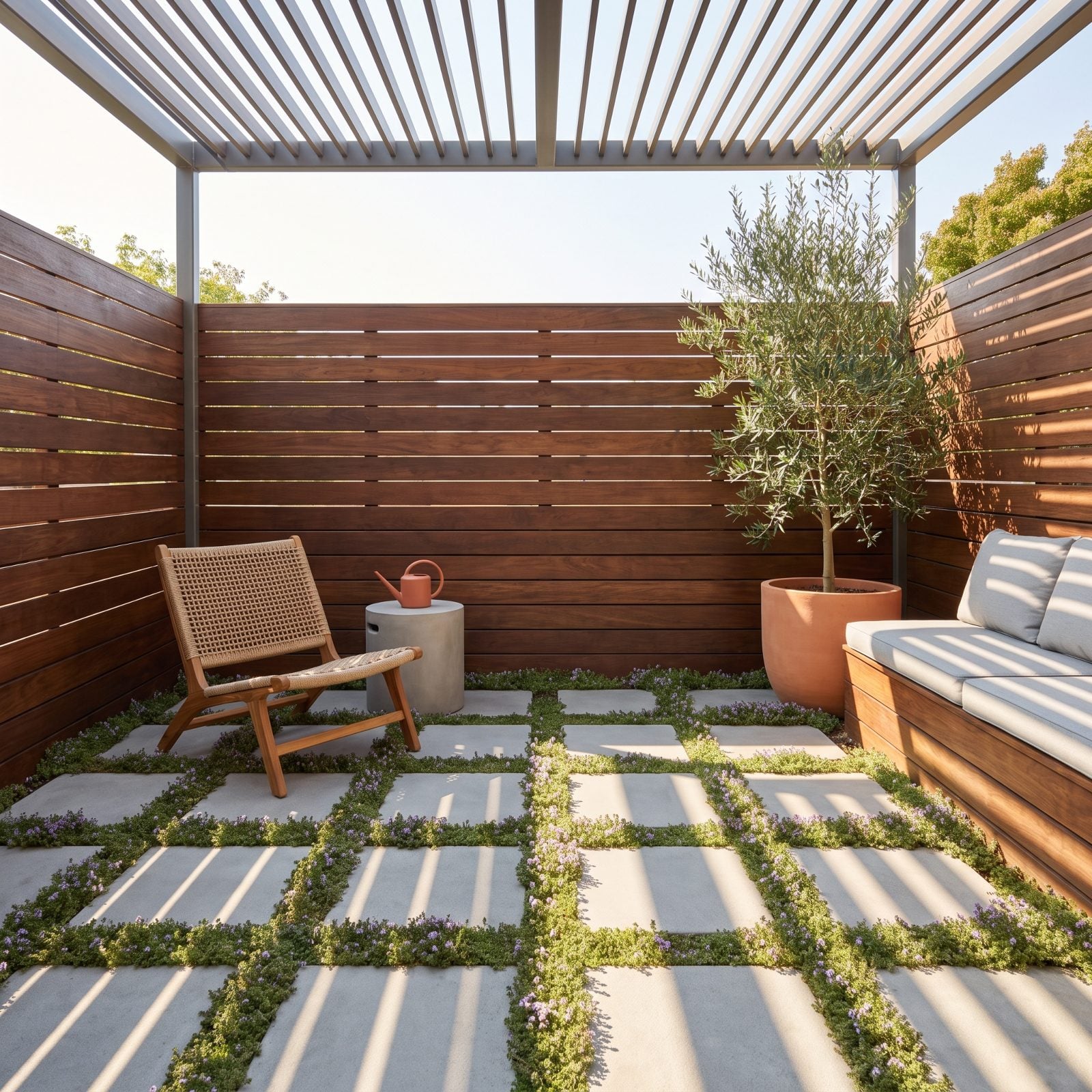
The thyme between the pavers is the whole trick. It softens a hard geometric grid, releases scent when you step on it, and turns a patio into something closer to a garden floor.
Three reasons this beats a solid slab:
- Rainwater drains through the planted joints instead of pooling or running off.
- The green seams break up the grey so it never reads as a parking lot.
- Thyme takes foot traffic and barely needs water once it’s rooted.
25. Pocket Pollinator Meadow
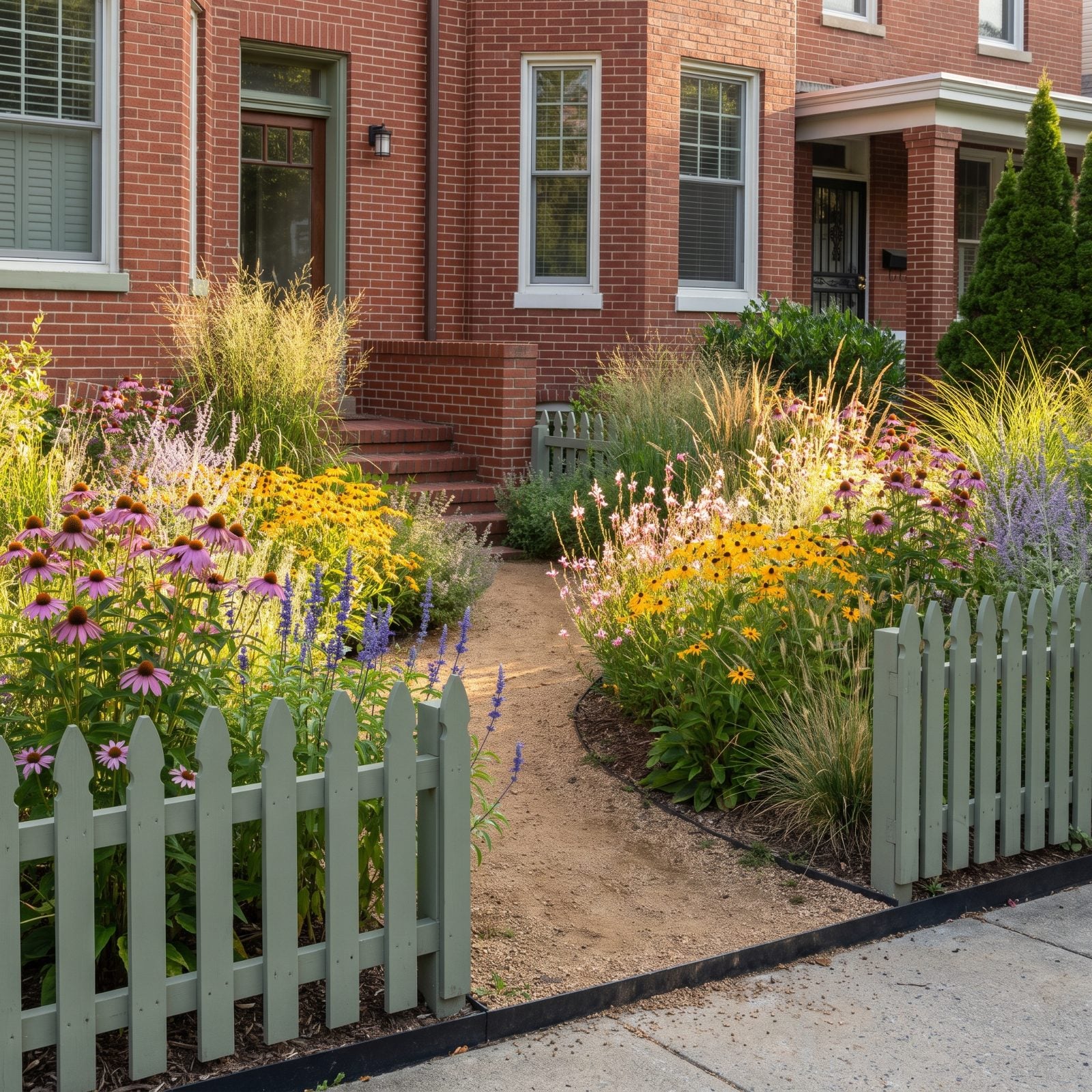
Rip out the front lawn and plant this instead. A pocket meadow of coneflower, salvia and grasses does everything a lawn can’t. It feeds bees and butterflies, it moves in the wind, and it never asks for a Sunday morning behind a mower.
A meadow doesn’t have to mean chaos. A curved granite path and a crisp metal edge keep the whole thing legible, so the neighbors read it as intentional rather than neglected.
24. Sunken Fire-Pit Lounge
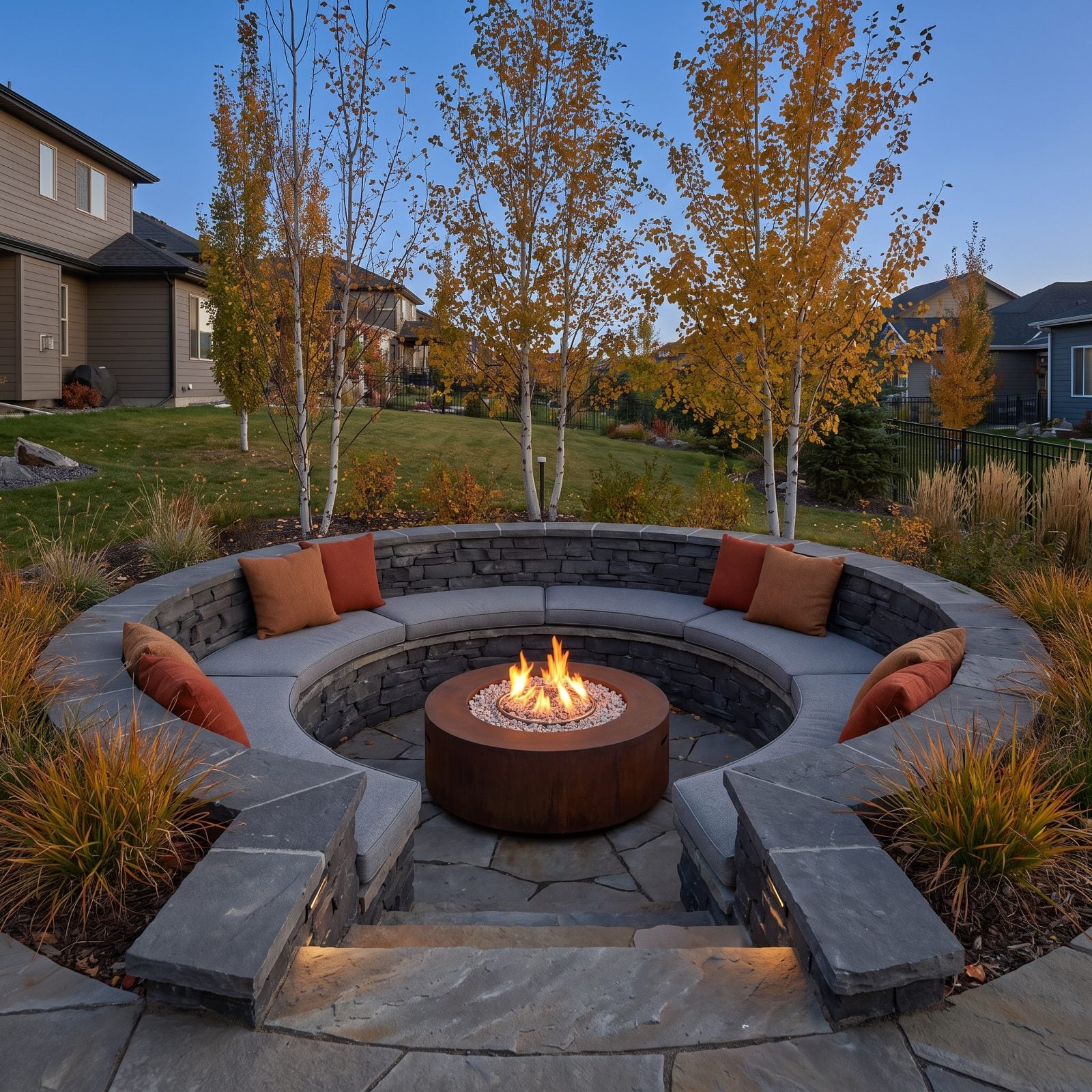
Dropping the seating two steps below grade is what makes this feel like a room. The low basalt wall ringing the pit works as a backrest and a boundary at once, so a small lot gains a real destination instead of a corner with chairs in it.
Sinking it also shelters the flame from wind and holds the heat in. You end up with a cozy outdoor den on a fraction of the footprint a sprawling patio would eat, and it borrows the same intimacy as an oversized den makeover indoors.
23. Tiered Planter Retaining Wall
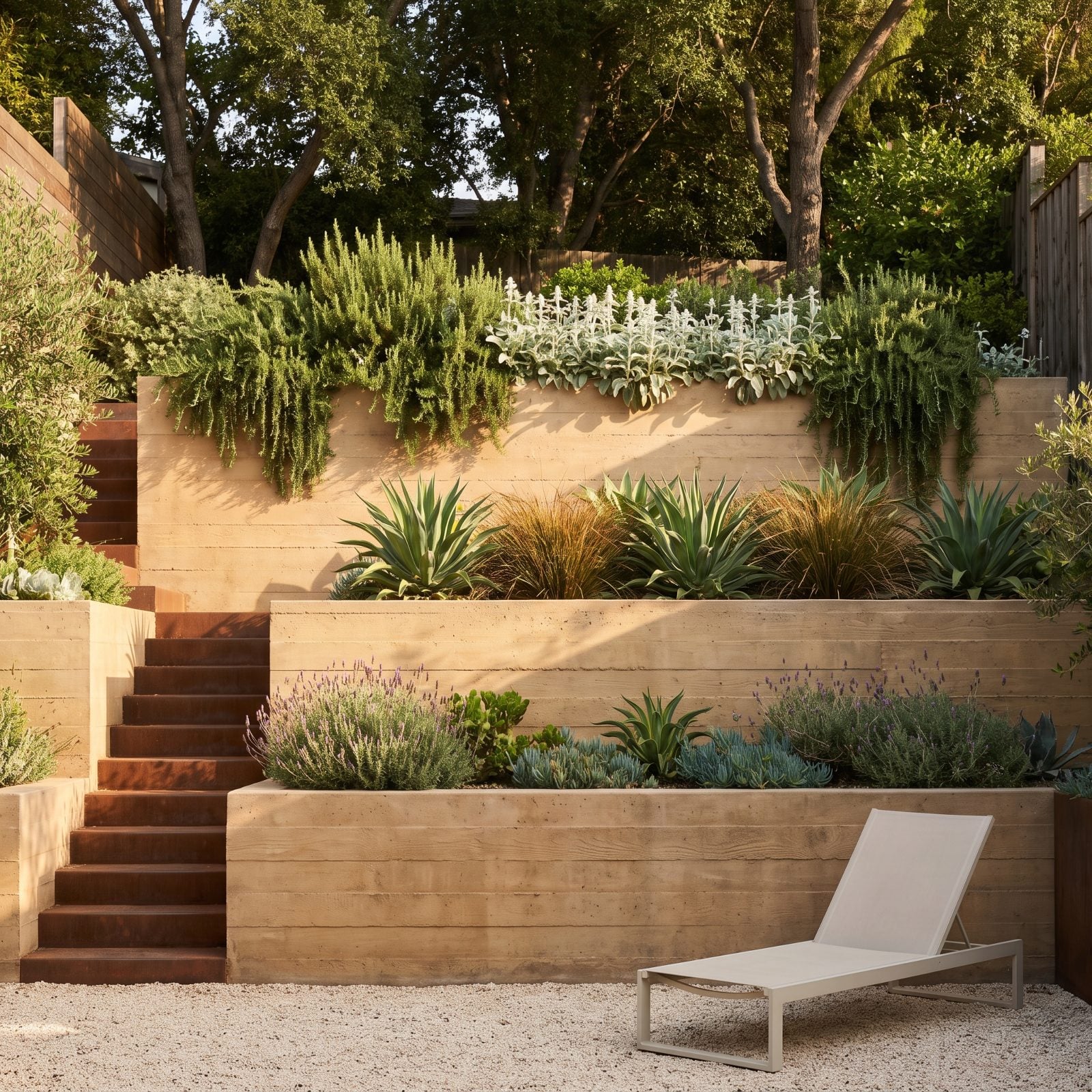
A slope usually gets treated as a problem. Terrace it and the problem becomes your best feature.
Each board-formed concrete tier holds back the grade while doubling as a planter, so a yard that was unusable at an angle turns into three flat beds stacked one above the other. Trailing rosemary spills over every hard edge and softens the lot.
22. One-Tree Miniature Woodland Garden
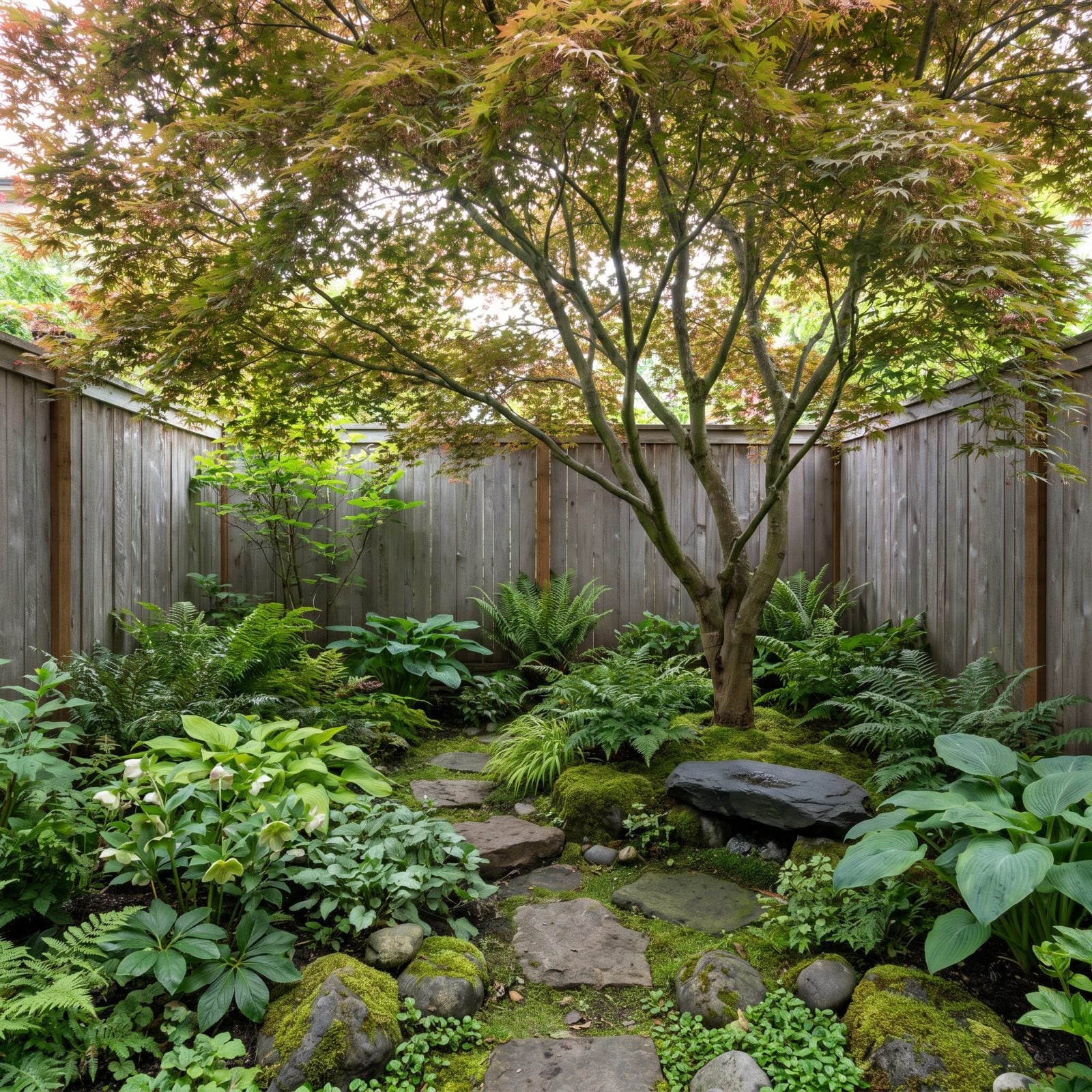
One tree, done right, can be the entire garden. A multi-stem Japanese maple throws a canopy over a 12-foot courtyard and hands you shade, scale and a ceiling all at once, which is more than any lawn ever managed.
Underneath, layer the woodland floor: ferns, hostas, hellebores, moss over stone. The understory reads lush precisely because the tree gives it something to grow beneath.
A single well-placed tree does more for a small garden than a hundred square feet of grass ever will.
21. Bench Wrapped Around a Tree
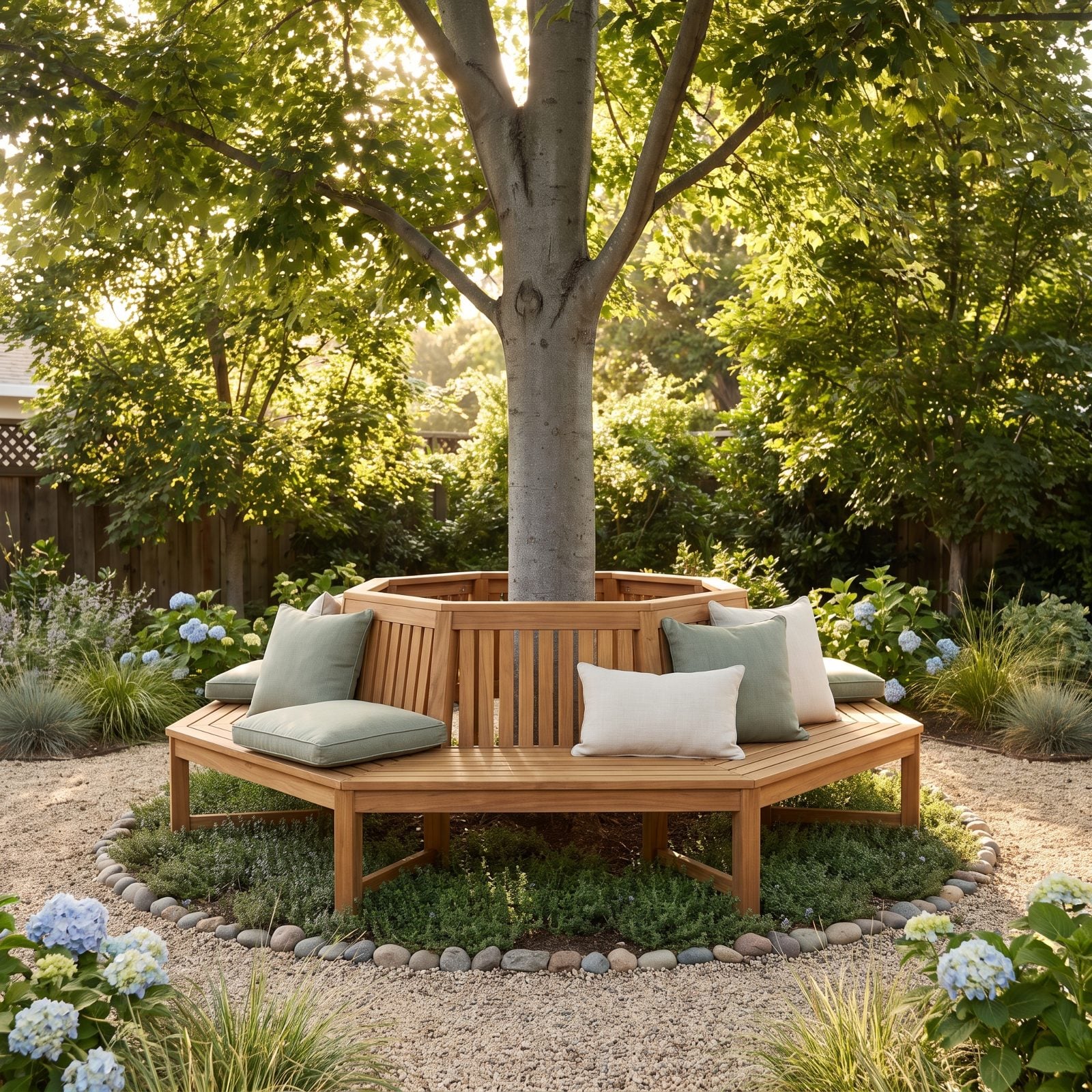
That hexagonal teak bench hugging the trunk is pure space economy. It turns the one spot you can’t plant, the base of a shade tree, into the best seat you’ve got.
Shade comes free, and because the bench follows the trunk all the way around, nobody ends up fighting over who sits in the sun. Toss on a couple of sage outdoor cushions and you’re done.
20. Narrow Boardwalk Through Planting Beds
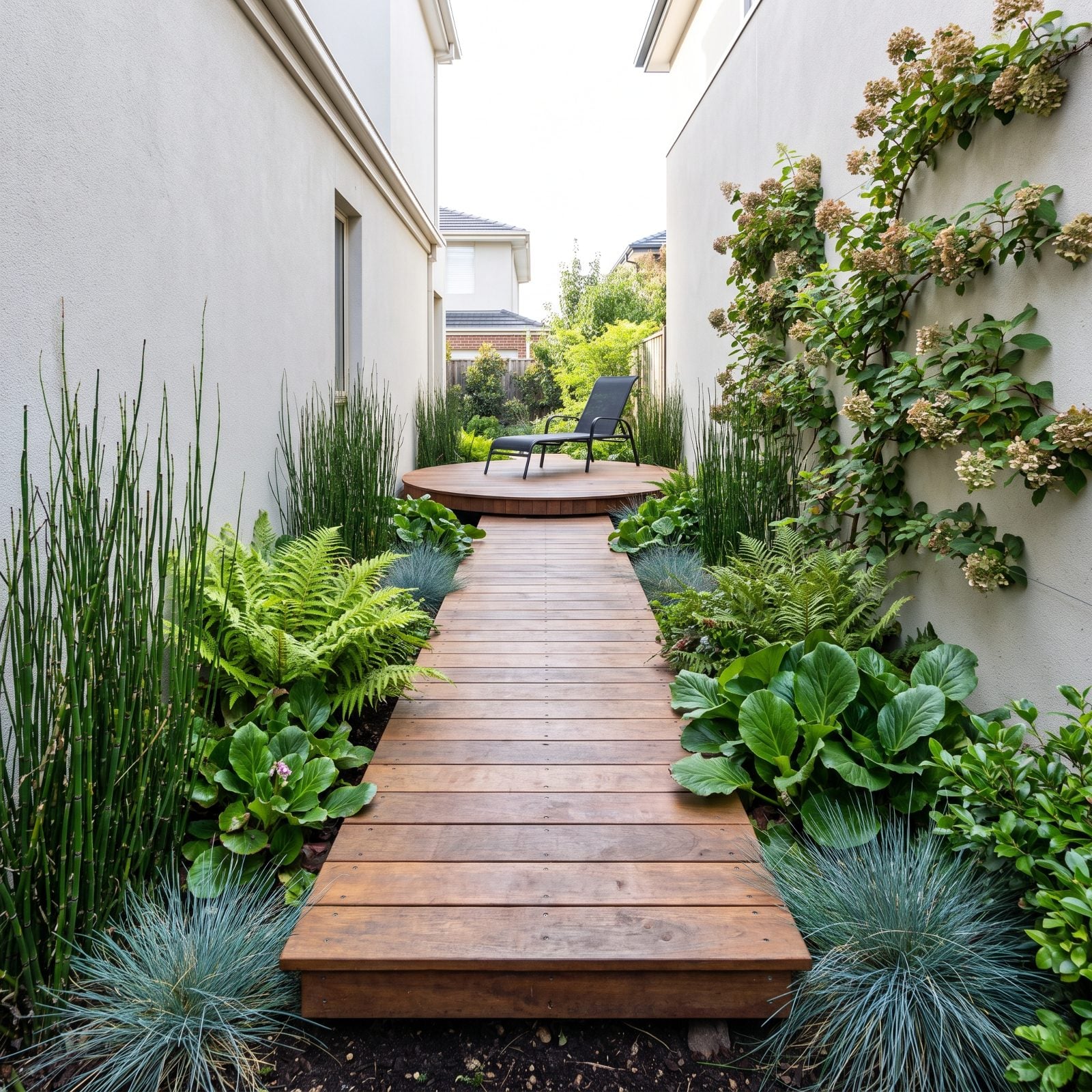
A six-foot gap between two houses is dead space in most homes. Float a boardwalk down the middle and it becomes the most interesting walk on the property.
Raising the ipe planks a few inches off the soil lets the beds crowd right up to the edge, so you move through the planting instead of past it. Call it the garden version of an oversized hallway renovation, just outdoors and far cheaper.
19. Climbing-Vine Trellis Tunnel
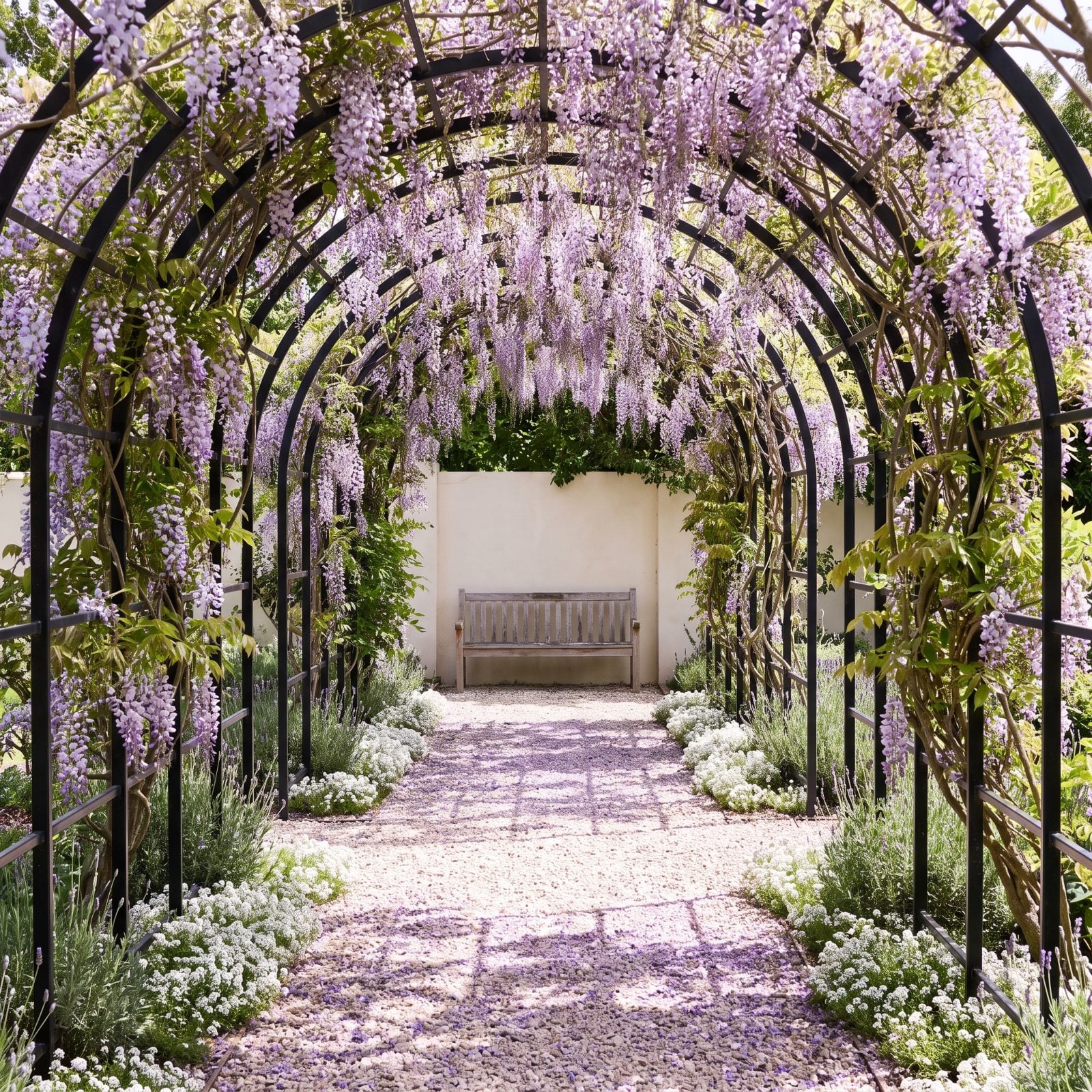
A vine tunnel is privacy, shade and a destination stacked into a footprint barely wider than the path itself. Once the wisteria establishes it does the heavy lifting, draping the steel arches in lavender and roofing the whole walk in green.
Now the clever part. A tunnel pulls your eye to whatever sits at the far end, so the bench against the back wall becomes a reward you walk toward, and that borrowed depth makes a short yard feel like it keeps going.
18. Retractable Outdoor Movie Screen
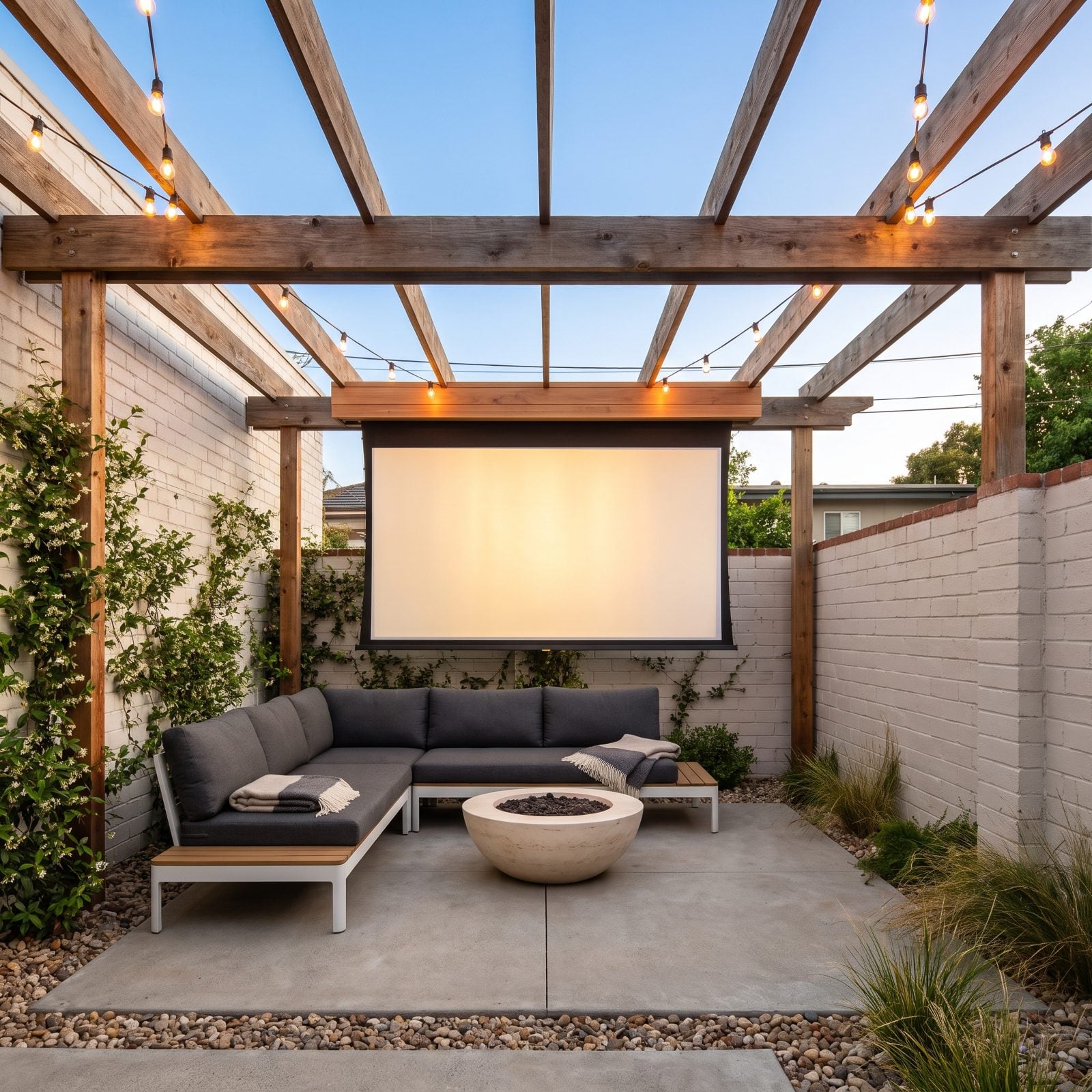
Most compact yards die at sundown. Tuck a retractable screen into a pergola beam and the whole space flips into a second living room the moment the light drops.
The real win is storage. Roll it back into its cedar housing and you’d never know it was there, so the yard reads as a quiet courtyard by day and a cinema by night. Pair it with a charcoal outdoor sofa and a travertine fire bowl and you’ve got one footprint pulling double duty.
17. Dual-Purpose Seat-Wall Planter
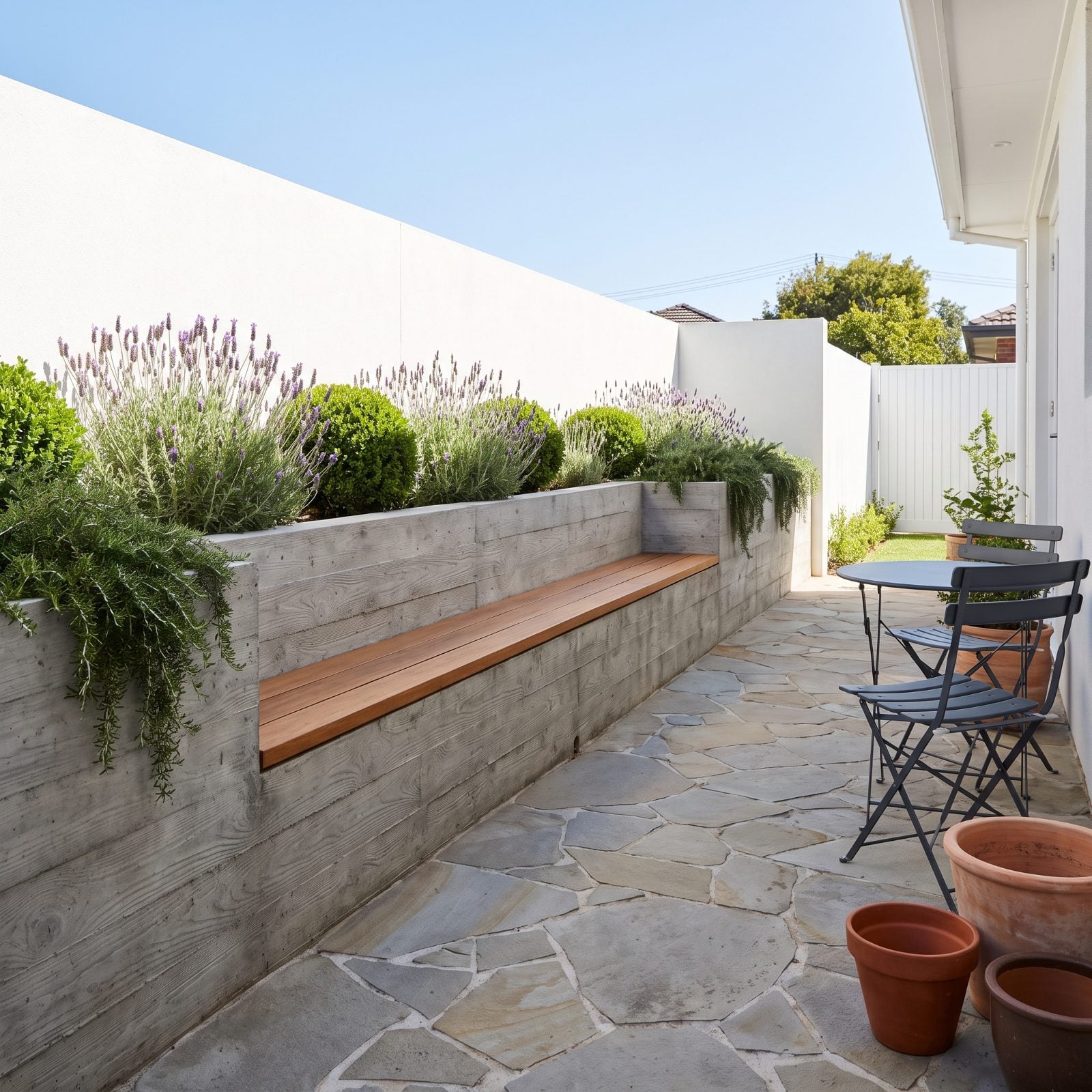
You’ve seen the side yard that’s nothing but a dead run of gravel between two fences. A seat-wall planter fixes that in one move.
The oak-capped concrete gives you perch space for six when people spill outside, and the back half grows lavender and clipped boxwood. One built-in, two functions, and no freestanding furniture eating your width. Drop an oak bench cushion on top and that hard edge softens the second you actually want to sit a while.
16. Small Wildlife Pond
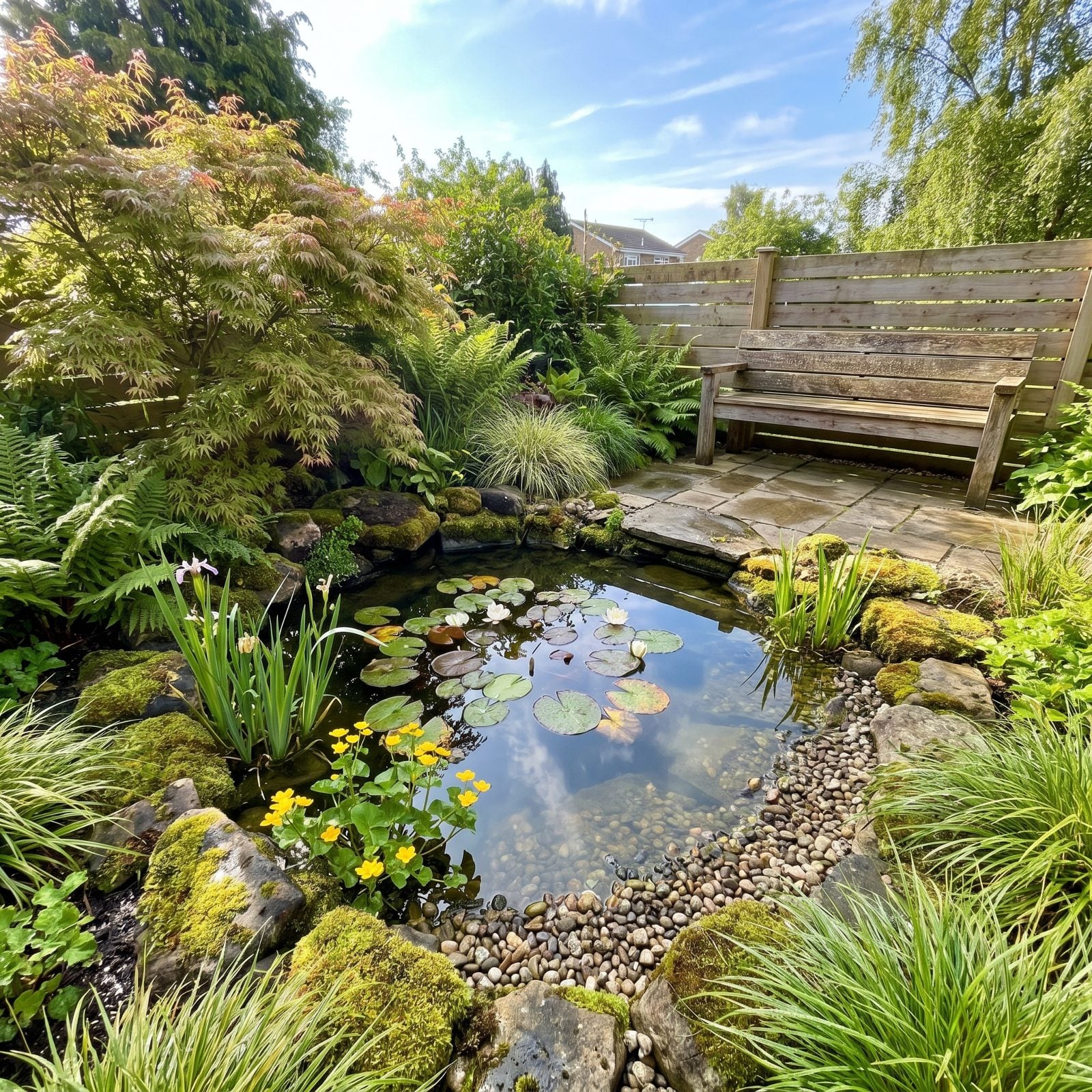
A pond the size of a dining table will pull more life into a yard than a lawn ten times its size.
Keep it small and layered. A pebble beach on one edge, marginal iris and marsh marigold, a lily pad or two for shade on the water. The sound alone does half the work, hushing traffic noise before you consciously register it. Ponds dug too deep and left too bare tend to fail, so don’t skip the shallow shelf and the planting.
15. Rain Garden in a Low Corner
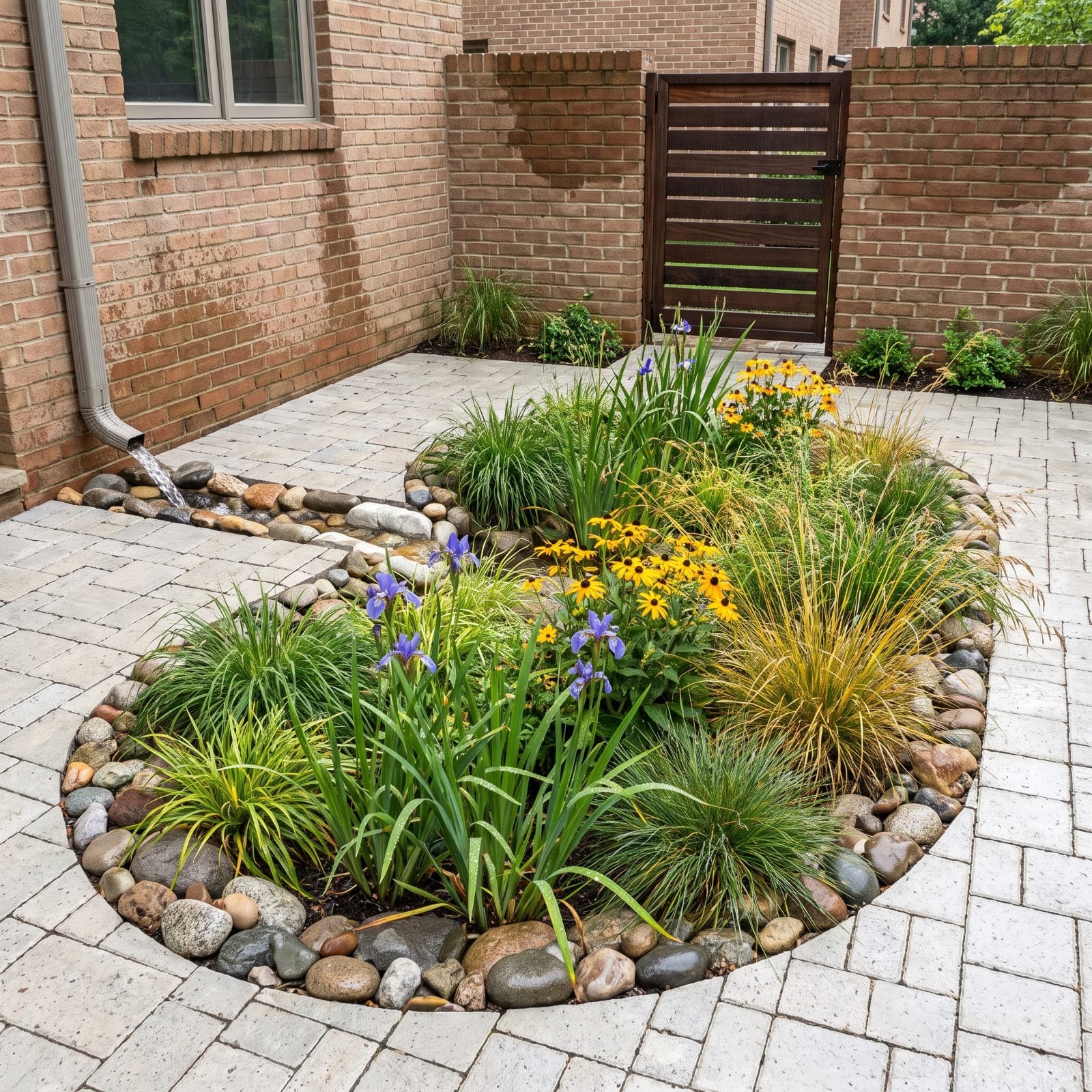
That soggy corner where water always pools? Not a problem. It’s a feature waiting to be planted.
Dig a shallow basin, pipe the downspout into it, and fill it with plants that drink hard and then shrug off dry spells: blue flag iris, sedges, black-eyed susans. The roof runoff that used to flood your path now feeds a bed that looks sharp right through the season.
14. Deck With Built-In Planter Boxes
🔥 Would you like to save this?
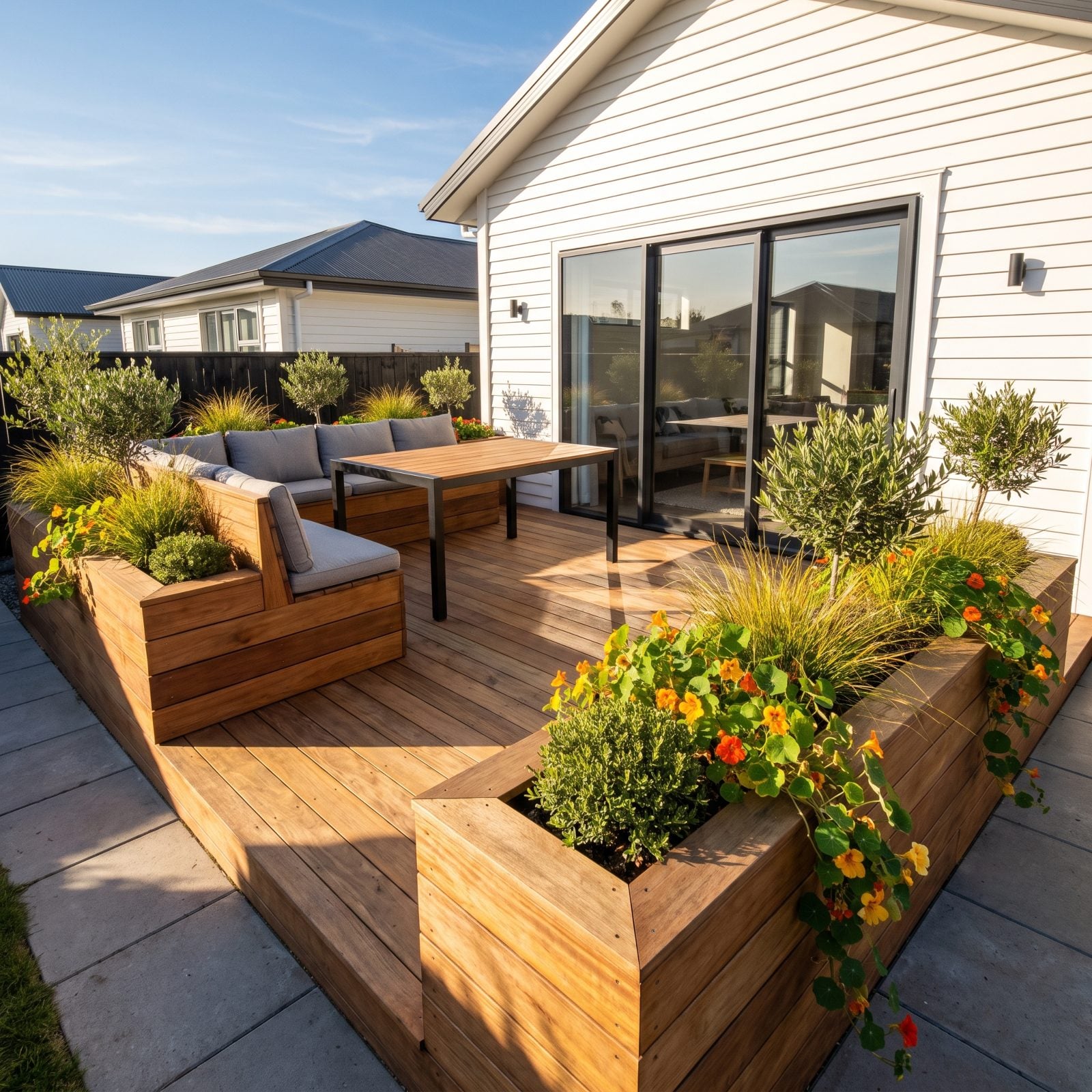
Built-in planters along a deck edge handle the railing’s job and the garden’s job at once.
Instead of a bare balustrade swallowing your sightline, you get grasses and dwarf olive marking the boundary at waist height. The floor stays wide open for a table and bench, and nobody trips over a dozen loose pots. It’s the trick that makes a twelve-foot deck feel like a room with green walls.
13. Foldaway Potting Station
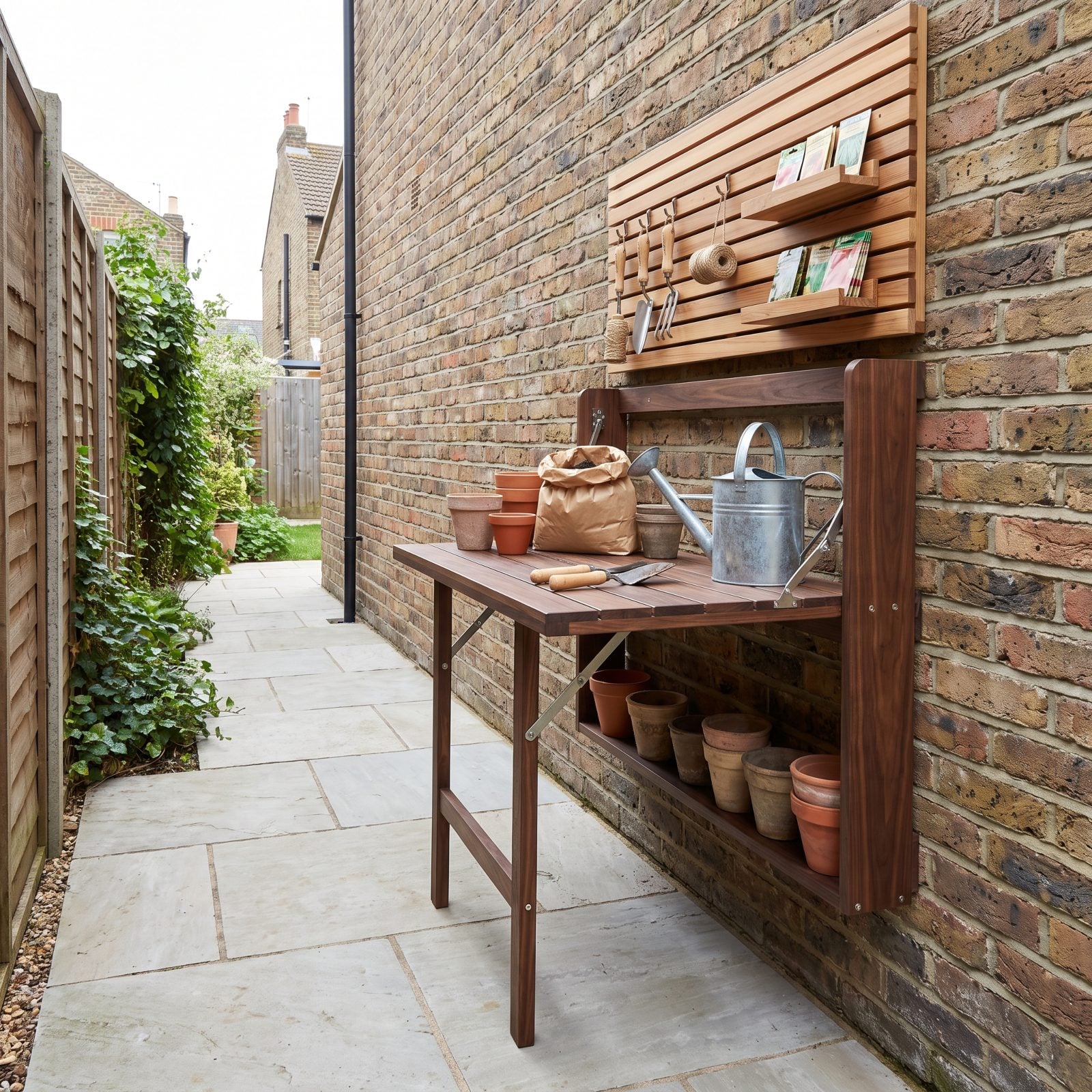
Nobody has room for a dedicated potting shed in a side return. A fold-down bench bolted to the wall does the whole job, then vanishes.
Open it to repot, pack seed trays, clean your trowels over a bag of compost with a split in the top. Fold it flat and the passage is a passage again. Add a slatted panel above for hanging tools and the wall earns its keep three ways.
12. Slatted Privacy Screen With Shelves
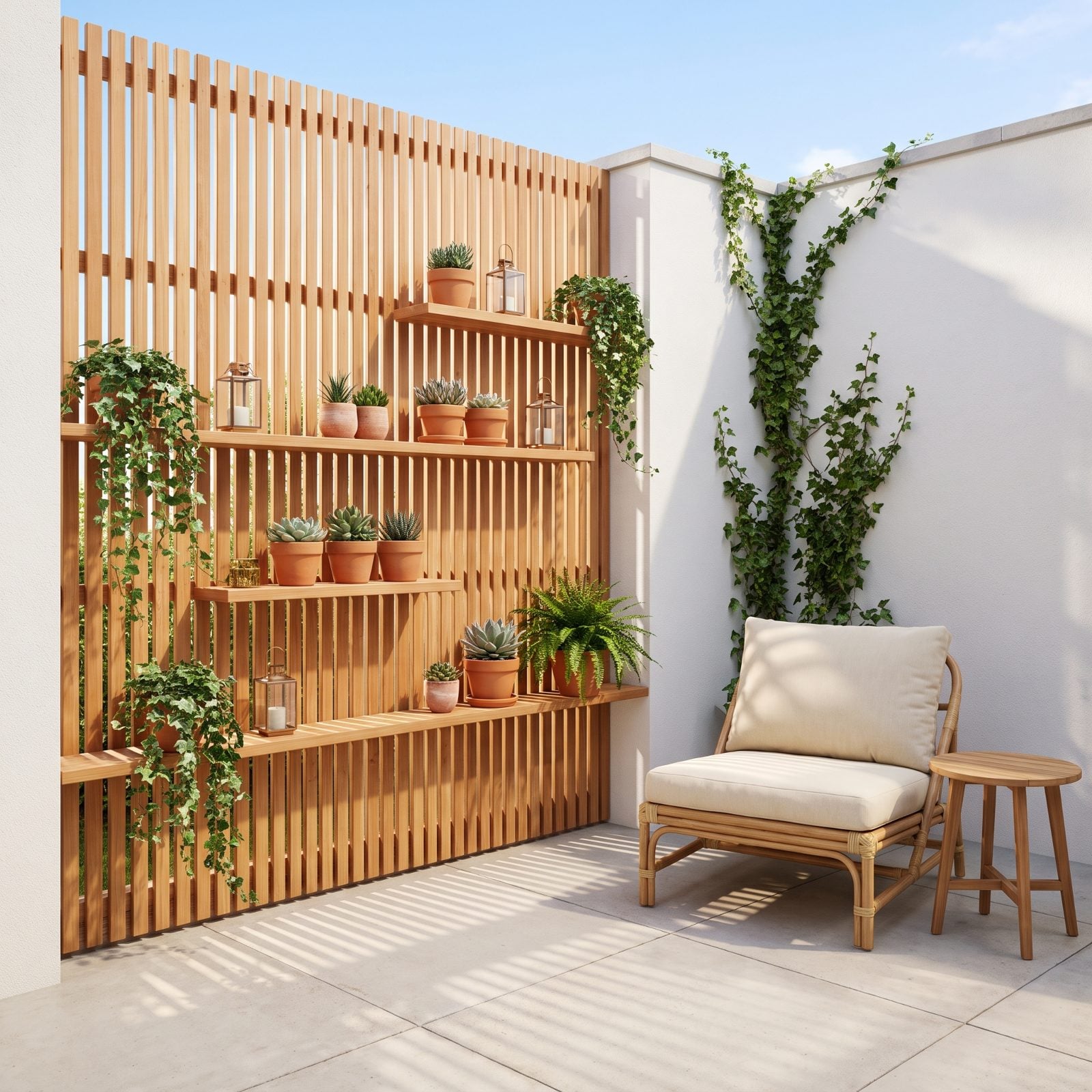
Privacy and storage usually fight over the same inches. A slatted screen with built-in shelves makes them share.
The cedar slats block the neighbor’s window while letting air and striped light slip through, so you get seclusion without that boxed-in feeling a solid fence gives you. Those floating shelves turn the vertical plane into display space for succulents and lanterns, with a rattan lounge chair pulled up alongside. One slim wall, nothing lost on the floor.
11. Compact Greenhouse Against a Wall
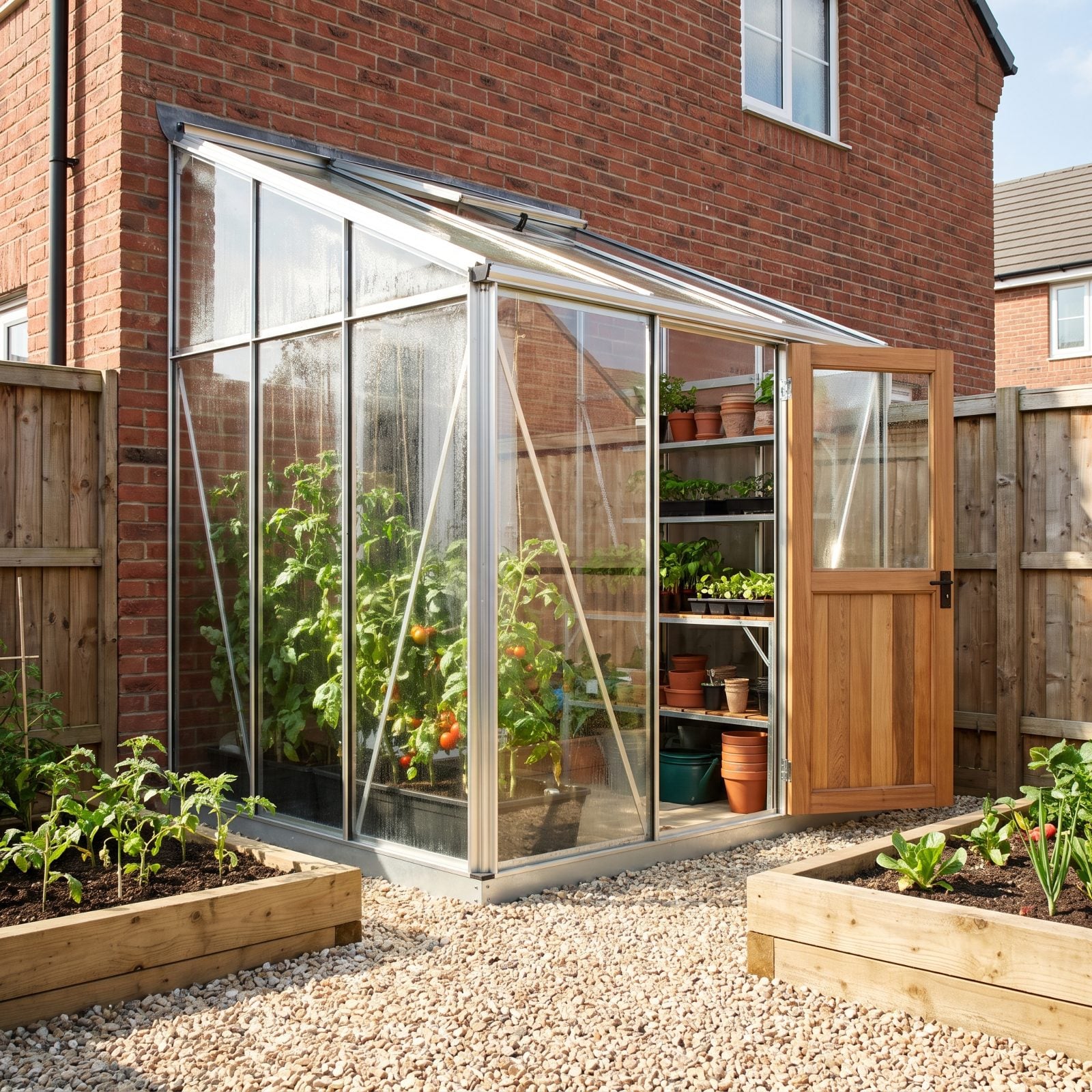
A freestanding greenhouse wants four walls and a chunk of lawn. A lean-to steals one wall from the house and shrinks down to a four-foot strip.
The brick behind it soaks up daytime heat and releases it after dark, so your seedlings sit in a warmer, steadier home than a standalone could ever manage. You run the whole thing off a side path nobody was using anyway. Same growing power, half the footprint.
10. Children’s Sandpit With a Deck Cover
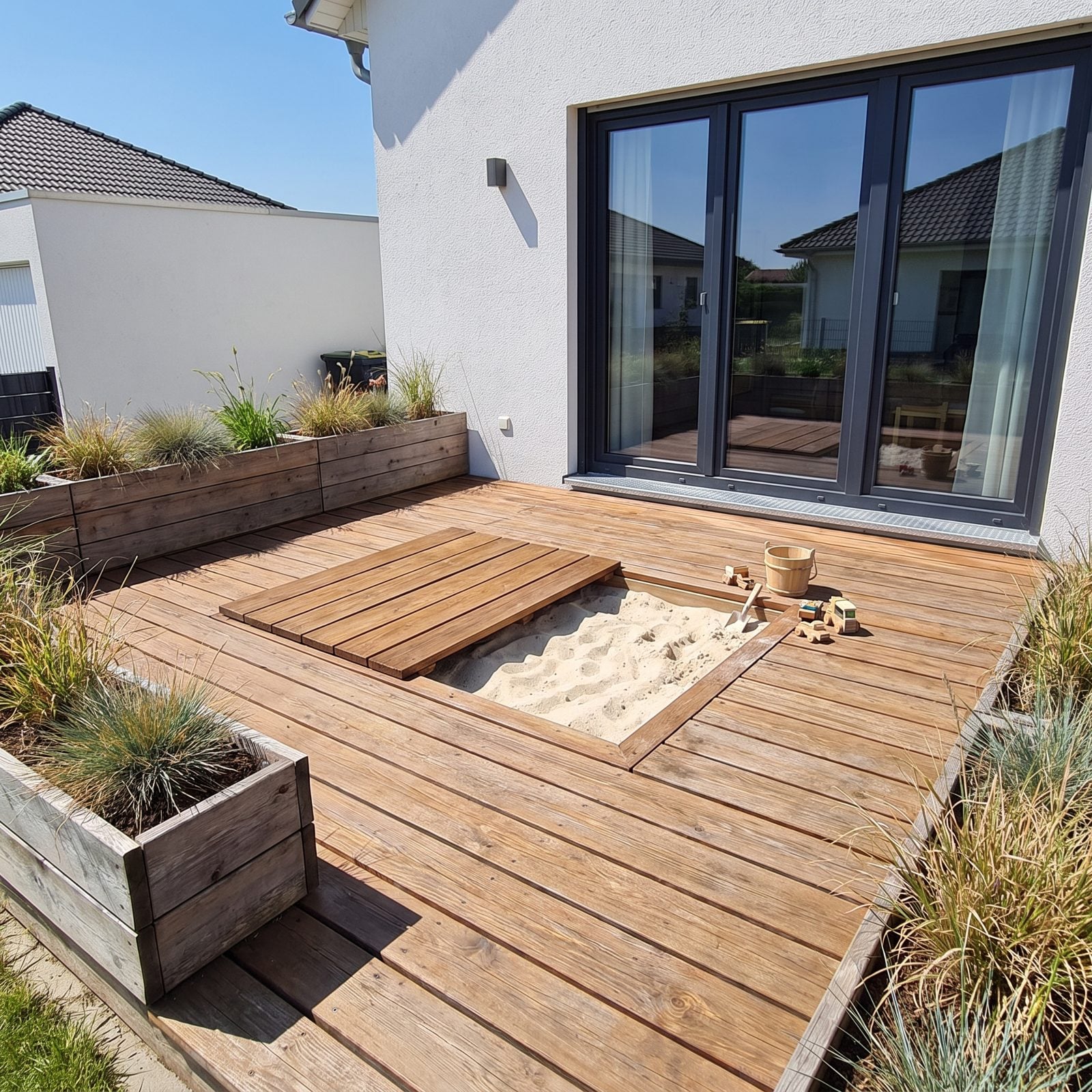
A sandpit eats a corner of the yard and starts looking like a litter box the day the kids outgrow it. Hide it under the deck instead.
A slatted lid slides partly aside to reveal clean play sand, then slides back flush when you want the deck for dinner. The lid keeps rain and leaves out, which is the quiet reason this one lasts. When the sandpit era ends, you fill the void and keep the deck. Honestly? Most future-proof idea on this whole list.
9. Outdoor Shower Tucked Into a Planted Alcove
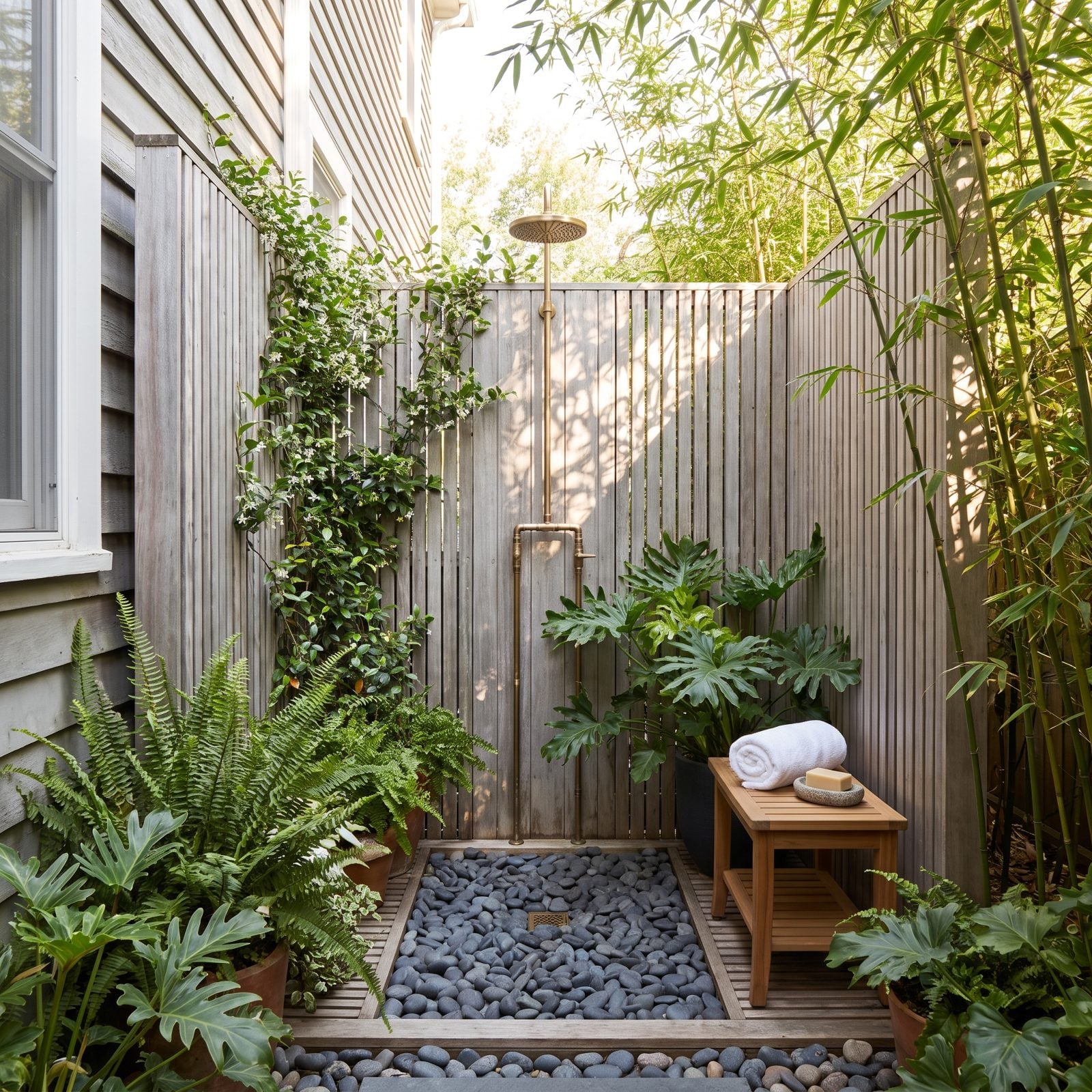
A shower outside sounds like a vacation rental gimmick until you give it four feet against a fence and wrap it in bamboo. Then it becomes the best use of a dead side wall you’ll ever make.
The cedar slat screen pulls double duty, offering privacy on one side while the jasmine climbs the other. That brass rainfall head against weathered wood is the whole look. River-rock drainage underneath means no standing water, no mud.
8. A Rolling Citrus Grove in Containers
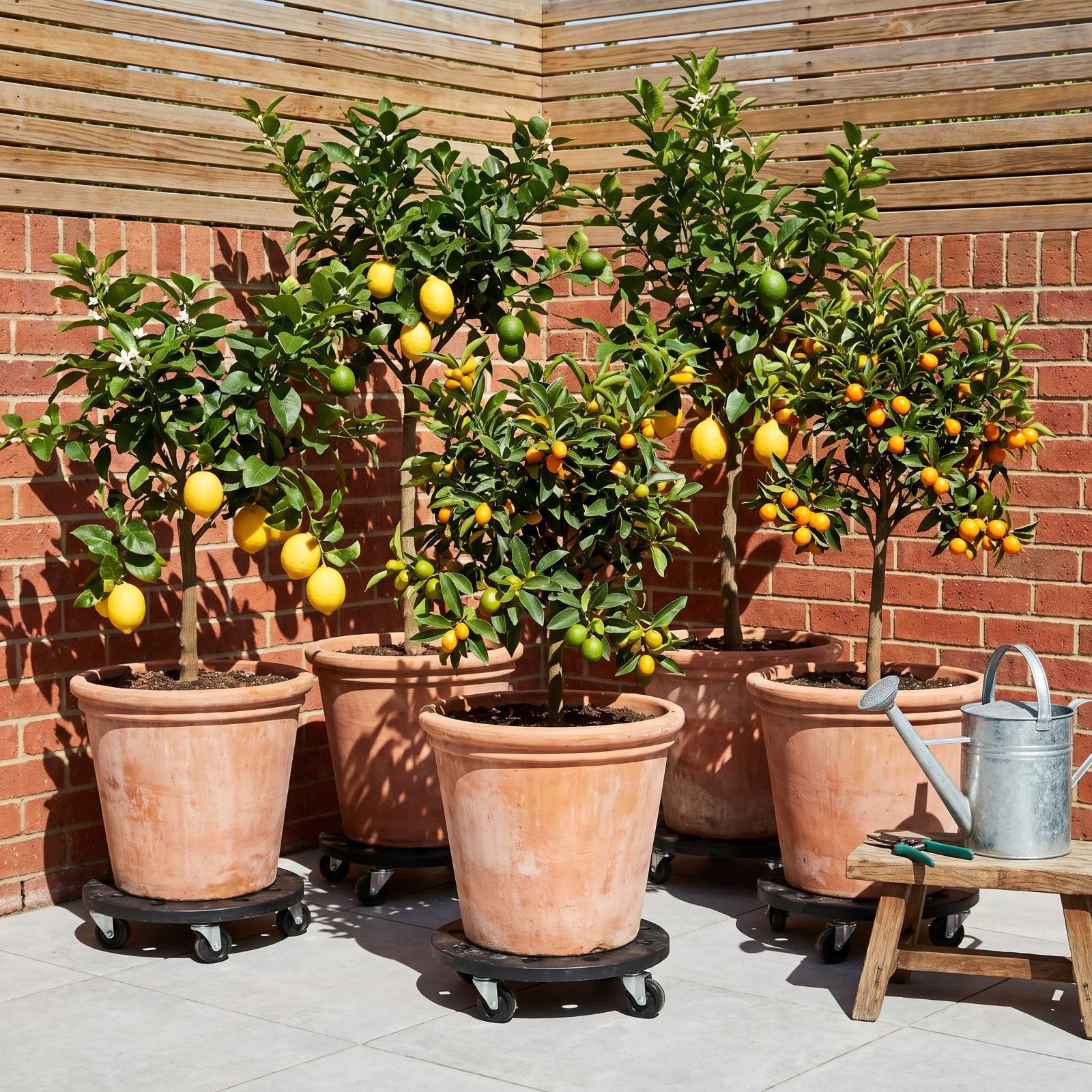
Citrus hates frost and loves to be moved. Put the pots on casters and you solve both problems at once.
Roll the grove into full July sun, then wheel it against the warm brick (or indoors) when the cold arrives. Dwarf Meyer lemons and calamondins fruit happily in a fifteen-gallon terracotta pot, and five of them turn a bare patio into something that smells like blossom every spring. They want to dry out between waterings. Terracotta helps with that.
7. Spiral Kitchen Garden That Stacks Herbs Up, Not Out
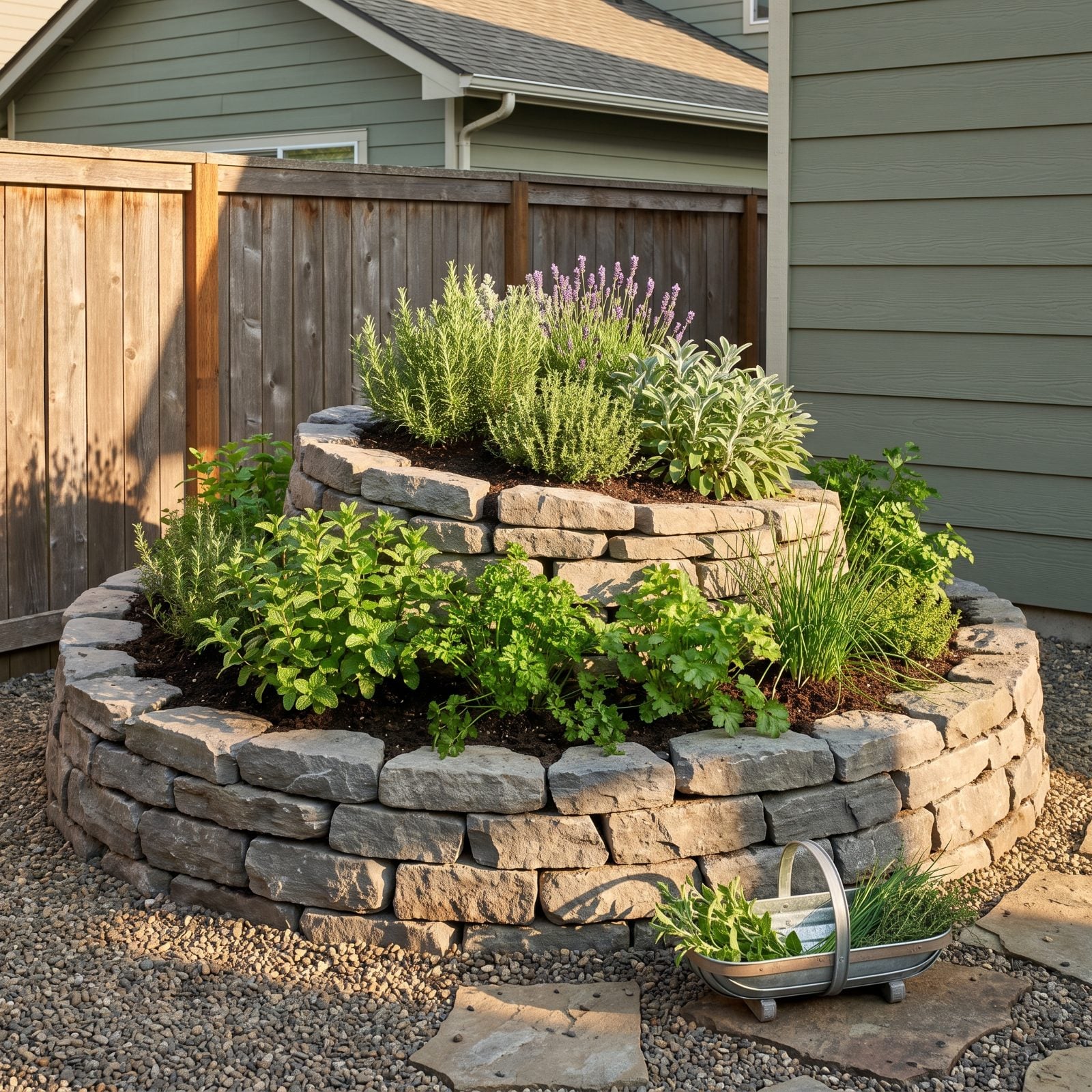
The clever part of a spiral isn’t the shape. It’s the microclimates.
Build a stone coil two feet high and you create a tall, dry, sunny crown and a cool damp base, all in a circle you can reach across. Rosemary and lavender ride the top where drainage runs sharp. Mint and parsley settle at the bottom where it stays moist. You get the herb range of a long border in the footprint of a kitchen table.
6. A Dry Creek Bed That Handles the Rain and Looks Intentional
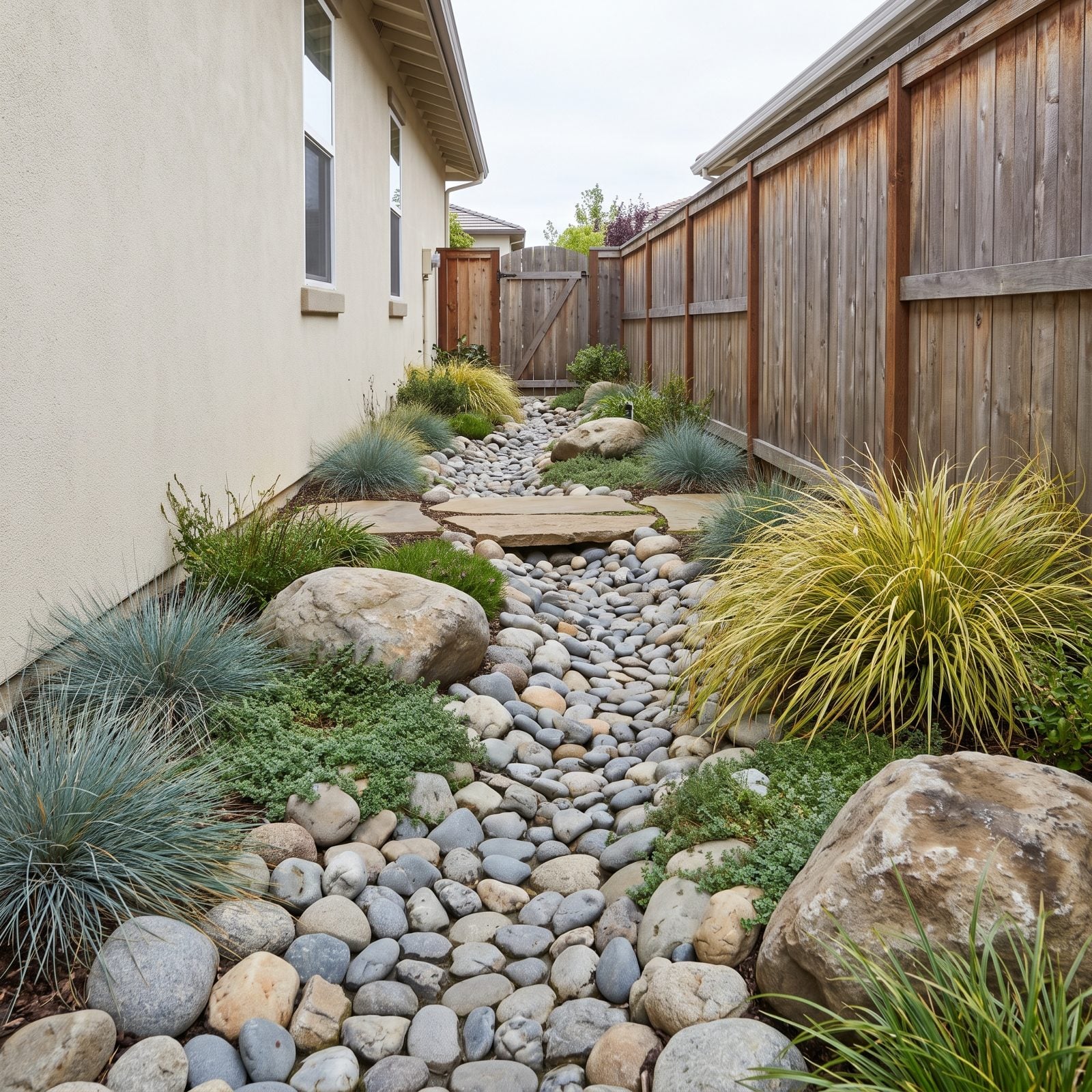
Every narrow side yard has the same problem: water pools where you don’t want it, usually right against the foundation.
A dry creek bed fixes the drainage and still earns its keep when it’s bone dry, which is most of the year. Grade a shallow channel, line it with river cobble, then drop a few boulders on the bends so it reads like a real streambed instead of a gravel ditch. Blue fescue and creeping thyme go along the banks. When the storm hits it moves water, and once it passes, it’s the best-looking thing in the yard.
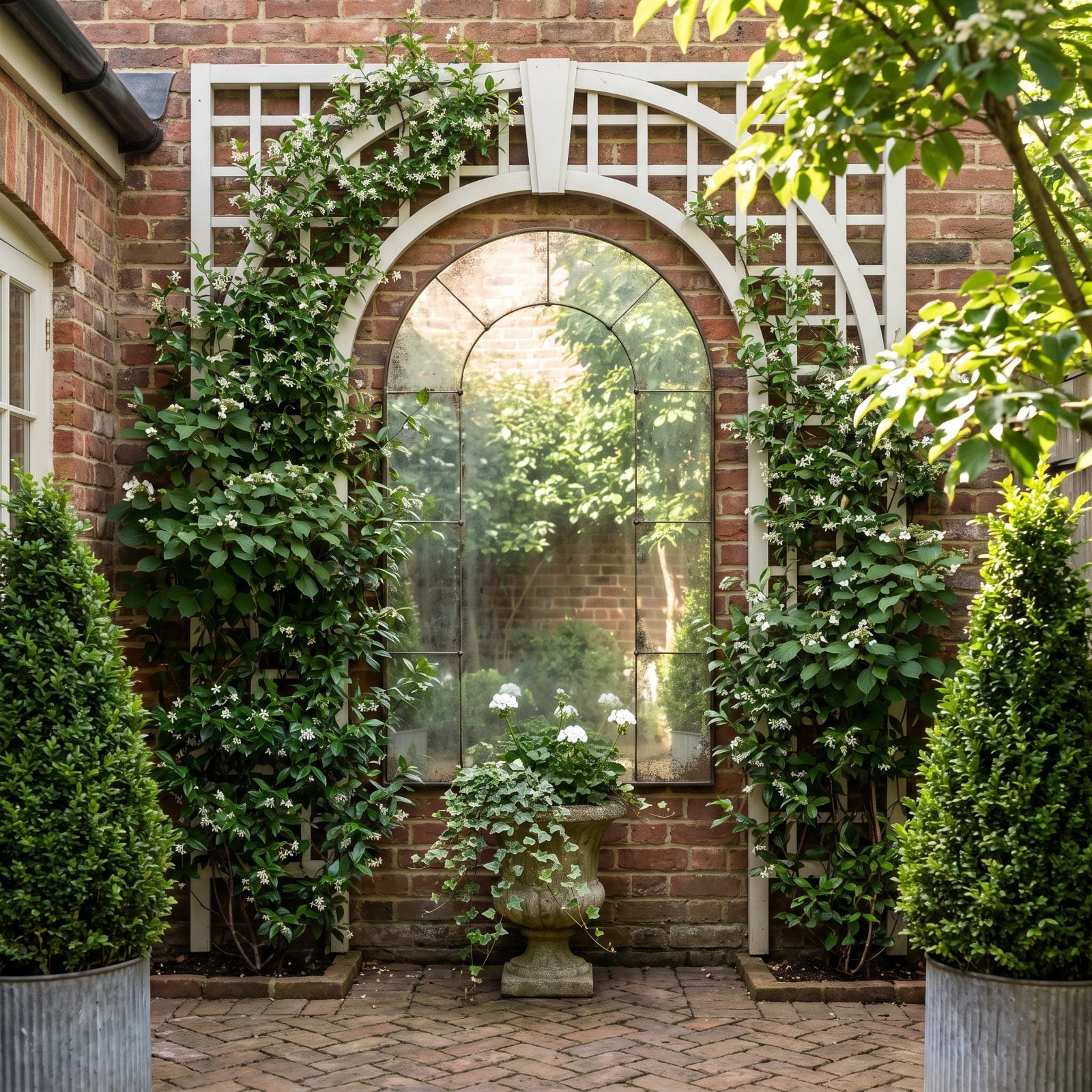
5. Mirror-Backed Trellis That Doubles the Garden
🔥 Would you like to save this?
An old trick from English walled gardens, and it still fools the eye every time.
Set an arched mirror behind a trellis, let a climber grow across it, and a dead-end brick wall suddenly reads as a gateway into more garden. The glass bounces foliage and light back into a tight courtyard, which is why these spaces feel twice their size. Age the surface so it doesn’t look like a bathroom mirror bolted to the fence. That slight distortion is what sells the whole thing.
4. A Layered Fern Garden for That Impossible Shady Corner
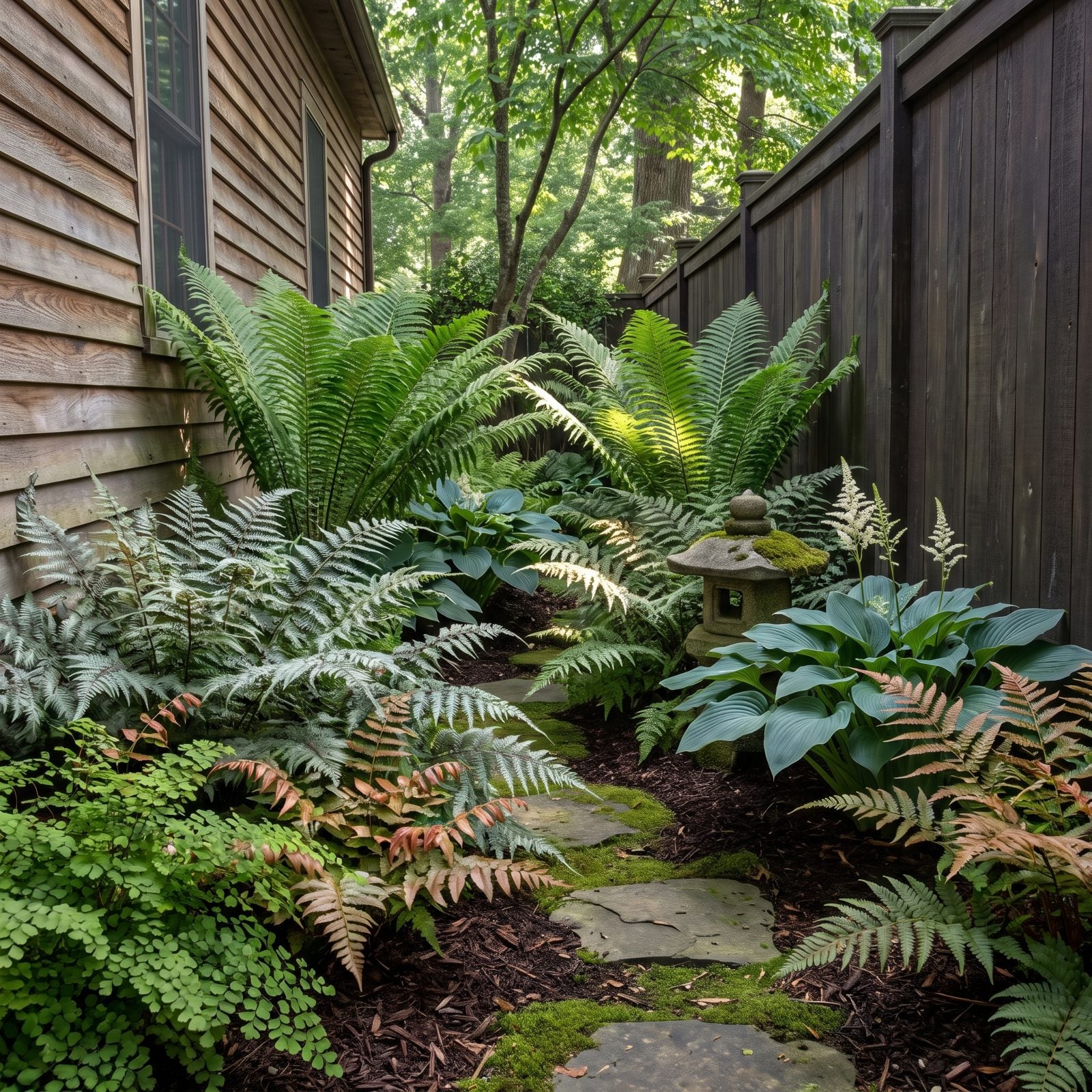
Deep shade is where most people give up and throw down gravel.
Ferns want exactly what that corner offers: no sun, moist soil, no competition. Stack them by height and texture, ostrich ferns at the back, silvery Japanese painted ferns in the middle, maidenhair up front, and the dead zone turns into the coolest-looking spot in the yard. Blue hostas and a stone lantern finish it. This is a corner you walk past, not into, so everything rides on texture you read from a few feet away.
3. The Trash-Bin Enclosure With a Green Roof You’ll Forget Is There
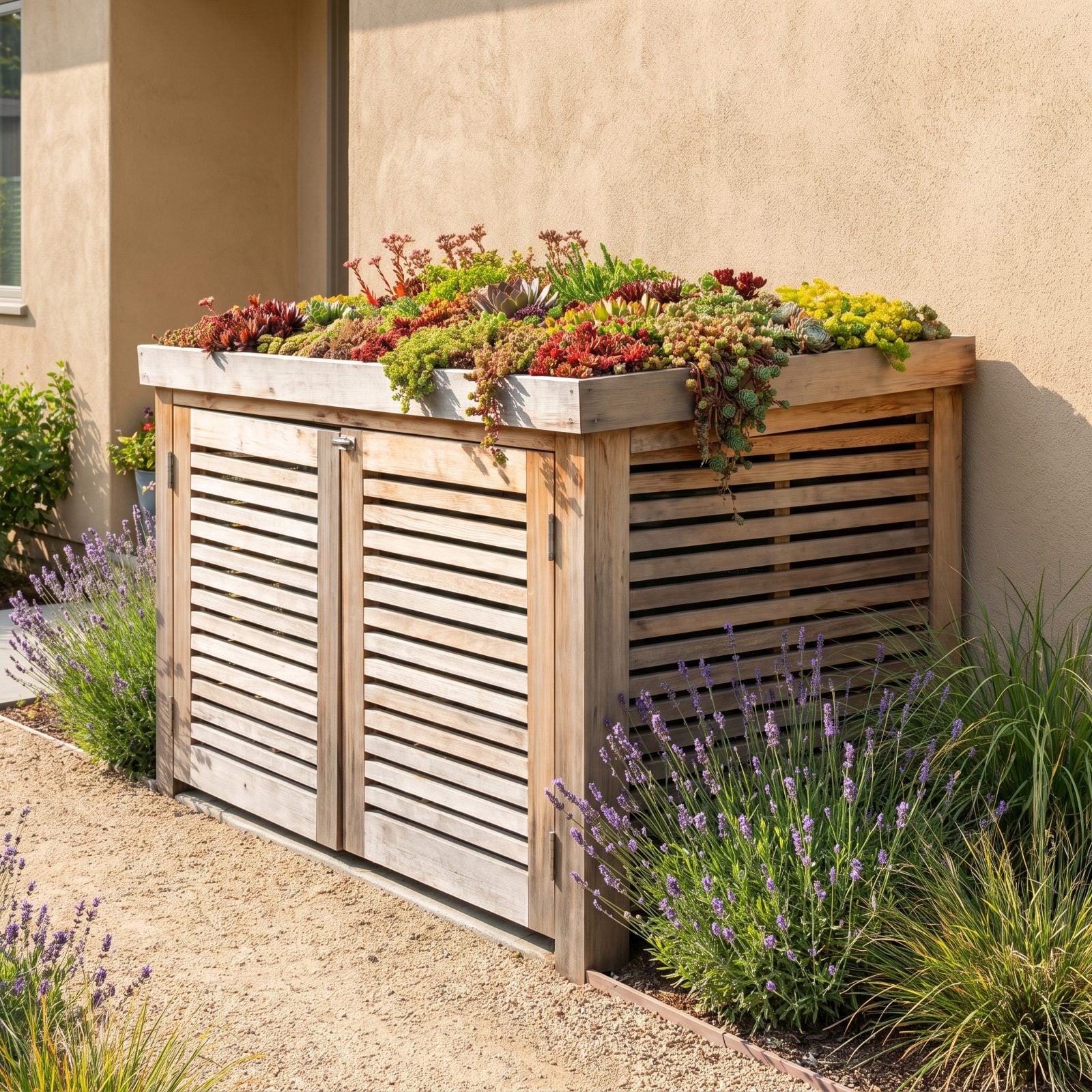
Nobody wants three wheelie bins to be the first thing a visitor sees. And in a small front yard, they usually are.
Box them into a cedar-slat enclosure and cap it with a shallow sedum roof. The succulents need almost no soil and no watering, and the whole thing stops reading as storage. Lavender and grasses on either side fold it into the border. You hide the ugliest necessity in the yard and gain a square of living roof doing it.
2. An Arched Arbor Entry That Makes a Small Yard Feel Composed
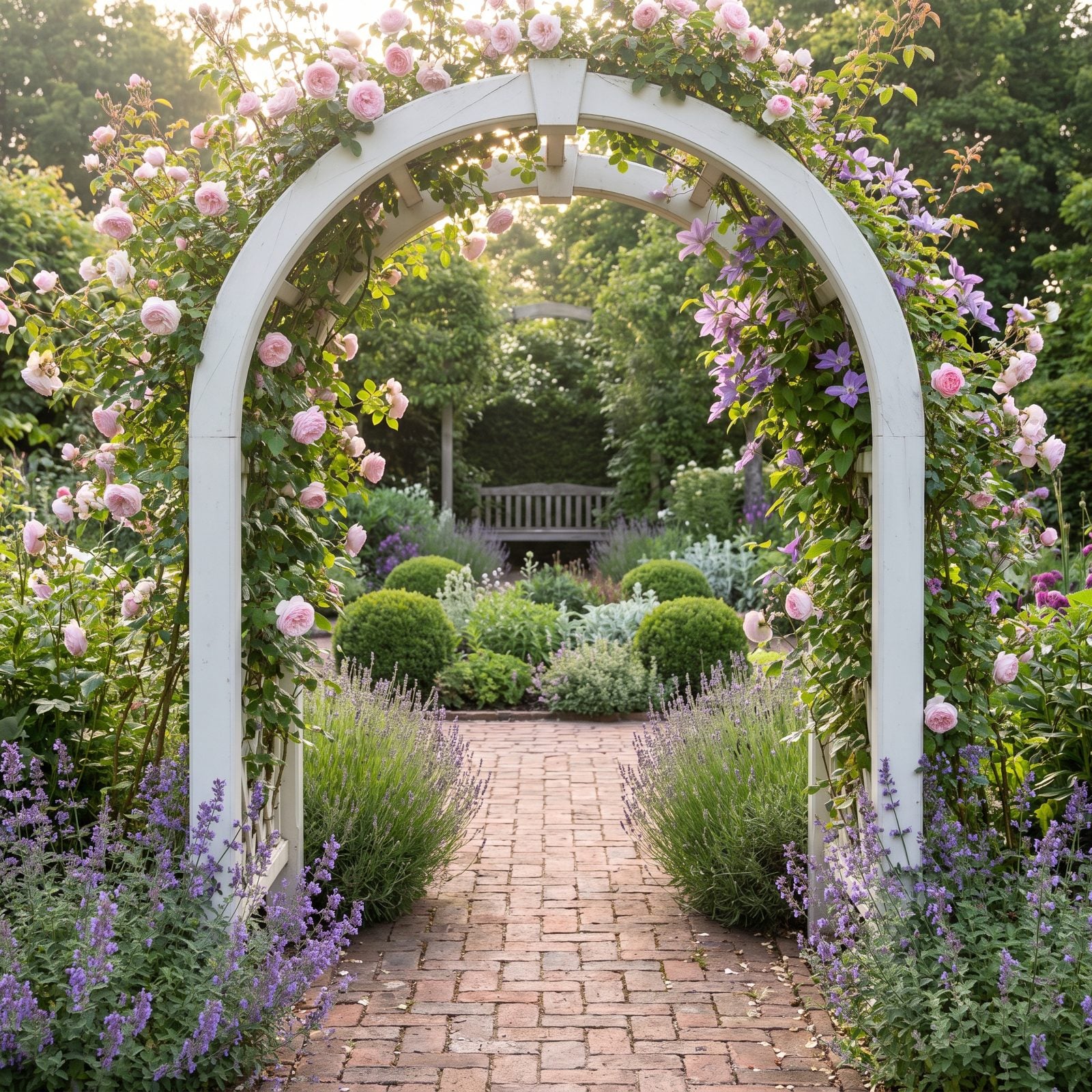
A small yard with no structure just sprawls. An arbor gives it a doorway.
Straddle the path with a simple arched arbor and you’ve split the space into here and beyond, the oldest trick going for making a tiny garden feel like it has rooms. The climbing rose and clematis cover the frame in a single season. And that half-hidden view through the arch? It pulls you forward. Much like the way an oversized hallway renovation uses a threshold to signal you’re crossing from one zone into another.
1. Modular Deck Platforms Floating Between the Trees
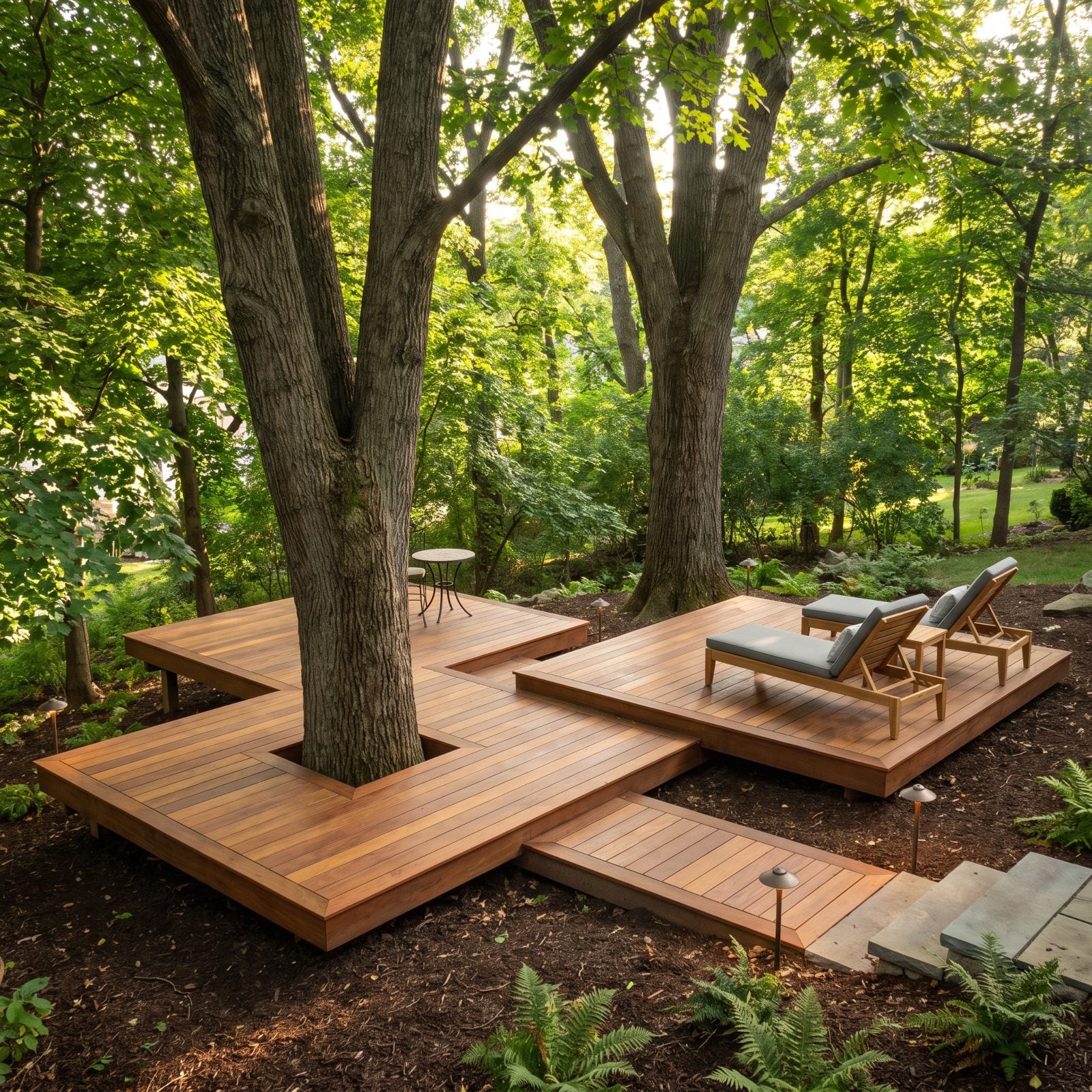
A full deck on a sloped, tree-filled lot means grading, removal, and a flat plane that fights the land every inch.
Modular platforms don’t fight anything. Set a few low ipe squares at different heights, weave them around the trunks with cutouts, link them with stepping stones. The trees stay. The slope stays. What you get are flat usable surfaces, a lounge chair here and a bistro table there, each its own little outdoor room under the canopy. Dappled light through the leaves is the entire mood, and this is the kind of space that drags you outside instead of back into the oversized den makeover indoors.