🔥 Would you like to save this?
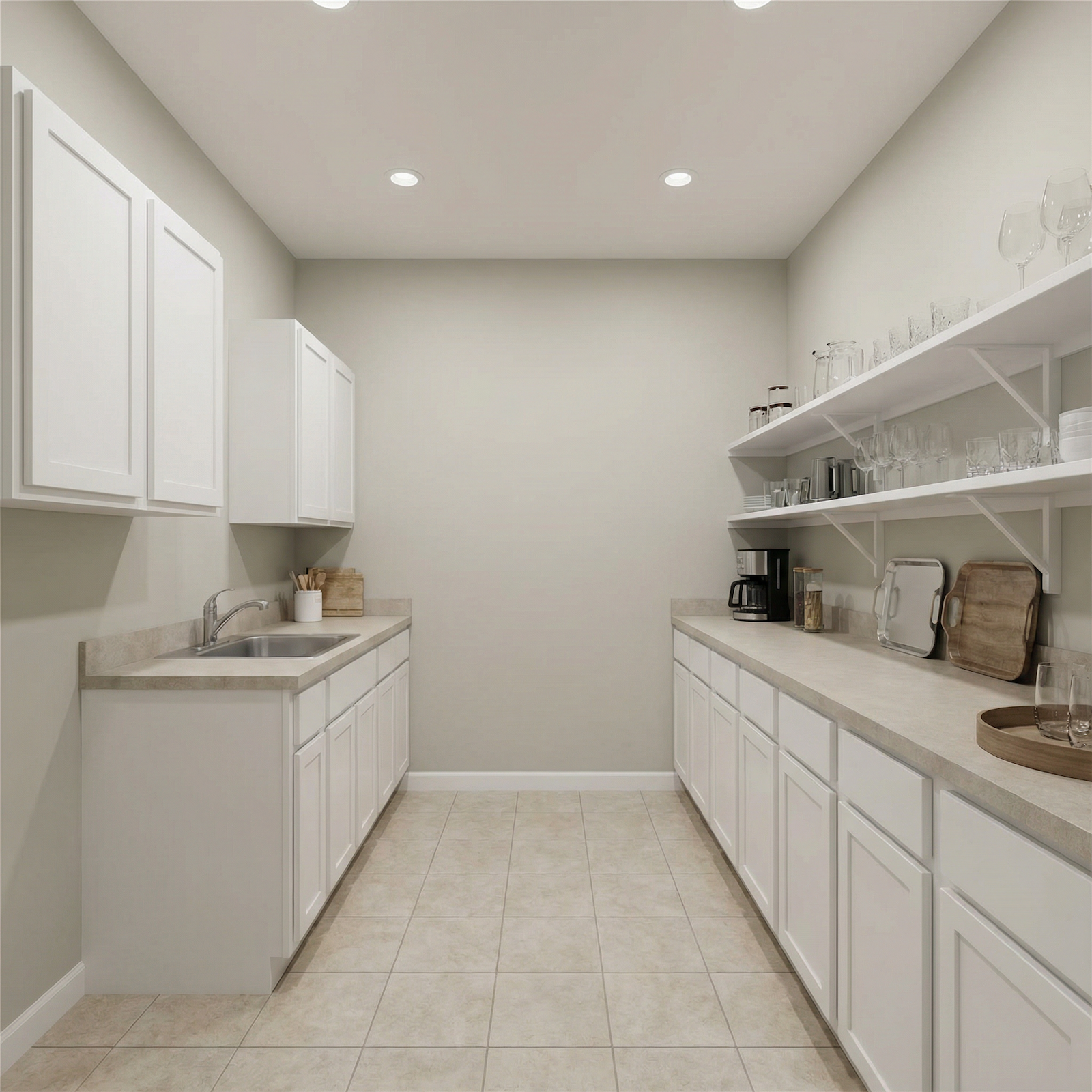
Recessed lighting is practical. It’s clean. It’s unobtrusive. And it’s absolutely everywhere in new kitchens.
But our reader data suggests there’s a difference between lighting that does its job and lighting that makes a kitchen visually interesting.
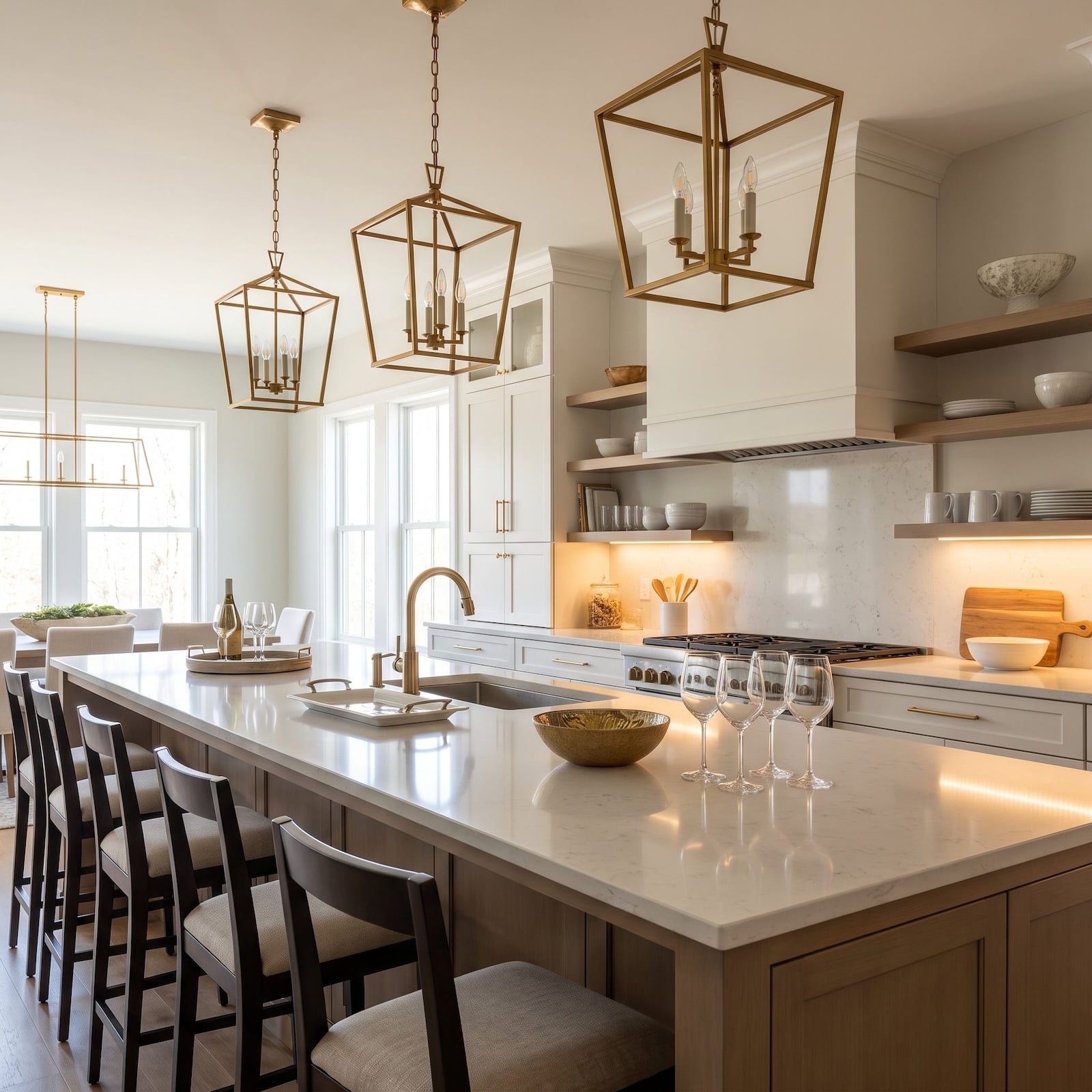
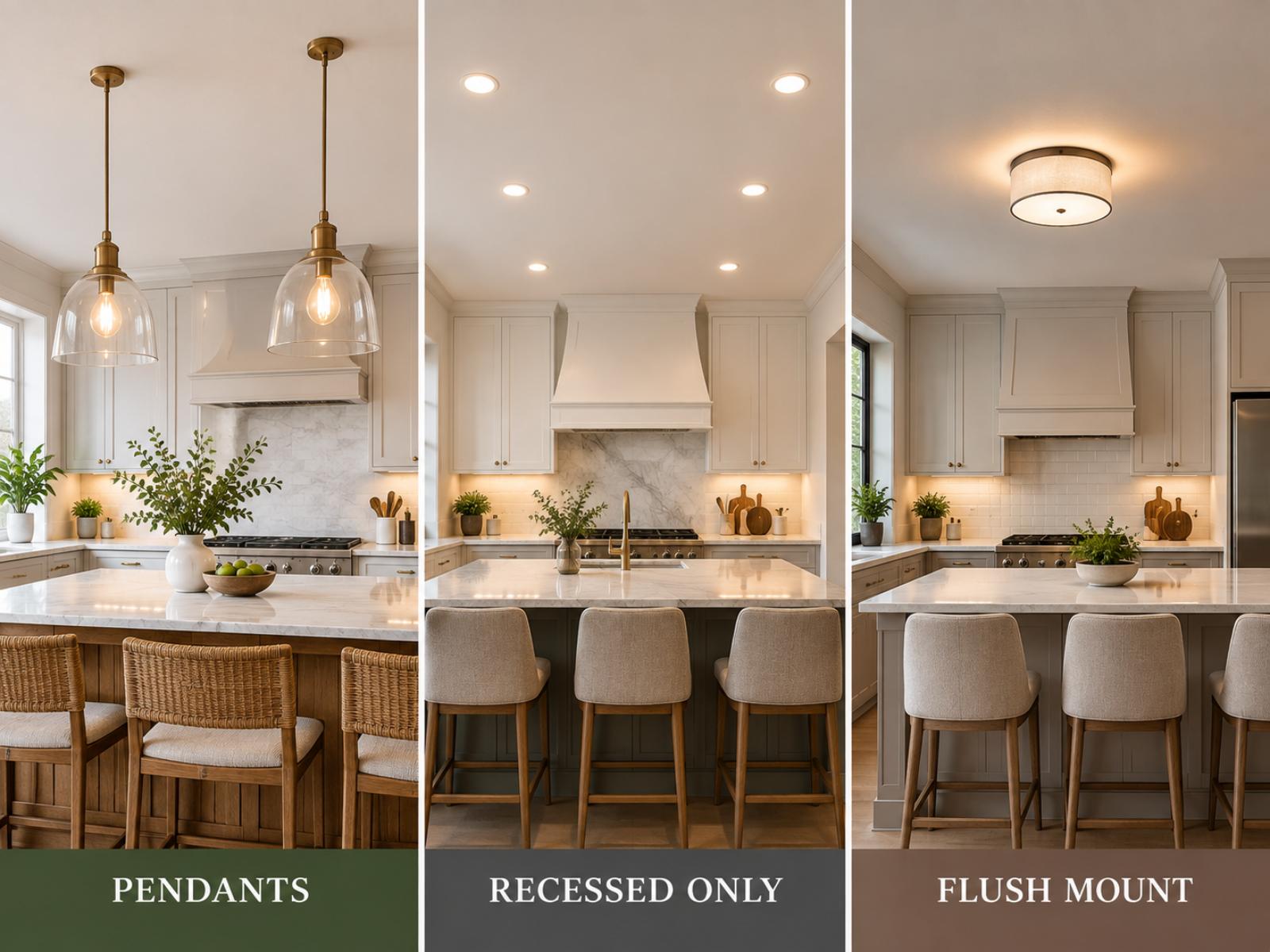
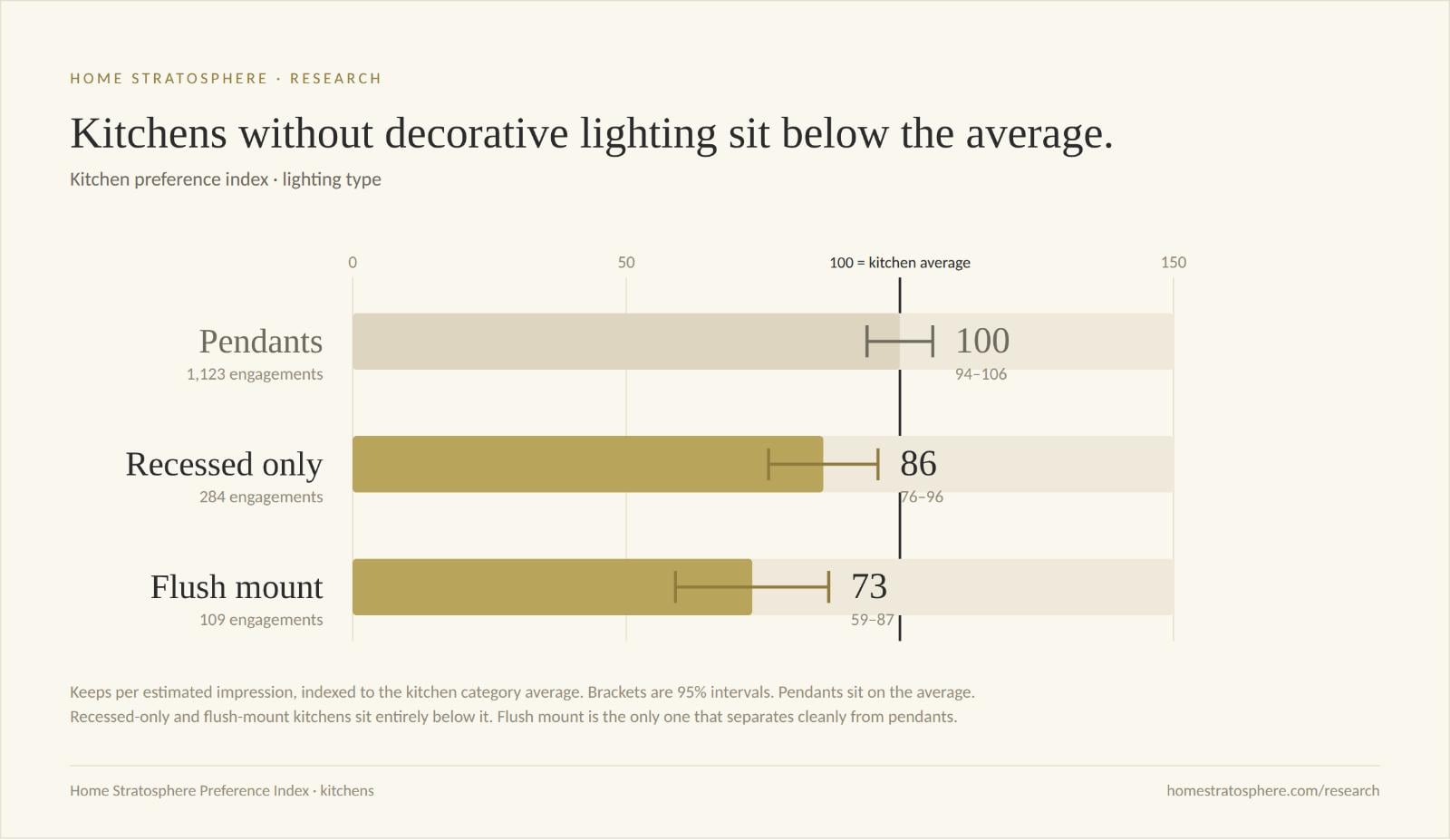
When we compared several common kitchen lighting approaches, pendant lighting landed at a Preference Index of 100—right at the kitchen-category average.
Kitchens relying on recessed lighting alone scored 86.
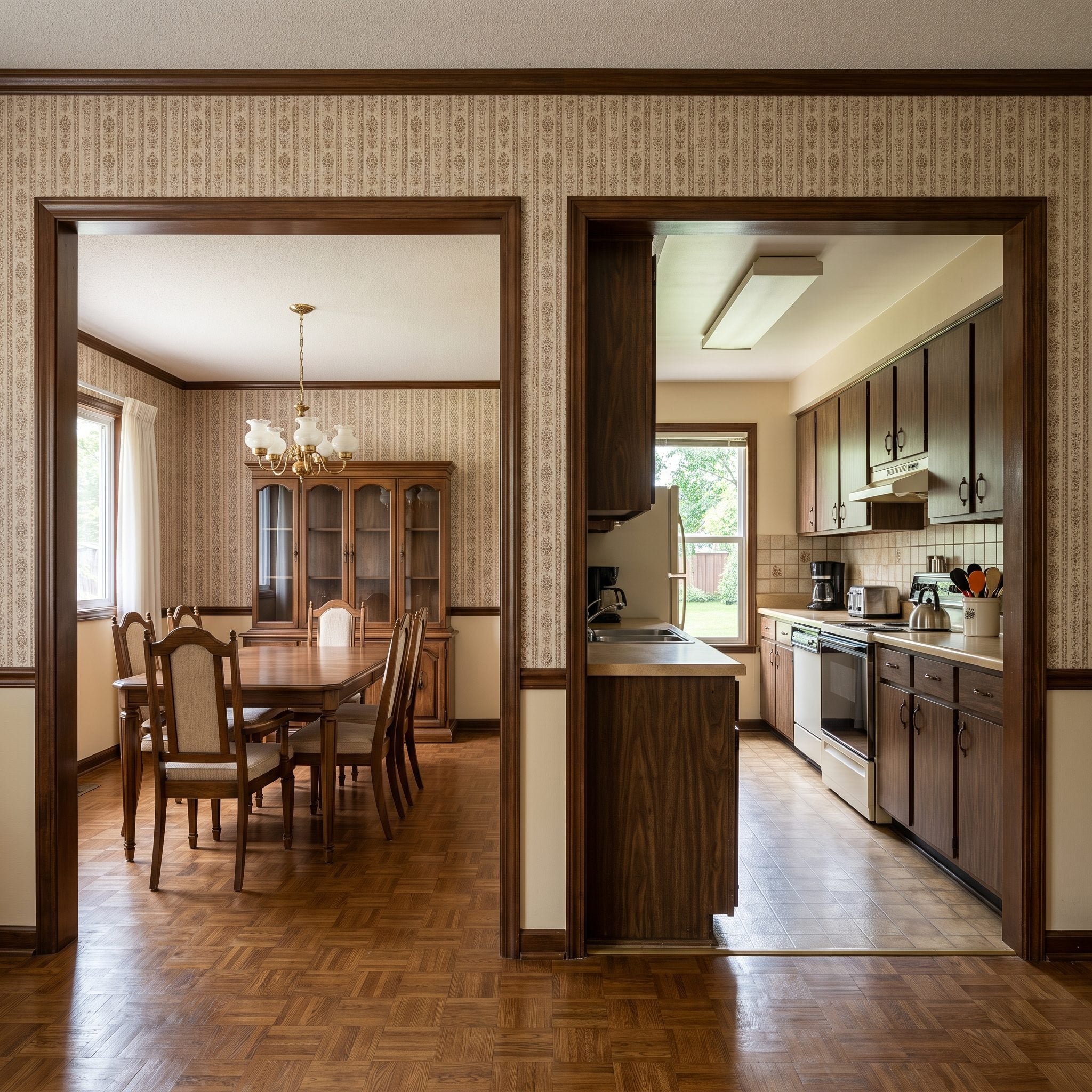
Flush-mount lighting did worse at 73.
The Kitchen Lighting Numbers
Our Preference Index measures reader keeps—love and save actions relative to estimated image exposure—against the average for the kitchen category. An index of 100 represents the category average.
| Lighting type | Preference Index | 95% CI | Engagements |
|---|---|---|---|
| Pendants | 100 | 94–106 | 1,123 |
| Recessed only | 86 | 76–96 | 284 |
| Flush mount | 73 | 59–87 | 109 |
Two of these three results are established, and one isn’t. That distinction is the whole article, so it’s worth being precise about.
Recessed-only and flush-mount kitchens both sit entirely below the category average. Recessed-only runs 76 to 96. Flush mount runs 59 to 87. Neither interval touches 100, so both are performing below average by more than sampling noise would explain.
Pendants are not established as better than recessed-only. Pendants run 94 to 106; recessed-only tops out at 96. Those overlap, so I’m not going to claim pendants beat recessed lighting head to head.
Flush mount is different. Its interval tops out at 87, below the bottom of the pendant interval at 94. Flush mount is the one lighting type that separates cleanly from pendants in this data.
So the finding isn’t “pendants win.” Pendants are exactly average. The finding is that kitchens leaning on recessed or flush-mount lighting alone are landing below average, and pendants aren’t.
Why Might This Be Happening?
The result doesn’t mean readers dislike recessed lights.
I suspect something simpler is happening.
Recessed lights are largely invisible.
That’s precisely why they’re useful. They illuminate a kitchen without adding much visual clutter. But when somebody is scrolling through kitchen images, there isn’t much there to respond to.
A pendant is different.
It hangs directly in the sightline, often above the island, which is already one of the visual focal points of a kitchen. It adds shape, material, scale and sometimes color.
In other words, a pendant isn’t merely lighting.
It’s furniture for the ceiling.
Recessed Lighting May Work Better as Supporting Cast
The interesting result here isn’t “pendants good, recessed lights bad.”
Most well-designed kitchens don’t have to choose between the two.
Recessed fixtures can handle ambient and task lighting while pendants provide the visual focal point.
Our data suggests the potential problem is relying on recessed lighting to do everything.
Kitchens featuring recessed lighting only scored 86, with the entire interval sitting under the category average.
That matters for builders and developers in particular, because recessed-only lighting is such an easy default. It’s clean, relatively neutral and unlikely to offend a buyer.
But neutral isn’t necessarily the same thing as appealing.
If the goal is to make a kitchen photograph well, attract attention in a listing, perform in advertising or simply feel more finished, decorative lighting may be doing more work than its wattage would suggest.
Flush Mounts Have the Clearest Problem
Flush-mount fixtures came in at 73, or 27% below the kitchen-category average, with an interval of 59 to 87.
That’s the only result in this comparison that separates from pendants outright, and it’s the strongest negative signal in the set.
There are obvious caveats. “Flush mount” covers an enormous range of fixtures, from basic builder-grade lights to expensive decorative pieces. The 109 engagements behind it also make it the thinnest cell here, which is why its interval is nearly thirty points wide.
I’d want considerably more data before concluding that the fixture type itself is the problem.
But it’s enough to put the category on my watch list.
What I’d Test If I Sold Kitchen Lighting
This is where the data becomes more useful.
If I were a lighting manufacturer or retailer, I wouldn’t respond by abandoning recessed or flush-mount fixtures.
I’d start breaking the pendant category apart.
Do oversized pendants outperform smaller ones? Does brass beat matte black? Do glass pendants perform differently from metal? Do two large pendants beat three smaller ones? Does pendant performance change with island size, cabinet color or kitchen style?
Those intersections are potentially much more commercially useful than knowing that recessed-only kitchens land below average.
The current result gives us the direction to investigate.
The Takeaway
Pendant lighting isn’t blowing the doors off our kitchen data. Its Preference Index is exactly 100.
That’s actually what makes this finding interesting.
The story isn’t that pendants are extraordinary.
It’s that kitchens without a strong decorative lighting element appear to be underperforming.
Recessed-only kitchens scored 86. Flush-mount kitchens scored 73. Both sit entirely below the average, and pendants don’t.
For builders, designers and lighting companies, that raises a pretty simple question:
Maybe the safest kitchen lighting choice is also making the room less interesting.
About the Data
Home Stratosphere measures reader interactions with individual images across our published design content. The Preference Index compares keeps—love and save actions relative to estimated image exposure—for an attribute value against the average for its category. An index of 100 represents the category average.
This is observational image-preference data, not sales or purchase-intent data. Impressions are sampled and scaled estimates, and results are most useful for comparisons within the same category. Where two intervals overlap, no difference between those values is claimed.