
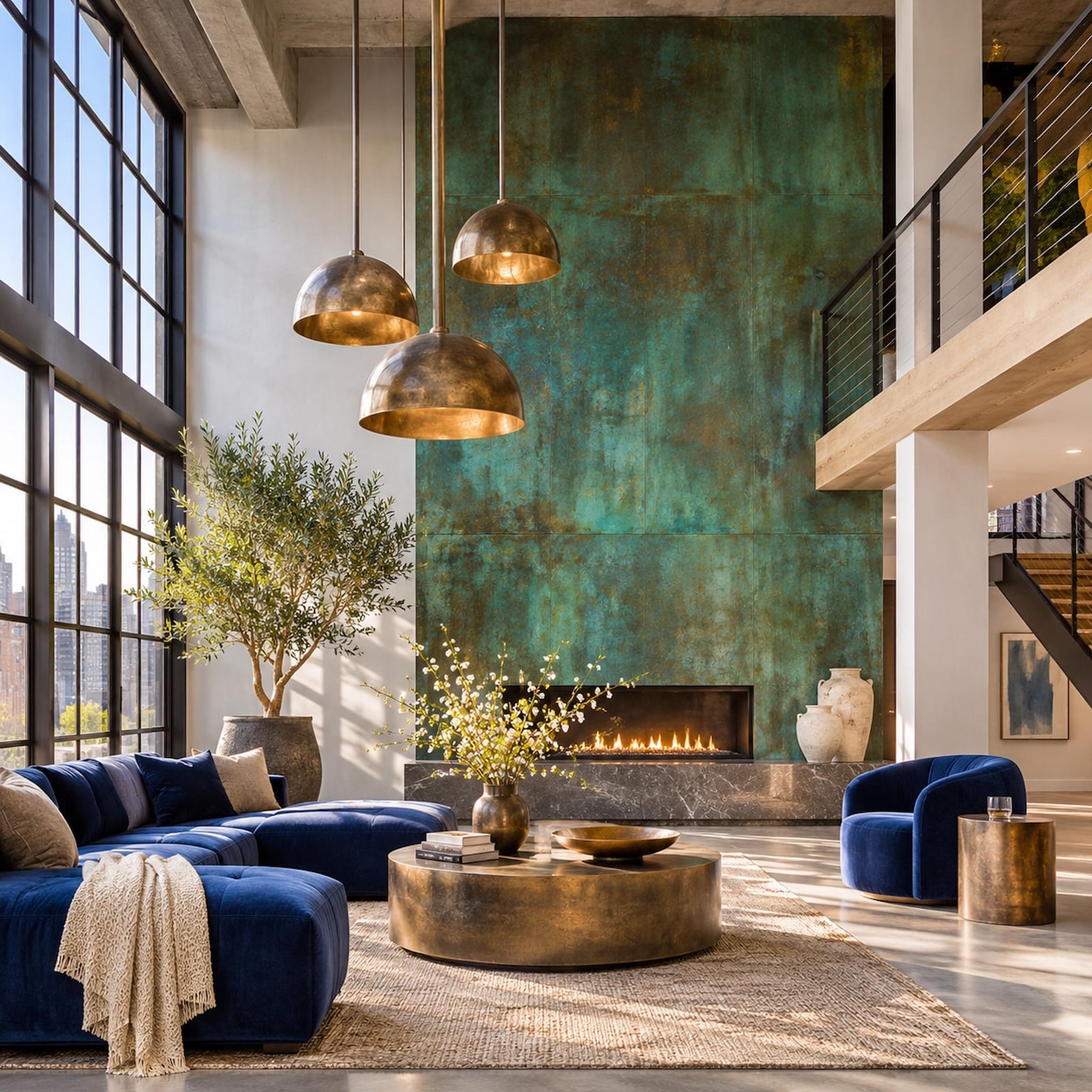
Brass spent years as the jewelry of the house. Faucets gleamed, pendants sparkled, and cabinet handles lined up like a row of cuff links. Bronze has more ambitious plans. Why stop at the handle if the whole cabinet could wear a clouded metal skin? Why confine metalwork to the fireplace surround if an entire wall could weather to verdigris?
In order to come up with the very specific design ideas, we create most designs with the assistance of state-of-the-art AI interior design software. Also, assume links that take you off the site are affiliate links such as links to Amazon. this means we may earn a commission if you buy something.
Finish matters as much as alloy. Brass can be aged and bronze can be polished, and the darker metals offer a remarkable spread of surfaces. Woven wire turns a cabinet door into a veil. Deep fluting breaks sunlight into ribbons. A bronze-tinted mirror borrows the color without a sliver of metal. Even a silver-toned bedside table can sharpen the warmth of a bronze wardrobe beside it.
Patina adds another dimension. Left uncoated, a copper alloy deepens and shifts with every touch, while a protective finish holds a chosen shade in place. From a hairline of inlay to a sweeping staircase, from a kitchen countertop to a wall two stories high, bronze covers astonishing ground. Brass can keep its shine. Bronze has simply graduated from jewelry to architecture.
39. A Staircase Wrapped in a Ribbon of Bronze
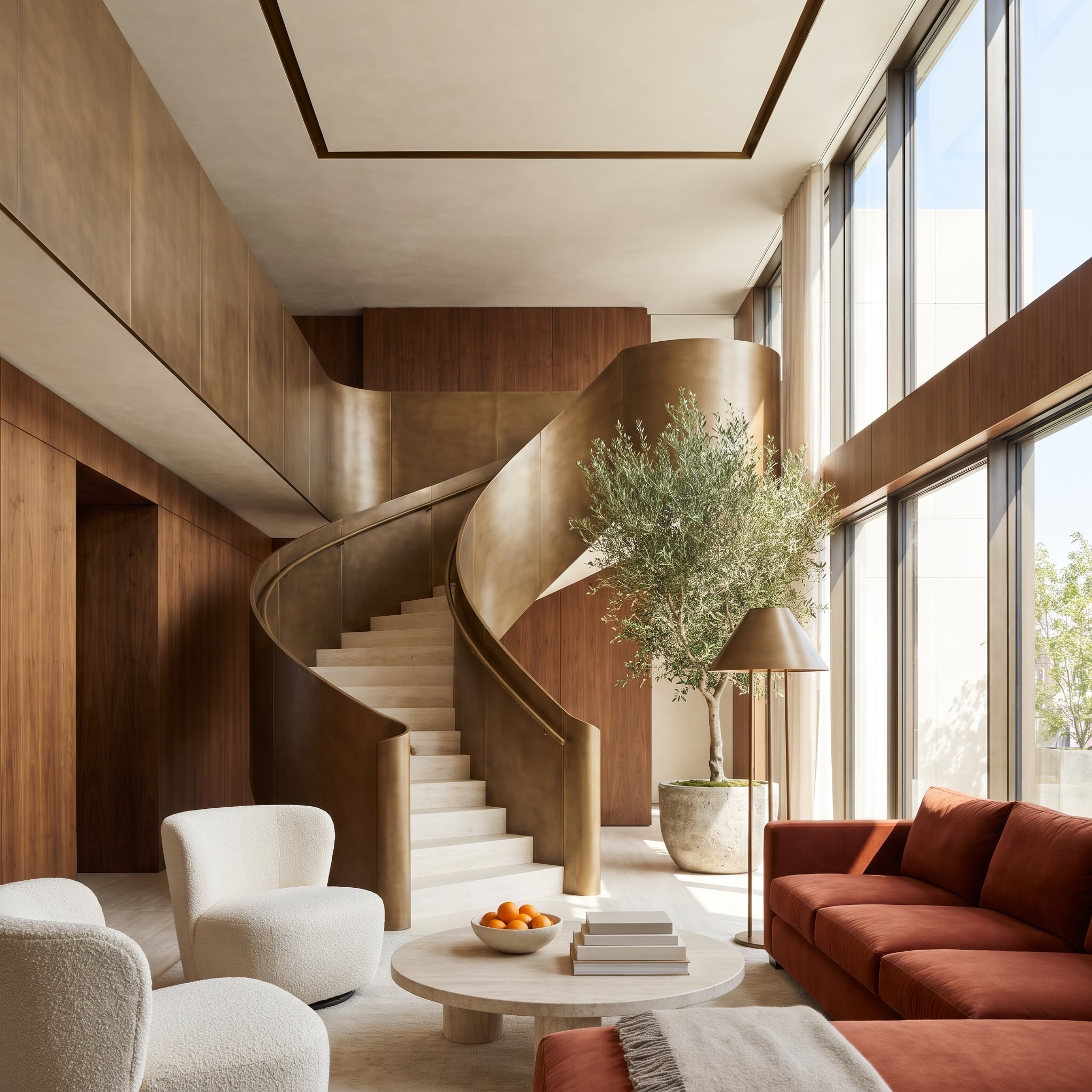
The bronze enclosure makes the ascent appear almost fluid. Its brushed finish softens the highlights along the sweeping profile, giving the curve a quieter presence than mirror-polished metal would. Pale stone treads offer a clean break between the brown metal and walnut.
The curve is the architectural event. A series of conventional balusters would divide the ascent into repeated vertical lines; the broad metal surface instead makes the entire stair read as one gesture. At furniture scale, the bronze cone of the floor lamp brings a little of that material down into the room.
Fabrication Detail: A curved metal enclosure requires careful templating, suitable supporting structure and an appropriate finish at seams and edges. If it forms part of the stair guard, its height, strength, anchorage and openings must meet applicable safety requirements.
38. Bronze Woven Into the Cabinet Doors
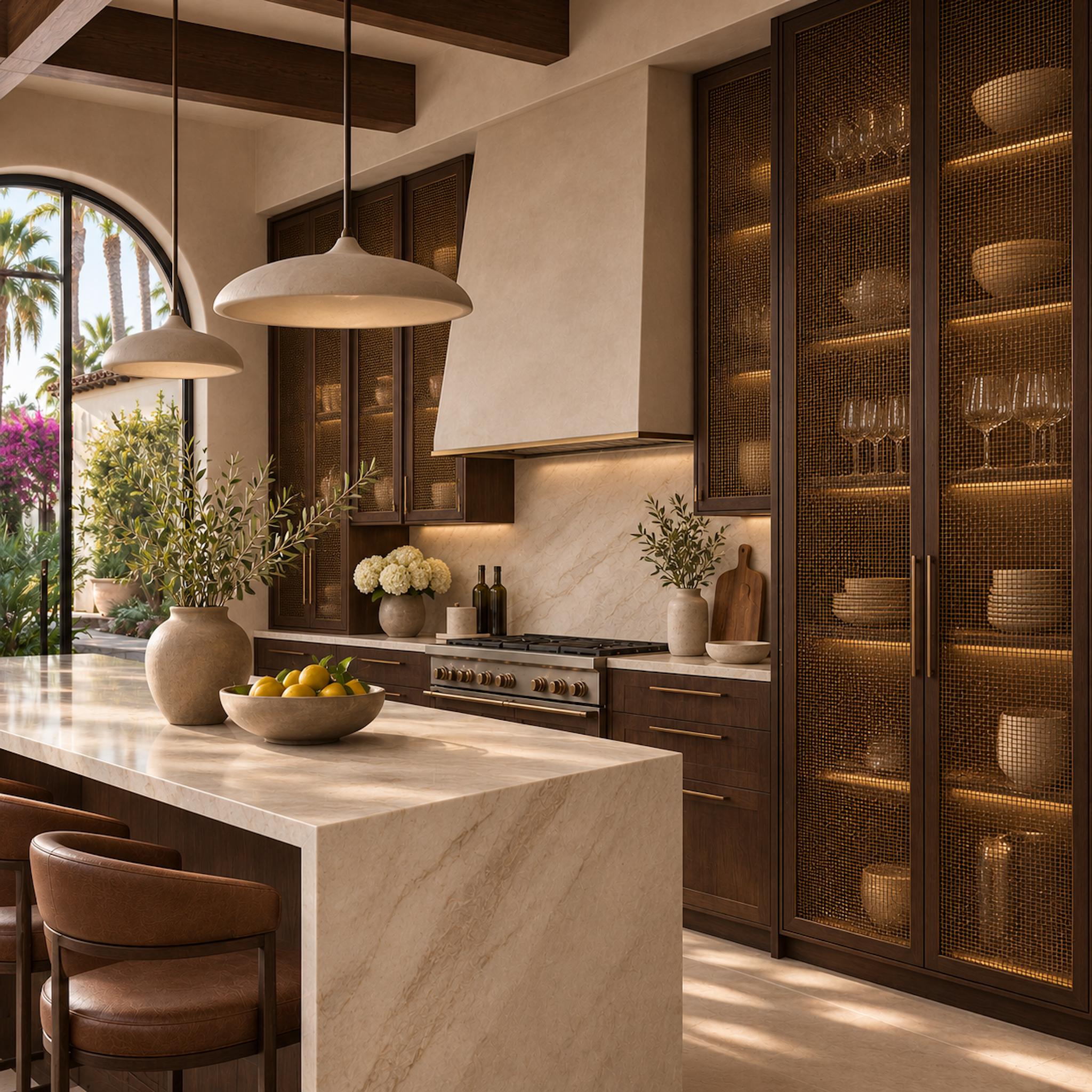
A fine bronze-colored weave gives the tall cabinet doors the character of a textile stretched inside a frame. Illuminated shelves reveal the outlines of glassware and stacked ceramics through the mesh, whose tiny openings make the display more intriguing than a conventional expanse of clear glass. Dark wood frames give the intricate weave a firm outline.
The plaster hood and broad cream-colored pendants leave the decorative work to the cabinet fronts. Pale stone wraps the island, while the arched opening admits a view of palms and flowering plants. Bronze here is less about monumental sheets than the exquisite repetition of a very small detail: the meeting of one wire with the next.
Cabinet Detail: Choose the weave density with the contents and internal lighting in mind. An open mesh admits dust; glass-backed mesh offers a different balance of visibility and protection. Secure the edges within the door frame and allow access to the lighting components.
37. A Bronze Bathtub With a Garden for Company
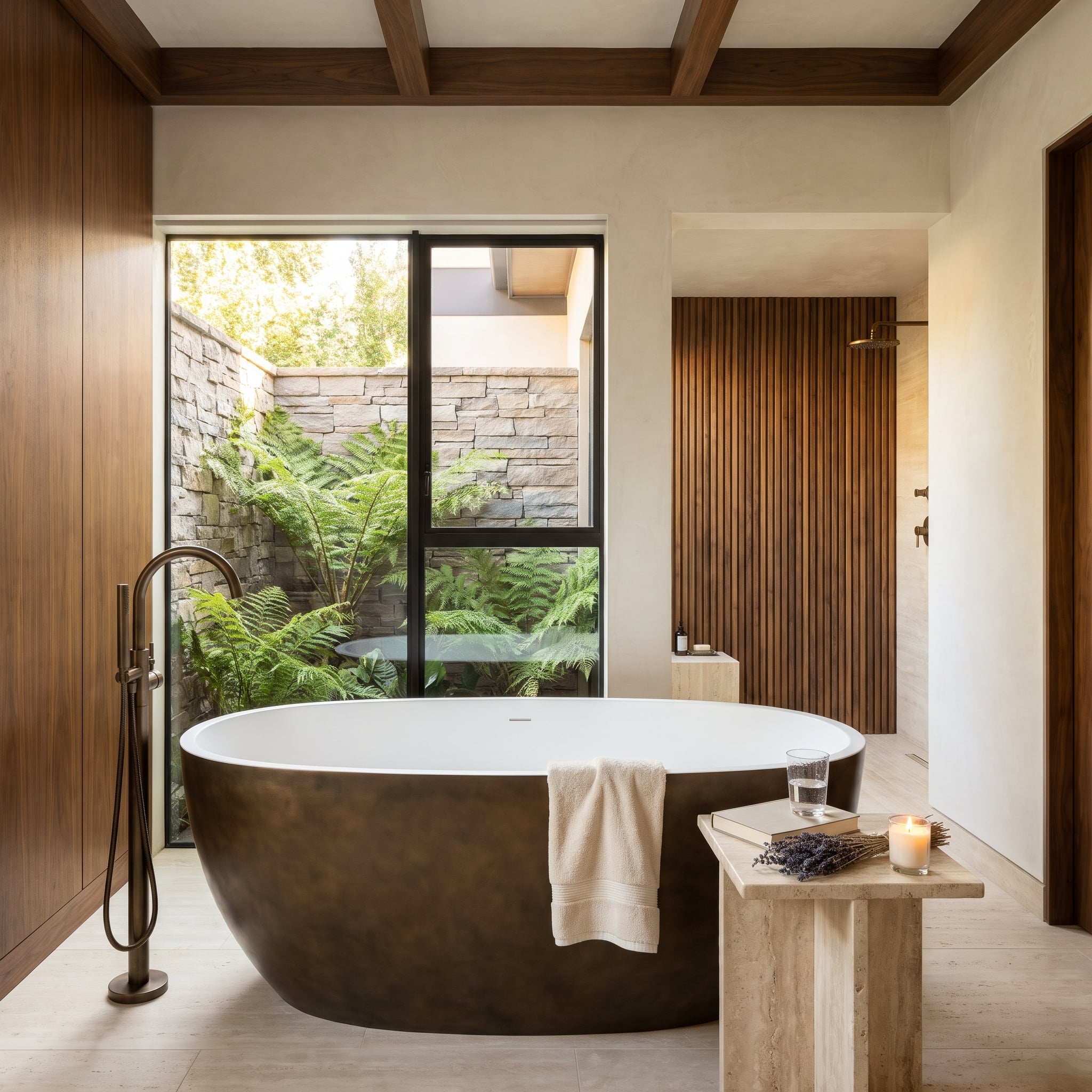
Ferns fill the view beside a freestanding tub whose dark bronze exterior has something of the richness of worn leather. Against the greenery and pale stone, the curved shell becomes the room’s most substantial piece of metalwork. A floor-mounted filler repeats its brown tone without drawing a separate bright line across the view.
Walnut slats behind the shower extend the earthy palette. A soft highlight travels around the tub’s shoulder before dissolving into deeper brown near the floor. The curve reveals subtleties of the bronze finish that a flat panel would render quite differently.
Material Detail: Specify the exterior finish and bathing surface separately. A bronze-clad or bronze-finished tub may use another material for its interior. Confirm the manufacturer’s cleaning instructions, filled weight, support requirements and access to plumbing.
36. Bronze Folded Like Origami
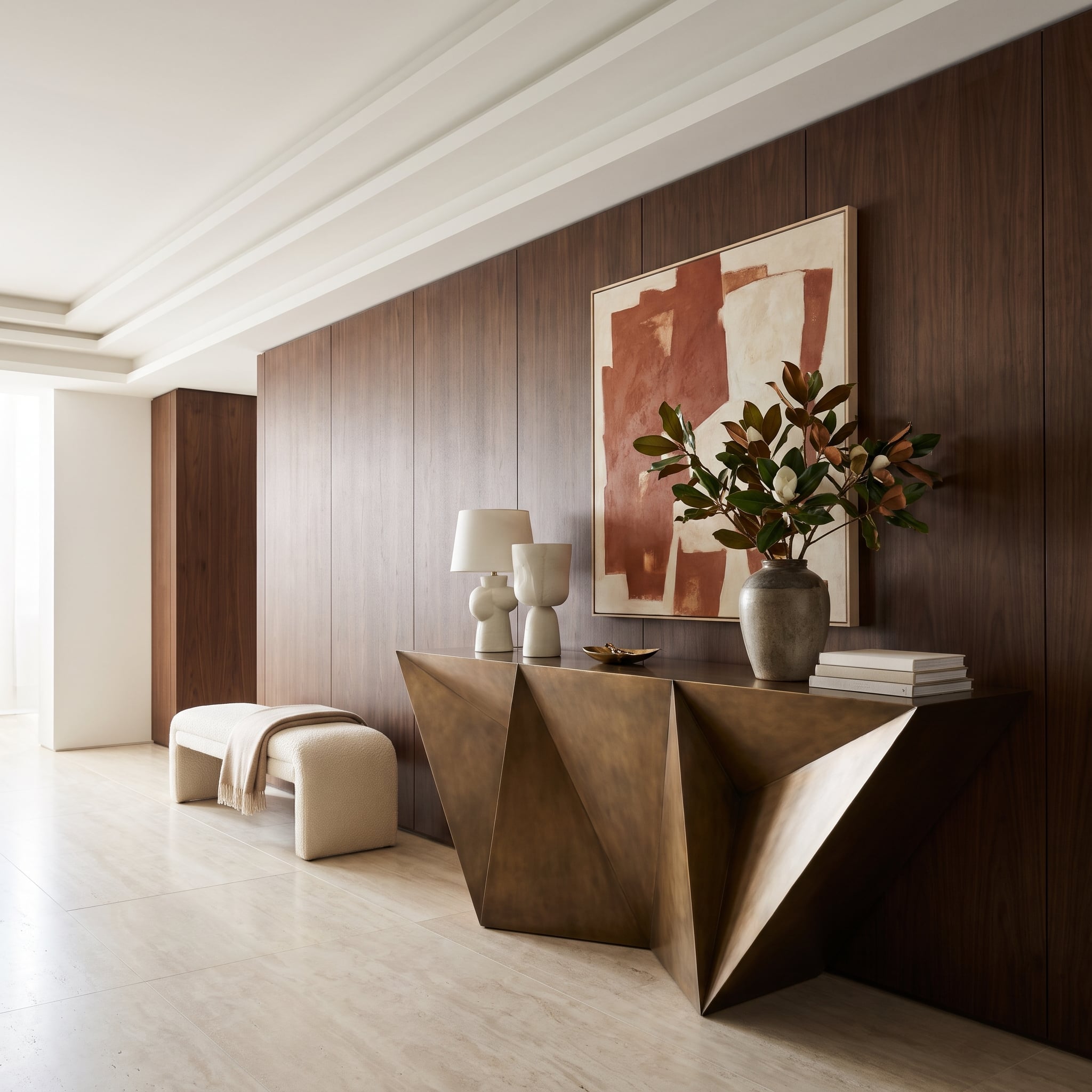
The facets of the console catch the light at different angles. The bronze can look almost ochre on one face and deep brown on the next, even when the underlying finish is consistent. Geometry is doing as much decorative work as the patina.
Full-height walnut panels supply a straight vertical backdrop for the console’s angular profile. Pale travertine underfoot and the coppery undersides of magnolia leaves extend the palette without competing with the furniture. Even a muted metal finish can be remarkably animated when daylight has so many angles to work with.
Fabrication Detail: For a folded or fabricated metal console, review corner detailing, seam placement and the finished edges. Keep objects on top from obscuring the silhouette, and confirm that the piece is stable under its intended loads.
35. When Bronze Becomes the Entire Wall
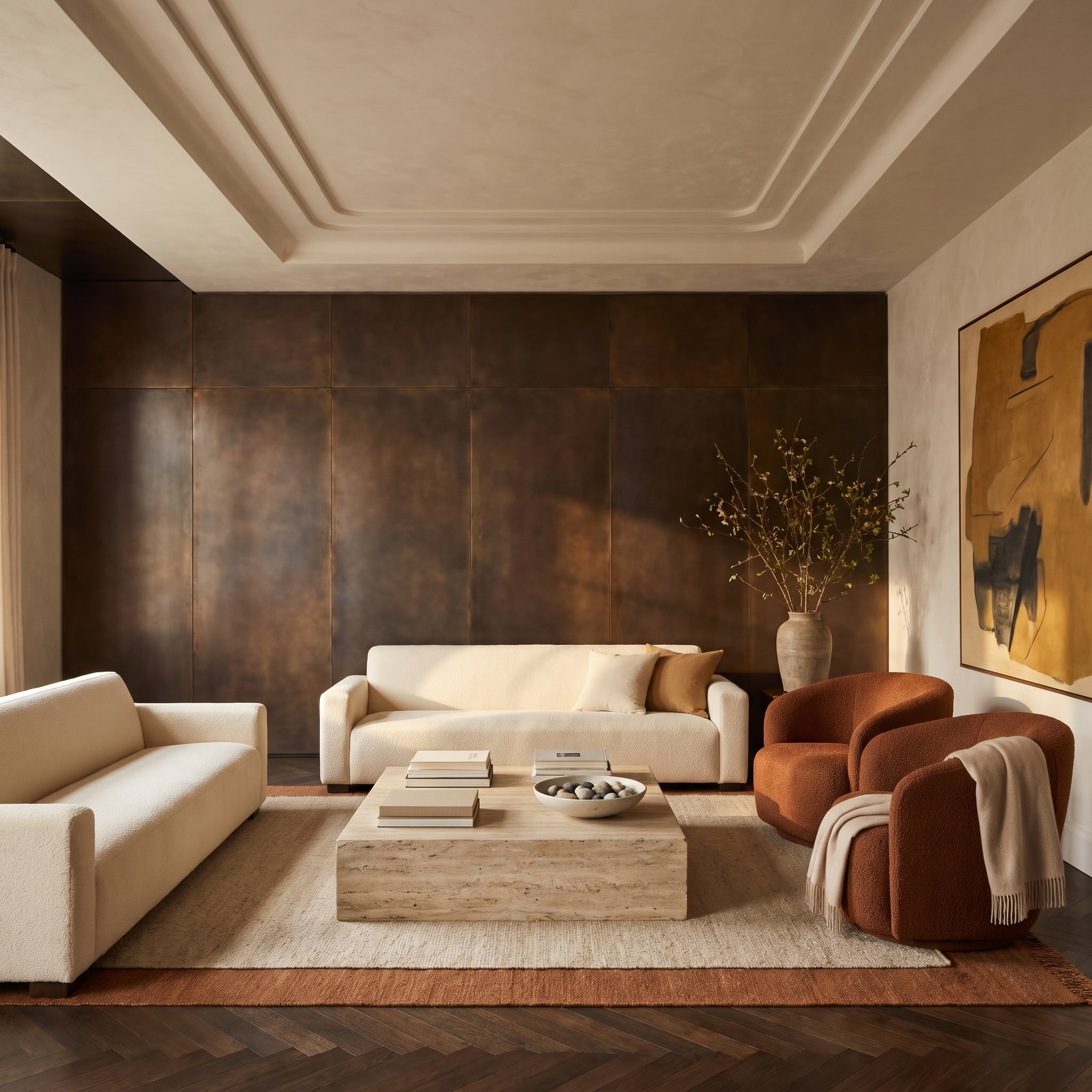
A wall of mottled bronze is an entirely different proposition from a row of bronze handles. Fine joints divide the full-height panels into a regular grid, while coppery brown patches and deep shadows refuse to follow that geometry. The precision of the panel layout makes the irregular patina all the more striking.
Cream bouclé sofas and a travertine table provide a pale foreground, while rust swivel chairs carry the reddish undertone toward an ochre painting. The stepped plaster ceiling keeps the composition from becoming an all-enveloping dark box. A wall finish of this scale deserves a full-size sample: the variation that looks attractive on a small swatch can become much more pronounced across a room.
What Our Readers Say
- When Home Stratosphere readers hearted a room and tapped a reason, “cosy” and “overall style” tied at the top with 25% each, while “materials” accounted for 14% of answers.
- Asked which vase they would buy for flowers on the table, only 11% of our readers chose metal, while about half went for glass.
From Home Stratosphere reader polls and votes.
34. A Hammered Bronze Dome Above Green Marble
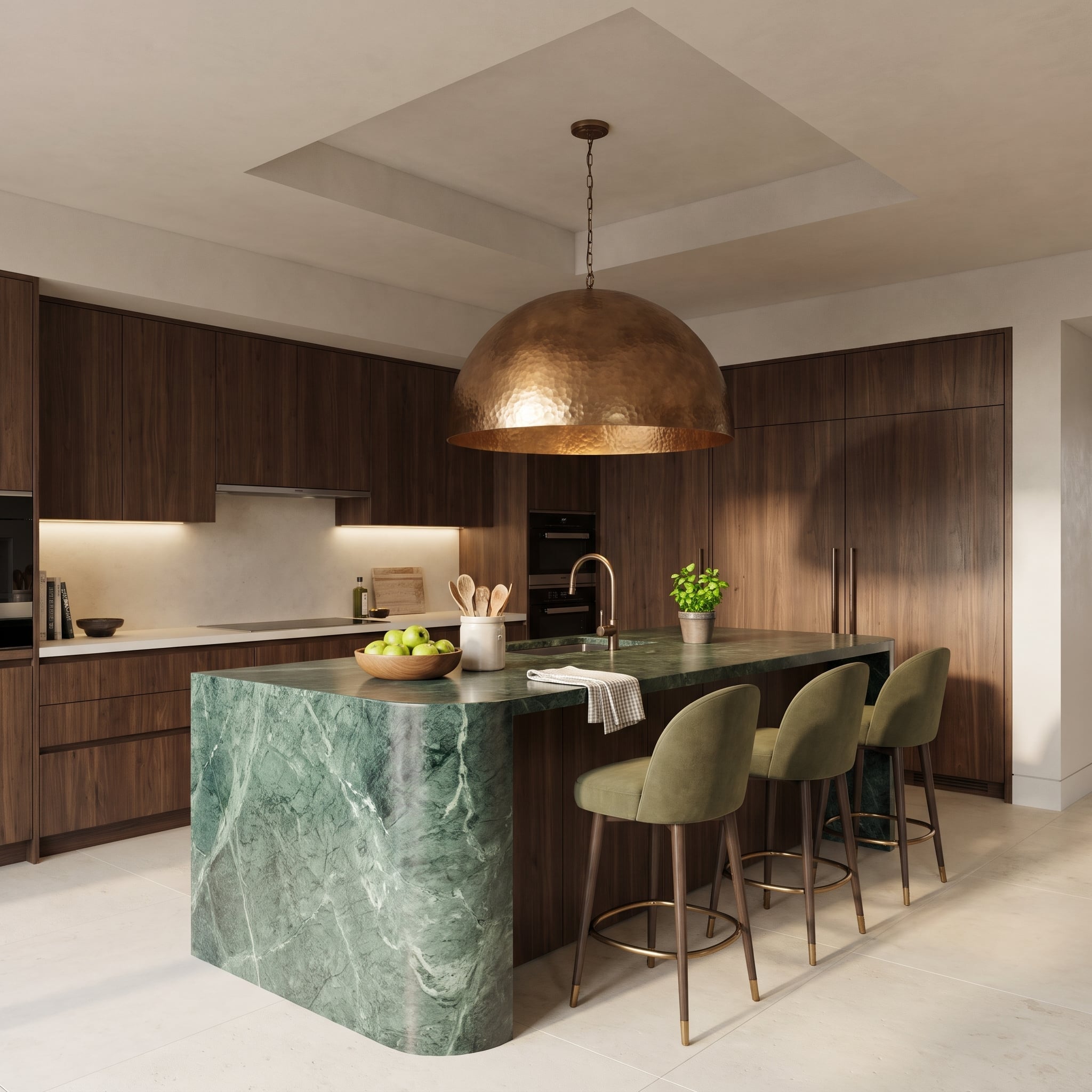
The broad dome over the island turns hammered metal into a landscape of small highlights. Its dimpled surface plays against the smooth walnut cabinetry and the long, flowing veins in the green marble. A rounded waterfall end carries the stone down toward the floor without introducing another sharp corner.
The dome gives the island a rounded canopy of its own. Its broad profile brings the lighting down to the scale of the cabinetry, making the island feel like a distinct destination within the kitchen.
Lighting Detail: An oversized pendant can serve as the island’s focal point, but confirm its light distribution, mounting height and task-lighting coverage. Supplement with other fixtures if needed, and coordinate metal finishes using samples rather than relying on finish names alone.
33. Patinated Bronze Meets Its Polished Opposite
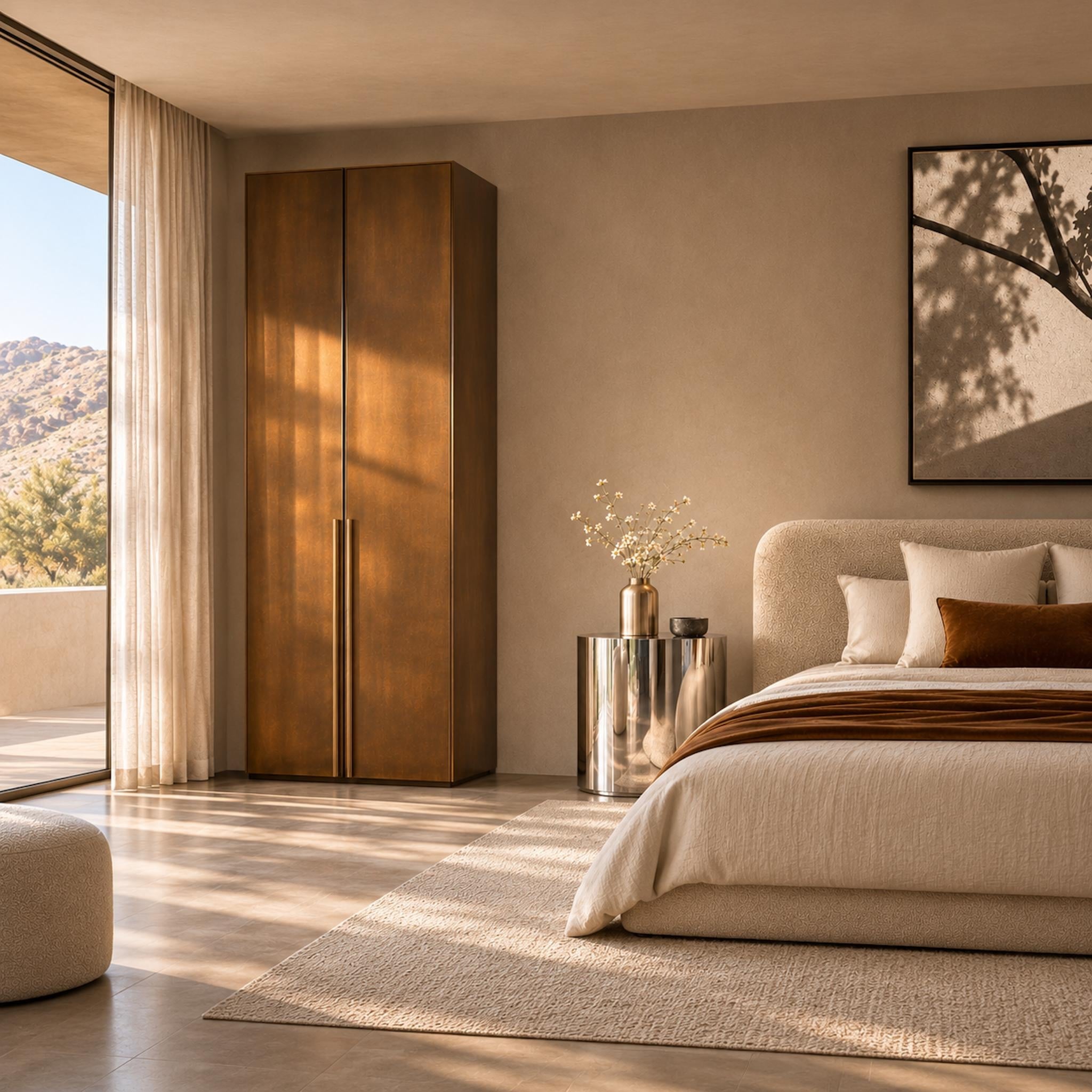
The wardrobe is all warm, cloudy brown, its tall bronze-faced doors catching the desert sunlight in broad patches. Beside the cream upholstered bed, the cylindrical silver-toned nightstand produces much sharper reflections. A slim metallic pendant repeats that brighter character above it. The two metals occupy different scales, so neither has to imitate the other.
Rust-colored bedding and the pale, textured headboard keep the room from becoming a study in metal alone. A monochrome photograph of tree shadows adds a darker graphic note. The pairing makes a persuasive argument for mixing finishes: the cooler polished surface sharpens the warmth of the bronze, while the softly mottled wardrobe makes the nightstand’s crisp reflections more dramatic.
32. Bronze Lattice Lets the Sun Draw Circles
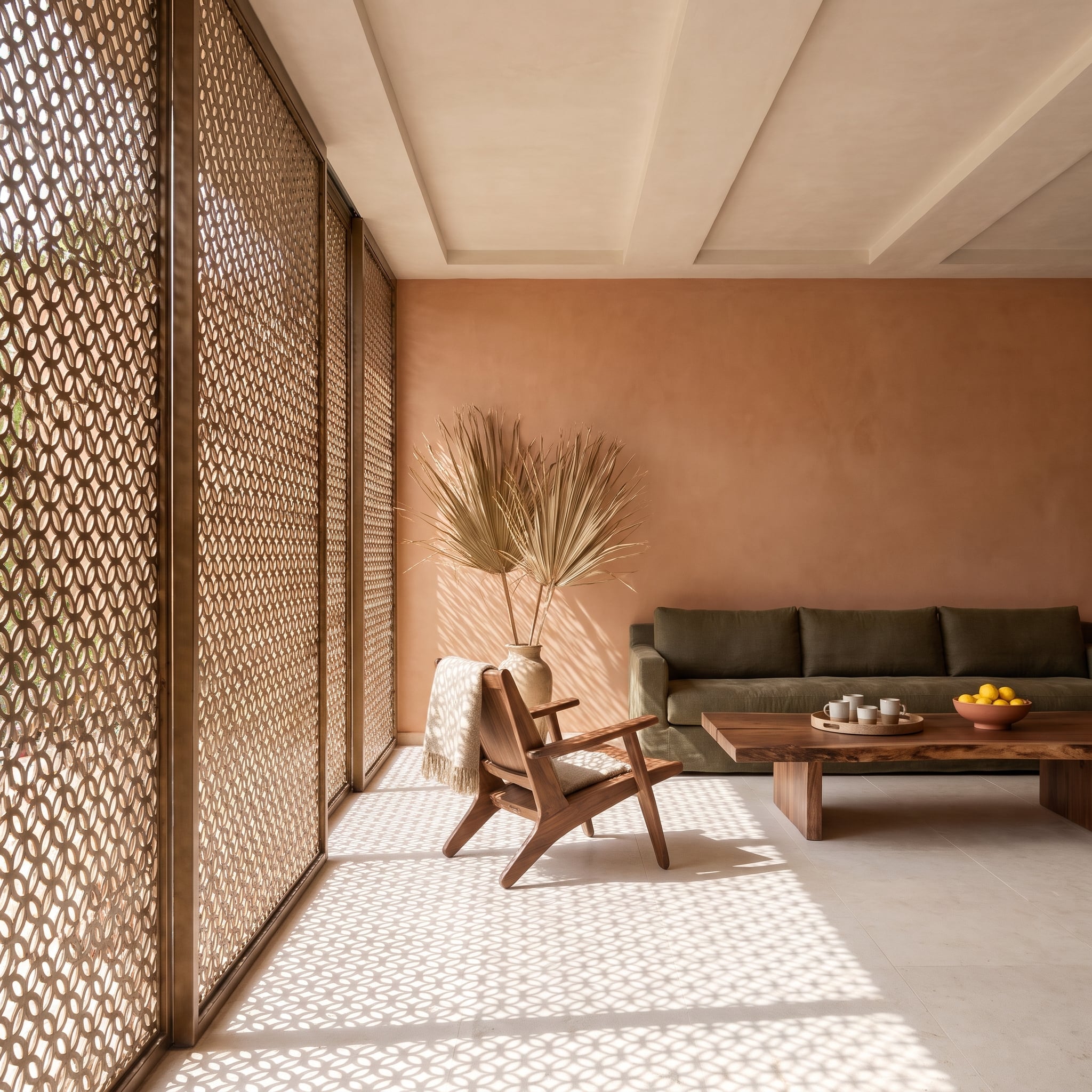
Interlocking circles in the bronze-finished lattice project a second pattern onto the pale stone floor. As sunlight changes direction, the pattern shifts. Unlike printed wallpaper or a decorative rug, this ornament belongs to the screen and the position of the sun.
Terracotta plaster, an olive linen sofa and a walnut lounge chair make a richly colored setting for the metalwork. The bare floor becomes a canvas for the shadows. A matte finish can temper the metal’s reflections, while the spacing and orientation of the lattice determine the amount of sunlight it admits.
31. Burgundy Plaster Meets Bronze Drawer Fronts
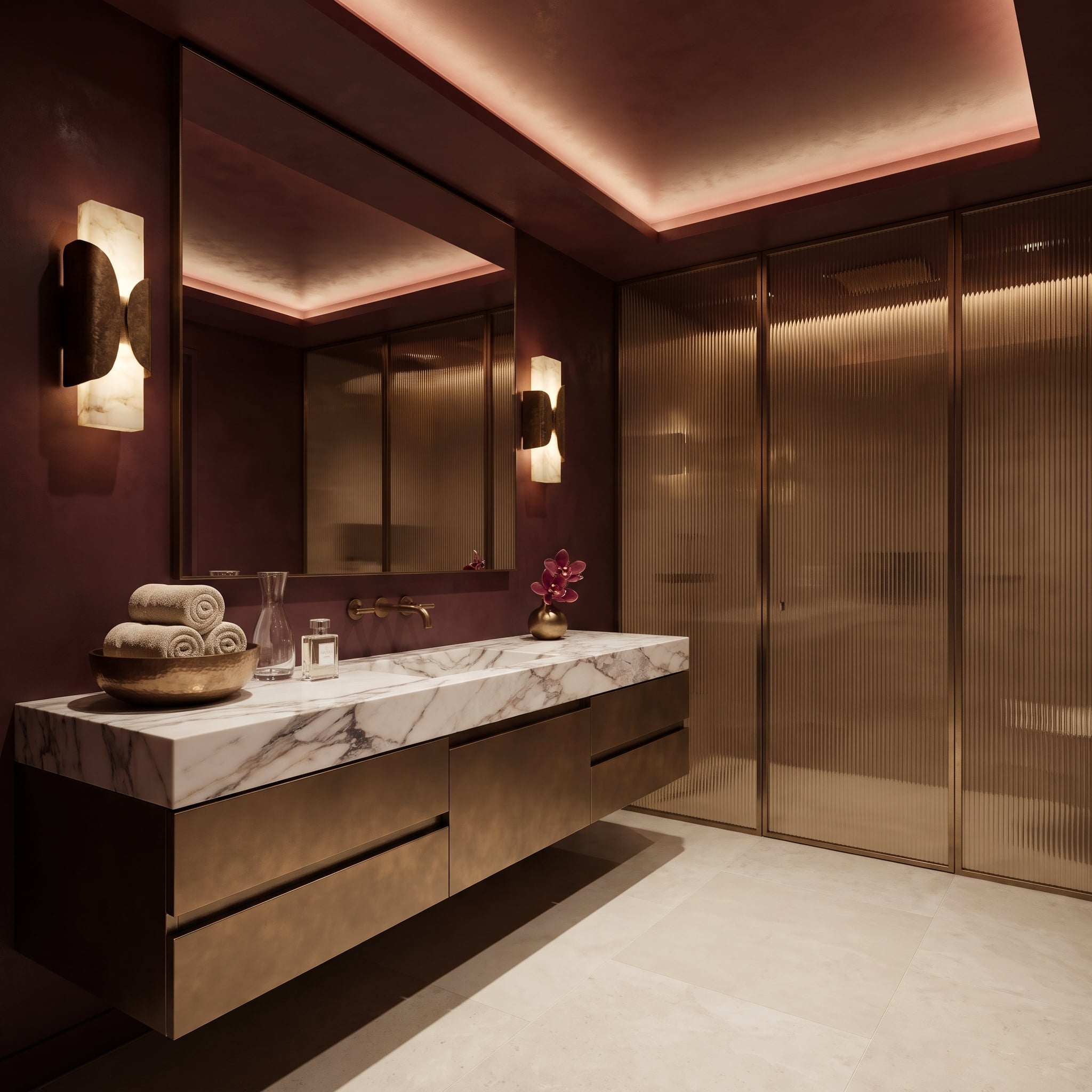
Burgundy plaster makes the bronze-faced vanity look particularly rich, especially where the brushed finish catches narrow highlights. A marble counter veined in dusky plum connects the wall color to the bronze-framed reeded glass doors. The broad drawer faces give the metal a more substantial role than a set of matching pulls would.
A wall-mounted faucet leaves the marble deck uninterrupted, and sconces beside the mirror bring light toward the face from both sides. The dark drawer fronts give the vanity the presence of a substantial piece of furniture, even with its clean-lined fittings.
Bathroom Detail: Choose metal finishes suitable for humid conditions and frequent cleaning. Check faucet projection and basin depth to limit splashing, and position the sconces to provide useful facial illumination without excessive glare.
30. Bronze Pedestals With the Shape of Tulips
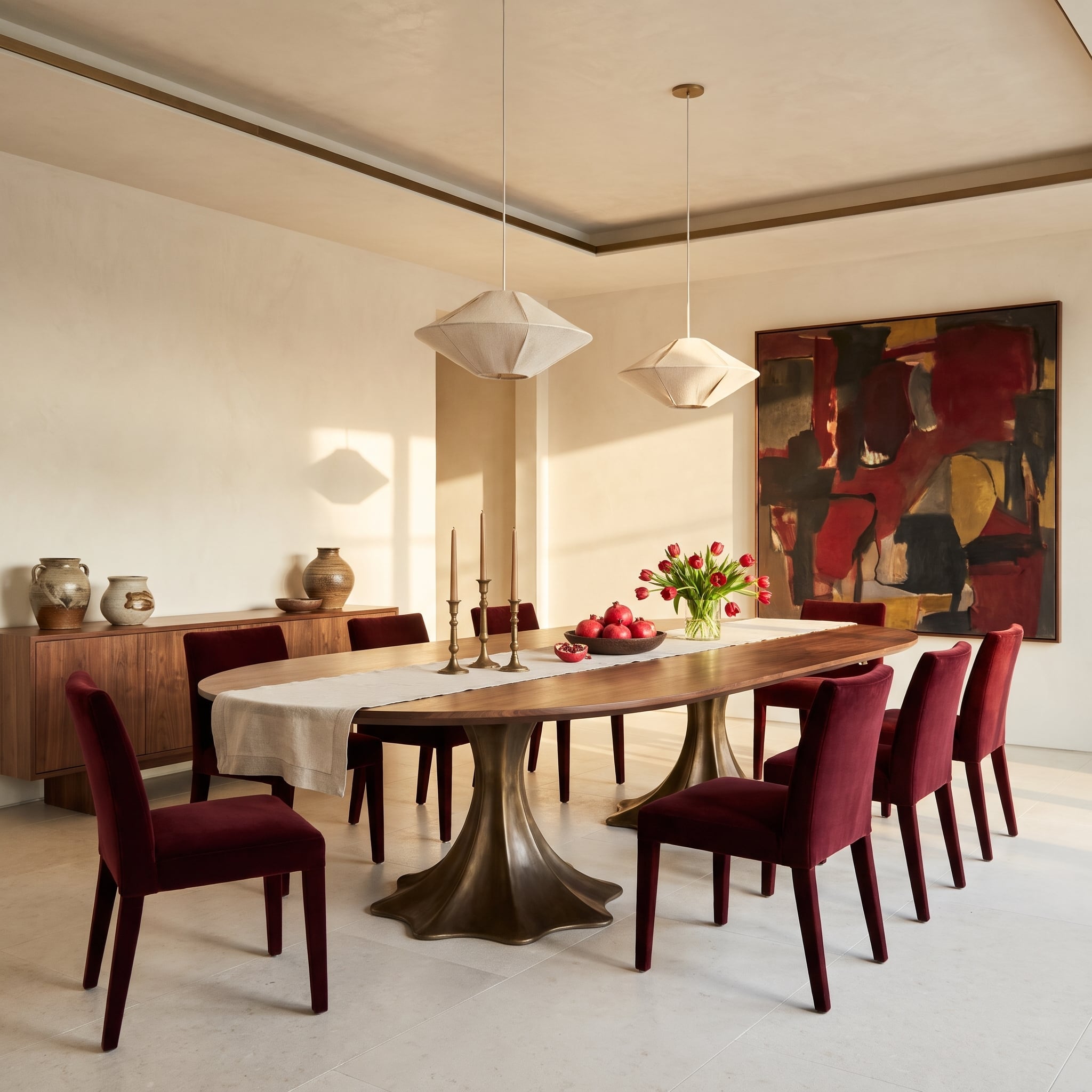
Two bronze pedestals flare toward the floor like oversized tulip stems, carrying the oval walnut tabletop above them. Their scalloped bases make the supporting elements the furniture’s most expressive feature. The muted sheen reveals the curves without overwhelming the grain of the top.
Burgundy velvet chairs and the abstract artwork deepen the color scheme, while a slim bronze reveal around the ceiling tray repeats the material overhead. A fine line of metal above and two substantial, flowerlike forms below: the relationship is in the material, not a repetition of the motif.
Furniture Detail: Twin pedestal bases can free space along the table’s sides, but their positions and dimensions determine actual legroom. Check chair placement, tabletop support and stability before specifying a sculptural base.
29. The Bronze Door With a Recessed Pull
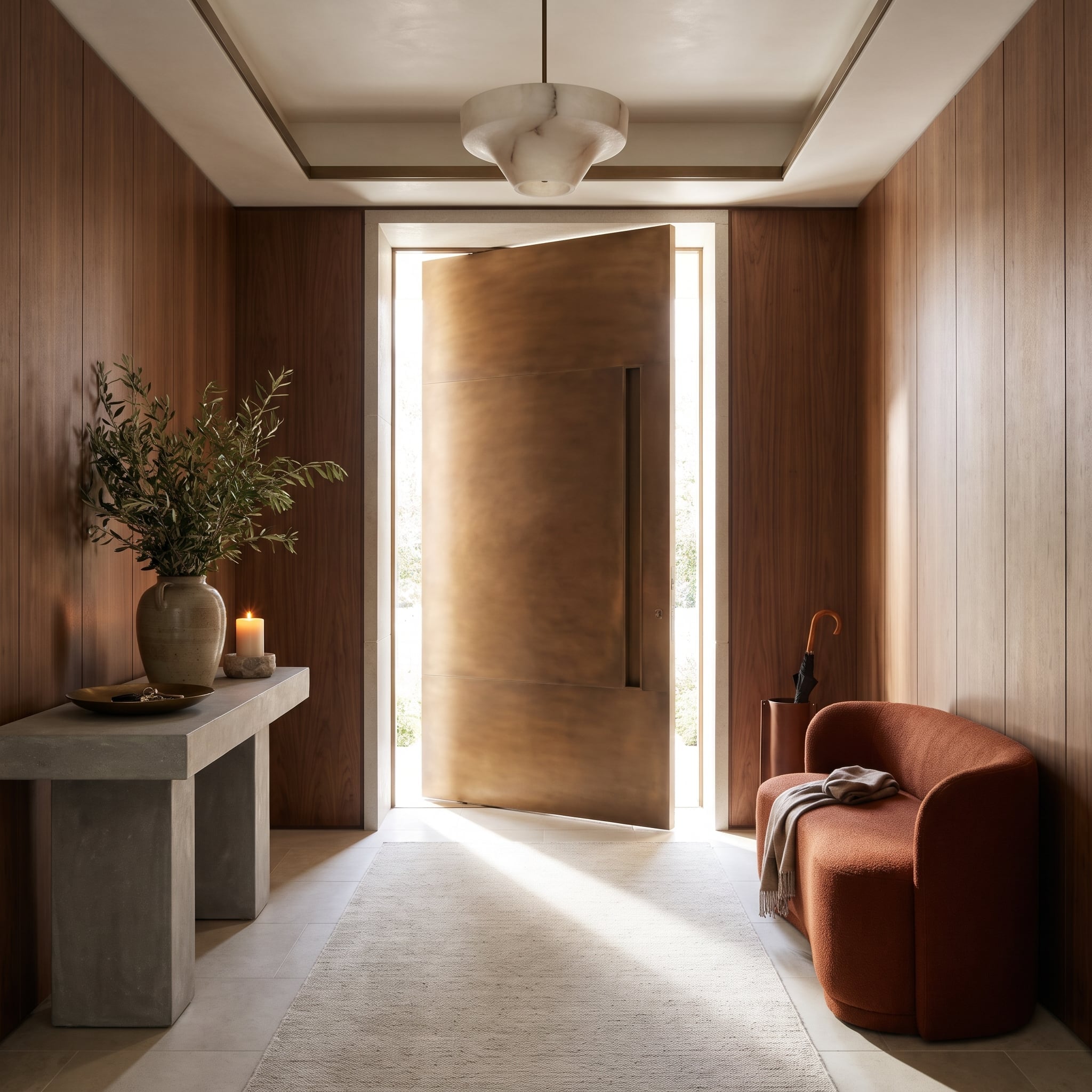
An offset pivot gives the bronze-faced entrance door a different movement from an ordinary side-hinged leaf. The large mottled surface turns as a plane, opening a view of the garden and revealing subtle changes in color where daylight strikes the finish.
A recessed pull preserves much of the uninterrupted face, while surrounding walnut paneling establishes a quieter vertical grain. The contrast is between the door’s cloudy surface and the more regular texture of the timber. An oversize bronze-faced door calls for a suitable core, properly rated pivot hardware, weather sealing and sufficient clearance on both sides of the pivot.
28. Bronze Eclipses Above the Bed
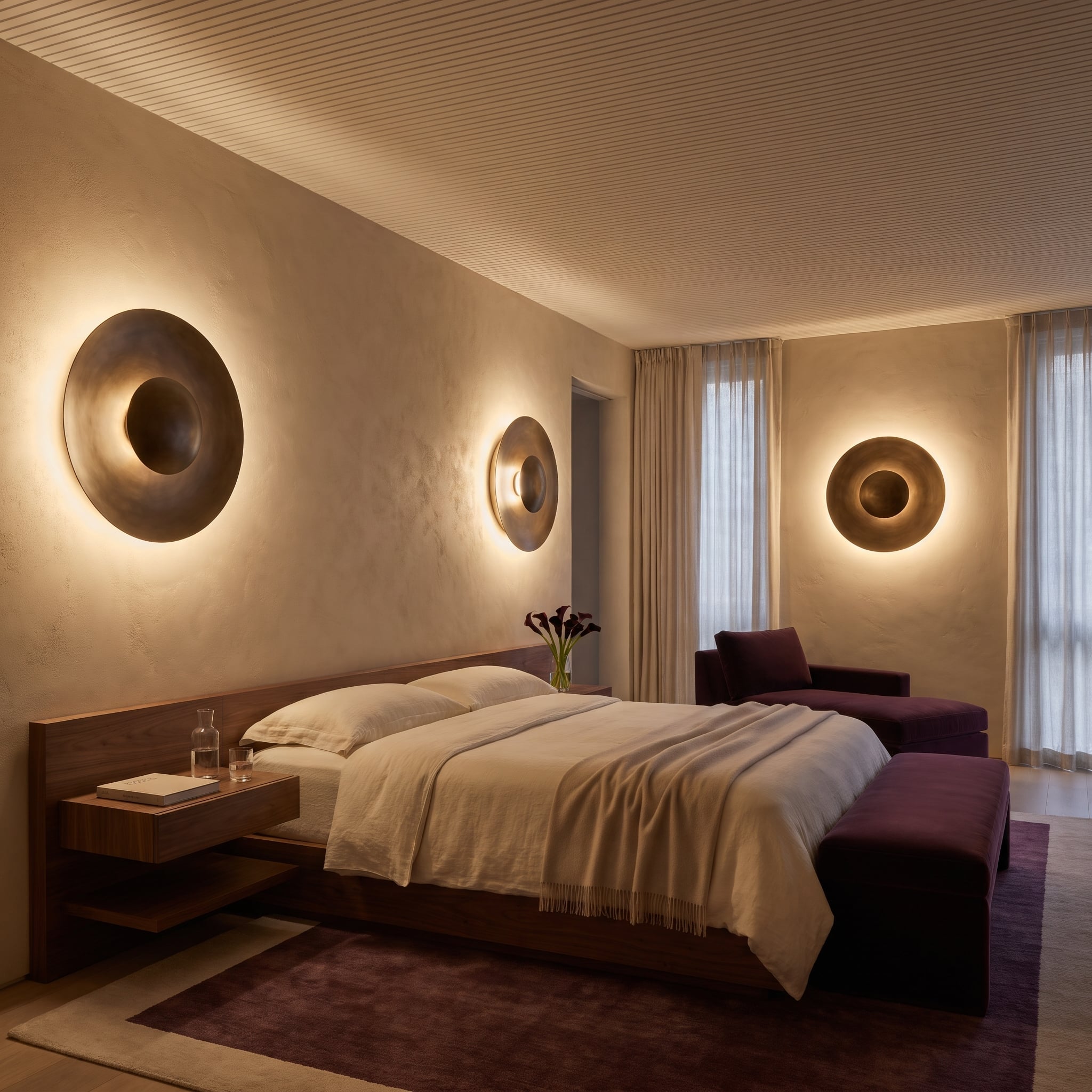
Two disc-shaped wall lights resemble eclipses above the bed: wide bronze dishes frame smaller central domes, with illumination washing back onto the textured wall. The metal supplies the silhouette; the halo of light picks out the irregularities of the plaster.
Plum velvet on the bench and chaise keeps the palette deep, while the walnut headboard carries a long horizontal line across the room. Concealing the light source behind the fitting can reduce direct glare. The reward is a luminous wall rather than a spotlight on the bed.
27. The Kitchen That Disappears Behind Bronze
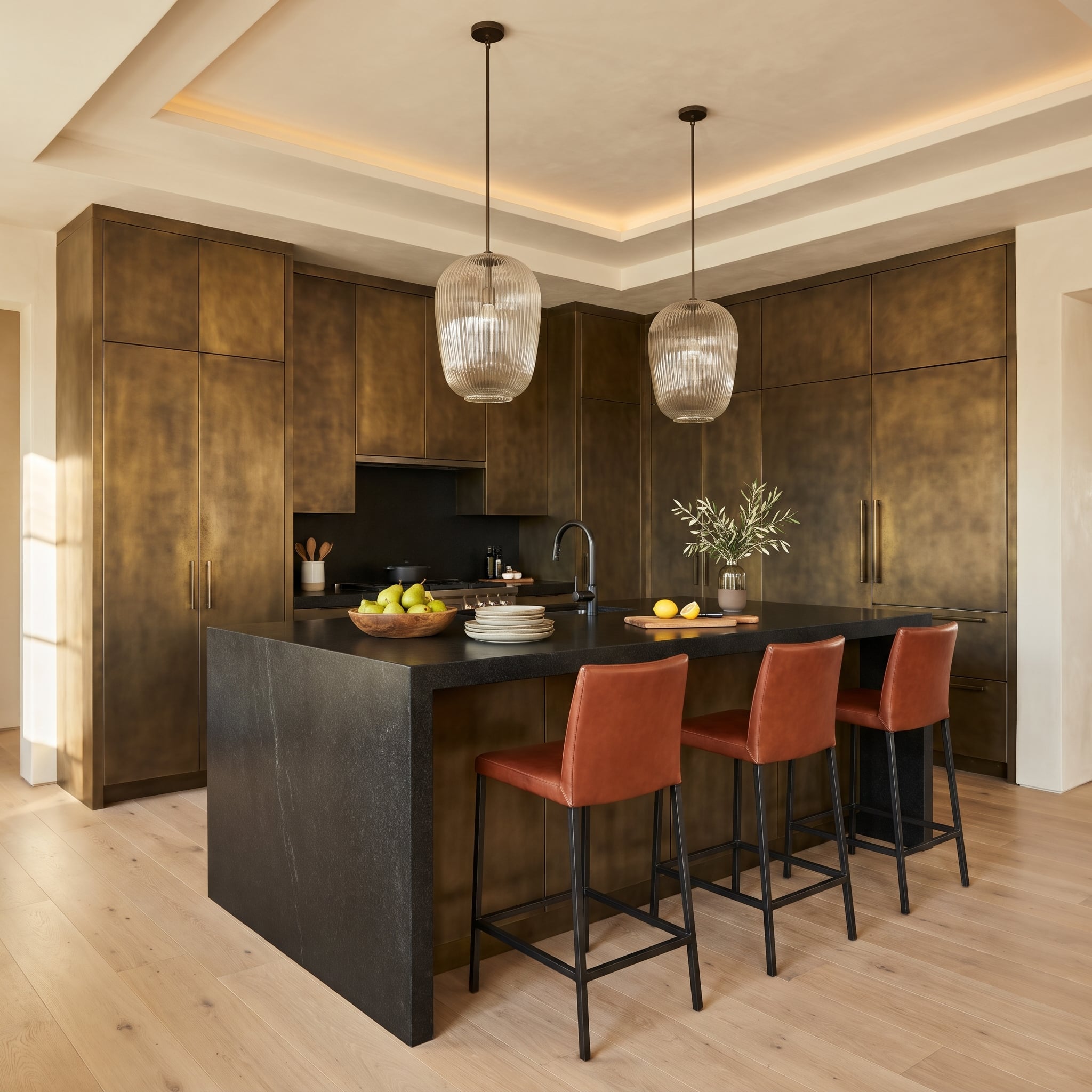
Mottled bronze-faced panels extend across the kitchen walls, integrating the refrigerator into a much larger composition of cabinetry. Long matching pulls maintain the broad vertical rhythm. The expansive panels give every variation in the finish room to register, from brown at the joints to warmer highlights across the doors.
The honed black stone island has a subdued reflective character, and cognac leather stools provide a distinct amber counterpoint. For a kitchen of this kind, appliance integration and panel weight matter as much as color. A metal-faced door needs a suitable substrate and hardware; an integrated refrigerator must retain the ventilation and clearances specified for the appliance.
26. Cognac Leather on Loops of Bronze
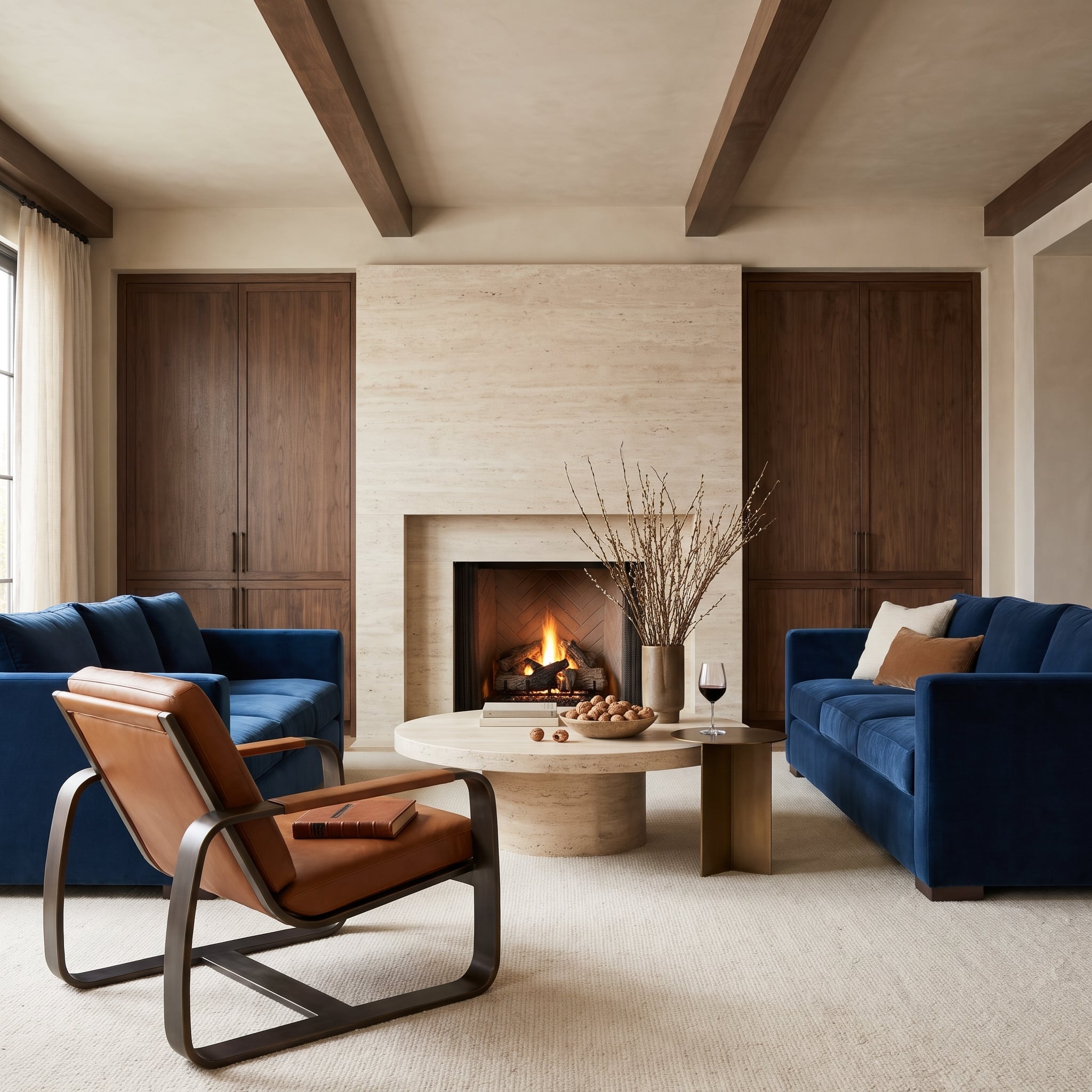
Open loops of bronze trace the cognac leather lounge chair, curling around its upholstered form without enclosing it in a solid mass. Between two navy velvet sofas, the slim metal frame gives the chair a distinctive profile. The richness of the leather needs little additional ornament.
A small bronze table with a cross-shaped base repeats the material near the walnut cabinetry. Glimpses of the travertine fireplace remain visible through the open portions of the chair frame. A heavier base would occupy considerably more of the view; here the bronze provides a supporting outline rather than another upholstered volume.
Furniture Detail: Compare the chair’s overall dimensions and sightlines with its intended position. For curved metal frames, verify stability, load capacity and the finish at joints and floor-contact points.
25. A Bronze Mirror Wall Borrows the Landscape
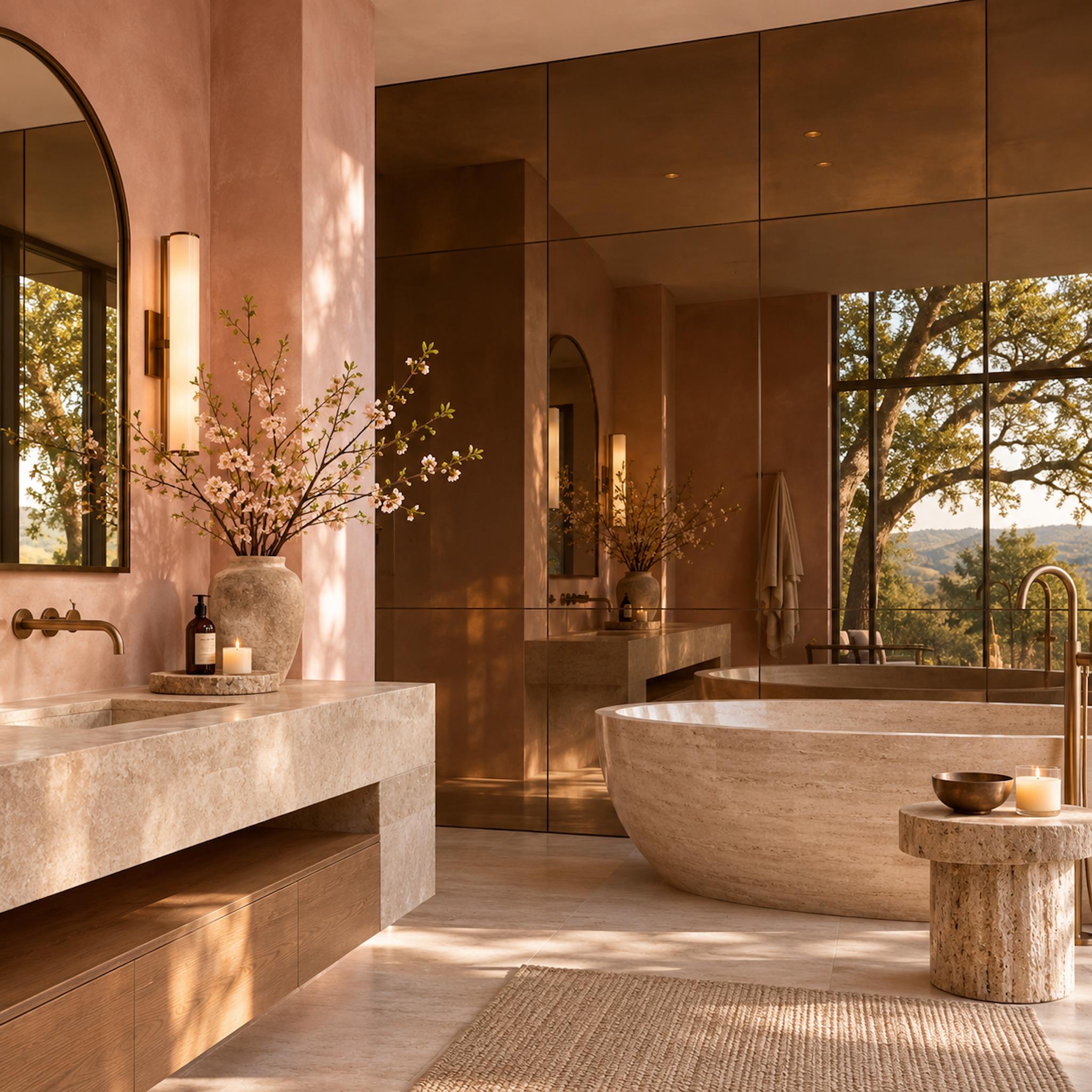
A wall of bronze-tinted mirror doubles the apparent silhouette of the pale stone bathtub and extends the bathroom’s visual depth. Reflected windows, trees and the vanity appear in a warmer register, as though the entire bathroom had been photographed through a subtle amber filter. Narrow panel joints interrupt the illusion often enough to keep the wall legible.
Dusty pink plaster and the broad, pale stone vanity provide a soft palette for the warm-toned reflections. The freestanding tub provides a solid sculptural foreground against the apparent depth of the glass. Unlike opaque bronze cladding, the tinted mirror does much of its decorative work with the room that already exists.
Mirror Detail: Bronze-tinted mirror is reflective glass, not a solid bronze panel. Select a moisture-suitable mirror system with appropriate backing, secure attachment and protected edges, and evaluate safety-glazing requirements. A neutral vanity mirror is useful when accurate color rendering matters.
24. A Metal Grid That Travels From Floor to Ceiling
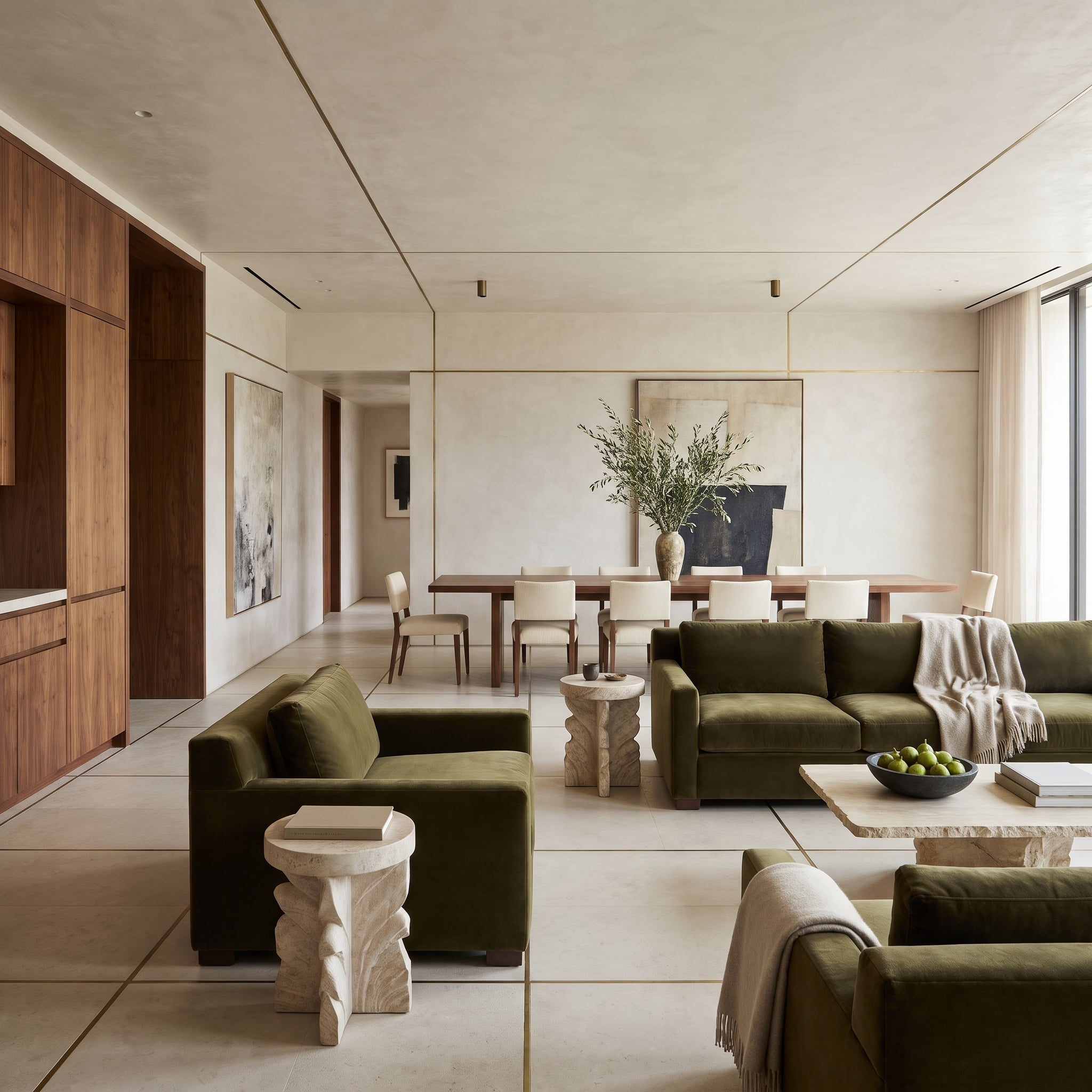
Thin bronze-toned strips trace a grid through the limestone floor, across the plaster walls and overhead. The satin finish lets the lines remain visible without dominating the surfaces they divide. Floor, wall and ceiling suddenly belong to a single architectural drawing.
Walnut cabinetry and olive velvet lend warmth to all that precision. Carrying the grid across three different materials takes careful alignment, provision for movement at the joints and flush floor inlays. The strips need not be physically continuous; the eye completes the line.
23. A Wine Cellar Framed in Dark Bronze
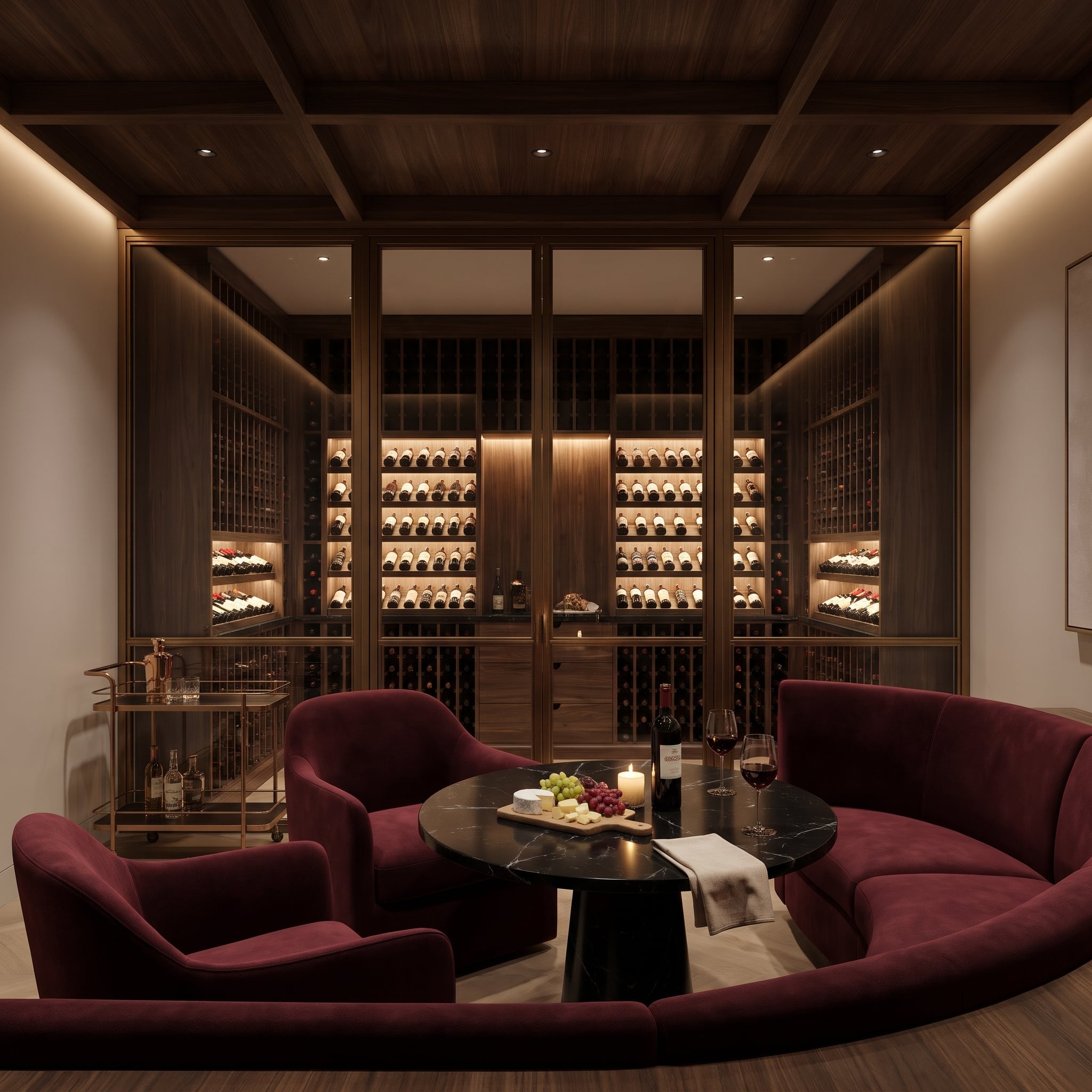
Narrow dark bronze mullions turn the cellar glazing into an orderly display of bottles. Against the walnut casework and coffered ceiling, the frames relate closely to the wood’s darker tones while providing a distinctly metallic outline. The bottles remain the principal pattern behind the glass.
A curved burgundy velvet banquette and black marble pedestal table make the cellar wall part of the adjoining seating area. The glazing provides visual connection without requiring the spaces to share the same environment. For a functioning temperature-controlled cellar, the glass, framing, seals and insulation must be specified for its cooling and humidity conditions.
22. A Bronze Chandelier That Branches Like a Tree
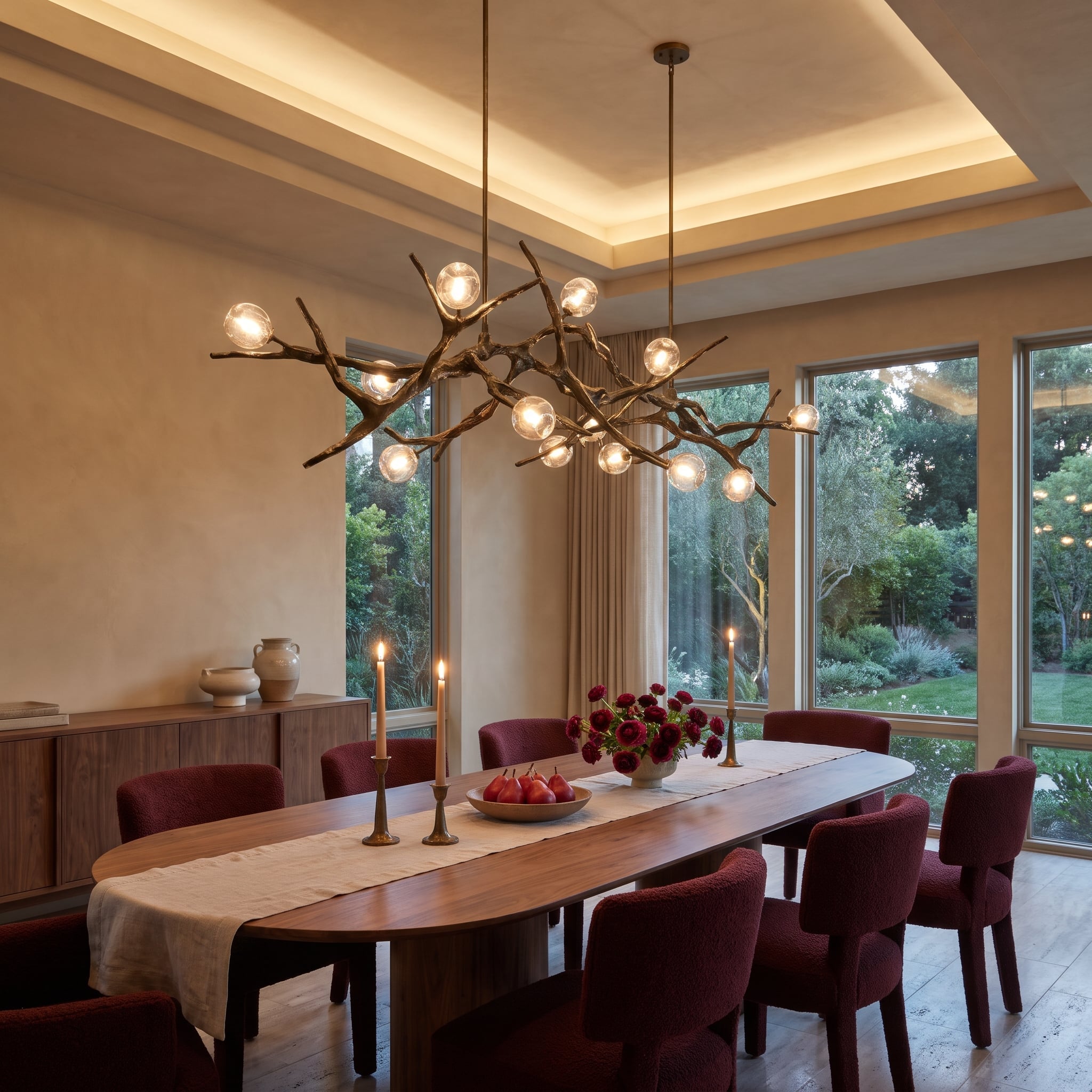
Bronze branches stretch across the tray ceiling, each ending in a glass globe like a bud. The asymmetrical spread of the chandelier interrupts the ceiling’s rectilinear pattern and echoes the garden trees outside. The fixture is part sculpture, part lighting system.
Burgundy bouclé dining chairs and walnut furniture establish a richer foreground. The glass globes offer moments of brightness along the dark branches, which remain visible against the pale ceiling. A sculptural fitting need not carry the full responsibility for illuminating a room; surrounding light can reveal its shape even when its own lamps are dimmed.
Lighting Detail: Use ceiling or wall illumination to retain the profile of a dark fixture after sunset. Verify mounting support, light distribution and lamp access, particularly with large branching fixtures.
21. Rootlike Bronze Legs Beneath a Rough Stone Slab
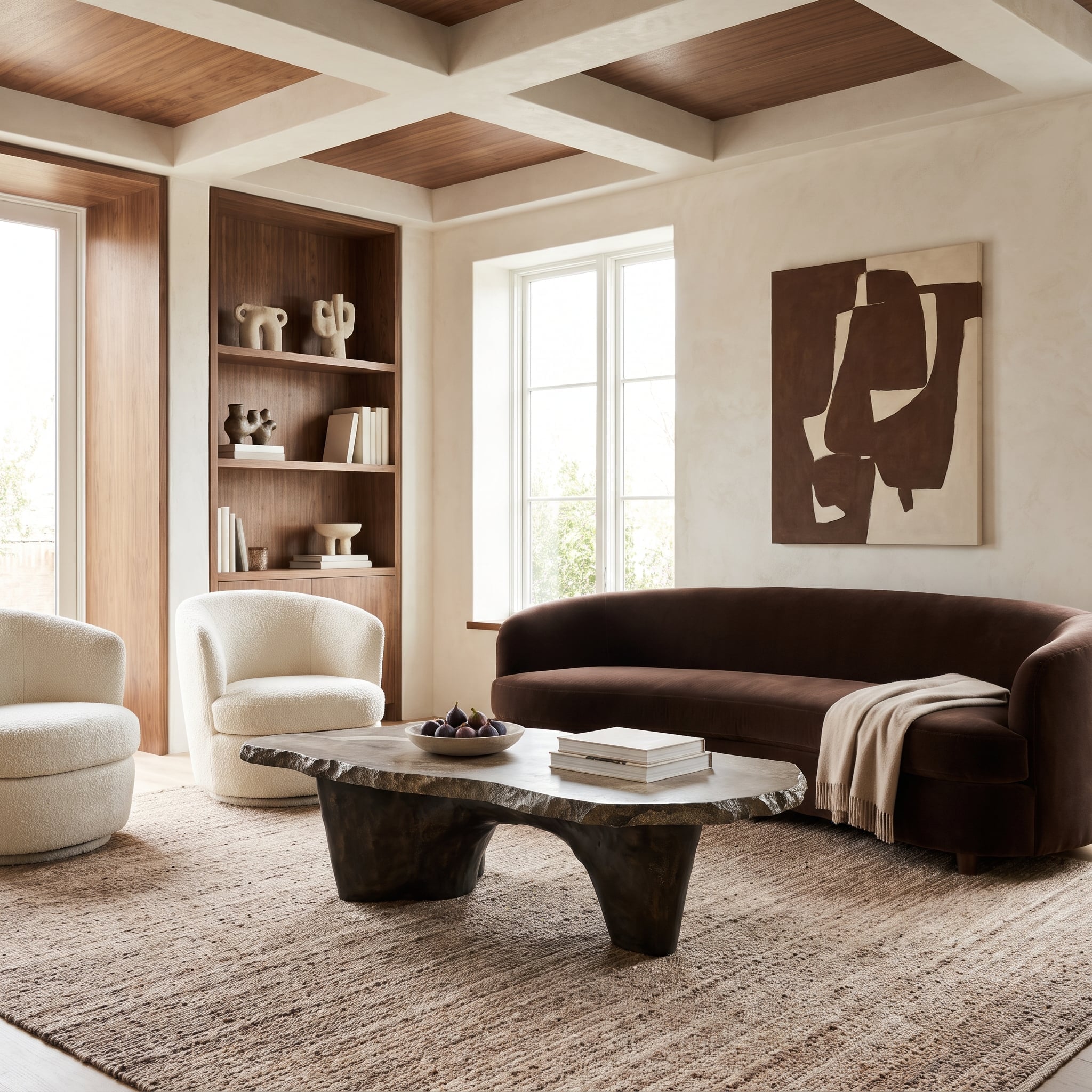
A chiseled stone slab sits on bronze legs that flare like roots. In a room of chocolate velvet and cream bouclé, the table introduces a deliberately different texture. The branching supports carry the irregular outline of the stone down toward the floor, giving the piece the character of a fragment of landscape.
Walnut coffers and shelving extend the brown palette around the seating. The rough edge of the slab looks particularly emphatic beside the rounded sofa and the soft curves of the swivel chairs. The metal has an organic quality here, quite unlike the straight lines of the surrounding cabinetry.
Material Detail: An irregular stone edge can add texture, but assess sharp projections, cleaning requirements and suitability for everyday use. Stone and metal support details must be designed for the weight of the slab and the stability of the table.
20. Olive Plaster and Bronze at the Bathroom Basin
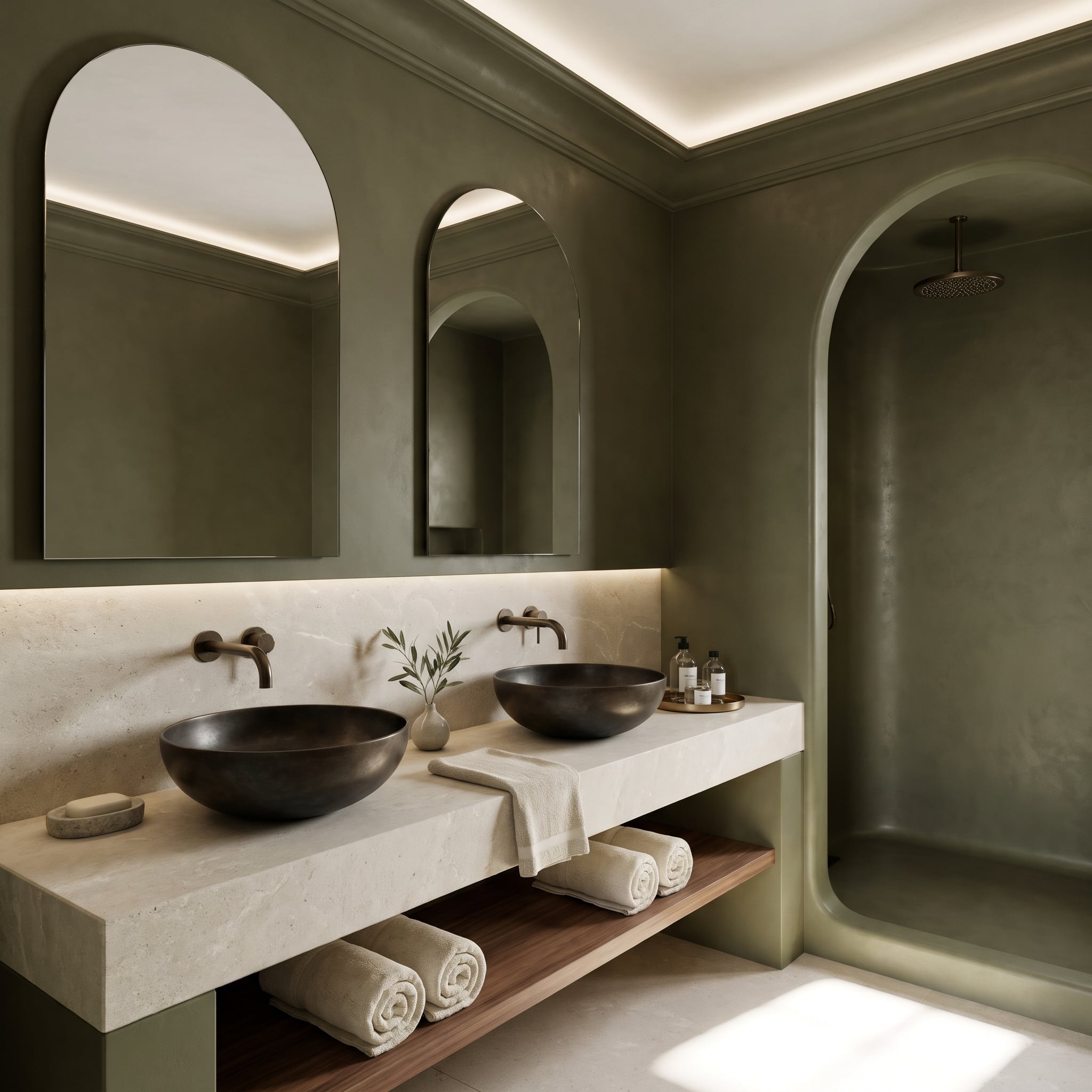
Olive plaster curves around the shower arch, giving the bathroom a continuous sculptural envelope. Dark bronze-finished vessel basins stand out against the limestone counter, with wall-mounted spouts and a rain showerhead repeating the metal at a smaller scale. Arched mirrors echo the enclosure without introducing a competing geometry.
The deep green and brown-black finishes make the pale stone especially luminous. The dark bowls have a sculptural presence, while the fittings reduce the same metallic color to a series of fine lines. For direct wet exposure, the plaster-like surface must be a suitable wet-area system over an appropriate waterproofed assembly; ordinary decorative plaster is not a substitute for waterproofing.
19. Fluted Bronze Turns the Fireplace Into a Wall of Light
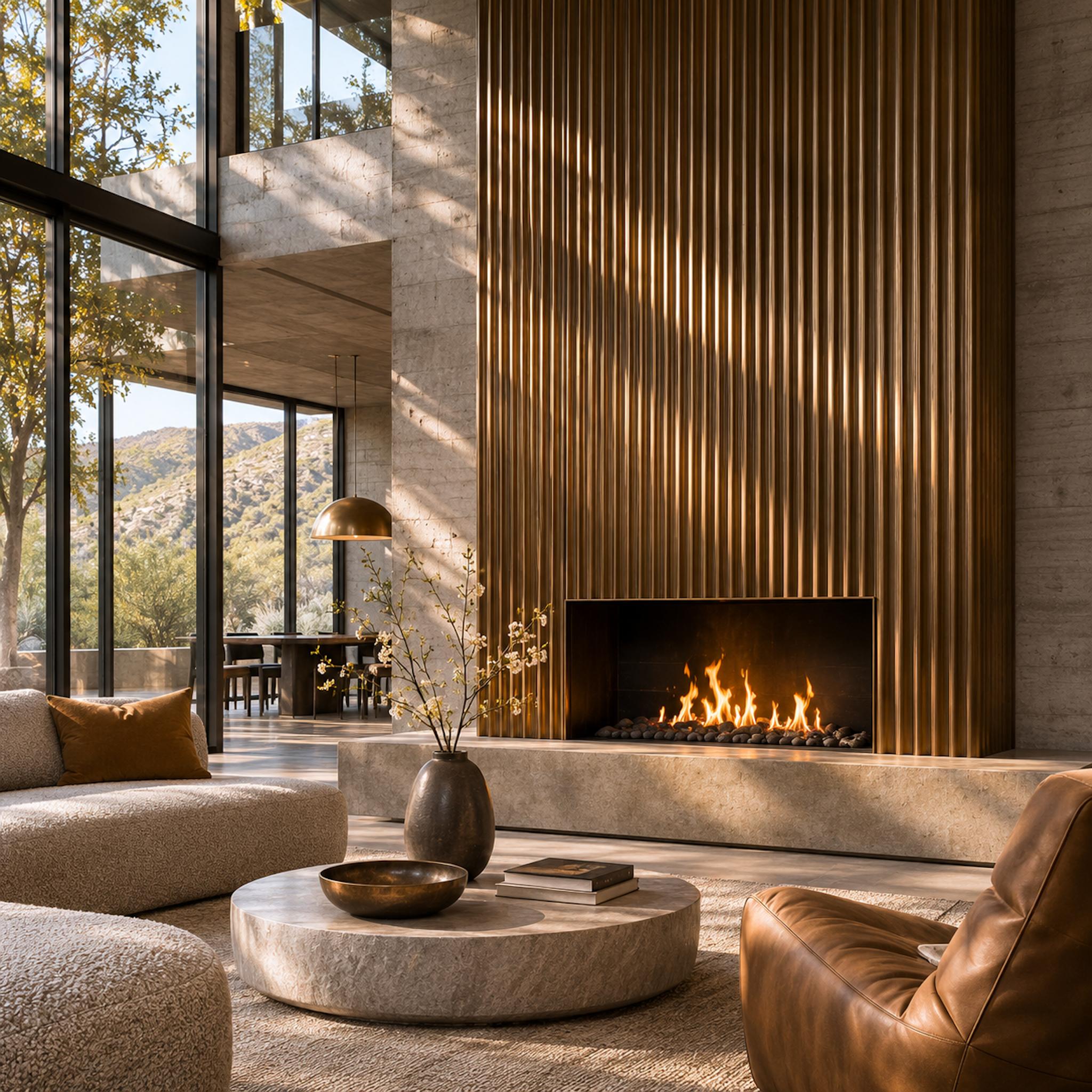
Deep vertical flutes rise from the stone hearth, lending the bronze fireplace surround an almost textile-like rhythm. The ridges catch the light while their recesses deepen into brown shadow. A patch of sunlight that would register as a single highlight on a flat panel becomes dozens of fine streaks across this relief.
The neighboring board-formed concrete has its own, predominantly horizontal texture. A low stone coffee table and generously upholstered seating keep the foreground quiet enough for the tall metalwork to dominate. Bronze acquires a different personality through profile alone: the ribbed surface needs no elaborate pattern or dramatic color change.
Cladding Detail: Profiled metal cladding requires a suitable support system, carefully finished edges and a means of cleaning the recesses. Around a fireplace, the complete assembly must be appropriate for heat exposure and comply with the appliance manufacturer’s installation requirements.
18. Bronze Channels Replace the Cabinet Handles
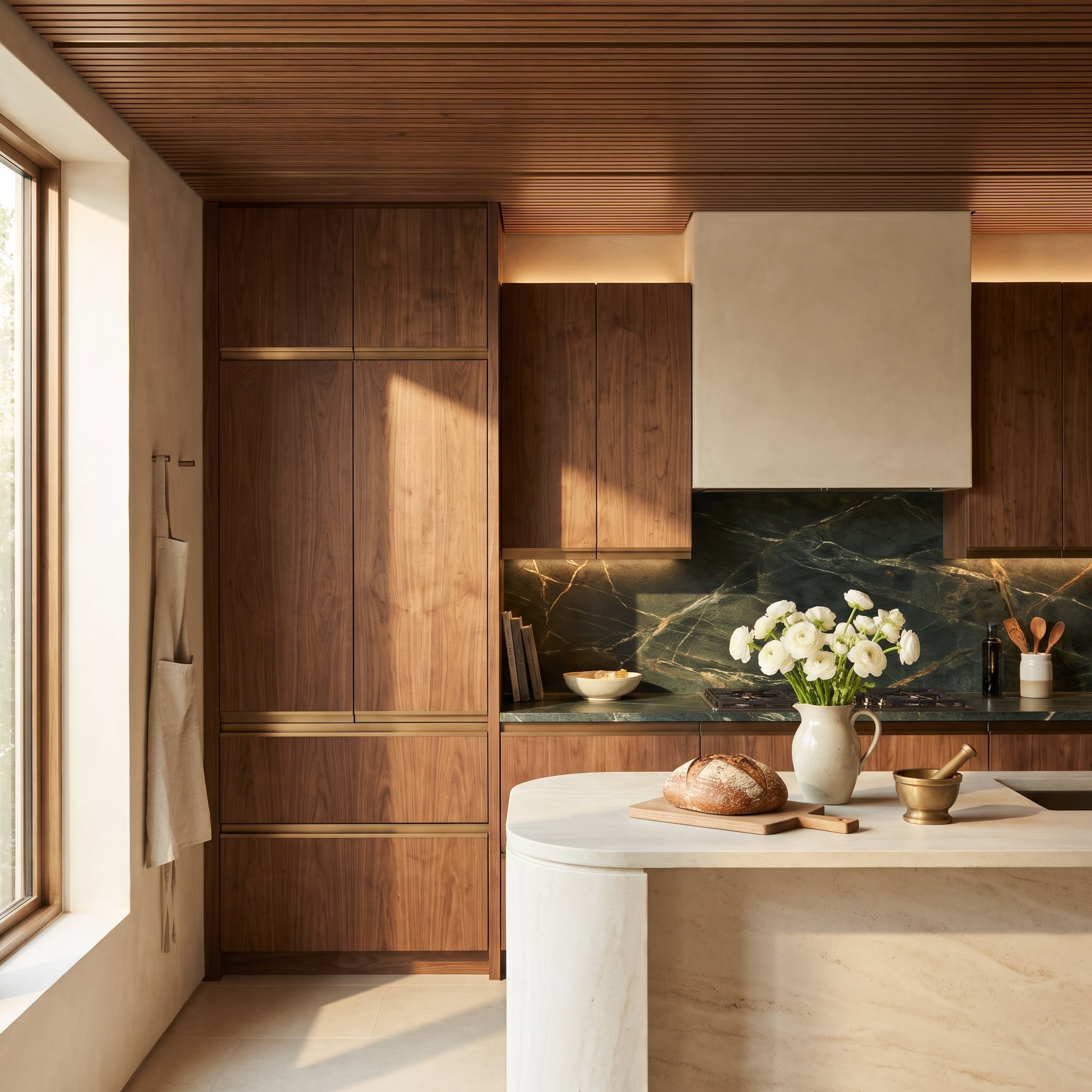
Recessed bronze-toned channels separate the walnut doors and drawers, giving the cabinetry a network of fine metallic lines in place of projecting handles. Where the channels serve as grips, their dimensions and location determine whether the doors and drawers are comfortable to operate. The walnut grain remains the dominant surface.
Gold-colored veins in the green backsplash relate to the metal channels, while a plaster hood introduces a broad pale form. A brass mortar on the island offers a brighter variation of the same general metallic palette. Finishes need not be identical to belong together; the difference in scale and sheen can be part of the composition.
17. The Bed With a Floating Bronze Base
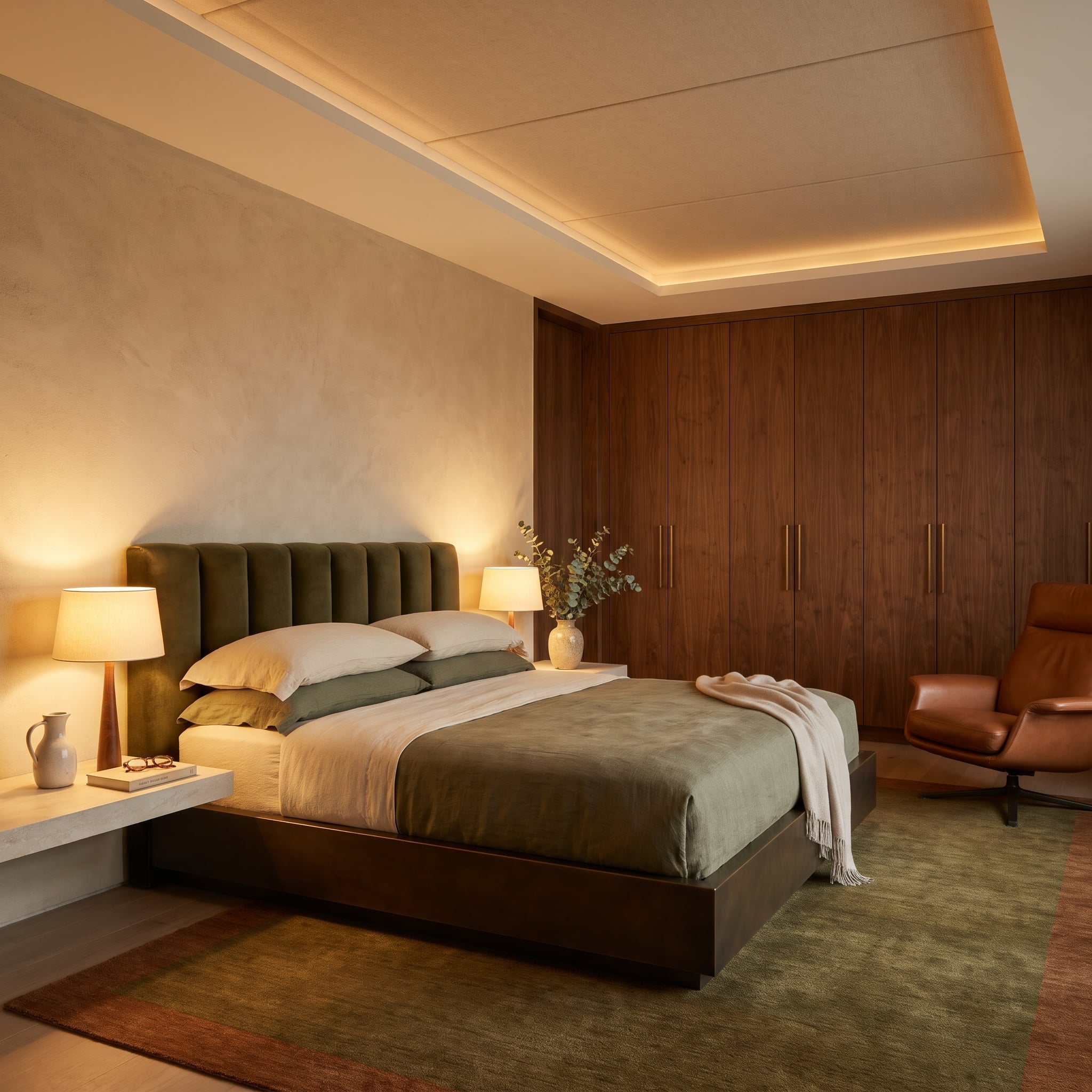
Patinated metal wraps the bed platform, its brown surface catching a narrow band of lamplight along the upper edge. A recessed plinth leaves a dark band of shadow beneath the bed, making the substantial metal base appear to float. The cantilevered plaster nightstand repeats the trick at the wall.
Olive velvet channels on the headboard, a green rug and a walnut wardrobe bring a softer character to the bedroom. Long wardrobe pulls echo the metal at a much smaller scale. The wardrobe’s slender vertical pulls and the platform’s broad horizontal band establish two very different scales of metalwork within the same room.
16. The Stair Screen That Draws Stripes With Sunlight
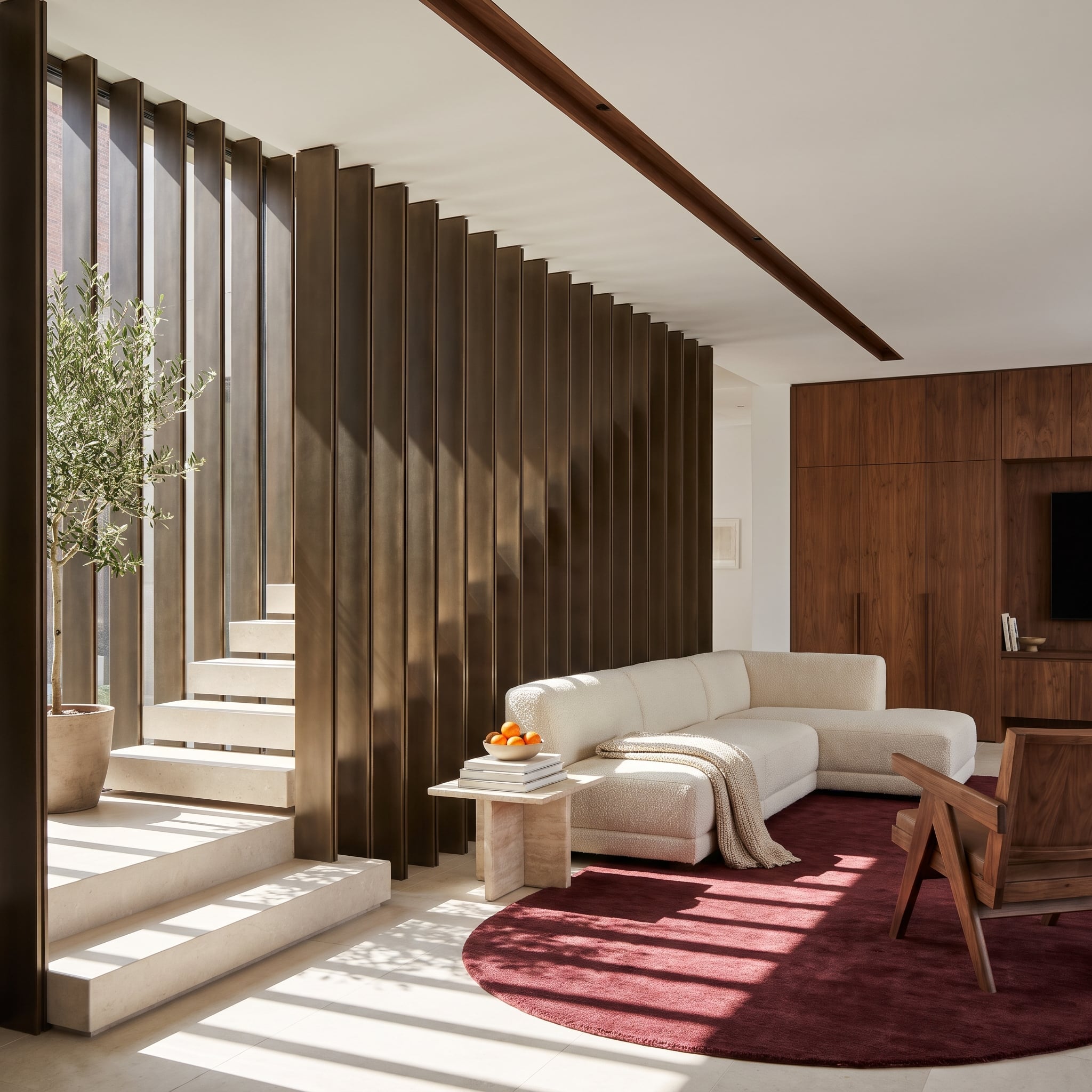
Tall bronze fins screen the stair beside the window wall, introducing a second set of vertical lines into the architecture. Sunlight passing between them draws stripes across the limestone treads, pale floor and burgundy rug. The changing angle of the sun gives the screen a different expression throughout the day.
Walnut cabinetry and a timber channel at the ceiling relate to the deep brown of the metal. The fins’ depth, spacing and orientation determine their effects on sightlines and sunlight. A dark or matte finish can soften concentrated highlights on the fins themselves; the geometry controls the pattern beyond them.
Guard Detail: Decorative fins may serve as a stair guard only if engineered and installed to meet applicable requirements for height, openings, loads and anchorage. Otherwise, provide an independent compliant guard. Fixed fins should be designed for the intended sun angles and sightlines.
15. An Aged Bronze Hood Above Wine-Red Marble
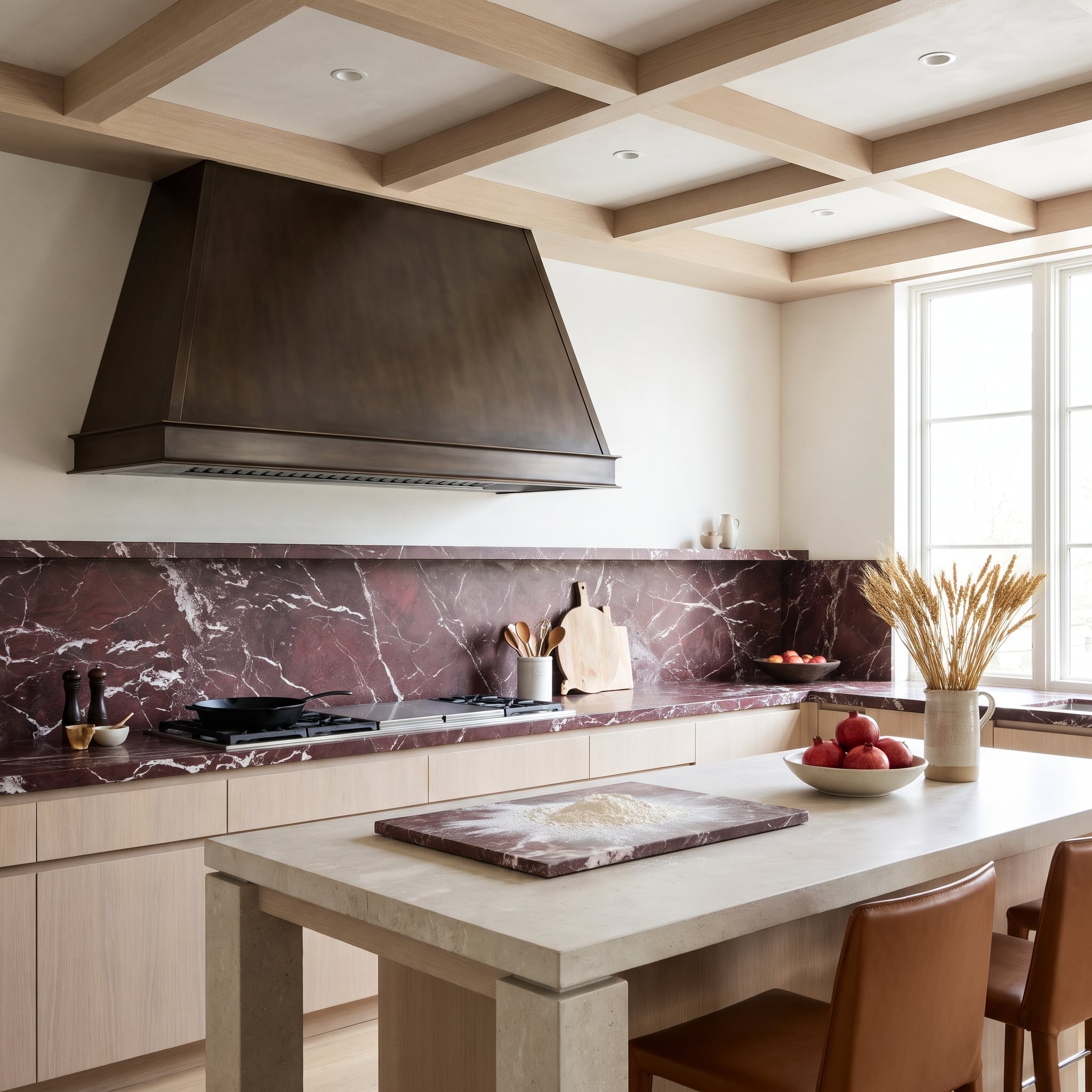
Wine-red marble and the aged bronze hood share a range of reddish-brown tones, although the stone’s veining and the metal’s mottled surface remain visibly distinct. A slim ledge and a band of white wall between the two finishes give each one a separate outline.
The hood has the presence of an architectural canopy instead of a small appliance. A decorative bronze face can conceal the ventilation assembly; its dimensions, installation height, clearances and cleaning access must suit the hood manufacturer’s requirements. The understated surround lets the wine-red stone retain its own drama.
Not everyone is sold on deep reds in the kitchen: in our reader votes, burgundy-dominant kitchens got hearts 38% of the time, versus 46% for other kitchens in the same articles.
14. A Knotted Bronze Lamp in the Library
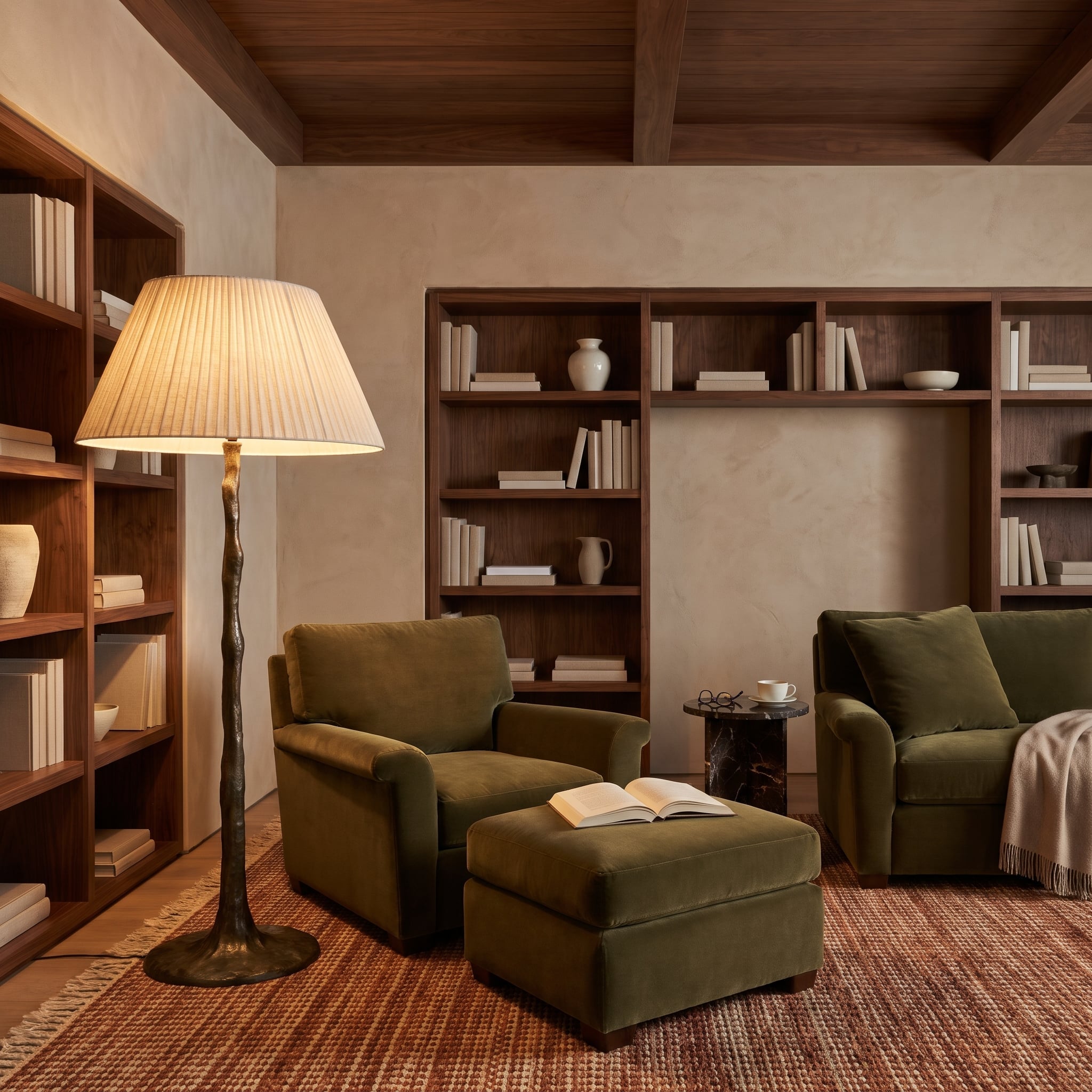
A knotted bronze stem rises from a broad base like a sapling translated into metal. Its irregular profile provides a counterpoint to the straight shelves and rectangular compartments of the walnut library. A pleated linen shade diffuses light and gives the substantial base a softer companion.
Olive upholstery and a rust-toned woven rug make the bronze feel related to the furnishings without requiring matching metalwork everywhere. One sculptural lamp can establish the material vocabulary of a reading corner. The shade size and lamp position should suit the intended reading height and light output as well as the scale of the furniture.
13. Dark Bronze Lines Across a Limestone Bathroom
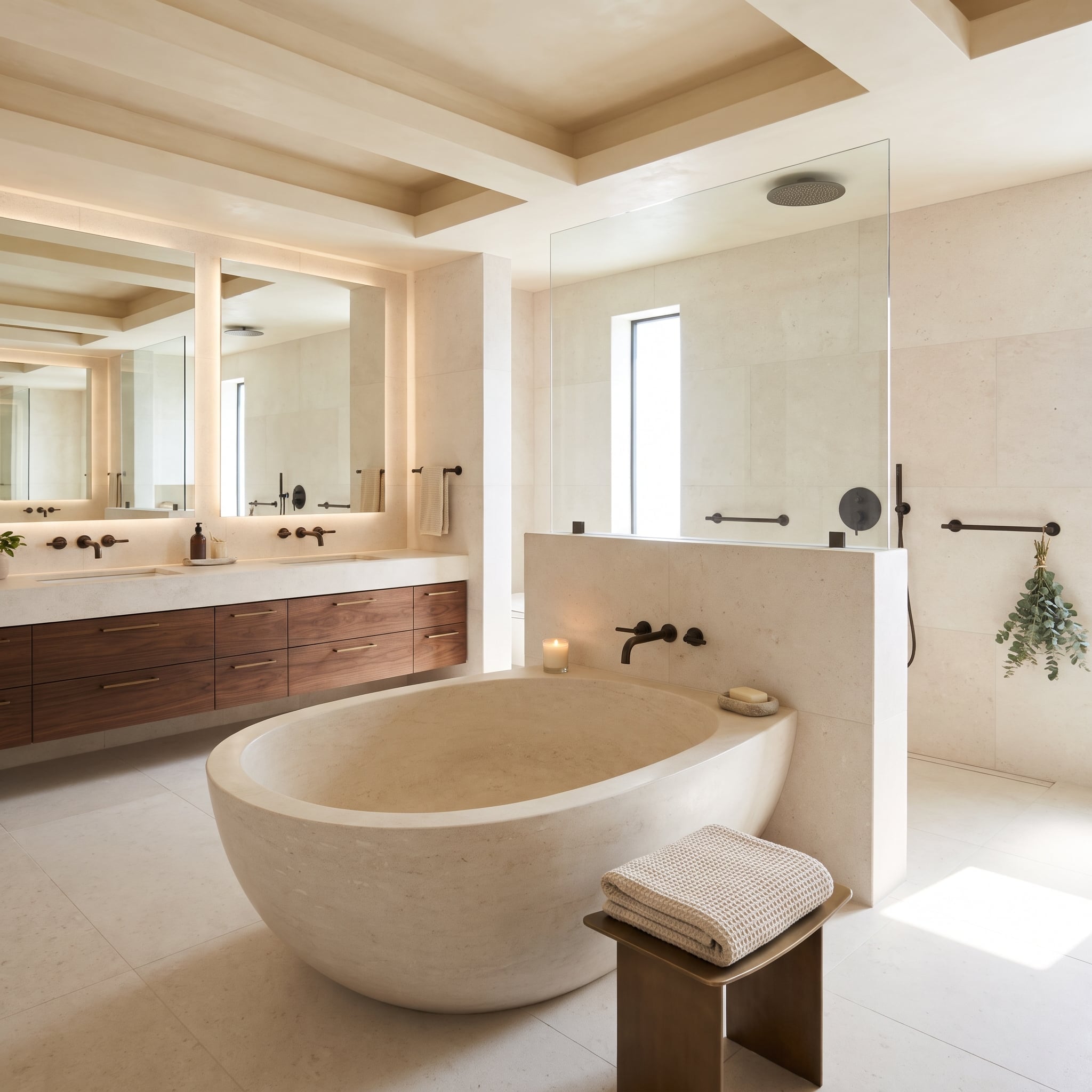
A carved oval tub sits against a limestone half-wall that carries its spout; glass above the wall allows the shower behind to share daylight. Dark bronze-finished fittings articulate the pale architecture, from the tub filler and rain shower to the towel bars and low stool.
The metal’s role is almost graphic: narrow lines against large blocks of cream stone. Walnut at the vanity adds another material without competing with the restrained fixture palette. The half-wall must accommodate plumbing, waterproofing and suitable support for the glass, with safety glazing and access for servicing where required.
12. Bronze Draws the Ceiling and Pottery Display Together
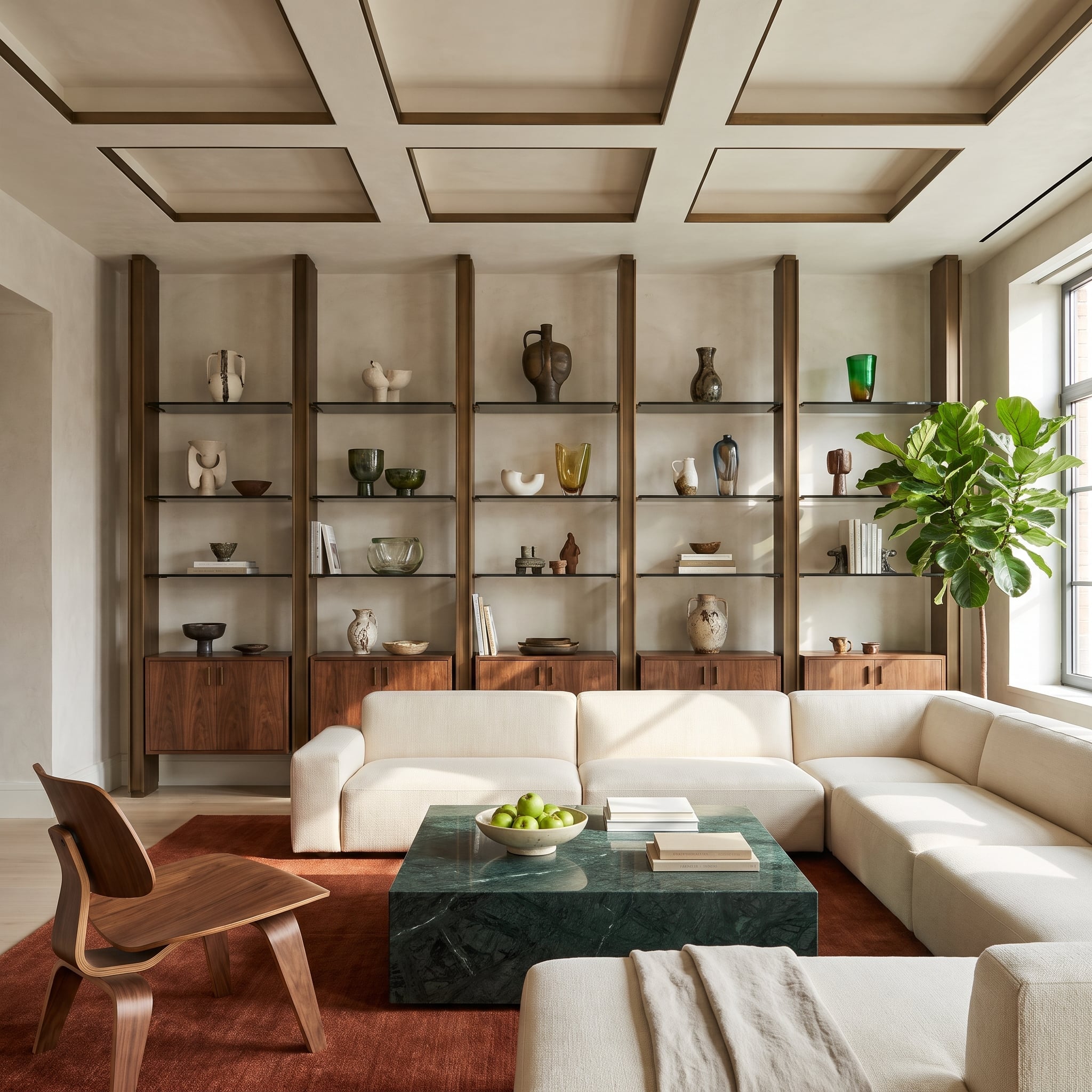
Bronze-wrapped uprights establish a repeated rhythm across the pottery display, and narrow bronze borders trace the ceiling coffers overhead. A vertical grid for the objects acquires its horizontal counterpart above the room.
Glass shelves keep the pottery prominent, while the deeper metal tone gives each bay definition. The effect can be achieved with decorative bronze cladding over a properly designed shelving system; the supports and attachments must be sized for the objects on display. The ceiling treatment makes the cabinetry feel less like an isolated piece of furniture and more like part of the room’s architecture.
11. Firelight Across Three Panels of Aged Bronze
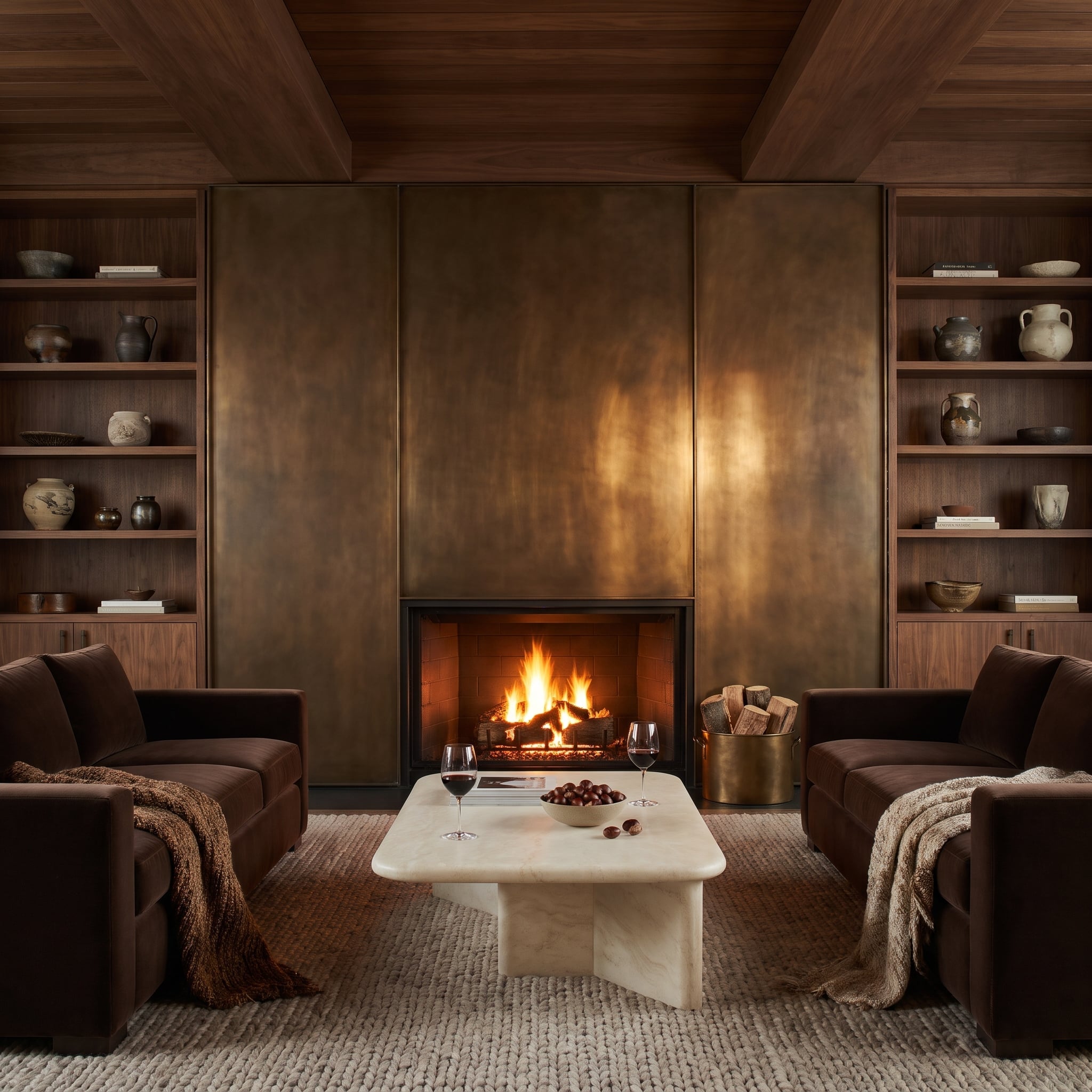
Three broad bronze panels rise above the fireplace toward the walnut ceiling. Firelight adds shifting highlights to the irregular surface, emphasizing the variations of the aged finish. A smaller bronze log bucket repeats the metal beside the hearth, while velvet seating and a pale stone table soften the surrounding composition.
The vertical joints give the surround the scale of an architectural wall rather than decorative fireplace trim. Specify a heat-compatible cladding assembly, including its substrate, coating and attachments, and follow the fireplace manufacturer’s clearances and applicable safety requirements. The beauty of the metal is in the way the moving firelight keeps changing an otherwise still surface.
10. Bronze Frames Give Amber Glassware Its Own Gallery
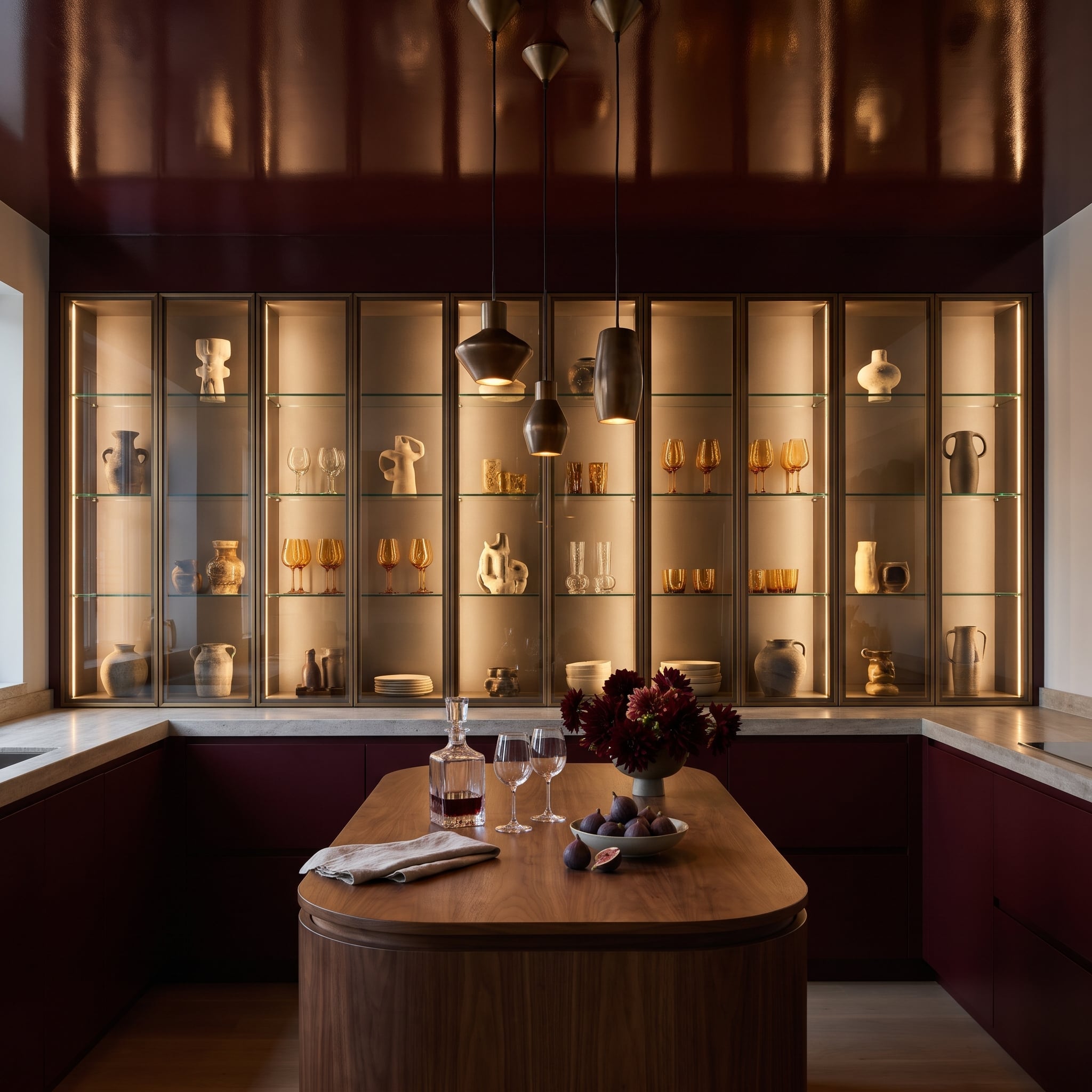
Bronze-framed glass cabinet doors turn the wall into a succession of illuminated display cases. The amber stemware seems almost to extend the color of the metal, although its transparency creates a very different effect. The narrow frames establish a quiet rhythm around the more intricate shapes of the glassware.
Burgundy lacquer overhead returns highlights from the display lighting, and a curved walnut island provides a solid foreground. Concealed light sources and accessible drivers are worth planning early, particularly where reflections could obscure the display. The most engaging contrast is between the glowing amber glass and the darker metal that frames it.
9. Bronze Mullions Frame a Winter Landscape
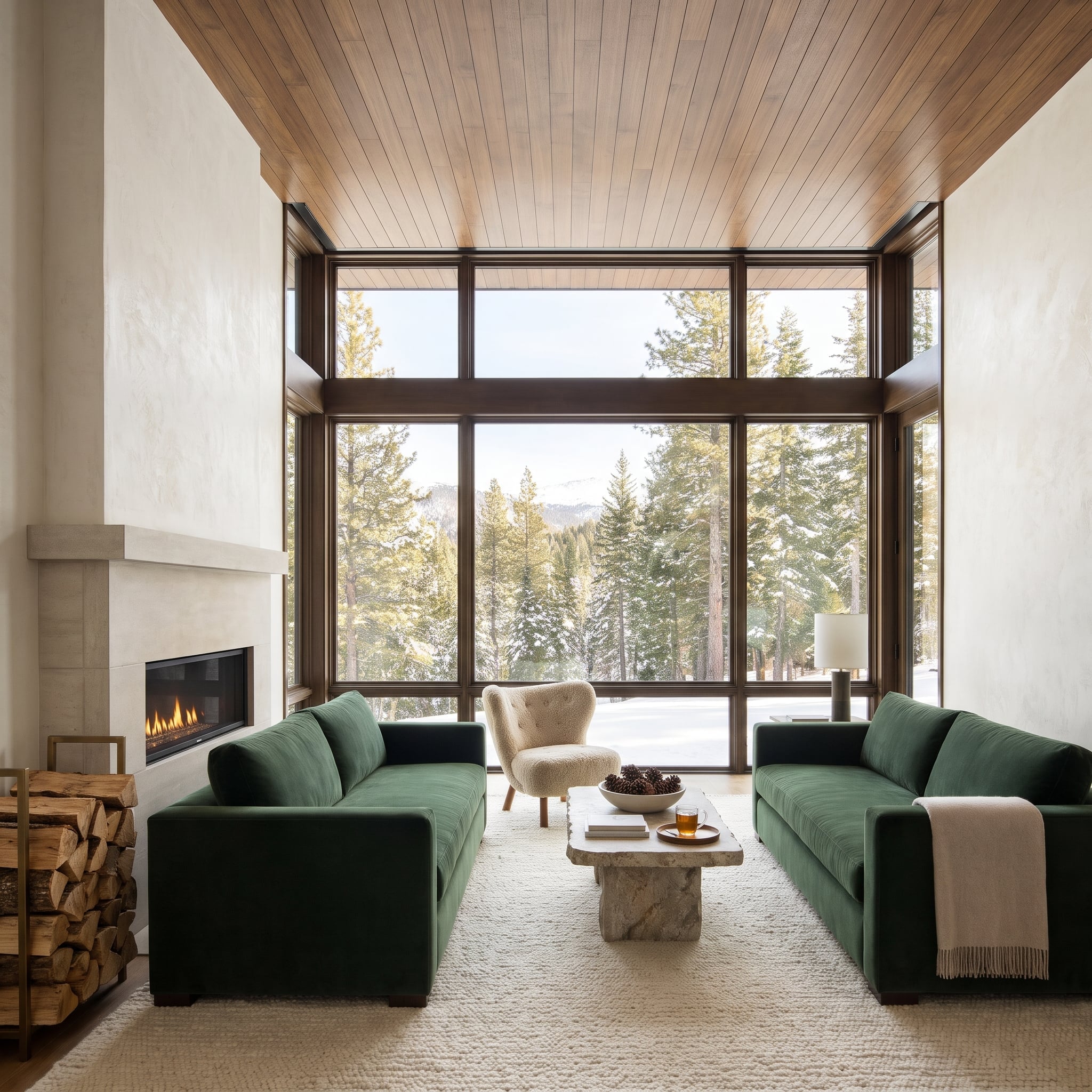
Dark bronze-toned mullions divide the broad window wall into framed portions of a winter landscape. The dark grid gives the snow-covered pines definition, while green velvet sofas carry the forest color into the room. Cream upholstery and a pale rug leave the view to provide the most intricate pattern.
The brown metal relates to the timber ceiling without imitating its grain. Slim profiles keep the landscape prominent, while their dark color makes even the narrowest lines distinct against the snow. Here the window frame is as much a part of the composition as the furniture.
Window Detail: Architectural bronze can refer to certain copper-zinc alloys; bronze-toned frames may also be coated or plated metal. Identify the actual material, and evaluate the complete glazing system for local weather exposure, structural performance, condensation resistance and energy efficiency.
8. The Bronze Alcove That Frames the Range
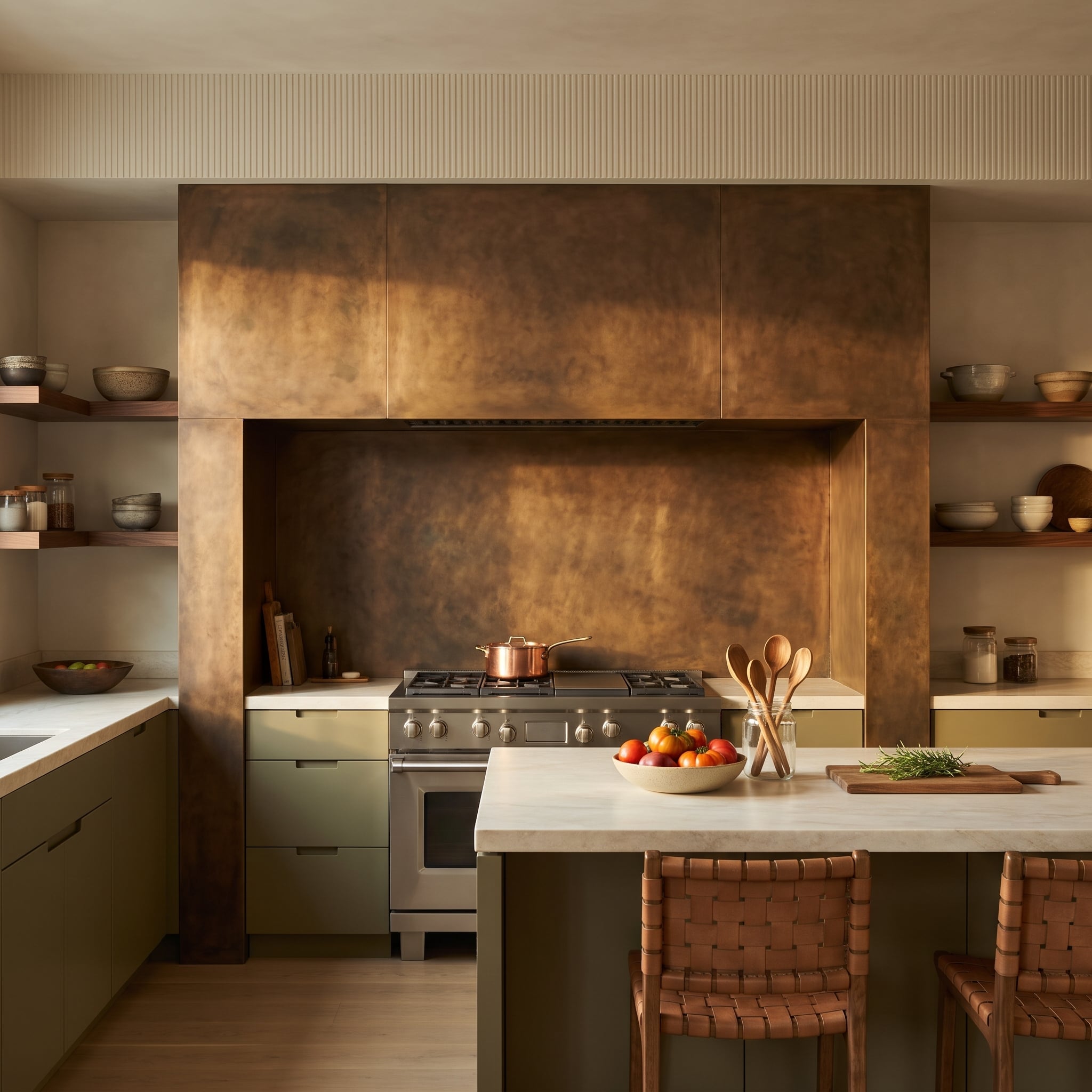
Bronze defines the cooking area as a recessed architectural composition, wrapping the sides and hood above the range. Olive flat-front cabinetry extends toward the metal enclosure, with walnut shelves providing a different texture at either side. The recess gives the cooking appliances the presence of a fireplace surround.
The mottled surface lends depth to a large expanse of metal, but its care requirements matter in a working kitchen. Choose a cleanable finish and a backing assembly rated for the intended exposure, and observe the appliance and ventilation manufacturers’ clearances. The dark alcove makes the range the centerpiece without relying on an elaborate mantel or ornamental trim.
7. Two Bronze Lines Above a Long Dining Table
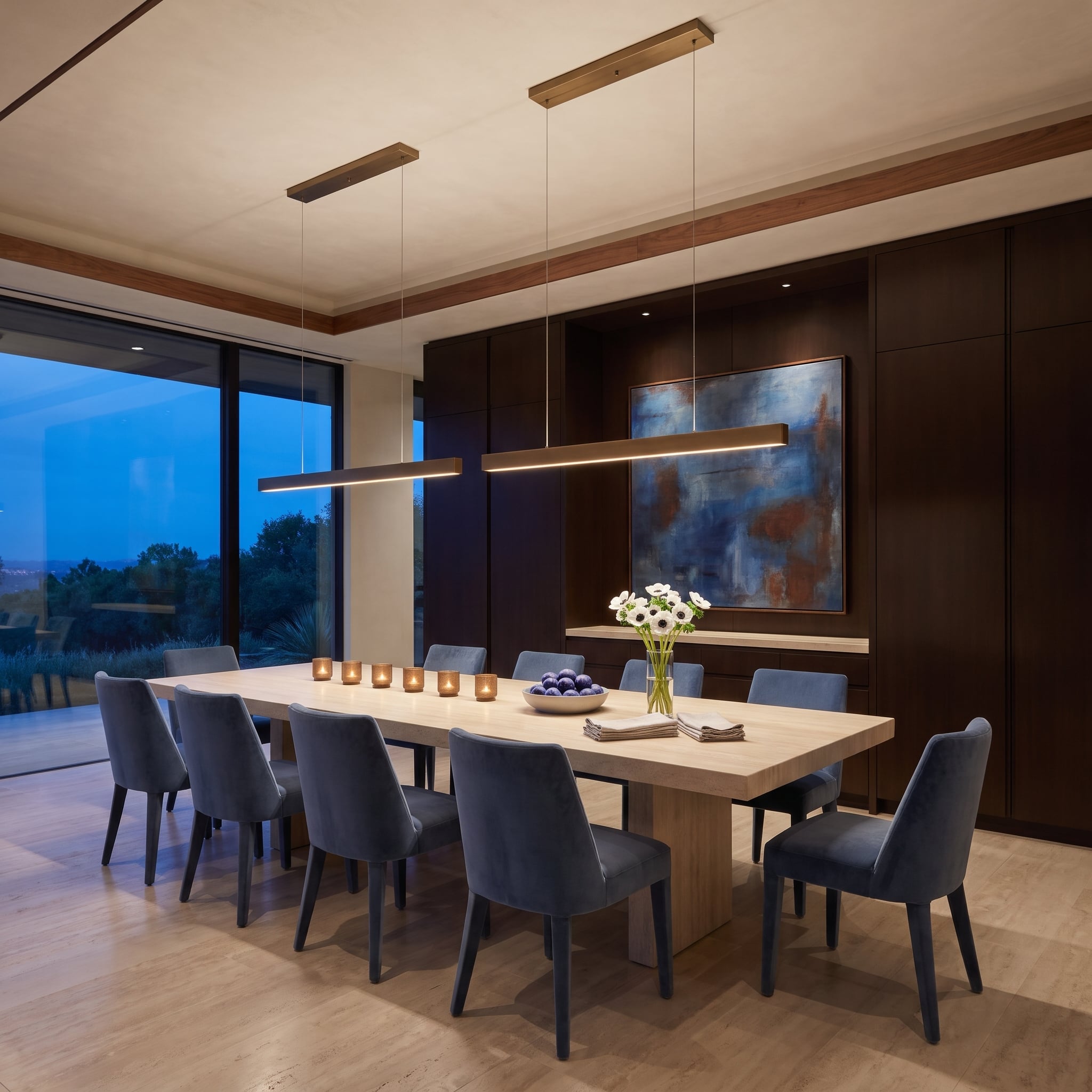
Two linear pendants extend along the stone dining table, their bronze housings appearing as slender lines beneath the pale ceiling. Light emerges along the undersides, following the length of the tabletop instead of concentrating the composition around a single chandelier.
Blue velvet seats relate to the blue and rust artwork in the recessed niche, while candles establish a lower layer of light. The pendants can spread illumination along the table when their output, optics and mounting positions are well matched to its dimensions. Their slender bronze housings have the precision of architectural trim.
6. Bronze Traces the Edges of Bookmatched Marble
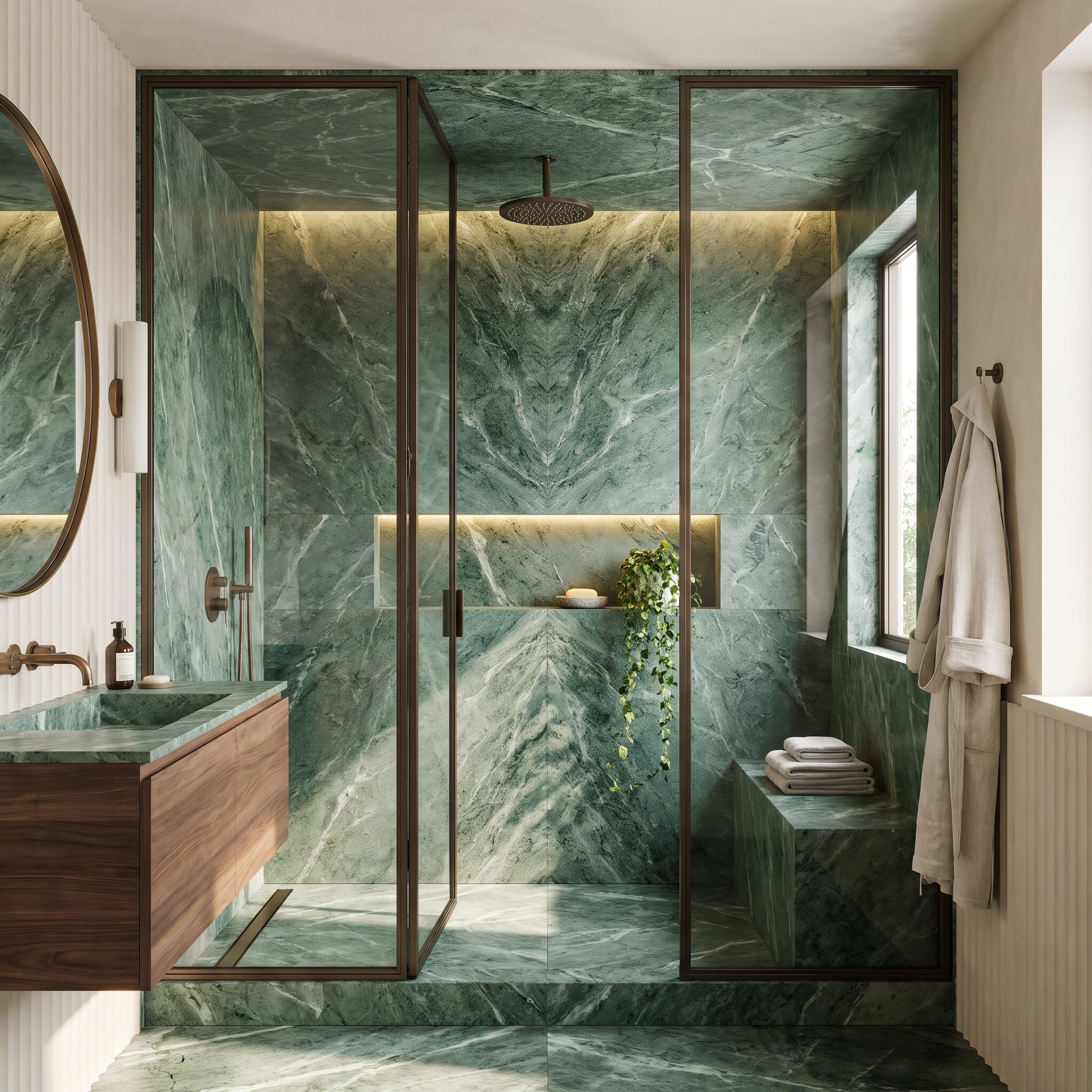
Bookmatched green marble slabs create a mirrored pattern behind the bronze-finished rain showerhead. A lit niche interrupts the stone with a narrow band of illumination, while fine bronze framing defines the glass enclosure without obscuring the veining.
The metal is used as a series of precise boundaries rather than a broad decorative surface. A matching drain cover repeats the finish at floor level. Its position can help simplify the layout of large stone pieces, provided the shower floor and drainage system are designed together.
Drainage Detail: An edge-positioned linear drain can permit a single-plane slope in a suitably designed shower. Specify appropriate drainage, waterproofing and a slip-resistant walking surface. Use finishes suitable for wet exposure, and provide a generous, unobstructed shower entrance with controls that can be reached before stepping beneath the spray.
5. A Bronze Mesh Curtain Turns Dining Into a Lantern
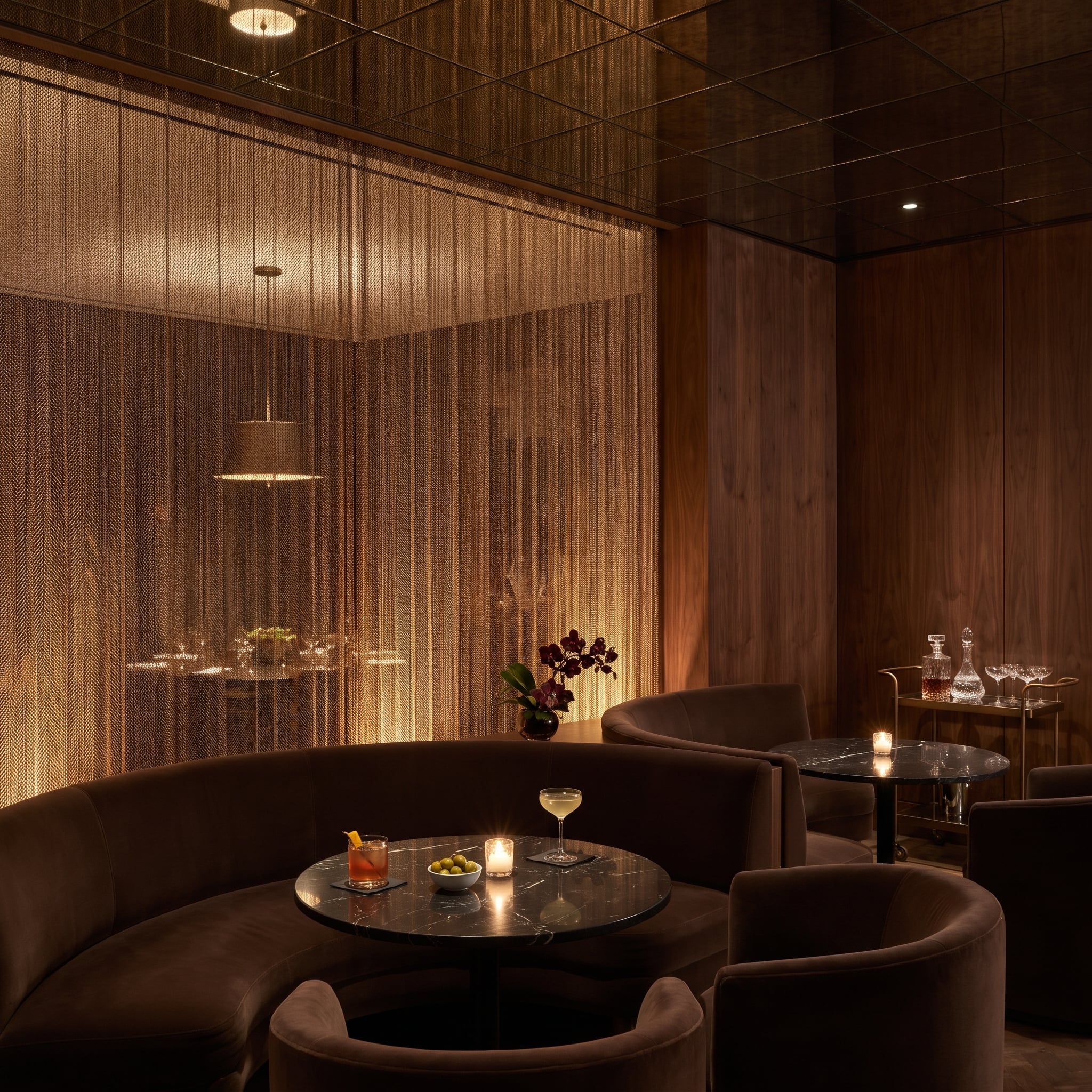
A bronze-finished chain mesh curtain wraps the dining area in a metallic textile. Lit from within, the enclosure becomes a lantern, its fine links alternately revealing and obscuring portions of the space. Unlike a rigid partition, the mesh gives a large opening a softer edge.
Walnut paneling, smoked mirror and a curved brown velvet banquette deepen the adjoining lounge. The mesh separates without sealing off, offering discretion rather than complete visual or acoustic privacy. Its density and the relative lighting on either side determine how much can be seen. A secure hanging system and clear circulation routes keep the curtain from becoming an obstacle.
4. When Bronze Becomes the Work Surface
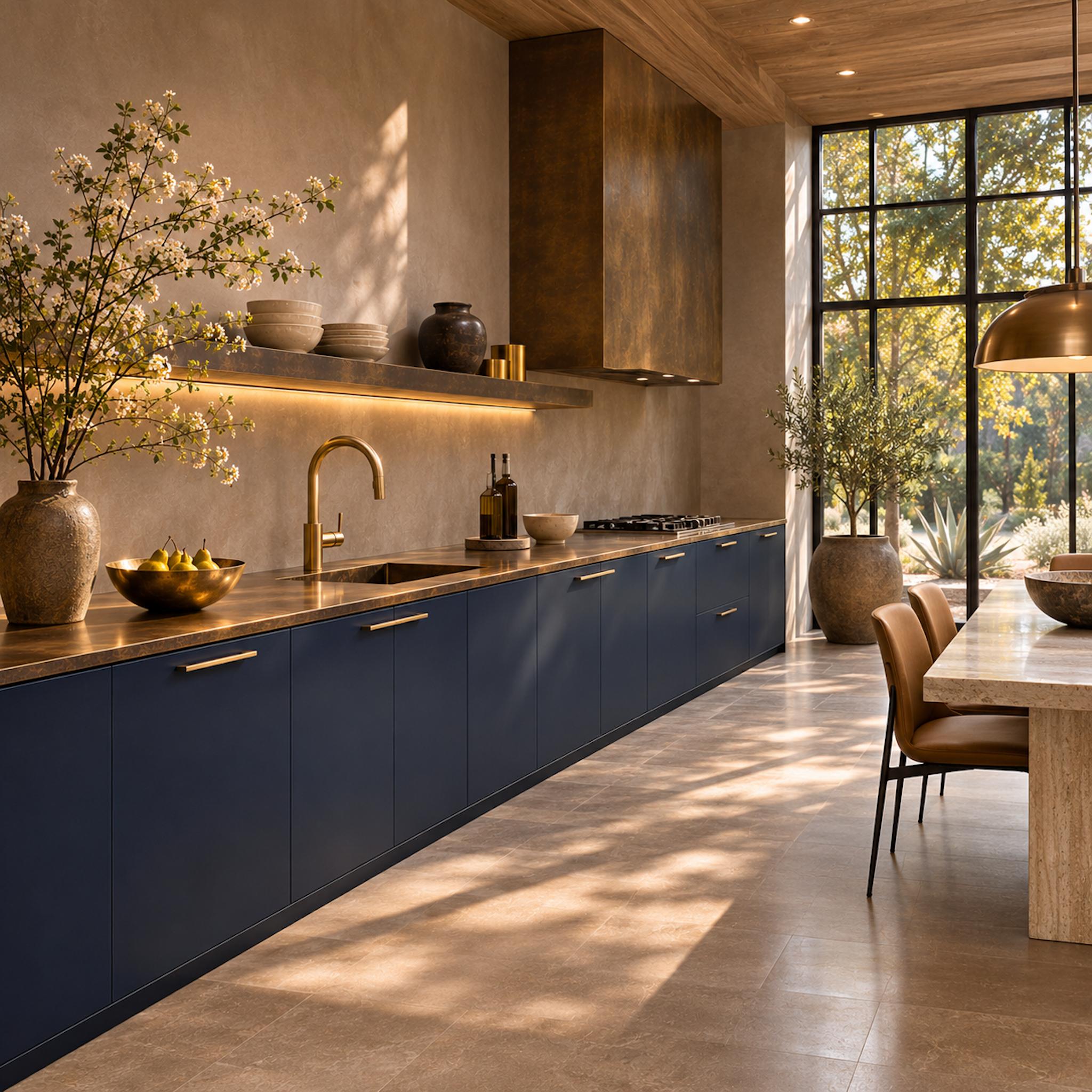
A slim bronze-colored countertop runs above the midnight-blue cabinetry, turning what would normally be a small hardware accent into the kitchen’s longest horizontal line. The sink shares the countertop’s metallic appearance, and the shelf above repeats the brown finish against pale plaster. Daylight from the garden end of the room brings out variations along the counter’s length.
The blue doors give the warm metal a particularly effective foil. Pale flooring, a timber ceiling and the stone dining table relieve the intensity of the two darker colors. Here the kitchen’s working surface, rather than the cabinet fronts or the island base, carries the richness of the metal.
Countertop Detail: Specify a purpose-designed countertop and sink with an alloy and surface treatment documented as suitable for the intended food and water contact. Unprotected copper alloys can react with acidic foods. Use separate cutting boards, follow the manufacturer’s care instructions, and never assume that a decorative patina or clear coating is food-contact safe.
3. A Bronze-Framed Den That Never Quite Disappears
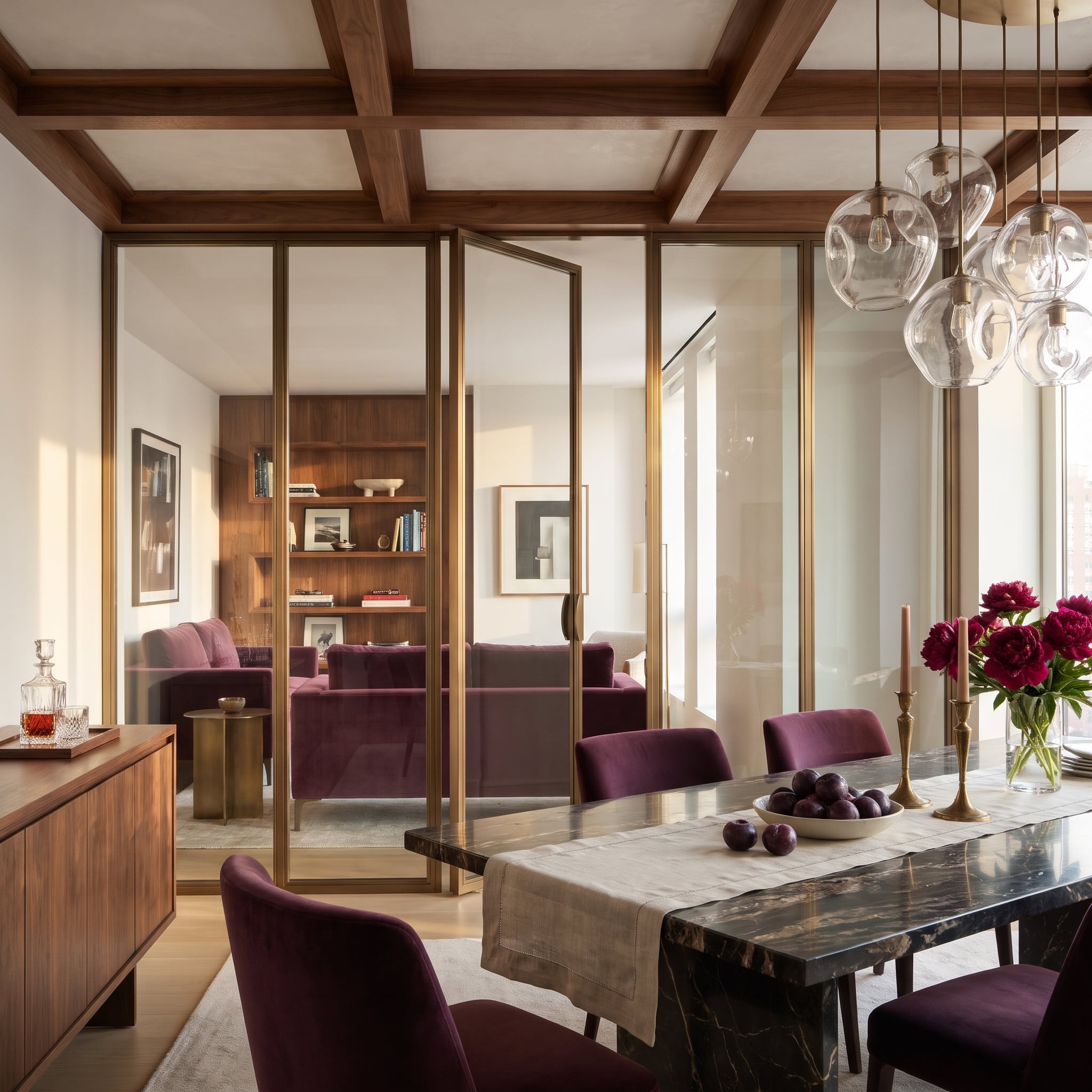
Slim bronze-toned frames define a glazed wall between the den and the adjoining dining space. The plum sofas remain visible through the partition even when the pivot door is closed. A walnut beam aligns with the upper rail, making the metalwork appear integral to the architecture.
The division preserves views while establishing a distinct room. Glass alone does not guarantee acoustic isolation, especially where door gaps remain. If separation is important, specify the glazing, seals and door hardware accordingly. Verify the pivot’s swing, edge clearances and safety glazing requirements before committing to the surrounding furniture layout.
2. When Bronze Turns Green and Takes Over Two Stories
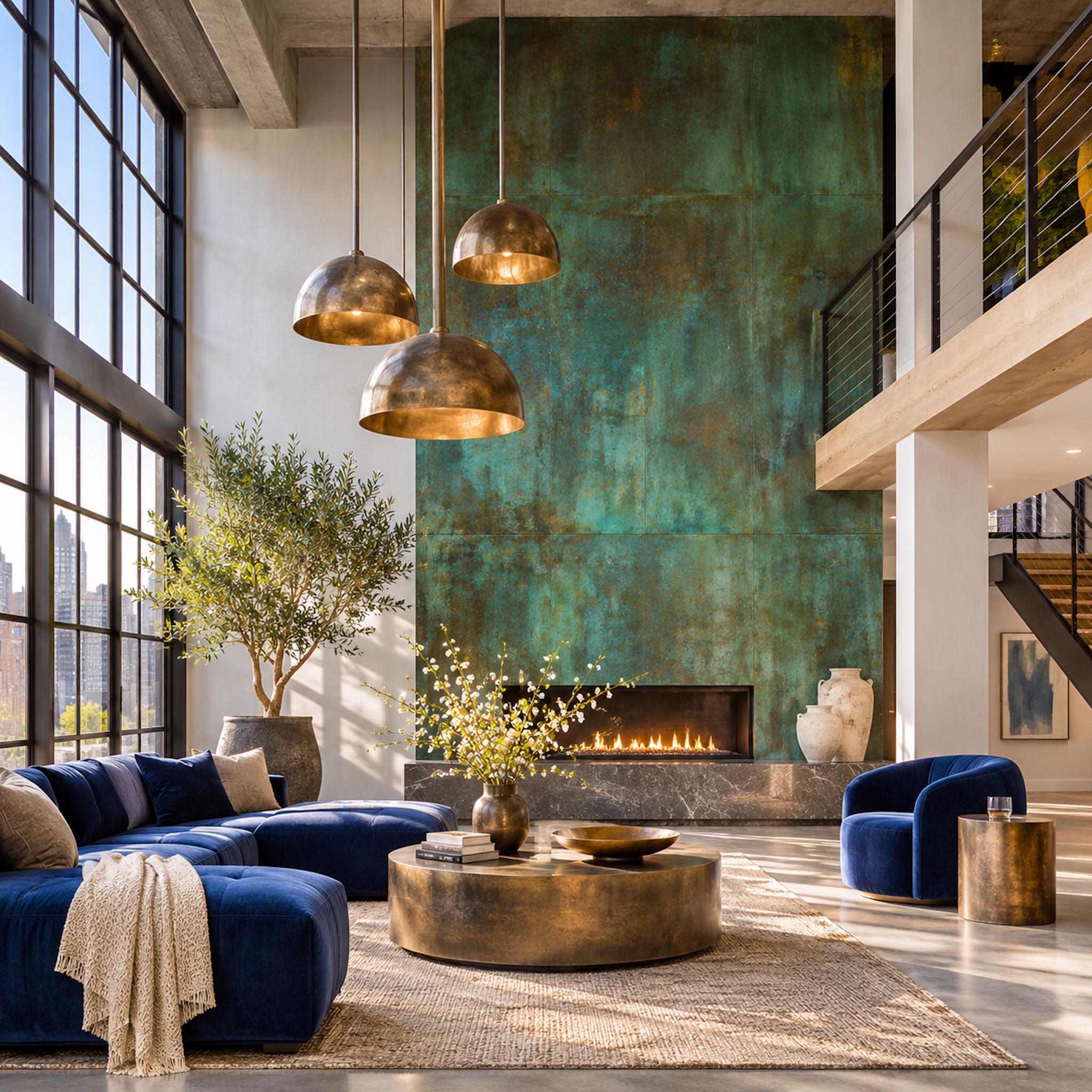
A turquoise-green patina gives the towering fireplace wall the color and irregularity of a large abstract painting. Fine panel joints establish a grid across the expanse, while brown and copper-colored patches interrupt the green. Daylight from the double-height windows reveals the subtle shifts from blue-green to olive and coppery brown.
Cobalt upholstery supplies a second strong color against chalk-white walls, exposed concrete and the pale timber of the mezzanine. Brown metal pendants and low tables repeat the warmer tones scattered through the patina. The more arresting pairing is cobalt against turquoise: two saturated colors on very different materials, set against the spare architecture of concrete and wood. Bronze, so often chosen for its earthy brown tones, becomes the room’s boldest color.
Patina Detail: Controlled chemical patination can produce green and blue-green tones on copper alloys. Review large samples in the intended light and agree on the acceptable variation between panels. Choose any protective coating and fireplace cladding assembly for their intended exposure, including heat.
1. Lavender-Veined Marble Over a Clouded Bronze Island
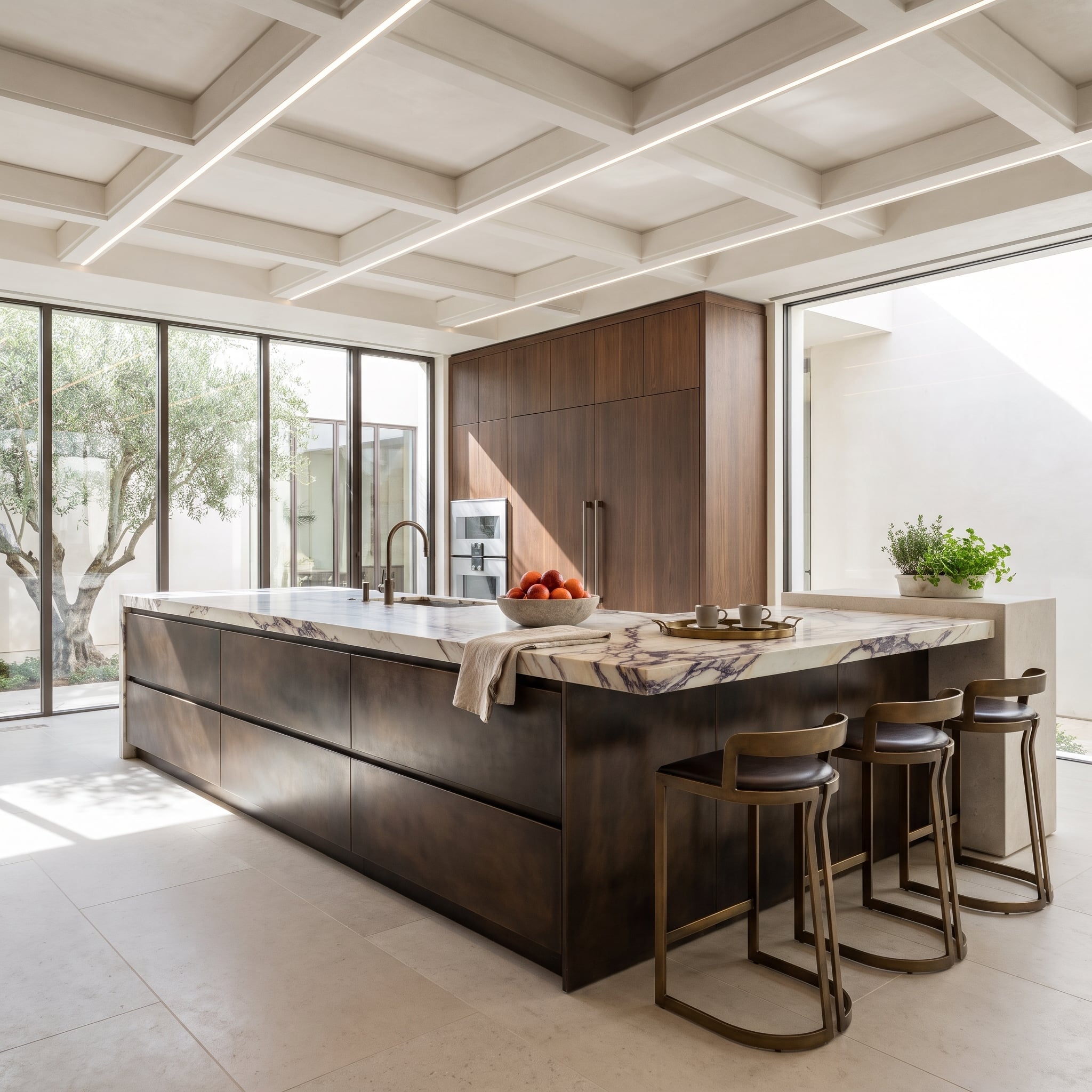
Violet veins travel across the thick marble slab above a clouded bronze island. The cool streaks give the brown metal a foil, and the squared profile of the stone makes the island read as one monumental piece of furniture. A finish normally encountered on a handle has been given the dimensions of a room-defining object.
Open bronze frames on the stools echo the metal without continuing the island’s solid mass. At the far end, a limestone pedestal provides a pale accent beneath the projecting slab; a cantilever of this scale requires carefully designed support. Whether the bronze develops its own patina or retains a carefully chosen finish under a protective coating, its appeal lies in the depth of the surface. The island’s broad bronze faces give the room a center of gravity that no collection of cabinet pulls could hope to achieve.