
🔥 Would you like to save this?
Two people who love each other can sit in the same room every night and slowly stop talking. Not because of anything either of them did. Because of where the couch faces.
In order to come up with the very specific design ideas, we create most designs with the assistance of state-of-the-art AI interior design software. Also, assume links that take you off the site are affiliate links such as links to Amazon. this means we may earn a commission if you buy something.
The room decides more than you think. The angle of a chair, the height of a lamp, the wall a television hangs on. These choices feel neutral. They feel like decorating. But your nervous system reads a room the way it reads a face, and it responds before you ever notice.
Some layouts invite you toward each other. Some quietly train you to look away. The difference is measurable, backed by decades of environmental psychology, and almost never obvious to the people living inside it.
Here are ten design choices doing damage in homes that look perfectly happy from the doorway. You may recognize your own living room in at least one of them.
The Furniture Arrangement That Makes You Argue Without Knowing Why
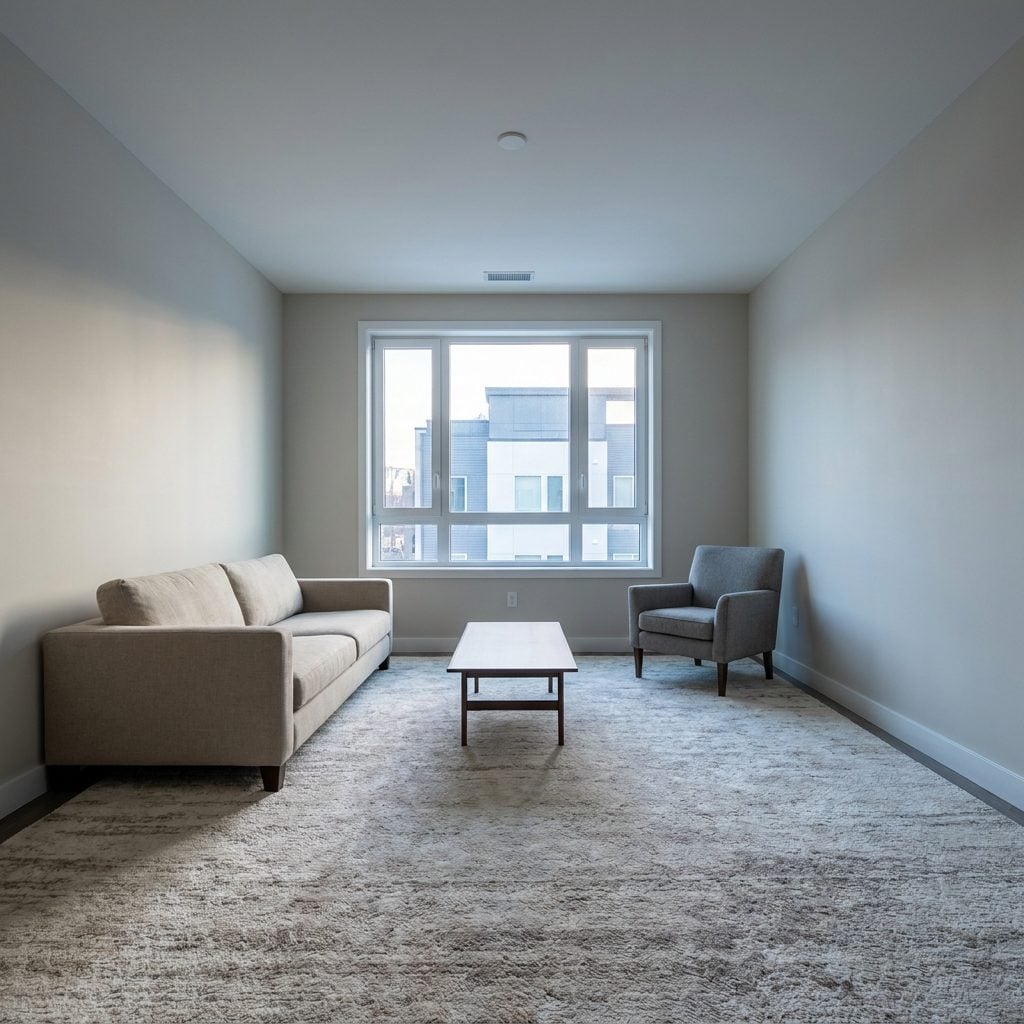
You’ve walked into the living room where the couch hugs one wall, the armchair hugs the other, and the whole room feels like a waiting area at the DMV. Nobody planned it. It just happened, one piece at a time, and now two people who love each other sit ten feet apart every night and can’t figure out why every conversation has a slight edge to it.
There’s a name for this. Environmental psychologists call it a sociofugal layout, a term tied to psychiatrist Humphry Osmond’s mid-century work in institutions. Research on seating arrangements found that sociopetal seating orients chairs to enable conversation, while sociofugal seating points people away from each other and quietly shuts it down. Robert Sommer proved the reverse works too. His early research showed that pulling furniture off the walls into small conversational clusters raised social interaction among patients, no other change required.
The wall-hugging habit feels tidy. It reads as distance to the nervous system. And distance, repeated nightly, becomes the mood of a marriage.
Why Two Reading Chairs Facing the Same Wall Slowly Kill the Conversation
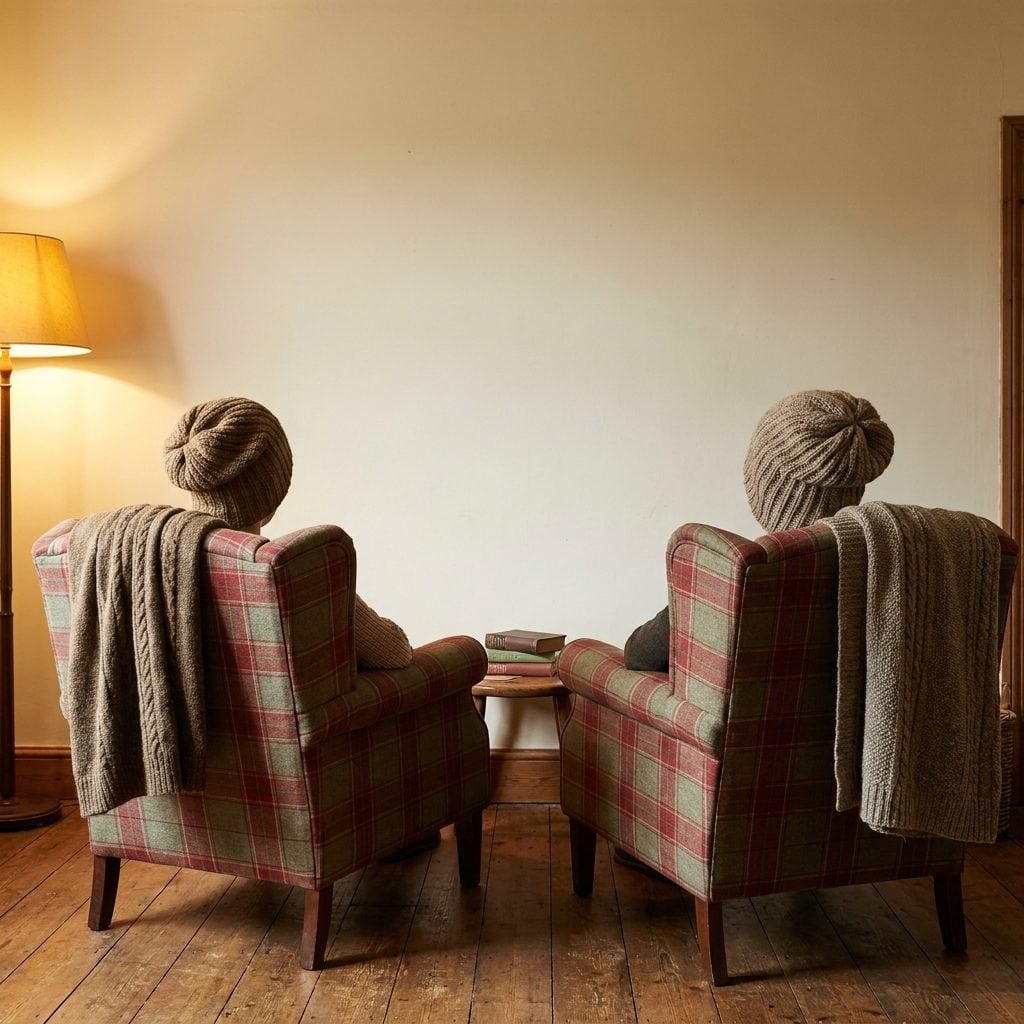
Two matching chairs. Both pointed at the fireplace, or the window, or the same blank stretch of wall. It looks like a spread in a design magazine. It functions like two strangers on a park bench.
The problem is orientation. When seats face outward toward a shared focal point instead of toward each other, they stop being a place to talk and become a place to sit near someone in silence. Environmental psychology research classifies exactly this as sociofugal: linear or parallel arrangements where people face a distant point instead of one another’s faces. Eye contact is the ignition switch for conversation, and a shared wall gives you none of it.
Here’s the fix nobody wants to hear because it breaks the symmetry: angle the chairs toward each other, even fifteen degrees. A layout should offer social possibility without forcing it. One guide on conversational seating makes the point well, noting an armchair angled toward a sofa still lets its occupant turn to the fire or window when they want solitude. That’s the goal. A room that invites talk but never demands it.
I killed a perfectly good reading nook this way for two years. Symmetry over connection. Rookie mistake.
The Television Placement That Trained You to Stop Looking at Each Other
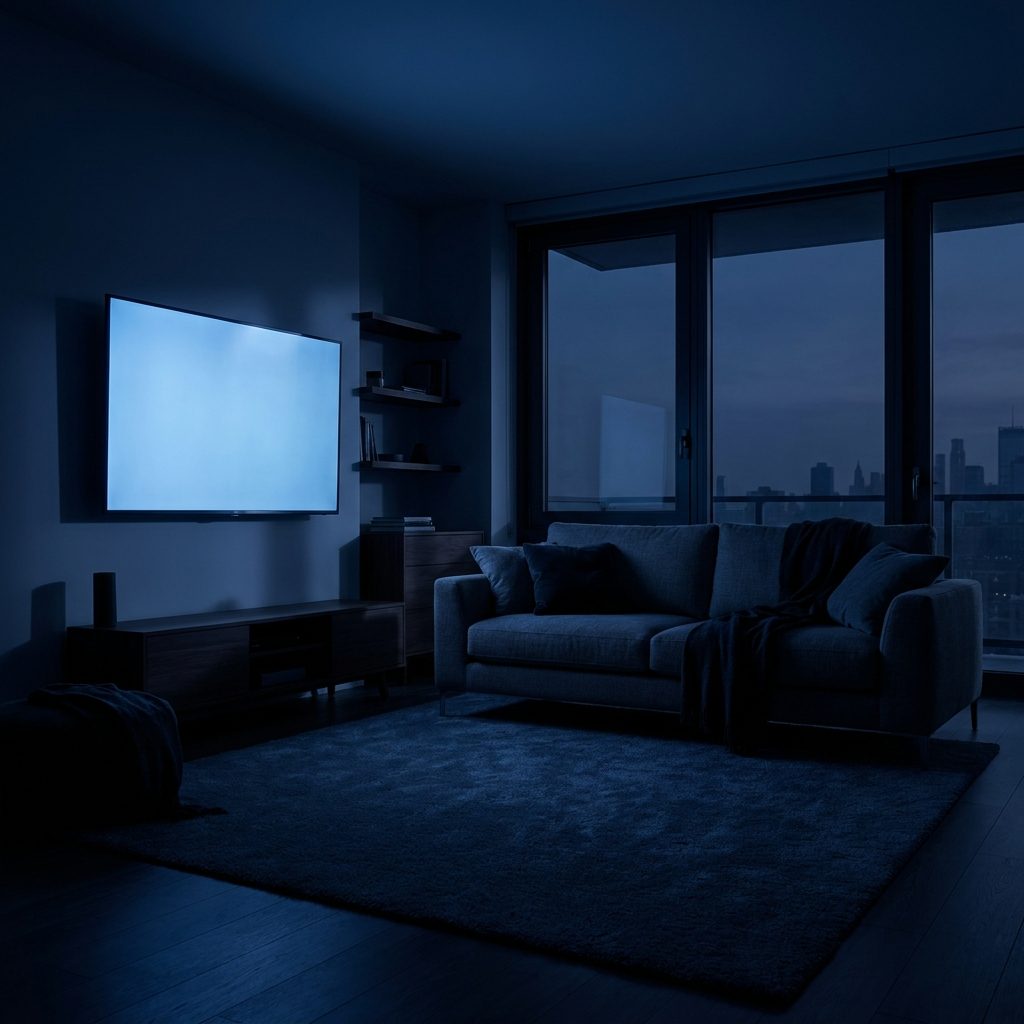
The TV won. It happened slowly, the way these things do. First it was a treat. Then it was background. Then it was the thing you both faced every night while facing away from the person you married.
The bedroom version is the quiet killer. Social scientist Paul Rosenblatt, in his book Two in a Bed, argues that bedtime is when partners actually catch up, plan, argue, repair, and put words to their realities. A screen at the foot of the bed compromises all of it. That same piece cites studies suggesting couples with a bedroom TV have sex about half as often as those without one.
It isn’t all doom. Research on couples who watch television together (Source) found that couples who genuinely share what they watch report greater closeness and commitment. The difference is whether you’re watching together or just watching near each other. One is a shared experience. The other is two people alone in the same bed.
The Lighting Setup That Makes One Person Feel Watched and the Other Feel Alone
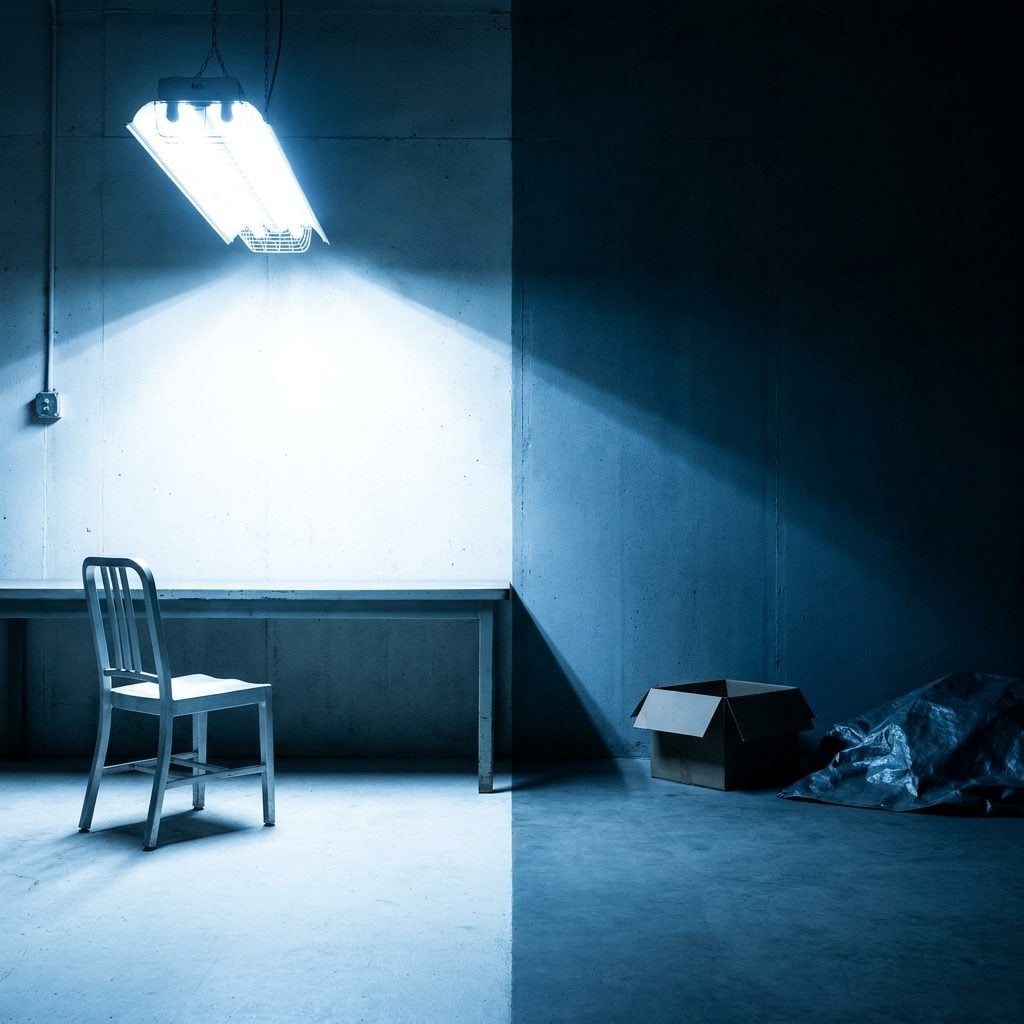
One overhead fixture. Blazing at 5000 kelvin. It lights the room like an interrogation and flattens every warm feeling in it.
Light does more emotional work than almost any other design choice, and couples rarely think about it as a shared system. Harsh single-source lighting creates a strange split. The person under it feels exposed, on display, slightly on trial. The person just outside its reach sits in a pool of shadow, physically present but atmospherically absent. Nobody feels close.
Softer, layered, dimmable light does the opposite. Research on lighting and romantic attraction (Source) notes that dim lighting measurably shifted people’s perception of attractiveness and increased feelings of intimacy and connection. Warm low light tells the nervous system it’s safe to relax and be relaxed around. Cold overhead light tells it to stay alert.
The fix costs almost nothing. A dimmer switch. A couple of lamps at eye level. A single warm bulb around 2700 kelvin. You want the light to fall on both people evenly and gently, not spotlight one and abandon the other.
I will die on the hill that overhead-only lighting has ended more evenings than any argument ever did.
The Bedroom Color That Lowers Desire Without Anyone Noticing
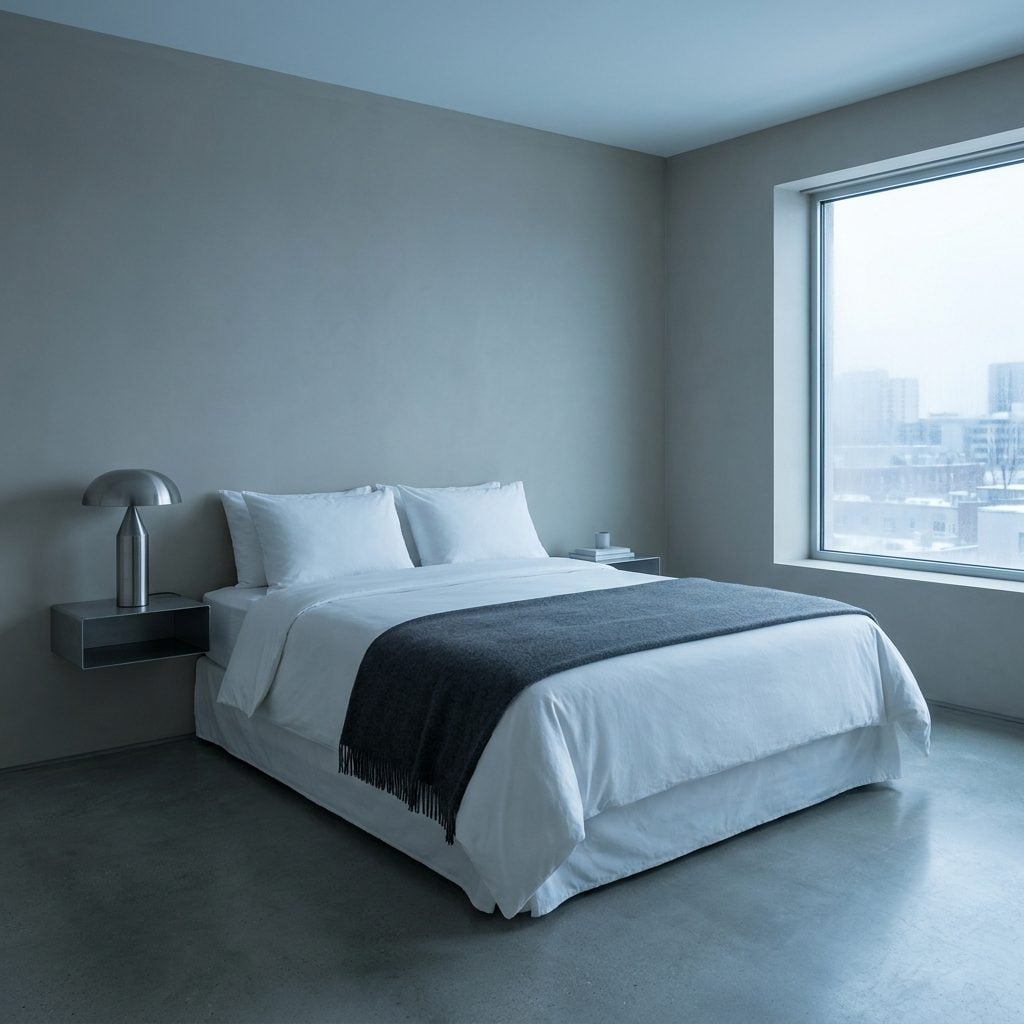
Grey. Cool, flattering-in-photos, endlessly-on-trend grey. It photographs like a luxury hotel and, on the wrong wall, it can drain the warmth right out of a room where warmth is the entire point.
Color in the bedroom does quiet work on the body. A study published in New Ideas in Psychology (Source) tested how interior colors affected people’s cognitive and sexual responses across bedrooms, kitchens, and other rooms. Red proved most congruent with erotic stimuli, while achromatic tones like white and black lined up with neutral, non-arousing responses. Cool and colorless walls simply don’t speak the same language desire does.
There’s a skin-tone angle too. Psychotherapist Dr. Tammy Nelson has pointed out that cool grey and blue walls can make skin look washed out (Source) while warm tones make skin read rosy and alive. And a Travelodge survey of over 2,000 couples turned up an odd champion: those with caramel-colored walls reported having the most sex of anyone surveyed.
You don’t need to paint the whole room the color of a latte. One warm accent wall, per Nelson, is often all it takes.
Why His-and-Hers Everything Is Quietly Building a Wall Down the Middle of the House
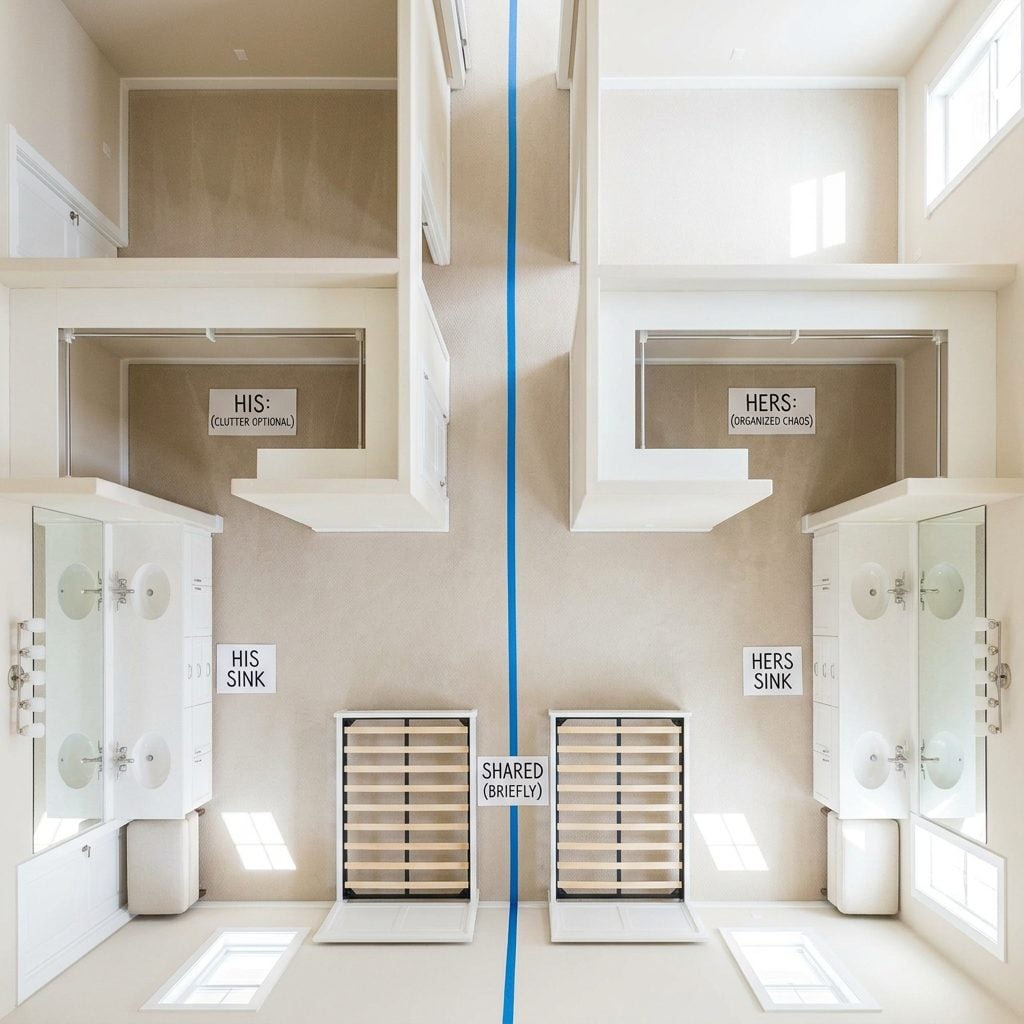
His closet, her closet. His sink, her sink. His side of the garage, her craft room. His recliner that nobody else is allowed to touch. Piece by piece, a shared home gets sorted into two kingdoms with a border running down the middle.
Personal space matters, and having a spot of your own is genuinely healthy. The trouble starts when everything gets divided and almost nothing stays shared. A home built entirely from separate zones stops requiring the small daily negotiations that keep two people in contact. You don’t have to coordinate, compromise, or even cross paths.
The design world’s most-worshipped feature carries a version of this problem. The open kitchen gets sold as the great togetherness hub, but research from UCLA’s Center on Everyday Lives of Families (Source) found it mostly makes one person’s labor more visible rather than more shared. In the UCLA CELF studies, mothers still did the vast majority of food work even in wide-open layouts. Visibility isn’t partnership. Sometimes it’s just an audience.
The healthiest homes I’ve seen keep a few genuinely shared territories on purpose. A closet you both dig through. A desk you both use. Friction, in small doses, is a feature.
The Open-Plan Trap That Leaves You Together and Never Actually Together
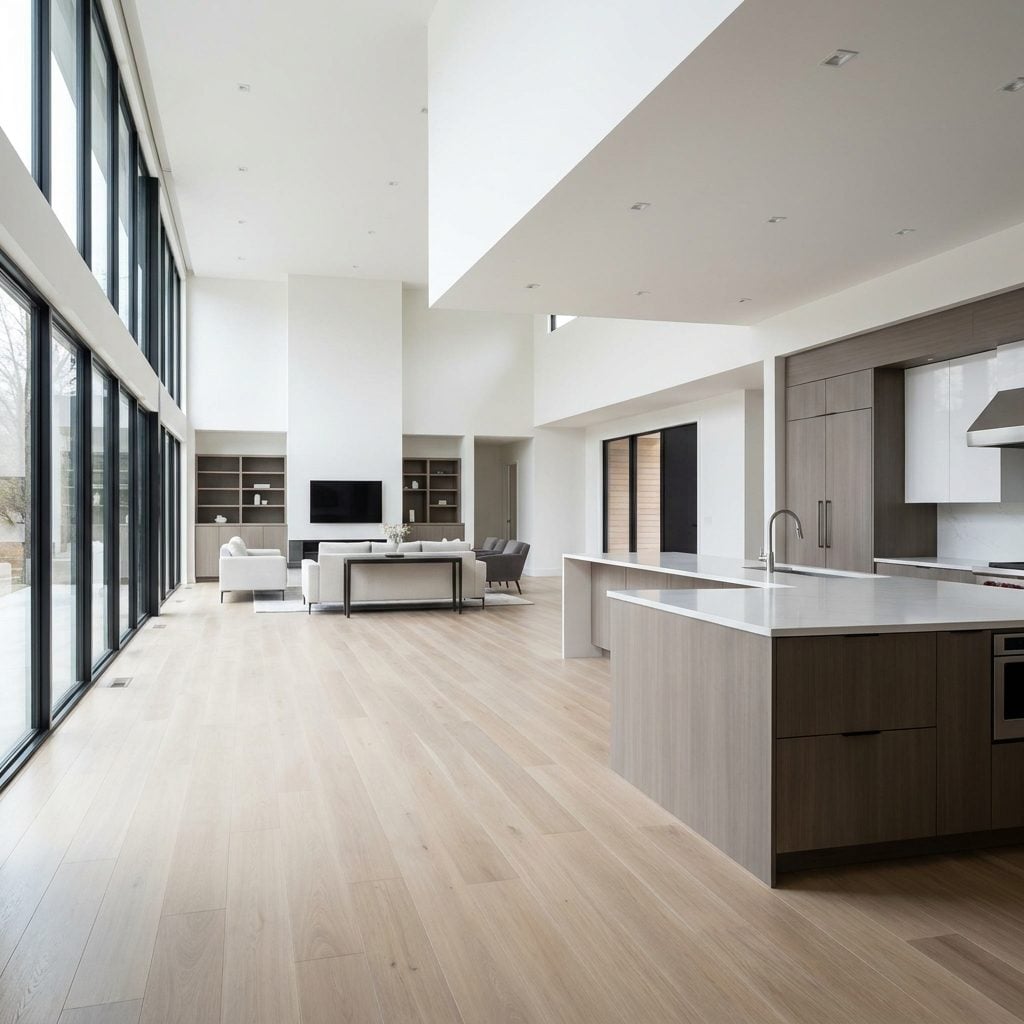
The wall came down. The dream was one big flowing space where the family orbits each other all day, always in sight, always connected. What actually happened is subtler and sadder. Everyone is always visible and nobody ever gets a real moment.
The togetherness that isn’t
Constant visibility is not the same as connection. When there’s no door to close and no corner to retreat to, being together stops being a choice and becomes the only option, which drains the meaning right out of it. You can’t miss someone you can never leave the room from.
Then there’s the noise. One person cooks with the extractor fan roaring while the other tries to talk over the TV, and neither is heard. It sounds trivial. It isn’t. A 2025 study of 28 open-plan offices (Source) found that in open-plan settings, lack of privacy predicted dissatisfaction 25 percent more strongly than raw noise did. It’s not just the volume. It’s having nowhere to be unobserved.
Privacy isn’t a luxury either. One critique of open-concept design argues bluntly that privacy is a necessary component of mental health, not an optional one. Couples who never get to withdraw never get the small hunger of coming back.
The Cluttered Surface That Raises the Room’s Tension Before Anyone Says a Word

The kitchen counter. Mail, keys, a phone charger, three water glasses, a shoe that migrated in from somewhere, a bill nobody opened. You’ve stopped seeing it. Your body hasn’t.
Clutter isn’t just ugly. It’s chemically loud. A landmark UCLA study of Los Angeles families (Source) that measured saliva cortisol in 32 dual-income households found a link between how people talked about their crowded home spaces and their stress-hormone patterns, especially in mothers. Excess stuff reads to the brain as a visible pile of unfinished work, and it quietly keeps the stress dial turned up.
Here’s the part that wrecks couples: the effect isn’t equal. Research by Dr. Darby Saxbe found that in cluttered homes, women showed elevated cortisol both day and night, while men were largely unaffected unless they were the ones doing the housework in the mess. So one partner walks into the room already tense, the other walks in fine, and the argument that follows feels like it came out of nowhere. It didn’t. It came off the counter.
Clear the flat surfaces. Not for guests. For each other’s nervous systems.
The Seating Distance That Decides Whether You Fight or Make Up
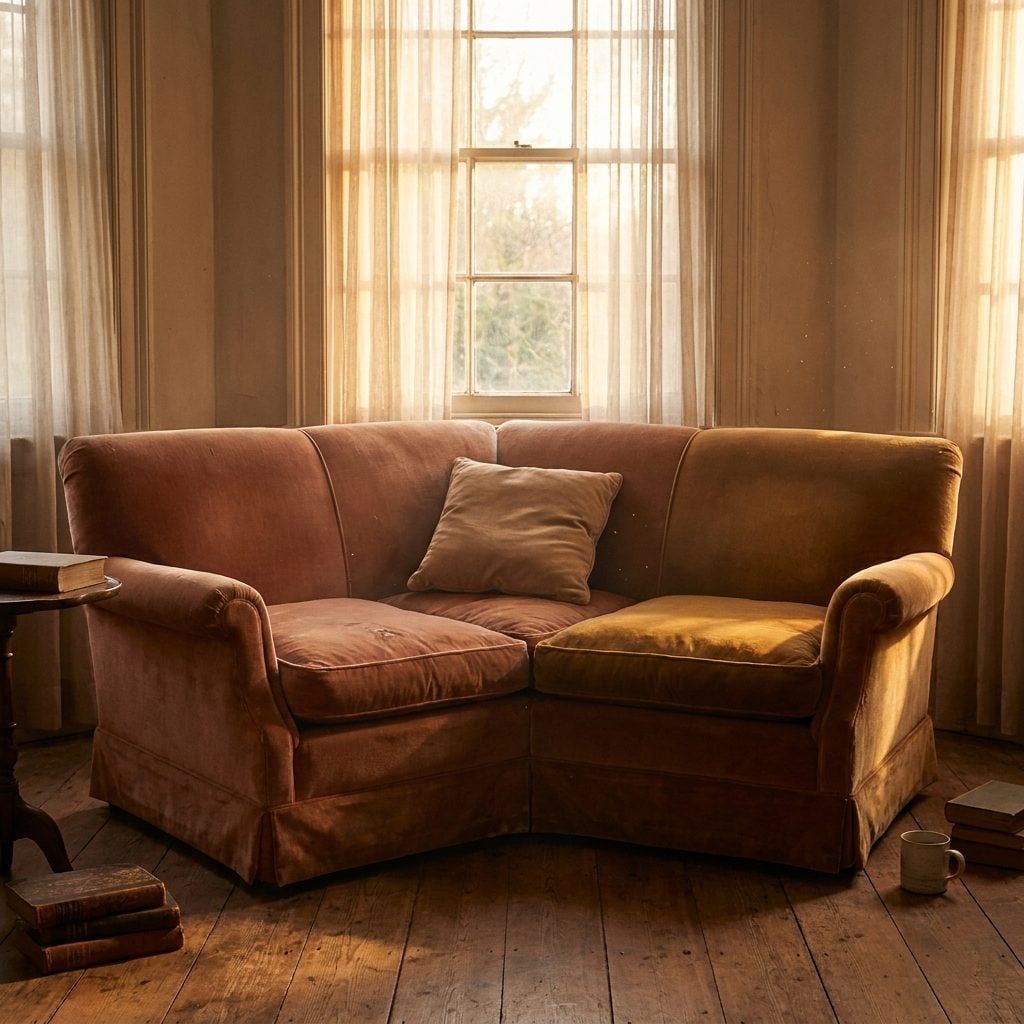
You know the sofa. The one where two people sit at opposite ends, a full cushion of empty space between them, both facing the TV instead of each other. It looks like togetherness. It behaves like a demilitarized zone.
Direct opposition is the most combative arrangement a room can offer. Body language research on seating found that sitting across from someone reads as territorial and adversarial, the kind of seating divorce attorneys and their clients typically adopt (Source). Face to face, every difference of opinion becomes a standoff. There’s even a name for the resistance: the person opposite you sits in the so-called gunslinger position.
What defuses it is the angle. Sitting at right angles is most conducive to informal conversation (Source). The corner of a table. A pair of chairs turned slightly toward each other. It sounds too small to matter. It isn’t.
Why the Home Office That Ate the House Ate the Marriage Too

It starts innocently. A desk in the corner of the bedroom. A laptop that lives on the kitchen island. Then the guest room becomes the office, and the office becomes the place one person disappears into at 8am and reemerges from, glassy-eyed, long after dinner has gone cold.
The problem was never the desk. It was that the desk never turned off. When the office sits a few steps from the couch, work bleeds into everything, and the line between work time and couple time disappears (Source). Without a door to close, couples struggle to actually disconnect, and the quality of the time they share drops.
The research on this is unsettling. A 2026 pair of studies on dual-earner couples found that mismatched work-life boundaries while working from home can push couples toward breaking up (Source). And here’s the part nobody expects: one partner’s work stress can spill over onto the other (Source).
Stress travels between two people like a cold. Design that gives work no off-switch just keeps everyone contagious.
The Sound Problem That Makes You Feel Ignored Even When You’re Being Heard
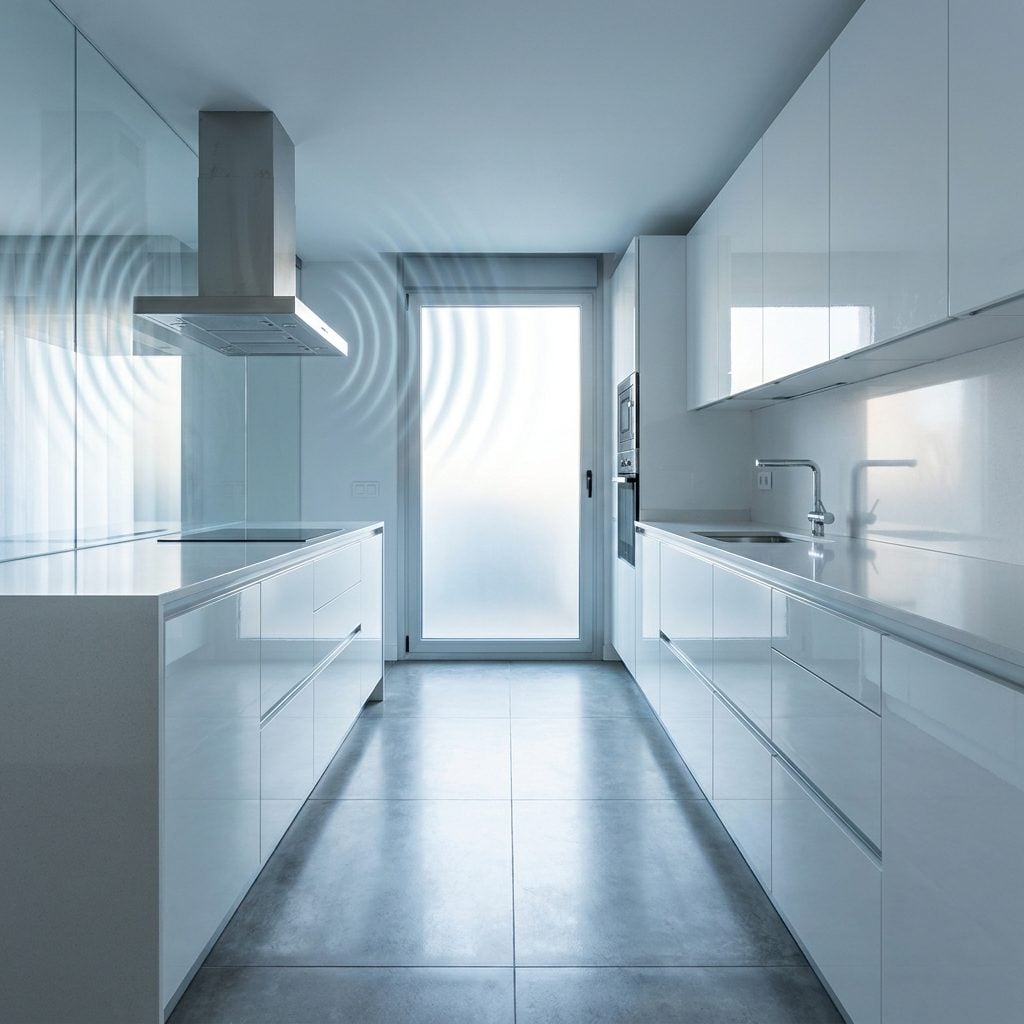
You say something across the kitchen. Your partner answers. But the words arrive mashed and smeared, and you ask them to repeat it, and now there’s an edge in the room that wasn’t there ten seconds ago. Nobody did anything wrong. The room did.
Hard floors, bare walls, tall ceilings, an open plan that looked so good on the tour. All of it bounces sound around until speech turns to mush. Researchers call it reduced speech intelligibility, and it’s the actual source of most noise stress in a home. Source The listener has to work to sort your voice out of the reverberation, and that low-grade effort reads to the brain as strain.
Do it a hundred times a day and you both start clipping your sentences. Softer surfaces fix more than acoustics. A wool rug, heavy linen curtains, a bookshelf packed full. The room stops fighting your voices.
The Bed Setup That Signals Distance Long Before Anyone Admits It
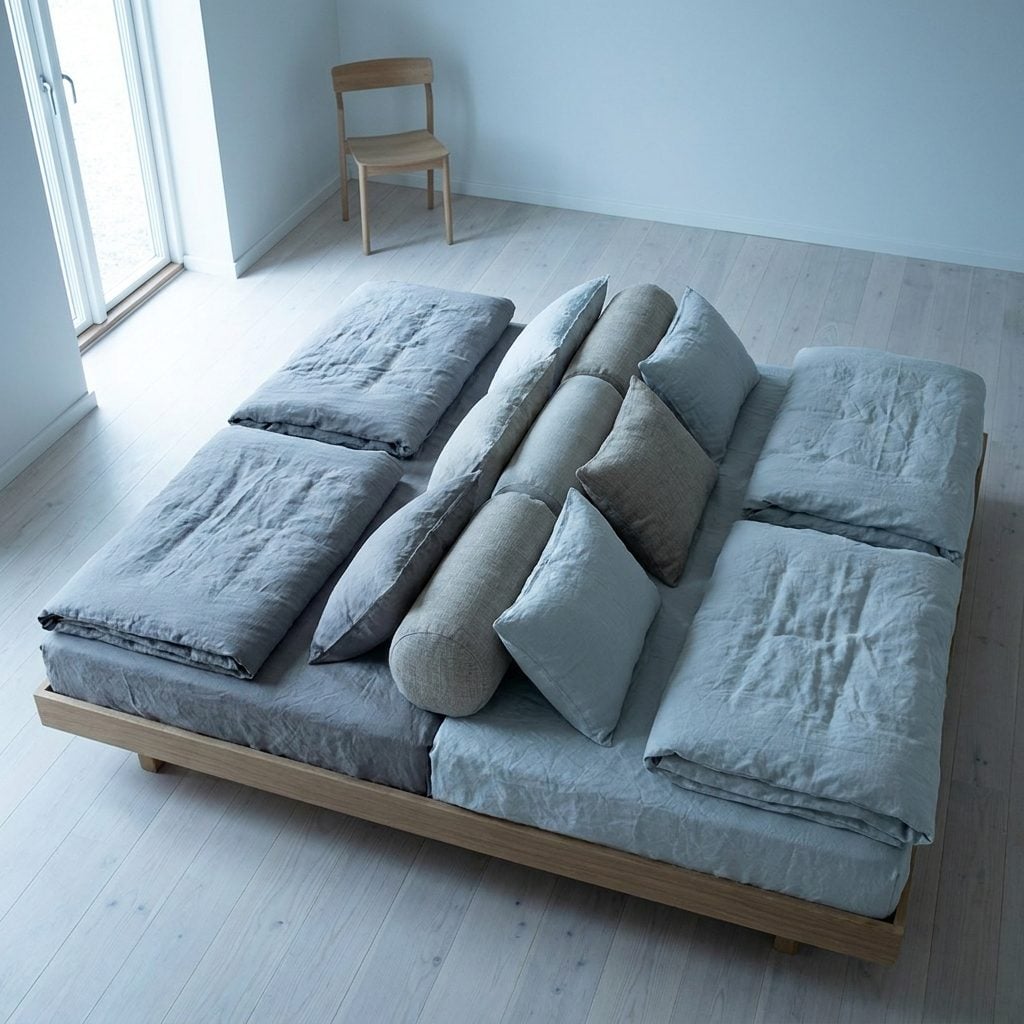
Two duvets. Two nightstands facing outward. A wall of pillows arranged like a demilitarized zone down the center. None of it gets discussed. It just happens, one small accommodation at a time, and then one day the bed is a border rather than a shared country.
Here’s the twist that makes this so hard to read. Sleeping apart, or even sleeping in the same bed under separate covers, isn’t automatically a warning sign. Surveys keep finding that separate sleep setups genuinely improve rest for a lot of couples. Source And poor sleep does real damage: research links fragmented sleep to more anger and less empathy, turning a stolen blanket into a full-blown fight by morning. Source
So the setup itself isn’t the tell. The tell is whether it was chosen out loud, together, or whether it crept in while nobody was talking. One is a plan. The other is drift.
The One Room With No Place to Sit Down Together
🔥 Would you like to save this?
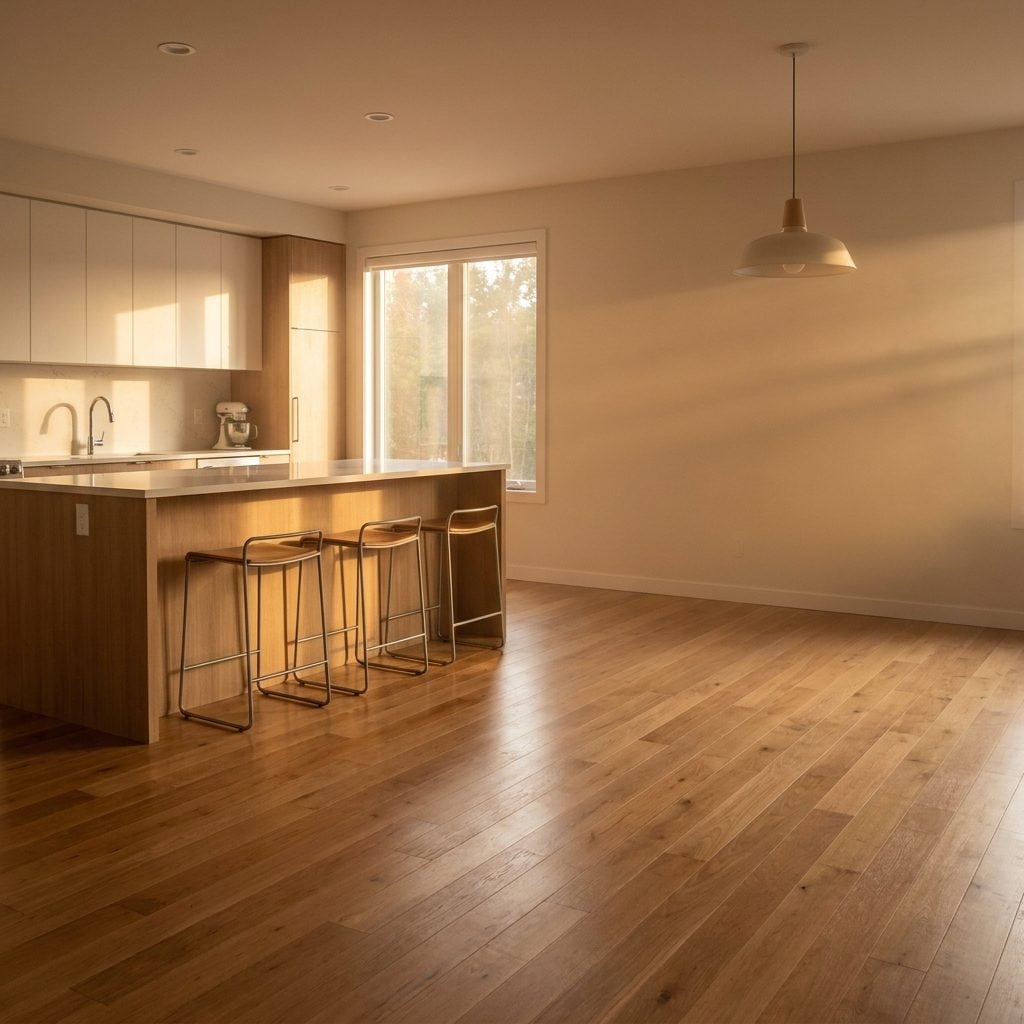
Count the seats in your kitchen. Not stools shoved under an island where you eat facing a wall. Actual chairs, angled toward each other, where two people could linger over coffee with nothing to do but talk.
A lot of modern homes quietly designed this out. The kitchen became a workstation. The dining room became a place you use twice a year. And the living room got built around the television, so “sitting together” now means sitting side by side, both facing the same glowing rectangle, which is a different thing entirely. You can spend an entire evening in the same room and never once look at each other.
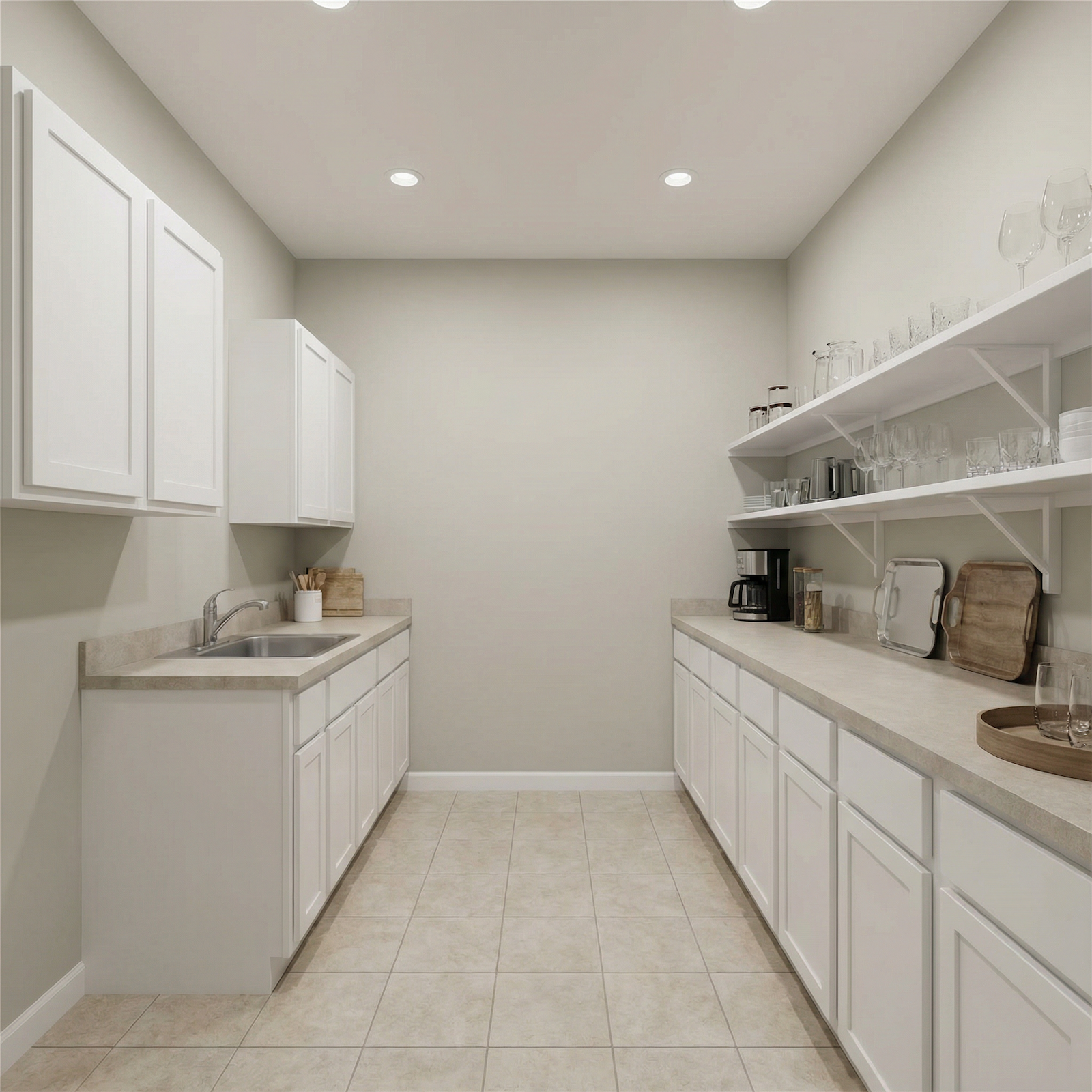
The fix costs almost nothing. A small table by a window with two chairs that face. A farmhouse kitchen bench tucked into a corner. Even a farmhouse pantry design can become a spot to stand and chat while one of you cooks. Give the room a reason to hold two people, and it will.
Why the Perfectly Styled Living Room Nobody’s Allowed to Touch Pushes You Apart
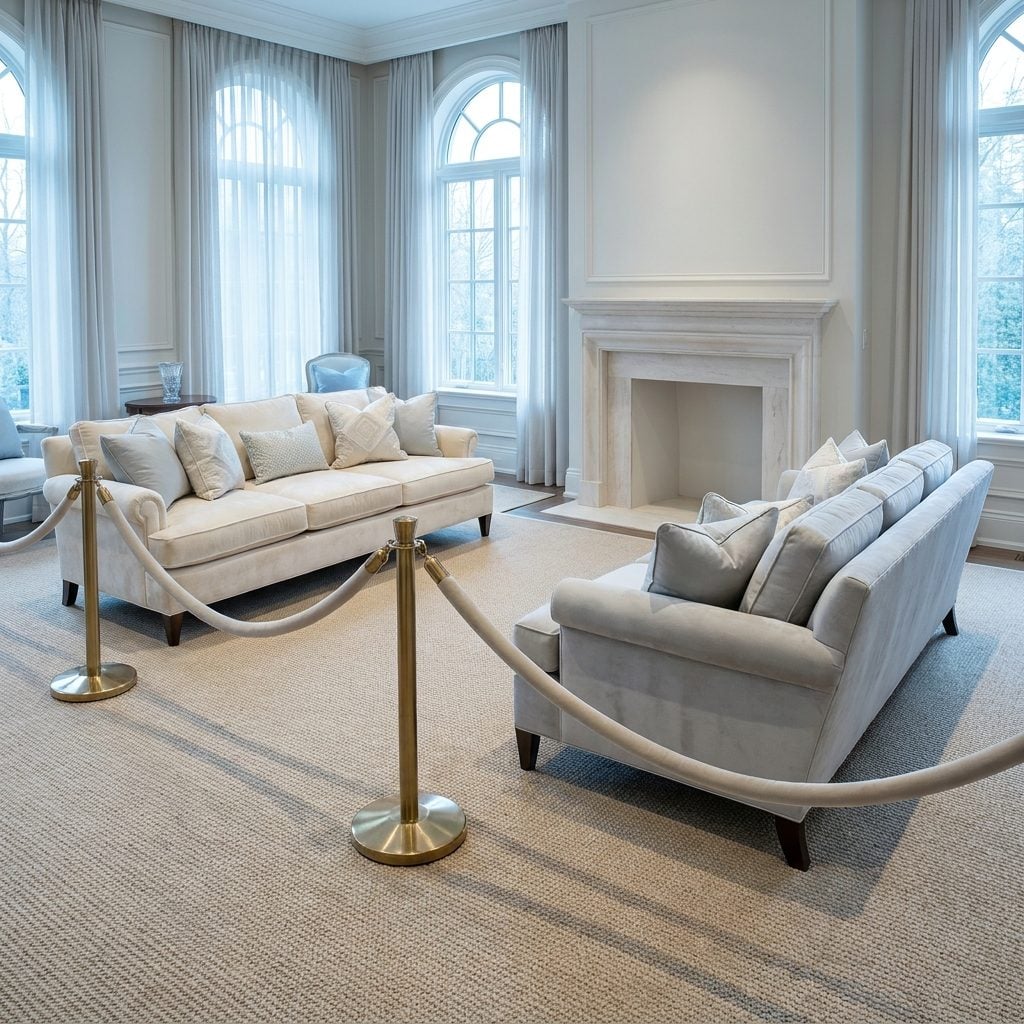
You know the room. The one with the pale sofa, the fluffed pillows arranged at forty-five degrees, the coffee table books nobody has ever opened. It looks like a furniture showroom nobody told it had closed. And the unspoken rule is: don’t mess it up.
A room you can’t relax in is a room you don’t share. If flopping down means recrushing three pillows, if a glass of wine means hovering anxiety, you’ll both drift somewhere you’re allowed to exhale. The showpiece room becomes a museum you walk past on the way to the couch in the basement.
There’s a deeper cost too. Living inside a space that feels like unfinished work, always needing to be reset, keeps your stress system idling. The UCLA study on family homes found that people who described their spaces as never-quite-right showed less healthy daily cortisol patterns. Source A home you’re afraid to use is quietly working against you.
The Temperature War That’s Really About Something Else Entirely
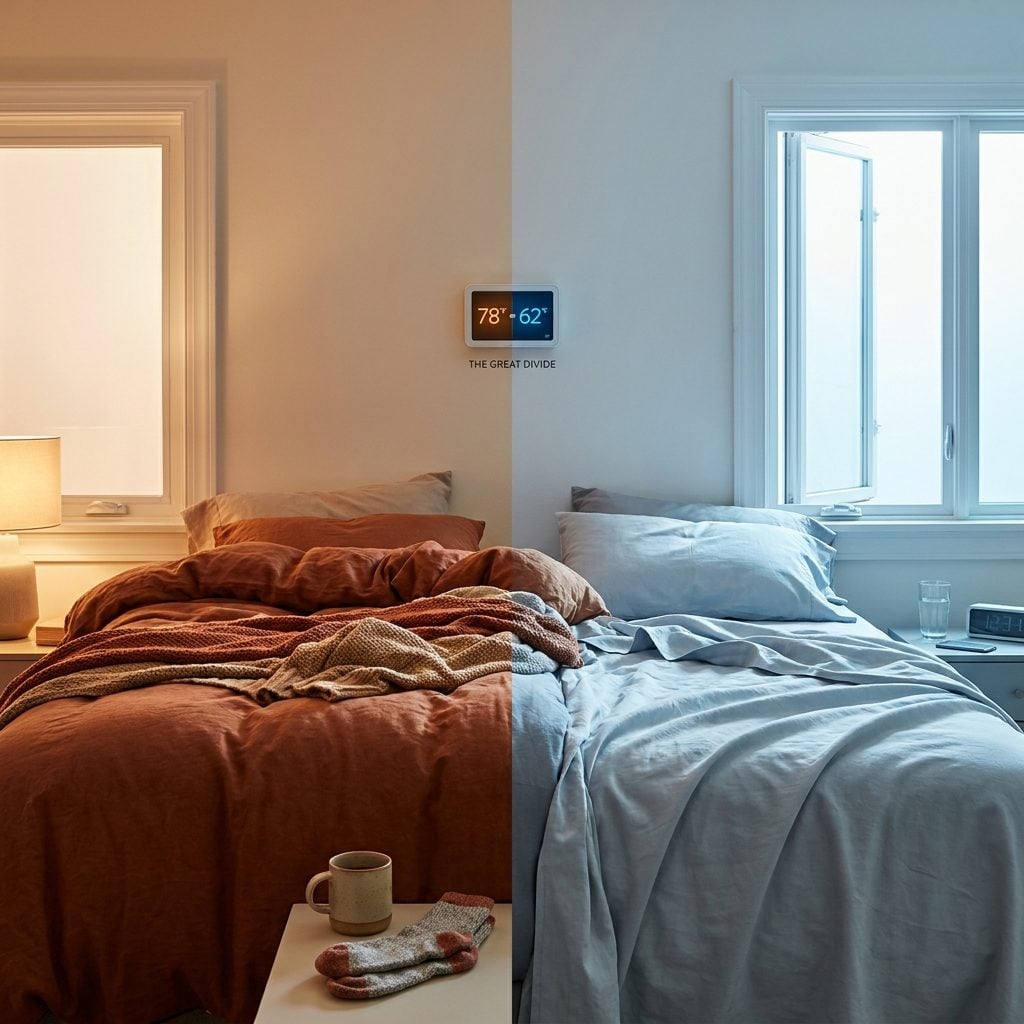
One of you sleeps buried under a duvet. The other kicks it off by 2 a.m. and cracks a window. The thermostat becomes a nightly negotiation, and somewhere in the middle of it, resentment sneaks in wearing the costume of a comfort preference.
Body clocks and body temperatures genuinely differ, and forcing two people into one setting can wreck both their sleep. Sleep scientists point to mismatched temperature preferences as a real, common reason couples struggle to share a bed at all. Source
The design answer isn’t winning the argument. It’s dual-zone bedding: separate duvets, layered so each person controls their own microclimate. What looks like a single comfort clash is often a stand-in for a bigger feeling. Whose needs get to matter tonight? Solve it with fabric instead of willpower, and you take the whole loaded question off the table.
The Entryway That Decides Whether Coming Home Feels Like Relief or Dread
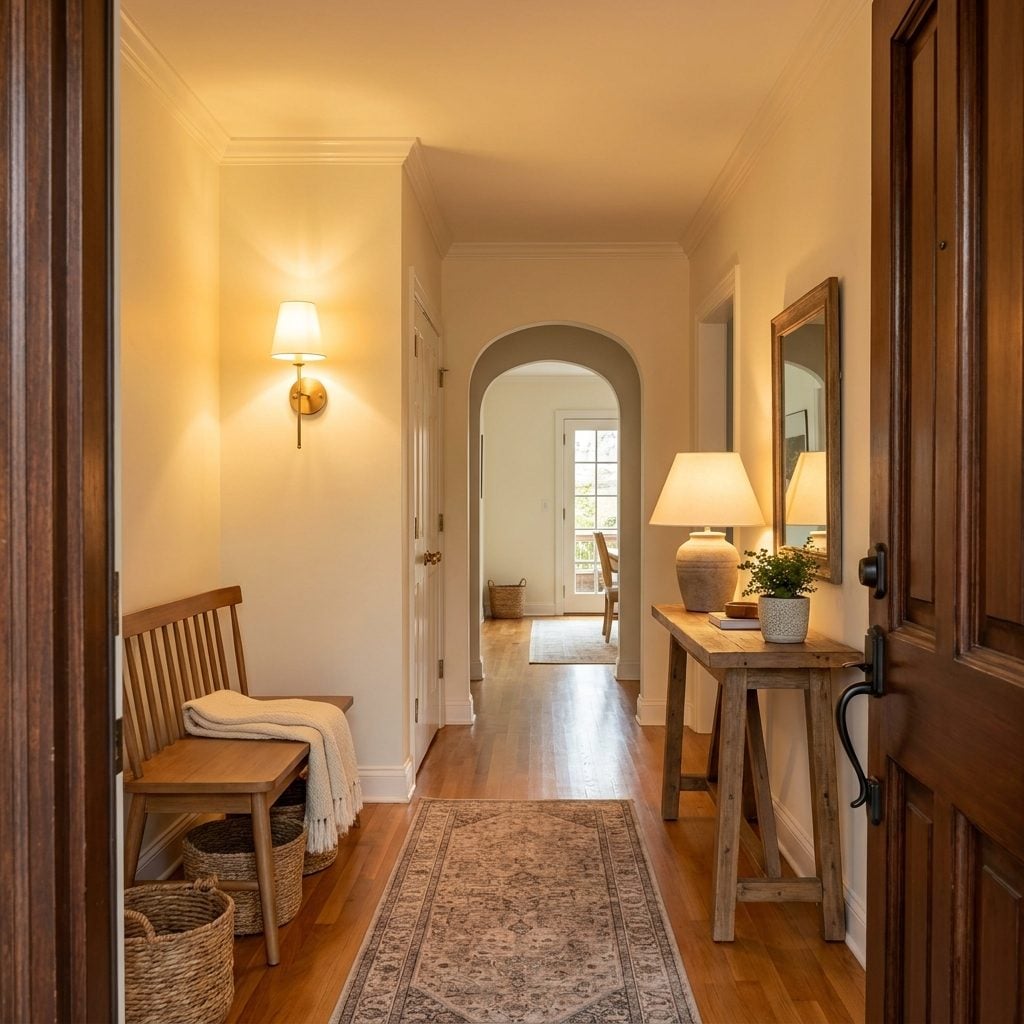
Picture the first five seconds of walking through your own front door. Do your shoulders drop, or do they climb? Because the entryway is the handshake your home gives you every single day, and most of them are gripping too hard.
A jumble of shoes, a bench buried under mail, three coats that never make it to a hook. Your brain reads that pile the instant you see it. The UCLA family-homes research found that people surrounded by visible clutter, especially women, carried higher cortisol and more of that low, grinding stress that never fully switches off. Source
Now run the scene forward. You come home already frayed, the doorway greets you with unfinished business, and the first words out of your mouth land on your partner with an edge nobody earned. A calm entry does the opposite. Hooks that hold everything, a bench you can actually sit on, a bowl for keys. A little green entryway design with a plant softens the whole arrival. Add a woven entryway bench and the door stops being an ambush.
Why Screens in the Bedroom Do More Damage Than the Screens Themselves
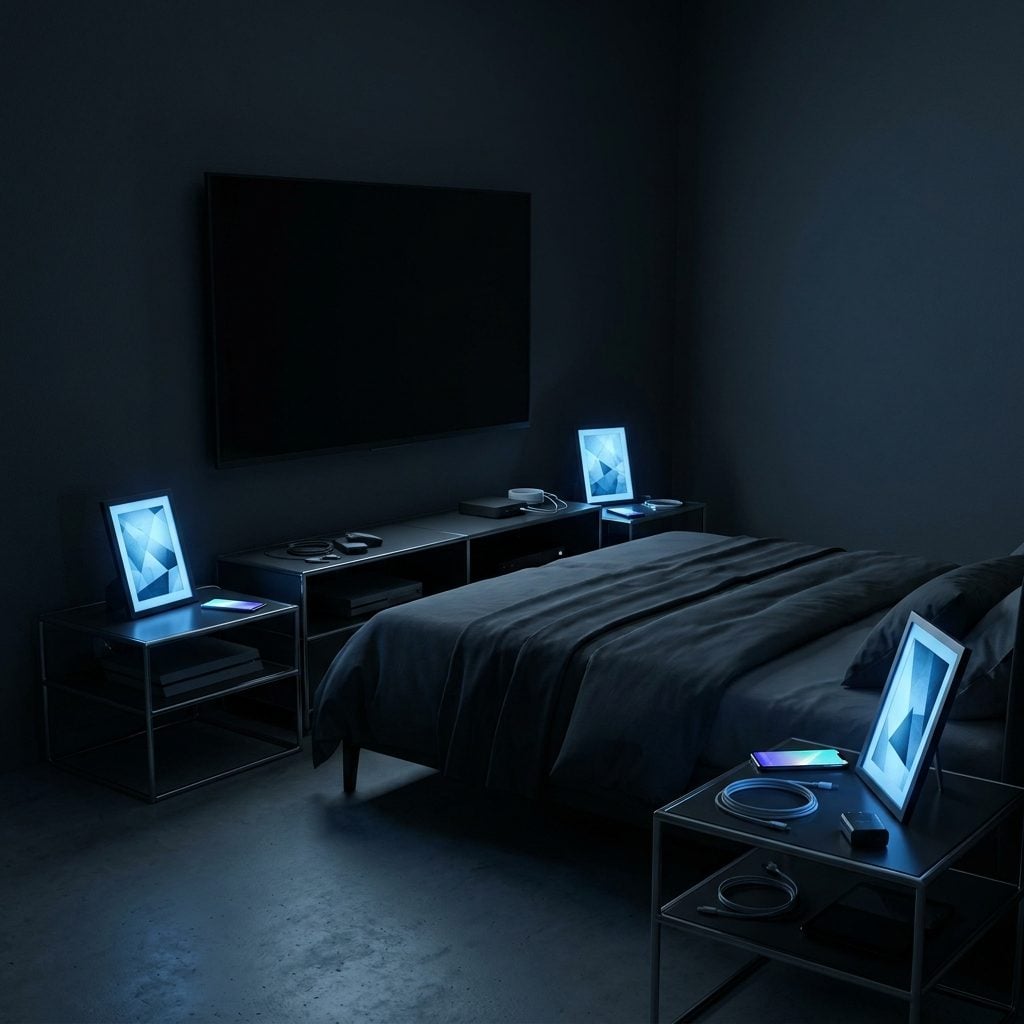
The TV mounted across from the bed. Two phones charging on the nightstands, faces lit, buzzing through the dark. It seems harmless. It is not.
Researchers have a name for what a device does to two people in a room: technoference, the interruption of face-to-face connection by a screen. One study found the link between technoference and lost intimacy runs through a chain, negative feelings about a partner’s phone habits, then a drop in communication satisfaction, then the closeness itself thinning out. Source And a University of Essex experiment found that a phone merely present during a conversation was enough to lower relationship quality and trust, even sitting silent on the table. Source
The bedroom is where this bites hardest. It’s the one room whose entire job is connection, and a glowing screen quietly reassigns it. The damage isn’t the light or the blue glow. It’s that the device keeps announcing there’s somewhere more interesting to be than here, next to the person you chose.
The Bottom Line
The thread running through all ten is the same: your home has been quietly deciding how often you turn toward each other instead of away, and almost none of it was a choice you made on purpose. Distance, angles, and sightlines don’t just reflect a relationship, they train it, one unnoticed evening at a time. Walk through your space tonight and ask a single question of every room: does this arrangement make it easier or harder for us to face each other? Then move one thing.