🔥 Would you like to save this?
White interior doors have enjoyed a remarkably long run as the household default. They’re safe, familiar, and almost impossible to argue with. They’re also remarkably good at disappearing. A door can stand nearly seven feet tall, carry a handsome set of panels, and still contribute about as much visual excitement as a blank sheet of paper.
In order to come up with the very specific design ideas, we create most designs with the assistance of state-of-the-art AI interior design software. Also, assume links that take you off the site are affiliate links such as links to Amazon. this means we may earn a commission if you buy something.
Dark doors change the arithmetic. Black against pale plaster becomes an architectural feature. Burgundy gives an ordinary corridor unexpected warmth. Forest green makes oak trim appear richer, while navy brings depth to walls that might otherwise fade into the background. The door stops behaving like an anonymous opening and starts shaping the room around it.
There’s more to the effect than choosing a darker paint chip. The surrounding walls, the width of the casing, the hardware, the flooring, and even the view through an open doorway can determine whether the result feels commanding or clumsy. Across these 35 interiors, doors become focal points, architectural punctuation, and occasionally the most interesting thing in the room. White has had the floor long enough.
35. Black Double Doors Between Two Circles of Stone and Plaster
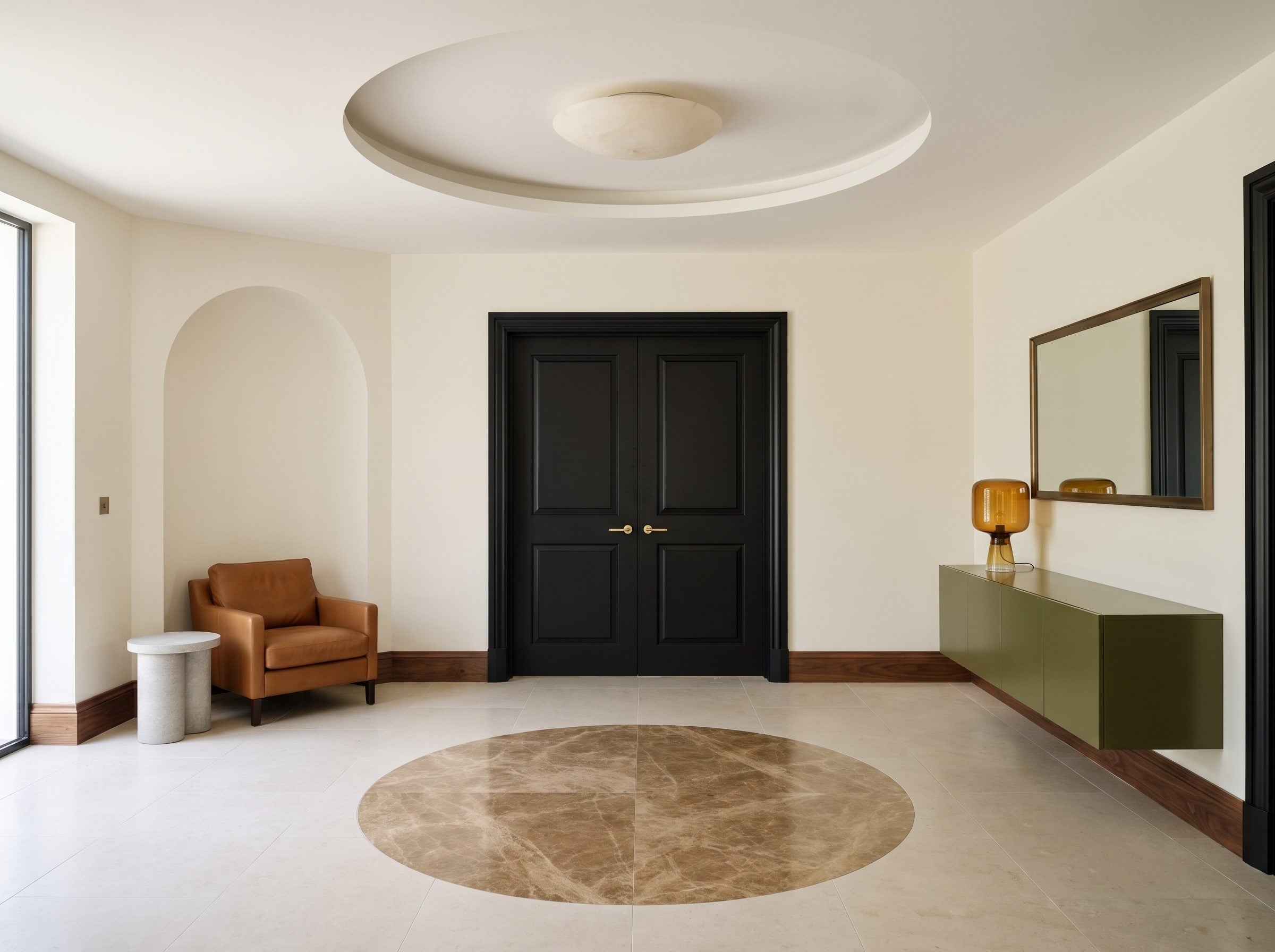
A circular recess in the ceiling answers a darker round marble inlay set into the pale floor. Between them, black paneled double doors establish a strong vertical counterpoint. Circles and rectangles play against each other without allowing either to overwhelm the room.
Brass lever handles introduce a restrained metallic accent. An olive-green floating console, amber glass lamp, and tan leather chair warm the otherwise cool palette. The doors are emphatically dark, yet their proportions feel entirely appropriate to the geometry surrounding them.
34. Burgundy Against Concrete — Industrial Without the Usual Chill
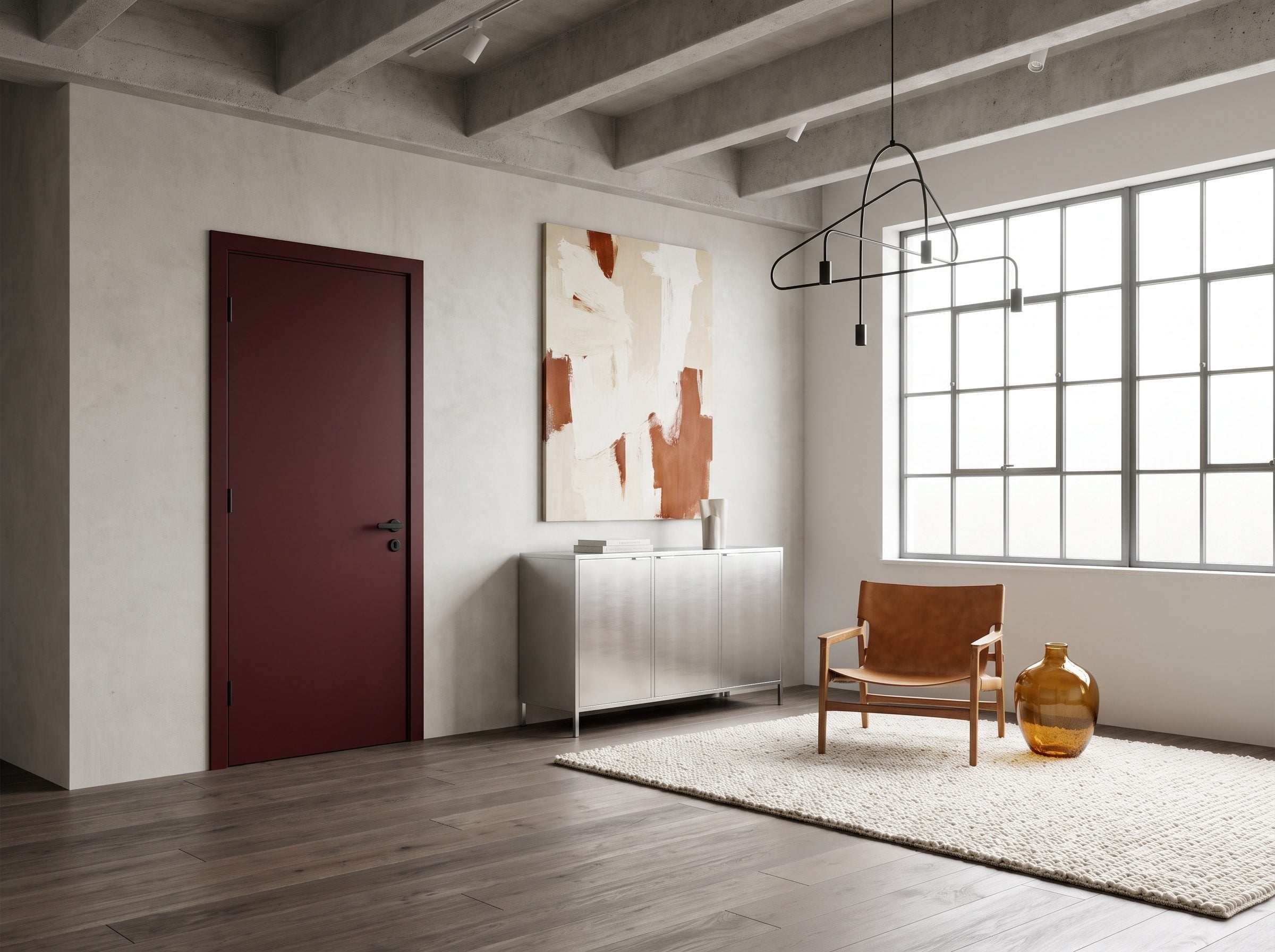
Raw concrete overhead, rough plaster walls, and a deep burgundy door make an unexpectedly civilized combination. Burgundy supplies the warmth missing from the mineral surfaces without resorting to the softness of a conventional neutral.
A low steel sideboard, abstract artwork, leather sling chair, and amber glass vase reinforce the industrial character. The door connects those harder materials with the warmer furnishings, producing a more complex color relationship than the familiar black-and-concrete formula.
33. Hunter Green Turns a Working Mudroom Into a Color Study
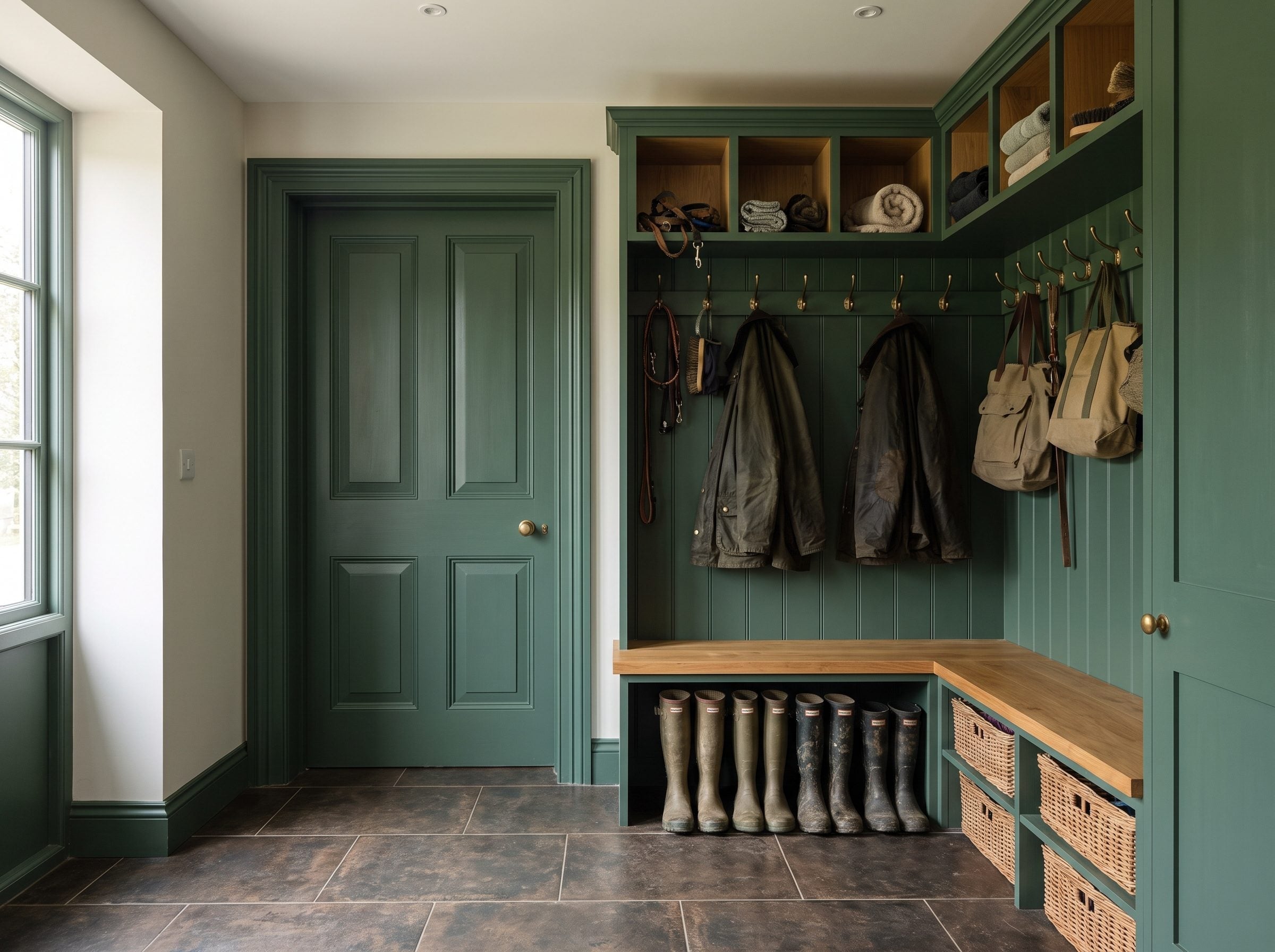
Hunter green extends from the four-panel door across the beadboard and built-in cabinetry, turning a practical mudroom into a continuous composition. Rather than standing apart from the wall, the door becomes part of a larger architectural surface.
The natural oak benchtop interrupts the green with a welcome change in texture, while brass hooks catch small highlights. Boots lined beneath the bench make the functional purpose unmistakable. The sophistication comes from consistency rather than decoration.
32. Navy at the End of a Barrel-Vaulted Corridor
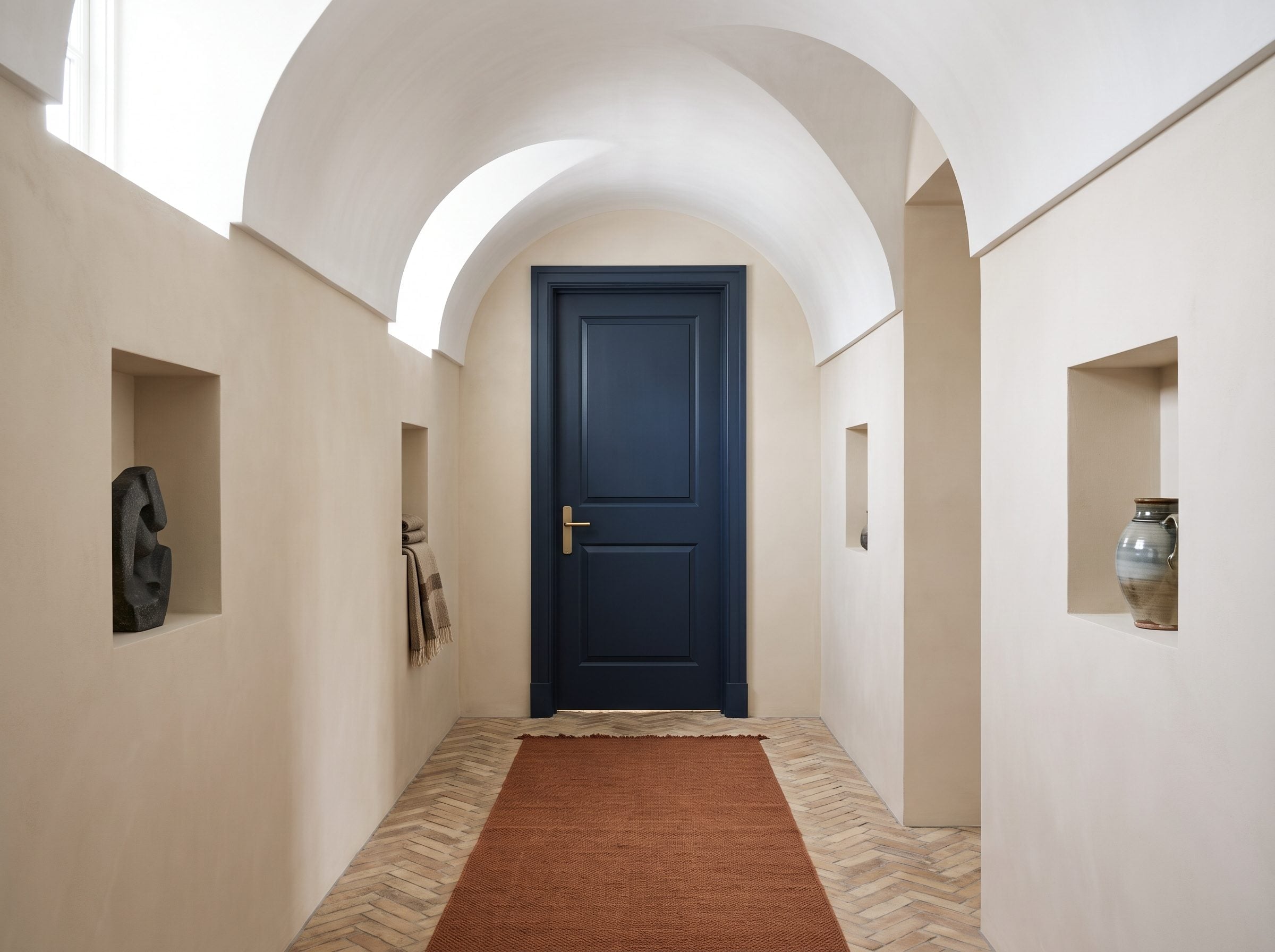
A smooth barrel vault draws the eye through a corridor lined with recessed niches. Dark sculptural objects and ceramics punctuate the walls, but the deep navy door at the far end supplies the strongest visual stop.
Its brass handle catches a warm glint against the nearly ink-colored paint. Herringbone wood flooring and a terracotta runner carry that warmth below. The architecture directs attention toward the door long before its color has a chance to make an impression.
What Our Readers Say
- In our reader poll on interior doors, wood and white finished in a dead heat at 44% each, while black was the pick of 12% of Home Stratosphere readers.
- Readers who chose white interior doors were more likely to want white trim as well, 76% versus 55% of readers who picked another door finish.
From Home Stratosphere reader polls and votes.
31. Copper Cladding Makes a Charcoal Door Look Almost Weightless
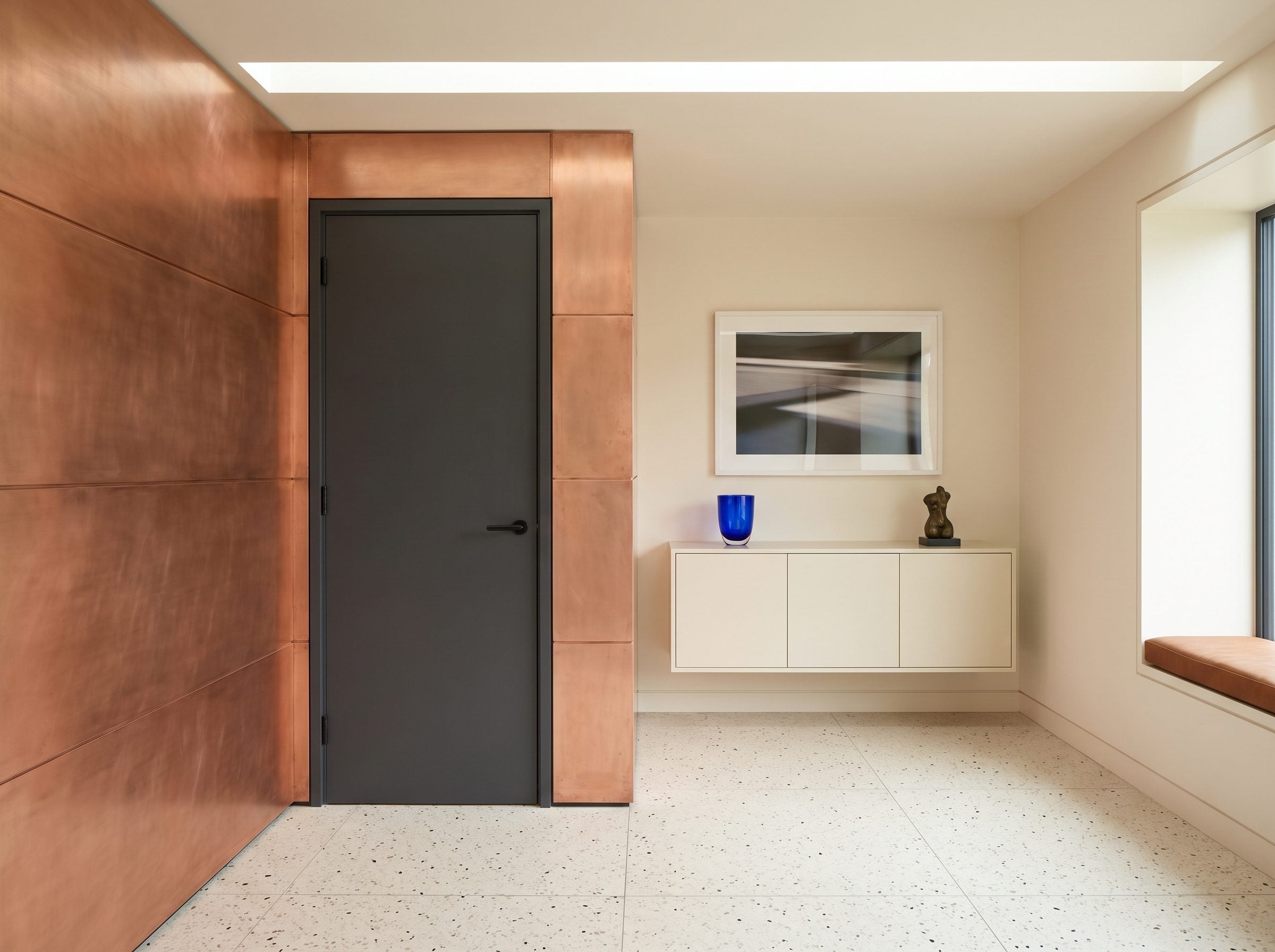
Polished copper panels wrap the left wall, bringing warmth, reflection, and a pronounced metallic texture to the room. Set within that surface, the charcoal door becomes a surprisingly restrained element.
The contrast isn’t simply between light and dark. Copper catches shifting highlights; the charcoal finish offers a quiet counterpoint to those reflections. Terrazzo flooring and cream cabinetry balance the warmer metal. The door gains definition without challenging the wall’s extraordinary material.
30. A Forest-Green Door, Plum Velvet, and No Interest in Playing Safe
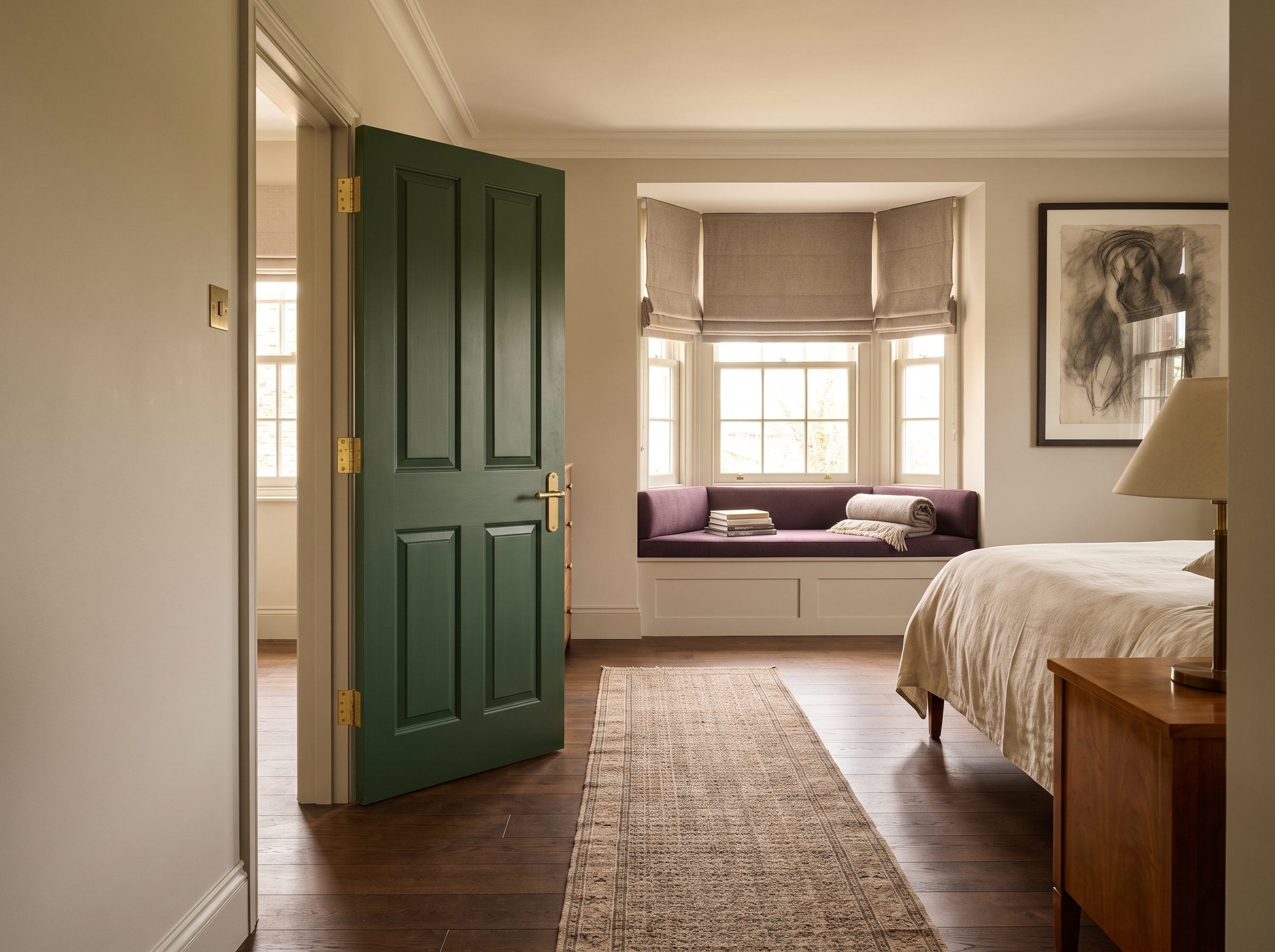
Forest green and plum share a richness that allows them to coexist without matching. The dark door forms a solid architectural element, while the velvet window seat introduces a softer, more saturated counterpart.
Brass hinges add another warm note. Painted wood against plush upholstery, a straight vertical plane beside a curved seating recess: the differences in material and shape give this combination its character. Neither element needs to imitate the other.
29. A Black Door Beneath an Arch of White Plaster
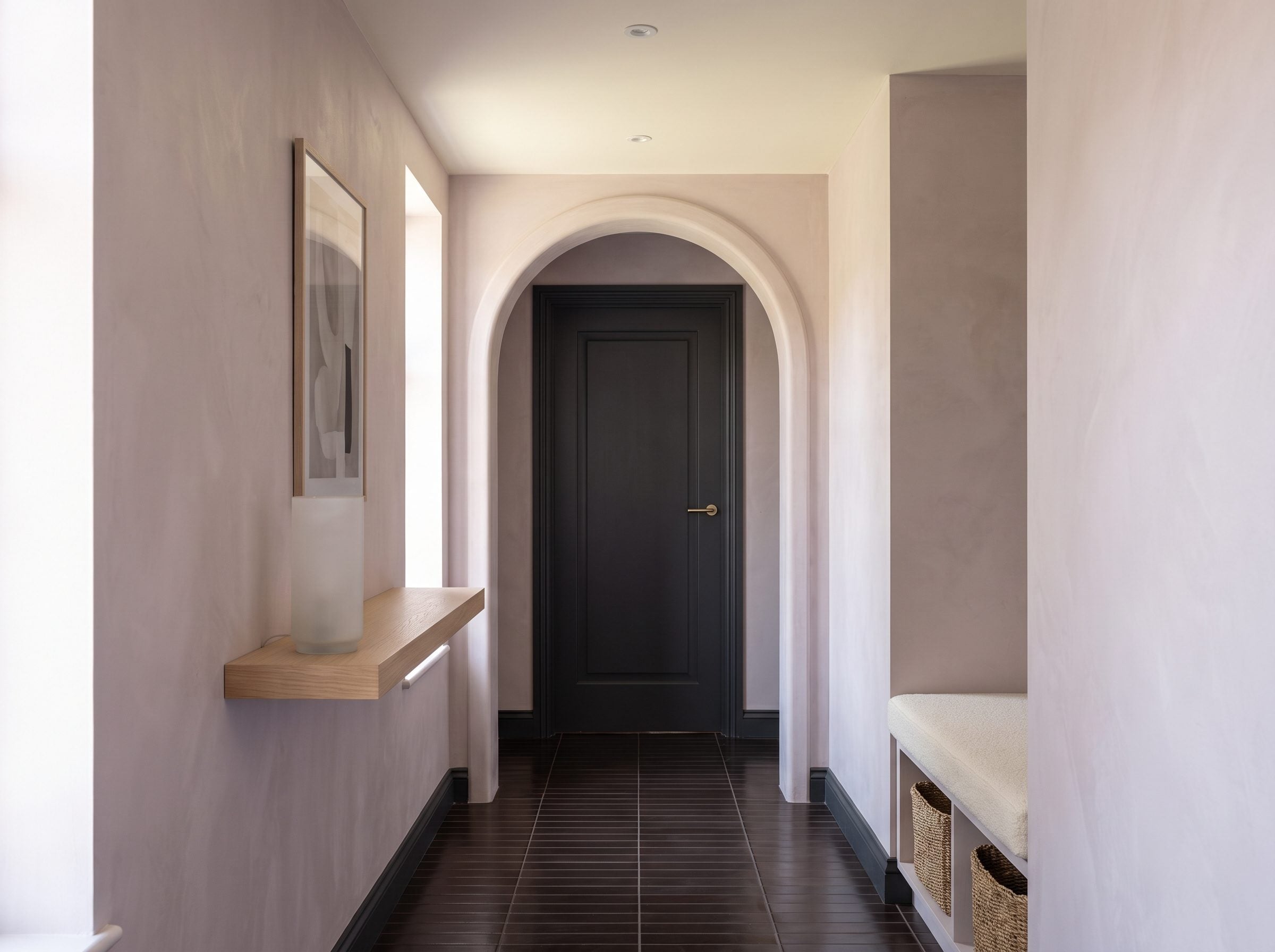
The white plaster arch supplies the drama; the near-black door gives it something substantial to frame. Recessed within the curved opening, the rectangular panel emphasizes the difference between the architecture’s soft outline and the crisp geometry beneath it.
A brass knob supplies a small glint against the dark surface. Nearby, a floating oak shelf and frosted glass lamp introduce warmth without distracting from the arch. A straightforward door becomes memorable because its surround has been treated as architecture rather than ordinary trim.
28. Burgundy and Lavender Make a Surprisingly Convincing Pair
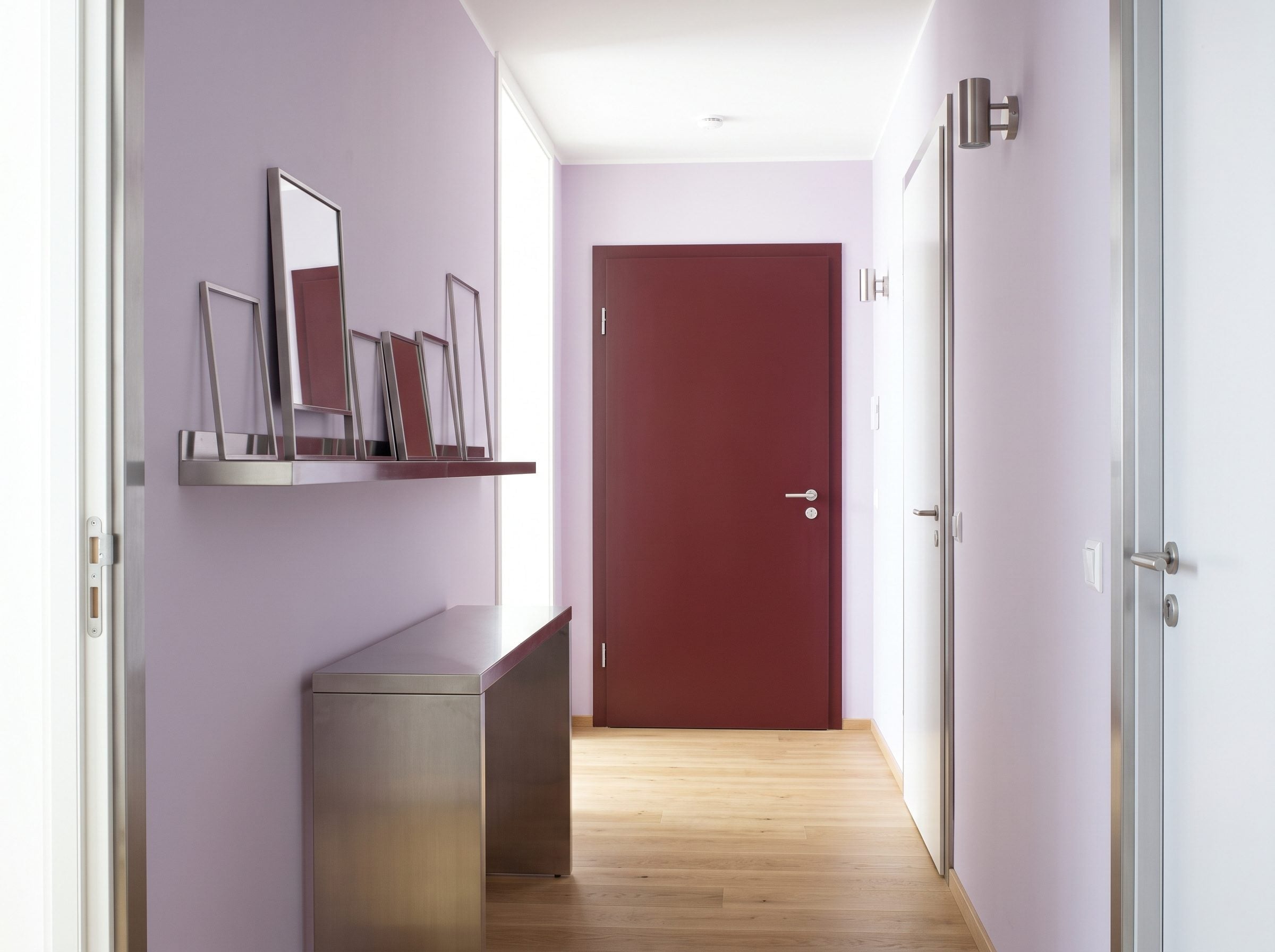
Lavender walls meet a saturated burgundy door in a pairing that trades conventional neutrality for a more nuanced color relationship. Both shades carry red and blue influences, but the burgundy has far greater depth and weight.
Light wood flooring prevents the corridor from becoming overly saturated. Silver picture frames and a brushed-metal cabinet add cooler highlights, while the dark door gives the passage a decisive ending. Colorful, certainly. Chaotic, not remotely.
27. Four Black Doors Give a Marble Foyer Its Backbone
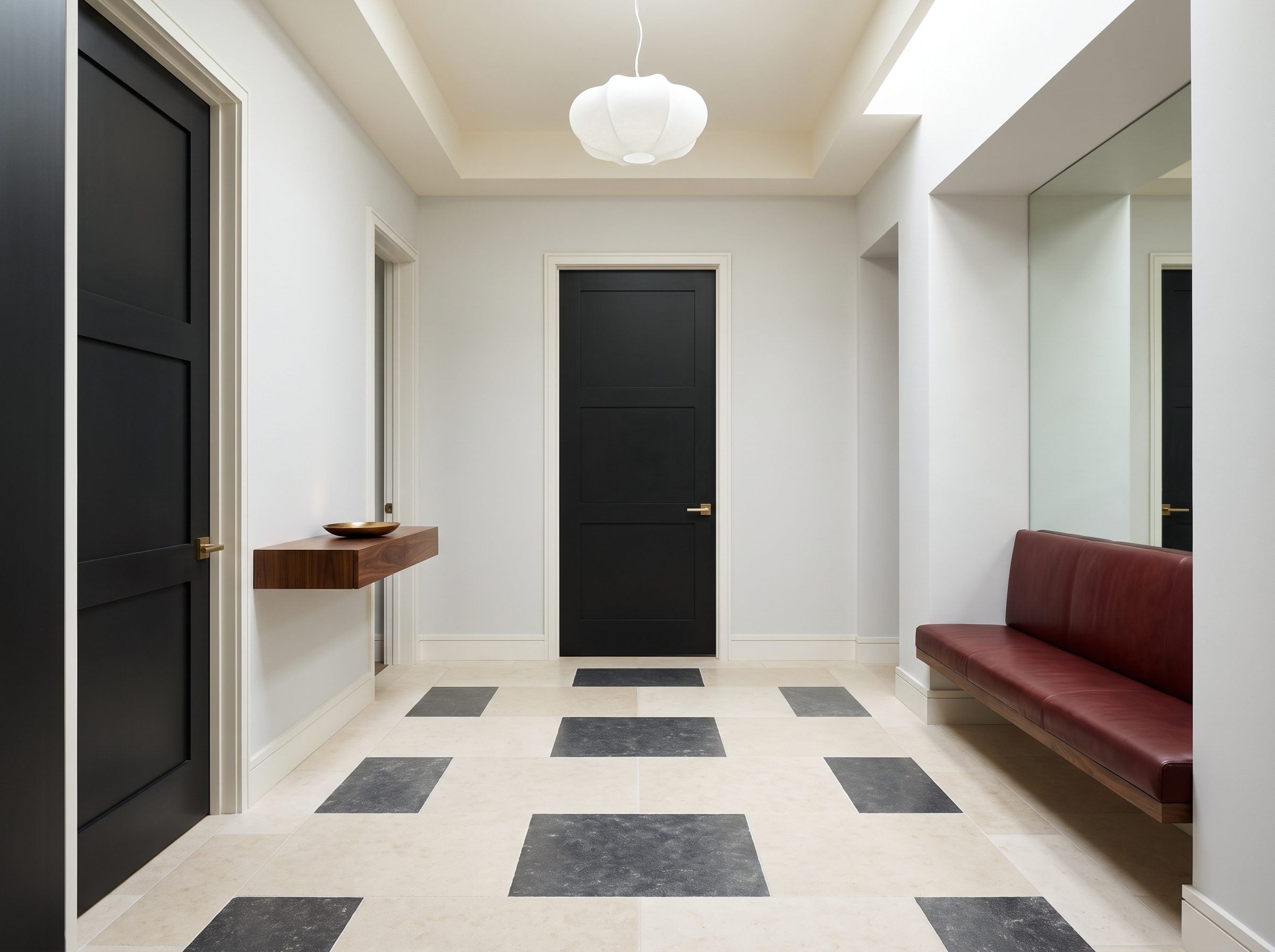
Four black shaker-panel doors establish a strong architectural rhythm. Their repeated dark rectangles stand against pale walls, while the floor introduces its own geometry through cream stone and darker inlaid squares.
A walnut floating shelf with a brass bowl adds a compact warm accent. Opposite, a burgundy leather bench and tall mirror bring color and reflection into the arrangement. The black doors prevent the patterned floor from monopolizing the room, establishing a vertical structure to balance the activity underfoot.
Design Detail: Traditional panel profiles can feel sharply contemporary when paired with dark finishes, restrained hardware, and geometric flooring. The surrounding architecture determines whether a shaker door reads as rustic or refined.
26. Sage Green Borrows Its Palette From the Landscape
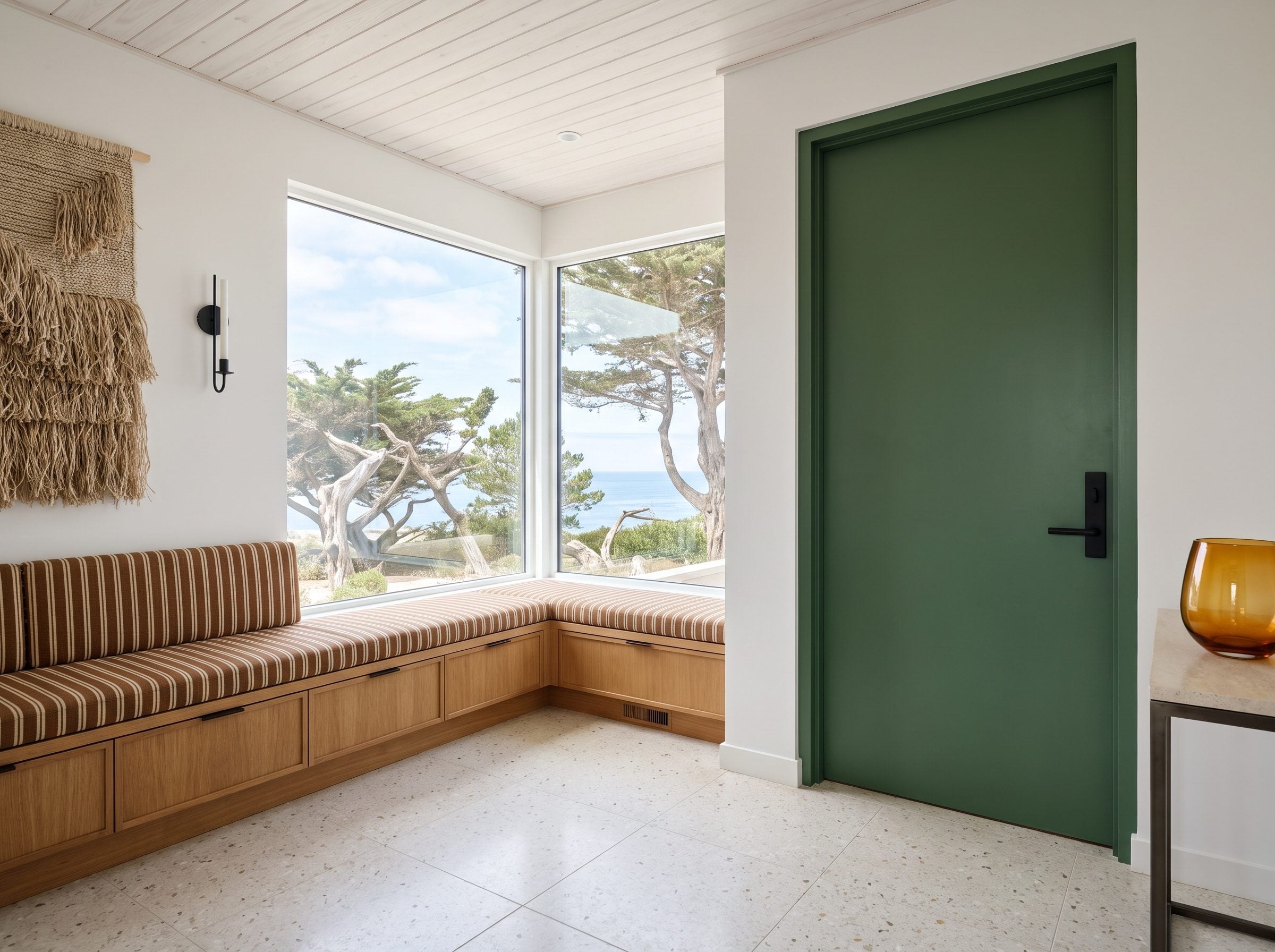
Not every departure from white requires a near-black finish. This muted sage-green door echoes the trees visible through the corner windows, carrying an outdoor color into the mudroom.
The L-shaped storage bench in pale wood keeps the interior light and practical. Against that restrained setting, the door supplies a gentle color accent rather than a dramatic contrast. Its connection to the view gives the choice a stronger rationale than simply selecting an attractive green.
25. Black Double Doors Frame a Bedroom Full of Jewel Tones
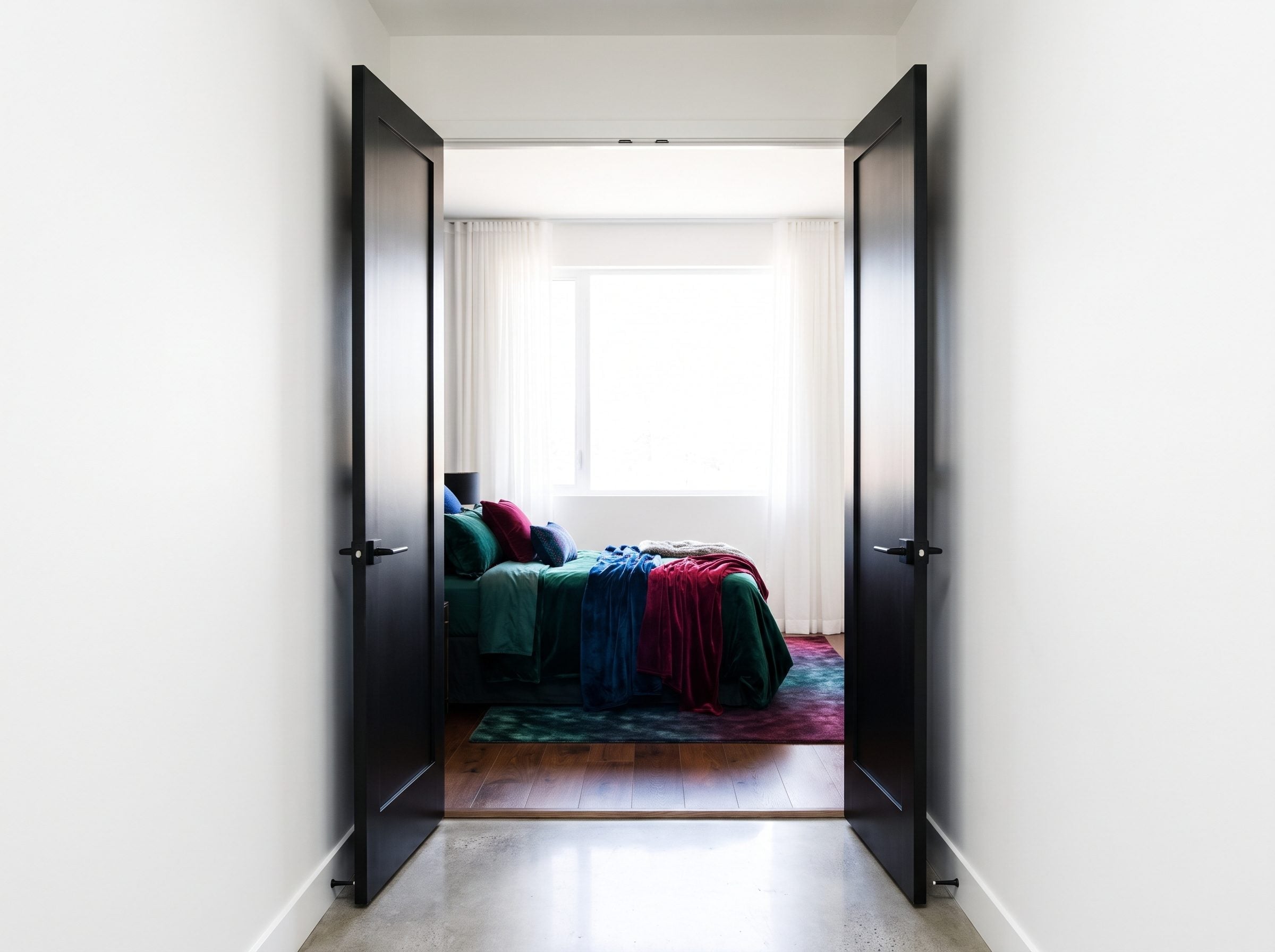
Floor-to-ceiling black doors establish a striking threshold between a restrained hallway and a bedroom filled with color. Polished concrete gives way to warm hardwood, while the nearly black panels form a substantial frame around the room beyond.
Forest-green velvet bedding, cobalt blue, and burgundy create a palette far richer than the corridor suggests. Sheer curtains admit enough daylight to prevent the bedroom from feeling enclosed. The contrast between the neutral approach and colorful interior gives the doorway its particular impact.
Try This: Dark doors can heighten the contrast between a neutral hallway and a colorful room. Keep the surrounding trim restrained when the view through the doorway is intended to be the main attraction.
24. Charcoal Finds Its Place Beneath Exposed Oak Beams
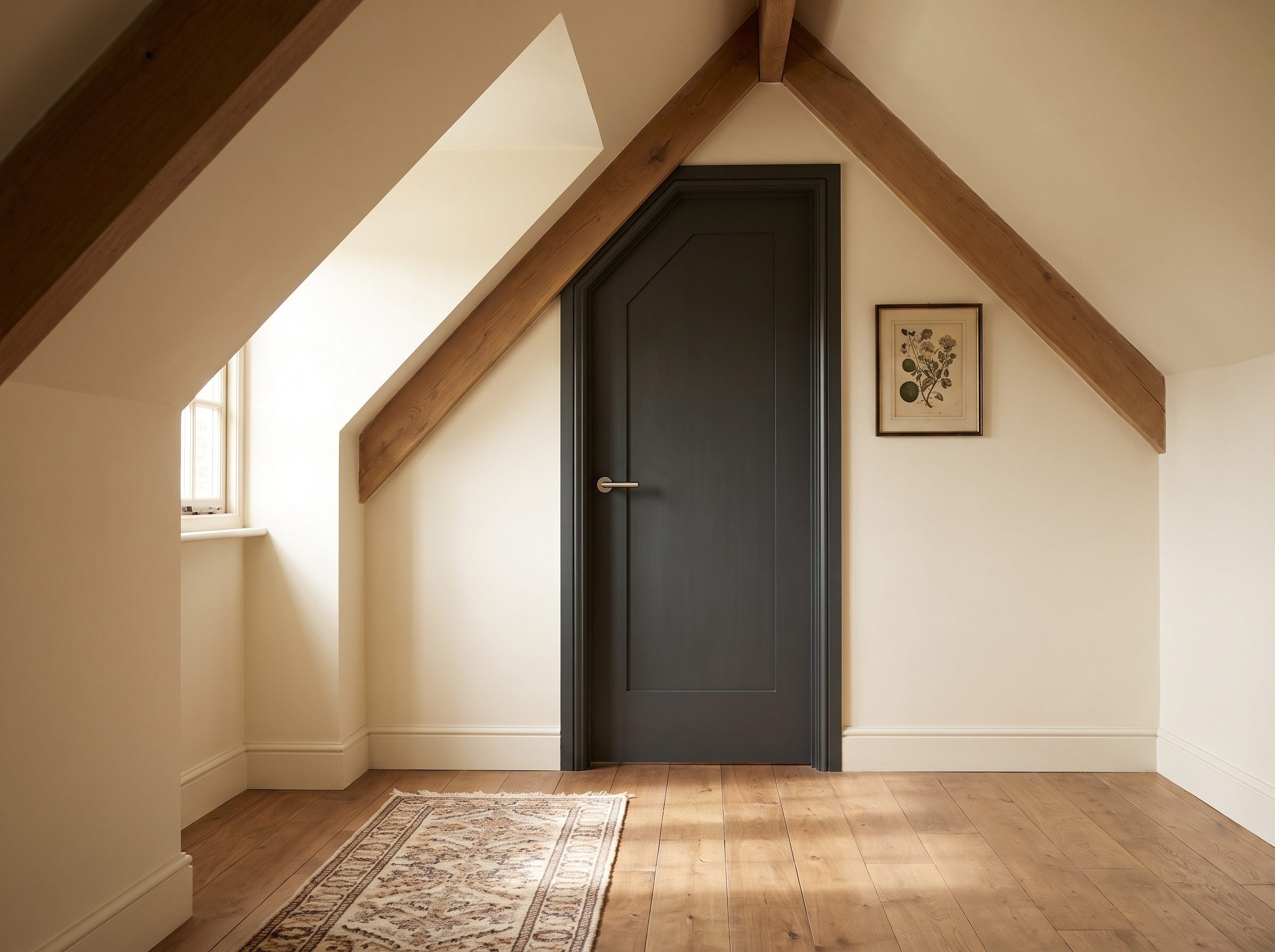
Exposed oak beams trace the pitched ceiling, drawing attention to the attic’s angular structure. Below them, a charcoal paneled door forms a dark, stable rectangle against the lighter surfaces.
Warm floorboards and timber overhead prevent the gray from feeling severe. The door acts as a visual counterweight to the beams, bringing the eye back down from the dramatic roofline. Warm wood and cool paint supply the contrast without requiring decorative embellishment.
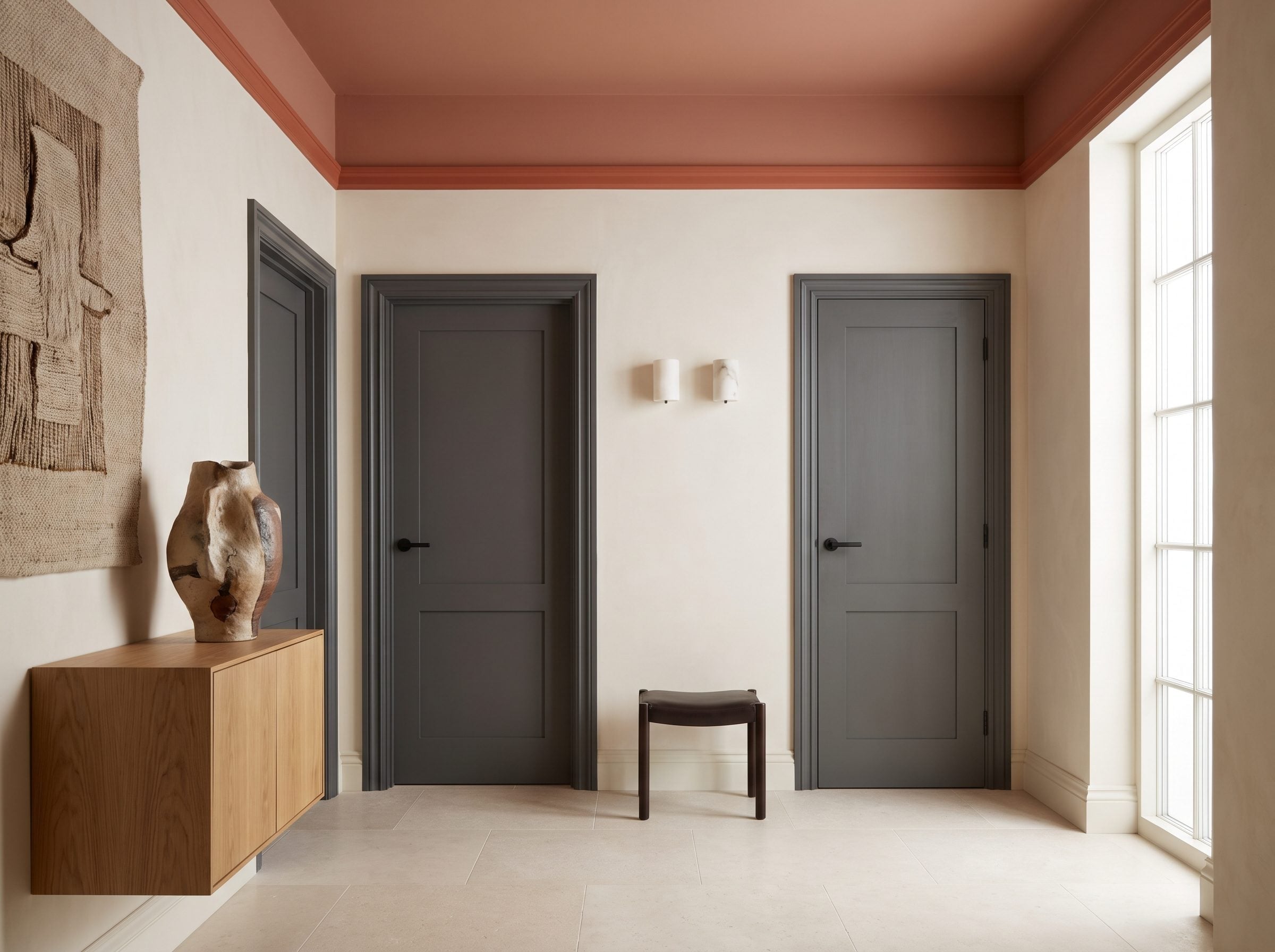
23. Graphite Doors Beneath a Terracotta Ceiling
🔥 Would you like to save this?
Three graphite doors establish a measured rhythm along cream plaster walls. Their consistent finish organizes the corridor, but the terracotta ceiling supplies its most unexpected feature.
That dusty red-pink overhead warms the gray and cream palette, while ceramic sconces echo the earthy color without reproducing it exactly. A floating oak credenza adds another natural surface. The doors bring discipline; the ceiling keeps the arrangement from becoming predictable.
22. A Burgundy Door Beside a Sweeping Plaster Staircase
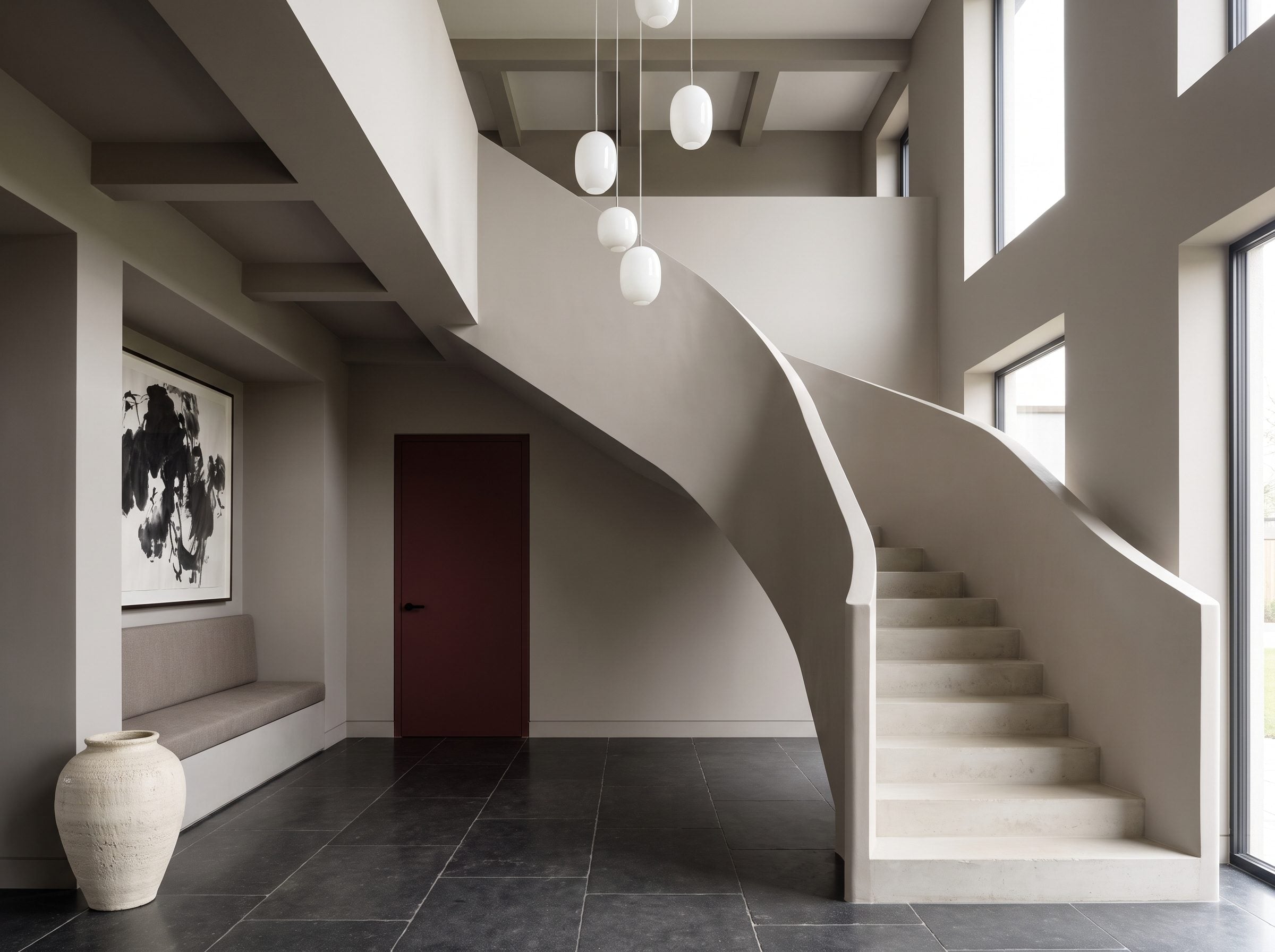
The curved plaster staircase supplies movement, while the burgundy door introduces a solid vertical element beside it. Their relationship is unusually effective: one feature bends through space, the other establishes a fixed plane.
The door’s deep color gives the pale architecture a point of contrast without requiring a complicated frame. A lighter finish would recede into the plaster; burgundy allows the staircase and doorway to remain distinct architectural gestures.
21. Forest Green Against Exposed Brick and Worn Hardwood
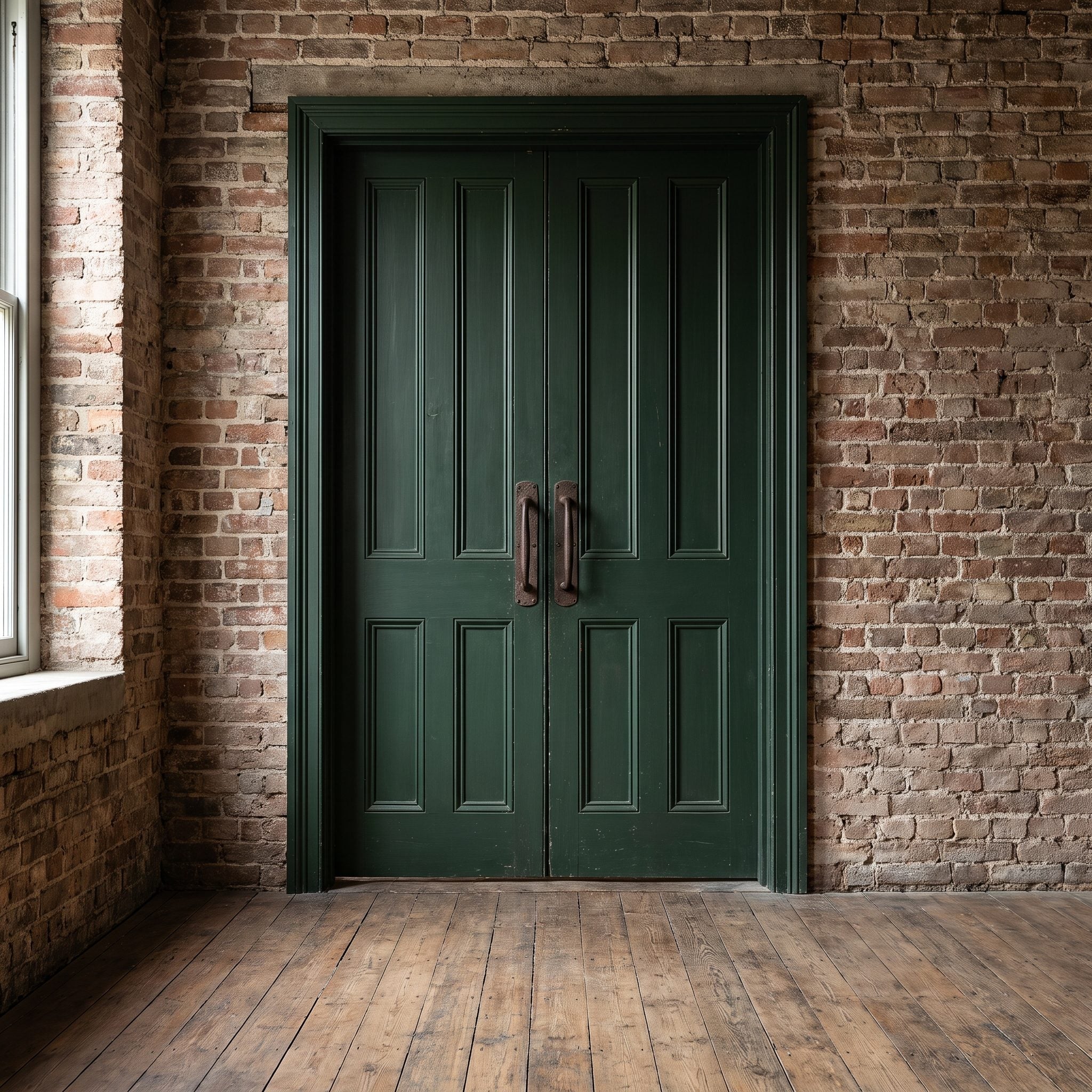
Forest-green double doors bring a deep, cool color into a room dominated by warm brick and aged hardwood. Vertical panel detailing emphasizes their height, while dark iron pulls suit the rougher character of the surrounding materials.
Rather than competing with the brick’s varied tones, the green offers a comparatively uniform surface. Worn floorboards soften the transition between old and new finishes. Polished door detailing and weathered materials coexist without either losing their identity.
20. A Navy Door Gives Powder-Blue Wainscoting More Depth
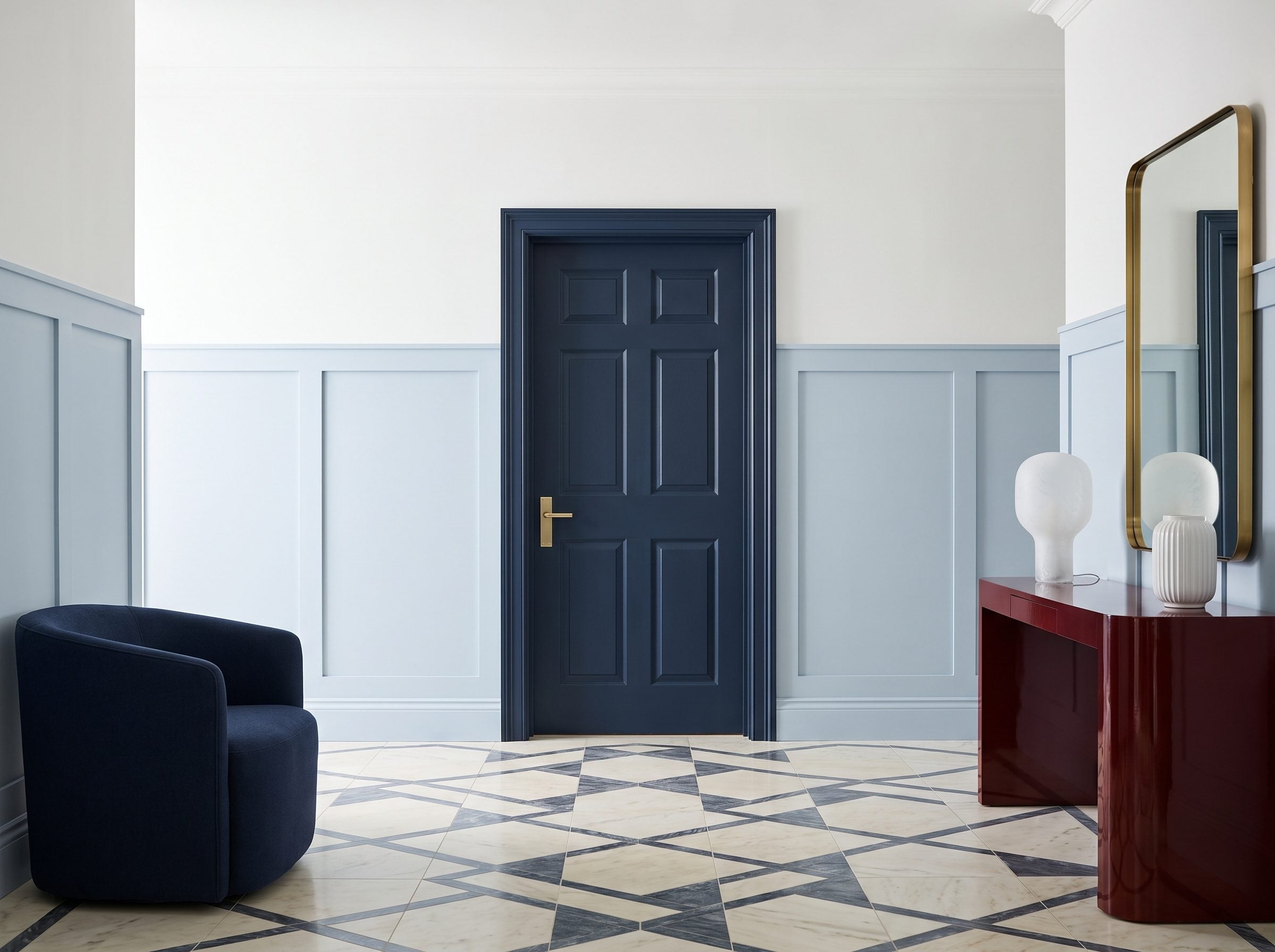
Powder-blue wainscoting runs beneath crisp white walls, establishing a restrained two-tone backdrop. At the end of the corridor, a deep navy six-panel door extends the blue family into a much darker register.
The brass lever introduces warmth, echoed by a gold-framed mirror and burgundy lacquered console. A diamond-patterned marble floor adds geometric interest, while a rounded navy armchair reinforces the door’s color. The scheme succeeds through repetition at different intensities rather than exact matching.
Color Strategy: Painting a door several shades darker than adjacent wainscoting can create depth while preserving a unified palette. The relationship works particularly well when the wall paneling already establishes a clear architectural rhythm.
19. Black Pocket Doors Make the Opening Part of the Design
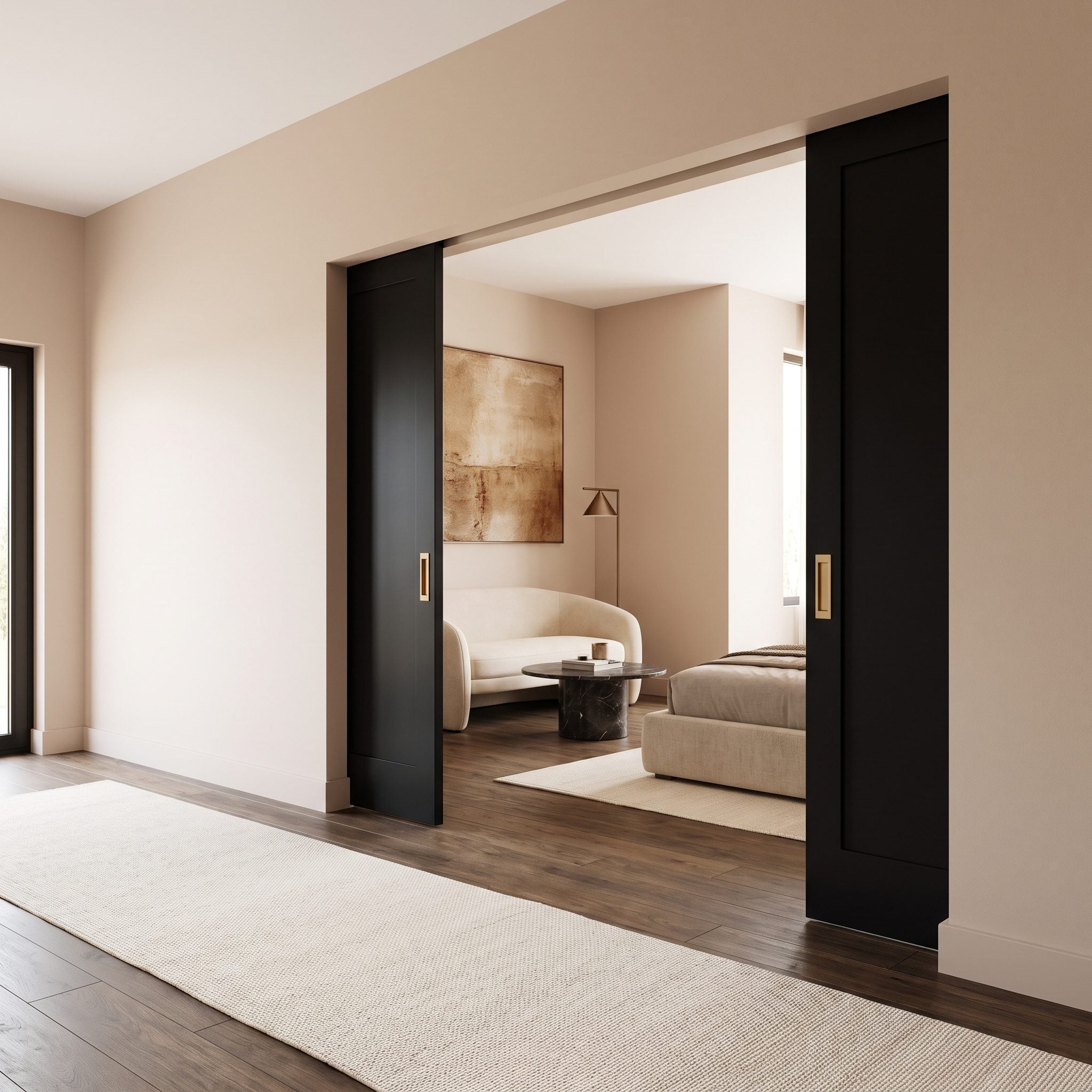
Double pocket doors painted near-black turn a practical space-saving feature into a pronounced architectural opening. Their flat panels and recessed brass pulls offer definition without the projecting hardware of conventional hinged doors.
Warm sand-colored walls soften the contrast, while dark wood flooring carries a related tone into the adjoining sitting area. Brass details inside the room connect with the door pulls, giving the threshold continuity even as the black panels mark a clear division between spaces.
18. A Burgundy Door Holds Its Own Beneath a Plaster Dome
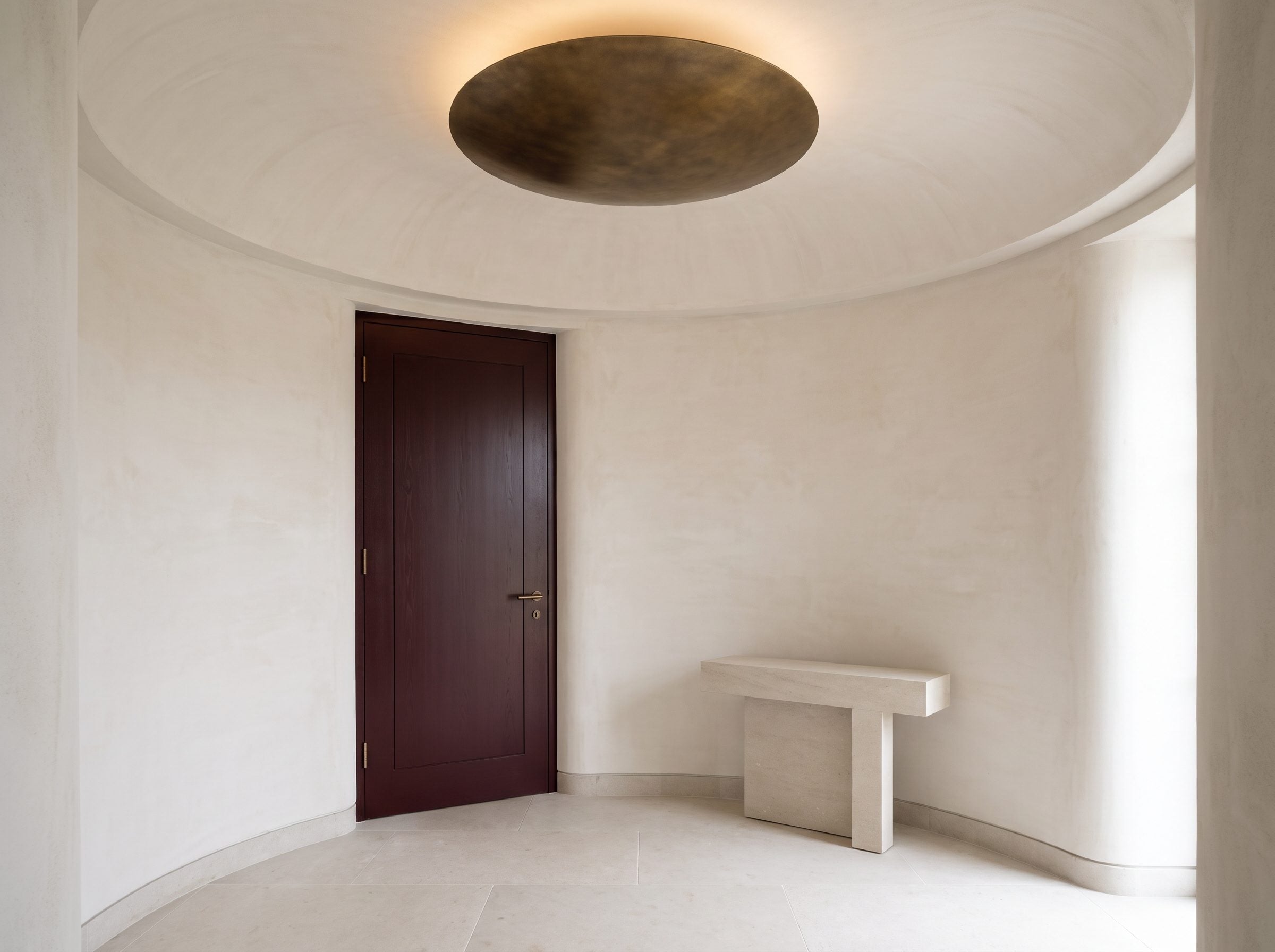
A circular foyer beneath a plaster dome creates an unusually sculptural entry. Against the pale, lime-washed surfaces, a burgundy door introduces a deep, warm plane that stands apart from the surrounding curves.
The oxidized brass disc overhead connects visually with the door’s brass hardware, drawing a subtle relationship between ceiling and threshold. A console finished close to the wall color preserves the room’s uninterrupted curvature. The dark panel adds contrast without disrupting the simplicity of the architecture.
17. Double Hunter-Green Doors in a Full Oak Surround
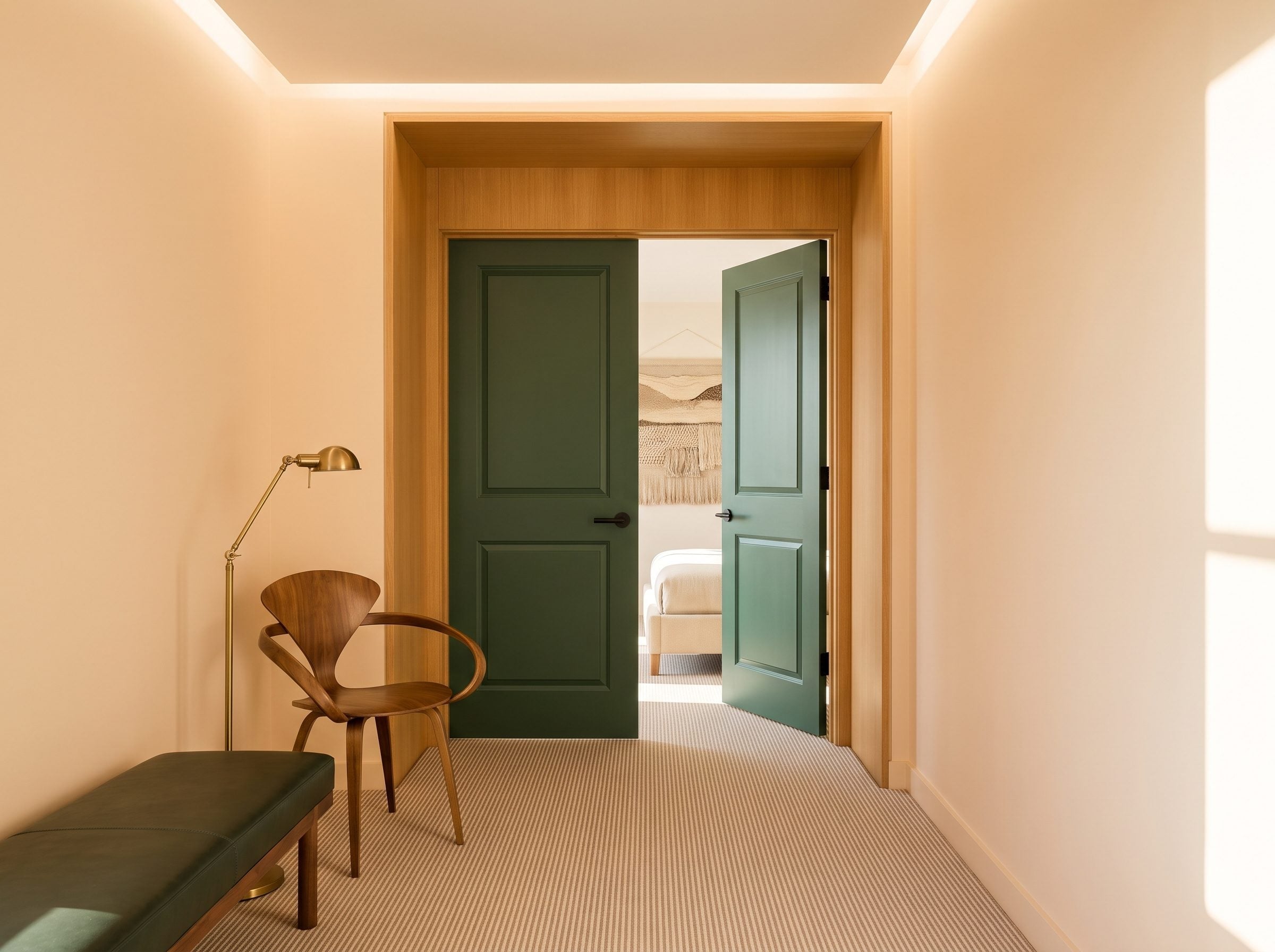
Deep hunter-green double doors sit within a substantial oak surround, creating a doorway with the presence of a piece of built-in furniture. Warm cream walls provide contrast, while the wood casing gives the dark green a natural companion.
Recessed ceiling lighting brightens the corridor. A walnut chair, brass pharmacy lamp, and green bench introduce additional layers of material and color. Beyond the opening, pale bedroom furnishings offer a softer counterpoint. The substantial surround makes the transition feel architectural rather than decorative.
16. A Black Door at the Top of the Stairs, Framed by Light
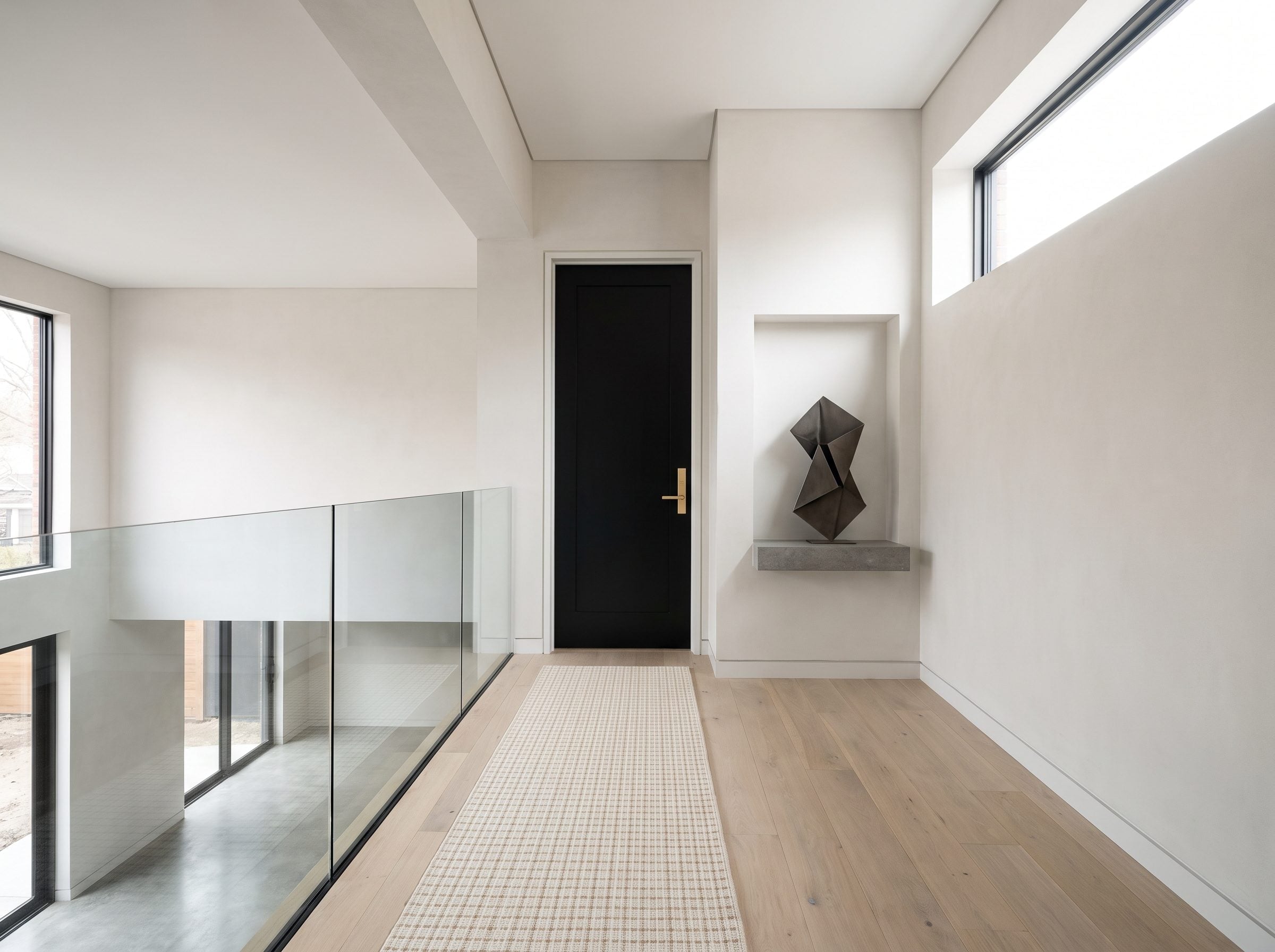
White plaster walls and pale oak flooring create an exceptionally light upper hallway. Against them, a matte black door becomes the clearest visual anchor at the end of the passage.
A glass railing preserves openness beside the stairs, while a recessed niche holding a geometric sculpture adds interest without introducing another large object. The gold lever handle supplies a restrained metallic accent. The dark door gives the otherwise pale composition a firm endpoint.
Design Idea: A single dark door can establish a focal point in a pale upper hallway. Pairing it with restrained artwork or a sculptural niche adds interest without crowding the circulation space.
15. Burgundy Doors Give a City-View Corridor Its Rhythm
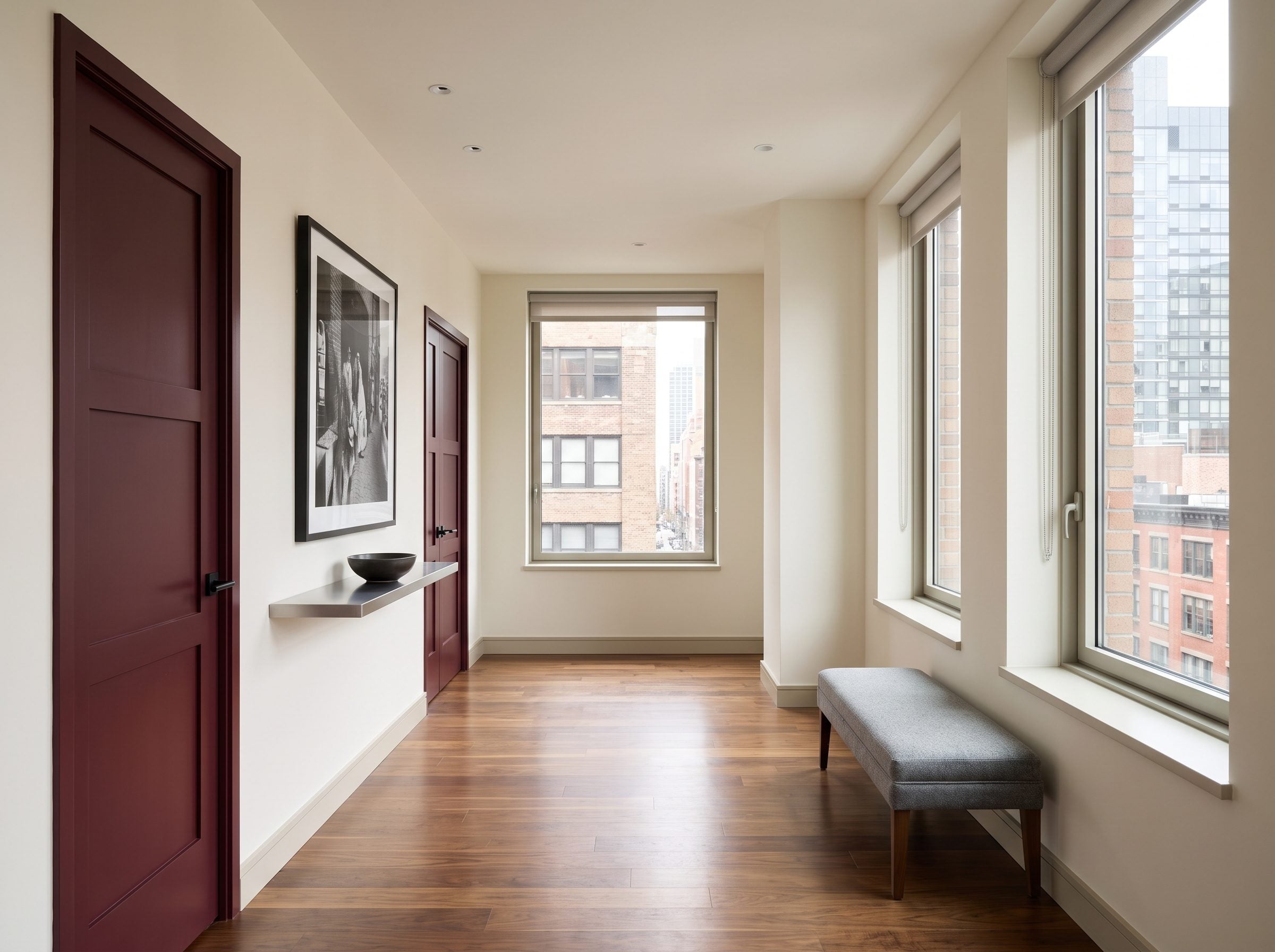
Two burgundy shaker-panel doors repeat their rich color along a long corridor. Their dark, warm finish contrasts with the lighter walls, while narrow walnut floorboards reinforce the hallway’s length.
A floating steel shelf holding a matte black bowl introduces a cooler material between the doors. The sparse composition leaves the burgundy panels and strong flooring lines to establish the spatial rhythm. The result feels measured rather than empty.
14. Navy Meets Walnut in a Hallway That Doubles as a Workspace
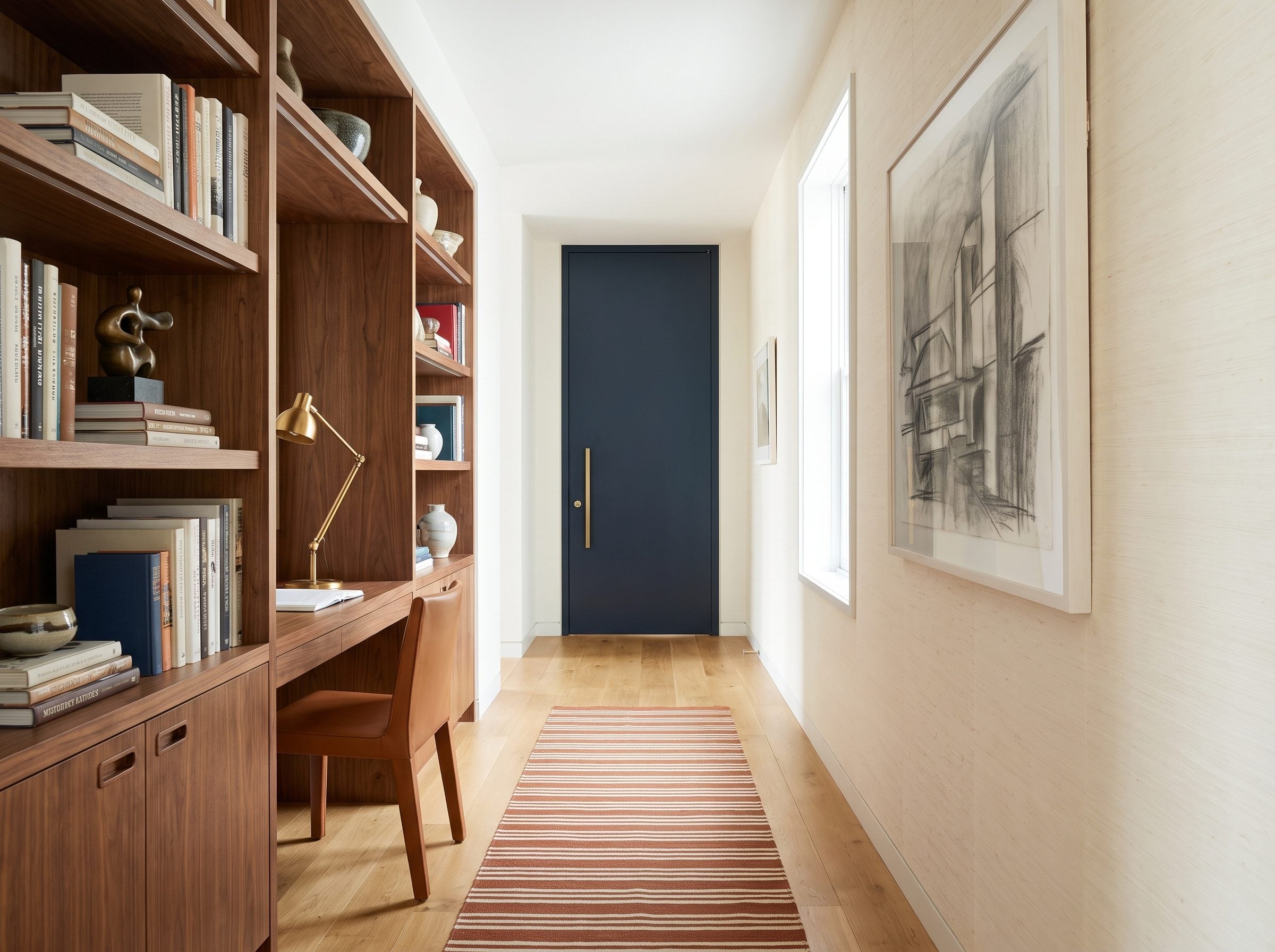
Floor-to-ceiling walnut shelving turns the left side of this narrow corridor into a compact workspace. A cognac leather chair and articulated brass lamp add a warm, practical layer without obstructing the passage.
At the far end, a navy slab door contrasts sharply with the white walls. Its long vertical brass pull emphasizes the door’s height, while a terracotta-striped runner directs attention toward it. The dark finish gives the multipurpose corridor a strong architectural ending.
13. Forest Green Finds an Unusual Partner in a Camouflage Rug
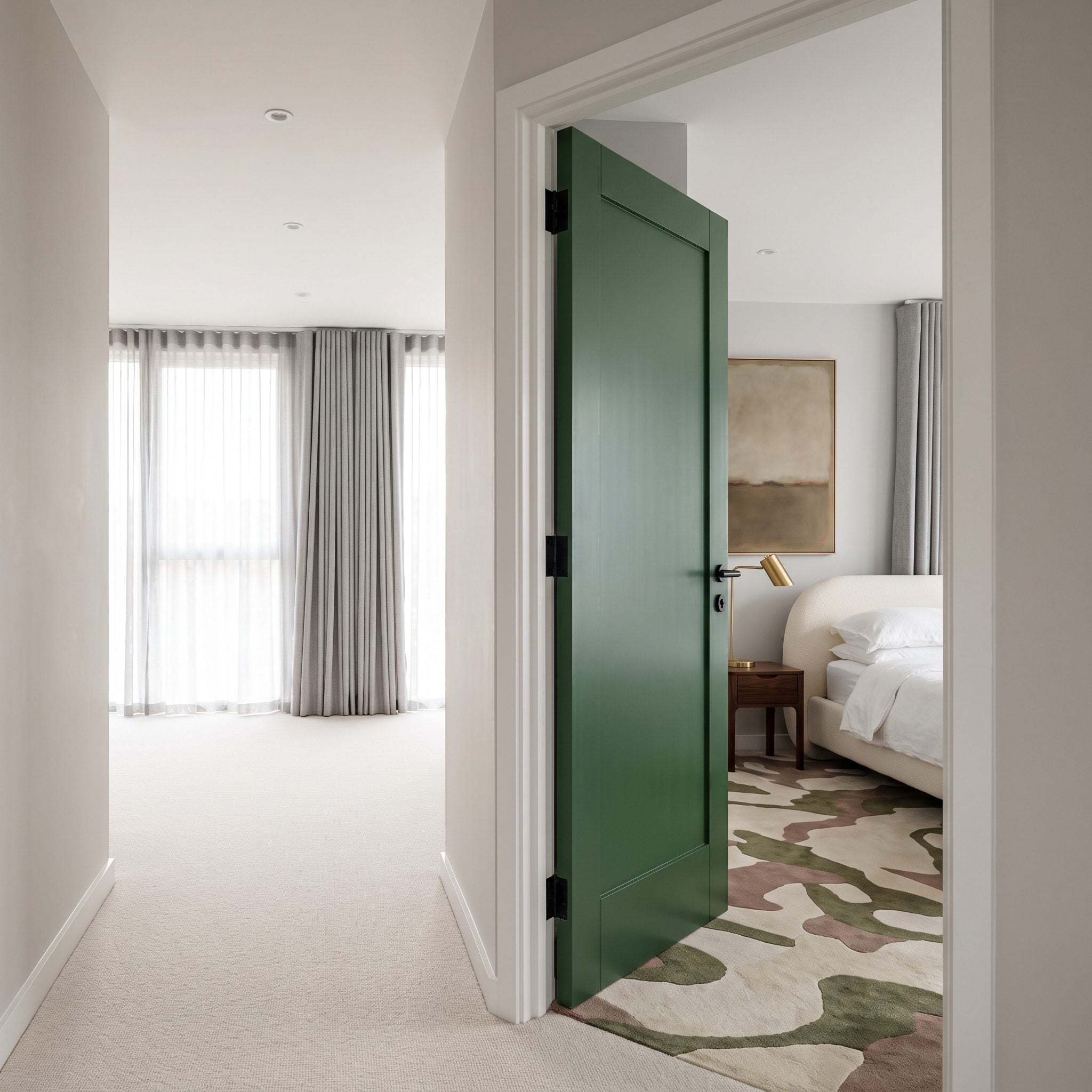
A deep forest-green door introduces the color that reappears in the camouflage-patterned rug beyond the threshold. The relationship is subtle enough to connect the hallway and bedroom without turning them into matching spaces.
Black hinges give the door a more restrained finish than polished brass would. Inside, a walnut nightstand, brass task lamp, and ochre artwork add warmth. Cream carpeting and softly filtered light keep the hallway quiet, allowing the green to connect the two rooms.
12. A Navy Door Introduces a Bedroom Raised Above the Hallway
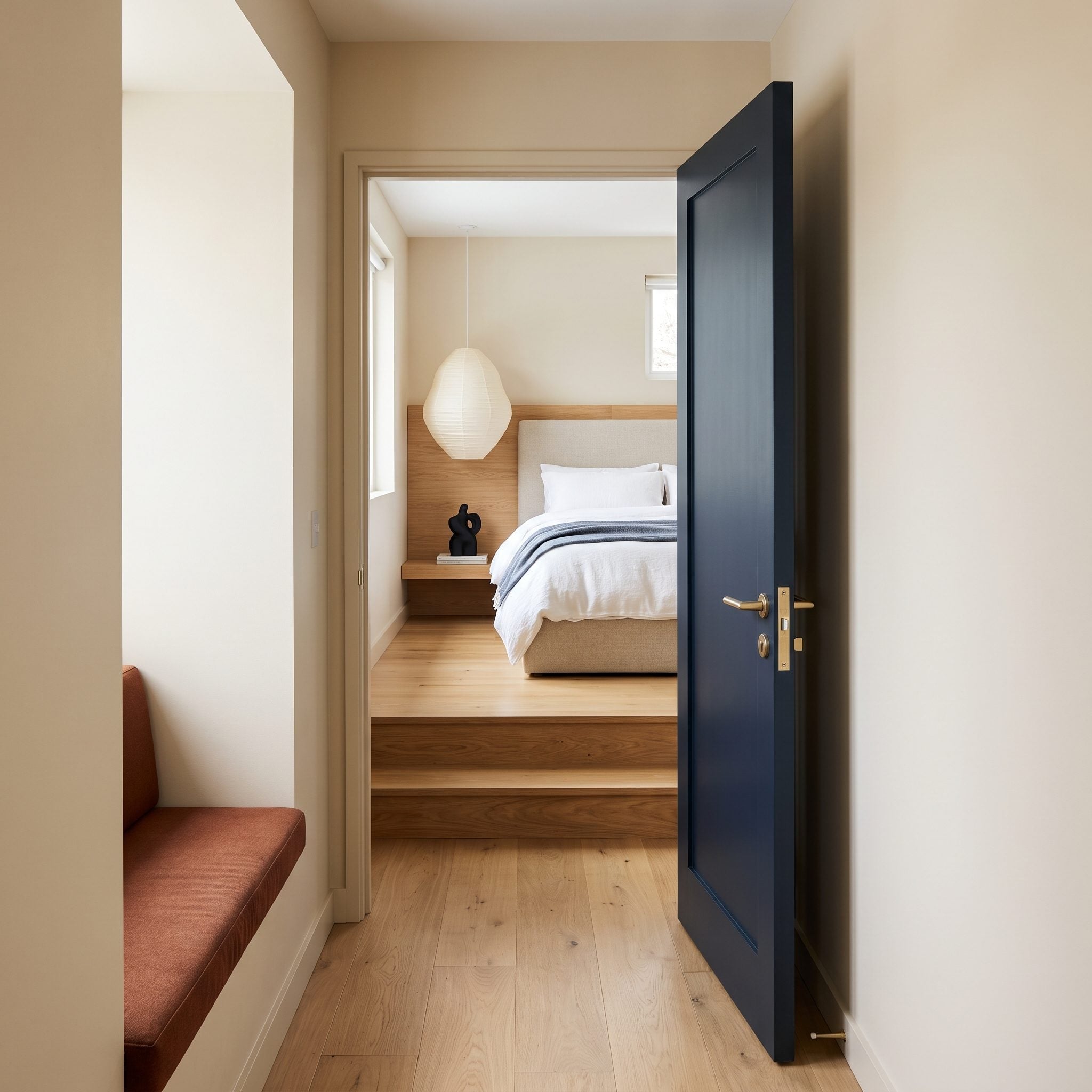
The navy door establishes a clear threshold, but the real architectural surprise waits beyond it. Two oak steps raise the bedroom above the hallway, creating a change in level that makes the transition more pronounced than a conventional doorway.
White bedding, a paper pendant, and a floating walnut nightstand keep the elevated room restrained. The dark door contrasts with those pale materials, while the oak platform introduces warmth and a sense of separation without enclosing the bedroom.
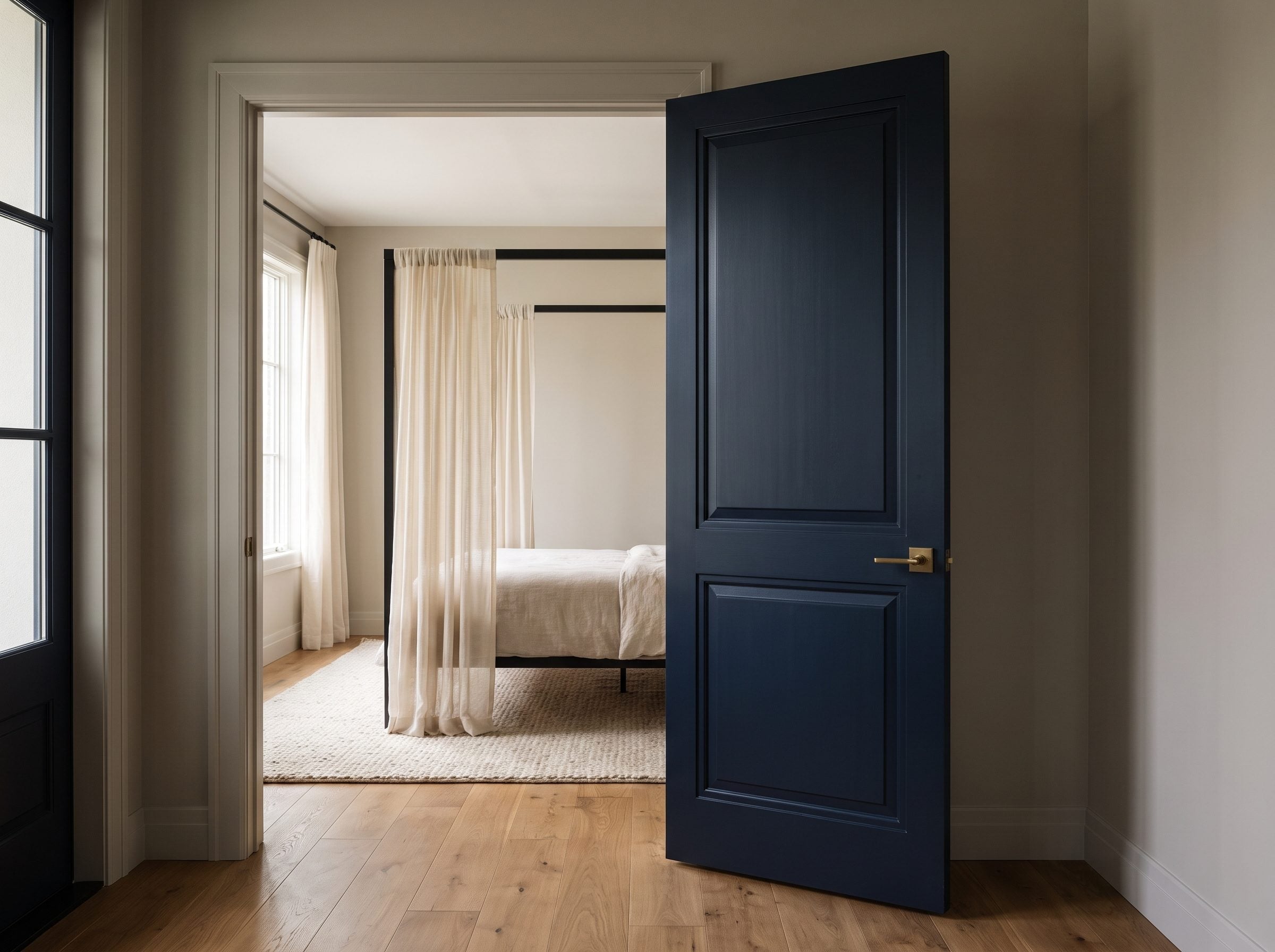
11. A Navy Door Frames a Canopy Bed Beyond the Threshold
🔥 Would you like to save this?
The deep navy door is partly open, framing a black metal canopy bed beyond the hallway. Sheer curtains soften the bed’s structure, while daylight from the window creates a luminous backdrop.
Natural oak flooring continues between the two spaces, providing visual continuity beneath the darker doorway. The door adds a strong frame to the view without isolating the bedroom. Its color and position make the composition feel deliberate rather than incidental.
10. Burgundy and Reeded Glass Divide Space Without Sacrificing Light
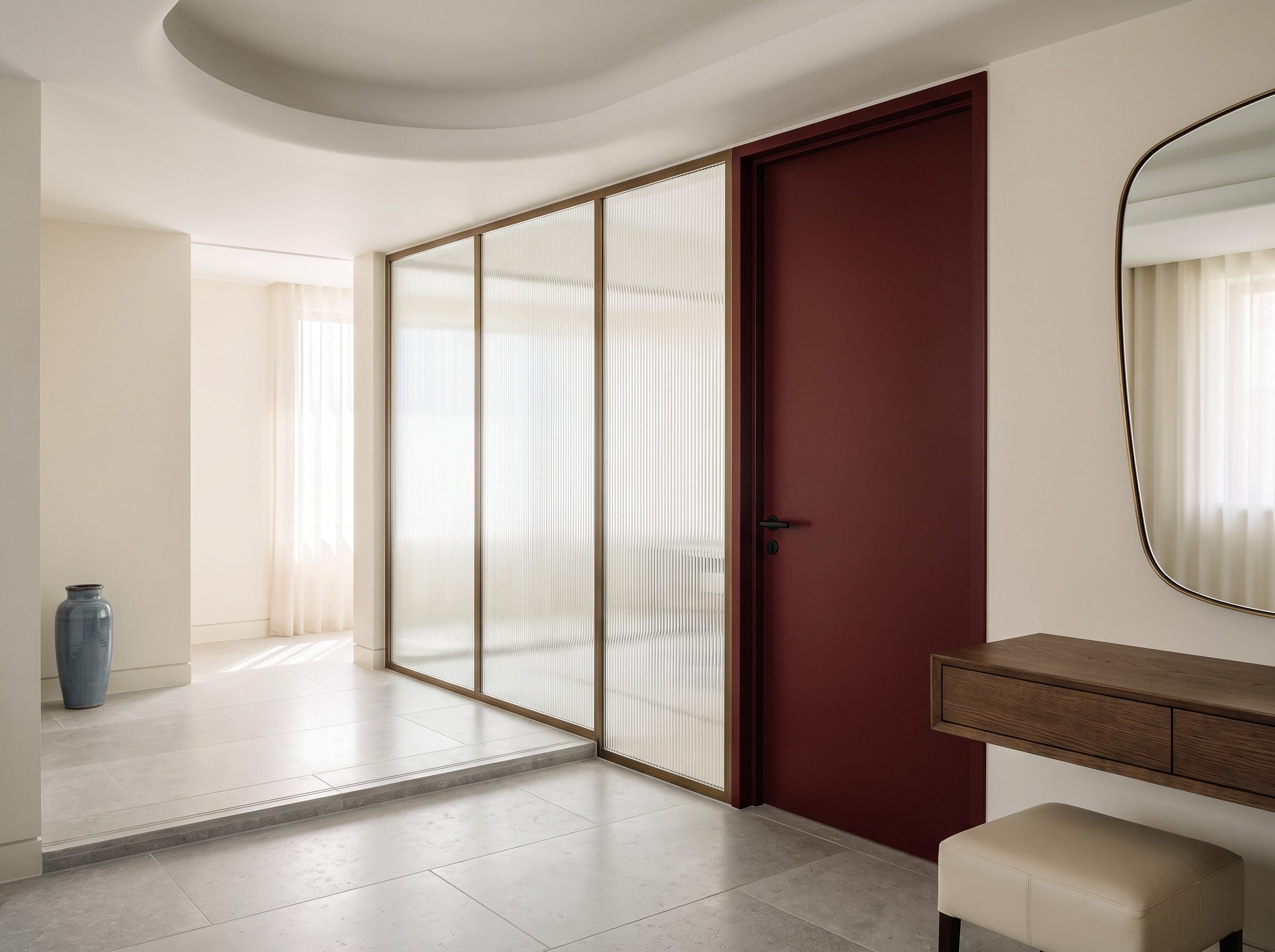
A burgundy door stands beside a floor-to-ceiling reeded glass partition framed in warm bronze. The hallway gains two distinct surfaces: one solid and saturated, the other translucent and textured.
Reeded glass diffuses light and obscures clear views without providing complete privacy. The burgundy panel supplies visual solidity beside it, while a walnut console and cream plaster walls temper the contrast. Light can travel between spaces even as the partition maintains a degree of separation.
9. A Graphite Door Against Linen-Textured Walls
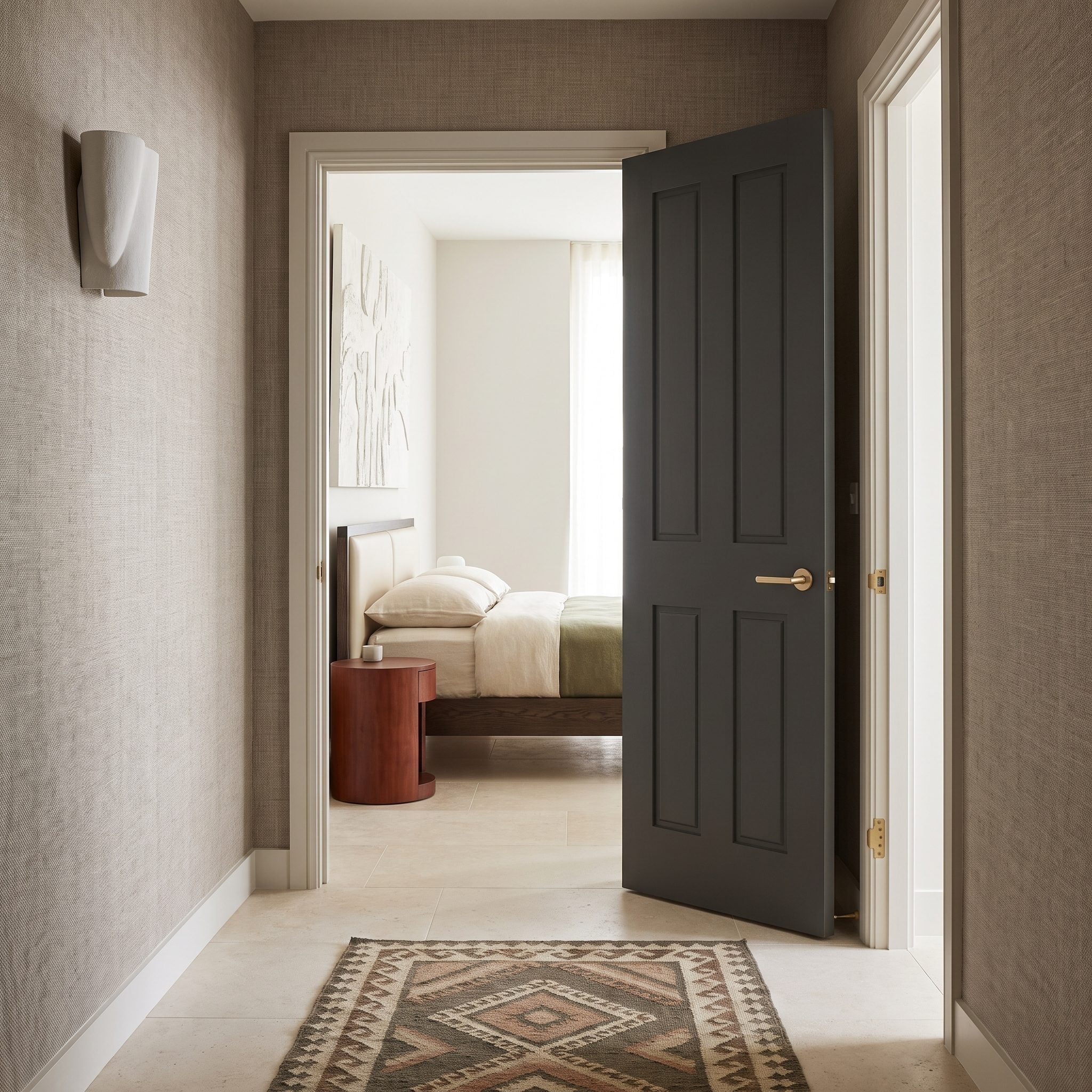
Warm taupe wallcovering introduces a subtle woven texture along the corridor, allowing the graphite four-panel door to stand out without the starkness of pure white walls. Brass hardware supplies a small warm accent against the cool paint.
Through the doorway, a walnut bed frame, terracotta side table, and sculptural white wall piece extend the palette into the bedroom. Shared earthy tones connect the two spaces, even as the darker door gives each room a distinct identity.
8. Two Forest-Green Doors, One Carefully Balanced Hallway
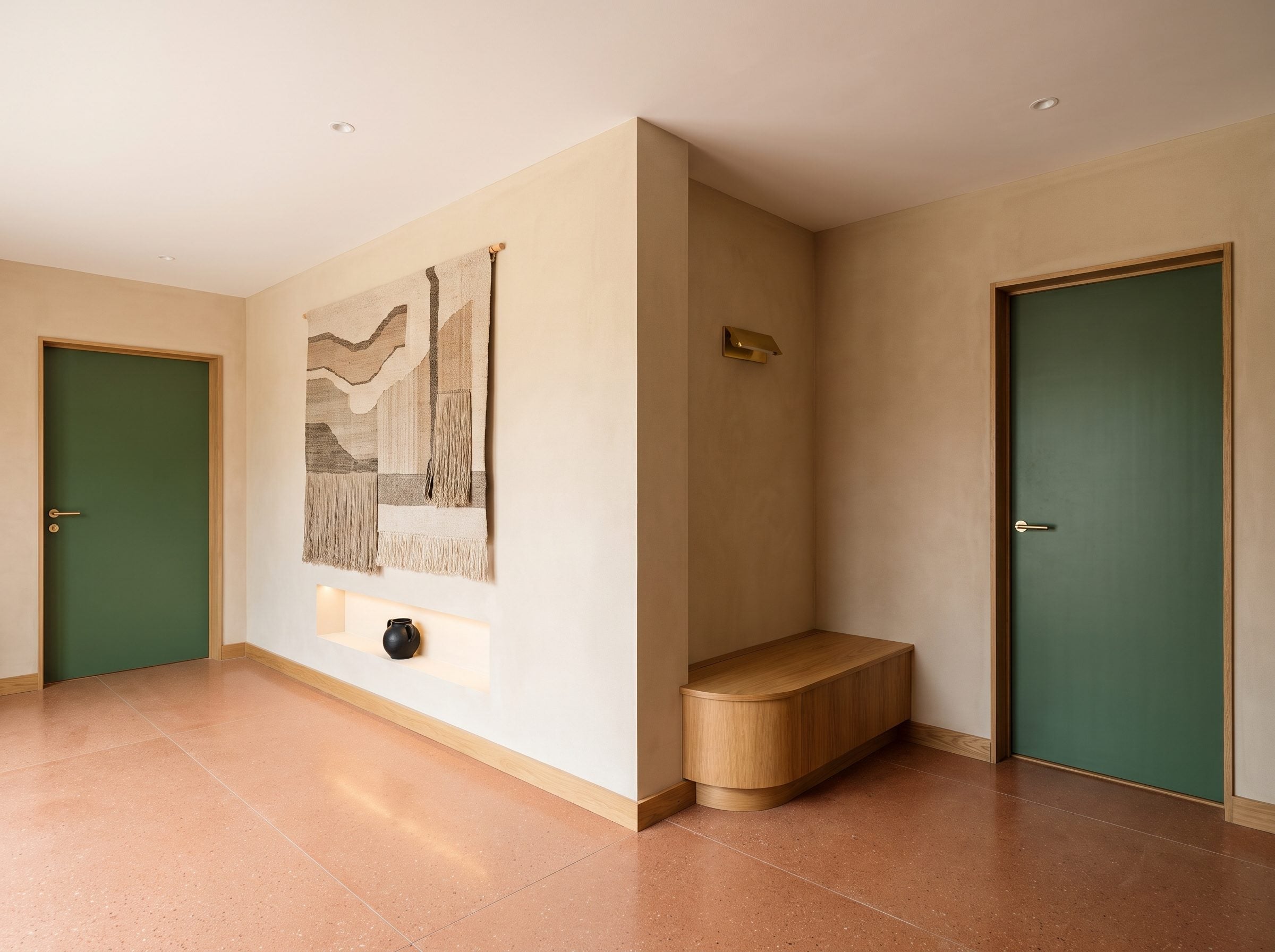
Two forest-green doors punctuate warm sienna-toned plaster walls, each framed by natural oak trim. The repeated dark panels establish a rhythm, while brass lever handles introduce a consistent metallic detail.
Between the doors, a woven wall hanging and recessed niche with a black ceramic vessel occupy the dividing wall. An oak bench with rounded corners adds a softer shape below. Repeated architectural elements meet carefully chosen changes in texture and form.
7. A Burgundy Door Leads Toward a Fireplace and a Darker Bedroom
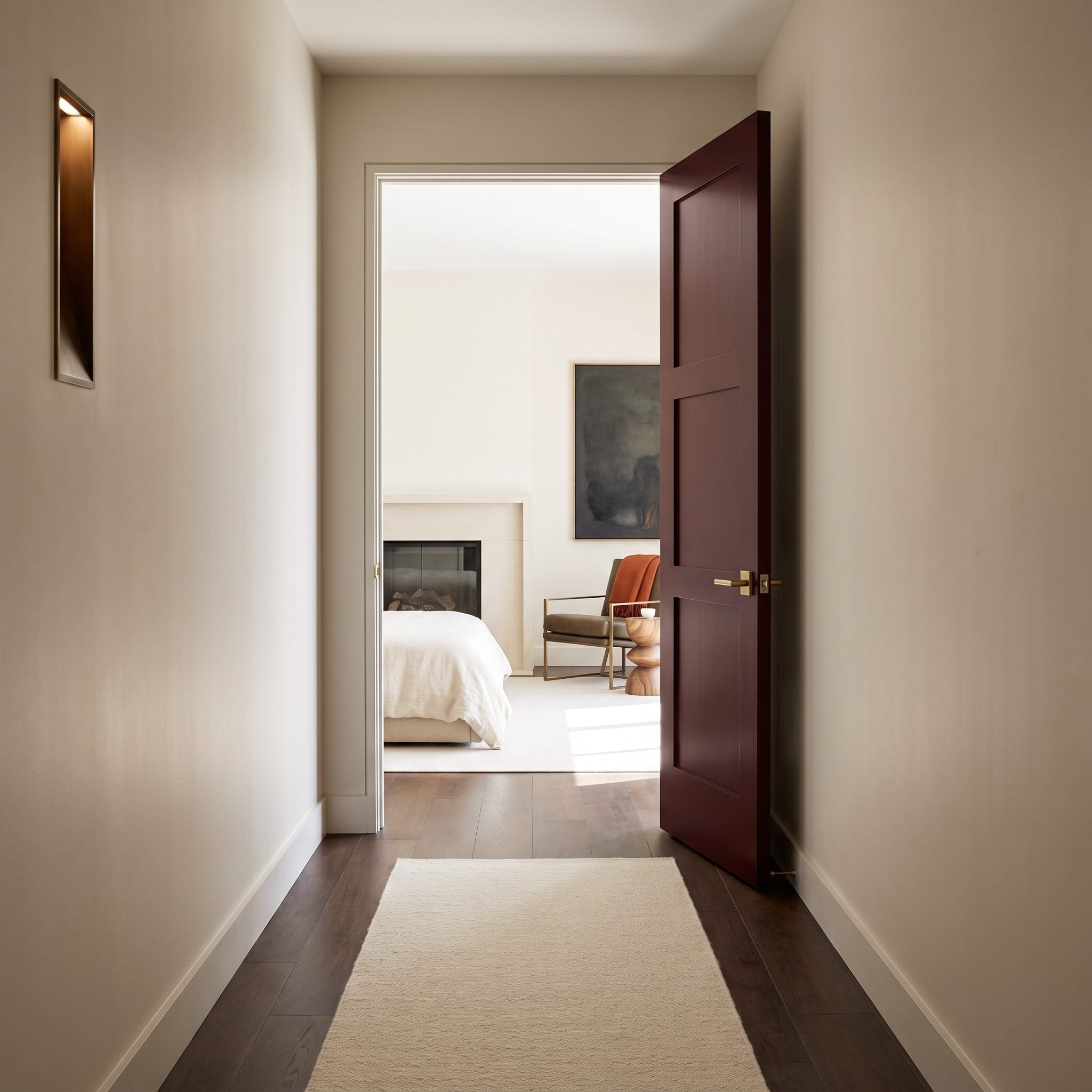
Dark wood flooring carries the eye through the corridor, while a cream runner introduces a lighter strip that stops near the burgundy doorway. The saturated door finish stands out against the surrounding walls.
Beyond it, a bedroom with a fireplace, moody landscape artwork, and an orange throw continues the warm palette. Burgundy links the restrained hallway with the richer room beyond, allowing the spaces to feel related without sharing identical finishes.
6. Travertine Steps Rise Toward a Pair of Black Doors
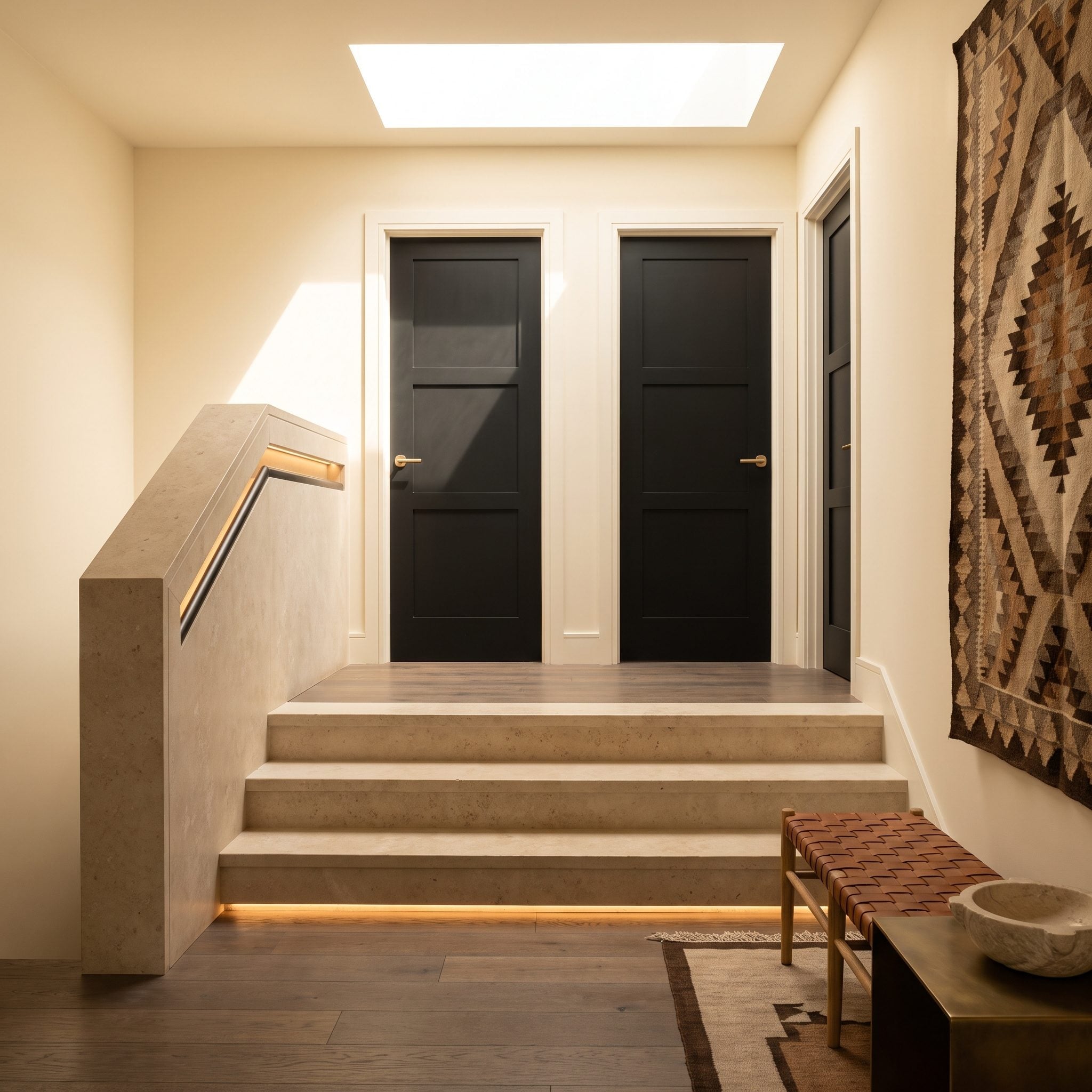
Warm LED lighting beneath pale travertine steps emphasizes each rise and draws attention toward the paired black shaker doors above. The dark panels form a clear endpoint to the upward movement.
Brass lever handles connect with the warmth of the step lighting, while a kilim wall hanging adds pattern and color beside the staircase. Illuminated horizontal steps meet solid vertical doors, turning a simple change in level into an architectural sequence.
5. A Navy Door Gives a Spare Hallway a Stronger Silhouette
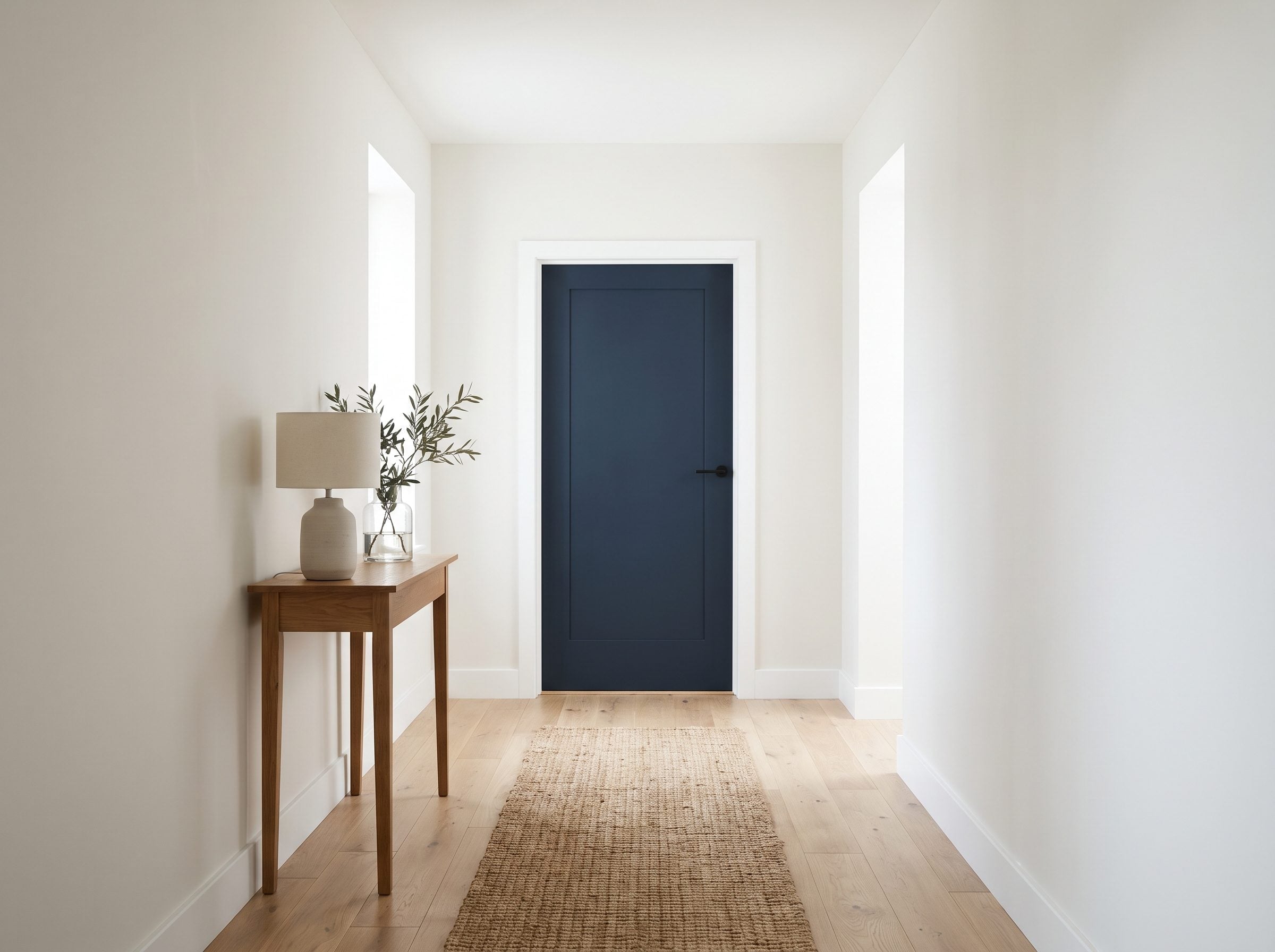
A navy door framed in crisp white casing creates a sharp contrast within a hallway of off-white walls and light oak floors. Its simple shape carries more visual weight than the surrounding furnishings.
A jute runner introduces texture, while a slim walnut console adds warmth along the wall. With so little competing for attention, the door becomes the clearest architectural accent. More elaborate trim or heavier furniture would produce a different balance.
Quick Fix: Painting one interior door deep navy can introduce contrast without remodeling the hallway. Matte or eggshell finishes reduce sharp reflections compared with glossier paints, although the best sheen depends on durability requirements and the surrounding trim.
4. Matte Black and Brass Bring Order to a Working Mudroom
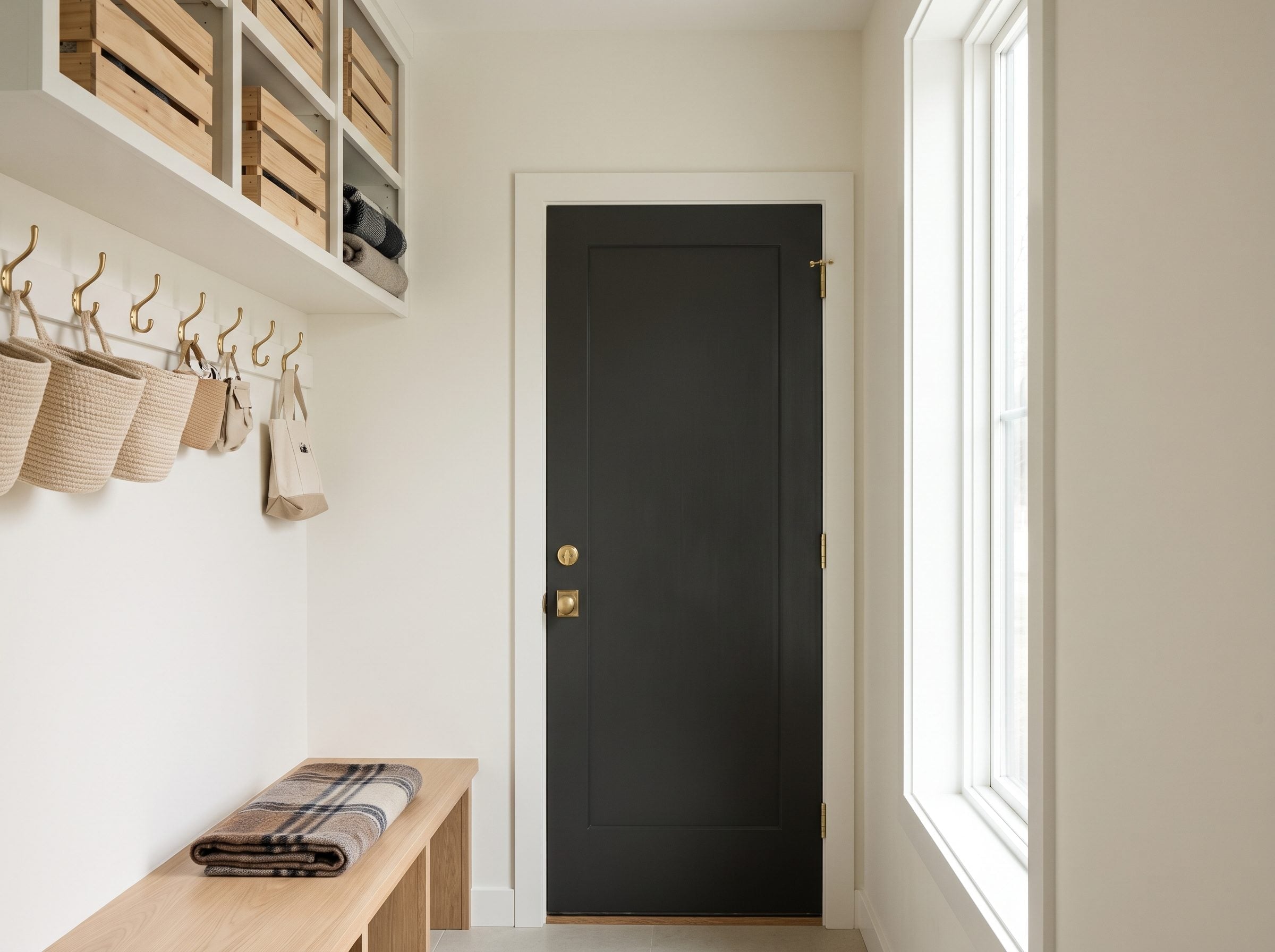
A flat-panel black door stands against the mudroom’s pale finishes. Along the wall, brass hooks support canvas totes and woven baskets, while a simple light-oak bench adds a warmer natural surface.
The arrangement balances everyday utility with a controlled material palette. Black defines the end wall, brass catches small highlights, and oak and woven fibers soften the contrast. The room remains practical without relying on the usual all-white mudroom formula.
3. Navy and Walnut Create a Quietly Dramatic Bedroom Entrance
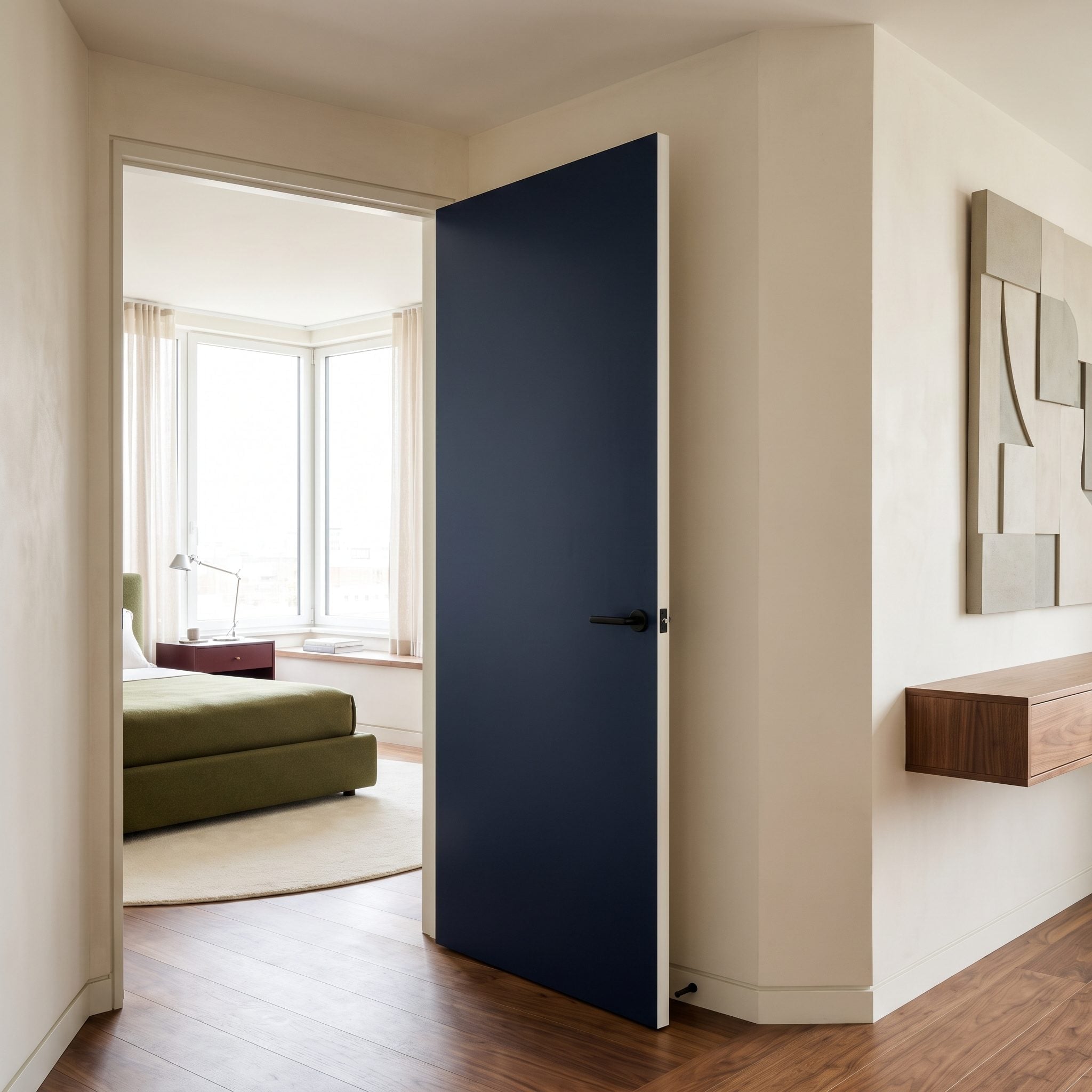
Off-white walls give the navy door a clean, contrasting backdrop. Matte black lever hardware keeps the finish restrained, while a walnut floating console adds warmth along the right wall.
Above the console, an abstract plaster relief introduces texture without another strong color. Beyond the doorway, an olive platform bed and round cream rug sit beneath a bright bay window. Dark paint and warm wood establish a composed approach to the lighter bedroom.
Among Home Stratosphere readers, those who picked black door hardware were more likely to choose cosy and moody as their ideal home feel, 54% versus 30% of everyone else.
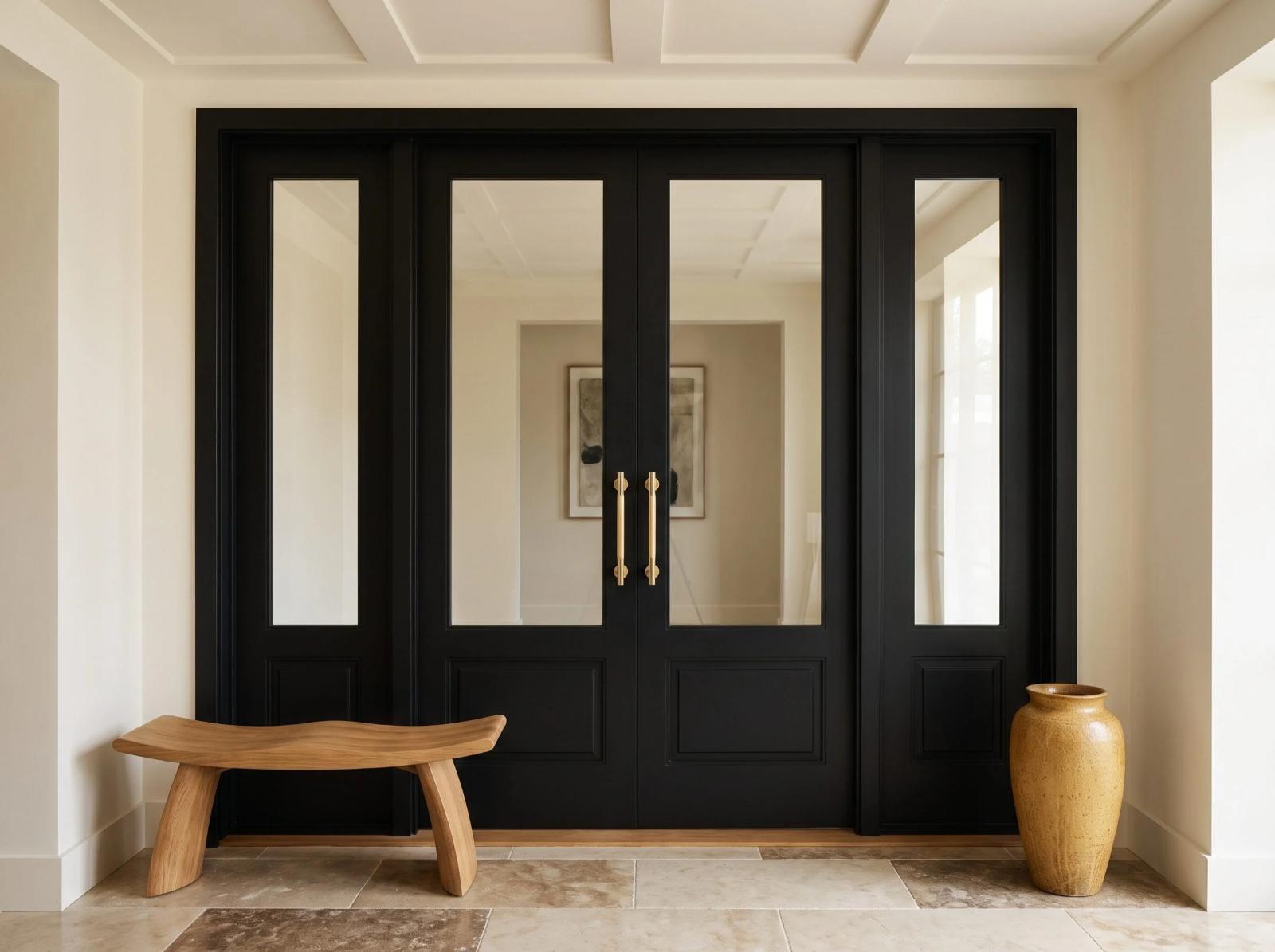
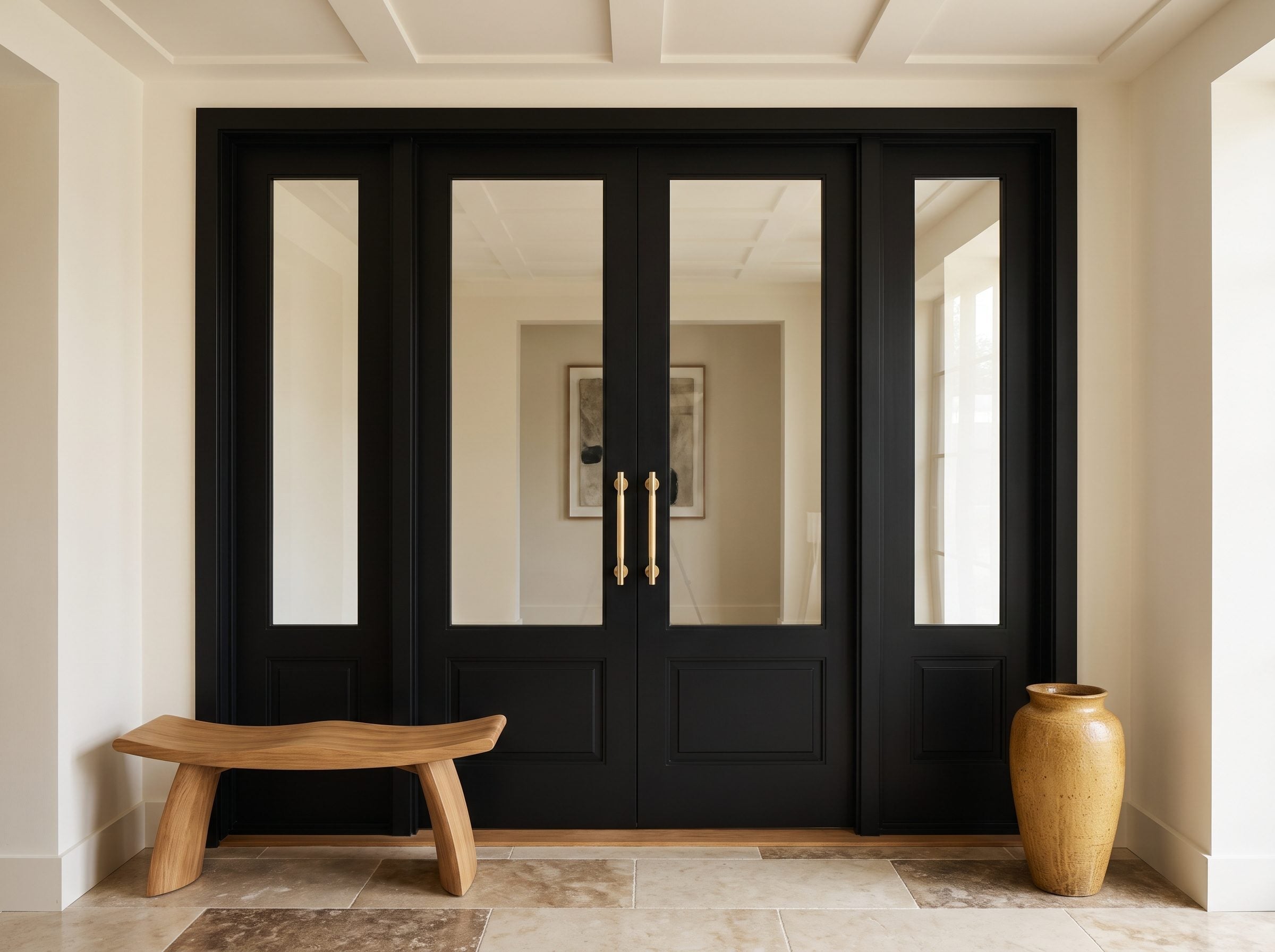
2. Matte Black Double Doors With Brass Pulls Command the Entry
🔥 Would you like to save this?
Matte black extends across the double doors and their full-height surround, creating one substantial dark plane. Long brass bar pulls with round ends interrupt that surface with warm, precise lines. The contrast is immediate, but the detailing remains restrained.
Travertine flooring introduces a pale mineral texture below. Sculptural walnut seating and an ochre-glazed stoneware vessel bring organic forms into the entry. The doors dominate through scale and consistency rather than elaborate ornament, making the brass hardware all the more effective.
1. Black Against Oak — A Door That Becomes Part of the Wall
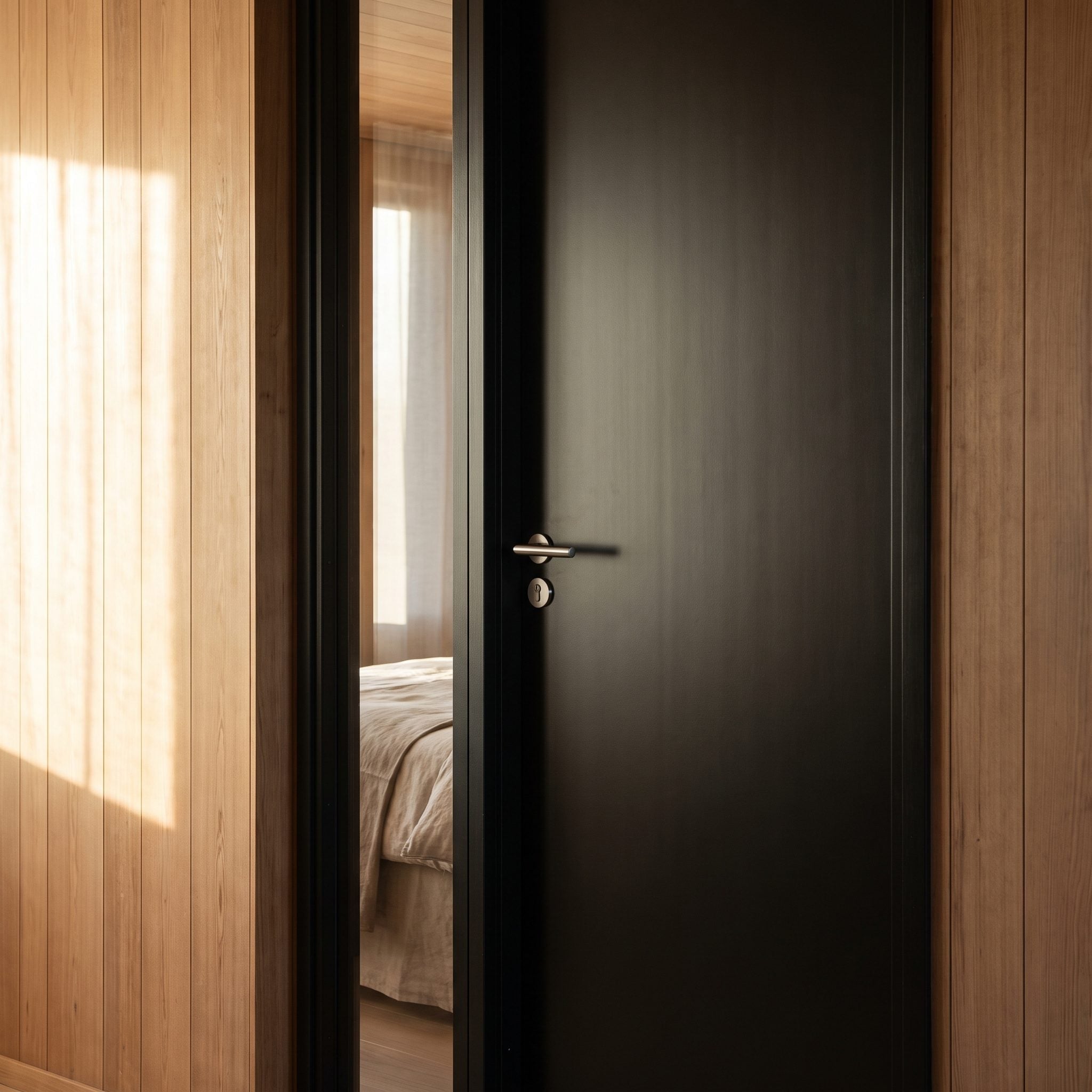
Vertical oak paneling runs from floor to ceiling, wrapping the doorway in a continuous field of warm wood. The matte black door sits flush within it, framed by a slim dark outline that emphasizes the precision of the opening.
A silver lever handle adds a cool highlight against the black surface. Through the narrow opening, linen bedding and sheer curtains catch the daylight, introducing a softer, brighter scene beyond the paneled wall. Black, oak, and filtered light give the doorway its architectural presence.