🔥 Would you like to save this?
Your dining room has been holding a grudge since the Clinton administration. That mahogany hutch isn’t “timeless”—it’s tired. This is your intervention: cream walls that breathe, brass that gleams like it means it, ceilings carved and coffered instead of just… there. Chippendale chairs get benched for velvet, boucle and gilded curves that actually deserve the good china. Same walls, same windows, entirely different life. Scroll through—your table is about to get very jealous.
In order to come up with the very specific design ideas, we create most designs with the assistance of state-of-the-art AI interior design software. Also, assume links that take you off the site are affiliate links such as links to Amazon. this means we may earn a commission if you buy something.
How often do you actually look forward to hosting dinner in your own dining room? For one homeowner, the honest answer was never, because dark wood, dated fixtures and low-contrast walls had quietly turned a gathering space into somewhere people hurried through.
What makes this collection worth studying isn’t simply the palette change. Cream and brass can become polite and forgettable in a hurry. The strongest rooms refuse that fate by giving the eye somewhere unexpected to land: a burgundy ceiling, sculptural plaster, mirrored coffers, Gothic arches, living walls, raw wood or one chandelier audacious enough to reorganize everything around it.
Thirty-five dining rooms, one consistent brief. Here’s what happened when designers stopped working around the darkness and started dismantling it.
35. Cream Walls, Gold Trim, and a Textured Ceiling That Earns Every Glance
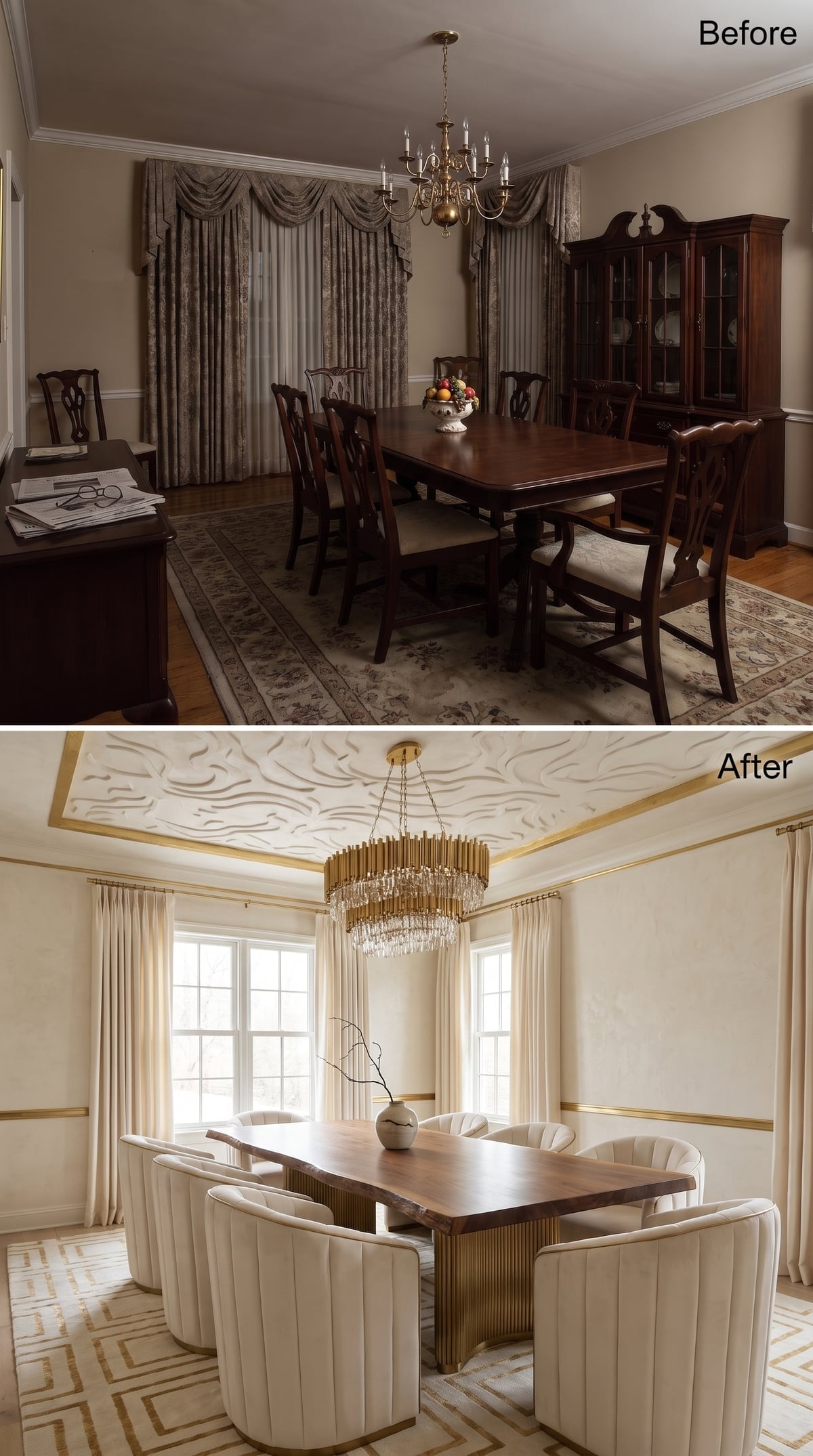
Fluted brass table legs anchor a live-edge walnut dining table surrounded by channel-tufted cream chairs. Above it, a cylindrical brass-and-crystal chandelier pulls the gaze toward a relief-sculpted ceiling edged in gold.
The important move isn’t simply making the room lighter. Texture takes over the job the dark furniture once performed. The walls recede, the ceiling gains authority, and suddenly the dining table isn’t fighting the room for attention.
34. Diagonal Slats, a Burgundy Ceiling, and Brass That Finally Has Somewhere to Go
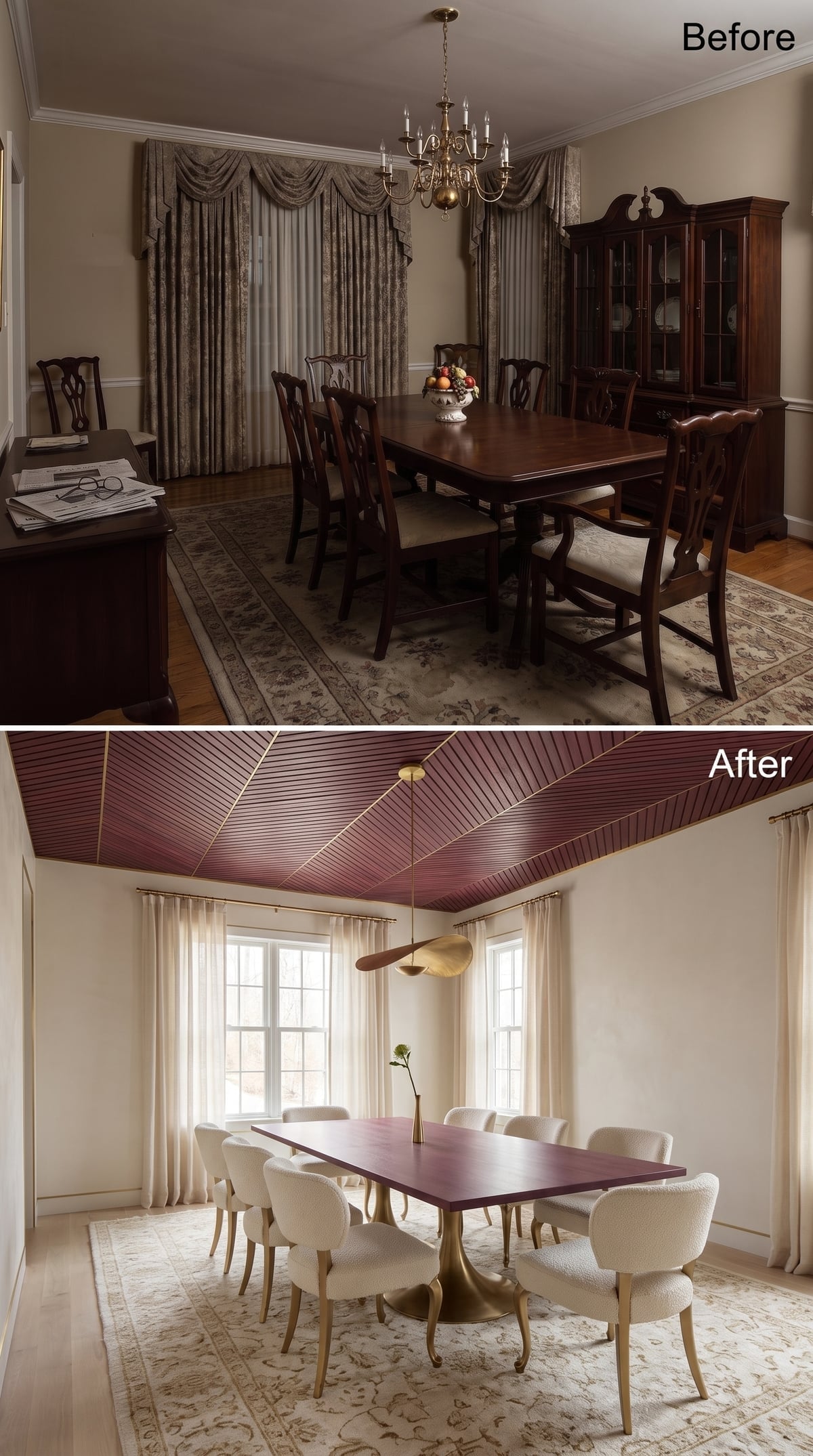
Just when cream threatens to behave itself, the ceiling turns burgundy. Stained wood slats run diagonally in opposing directions, divided by brass into four quadrants that converge at the pendant.
The table picks up the same deep red-purple tone on a sculptural brass tulip base, while white boucle chairs keep the color from closing in. This is what the gallery needs early: proof that “lighter” doesn’t have to mean “paler.”
Why the Diagonal Slat Pattern Works Better Than a Straight Grid
Parallel slats tend to emphasize a room’s length. Turning them diagonally introduces tension with the rectangular footprint and redirects the eye toward the center. Brass dividing lines keep the pattern disciplined rather than frantic.
33. Walnut Ceiling Planks and Brass Legs Rewrote the Rules of This Dining Room
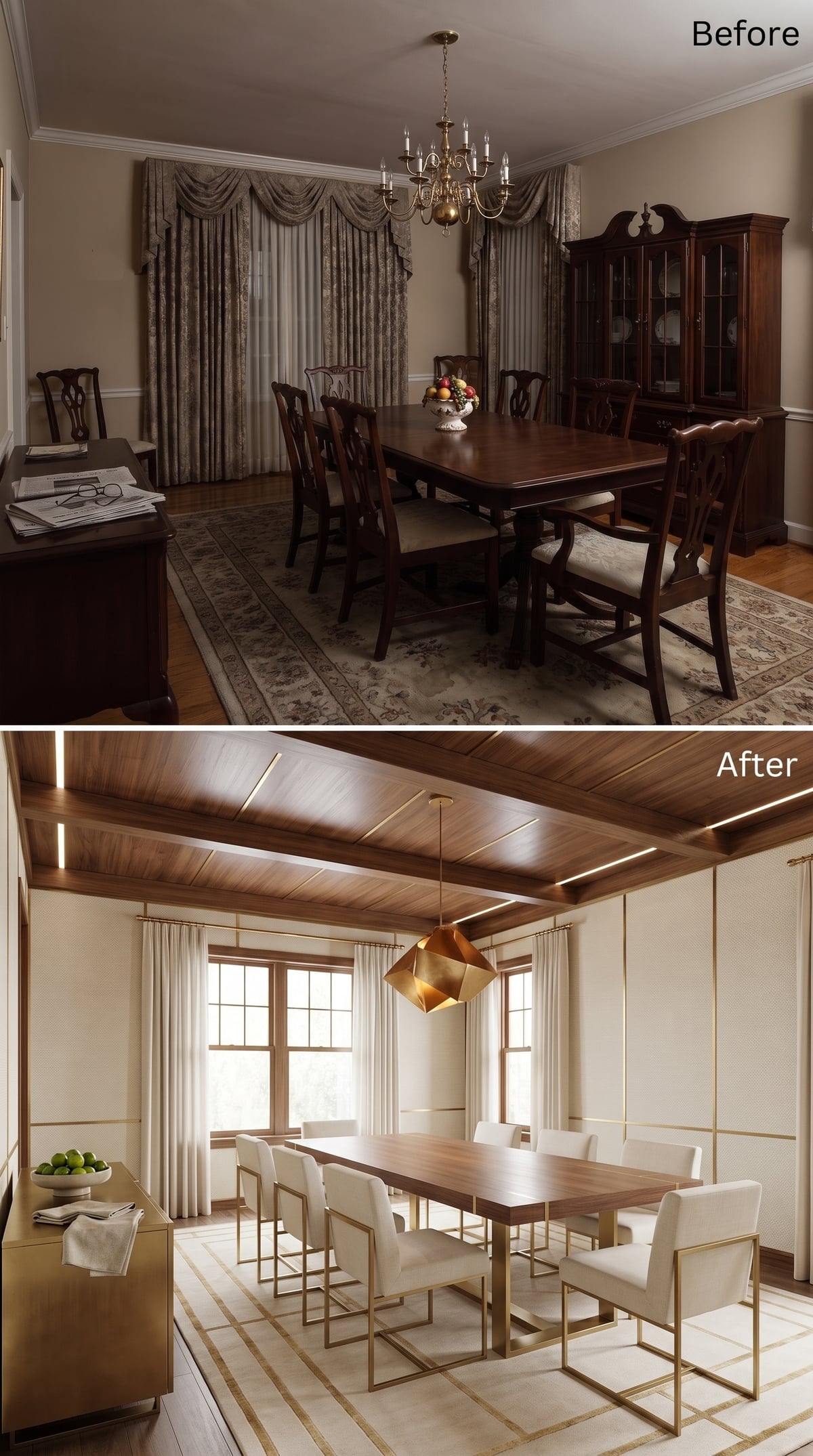
Walnut planks run the length of the ceiling, interrupted by recessed channels of warm light. Instead of hanging all the drama from one chandelier, illumination is spread across the architecture itself.
Paneled cream walls and sheer ivory curtains prevent the wood overhead from turning oppressive. Brass repeats at the pendant, table and chair frames, but the room doesn’t feel dipped in metal. Everything has somewhere specific to go.
Did You Know: Paneled wood ceilings have appeared in European interiors for centuries. Walnut works particularly well in contemporary rooms because its warm brown undertones sit comfortably beside cream, brass and diffused lighting without automatically reading as rustic.
32. Diamond Mirror Panel, Gold Fretwork Chairs, and a Ceiling That Earns the Room
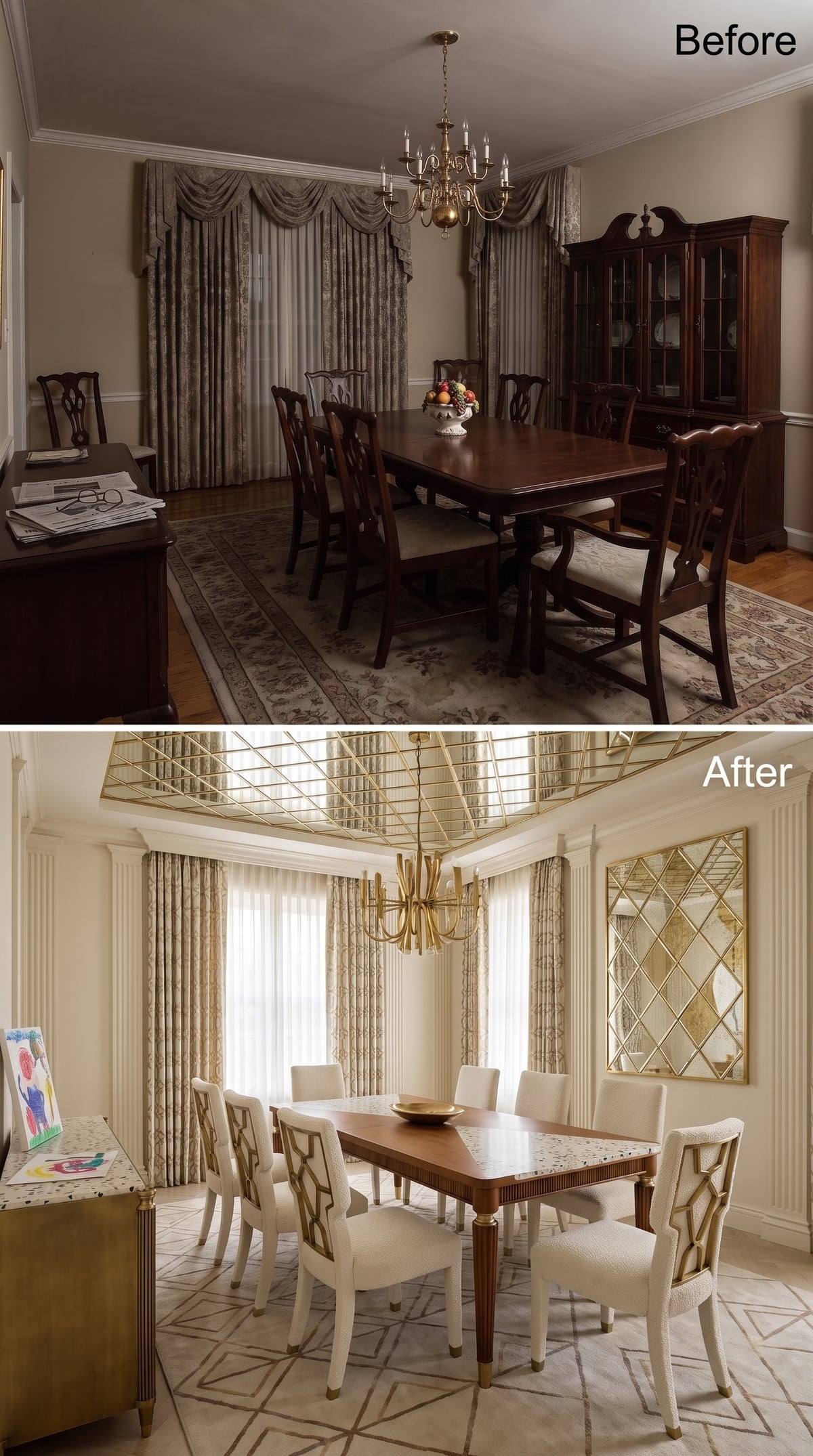
Antiqued mirror tiles cover the ceiling in a diamond grid, which is about as far from anonymous drywall as a dining room can get without installing a fresco.
Gold fretwork chairs wear cream upholstery below, and the rug quietly repeats the lattice. The mirrored surface catches fragments of the room rather than throwing back a perfect reflection, so the effect is atmospheric instead of nightclub shiny.
31. Trailing Ivy, a Gold Pendant, and Ceiling Molding That Took the Room Somewhere New
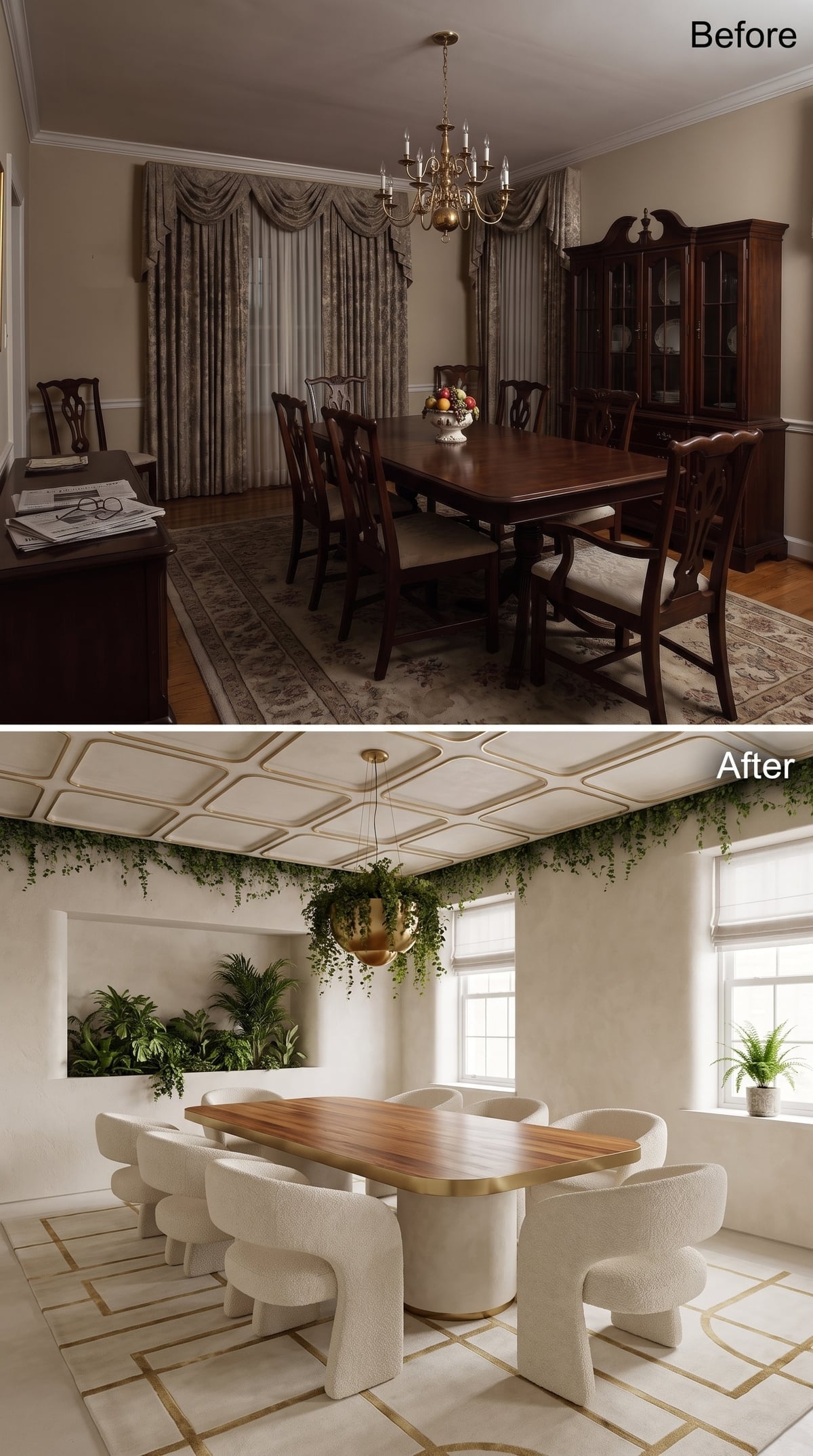
Trailing greenery runs the perimeter where wall meets ceiling, turning an architectural edge into something alive. Below, boucle barrel chairs circle a live-edge table on a brass base, while a cream rug with gold geometry keeps the floor quiet.
The best part is the echo. Greenery appears again around the orb pendant and in the wall niche, giving the plants a rhythm instead of making them look like somebody remembered decorating with foliage at the last minute.
Quick Fix: Trailing plants can soften crown molding or a ceiling ledge, but choose the plant for the actual light available. Pothos tolerates relatively low indoor light; ivy generally performs better with brighter indirect light.
30. Natural Wood Coffered Ceiling, Shiplap Walls, and Brass That Knows When to Stop
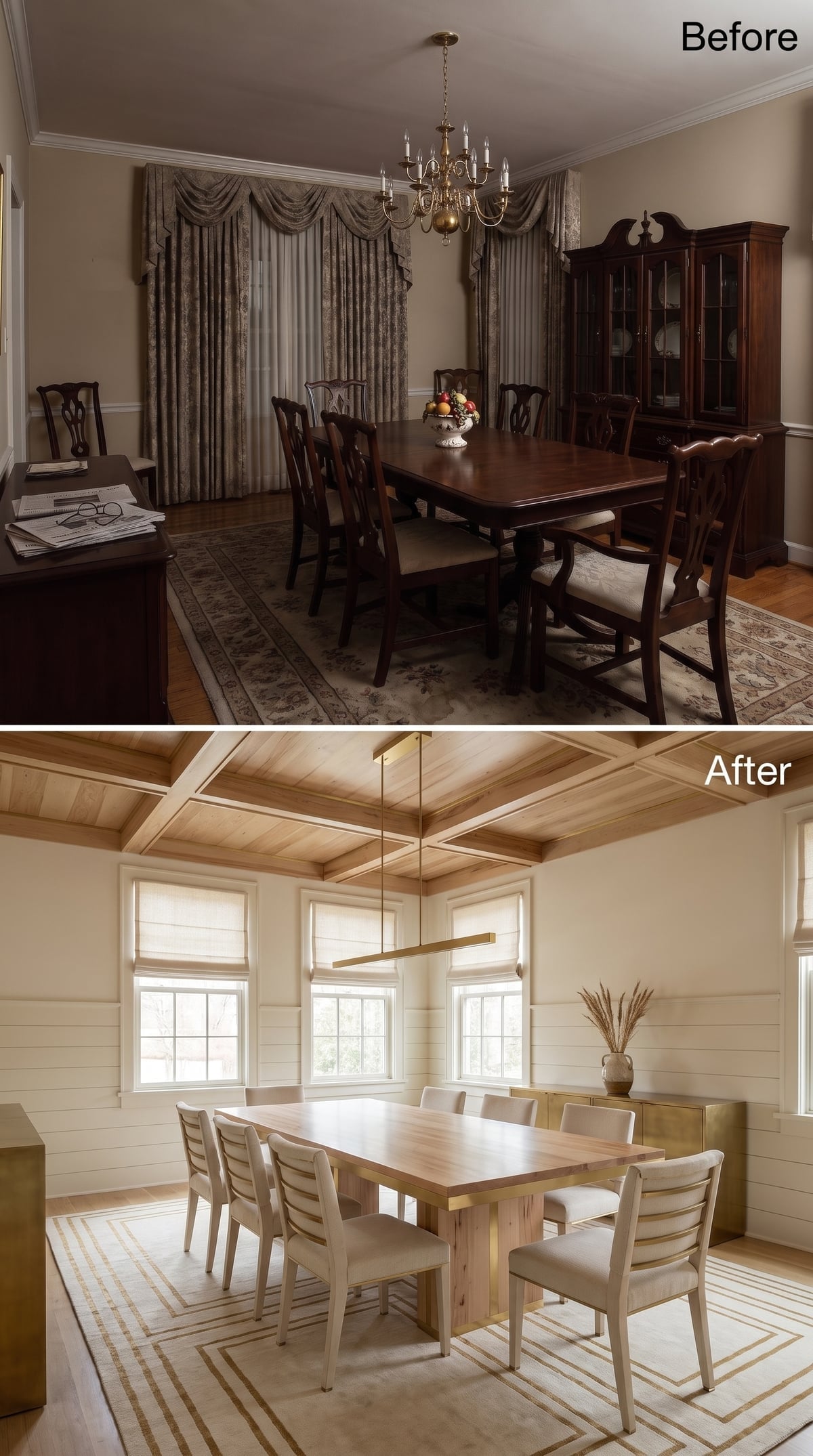
Raw-looking wood fills the coffered ceiling bays while horizontal shiplap keeps the walls moving quietly underneath. The material palette feels almost rural on paper, but the proportions keep it far from farmhouse cliché.
A substantial wood pedestal table and ladder-back chairs give the room enough backbone to handle the ceiling. Brass appears once, decisively, at the sideboard. For once, nobody felt compelled to gild every available edge.
29. Cream Boucle, Brass Geometry, and a Gold Wall Panel That Anchors the Whole Room
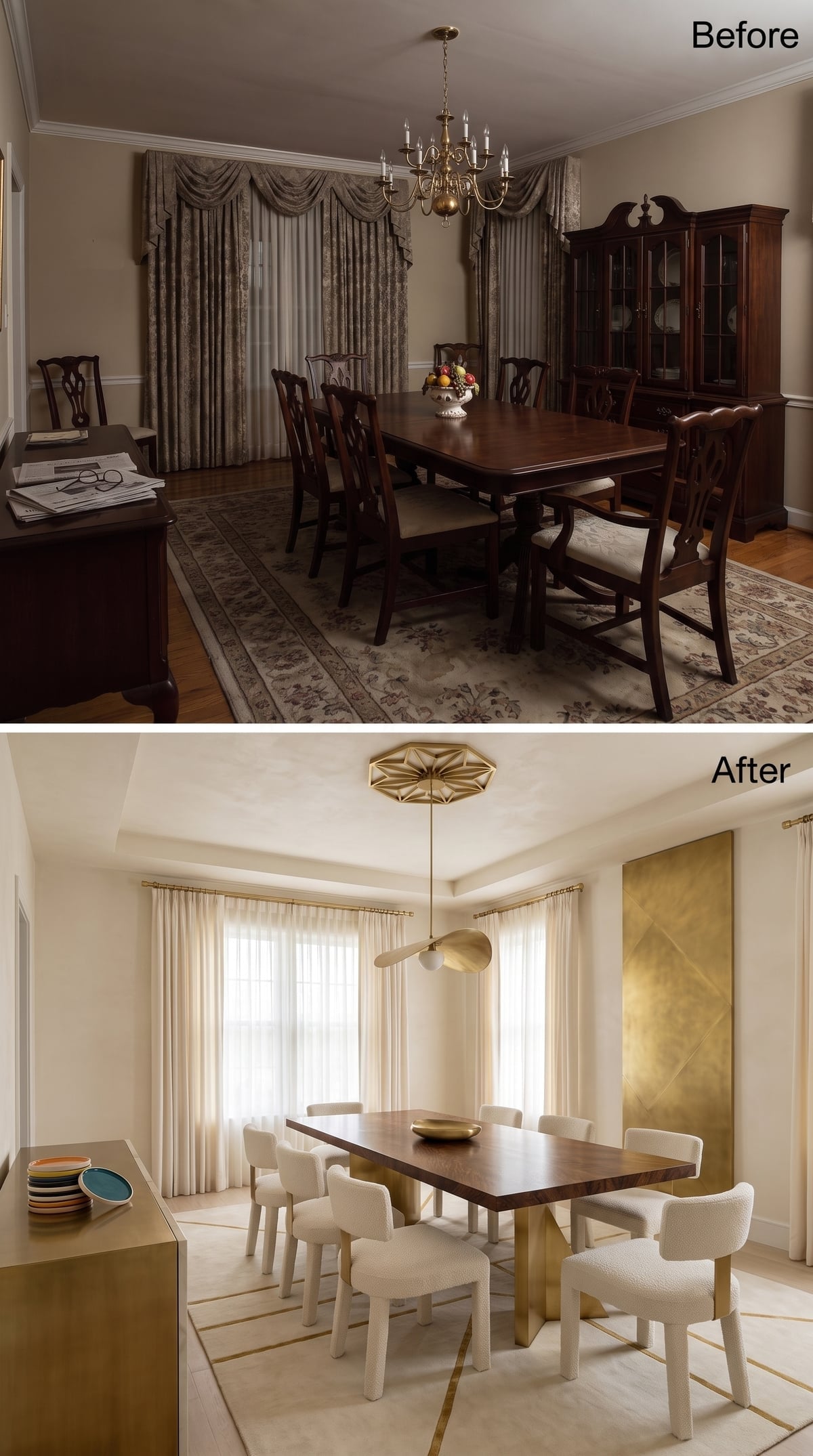
Eight rounded chairs gather around a walnut table on thick brass-finished legs, but the real interruption comes from the floor-to-ceiling gold-leaf panel on the right wall.
That concentrated flash of metal is smarter than scattering dozens of tiny accents through the room. Cream stays calm, walnut supplies weight, and one unapologetic golden plane keeps the palette from dissolving into expensive oatmeal.
In The Details: Gold leaf has been used in decorative interiors for thousands of years and became especially celebrated in Byzantine architecture. In contemporary residential spaces, limiting it to a single panel can deliver the glow without turning every wall into an event.
28. Gothic Arch Paneling, Ornamental Plaster Ceiling, and a Chandelier That Finally Fits
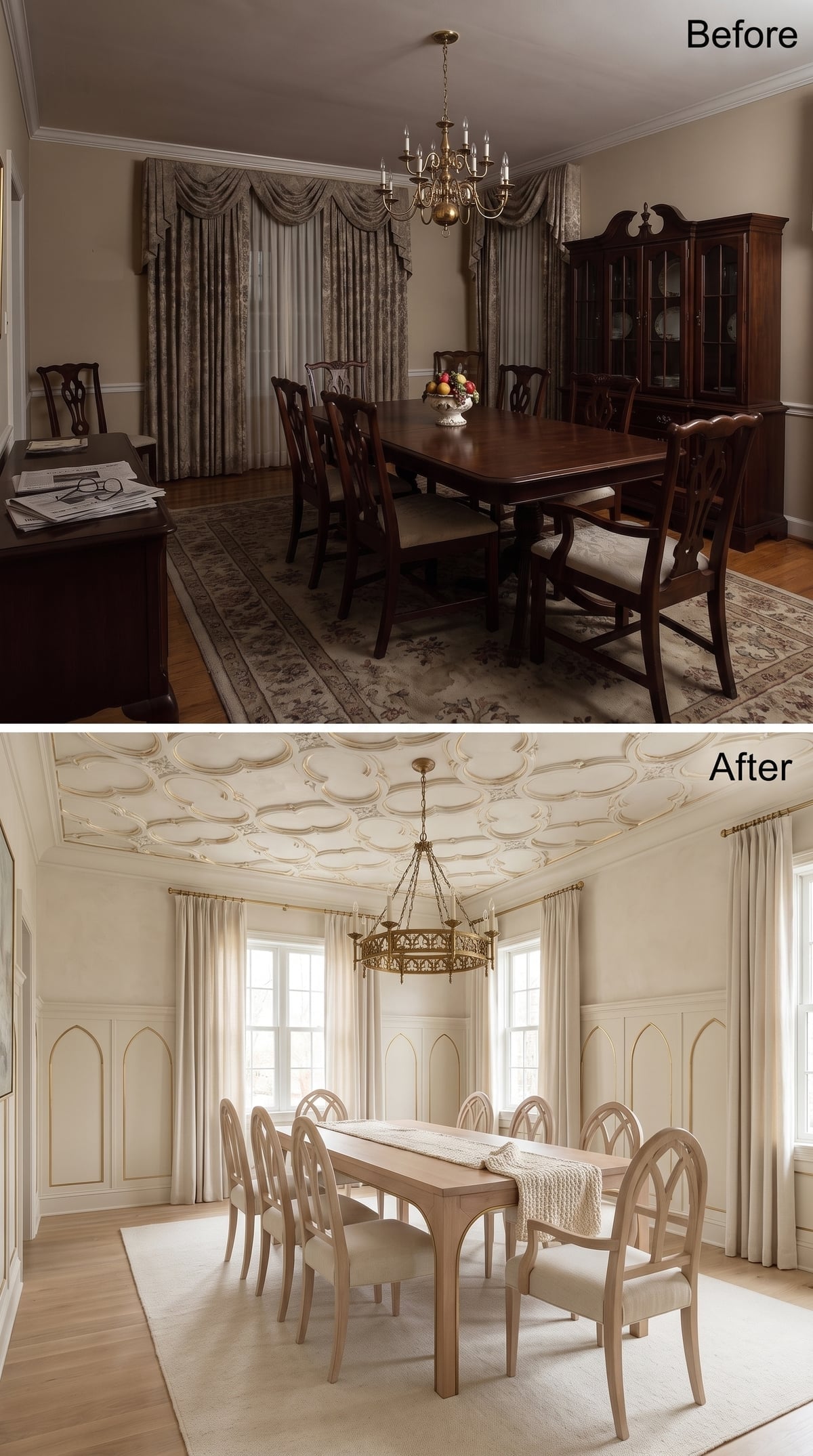
Pointed Gothic arches march around the lower walls, traced with restrained gold outlines. Above them, overlapping plaster medallions cover the ceiling with enough ornament to make plain drywall seem personally insulting.
Bleached-oak cathedral-back chairs echo the wall motif without copying it literally. A low brass ring chandelier bridges old and new, while sheer curtains keep all that architecture from turning solemn.
27. Sunburst Ceiling, Chevron Table Base, and Cream Upholstery That Finally Feels Right
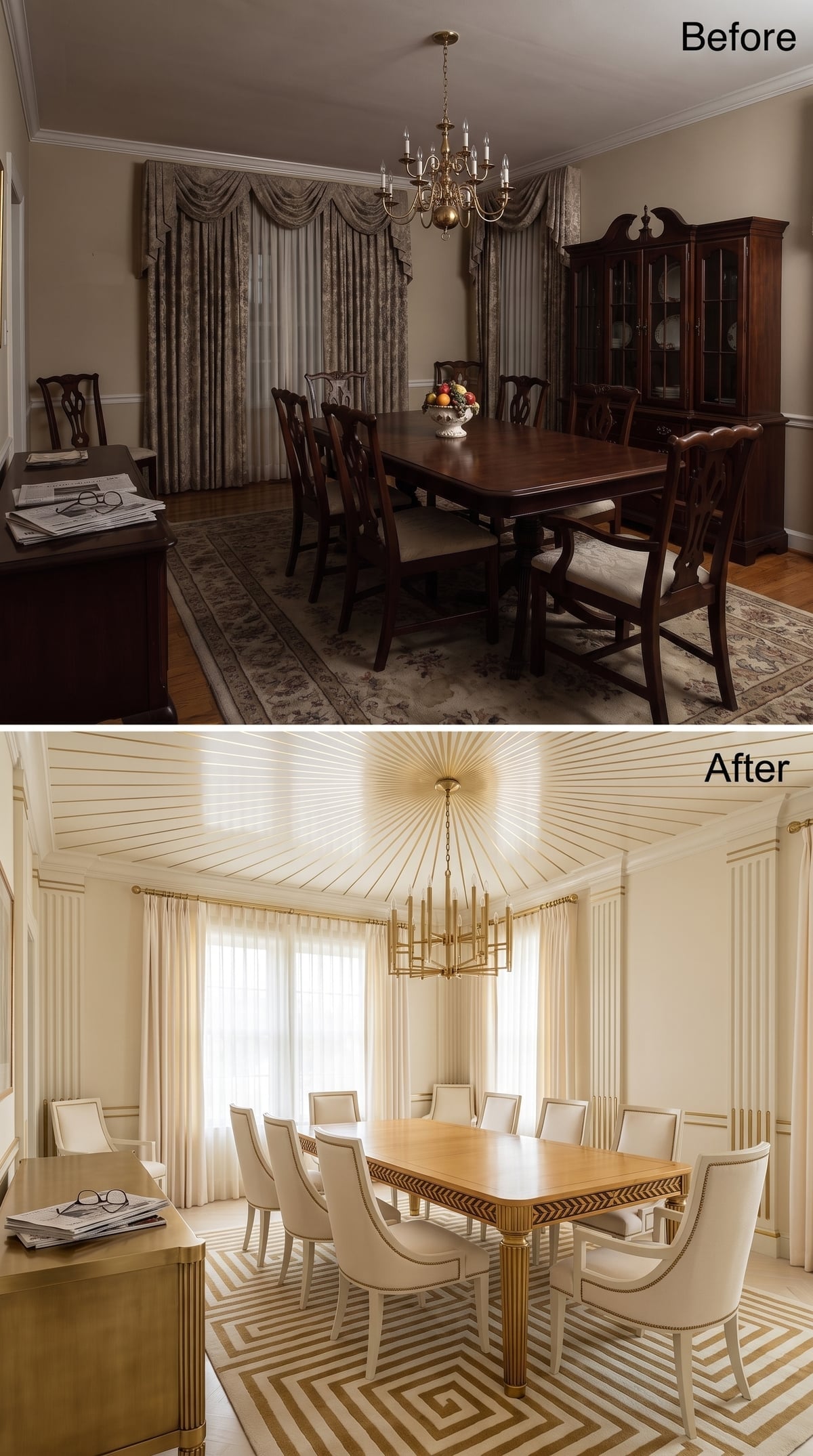
Radiating lines stretch from the center of the ceiling like a compass gone glamorous. Underneath, a chevron-inlaid table base gives the room a second point of geometric tension.
Cream linen chairs could have disappeared into the pale walls, but the strong lines above and below prevent that. The furniture gets to be soft because the architecture has already supplied the edge.
Pro Tip: Radial ceiling patterns naturally draw the eye toward their center and can make the overhead plane feel more active. Thin molding or wood strips can create the effect without requiring a fully rebuilt ceiling.
26. Moss Wall, Botanical Chandelier, and Chairs That Finally Stopped Apologizing
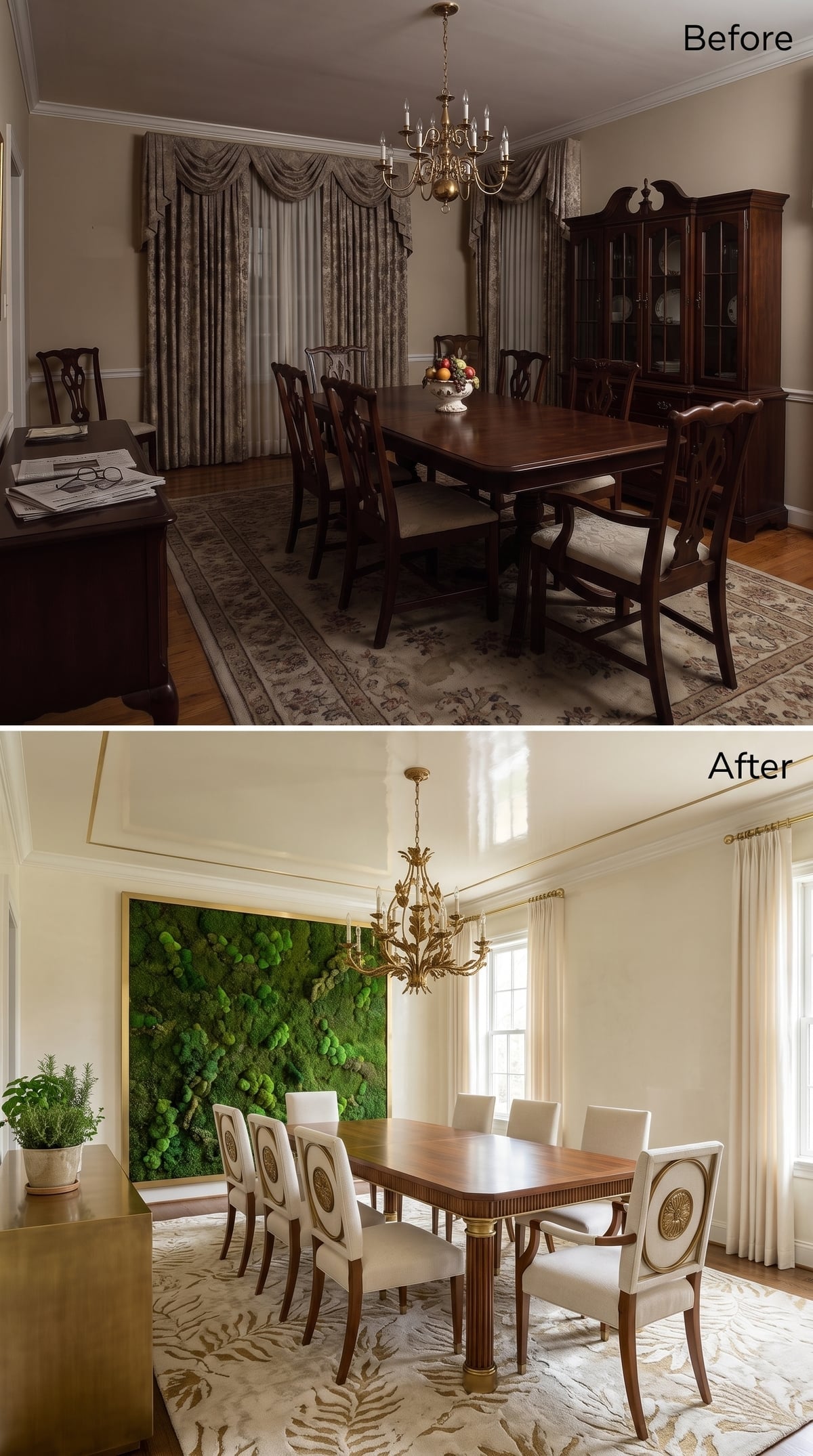
Few materials can seize a wall as completely as preserved moss. Framed in gold, the installation reads halfway between art and landscape and instantly makes the cream surroundings feel more deliberate.
Neoclassical chairs with oval backs answer in white and brass, while the table’s reeded gold legs bring enough ceremony to stand up to all that green. The botanical rug knows better than to compete; from across the room it barely announces itself.
Few materials command a wall the way preserved moss does.
25. Coffered Gold Ceiling, Ivory Upholstery, and Sheer Curtains That Flood the Room With Light
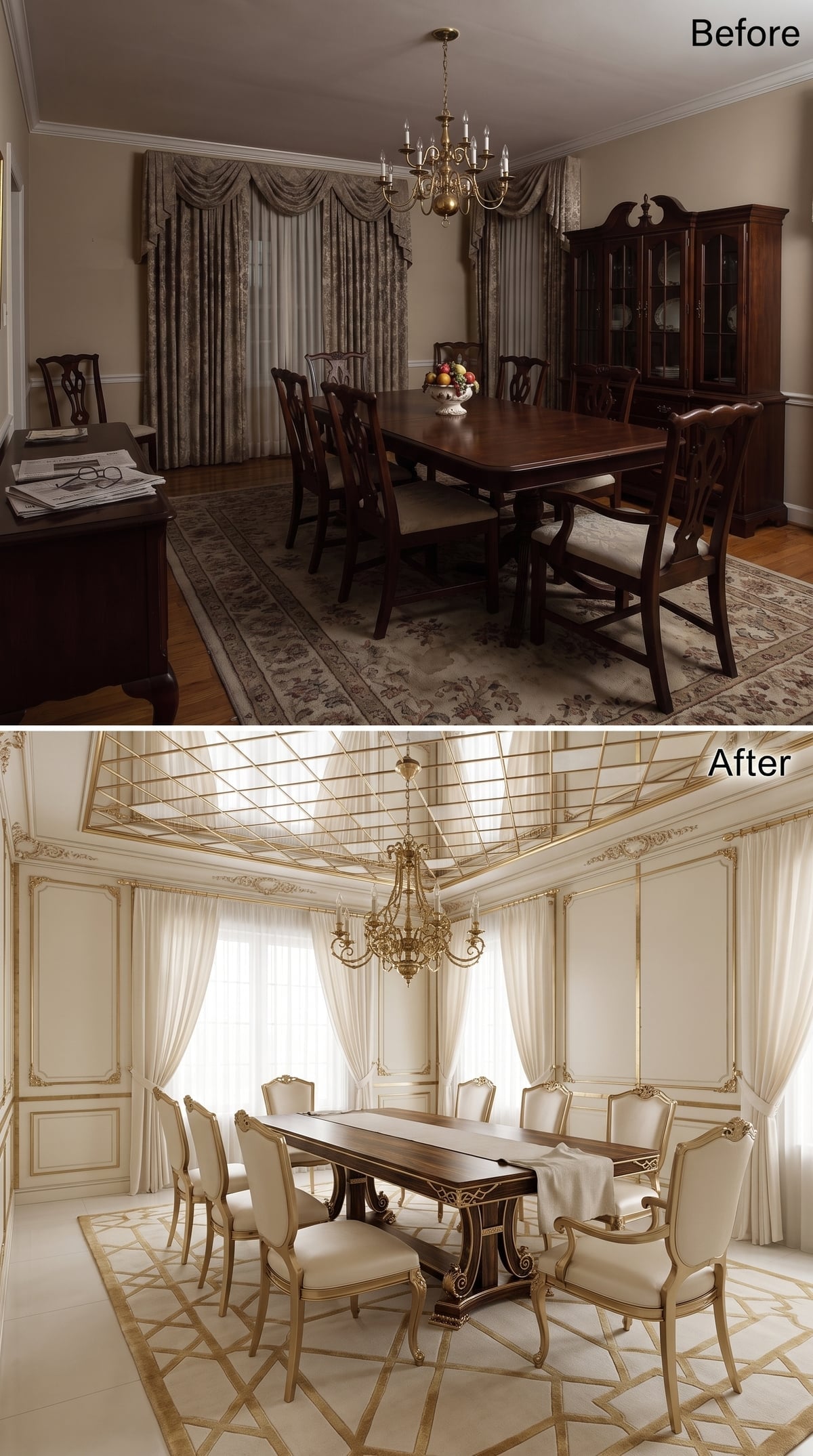
Brass lines run through the coffered ceiling like jewelry laid across architecture. The dark walnut table underneath keeps all that glow from floating away, while ivory chairs soften the transition back to the pale walls.
Sheer curtains are doing more than providing privacy. They flatten hard daylight into an even wash, which lets metallic trim sparkle without turning every surface into glare.
Trend Watch: Metallic trim inside coffers has become a popular way to add contrast without painting an entire ceiling. Real and plated metals can develop patina over time, so the finish and maintenance requirements matter as much as the initial shine.
24. Painted Brick, a Crystal-and-Brass Chandelier, and Upholstery That Finally Pulls Its Weight
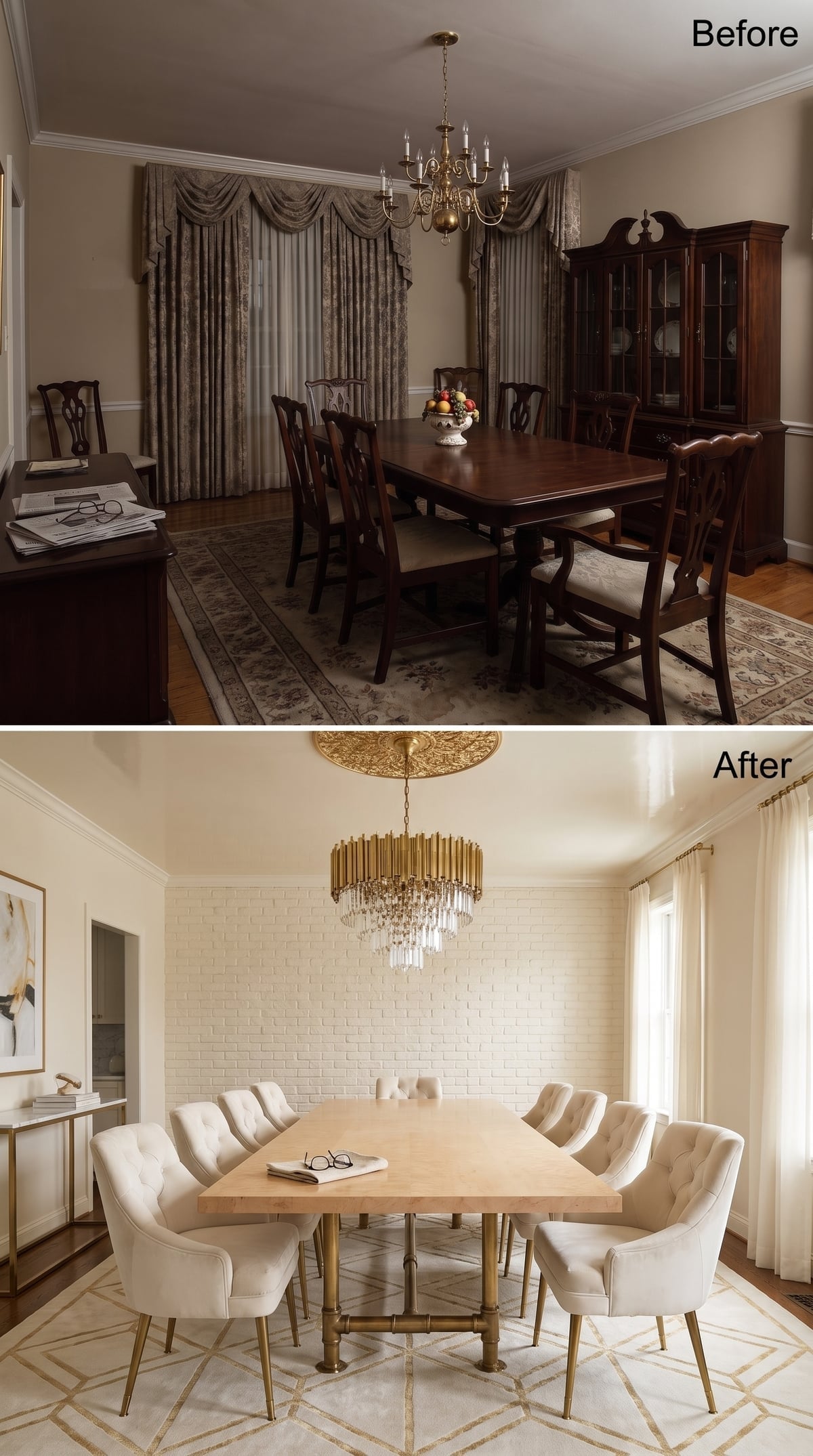
White-painted brick runs across one wall and immediately gives the pale palette something tactile to push against. Without it, the room could have drifted dangerously close to showroom beige.
Tufted chairs on gold legs surround a blonde-wood table, while a tiered crystal-and-brass chandelier supplies the polished counterpoint. Rough wall, gleaming fixture: the contrast gives both more presence.
Material Matters: Painted brick doesn’t have to read as rustic. In a room filled with tailored upholstery and polished lighting, it functions primarily as texture, especially when the brick is brought into the same cream or white family as the surrounding walls.
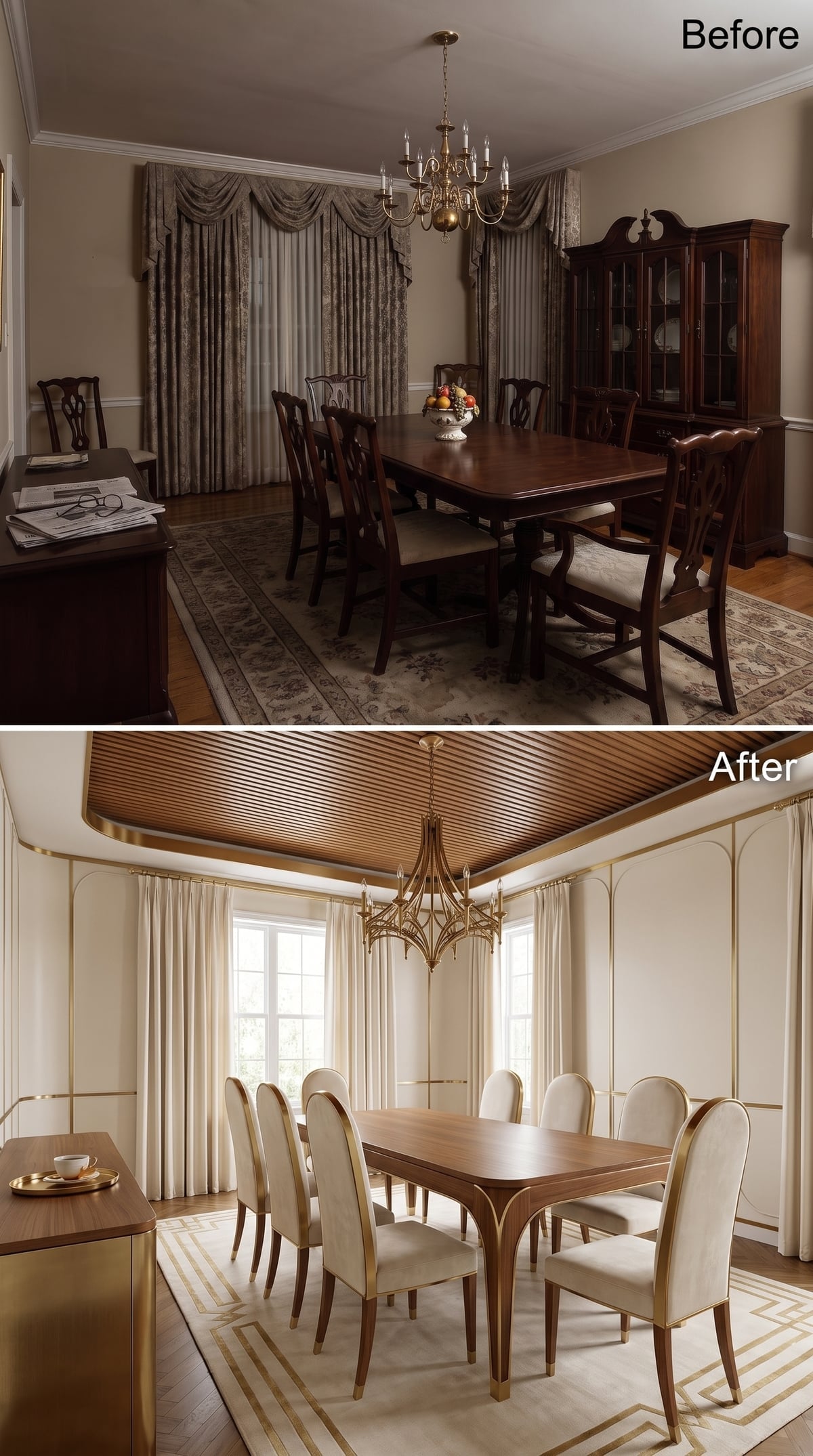
23. Slatted Walnut Ceiling, Cream Upholstery, and Brass Inlay That Finally Mean Business
🔥 Would you like to save this?
Edge-to-edge walnut slats bring warmth overhead, but a curved brass border keeps the ceiling from feeling like one heavy brown lid. The branching chandelier beneath has enough organic movement to keep the straight slats from becoming rigid.
Cream seating and sheer curtains do the balancing act below. This room understands that a dark ceiling doesn’t require dark walls to justify itself.
Ask Yourself: Before adding dark wood overhead, consider the direction and quantity of daylight. Pale walls, large windows and sheer treatments can keep a walnut ceiling dramatic rather than oppressive.
22. Rococo Plasterwork, Sputnik Brass, and Upholstery That Finally Belongs in the Room
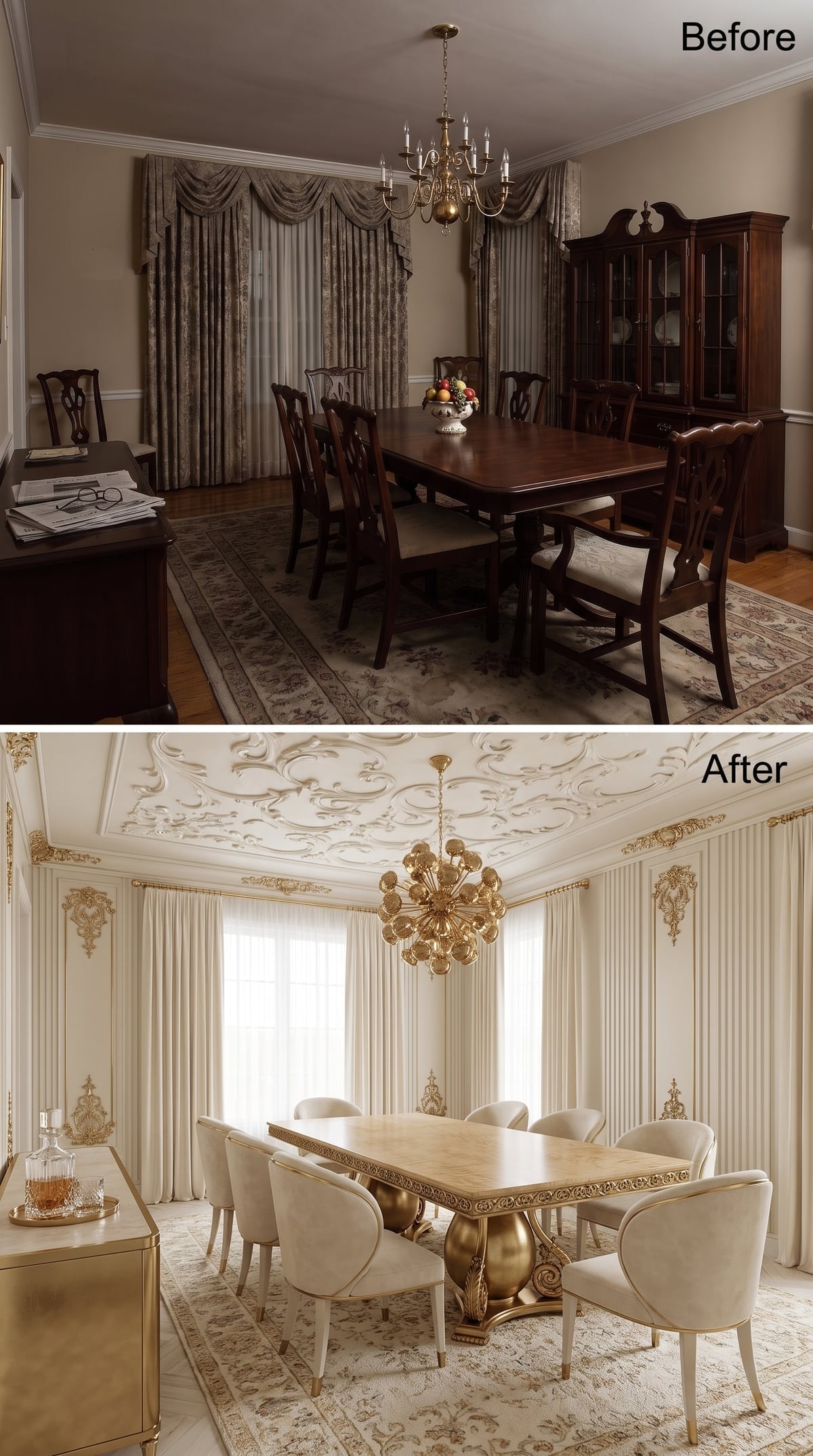
Ornamental plaster scrollwork covers the ceiling, all curls, medallions and shadows. Then somebody hangs a brushed-brass Sputnik chandelier underneath it and politely ignores the rule that historical styles should stay in their own centuries.
That friction is why the room works. Cream barrel chairs and a carved gilt table base carry the traditional side of the conversation, while the light fixture refuses to play period piece.
By The Numbers: Ornamental plasterwork has returned to many high-end interiors as homeowners and designers rediscover decorative ceilings, medallions and molding. The appeal is less about recreating one historical period than giving flat surfaces depth again.
21. Gold Brushstrokes on the Ceiling Changed Everything About This Room
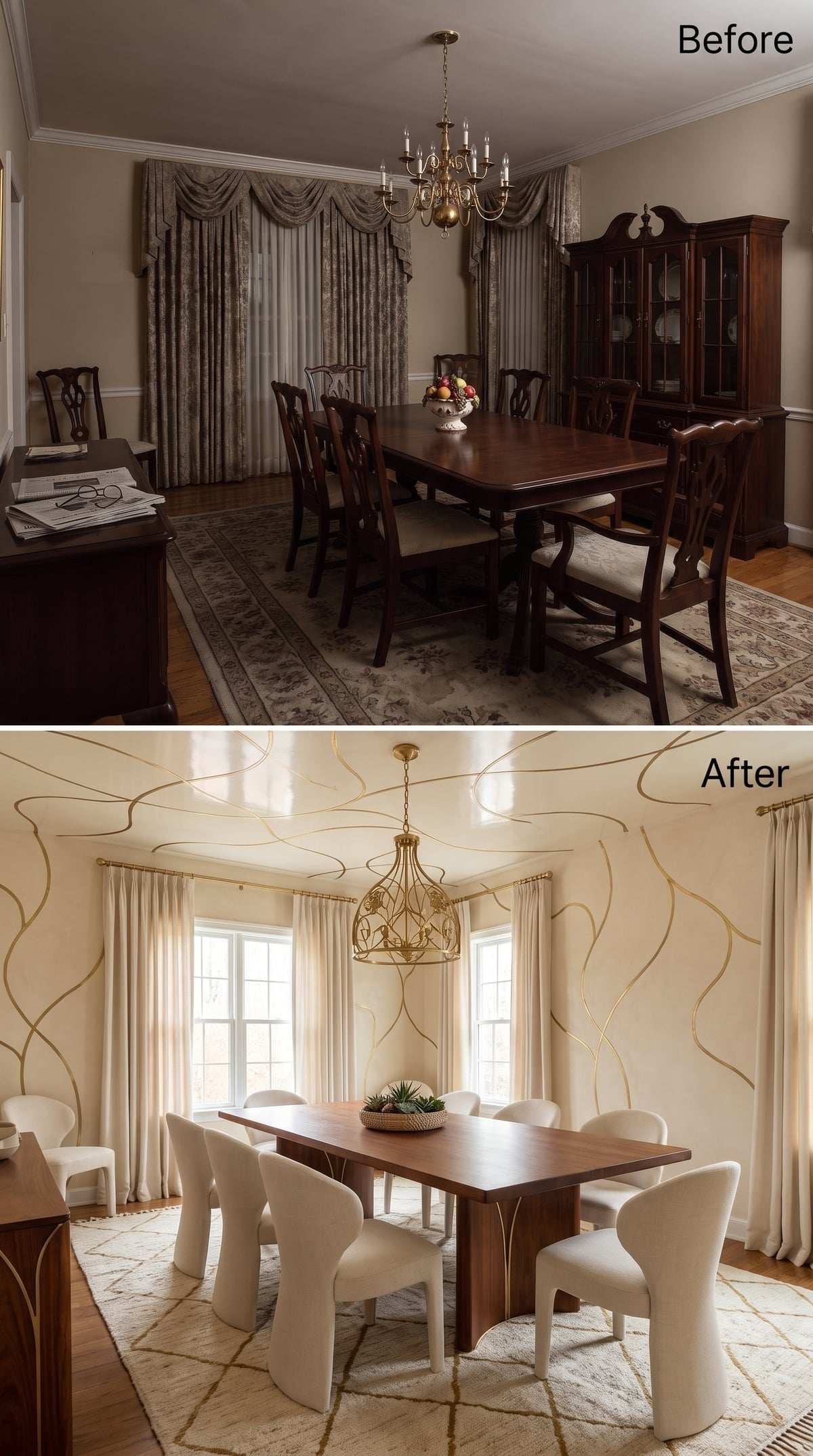
Loose gold lines sweep across the walls and ceiling as though somebody finally allowed the room to stop coloring inside the lines. The gesture is expressive enough that a conventional chandelier would have felt strangely timid.
Instead, a sculptural gold cage fixture hangs over rounded cream chairs and a simple walnut table. The furniture deliberately backs off. When the ceiling is already improvising, the table doesn’t need a solo.
20. Exposed Beams, Arched Windows, and Brass Sconces That Actually Earn Their Place
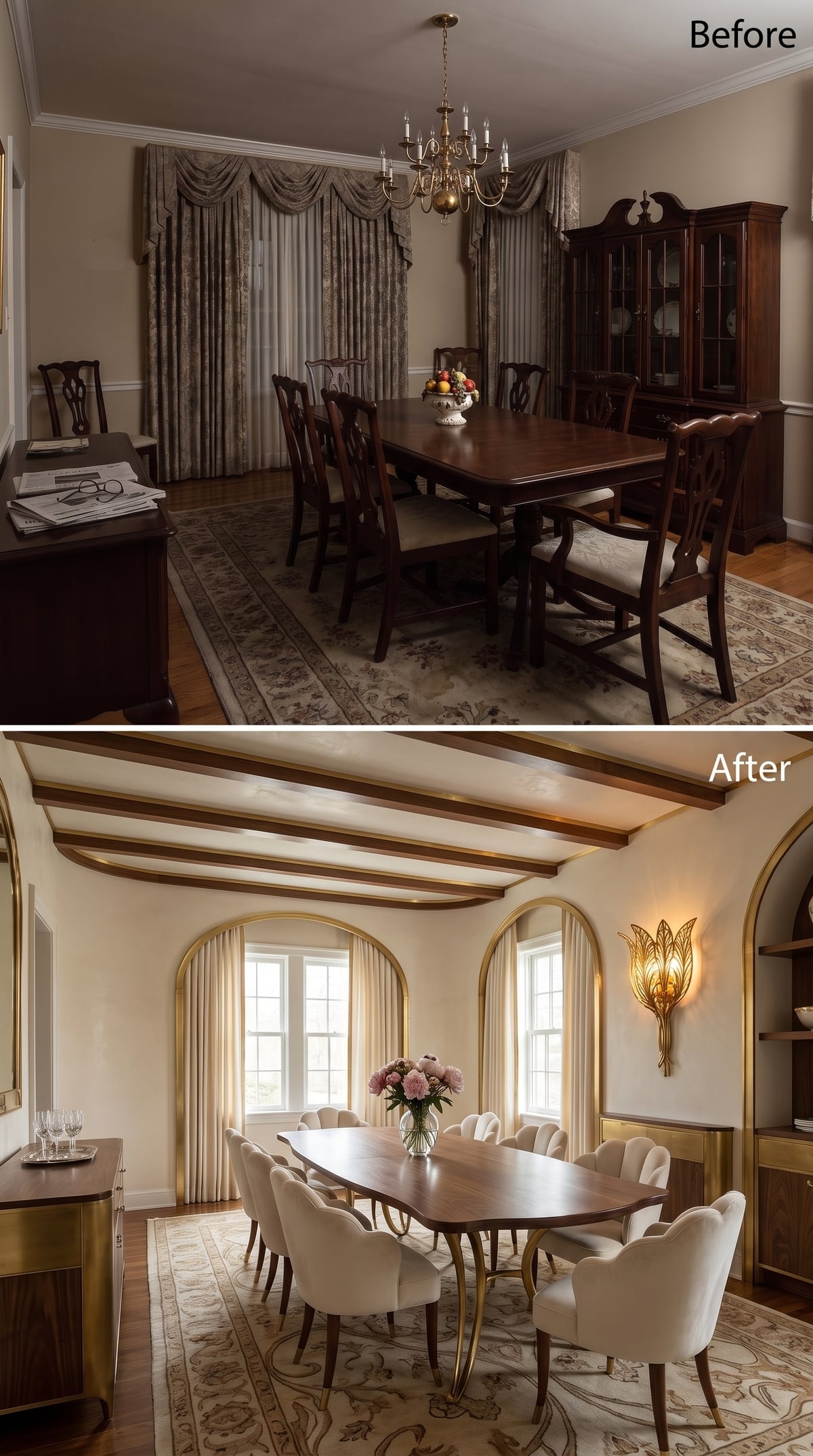
Cream plaster walls meet wood ceiling beams edged with brass, while arched windows are outlined in gold instead of buried under curtains. The effect is architectural first, decorative second.
The sculptural tulip sconce is the small move worth stealing. Rather than adding another large ceiling fixture to compete with the beams, the wall lighting places the metal at eye level and lets the windows remain the room’s main event.
19. Sculptural Plaster Walls, Coffered Ceiling, and Brass That Earns Every Inch
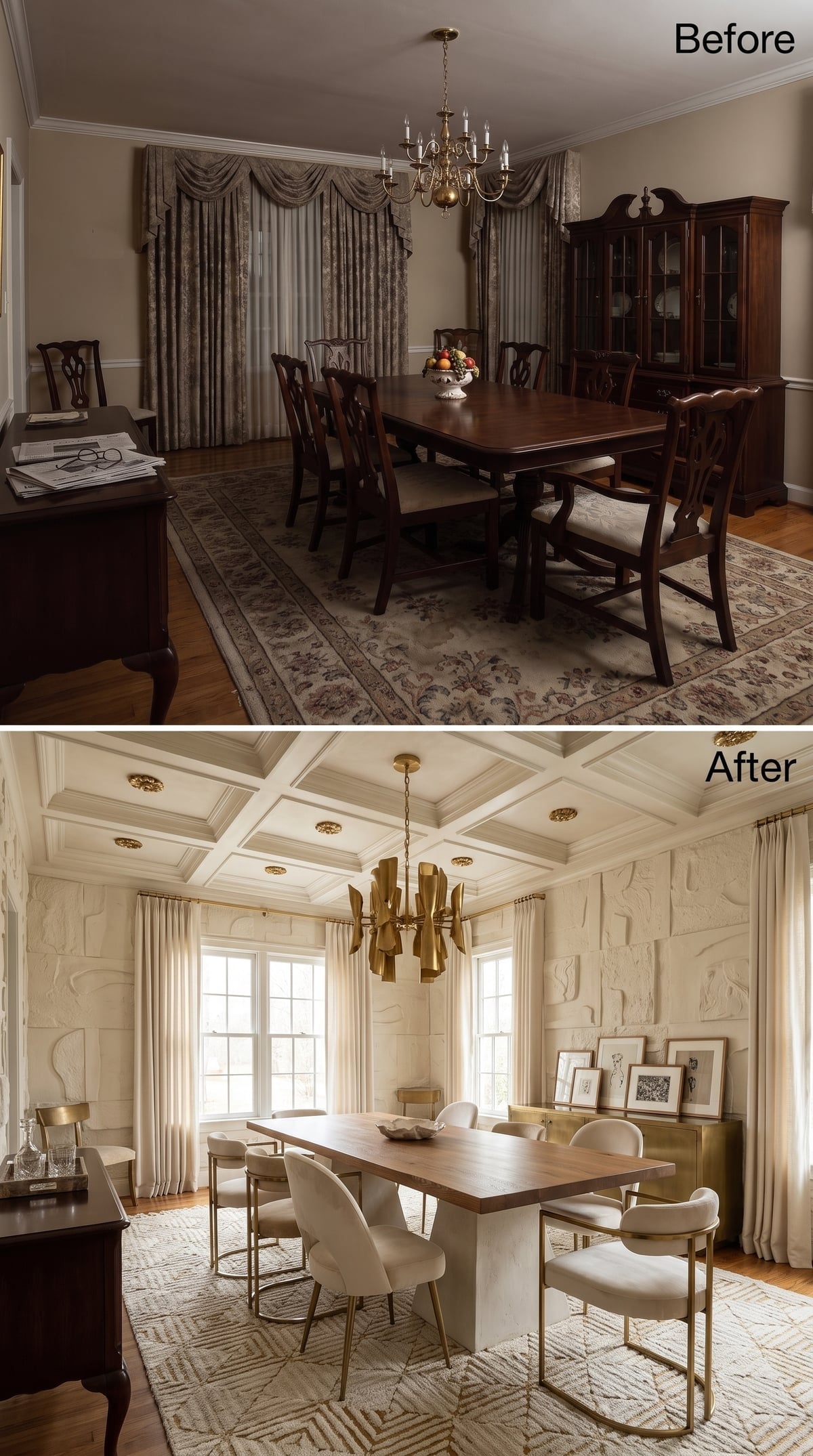
Raised plaster patterns turn the walls into shallow sculpture. Unlike wallpaper, the interest changes with the daylight: every ridge throws a different shadow as the room brightens and dims.
The ceiling stays comparatively disciplined, using coffers and small brass accents rather than another full pattern. Below, boucle chairs on slim metal legs keep the furniture visually light against walls this active.
- Sculptural plaster adds pattern through shadow rather than color
- Small metallic accents connect the ceiling to the chandelier without overwhelming the relief
- Open metal chair frames keep heavy wall texture from making the room feel crowded
18. Wallpapered Ceiling, Crystal Chandelier, and Skirted Chairs That Actually Commit
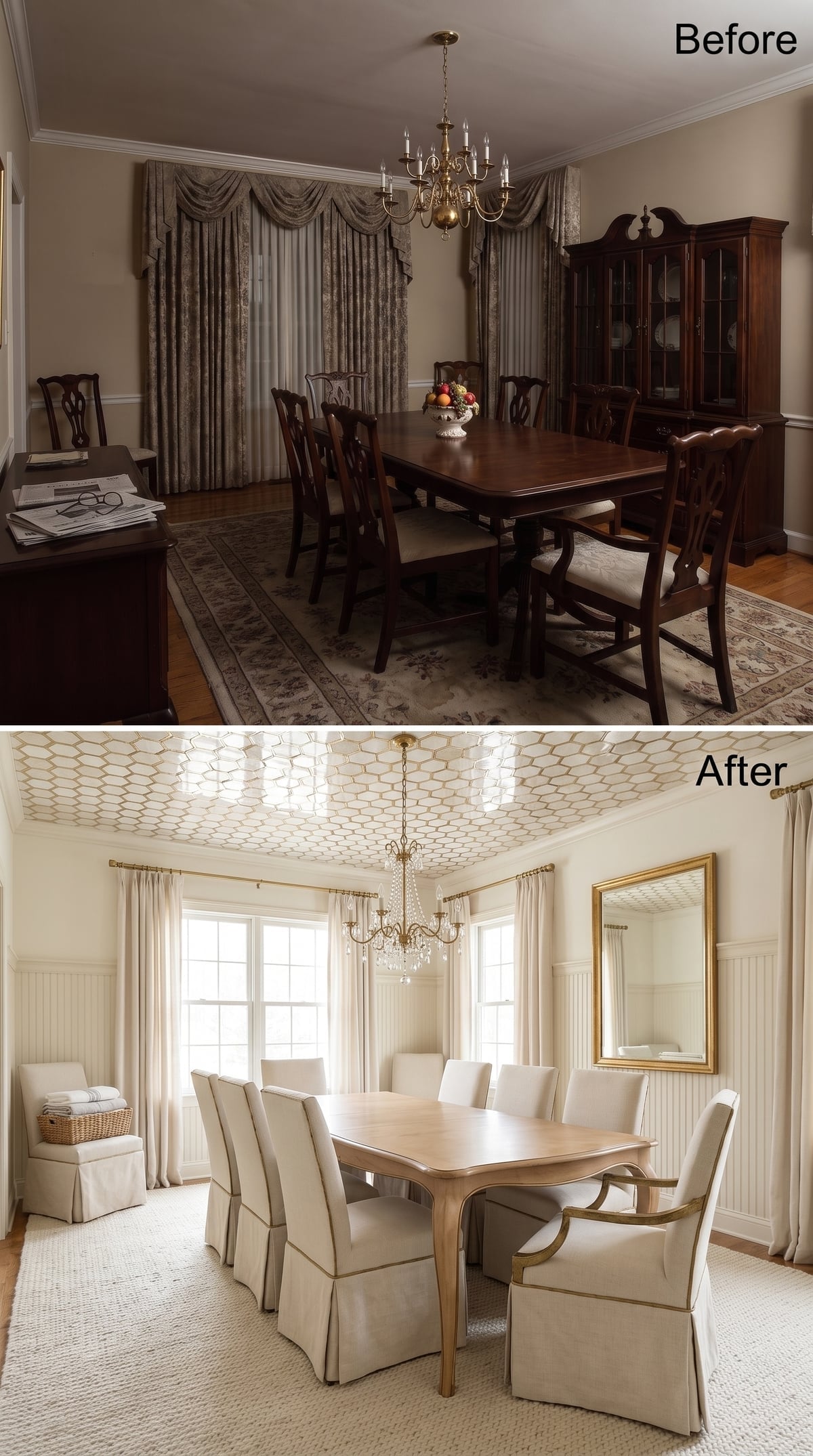
Geometric wallpaper covers the entire ceiling in a cream-and-gold honeycomb. White crown molding frames the pattern like a gigantic piece of art and stops it from bleeding visually into the walls.
Everything underneath stays remarkably quiet: skirted ivory chairs, blonde wood, a gold-framed mirror and pale beadboard. The room knows exactly which surface is allowed to misbehave.
17. Slatted Walnut Overhead, Cream Upholstery Below, and a Gold Wall Panel That Ties It Together
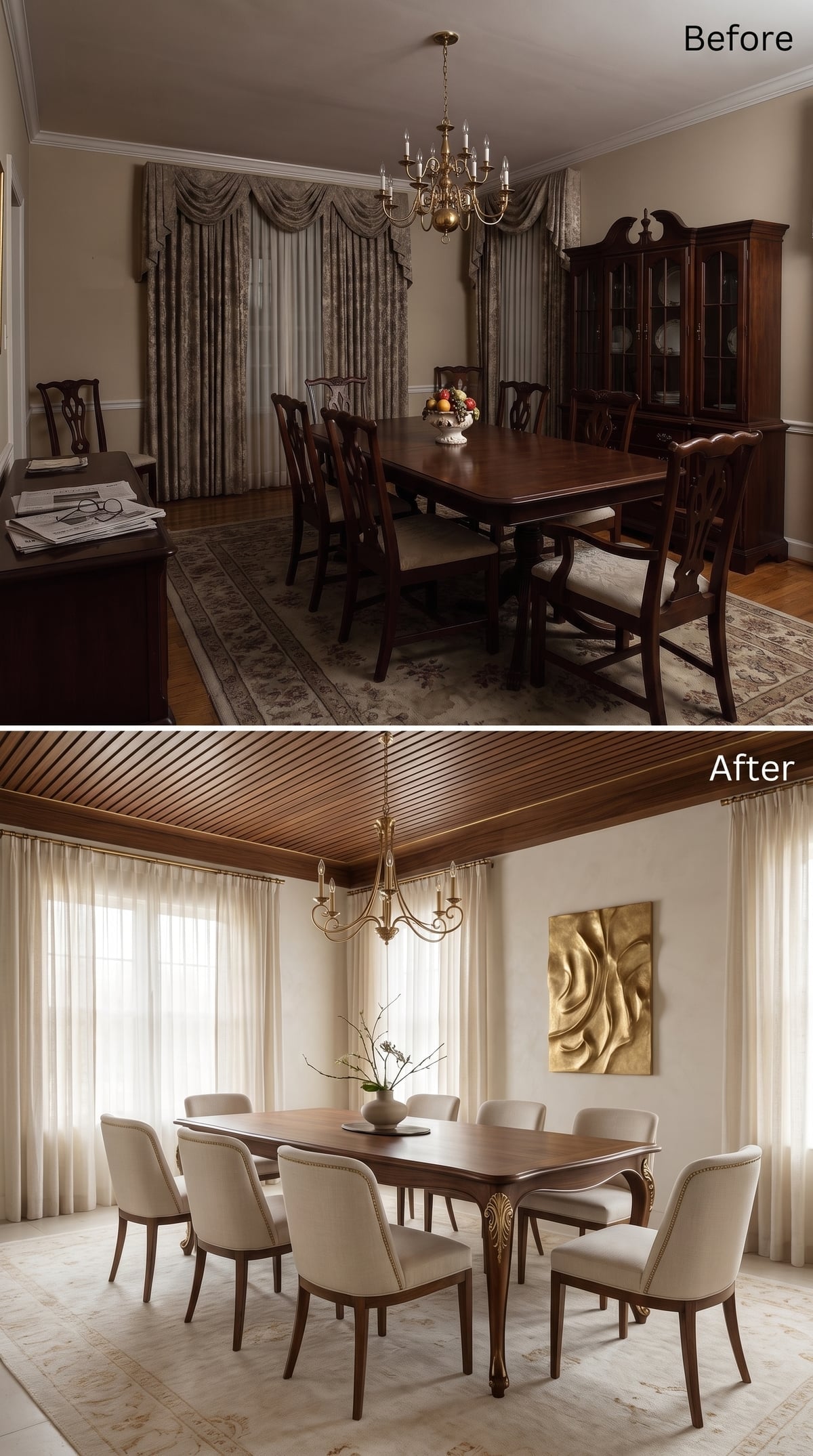
A slatted walnut ceiling stretches the room visually toward the windows, where sheer linen curtains diffuse the daylight. The wood gives the upper half warmth while the floor stays pale and open.
Below, cream linen chairs with nailhead trim surround a walnut table with gilded detailing. A sculptural gold panel takes over the far wall, leaving the centerpiece wisely restrained to a single branch.
History Corner: Upholstery tacks began as functional fasteners and gradually became decorative as furniture makers turned visible hardware into deliberate trim. Modern nailhead detailing continues that tradition without requiring pattern or contrasting fabric.
16. Botanical Plaster Ceiling, Paneled Walls, and Gold Tube Chandelier Worth Looking Up For
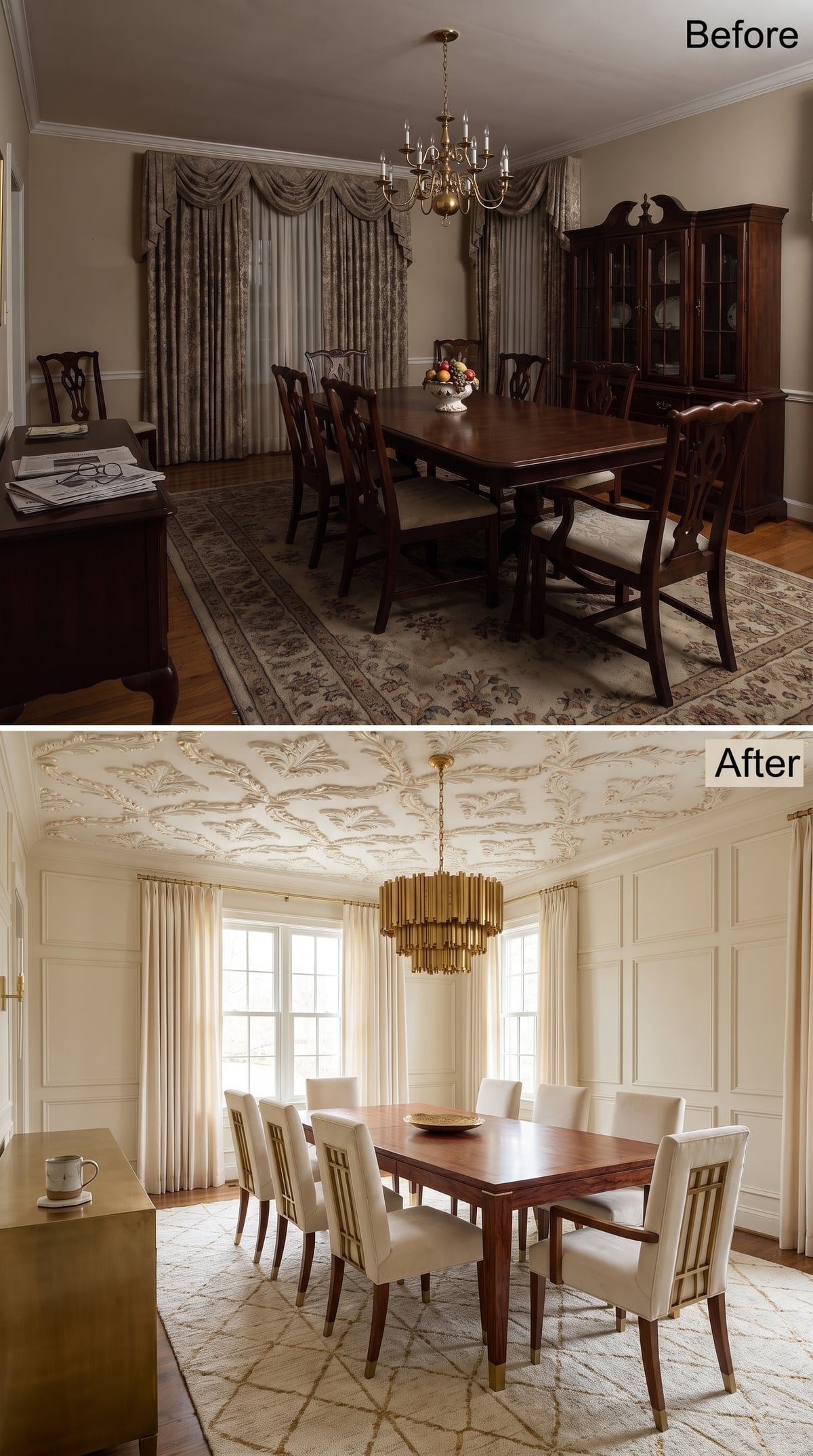
Dimensional leaves spread across the ceiling, each one casting its own small shadow. The tiered brass tube chandelier holds the center without trying to out-ornament the plaster above it.
Floor-to-ceiling wall paneling keeps the lower half disciplined, while linen chairs and brass-capped table legs carry the palette downward. The room is decorative, but the hierarchy is crystal clear: ceiling first, everything else in support.
Editor’s Note: Raised ceiling relief depends heavily on light. Indirect illumination exaggerates the shadows between motifs, so fixture placement should be considered before decorative plasterwork is installed rather than after.
15. Brass Grid Ceiling, Square Table Base, and Ivory Upholstery That Finally Speak the Same Language
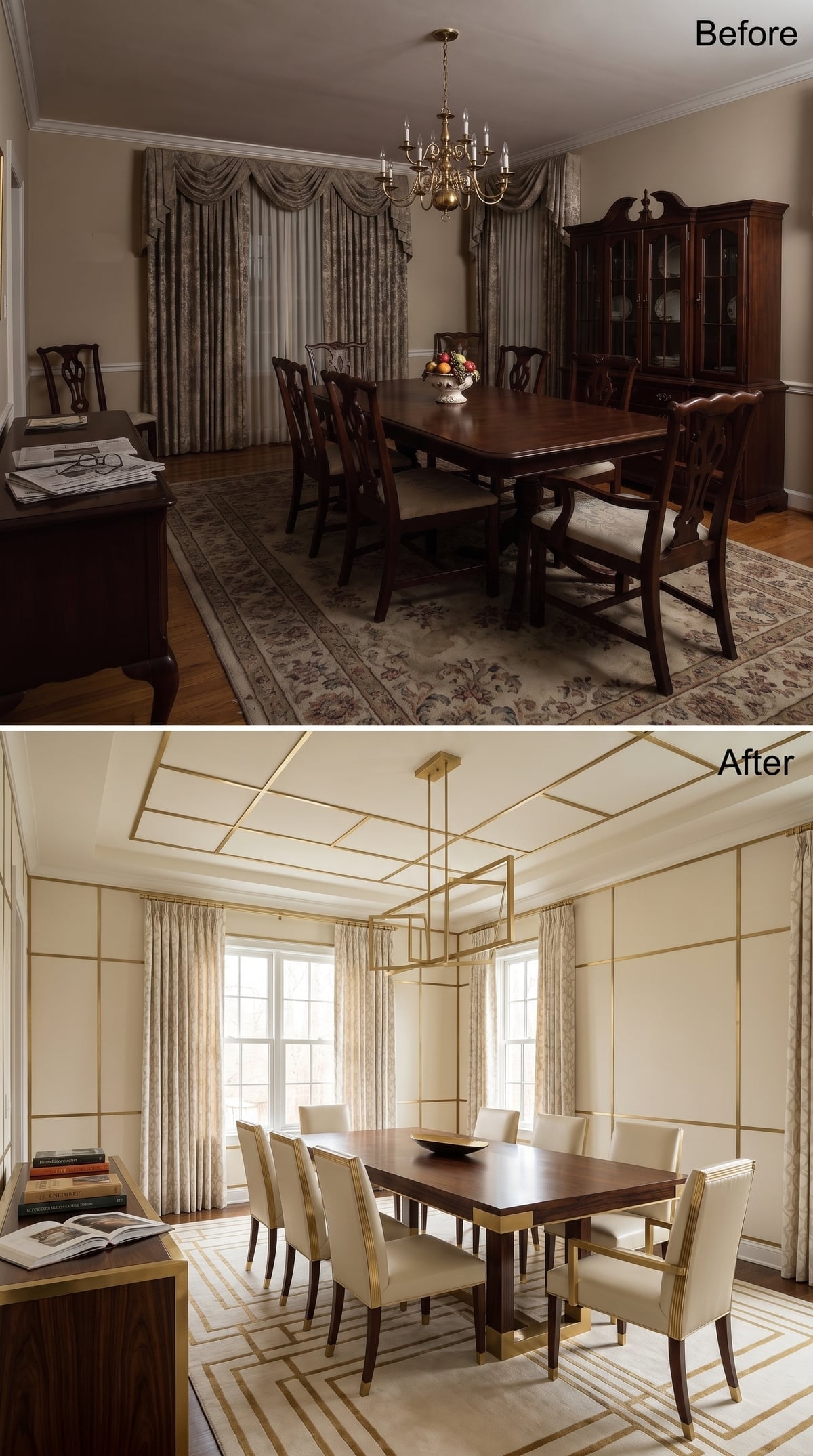
Ivory wall panels form a floor-to-ceiling grid, and brass traces that geometry across the ceiling, chair legs, rug border and table base. Repetition could have become obsessive. Instead, it gives the room a strong visual grammar.
The square table sits low and solid inside all those vertical lines. Sheer curtains loosen the strict geometry just enough to keep the dining room from resembling a beautifully upholstered spreadsheet.
Budget Tip: Fabric-wrapped panels can sometimes be built as removable decorative pieces rather than permanently upholstered walls. For large installations, consider mounting, electrical outlets and local material requirements before treating the project as a simple weekend DIY.
14. Slatted Wood Ceiling, Living Wall Inset, and Boucle Chairs That Earn the Lightness
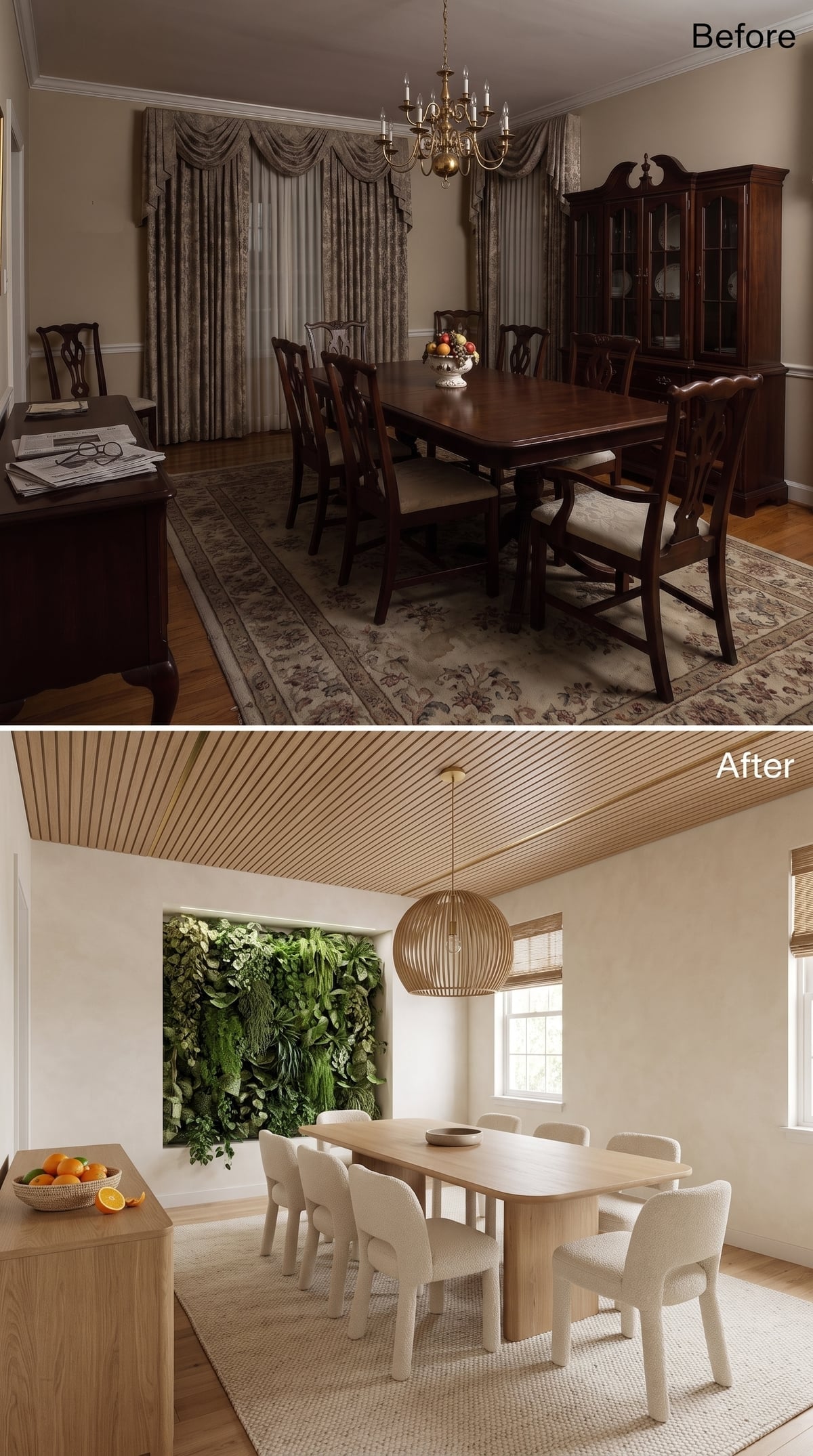
Narrow wood slats run overhead beside a woven pendant that allows light through rather than blocking it. The ceiling supplies warmth without asking the walls to go darker.
Then comes the living wall, inset into the plaster like a piece of art. That dense square of green gives all the pale furniture something to orbit. Light ash, cream boucle and a nearly white rug would fade together without one organic element willing to take the visual hit.
13. Paneled Walls, Brass Inlay, and a Ceiling That Finally Pulls Its Weight
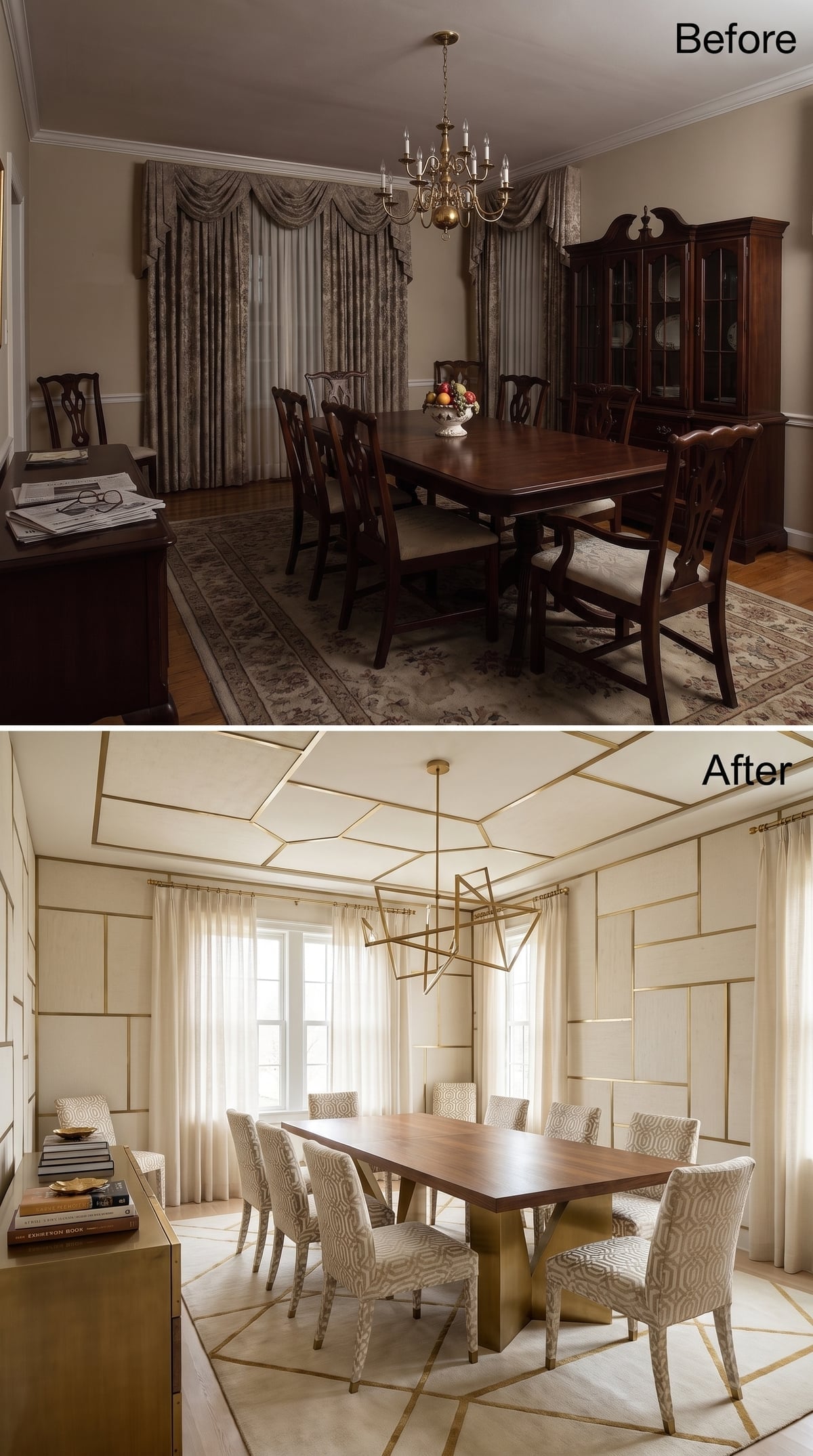
Gold lines trace a grid across both walls and ceiling, allowing two surfaces to read as one architectural system instead of unrelated upgrades. The pendant follows the same geometry rather than introducing another shape.
What saves the scheme from becoming overly precise is restraint elsewhere. Once the room has established its grid, it doesn’t need another decorative language competing for airtime.
Style Math: Repeating one finish or geometric idea across several surfaces can make a room feel cohesive without requiring every object to match. Pick the motif, repeat it selectively and know when to stop.
12. Sunburst Ceiling, Gallery Wall, and Damask Chairs That Actually Deserve Each Other
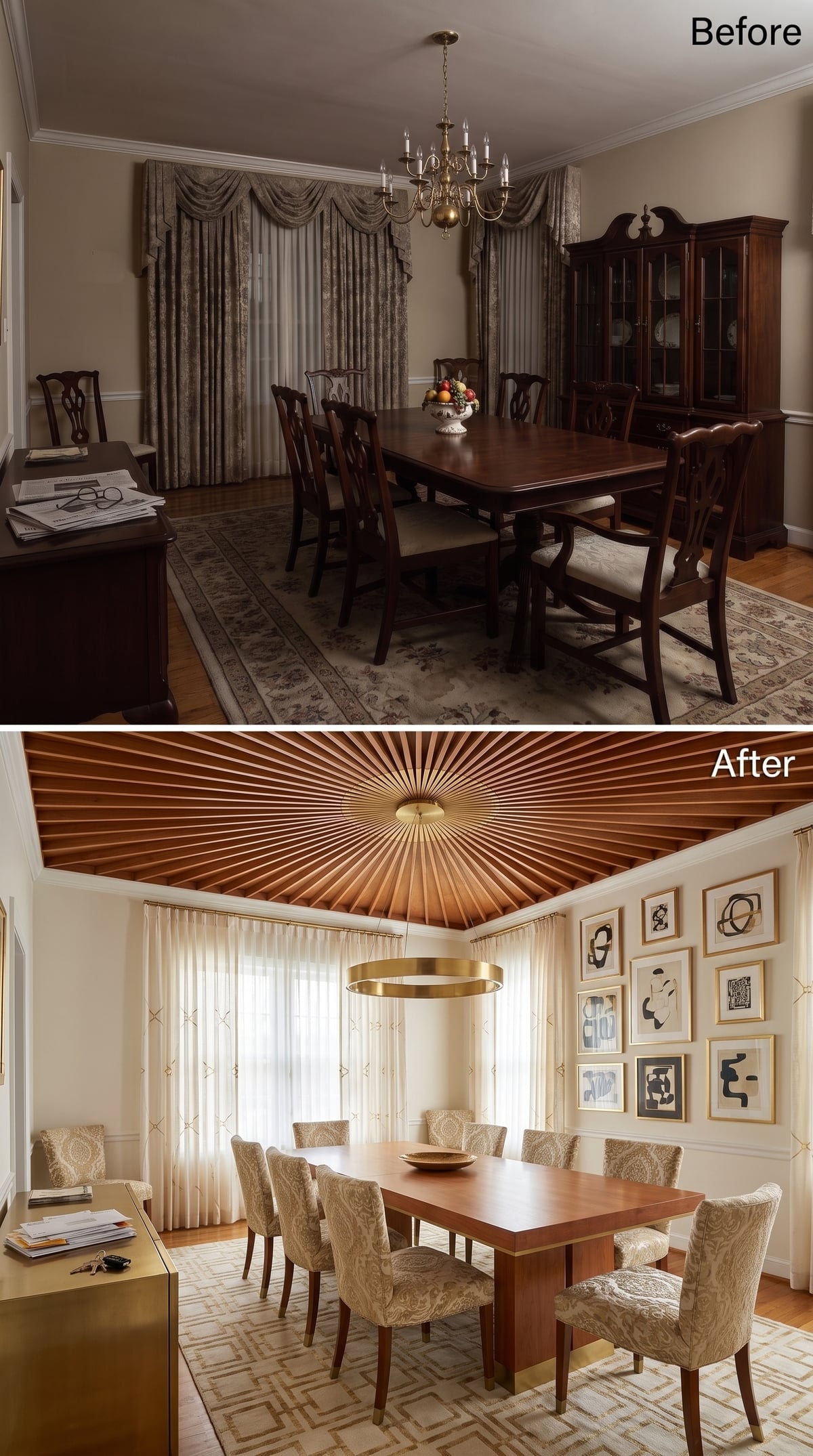
That ceiling is doing more work than anything else in the room, and it earns the attention.
Warm wood strips radiate from a brass center ring, making the ceiling feel almost structural despite being highly decorative. Below, damask chairs and a square walnut table stay grounded while sheer curtains keep the perimeter light.
Nine abstract prints line the wall in matching gold frames. A gallery that large could easily become visual static, but the repeated frames turn it into one composition rather than nine separate arguments.
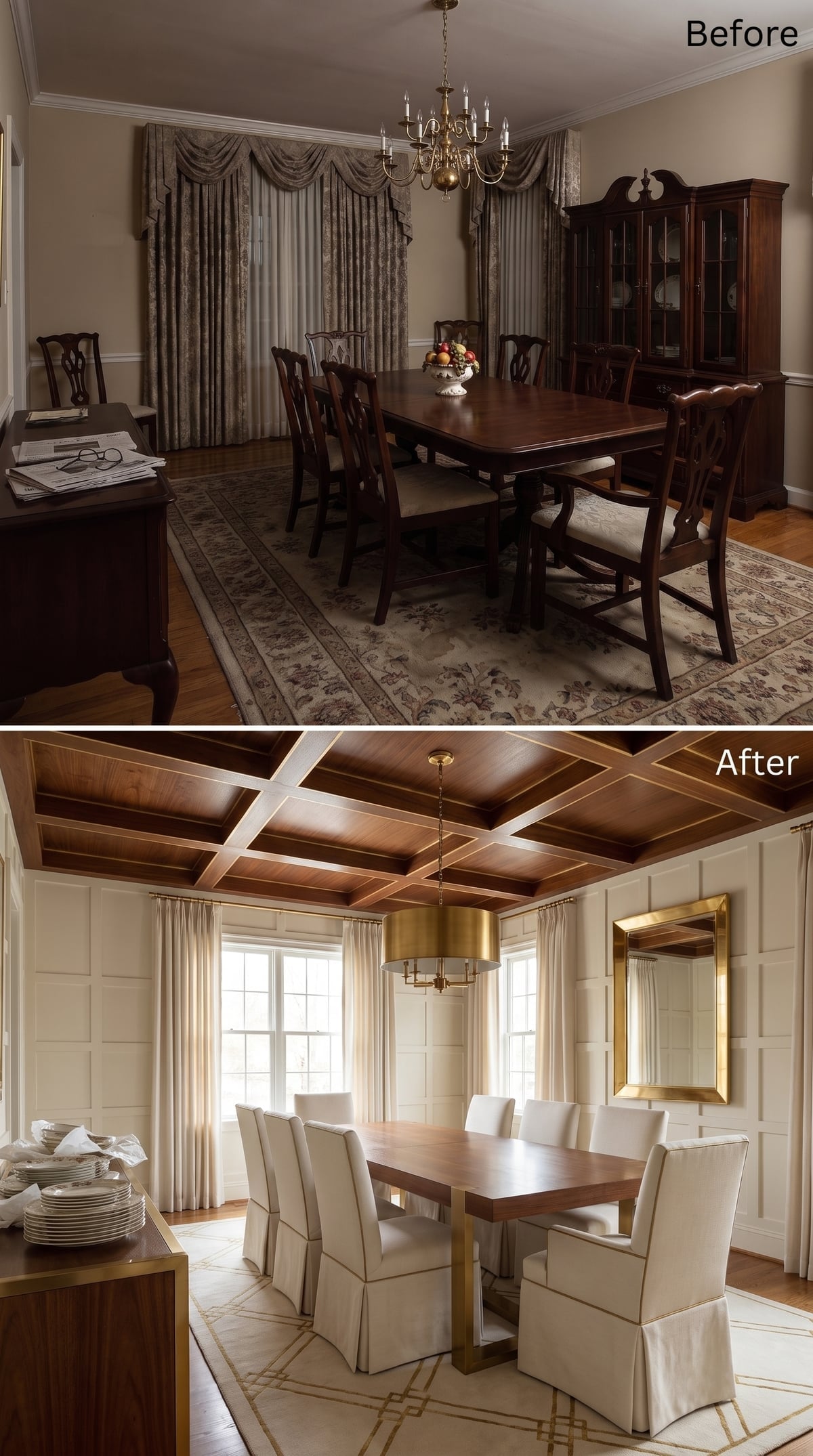
11. Coffered Walnut Overhead, Slipcovered Chairs, and Brass That Reads Across Every Surface
🔥 Would you like to save this?
Floor-length cream slipcovers create one of the softest seating groups in the gallery, which makes the walnut coffered ceiling overhead feel even more deliberate.
A brass drum pendant, table legs and mirror frame stitch the two halves together. The gold-framed mirror isn’t a decorative afterthought; positioned opposite the brighter side of the room, it helps return light into a space carrying a considerable amount of wood overhead.
The pale walls and slipcovers keep the room from feeling heavy despite how much walnut is above eye level.
10. Arched Gold Niches, Cove Lighting, and Boucle Chairs That Rewrote the Whole Room
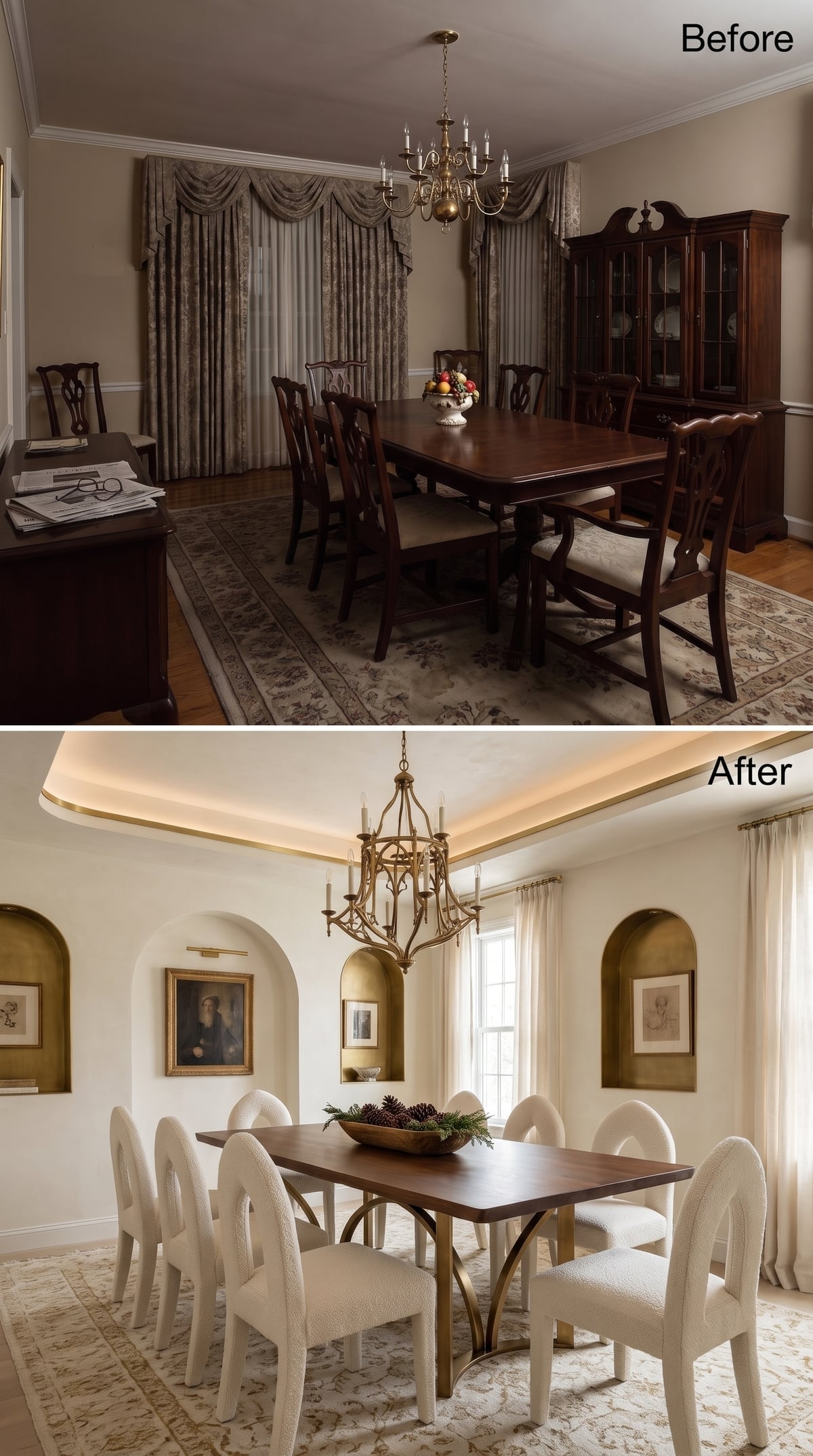
Arched wall niches finished in an aged-brass tone give the room depth without adding furniture. Instead of hanging art on a flat wall, the architecture becomes the display.
Cove lighting traces the tray ceiling with no obvious fixture interrupting the edge, while rounded cream chairs repeat the curves below. After so many grids and coffers, those arches feel almost rebellious.
9. Brass-Trimmed Coffered Ceiling, Diagonal Wall Panels, and Chairs That Finally Match the Room’s Ambition
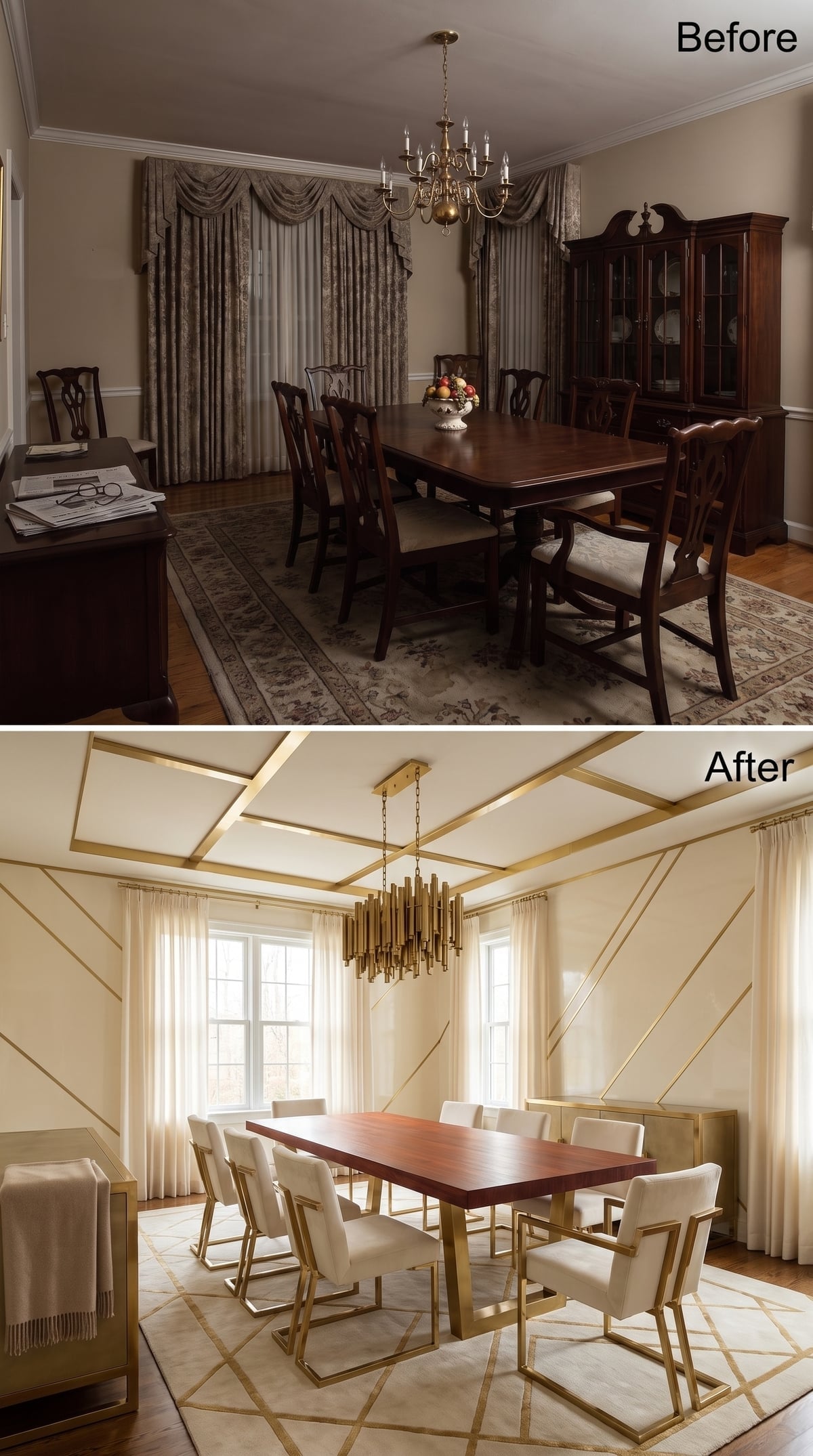
Diagonal brass lines cross the coffered ceiling and continue onto the wall panels below. The eye understands the connection before the brain has time to inventory it.
Gold-framed dining chairs with ivory seats stay simple enough to let those lines carry the room. Rather than introducing a third motif, the furniture gives the architecture room to finish its sentence.
Designer’s Secret: Continuing the same line or motif from one surface to another can make separate architectural elements feel related. Brass is especially effective because changing light makes the repeated line appear and disappear throughout the day.
After all that precision, the next room loosens its collar.
8. Scalloped Brass Pendant, Coffered Shiplap Ceiling, and Skirted Chairs That Mean Business
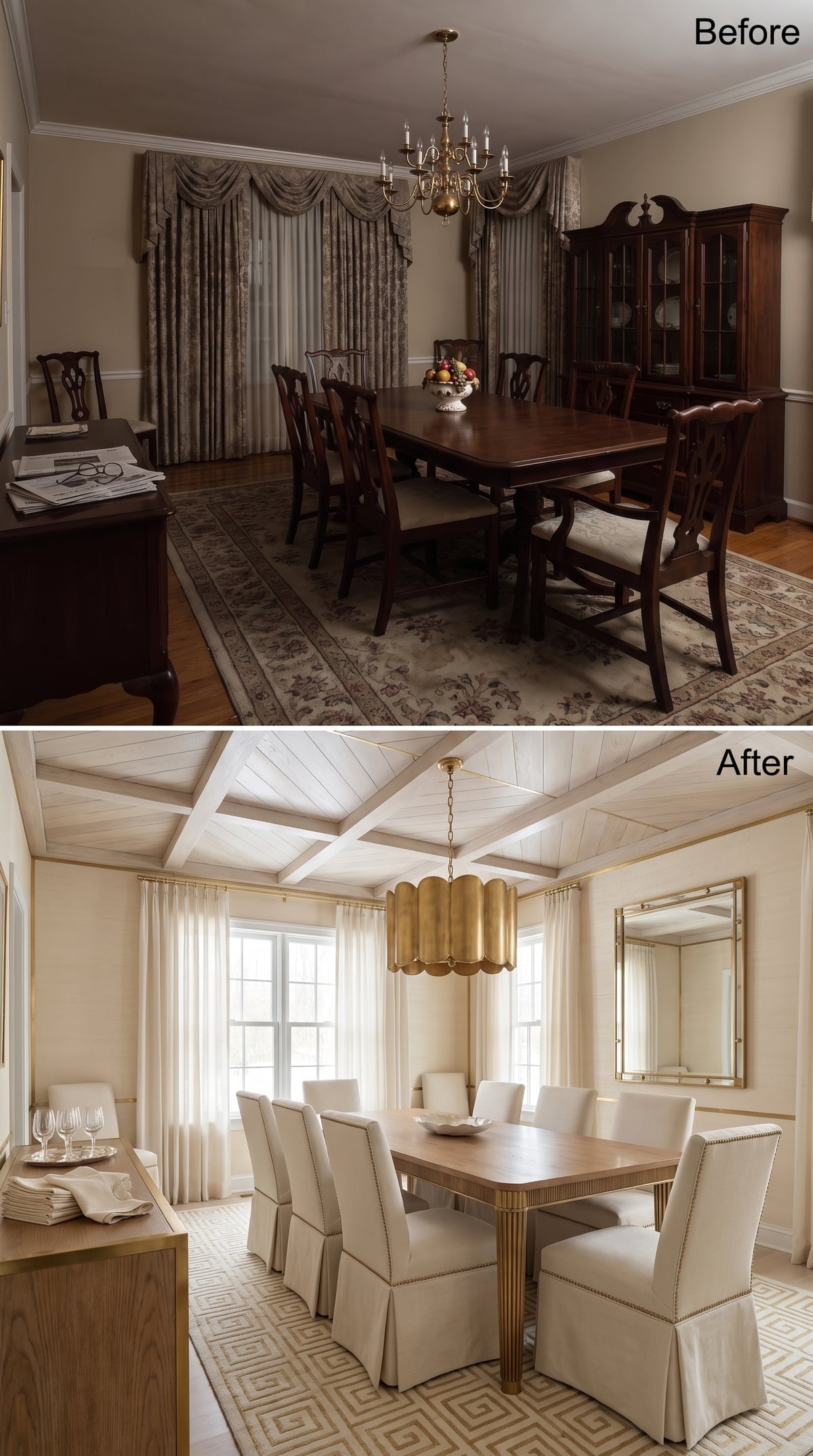
Diagonal shiplap fills the ceiling coffers, painted the same cream as the walls so the pattern arrives through shadow rather than color. A scalloped brass drum pendant gives the center enough visual weight to keep the pale room from floating away.
Skirted linen chairs soften the table’s reeded base, while a Greek-key rug supplies just enough geometry at floor level. Everything is restrained, but nothing feels anonymous.
Why It Works: A nearly monochromatic room depends on changes in texture, shadow and silhouette. Here, shiplap, linen, reeding and the scalloped pendant do more for the composition than adding another color would.
7. Walnut Beams, Brass Inlay, and White Upholstery That Finally Own the Room
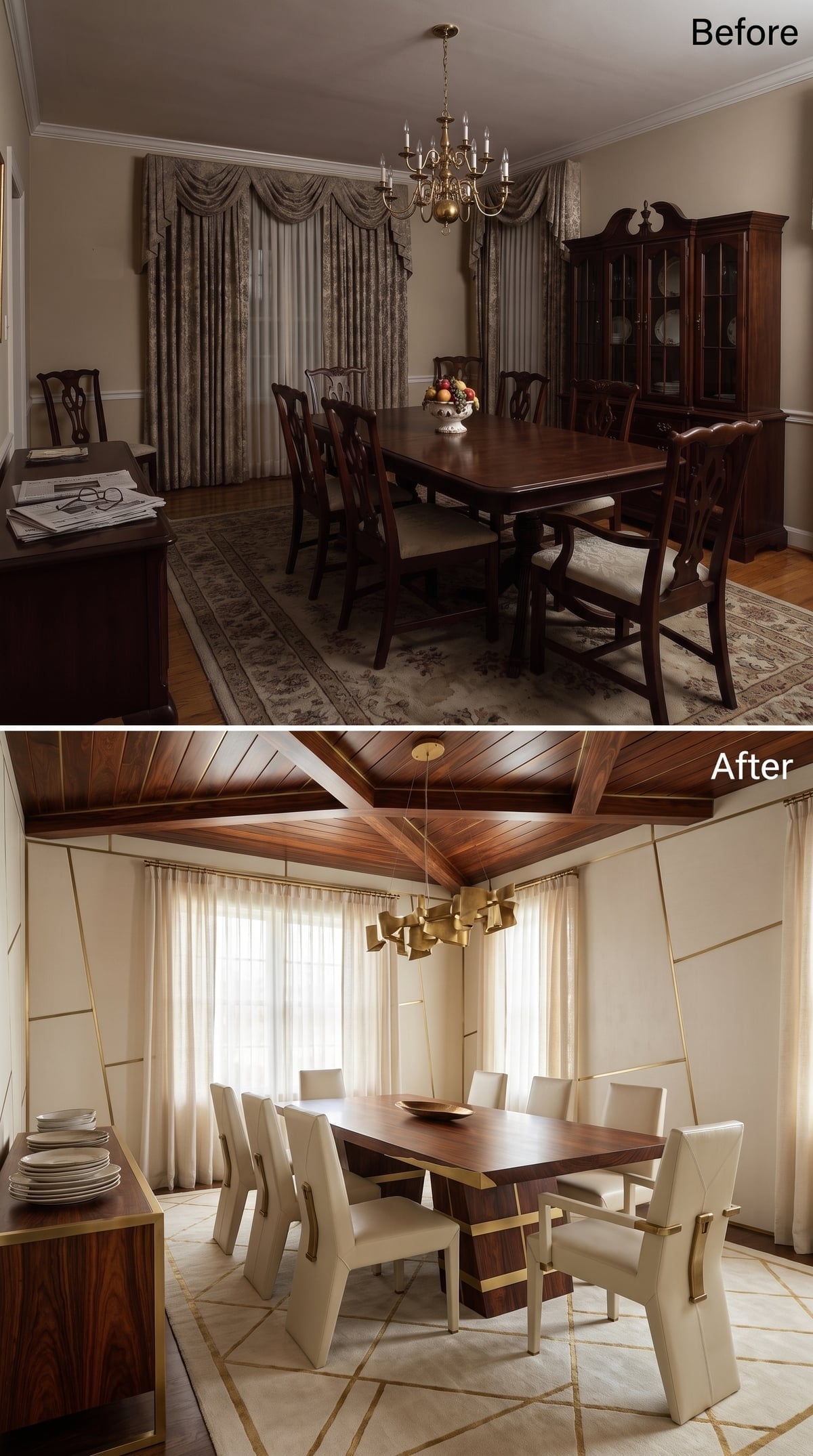
Walnut planks angle into a cathedral-like ceiling composition while diagonal brass lines repeat across walls and rug. There’s no shortage of geometry here, but it is controlled rather than frantic.
A dark walnut table and white upholstered chairs create a blunt light-dark contrast underneath all that pattern. Sheer curtains soften the edges without disguising them.
- Repeating brass lines works best when the pattern appears in more than one plane
- Walnut usually reads warmer than many pale woods under evening light
- White upholstery can be practical or demanding depending on its actual material and finish, so care instructions matter more than color alone
6. Tray Ceiling with Gold Trim, Infinity Pendant, and Chairs That Refuse to Be Ignored
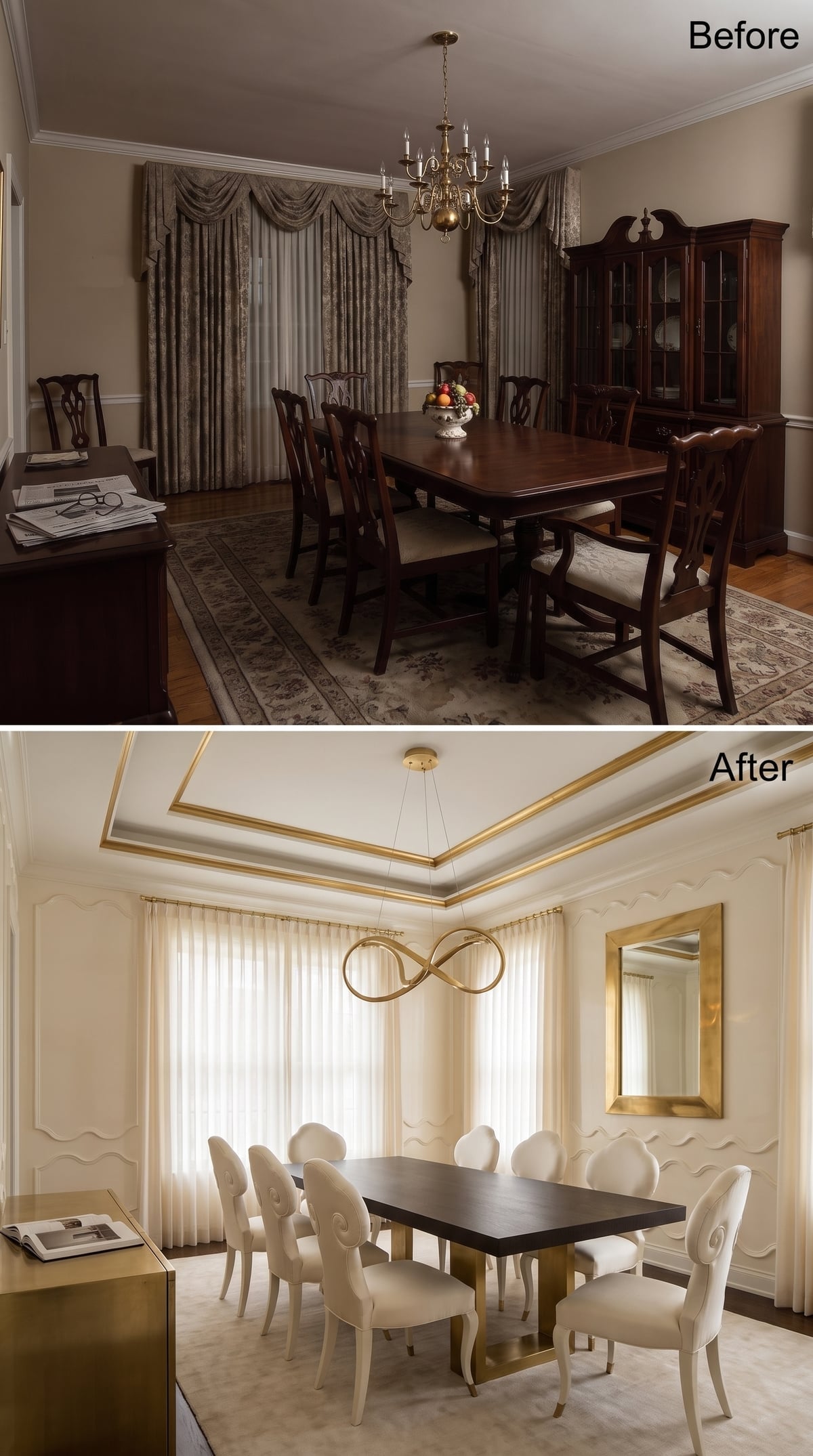
Scroll-back white chairs gather around a dark espresso table while an infinity-loop pendant hangs above like a piece of jewelry enlarged to architectural scale.
Gold trim follows the tray ceiling and mirror frame, giving the fixture a context instead of leaving it stranded overhead. This room isn’t subtle, but subtlety was never on the invitation.
5. Botanical Plaster Ceiling, Sputnik Brass, and Wainscoting That Finally Has a Point
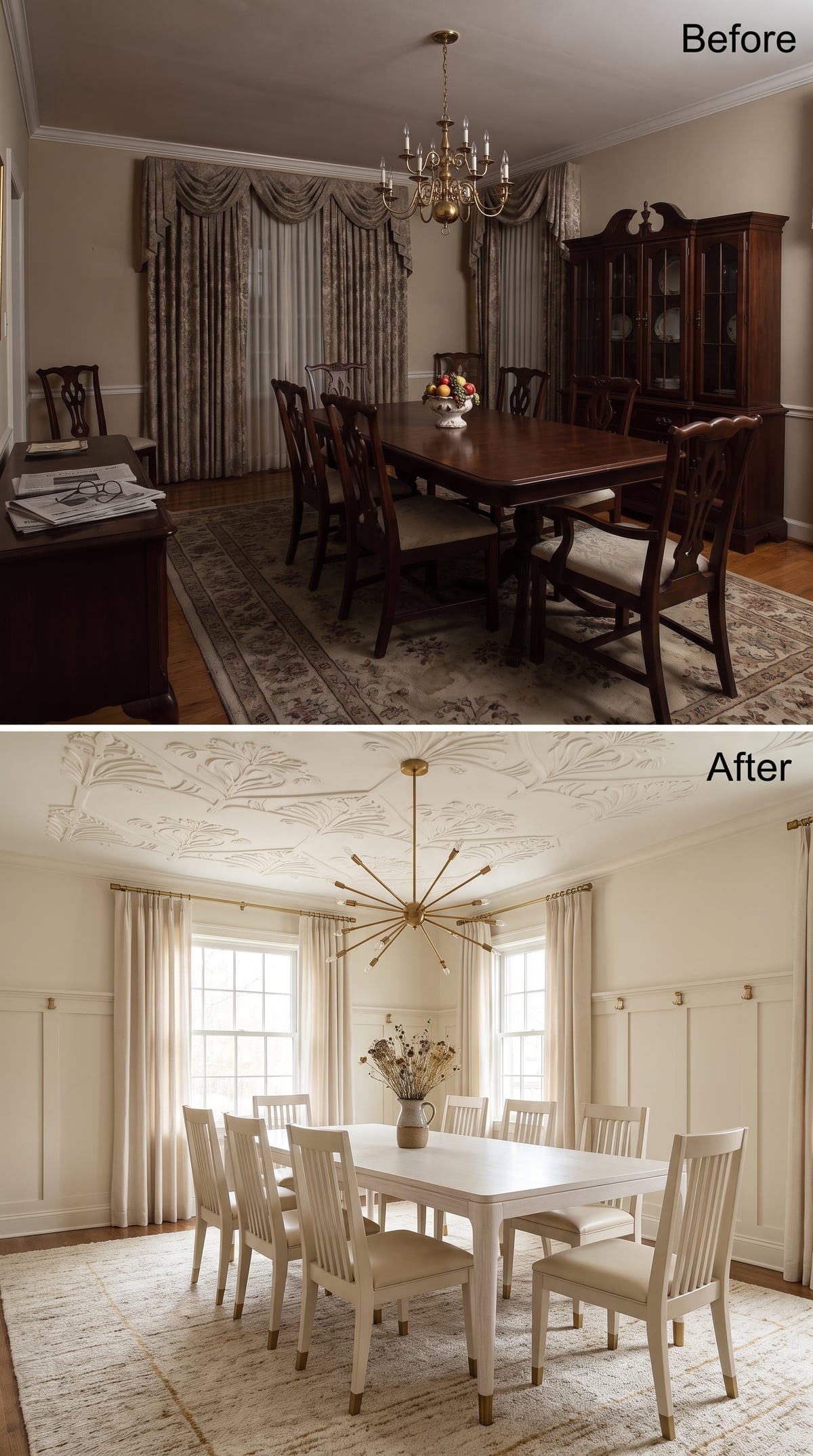
Trailing botanical relief covers the ceiling while a brass Sputnik fixture sends sharp arms through all that softness. The contrast has enough tension to keep the room from slipping into historical pastiche.
Picture-frame wainscoting stays the same cream as the walls, so the lower half contributes shadow rather than another color. Simple chairs and a pale table understand their assignment: don’t compete with the ceiling.
Why the Ceiling Relief Works Without Overpowering the Room
Leaving the plaster monochromatic means the pattern reveals itself through light instead of pigment. The chandelier marks the center of the composition without requiring another band of gilding or trim.
4. Coffered Ceiling with Gilt Rosettes, Carved Table Legs, and Chairs That Actually Commit
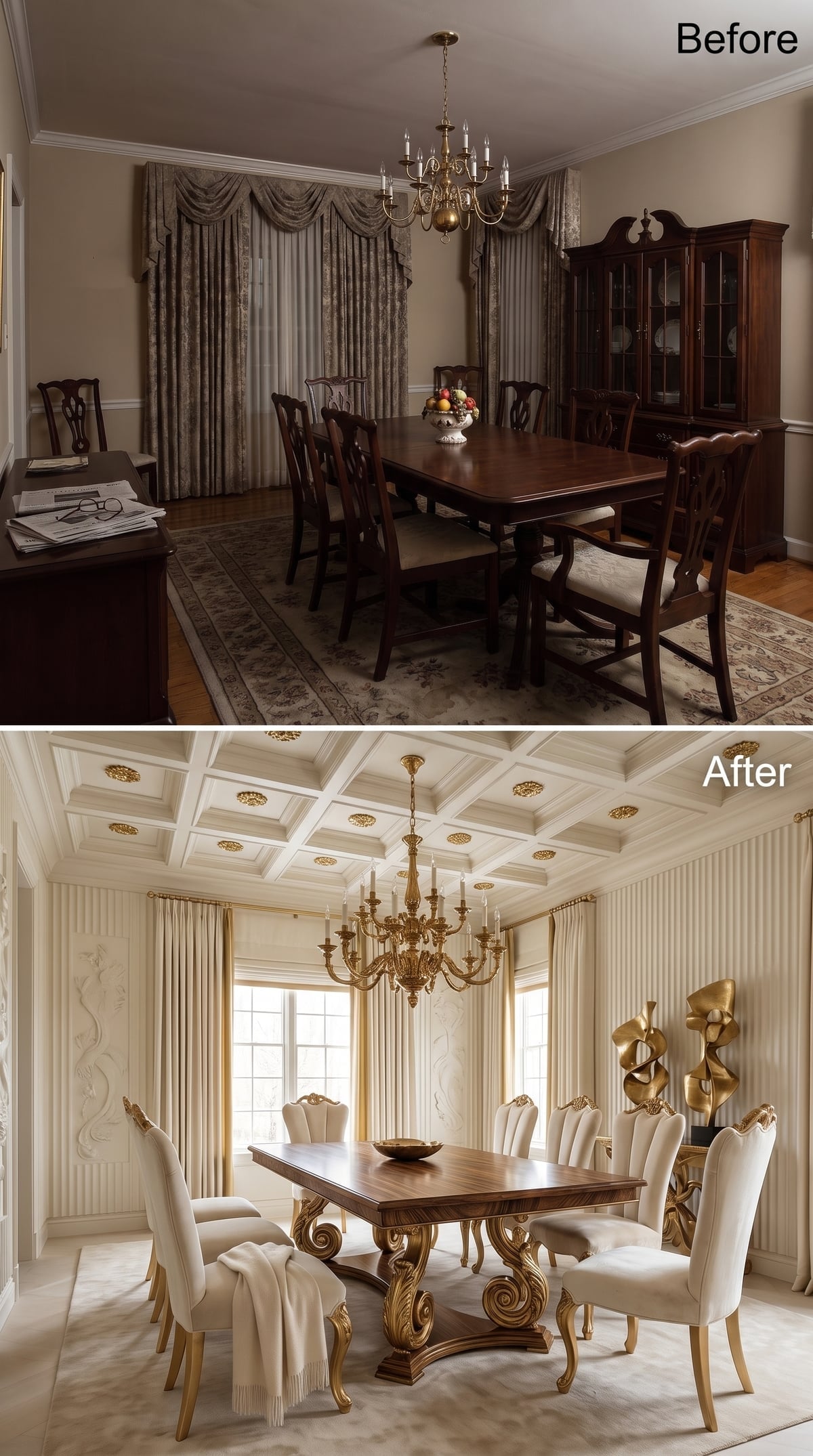
Gilt rosettes punctuate the intersections of a crisp white coffered ceiling. Each little burst of gold turns the grid from background architecture into something closer to ornament.
Below, carved and gilded table legs are theatrical enough to justify the ceiling. Ivory chairs step back, while sculptural brass pieces on the wall provide punctuation rather than another paragraph.
3. Tray Ceiling with Gold Banding, Geometric Rug, and Boucle Chairs That Hold the Room Together
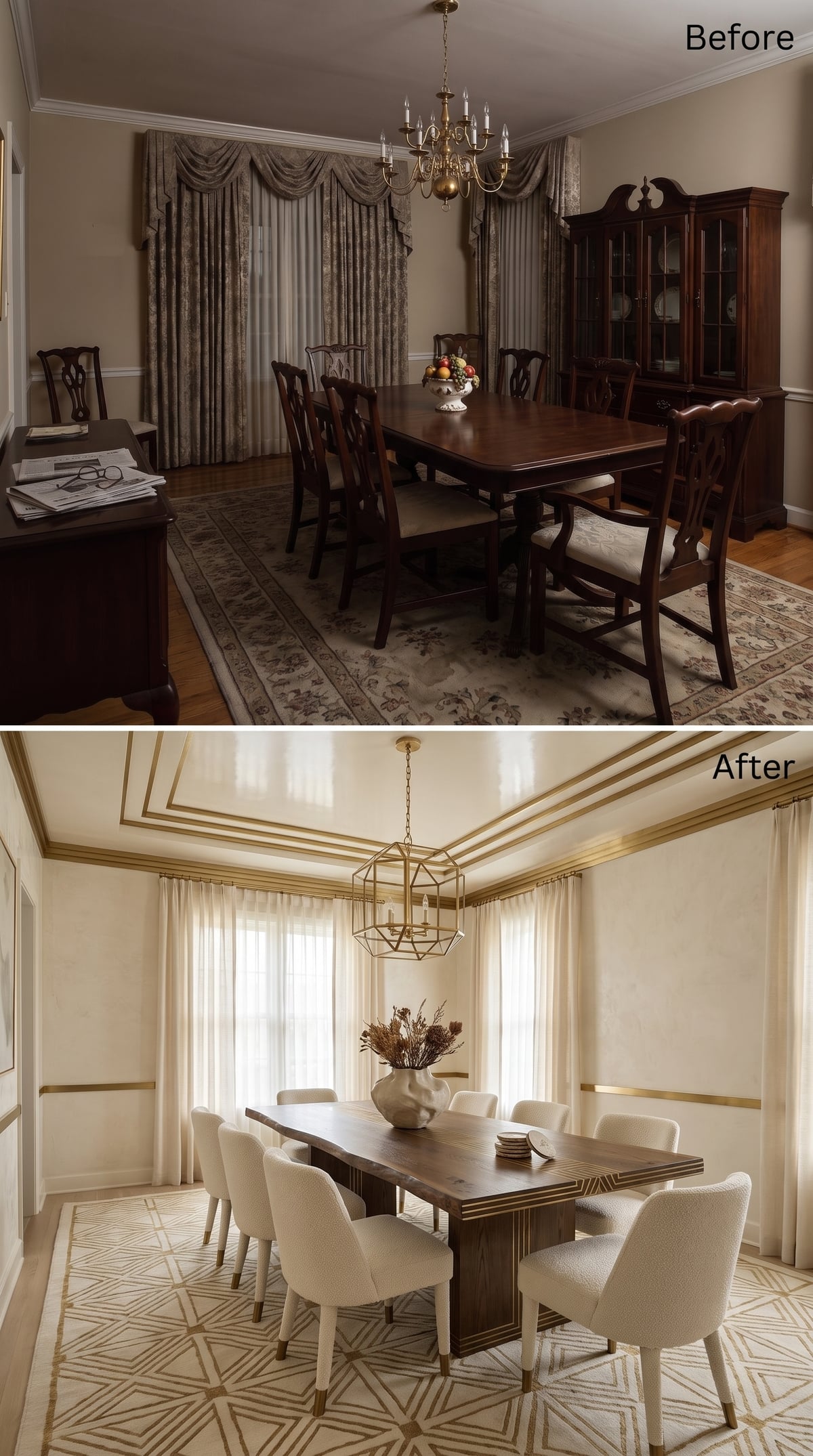
Thin gold bands trace the tray ceiling in parallel lines, giving the room a crisp perimeter without relying on carved molding. Down below, an interlocking-diamond rug introduces the stronger pattern.
The brass cage pendant is deliberately spare. With geometry already happening overhead and underfoot, another complicated fixture would have turned the center into rush hour.
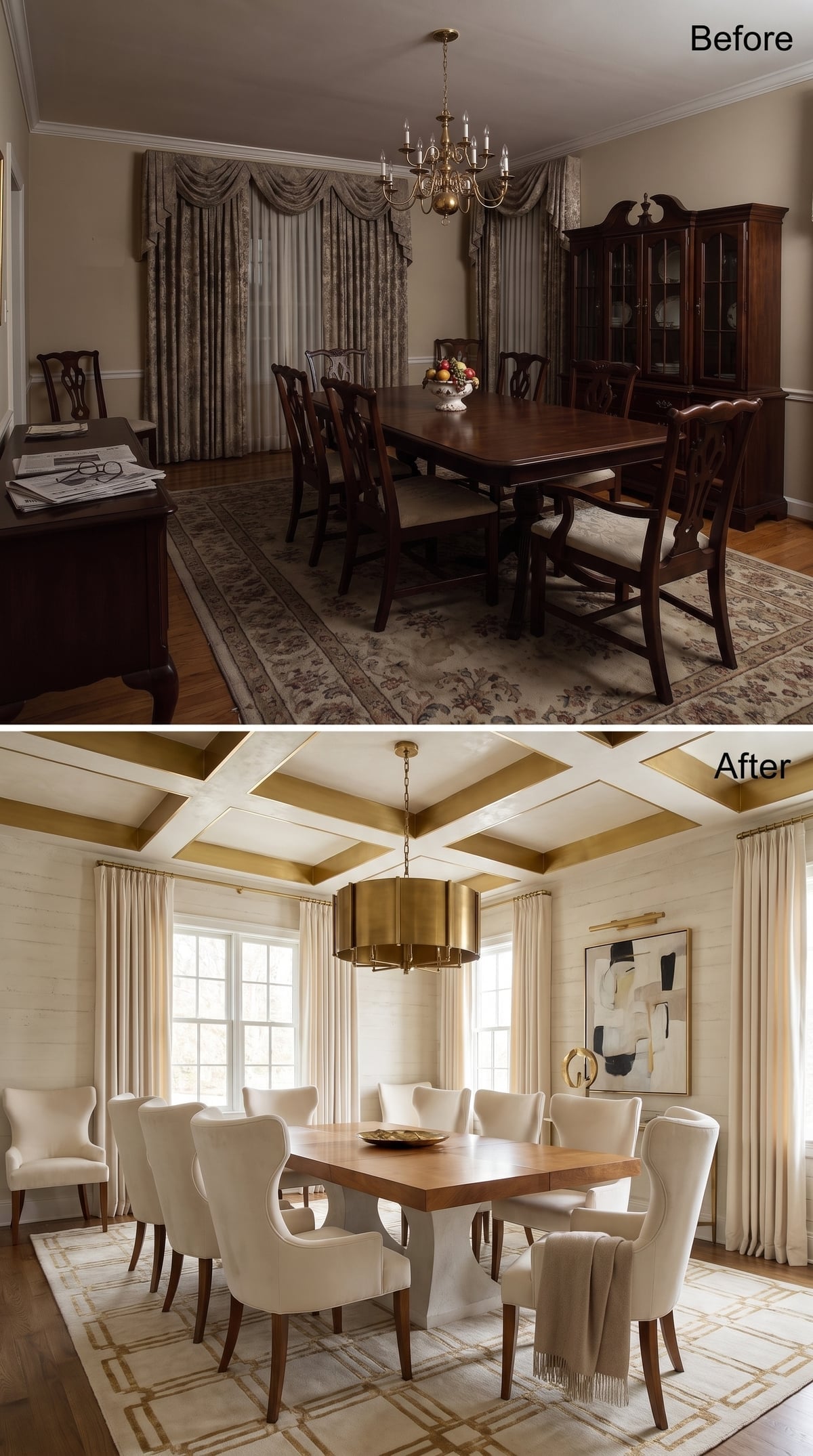
2. Coffered Ceiling with Brass Inlay, Wing Chairs in Boucle, and a Rug That Finally Matches the Room’s Ambition
🔥 Would you like to save this?
Antique-gold lines outline recessed ceiling squares, while a broad brass drum pendant sits beneath them with contemporary simplicity. That old-new tension keeps the room from feeling like a reproduction.
Wing-back chairs bring more visual mass than most of the seating in this gallery, but tapered walnut legs lift them off the floor. A live-edge table breaks the surrounding geometry, while the rug quietly repeats the ceiling grid in softer form.
1. Sputnik Chandelier, Sunburst Ceiling Medallion, and Chairs That Finally Belong in the Room
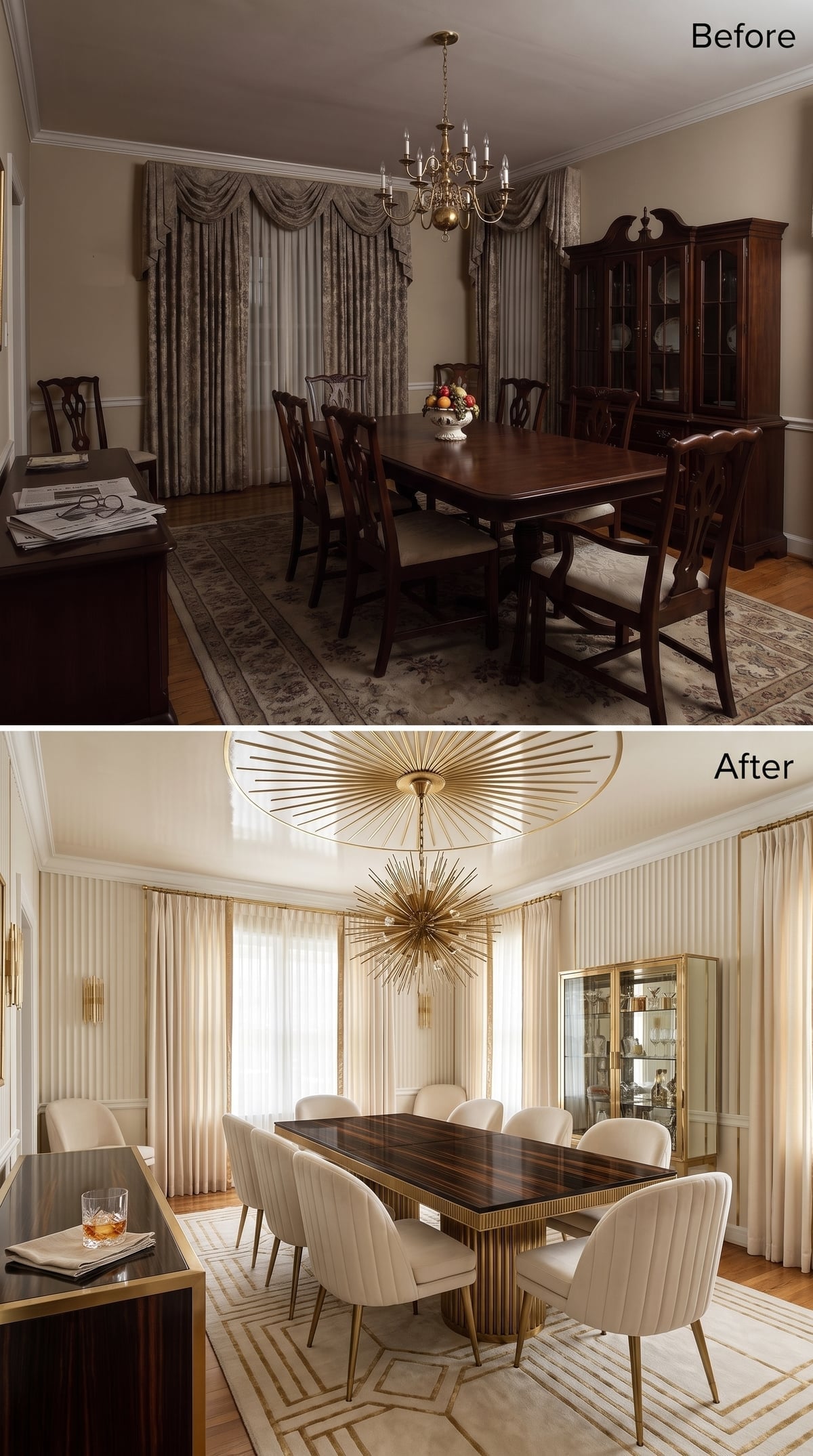
Few rooms in the collection commit this completely to one metallic language. The Sputnik chandelier establishes the vocabulary, and brass answers at the sunburst medallion, fluted table base, chair legs and display cabinet.
What keeps the repetition from feeling showroom-matched is contrast. The tabletop goes almost ebony against warm-white upholstery. Ripple-fold curtains soften the edges. A geometric rug keeps the furniture visually anchored without shouting one last time for attention.
That’s the difference running through the best transformations in this gallery. Cream wasn’t asked to create excitement by itself, and brass wasn’t scattered around like confetti. Each room found one architectural idea strong enough to lead—wood, plaster, geometry, greenery, mirror, color—and let everything else fall into place around it. The dark dining rooms didn’t simply get brighter. They finally got a point of view.