🔥 Would you like to save this?
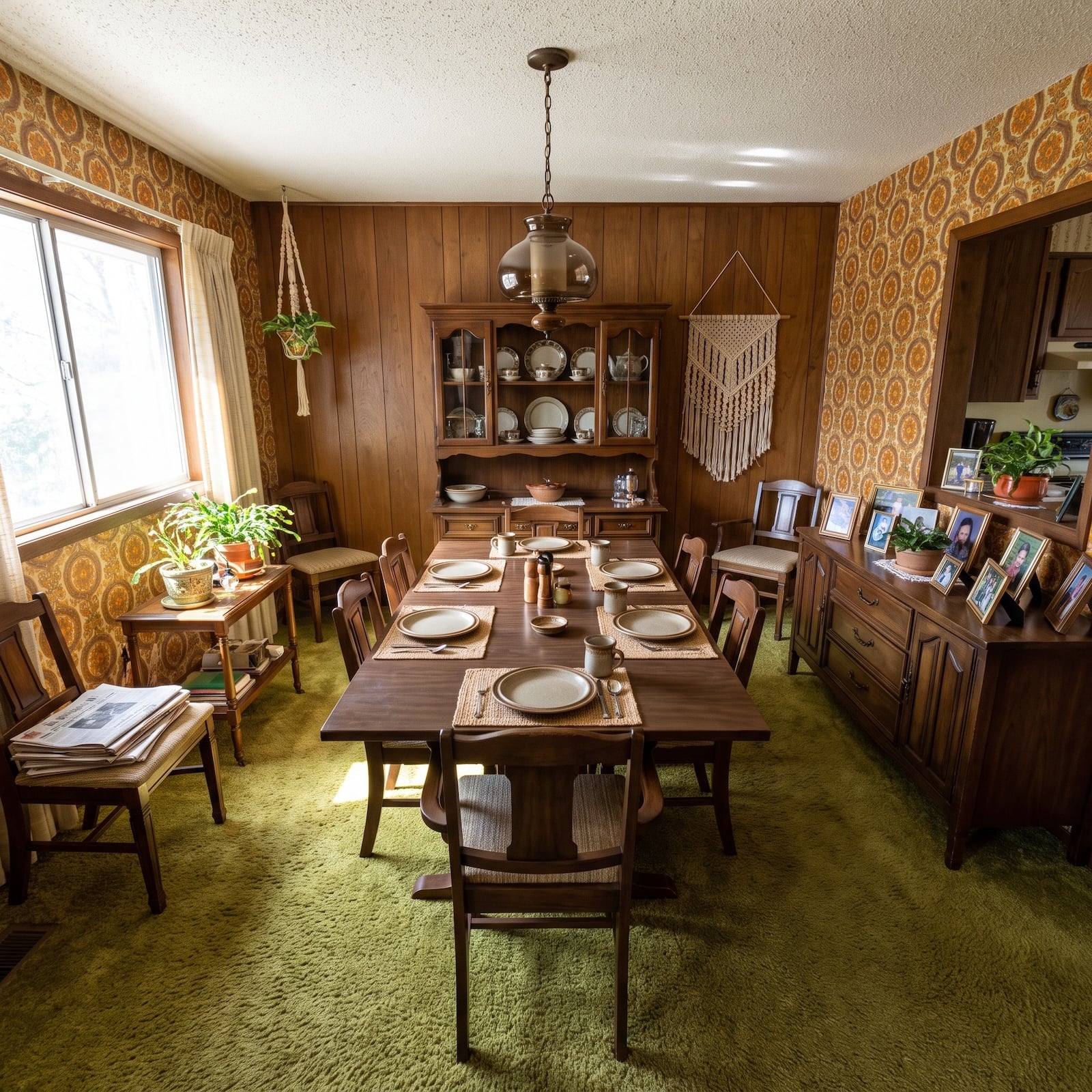
A 1970s dining room could make six chairs feel like twelve. Shag carpet thickened the floor, orange patterning pressed in from the walls, and dark paneling turned every piece of furniture into one more thing competing for space. Add a Christmas table, serving pieces, extra seating and a tree, and the room stopped feeling cozy and started feeling overbooked.
In order to come up with the very specific design ideas, we create most designs with the assistance of state-of-the-art AI interior design software. Also, assume links that take you off the site are affiliate links such as links to Amazon. this means we may earn a commission if you buy something.
That is where these redesigns get interesting. Some clear away visual weight from the floor and walls. Others change the geometry entirely with round tables, banquettes, built-ins or stronger sightlines. A few refuse restraint altogether — but with enough control that stained glass, velvet, lacquer, marble or an oversized chandelier creates order instead of adding clutter.
The smartest transformations understand that a small dining room does not necessarily need less design. It needs better hierarchy. One dominant ceiling move instead of five competing gestures. Storage that becomes architecture. Holiday decoration that works with the palette instead of sitting on top of it. Furniture that leaves circulation room without making the table feel undersized.
These 39 transformations take the same stubborn 1970s shell in radically different directions, from restrained wood-and-linen updates to rooms involving amethyst geodes, living walls, nutcracker niches and a chandelier shaped like a carousel. The common goal is simple: make Christmas dinner feel generous even when the original room was anything but.
39. Gold, Wings, and Candlelight: One Dining Room’s Complete Reinvention
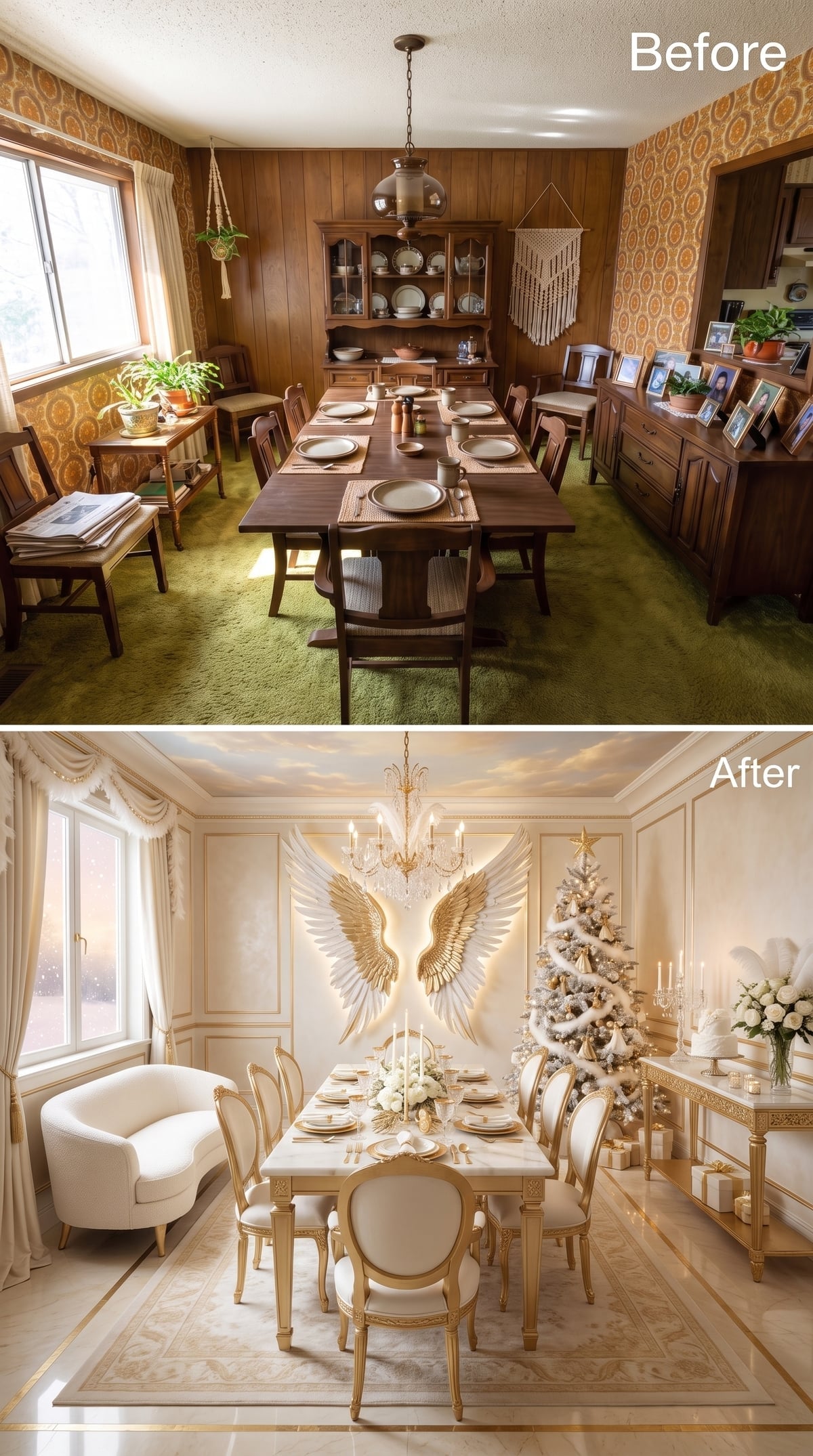
Cream-painted paneling with gold molding completely changes the room’s weight before the furniture even arrives. A marble-top table and Louis XVI-style chairs continue the formal direction, while the cloud-painted ceiling and crystal chandelier push the composition well beyond an ordinary Christmas dining room.
The backlit angel wings behind the table are the unapologetic centerpiece. Keeping the remaining palette to ivory, gold and soft white prevents the sculpture, frosted tree, roses and chandelier from turning into five separate focal points. Excess, in this case, has been given a very strict color code.
38. Concrete Walls, Bell Cluster Pendant, and a Fireplace That Anchors Christmas
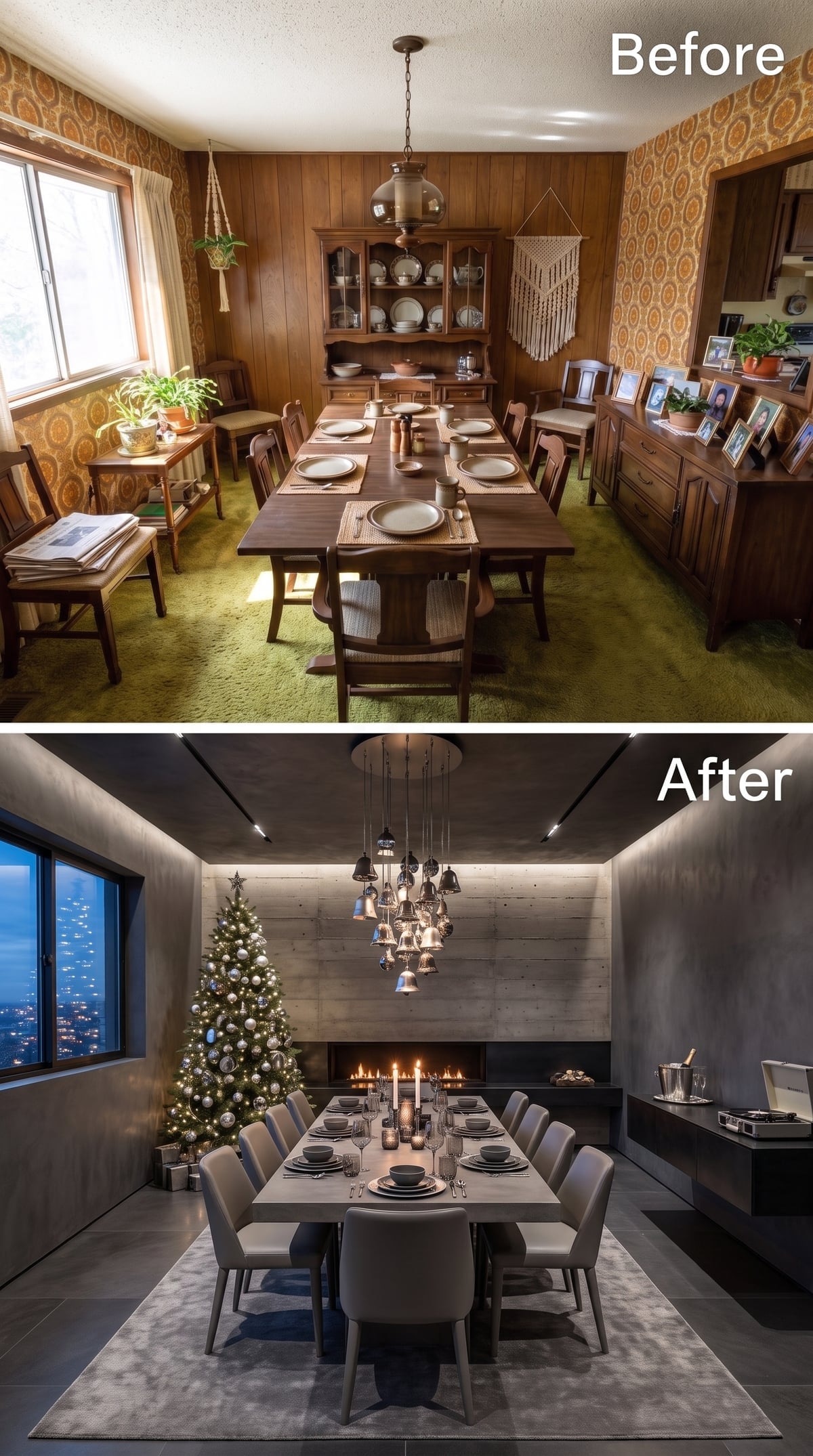
Board-formed concrete gives this room a completely different kind of Christmas atmosphere: spare, tactile and deliberately unsentimental. The long horizontal fireplace cuts a warm line through the back wall while the dining table stays low and linear in front of it.
A staggered cluster of bell-shaped pendants brings softer curves into all that concrete geometry. Charcoal place settings, a restrained tree and a long candle centerpiece keep the composition narrow enough that the materials, rather than piles of decoration, create the drama.
37. Moss Walls, Marble, and Pink Velvet Turn Christmas Botanical
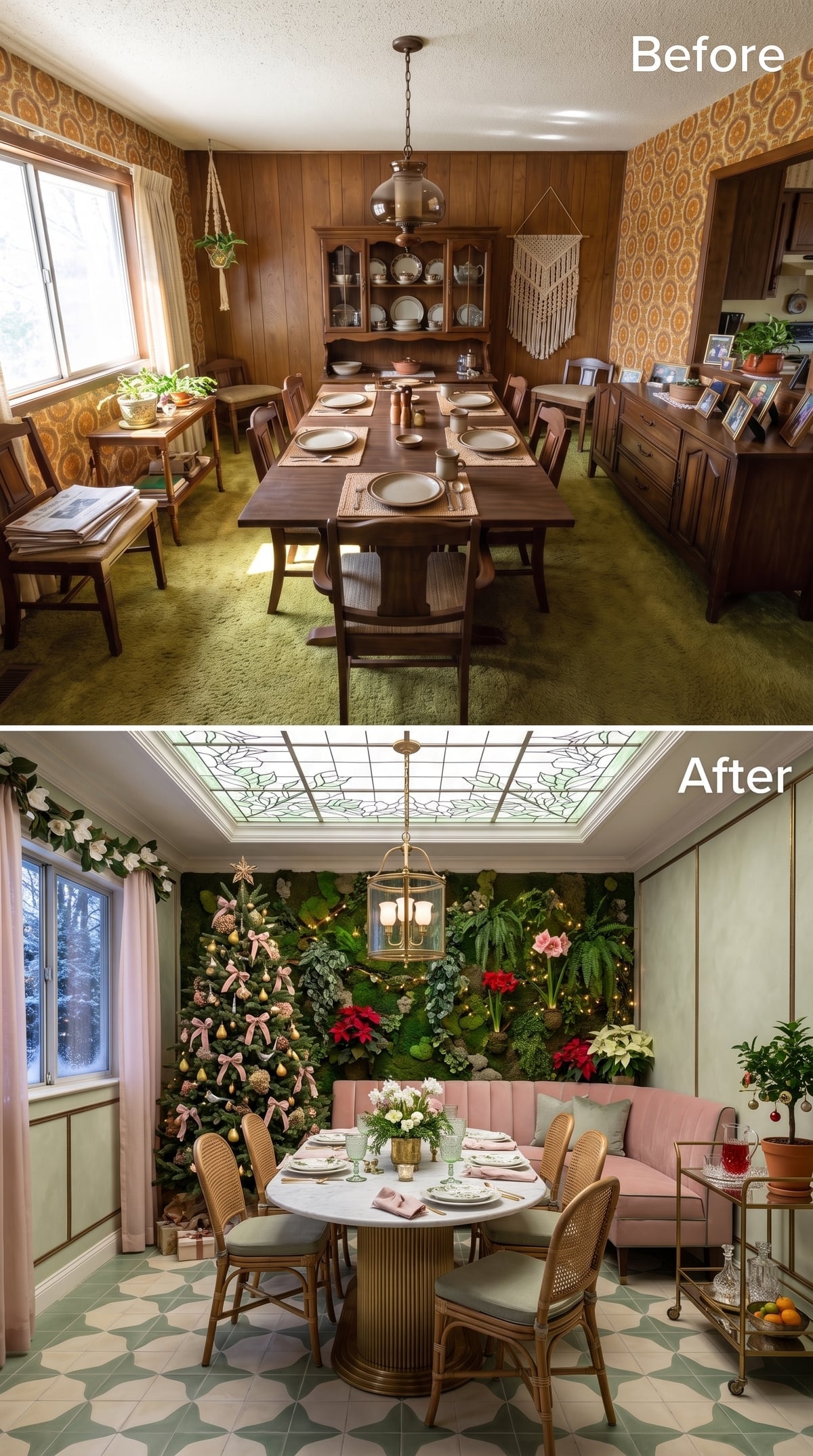
A living moss wall packed with tropical foliage, poinsettias and amaryllis turns the back of the room into an indoor garden. The stained-glass skylight above extends that botanical quality without simply repeating green everywhere.
A round marble-top table on a fluted walnut base gives the dense planting a clean geometric counterpoint. Cane-back chairs, sage cushions and the pink velvet banquette soften the architecture, while pink ribbons on the Christmas tree pick up the upholstery just enough to make the whole eccentric palette feel connected.
36. Navy Walls, a Sputnik Chandelier, and Art Deco Ceiling Paper Take Over
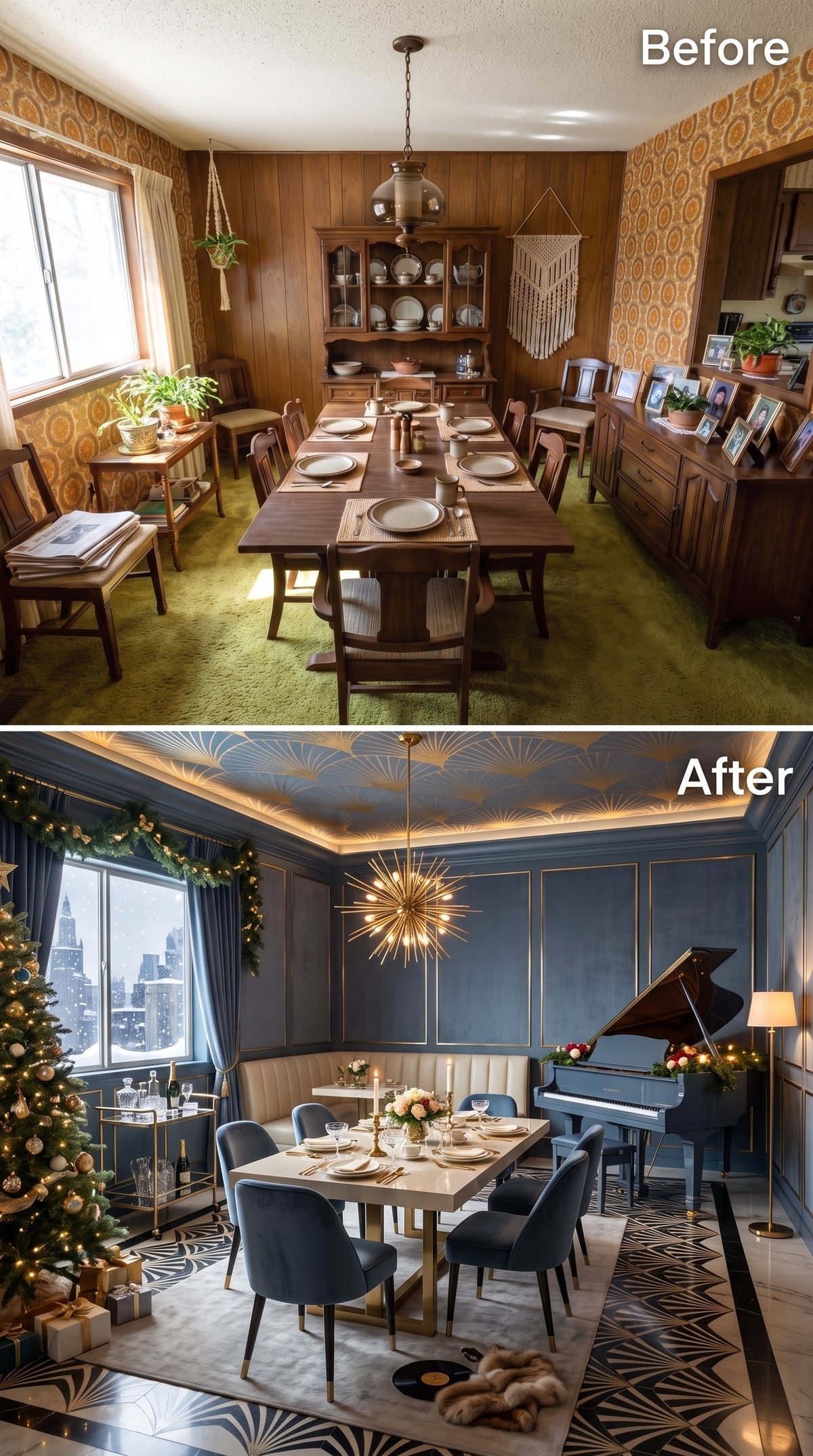
Gold-traced fan motifs cover the ceiling instead of behaving like a polite accent. The Sputnik fixture below picks up the same radiating geometry, while navy paneling with narrow gold borders turns the walls into a much calmer frame.
Matching navy velvet chairs continue that restraint around the marble-top table. The baby grand against the far wall introduces one more substantial shape, but its black finish recedes against the saturated envelope rather than demanding a separate color story.
35. Peppermint Stripes, Candy Pendants, and a Room That Refuses to Hedge
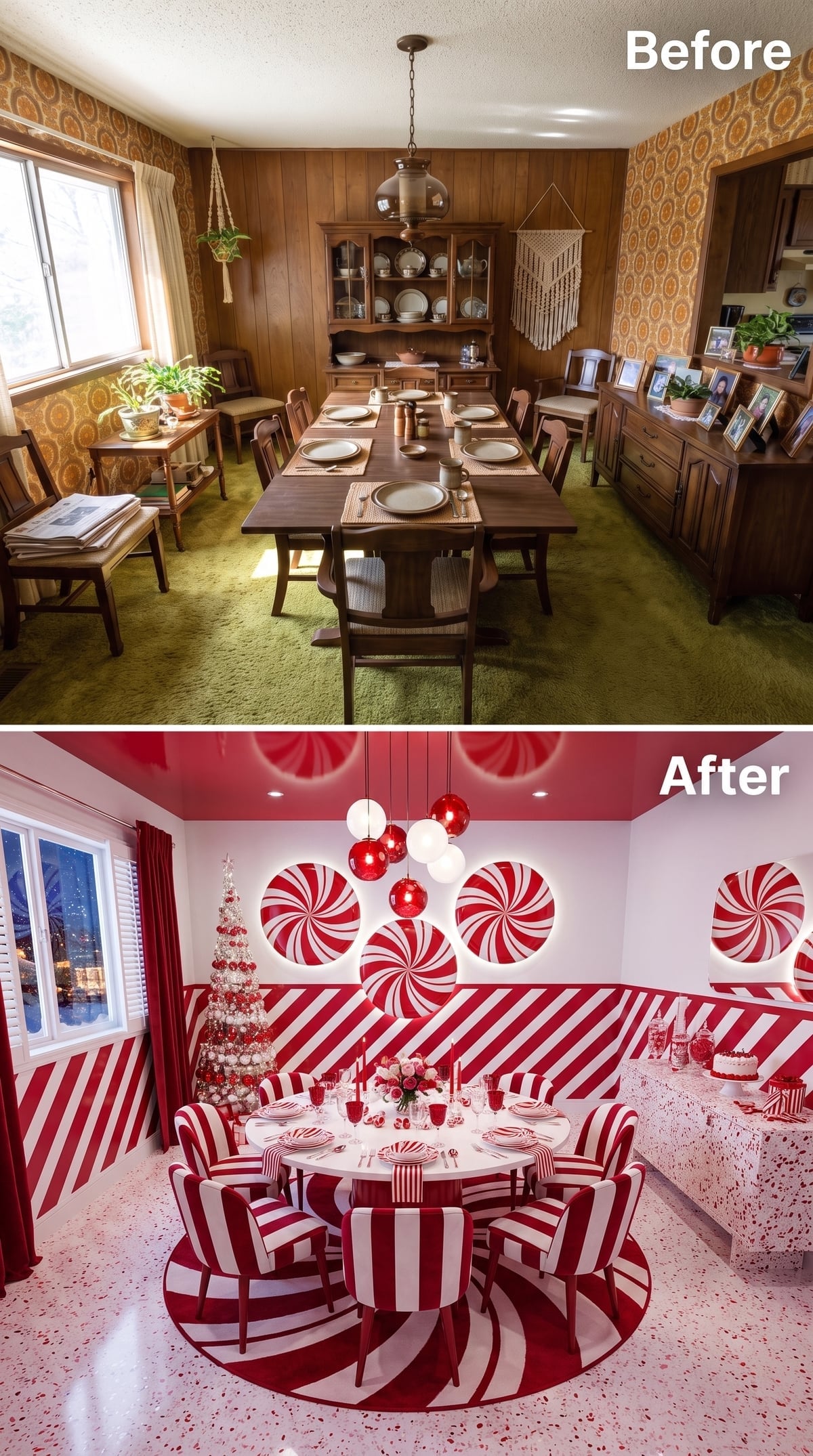
Red and white take over nearly every surface, but the limited palette is precisely what keeps the room from collapsing under its own theme. Swirling peppermint discs punctuate the walls like oversized graphic medallions while broad stripes continue the pattern across the architecture.
The pendant cluster mixes glossy red spheres with matte white globes, translating the same idea into three dimensions. There is nothing subtle about the result, but the repetition is disciplined enough that the room reads as one giant graphic composition rather than a collection of candy-themed props.
34. Bubble Glass, a Velvet Banquette, and a Round Table Fix the Squeeze
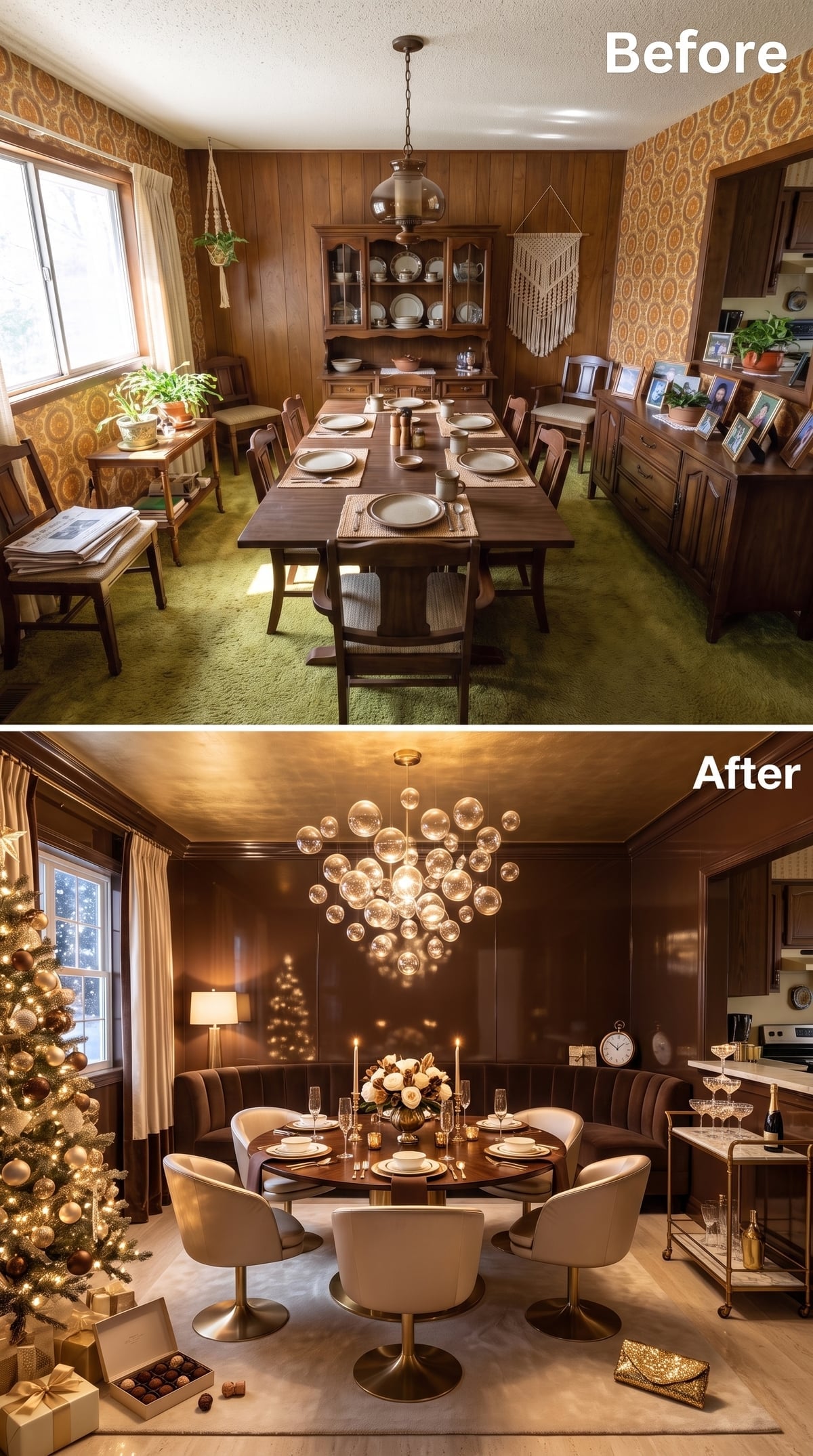
Dozens of blown-glass spheres tumble from a brass ceiling mount, giving the room one large decorative gesture instead of several smaller ones. Dark chocolate walls create a dense backdrop while the chandelier keeps the upper half visually buoyant.
The more important move happens below. A round walnut table eliminates projecting corners, cream pedestal chairs keep the floor visually open, and a curved velvet banquette uses the back wall without introducing another bulky cabinet. Here, the glamour arrives with a genuine circulation improvement.
33. Stone Fireplace Wall, Wood Ceiling, and a Hanging Lantern Reset the Room
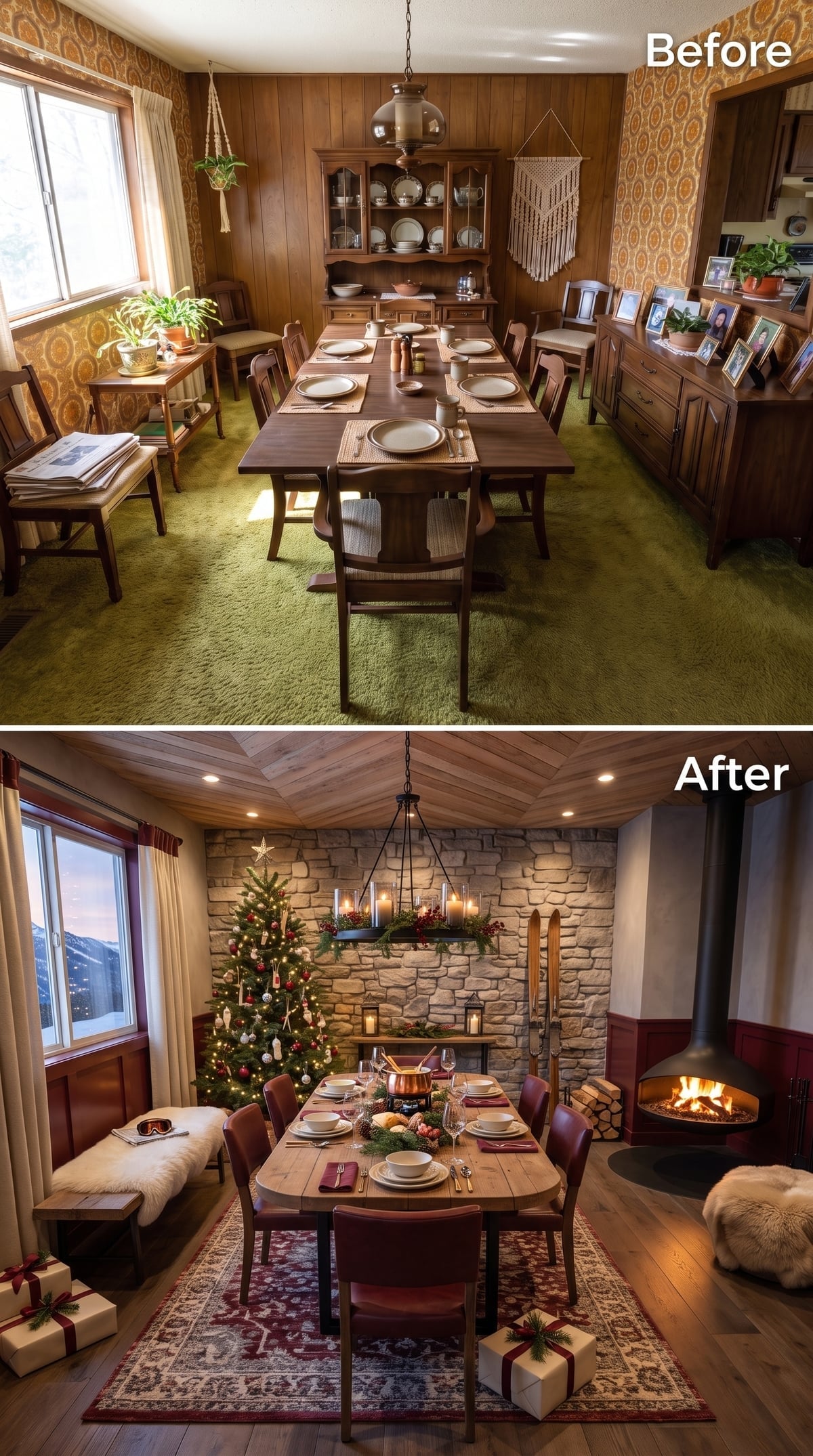
Rough-cut limestone takes over the back wall, giving the room a permanent focal point that does not depend on seasonal decoration. Hardwood replaces the shag, while the suspended wood-plank ceiling introduces a warmer plane above the table.
A black hanging lantern keeps the overhead shape simple beside all that stone texture. The freestanding cone fireplace and decorated tree occupy opposite sides of the composition, creating a useful balance between something architectural and something temporary.
32. Plum Damask, Pink Velvet, and Ribbons Falling From the Ceiling
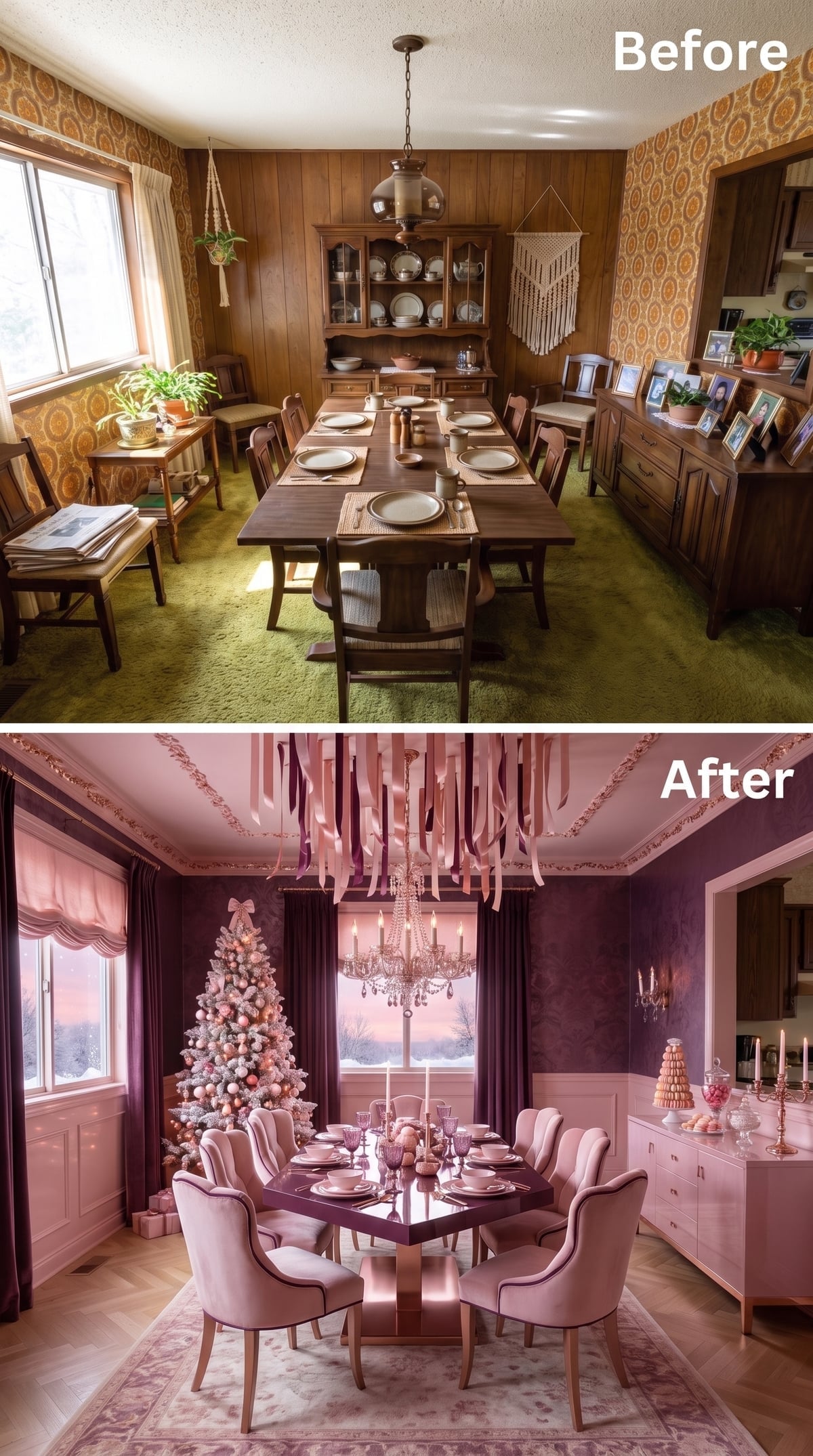
Deep plum damask above blush paneling gives the room a rich two-part wall treatment without splitting it into unrelated halves. Dusty rose velvet chairs reinforce the softer color at table level, leaving the crystal chandelier to provide the sharper edge.
The ceiling ribbons are where the room takes its risk. Suspended in varied lengths around the chandelier, they introduce movement without requiring another permanent architectural feature. A flocked tree carrying the same pink-and-white palette keeps the Christmas decoration inside the established scheme rather than starting another one.
31. Fluted Walnut, Emerald Velvet, and a Pine-Bough Chandelier
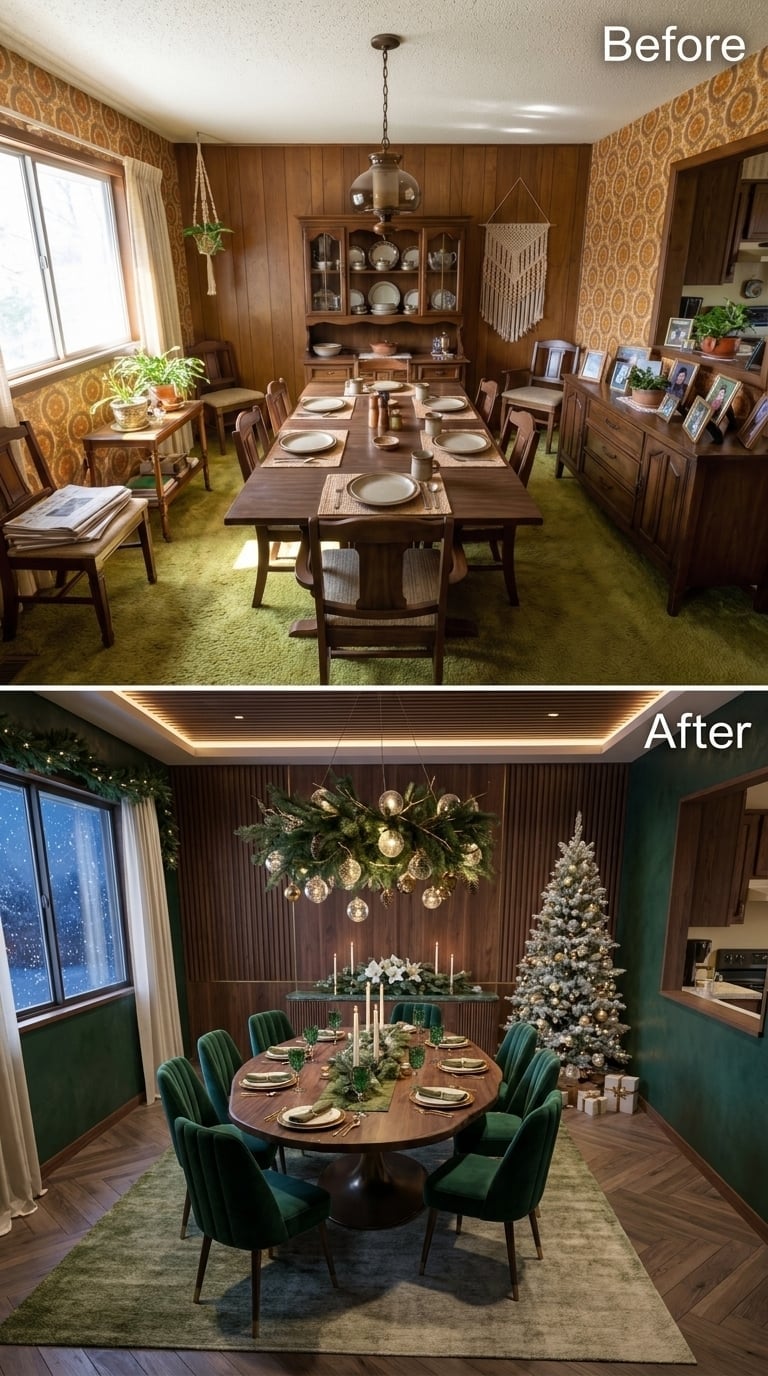
Fluted walnut gives the back wall enough rhythm to stand on its own without artwork. Six emerald velvet chairs tighten the palette further, wrapping a round pedestal table in one saturated band of green.
Above it, a suspended wreath installation hung with glass ornaments replaces the conventional pendant entirely. Because the greenery echoes the upholstery instead of introducing a new color, the seasonal feature feels architectural rather than temporarily attached.
30. Aurora Borealis Overhead and Lavender Velvet Below
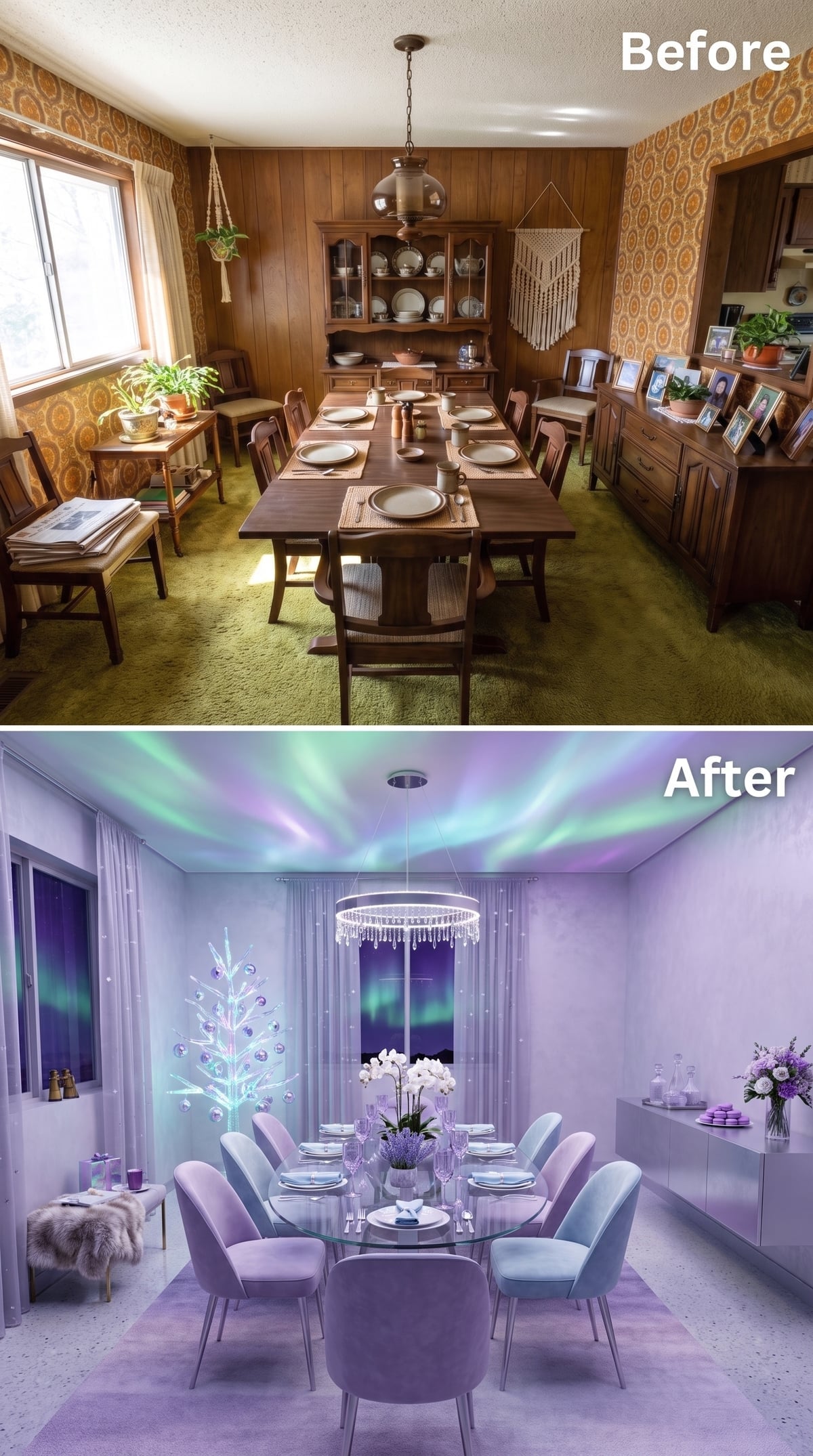
Projected ribbons of green and violet turn the ceiling into the room’s moving surface, making conventional Christmas ornament almost unnecessary. A ring chandelier with crystal drops establishes a firm center beneath the shifting projection.
Lavender velvet chairs and soft lilac walls keep the lower half related to the violet overhead without trying to imitate the aurora literally. A glass dining table helps too: instead of adding another solid block, it allows the room’s strongest colors to remain on the perimeter.
29. Blue-and-White Willow, Panel Molding, and a Chandelier That Cleans Everything Up
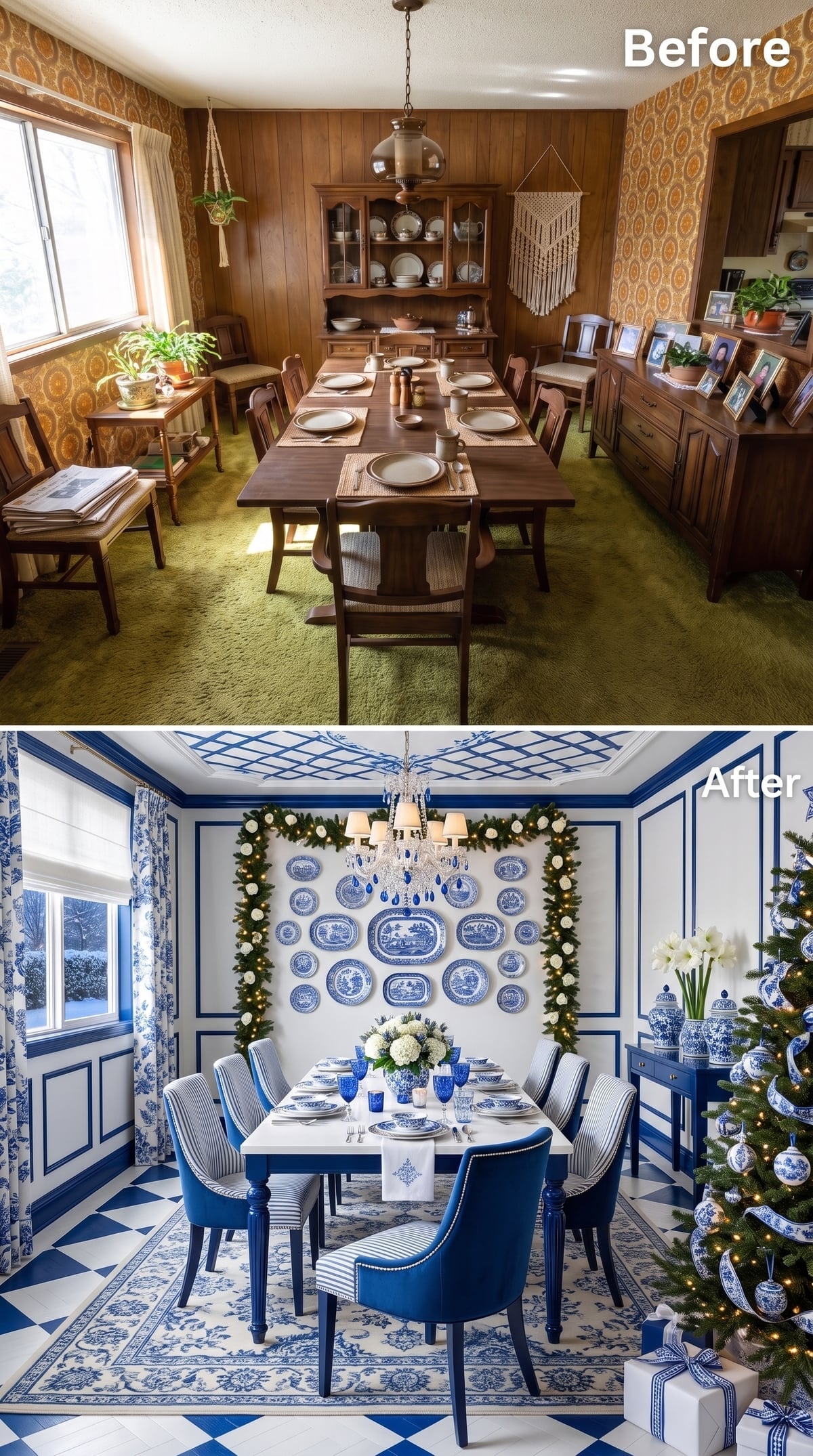
Cobalt trim outlines white panel molding across the walls and continues onto the trellis-patterned ceiling, giving the room a crisp framework before the furniture is considered. Blue drops on the crystal chandelier repeat the color overhead without turning the fixture into a novelty piece.
Willow-pattern plates arranged in an arc add detail to one wall, while striped and velvet chairs share the table without looking mismatched because cobalt reappears in their legs and surrounding trim. The Christmas garland stays white and green, smartly refusing to introduce another dominant color.
28. Dark Walls, Floating Shelves, and a Christmas Village With Actual Presence
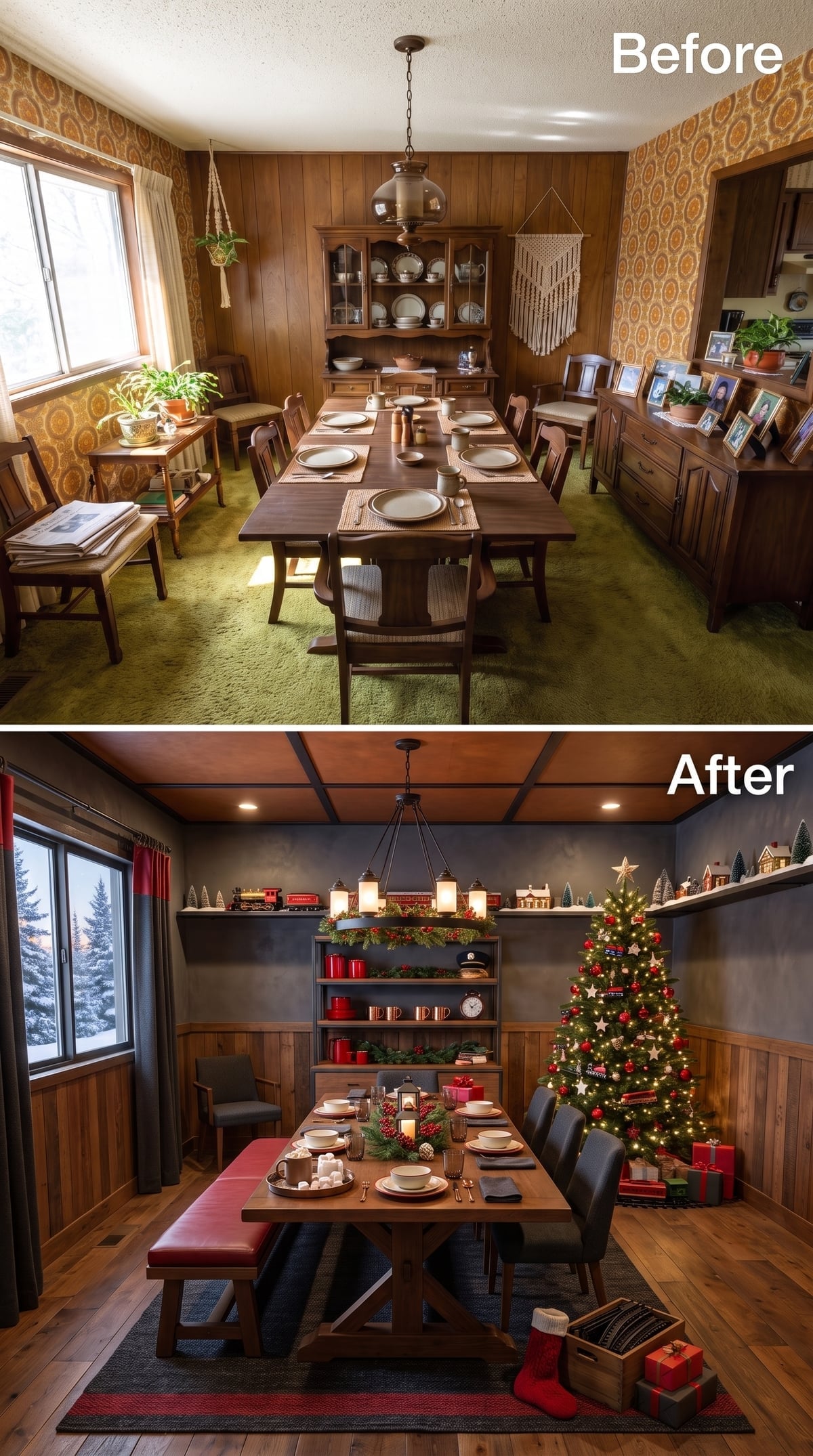
Charcoal plaster above warm wood wainscoting keeps the room dark without making every surface equally heavy. Floating shelves span the back wall, turning miniature village pieces, candles and a toy train into one continuous horizontal display.
A farmhouse table with a bench on one side saves visual and physical space compared with a second row of bulky chairs. The Christmas tree sits close to the dining zone, but the red-and-gold decoration is concentrated enough that it does not compete with the layered shelves behind it.
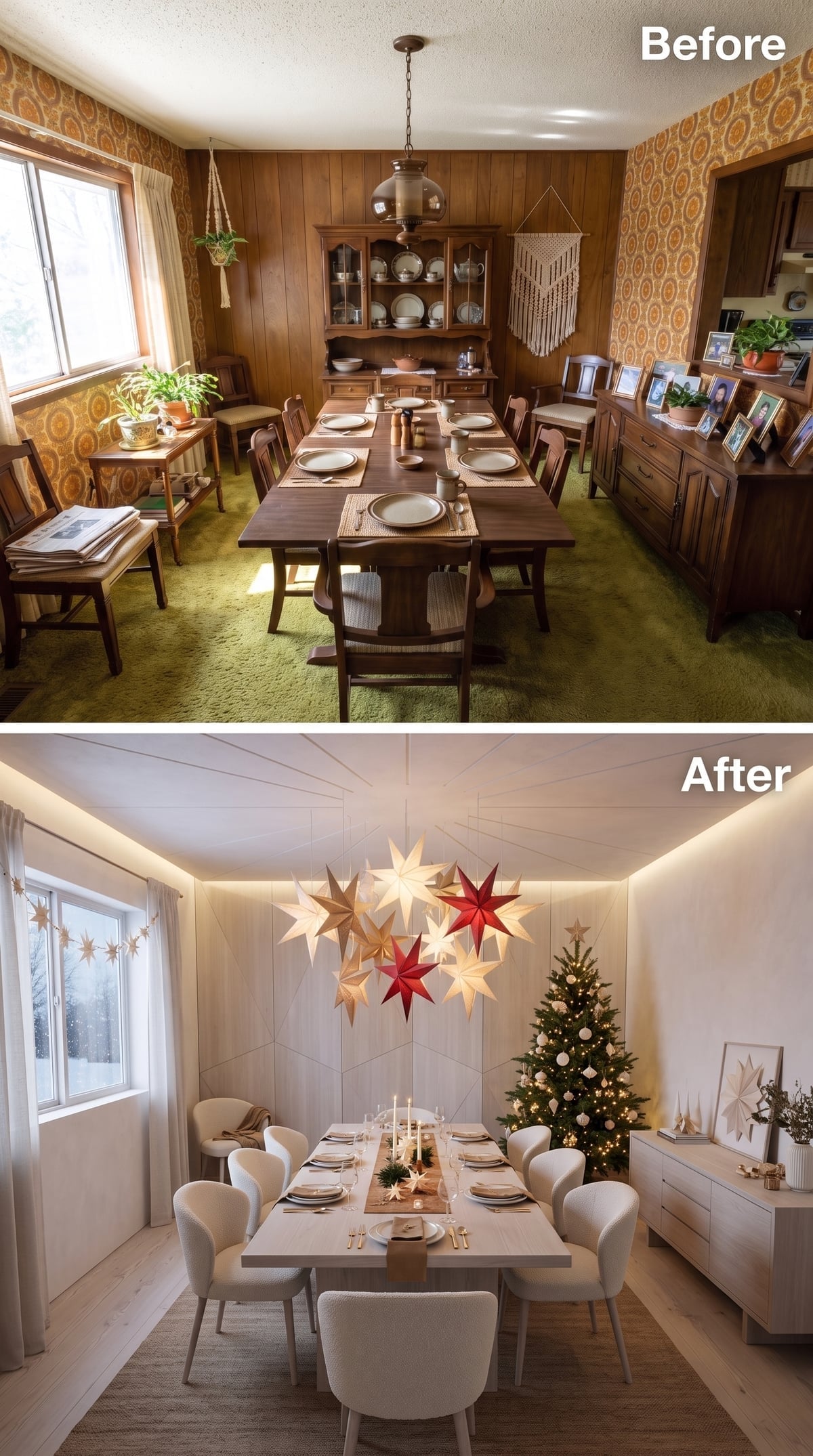
27. Paper Stars, Cove Lighting, and One Deep-Red Accent Over the Table
🔥 Would you like to save this?
Clusters of paper stars hang at different heights above a pale ash table, mixing cream and tan with a single deep-red lantern. That one saturated note prevents the arrangement from dissolving into a cloud of beige.
The stars provide a useful seasonal layer because they create volume overhead without the visual weight of metal or glass fixtures. Paired with the restrained furniture and tucked-away tree, the room feels festive without surrendering its entire identity to Christmas.
26. A Wine Wall, White Bouclé, and a Chandelier Big Enough to Compete
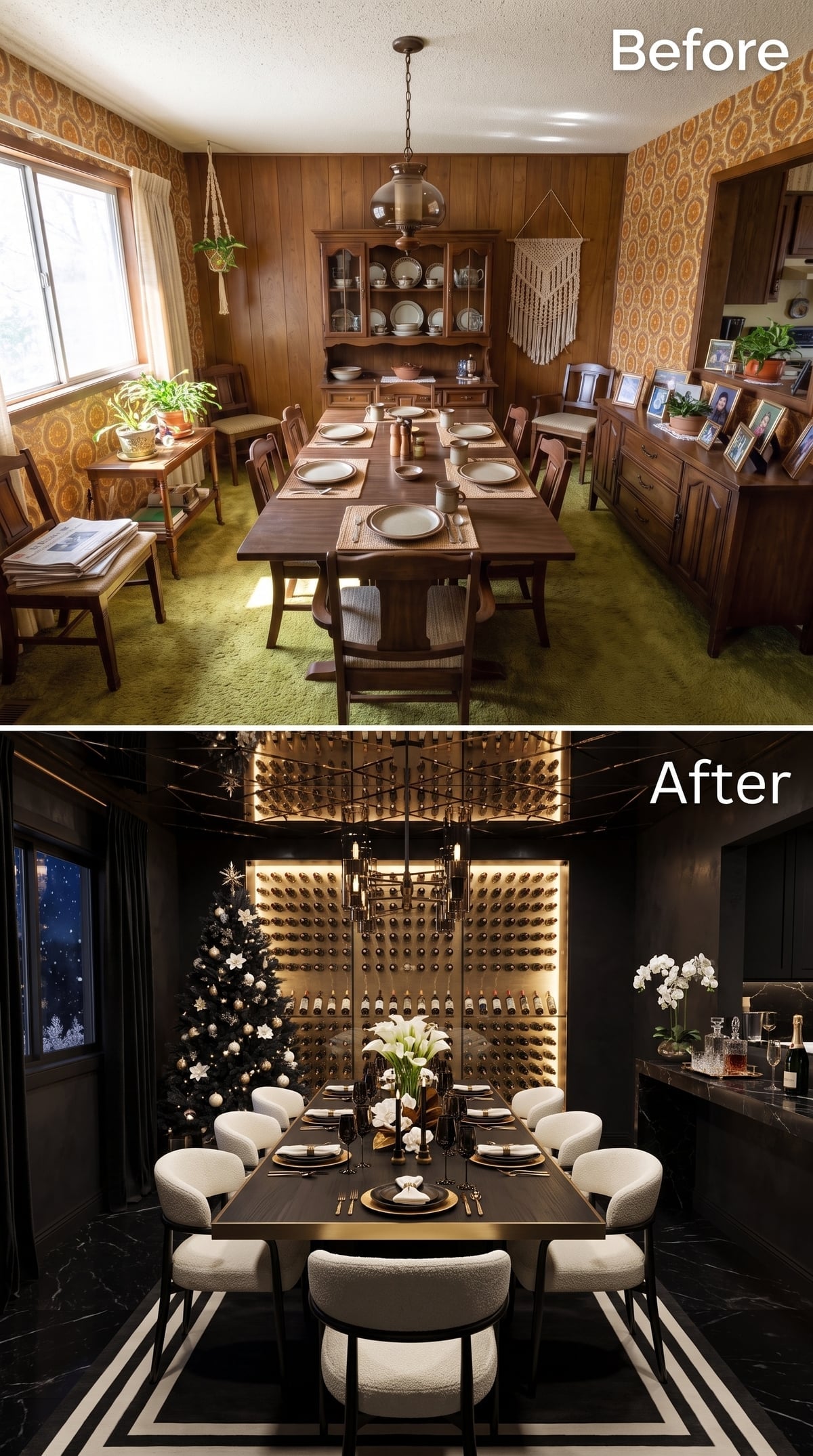
Floor-to-ceiling wine storage becomes architecture once hundreds of bottles are arranged against amber backlighting. Matte black walls deepen the effect, letting the bottle shapes and warm glow build the pattern instead of conventional wallpaper or artwork.
White bouclé chairs create the necessary break around a dark wood table edged in brass. The black-and-white striped rug sharpens that contrast at floor level, while pale flowers on the table keep the center from disappearing into all the surrounding black and amber.
25. Terracotta Plaster, Pampas Overhead, and Christmas Without Red or Green
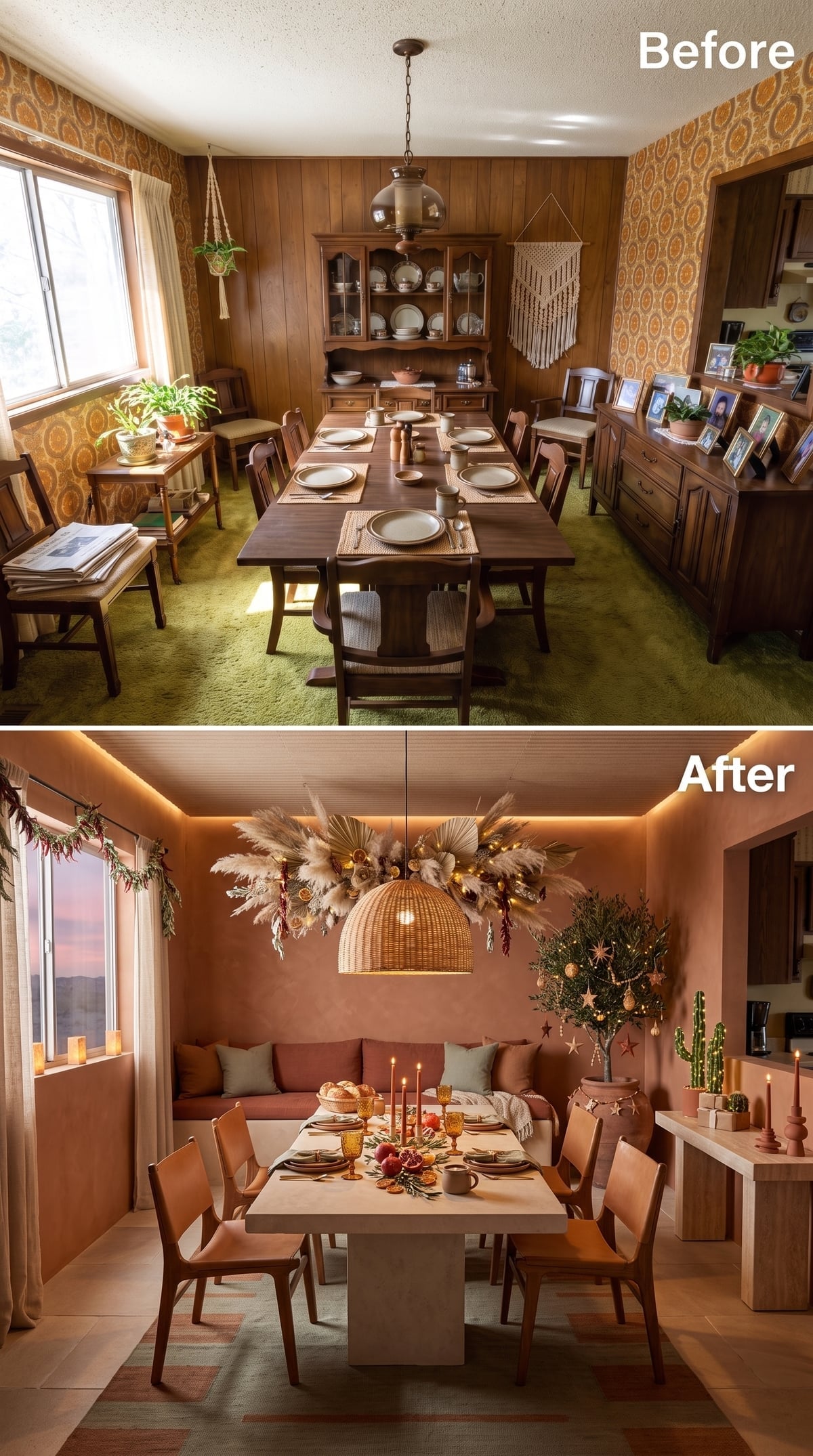
Terracotta plaster provides enough color that the room never needs a conventional Christmas palette. A woven rattan pendant hangs over the table beneath a broad fan of dried pampas and palm leaves, giving the ceiling a soft, feathery silhouette instead of glitter or greenery.
Perimeter cove lighting emphasizes the irregular plaster surface and separates the wall from the ceiling. The result feels seasonal through warmth and abundance rather than through obvious holiday symbols.
24. Carousel Chandelier, Navy Panels, and a Ceiling That Becomes the Main Event
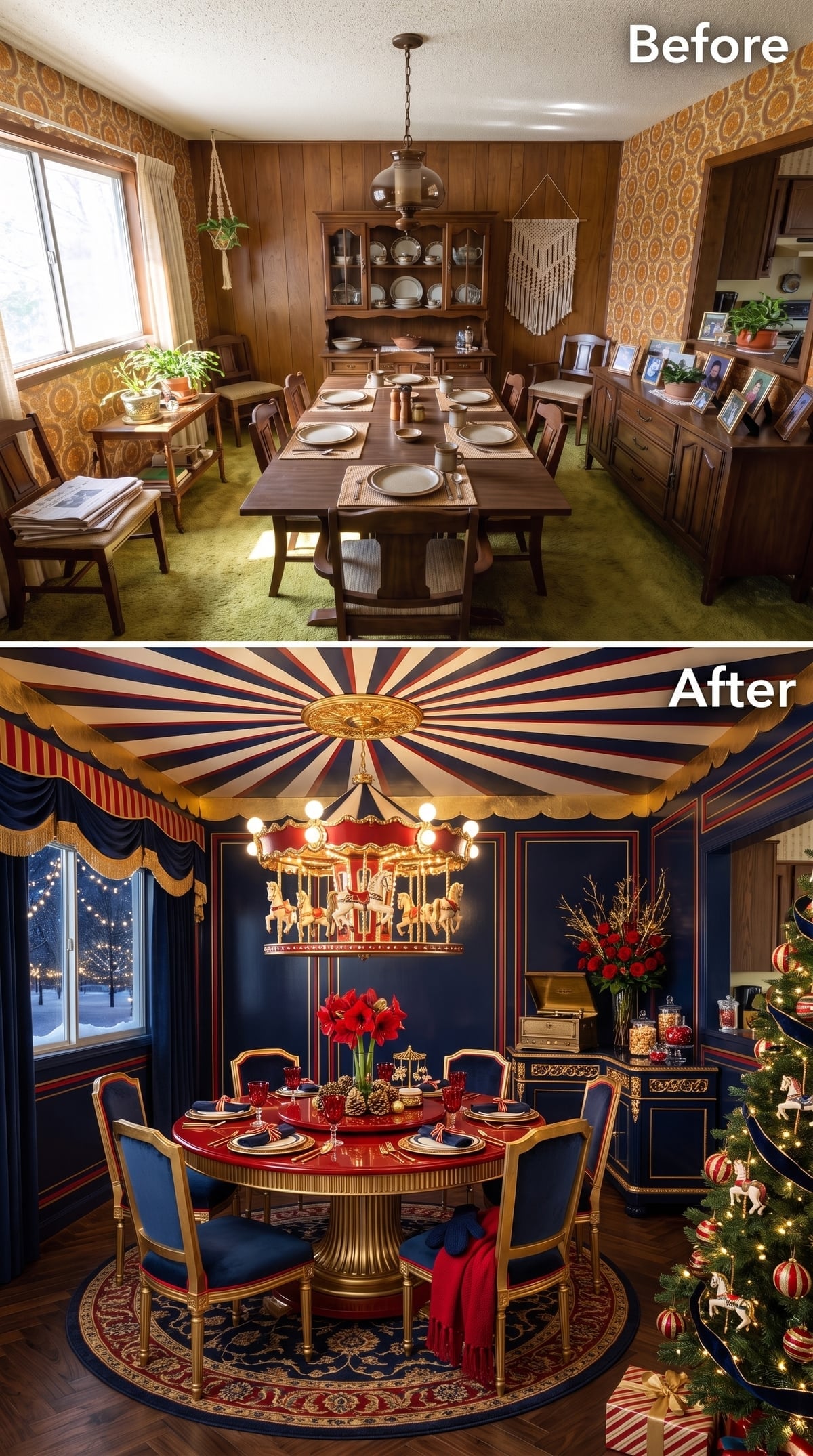
A red lacquer table on a gold-leaf base sits beneath an eccentric carousel chandelier that turns the center of the room into something halfway between dining room and miniature pavilion.
The striped ceiling radiates outward from a gold central medallion, reinforcing that circular motion. Navy wall panels and velvet chairs are unusually disciplined by comparison, which is exactly what the room needs once both table and ceiling have decided to perform.
23. Stained Glass, Painted Coffers, and a Winter Scene Built Into the Wall
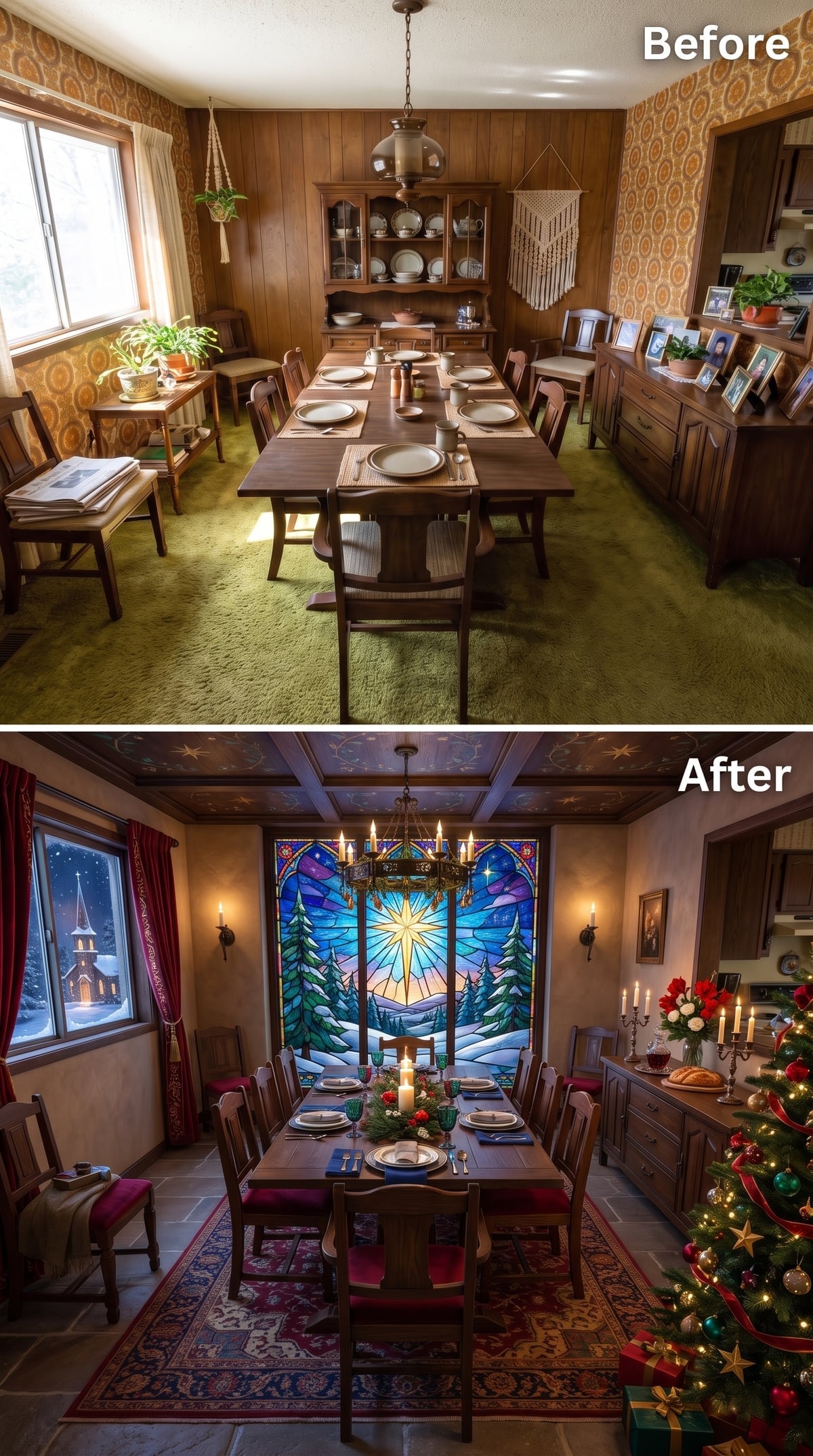
A floor-to-ceiling stained-glass winter scene gives the back wall so much imagery that conventional framed art would be redundant. Deep cobalt, evergreen and warm amber move upward into a coffered ceiling painted with stars on an ochre field.
Wrought-iron sconces and a candle-style chandelier add darker lines between those saturated surfaces. Red velvet chair seats and a patterned wool rug carry just enough color downward to prevent all of the visual energy from hovering above eye level.
22. Geometric Circles, a Mobile Pendant, and Polka-Dot Floors That Keep Moving
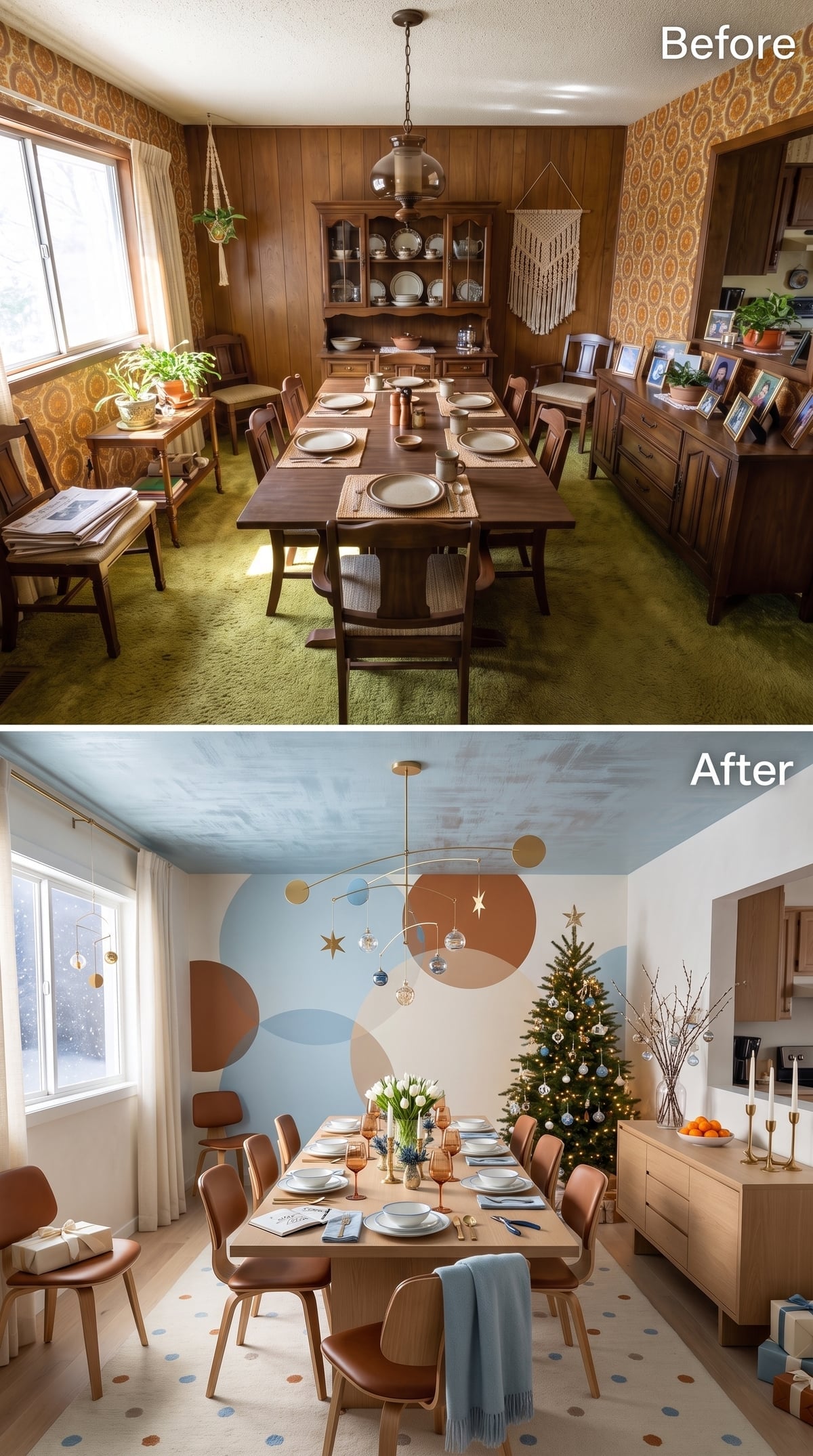
Oversized circles in dusty blue, terracotta and warm beige travel from the accent wall onto the ceiling, breaking down the usual boundary between the two planes. A brass mobile-style pendant continues the sense of motion over the table without copying the circles exactly.
Light maple furniture gives all that geometry somewhere quiet to land. Cognac leather chairs add warmth, while the spotted floor extends the playful graphic language without introducing another unrelated motif.
21. Capiz Shells, an Ocean Mosaic, and Rattan Overhead
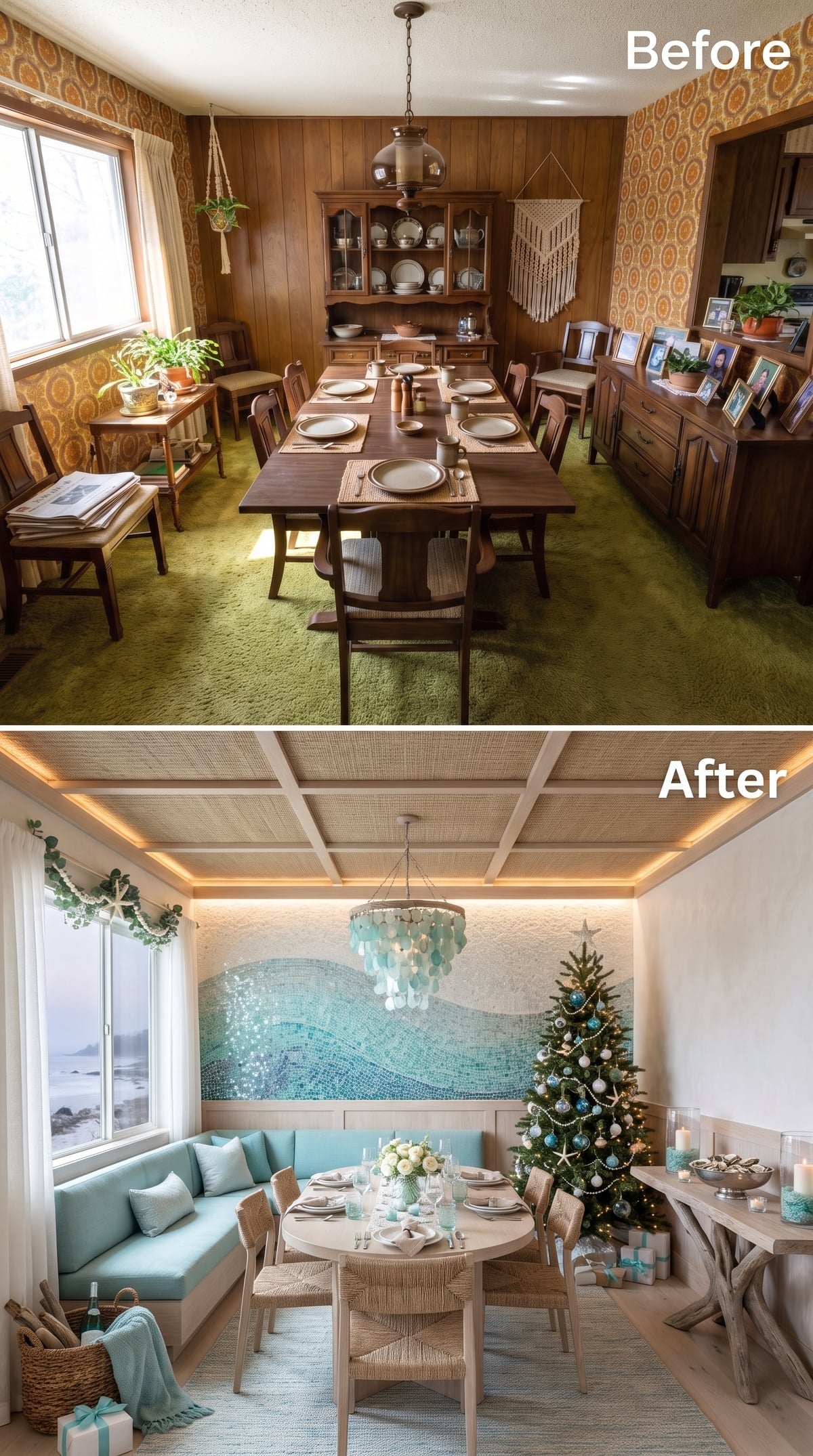
Woven rattan panels set into the coffered ceiling bring texture overhead, while a capiz chandelier supplies a much finer, translucent surface beneath them. The two materials keep the upper half interesting without relying on color alone.
A wave-pattern mosaic in aqua and seafoam takes over the focal wall, balanced by a built-in banquette upholstered in robin’s-egg blue. The round table keeps circulation simple, and the restrained palette stops the coastal references from turning literal.
20. Nutcracker Niches, Red Lacquer, and Chevron Marble With No Interest in Moderation
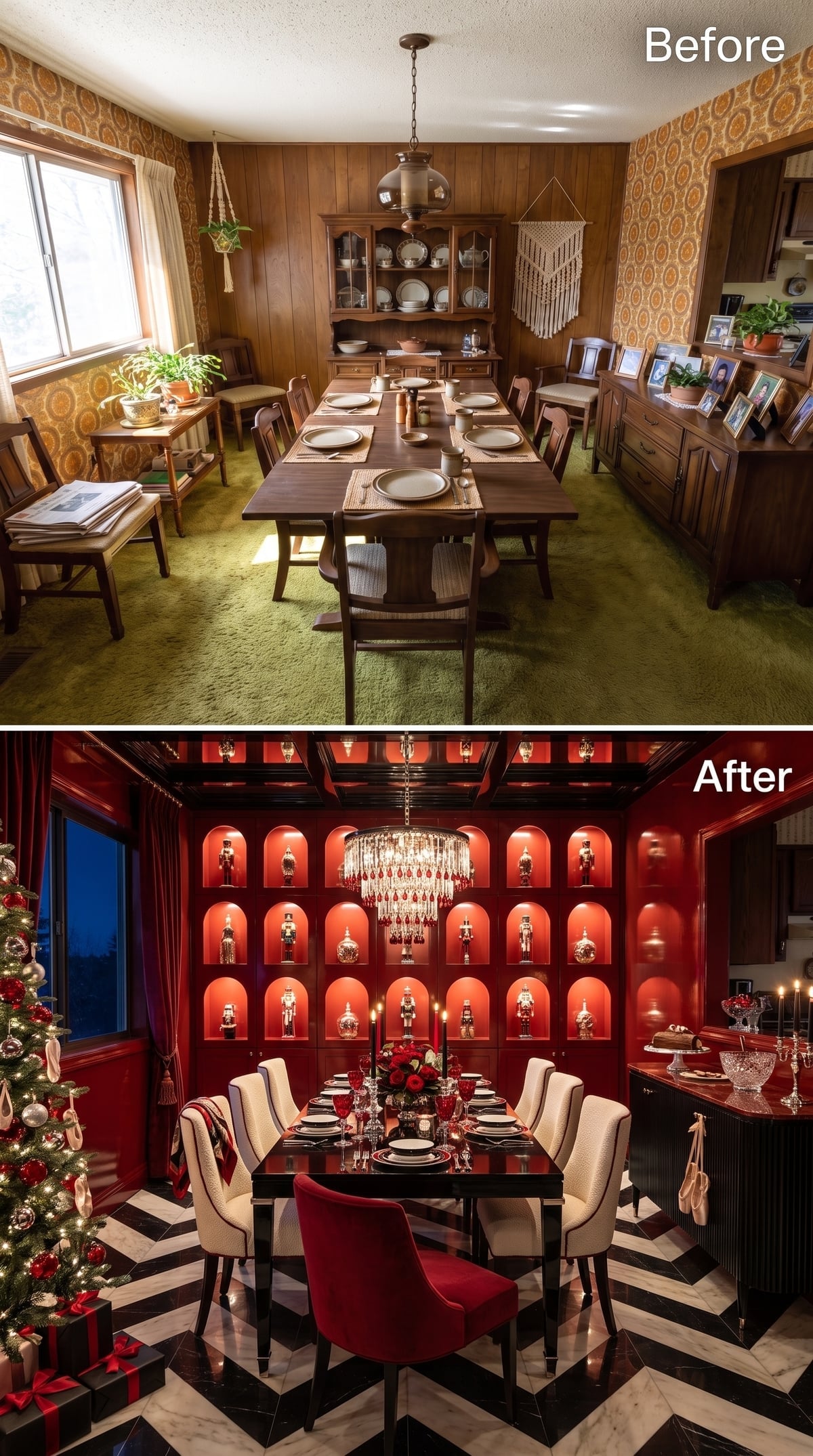
Red lacquer wraps the walls and built-ins, immediately establishing the room’s dominant color before a single ornament appears. Arched niches across the back wall contain nutcracker figures, and individual illumination gives each recess enough depth to read as architecture rather than shelving.
A black lacquer table introduces a hard stop in the middle of the red, surrounded by cream chairs and one red velvet host chair. Beneath everything, the black-and-white chevron marble floor supplies an entirely different geometry. Nothing about the room is timid, but the palette is controlled enough to keep the theatricality legible.
19. Birch Trunks, Globe Pendants, and a Wall Made From Winter
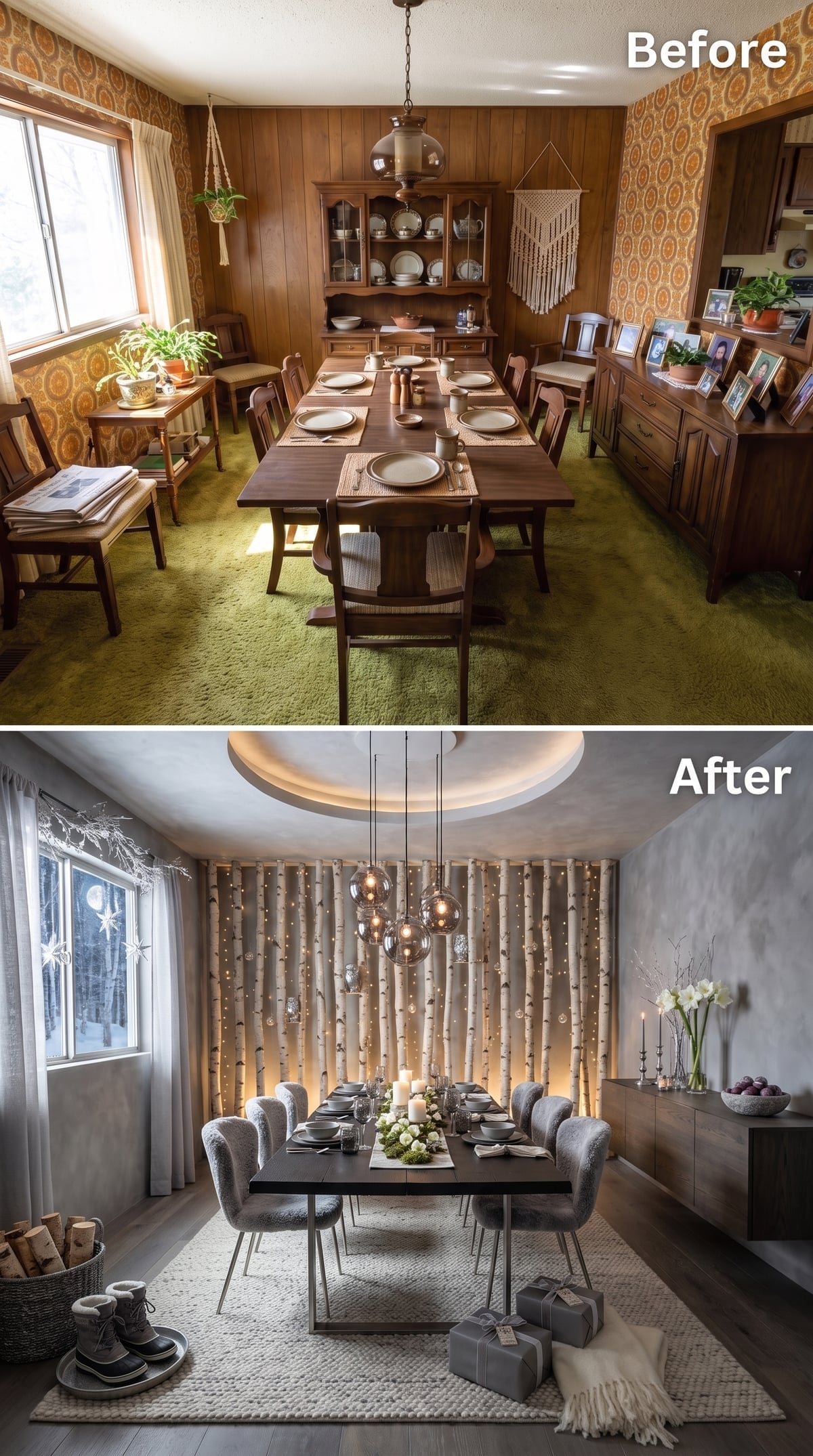
Floor-to-ceiling birch poles transform the back wall through repetition rather than ornament. Their pale bark provides enough natural pattern that the wrapped fairy lights can remain simple instead of becoming another elaborate installation.
Three globe pendants suspended at different heights introduce smooth geometry above the darker table, while the tray ceiling gives them a defined zone. The room feels wintry without depending on snowflakes, red bows or conventional Christmas graphics.
18. Crystal, Dusty Rose Velvet, and a Formal Dining Room That Refuses to Turn Sugary
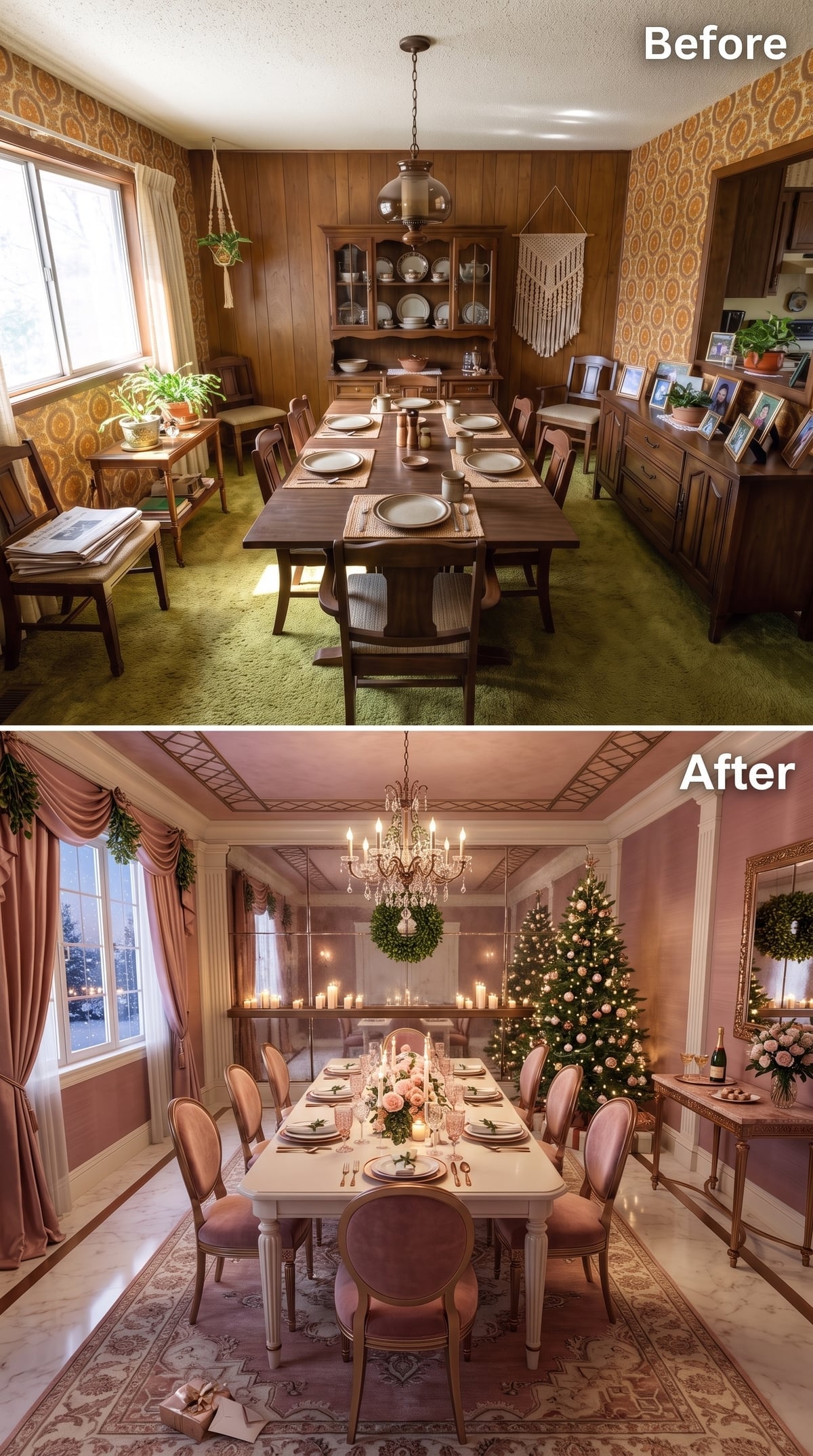
Pink plaster walls and warm-white coffered trim establish the formal shell, while dusty rose velvet Louis XVI-style chairs carry the color directly to the table. A brass-and-crystal chandelier introduces sharper detail without needing another major hue.
The white lacquer table is crucial. Its clean surface gives the pinks somewhere to stop, while gold flatware and pale florals add smaller notes around the perimeter. The result is romantic without losing structure.
17. Teal Lacquer, Crimson Cane Chairs, and a Gold Palm Tree
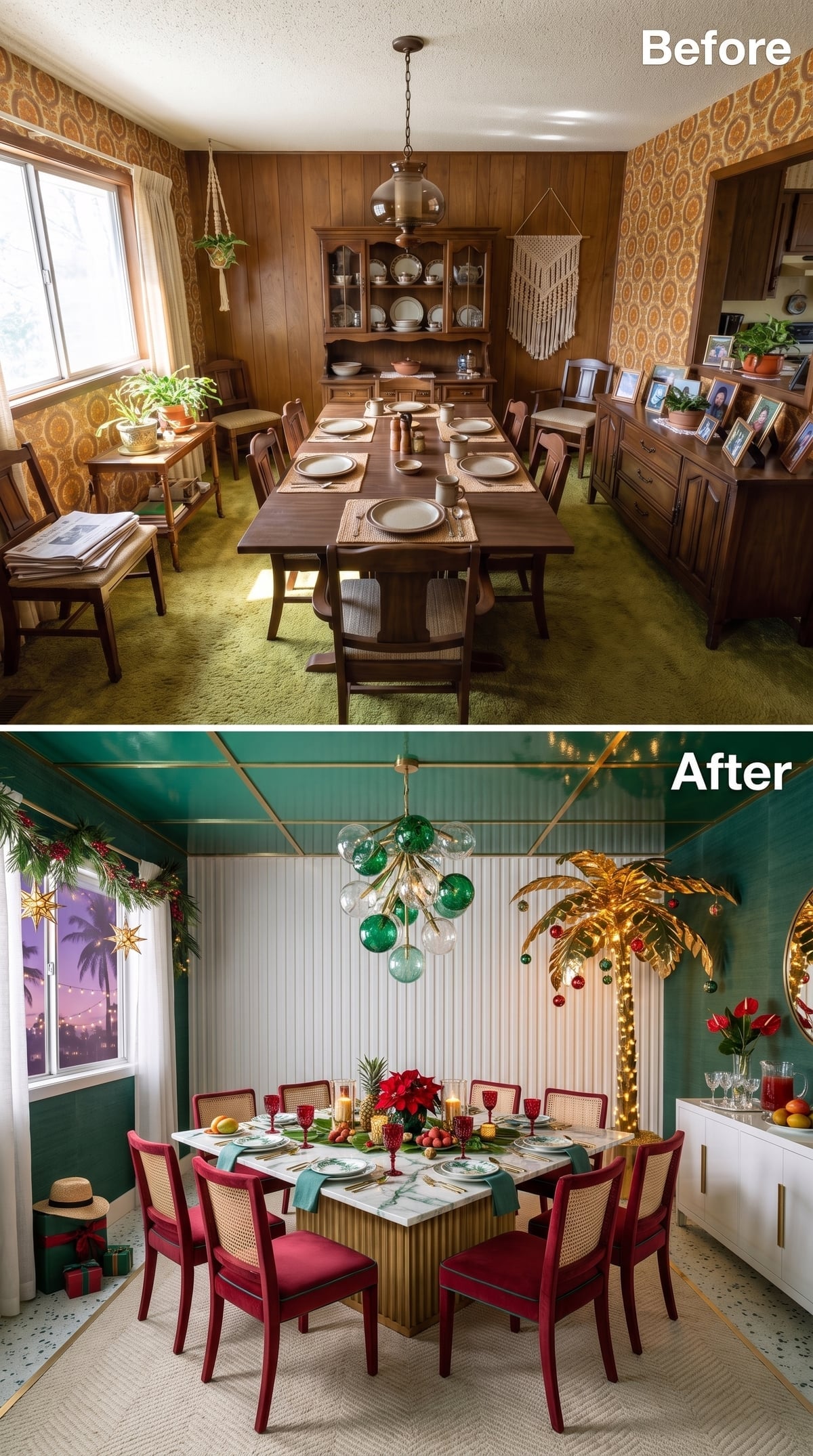
Teal lacquer and vertical paneling give the walls both saturated color and visible rhythm. Overhead, clear and green glass globes hang at varied heights, creating a lighter counterpoint to the dense wall treatment.
Crimson cane-back chairs around the square marble table deliberately push against the teal instead of blending into it. Poinsettias and ruby glassware repeat the red in smaller doses, while the gold palm introduces one flamboyant sculptural accent without requiring another pattern.
16. Forest Green Walls and a Cabinet Grid With Stars in Every Drawer
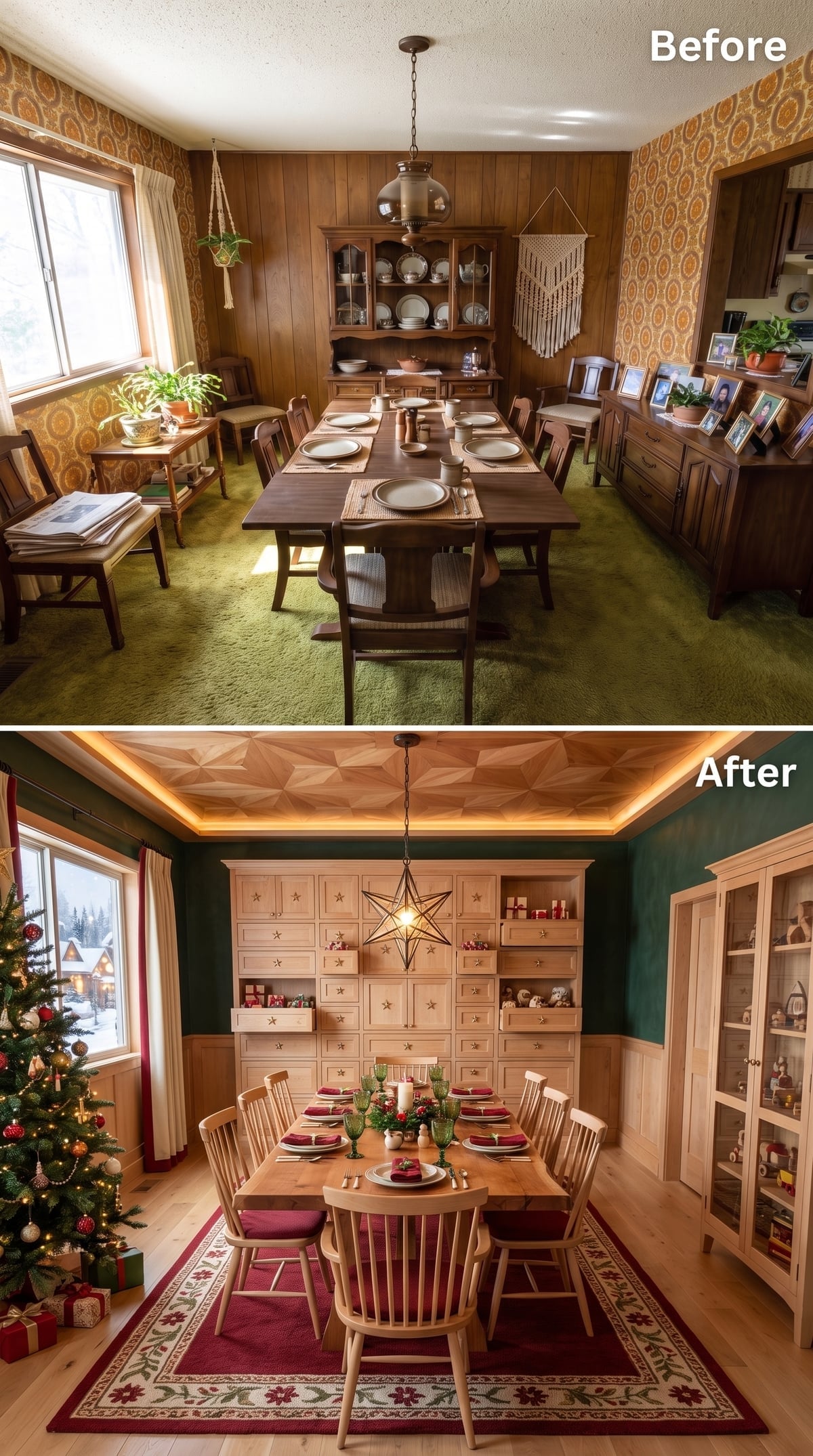
Forest green plaster gives the room depth, but the floor-to-ceiling maple cabinetry is what reorganizes the back wall. Small drawers and open cubbies create a tight grid, each punctuated by a six-pointed star pull.
A Moravian star pendant takes that geometry overhead without matching the hardware too literally. Windsor-style chairs in pale wood and a restrained table setting keep the lower half comparatively quiet, allowing storage itself to become the ornament.
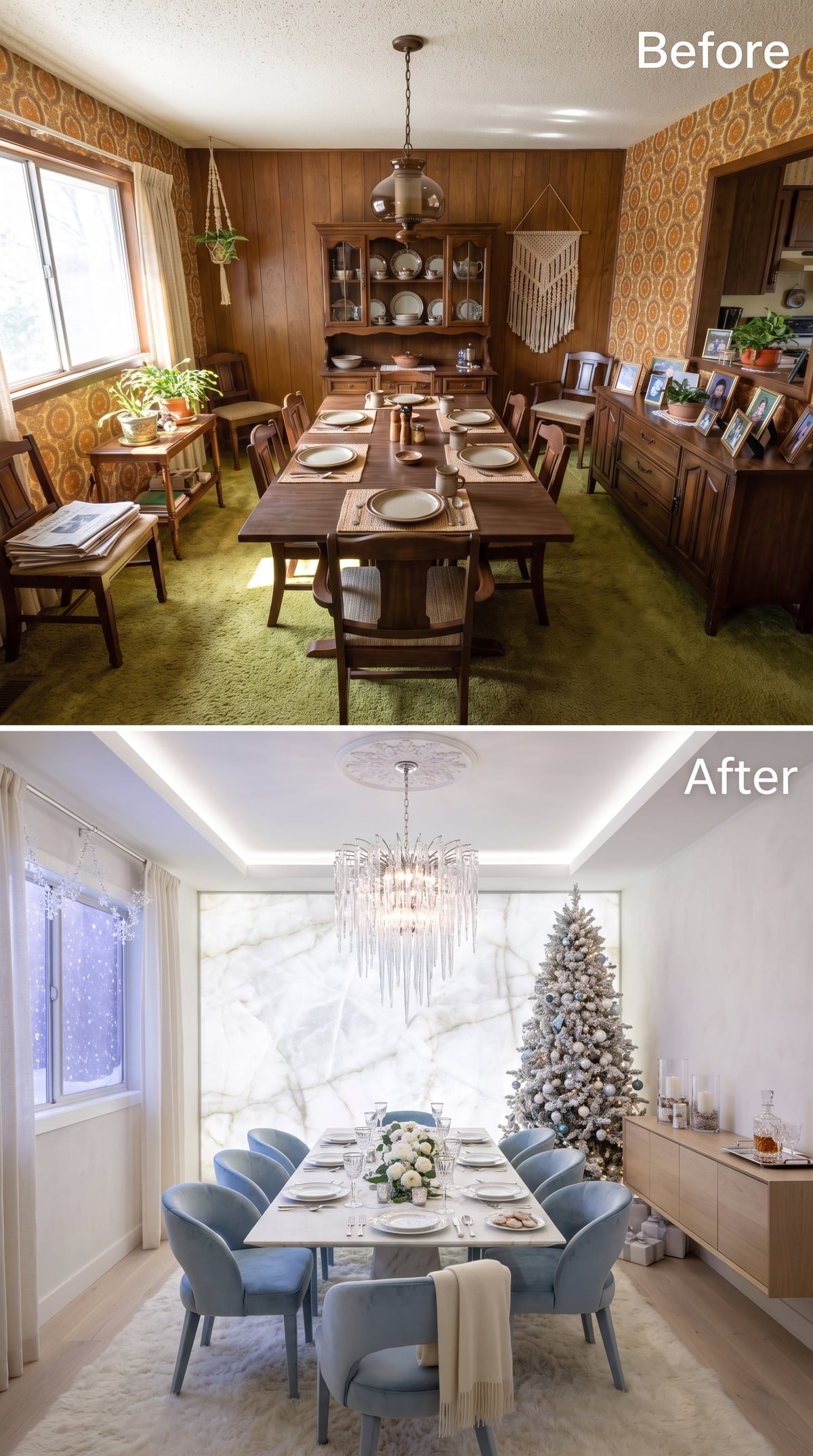
15. Marble Wall, Icicle Chandelier, and Blue Velvet Keep Winter Graphic
🔥 Would you like to save this?
Veined white marble covers the back wall from floor to ceiling, creating enough natural movement that the frosted tree almost disappears into it. Cascading crystal rods above the table suggest icicles without turning the chandelier into a literal snow prop.
Dusty blue velvet chairs soften the white marble table while cream curtains and a pale wool rug keep the room from becoming sterile. A low oak credenza provides the one substantial warm material, giving the cool palette a necessary interruption.
14. Sputnik Chandelier, Terrazzo, and Colored Bulbs With Full 1970s Energy
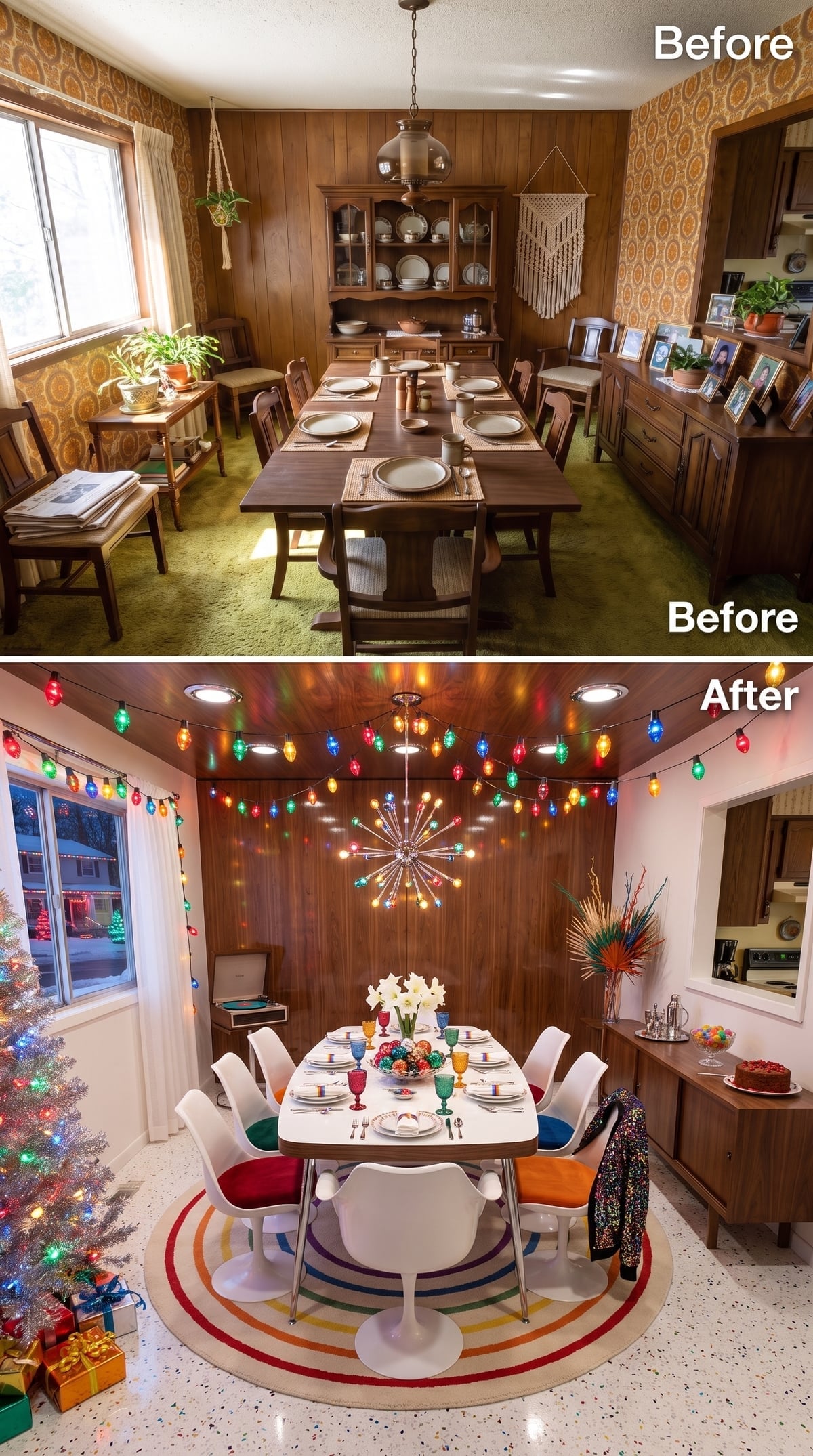
White tulip chairs with red, orange and teal cushions surround an oval table over a striped circular rug. Nothing is trying to disguise the decade here, and that is exactly why the room feels so lively.
The Sputnik chandelier provides a crisp metallic center, while oversized colored bulbs draped across the wood-paneled wall turn the original material into part of the celebration instead of something that needs to be erased. This renovation improves the room without pretending the 1970s never happened.
13. Copper Tree Wall Sculpture and Lotus Pendants Replace the Chandelier Entirely
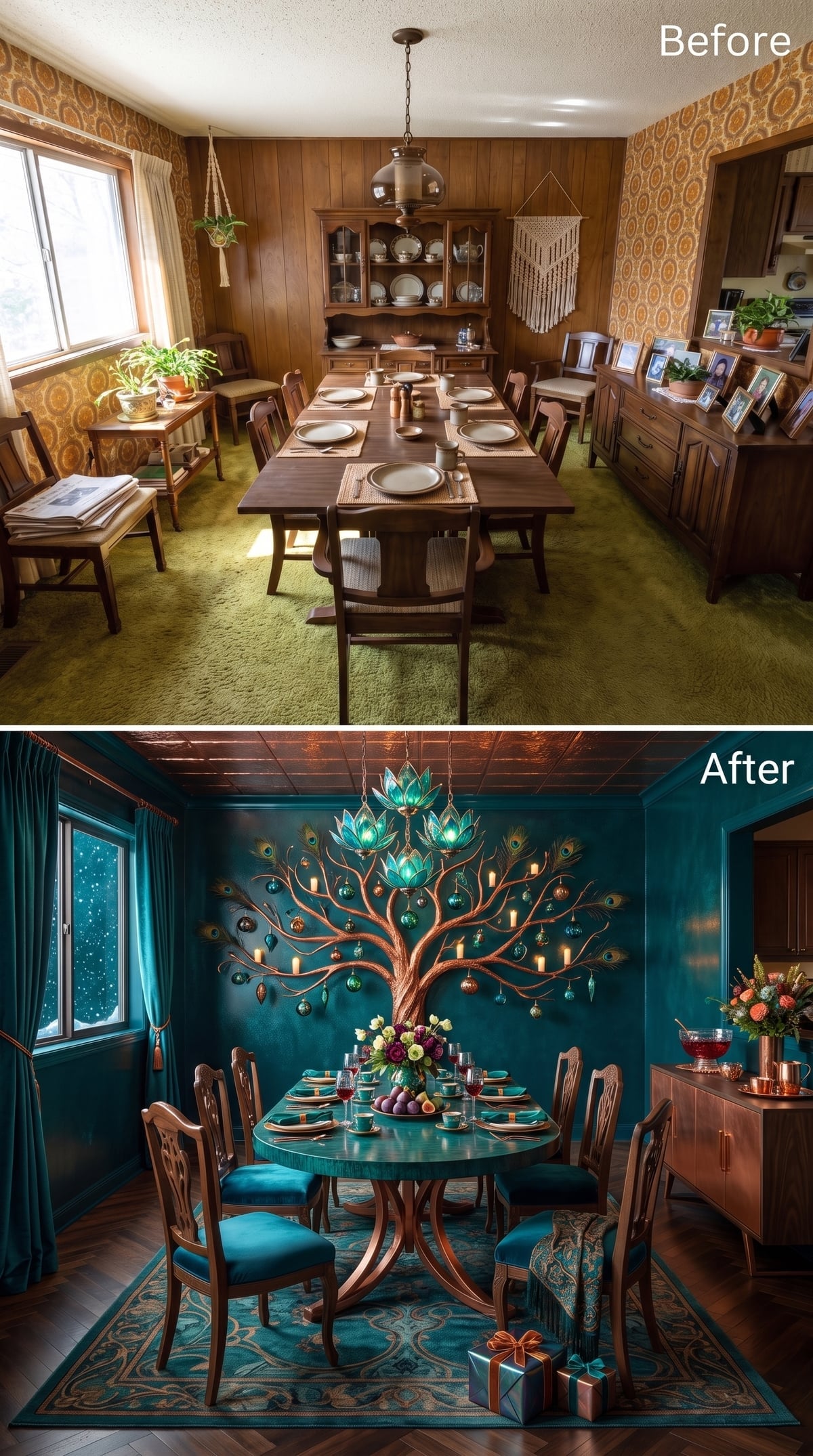
A sculptural copper tree spreads across the teal plaster wall, its branches hung with glass ornaments and peacock feathers. Instead of stopping at decoration, the branches terminate in lotus-shaped pendant lights, turning the wall piece into the room’s illumination system as well.
Teal velvet chair cushions repeat the wall color around the oval table, leaving copper as the principal contrasting material. The sculpture also gives the back wall depth and direction, drawing the eye outward instead of allowing the compact room to end abruptly behind the table.
12. Mustard Velvet, Espresso Paneling, and Bookshelves With Christmas Built In
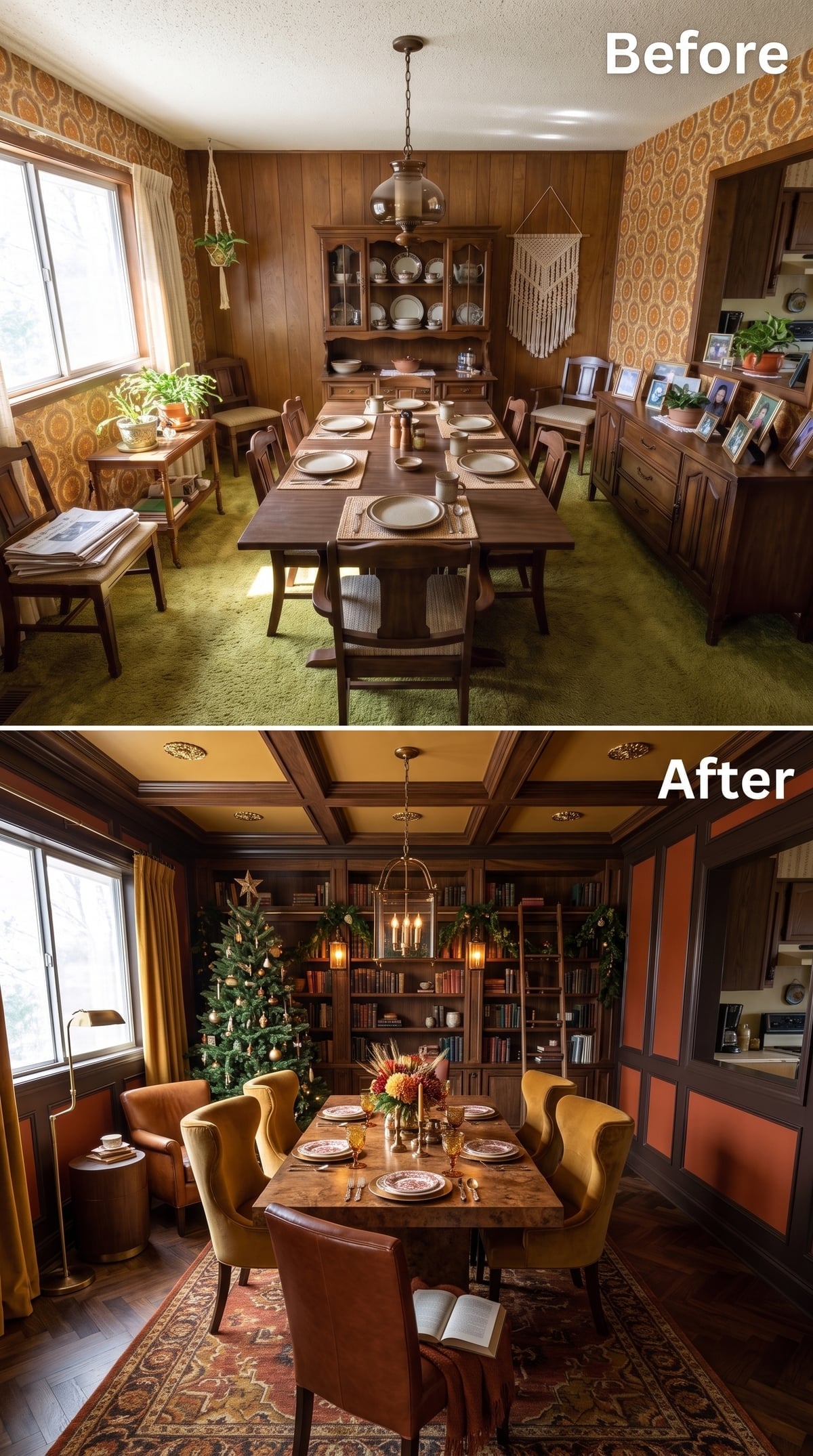
Deep espresso paneling wraps the room while an ochre coffered ceiling shifts the warmth upward instead of allowing the wood to dominate every surface. Small brass medallions at the coffer intersections introduce just enough ornament to make the ceiling feel finished rather than merely dark.
Mustard velvet wingbacks mark the table ends, with cognac leather chairs along the sides. Bookshelves flank the Christmas tree, allowing seasonal decoration to occupy an established architectural niche rather than being stranded in an empty corner.
11. Midnight Blue, a Moravian Star, and a Ceiling That Goes Full Planetarium
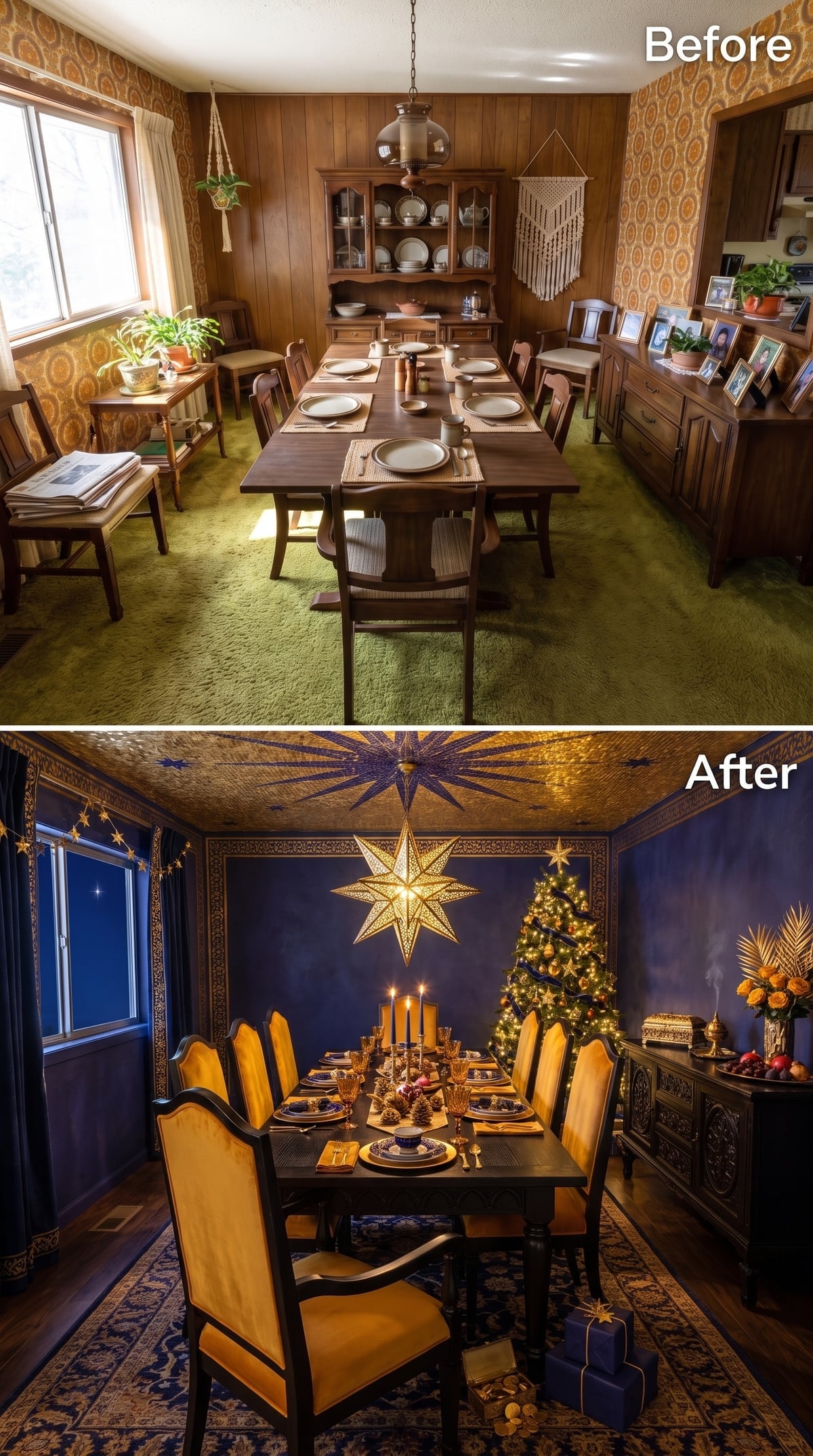
Deep cobalt plaster wraps the room while a hand-painted starburst radiates across the ceiling in navy and burnished gold. The Moravian star pendant beneath it repeats the angular geometry without disappearing into the mural.
Amber velvet chairs are the crucial interruption, placing a warm band around the table against all that blue. A carved sideboard, blue-and-ivory rug and restrained Christmas tree keep the lower half detailed enough that the ceiling does not monopolize the entire room.
10. Mushroom Pendants, Living Ferns, and Christmas Gone Completely Woodland
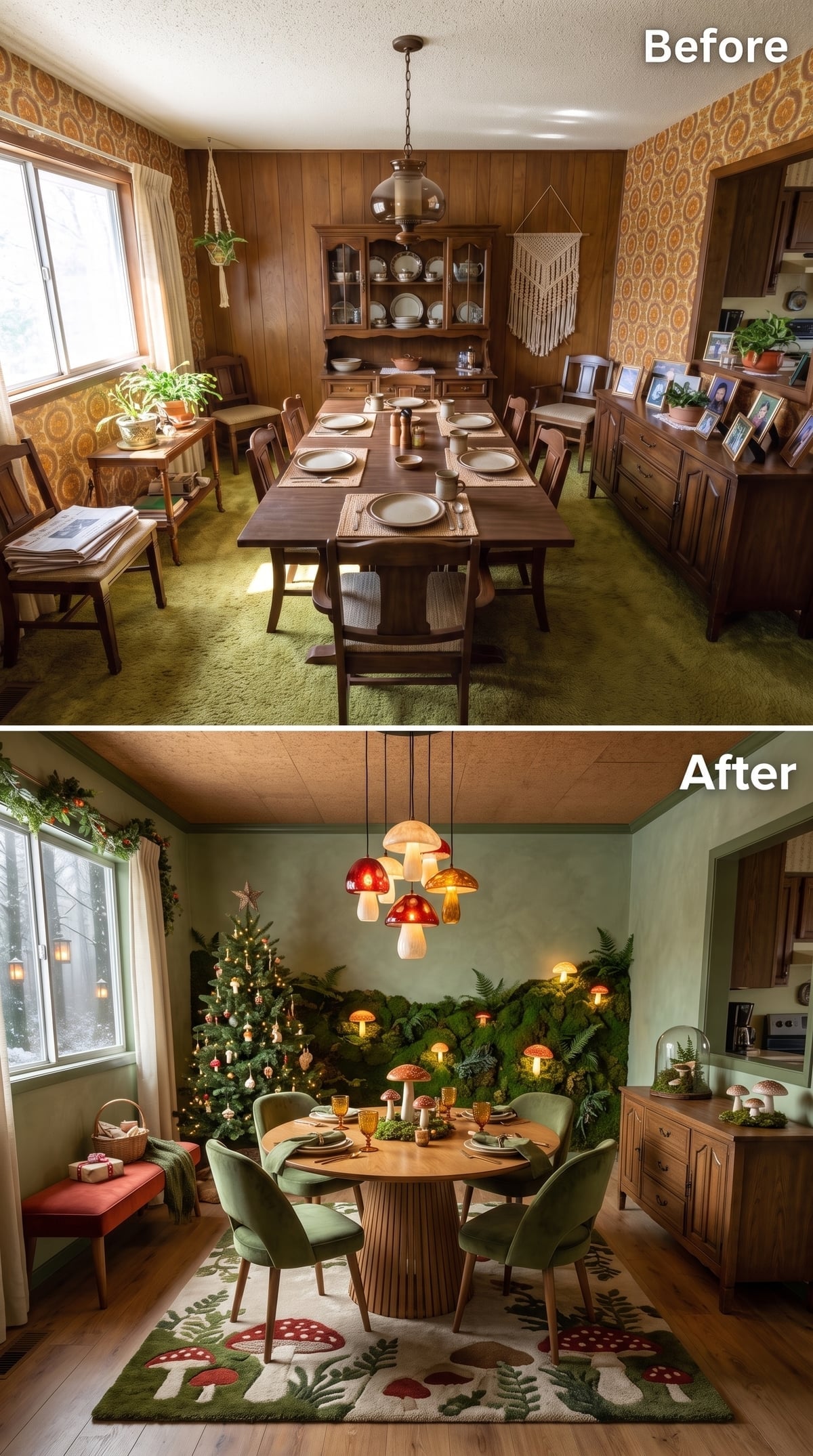
Sage plaster sets a quiet base before the room veers into full woodland fantasy. Red-and-cream mushroom-cap pendants gather above a round fluted oak table, introducing the theme at exactly the place a conventional chandelier would normally occupy.
The back wall goes further, layering ferns, moss and ceramic mushrooms from floor to ceiling. Because the Christmas tree is decorated sparingly, it merges into the botanical composition instead of becoming a second forest competing with the first.
9. Burgundy Velvet and a Rose-Lined Tray Ceiling Bring the Scale Down
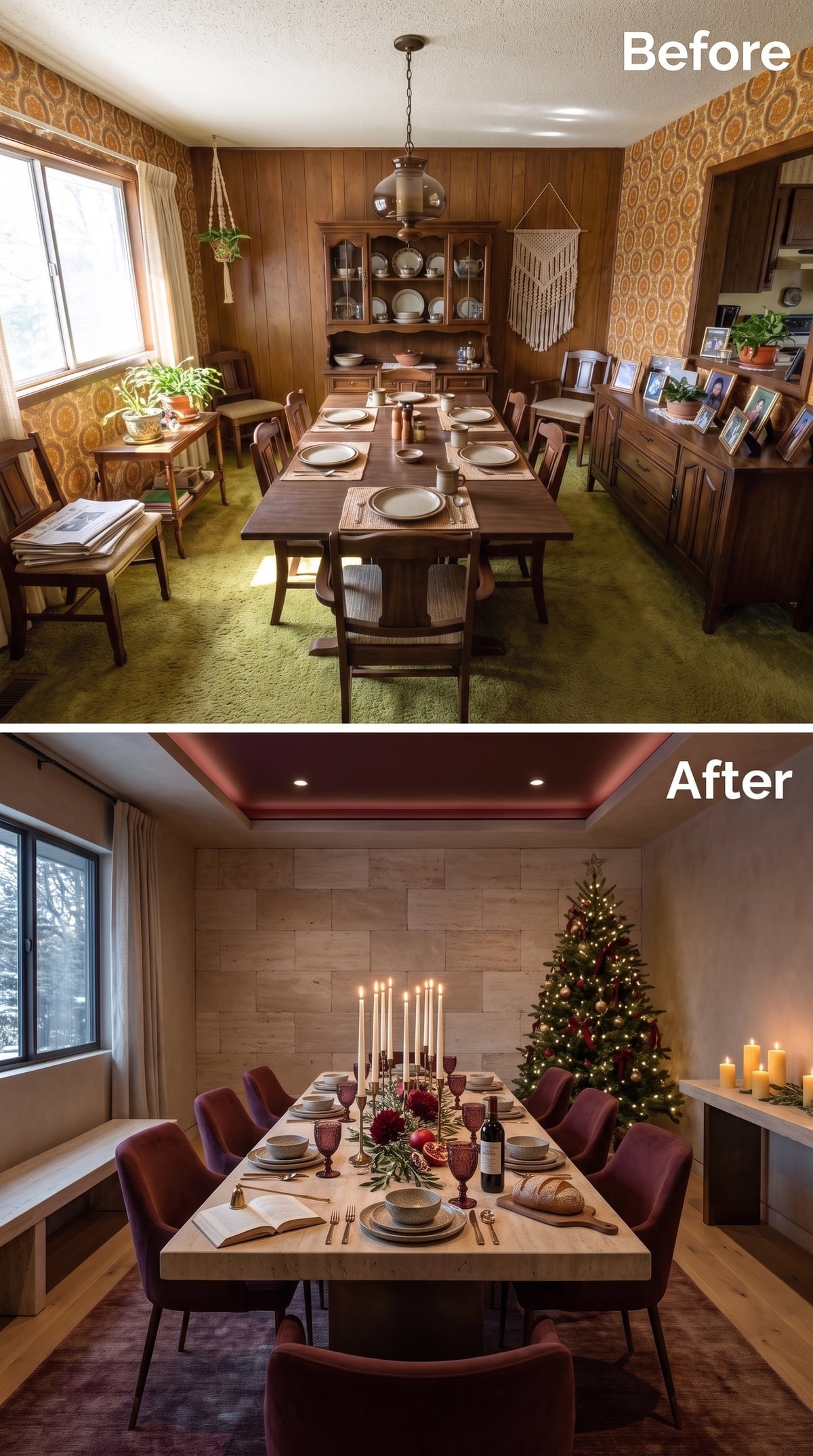
Plum velvet chairs have enough visual weight to stand beside the thick natural-edge dining table without being swallowed by it. Above, a tray ceiling lined in deep rose defines the dining zone and gives the overhead plane a warmer, more intimate boundary.
The candelabra remains low and decorative while recessed fixtures handle the general illumination. A Christmas tree fits neatly into the corner, its narrow placement preserving circulation around a table that already has substantial furniture on every side.
8. Pear Trellis, Mixed Chairs, and a Coffered Ceiling Keep the Holiday Palette Earthy
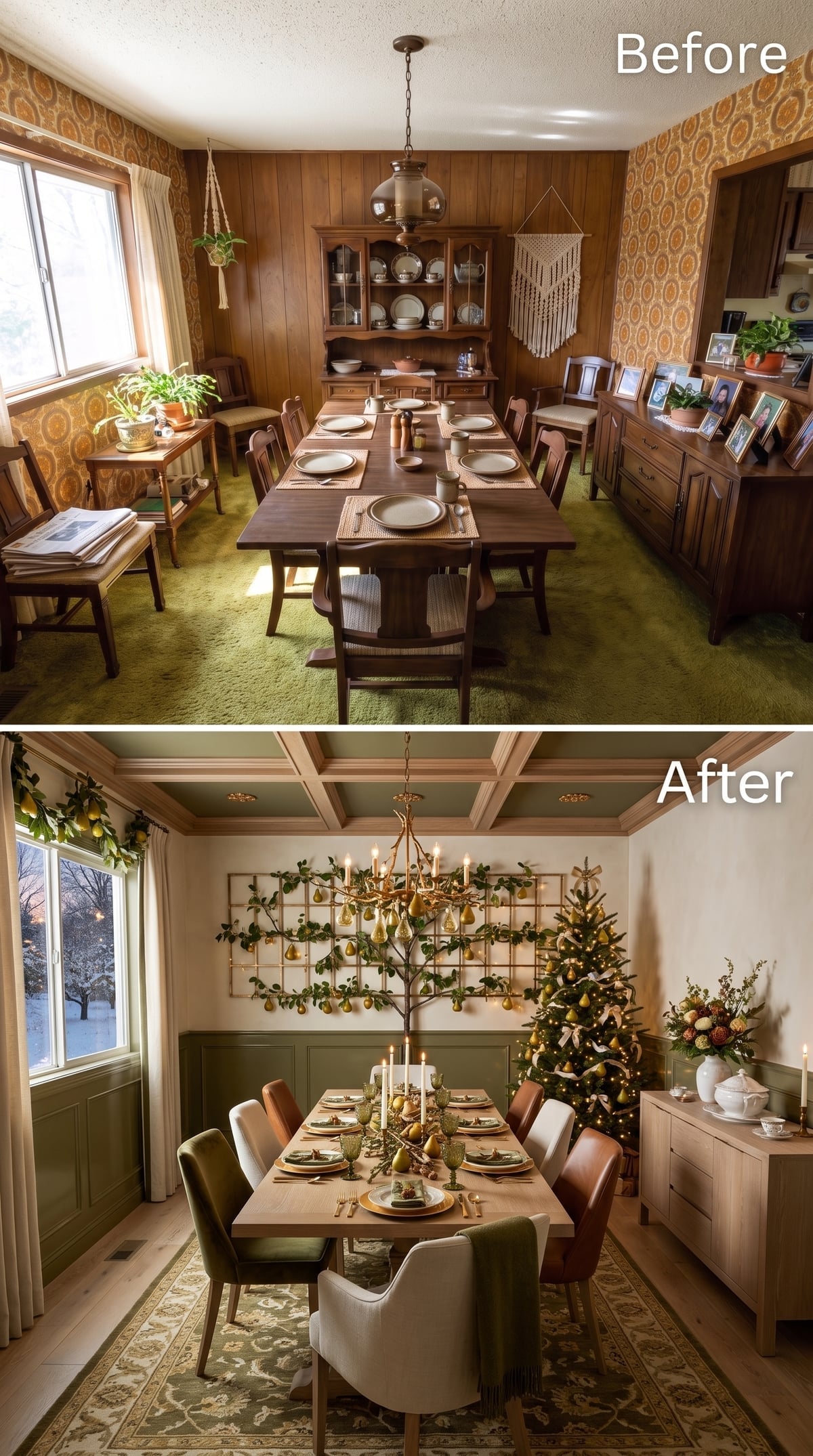
Sage board-and-batten grounds the lower walls while cream plaster above keeps the room from becoming too dense. Wood-trimmed coffers give the ceiling enough structure to balance the trellis panel behind the table.
Green velvet, cream linen and cognac leather chairs deliberately differ, but the muted olive-and-cream palette keeps the variation controlled. Pears on the wall trellis introduce a seasonal botanical note that feels festive without depending on ornaments or glitter.
7. Lit Display Cabinets Turn Storage Into the Main Attraction
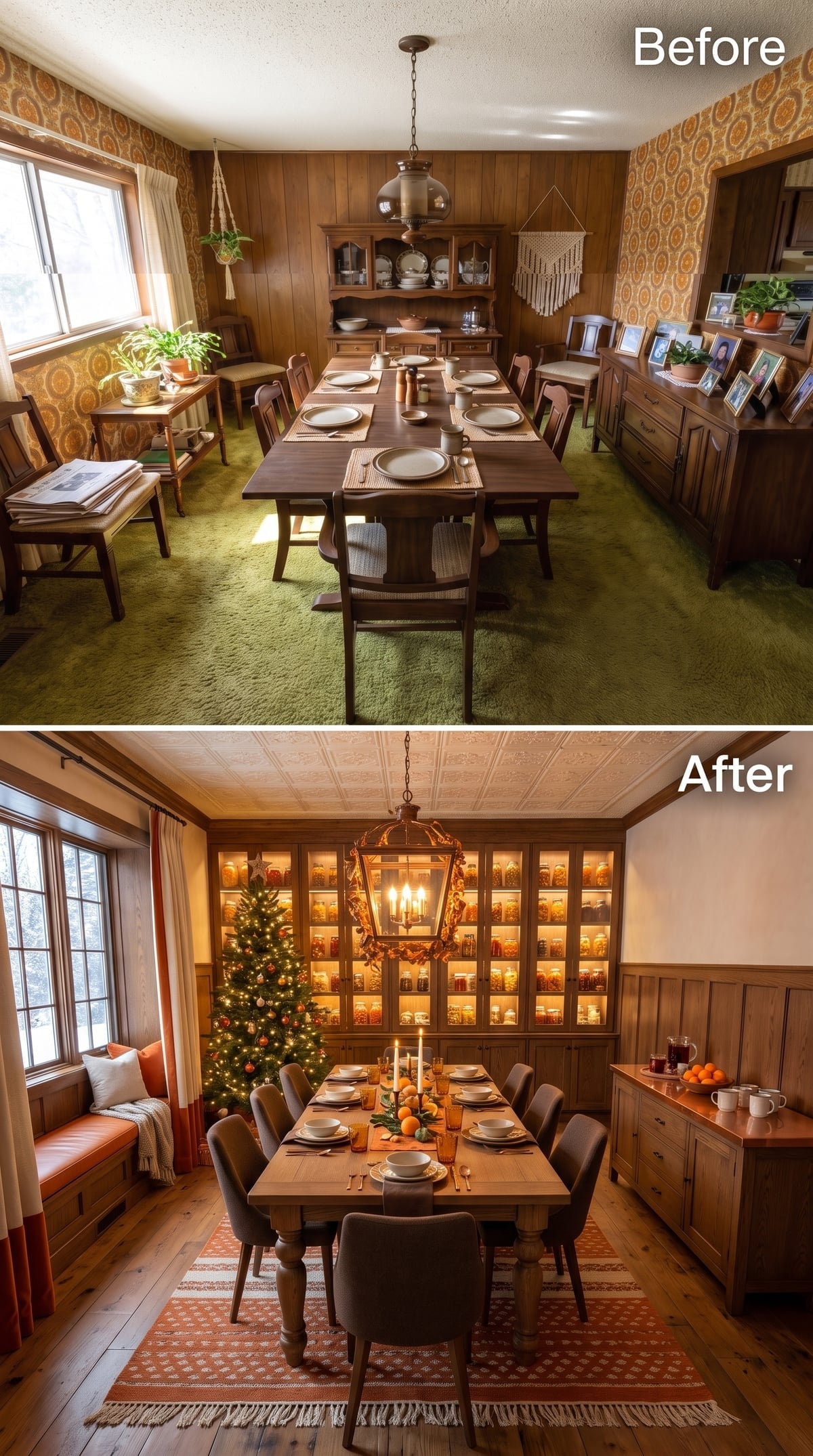
Floor-to-ceiling built-ins reorganize the back wall into a grid of illuminated shelves, with glass jars and serving pieces becoming part of the composition. Warm backlighting gives the cabinetry depth without requiring another wall treatment behind it.
A restrained brass lantern above the table is deliberately simpler than the cabinetry. Hardwood floors and a rust-toned woven rug replace the shag with cleaner horizontal surfaces, making the room feel more spacious without needing to erase its warmth.
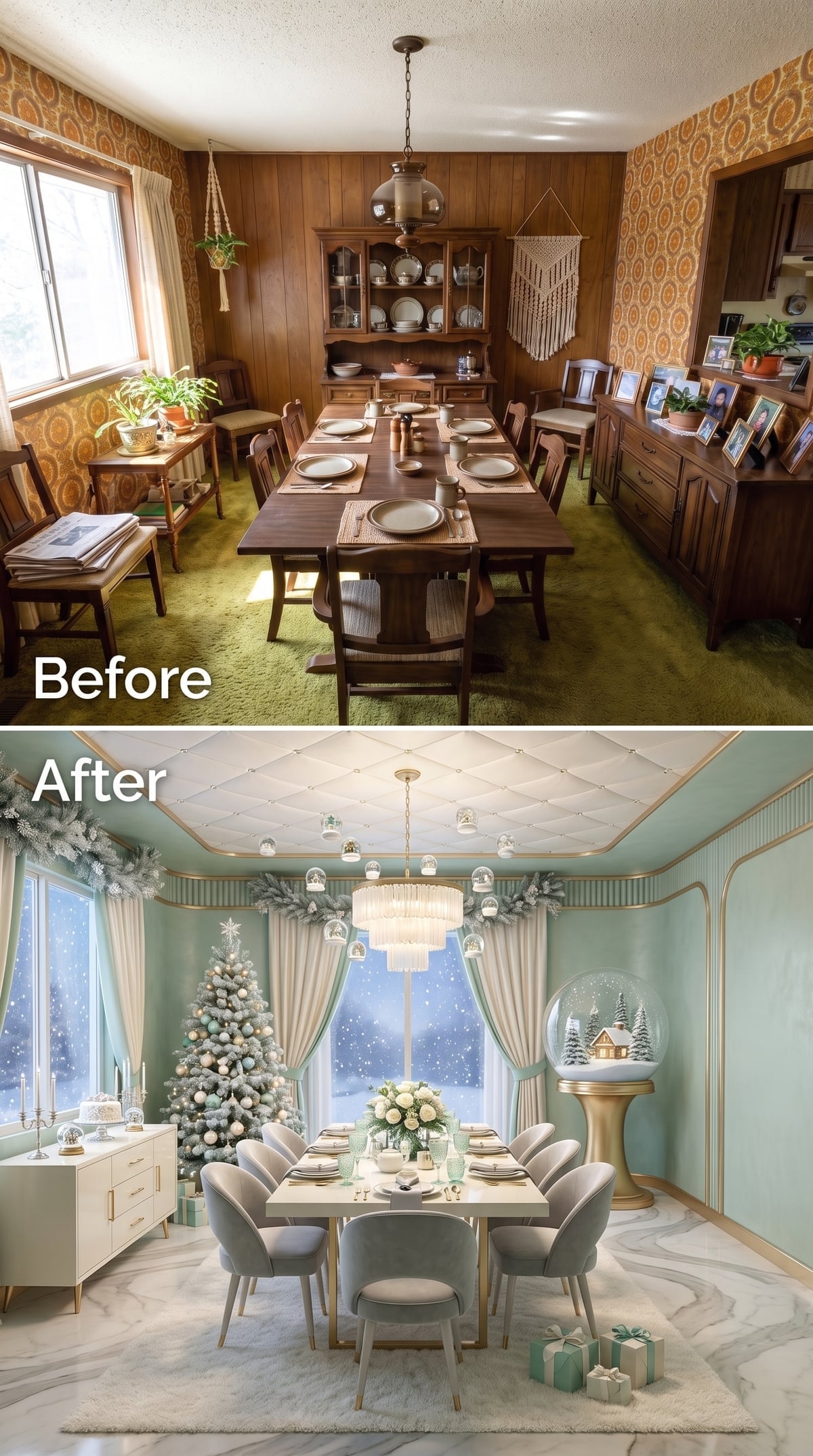
6. Sage Walls, a Giant Snow Globe, and a Ceiling With Ballroom Ambitions
🔥 Would you like to save this?
Sage walls with gold trim establish a formal envelope, but the ceiling takes the room somewhere stranger: padded ivory panels sit inside a gold coffer grid, giving the upper plane a softly upholstered appearance.
Gray velvet chairs and a white dining table repeat that softness below. The oversized snow globe on its gold pedestal is pure theater, but isolating it as the major holiday object keeps the rest of the room from becoming a collection of competing Christmas props.
5. Charcoal Walls, Sixteen Wreaths, and Chartreuse Chrome Chairs
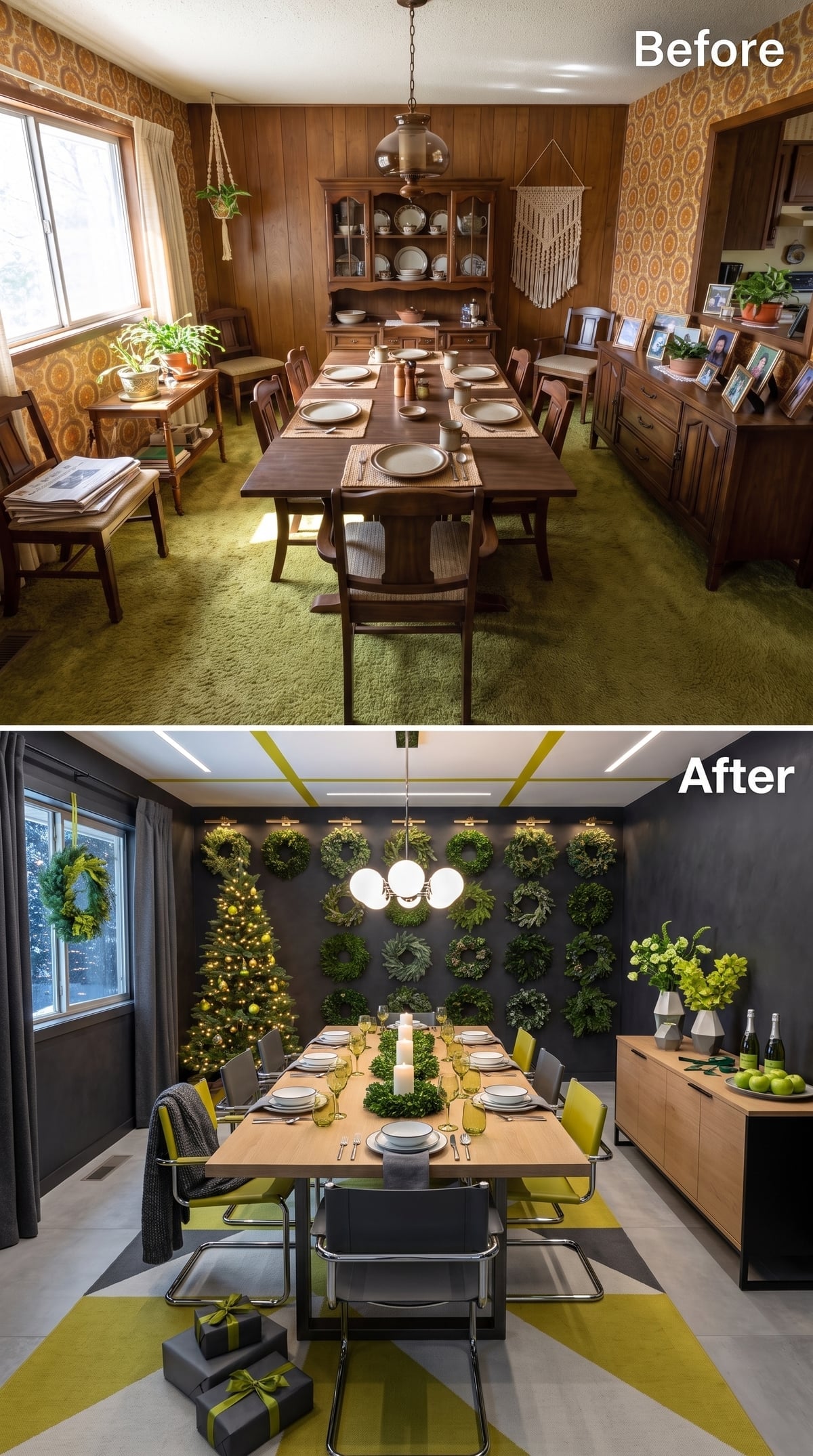
Sixteen evergreen wreaths mounted in a strict grid turn a familiar Christmas object into a graphic wall installation. Against charcoal, the repetition becomes stronger than any single wreath could have been on its own.
Chrome cantilever chairs upholstered in chartreuse break sharply from both the dark wall and traditional holiday green. That acidic color is the useful surprise here: without it, the room could drift toward solemn. With it, the composition becomes unmistakably modern.
4. Navy Velvet, an Orrery Chandelier, and a Ceiling Mapped With Stars
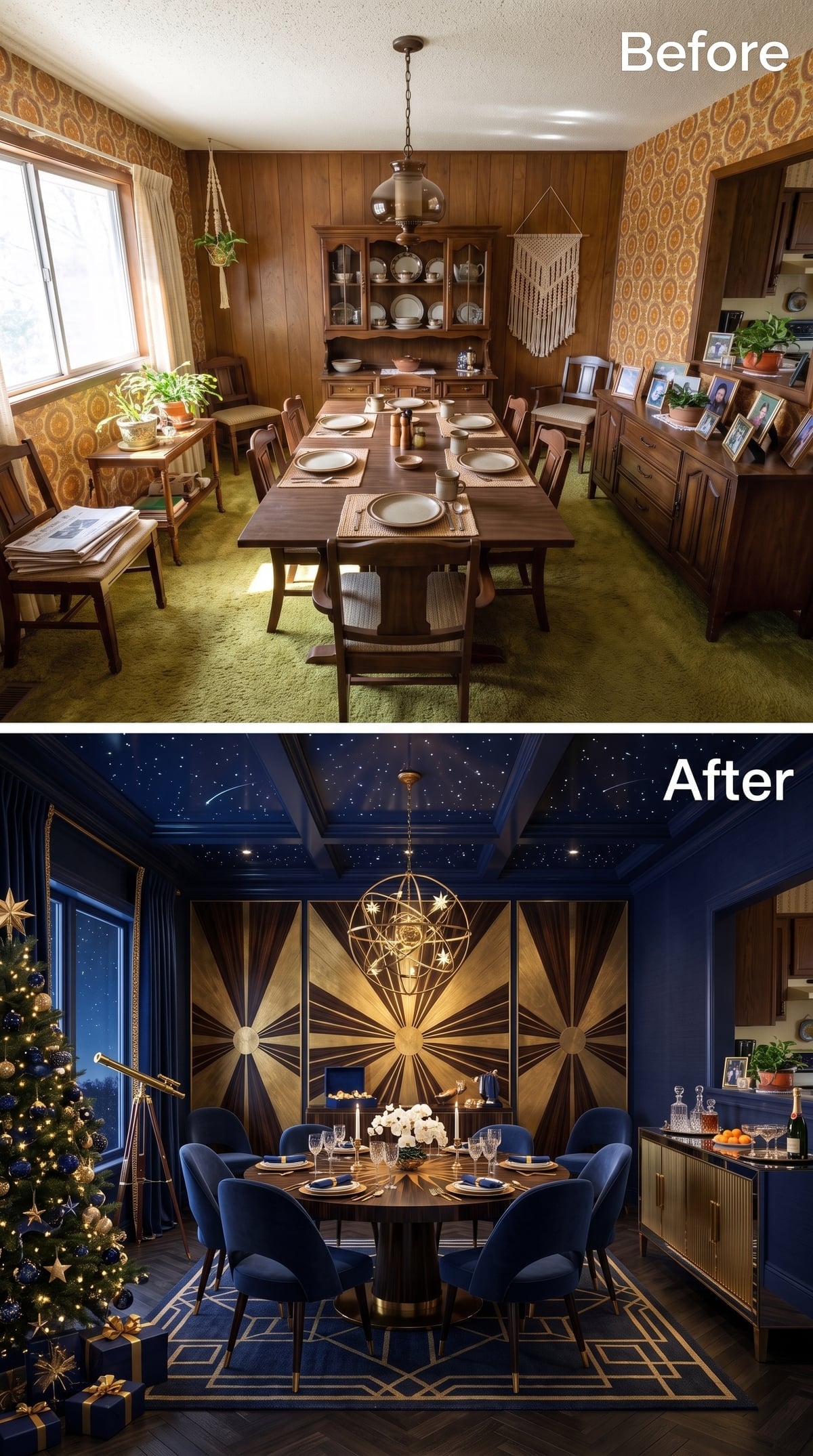
Dark walnut paneling inlaid with brass sunbursts turns the entire back wall into a geometric focal surface. Six navy velvet chairs gather around a round pedestal table beneath a brass orrery-style pendant whose rings echo the circular furniture below.
The deep-blue ceiling scattered with stars extends the celestial idea without repeating the wall’s sunburst pattern. White orchids at table level provide a clean pause between all that navy, walnut and brass.
3. Amethyst Geodes, Purple Walls, and a Crystal Starburst With Serious Competition
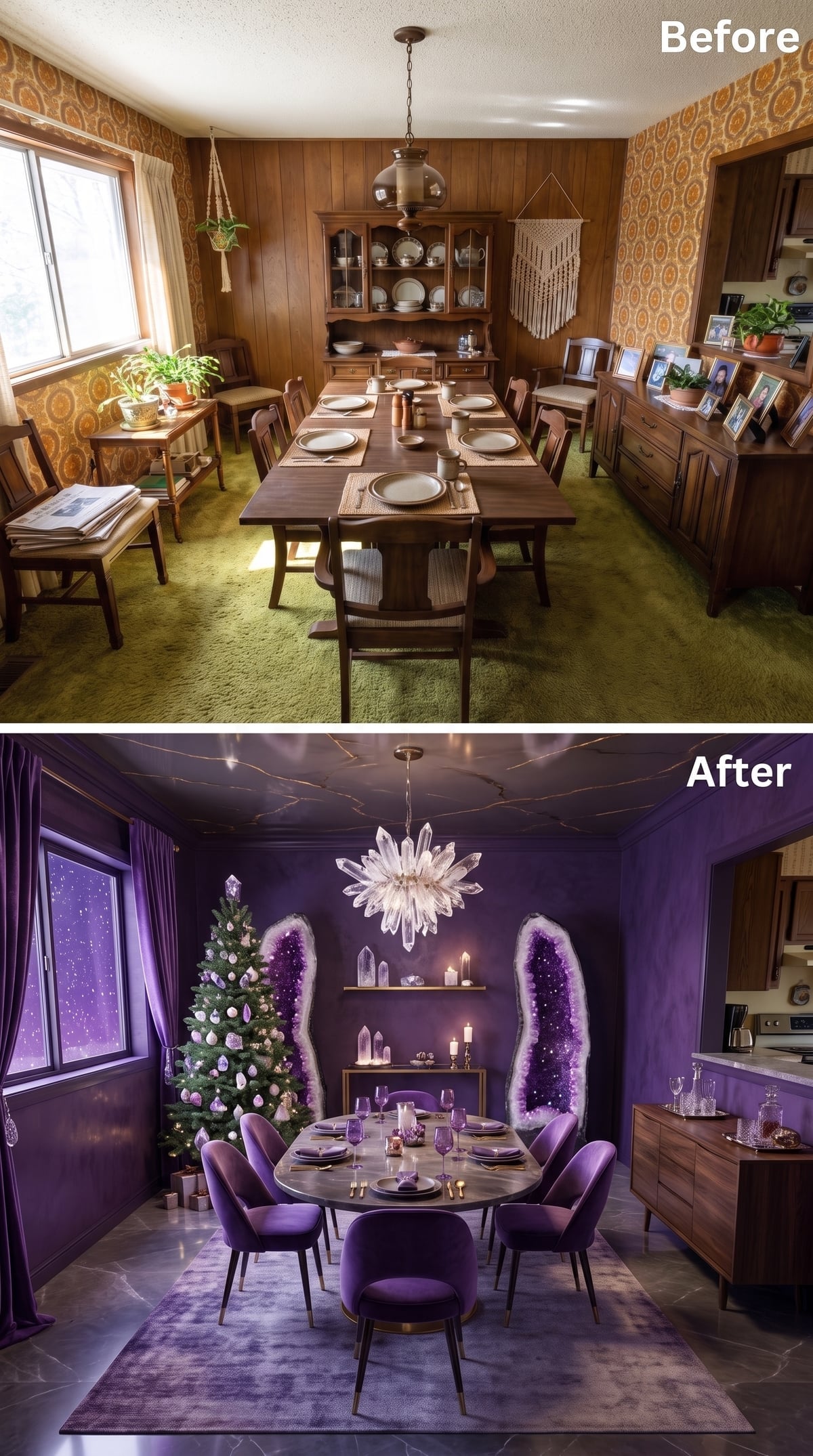
Two cathedral-scale amethyst geodes turn the back wall into something closer to a mineral gallery than a conventional dining room. Purple walls deliberately refuse to neutralize them, creating a saturated backdrop that makes the crystalline interiors appear even brighter.
The starburst chandelier above the table answers the geodes with a much finer kind of sparkle. Keeping the furniture comparatively streamlined prevents three major elements — wall color, stone and chandelier — from fracturing into three unrelated spectacles.
2. Linen Drum Pendant, Snowflake Relief, and Christmas Decoration Carved Into the Wall
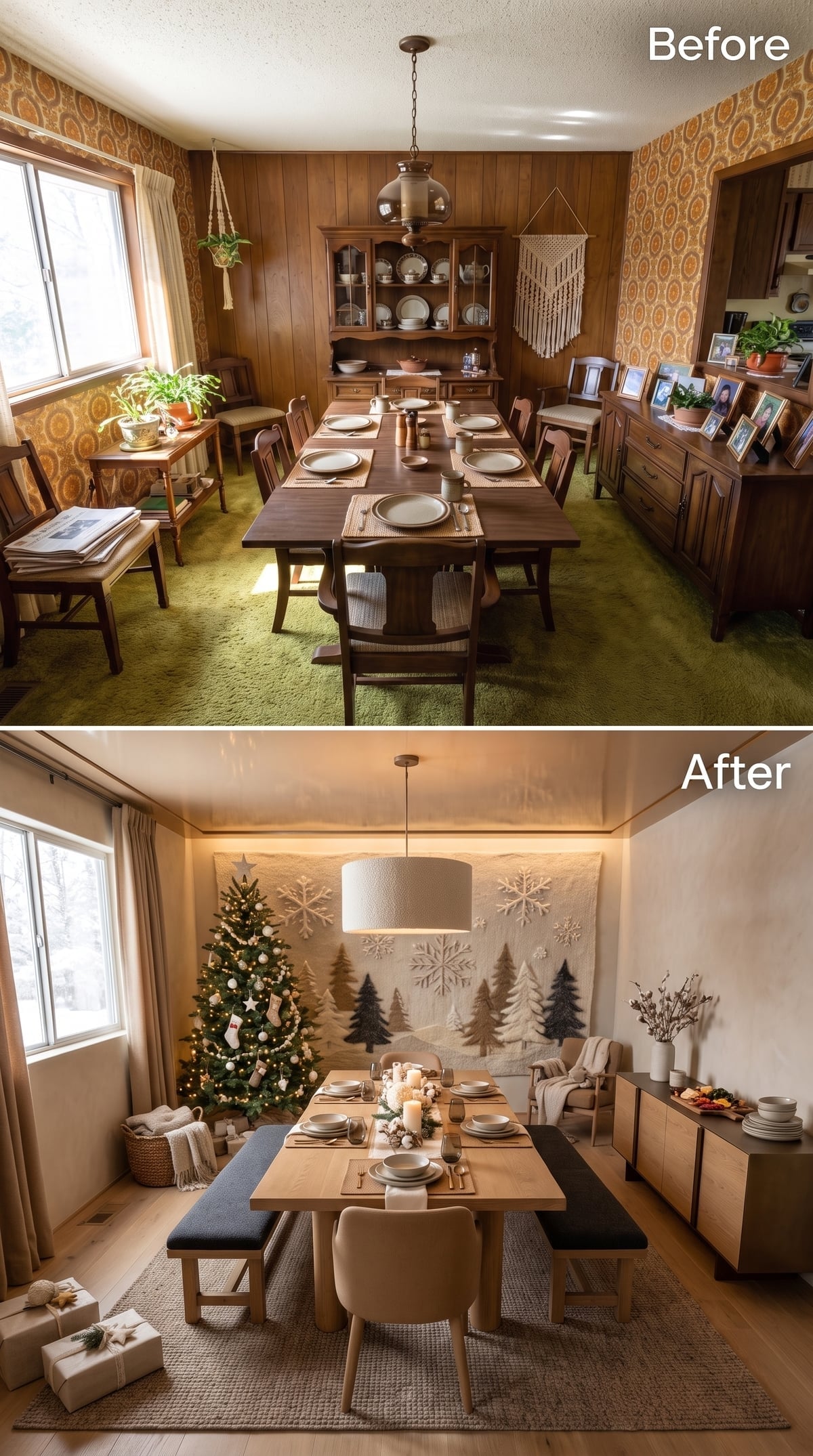
A textured relief panel filled with pine-tree and snowflake motifs gives the focal wall dimensional pattern without relying on wallpaper or framed art. Perimeter cove lighting grazes the surface, making the raised shapes legible without turning them into hard-edged shadows.
The linen drum pendant is intentionally plain beside such a detailed wall. A Christmas tree occupies the adjoining corner rather than sitting directly in front of the relief, allowing both seasonal elements to register independently instead of piling into the same sightline.
1. Amber Glass, Dried Citrus, and a Coffered Ceiling That Turns Warmth Into Architecture
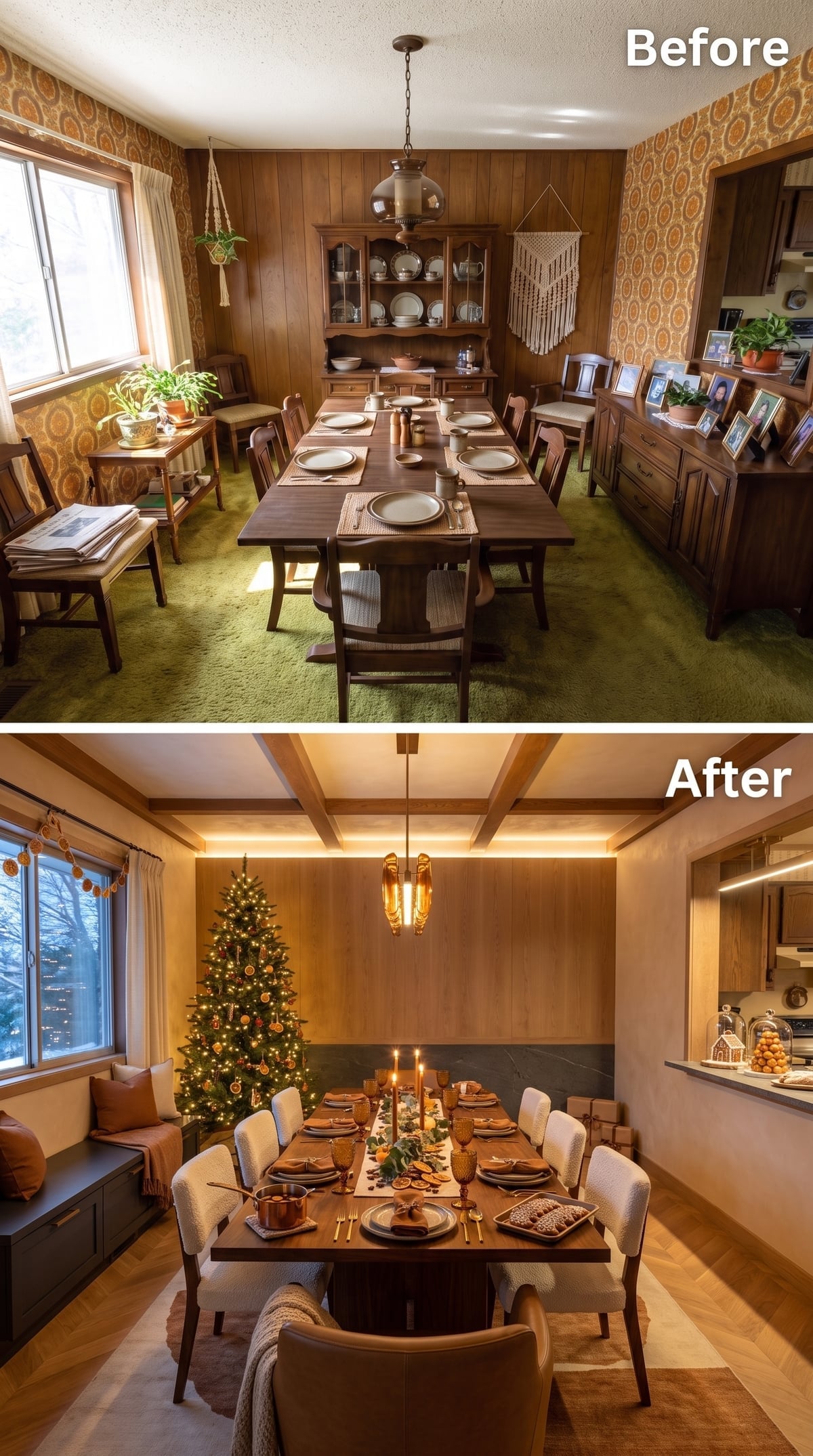
Light-toned wood planks and coffered beams give the room its architectural backbone, while concealed perimeter lighting emphasizes the depth between them rather than flattening the ceiling into one plane. Amber glass pendants bring that warmth directly over the dining table.
The Christmas tree trades glossy ornament for dried citrus, natural greenery and warm tones that echo the wood rather than fighting it. Material discipline can be every bit as transformative as stained glass, geodes or a chandelier shaped like a carousel.