
Four walls get the expensive finishes, the architectural flourishes, and the endless arguments over color. The ceiling gets white. Perhaps a recessed light or two. For a surface that occupies so much visual real estate, it has spent an astonishing amount of time being told to keep quiet. Meanwhile, an entire dimension of interior design is going to waste above everyone’s heads.
Consider what happens when the ceiling refuses its supporting role. A suspended plane appears to float without touching the walls. A barrel vault turns timber ribs into an architectural procession. Black reflections make a Manhattan penthouse seem to extend upward into another dimension. Elsewhere, stone glows from within, plaster folds like fabric, and a circular skylight gives the desert sky a permanent place in the living room. These are not simply new colors for the fifth wall. They are different ways of constructing space.
In order to come up with the very specific design ideas, we create most designs with the assistance of state-of-the-art AI interior design software. Also, assume links that take you off the site are affiliate links such as links to Amazon. this means we may earn a commission if you buy something.
Some of these ceilings demand elaborate craftsmanship; others achieve their effects through geometry, shadow, or an ingenious use of ordinary materials. They can make a room appear taller, quieter, more intimate, or dramatically larger than its actual dimensions. The remarkable thing is how thoroughly a single overhead decision can rewrite everything happening beneath it. The furniture hasn’t moved. The floor plan hasn’t changed. Suddenly, the room is having an entirely different conversation.
32. Backlit Onyx Turns a Desert Living Room Ceiling Into Its Own Light Source
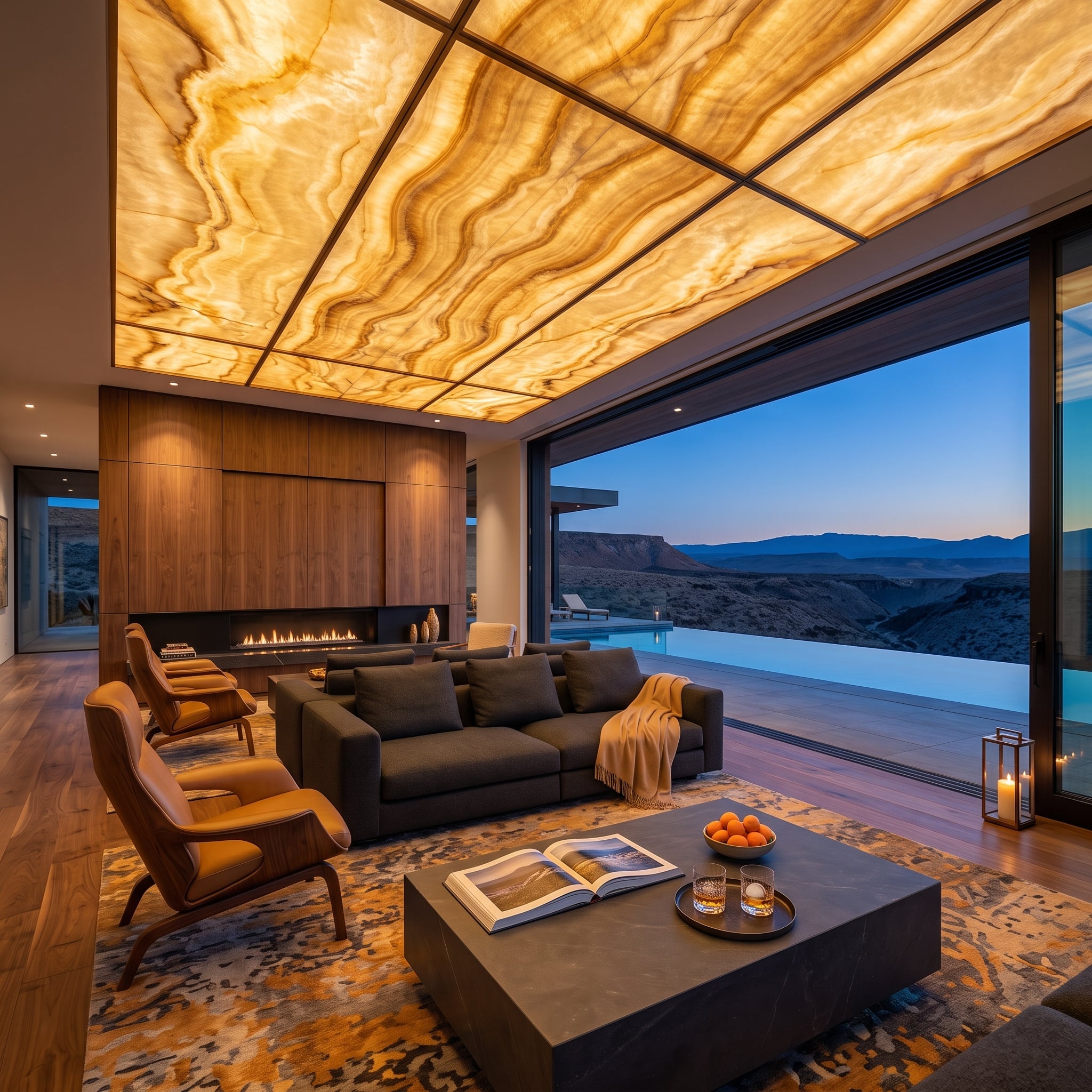
Forget the usual arrangement of lights mounted beneath a ceiling. Here, translucent honey-colored onyx appears to generate the illumination itself, its mineral veining glowing through layers of amber and gold. What might have been a conventional stone finish becomes an enormous illuminated geological composition.
Walnut paneling and cognac leather seating extend the warmth downward without competing with the intricate pattern overhead. The stone’s translucency allows light to penetrate its veining, revealing a complexity that opaque marble cannot reproduce. Against the desert landscape beyond the windows, the ceiling becomes an extraordinary second horizon: one formed millions of years ago, now glowing above a thoroughly contemporary room.
31. A Herringbone Cork Ceiling Gives This 1970s-Inspired Living Room an Unexpected Finish
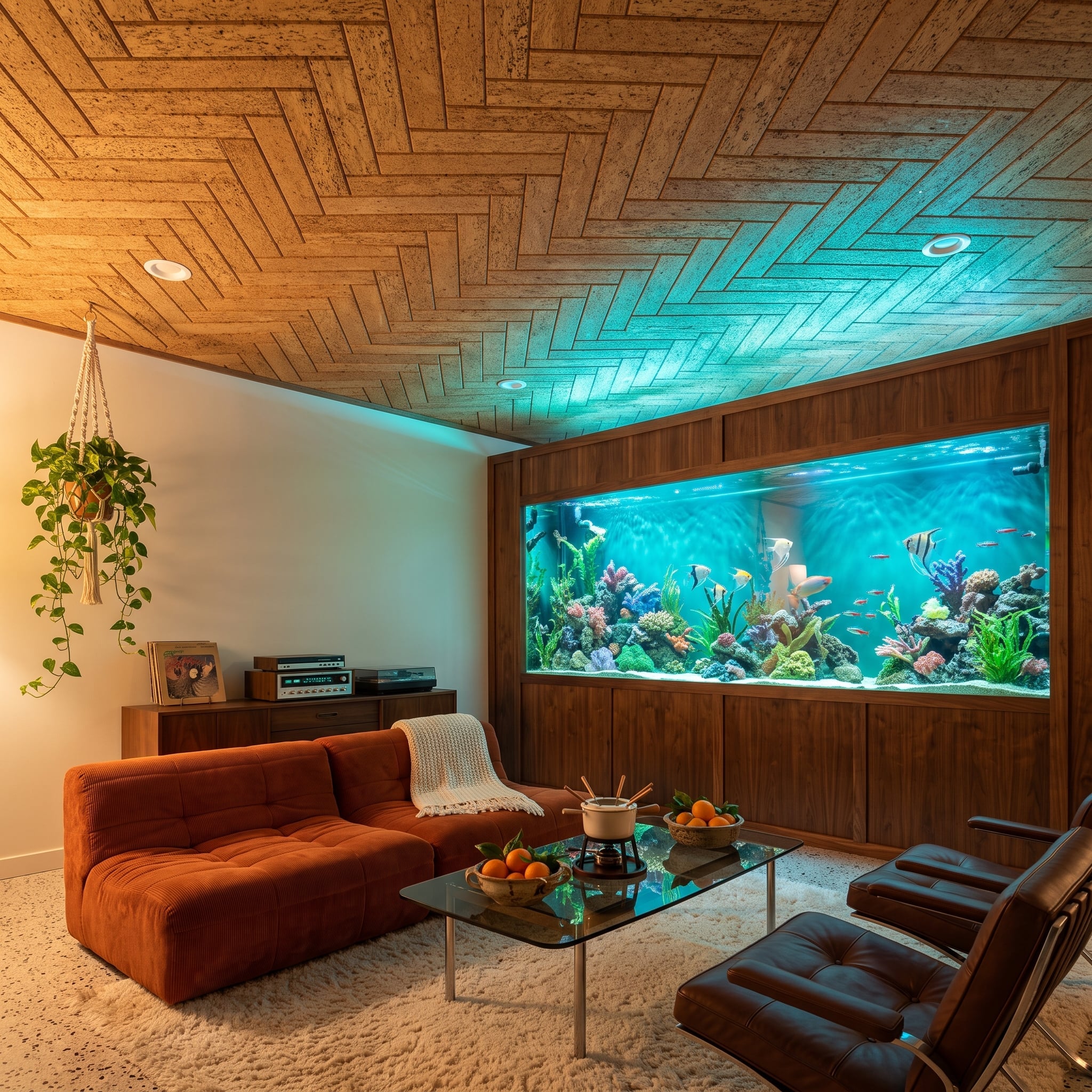
Cork has escaped the bulletin board and arrived overhead with considerably better tailoring. Small pieces arranged in a precise herringbone pattern create the kind of directional movement usually associated with parquet flooring. Their irregular natural texture gives the geometry warmth rather than rigidity.
Rust-colored modular seating and tufted leather chairs reinforce the room’s 1970s character, while the aquarium introduces a sharp note of teal against the predominantly earthy palette. Cork’s cellular structure also gives it useful sound-absorbing properties when incorporated into an appropriate acoustic assembly. The real surprise, however, is how convincingly the herringbone arrangement elevates the material. What looks casual in isolation becomes remarkably sophisticated when repeated across an entire ceiling.
30. A Floating Ceiling Appears to Defy Gravity Above a Southern California Living Room
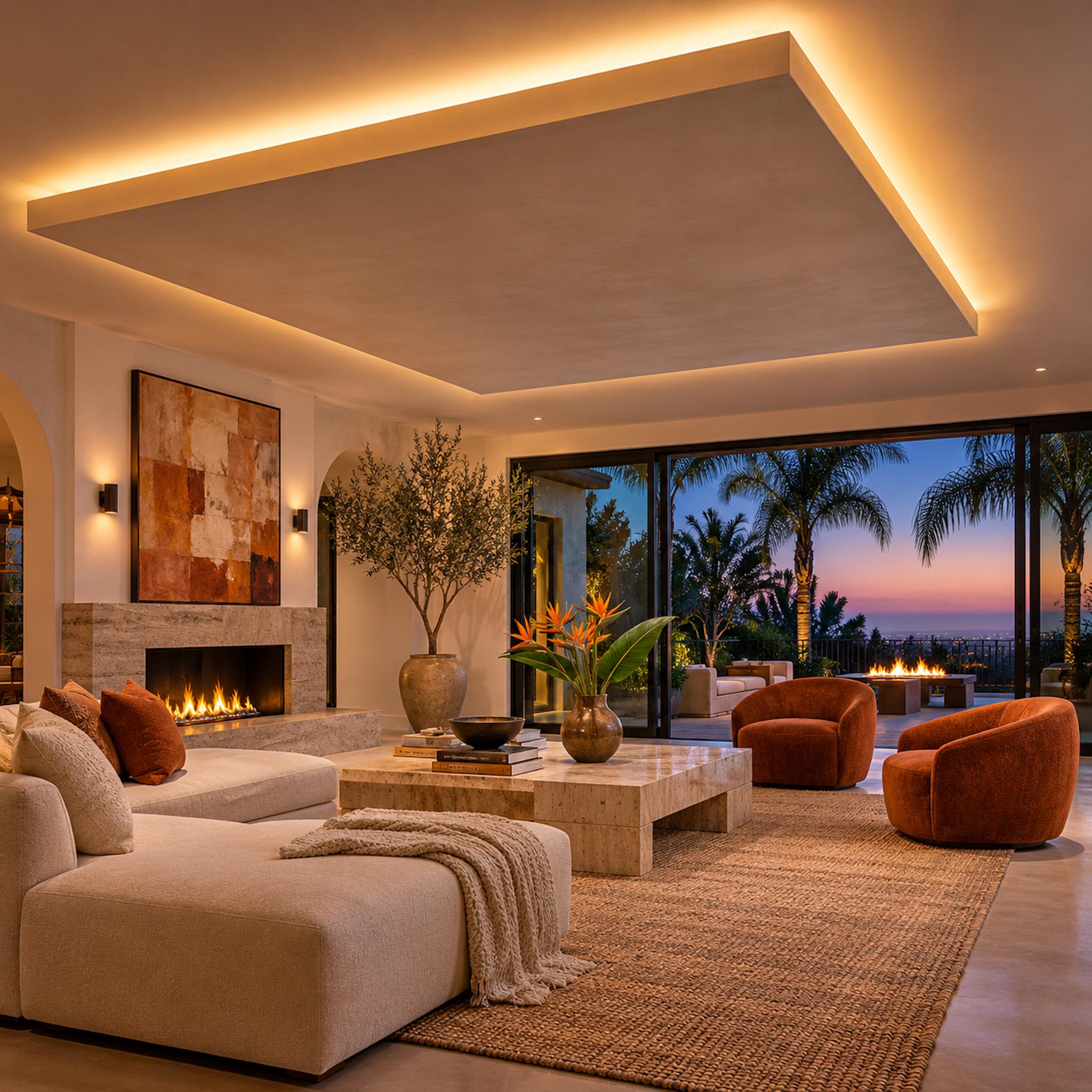
A broad rectangular ceiling plane seems to hover independently above this Southern California living room, its edges separated from the surrounding plaster by a continuous band of warm concealed light. The glowing perimeter creates the illusion that the substantial panel has no visible means of support. Against the evening sky beyond the glass doors, the effect is especially convincing.
Generous cream upholstery, rust-colored chairs, a substantial stone coffee table, and an abstract painting establish a relaxed but carefully composed interior. The ceiling achieves its effect through a simple architectural sleight of hand: conceal the connections, illuminate the separation, and allow the eye to interpret the resulting shadow as empty space. Nothing overhead is especially ornate, yet the entire room seems to have acquired an unexpected lightness.
What Our Readers Say
- White ceilings still have fans: readers who chose a bright light in one of our polls picked a white ceiling 75% of the time, vs 44% of everyone else.
- In our reader polls, readers who wanted white ceilings were also more likely to want white trim, 71% compared with 52% of readers who chose another ceiling.
From Home Stratosphere reader polls and votes.
29. Concrete Coffers Give This Kitchen the Weight of a Brutalist Building
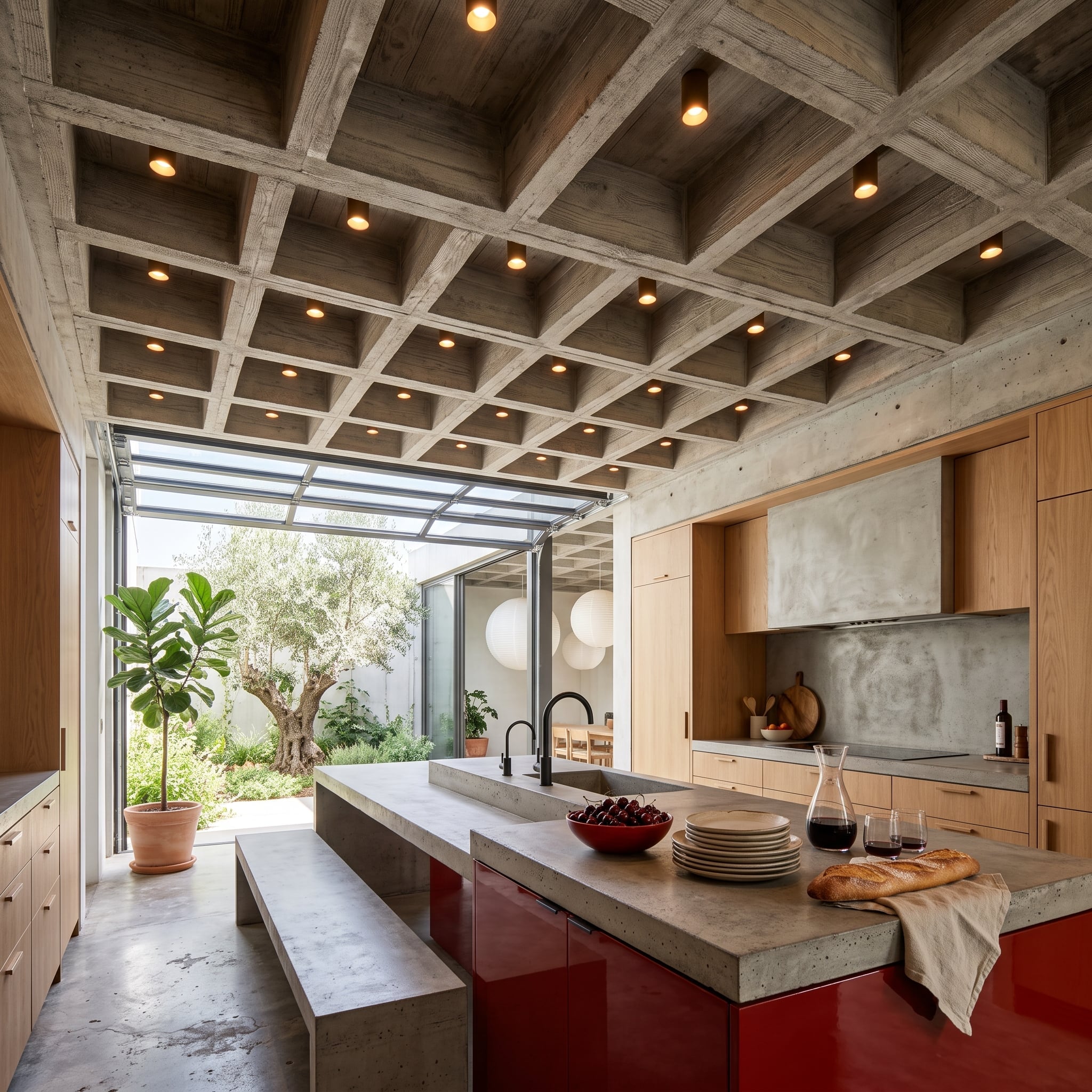
A deep waffle-grid ceiling introduces the uncompromising geometry associated with Brutalist architecture. Each square recess receives its own light and shadow, turning a heavy-looking overhead surface into a disciplined sequence of architectural compartments. The ceiling appears substantial enough to belong to a civic building rather than a private kitchen.
Red lacquer cabinetry, oak storage, and a concrete island meet that visual weight with equally assertive materials. Daylight from the courtyard glazing keeps the composition from becoming oppressive. The repeated coffers introduce a surprisingly fine-grained rhythm to the massive-looking concrete, demonstrating that even the most imposing material can acquire delicacy through proportion. Above all that polished cabinetry, the ceiling refuses to be polite.
28. Wisteria Climbs Straight Across the Ceiling in This Chinoiserie Bedroom
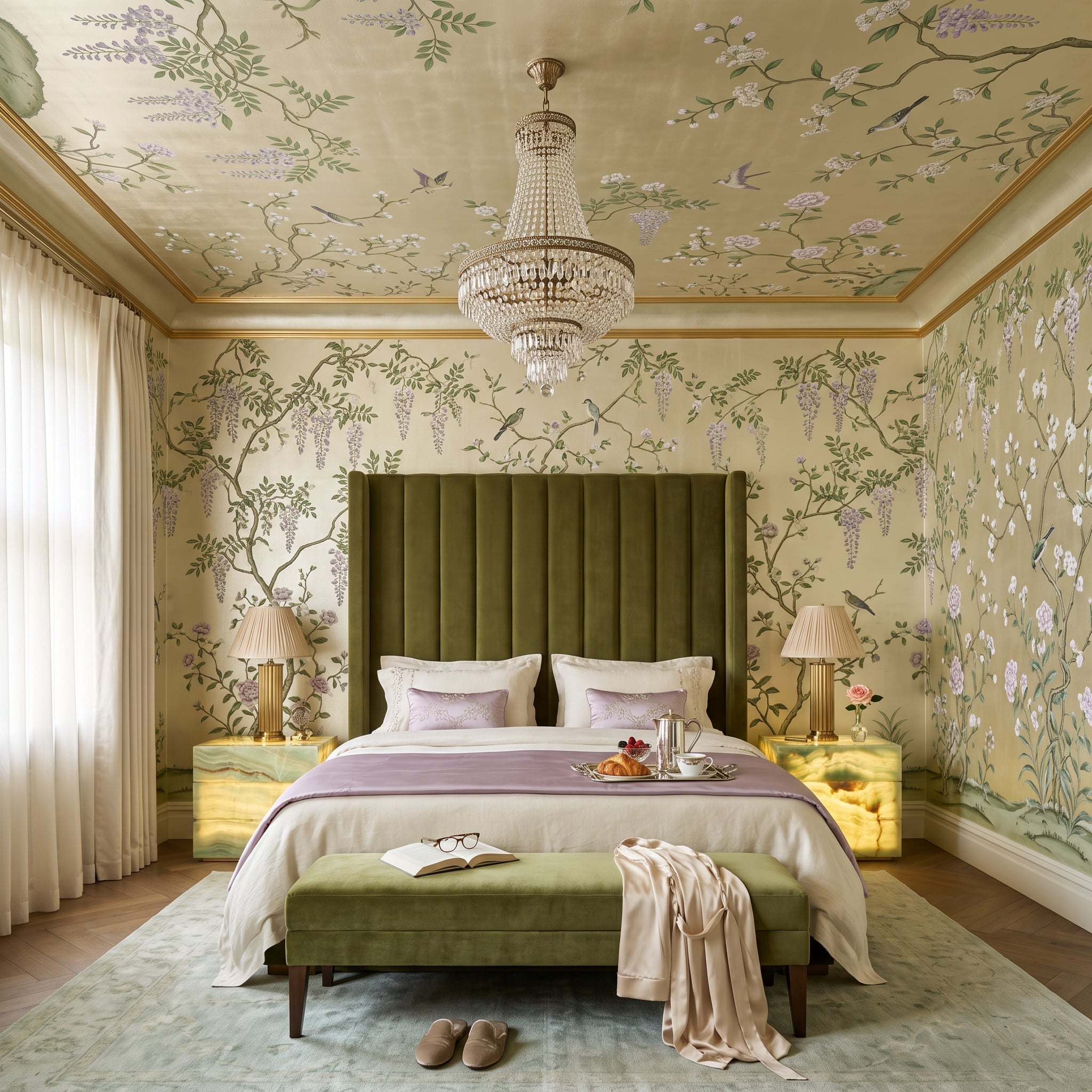
The wisteria refuses to stop at the cornice. Flowering branches climb the bedroom walls and continue across the ceiling, eliminating the abrupt boundary where most decorative schemes surrender to plain plaster. The result suggests an enclosed garden without requiring a single blossom to grow above the bed.
Olive velvet upholstery anchors the lavender blossoms, while illuminated onyx nightstands add amber warmth near the floor. The chinoiserie-inspired imagery belongs to a European decorative tradition that interpreted Chinese artistic motifs through wallpapers, murals, and interiors. Here, the flowers do something more ambitious than decorate a surface. They dissolve the distinction between wall and ceiling, allowing the entire bedroom to participate in one continuous botanical composition.
27. Cobalt Fish-Scale Tiles Bring an Oceanic Rhythm to the Kitchen Ceiling
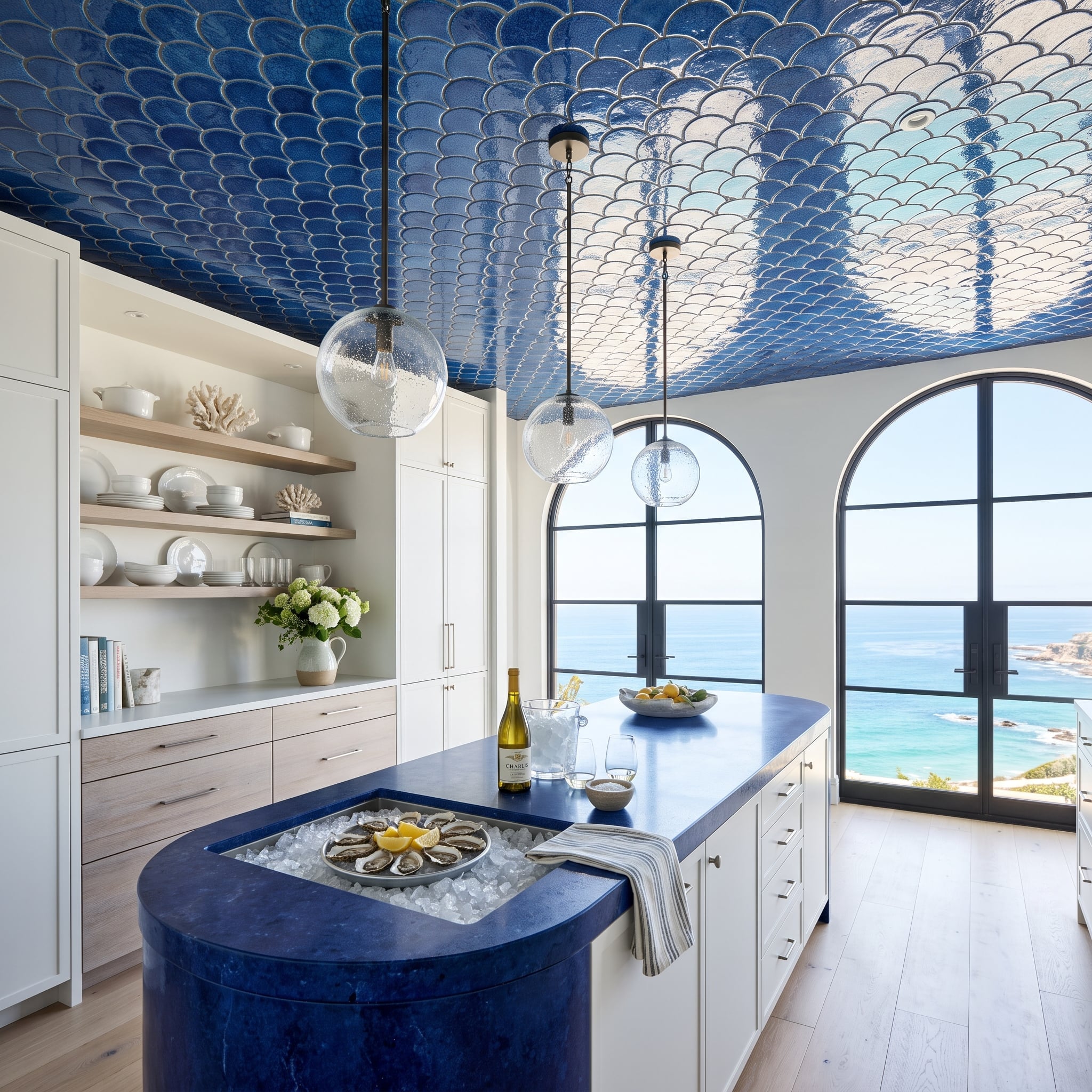
Glazed cobalt tiles repeat their curved fish-scale outlines across the ceiling, creating a vivid blue canopy with the visual movement of water. Each overlapping arc catches light differently, giving the surface a shifting rhythm that a painted pattern would struggle to reproduce.
The rounded island repeats the saturated color, while its integrated ice well suggests an oyster bar rather than an ordinary preparation counter. Steel-framed arched windows and seeded-glass pendants keep the coastal references architectural. The ceiling’s scalloped geometry supplies movement without a single literal wave, while the reflective glaze introduces an aquatic shimmer. The kitchen doesn’t need seashell decorations to make its point.
26. Sculpted Felt Waves Soften a Bedroom Surrounded by Snow-Covered Peaks
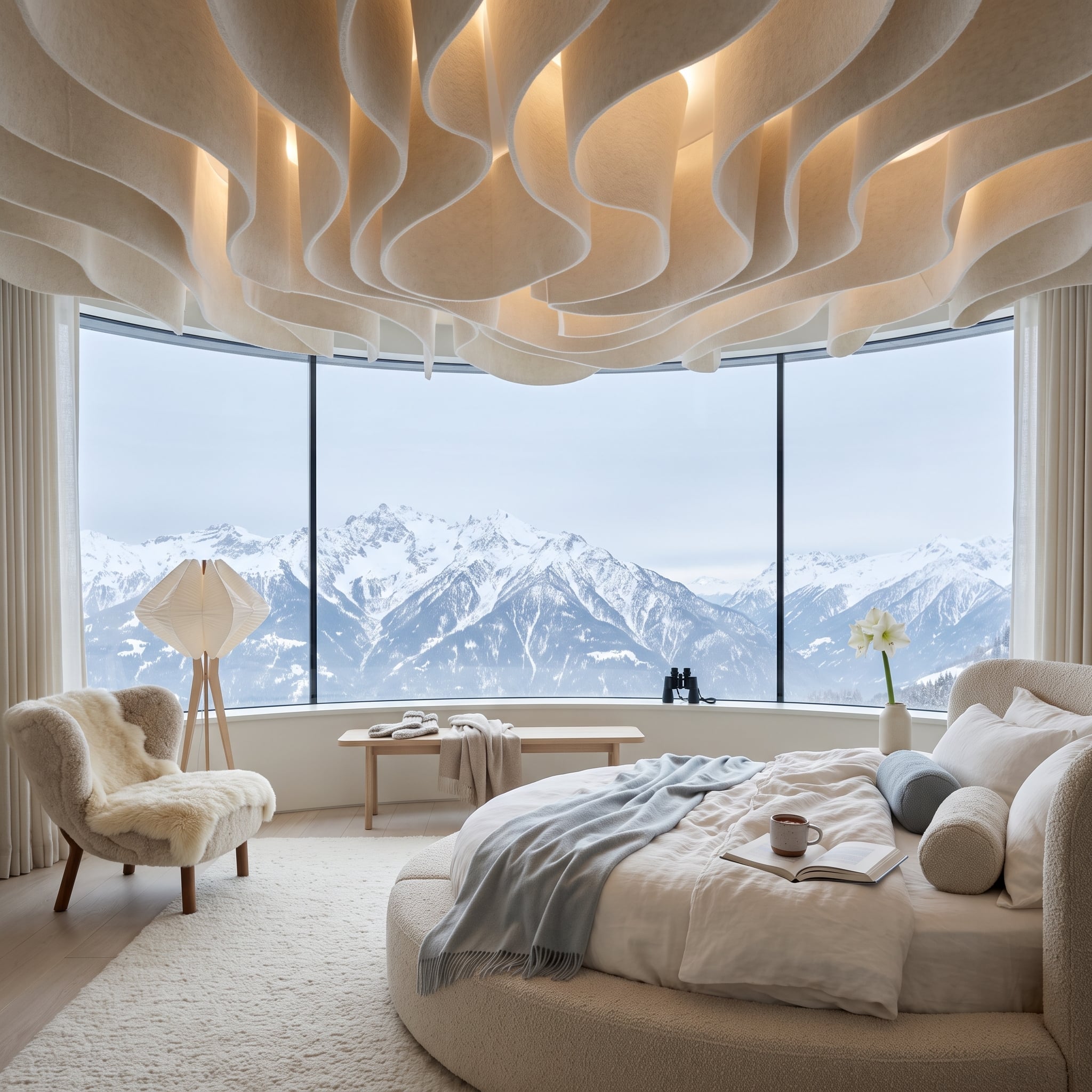
Overlapping waves of cream-colored felt travel across the ceiling, their contours revealed by concealed warm lighting. The treatment resembles an enormous piece of softly folded fabric, introducing a tactile quality that contrasts with the hard mountain landscape beyond the windows.
A circular bouclé bed and pale furnishings support the room’s emphasis on softness without reproducing the ceiling’s complicated geometry. Felt also offers acoustic possibilities, particularly valuable in a bedroom surrounded by extensive glazing. The most compelling contrast is between the architecture outside and the one overhead: jagged, snow-covered peaks beyond the glass, gentle folds of fabric above the bed. One landscape is monumental and unforgiving; the other feels almost touchable.
25. Stained Glass Turns a Craftsman Kitchen Skylight Into a Geometric Jewel
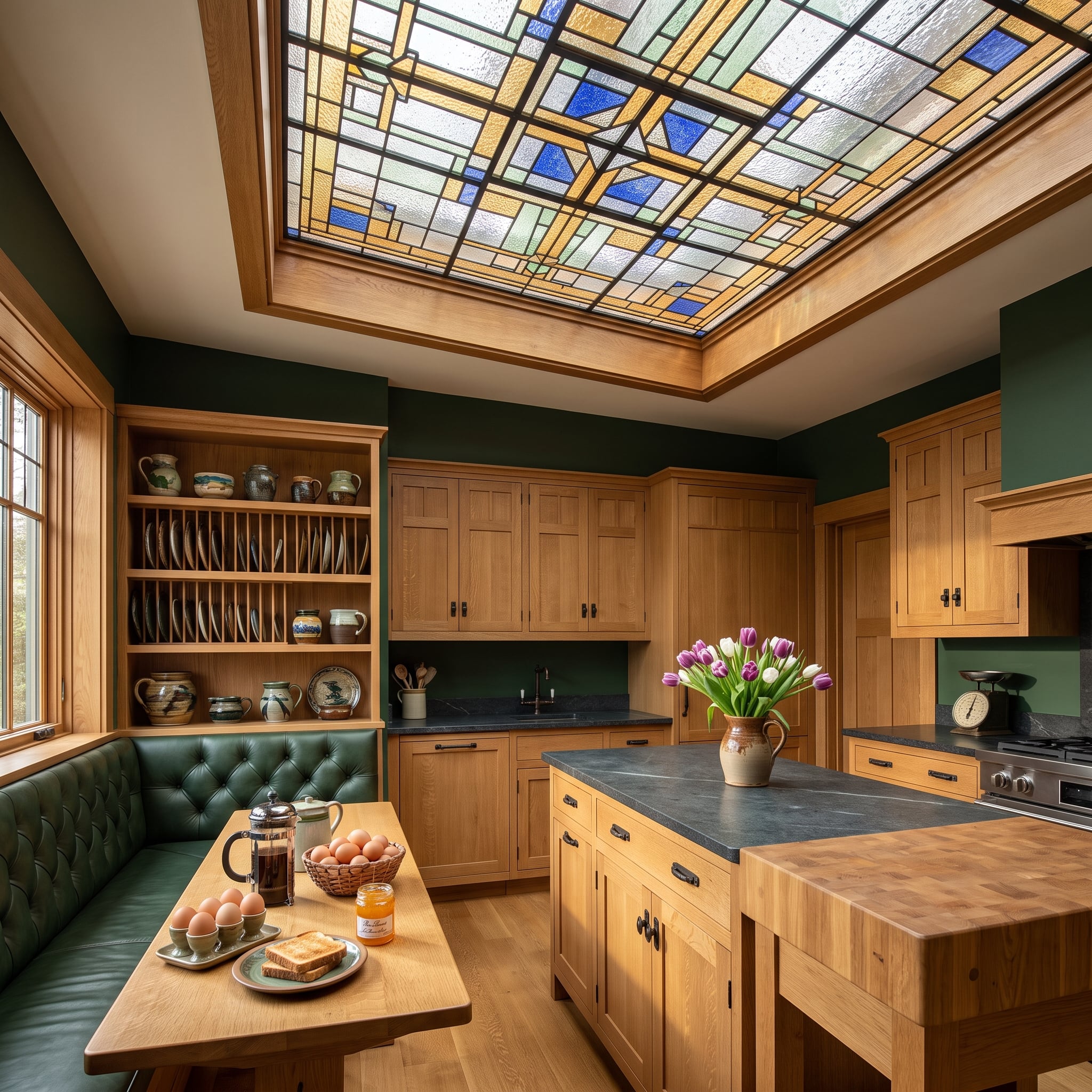
Amber, cobalt, and sage glass transform a kitchen skylight into an intricate geometric composition framed by warm oak. Its rectilinear pattern recalls Prairie-style decorative glazing, bringing a related but distinct architectural vocabulary into a Craftsman-influenced room.
Quarter-sawn oak cabinetry, dark countertops, and a green banquette give the colored glass a historically sympathetic setting without turning the kitchen into a period reproduction. As daylight passes through the colored panels, the ceiling becomes something more interesting than a decorative fixture. Its appearance changes with the sun, the weather, and the hour. Even the most carefully chosen pendant light would have difficulty competing with a composition that the sky continually rearranges.
24. A Sunburst Walnut Ceiling Gives This Bedroom a Midcentury Architectural Crown
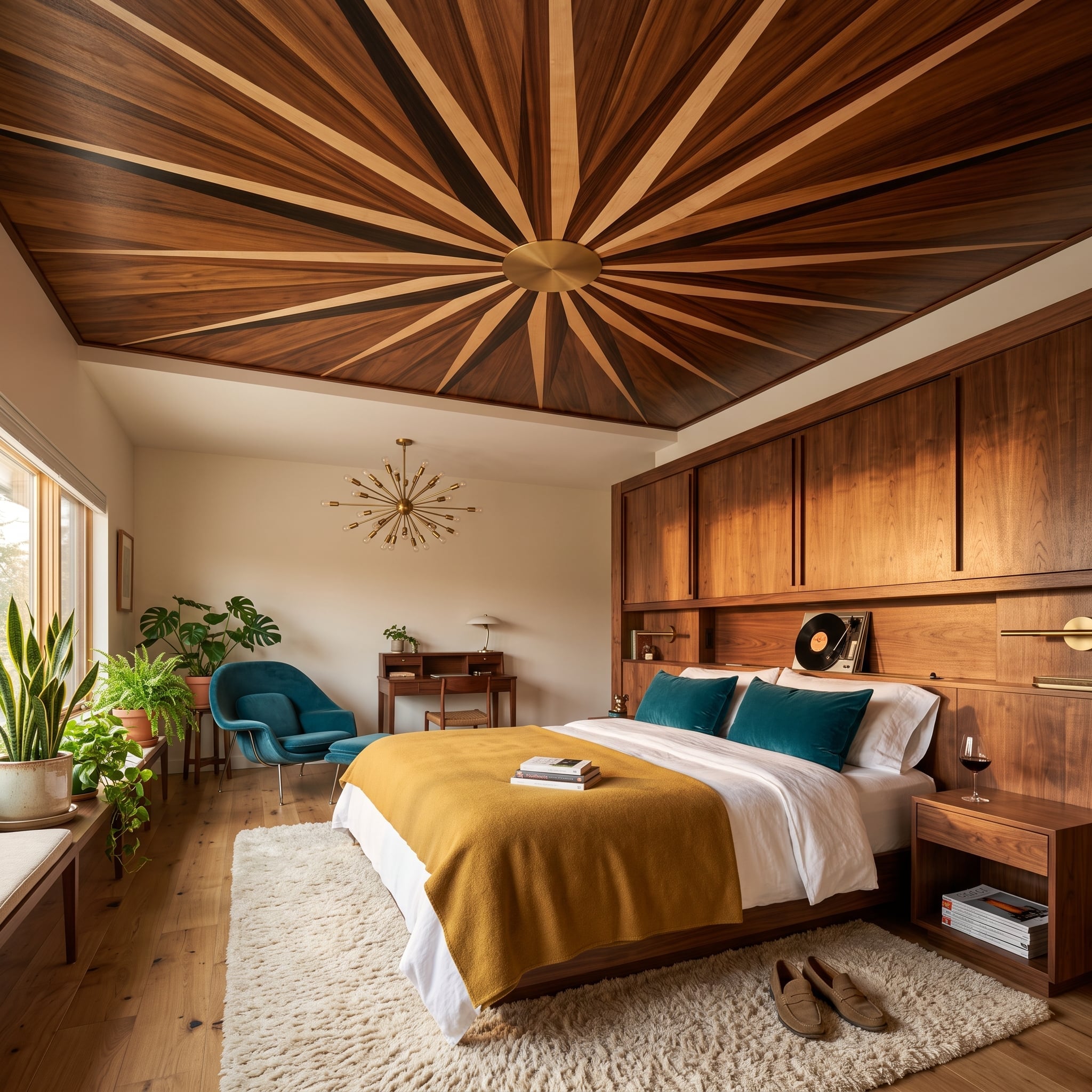
Walnut strips radiate from a central brass detail, spreading across the recessed ceiling like the spokes of an enormous wheel. Variations in grain and tone sharpen the geometry, while the radial arrangement gives the otherwise symmetrical bedroom a surprising sense of motion.
A Sputnik chandelier reinforces the midcentury references. Teal velvet pillows and a mustard throw introduce color below, while the walnut headboard wall supplies a calmer vertical counterpart. Most wood ceilings emphasize a room’s length or width through parallel boards. This one establishes a center and sends the eye outward in every direction. The result is less a conventional ceiling than an enormous piece of architectural marquetry.
23. A Fiber-Optic Starfield Gives an Aspen Bedroom Its Own Night Sky
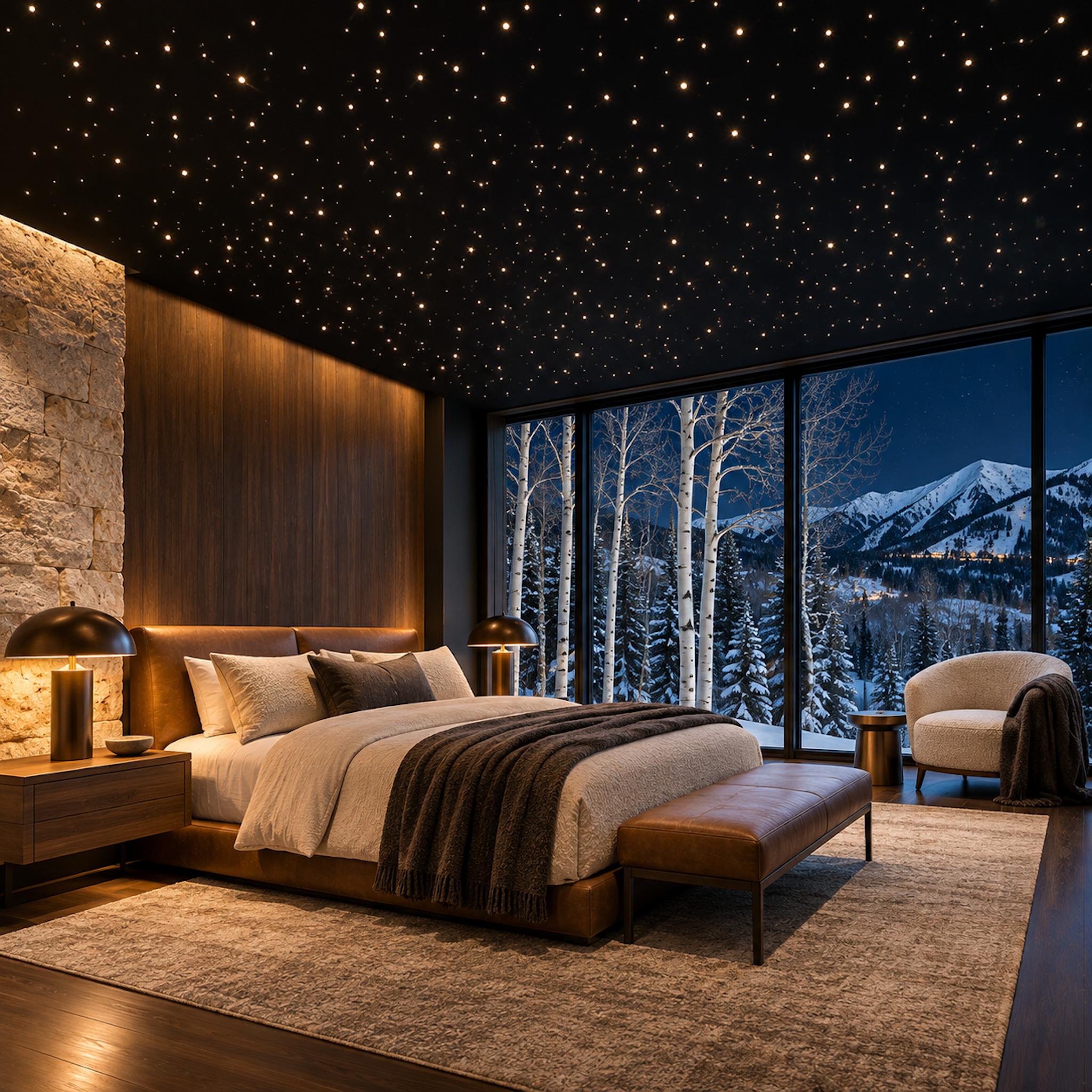
Hundreds of tiny fiber-optic points emerge from a matte-black ceiling above a contemporary Aspen bedroom. Their irregular spacing and subtle differences in brightness suggest a star-filled sky, but the effect comes from actual light rather than painted imagery. With no conventional fixtures interrupting the dark surface, the ceiling seems to recede beyond its physical limits.
A low leather-upholstered bed, smoked-oak wall paneling, and restrained bronze bedside lamps establish a warm interior against the moonlit snow outside. Floor-to-ceiling glazing frames slender white aspen trunks and distant mountain slopes. The fiber-optic system’s individual points of light introduce a delicate counterpoint to the vast, cold landscape. Rather than depicting the heavens, this ceiling illuminates them, bringing the suggestion of a clear Colorado night directly above the bed.
22. An Indoor Olive Tree Meets a Ceiling of Parametric Cedar Waves
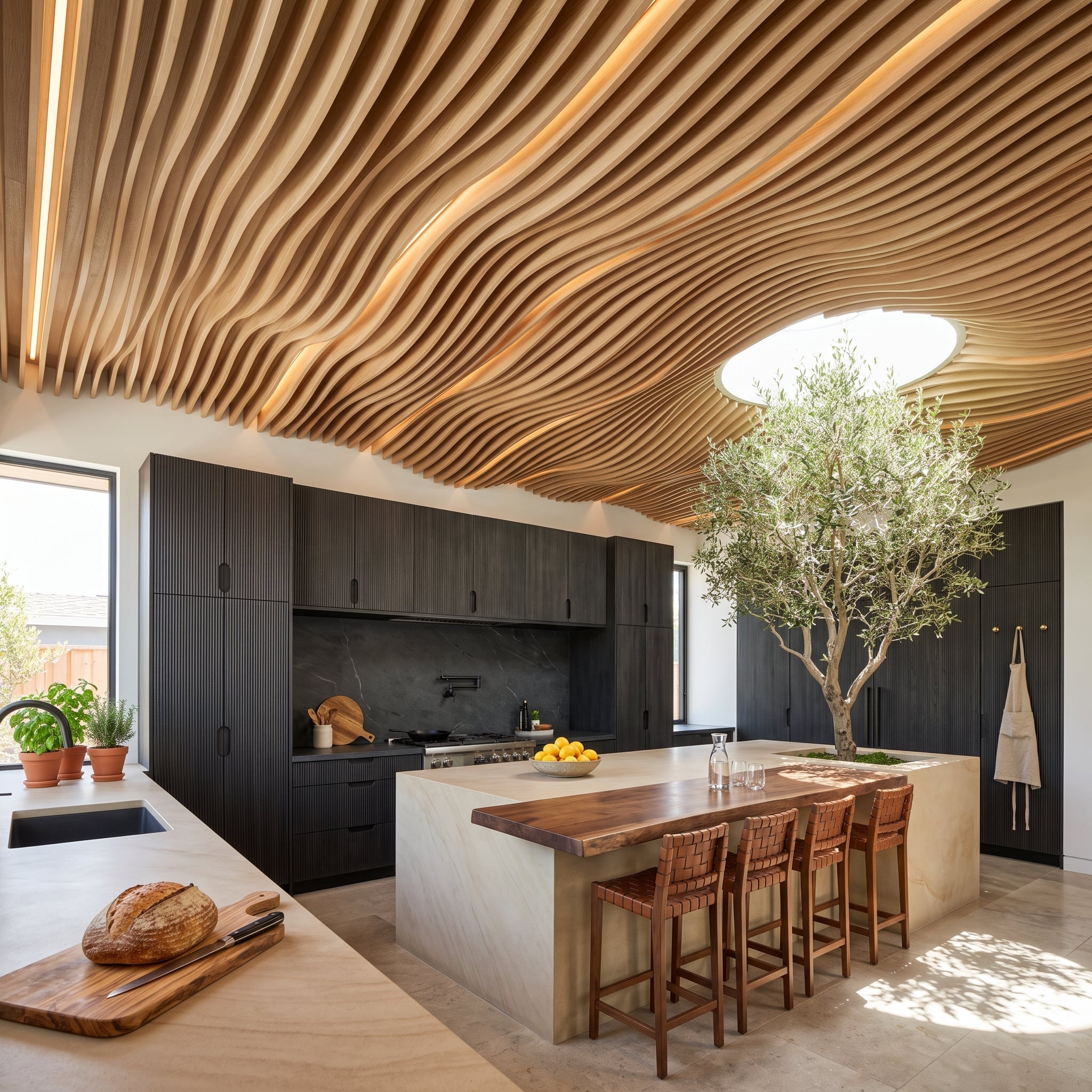
Individual cedar elements rise and fall across the ceiling, forming a series of fluid contours that seem to move through the kitchen. Concealed lighting accentuates the gaps between the slats, emphasizing the changing profiles of the timber rather than treating it as a flat decorative covering.
An olive tree emerging from the island introduces an irregular natural form beneath the carefully controlled geometry. Dark cabinetry and stone surfaces keep both features in focus. The ceiling’s digitally conceived precision and the tree’s unpredictable branching structure offer two entirely different interpretations of organic movement. One has been calculated down to the spacing of its slats. The other answers to no designer’s grid.
21. A Draped Velvet Ceiling Turns a Living Room Into a Private Salon
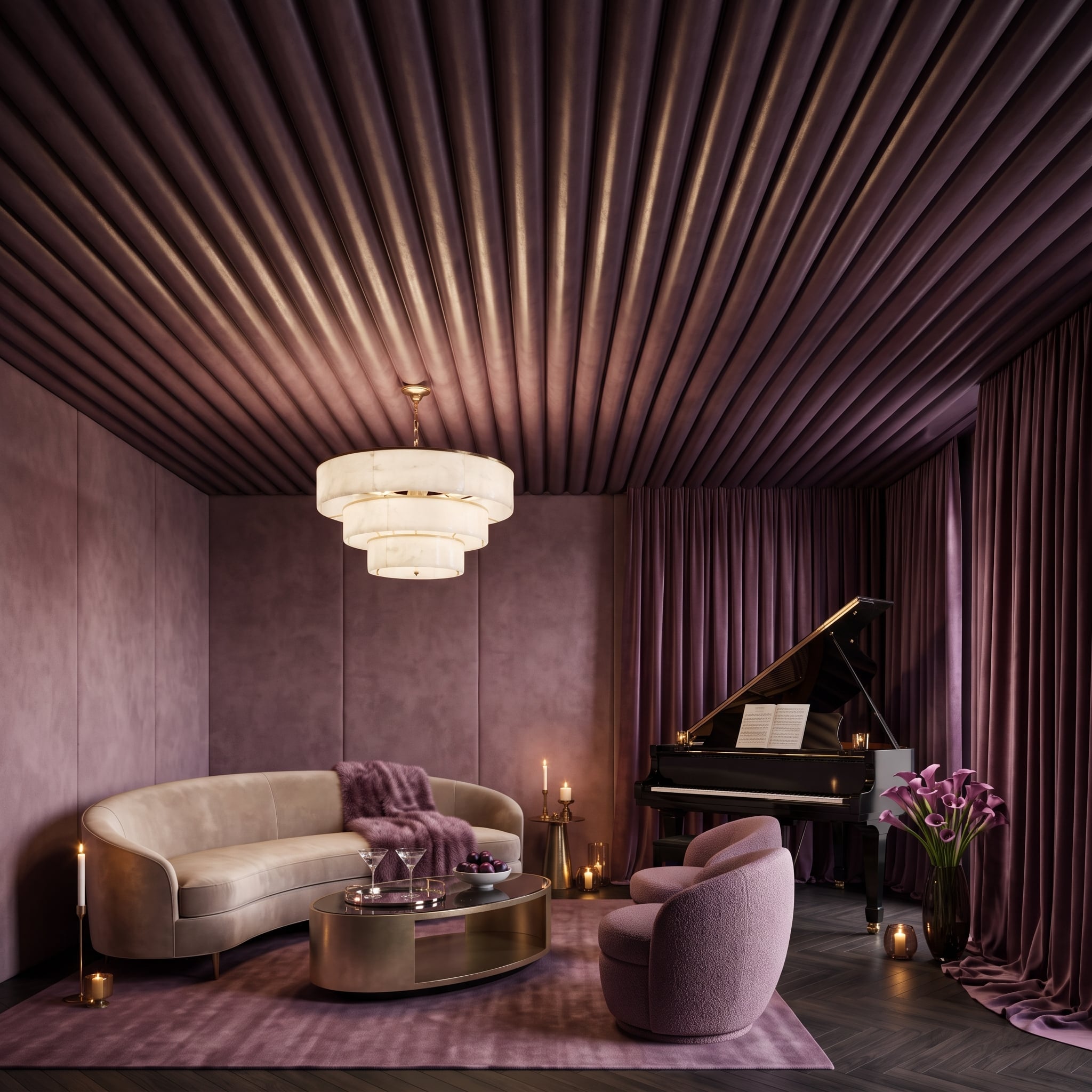
Mauve velvet gathers overhead in generous folds, replacing conventional ceiling geometry with the theatrical softness of a fabric-lined salon. An alabaster chandelier hangs beneath the drapery, its pale form contrasting with the rich textile and the deep shadows created by each gathering.
A grand piano, curved taupe sofa, and bouclé armchairs provide the setting for an unusually intimate living room. Draped ceilings have precedents in historic tent rooms and elaborate decorative interiors, where fabric was used to soften architecture and establish atmosphere. The folds absorb light rather than reflecting it, giving the room a hushed, enveloping character. With the ceiling dressed in velvet, even the grand piano seems to have acquired a more private audience.
20. Leather-Lined Coffers Give This Library a Tailored Ceiling
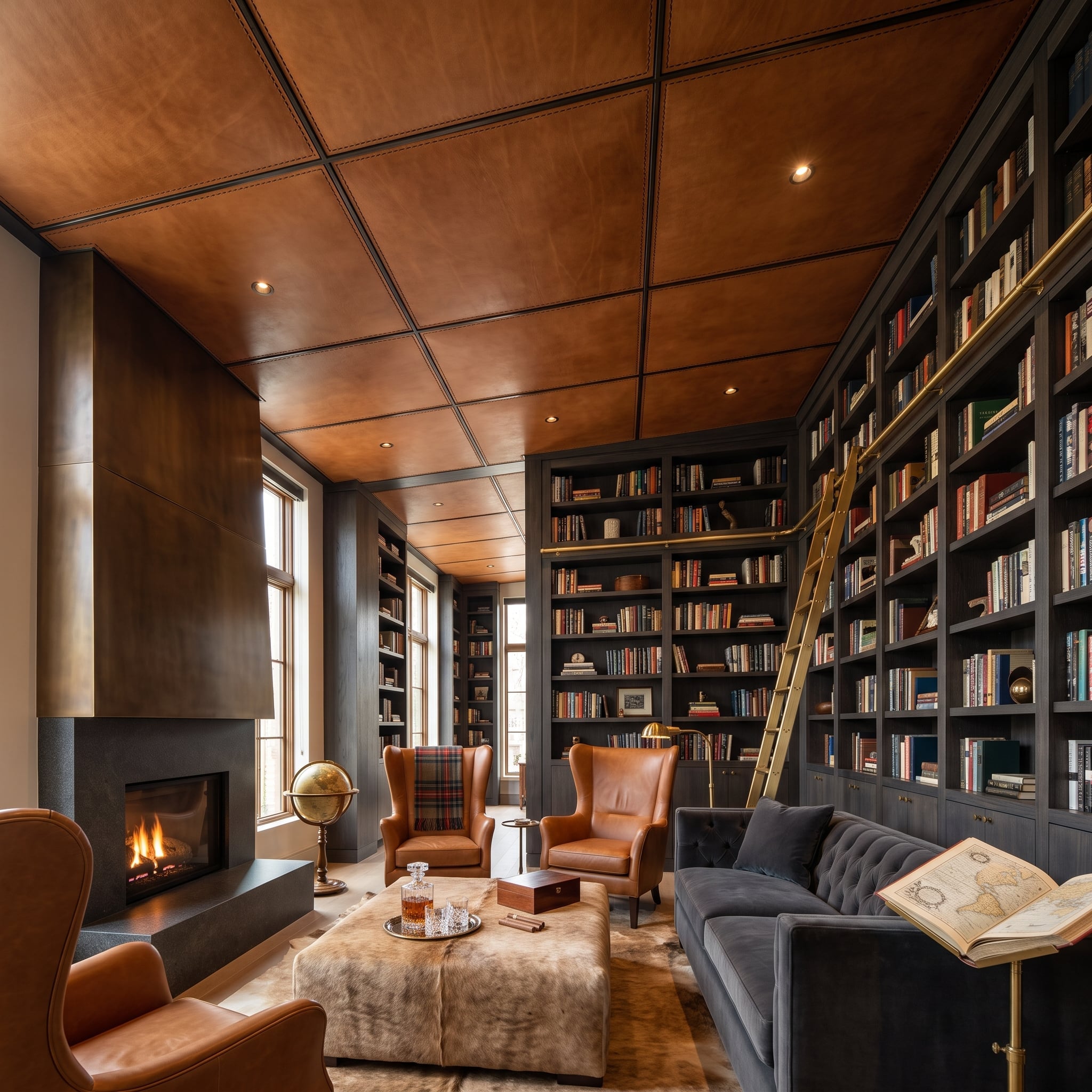
Cognac-colored panels with stitched detailing occupy a regular grid of ceiling recesses, suggesting the construction of fine leather upholstery rather than conventional timber coffers. The supple-looking surfaces provide an unexpected contrast to the nearly black bookshelves below.
A brass rolling ladder, saddle-leather chairs, slate velvet sofa, and cowhide ottoman build a richly layered library without competing with the ceiling’s orderly pattern. The stitched panels introduce a degree of craftsmanship more commonly encountered in upholstered furniture, fine luggage, or automotive interiors. Enlarged to architectural scale, the detailing gives the room a distinctly bespoke character. Even the ceiling appears to have been fitted by a very particular tailor.
Leather divides opinion, though: in spaces like libraries and dens, images featuring leather got fewer hearts from our readers than the other images in the same articles.
19. Dark Metallic Leaf Meets a Suspended Fireplace in This Dramatic Living Room
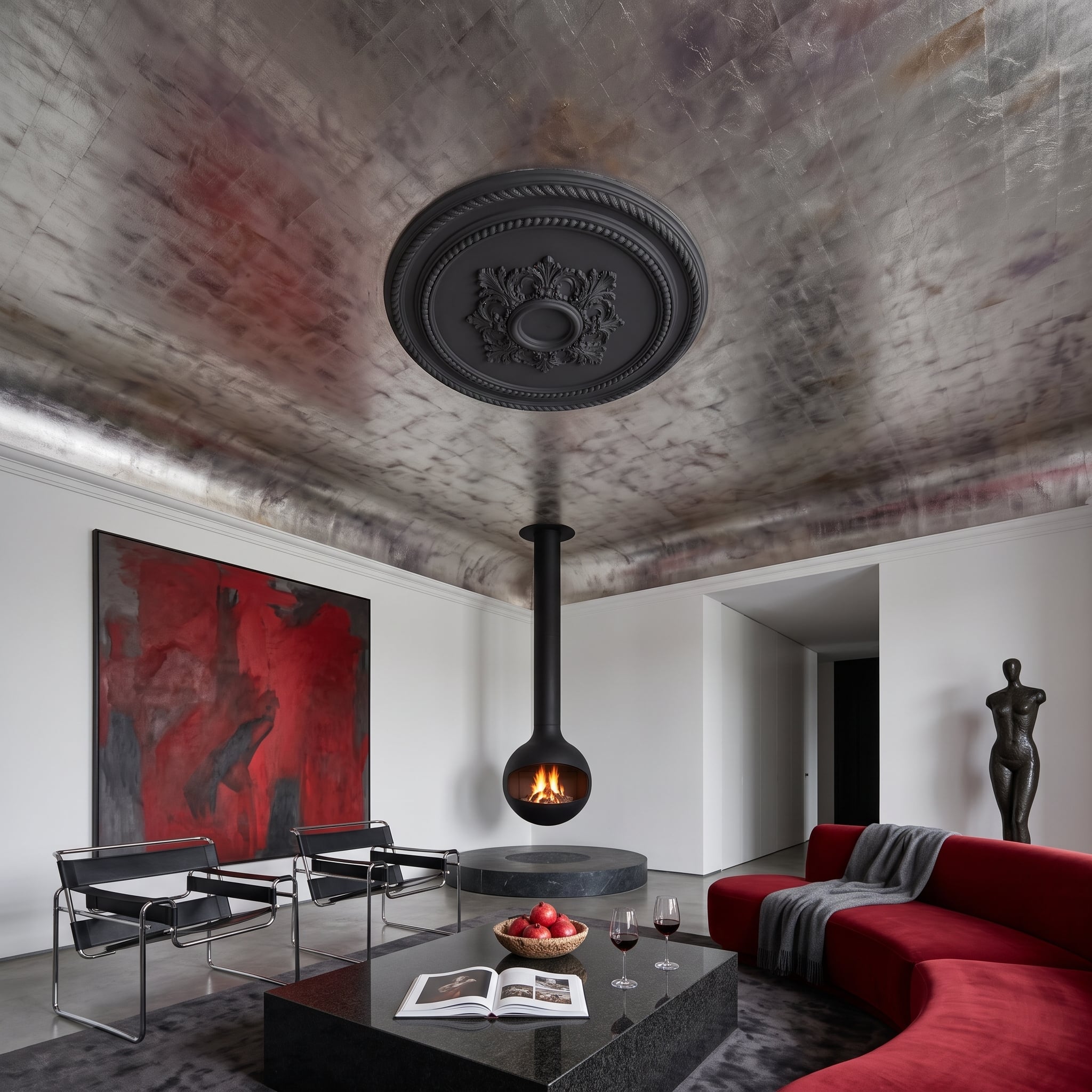
Overlapping metallic-leaf finishes give the ceiling a mottled surface of pewter, charcoal, and burgundy. An elaborate ornamental medallion occupies the center, visually aligning with a spherical suspended fireplace below. The combination brings Baroque-inspired decoration into direct conversation with industrial metal.
Wassily chairs, a curved crimson sofa, and abstract artwork establish a distinctly modern counterpoint to the historical ornament. The ceiling’s uneven metallic reflections give the surface depth without turning it into a mirror. Below, the fireplace hangs as a dark, rounded mass against the elaborate overhead detailing. Historical grandeur and machine-age geometry occupy the same room, neither particularly interested in yielding the spotlight.
18. Reclaimed Timber Coffers Bring Architectural Weight to a Contemporary Living Room
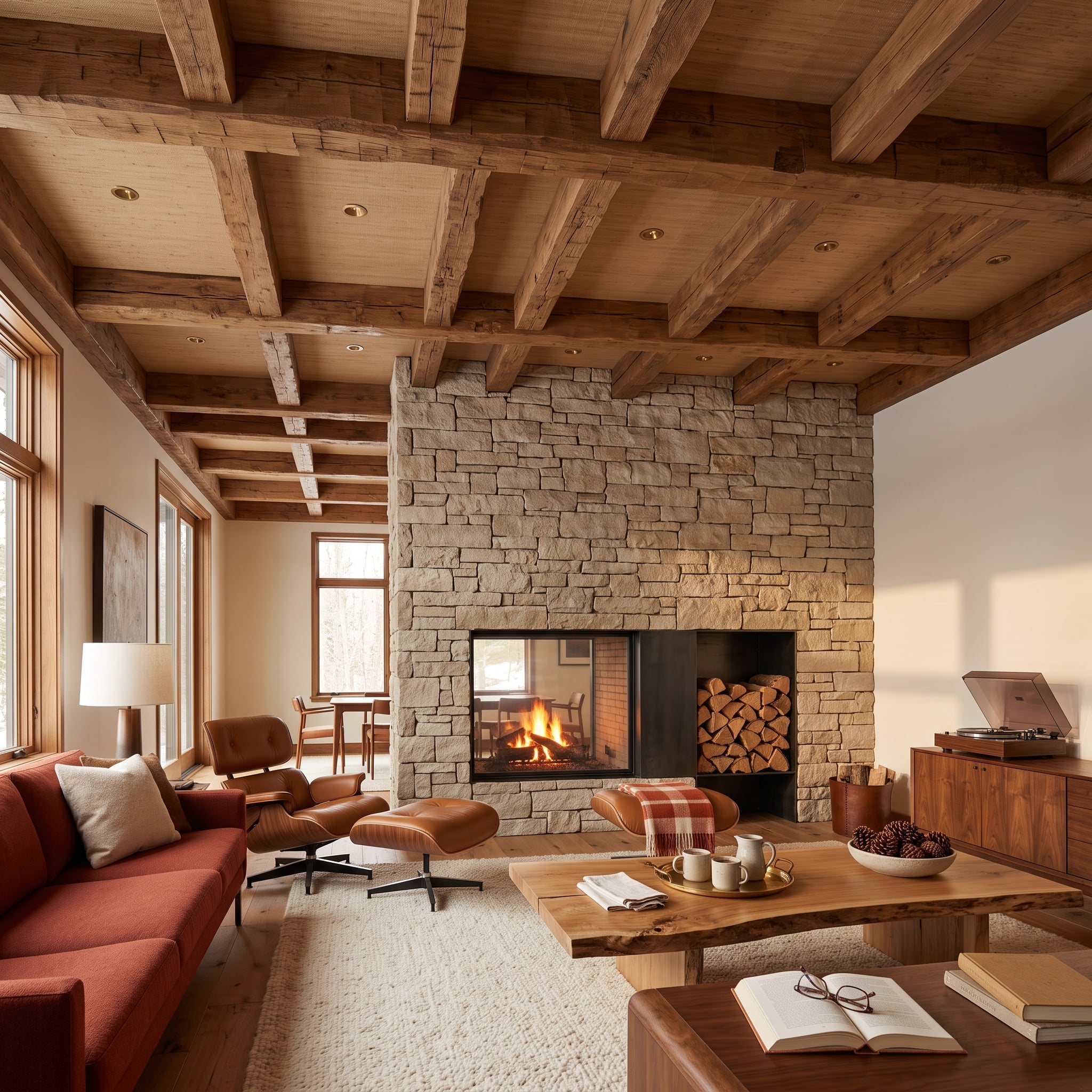
Weathered timber beams form a disciplined ceiling grid, their rough surfaces bringing irregular natural texture to an otherwise precise architectural arrangement. Small recessed lights occupy the coffers without interrupting the visual rhythm of the wood.
A towering stone fireplace provides a second major architectural element, supported by a cognac lounge chair, brick-red sofa, and live-edge table. The relationship between ceiling and fireplace is especially effective: one extends horizontally through repetition, while the other rises vertically as a continuous mass. The timber’s weathered appearance introduces a sense of age, but the crisp grid prevents the room from drifting into conventional rustic territory. Rough material, exact geometry, and a surprisingly civilized result.
17. A Ribbed Barrel Vault Turns a Mediterranean Dining Room Into Sculpture
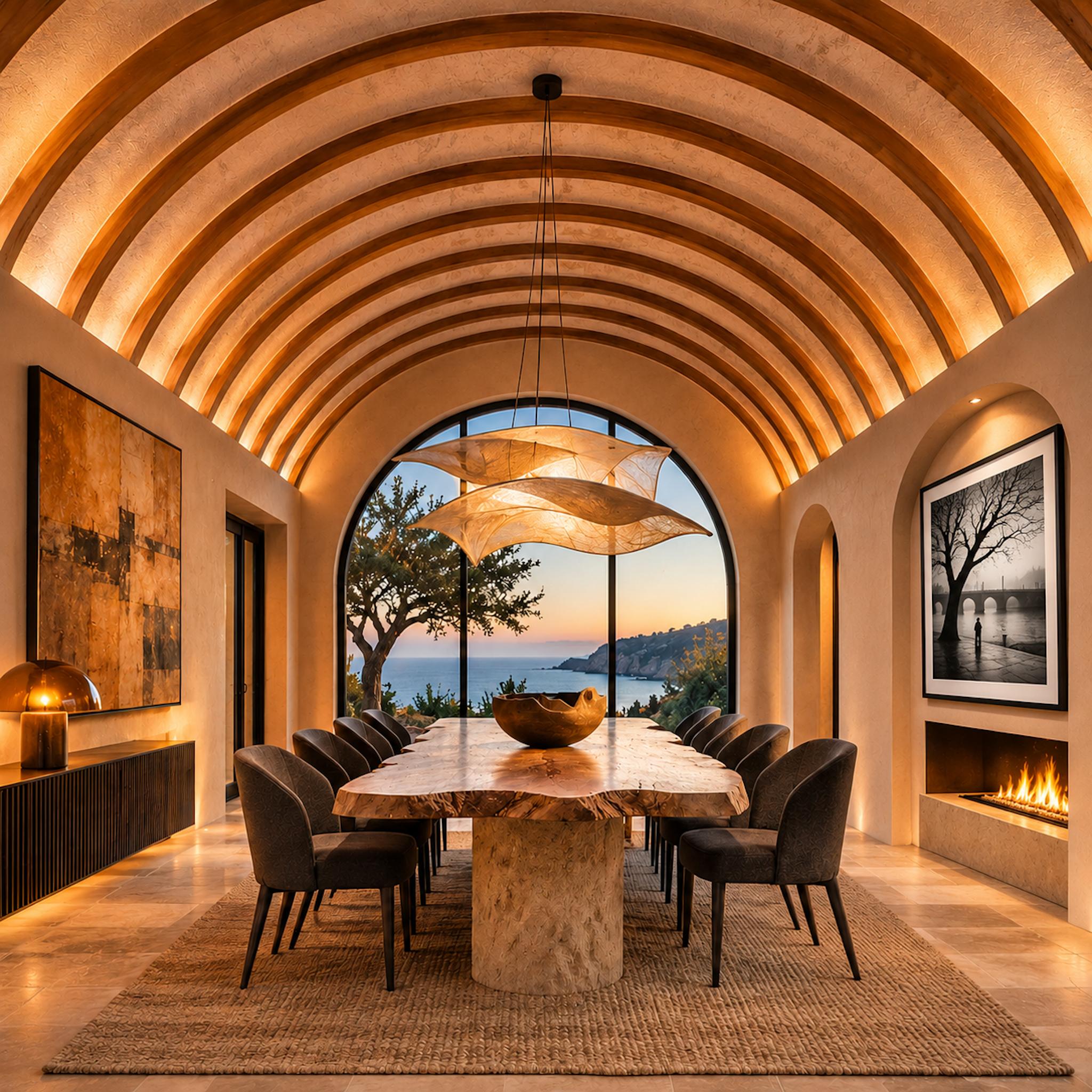
Closely spaced curved timber ribs sweep across a lofty barrel-vaulted ceiling, creating a procession of arches above a Mediterranean dining room. Warm concealed lighting follows the contours, revealing the depth of the pale textured plaster between each rib. The entire room seems to have been organized around the ceiling’s continuous curve.
A monumental dining table, charcoal upholstered chairs, and a sculptural suspended light occupy the center of the composition. Beyond the arched glazing, the coastline meets the evening sky. A framed black-and-white photograph provides a disciplined contrast to the warm architectural finishes. Barrel vaulting is one of architecture’s enduring forms, but the repeating timber ribs give this interpretation a contemporary precision. Each arch leads into the next, turning the length of the dining room into an architectural procession rather than a simple rectangular enclosure.
16. Mother-of-Pearl Mosaics Turn This Aqua Living Room Ceiling Into a Shimmering Grid
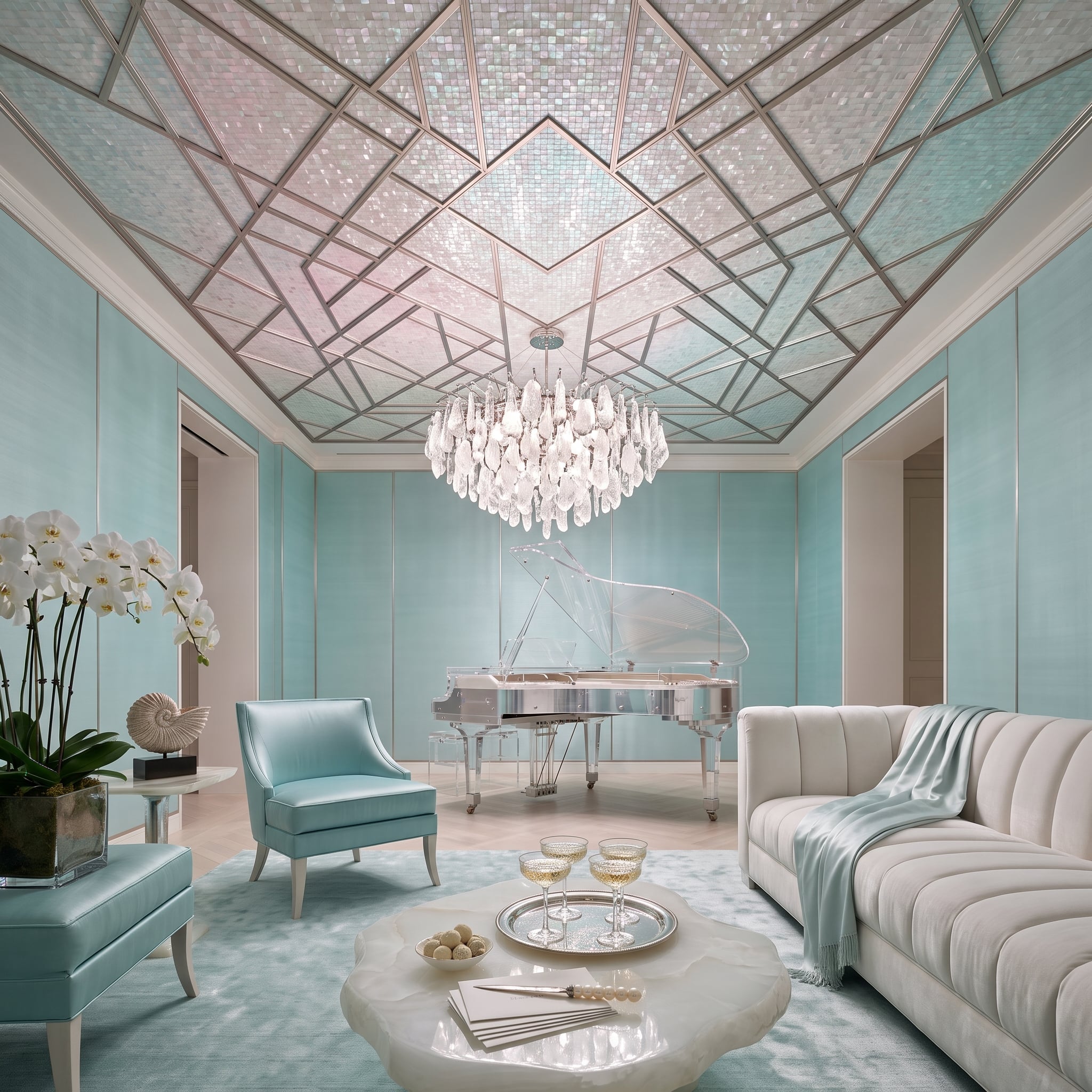
Small iridescent tiles fill the ceiling’s diamond-patterned coffers, shifting visually between pearl, silver, pale blue, and blush. The geometric grid supplies discipline to a surface that seems to change whenever the light or viewing angle moves.
A transparent-looking grand piano and crystal chandelier continue the room’s interest in reflection, while aqua walls and pale furnishings provide a softly colored setting. The mother-of-pearl effect introduces a delicate play of color that feels almost impossible to pin down: one moment silvery, the next faintly pink or blue. Thousands of small reflective surfaces turn the ceiling into a shifting mosaic, with the strict diamond pattern preventing all that shimmer from becoming visual confusion.
15. Terracotta Overhead Gives This Living Room a Warm Architectural Center
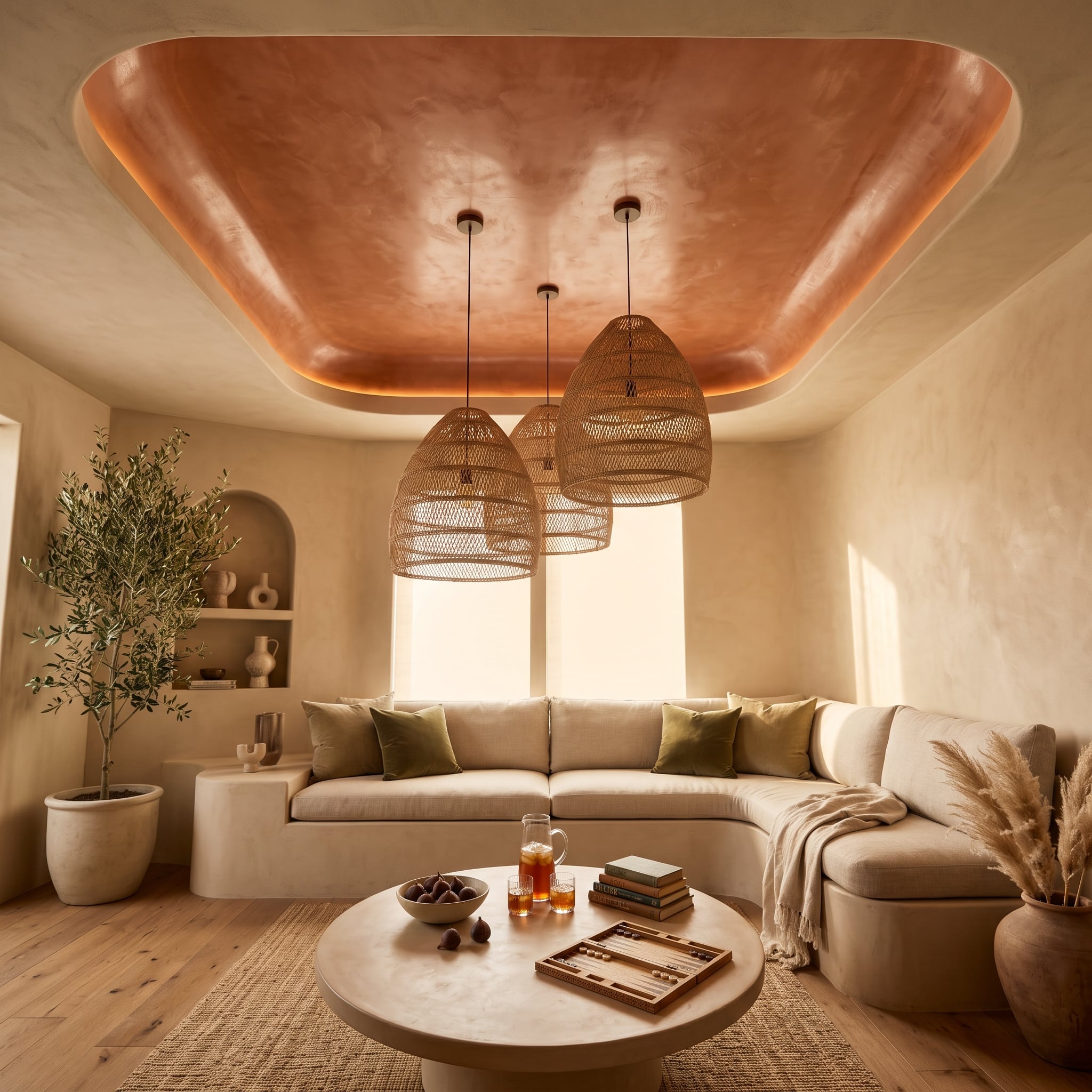
A recessed tray ceiling finished in rich terracotta concentrates a powerful field of color above a pale living room. Three oversized woven pendants descend at different heights, introducing an open, tactile texture against the solid color overhead.
The curved cream sectional, olive accents, and restrained natural materials allow the terracotta to remain the dominant note. Concealed lighting traces the change in ceiling level, emphasizing the tray’s architectural depth. The woven pendants break up the broad expanse of saturated color without obscuring it, their intricate construction throwing a delicate counterpoint against the smooth surface. A relatively simple painted ceiling suddenly looks like an architectural decision rather than a decorating afterthought.
Not everyone agrees: Home Stratosphere readers gave rust-dominant living rooms fewer hearts than the other living rooms in the same articles, 43% versus 54%.
14. A Mirrored Ceiling Doubles the Drama of a Sunken Velvet Conversation Pit
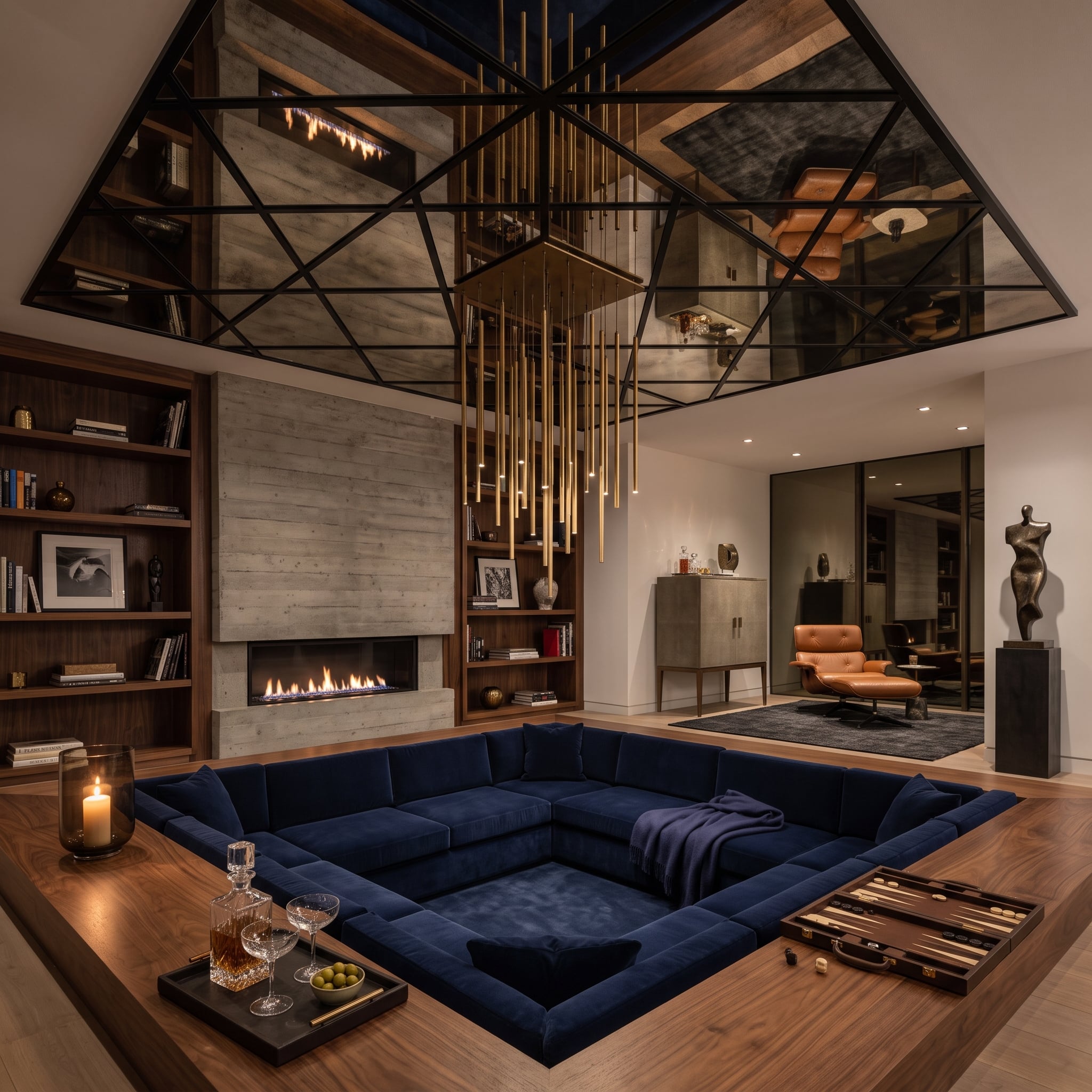
A grid of mirrored panels reflects the living room back toward itself, multiplying the sunken navy velvet seating and surrounding architecture. Matte-black framing divides the reflections into separate geometric fields, preventing the ceiling from becoming one uninterrupted reflective surface.
Brass pendants descend through the grid, while a board-formed concrete fireplace introduces a rough, nonreflective counterpoint. The lowered seating makes the mirrored treatment especially prominent from the conversation pit. The room’s proportions become deliberately difficult to read: the floor drops, the ceiling reflects, and the furniture appears to occupy more than one level at once. The result is a sophisticated manipulation of depth, with geometry doing as much work as the mirrors themselves.
13. A Copper-Toned Pressed-Metal Ceiling Brings Historic Texture to a Farmhouse Kitchen
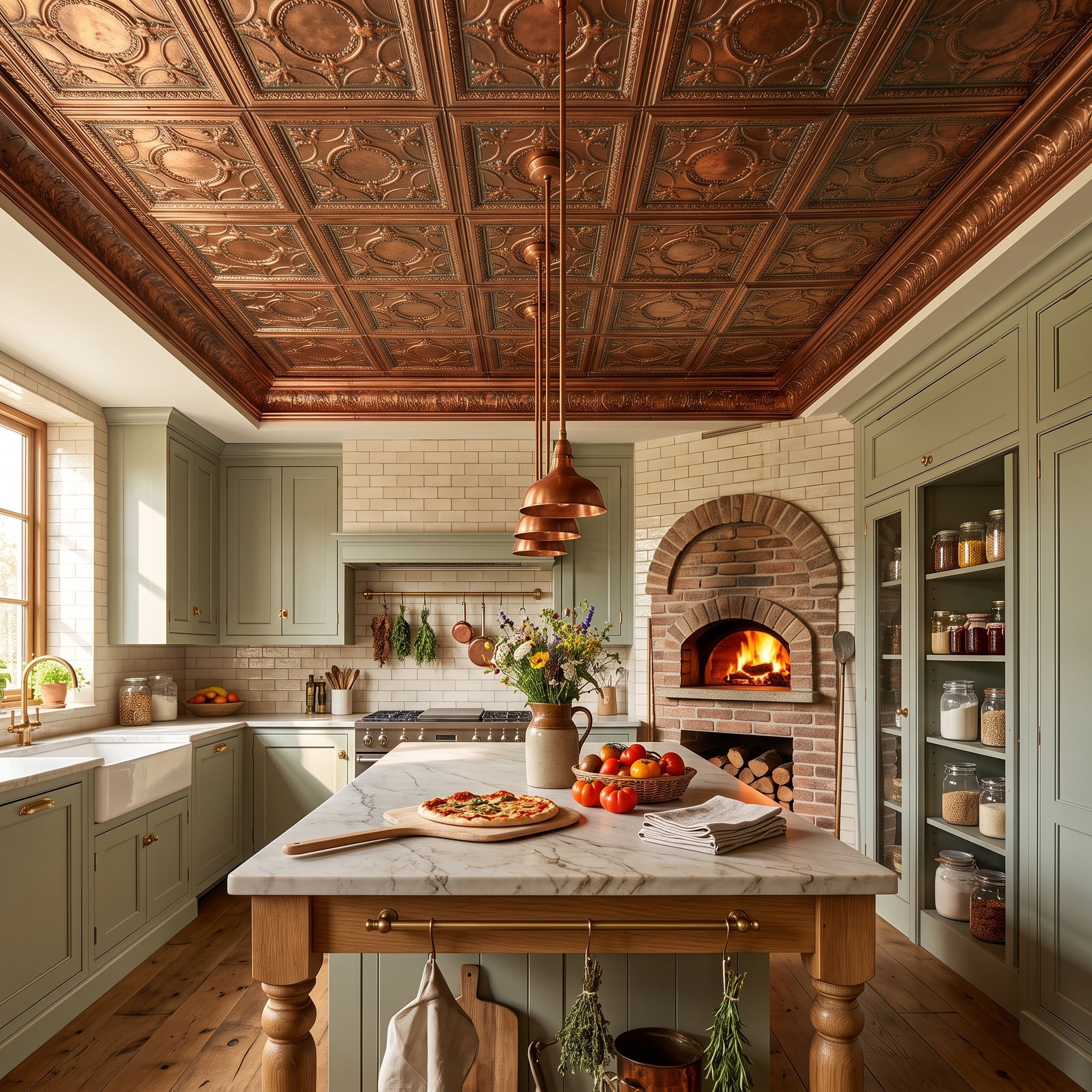
Embossed metal tiles repeat an ornate medallion pattern across the kitchen ceiling, their copper-toned finish catching highlights along every raised edge. The intricate relief introduces a historical reference without requiring the room to become a complete period reconstruction.
Sage cabinetry, a marble island, and an arched brick pizza oven combine contemporary and traditional materials beneath the decorative metalwork. Pressed-metal ceilings became popular in North America during the late nineteenth century, often as a more affordable alternative to elaborate plaster ornament. Their appeal remains remarkably current: a repeating metal pattern introduces both texture and reflected light, while the warm finish connects naturally with the brick and wood below. History has rarely looked so comfortable in a working kitchen.
12. Woven Bamboo Panels Give This Tropical Bedroom a Graphic Overhead Pattern
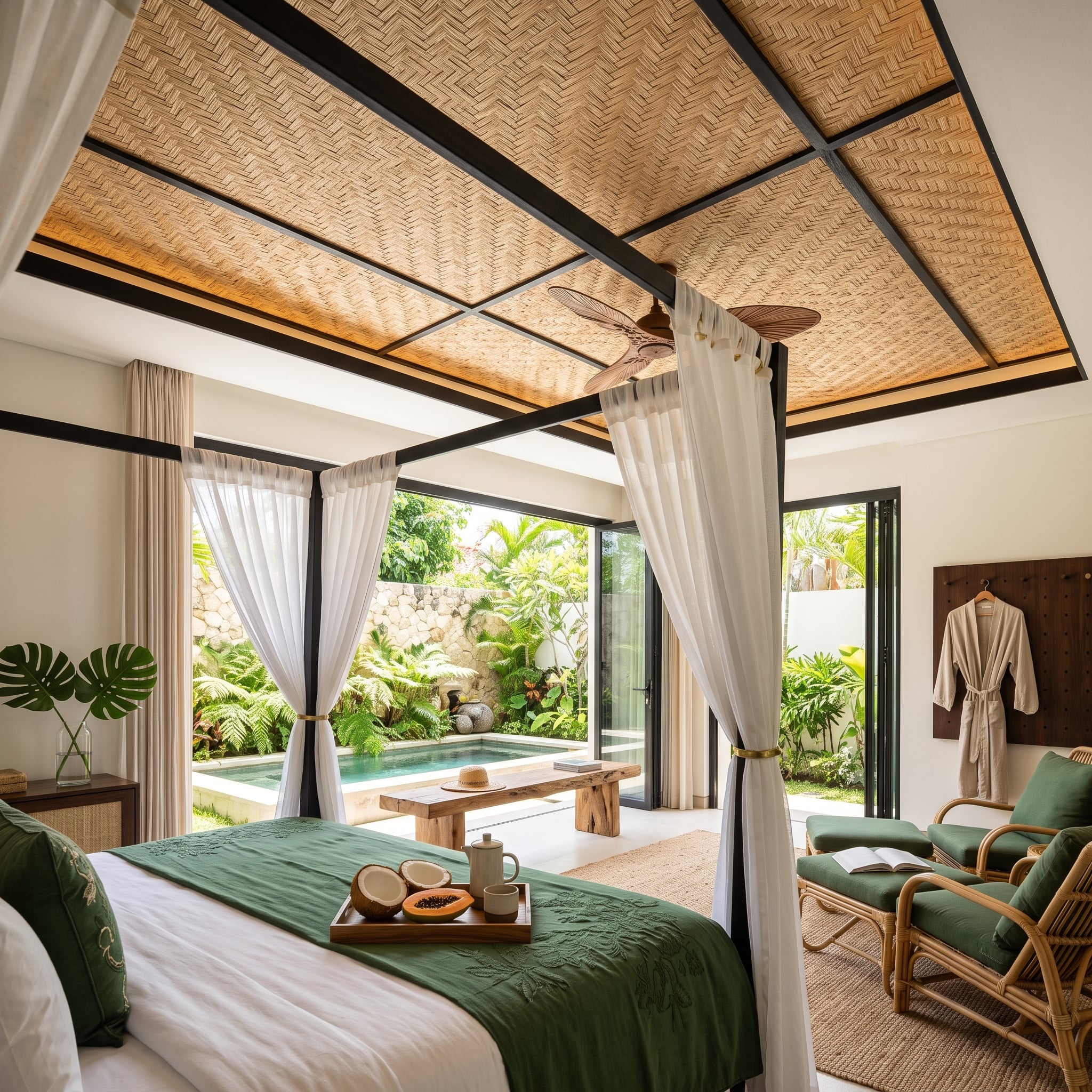
Woven bamboo panels fill dark-framed ceiling recesses, their herringbone pattern creating a sharp graphic rhythm above a tropical bedroom. The amber-colored natural material contrasts with the matte-black borders, giving the overhead surface the appearance of carefully arranged architectural screens.
A four-poster bed with sheer drapery faces sliding doors opening toward a stone-edged plunge pool. Rattan chairs and pale textiles establish a relaxed resort atmosphere, but the ceiling’s strict geometry keeps the room from feeling casually assembled. Each woven panel introduces a dense, intricate texture within the larger rectangular framework. The combination of dark outlines and natural fibers gives the ceiling a precision that contrasts beautifully with the softness of the surrounding textiles.
11. Art Nouveau Scrollwork Frames a Deep Teal Lacquered Bedroom Ceiling
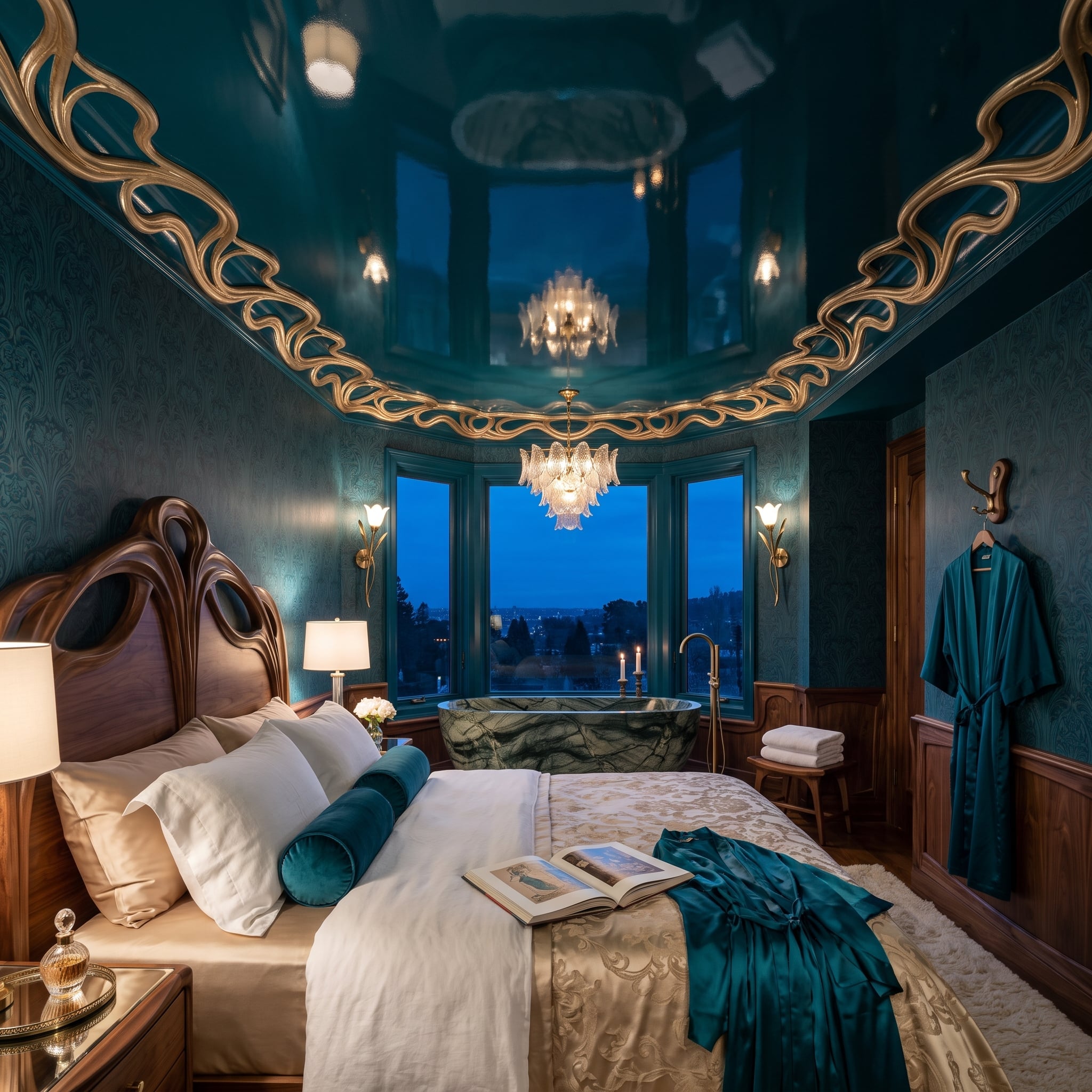
Gilded scrollwork follows the perimeter of a deep teal lacquered ceiling, its sinuous curves contrasting with the glossy surface inside. The ornament recalls Art Nouveau’s fascination with organic forms, making the transition between wall and ceiling the room’s most elaborate architectural detail.
A carved walnut headboard, glass chandelier, and green marble soaking tub extend the luxurious atmosphere without repeating the overhead pattern. The lacquer provides a rich, reflective field, while the gilded border moves in flowing curves around its edges. The ceiling’s visual complexity is concentrated at the perimeter rather than spread across the entire surface, allowing the deep teal center to remain remarkably calm. Ornament has been given a very specific assignment, and it performs with considerable flair.
10. A Milky Way Mural Turns This Bedroom Ceiling Into a Night Sky
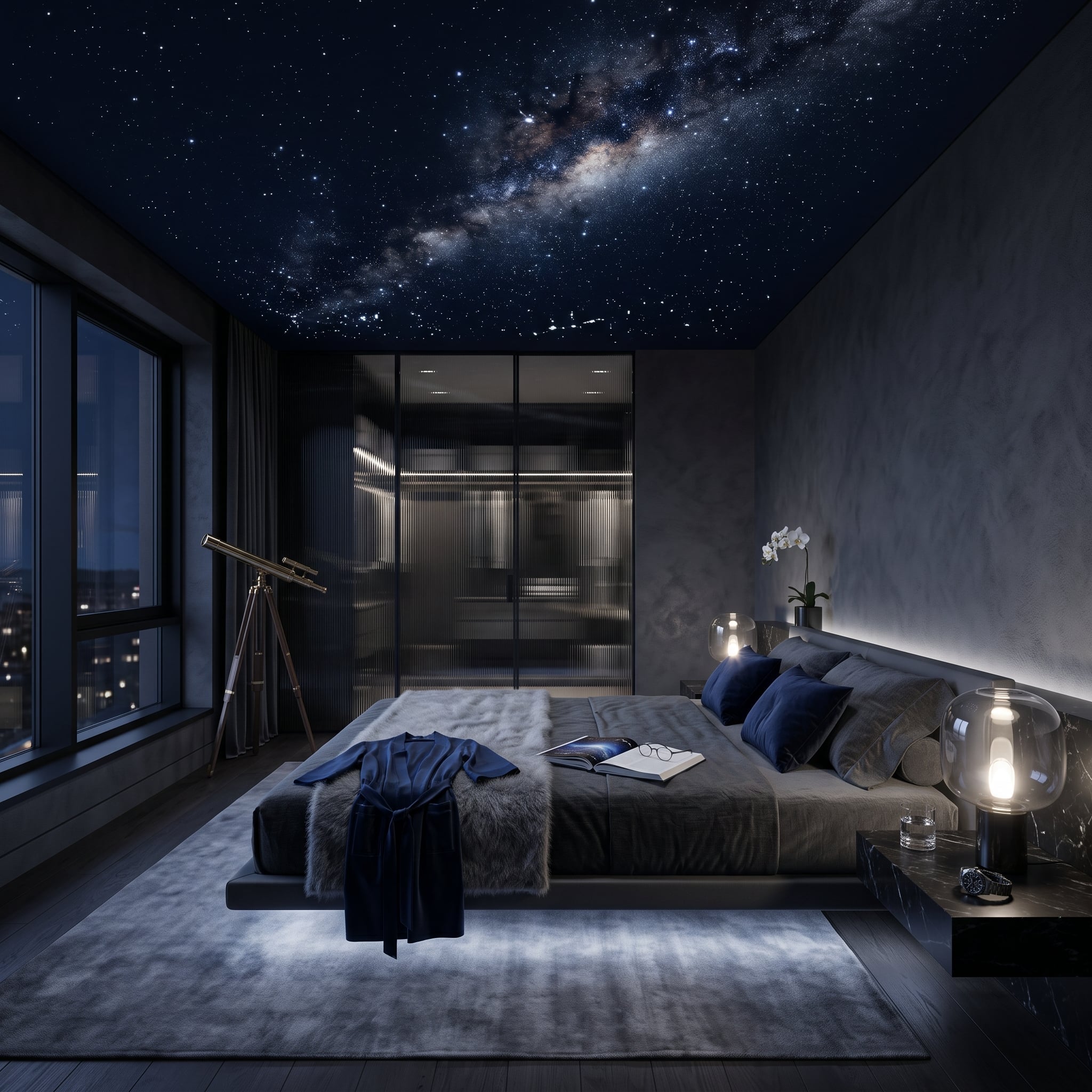
A photorealistic Milky Way mural covers the ceiling, its luminous clouds and dense star fields creating the illusion of extraordinary distance above the bed. Dark walls and charcoal bedding reduce competing visual information, allowing the celestial artwork to dominate the room.
The low platform bed preserves a broad view of the mural, while warm bedside lighting softens the contrast with its cool colors. A brass telescope near the window reinforces the astronomical theme. Painted perspective, tonal gradation, and carefully arranged highlights create the apparent depth, transforming a physically flat surface into an imaginary view of the cosmos. The illusion depends entirely on the artwork’s composition: the stars don’t emit light, but the ceiling makes a persuasive argument that they might.
9. A Giant Circular Oculus Opens a Palm Springs Living Room to the Desert Sky
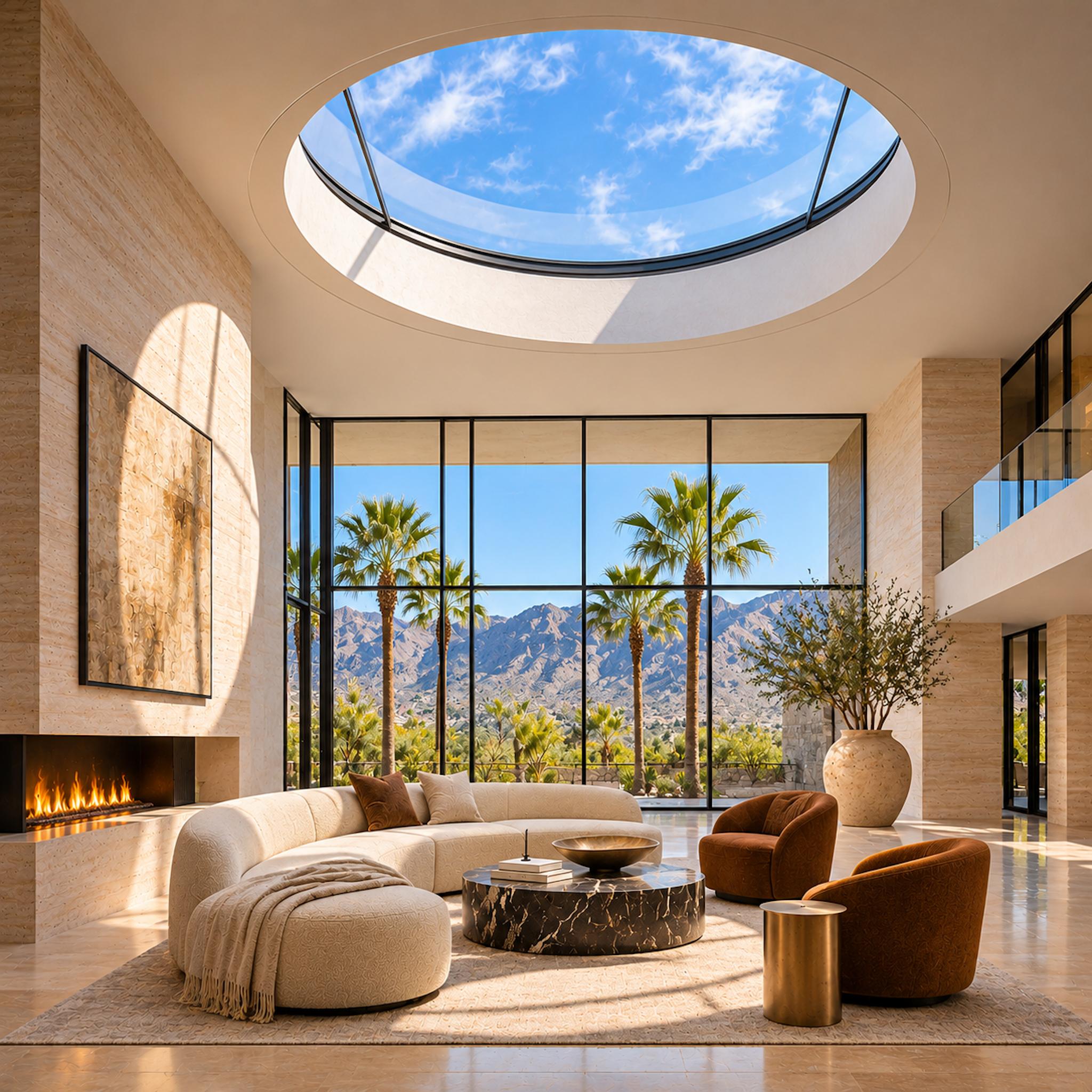
A monumental circular skylight interrupts the ceiling of this double-height Palm Springs living room, framing an expanse of brilliant blue sky and passing clouds. The deep plaster reveal gives the opening architectural weight, while glazed sections and slender framing maintain a clear view overhead. Sunlight moves across the pale stone surfaces, making the room’s appearance change with the time of day.
Floor-to-ceiling windows reveal palms and rugged desert mountains beyond a restrained interior of cream upholstery, rust-colored chairs, and a dark marble coffee table. The oculus introduces an entirely different kind of ceiling design: rather than adding material or decoration, it removes the visual solidity of the surface. Its circular geometry contrasts with the room’s straight architectural lines, while the changing sky supplies a composition no interior designer can permanently control. The most extraordinary thing about this ceiling is what isn’t there.
8. Sculpted Plaster Waves Make a Cream Living Room Anything but Plain
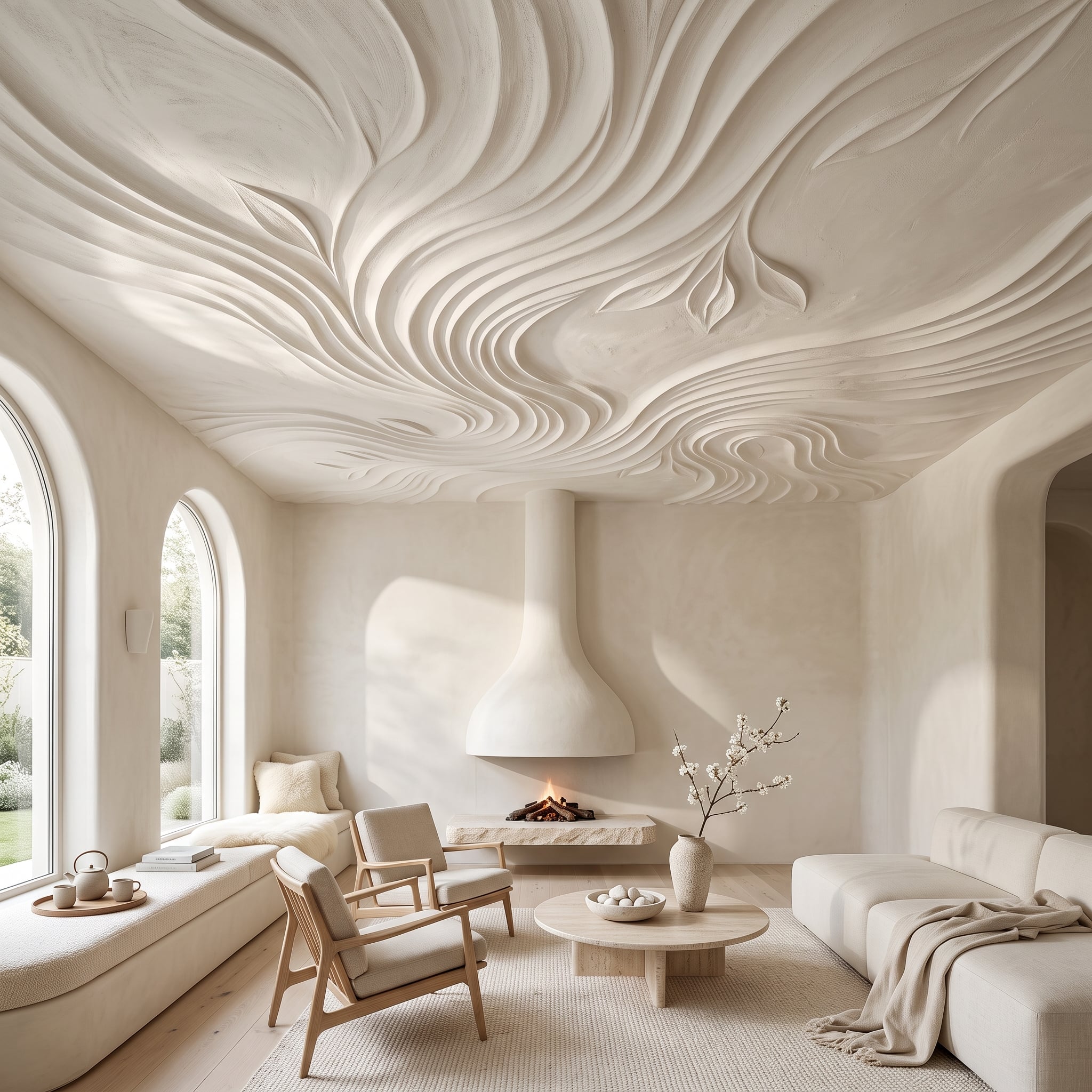
Broad plaster ridges sweep across the ceiling like wind-shaped dunes, transforming an almost monochromatic living room into a study of shadow and relief. The forms rely on depth rather than color contrast, with grazing light revealing the changing contours of the overhead surface.
A pale fireplace hood, rounded sofa, and travertine table continue the restrained palette, leaving the ceiling free to establish the room’s principal visual movement. The plaster’s smooth, continuous finish makes the sculptural forms appear integral to the architecture rather than attached afterward. There are no visible joints, contrasting materials, or decorative borders to interrupt the effect. The room’s entire personality emerges from the way light travels across a series of gentle curves.
7. Oxblood Lacquer Gives This Coffered Ceiling the Richness of a Jewel Box
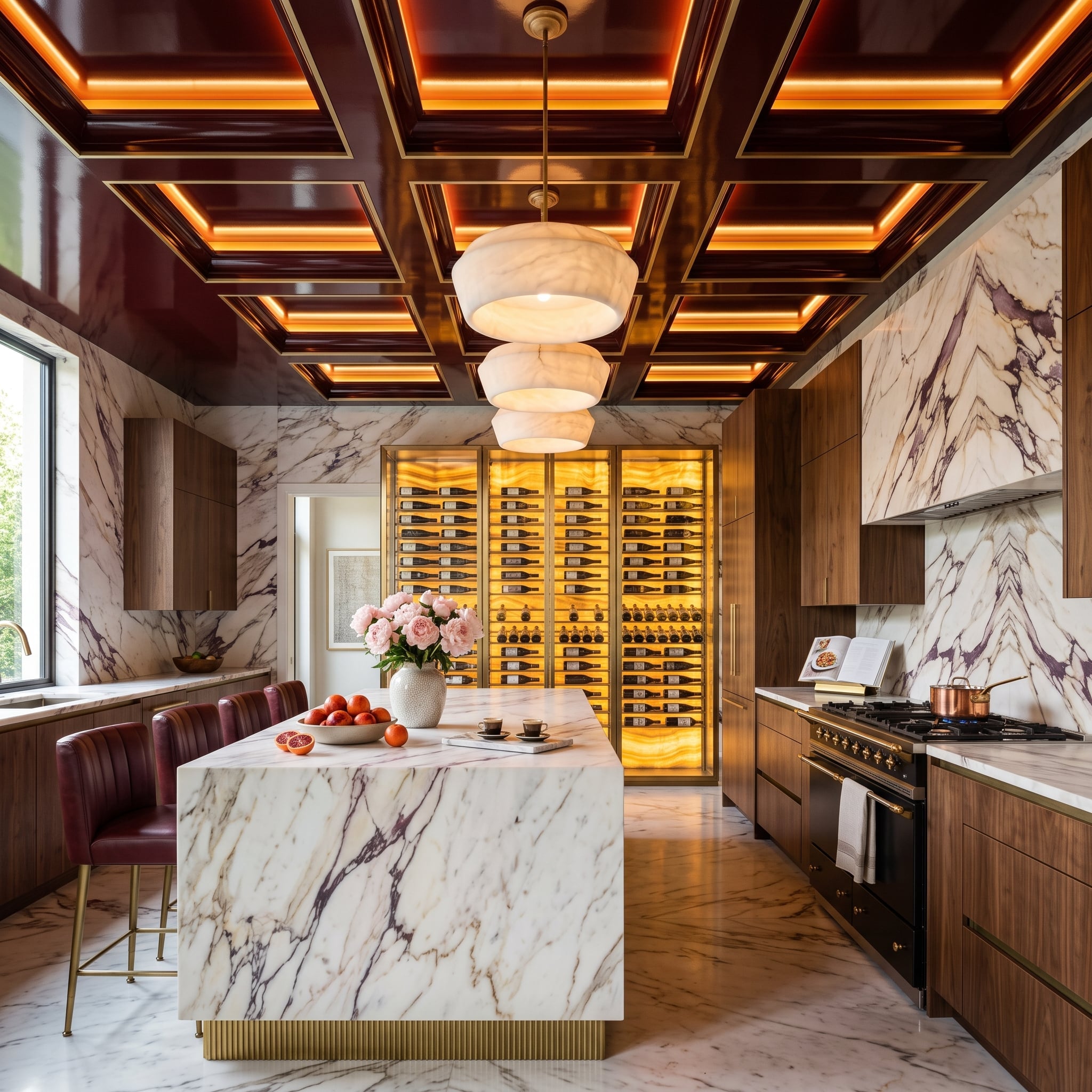
Deep oxblood lacquer fills the recessed panels of a geometric ceiling, with illuminated brass-toned lines defining each coffer. The glossy finish introduces subtle reflections, preventing the dark color from becoming a heavy, featureless expanse.
Calacatta Viola-style marble carries dramatic purple veining across the kitchen island, establishing a visual connection with the burgundy overhead. An illuminated wine display adds amber warmth along one wall. The contrast between the highly patterned stone and disciplined ceiling grid gives the room its tension: one material moves unpredictably, while the other remains confined within precise geometric boundaries. The combination feels opulent, but the orderly ceiling keeps the extravagance firmly under control.
6. Red Lacquer and Gold Beams Give This Bedroom a Ceiling With Royal Ambitions
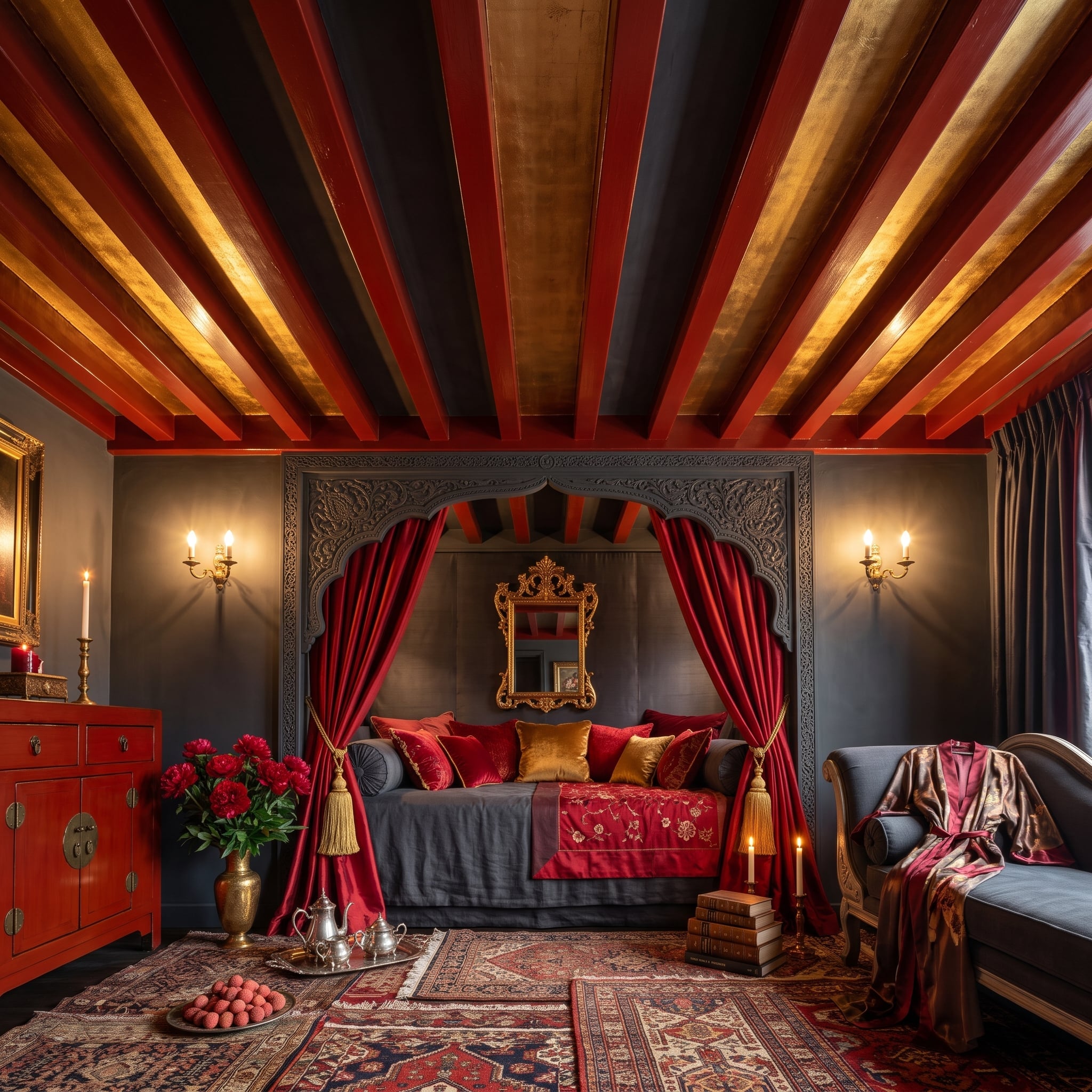
Crimson lacquered ceiling members alternate with gold-toned detailing, creating an emphatic overhead rhythm. The reflective red surfaces and metallic accents are deliberately theatrical, but the regular geometry gives the composition enough discipline to avoid visual chaos.
An ornately carved arch frames the sleeping area, while charcoal bedding, crimson velvet, and gold embroidery carry the palette into softer materials. Gray plaster walls provide necessary relief between the elaborate features. The ceiling’s straight lines and the arch’s sweeping curve introduce different architectural vocabularies, connected by a tightly controlled combination of red, gold, and dark neutrals. There is nothing timid about the composition, but its extravagance follows a surprisingly strict set of rules.
5. A Slatted Walnut Ceiling Leads the Eye Straight Toward a Living Herb Wall
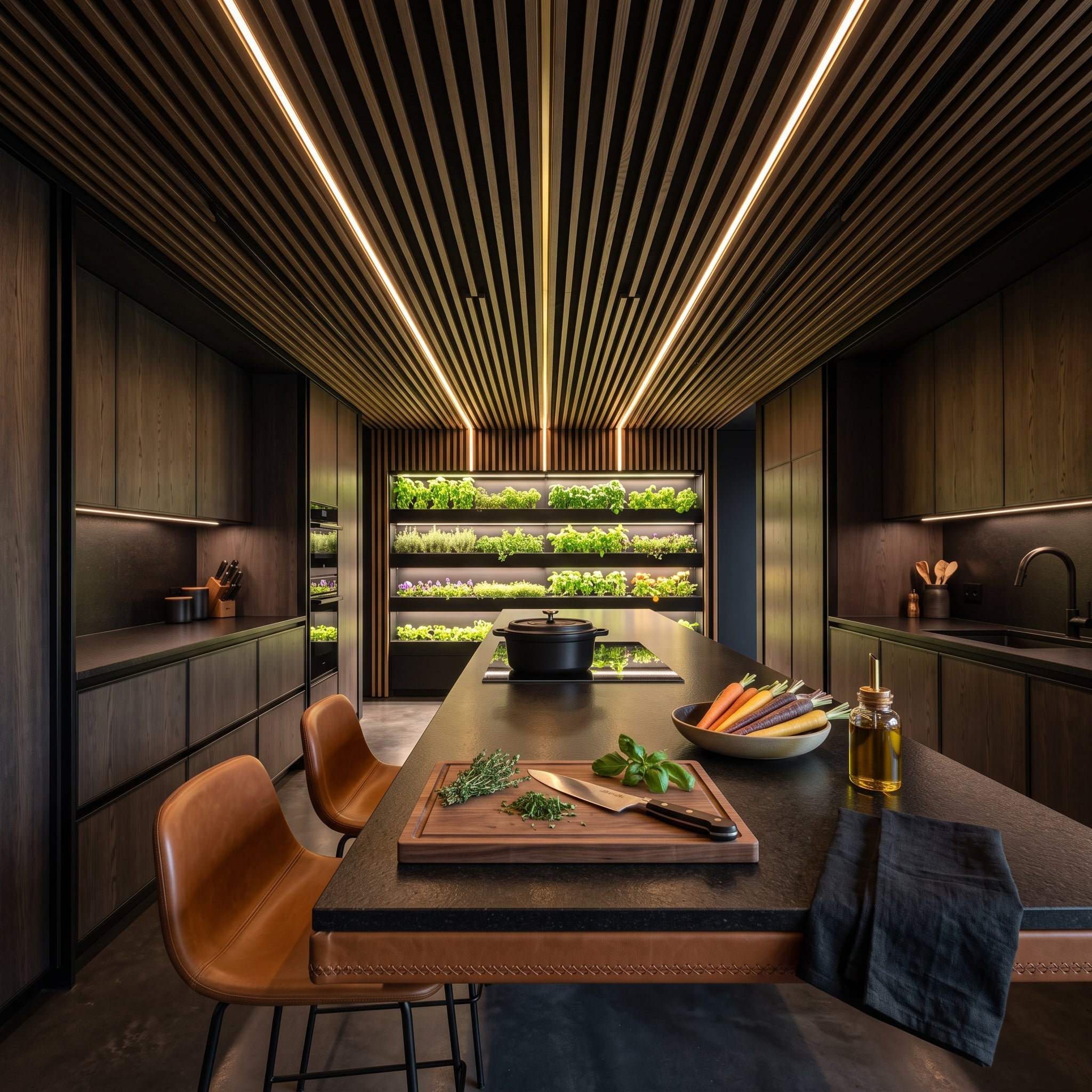
Long walnut slats run toward the far end of the kitchen, their parallel lines reinforced by narrow recessed lighting strips. The arrangement establishes a strong sense of direction, guiding attention toward an illuminated wall of herbs and leafy greens.
Matte-black cabinetry, a dark stone island, and cognac leather stools provide a restrained background for the warm timber. The living wall introduces an irregular texture against the ceiling’s precise repetition. The architectural effect is almost cinematic: every line overhead draws the eye deeper into the room, toward a bright vertical surface of vegetation. Rather than competing for attention, the ceiling acts as an enormous directional device, making the kitchen feel longer and more purposeful.
4. A Silk-Like Tent Ceiling Brings Couture-Level Drama to a Romantic Bedroom
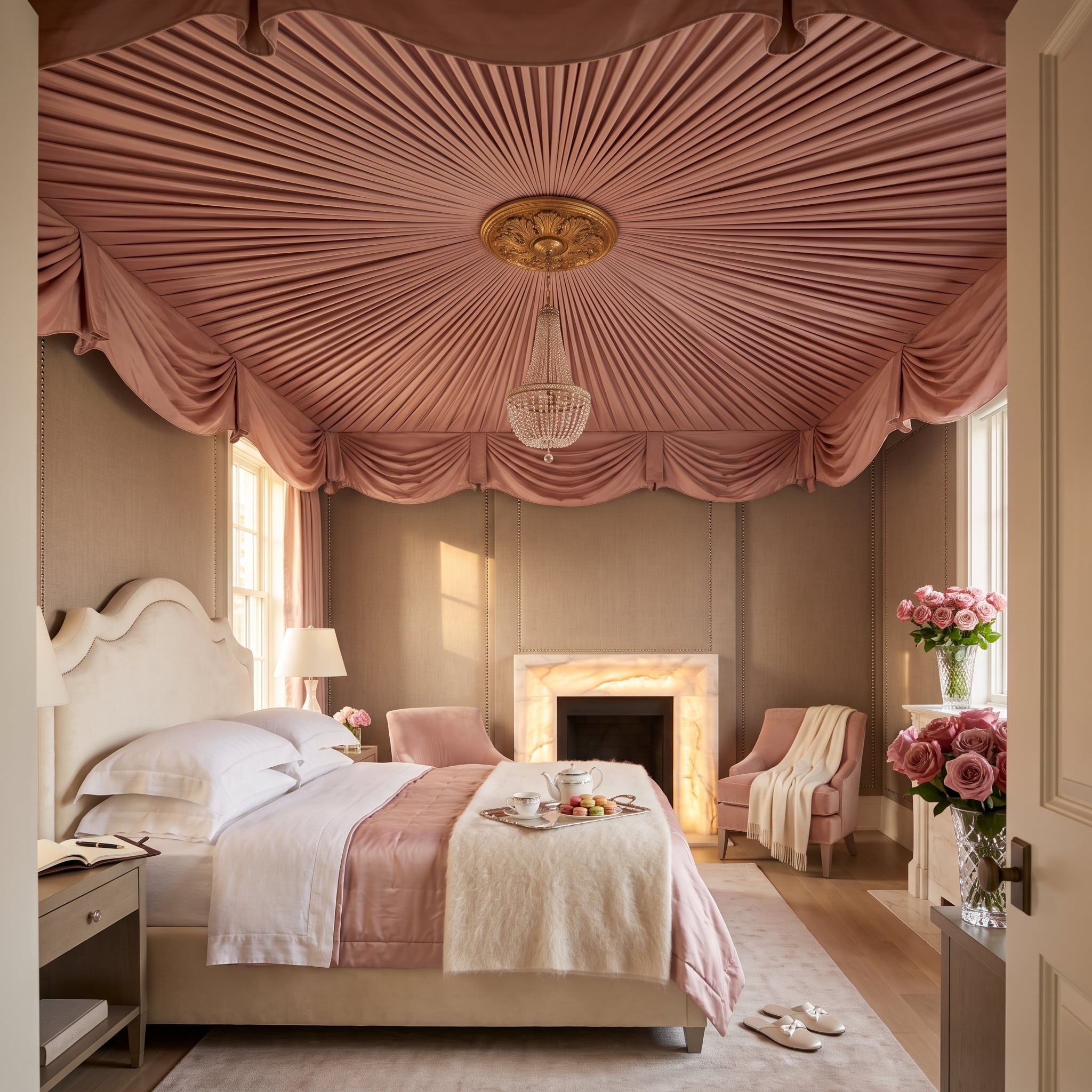
Dusty-rose fabric radiates from a gilded central medallion, its carefully arranged pleats spreading toward the perimeter like the canopy of an elaborate tent. A crystal chandelier descends from the center, reinforcing the ceiling’s formal symmetry.
Blush upholstery and an illuminated onyx fireplace continue the romantic palette without copying the overhead folds. The fabric’s soft sheen allows light to travel across each pleat, giving the ceiling the appearance of an enormous couture creation stretched across the room. Its radial geometry draws attention toward the chandelier before carrying the eye outward to the walls. The result is unapologetically theatrical, yet the disciplined arrangement of the pleats prevents the elaborate fabric from overwhelming the bedroom.
3. A Baroque-Inspired Sky Mural Opens This Living Room to Painted Clouds
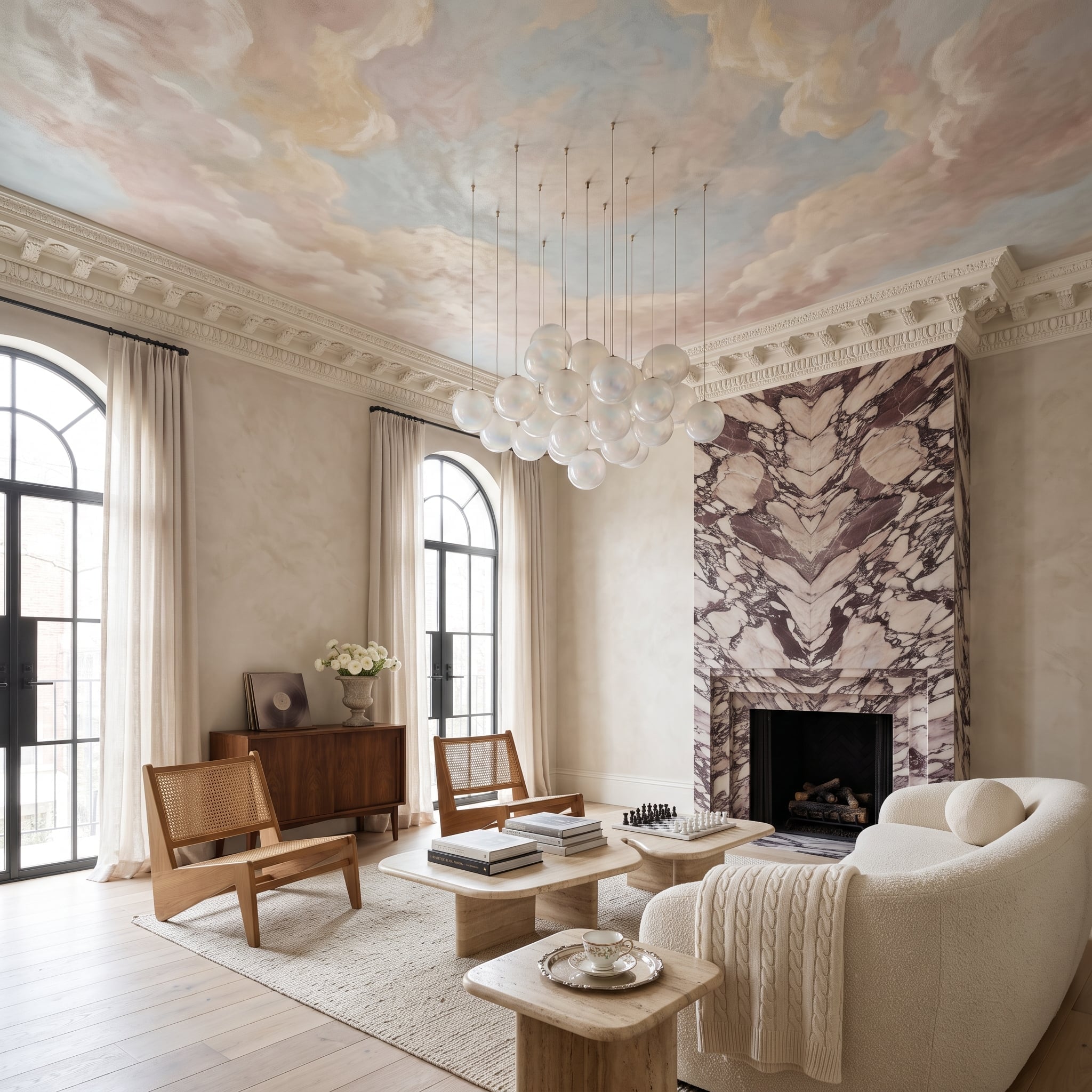
Pale blue sky, blush clouds, and warm golden light spread across the ceiling, framed by elaborate cornices. The painted scene recalls the illusionistic ceiling decoration associated with European Baroque interiors, where perspective and theatrical imagery were used to suggest architecture extending beyond its actual limits.
A bookmatched Calacatta Viola-style fireplace provides a second powerful pattern below, while rattan chairs, pale upholstery, and travertine tables introduce a contemporary contrast to the ornate surroundings. The ceiling’s painted clouds create an impression of open air above the formal architecture, turning the solid plaster surface into an imaginary opening. Its sunlight never moves and its clouds never gather, yet the illusion gives the room an expansiveness that conventional ceiling decoration could scarcely achieve.
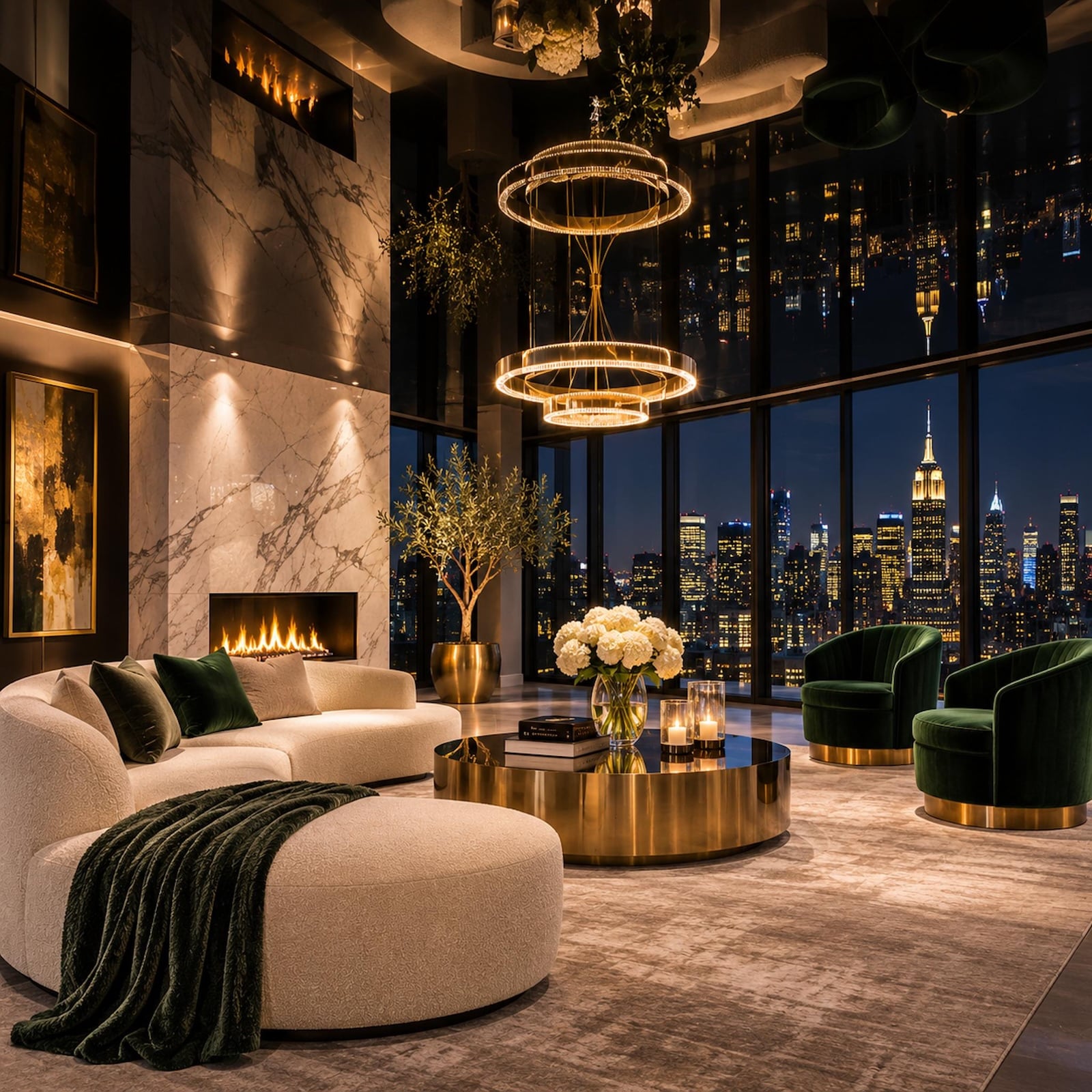
2. A Black Mirror Ceiling Makes a Manhattan Penthouse Look Twice as Tall
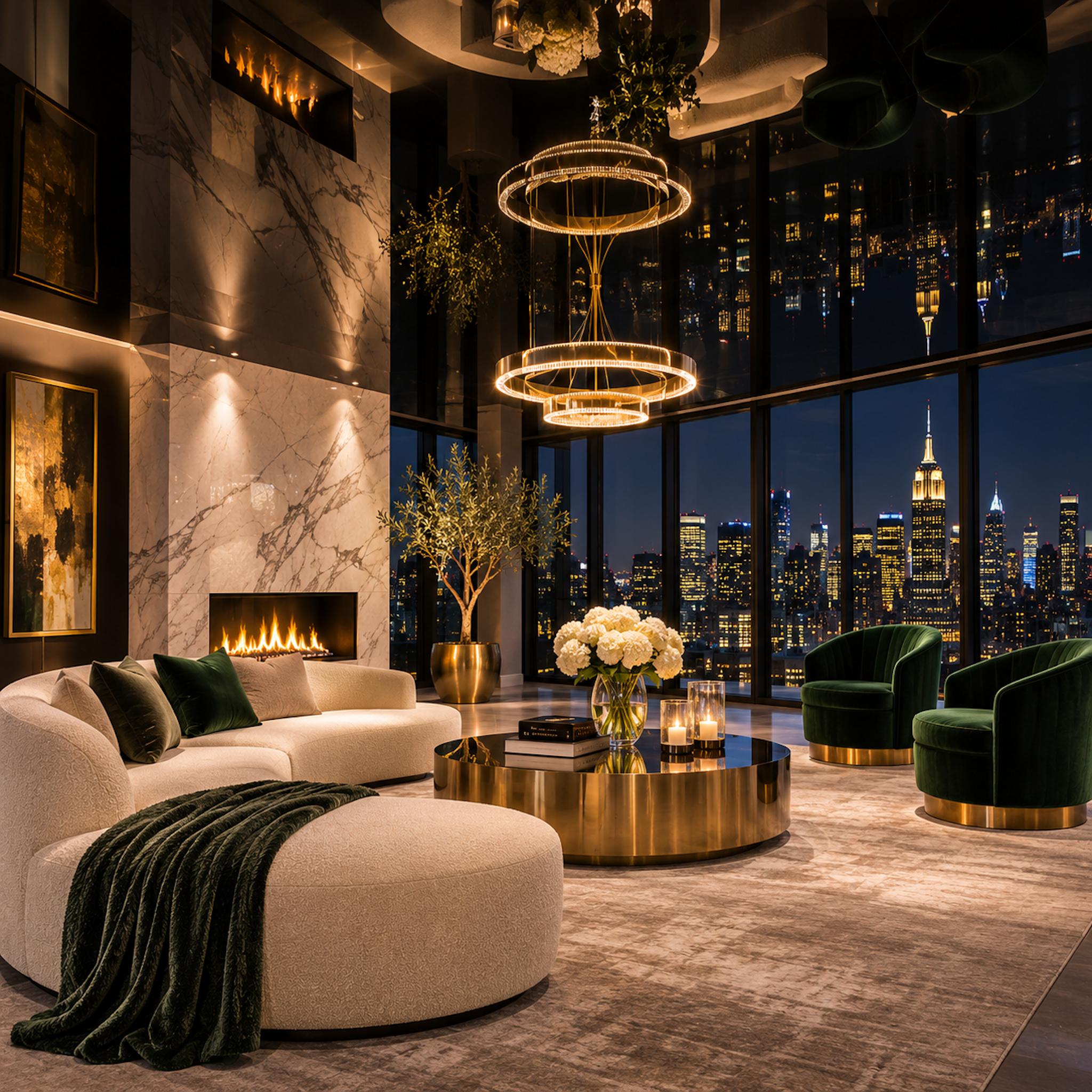
Above a Manhattan penthouse living room, a seamless high-gloss black ceiling reflects the illuminated skyline, sculptural chandelier, and furnishings below. The dark surface behaves almost like still water, creating an inverted image of the room without the visible joints of a conventional mirrored-panel installation. At night, the reflections make the architecture appear to continue upward into another level.
Curved cream seating, emerald velvet chairs, a brass coffee table, and a marble fireplace provide enough contrast to register clearly against the black reflection. Floor-to-ceiling windows reveal the city lights beyond, extending the interplay between interior illumination and exterior darkness. The ceiling’s uninterrupted surface is essential to the illusion: without obvious seams or framing, there is little to reveal where the physical room ends and its reflection begins. The penthouse already commands an extraordinary view of Manhattan. Now it appears to have acquired a second skyline overhead.
1. Bookmatched Marble Climbs the Walls and Takes Over the Kitchen Ceiling
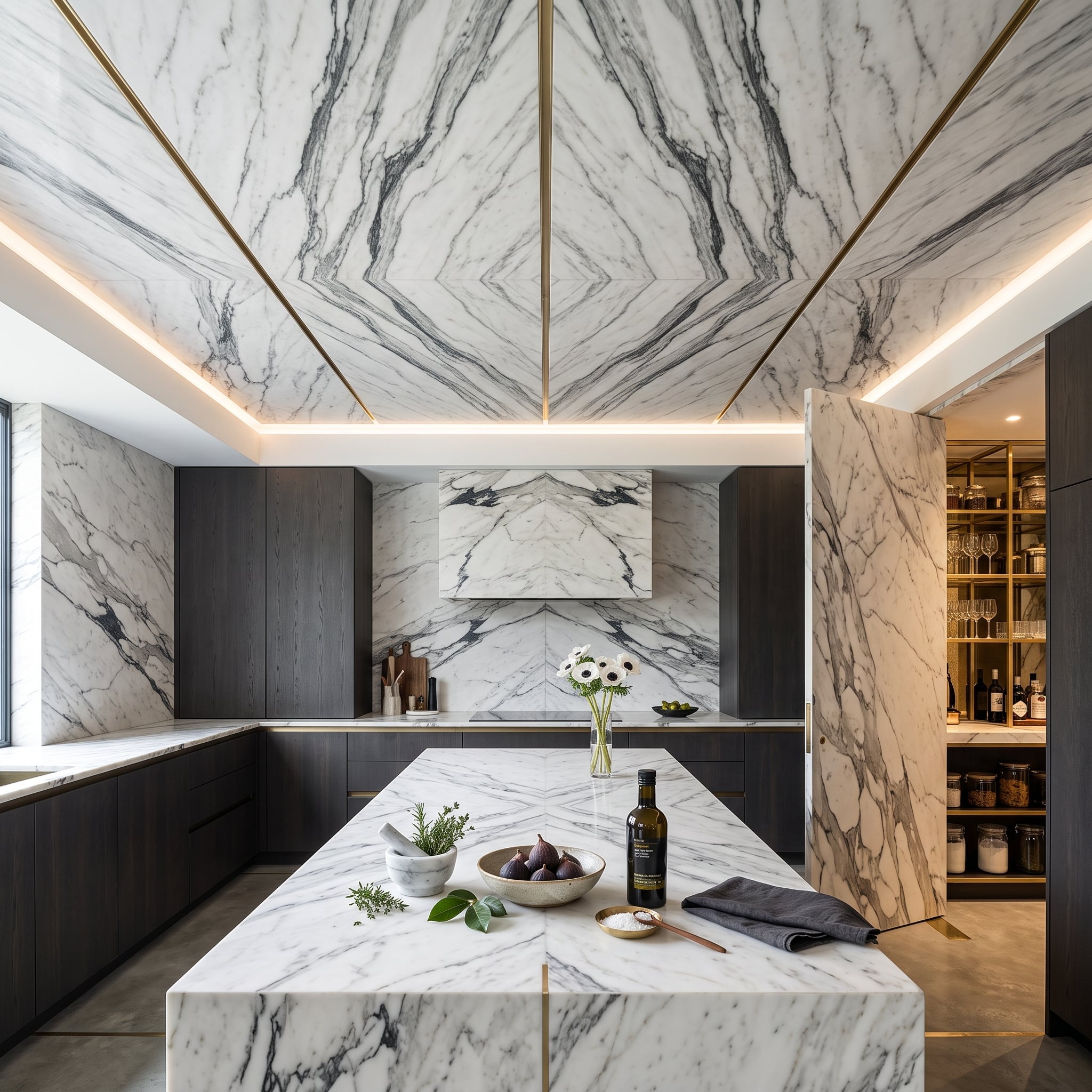
Calacatta-style marble refuses to stop at the backsplash. Dramatic gray veining climbs the walls and continues across the ceiling, where mirrored patterns form an elaborate overhead composition. Brass-toned seams emphasize the geometry, transforming the stone into something closer to monumental architectural paneling than an ordinary decorative finish.
Dark oak cabinetry provides the contrast needed to keep the marble’s veining legible. Bookmatching uses consecutively cut stone slabs arranged to create mirrored markings, turning naturally irregular patterns into carefully composed symmetry. Extending that visual relationship from the walls onto the ceiling creates a remarkably immersive effect. The marble no longer behaves like a luxurious accent selected for a few prominent surfaces. It has taken possession of the architecture, leaving the cabinetry to provide the necessary restraint.