🔥 Would you like to save this?
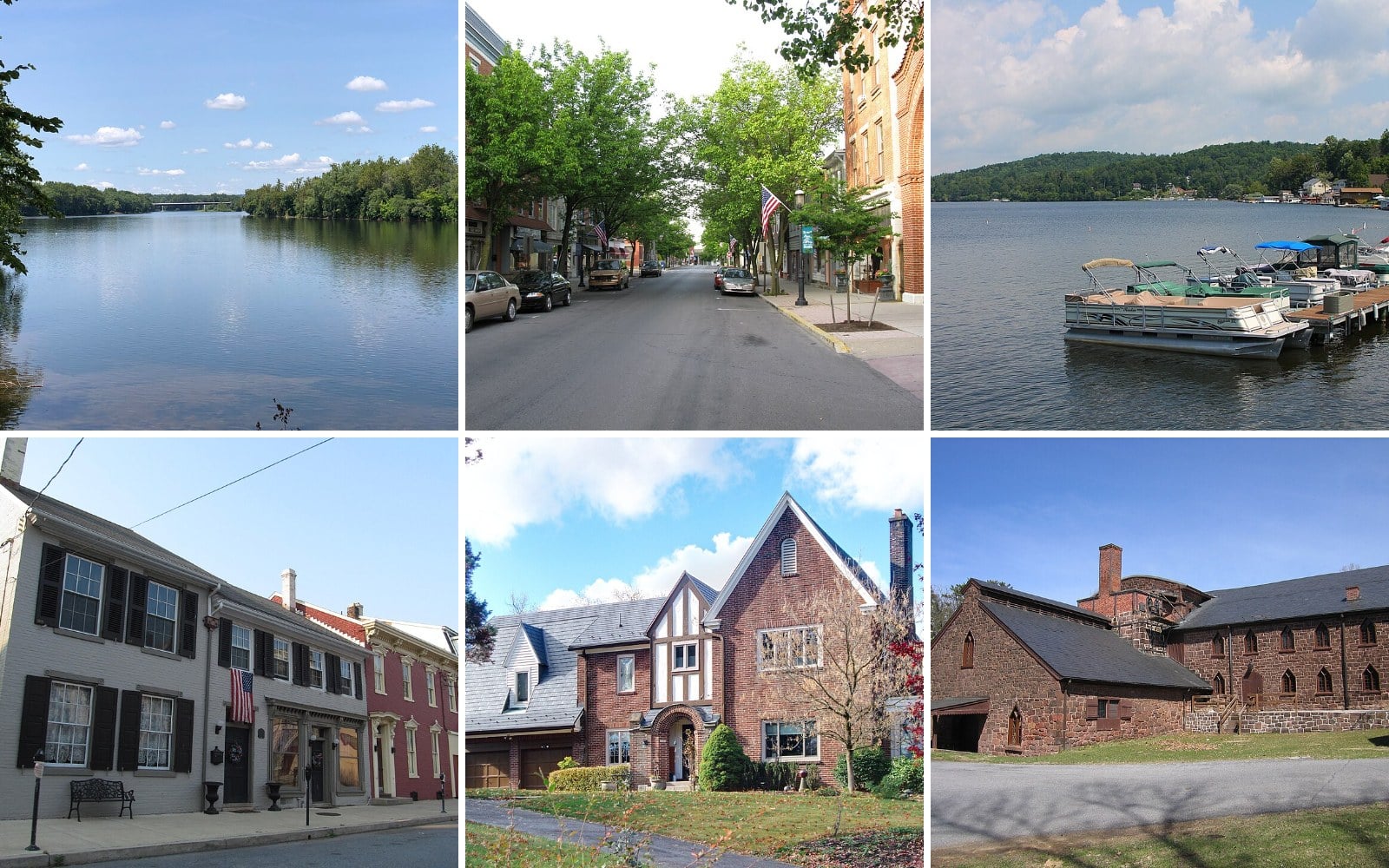
Clockwise from top left: Yardley, Hollidaysburg, Harveys Lake, Cornwall, Green Tree and Marietta. Photos: Famartin (CC BY-SA 4.0), Andrew Bossi (CC BY-SA 2.5), Jakec (CC BY-SA 4.0), Wherring (CC BY-SA 3.0), Cbaile19 (CC0), Doug Kerr (CC BY-SA 2.0) · via Wikimedia Commons
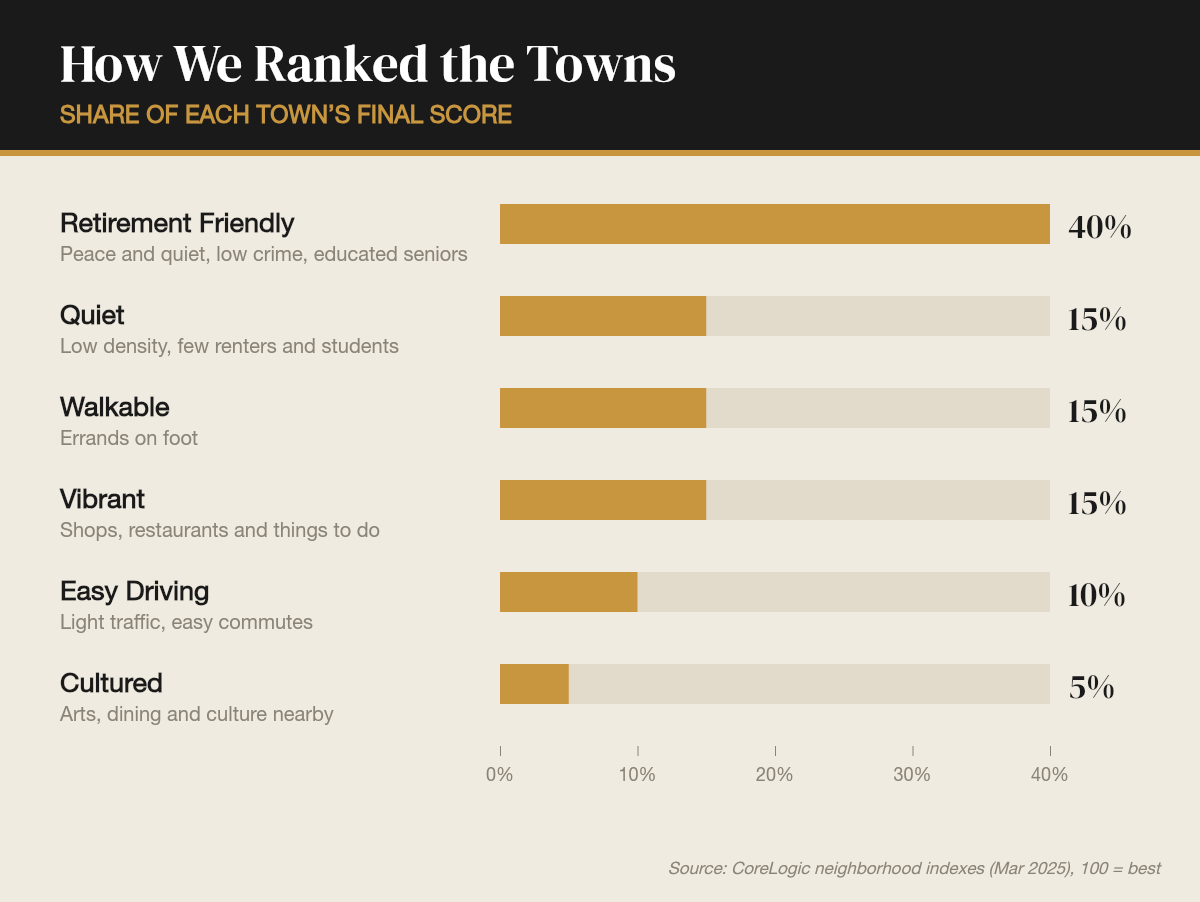
Pennsylvania has hundreds of boroughs and townships, and plenty of them make a lovely place to spend retirement. To find the best, we used CoreLogic’s neighborhood indexes, which score every census tract in the country from 1 to 100 using data from the Census, the FBI and local police, the Department of Education, the Bureau of Labor Statistics and more.
We rolled those tract scores up to the borough or township they belong to and kept only real municipalities with between 500 and 15,000 residents. Each town’s final score blends six measures. Retirement friendliness counts most. It’s CoreLogic’s own mix of peace and quiet, low crime, educated seniors and a range of housing. Quiet streets, walkability, local shops and restaurants, light traffic and a bit of culture make up the rest. Towns scoring under 40 on quiet were left out.
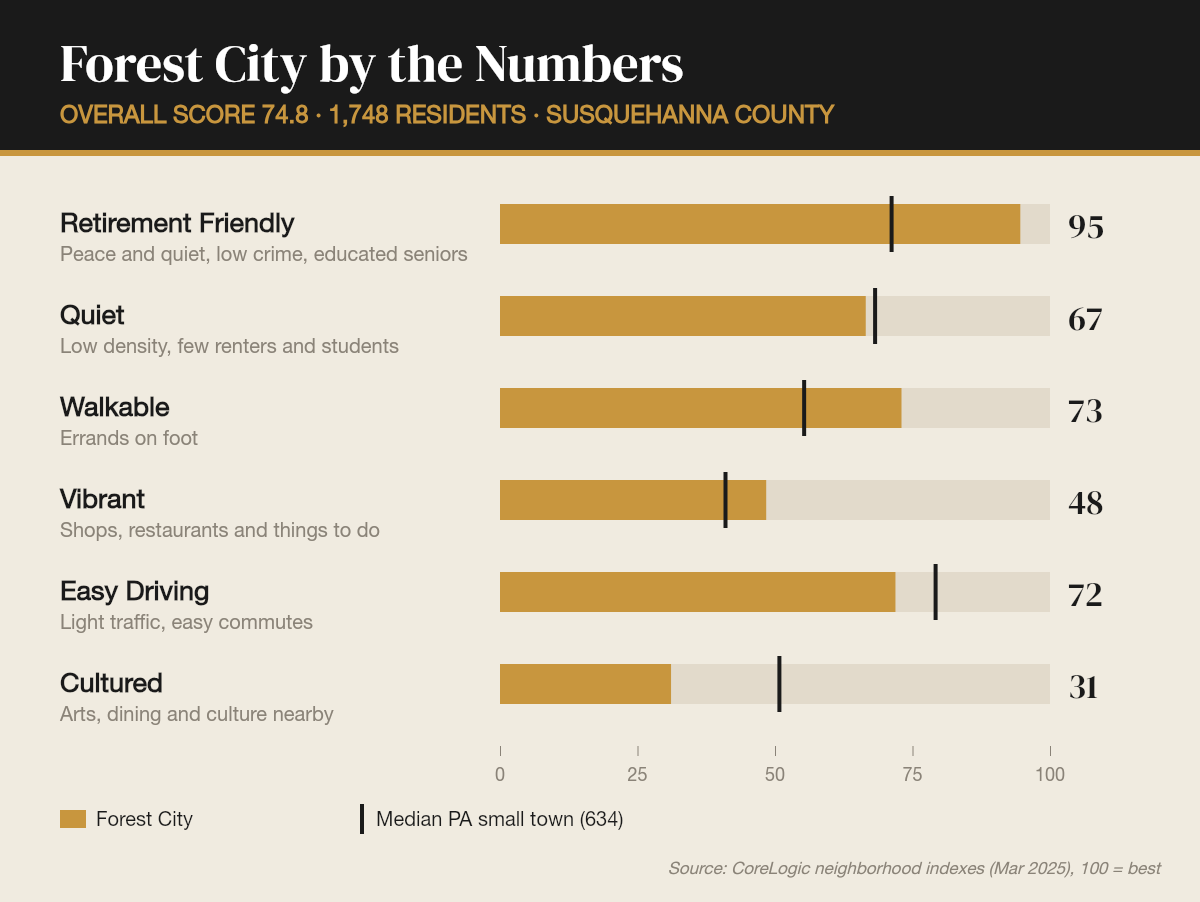
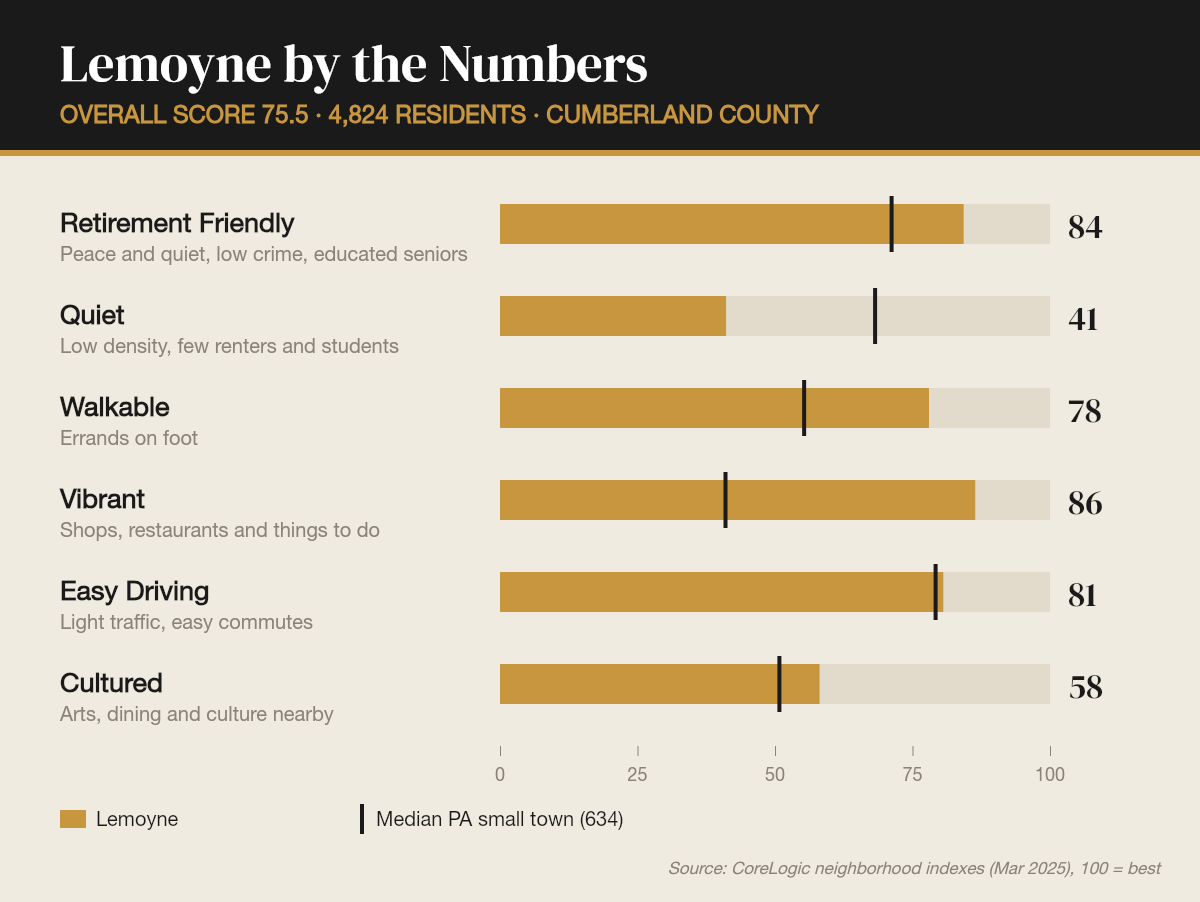
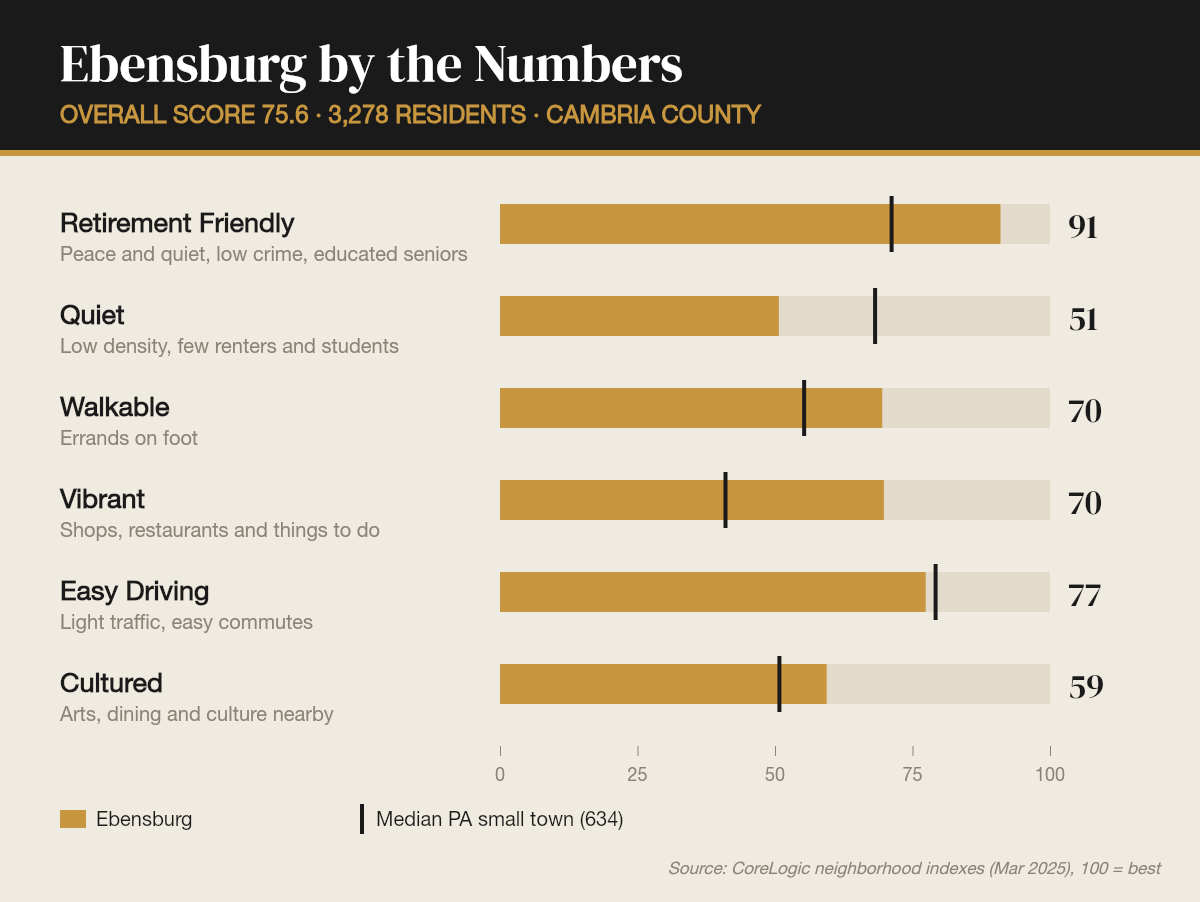
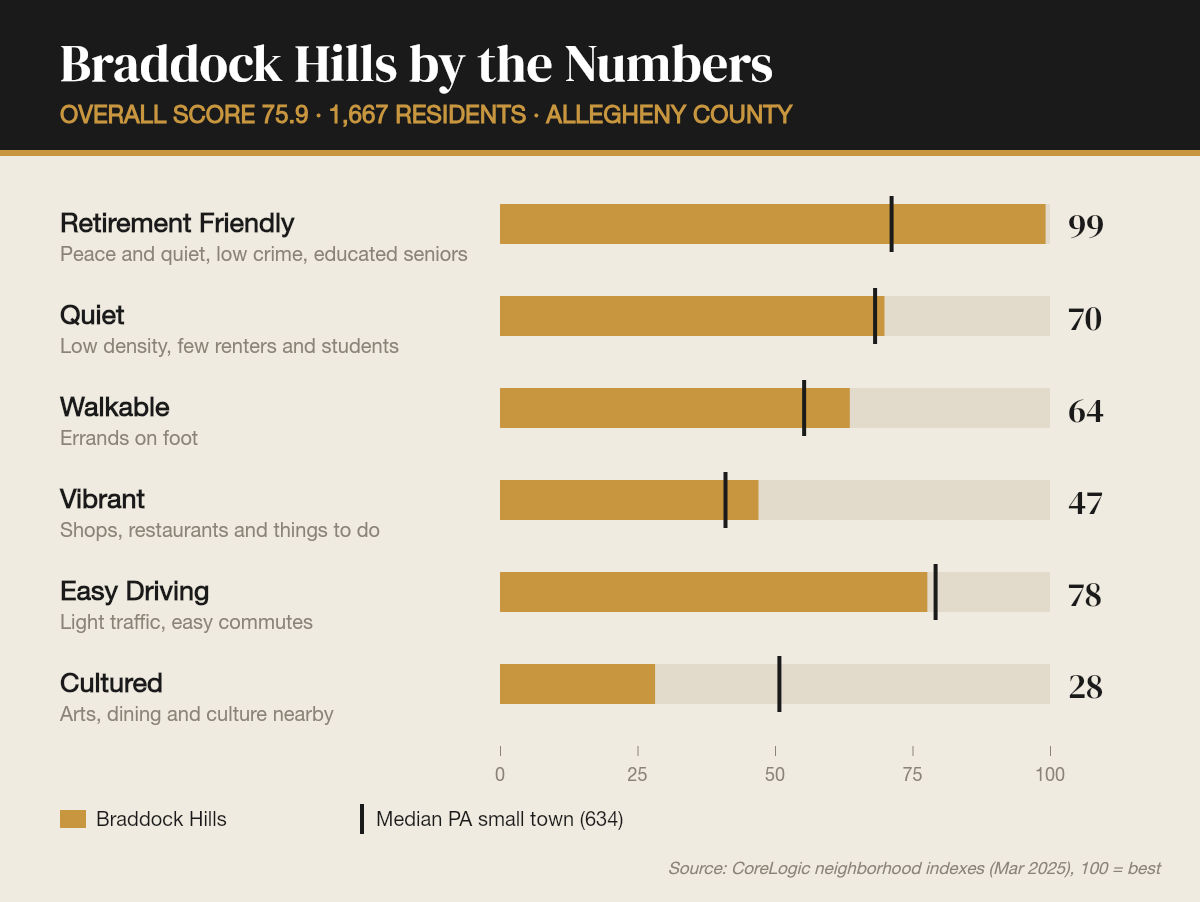
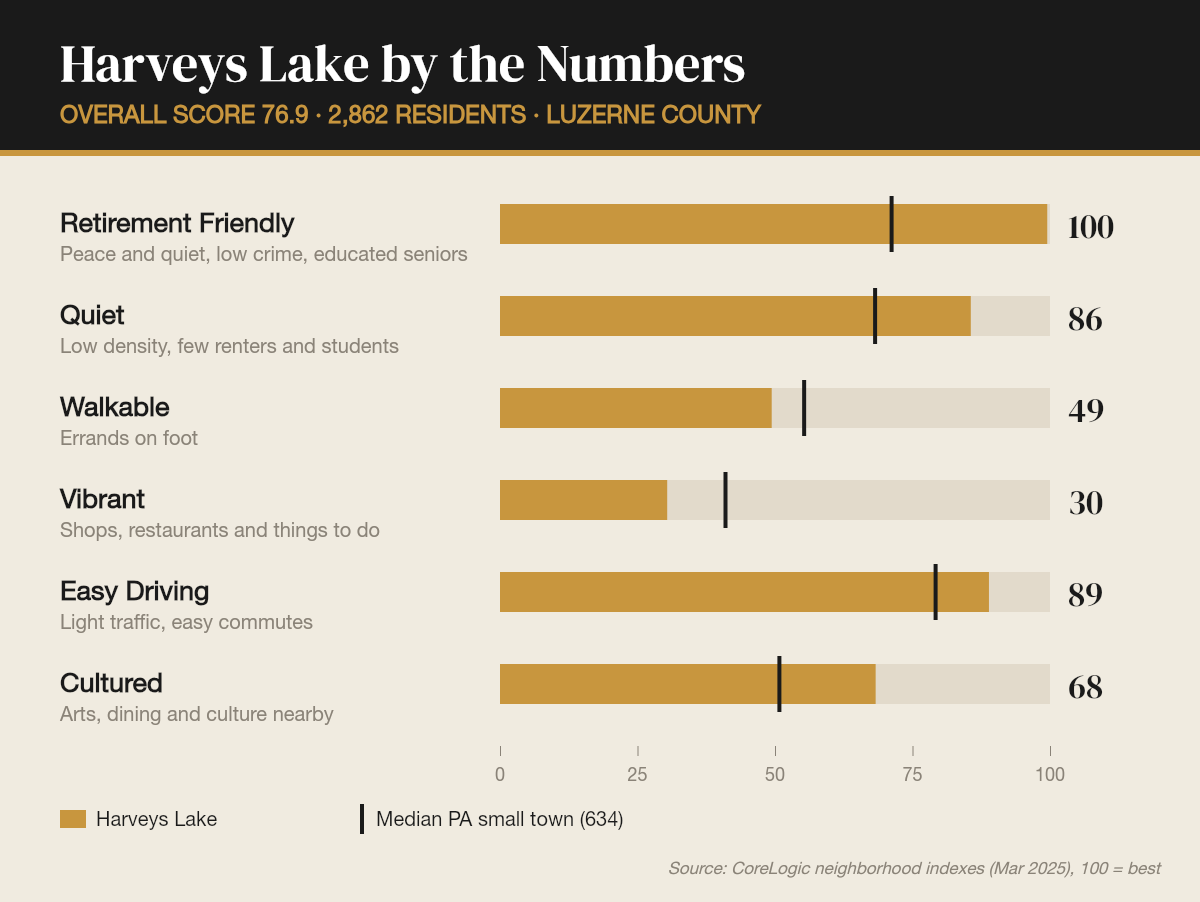
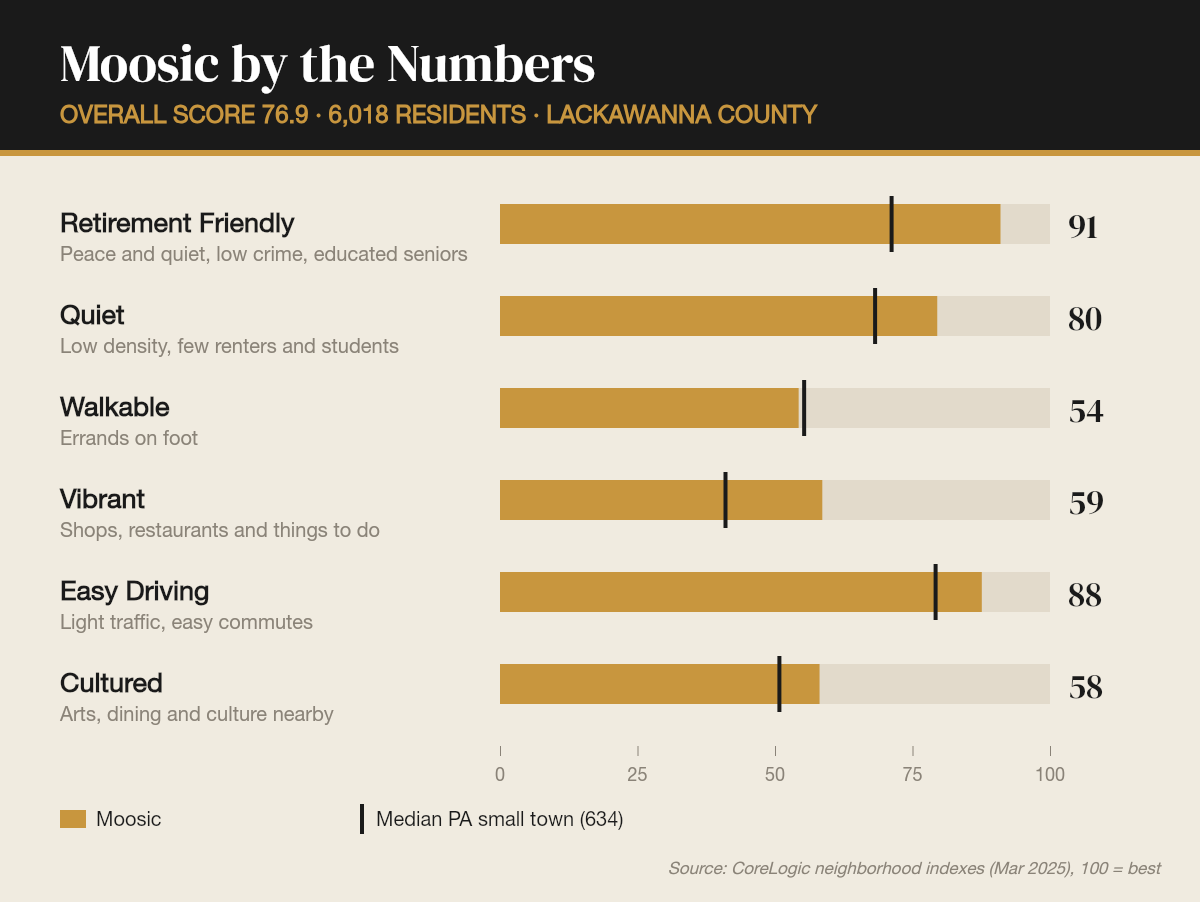
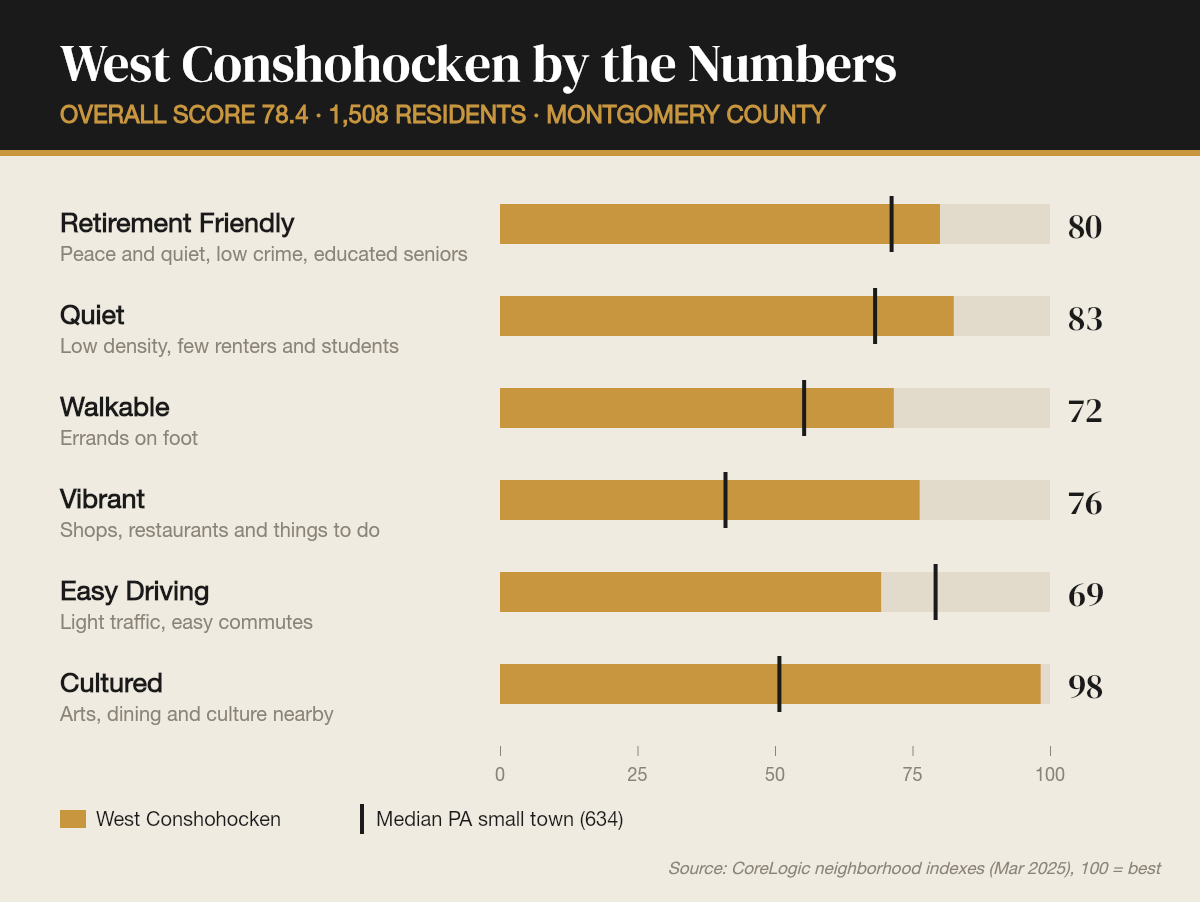
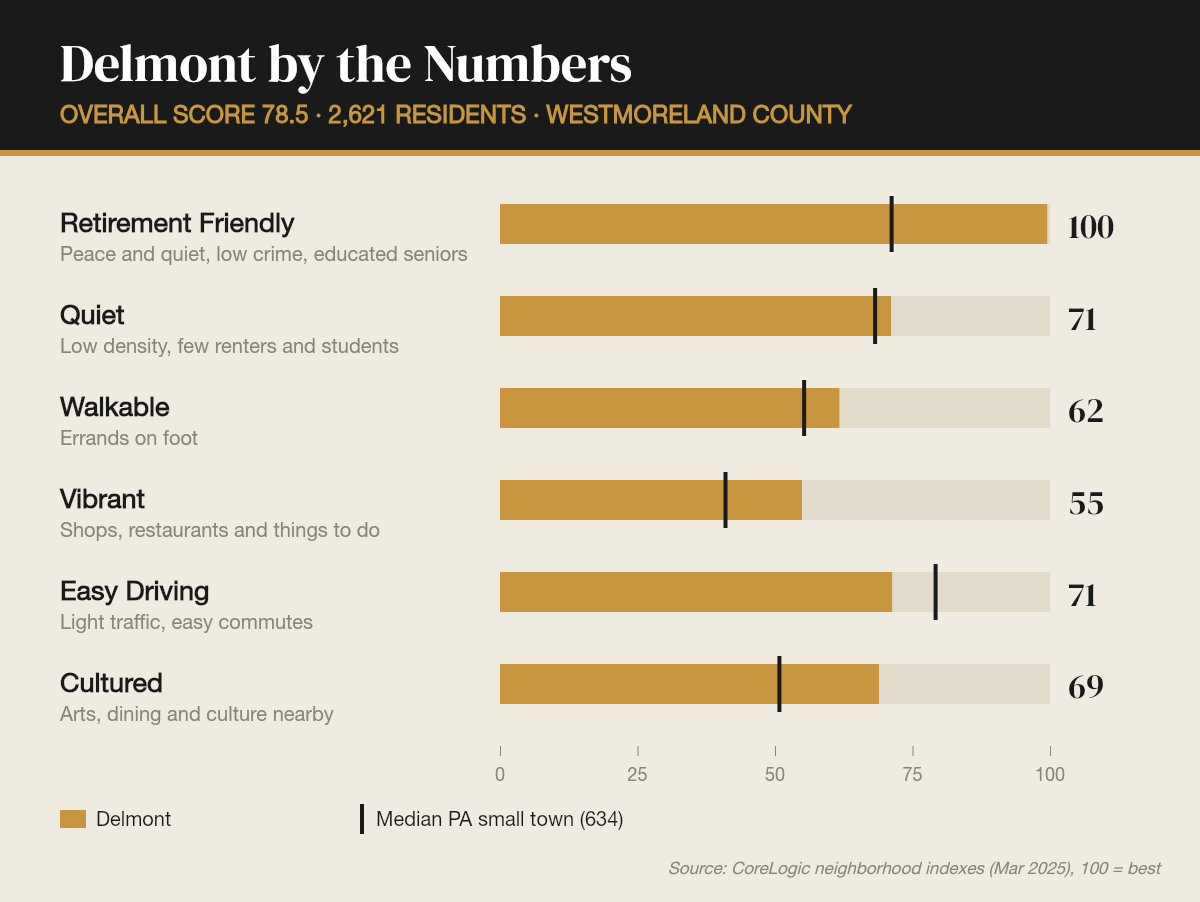
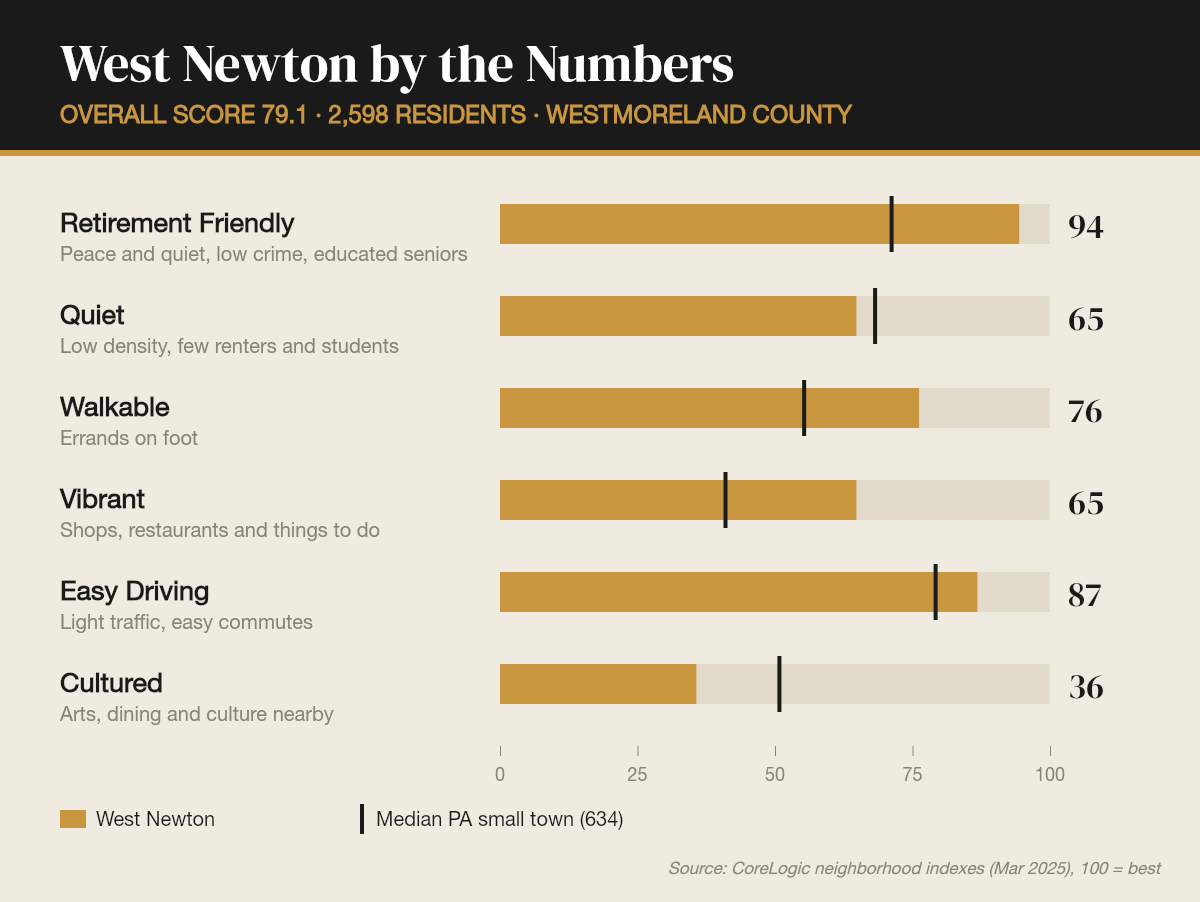
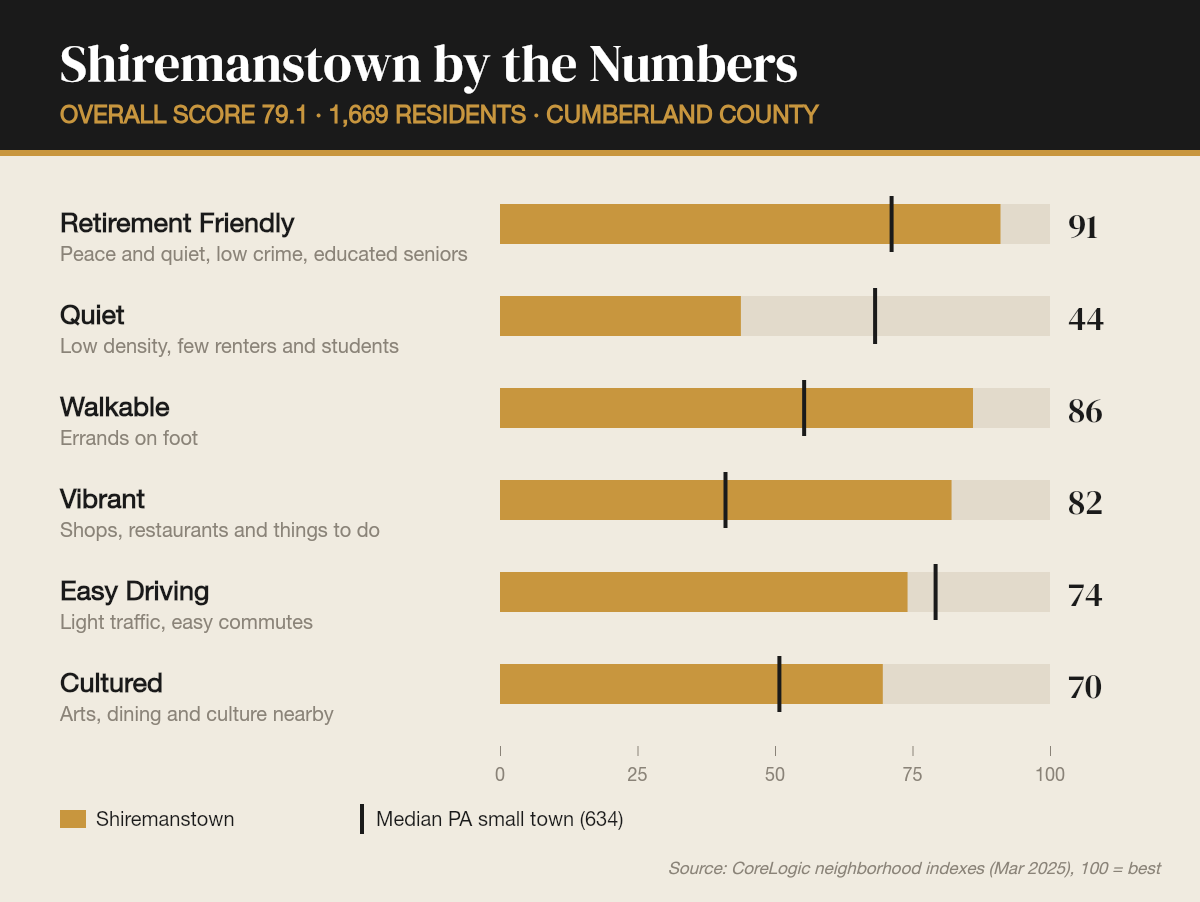
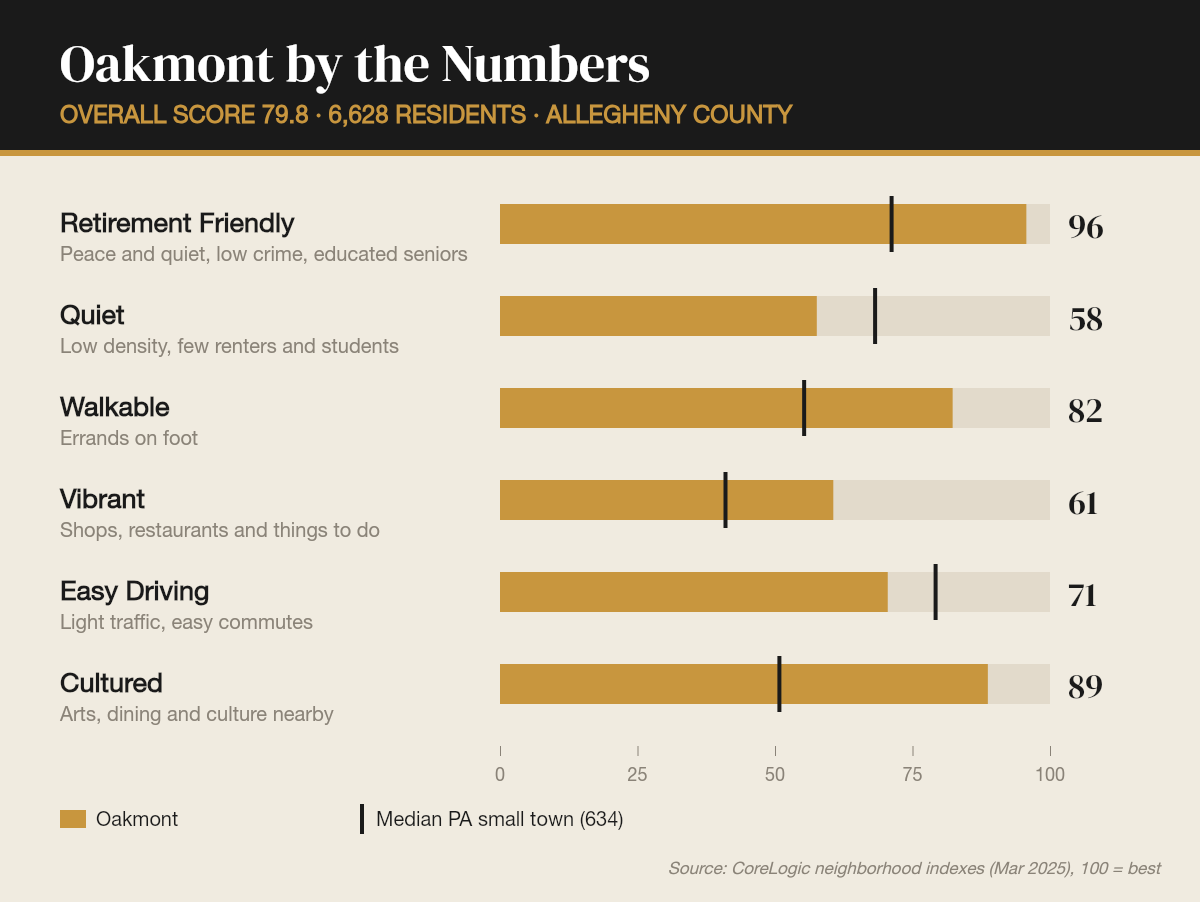
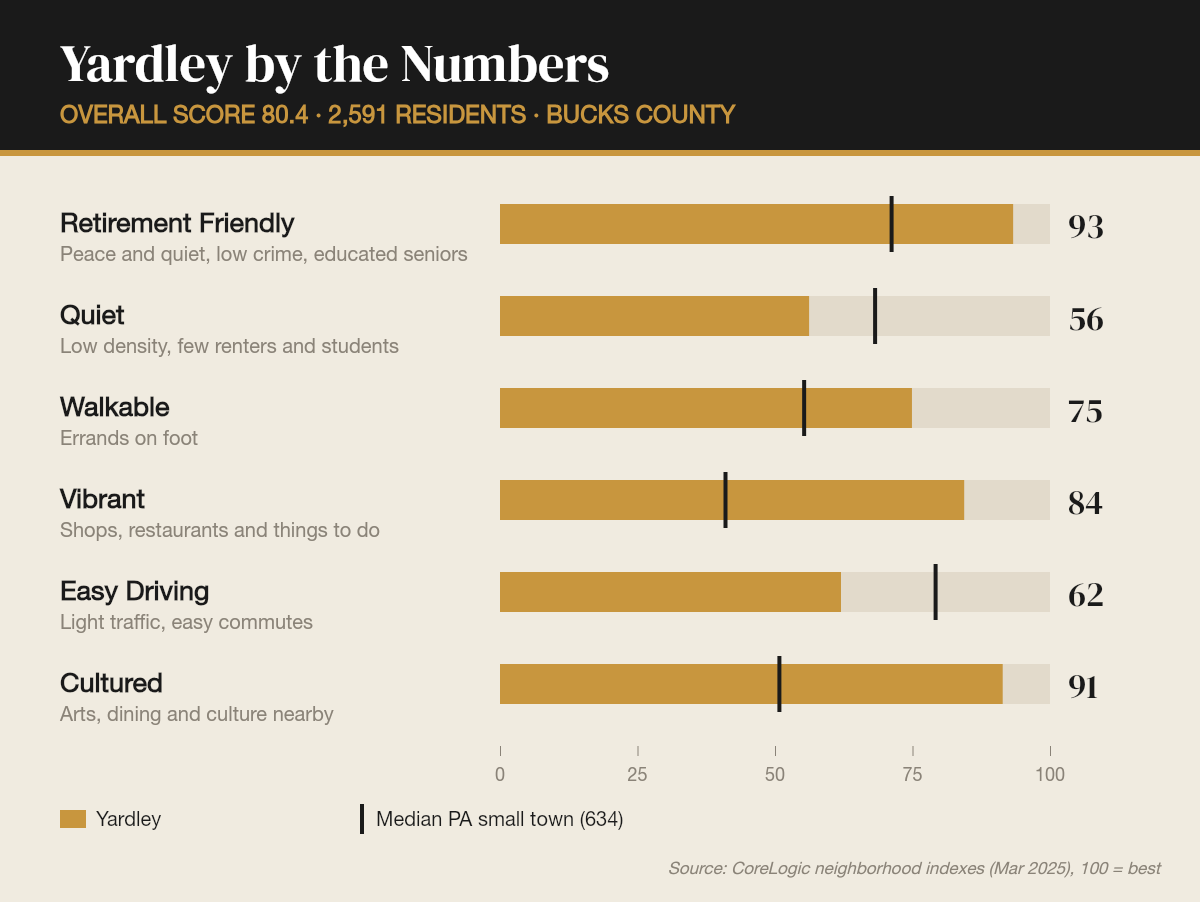
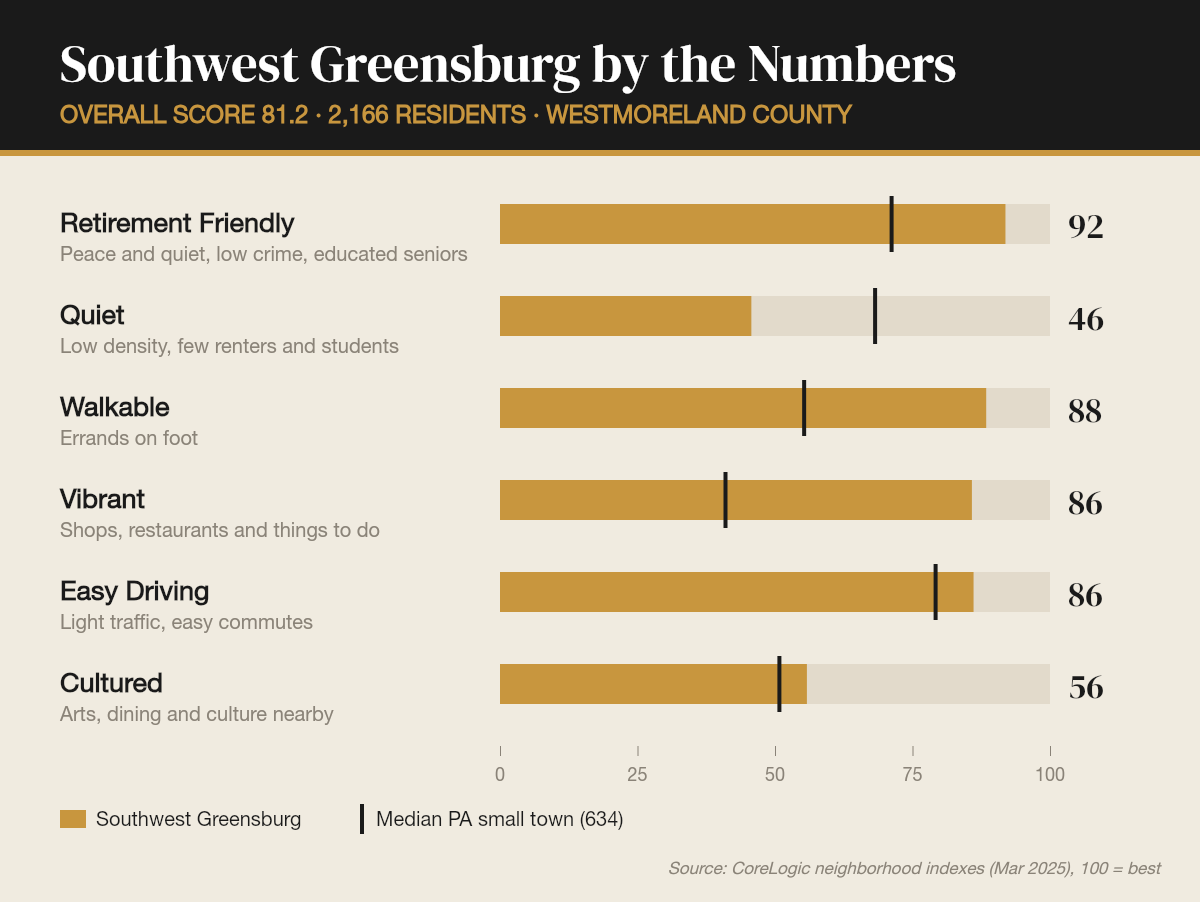
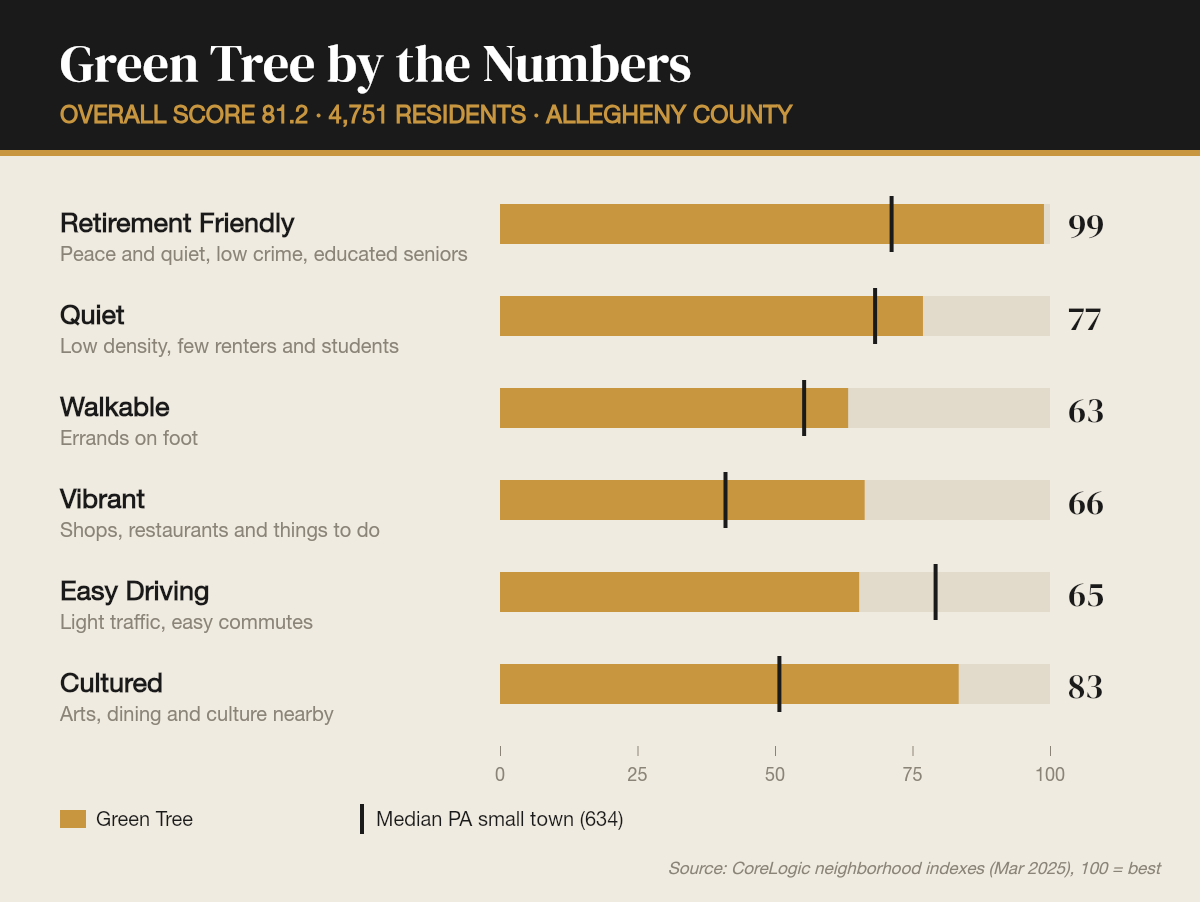
Each town's chart below shows its six scores in gold. The black tick marks the median for all 634 Pennsylvania small towns we scored.
Here they are, counting down from 30 to the best small town in Pennsylvania for retirement.
30. Forest City
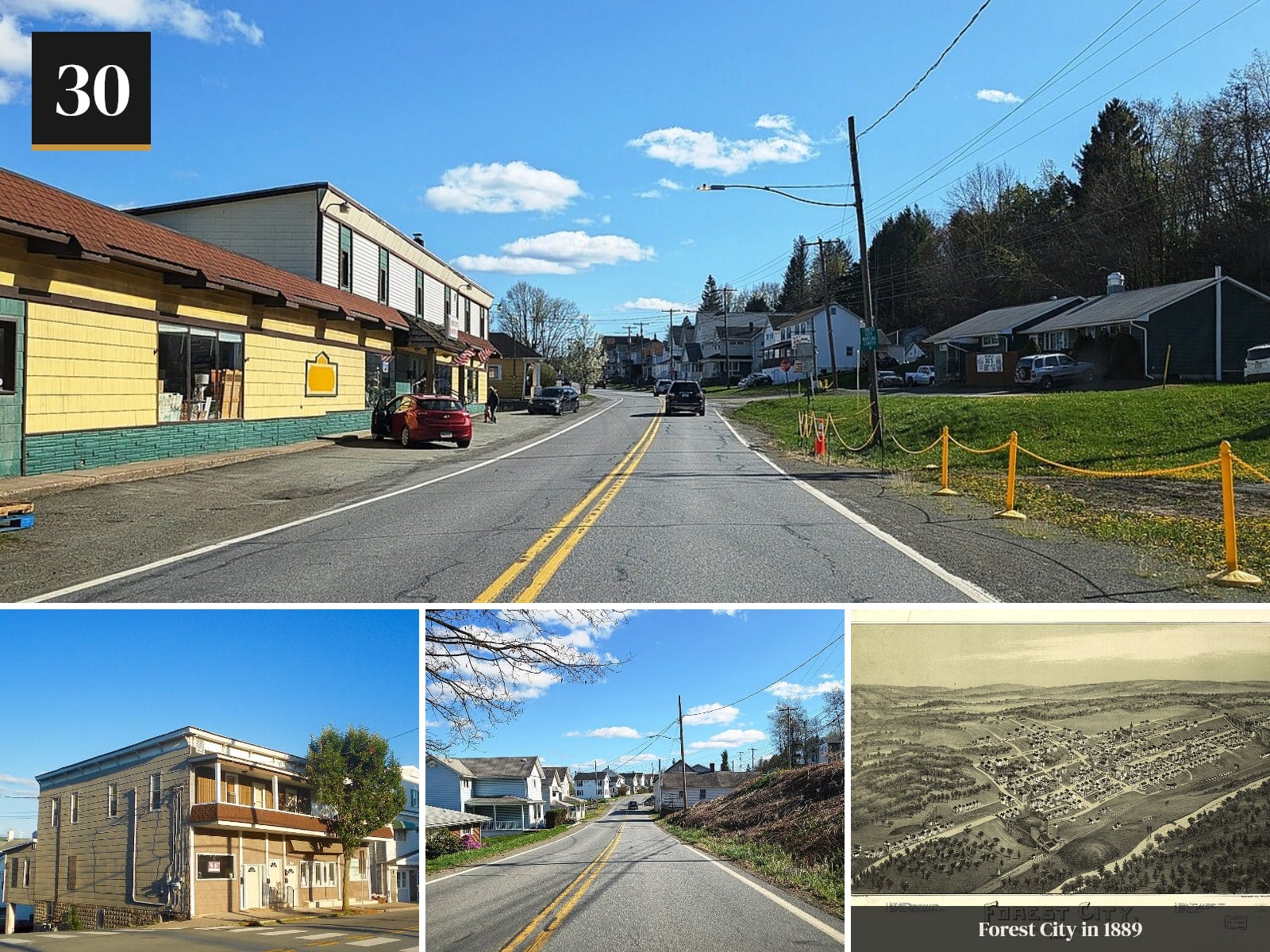
Photos: Mr. Matté (CC BY-SA 4.0), Smallbones (CC0) · 1889 view: T. M. Fowler, Library of Congress (public domain) · via Wikimedia Commons
Forest City sits right where Susquehanna, Lackawanna and Wayne counties meet, and the whole town proper is about four avenues by ten blocks. A century ago, timber, silk and coal packed close to 6,000 people onto a busy Main Street. Today about 1,750 live here, and almost nine in ten of them live in town, close to everything.
That compact layout explains the scores. Forest City rates 95 for retirement friendliness, against 71 for a typical small Pennsylvania town, and 73 for walkability, against 55. The post office, churches and Main Street shops are a short stroll from the older frame houses. It’s weak on culture, so plan on a drive for a concert or a museum. For a small, safe town where you can run errands on foot, though, few places this size do better.
Overall score: 74.8 · Population: 1,748 · County: Susquehanna · Best score: Retirement 95
29. Lemoyne
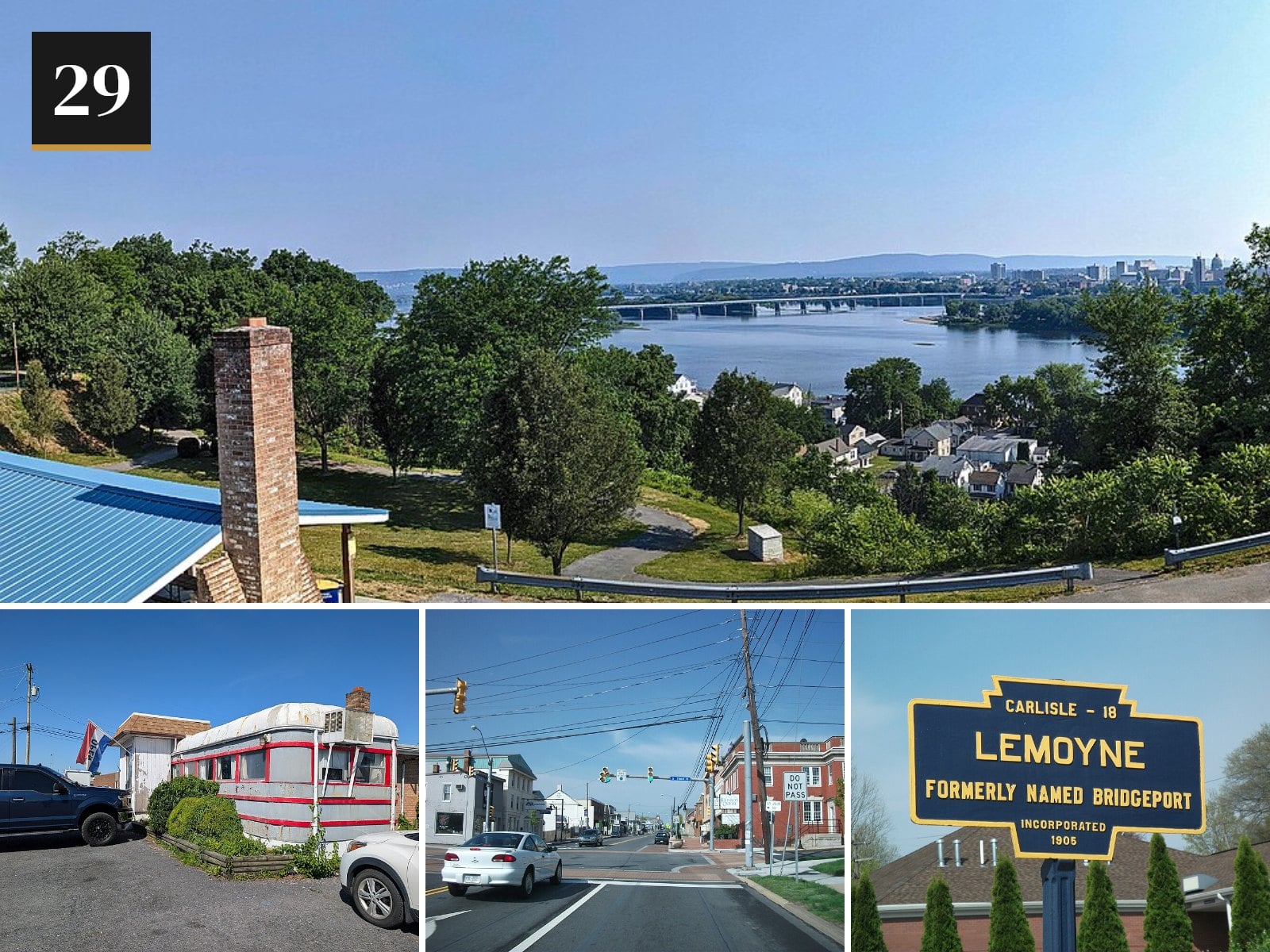
Photos: DutchTreat (CC BY-SA 4.0), Xanadu73 (CC0), Dougtone (CC BY-SA 2.0) · via Wikimedia Commons
Lemoyne is just across the Susquehanna from Harrisburg, and it has the best seat in the house. From the overlook at Negley Park you can see the river and the capital’s skyline. The borough started life as Bridgeport, named for the bridge that went in around 1815, and took the name Lemoyne in 1905.
This is the busiest town on the list. Lemoyne scores 86 for vibrancy and 78 for walkability, with diners, shops and bars along a few compact blocks. Downtown Harrisburg and its hospitals are a short drive over the bridge. If you want some life outside your door rather than a dead-silent street, Lemoyne gets the balance right.
Overall score: 75.5 · Population: 4,824 · County: Cumberland · Best score: Vibrant 86
28. Southmont
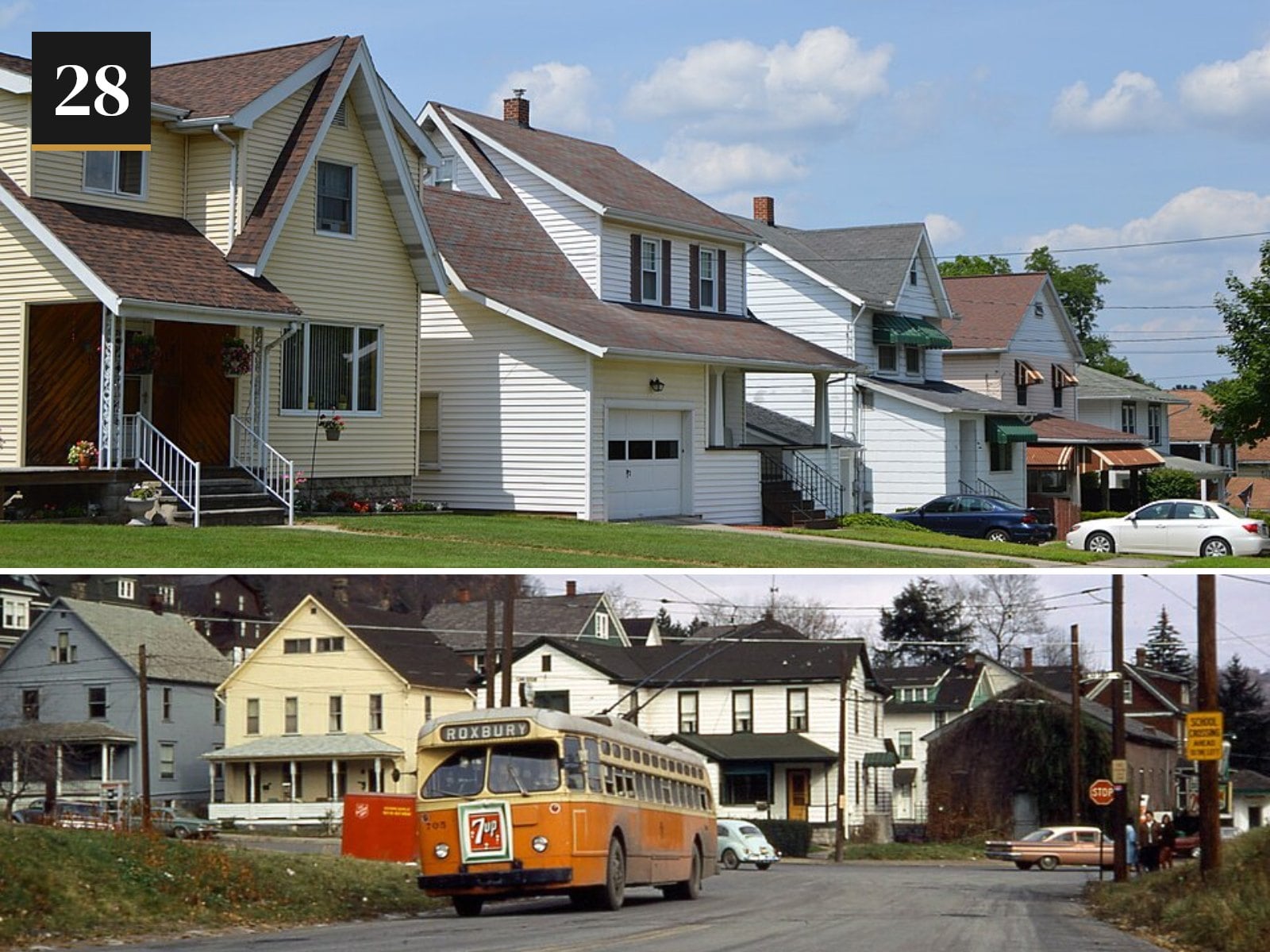
Photos: Nyttend (Public domain), David Wilson (CC BY 2.0) · via Wikimedia Commons
Southmont sits on the heights almost 600 feet above the Stonycreek River valley, on the hill above Johnstown. It became a borough in 1919, and it still feels like a planned hilltop neighborhood, with leafy streets and solid early-1900s houses.
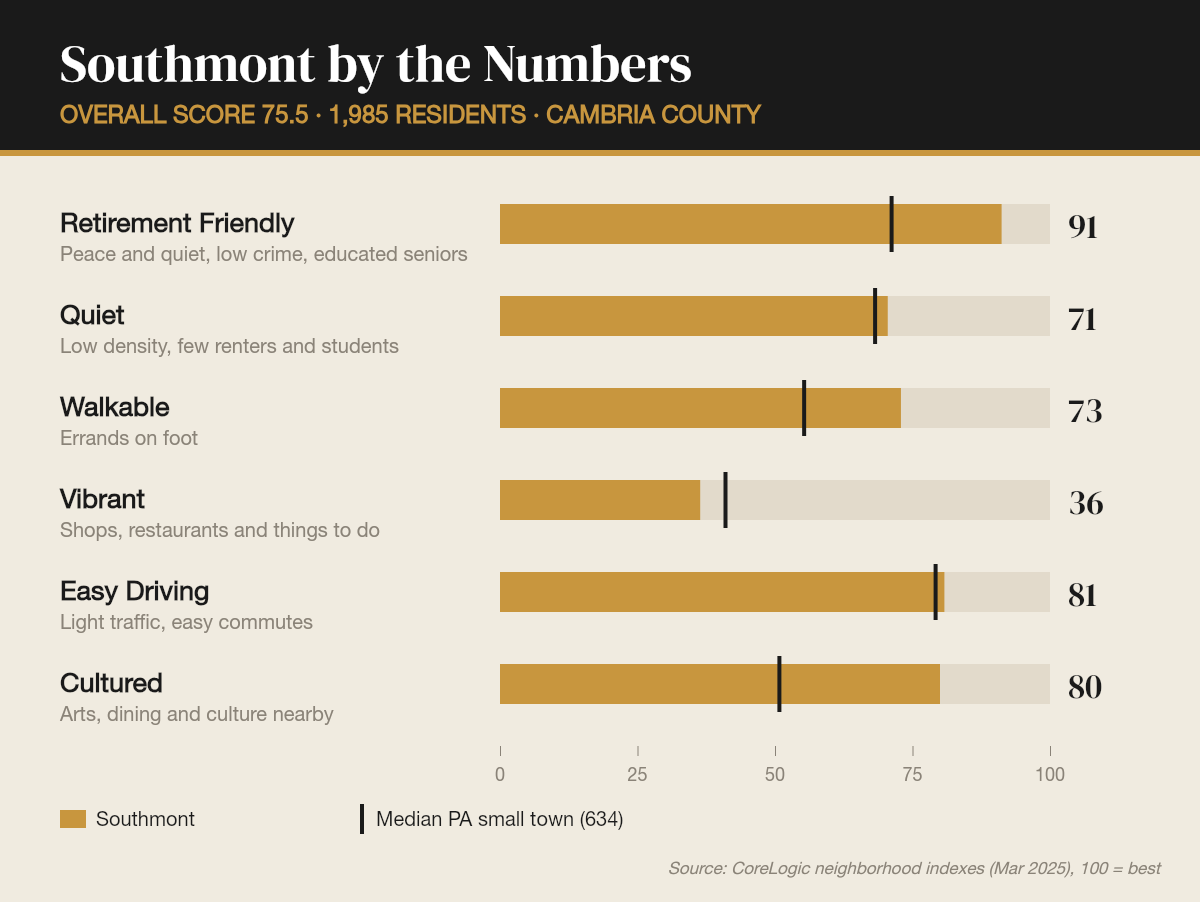
The numbers favor a settled, comfortable life. Southmont rates 91 on retirement friendliness, 80 on culture and 73 on walkability, well above the typical small PA town on all three. Westmont is right next door, and the shops, restaurants and hospital of the Johnstown area are a few minutes down the hill.
Overall score: 75.5 · Population: 1,985 · County: Cambria · Best score: Retirement 91
27. Swoyersville
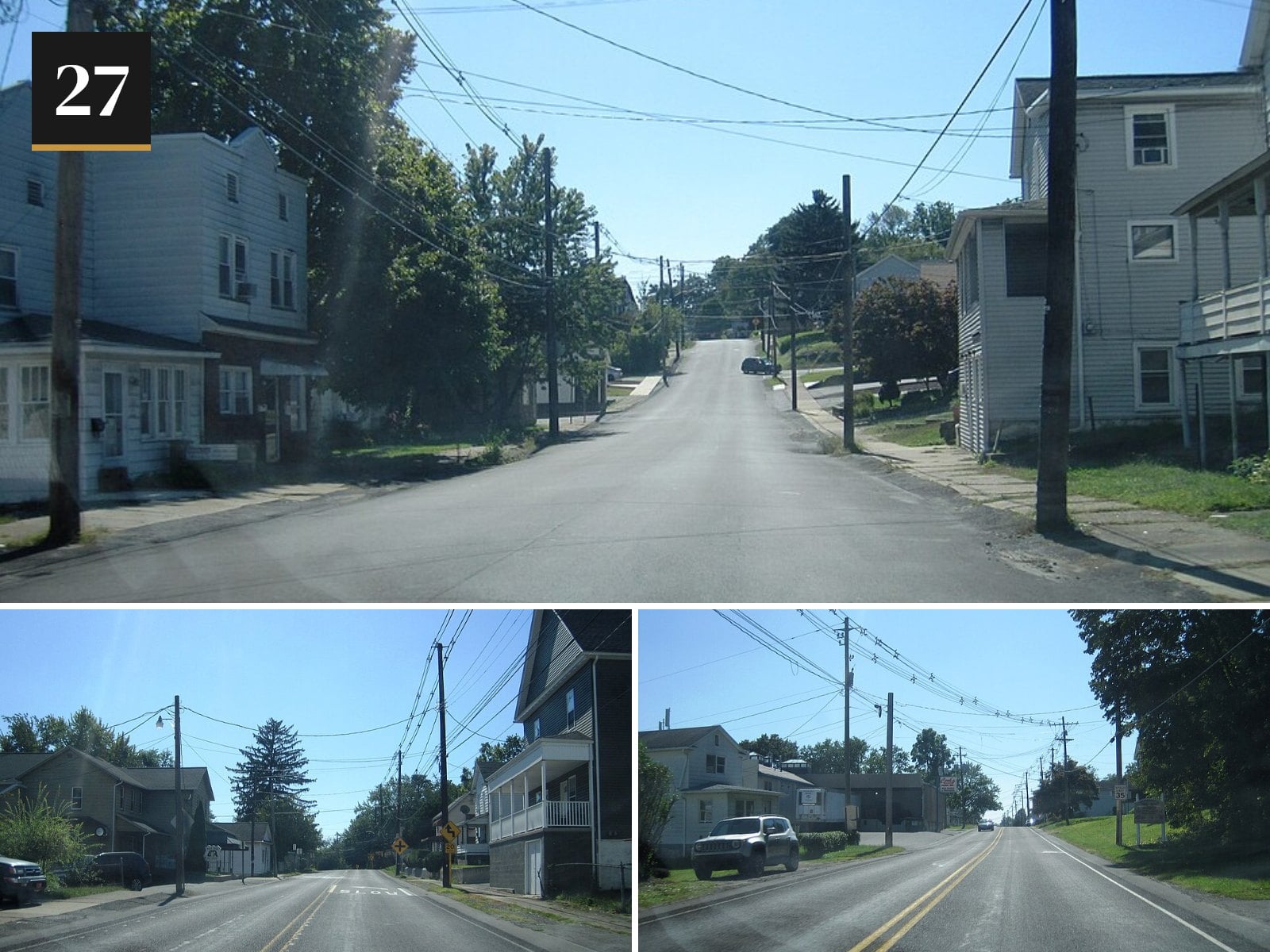
Photos: Mr. Matté (CC BY-SA 4.0) · via Wikimedia Commons
Swoyersville is a Wyoming Valley coal town named for mine owner John Henry Swoyer, and it’s proud enough of its name that residents once held a vote to add an “s”. The mines closed after the 1950s. What’s left is a tight-knit borough of about 5,000 people with modest houses and the valley’s ridges on every side.
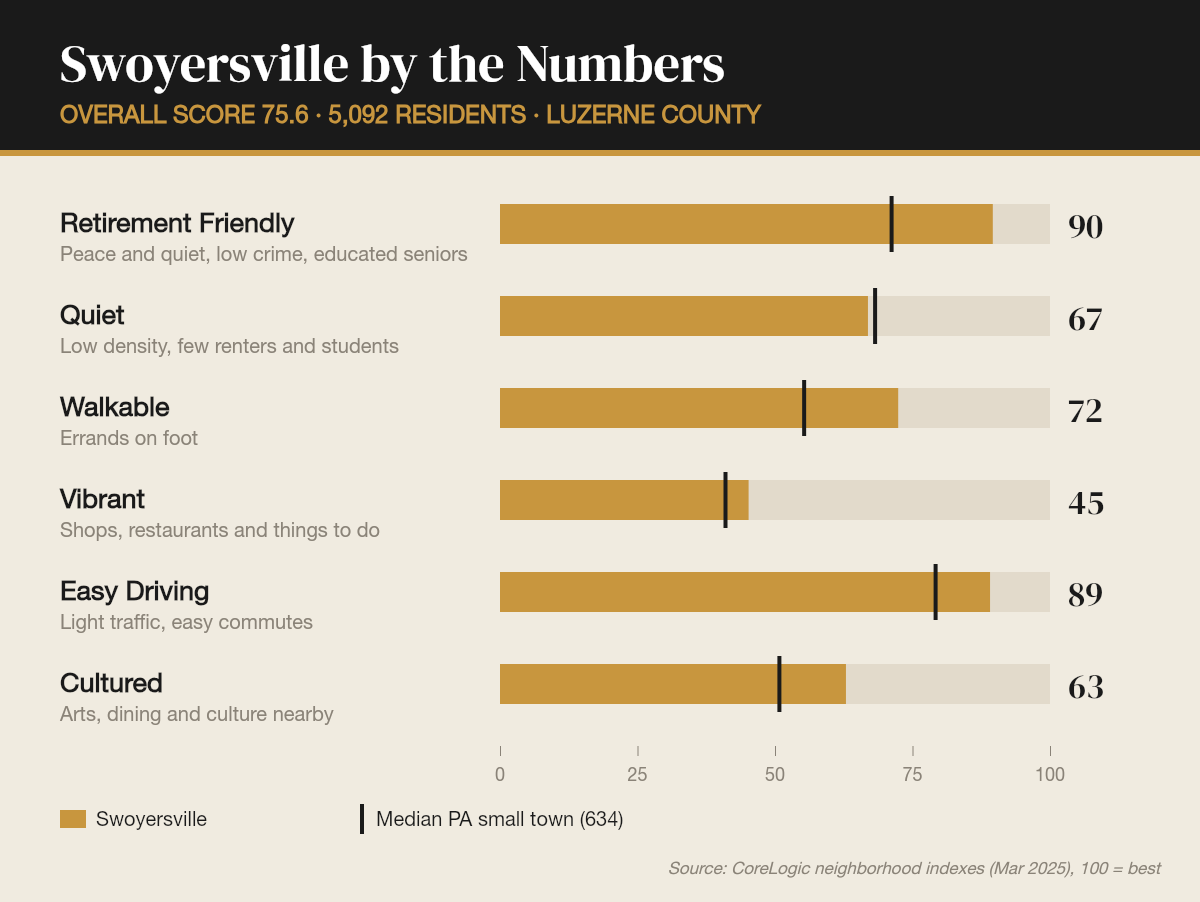
It’s one of the easiest places on this list to get around by car (89 for light traffic and easy commutes) while still scoring 72 for walkability. Wilkes-Barre is a short hop away. Housing here typically costs a fraction of what you’d pay in the Philadelphia or Pittsburgh suburbs, which leaves more of a fixed income for everything else.
Overall score: 75.6 · Population: 5,092 · County: Luzerne · Best score: Retirement 90
26. Cornwall
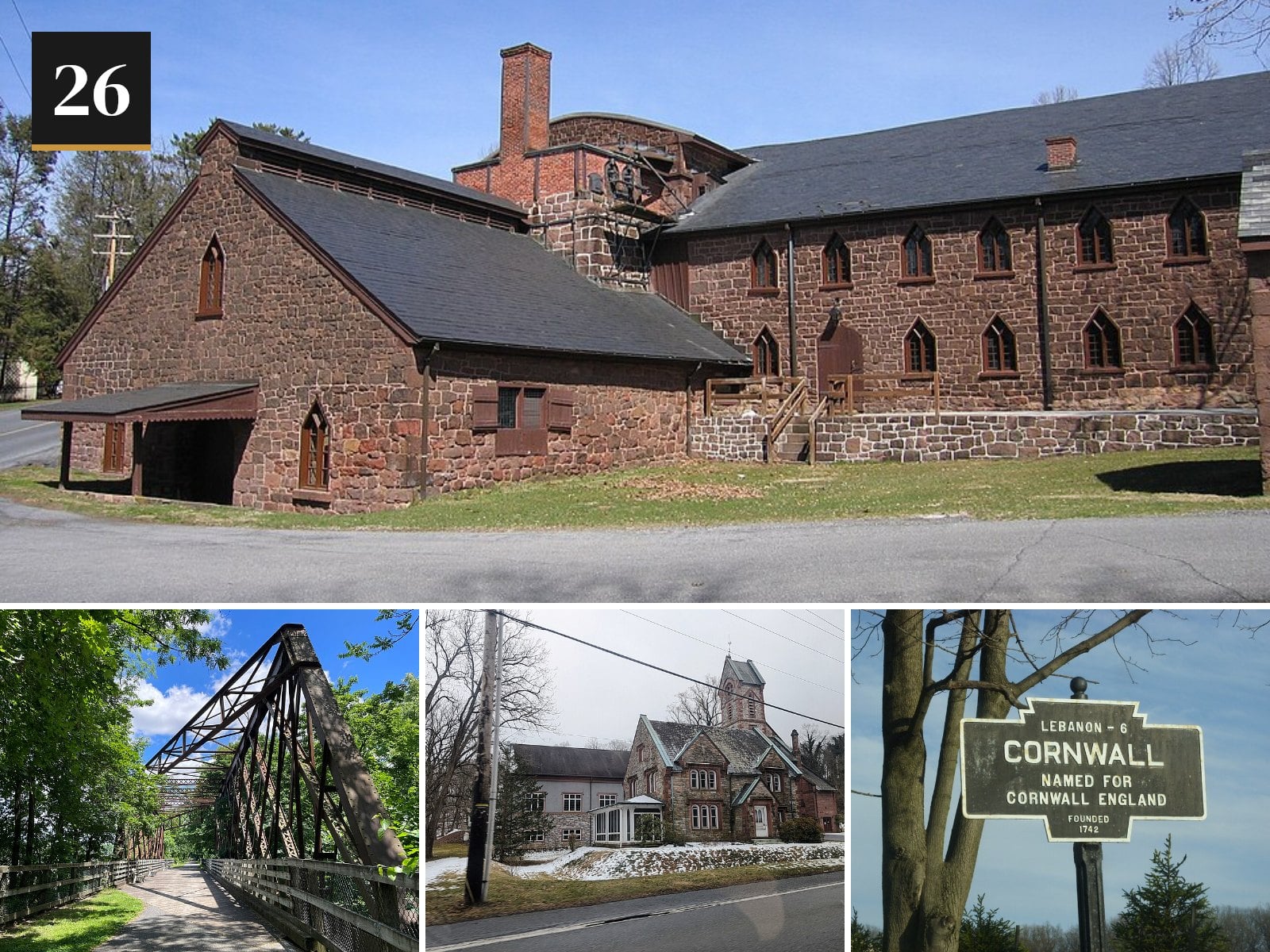
Photos: Wherring at en.wikipedia (CC BY-SA 3.0), Dough4872 (CC BY-SA 4.0), Mr. Matté (CC BY-SA 4.0), Doug Kerr (CC BY-SA 2.0) · via Wikimedia Commons
Cornwall is where Pennsylvania’s iron industry began. Peter Grubb built the Cornwall Iron Furnace here in 1742, and the mine next to it ran for 236 years. The furnace buildings still stand, and they’re among the most remarkable industrial sites in the state.
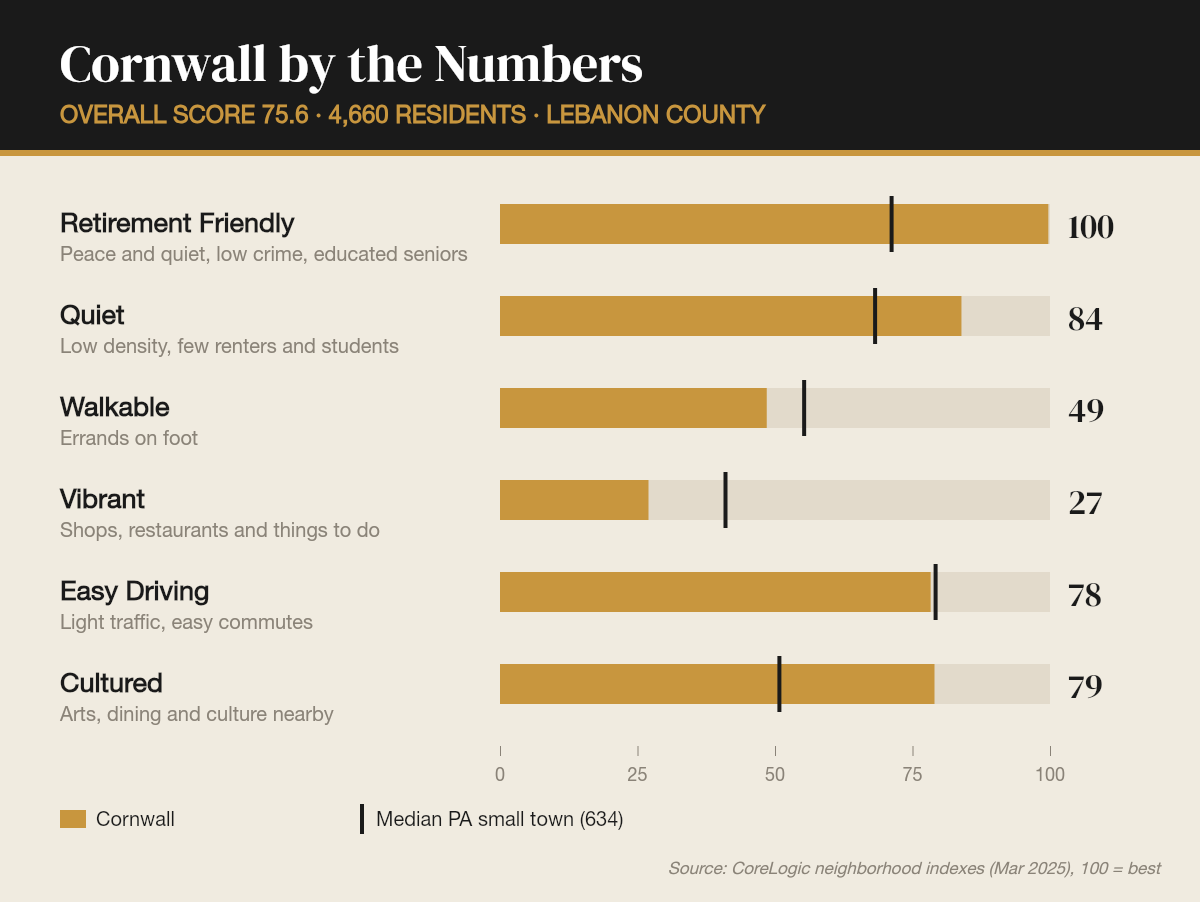
Cornwall scores a perfect 100 for retirement friendliness and 84 for quiet, which is about as peaceful as Pennsylvania gets. The Lebanon Valley Rail Trail runs through town on an old rail bed, with flat, shaded miles for walking or biking. It isn’t a shopping town, so expect to drive to Lebanon or Hershey for most errands. Calm is what you get here.
Overall score: 75.6 · Population: 4,660 · County: Lebanon · Best score: Retirement 100
25. Mountville
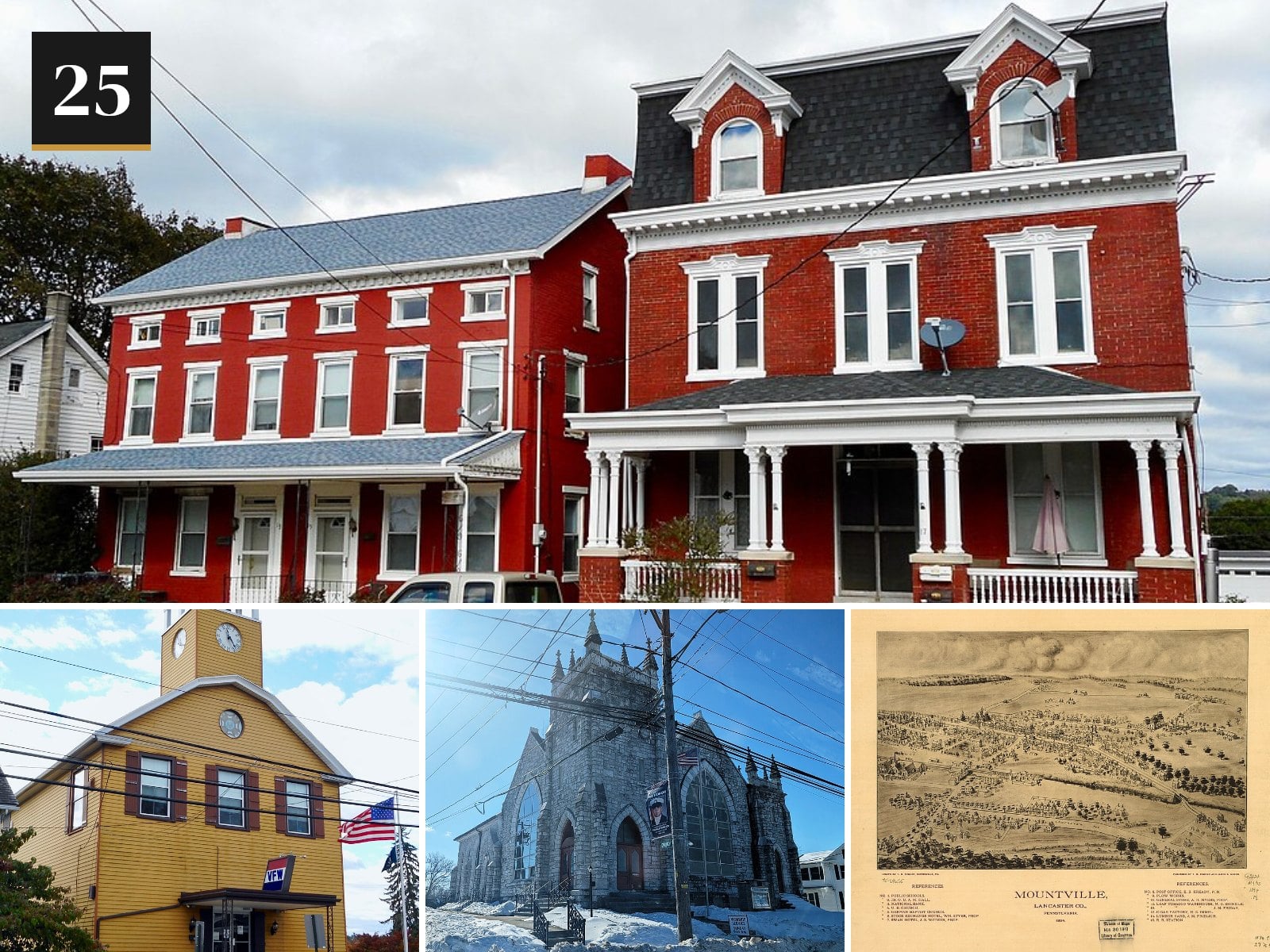
Photos: Smallbones (CC0), Mr. Matté (CC BY-SA 4.0), Fowler, T. M. (Public domain) · via Wikimedia Commons
Mountville is a small Lancaster County borough of about 3,000 people, best known as the original home of Charles Chips. It sits between Lancaster and the river town of Columbia, with downtown Lancaster about 6 miles east along Columbia Avenue.
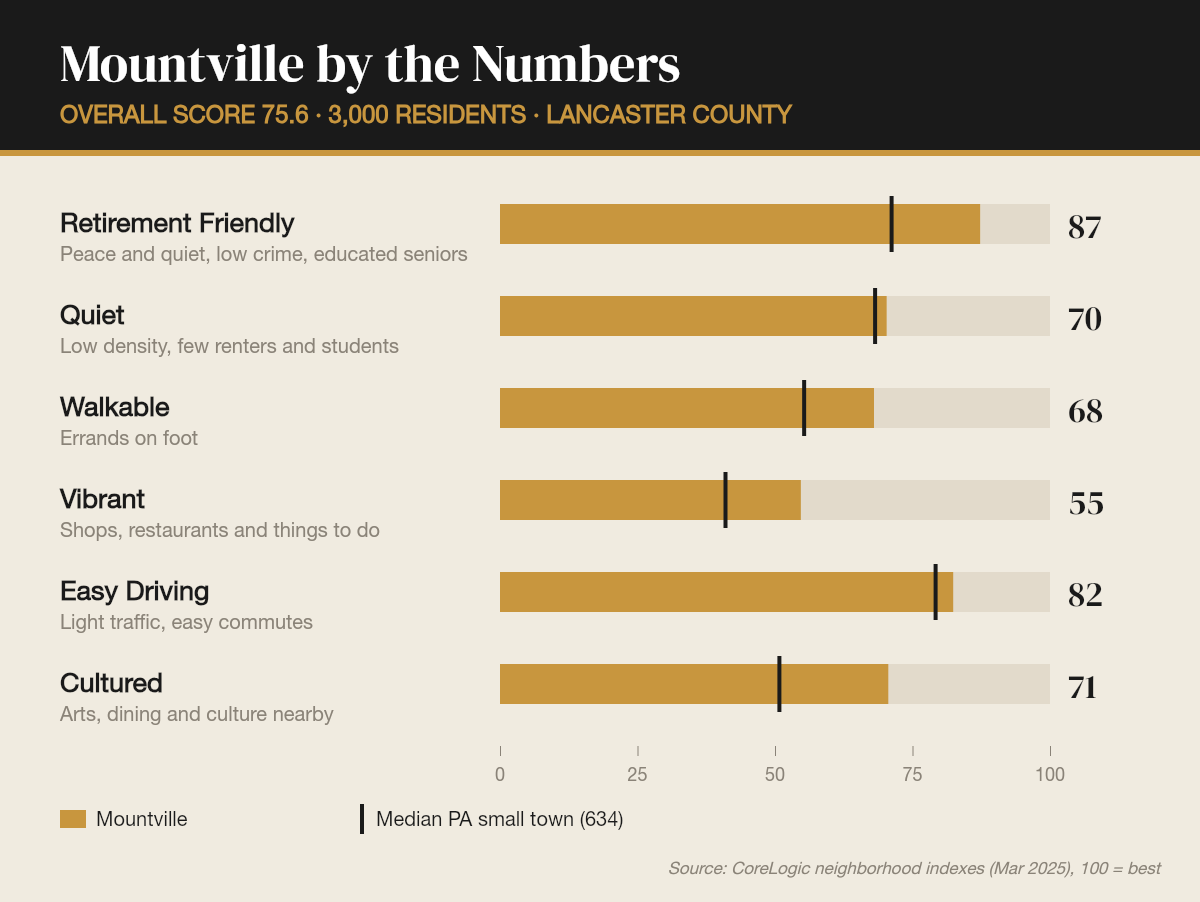
It has all-round strength rather than a single headline number: 87 for retirement, 82 for easy driving, 70 for quiet and 71 for culture. That last score is unusual for a town this small, and it reflects how close Lancaster’s restaurants, theaters and markets are. You get the farmland and small-town pace of Lancaster County without being cut off.
Overall score: 75.6 · Population: 3,000 · County: Lancaster · Best score: Retirement 87
🔥 Would you like to save this?
24. Ebensburg
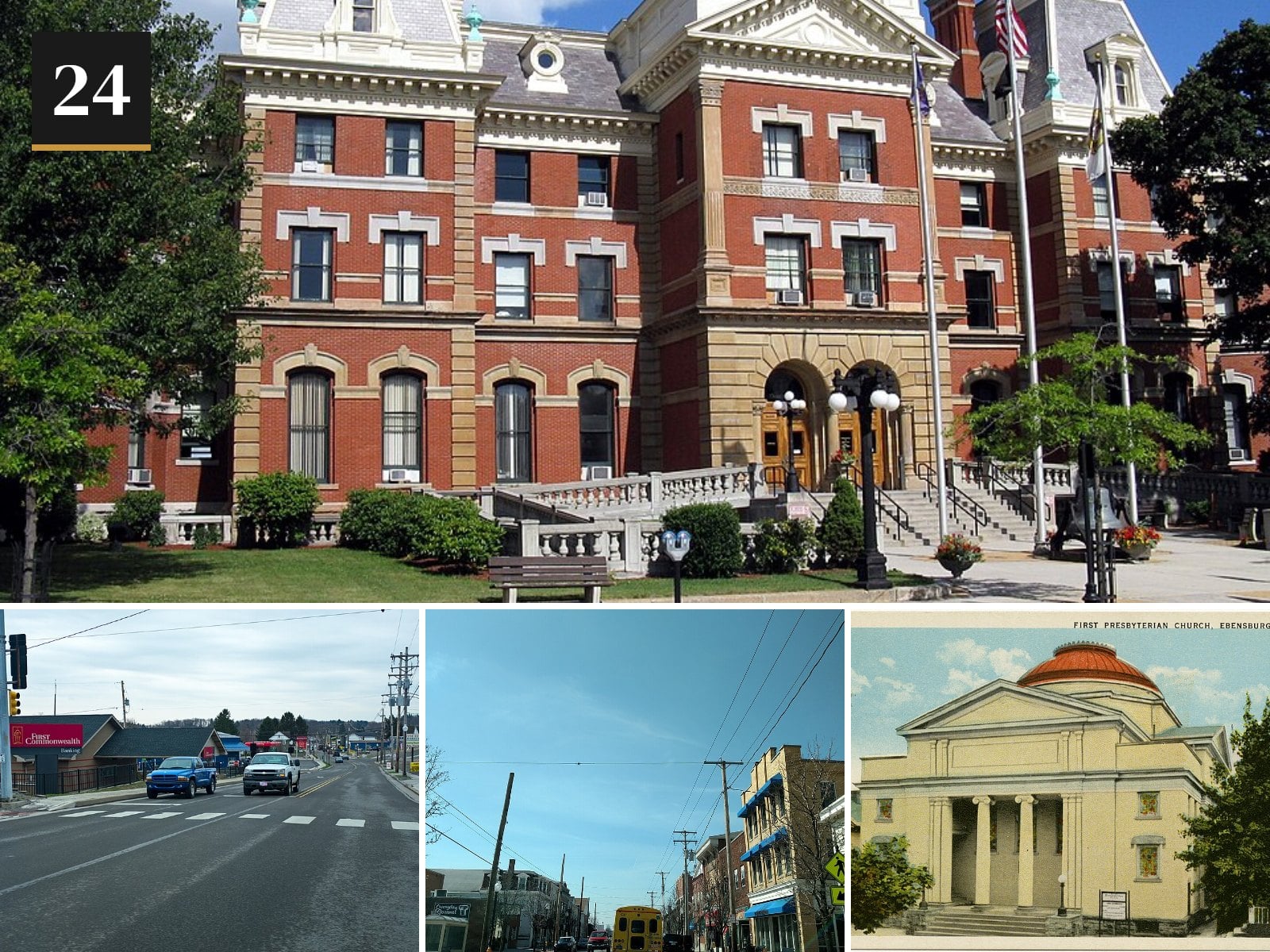
Photos: Publichall (CC BY-SA 3.0), Bonnachoven (CC0), Ron Shawley (CC BY 3.0), Unknown author (Public domain) · via Wikimedia Commons
Ebensburg was founded in 1796 by Welsh settlers who picked a spot high in the Allegheny Mountains. At about 2,140 feet up, it has cooler summers and real winters. The Cambria County Courthouse anchors a classic small downtown.
Ebensburg scores 70 for both vibrancy and walkability, so there are shops and restaurants within reach of home. It’s also the end point of the Ghost Town Trail, a rail trail built on the bed of the old Ebensburg and Black Lick Railroad. For an active retiree who wants mountain air and a proper Main Street, it’s a strong pick.
Overall score: 75.6 · Population: 3,278 · County: Cambria · Best score: Retirement 91
23. Braddock Hills
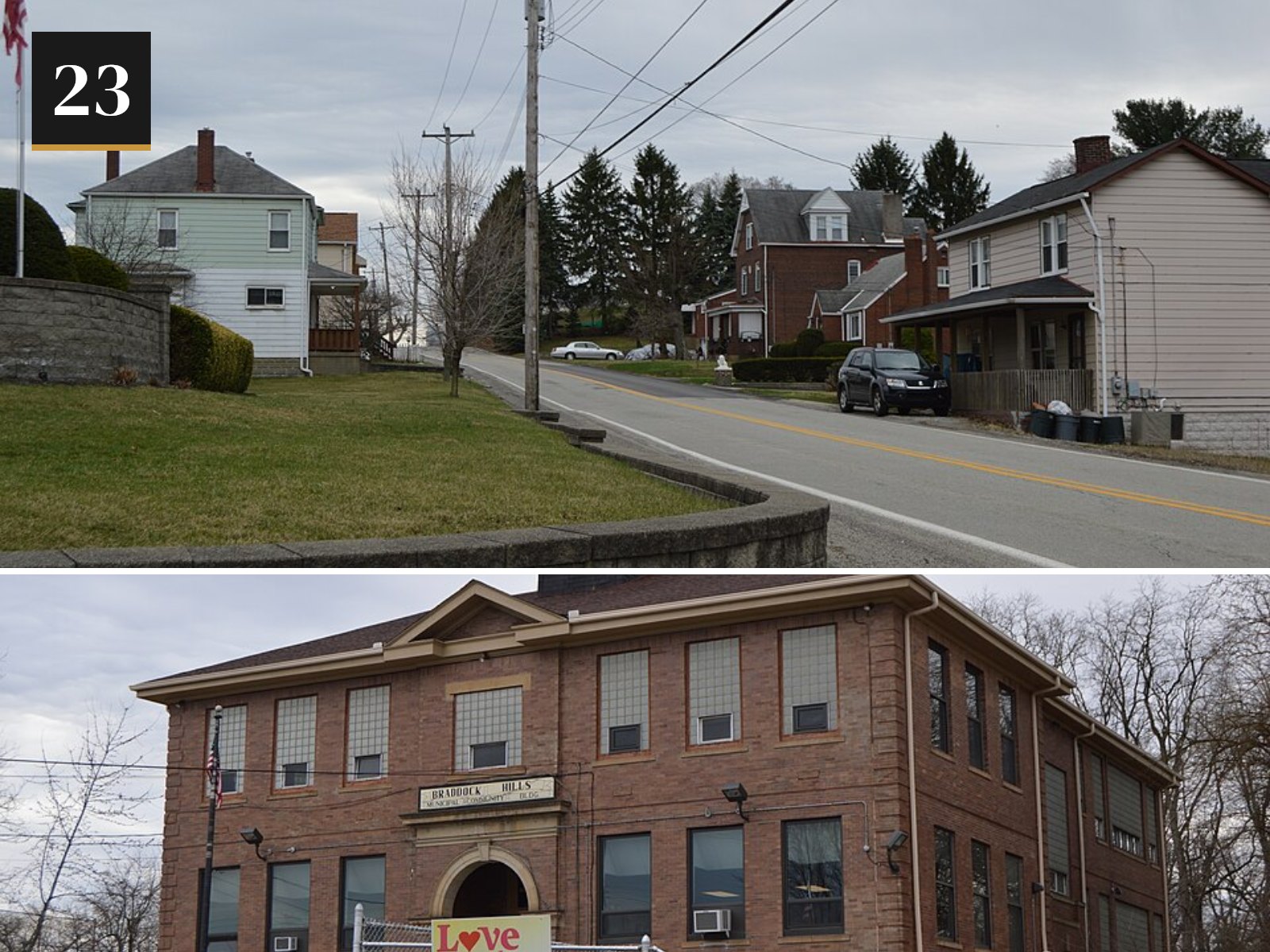
Photos: Nyttend (Public domain) · via Wikimedia Commons
Braddock Hills is a small residential borough about 8 miles east of downtown Pittsburgh. It overlooks the ground where General Braddock was defeated in 1755, and its main road, Brinton Road, began as a Native American trail. Most of its homes went up in the building boom after World War II.
That postwar character is a big part of why it scores 99 for retirement friendliness. Neighbors stay put, streets are safe, and the houses are mostly single-level ranches and modest two-stories that are easy to live in as you age. You’re a short drive from Pittsburgh’s hospitals and cultural district without paying city prices.
Overall score: 75.9 · Population: 1,667 · County: Allegheny · Best score: Retirement 99
22. Heidelberg
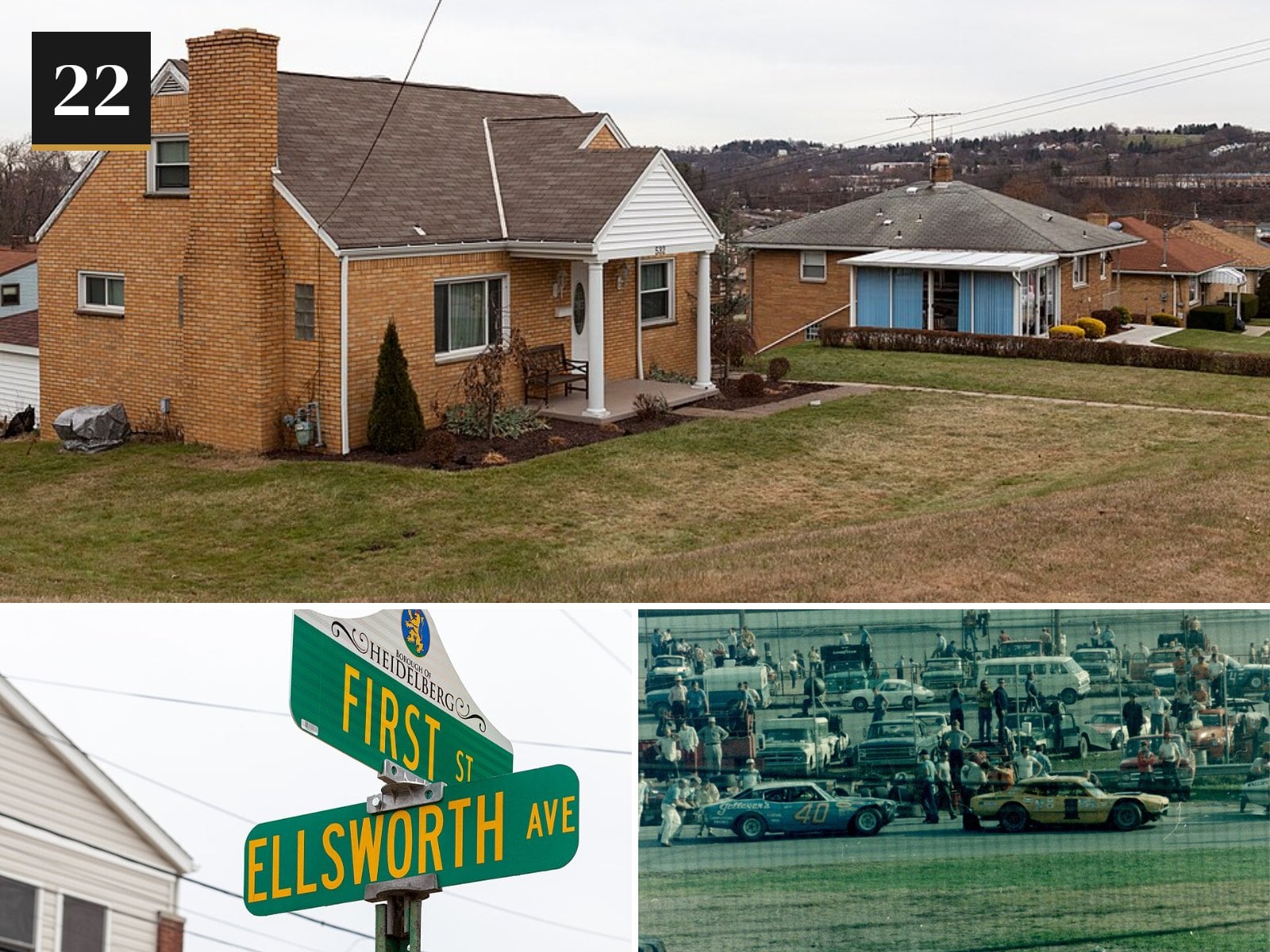
Photos: Generic1139 (CC BY-SA 3.0), Ched Davis (CC BY-SA 3.0) · via Wikimedia Commons
Heidelberg covers just 0.3 square miles southwest of Pittsburgh, and it was named for the German city many of its early settlers came from. Locals still remember the old Heidelberg Raceway, which ran until 1973, and the borough’s amateur soccer teams won national titles in 1927, 1929 and 1955.
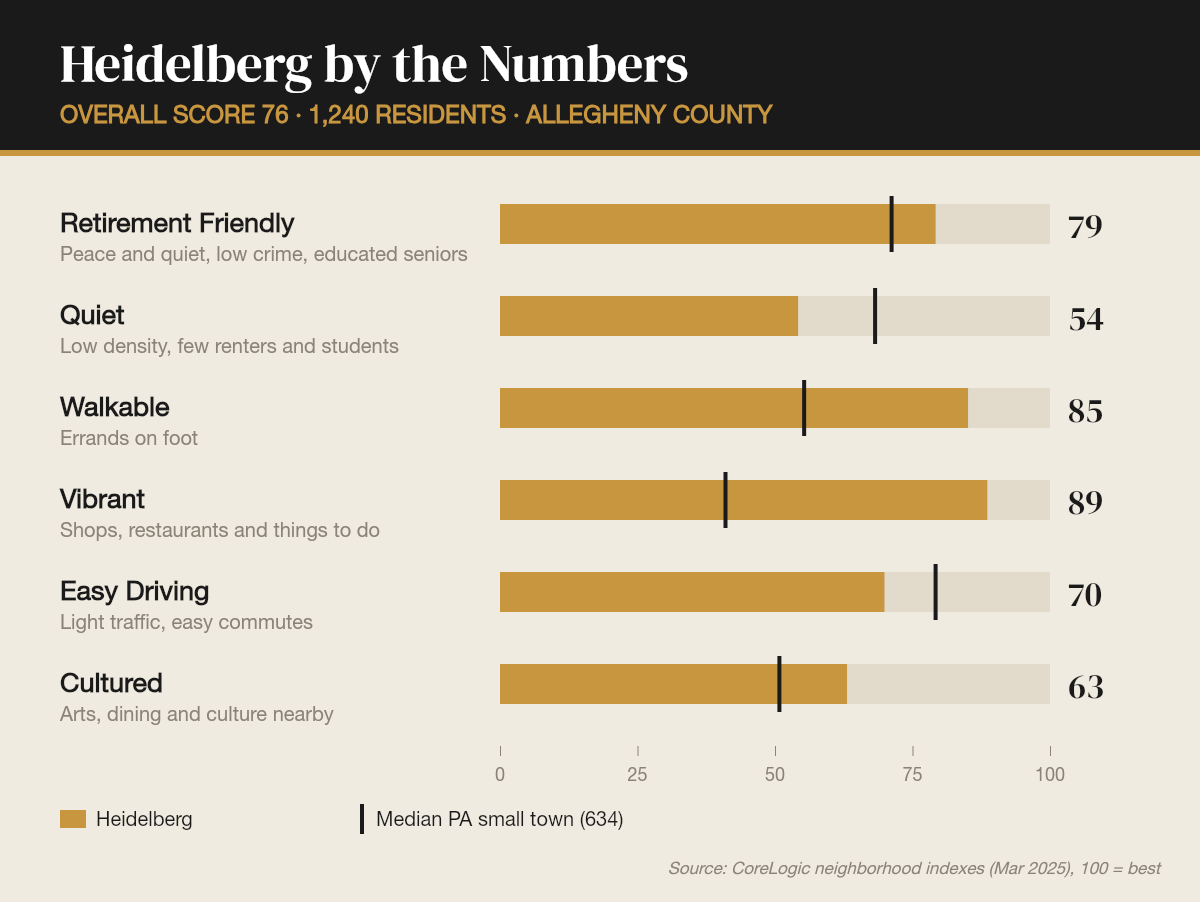
Being so small works in its favor. Heidelberg scores 85 for walkability and 89 for vibrancy, the second-highest on this list, so there’s always somewhere to go within a few blocks. If you’d like to give up some driving and still have Pittsburgh’s suburbs on your doorstep, it’s worth a close look.
Overall score: 76.0 · Population: 1,240 · County: Allegheny · Best score: Vibrant 89
21. Larksville
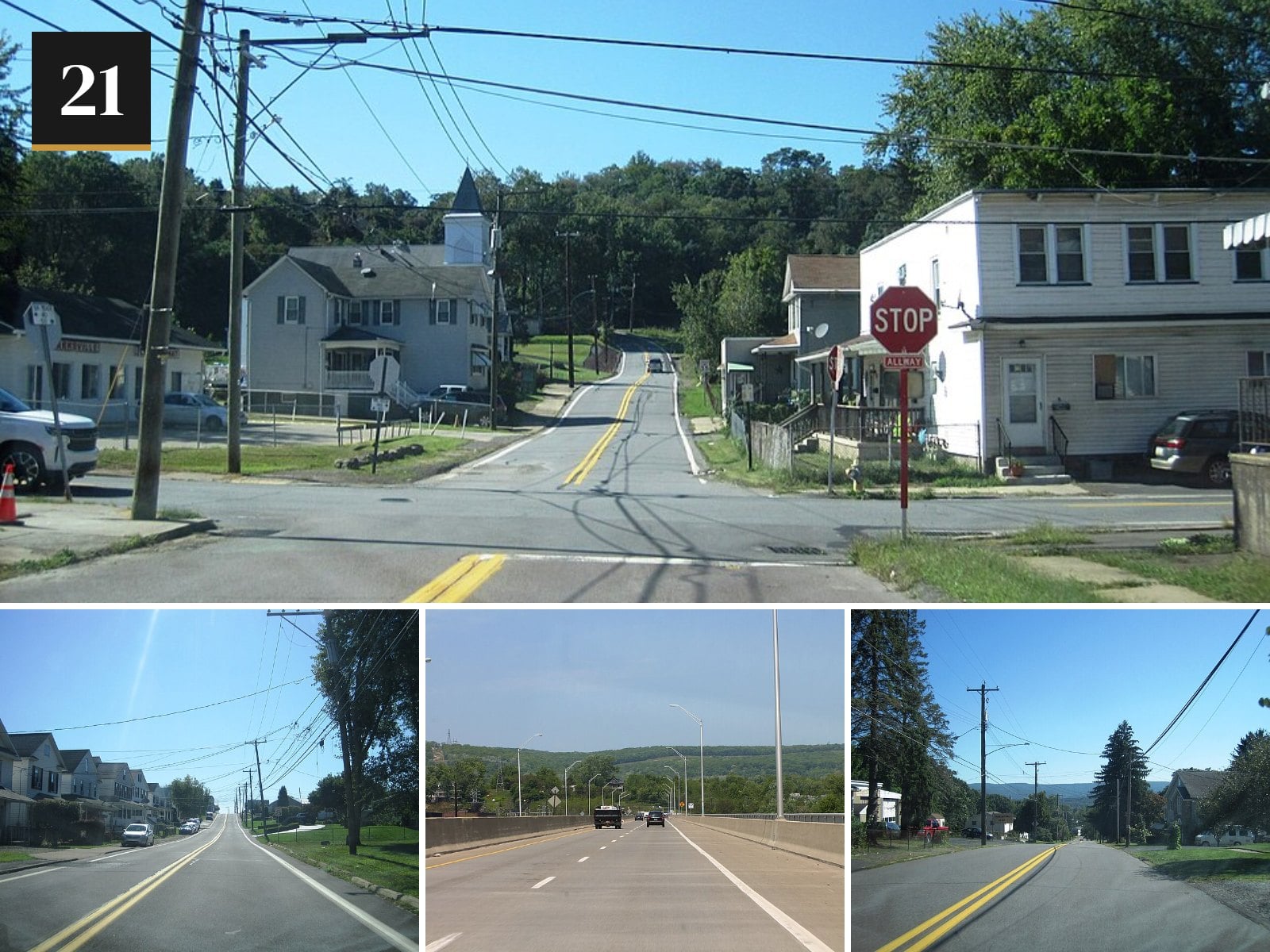
Photos: Mr. Matté (CC BY-SA 4.0), Jakec (CC BY-SA 4.0) · via Wikimedia Commons
Larksville was once called Blindtown, before it was renamed for a resident named Peggy Lark. In 1920, more than 9,000 people lived here and worked the anthracite collieries. Today there are about 4,200, spread across a hillside just 2 miles west of Wilkes-Barre.
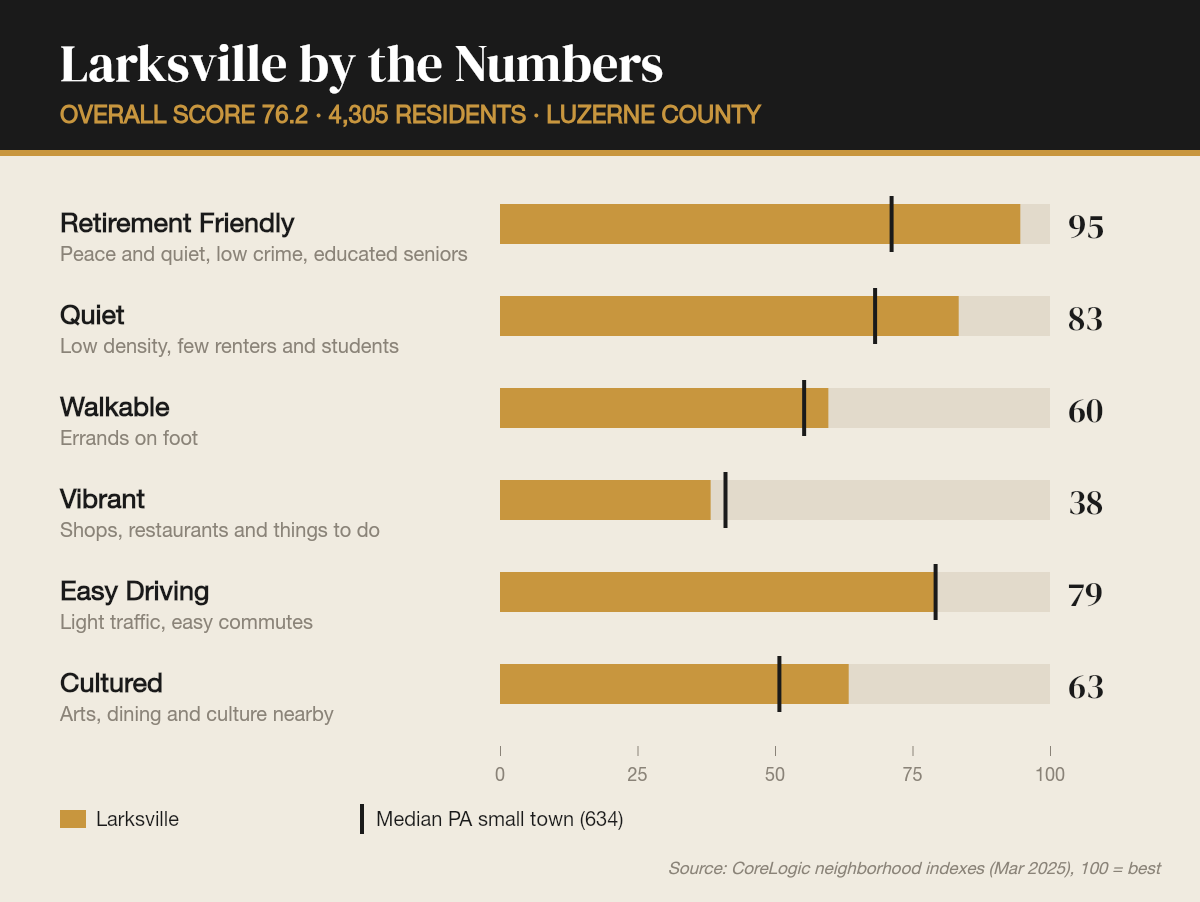
With far fewer people on the same land, Larksville is now one of the most peaceful towns on the list. It scores 83 for quiet and 95 for retirement friendliness. The streets are residential, traffic is light, and the Susquehanna and Wilkes-Barre’s services are minutes away. It’s a good fit if a peaceful street matters more to you than a busy downtown.
Overall score: 76.2 · Population: 4,305 · County: Luzerne · Best score: Retirement 95
20. Blakely
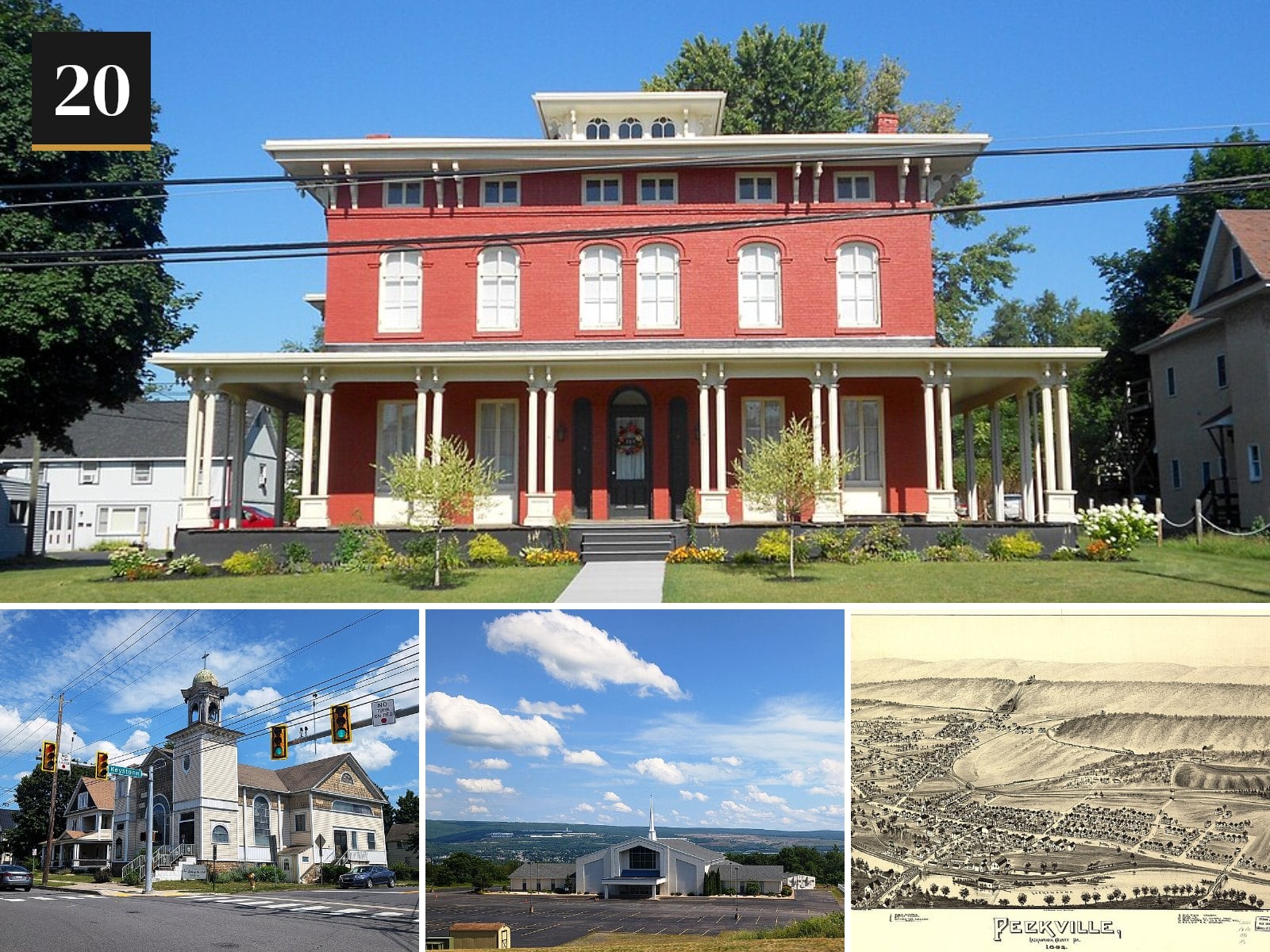
Photos: Smallbones (CC0), Mr. Matté (CC BY-SA 4.0), Fowler, T. M. (Public domain) · via Wikimedia Commons
Blakely sits along the Lackawanna River north of Scranton and takes in the village of Peckville. It’s named for Johnston Blakely, a naval hero of the War of 1812, and a large anchor from the aircraft carrier USS Wasp stands in his memory.
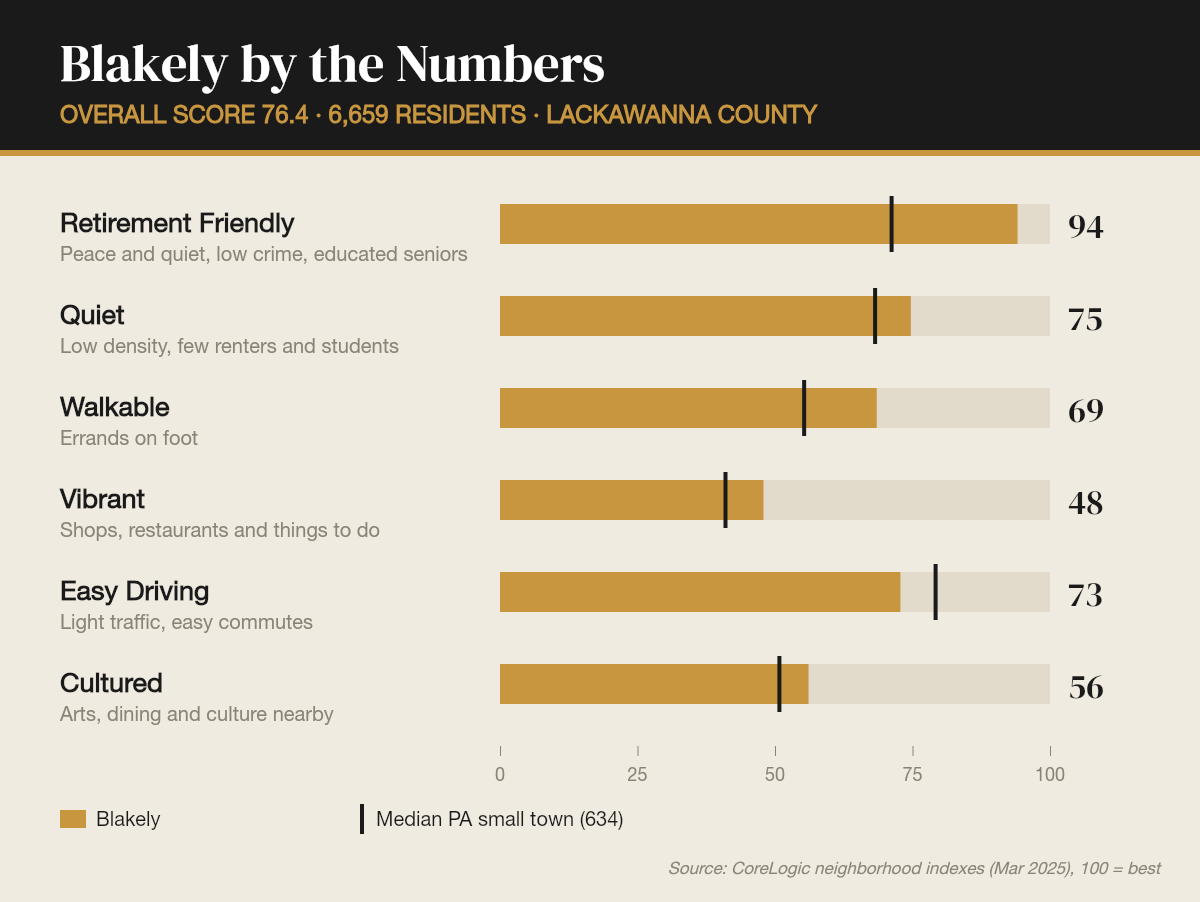
Blakely is bigger than most towns here, at about 6,700 people. Even so, it scores 94 for retirement friendliness and 75 for quiet, with a riverside recreation complex for walking and fresh air. The shopping along the Route 6 corridor and Scranton’s medical centers are close, so day-to-day life is easy without feeling like the city.
Overall score: 76.4 · Population: 6,659 · County: Lackawanna · Best score: Retirement 94
19. Wernersville
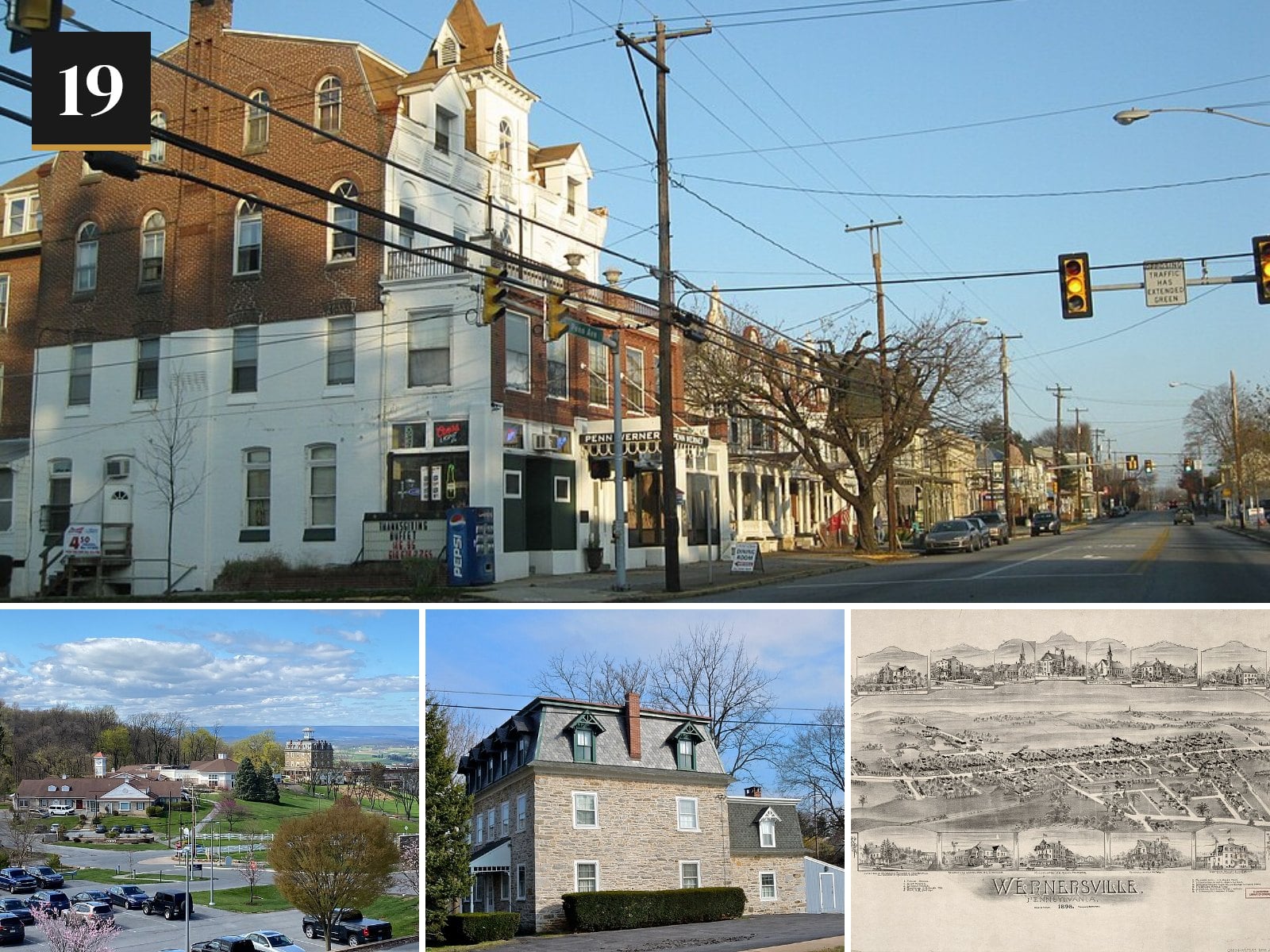
Photos: Doug Kerr (CC BY-SA 2.0), Dr.A.Fisk (CC BY-SA 4.0), Smallbones (CC0), Bailey & Fowler (Public domain) · via Wikimedia Commons
Wernersville was a resort town a century ago. City people from Philadelphia and New York rode the Reading Railroad out here for the cool air of South Mountain, and grand hotels like Galen Hall filled the hillsides. Some of the old resort cottages are private homes now.
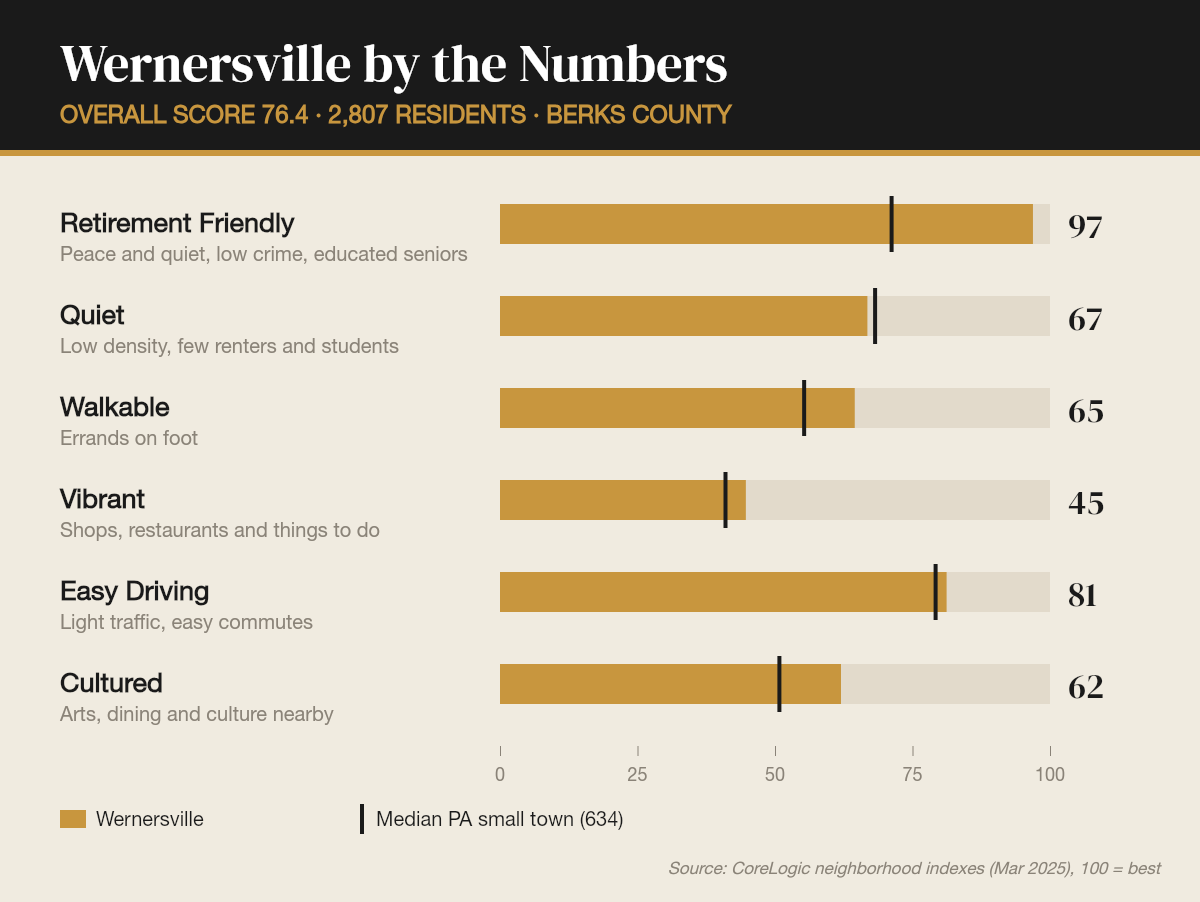
The town’s restful reputation holds up in the data. Wernersville scores 97 for retirement friendliness and 81 for easy driving, and its historic main street is lined with brick and stone buildings. Reading is about 10 miles east, and the Lancaster and Lebanon County countryside is all around you.
Overall score: 76.4 · Population: 2,807 · County: Berks · Best score: Retirement 97
🔥 Would you like to save this?
18. Edgeworth
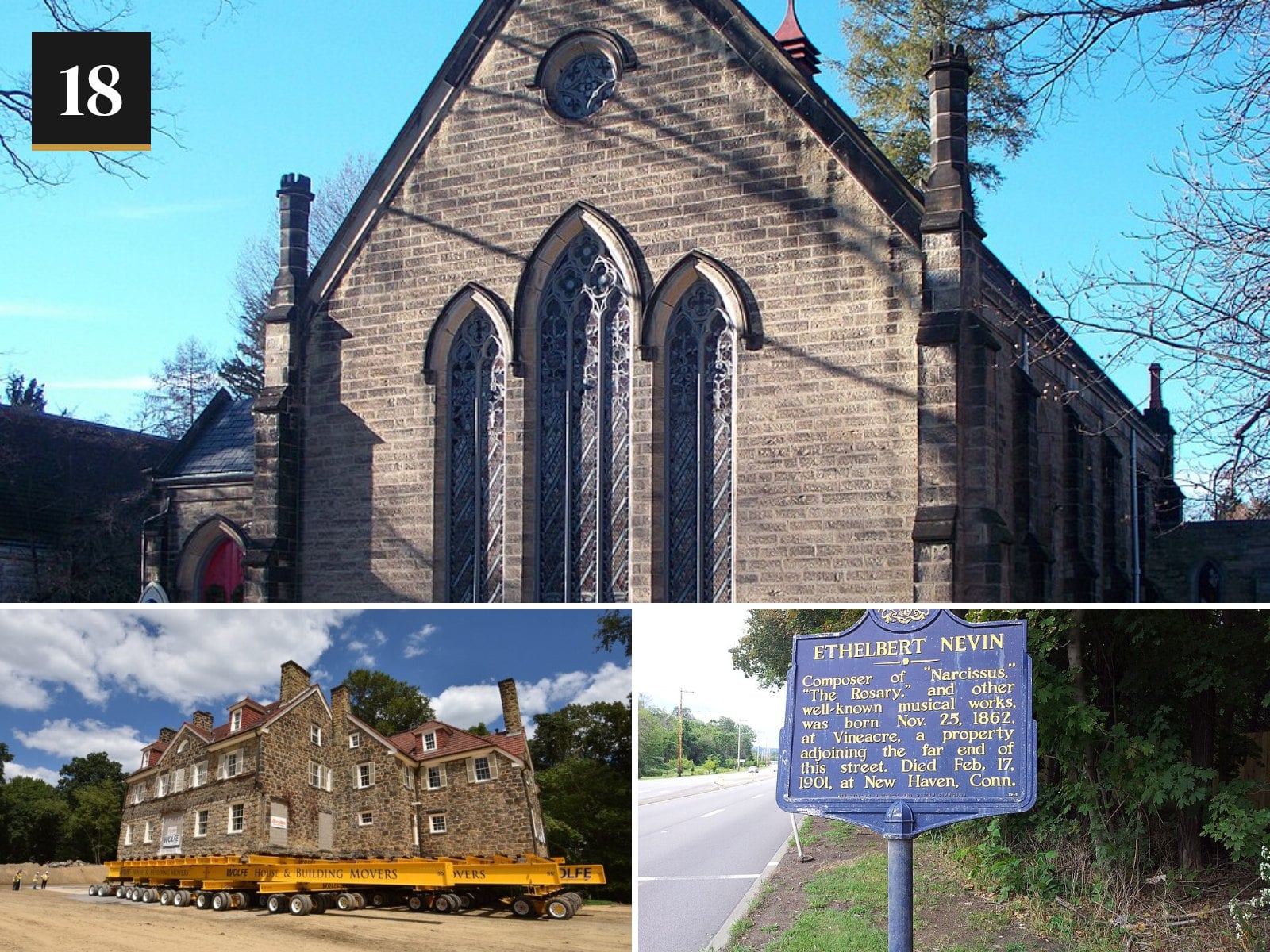
Photos: Cbaile19 (CC0), Wolfe House & Building Movers (CC BY-SA 3.0), Allan Knoch (CC BY-SA 4.0) · via Wikimedia Commons
Edgeworth sits along the Ohio River about 14 miles northwest of Pittsburgh. It’s named for the Edgeworth Seminary, a girls’ school that moved here in 1836, and since then it has been a retreat for professionals escaping the city. It’s often listed as one of the wealthiest towns in Pennsylvania.
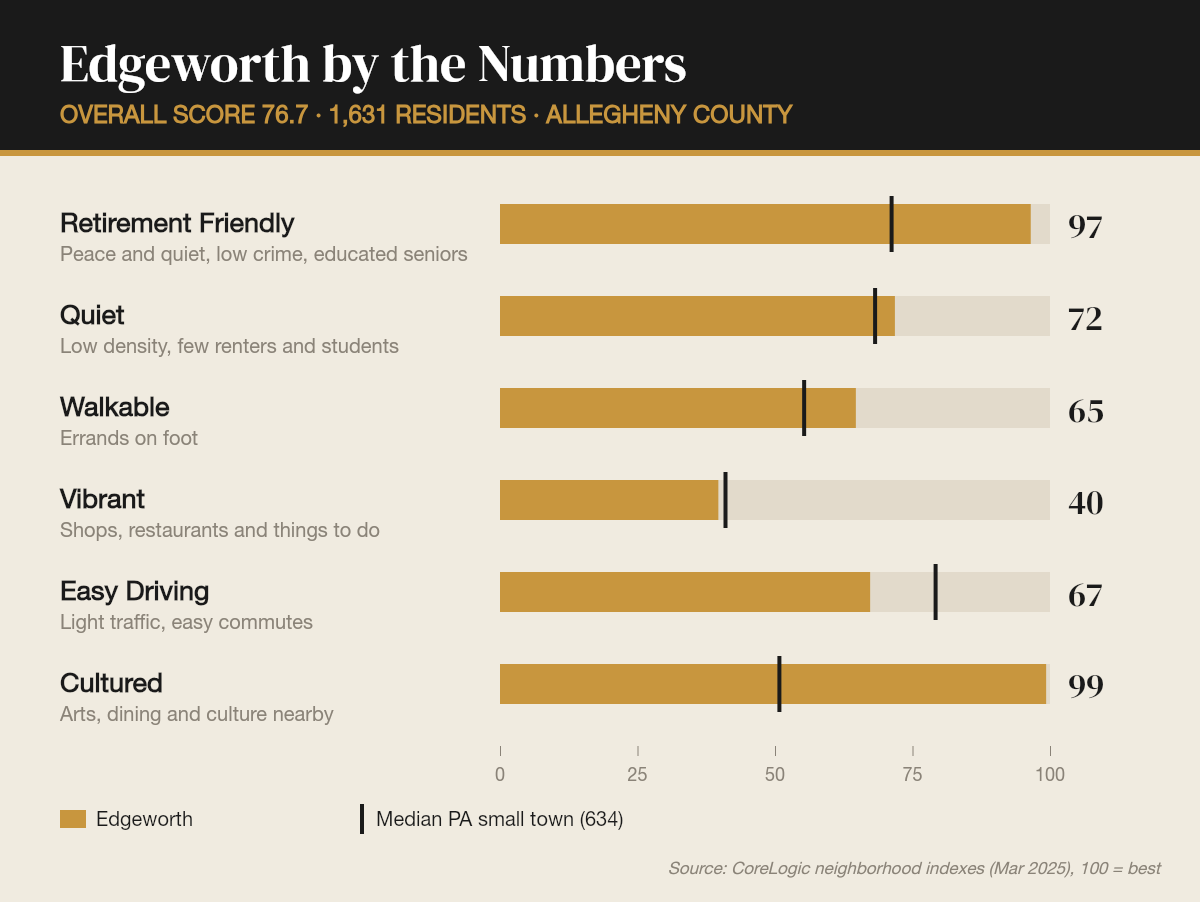
That shows in a near-perfect 99 for culture, the highest on this list, and 96 for retirement friendliness. Leafy streets, stone churches and big old houses set the tone. The shops and restaurants of Sewickley Village are right next door. If your budget stretches, Edgeworth is about as refined as small-town Pennsylvania gets.
Overall score: 76.7 · Population: 1,631 · County: Allegheny · Best score: Cultured 99
17. Marietta
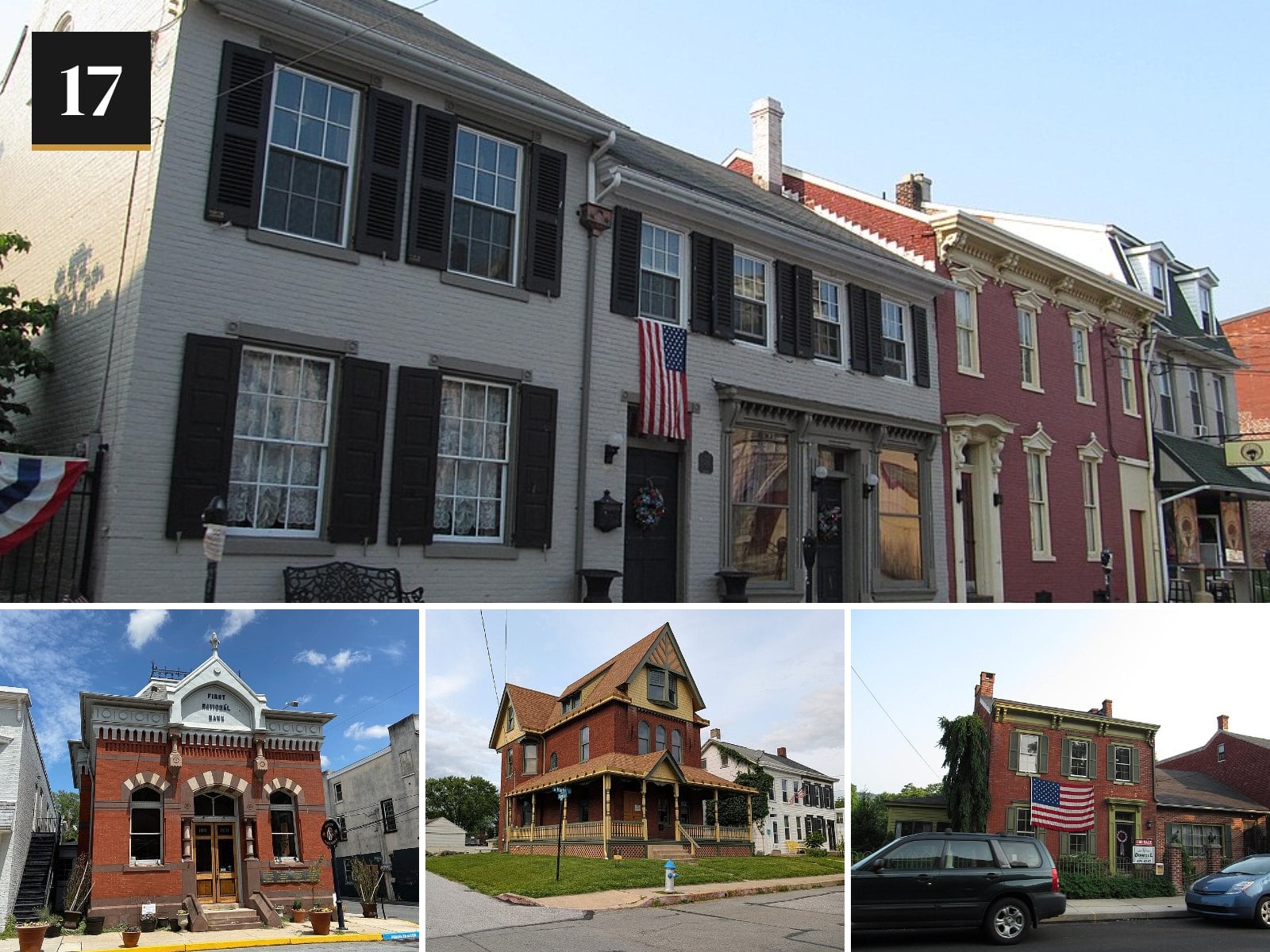
Photos: Doug Kerr (CC BY-SA 2.0), Nolabob (CC BY-SA 4.0), Mr. Matté (CC BY-SA 4.0) · via Wikimedia Commons
Marietta stretches along the east bank of the Susquehanna, and Market Street runs the whole length of town. Incorporated in 1812, it’s packed with Federal and Victorian brick buildings, many dressed in flag bunting on holidays. The Northwest Lancaster County River Trail runs right along the water.
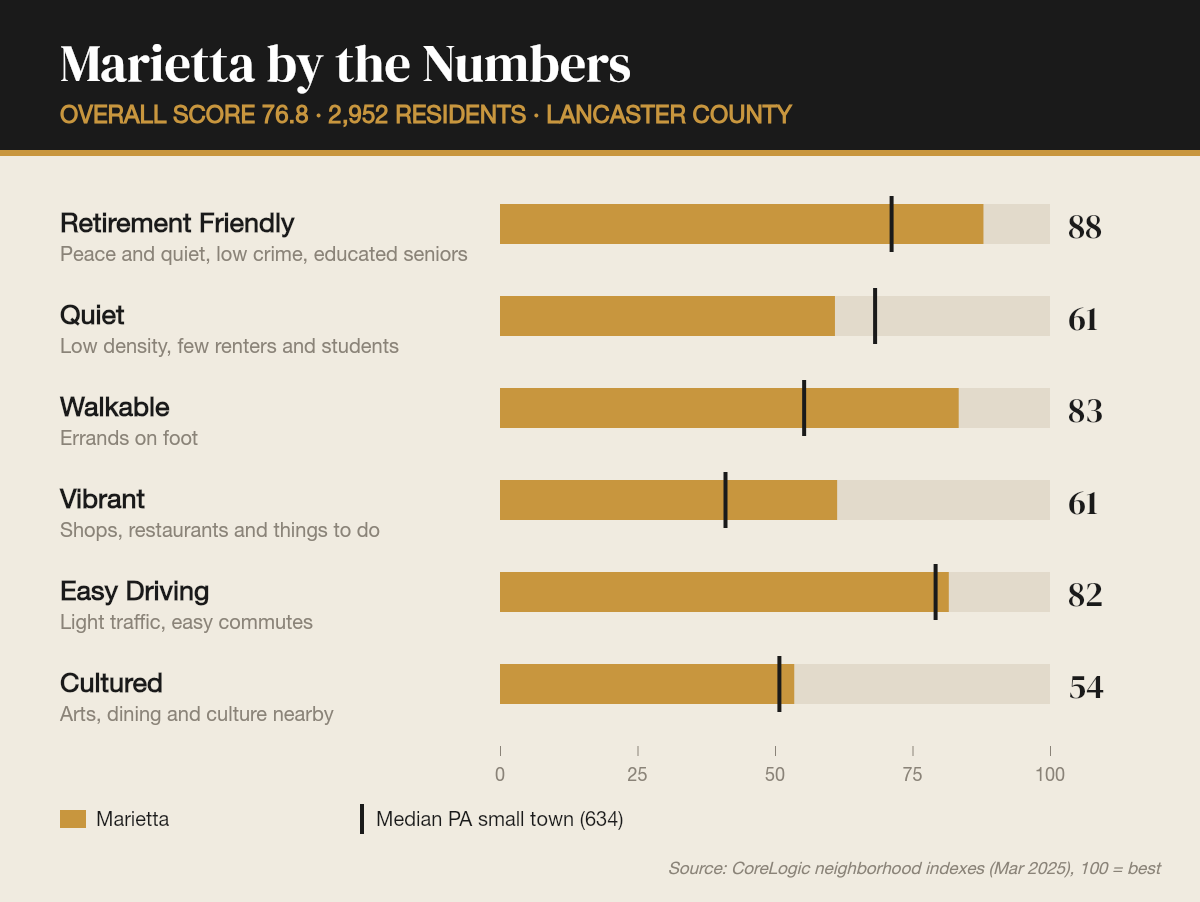
Marietta scores 83 for walkability and 82 for easy driving, so you can run errands on foot or be in Lancaster or Harrisburg in half an hour. Riverside sunsets, walkable history and a slower pace make it one of the most charming entries here.
Overall score: 76.8 · Population: 2,952 · County: Lancaster · Best score: Retirement 88
16. Harveys Lake
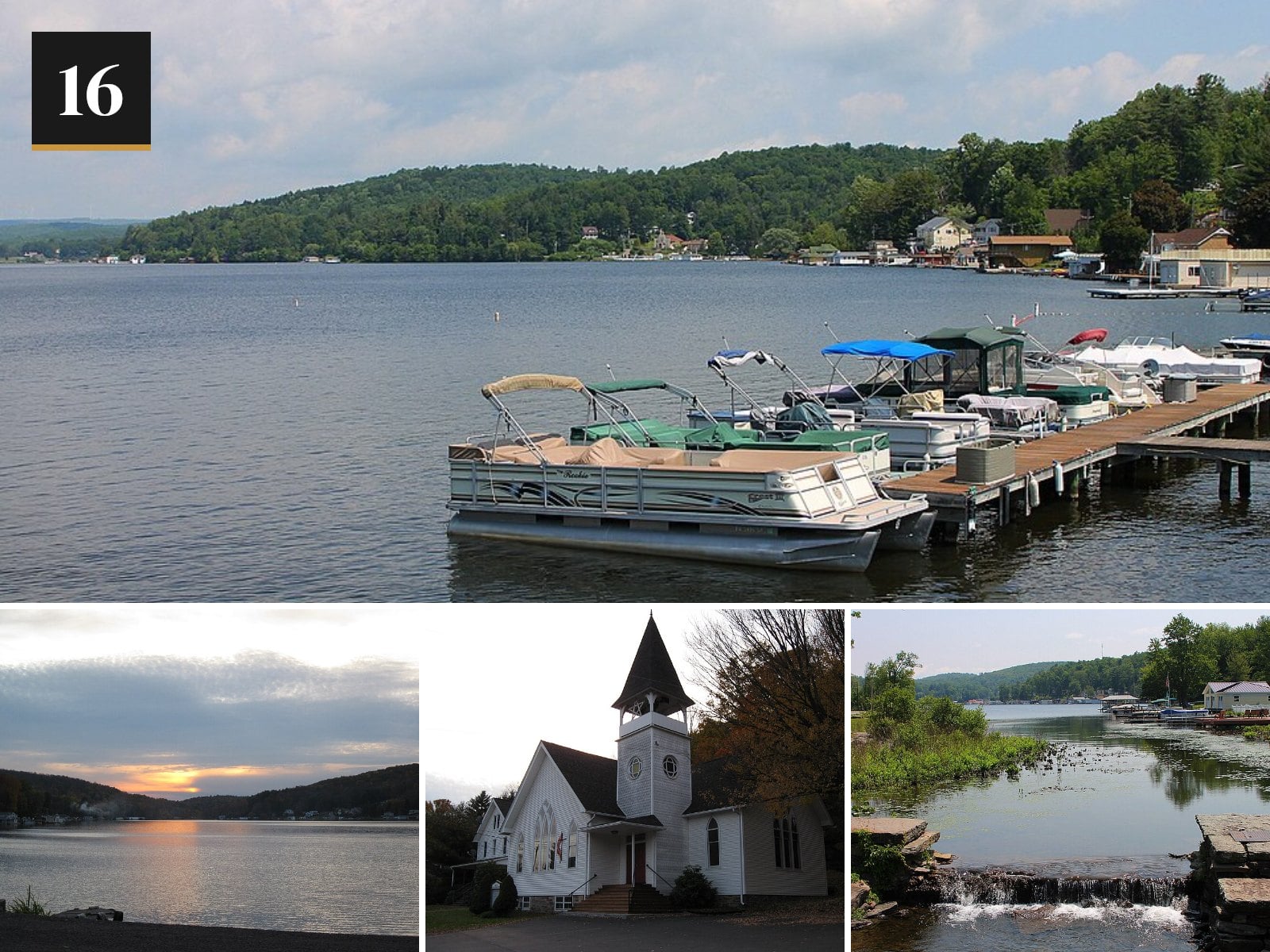
Photos: Jakec (CC BY-SA 4.0), Dougtone (CC BY-SA 2.0) · via Wikimedia Commons
Harveys Lake is the lake. The borough wraps around Pennsylvania’s largest natural lake, and a century ago it was a resort with grand hotels, a casino and an amusement park. Theodore Roosevelt stayed at the Hotel Oneonta in 1912. Today it’s a lake community of about 2,800 people, with docks, pontoon boats and cottages along the shore.
This is the most retiree-friendly town on our list by CoreLogic’s measure, a perfect 100, and it rates 86 for quiet. You won’t walk to the store (it scores 49 on walkability). You will spend summer evenings on the water and see sunsets over the ridge. If lake living is the dream, this is it.
Overall score: 76.9 · Population: 2,862 · County: Luzerne · Best score: Retirement 100
15. Moosic
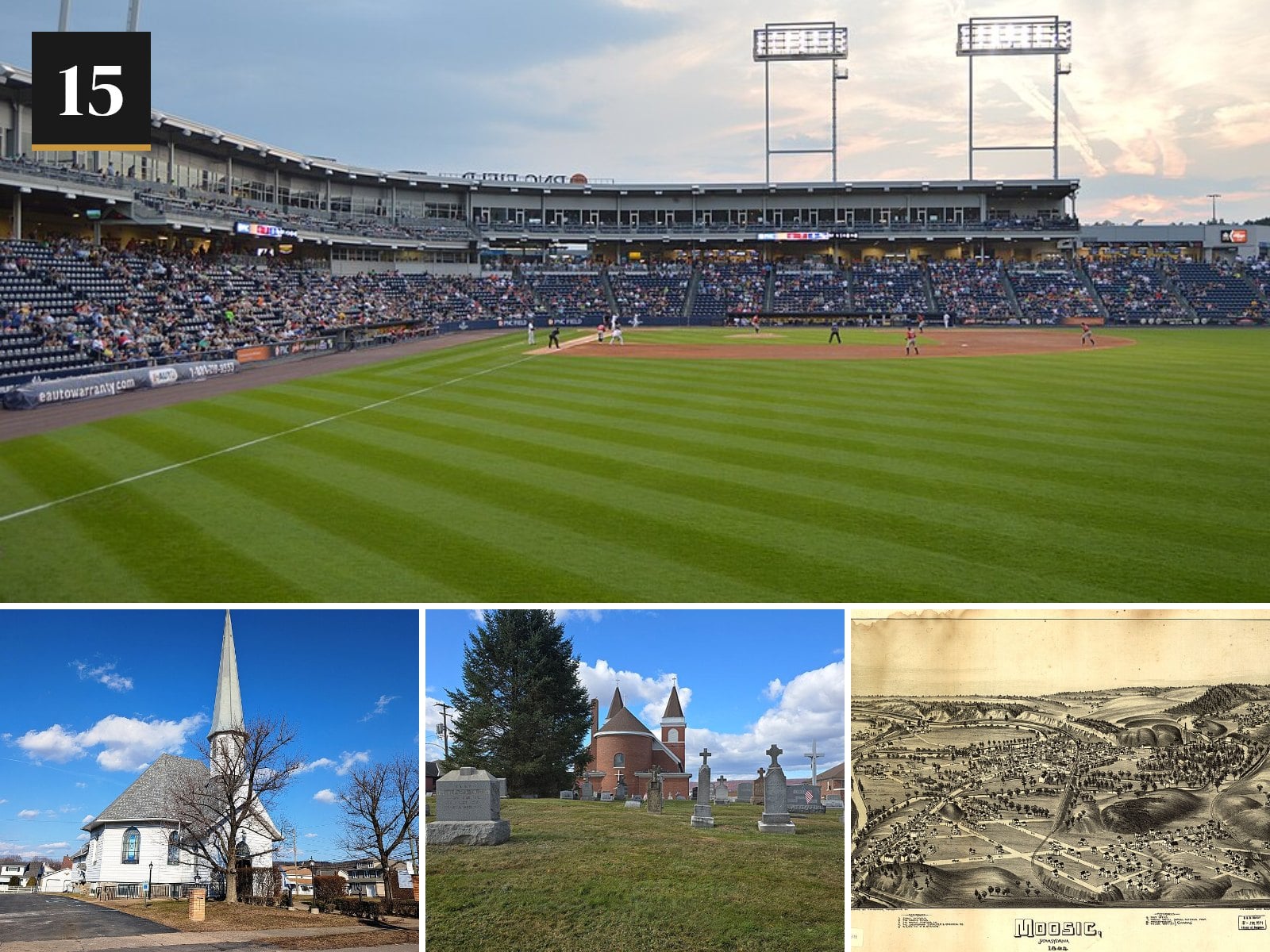
Photos: Michael Stokes (CC BY 2.0), Mr. Matté (CC BY-SA 4.0), Gt59514 (CC0), Fowler, T. M. (Public domain) · via Wikimedia Commons
Moosic sits on the Lackawanna River just 3 miles south of Scranton. Its name probably comes from a Lenape word meaning “elk place”. From 1886 to 1987 it was home to Rocky Glen Park, a beloved amusement park. Today it’s home to PNC Field, where the Scranton/Wilkes-Barre RailRiders play minor league baseball.
Moosic scores 80 for quiet and 88 for easy driving, with tidy streets and steepled churches. A summer night at the ballpark is a few minutes from your front door. Shopping, hospitals and the airport are close, so it’s easy to stay independent here.
Overall score: 76.9 · Population: 6,018 · County: Lackawanna · Best score: Retirement 91
14. Wyoming
🔥 Would you like to save this?
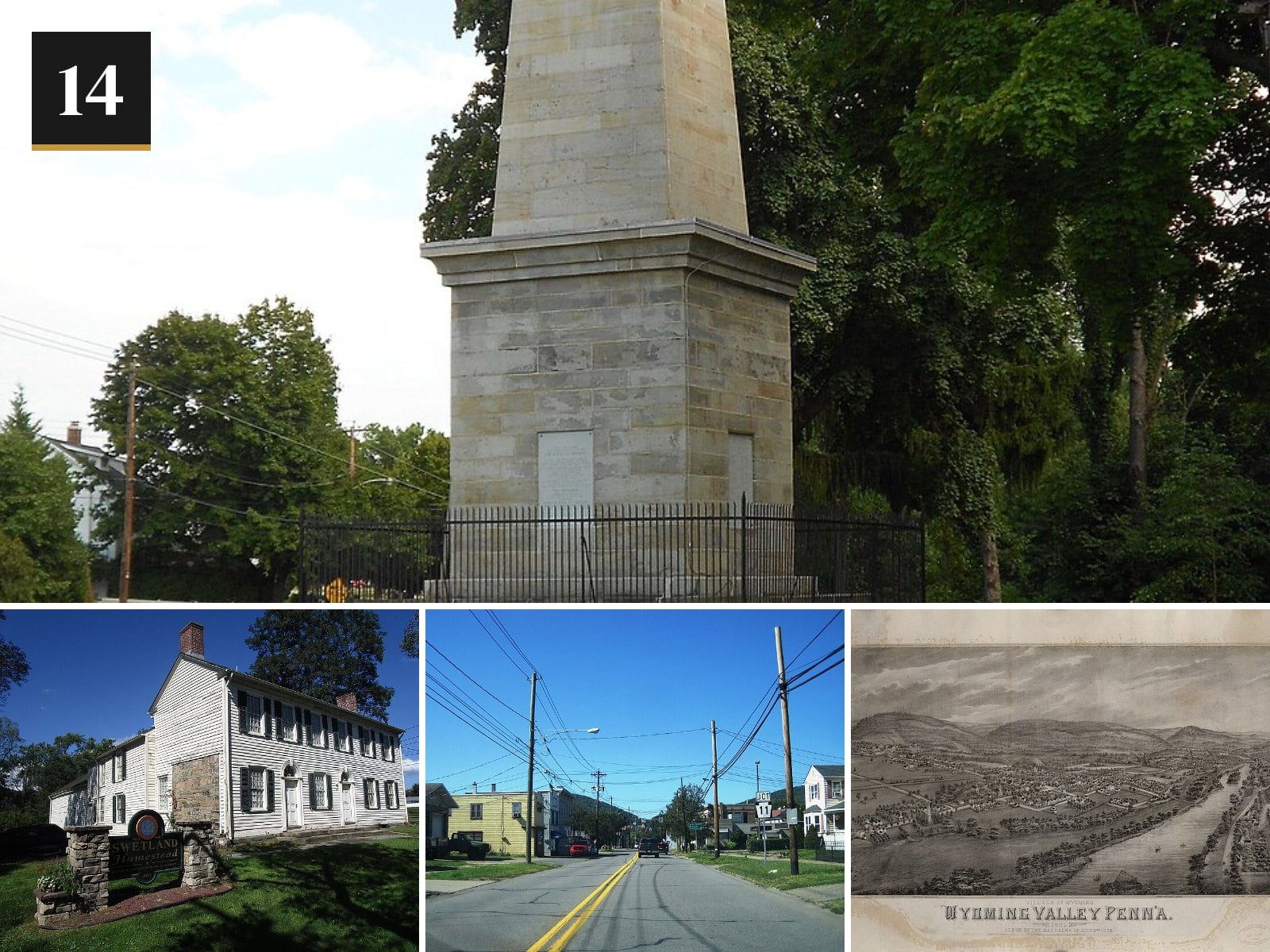
Photos: Smallbones (CC0), Joe Orbin (CC BY-SA 4.0), Mr. Matté (CC BY-SA 4.0), Rowley, H. H.; C.H. Vogt & Son (Public domain) · via Wikimedia Commons
Wyoming’s name comes from a Munsee word meaning “at the big river flat”, and the western state may well be named after it or the valley around it. The borough sits along the Susquehanna 5 miles north of Wilkes-Barre. Its landmark is the Wyoming Monument, which marks the 1778 Battle of Wyoming.
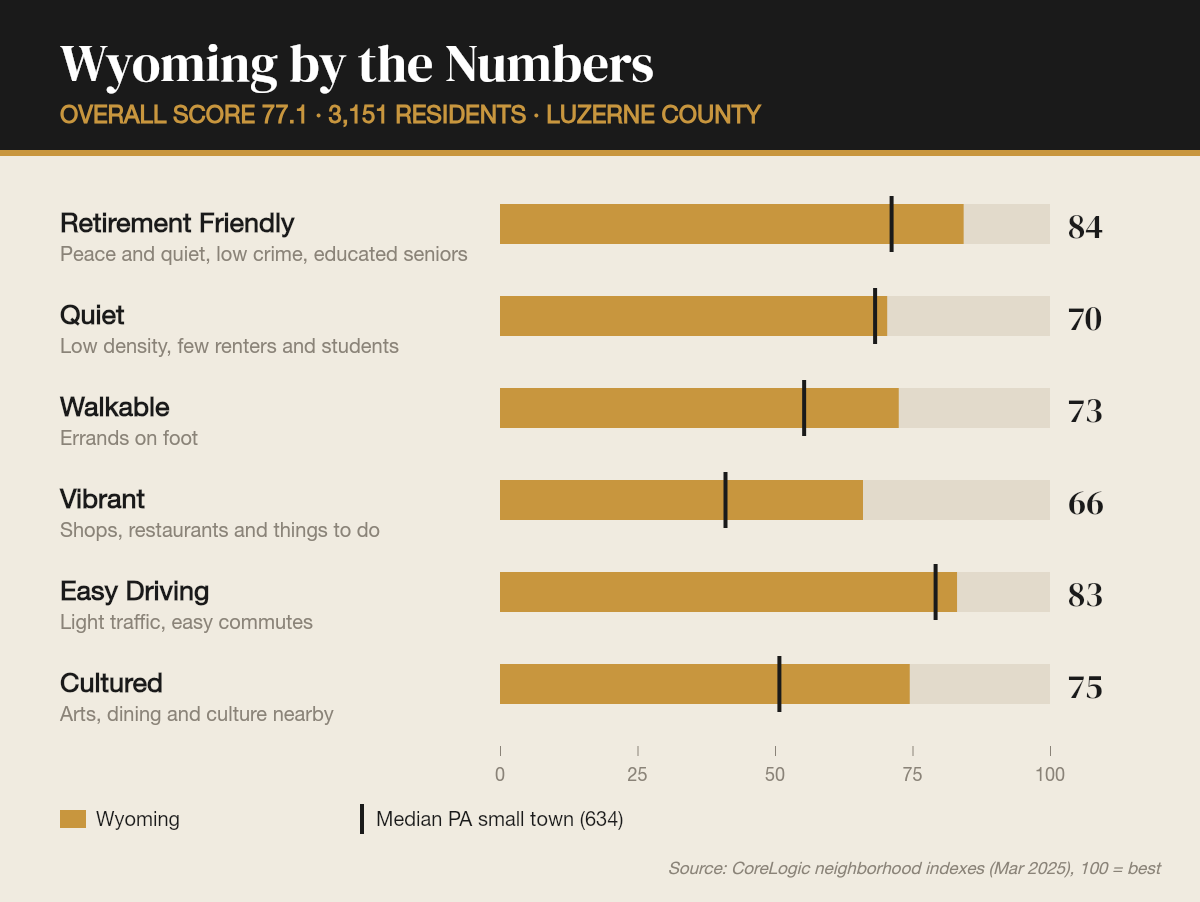
Wyoming scores well across the board: 84 for retirement, 72 for walkability, 74 for culture and 83 for easy driving. Historic homes like the Swetland Homestead sit alongside comfortable neighborhoods. It’s a town with real roots and every convenience close at hand.
Overall score: 77.1 · Population: 3,151 · County: Luzerne · Best score: Retirement 84
13. Hollidaysburg
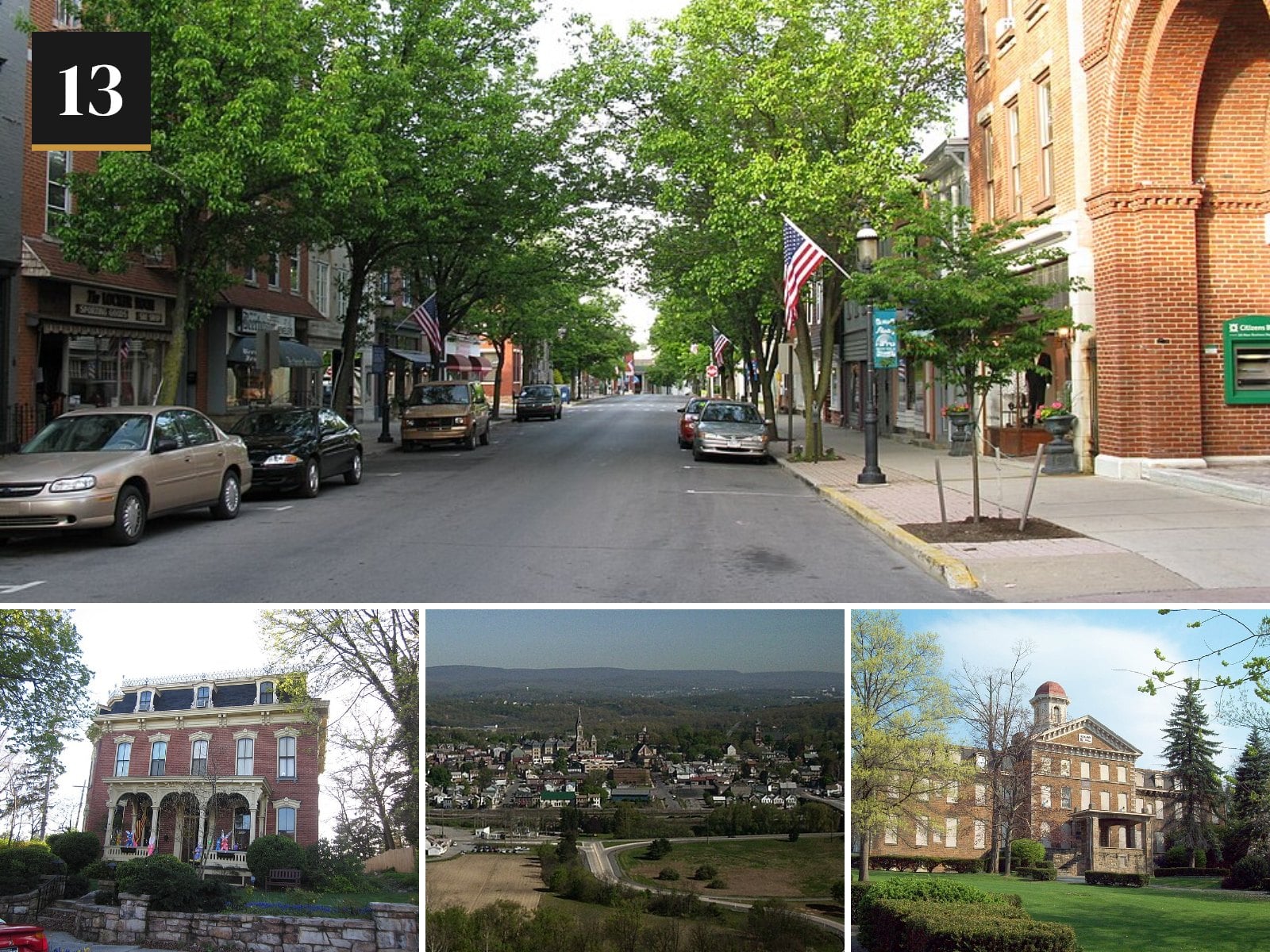
Photos: Andrew Bossi (CC BY-SA 2.5), Doug Kerr (CC BY-SA 2.0), David Carey (CC BY 2.5), Pubdog (Public domain) · via Wikimedia Commons
Hollidaysburg was laid out in 1796. From 1834 to 1854 it was a busy canal port where the Pennsylvania Main Line Canal met the Allegheny Portage Railroad. The Blair County seat sits on the Juniata River, and its downtown, known as “The Diamond”, still hosts the town’s parades and festivals.
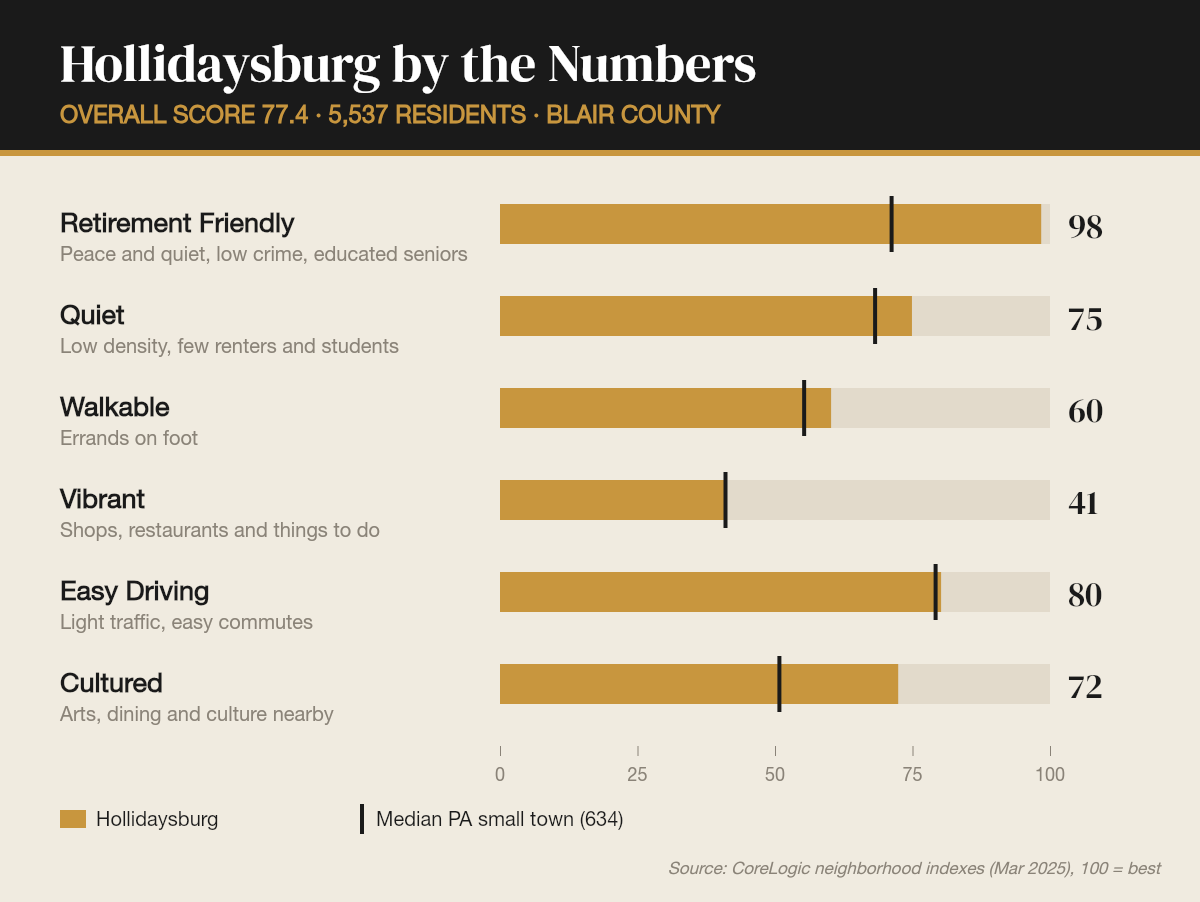
With a 98 for retirement friendliness and 75 for quiet, Hollidaysburg gives you a real historic downtown without the noise. Victorian homes line the side streets, and Altoona’s shopping and hospitals are 5 miles north. For someone who wants small-town traditions and county-seat convenience, it’s hard to beat.
Overall score: 77.4 · Population: 5,537 · County: Blair · Best score: Retirement 98
12. Homer City
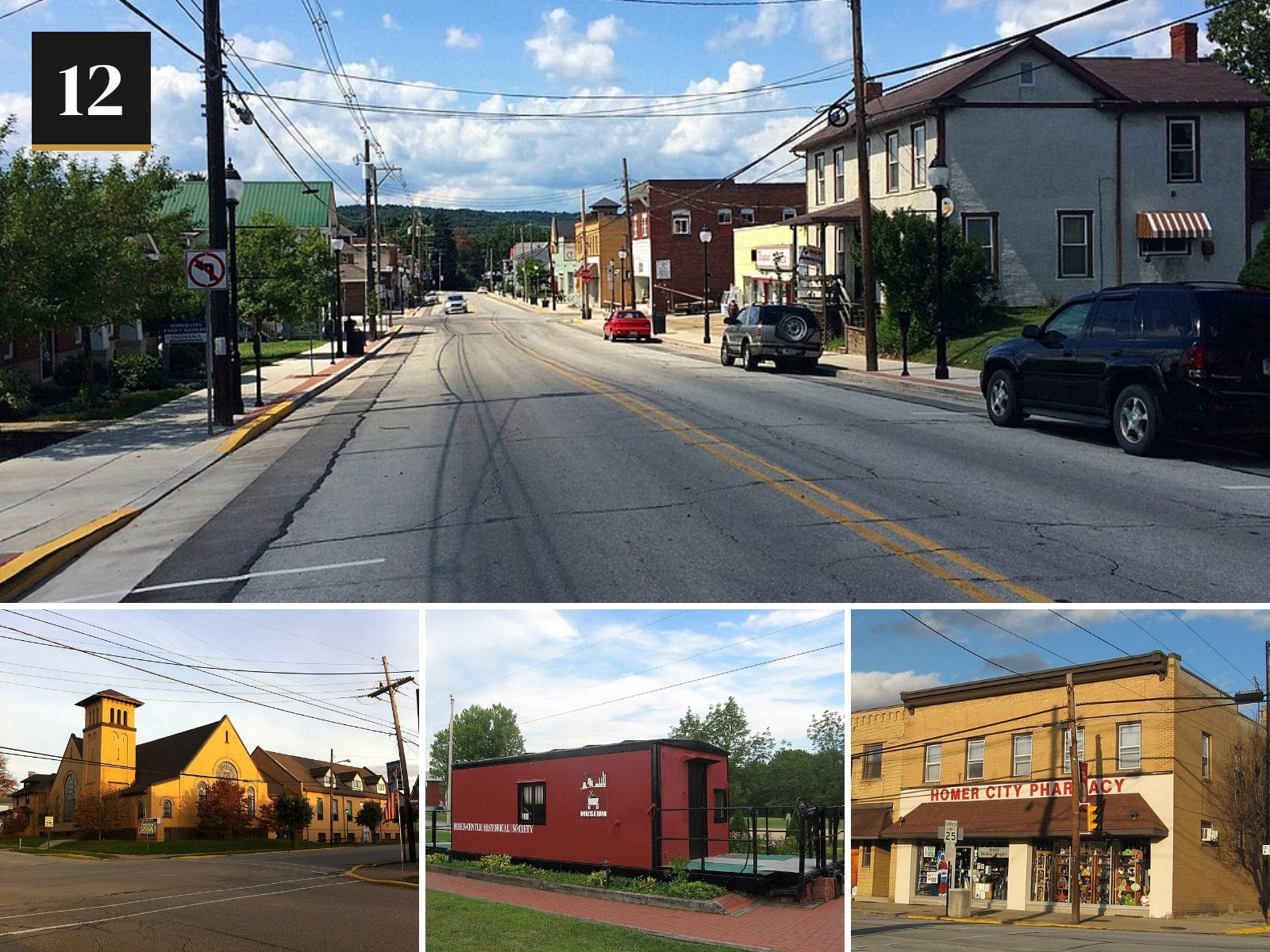
Photos: Andre Carrotflower (CC BY-SA 4.0), PowThudPop (CC BY-SA 4.0), UMVUR1972 (CC BY-SA 3.0) · via Wikimedia Commons
Homer City was named for the Greek poet Homer when it was founded in 1854. It grew up where Two Lick and Yellow creeks meet, in the hills of Indiana County. It’s a small borough of about 1,700 people, with a straightforward Main Street of brick storefronts and churches.
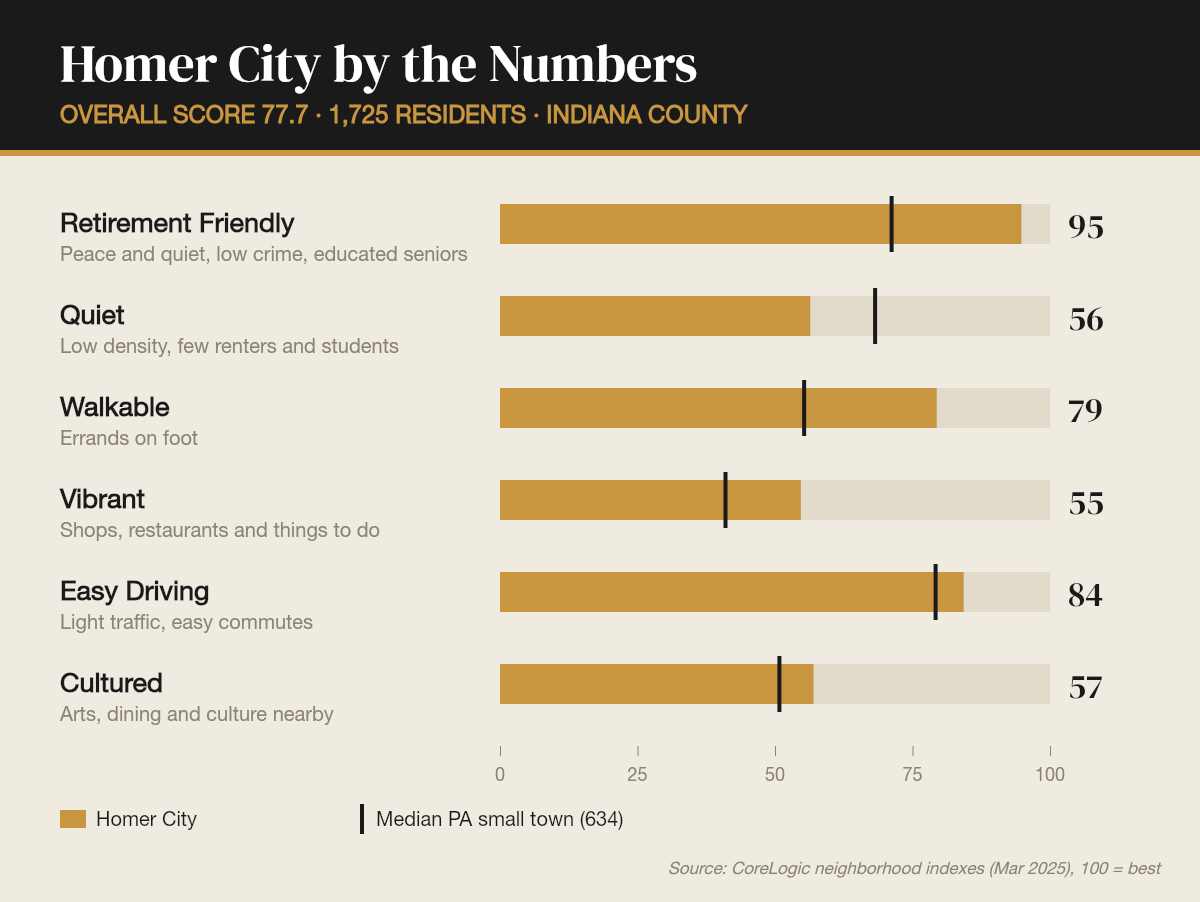
Homer City scores 79 for walkability and 84 for easy driving, and its 95 for retirement friendliness puts it near the top of this list. The college town of Indiana, with its restaurants, concerts and hospital, is a short drive north. It’s an affordable place to settle where the whole downtown is within walking distance.
Overall score: 77.7 · Population: 1,725 · County: Indiana · Best score: Retirement 95
11. Conyngham
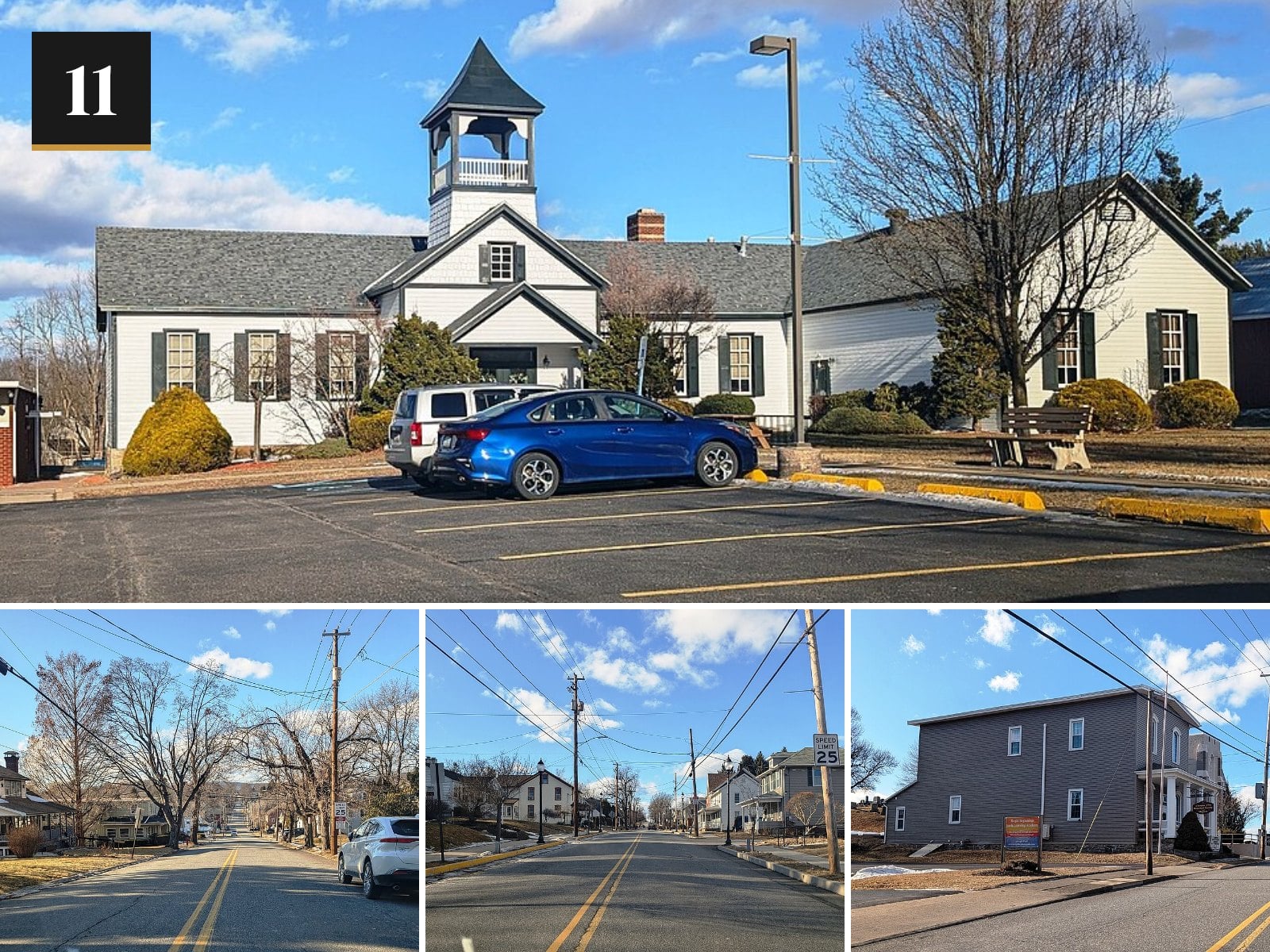
Photos: Mr. Matté (CC BY-SA 4.0) · via Wikimedia Commons
Conyngham is a small Sugarloaf Valley borough with a long memory. A monument recalls the 1780 Sugarloaf Massacre, and the home of George Drum, a Revolutionary veteran and the area’s first settler, still stands on Main Street. The neighboring village of Drums is named for his family.
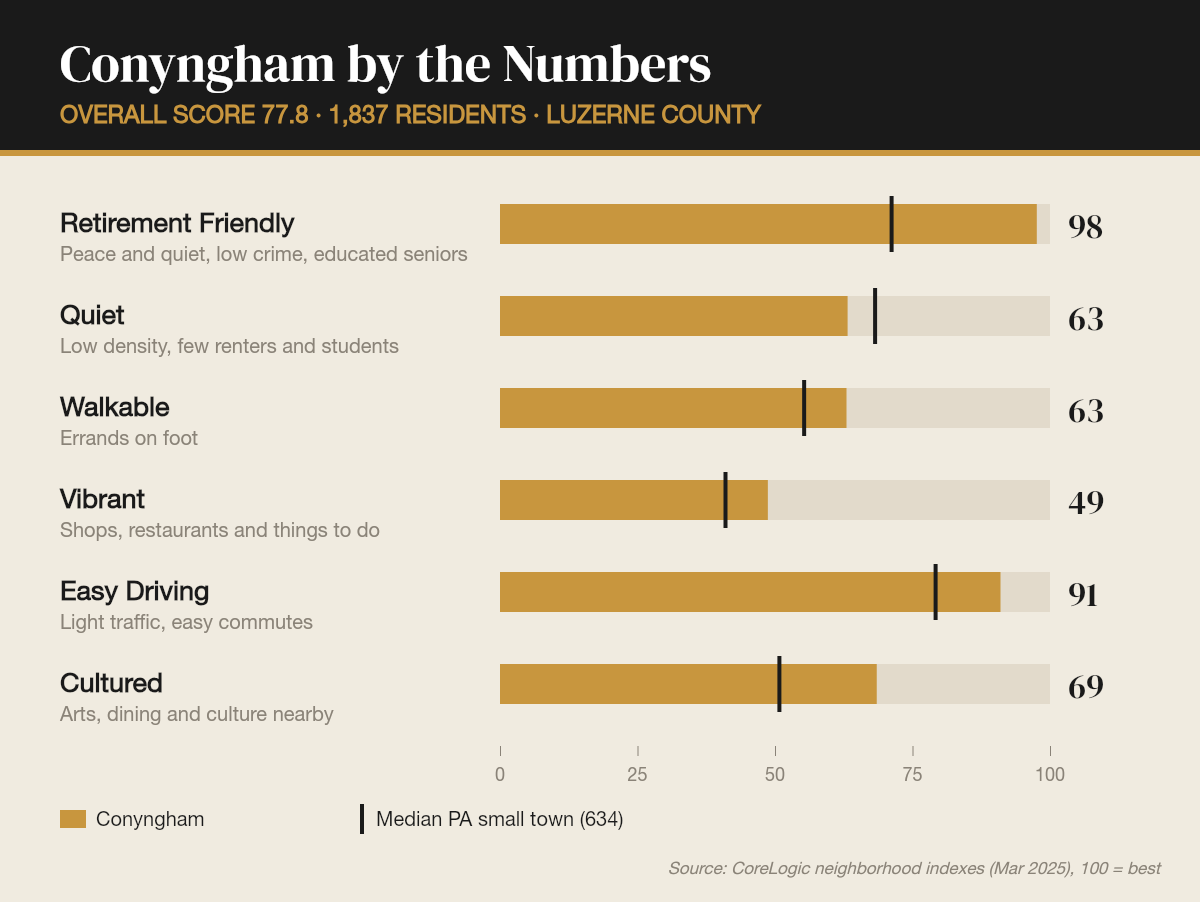
Conyngham scores 98 for retirement friendliness and 91 for easy driving, one of the best traffic scores on this list. Its Main Street of white clapboard churches and historic houses looks like a postcard. Hazleton is close for shopping and medical care, and the valley’s open views are all around.
Overall score: 77.8 · Population: 1,837 · County: Luzerne · Best score: Retirement 98
10. Old Forge
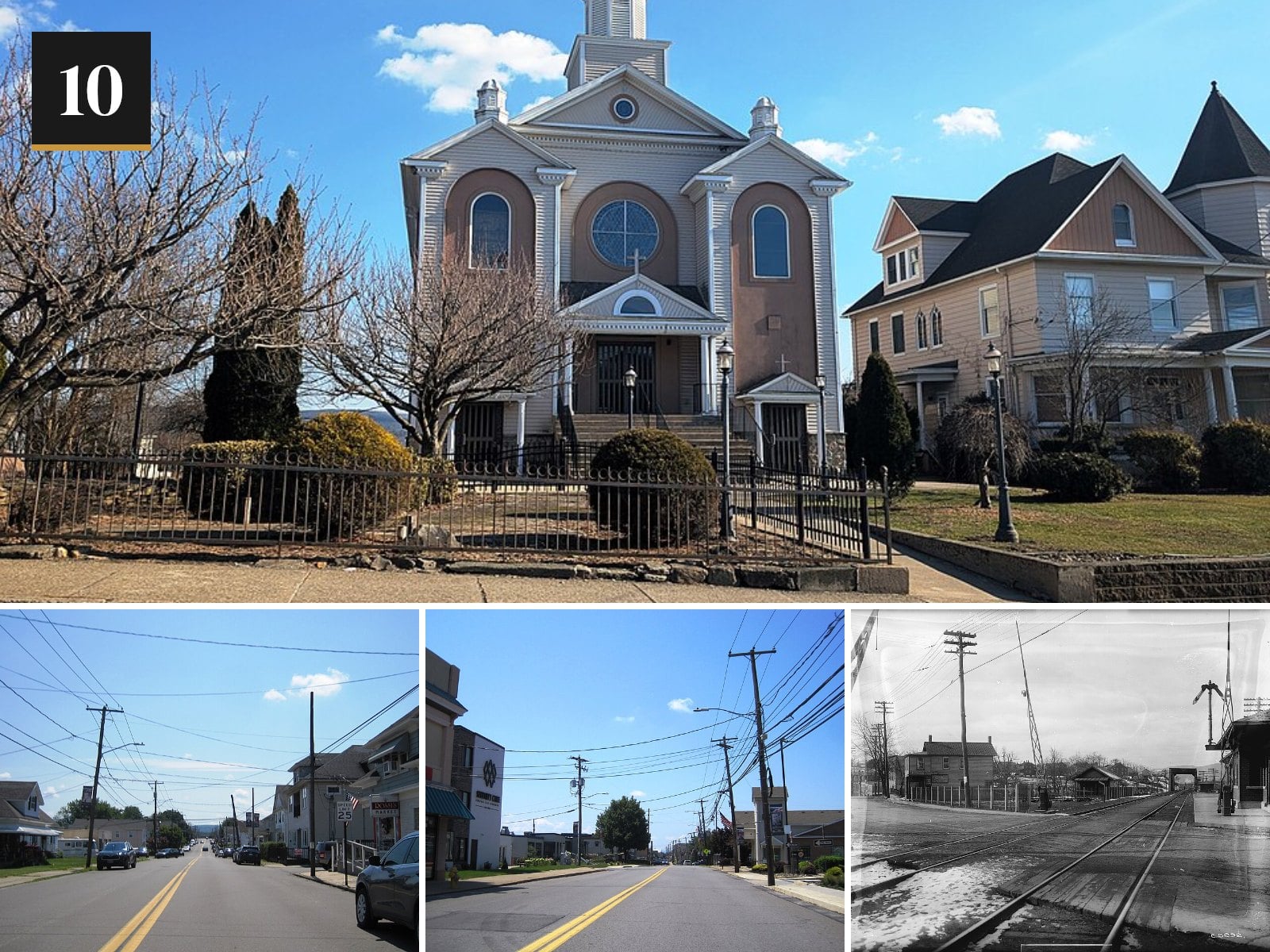
Photos: Mr. Matté (CC BY-SA 4.0), Bunnell, Watson B. (Public domain) · via Wikimedia Commons
Old Forge is 5 miles southwest of Scranton on the Lackawanna River. Anyone in northeastern Pennsylvania will tell you it’s the self-proclaimed Pizza Capital of the World, known for rectangular trays of Old Forge-style pizza. Fridays here mean pizza night at one of the many family-run spots in town.
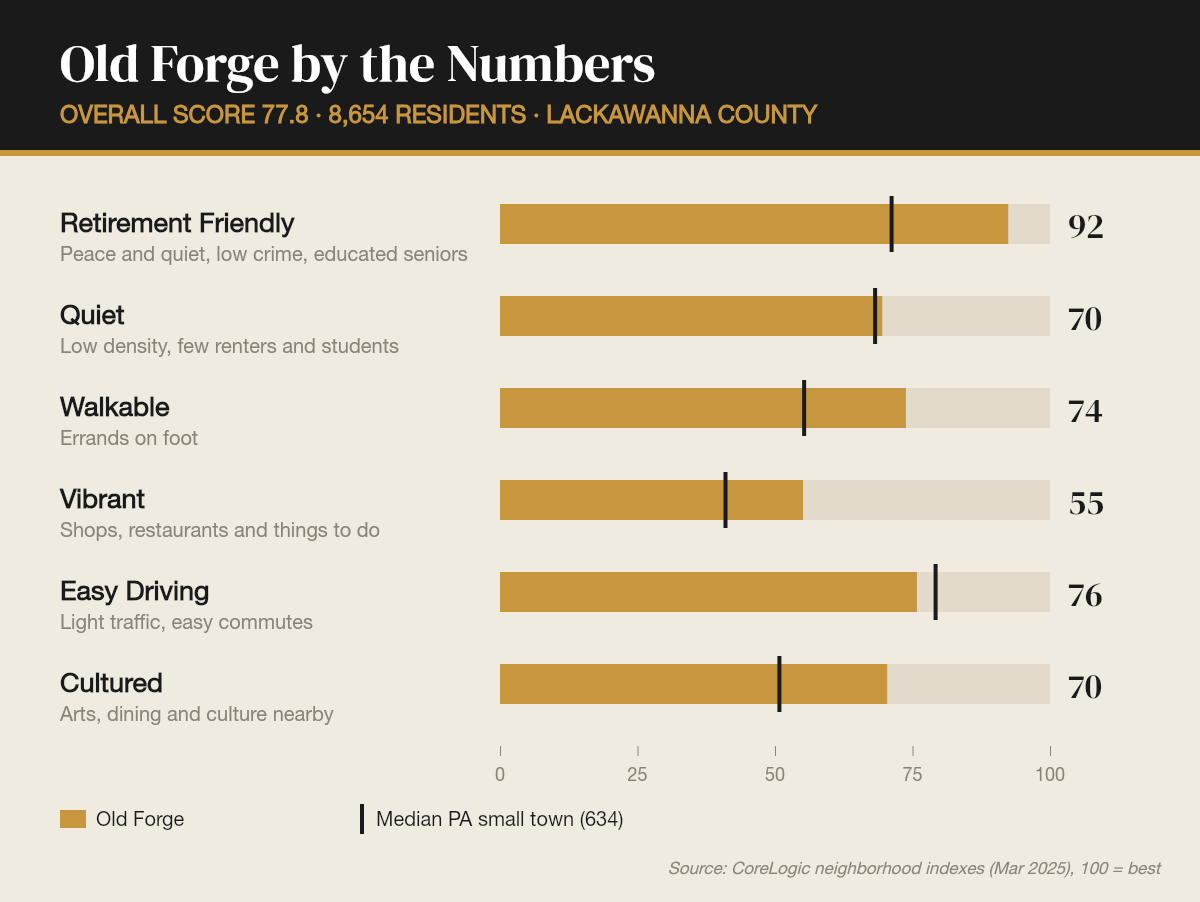
Old Forge is the largest town here at about 8,600 people. It still scores 92 for retirement friendliness and 74 for walkability, with churches, restaurants and shops along Main Street. Scranton and Wilkes-Barre are both close, but Old Forge keeps its own identity and its neighborly feel.
Overall score: 77.8 · Population: 8,654 · County: Lackawanna · Best score: Retirement 92
9. Geistown
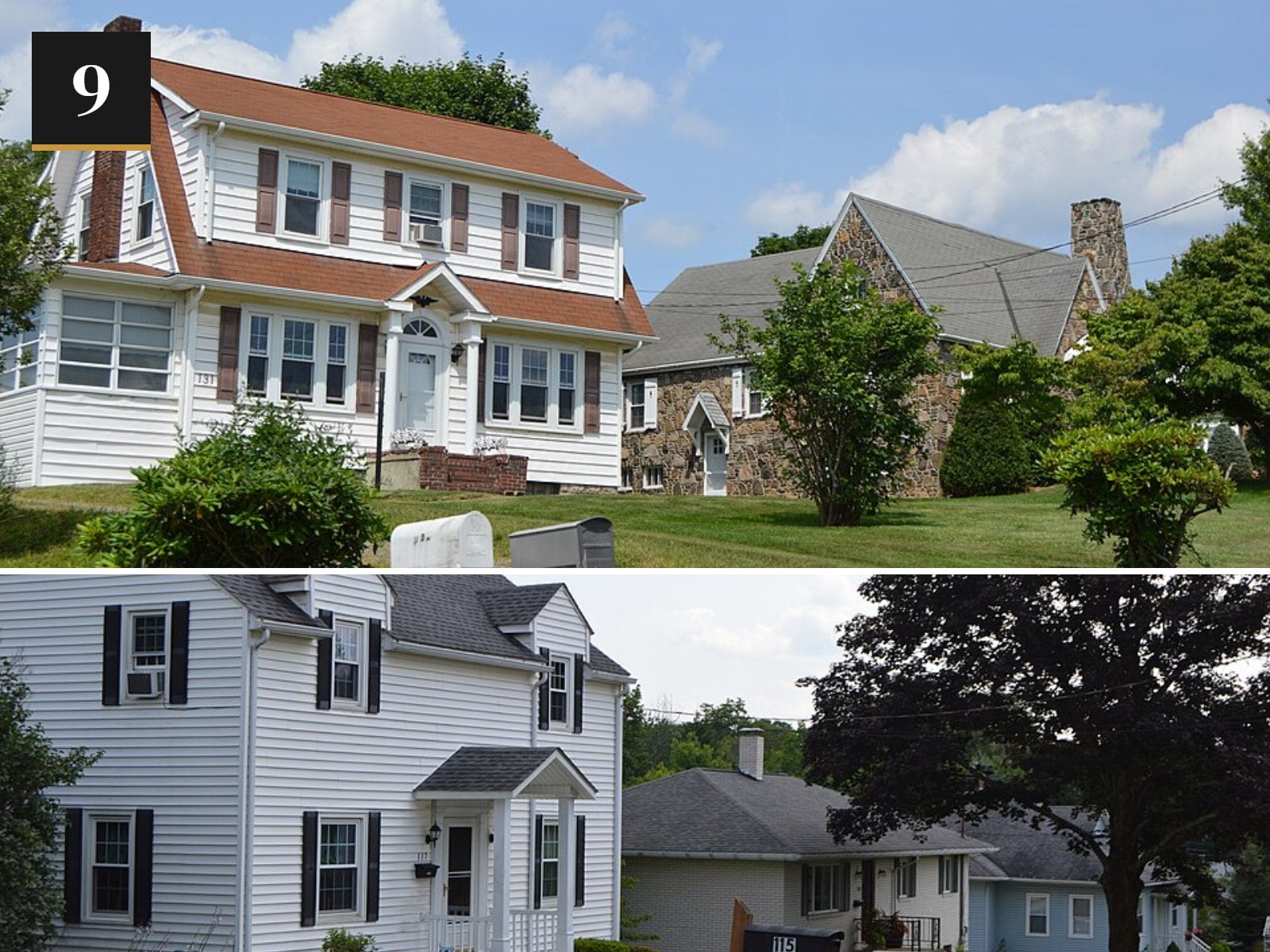
Photos: Nyttend (Public domain) · via Wikimedia Commons
Geistown is a compact borough of about 2,300 people covering just one square mile, 4 miles southeast of downtown Johnstown. Its streets are lined with tidy Cape Cods, colonials and ranch homes with big lawns.
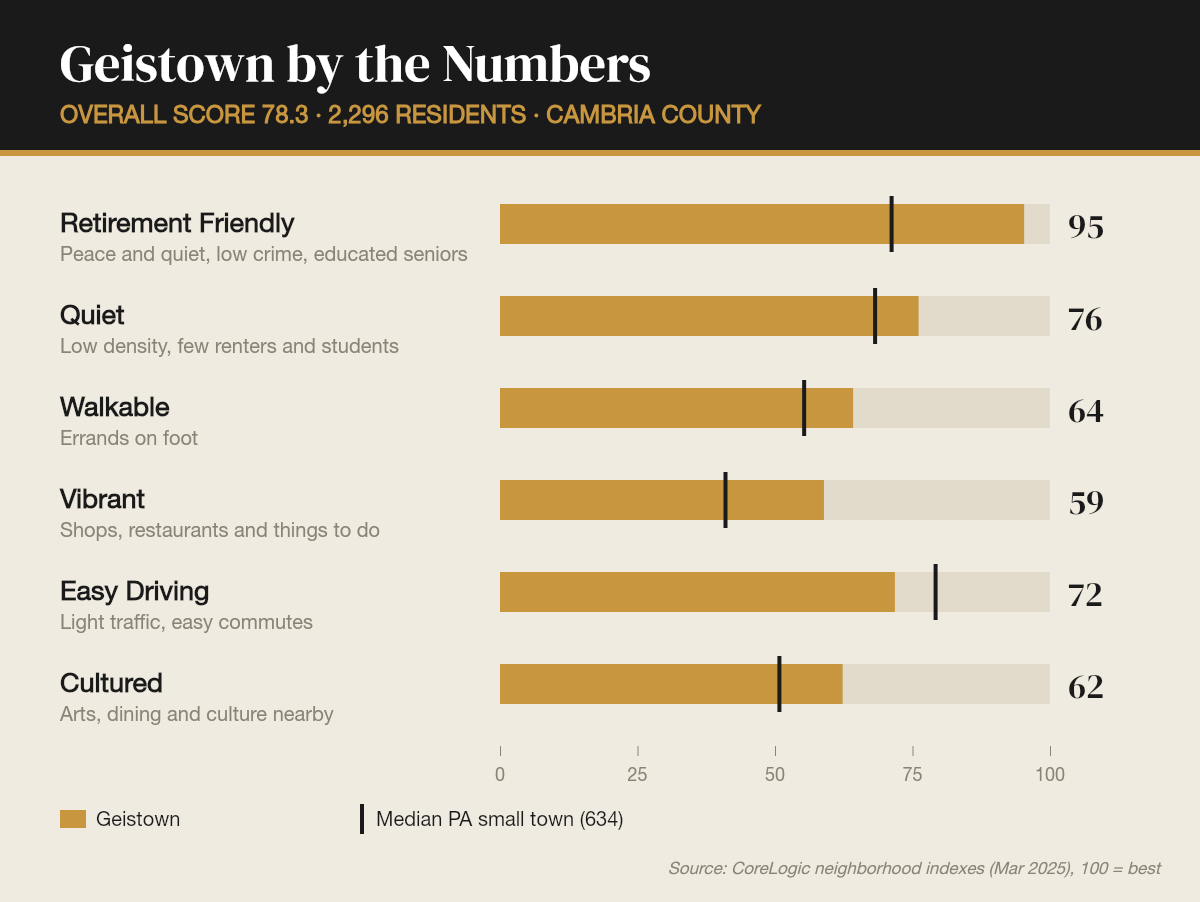
It’s a quiet suburb in the best sense, with 76 for quiet and 95 for retirement friendliness. Shopping and Johnstown’s medical centers are a few minutes away. Homes in the Johnstown area cost much less than in most of the state, which makes Geistown a very practical choice.
Overall score: 78.3 · Population: 2,296 · County: Cambria · Best score: Retirement 95
8. West Conshohocken
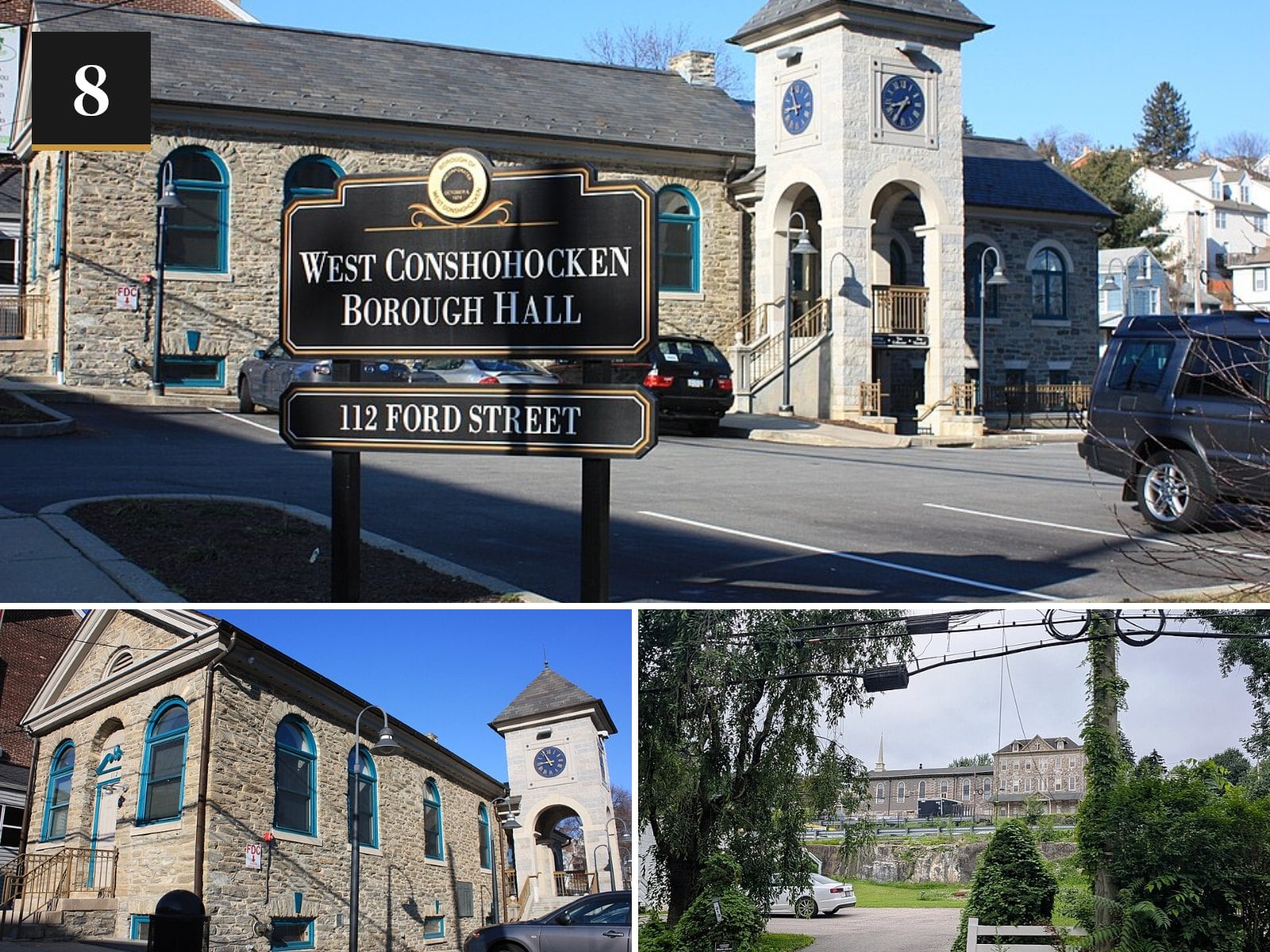
Photos: Montgomery County Planning Commission (CC BY-SA 2.0), Mr. Matté (CC BY-SA 4.0) · via Wikimedia Commons
West Conshohocken sits on the Schuylkill River across from its sister town, Conshohocken, about a dozen miles from Center City Philadelphia. Its quarries once produced “Merion Blue” stone for public buildings up and down the East Coast. The stone borough hall with its clock tower still shows that history.
West Conshohocken scores 98 for culture and 82 for quiet, a rare pairing. The Schuylkill River Trail and Conshohocken’s restaurants are just across the river, and Philadelphia’s arts scene is a short drive. You give up small-town affordability, but you get a small borough with the city on call.
Overall score: 78.4 · Population: 1,508 · County: Montgomery · Best score: Cultured 98
7. Delmont
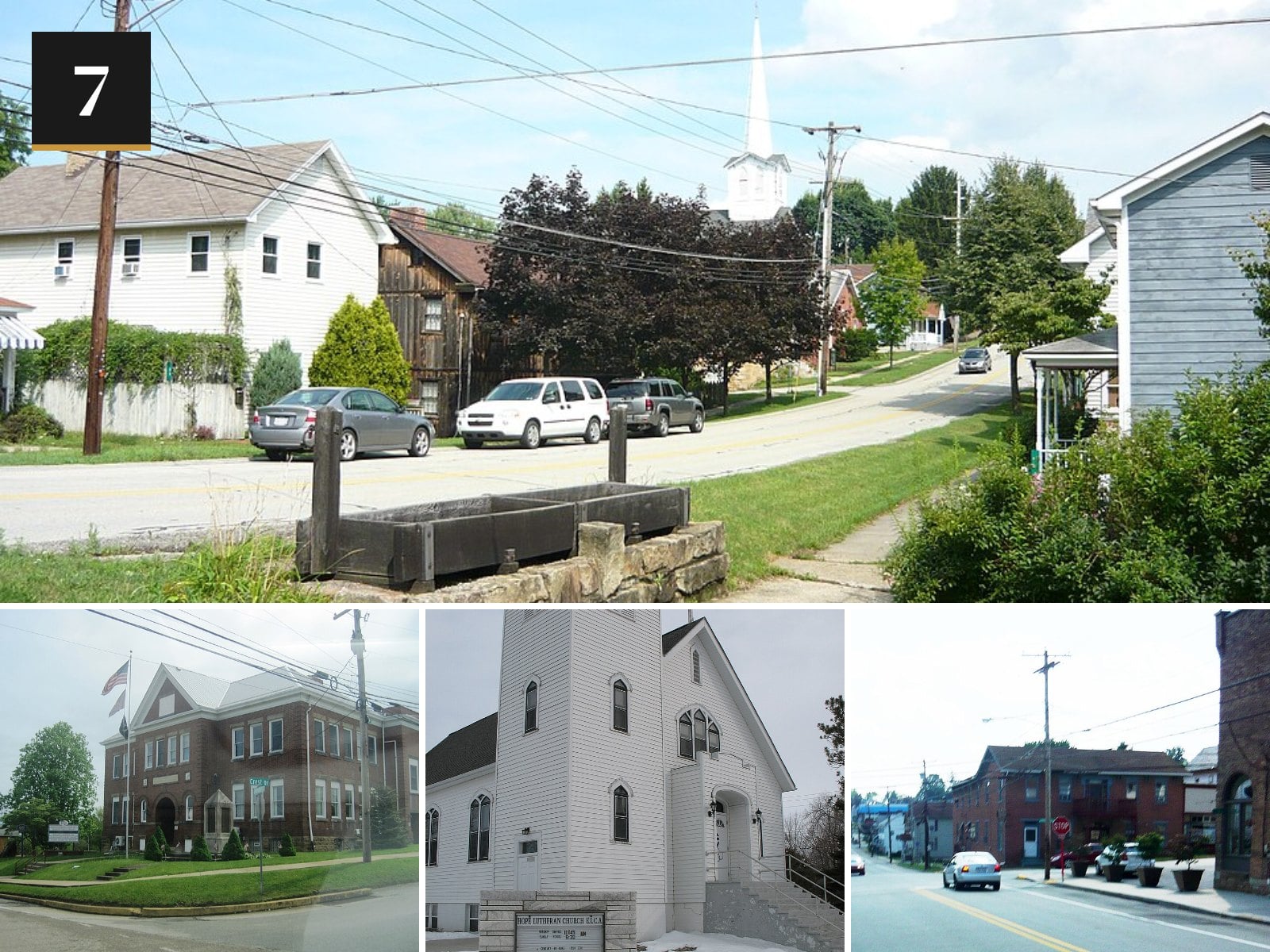
Photos: Canadian2006 (CC BY-SA 3.0), Mr. Matté (CC BY-SA 4.0), Sdgjake (CC BY-SA 3.0) · via Wikimedia Commons
Delmont began as Salem Crossroads. In 1814, Thomas Wilson laid out the town around a stone watering trough fed by a spring said never to run dry. The borough later took the name Delmont, and that original trough is still a town landmark.
Delmont scores a perfect 100 for retirement friendliness and 71 for quiet. It’s a friendly crossroads town in Westmoreland County with the shops of Route 66 and Route 22 close by, and Pittsburgh and Greensburg are within easy reach. Here the slower pace comes with plenty of conveniences.
Overall score: 78.5 · Population: 2,621 · County: Westmoreland · Best score: Retirement 100
6. West Newton
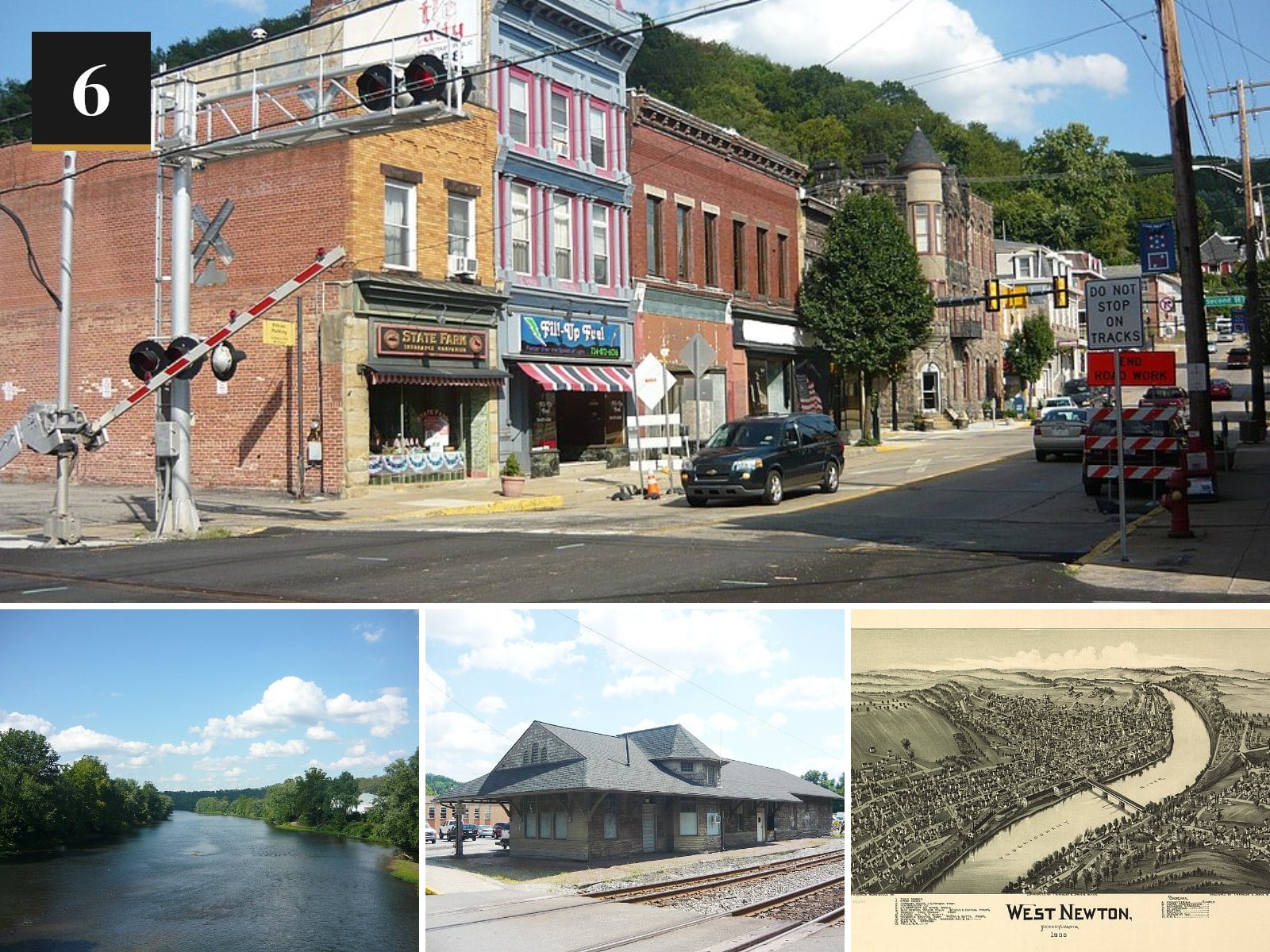
Photos: Canadian2006 (CC BY-SA 3.0), Fowler, T. M. (Public domain) · via Wikimedia Commons
West Newton sits on the Youghiogheny River about 25 miles southeast of Pittsburgh. In 1788, pioneers led by Rufus Putnam built boats here before heading downriver to found Marietta, Ohio. Today the Great Allegheny Passage bike trail runs right through town, and cyclists stop at the riverfront.
West Newton scores 94 for retirement friendliness and 76 for walkability, and its 87 for easy driving makes getting around effortless. With a classic brick Main Street, a river view and a world-class trail at the edge of town, it’s ideal for a retiree who wants to stay active.
Overall score: 79.1 · Population: 2,598 · County: Westmoreland · Best score: Retirement 94
5. Shiremanstown
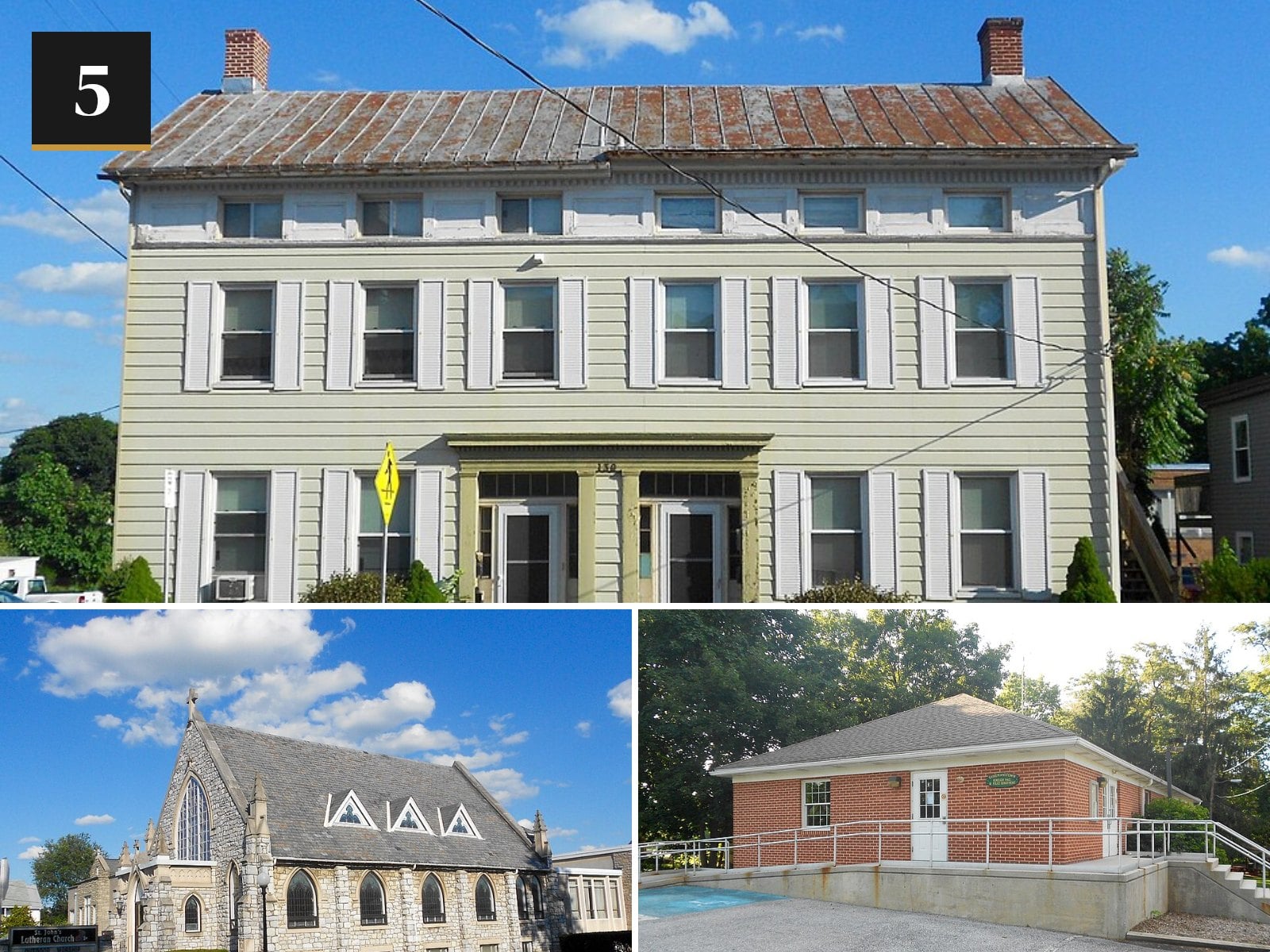
Photos: Smallbones (CC0) · via Wikimedia Commons
Shiremanstown is a tiny borough on Harrisburg’s West Shore, named for Daniel Shireman, an 18th-century German settler. It grew around St. John’s Lutheran Church, whose congregation traces back to a log “Peace Church” from before 1797.
Despite having just 1,700 people, Shiremanstown scores 86 for walkability and 82 for vibrancy. It’s surrounded by the West Shore’s shops, restaurants and parks, and the hospitals in Camp Hill and Harrisburg are minutes away. You get a small-town address with city amenities right at its edges.
Overall score: 79.1 · Population: 1,669 · County: Cumberland · Best score: Retirement 91
4. Oakmont
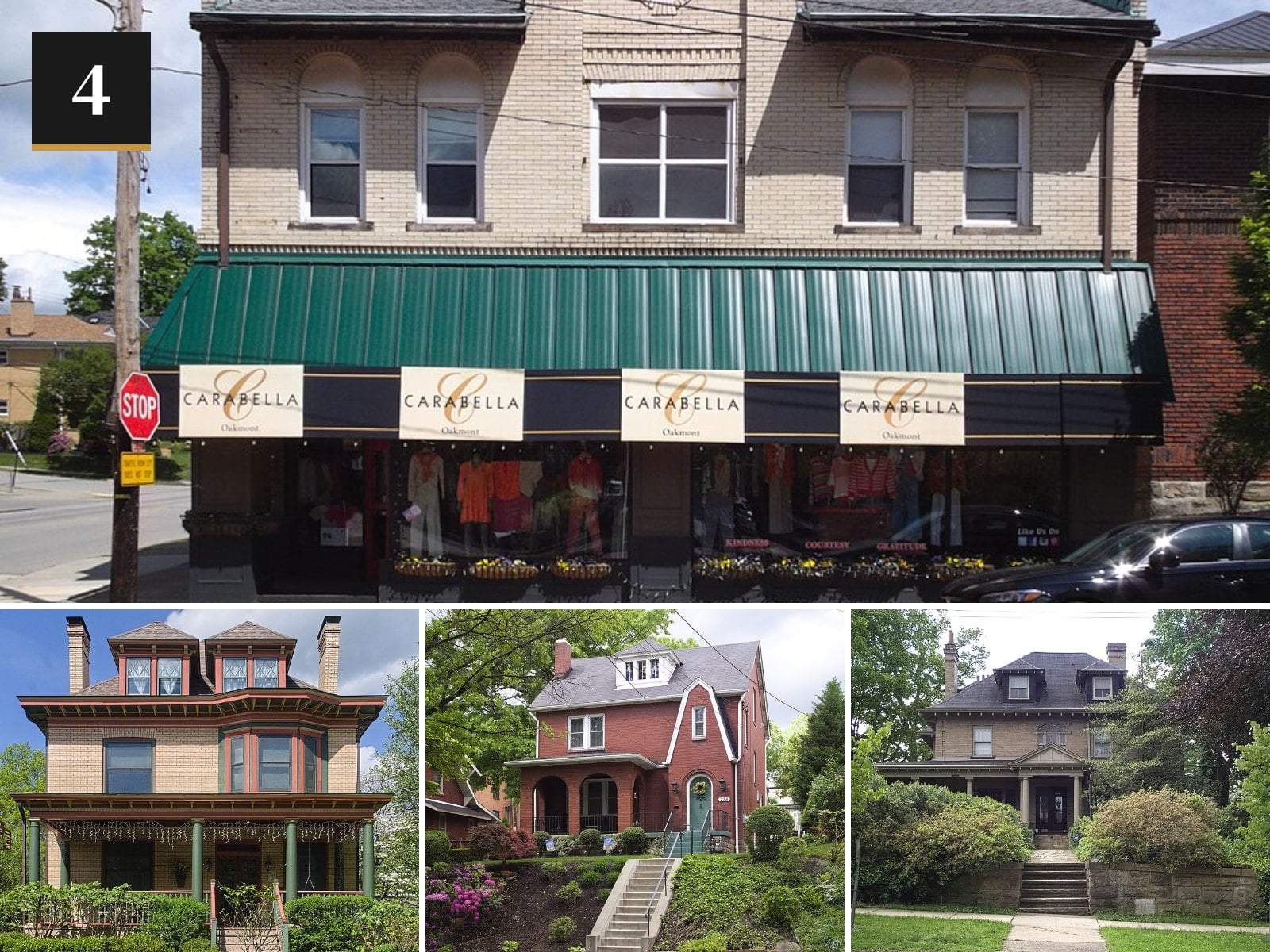
Photos: Cbaile19 (CC0) · via Wikimedia Commons
Oakmont sits along the Allegheny River about 15 miles northeast of Pittsburgh. Golf fans know it for Oakmont Country Club, host of many U.S. Opens. The town takes its name from a black oak on the riverbank mentioned in the original land deed.
Oakmont scores 96 for retirement friendliness, 82 for walkability and 89 for culture, so you get a real downtown of shops and cafés, a riverfront and handsome brick homes. It’s the kind of town where you know your neighbors and can still be at a Pittsburgh show in half an hour.
Overall score: 79.8 · Population: 6,628 · County: Allegheny · Best score: Retirement 96
3. Yardley
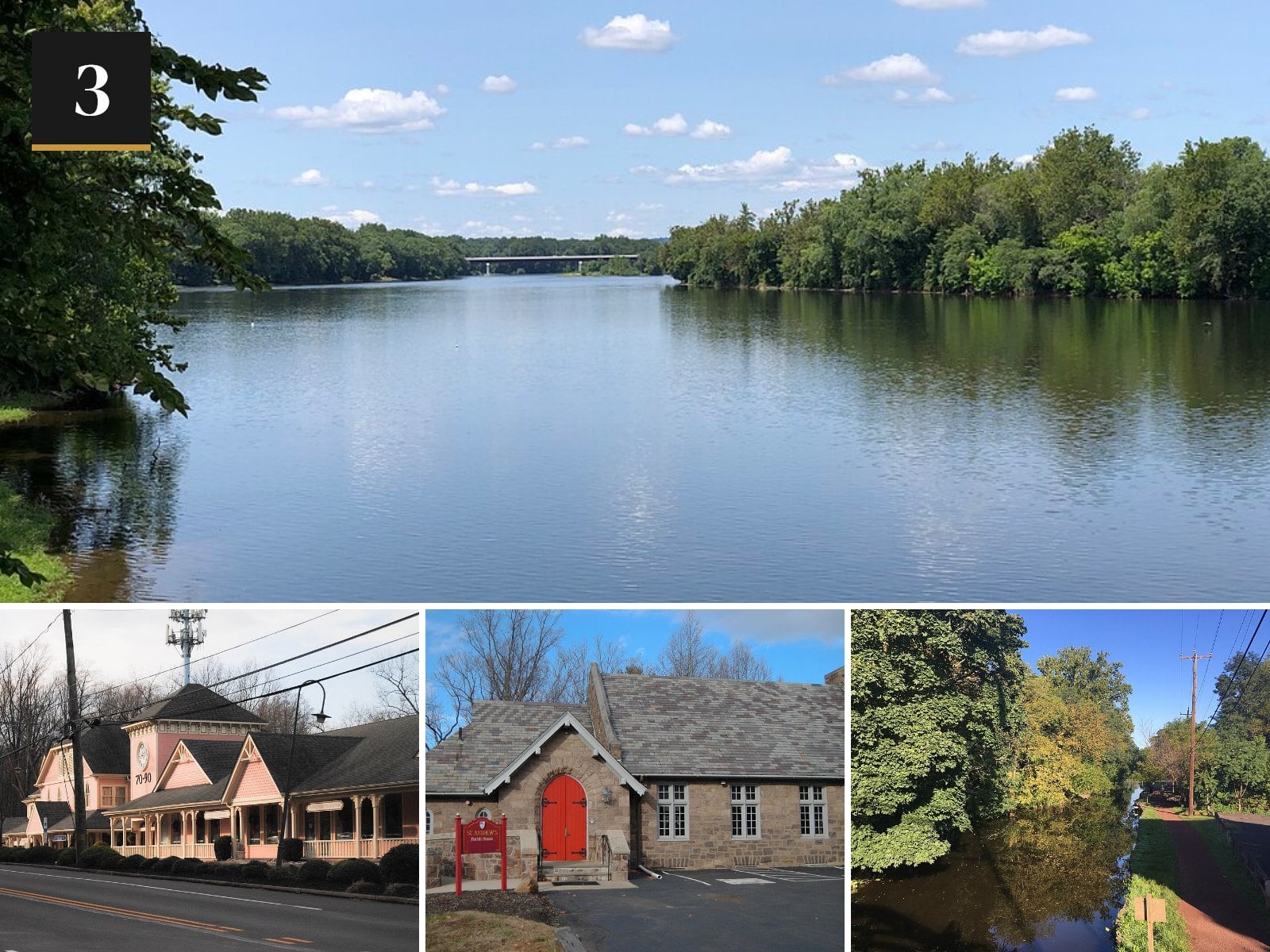
Photos: Famartin (CC BY-SA 4.0), LR.127 (CC BY 4.0), Dough4872 (CC BY-SA 4.0) · via Wikimedia Commons
Yardley was founded by William Yardley, who came from England in 1682, and by 1710 a ferry was running across the Delaware River from here. Today the town has the river on one side, the Delaware Canal towpath running through the middle, and little Lake Afton with its old library at the center.
Yardley scores 93 for retirement friendliness, 84 for vibrancy and 91 for culture. Its inns, cafés and Victorian storefronts sit along a short, walkable main street. For waterside walks, history and good dining, Yardley is the jewel of Bucks County.
Overall score: 80.4 · Population: 2,591 · County: Bucks · Best score: Retirement 93
2. Southwest Greensburg
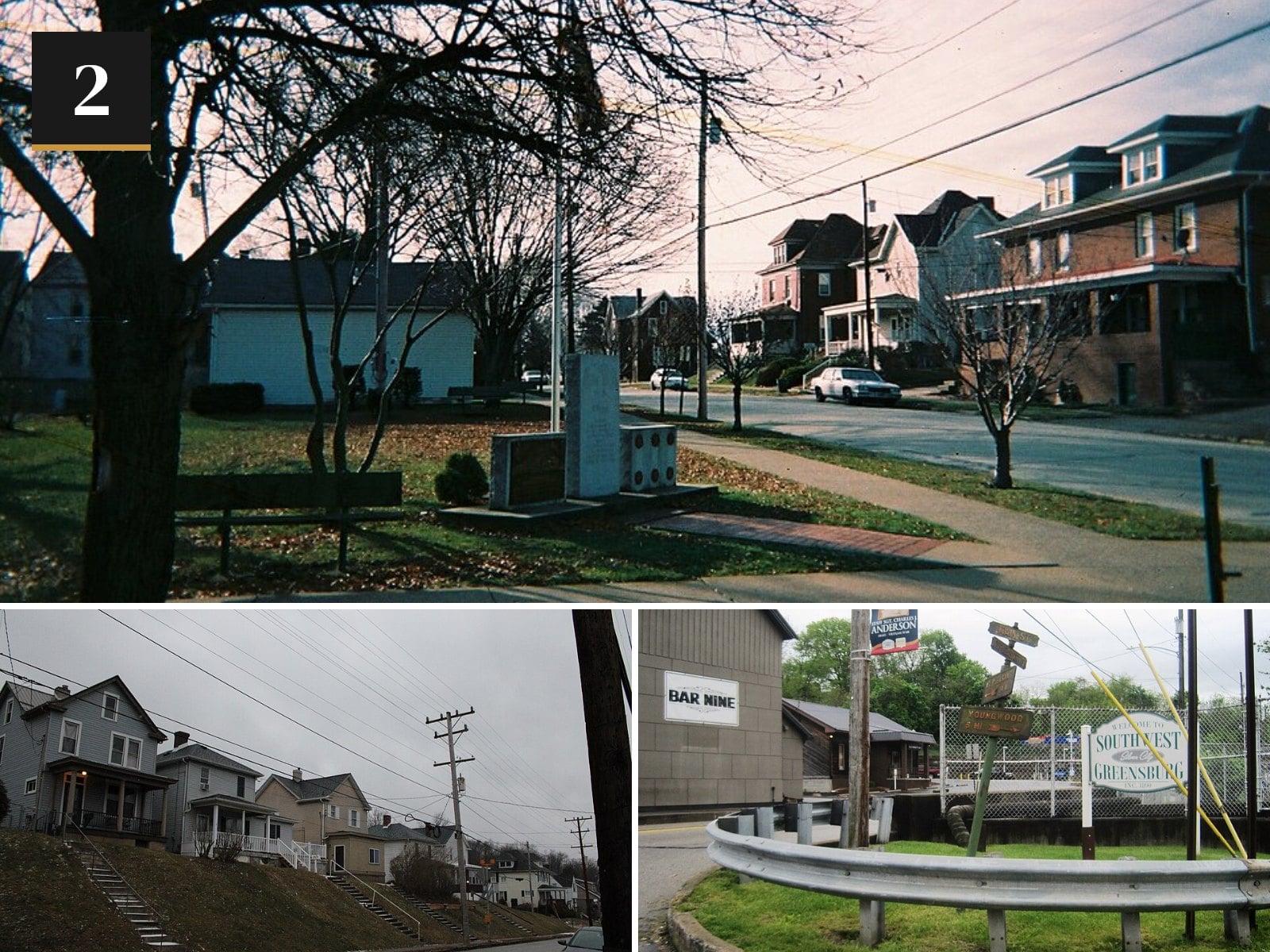
Photos: Canadian2006 (CC BY-SA 3.0), Cramerwiki (CC0), Mr. Matté (CC BY-SA 4.0) · via Wikimedia Commons
Southwest Greensburg was once called “What You Please?”, which was reportedly the answer its first landowner gave when asked to name the place. In 1887 two coal businessmen laid out 413 lots and turned the farmland into a planned residential community. It became a borough in 1890.
Southwest Greensburg ties for the top overall score on our list. It rates 88 for walkability, 86 for vibrancy and 86 for easy driving, and downtown Greensburg, the Westmoreland County seat, is just next door. You get a real small neighborhood with the full services of a county seat, which is very close to the ideal setup for retirement.
Overall score: 81.2 · Population: 2,166 · County: Westmoreland · Best score: Retirement 92
1. Green Tree
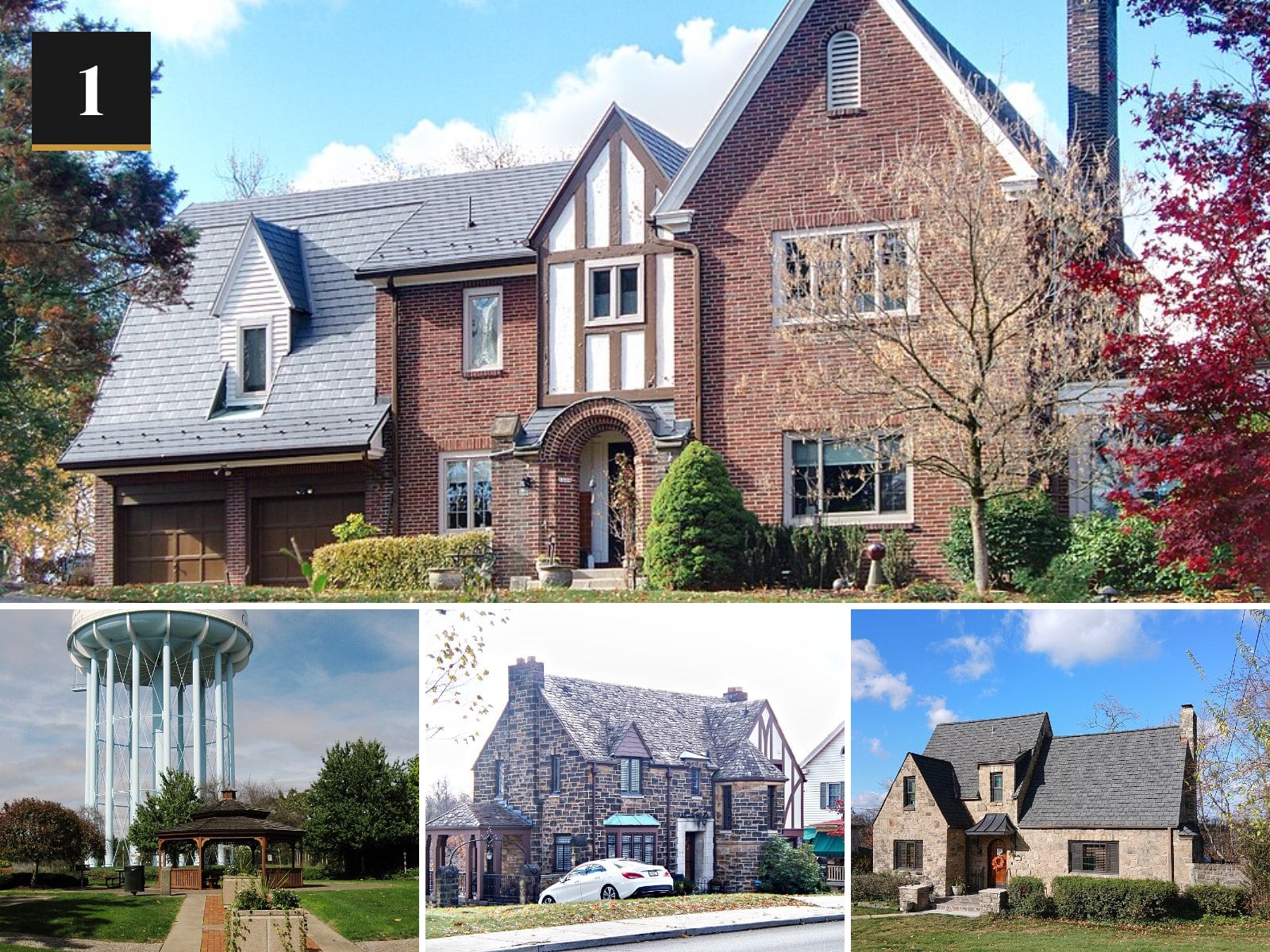
Photos: Cbaile19 (CC0) · via Wikimedia Commons
Green Tree, our number one, is named for a large sycamore on Greentree Road where stagecoaches once delivered the mail. The borough was chartered in 1885 and sits just through the Fort Pitt Tunnel from downtown Pittsburgh. Its streets are full of storybook Tudor and stone houses.
Green Tree scores 99 for retirement friendliness and 77 for quiet, with balanced strength in walkability, vibrancy and culture. The water tower park with its gazebo is a local favorite for an evening stroll. It combines a peaceful, beautiful neighborhood with one of America’s most livable cities minutes away. That’s why it takes the top spot.
Overall score: 81.2 · Population: 4,751 · County: Allegheny · Best score: Retirement 99
The Full Ranking
Scores run from 1 to 100, and higher is better on every measure.
| Rank | Town | County | Pop. | Score | Retirement | Quiet | Walkable | Vibrant | Easy driving | Cultured |
|---|---|---|---|---|---|---|---|---|---|---|
| 1 | Green Tree | Allegheny | 4,751 | 81.2 | 99 | 77 | 63 | 66 | 65 | 83 |
| 2 | Southwest Greensburg | Westmoreland | 2,166 | 81.2 | 92 | 46 | 88 | 86 | 86 | 56 |
| 3 | Yardley | Bucks | 2,591 | 80.4 | 93 | 56 | 75 | 84 | 62 | 91 |
| 4 | Oakmont | Allegheny | 6,628 | 79.8 | 96 | 58 | 82 | 61 | 70 | 89 |
| 5 | Shiremanstown | Cumberland | 1,669 | 79.1 | 91 | 44 | 86 | 82 | 74 | 70 |
| 6 | West Newton | Westmoreland | 2,598 | 79.1 | 94 | 65 | 76 | 65 | 87 | 36 |
| 7 | Delmont | Westmoreland | 2,621 | 78.5 | 100 | 71 | 62 | 55 | 71 | 69 |
| 8 | West Conshohocken | Montgomery | 1,508 | 78.4 | 80 | 82 | 72 | 76 | 69 | 98 |
| 9 | Geistown | Cambria | 2,296 | 78.3 | 95 | 76 | 64 | 59 | 72 | 62 |
| 10 | Old Forge | Lackawanna | 8,654 | 77.8 | 92 | 70 | 74 | 55 | 76 | 70 |
| 11 | Conyngham | Luzerne | 1,837 | 77.8 | 98 | 63 | 63 | 49 | 91 | 68 |
| 12 | Homer City | Indiana | 1,725 | 77.7 | 95 | 56 | 79 | 55 | 84 | 57 |
| 13 | Hollidaysburg | Blair | 5,537 | 77.4 | 98 | 75 | 60 | 41 | 80 | 72 |
| 14 | Wyoming | Luzerne | 3,151 | 77.1 | 84 | 70 | 72 | 66 | 83 | 74 |
| 15 | Moosic | Lackawanna | 6,018 | 76.9 | 91 | 80 | 54 | 59 | 88 | 58 |
| 16 | Harveys Lake | Luzerne | 2,862 | 76.9 | 100 | 86 | 49 | 30 | 89 | 68 |
| 17 | Marietta | Lancaster | 2,952 | 76.8 | 88 | 61 | 83 | 61 | 82 | 54 |
| 18 | Edgeworth | Allegheny | 1,631 | 76.7 | 96 | 72 | 65 | 40 | 67 | 99 |
| 19 | Wernersville | Berks | 2,807 | 76.4 | 97 | 67 | 64 | 45 | 81 | 62 |
| 20 | Blakely | Lackawanna | 6,659 | 76.4 | 94 | 75 | 68 | 48 | 73 | 56 |
| 21 | Larksville | Luzerne | 4,305 | 76.2 | 95 | 83 | 60 | 38 | 79 | 63 |
| 22 | Heidelberg | Allegheny | 1,240 | 76.0 | 79 | 54 | 85 | 89 | 70 | 63 |
| 23 | Braddock Hills | Allegheny | 1,667 | 75.9 | 99 | 70 | 64 | 47 | 78 | 28 |
| 24 | Ebensburg | Cambria | 3,278 | 75.6 | 91 | 51 | 70 | 70 | 77 | 59 |
| 25 | Mountville | Lancaster | 3,000 | 75.6 | 87 | 70 | 68 | 55 | 82 | 71 |
| 26 | Cornwall | Lebanon | 4,660 | 75.6 | 100 | 84 | 48 | 27 | 78 | 79 |
| 27 | Swoyersville | Luzerne | 5,092 | 75.6 | 90 | 67 | 72 | 45 | 89 | 63 |
| 28 | Southmont | Cambria | 1,985 | 75.5 | 91 | 70 | 73 | 36 | 81 | 80 |
| 29 | Lemoyne | Cumberland | 4,824 | 75.5 | 84 | 41 | 78 | 86 | 81 | 58 |
| 30 | Forest City | Susquehanna | 1,748 | 74.8 | 95 | 66 | 73 | 48 | 72 | 31 |
Data: CoreLogic neighborhood indexes (March 2025); population from U.S. Census Bureau 2024 estimates. Photos via Wikimedia Commons under the licenses listed with each town.