
🔥 Would you like to save this?
You know every delivery driver by name. Your oven manual is still in the box. The most cooking you do is reheating, and even that feels ambitious. So why does your kitchen look like it was designed for someone who actually uses it? These transformations are for you — the unapologetic takeout loyalist who deserves a $250,000 kitchen they’ll never cook in. You’re welcome.
In order to come up with the very specific design ideas, we create most designs with the assistance of state-of-the-art AI interior design software. Also, assume links that take you off the site are affiliate links such as links to Amazon. this means we may earn a commission if you buy something.
Builder-grade kitchens were never designed with cooking in mind. They were designed with budgets in mind. For the growing number of people who live on takeout, delivery apps, and reheated leftovers, that distinction matters less than aesthetics do. A kitchen that sees no pots boiling still gets seen every single day. It sits at the center of the home, absorbing light, setting mood, and either pulling a space together or quietly undermining it. AI-generated design has started producing real answers for exactly this type of neglected room.
The 33 before-and-after kitchens collected here started as the same flat-fronted cabinets and beige countertops found in subdivisions everywhere. AI tools reworked each one with specific material choices, lighting adjustments, and layout logic rather than generic suggestions. The results show what is actually possible when design attention finally lands on a room that cookware never touches.
25. Navy Blue Cabinets and Gold Trim Replaced Every Inch of Honey Oak
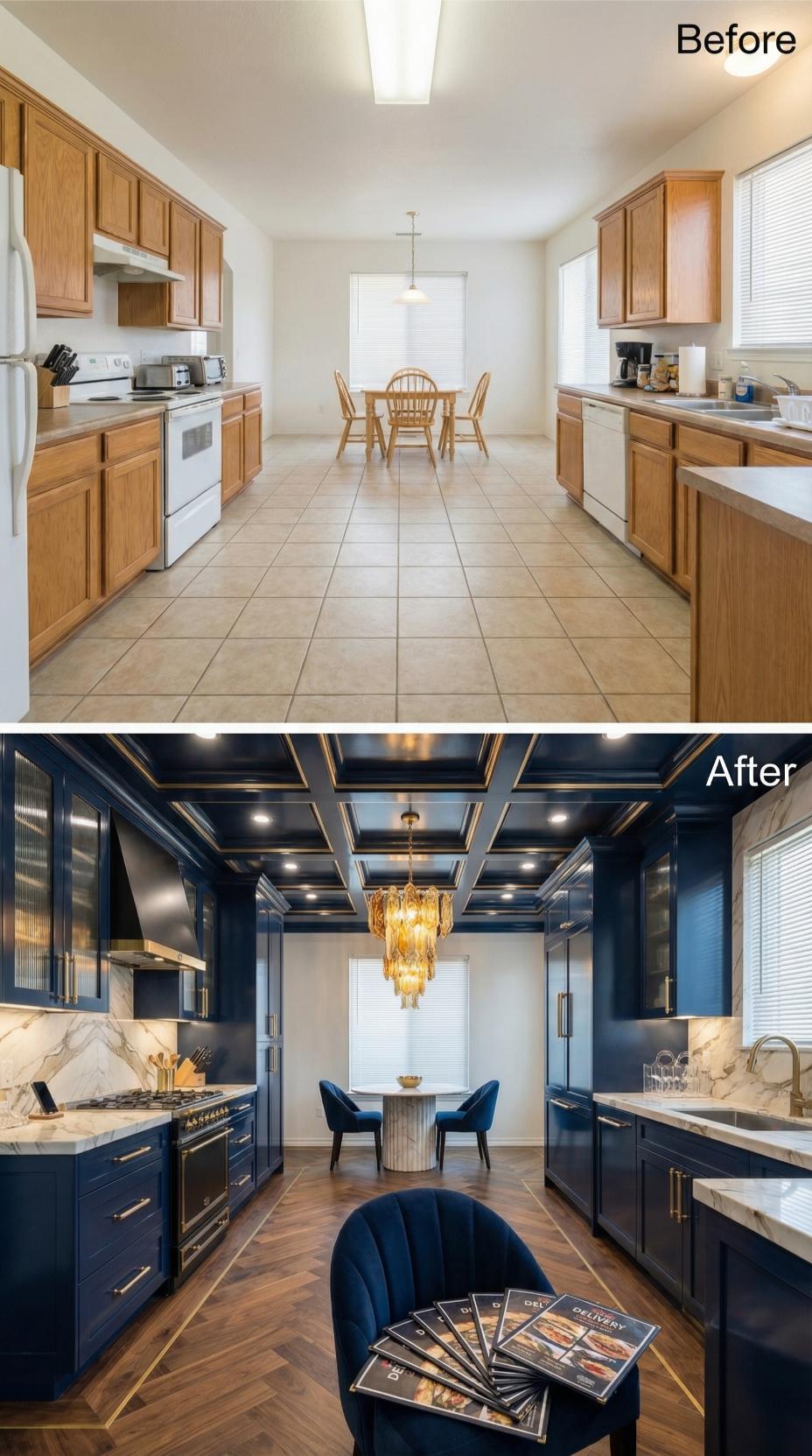
Flat-front honey oak cabinets and beige ceramic tile gave way to high-gloss navy cabinetry with brass bar pulls, marble slab backsplash, and a herringbone parquet floor with gold inlay borders. A coffered ceiling painted the same deep navy adds architectural weight the original flat drywall never had. The pendant light is now a tiered amber glass chandelier, and a compact round marble dining table with navy velvet chairs replaced the four-piece oak dinette set.
24. Honey Oak Cabinets Gone, Exposed Black Beams and Zellige Tile Take Over
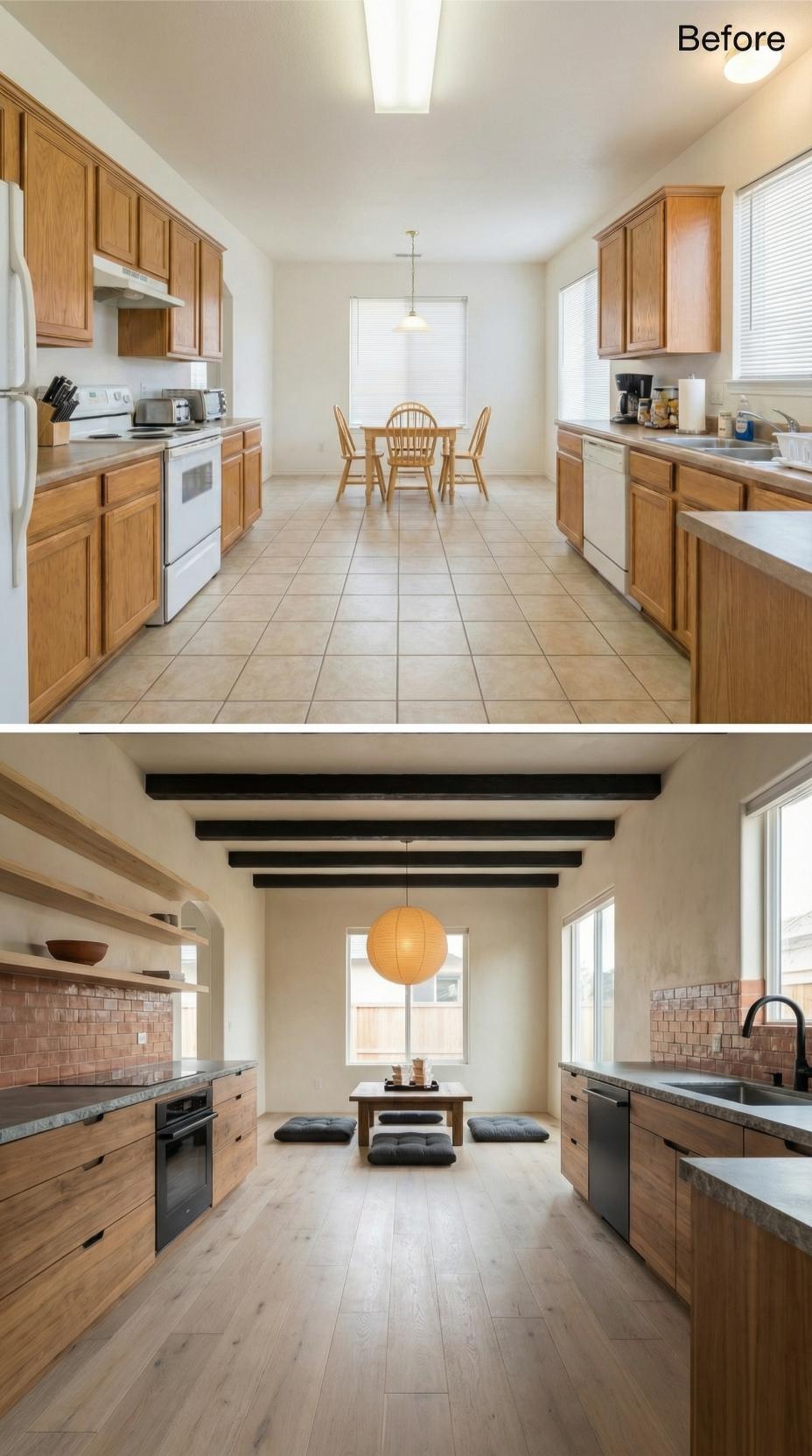
Where builder-grade oak upper cabinets once crowded the ceiling, black-painted exposed beams now run the length of the room, pulling the eye upward and adding weight without bulk. The lowers are rift-cut oak in a warm amber tone, paired with concrete-look countertops and a handmade terracotta zellige backsplash in a running brick pattern. Hardware is matte black throughout.
The white tile floor gave way to wide-plank light oak hardwood, and the dining area swapped a Windsor chair set for a low Japanese-style table with square charcoal floor cushions. A paper lantern pendant in amber replaces the brass builder fixture, casting soft diffused light across the plaster-finish walls.
23. Dark Slat Ceiling and Edison Cage Pendant Replace Flush Fluorescent Box
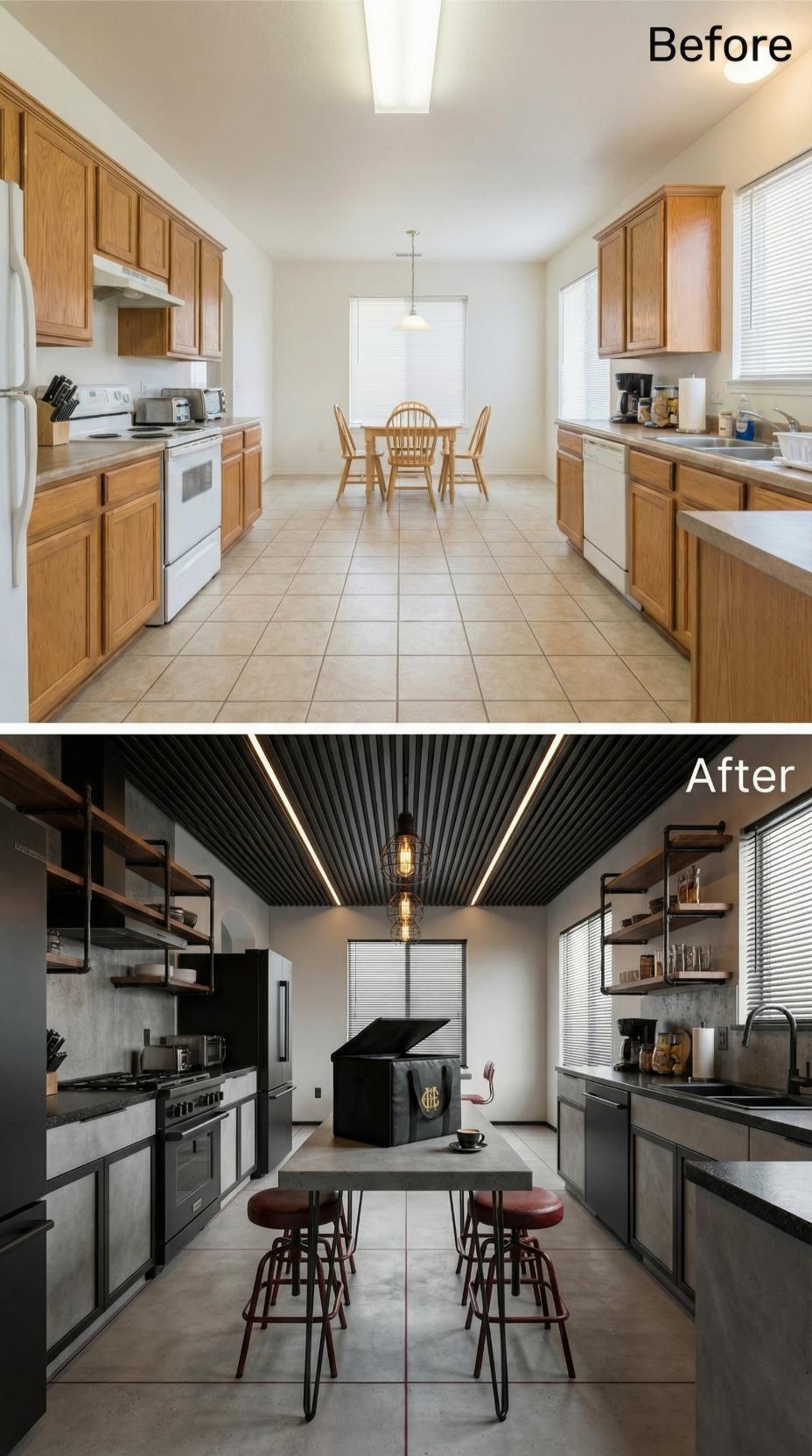
Black-painted tongue-and-groove slat ceiling with recessed LED strip lighting swaps out the honey oak cabinets for dark gray flat-front lowers and open pipe-bracket shelving. A concrete-topped island with hairpin legs and red leather bar stools anchors the center.
22. Burgundy Lacquer and Plaster Ceiling Medallions Buried the Builder Oak Completely
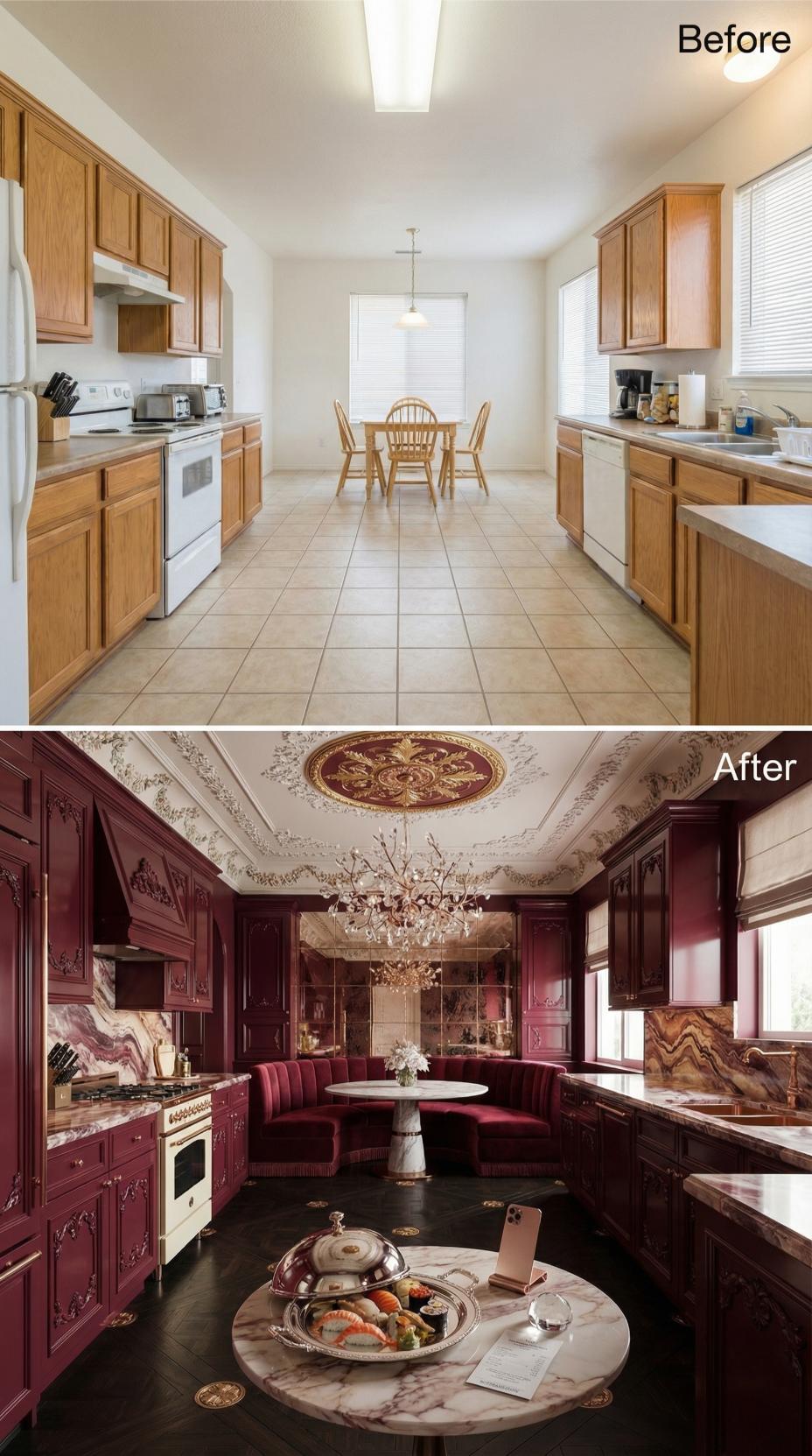
Carved wood cabinet faces in deep burgundy lacquer replaced every flat honey oak door, while a plaster ceiling loaded with floral relief work and a gilded central medallion took over what was once a plain white surface. A curved velvet banquette in crimson anchors the dining end, surrounding a marble pedestal table. Dark hardwood flooring and swirled onyx countertops finish the shift.
- Gilded ceiling medallion with painted floral surround replaces flat fluorescent panel
- Curved velvet banquette replaces four spindle-back Windsor chairs
- Swirled onyx backslab replaces laminate countertop on both runs
21. Sage Green Cabinets and Plaster Ceiling Vines Erased Every Trace of Honey Oak
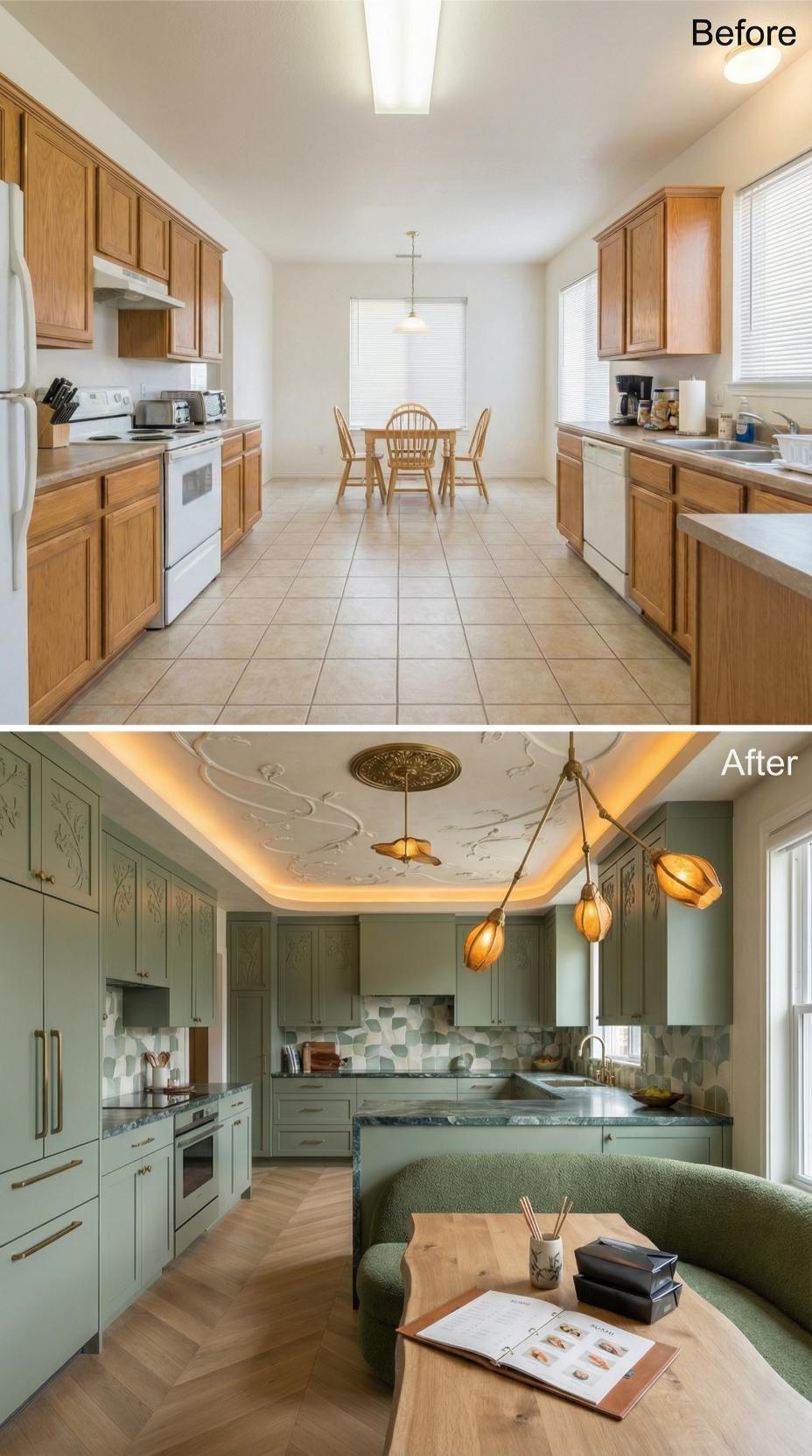
Sage green shaker cabinets with brass pulls line both walls, and hand-carved botanical details on the upper doors push the finish well past a simple paint job. The countertops read as green-veined marble, and the backsplash runs a geometric pattern in soft celadon and white. Herringbone oak flooring replaced the original beige tile entirely.
A tray ceiling frames the room with warm amber cove lighting, and at its center sits a plaster relief of trailing vines anchored by a gold medallion. Three amber glass pendants hang from a single brass cord cluster. A curved bouclé banquette in forest green grounds the dining end of the kitchen.
Trend Alert: Plaster ceiling relief is gaining ground as a high-impact alternative to coffered or beamed ceilings, particularly in kitchens where texture overhead reads as architectural investment rather than afterthought. Paired with cove lighting, the effect adds depth without consuming vertical space. Ornamental plaster suppliers have reported a measurable uptick in residential orders since 2022.
Plaster relief on the ceiling proved so effective that the next kitchen doubled down on the same move.
20. Sage Green Cabinets With Botanical Relief Get the Last Word Over Honey Oak
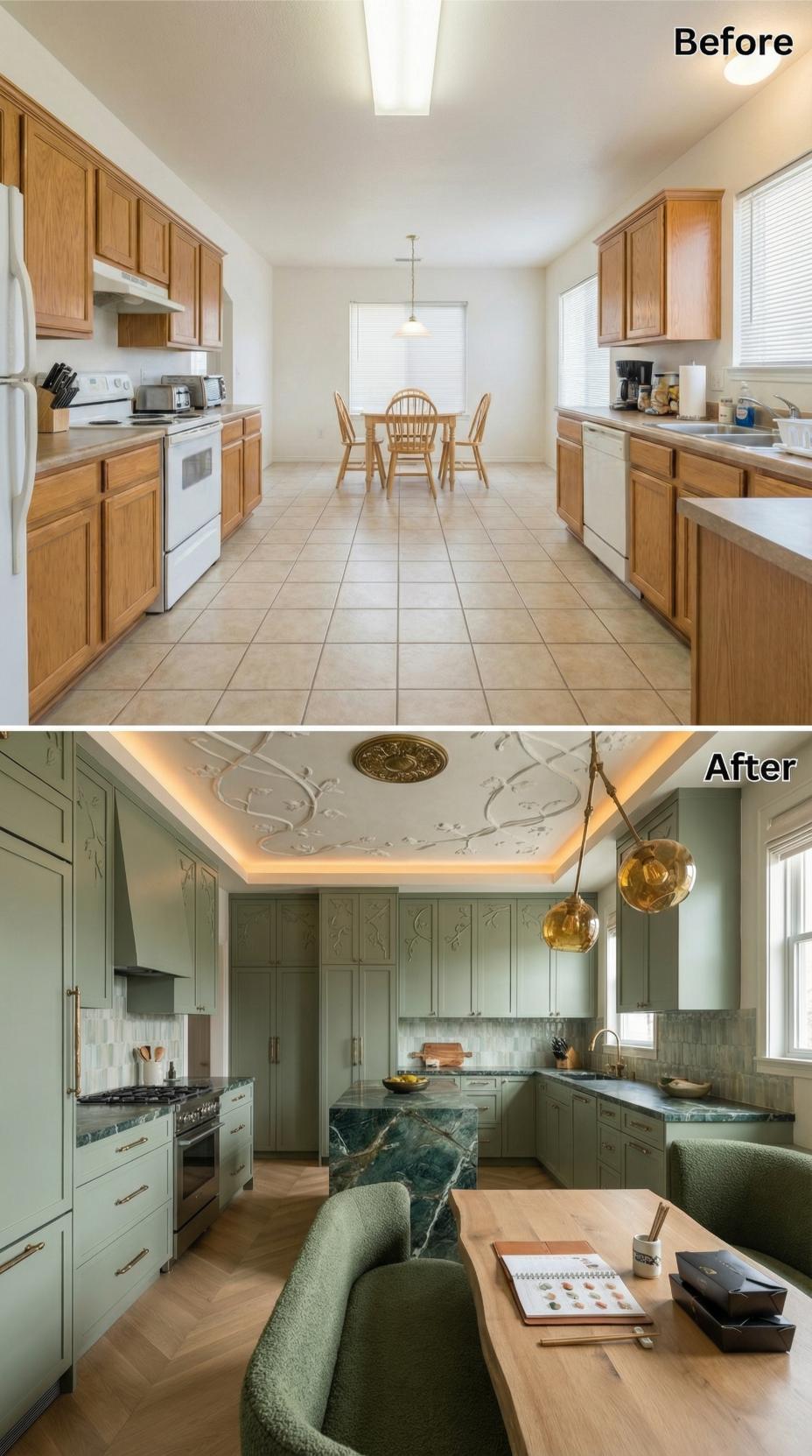
Inset cabinet doors painted in muted sage green run floor to ceiling, with brushed brass bar pulls adding warmth against the cool finish. A tray ceiling frames hand-applied plaster vines and a gilded medallion at center, lit from behind by recessed LED cove lighting. Dark green marble with gold veining wraps the island base. Amber blown-glass globe pendants hang on rope cord above a butcher block dining table surrounded by boucle armchairs in forest green.
19. Matte Black Cabinets and Tufted Leather Banquette Buried the Beige Tile for Good
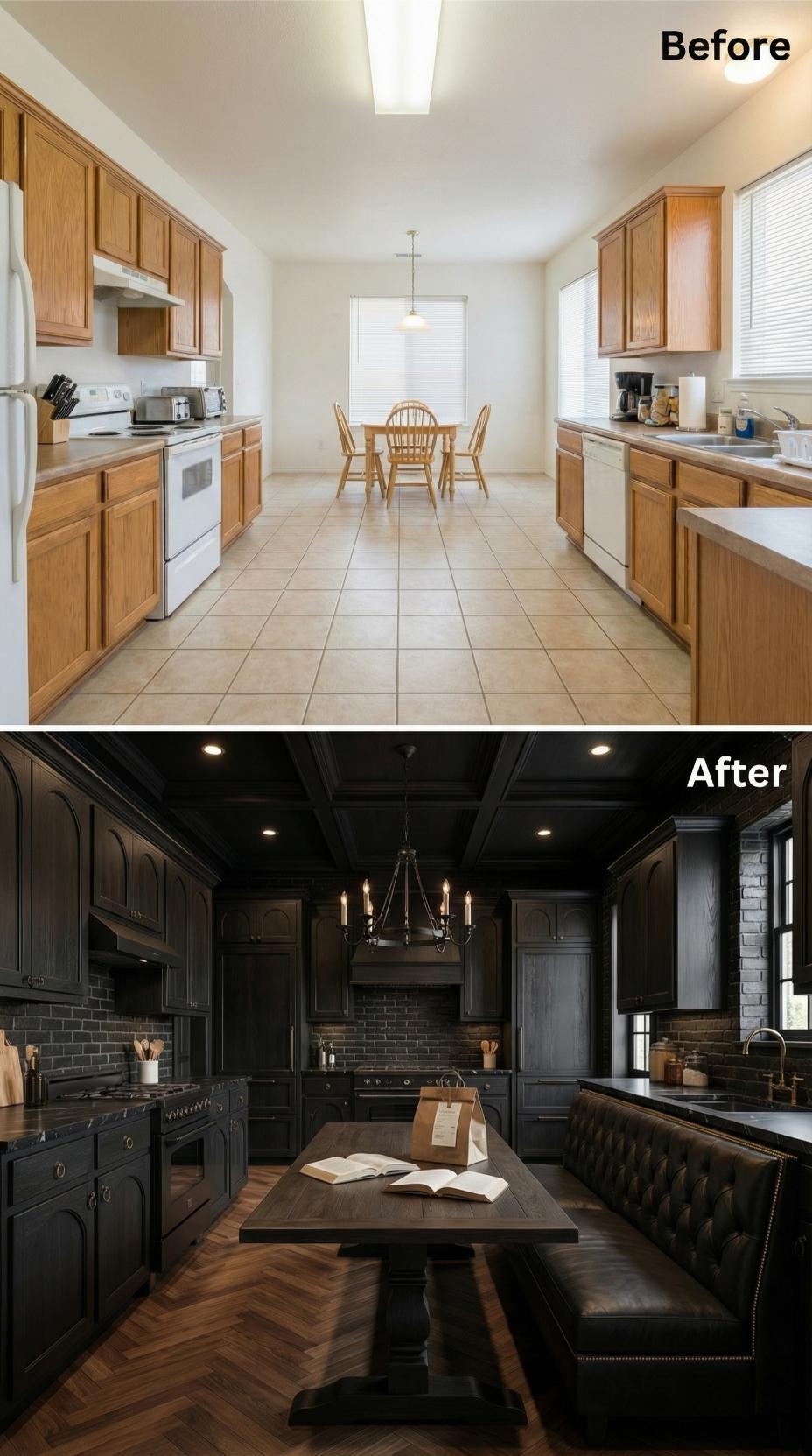
Honey oak and cream grout gave way to floor-to-ceiling matte black cabinetry with raised-arch door profiles and brass ring pulls. The walls behind the range got dark brick, painted black to blend with the hood surround. Herringbone hardwood replaced the large-format beige tile, running the full length of the galley.
The eating area shifted from a spindle-chair dinette to a farmhouse table paired with a tufted leather banquette in charcoal. An iron chandelier with exposed candle-style sockets hangs at center. Recessed ceiling cans handle the ambient load while the chandelier handles the drama.
Style Tip: Tufted leather seating requires more upkeep in a kitchen than performance fabric, but the payoff in visual weight is significant. If leather isn’t practical, a channel-tufted vinyl in a similar dark tone reads nearly identical from across the room and holds up against cooking splatter far better.
18. Teal Lower Cabinets and a Wood-Planked Ceiling Finished Off the Beige Tile Era
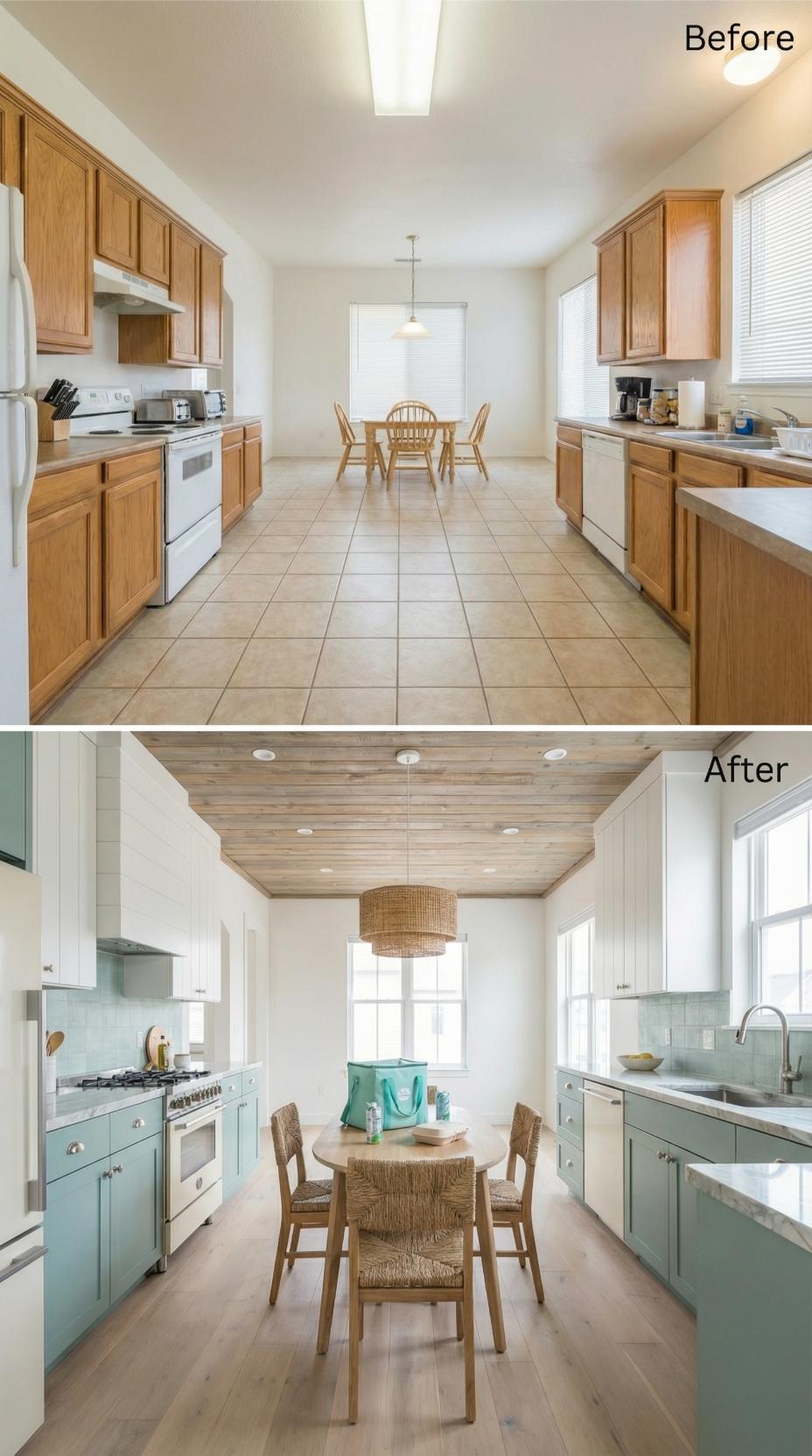
Soft teal lower cabinets paired with white shiplap uppers break the monotony that plagued the original honey oak-and-tile layout. The wood-planked ceiling adds warmth overhead without the formality of coffered millwork, and recessed lighting replaces the fluorescent box that once washed everything flat.
A woven drum pendant anchors the round dining table below, surrounded by rush-seat chairs in natural wood. Light wide-plank flooring runs the full length, and aqua glass subway tile on the backsplash ties the lower cabinet color back into the wall plane without forcing a match.
Why the Two-Tone Cabinet Strategy Works in a Long Galley Layout
Painting only the lower cabinets in teal while keeping the uppers white does more than add color. It visually lowers the room’s center of gravity, drawing the eye along the countertop line rather than up toward the ceiling, which helps a narrow galley read as grounded rather than tunnel-like. The marble-look countertop running across both sides reinforces that horizontal pull while keeping the upper half of the room light enough to breathe.
17. Forest Green Cabinets and Copper Hardware Erased the Honey Oak in One Move
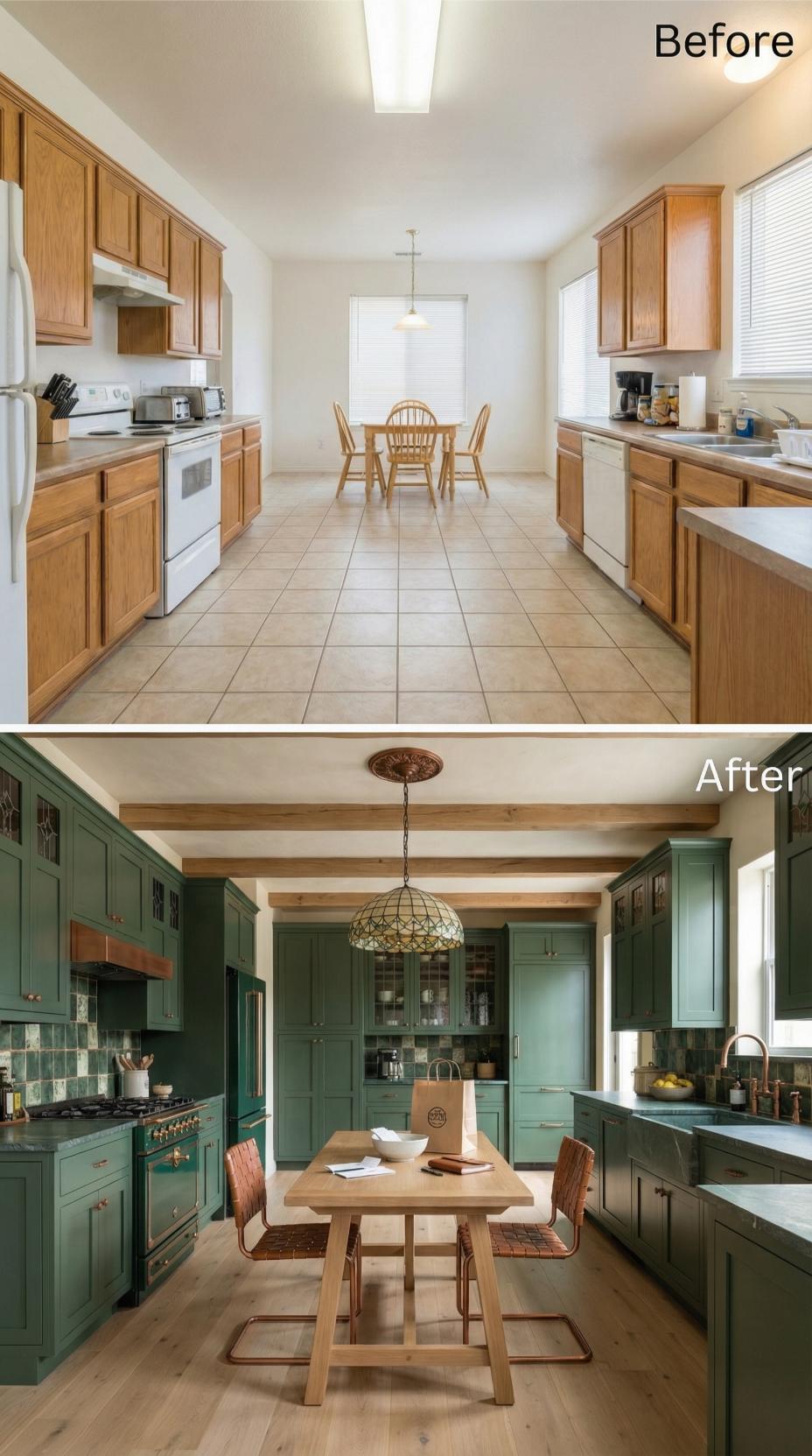
The after kitchen runs floor-to-ceiling in a deep forest green, applied to shaker-style cabinetry with recessed panel doors and copper bin-pull hardware throughout. Exposed wood ceiling beams break up the cream plaster overhead, anchored by a Tiffany-style pendant in green and amber slag glass. The range hood is clad in wood to match the beams, flanking a gas range finished in the same green as the cabinetry. A green ceramic tile backsplash in a staggered pattern carries the color behind the cooking zone and the copper gooseneck faucet at the sink.
A light oak trestle table with woven leather chairs sits at center, grounding the room without competing with the cabinetry. Wide-plank oak flooring replaced the builder beige tile, and the countertops read as a muted slate gray against all that green.
Color Story: Forest green cabinetry reads differently depending on its undertone. This particular shade pulls slightly teal, which keeps it from feeling too heavy against the cream plaster ceiling and natural wood accents. Pairing it with copper rather than brass hardware was a deliberate choice that leans the palette warmer without tipping into gold territory.
16. Exposed Ceiling Beams and Flat-Face Cabinetry Closed the Book on Honey Oak
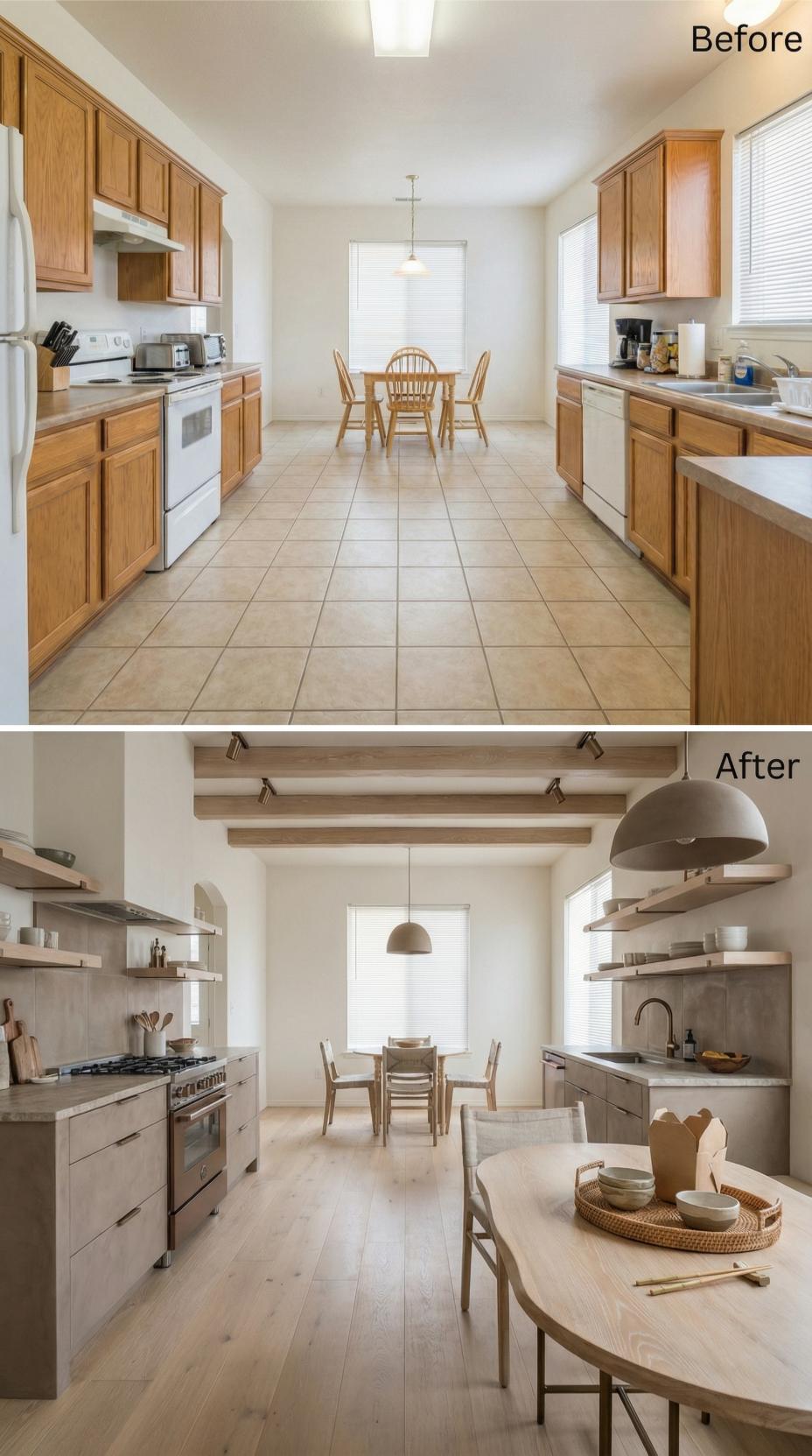
Light ash cabinetry with integrated pulls replaced the original honey oak boxes, and the countertops shifted to a honed concrete-look surface that reads warmer than polished stone. Open shelving in matching ash takes the place of upper cabinets entirely, leaving the walls to breathe. A dome pendant in matte putty clay hangs over the dining area, and track lighting mounted to the exposed wood beams handles task lighting without a single recessed can.
The floor swap from large-format beige tile to wide-plank white oak does more work than any other single change here. An oval dining table in raw ash anchors the foreground, styled with a rattan tray, ceramic bowls, and takeout containers that feel entirely at home in a kitchen designed around the idea that cooking is optional.
History Corner: Open shelving became a mainstream kitchen feature in the United States during the mid-2010s, partly driven by the farmhouse aesthetic popularized on home renovation television. Before that era, upper cabinets with solid doors dominated American kitchen design from roughly the 1950s onward, largely because closed storage was considered more practical for households that cooked daily.
15. Royal Blue Lacquer and a Mirrored Grid Ceiling Declared War on Beige Tile
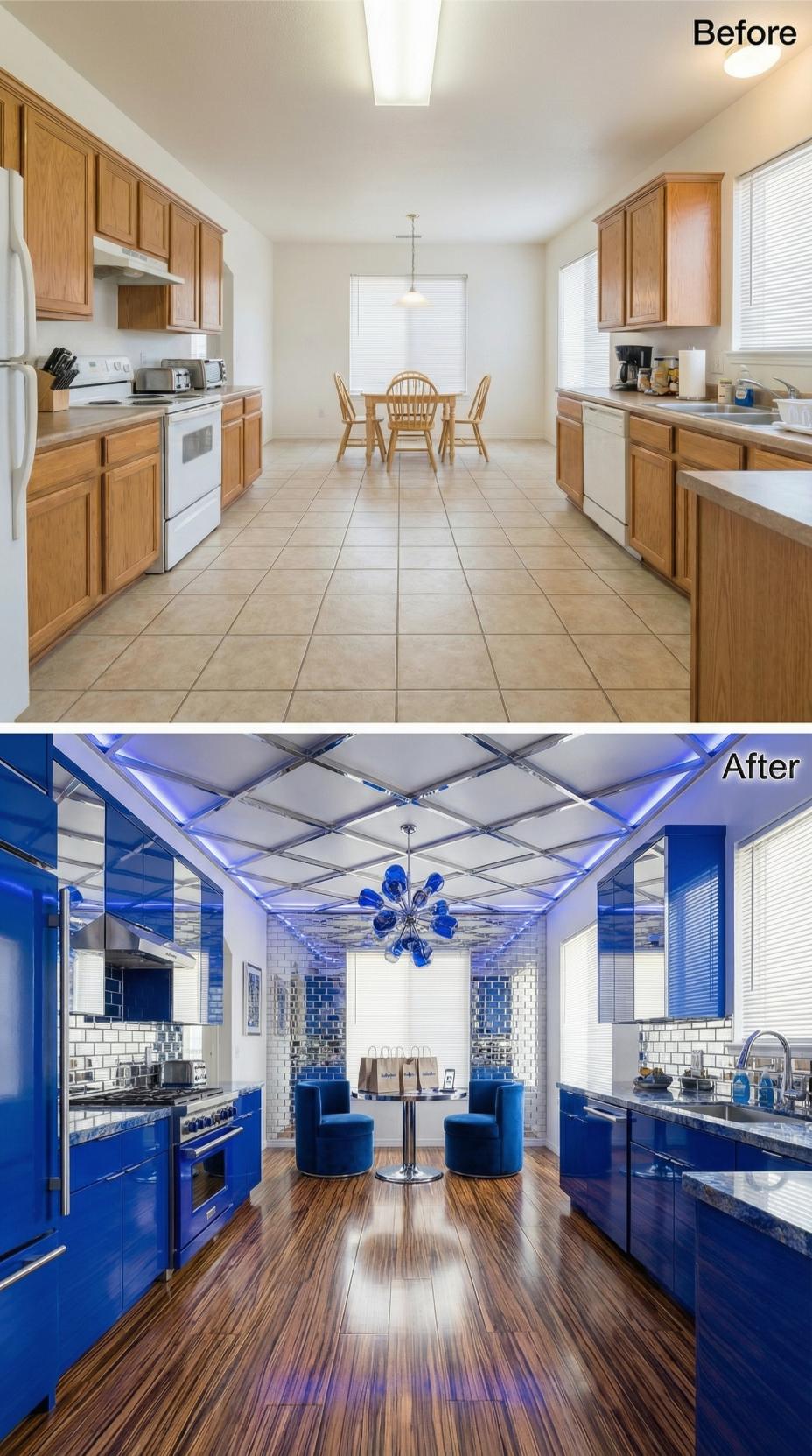
Cobalt gloss cabinets in a kitchen designed for someone whose oven has never once been preheated is either deeply ironic or completely logical.
Every cabinet face is wrapped in high-gloss royal blue lacquer with chrome pulls, and the countertops appear to be a blue-veined granite or engineered stone in a similar cool register. The original beige ceramic tile is gone, replaced by wide-plank flooring in a tiger-striped wood with heavy contrast between its light and dark grain lines. Overhead, a mirrored drop ceiling in a grid pattern bounces blue LED strip lighting across the entire room.
The dining area swapped the oak table-and-chair set for two velvet barrel chairs in cobalt and a chrome pedestal bistro table. A sputnik-style chandelier with blue glass globes hangs at center. Mirror-finish subway tile runs the backsplash on the far wall, and a commercial-style range with a low-profile steel hood anchors the cooking side that, statistically speaking, will see very little use.
14. Terracotta Cabinets and Blue Velvet Dining Chairs Finished What Honey Oak Started
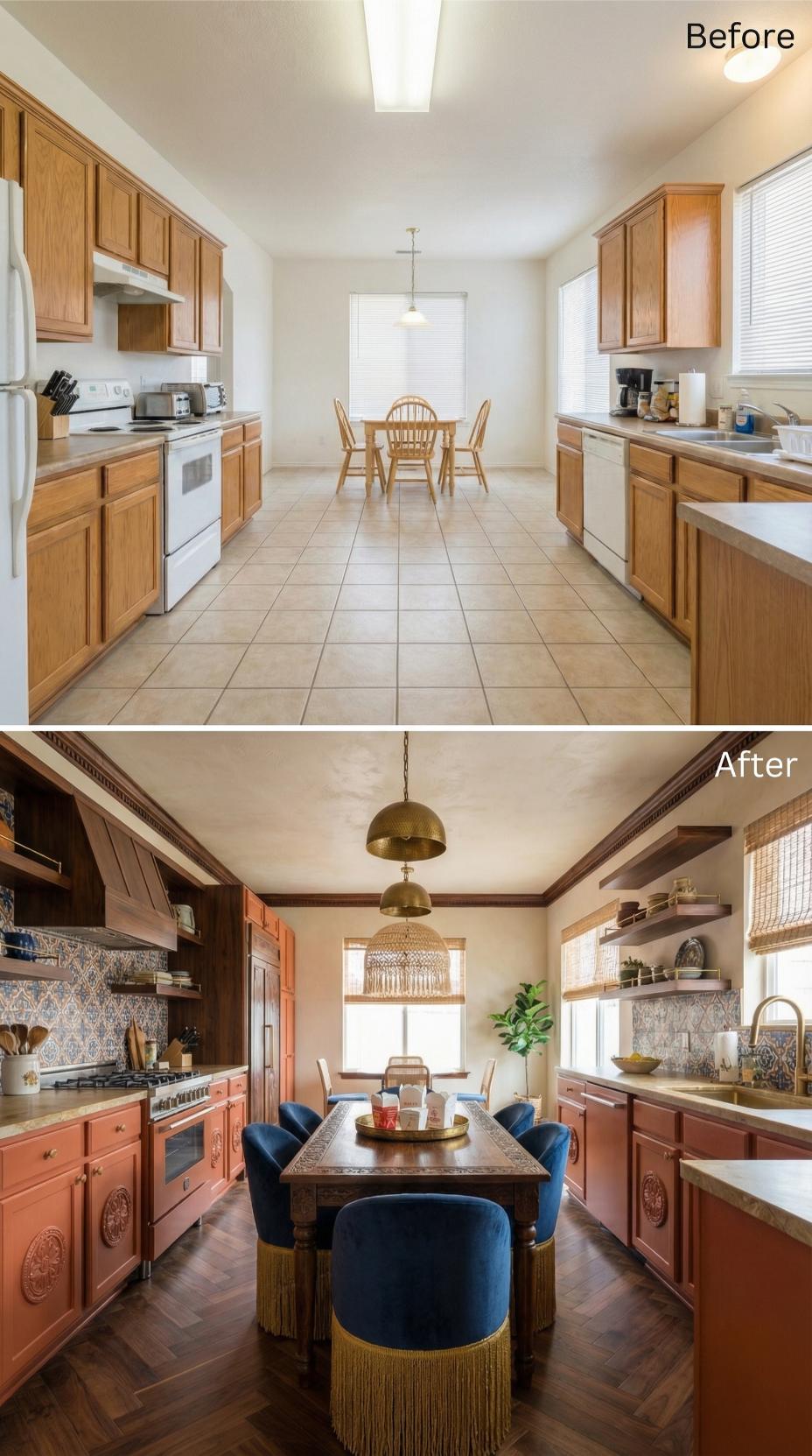
Painted in a deep terracotta with carved medallion details on the lower cabinet doors, the cabinetry reads closer to fired clay than standard paint. Brass cup pulls carry through to a hammered brass dome pendant overhead, while a macramé chandelier hangs above the dining area, layering two lighting moments in the same sightline. Blue velvet chairs with gold fringe trim the base of a dark wood dining table that replaced the blond Windsor set entirely. Patterned blue-and-white tile runs the full backsplash on both walls, and open wood shelving replaces the upper cabinet run on the right side.
Two lighting moments in the same sightline create depth that a single fixture never could.
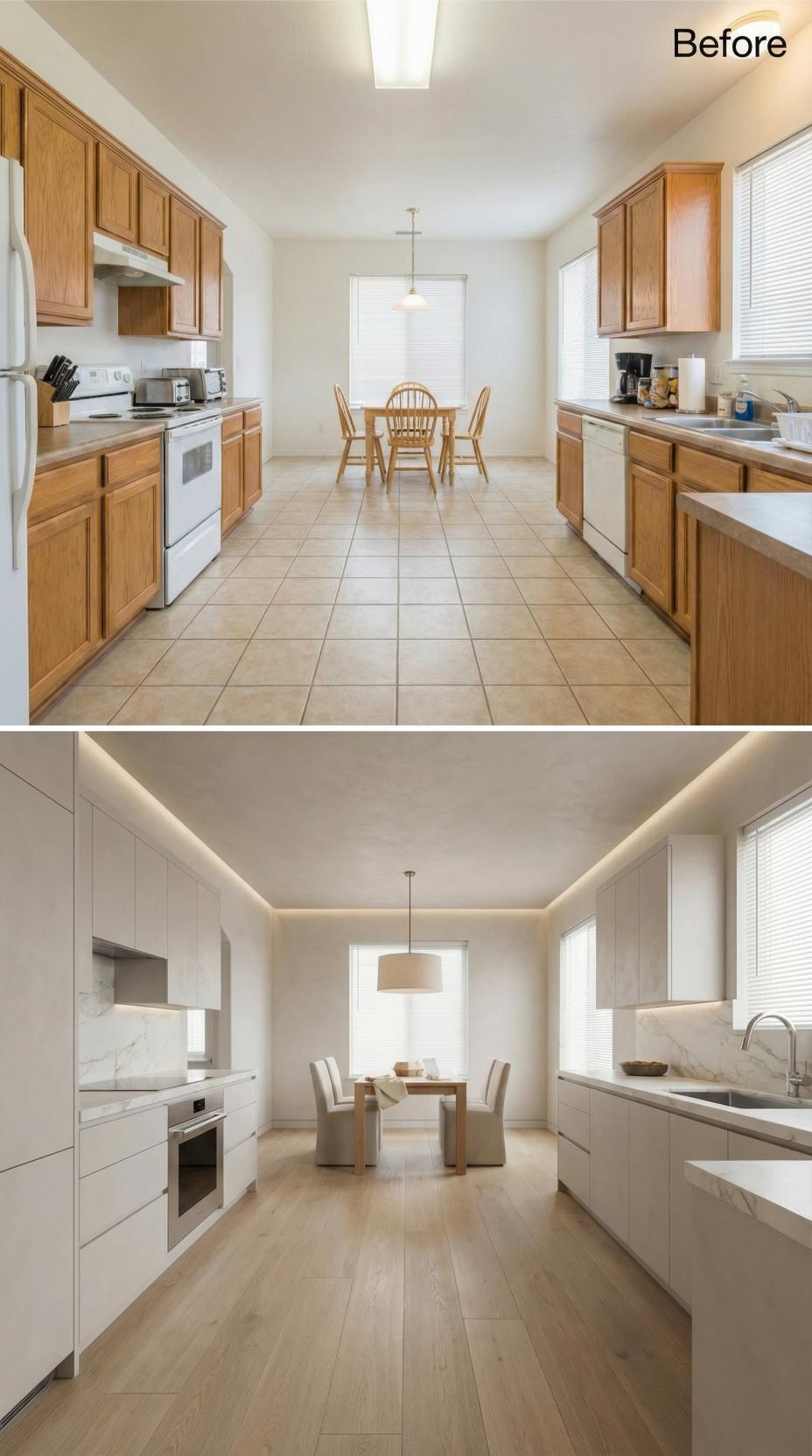
13. Flat-Face White Cabinetry and Cove Lighting Swept the Honey Oak Out Completely
🔥 Would you like to save this?
Warm oak and beige ceramic tile gave way to floor-to-ceiling handle-free cabinetry in a matte white finish, with LED cove lighting running the full perimeter where the cabinets meet the ceiling. Wide-plank blonde hardwood replaced the grout-heavy tile, and marble slab countertops carry the same pale veining on both sides of the galley run.
Why the Cove Lighting Placement Changes the Entire Spatial Read
Positioning LED strips at the top of tall cabinetry rather than in a dropped soffit pulls the eye upward and makes a standard ceiling height read as considerably taller. In this kitchen, the warm-white color temperature of the cove lighting was deliberately kept below 3000K to avoid washing out the matte cabinet finish with a yellow cast. That single decision is what keeps the all-white palette from feeling clinical rather than warm.
12. Cobalt Blue Appliances and a Checkerboard Ceiling Declared the Takeout Era Officially Over
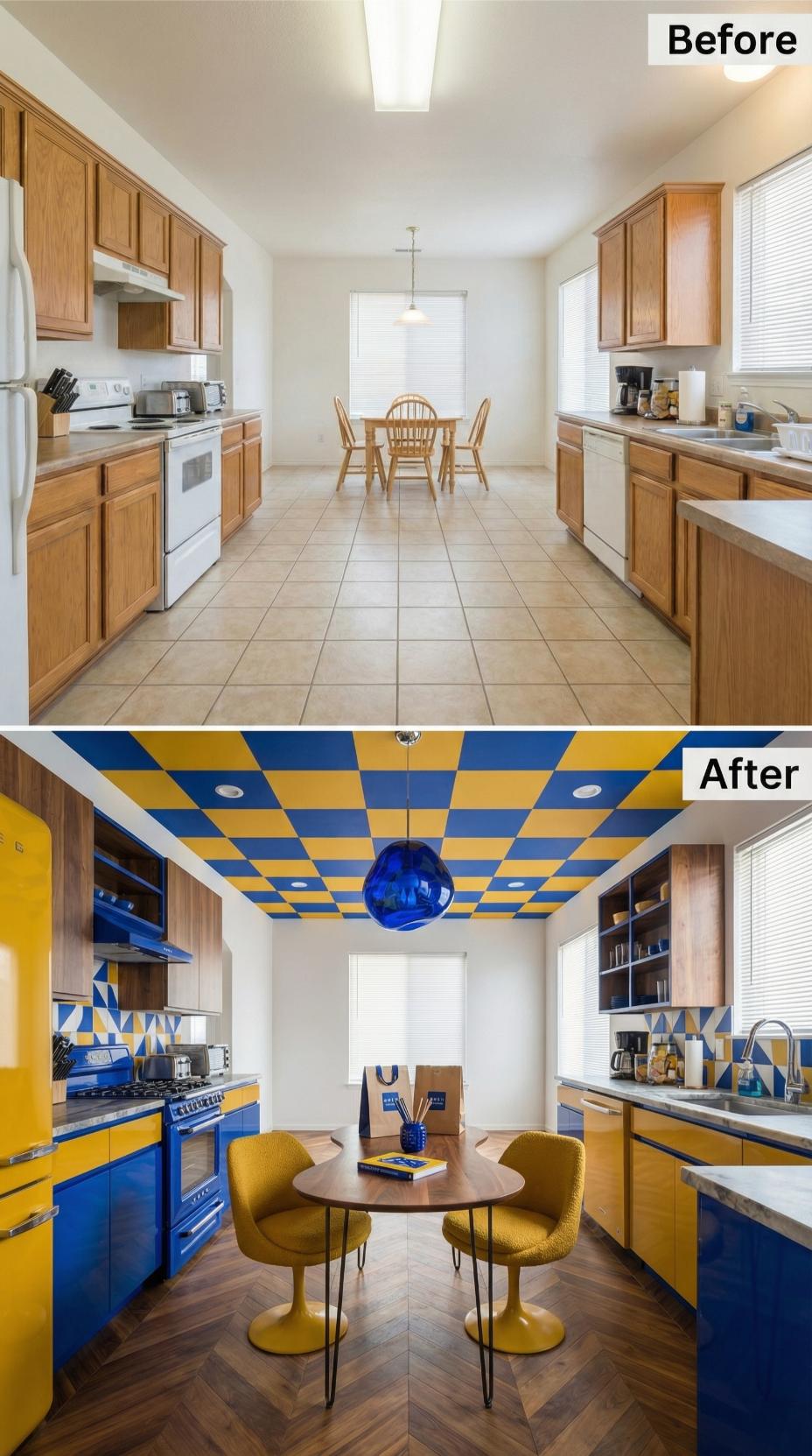
Builder oak and beige tile gave way to royal blue cabinetry paired with walnut-grain upper panels and a bold yellow-and-cobalt checkerboard ceiling that runs the full length of the room. A gas range and refrigerator finished in matching cobalt anchor the left wall, flanked by geometric blue-and-white backsplash tile in a triangular repeat pattern. Herringbone wood flooring replaced the original square tile, and a globe pendant in translucent cobalt glass drops from the ceiling’s center point above a hairpin-leg dining table ringed by mustard boucle tulip chairs.
Style Math: Checkerboard ceilings have roots in 17th-century Dutch interiors, where alternating painted panels were used to draw attention upward in rooms with low furniture. Applying that logic to a galley kitchen compresses the pattern and intensifies its visual effect considerably. Pairing it with a pendant in the same dominant color, as done here with the cobalt glass globe, locks the ceiling and the room together rather than letting the pattern read as a separate decorative decision.
11. Copper Appliances and a Rosy Plaster Ceiling Buried the Oak-and-Tile Combo
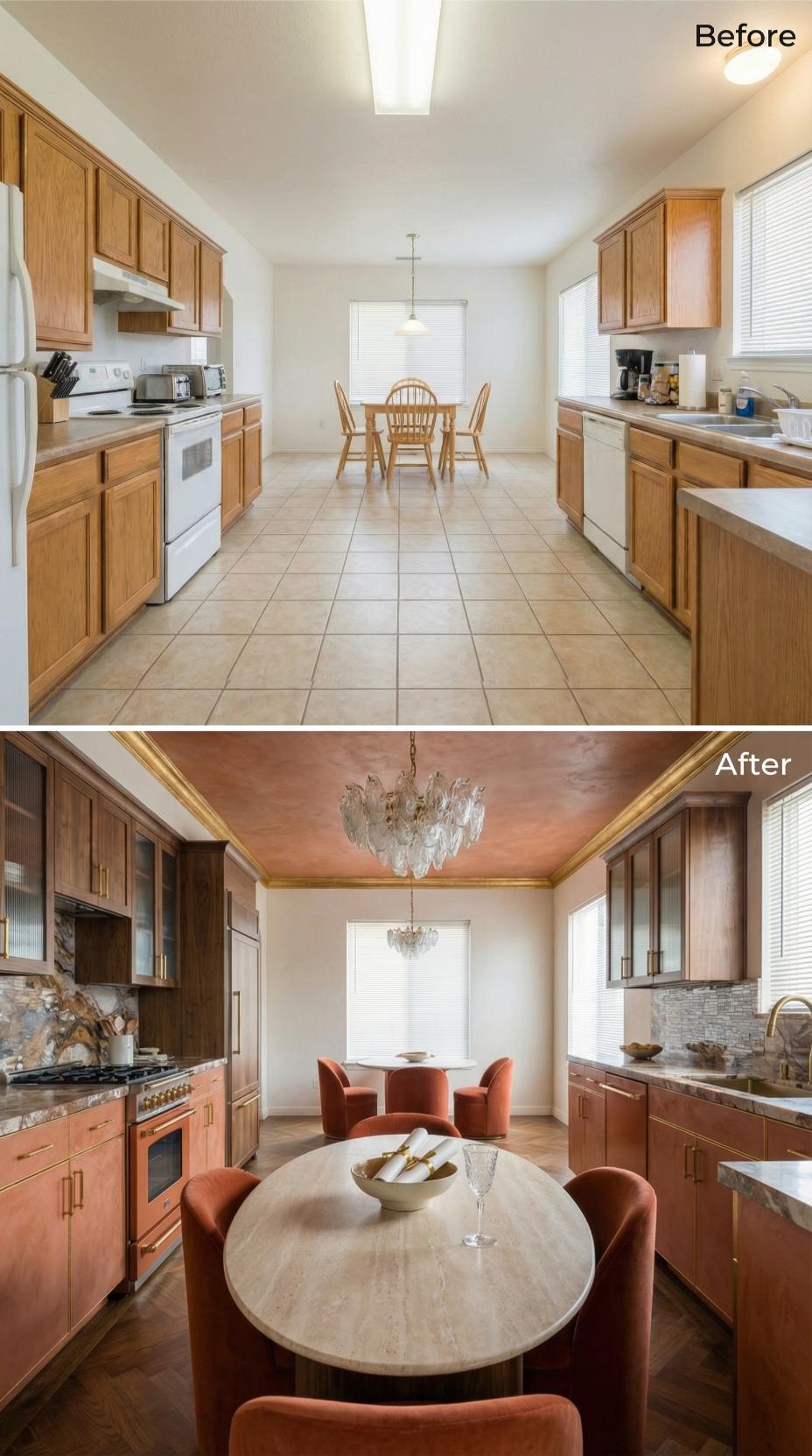
Dark walnut cabinetry with ribbed glass uppers replaced the flat honey oak doors, while a terracotta-washed plaster ceiling framed by gold crown molding pulls every surface into a warmer register. Velvet rust dining chairs surround a travertine-top round table, and a Murano-style glass chandelier hangs center above it all.
Try This: Murano-style glass chandeliers vary widely in price depending on whether the glass is hand-blown in Italy or manufactured elsewhere. Checking the vendor’s sourcing documentation before purchase can save significant cost without sacrificing the visual effect. Replicas made with machine-formed glass still catch light convincingly in a space this warm-toned.
10. Exposed Beams and Brick Backsplash Pulled This Kitchen Out of the Takeout Drawer
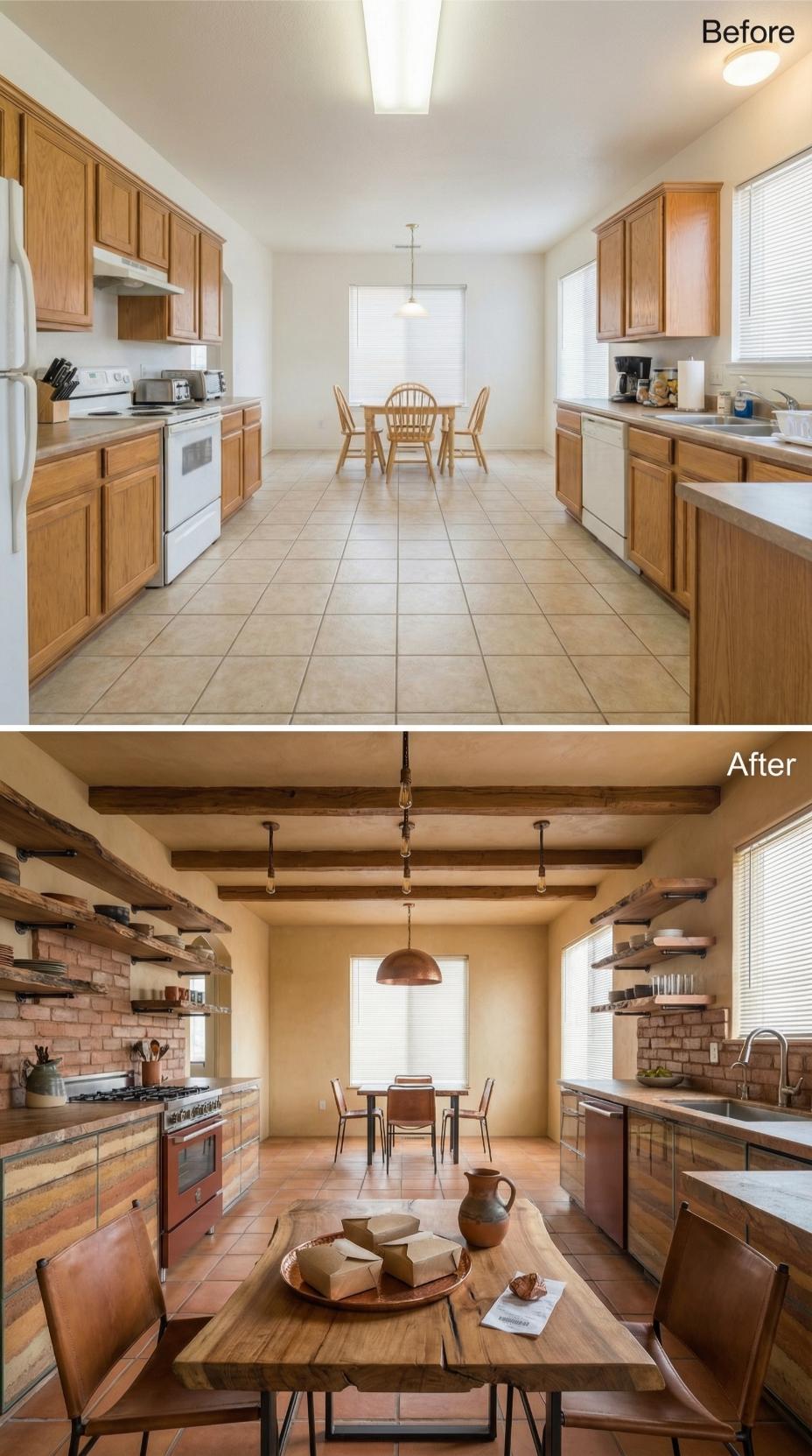
Raw wood ceiling beams anchor the after photo in a way that fluorescent tube lighting never could. The plaster walls shift to a warm sand tone, replacing flat white with something that actually holds the afternoon light. Open shelves cut from what appears to be reclaimed hardwood replace upper cabinets entirely, and a brick backsplash runs the full length of both walls behind the cooking zone. The range swaps white enamel for a red-accented gas model, and a copper pendant drops over the dining area.
A live-edge wood table with hairpin legs now occupies the center of the room. Leather dining chairs in a cognac tone ring it, and a terracotta jug sits on the surface beside a shallow wooden bowl. The floor tile stays, but terracotta-toned grout lines read completely differently against the new palette.
Fun Fact: Adobe-style plaster walls, sometimes called tadelakt or lime plaster, have been used in North African and Southwestern American architecture for centuries as a natural insulator. Modern applications in kitchens often use synthetic alternatives that mimic the texture without the curing time. The sand-toned finish visible here likely required tinting in multiple layers to achieve that depth of color.
9. Hot Pink Lacquer Cabinets and a Mirrored Coffered Ceiling Wiped Out Oak Completely
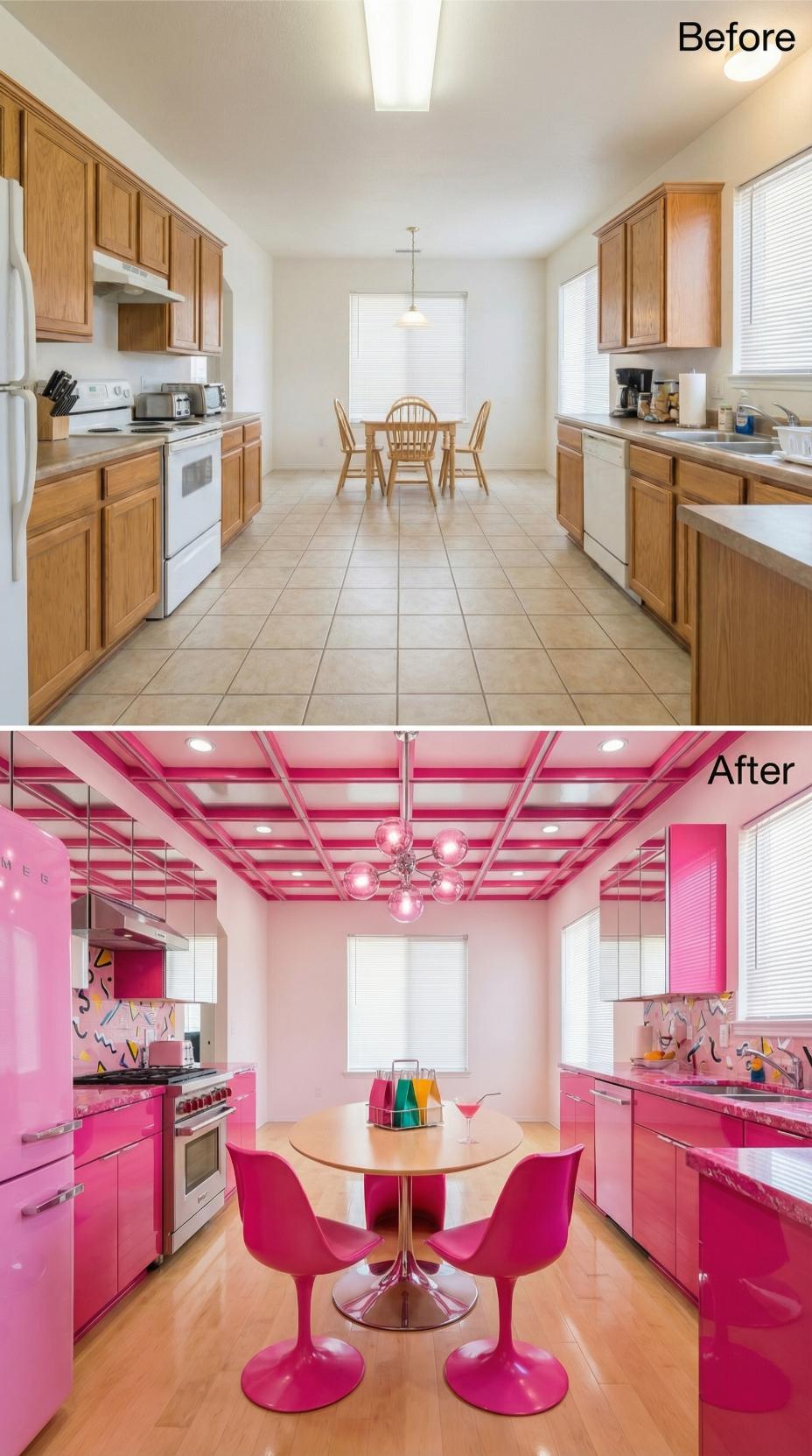
Glossy hot pink cabinetry runs floor to ceiling on both sides, paired with a pink-veined marble countertop and a geometric backsplash in multicolor Memphis-style print. Overhead, a mirrored coffered ceiling with magenta beams reflects a chrome globe chandelier downward, compressing the space into something almost theatrical. Tulip chairs in matching fuchsia pull up to a pedestal dining table in natural maple.
Why It Works: Memphis Group pattern, originating in 1980s Milan under designer Ettore Sottsass, used exactly this kind of irregular geometric print in bold colors as a deliberate rejection of minimalism. Pairing it with mirrored surfaces multiplies the visual chaos in a way that reads as intentional rather than accidental, which is what separates a committed design choice from a bad one. Pink refrigerators with retro rounded bodies, like the Smeg FAB series visible here, have become a reliable anchor for maximalist kitchens because their silhouette reads as sculptural rather than purely functional.
8. Slate Blue Drawers and a Slatted Wood Ceiling Retired the Honey Oak for Good
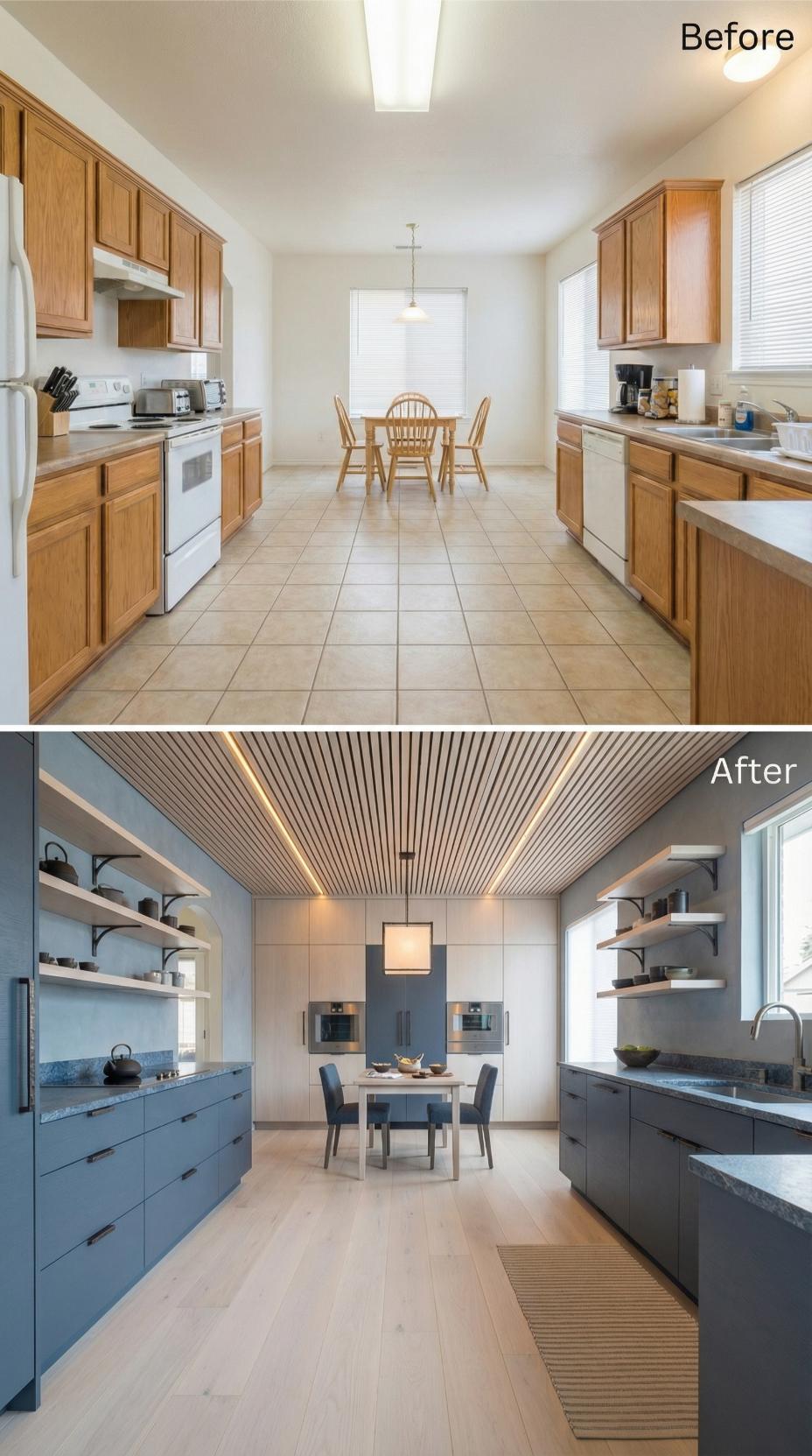
Flat-face cabinetry in a muted slate blue replaced the raised-panel oak on both walls, paired with granite-look countertops and black bar pulls. Light oak plank flooring swapped out the beige ceramic tile, and a slatted wood ceiling with recessed LED strips runs the full length of the room. Open shelves on bracketed supports replaced upper cabinets entirely.
Common Mistake: Replacing upper cabinets with open shelving looks intentional only when the objects on those shelves are edited down to a single layer of items per shelf. Most people load them like closed cabinets, which defeats the visual purpose entirely and makes the kitchen feel cluttered rather than considered.
7. Scored Terracotta Cabinetry and Exposed Ceiling Beams Retired the Honey Oak Permanently
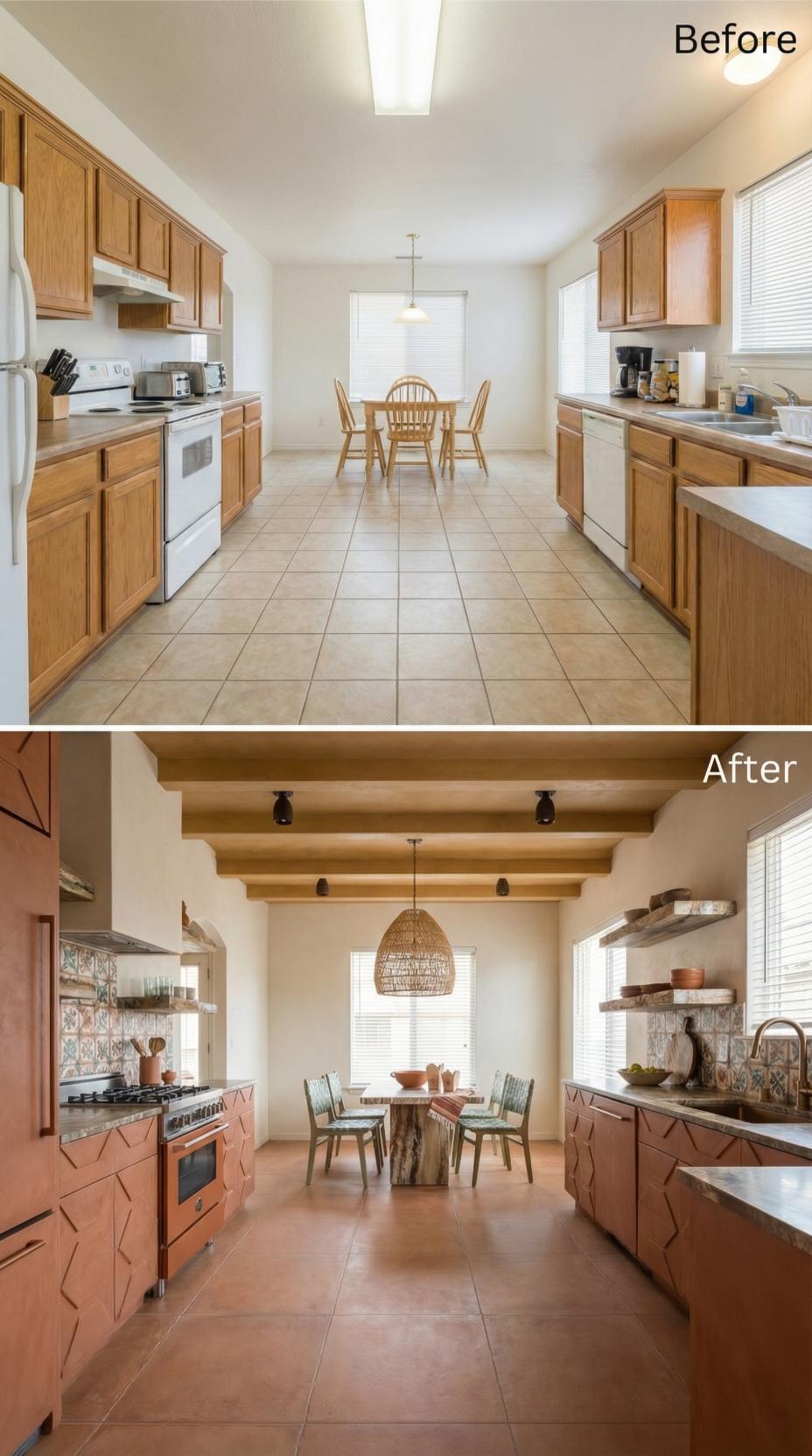
Geometric scoring cut directly into the terracotta-stained cabinet faces does more visual work than any hardware could. Upper cabinets disappeared entirely on both sides, replaced by floating shelves in what appears to be reclaimed wood with a rough-sawn edge. Colorful hand-painted Talavera-style tile covers the backsplash behind the range, and a woven rattan pendant drops over a stone-slab dining table. Terracotta floor tile, larger format than the original beige squares, grounds the whole room without competing.
Ask Yourself: Before committing to open shelving on both sides of a galley kitchen, consider what happens to the visual weight of the room when upper storage disappears completely. In this layout, the floating shelves succeed because they sit at different depths and carry only a few objects each. Crowding them would undo everything the scored cabinetry below is working to establish.
6. Exposed Ceiling Beams and Stone Backsplash Closed the Case on Honey Oak and Flat Tile
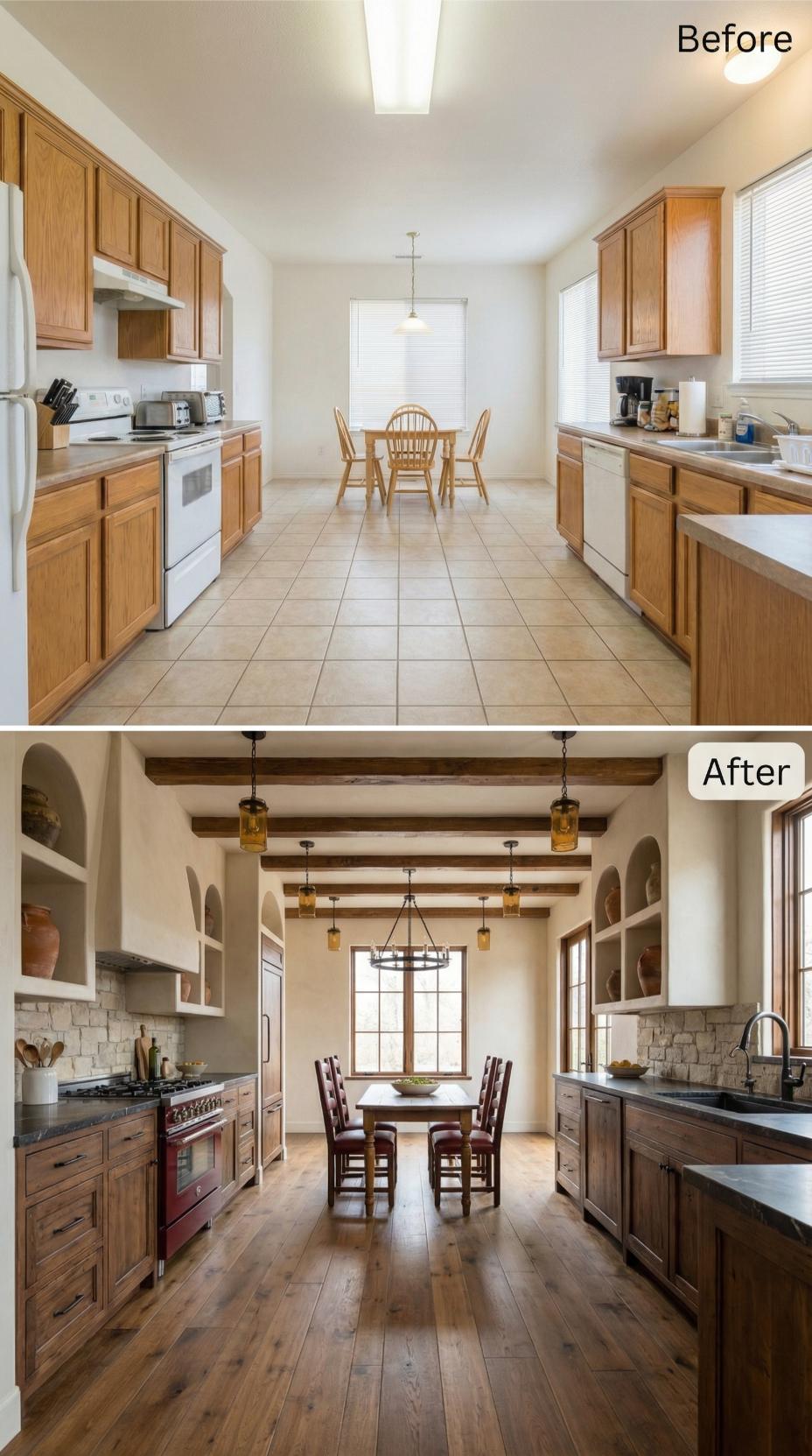
Rough-sawn wood beams span the ceiling in pairs, and amber glass pendant lights hang between them on long cords, casting a color that works with the warm plaster walls rather than against them. The upper cabinets are gone entirely, replaced by arched niches with curved plaster surrounds holding ceramic vessels. Below, the base cabinets are stained walnut with simple bar-pull hardware in a dark bronze finish. Soapstone countertops run both sides of the galley, and a stacked natural stone backsplash fills the wall behind a red range with commercial-style burners.
Wide-plank white oak flooring replaced the builder-grade ceramic tile, and the difference in visual weight alone is substantial. Stone tile reads flat under overhead fluorescents. Wide-plank oak under pendant lighting reads like a material with actual history. A wrought iron ring chandelier anchors the dining area, where leather-seated ladder-back chairs surround a rectangular table with a painted base.
5. Charcoal Cabinets and a Wood-Plank Ceiling Sent the Honey Oak Into Retirement
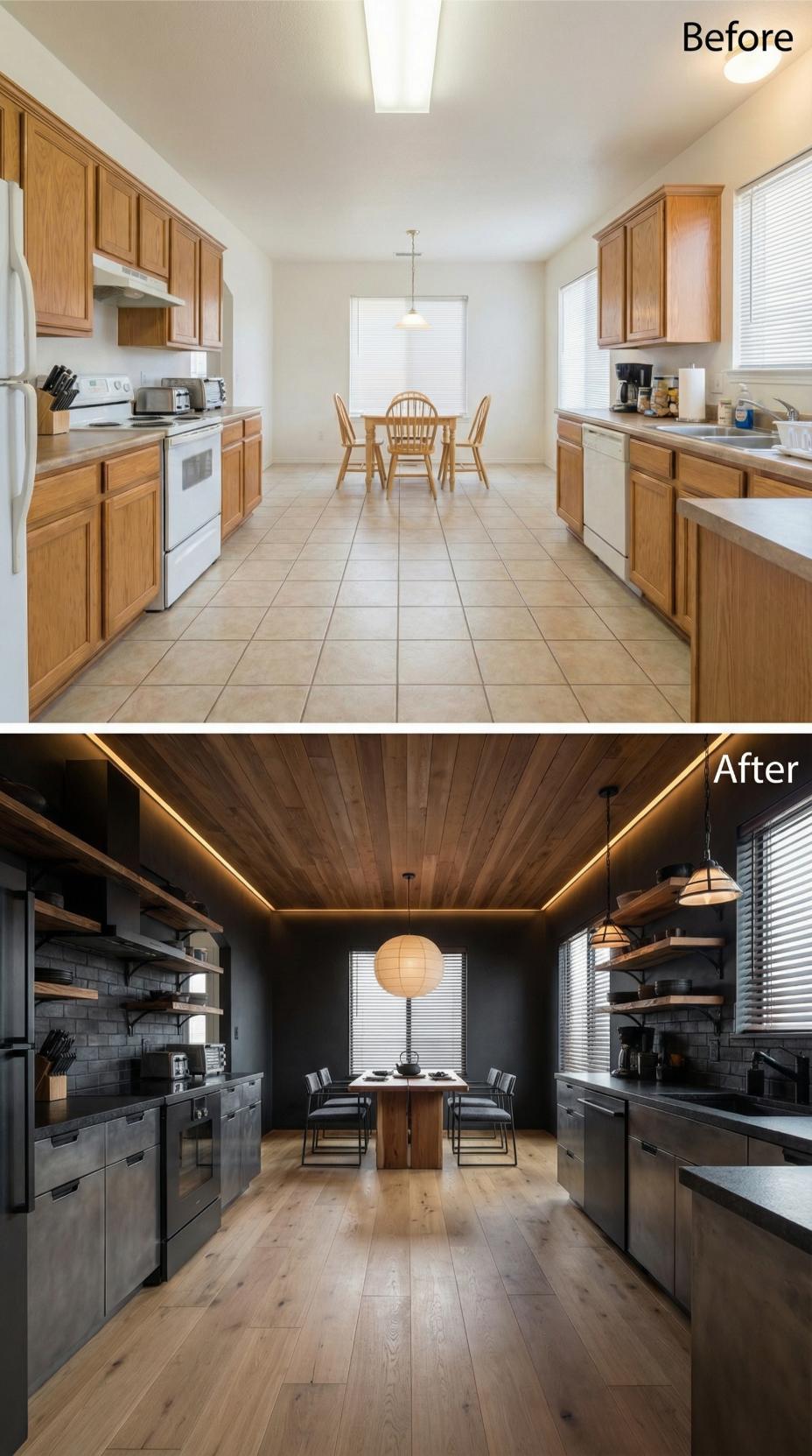
Matte black flat-panel cabinetry replaces the original honey oak on both sides of the galley, and the open shelving above it holds cookware with enough breathing room that nothing looks crammed. Wide-plank white oak flooring runs the full length of the space, anchoring the room in a way the large-format beige tile never could. Cove lighting tucked along the ceiling perimeter casts a warm band of amber across the tongue-and-groove wood planks above, which pulls the two materials into a single register. At the far end, a paper globe pendant hangs over a live-edge dining table paired with black metal chairs.
4. Coral Lacquer Cabinets and Cane Insets Replaced Every Oak Panel in Sight
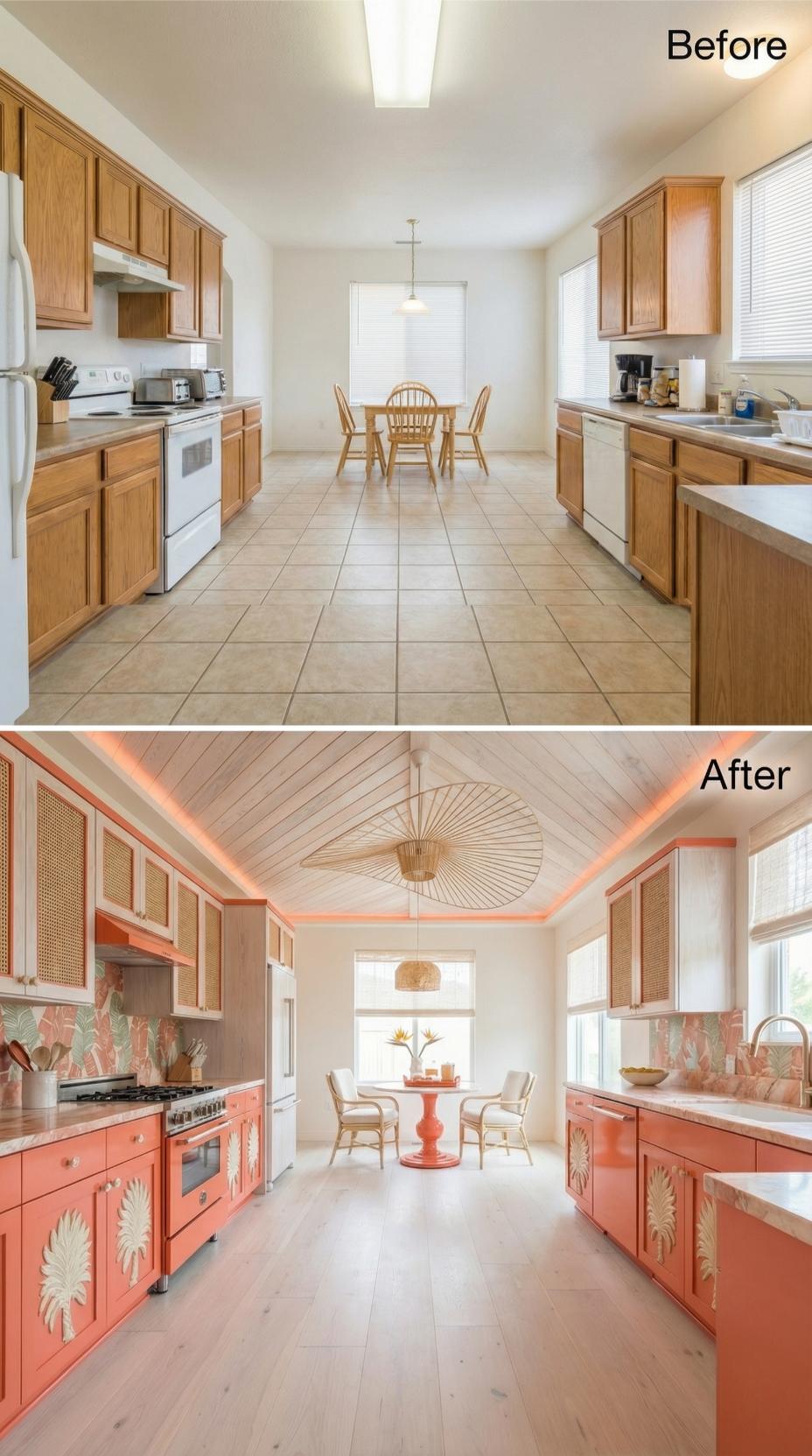
Coral-painted lower cabinets carry carved palm leaf reliefs on their flat fronts, while upper cabinets swap solid doors for rattan cane insets framed in matching coral. Whitewashed wide-plank flooring replaced the beige ceramic tile, and a shiplap ceiling with coral cove lighting overhead draws the eye up toward a rattan pendant. Tropical leaf wallpaper fills the backsplash zone behind the range.
3. Concrete Cabinetry and Steel Ceiling Beams Drove the Honey Oak Out for Good
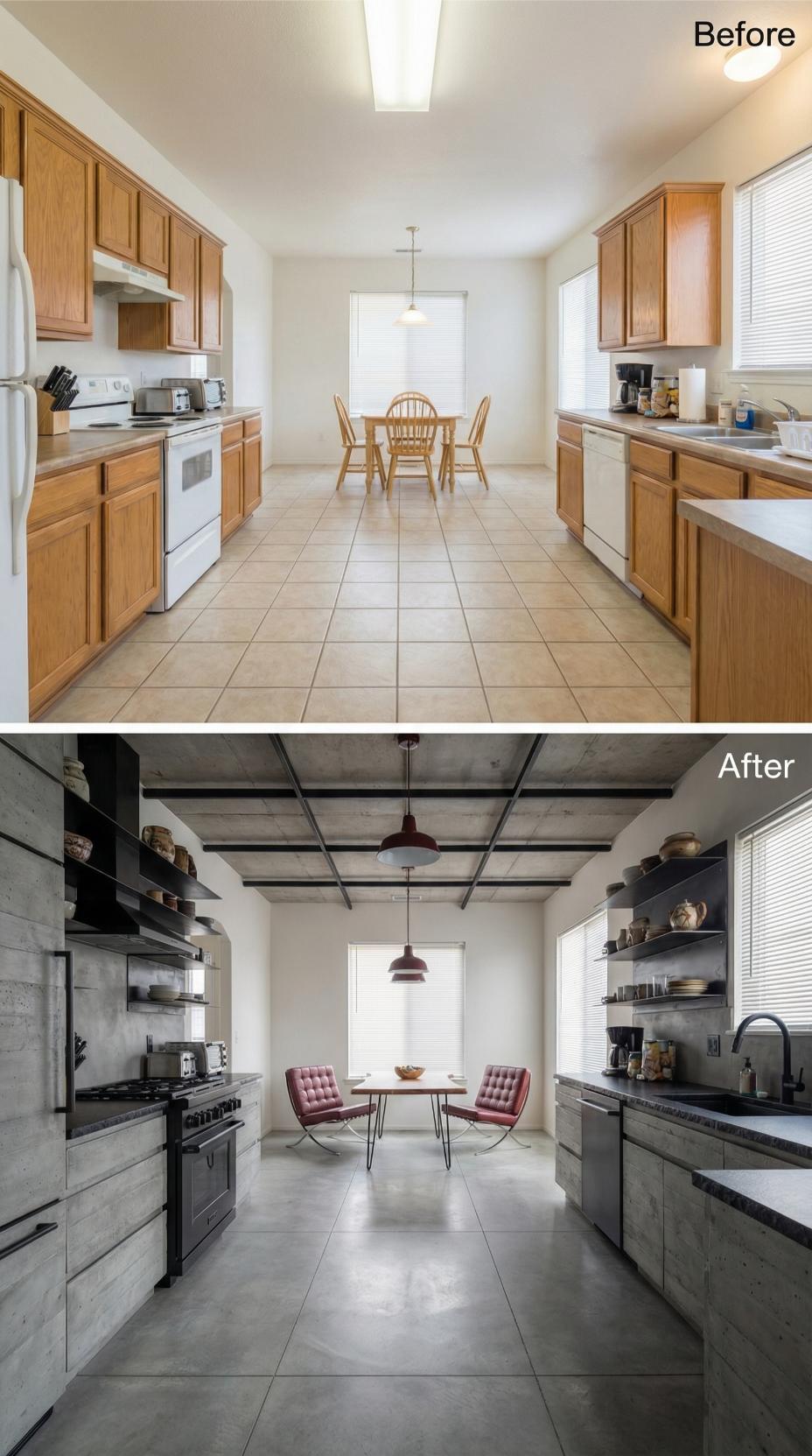
Poured-concrete cabinet fronts run floor to ceiling on both sides of the galley, finished with black bar pulls and topped with a dark stone countertop that reads almost black under the pendant lighting. The ceiling drops exposed steel I-beams across a concrete panel surface, a detail rarely attempted in residential kitchens outside of loft conversions.
Two Barcelona-style chairs in tufted red upholstery anchor the dining end, pulled up to a hairpin-leg table that sits low and spare. Red dome pendants hang at two heights above it, repeating the chair color without matching it exactly. The polished concrete floor reflects just enough light to keep the room from reading too heavy.
2. Navy Lacquer Cabinets and Gold Leaf Backsplash Finished Off the Oak-and-Tile Era
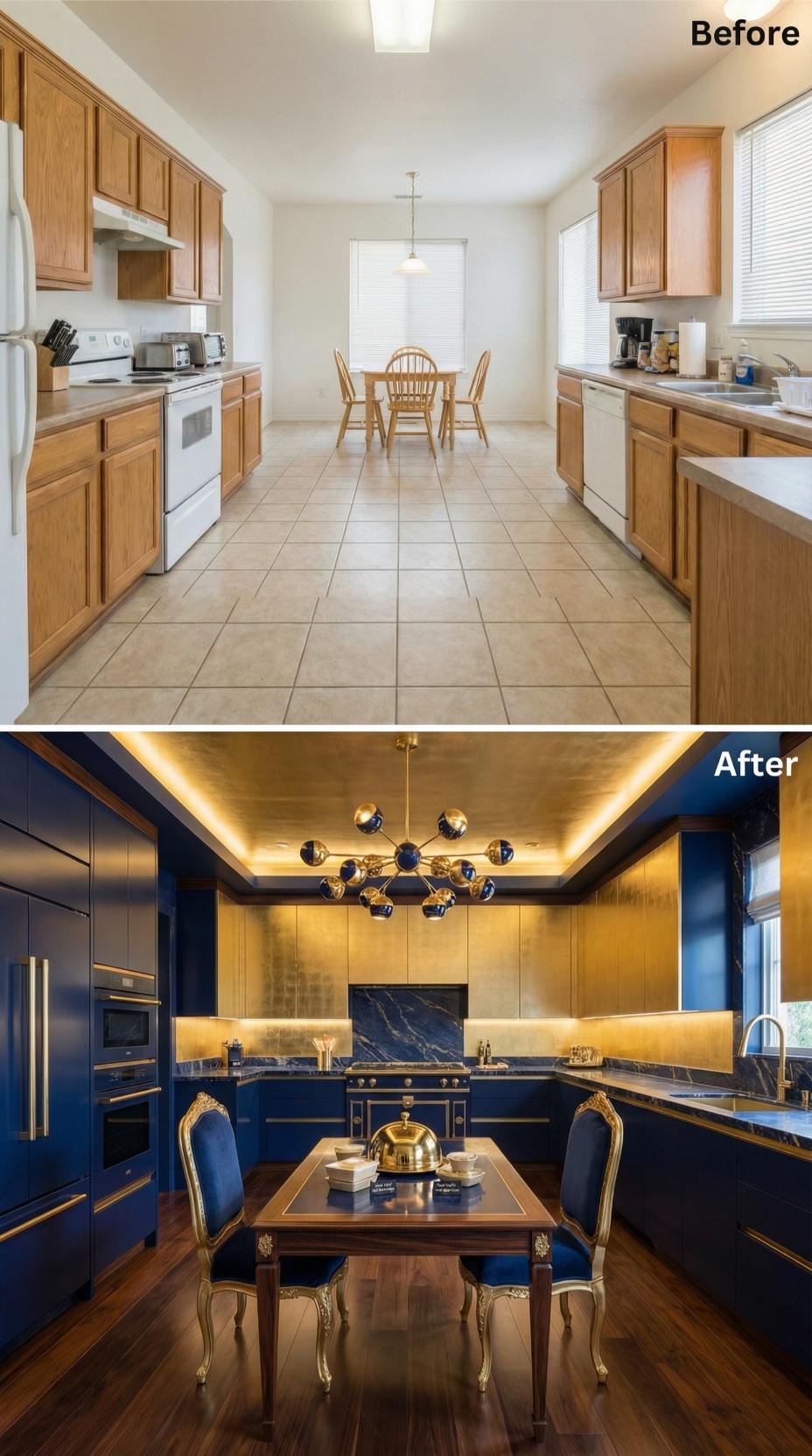
Honey oak and beige tile gave way to navy lacquer cabinets with brass pulls, a gold leaf backsplash panel, and a coffered tray ceiling lined with warm amber cove lighting. The chandelier is a sputnik-style brass fixture with navy and gold globe shades, positioned above a walnut dining table flanked by Louis XVI-style chairs upholstered in royal blue velvet. Blue-veined black marble covers the countertops and the range surround, anchoring the gold without letting it read as gilded excess.
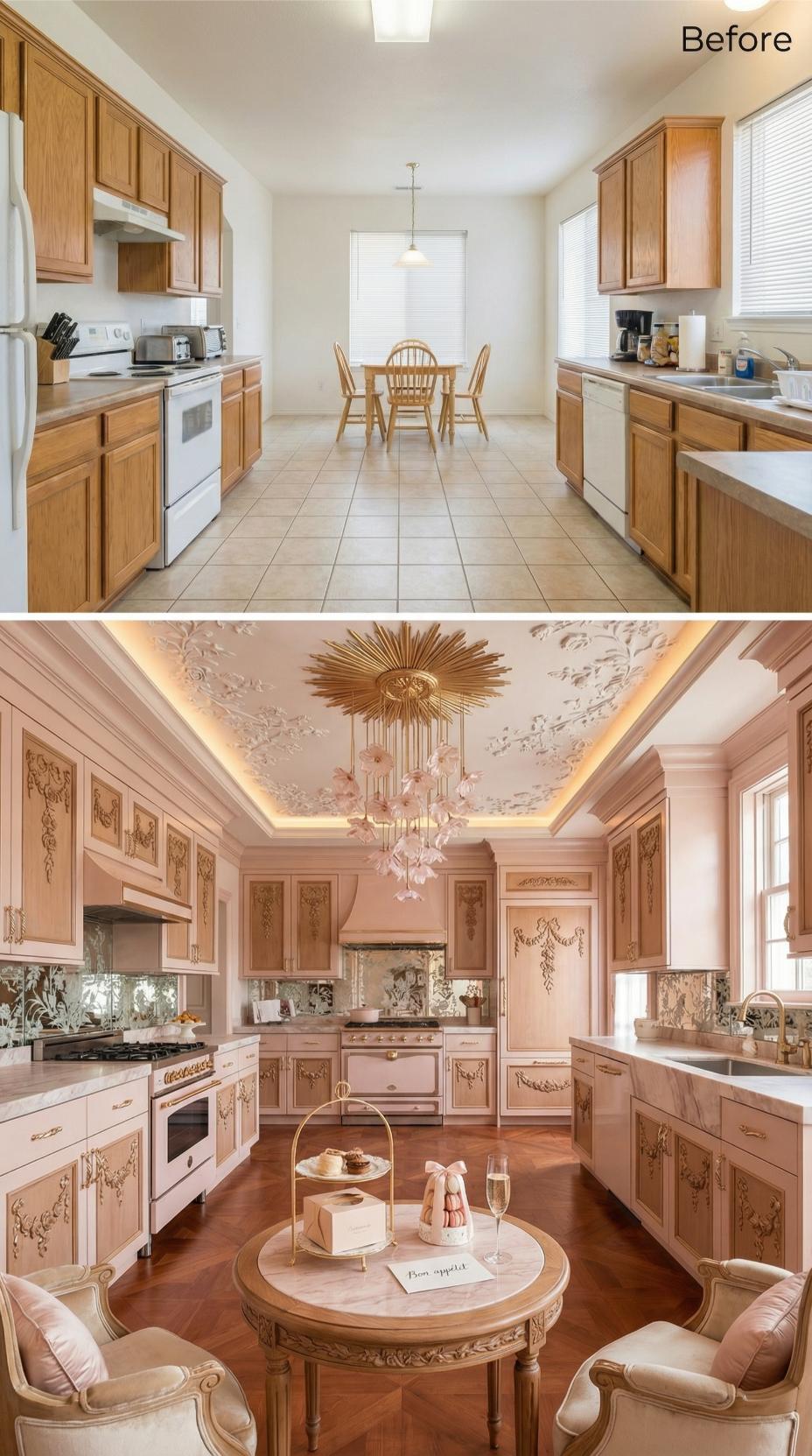
1. Rococo Plaster Ceiling and Blush Cabinetry Erased Every Trace of Honey Oak
🔥 Would you like to save this?
Oak cabinets and beige tile gave this galley kitchen the personality of a waiting room. The after replaces all of it with hand-carved blush cabinetry featuring gold-painted relief detailing across every door panel, paired with marble countertops and a mirrored toile backsplash that reflects light back into the space.
Overhead, a tray ceiling with warm LED cove lighting frames a plaster relief medallion surrounded by floral sculptural work, with a cascading pink glass flower chandelier suspended from a gilt sunburst mount at center. The herringbone wood floor grounds the room, and a round marble-top dining table on a carved wood pedestal base anchors the far end with French provincial chairs in cream upholstery.