🔥 Would you like to save this?
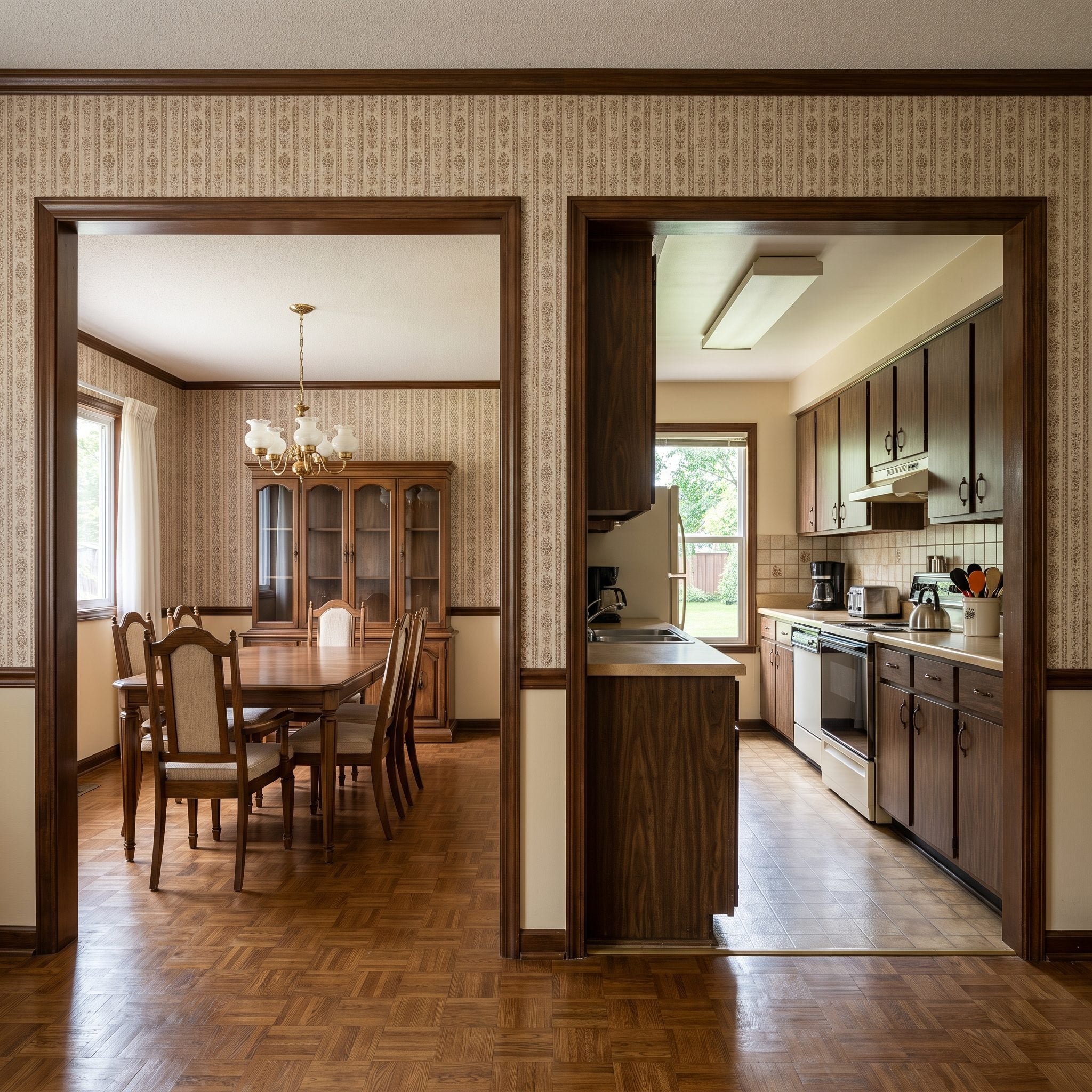
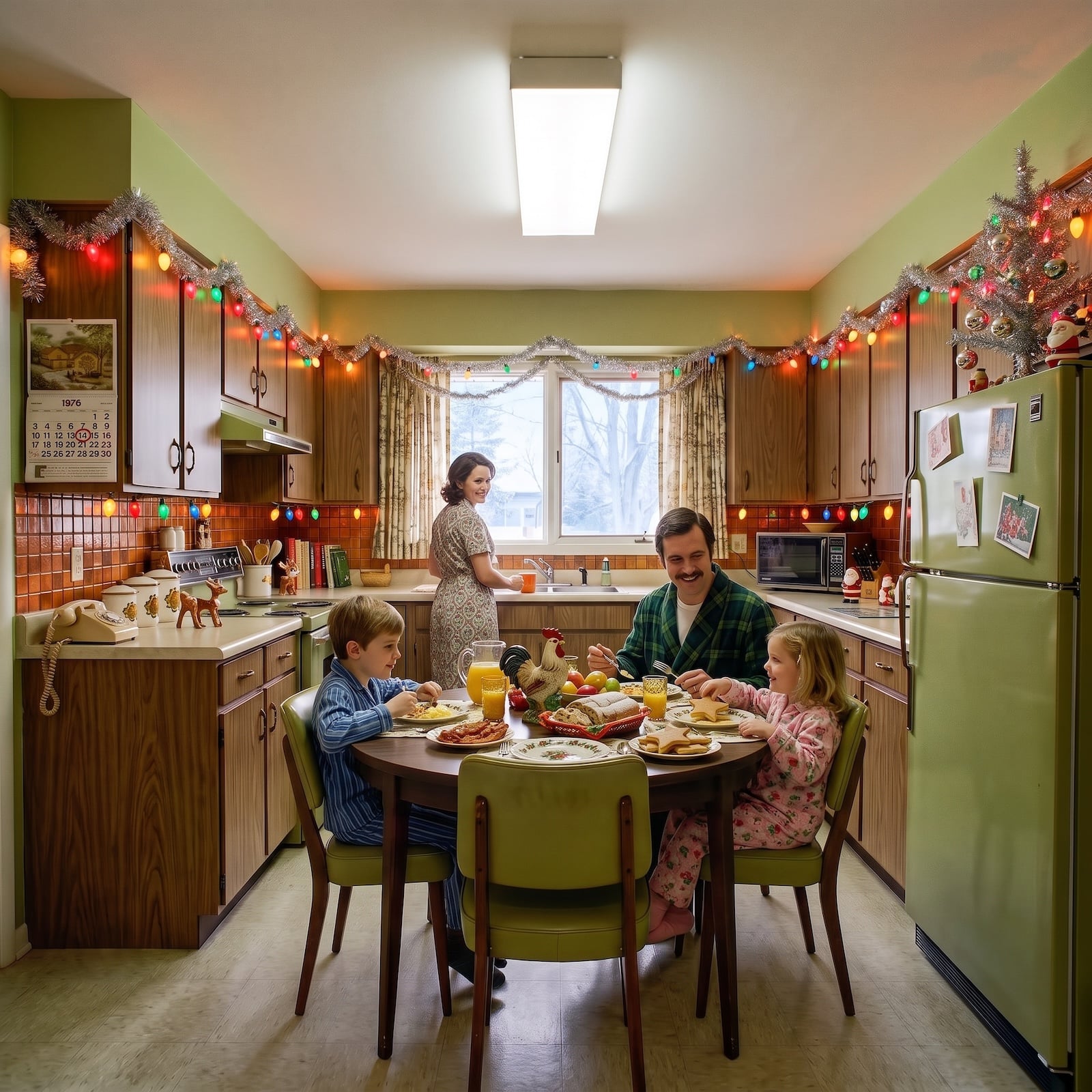
Avocado green once had a remarkable ability to make Christmas morning look even more like Christmas morning. Put it beside walnut cabinets, patterned floors, colored lights and a refrigerator wearing the same unmistakable shade, and an ordinary kitchen suddenly becomes a time stamp. You can almost hear wrapping paper tearing in the next room.
That nostalgia is what makes this kitchen worth keeping in the conversation instead of scrubbing clean of its decade. The challenge across these 25 transformations is not simply to replace avocado green with something newer. It is to change the architecture, materials and mood without draining away the warmth that made the original such a convincing stage for a holiday morning.
In order to come up with the very specific design ideas, we create most designs with the assistance of state-of-the-art AI interior design software. Also, assume links that take you off the site are affiliate links such as links to Amazon. this means we may earn a commission if you buy something.
Some versions go dark and theatrical. Others turn pale, polished and almost weightless. Mahogany meets emerald marble. Cobalt lacquer shares the room with a white Christmas tree. Crimson cabinets push straight into manor-house territory, while walnut, brass, copper, slate and soapstone take quieter routes. Garland behaves differently against every one of them.
The strongest transformations understand that Christmas decoration cannot rescue a room that has no character underneath it. Here the cabinets, ceilings, floors, counters and lighting have to carry the architecture first. Then the tree comes in. Then the garland. Then the bells, candles and stockings. Sometimes the result whispers Christmas. Sometimes restraint has already left the building.
A little inspiration can turn into a serious renovation plan—check today’s home equity rates if financing is on your mind.
25. Lacquered Black Cabinets Meet a Mirrored Ceiling With No Interest in Restraint
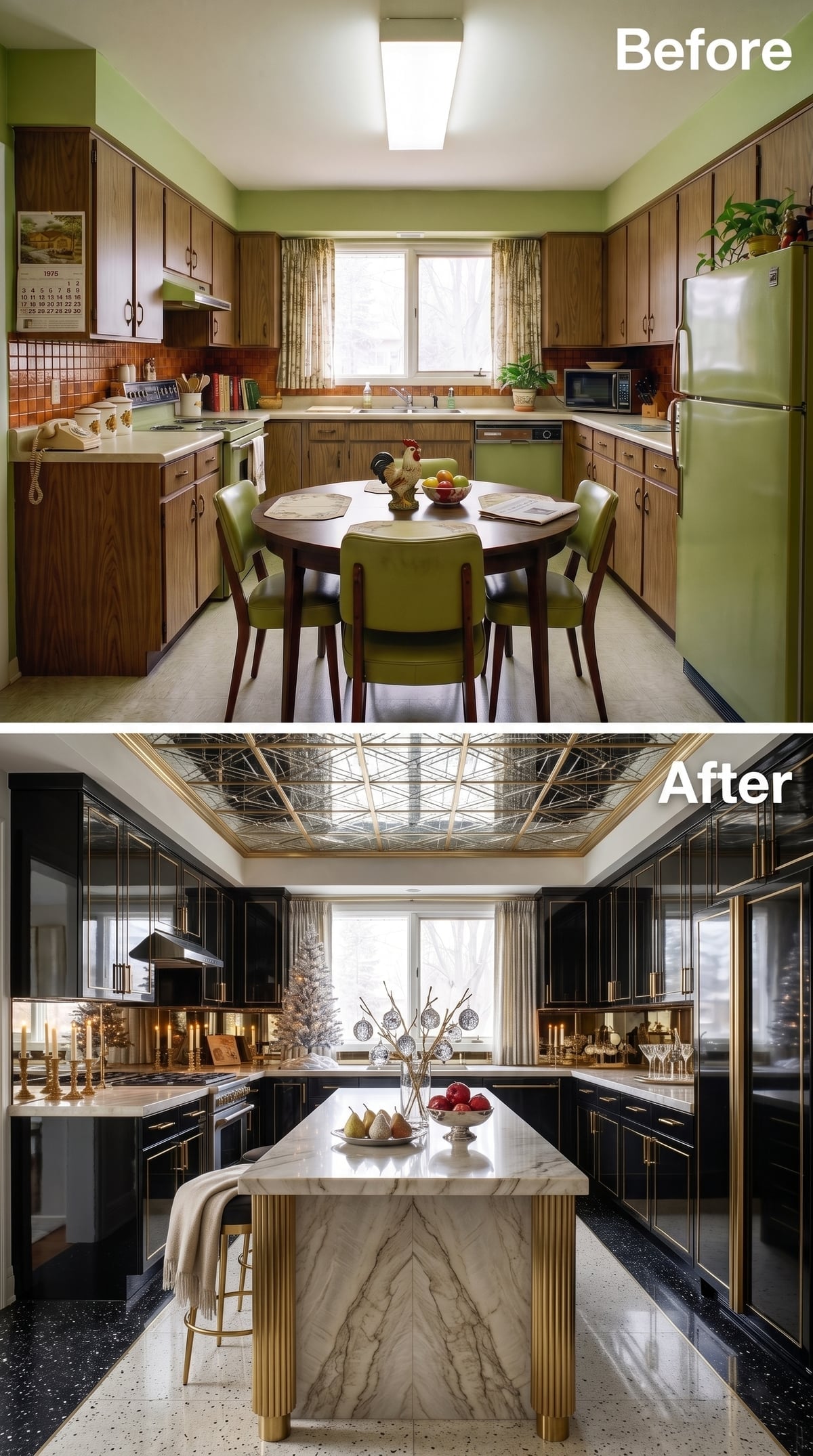
Black lacquer around the perimeter absorbs and reflects light at the same time, depending on the angle. Then the ceiling reverses the equation entirely: mirrored geometry catches candlelight and throws it straight back into the room.
The marble island sits between those extremes like a bright slab of calm. Reeded gold columns underneath keep the center from disappearing against the cabinetry, while the tray ceiling gives all that mirror a defined boundary rather than letting it drift overhead.
This kitchen has no interest in easing us gently into the gallery. It looks expensive, theatrical and completely aware of both facts.
24. Rose Marble and White Lacquer Make Gold Feel Almost Delicate
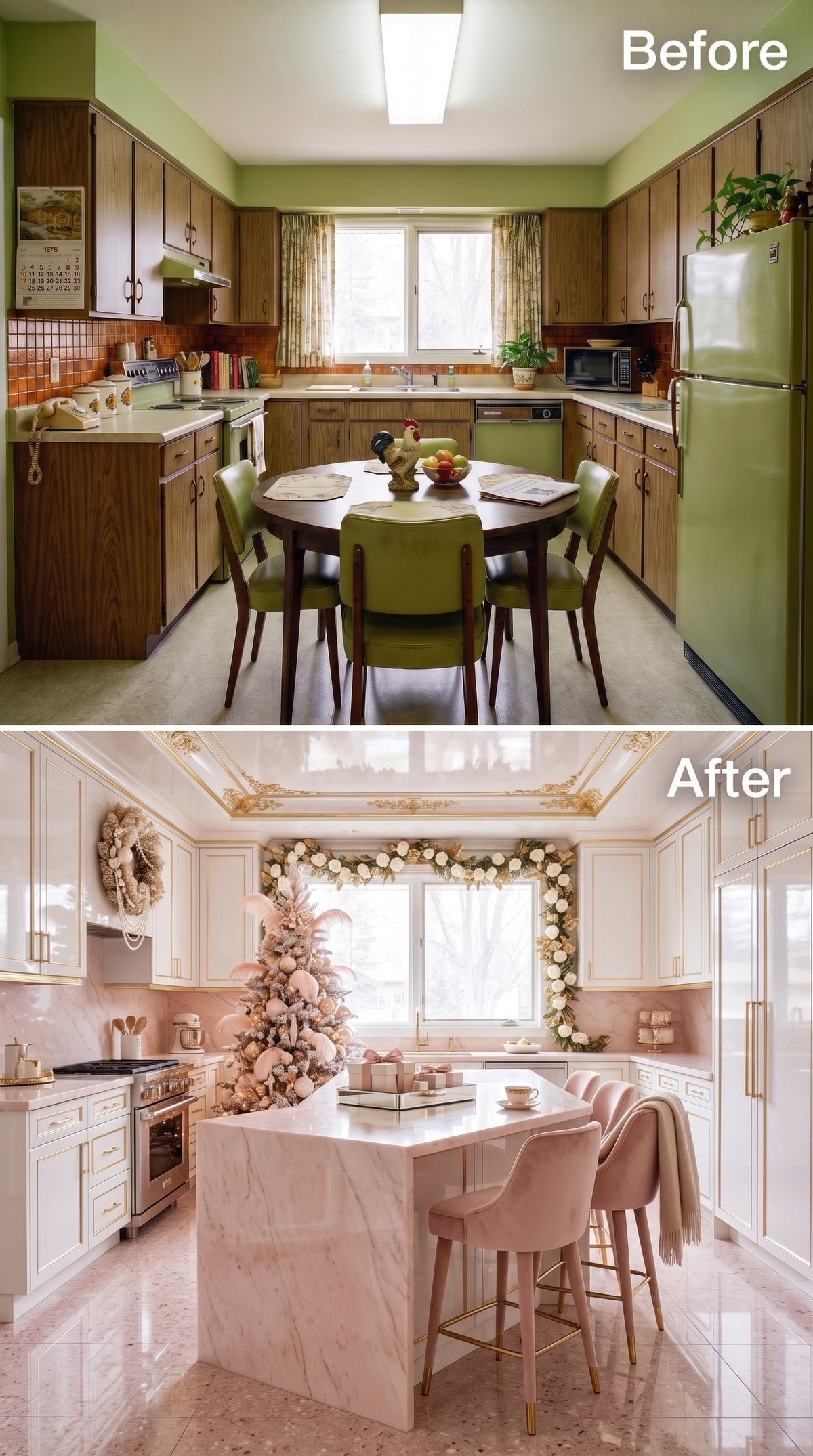
After all that black and mirror, this one nearly floats. Cream cabinetry, rose-veined marble and brushed gold could have tipped straight into confectionery, but the largest surfaces stay pale enough to give the pink and gold room to breathe.
Pink velvet stools repeat the marble without trying to match it exactly. Ornate crown molding gives the gold someplace architectural to live. When Christmas garland reaches the window, it feels less like seasonal decoration than the last line in a palette that was waiting for it.
Design Question: Existing crown molding, beams, niches and tray ceilings give seasonal greenery a natural route through a room. Decorating becomes much easier when the architecture has already drawn the lines.
23. Craftsman Cabinetry Meets the Kitchen Fireplace Nobody Expected
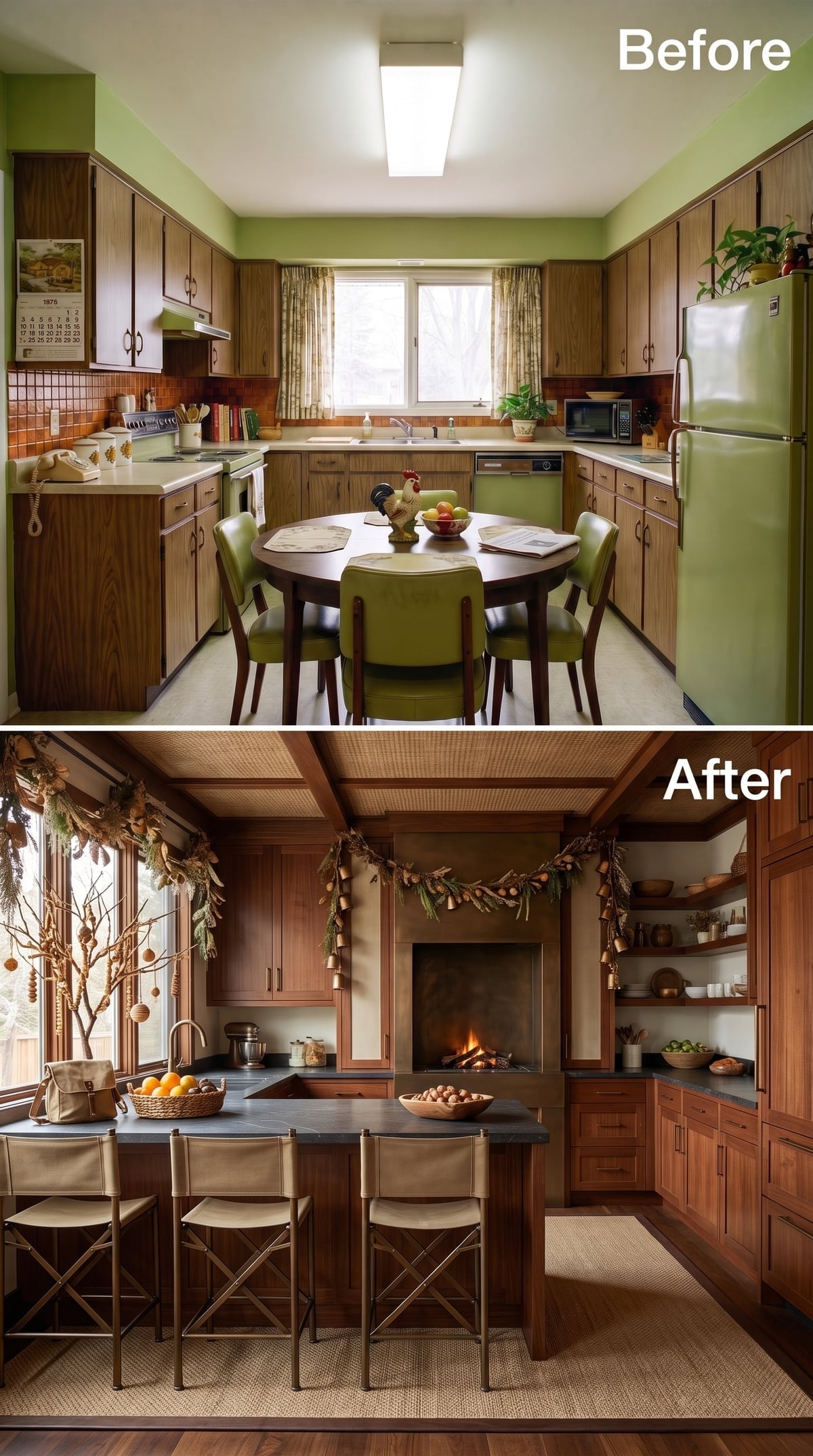
Cherry-toned Shaker cabinetry establishes the Craftsman mood before the fireplace even enters the conversation. Slate counters stay matte and dark beside the wood, while open shelves keep one wall from becoming a continuous bank of cabinetry.
Then there is the fireplace. Built directly into the kitchen wall, it turns the cooking area into something closer to a keeping room. Garland and brass bells suddenly have an obvious place to land, while the bare-branched Christmas tree near the window keeps the holiday layer from becoming sugary.
Storage Strategy: One short run of open shelving can introduce breathing room without surrendering every upper cabinet. It also gives favorite pieces and seasonal objects somewhere to appear without colonizing the counters.
22. Verdigris and Hammered Copper Let Aging Become Part of the Finish
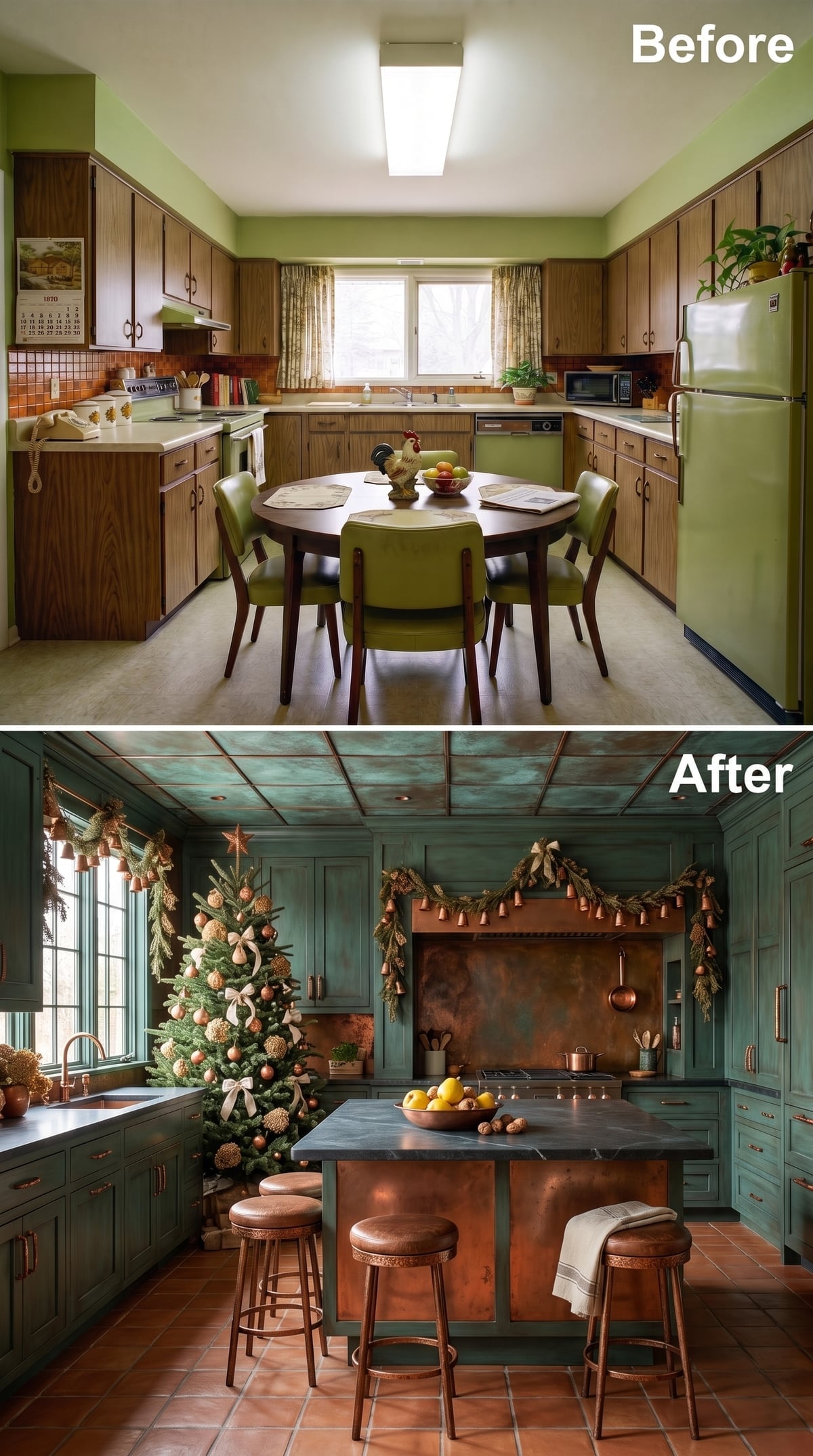
Patinated green cabinetry beside hammered copper feels almost inevitable because the materials already share a visual history. Copper can move toward brown, green and blue-green as its surface changes, so the cabinet color feels less like contrast than a conversation with the metal itself.
The hammered range wall stays lively without elaborate carving or pattern. Bells and greenery overhead pick up the same warm-cool tension, which lets Christmas enter without asking the room to change personality for December.
Material Note: Copper changes with exposure, handling and cleaning. Some homeowners preserve a brighter finish; others let the patina develop and make the aging process part of the room.
21. Arabescato Marble Gives This Cream Kitchen Its Backbone
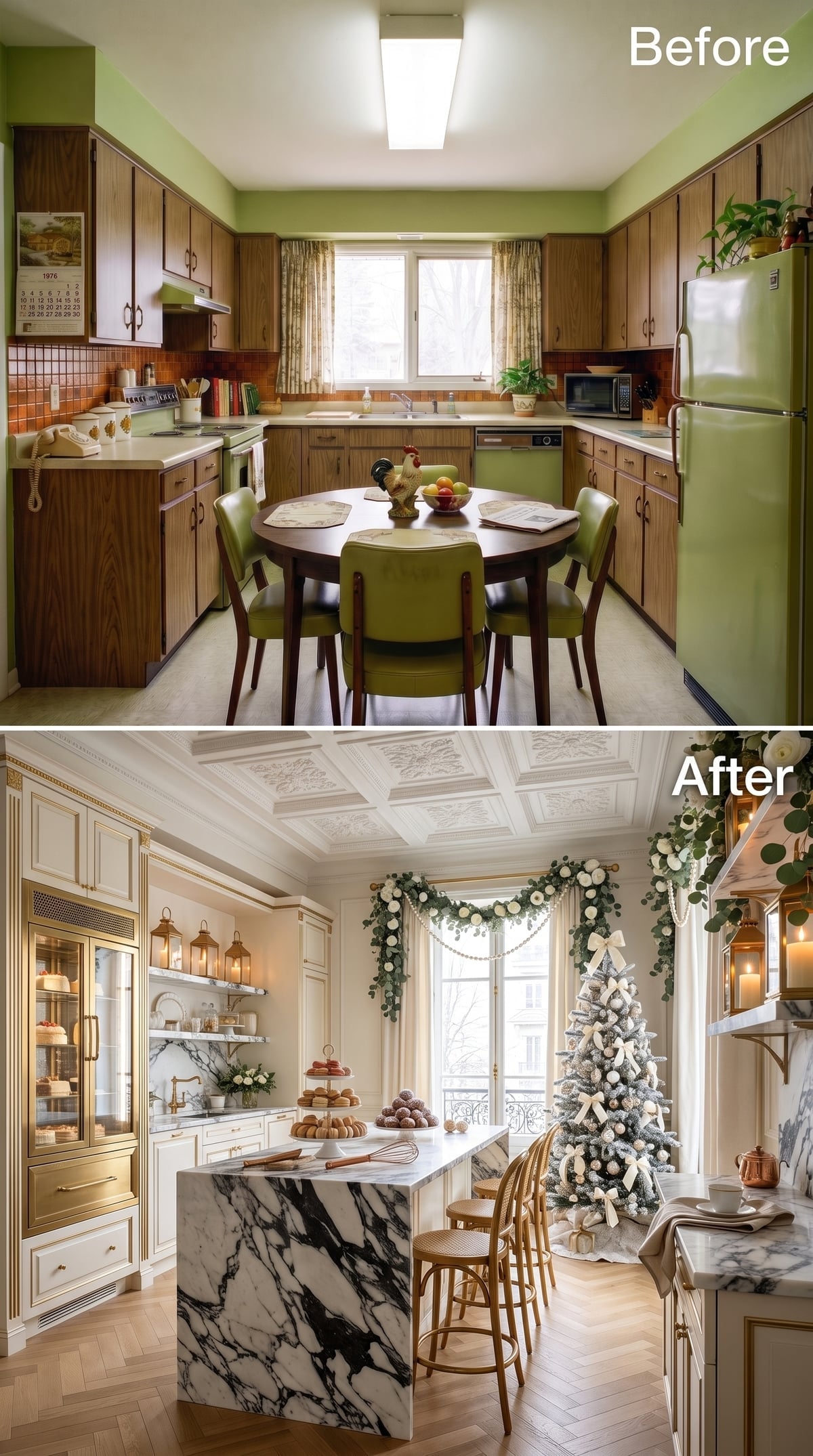
Cream cabinetry and gold trim establish a formal shell, but the Arabescato island keeps the room from becoming polite. Black veining cuts through all that pale color with enough movement to carry the center almost by itself.
Bentwood stools are the counterweight. Their curves feel familiar and light beside the marble’s grandeur. Above, the coffered plaster ceiling creates depth and shadow, giving the Christmas garland and flocked tree an architectural setting instead of a blank white lid.
- Arabescato marble varies significantly from slab to slab, making layout selection important when prominent veining is part of the design.
- Bentwood furniture crosses traditional and modern interiors easily because its curves are strong without appearing heavy.
- Coffering adds depth and rhythm overhead; its acoustic performance depends on the actual materials and assembly.
20. Matte Black Cabinets Get Their Warmth From the Ceiling
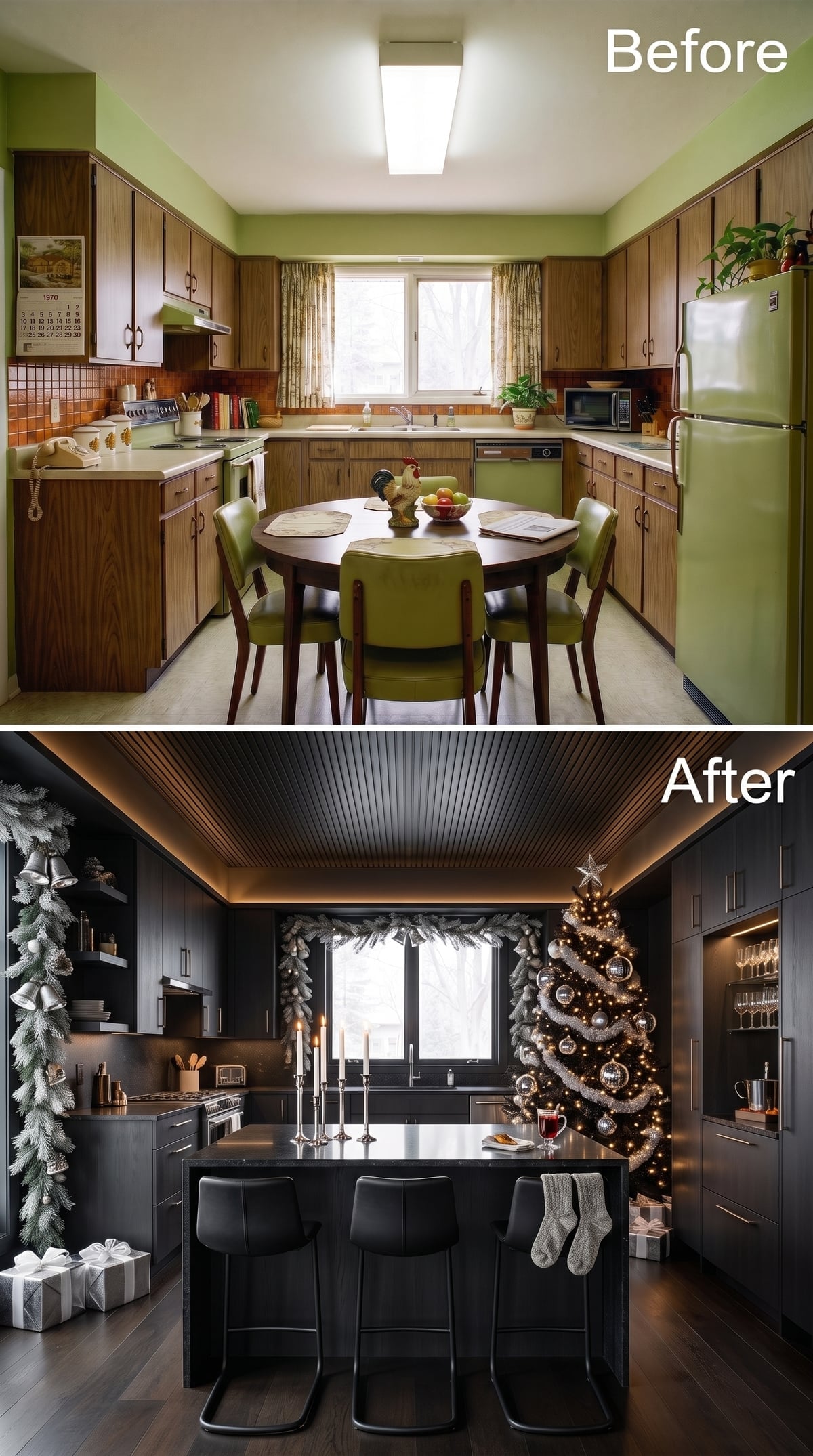
Charcoal cabinetry could have made this kitchen feel sealed shut. Instead, the ceiling pulls the room in the opposite direction. Slatted wood introduces grain overhead, and concealed amber lighting washes across it without adding another visible fixture.
The marble island creates a pale landing zone in the center. Black leather stools nearly disappear against the cabinetry, leaving the Christmas tree to carry most of the sparkle. That is a smart division of labor: architecture supplies the drama, Christmas supplies the light.
Ceiling Strategy: Wood slats add linear texture and can form part of an acoustic ceiling assembly when paired with suitable absorptive backing. Even without that system, they soften rooms dominated by stone, glass and cabinetry.
19. Pale Oak and a Marble Waterfall Island Give Christmas Some Breathing Room
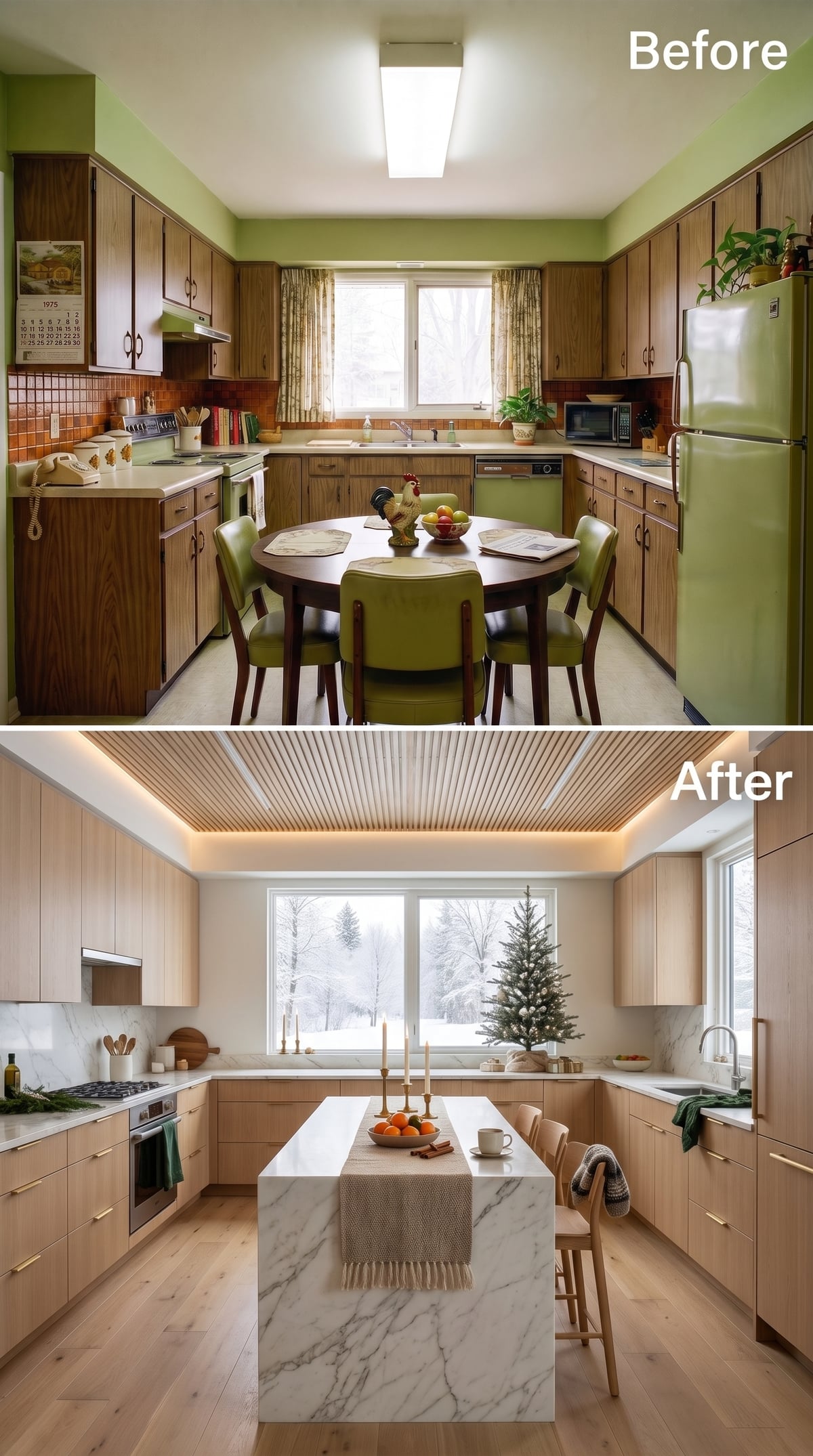
The oak is bleached nearly to the color of sand, allowing the grain to remain visible without visually shrinking the room. Thin gold pulls barely interrupt the cabinet fronts.
The waterfall island is the deliberate heavyweight: one marble volume dropping cleanly to the floor. Above it, a ribbed wood ceiling and concealed lighting put warmth back into a room that could otherwise become almost too pristine.
Not every Christmas kitchen needs red cabinetry, velvet and a tree fighting for center stage. This one earns its place by giving the holiday layer somewhere quieter to land.
18. Cobalt Lacquer Turns the Old Kitchen Into a Christmas Jewel Box
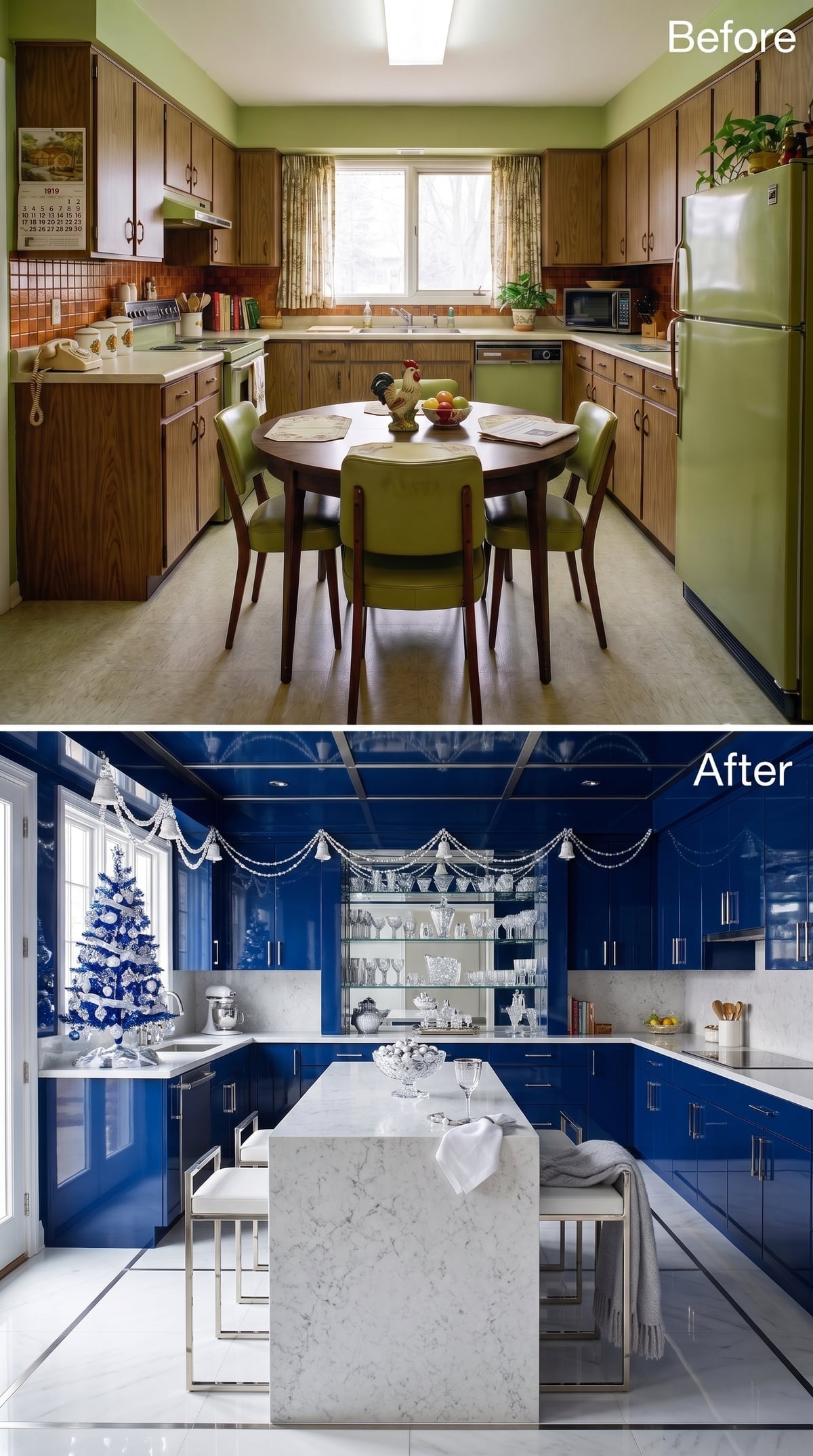
Glossy cobalt cabinetry changes the room before you even register the marble. Unlike a matte finish, lacquer catches windows, lights and movement, so the blue never quite sits still.
A white marble waterfall island gives all that color one clean interruption. Silver hardware stays deliberately quiet. Then the white Christmas tree and pale garland pick up the marble instead of introducing another competing hue.
The blue supplies the drama. Everything pale around it gives that drama somewhere to stop.
17. Crimson Lacquer and Gold Molding Bring the Manor House to the Suburbs
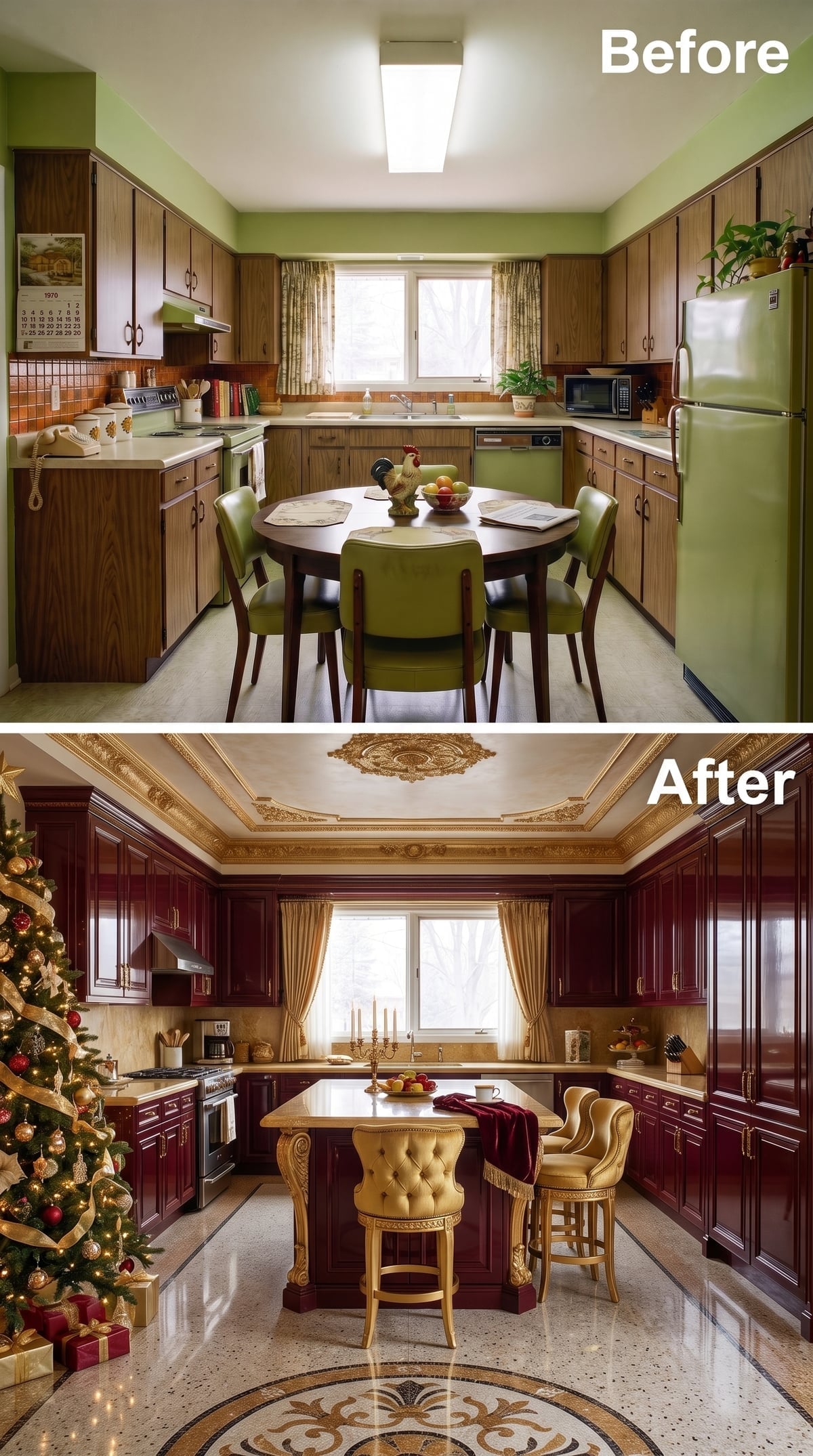
Deep burgundy lacquer climbs all three walls, leaving very little neutral territory. Gilt crown molding and ornate plaster overhead refuse to calm it down.
That commitment is exactly why the design survives. A timid version would look confused. Here, tufted gold stools, patterned terrazzo and crimson drapery all agree that restraint has been excused for the evening.
The Christmas tree does not dominate because the room was already operating at holiday volume before the first ornament went up.
16. Beadboard, Zinc, and Coffering Give Ivory Cabinets Some Muscle
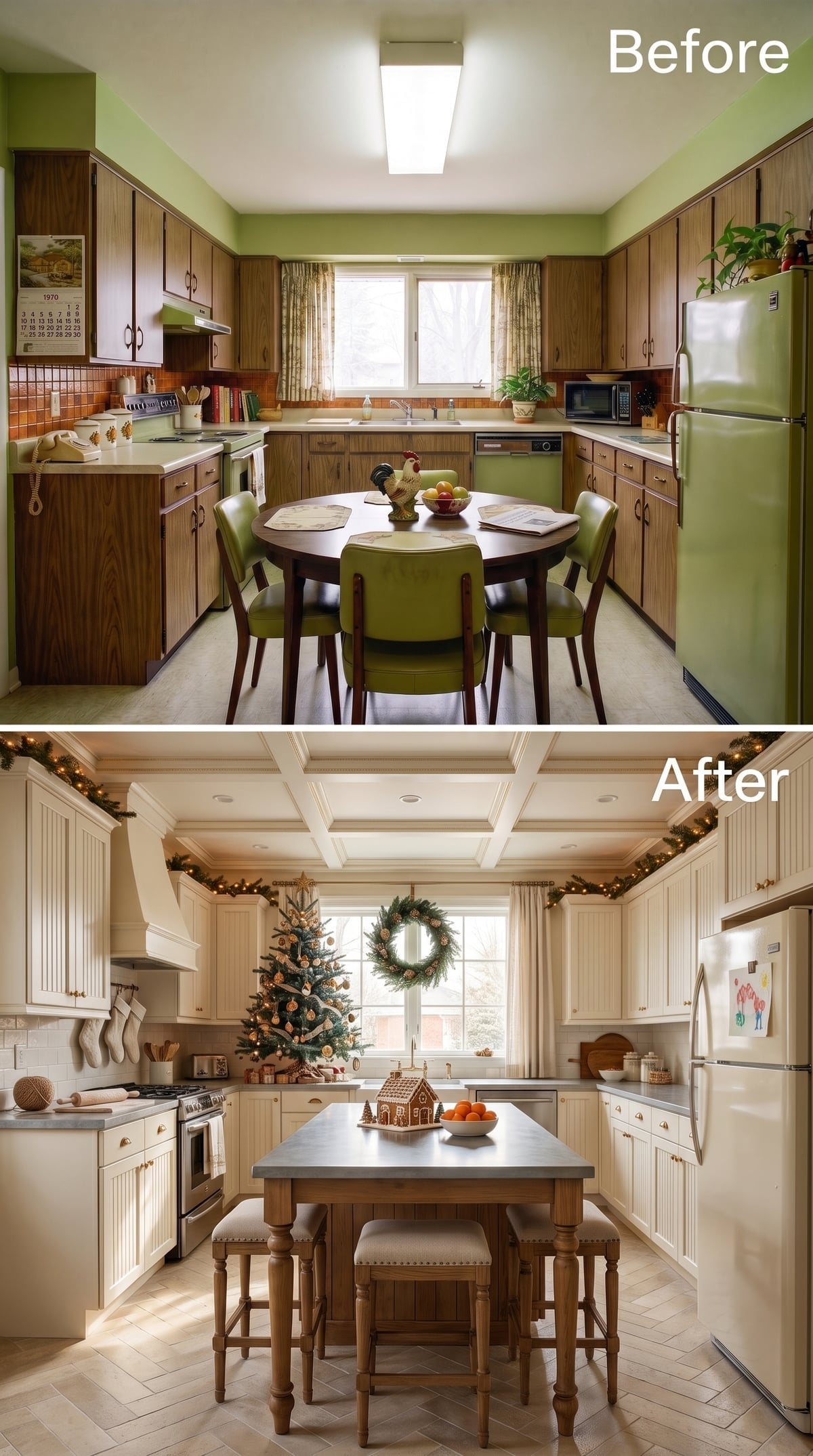
Warm ivory cabinetry could have dissolved into the walls, so beadboard gives every door a vertical rhythm. Zinc takes the opposite role on the island: broad, smooth, slightly industrial and darker than everything around it.
Turned island legs make the center feel more like furniture, while the coffered ceiling imposes a grid overhead. Garland traces that geometry instead of inventing its own route through the room. Christmas is not pasted over the architecture here; it follows it.
What the Coffered Ceiling Is Actually Doing
Coffers add shadow, repetition and architectural depth. They do not automatically make every room feel taller; their effect depends on ceiling height, beam depth and proportion. Here the grid works because it gives a fairly decorative kitchen a disciplined top edge.
15. Navy Cabinets and Green Marble Make Cool Colors Feel Surprisingly Rich
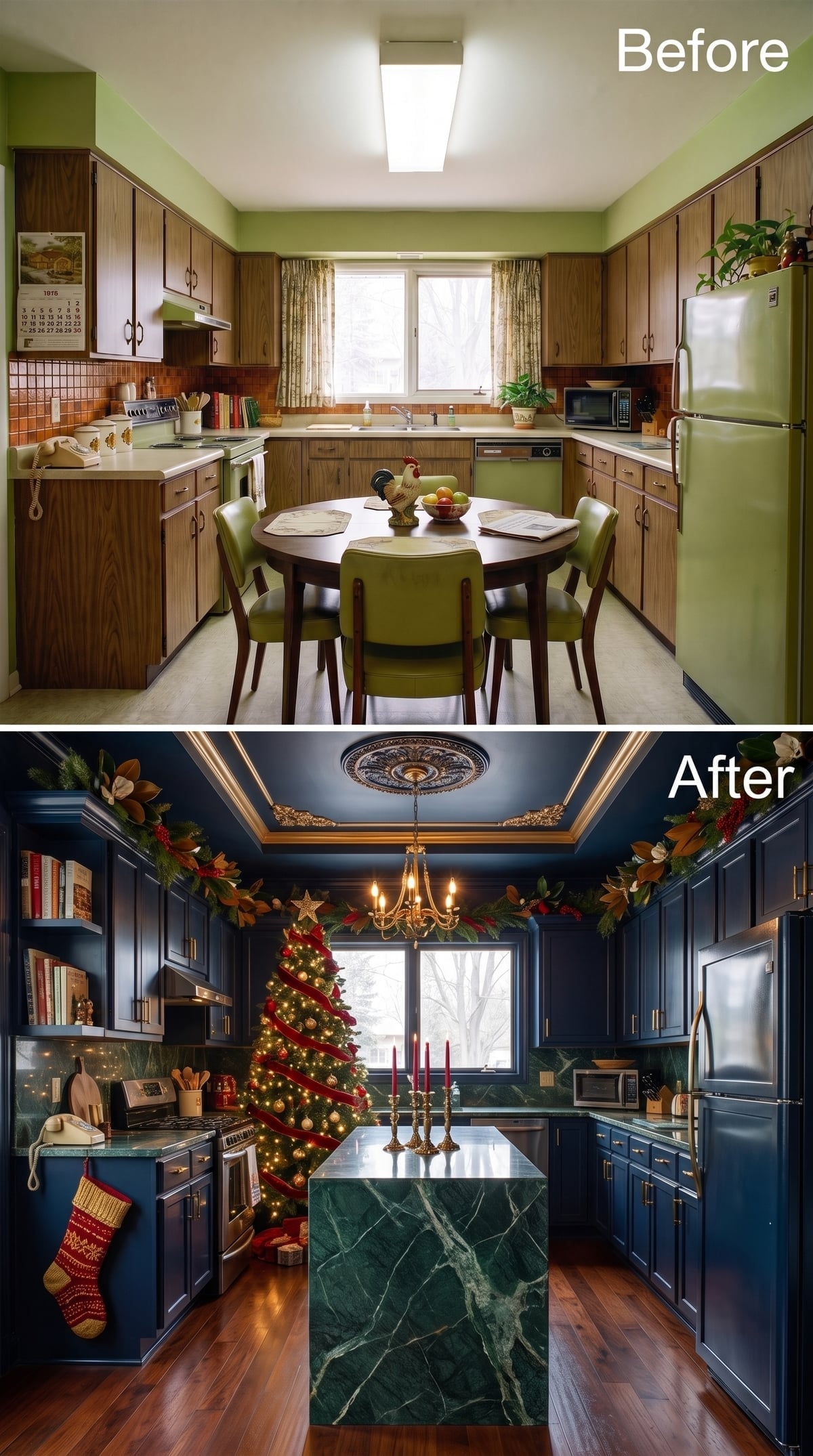
Navy paint covers every cabinet, yet the room never sinks under it.
Brass hardware flickers against the blue, green marble creates a separate center of gravity and warm hardwood underfoot keeps the palette from becoming cool and formal.
The ornate tray ceiling supplies another layer entirely. Garland runs along the upper cabinetry, following the room’s existing horizontal lines rather than arriving as something simply draped on top.
14. Shiplap, Steel Beams, and a Copper Range Refuse to Pick One Style
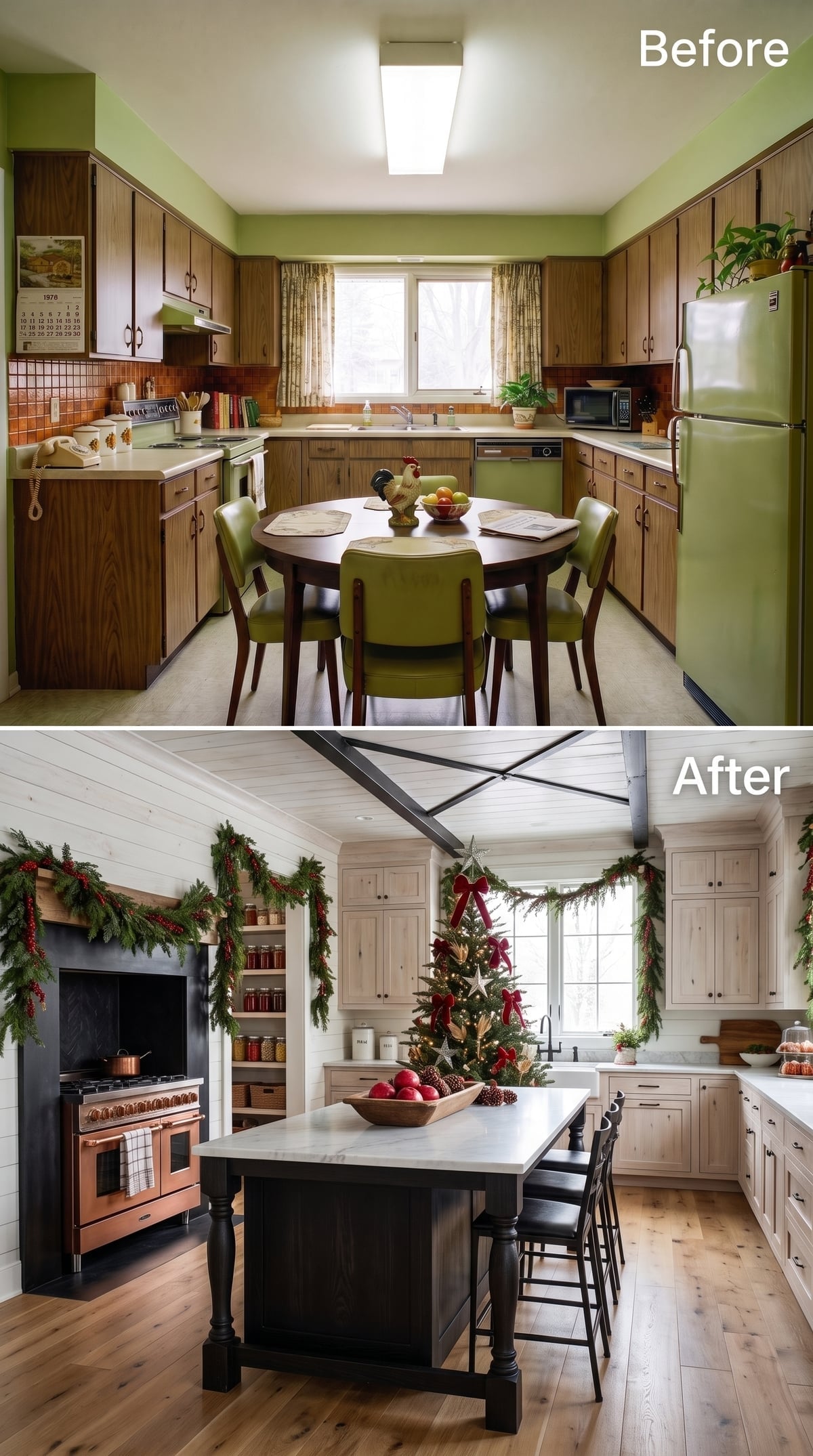
Bleached oak cabinetry and white shiplap begin in familiar country territory. Then the exposed steel beams arrive. Then the copper range. Then a nearly black island. The room keeps changing dialect and somehow stays in the same conversation.
Copper is the translator. Its warmth connects the wood to the dark metal without requiring another painted cabinet to bridge the gap.
Garland runs freely through the room, but the architecture underneath is strong enough that greenery never becomes the primary design.
In the Details: Horizontal boards emphasize the room’s length, while exposed beams introduce a perpendicular rhythm overhead. That push and pull is more interesting than either treatment would be alone.
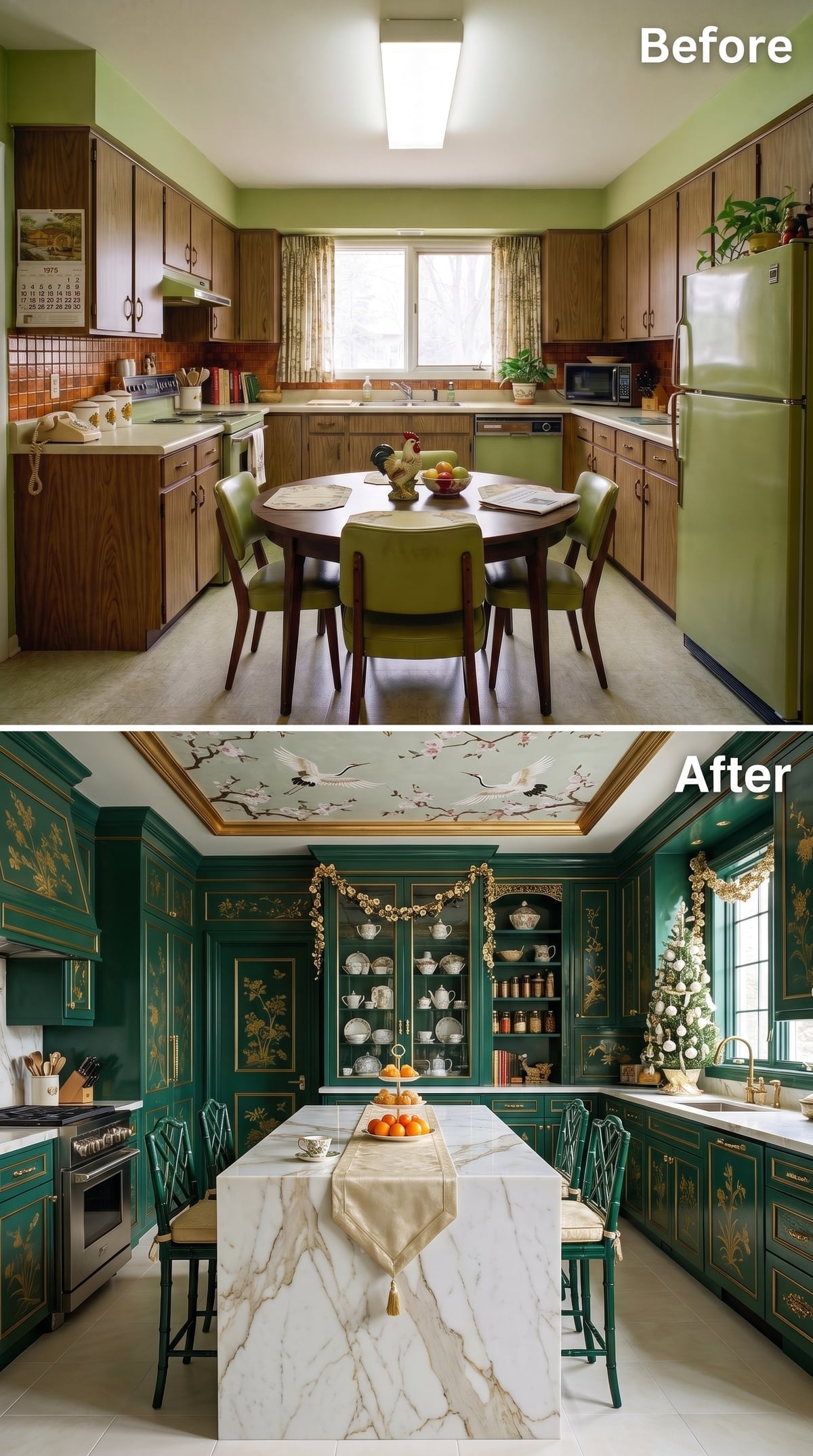
13. Hunter Green Chinoiserie Turns Every Cabinet Door Into Christmas Decoration
🔥 Would you like to save this?
Gold botanical motifs turn the hunter-green cabinets into something closer to lacquered panels than conventional kitchen doors. Then the ceiling takes the same idea overhead with a painted scene framed in gilded molding.
The danger with this much decoration is that every remaining object starts auditioning for attention. The marble island wisely refuses. Bamboo-style chairs echo the East Asian-inspired decorative vocabulary at a smaller scale and then stop.
Green lacquer and gold detailing already sit so close to a Christmas palette that the room needs surprisingly little help once December arrives.
History Corner: Chinoiserie emerged in Europe as a decorative interpretation of East Asian art and design and became especially fashionable from the 17th century onward. Its imagined landscapes, florals and architectural motifs have repeatedly returned to Western interiors.
12. Gothic Arches and Slate Turn Christmas Dinner Prep Into Minor Theatre
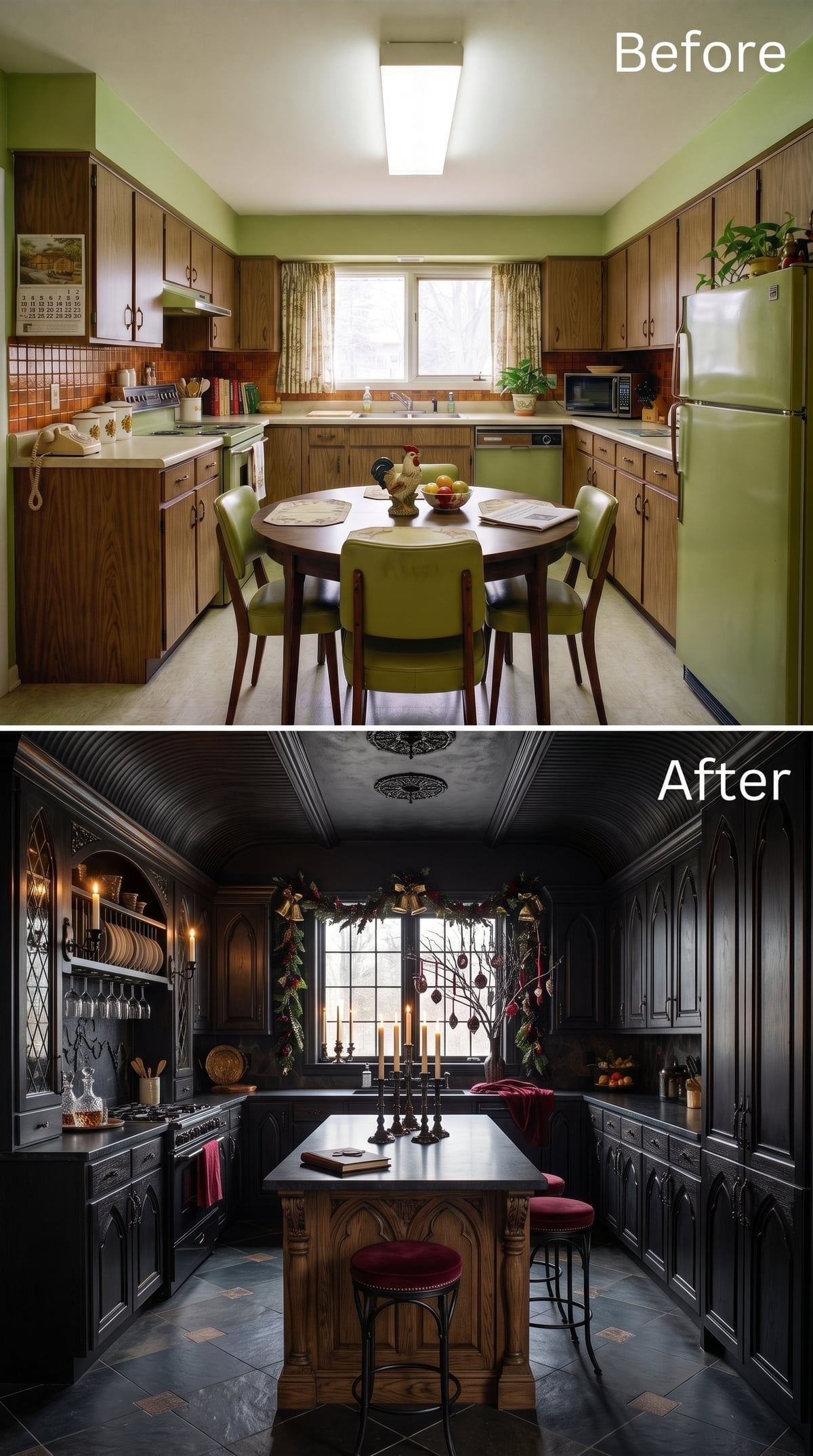
Black cabinetry carved into Gothic arches pushes this transformation well beyond ordinary kitchen styling. Add a barrel-vaulted ceiling and slate underfoot and the room starts borrowing more from a chapel than a showroom.
The natural wood island is crucial. Without it, the black perimeter might close in completely. Crimson velvet stools provide the only saturated warmth, while candelabras supply exactly the amount of impractical grandeur Christmas can get away with.
Millwork Note: Arched cabinet profiles usually require additional fabrication compared with a simple square panel, whether they are routed, molded or built from separate components. That extra geometry is what gives the doors their architectural character.
11. Blue-Gray Cabinets Make the Cast-Iron Range the Christmas Center of Gravity
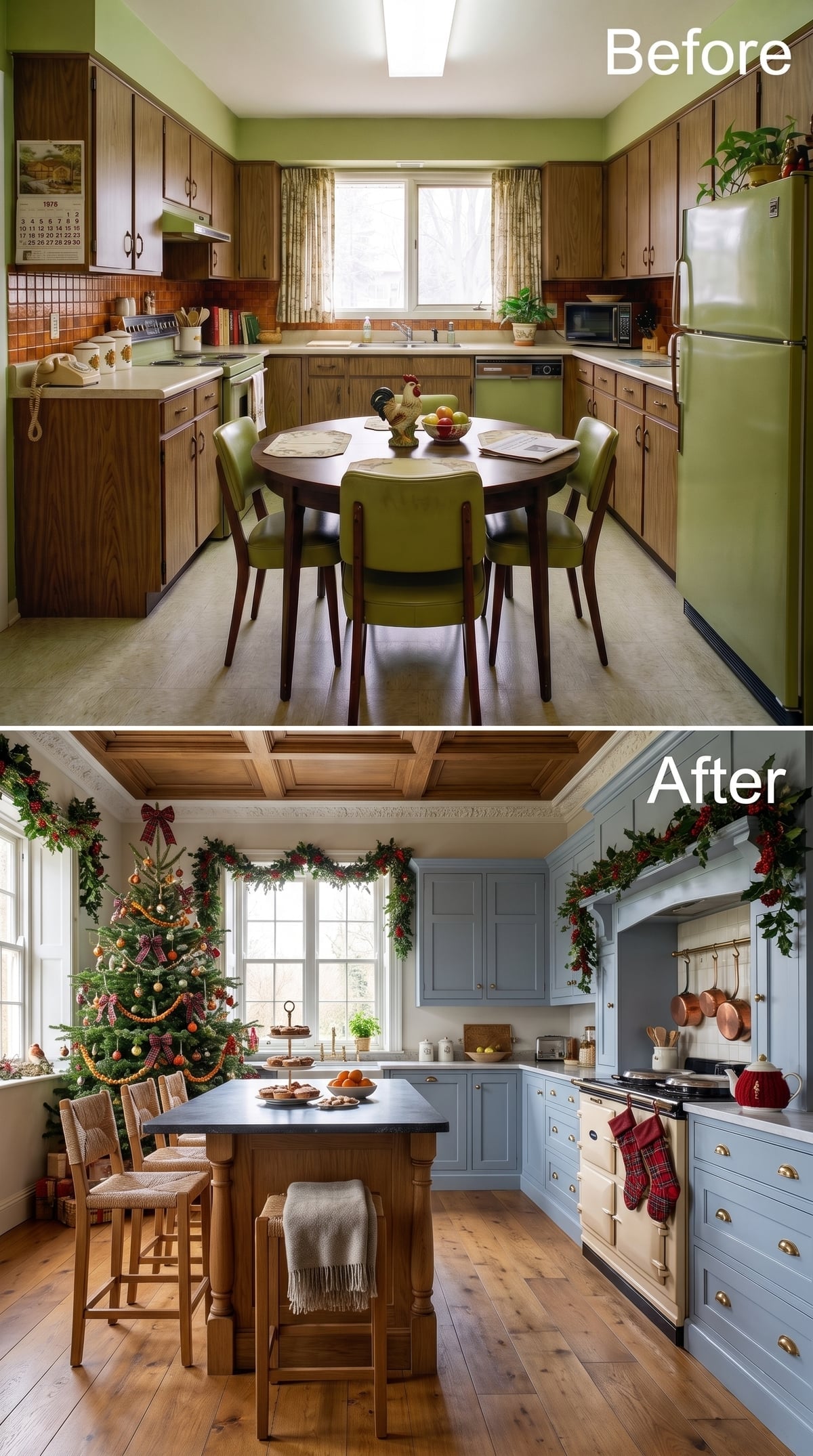
Slate-blue Shaker cabinetry gives this room a traditional base without pushing it toward cream-and-beige nostalgia. Brass hardware warms the blue, but the cream cast-iron cooker still owns the cooking wall.
Copper pans and red stockings turn that appliance into the seasonal focal point. The wood island stays open underneath, allowing more floor to remain visible than a conventional cabinet-box island would.
Planning Note: A cast-iron range can be substantially heavier and more demanding than a conventional appliance. Utility connections, ventilation, surrounding cabinetry and floor structure all need consideration before treating one as a simple swap.
10. Gilded Cabinets and Rose Marble Treat Restraint as a Personal Insult
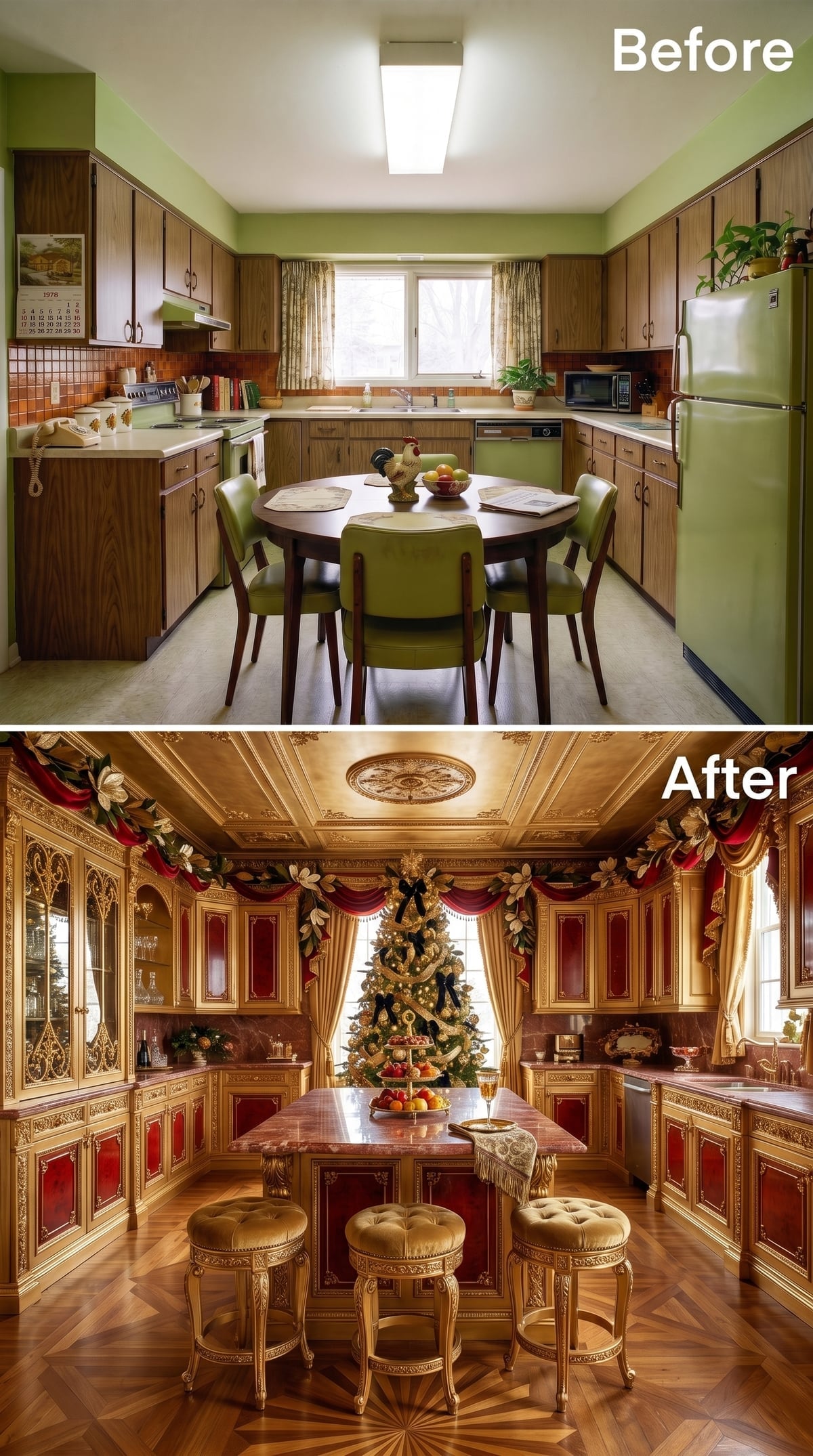
Gold-leafed cabinetry with crimson inset panels takes the formal impulse of the earlier kitchens and pushes it all the way to spectacle. Rose marble fills the center. Velvet stools arrive with carved gilt legs because ordinary stools clearly missed the dress code.
Herringbone parquet is almost understated by comparison. Above, a decorative coffered ceiling and medallion organize the visual chaos, giving the garland a defined route around the room.
No single feature here is pretending to be quiet. The achievement is getting them all to speak at roughly the same volume.
9. Light Oak and Dark Slate Give Christmas a Quieter Room
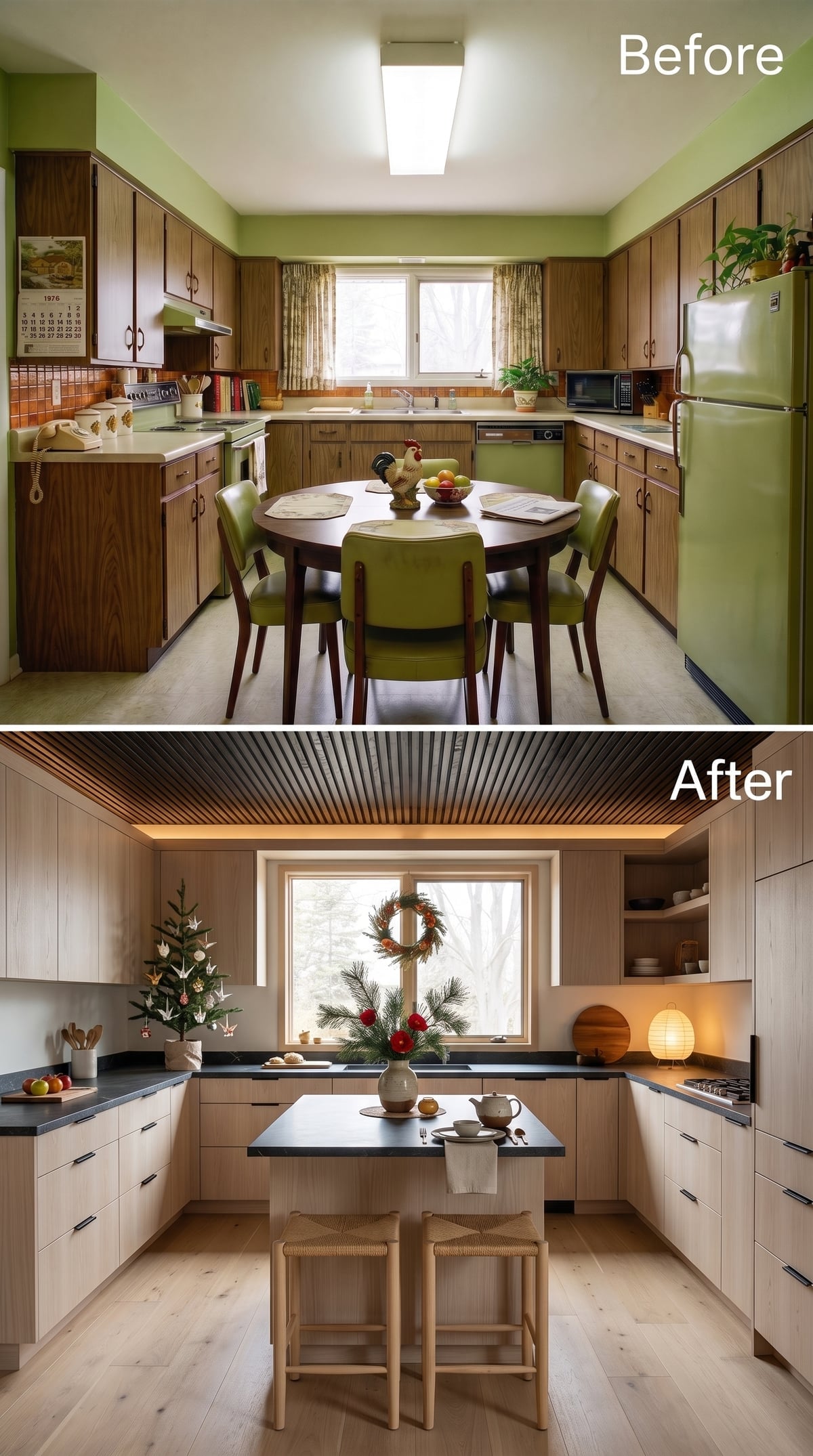
The earlier light-oak kitchen polished everything toward marble and precision. This one heads the other way. Bare-looking oak, woven stools and dark slate make the room feel more relaxed and materially grounded.
The island sits low and straightforward instead of becoming another marble monument. Above it, the slatted ceiling supplies the architectural detail while integrated lighting keeps fixtures from interrupting the lines.
After gilded cabinets and rose marble, the restraint feels almost startling. That contrast is useful in a Christmas gallery too. Not every room needs to shout before the decorations arrive.
Natural Wood: Clear-finished and oiled woods can change color over time as they are exposed to light and oxygen. Pale species often become warmer or more amber, giving the cabinetry a finish that evolves rather than remaining frozen at installation day.
8. Mahogany and Emerald Marble Go Full Formal Christmas
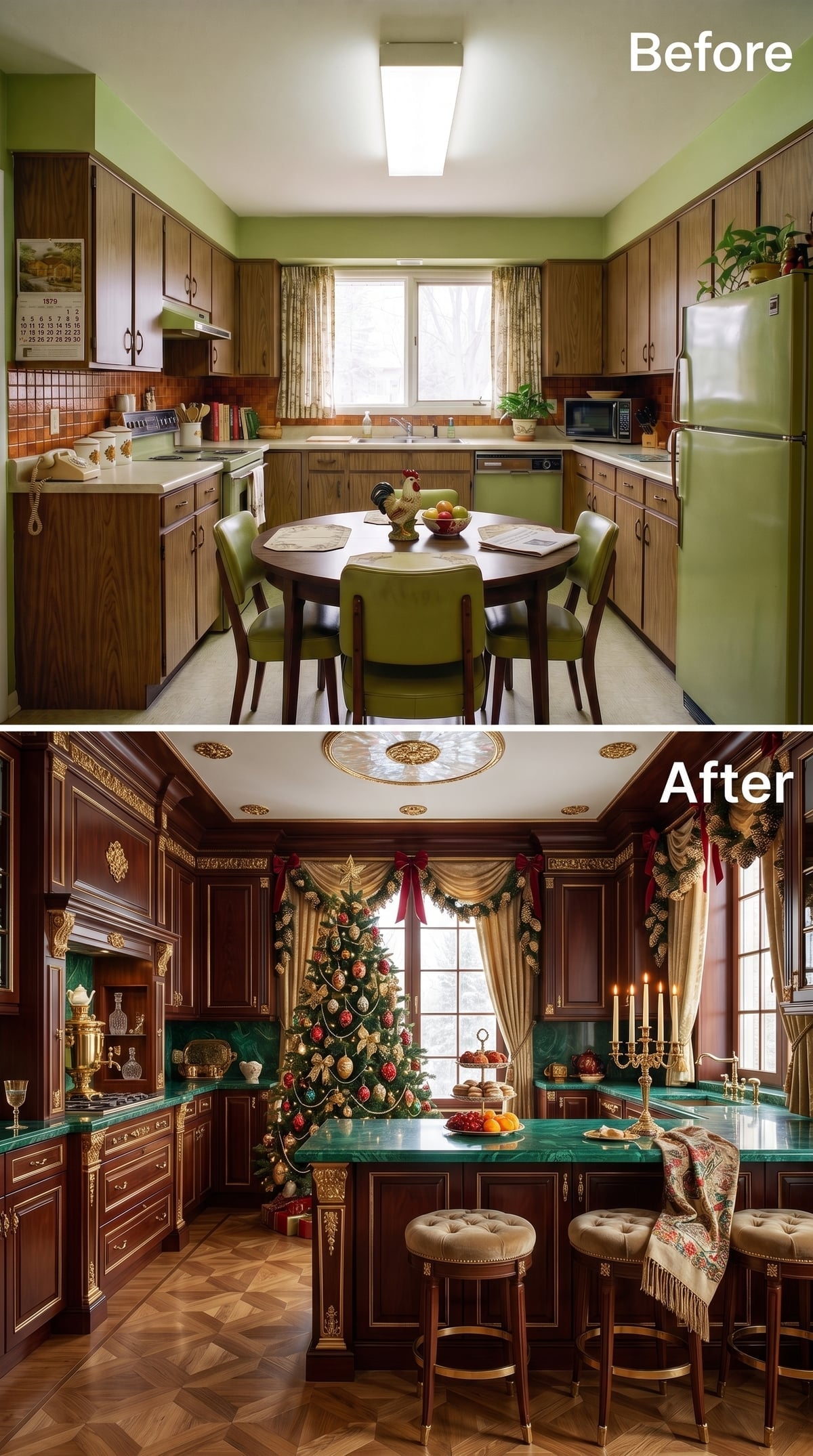
Dark mahogany cabinets and emerald marble bring the palette close to traditional Christmas before a single branch of garland appears. Brass hardware and a gilded ceiling medallion push the formality even further.
The island is almost malachite in intensity, while upholstered stools make the room feel furnished rather than merely fitted. Swag curtains, ribbon and a decorated tree do not need to manufacture festivity here. They walk into a room that was already halfway there.
Color Story: Deep red-brown wood, saturated green stone and warm metal create a palette with enough depth to absorb substantial holiday decoration without losing the architecture underneath.
7. Dark Green Cabinets Let Christmas Decoration Practically Write Itself
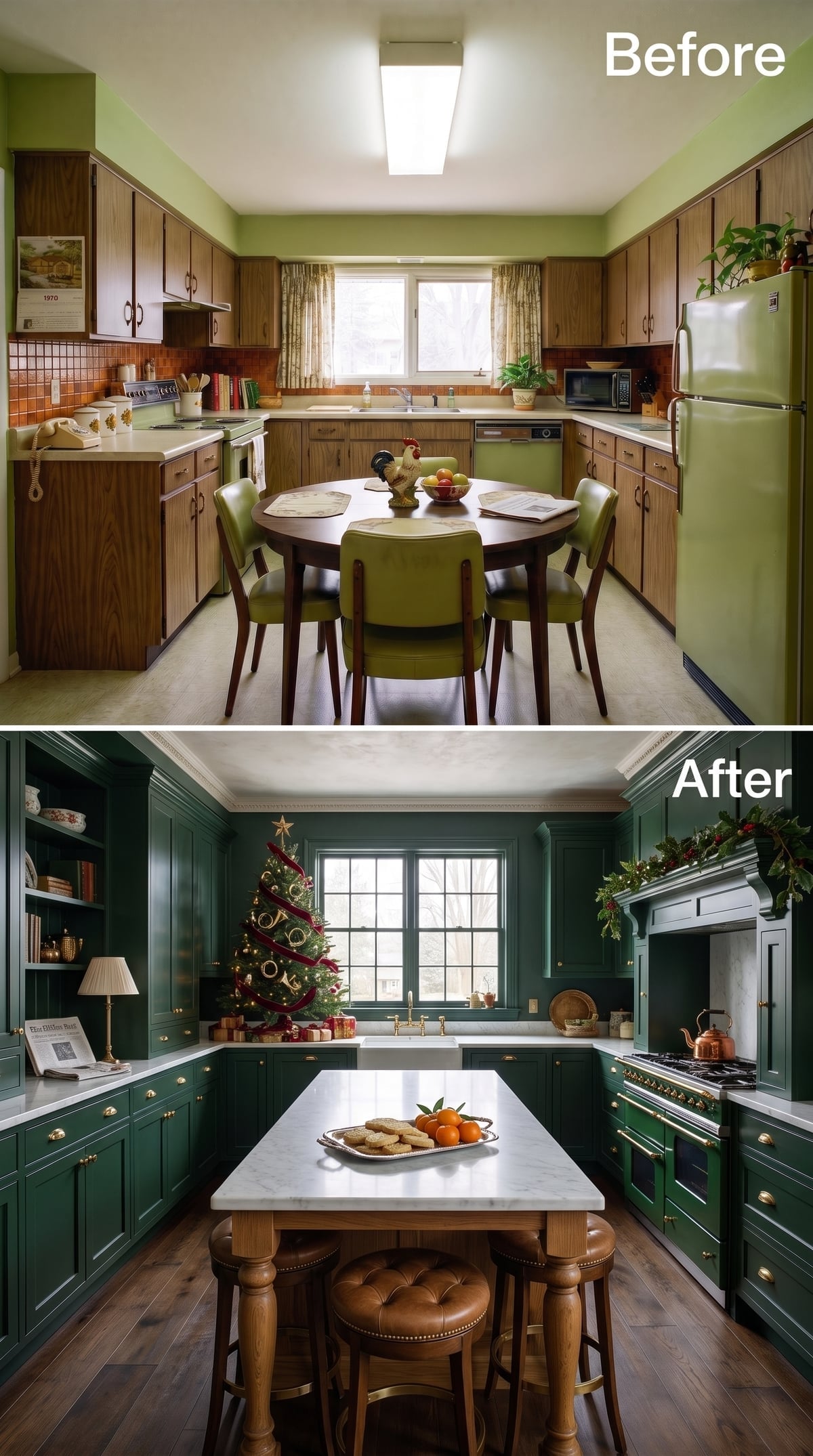
Forest green cabinetry gives this kitchen so much permanent color that the seasonal layer can stay remarkably simple. Brass warms the doors, white marble clears the center and a farmhouse sink creates a bright break beneath the window.
The tree slips into the corner without fighting the cabinetry, while garland follows the hood rather than smothering it. When a room already owns the green, Christmas has no need to bring another palette with it.
Color Story: Forest green can behave almost like a neutral when it covers a large continuous surface. Brass, marble, wood and evergreen branches all sit comfortably beside it without requiring exact color matching.
6. Dark Cabinets and Burgundy Velvet Turn Christmas Into Cocktail Hour
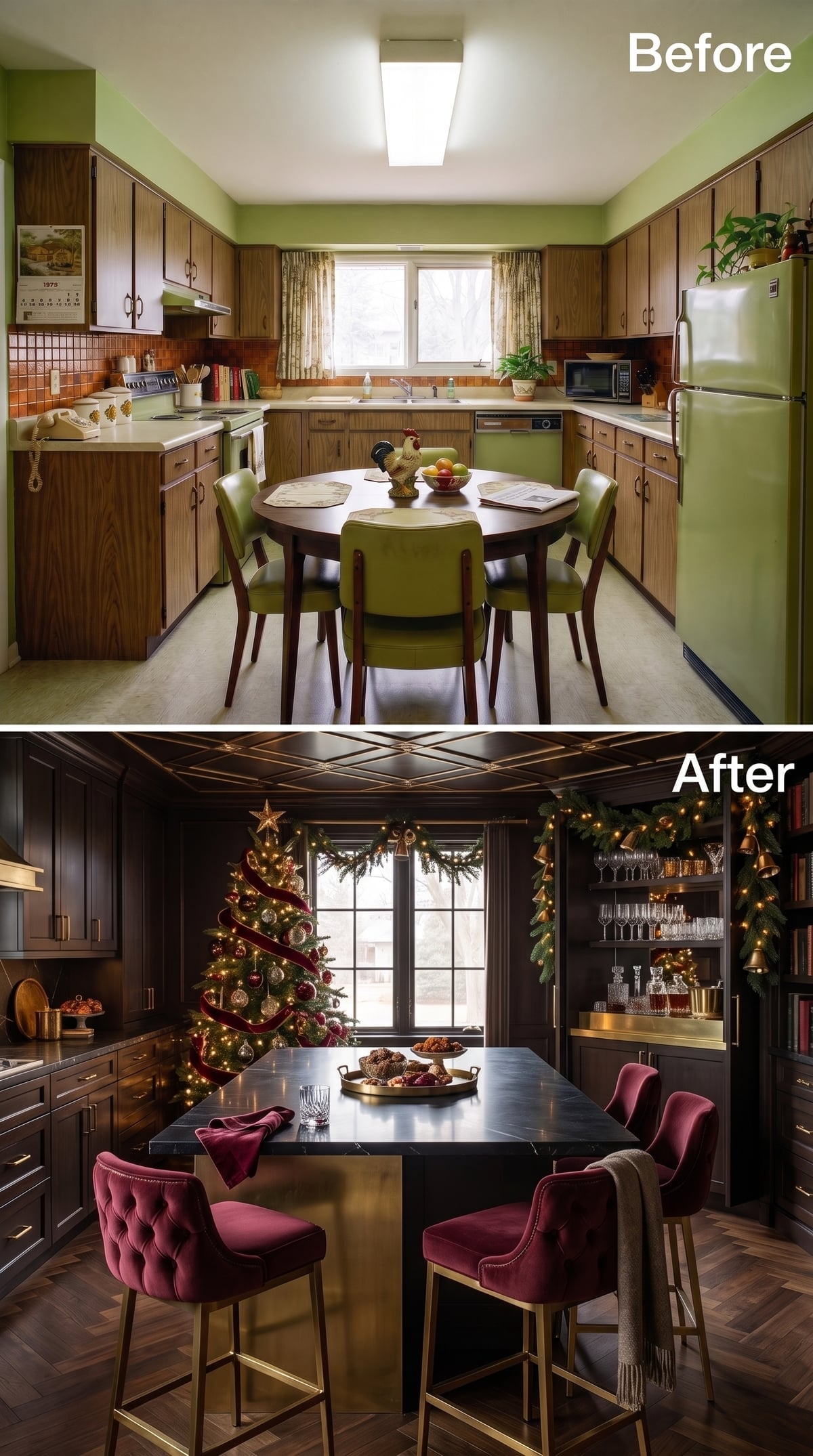
This one shifts the kitchen toward after-dinner territory. Dark cabinetry and a black marble island establish the backdrop, while burgundy velvet stools supply nearly all the softness.
Gold hardware and bar shelving bring reflected light into the darker palette. The bar cart earns its floor space because it extends the entertaining zone without demanding another built-in cabinet run.
Most Christmas kitchens are photographed at breakfast or dinner. This one is waiting for the hour when the dishes are done and somebody finally opens the good bottle.
5. Walnut and Slate Keep the Christmas Layer Almost Incidental
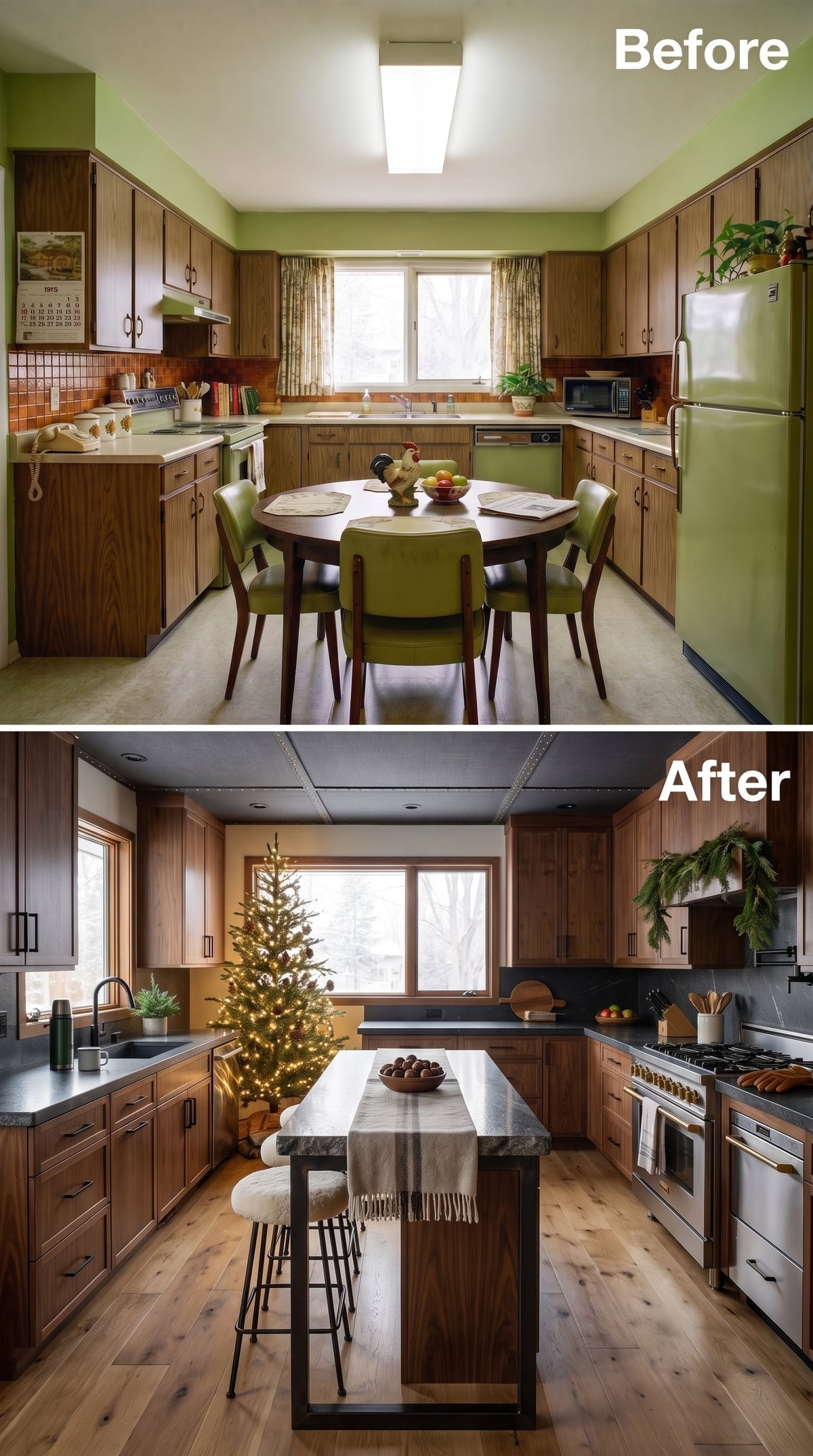
Flat-sawn walnut provides enough grain that the cabinet hardware can nearly disappear. Slate at the perimeter absorbs light, while marble on the island throws more of it back into the room.
That difference between the two counters separates the work surfaces without introducing another cabinet color. A plaid runner and Christmas tree then settle into a room that was already warm, dark and comfortable enough to carry them.
Why Two Counter Materials Can Work
A polished pale island and darker matte perimeter react differently to light, giving the center more emphasis. Used deliberately, mixed counters can define zones without turning every cabinet run into a separate design statement.
4. A Forest-Green Island Gives Walnut Its Christmas Counterpoint
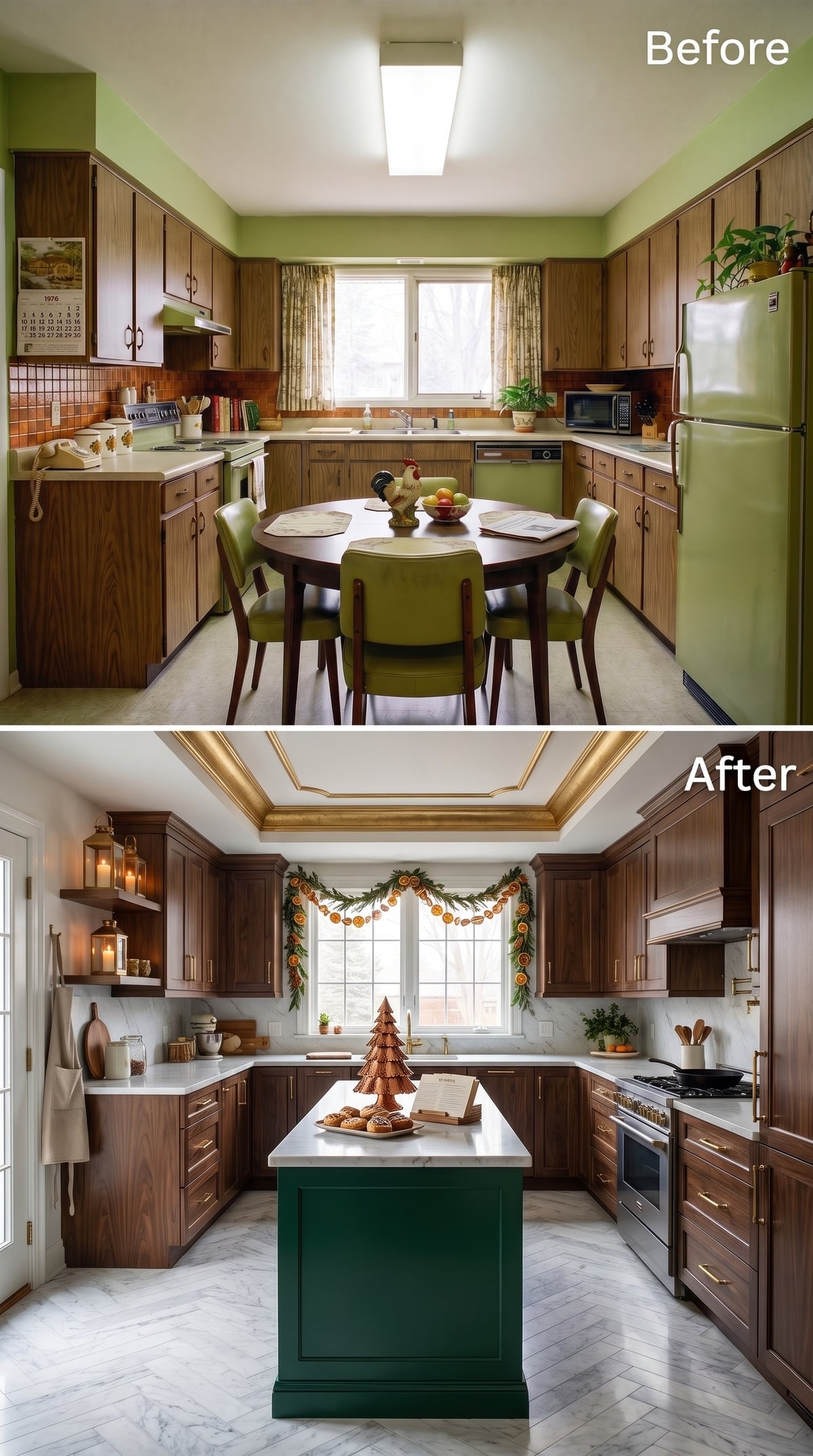
Walnut covers most of the perimeter, but the island refuses to match. Forest green gives the center its own identity while the white marble top keeps that saturated color from becoming too dense.
Brass pulls create the link between the wood and painted surfaces. That small repetition is enough; the cabinet colors do not need to match when the metal finish keeps moving through both.
The combination is particularly comfortable at Christmas. Wood, green, brass and marble already contain most of the holiday vocabulary before a single branch appears.
Budget Move: Painting an island while leaving perimeter cabinetry intact can create a two-tone effect without refinishing every door in the room. Hardware is another relatively contained change with disproportionate visual impact.
3. Herringbone Floors Give This Walnut Christmas Kitchen Its Movement
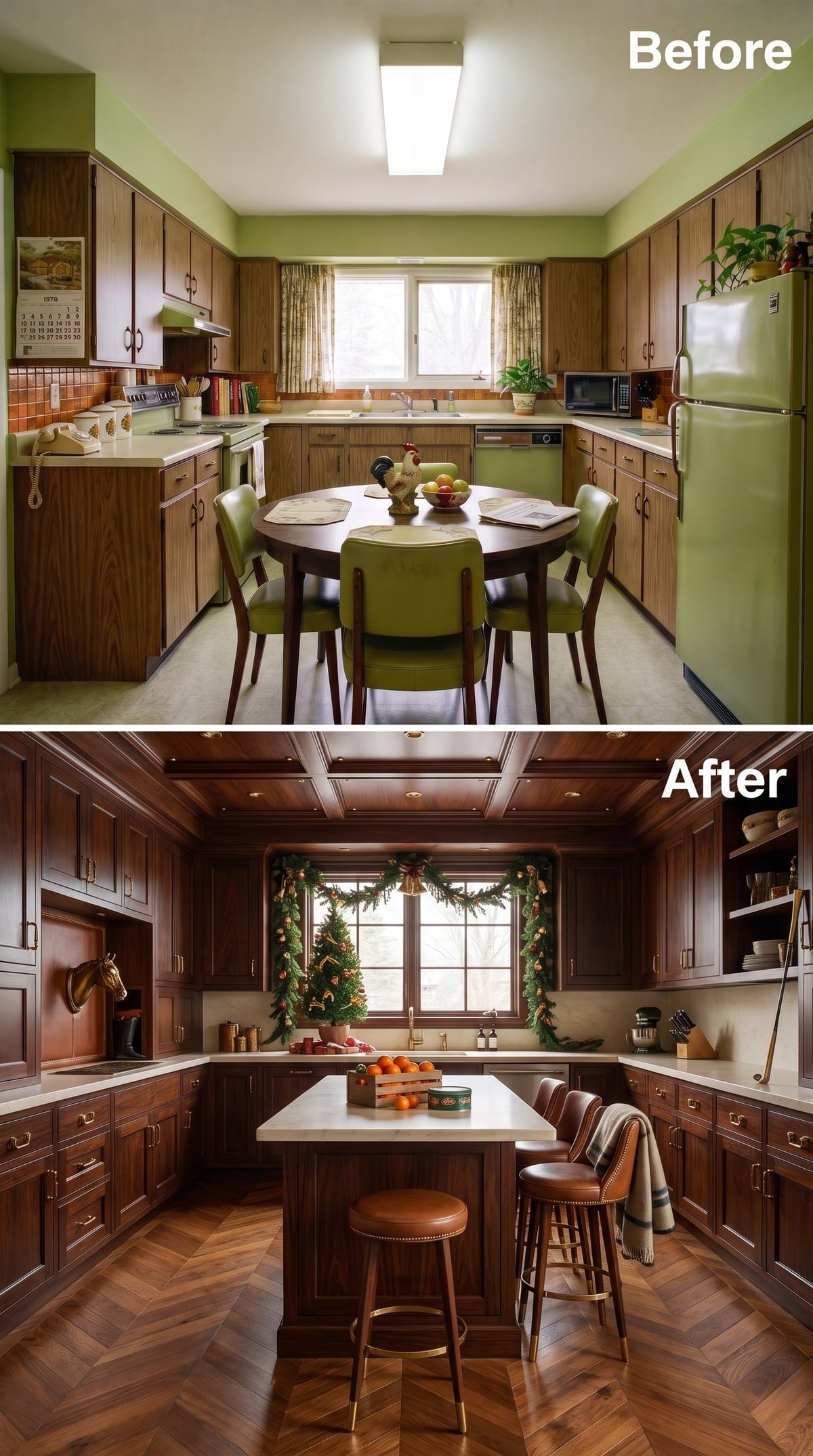
Another walnut kitchen, but this time the emphasis has shifted downward. Herringbone flooring turns the largest horizontal surface into the pattern, allowing the cabinetry itself to remain comparatively straightforward.
Gold bin pulls punctuate the dark wood without becoming jewelry for its own sake. A marble-topped island and leather stools keep the middle handsome but quiet, leaving the floor to supply most of the movement.
The Christmas garland works for the same reason. It follows an existing line instead of creating a new one. One sweep at the window is enough.
2. Mahogany, Green Marble, and a Library Ladder Make Christmas Feel Collected
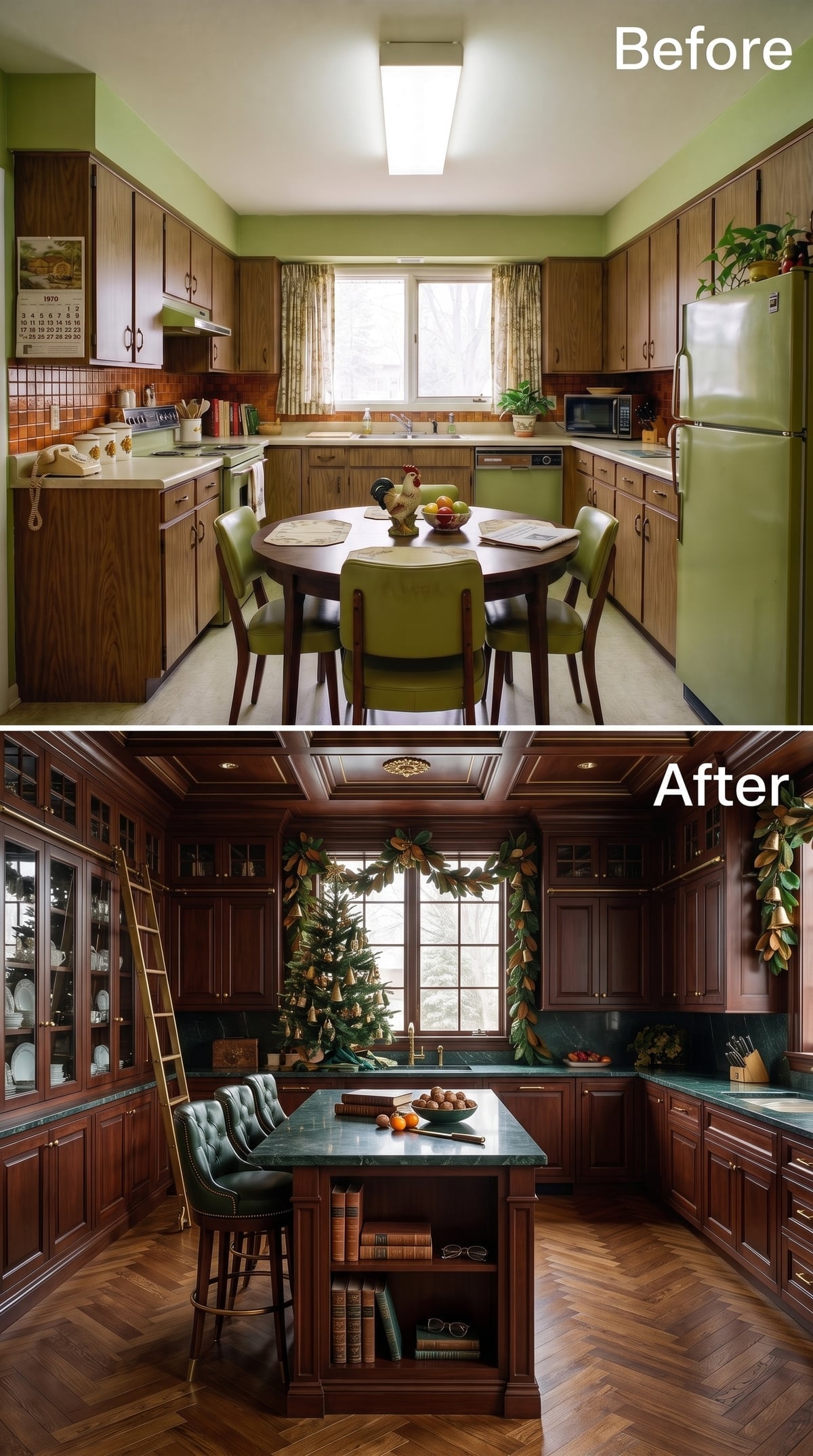
This shares mahogany and green stone with the earlier formal kitchen, but the personality is completely different. Glass-front uppers, books at the island and a brass library ladder make the room feel less ceremonial and more like a kitchen that has gradually acquired things.
Herringbone wood underfoot and a dark coffered ceiling deepen the library effect. Green marble becomes the bridge between all that brown wood and the holiday greenery rather than simply another luxury surface.
The ladder is the detail that makes the tall cabinetry believable. Without it, the upper shelves would look aspirational. With it, somebody could actually reach the Christmas platter stored at the top.
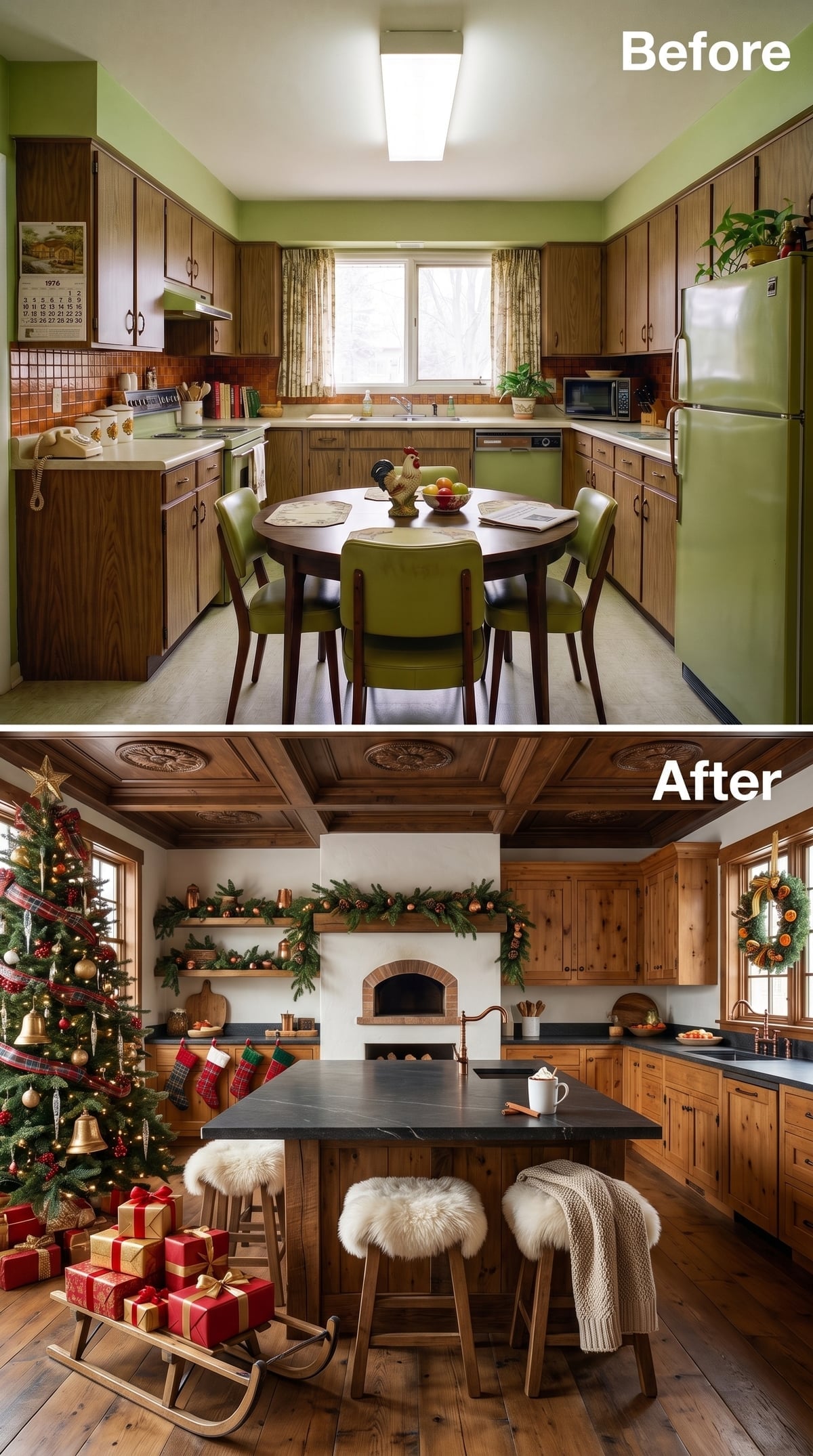
1. Knotty Pine and Soapstone Bring Christmas Morning Back Down to Earth
🔥 Would you like to save this?
After lacquer, marble, mirrors, velvet and gilding, knotty pine feels almost radical. The grain remains visible, the knots stay knots and dark soapstone gives the wood enough contrast to keep the room from dissolving into honey-colored timber.
Sheepskin stools add softness without introducing another hard finish. The wood-burning oven at the back becomes the natural focal point, flanked by open shelves rather than towering cabinetry.
Garland threads through those shelves, the ceiling detail stays warm and carved rather than polished, and the entire room lands somewhere between rustic and highly considered. It is the right place to finish because it does not try to erase the idea of an older kitchen. It simply imagines Christmas morning there after the avocado green has gone.