🔥 Would you like to save this?
Some rooms tolerate dinner. These rooms make a case for it.
In order to come up with the very specific design ideas, we create most designs with the assistance of state-of-the-art AI interior design software. Also, assume links that take you off the site are affiliate links such as links to Amazon. this means we may earn a commission if you buy something.
The table is only the beginning. One dining room buries a glowing wine cellar beneath the floor. Another wraps the table in a terracotta alcove. Glass blocks curve around green stone, a tree-trunk column climbs through the ceiling, stained glass turns the room overhead into jewelry, and lacquered crimson makes walls and ceiling behave like one enormous piece of furniture.
That is the real appeal of a dedicated dining room: four walls give design somewhere to go. Color can become immersive instead of cautious. Lighting can drop lower. Banquettes can wrap corners. Murals can take over. A ceiling can suddenly matter as much as the chairs beneath it.
Across these 30 contemporary dining rooms, separation does not mean stiffness. It means permission — to make the room darker, stranger, softer, louder, more intimate, or far more theatrical than the open-plan space beside it.
30. Mondrian Didn’t Design This Room, but the Cabinetry Got the Message
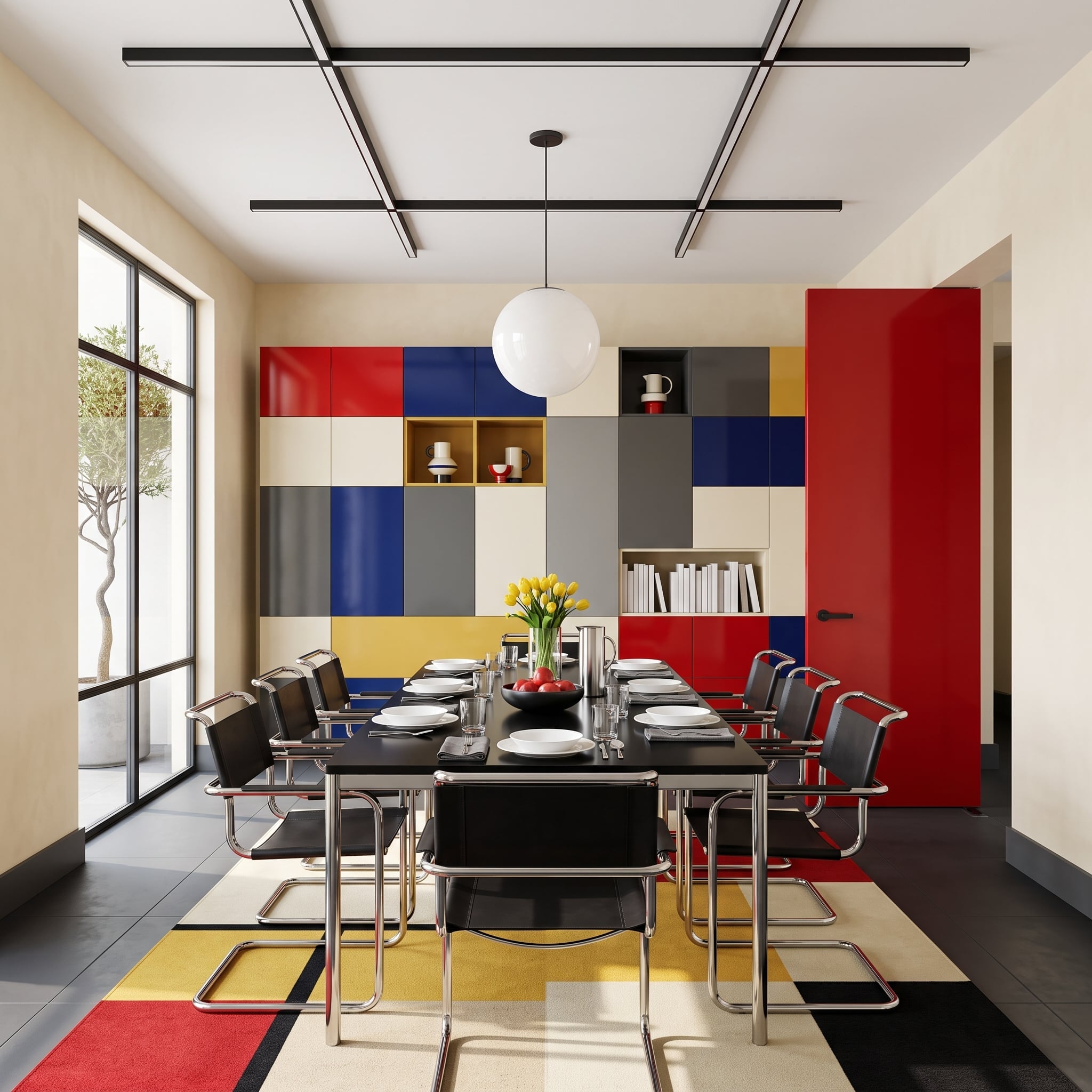
The wall is cabinetry, but it refuses to behave like background storage. Red, cobalt, mustard, charcoal, and cream panels break the surface into a De Stijl-inspired grid of unequal rectangles, turning practical millwork into the room’s largest graphic gesture.
A matte-black table and chrome cantilever chairs simplify everything in front of it, while the rug repeats the geometry at a broader scale. The white globe pendant is almost comically restrained by comparison. With this much happening on one wall, restraint elsewhere becomes useful.
29. Shaker Bones, Butter Walls, and a Dining Room Built Around Wood
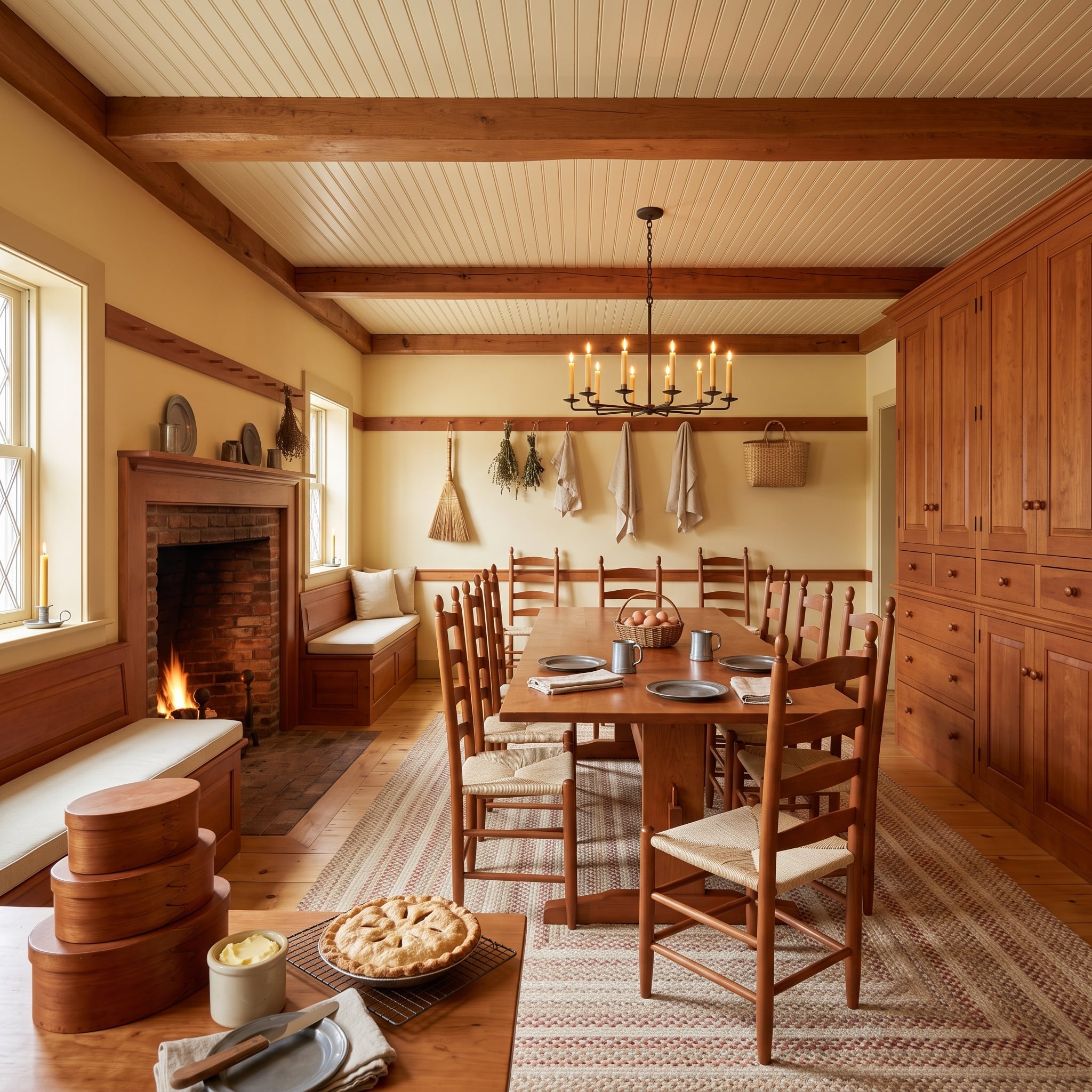
Warm reddish wood links the ladder-back chairs, trestle table, and floor-to-ceiling cabinetry, but the room never collapses into one brown mass. Butter-yellow walls and a pale beadboard ceiling keep enough light around the furniture for every spindle, drawer front, and tabletop edge to remain distinct.
The brick fireplace adds another rough, matte surface opposite all that finished wood. Dried herbs, pottery, and the visible pie are small details; the larger story is architectural — storage, hearth, table, and ceiling all belong to the same warm material vocabulary.
- Built-in cabinetry can replace several smaller freestanding storage pieces when wall space allows.
- A pale ceiling keeps extensive dark or reddish woodwork from visually compressing the room.
- A braided rug introduces pattern at floor level without competing with the strong lines of ladder-back chairs and a trestle table.
28. Black Marble and Fire Turn the Dining Room Almost Cinematic
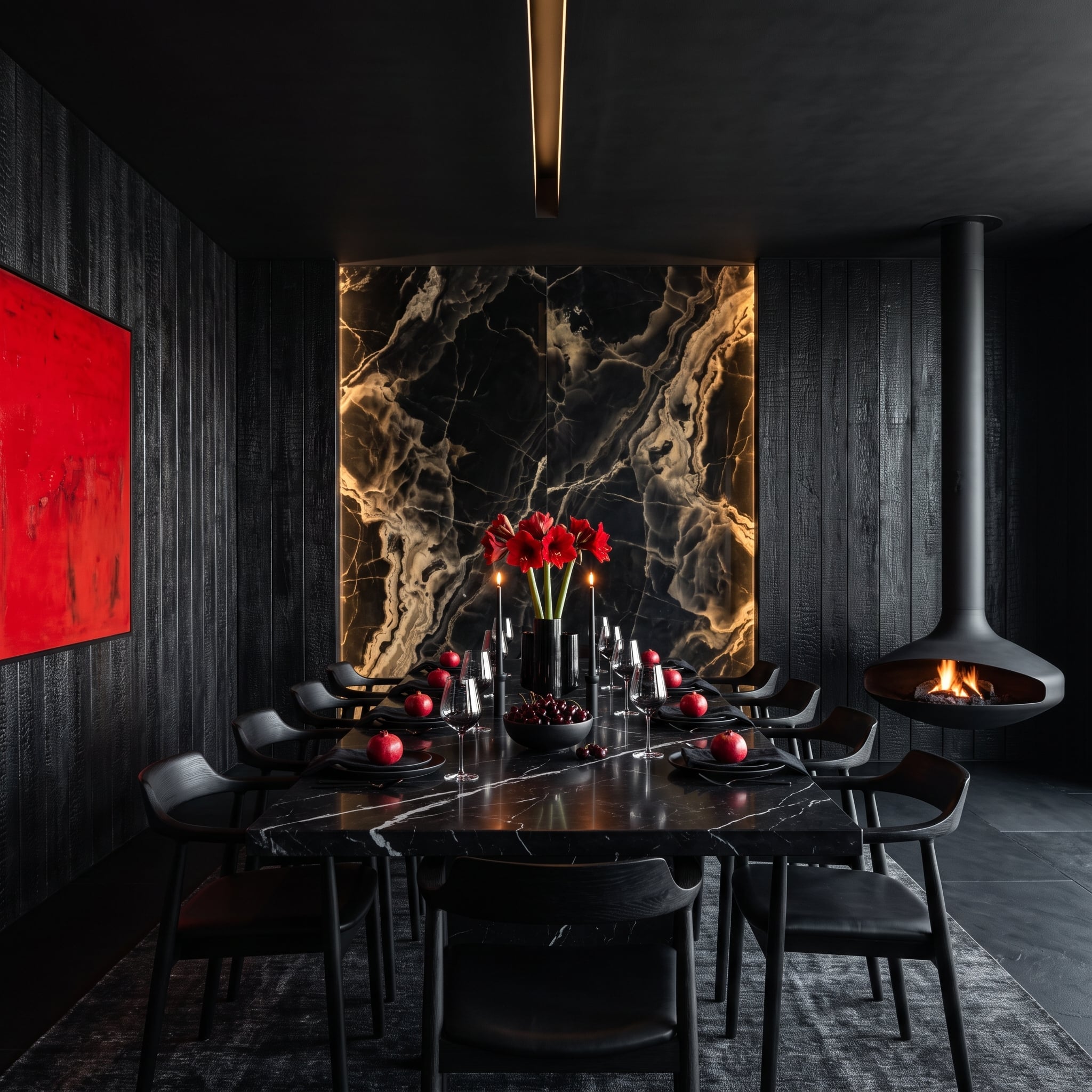
Dark wood paneling establishes the envelope, then a black-and-gold stone slab pushes the room further into shadow. Warm light behind the stone picks out its veining while an oval dark table repeats the same depth below eye level.
Pomegranates, red amaryllis, candles, and the suspended fireplace provide the warm notes. None is large enough to compete with the stone wall, but together they keep the room from becoming a study in black surfaces alone.
Stone Detail: Dark marble and marble-like stones vary greatly in translucency. Backlighting works only when the selected material and slab thickness allow enough light through, so lighting, backing, stone selection, and fabrication need to be planned together rather than treated as separate decisions.
27. Living Wall, Terracotta Floor, and a Dining Room With Its Own Green Horizon
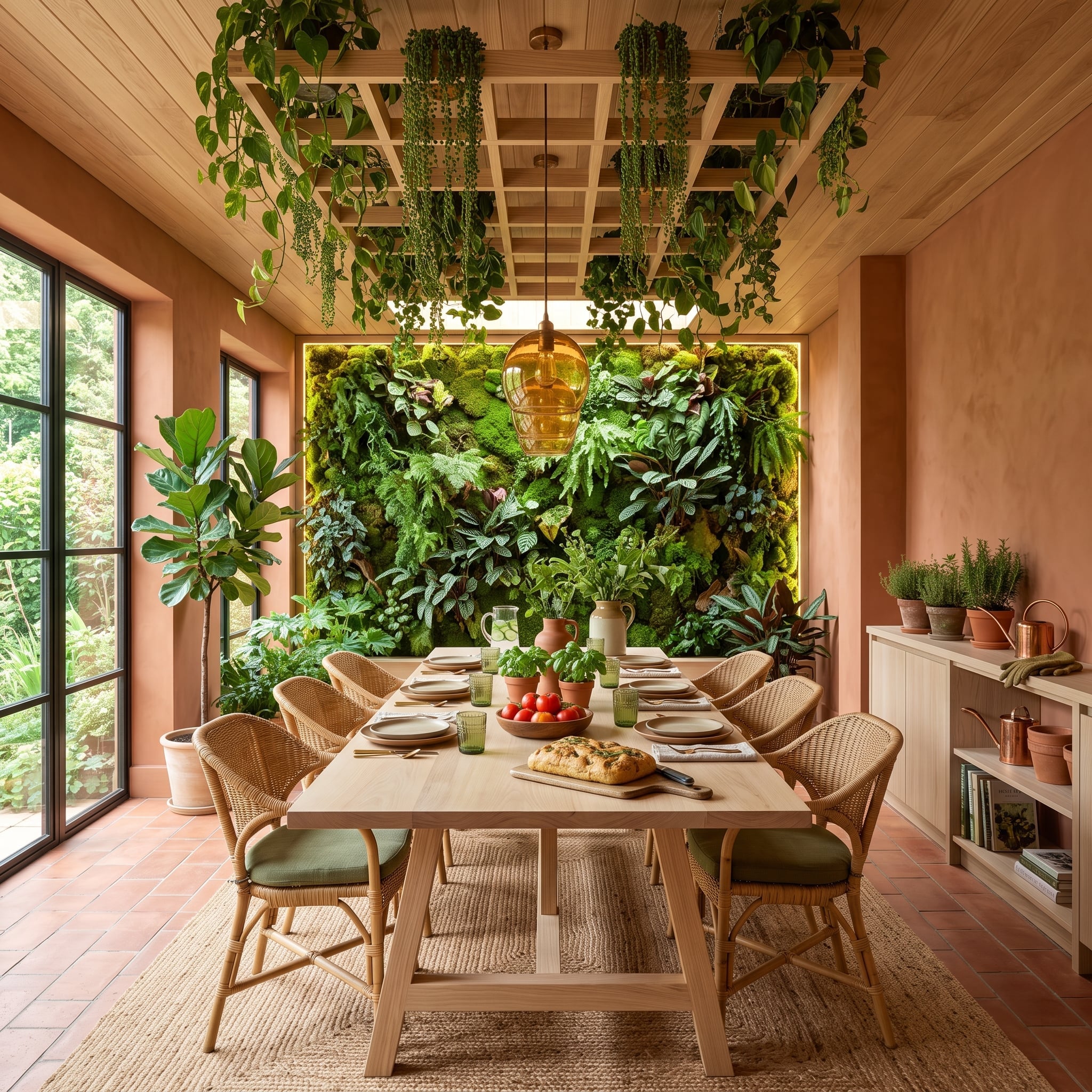
A floor-to-ceiling wall of ferns, moss, and trailing greenery occupies the far end of the room like a vertical garden viewed through an opening. A warm amber pendant glows against the foliage while pale wood furniture keeps the center visually light.
Terracotta tile and salmon-toned plaster stop the green from taking over completely. Olive cushions connect the rattan chairs back to the planted wall, but the color arrives in upholstery rather than another botanical surface.
Planting Note: A living plant wall needs an irrigation strategy, drainage, appropriate light, and ongoing maintenance. Preserved moss can produce a similarly dense green surface without watering, but it is a different material and should not be treated as living planting.
26. Ionic Pilasters and Marble Inlay Make Gray Look Anything but Quiet
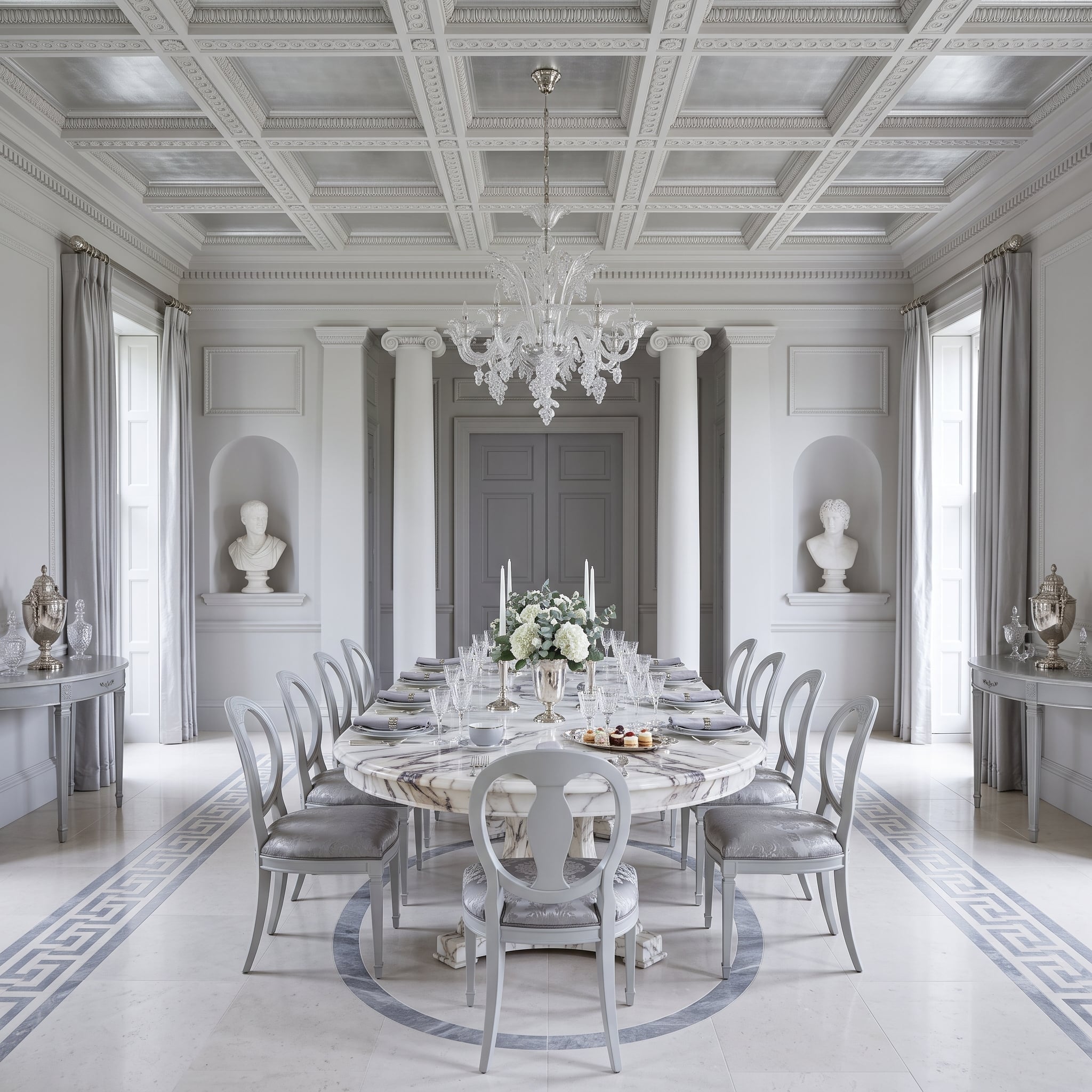
White and gray dominate, yet the room is anything but blank. Coffers break the ceiling into deep recessed panels, Ionic pilasters give the walls vertical rhythm, and arched niches create enough shadow to make a restrained palette feel architectural rather than plain.
An oval marble table sits within a Greek-key floor border while a Murano-style glass chandelier supplies the most fluid shape overhead. Busts in the wall niches reinforce the neoclassical vocabulary without requiring another color.
Design Detail: A narrow palette puts more pressure on relief, proportion, shadow, and material variation. Coffers, pilasters, veined stone, and recessed niches give this room enough depth that gray never has to become an accent color.
25. Adobe, Copper, and Desert Light Keep the Palette Close to the Ground
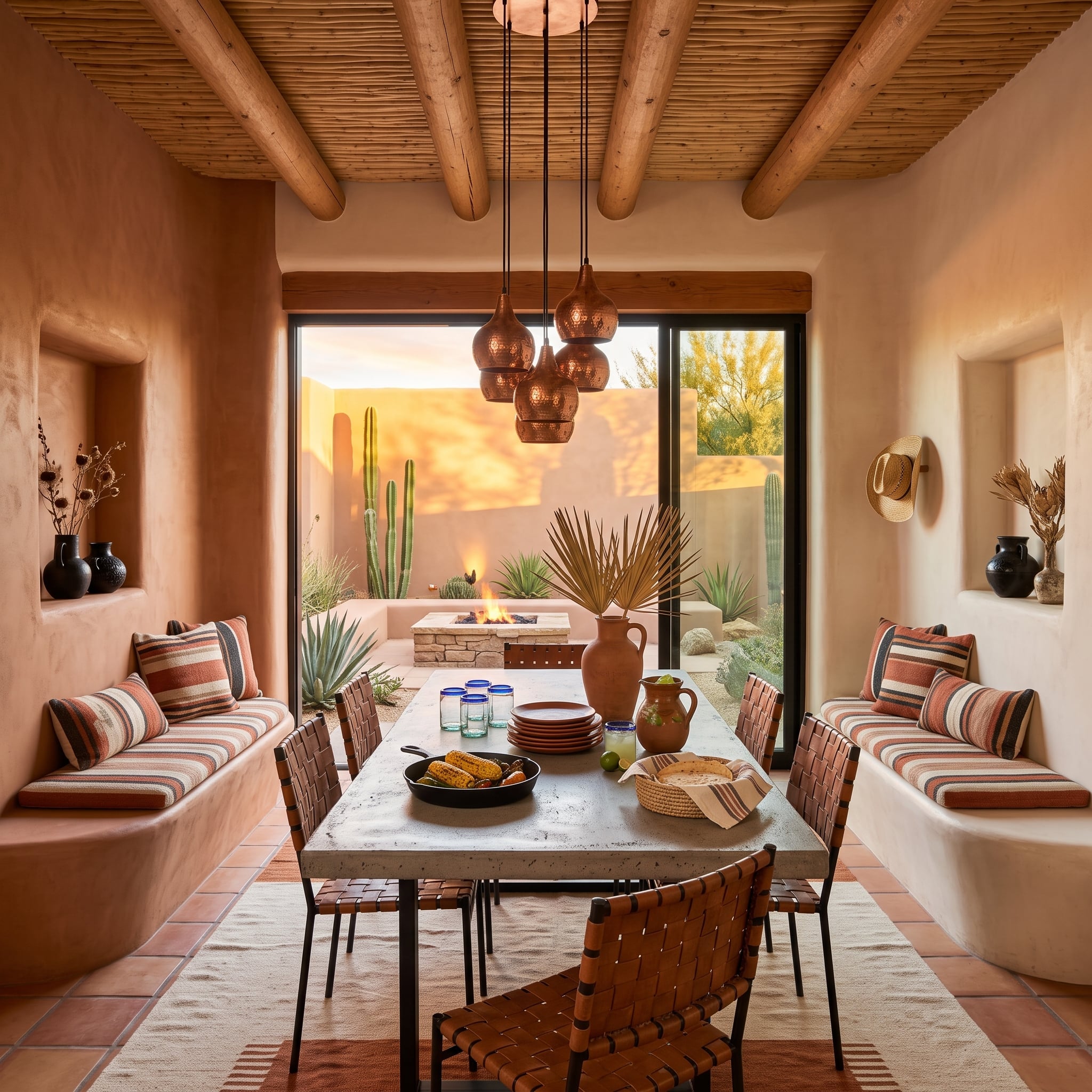
Warm earthen walls, terracotta tile, a vigas-and-latilla-style ceiling, and woven leather chairs keep nearly every surface inside a clay, wood, and copper range. The hammered pendants pick up the sunset outside without turning metallic shine into the dominant feature.
Built-in banco seating extends along both sides, with small nicho-like shelves holding pottery and dried botanicals. Beyond the glazing, saguaros and desert stone make the interior palette look less like decoration than a continuation of the landscape.
Material Note: Traditional adobe uses earth-based masonry with substantial thermal mass, which can help moderate indoor temperature swings when the building, climate, shading, and ventilation work together. Vigas and smaller latillas are longstanding features of Pueblo and Southwestern building traditions, while hammered copper adds a compatible regional craft reference without needing to imitate historic construction exactly.
24. Glass Blocks, Green Stone, and a Dining Room Made Almost Entirely of Curves
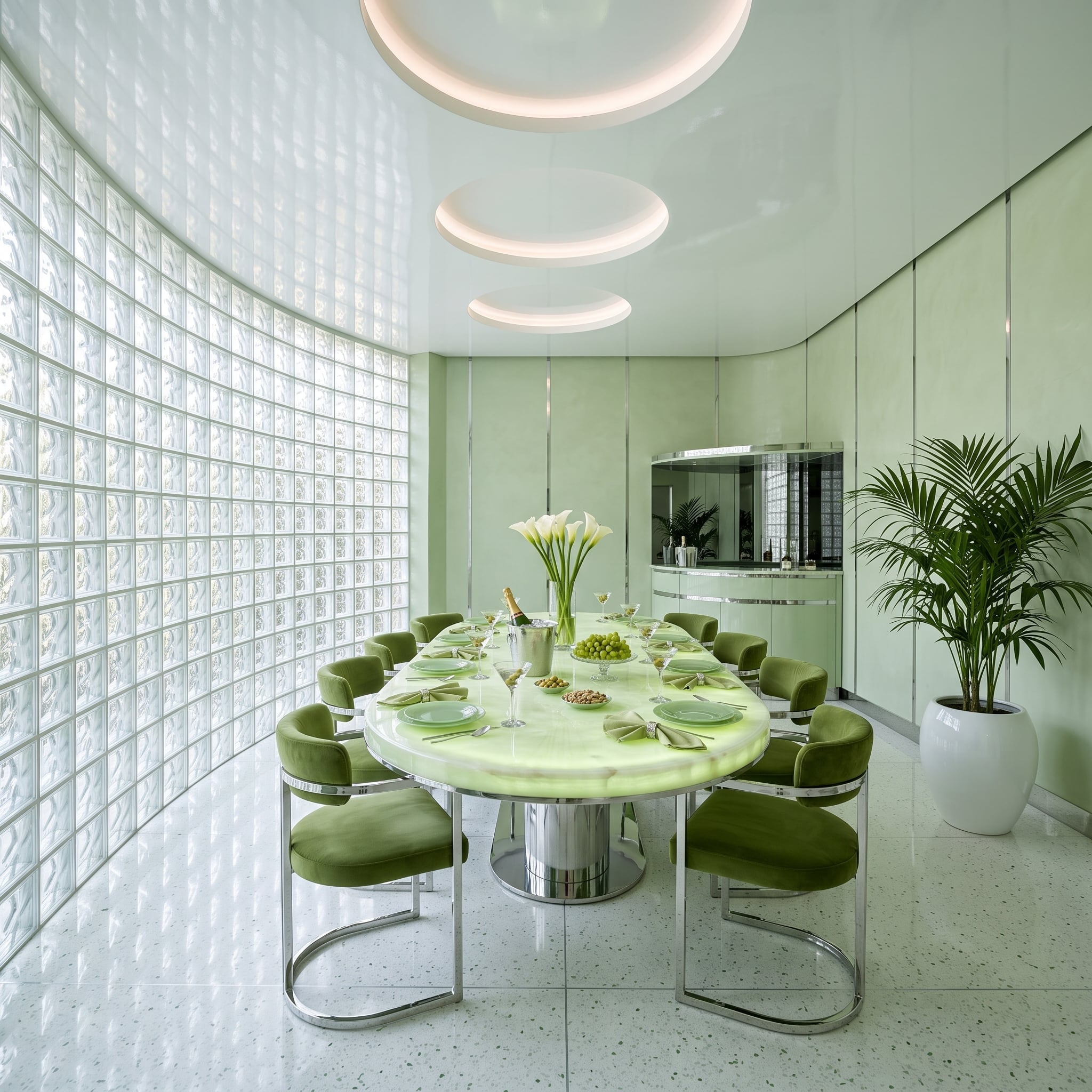
Curved glass-block walls soften daylight before it reaches the oval dining table, turning the perimeter into a translucent enclosure rather than a conventional set of windows. The green stone tabletop appears slightly luminous beneath recessed oval ceiling fixtures.
Green velvet cantilever chairs repeat the table color while chrome bases introduce harder reflections against the terrazzo floor. Even the lighting follows the same geometry rather than defaulting to round pendants over an oval table.
Why the Ceiling Shape Matters
Repeating the table’s oval footprint overhead creates a strong vertical relationship between floor plan and ceiling. The eye reads the two shapes together even though they are separated by an entire room of air.
23. Reclaimed Wood and a Snowy Mountain View Pull in Opposite Directions
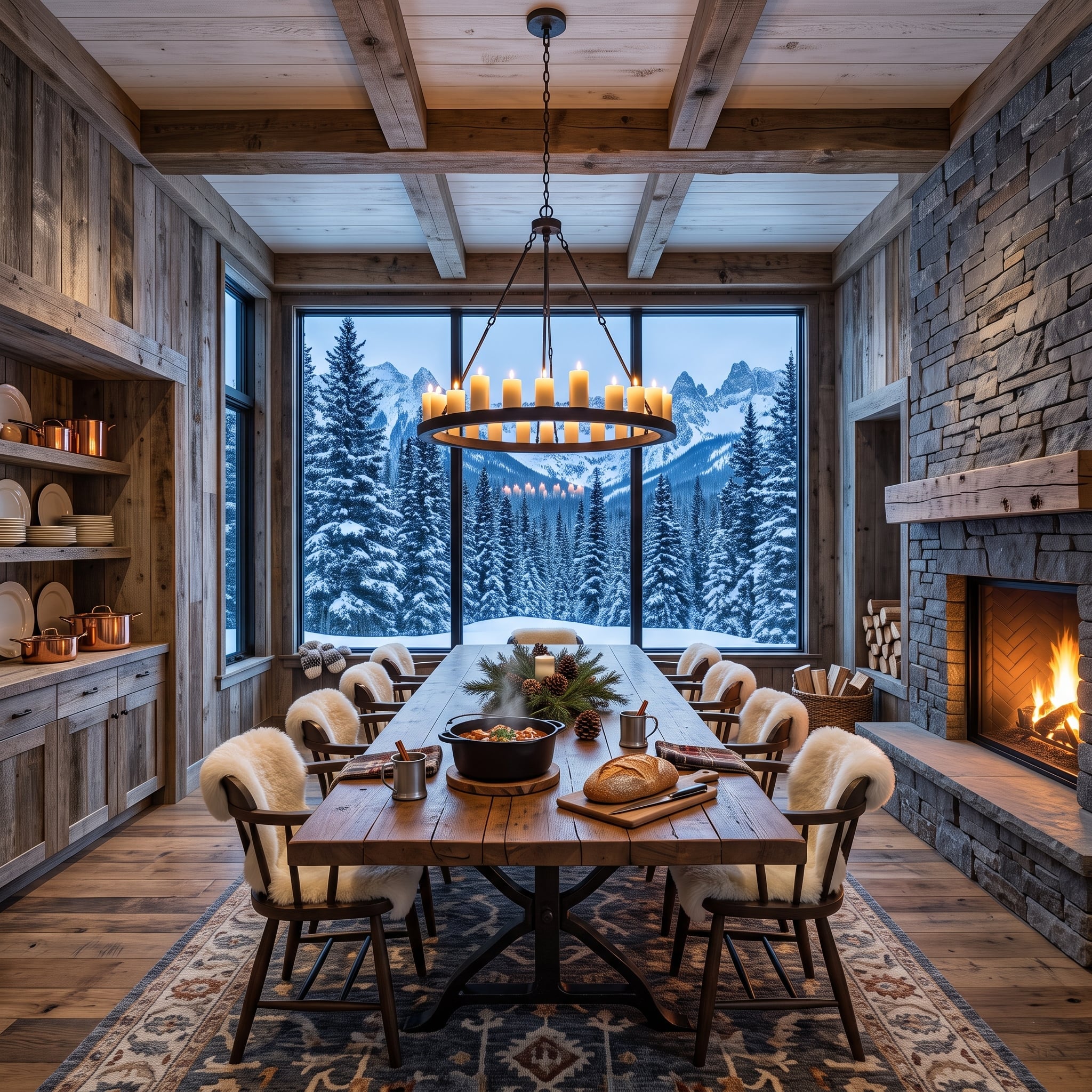
Rough-sawn planks cover the walls in warm brown while the window beyond fills with snow, spruce, and cold blue mountain light. That temperature contrast gives the interior much of its drama before the chandelier or fireplace enters the picture.
A live-edge dining table and dark chairs keep the center substantial, with sheepskin softening the chair backs. The wrought-iron candle ring adds a darker silhouette overhead, and the stone fireplace introduces one coarse mineral surface beside all that wood.
- A large landscape view can handle visually heavy interior materials because the glazing provides a broad field of light and distance.
- Removable chair throws introduce softness without permanently upholstering rustic wood seating.
- A herringbone firebox changes the brick pattern visually; fireplace performance depends on the complete firebox, throat, damper, chimney, and ventilation design rather than the bond pattern alone.
22. Cobalt Walls and Pink Marble Make Color Behave Like Architecture
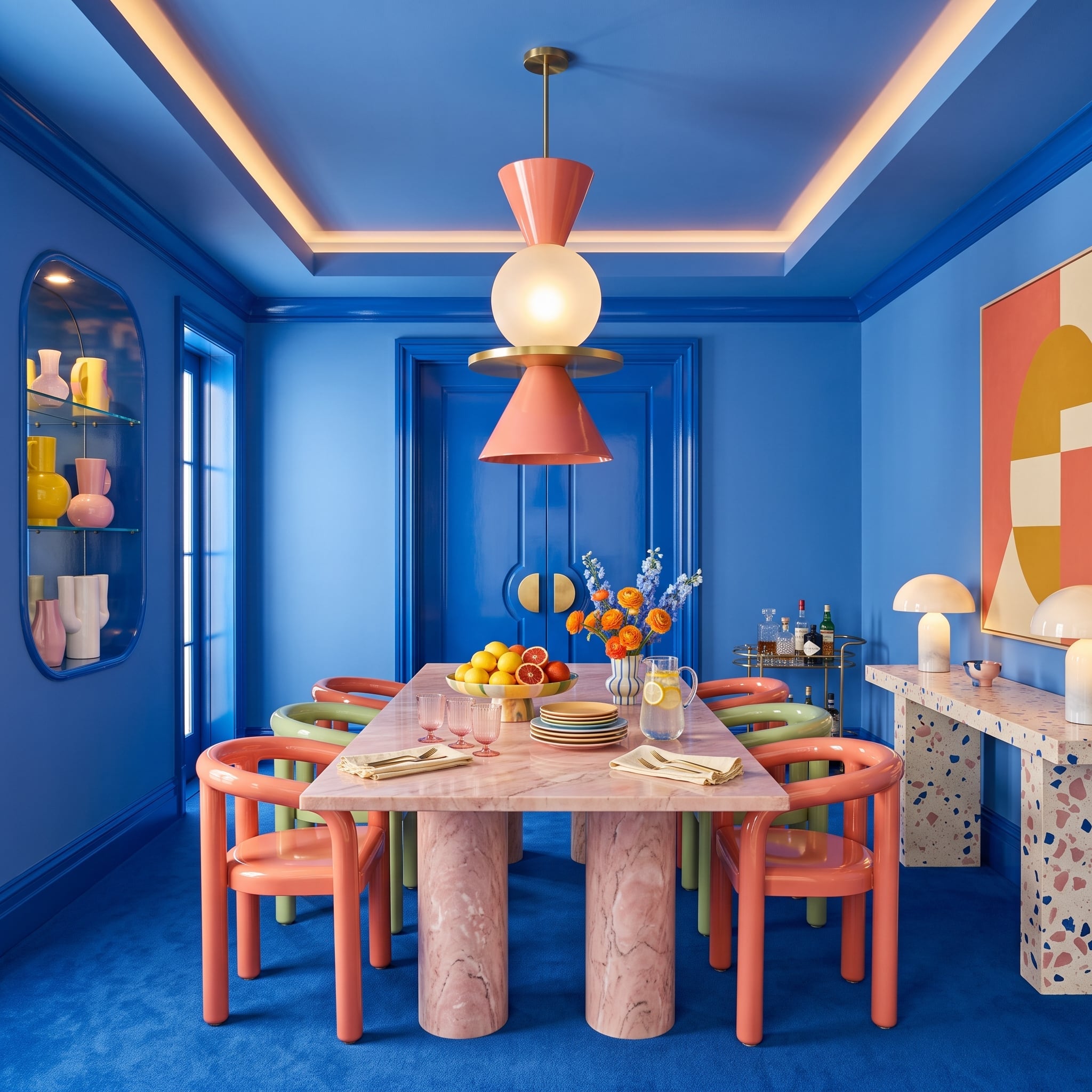
Cobalt wraps the walls almost without interruption, so the pink stone dining table lands in the center like a completely different geological event. Coral chairs with sage-green inner rings add two more colors without diluting either of the dominant ones.
The pendant stacks coral cones around a frosted globe, while a terrazzo console introduces pattern through aggregate rather than print. Strong color is doing several different jobs here: defining the envelope, identifying furniture, and separating planes.
Color Detail: Veined stone and terrazzo are useful in heavily saturated rooms because their patterns break up large blocks of color without introducing another motif that has to be coordinated.
21. Steel and Glass Give This Loft a Dining Room Without Building an Opaque Wall
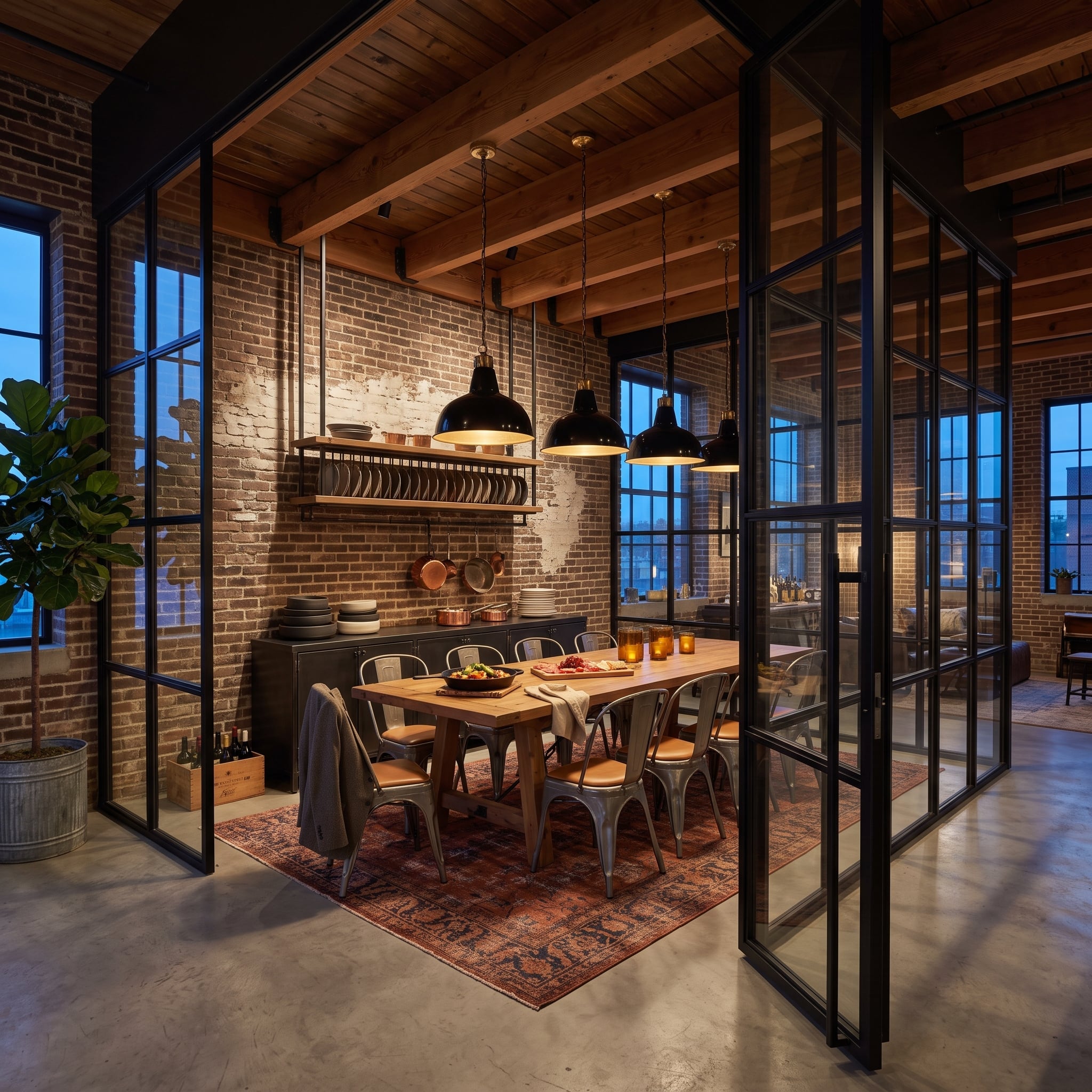
Floor-to-ceiling steel-framed glazing gives the dining area a clear perimeter while leaving the exposed brick visible beyond it. Black metal chairs and four matte pendants repeat the partition frame, while the wood table and Persian rug keep the enclosed zone from becoming all iron, glass, and concrete.
Why the Glass Partition Changes the Plan
Steel-framed interior glazing has strong associations with industrial architecture and loft conversions because it can divide spaces while preserving sightlines and borrowed light. It may also reduce sound when properly glazed and sealed, although acoustic performance depends on the entire partition and door assembly.
20. Cherubs, Powder Blue, and a Banquette That Turns Dinner Into a Circle
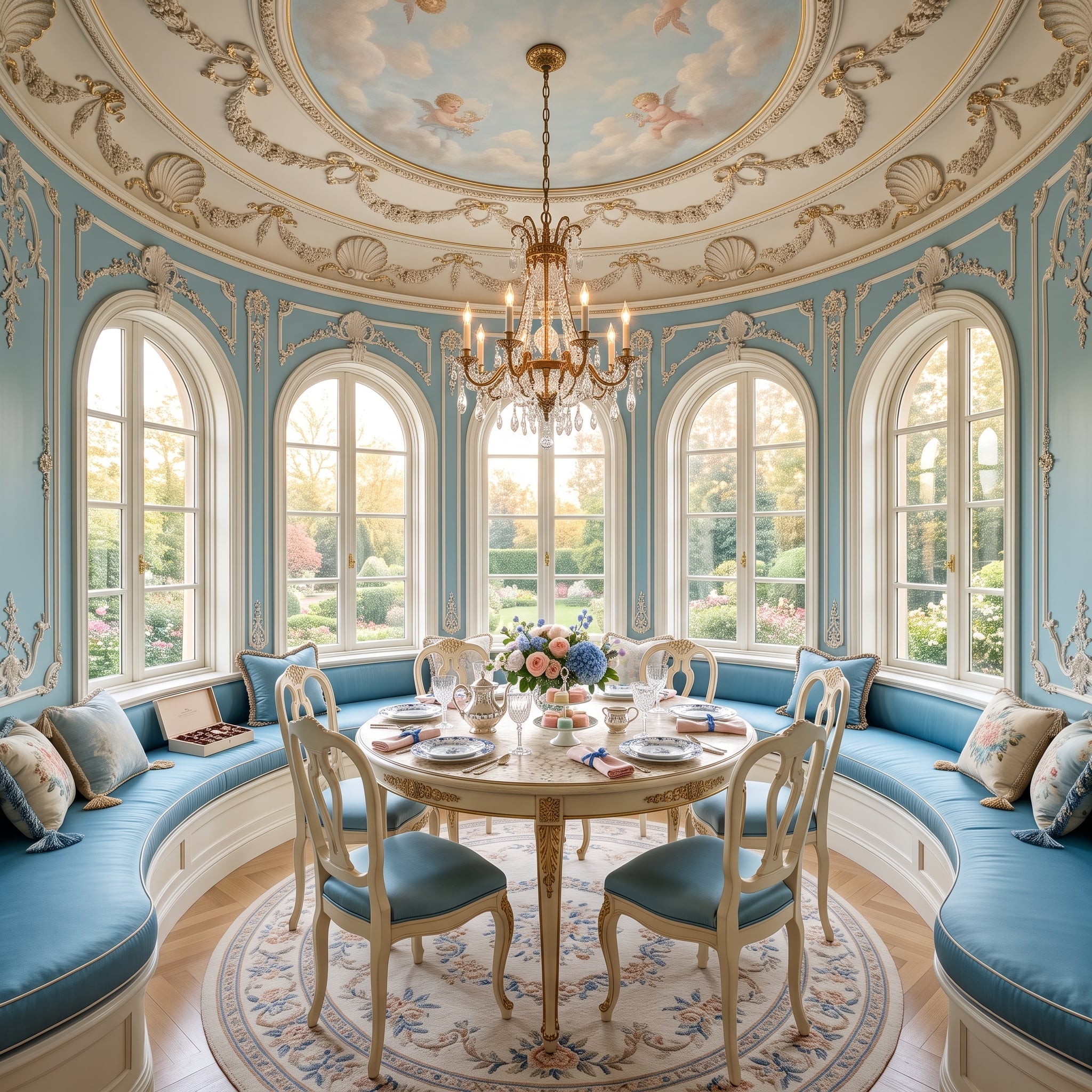
Rococo never learned how to whisper. Powder-blue walls carry gilded plasterwork, crystal drops fall from the chandelier, and a painted cherub ceiling occupies the coffered dome overhead.
The more interesting move happens at seating level. Instead of marching chairs down two sides of a long table, an oval banquette bends around a round table and changes the entire social geometry of the room. Arched garden windows keep all that ornament from becoming sealed off from daylight.
19. Wavy Wood Walls Meet an Electric-Blue Table Above the City
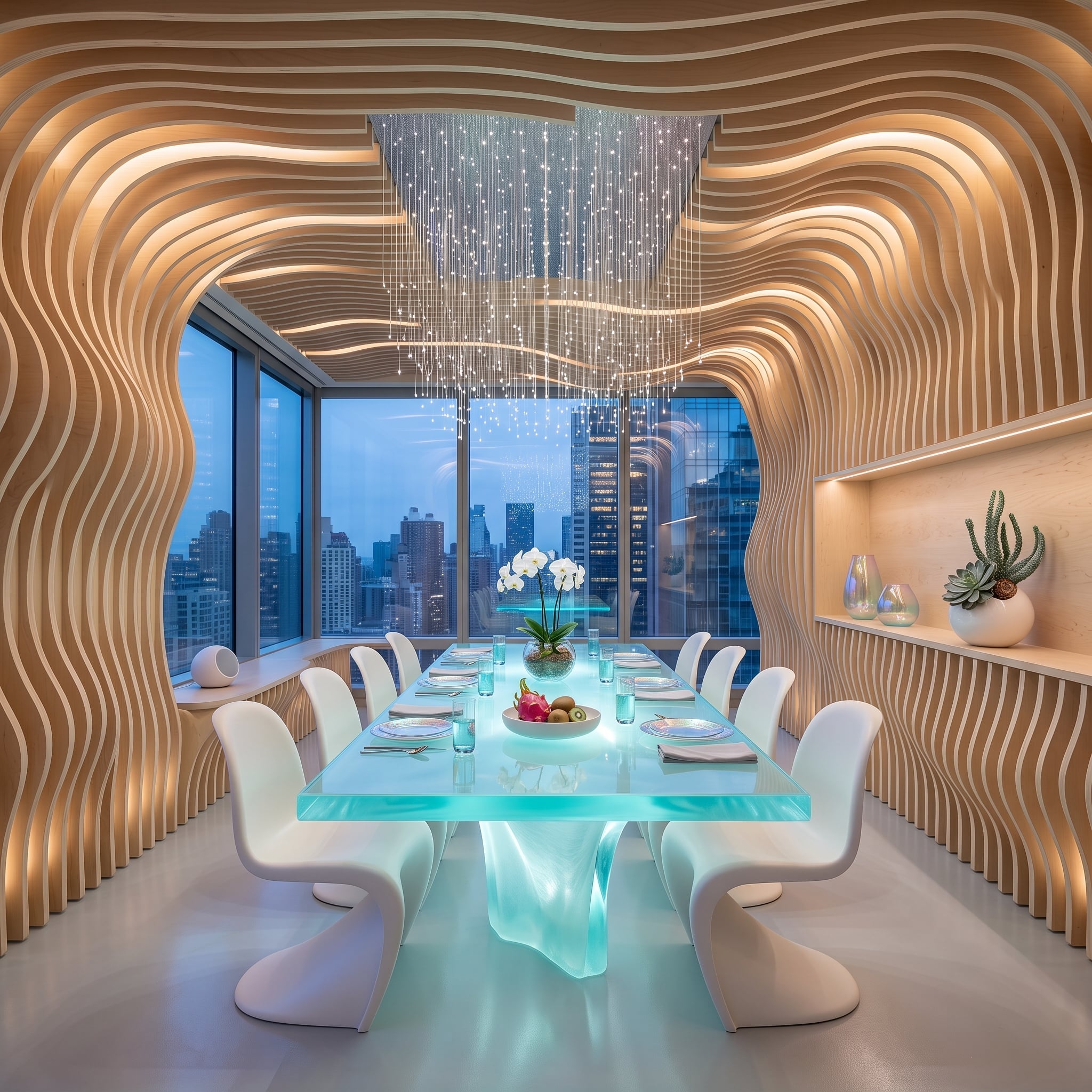
Layered wood panels ripple across the walls and continue over the ceiling, with concealed light exaggerating every ridge. Against that warm sculptural shell, the illuminated aqua table looks almost extraterrestrial.
White Panton-style chairs act as a visual buffer between the two extremes. Fiber-optic strands descend overhead like frozen rain, while the city view supplies another field of small lights beyond the glass. Orchids and fruit are tiny details in a room governed by much bigger gestures.
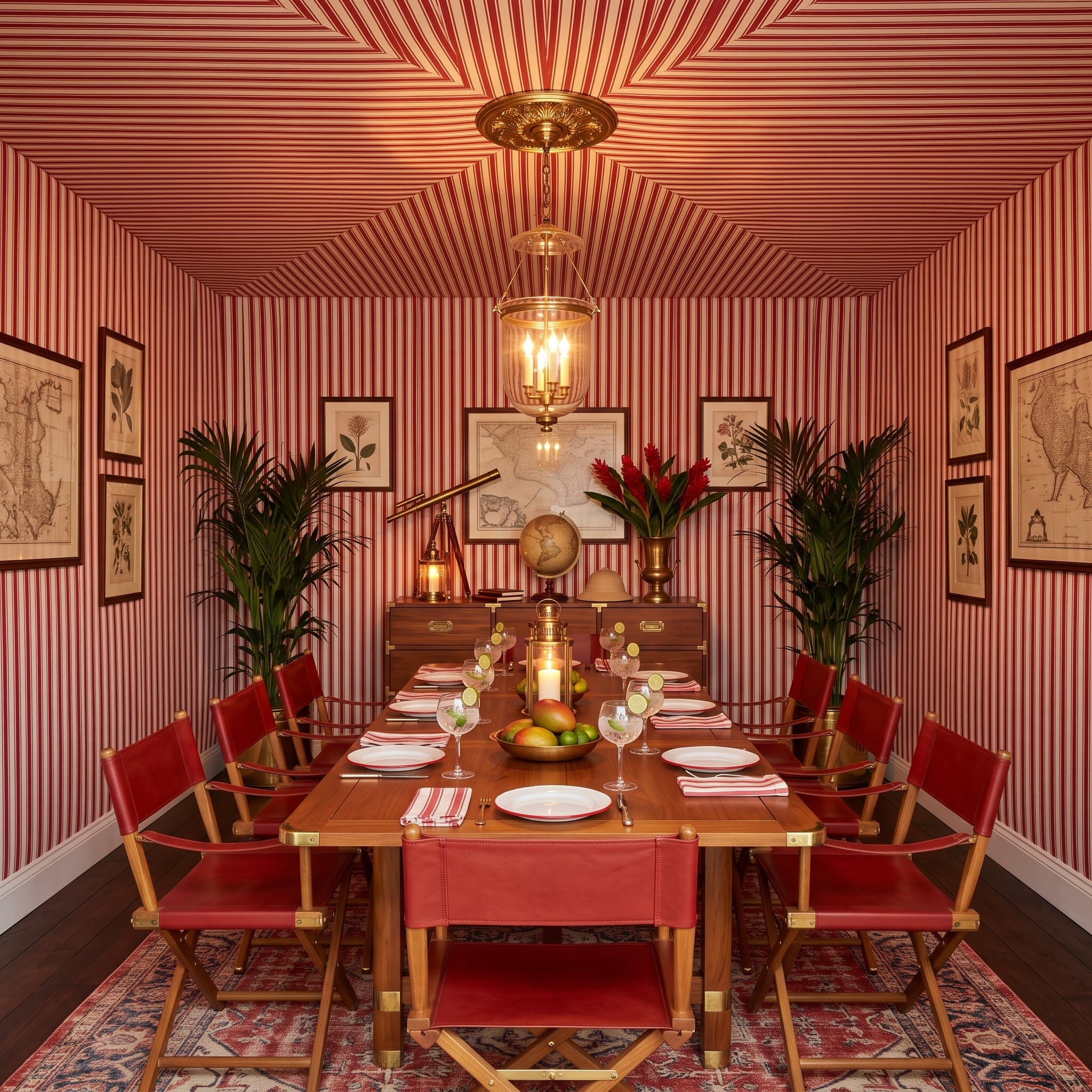
18. Stripes Run Up the Walls and Keep Going Across the Ceiling
🔥 Would you like to save this?
Red-and-cream ticking stripe covers the walls and ceiling, converging overhead like the inside of a tailored tent. Campaign-style chairs in red leather and brass sit around a dark wood table, keeping the furnishings substantial enough not to disappear against all that pattern.
Antique-style maps, botanical prints, a globe, and a brass lantern continue the room’s travel-inflected vocabulary. Dark frames give the artwork a clean edge against the stripes instead of asking each print to compete individually with the wallpaper.
Pattern Move: Extending a stripe onto the ceiling can turn separate surfaces into one continuous enclosure. Keeping the furniture in natural wood, leather, and brass gives the eye larger solid shapes to rest on between the repeated lines.
17. Bleached Oak and Seafoam Green Leave the Ocean to Supply the Loudest Color
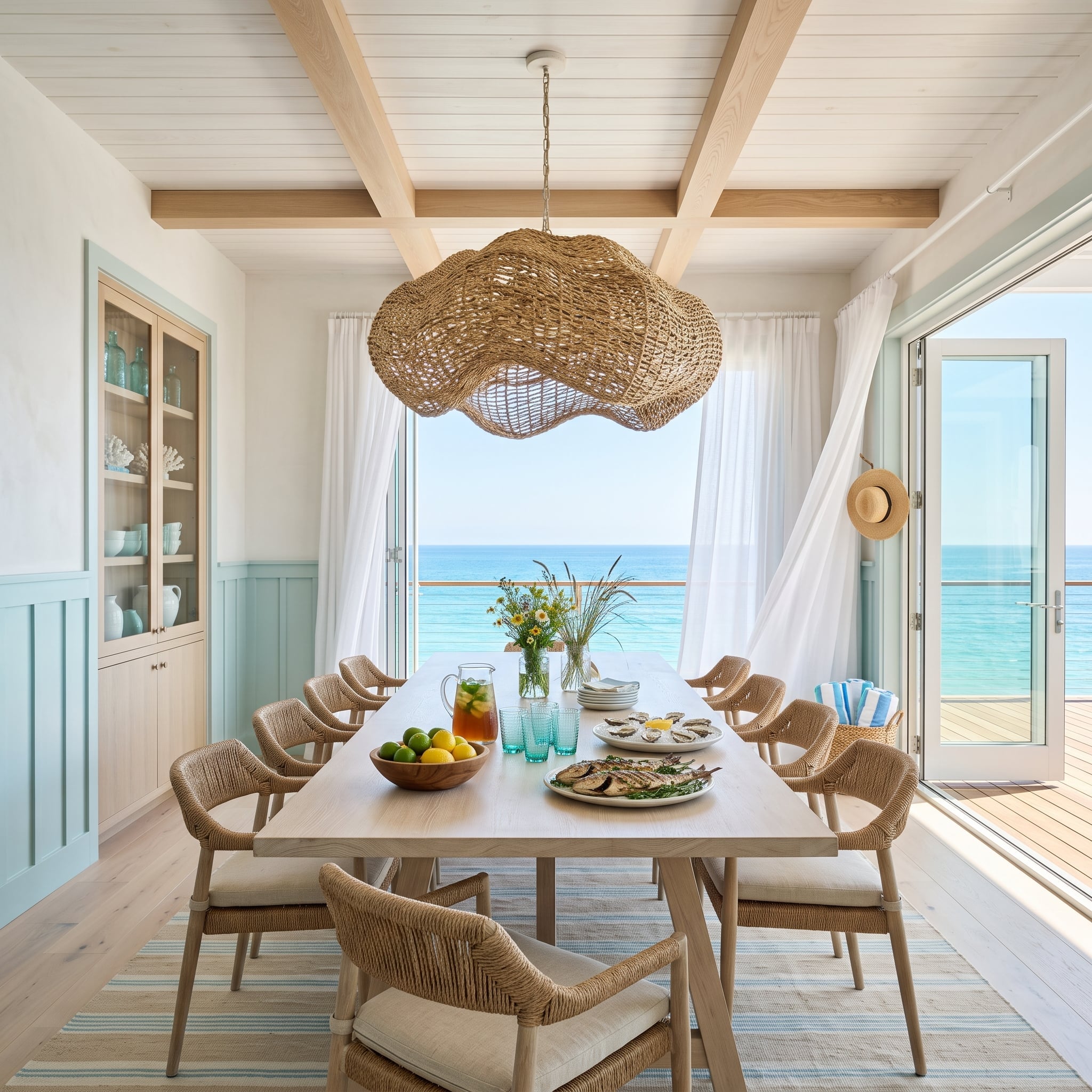
Bleached oak appears at the table, chairs, and wide-plank floor, creating a pale timber field beneath a loose cloud of woven fiber overhead. Seafoam-green wainscoting brings in color without trying to rival the turquoise water beyond the open doors.
Blue glass and coral-like accents appear in the built-in cabinet, but the room stops before coastal shorthand takes over. The strongest decorative element is still the actual horizon outside.
Material Note: Natural-fiber shades bring texture and visual lightness, but humidity resistance depends on the particular fiber, treatment, ventilation, and exposure. In coastal interiors, good airflow and keeping woven fixtures away from direct moisture matter more than assuming any natural fiber is automatically humidity-proof.
16. Plum Velvet and Crystal Make Restraint Entirely Optional
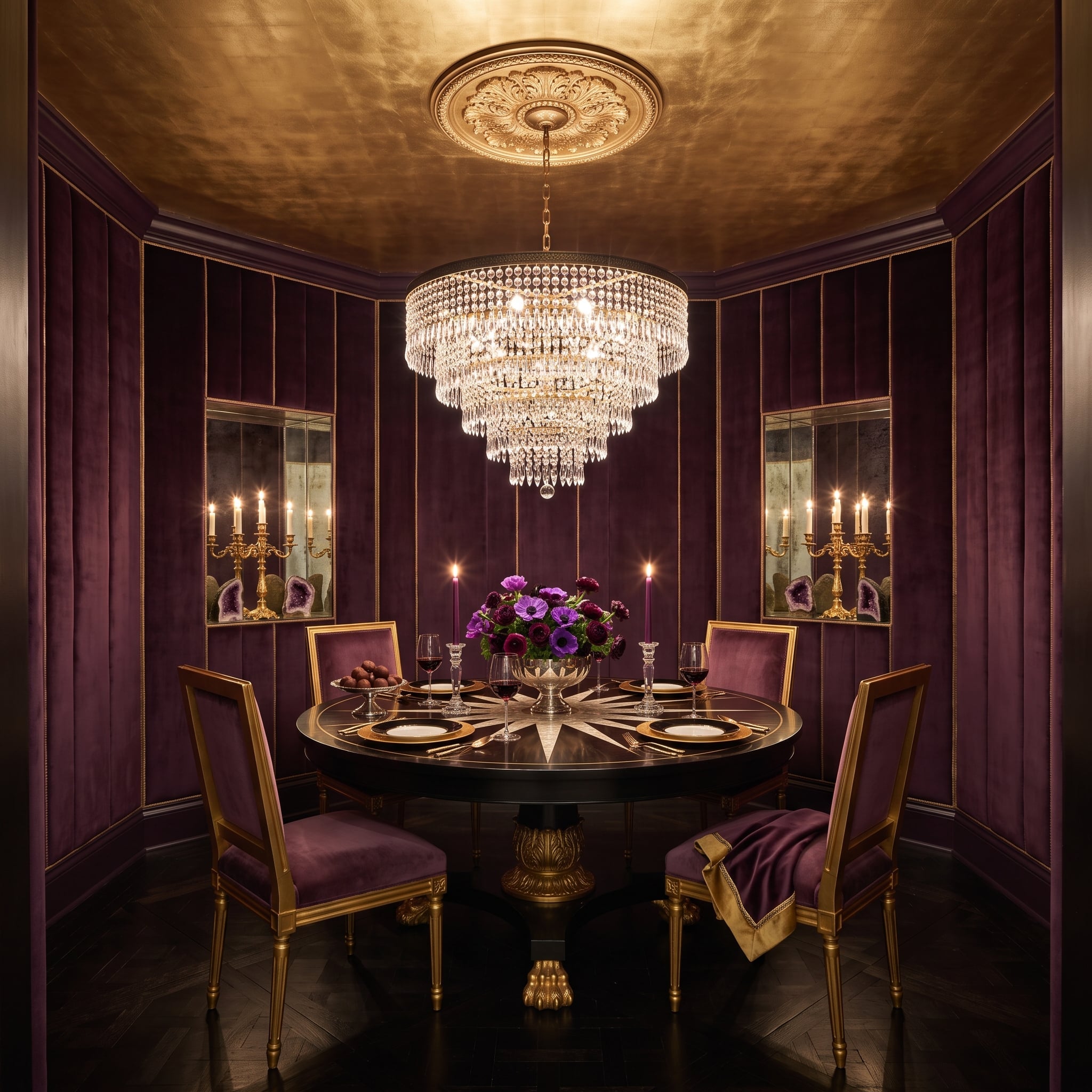
Deep plum velvet panels cover the walls between narrow gold trim, turning color into something tactile rather than simply painted. Above, a gold-toned ceiling and carved medallion give the tiered crystal chandelier an appropriately elaborate setting.
Gold-framed chairs repeat the wall color in their upholstery while a black lacquer table interrupts the purple at the center. Mirrors multiply candlelight and chandelier reflections, and the amethyst-colored objects in the niches push the palette another shade deeper.
Lighting Detail: A multi-tier crystal fixture scatters highlights across a room very differently from a single opaque pendant. Table dimensions, ceiling height, sightlines, and required clearances should determine scale rather than relying on one universal chandelier-to-table ratio.
15. A Tree-Trunk Column Makes the Forest Part of the Structure
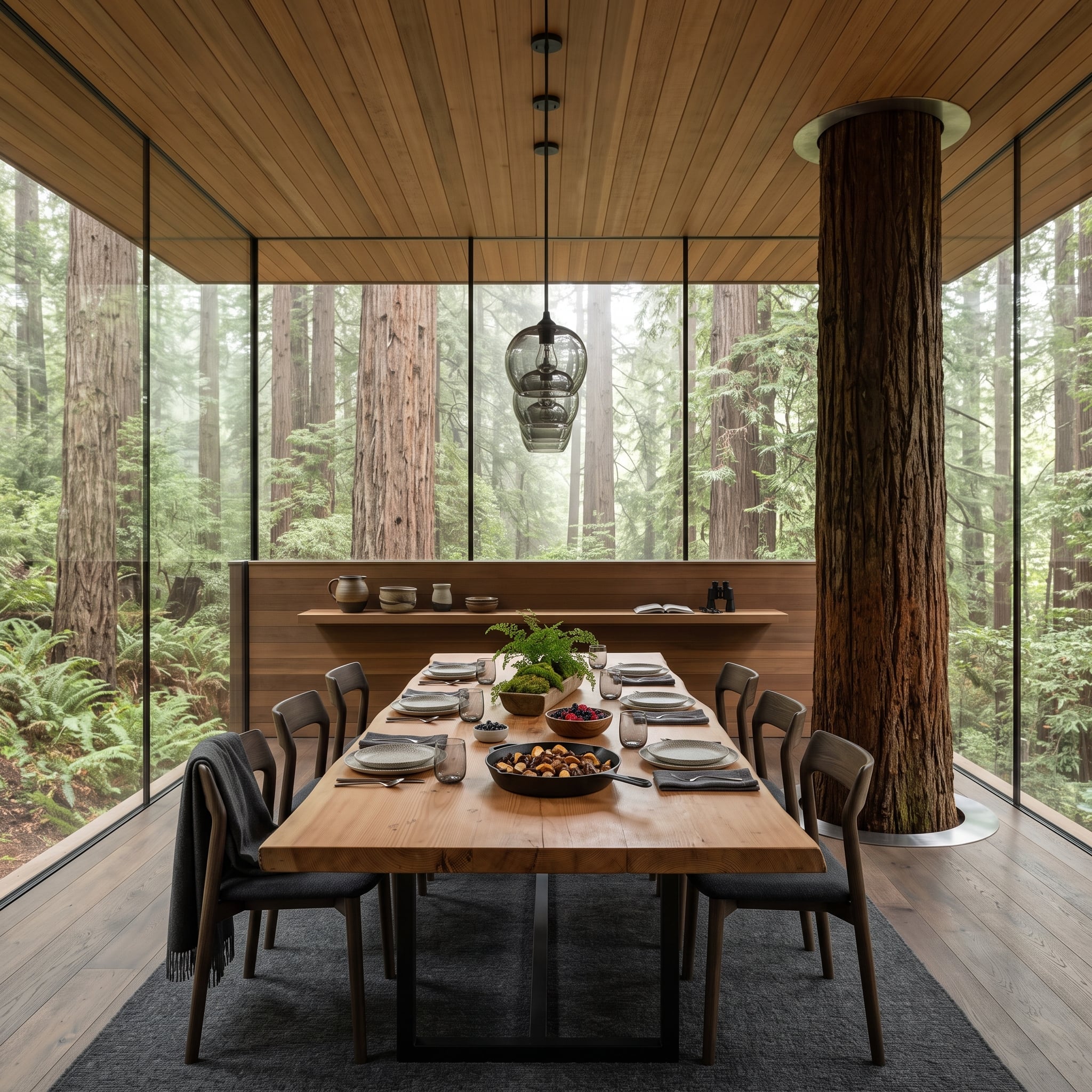
A massive tree-trunk column rises through the floor and continues through the wood ceiling, held at the junction by a dark metal collar. Floor-to-ceiling glass on three sides places it against a forest backdrop, blurring the distinction between structural object and landscape reference.
The live-edge table stays low and horizontal beneath that vertical mass. With the view and column already supplying so much organic irregularity, the rest of the room has little reason to become decorative.
14. Grisaille Murals and a Cloud Ceiling Turn the Walls Into Landscape
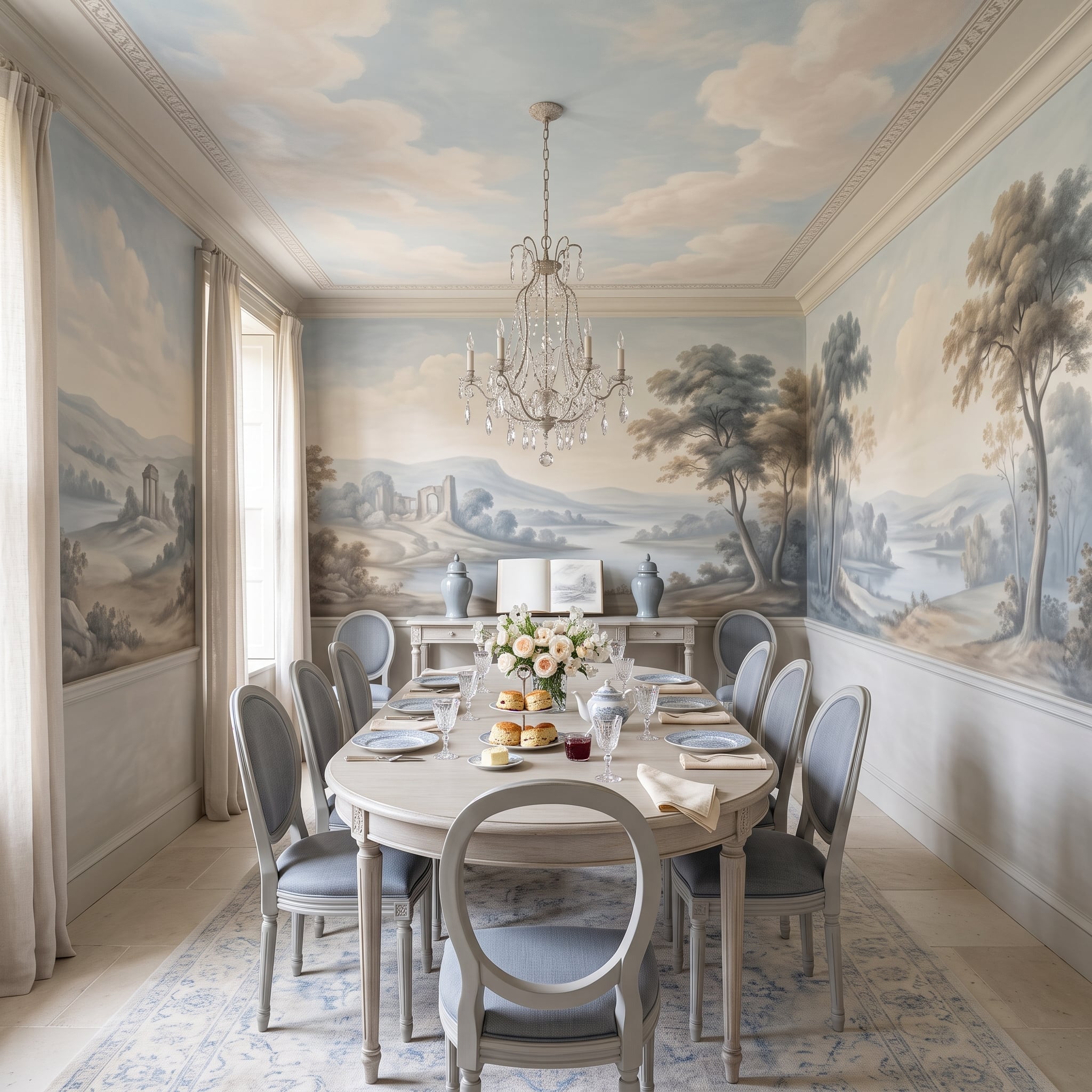
Pastoral scenes wrap the room in muted blue, sage, gray, and warm stone, carrying classical ruins and distant landscape across the walls at architectural scale. Above them, a painted sky continues the illusion inside ornate plaster molding.
Dusty-blue Louis XVI-style chairs and an oval table keep the furniture comparatively disciplined beneath such active walls. A crystal chandelier adds sparkle without introducing another pictorial element.
Art Detail: Grisaille refers to painting executed largely in shades of gray or a narrow monochromatic range, often to suggest relief or sculpture. Large scenic murals and mural wallpapers can borrow that restrained tonal effect without being strict examples of historical grisaille technique.
13. A Sunken Dining Pit Makes the Table Part of the Floor Plan
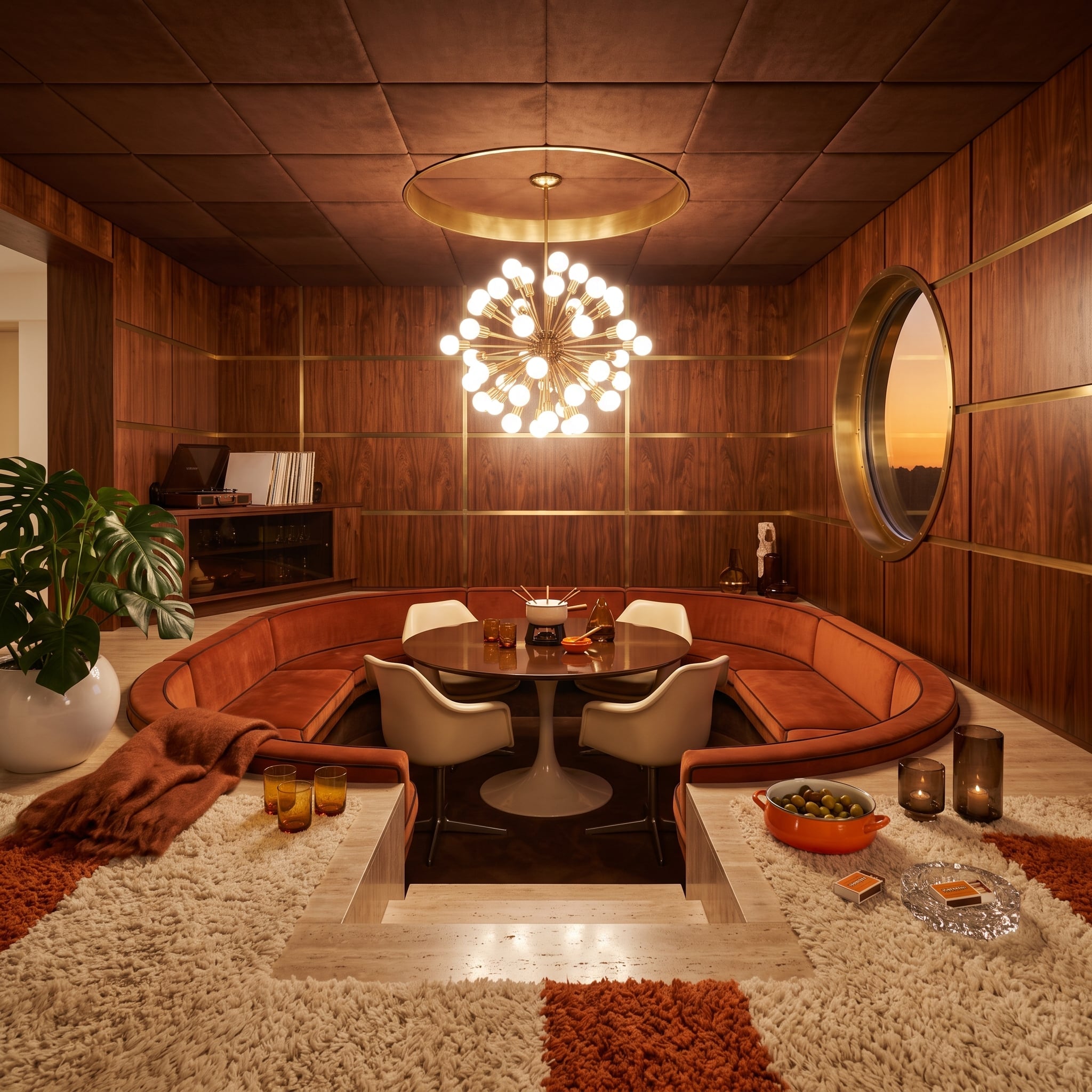
The dining area drops below the surrounding travertine floor and wraps itself in a rust-velvet banquette. Tulip-style chairs and a pedestal table occupy the center beneath a brass Sputnik chandelier, while walnut paneling continues across walls and ceiling.
Sunken conversation areas became particularly associated with postwar modern interiors because they could define a gathering zone without surrounding it with full-height walls. Applying the idea to dining makes the table itself part of the architecture rather than furniture simply placed on top of the floor.
12. Saffron Walls and Cobalt Blue Turn the Ceiling Into the Second Main Event
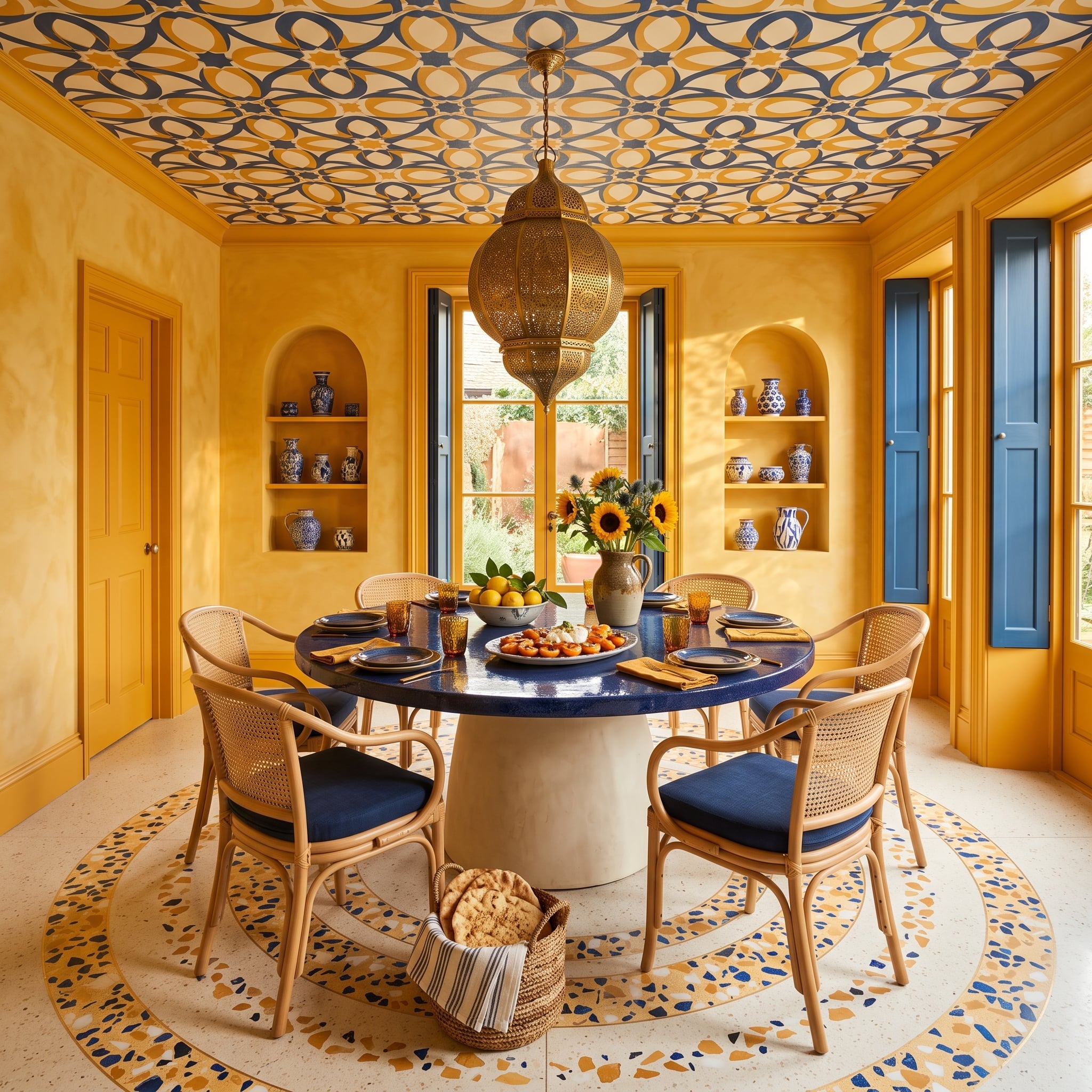
Saffron plaster surrounds the room, then gives way overhead to an indigo-and-gold geometric ceiling. A pierced brass lantern hangs in the center above a deep-cobalt table surrounded by rattan chairs with navy cushions.
The floor joins the composition rather than disappearing beneath it. Blue and amber terrazzo inlays radiate around the table base, while arched niches display ceramics that repeat those same saturated colors at a smaller scale.
Ceiling Move: A painted or stenciled ceiling pattern can be laid out from a central reference point so its geometry relates clearly to the table and fixture below. Accurate measuring matters; hand-painted character and careless alignment are not the same thing.
11. Stained Glass Overhead Makes the Ceiling the Most Colorful Surface
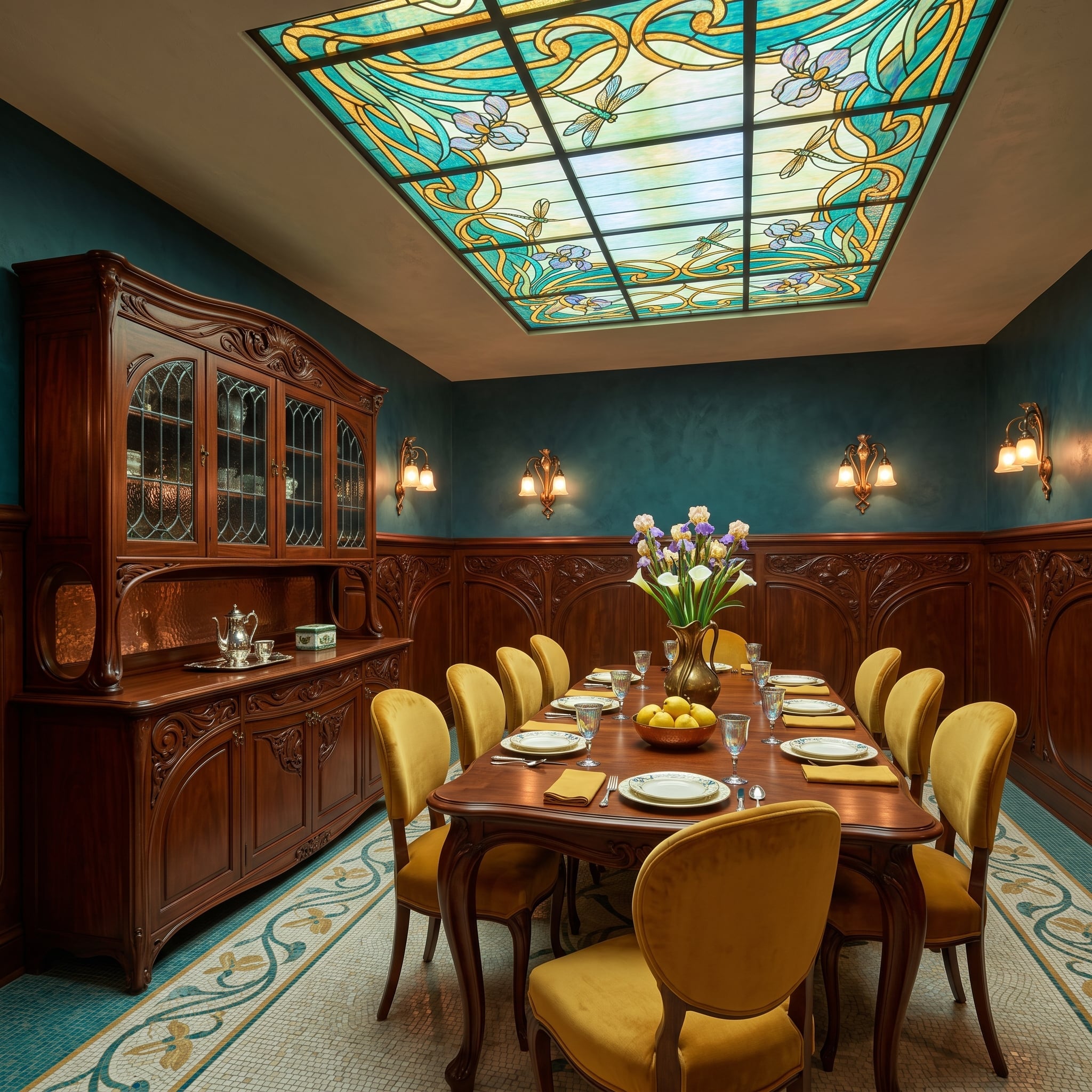
Art Nouveau does not whisper here. A leaded stained-glass skylight spreads irises, dragonflies, gold scrollwork, aquamarine, and ivory across the ceiling, throwing colored light into a room already rich with carved wood.
A dark mahogany sideboard gives that luminous ceiling something substantial to sit above, while mustard velvet chairs bring gold warmth down to floor level. A teal-and-gold mosaic border repeats the skylight colors without copying its imagery.
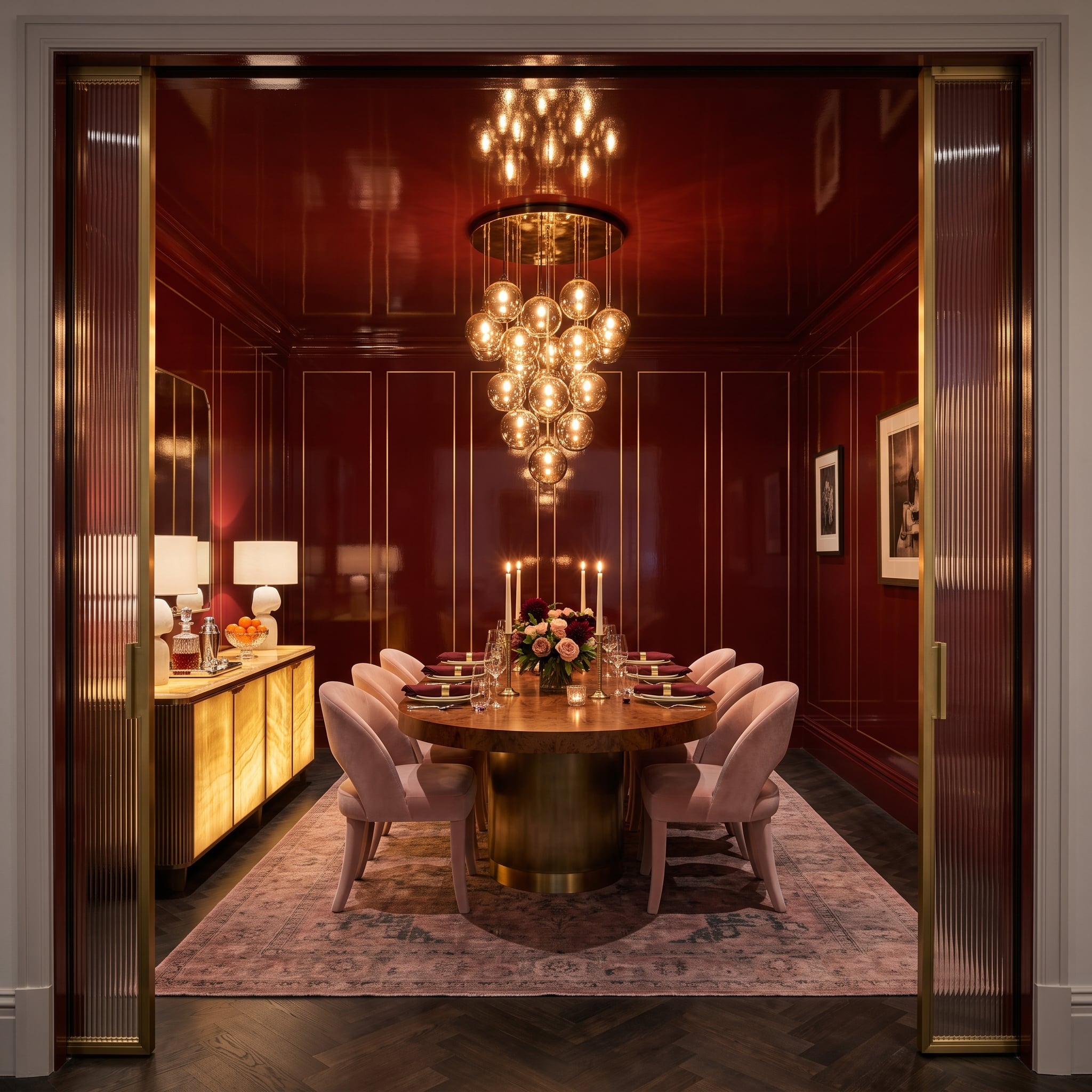
10. Lacquered Crimson Turns the Entire Room Into a Red Interior Landscape
Burgundy lacquer covers walls and ceiling until the room reads as one saturated enclosure. Thin gold lines break the paneling into vertical sections, giving the color enough structure to avoid becoming a featureless red box.
The chandelier is the counterattack: dozens of amber globes descend from a brass ceiling mount at different heights, resembling a shower of lit embers. Blush velvet chairs and a pink rug lighten the lower half, while the burl tabletop introduces swirling natural grain amid all those smooth lacquered planes.
9. Cream, Bouclé, and Sculpted Plaster Prove Pale Doesn’t Have to Mean Flat
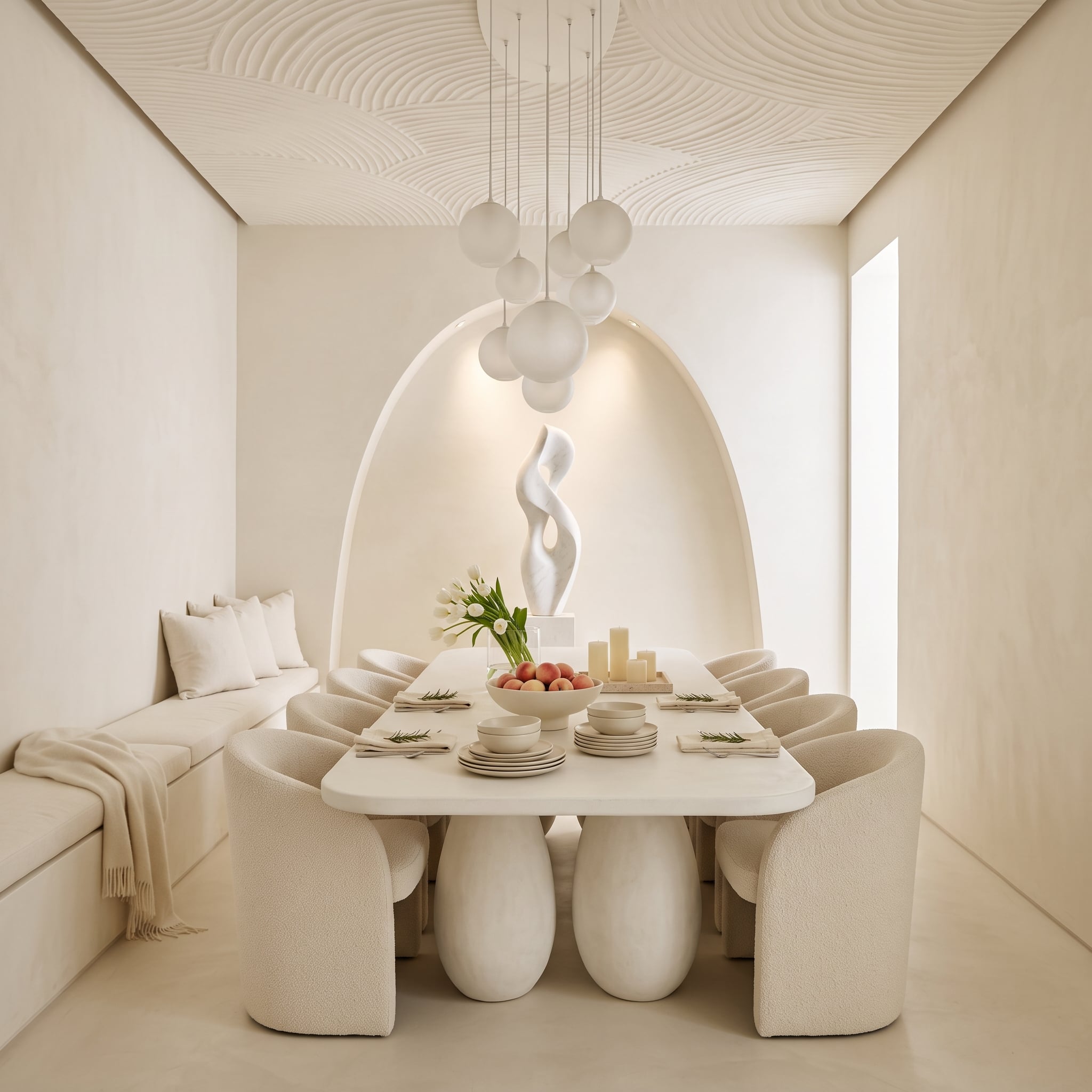
Cream and warm ivory dominate almost everything, leaving texture to create the contrast. Rippled plaster moves across the ceiling, bouclé gives the barrel chairs a nubby surface, and chunky ovoid table pedestals introduce weight without requiring dark color.
A white figurative sculpture sits inside an illuminated arched niche while frosted globes descend over the table in several sizes. Ceramic bowls, taper candles, and peaches add just enough warm color to stop the pale palette from becoming chilly.
Texture Detail: Monochromatic rooms become more legible when adjacent surfaces respond to light differently. Matte plaster, fuzzy upholstery, smooth ceramic, glass, and stone can create plenty of separation even when their colors are nearly identical.
8. A Wine Wall Behind Glass Turns Storage Into the Far End of the Room
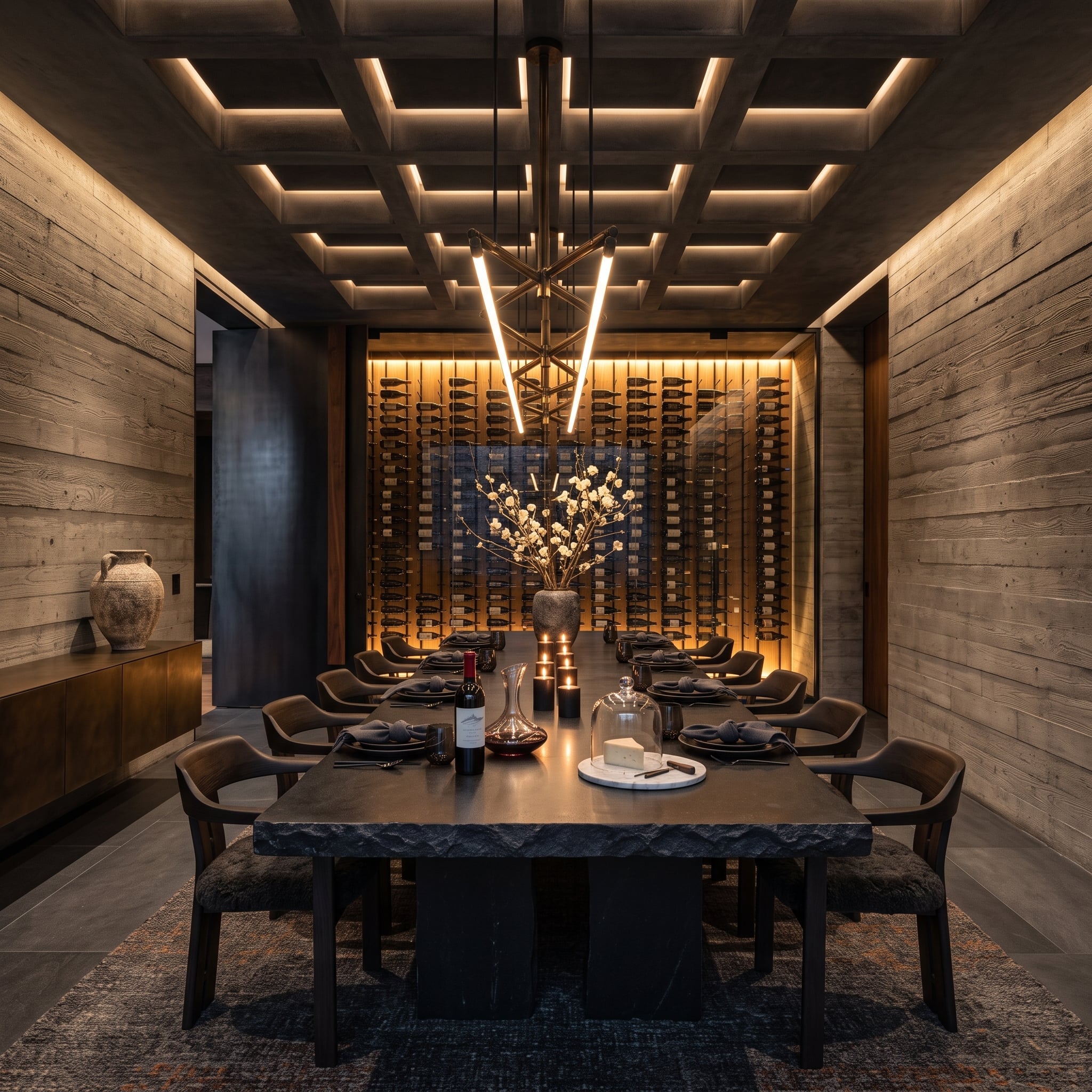
Reclaimed-looking wood runs across the walls while a dark stone table gives the center an almost black horizontal plane. At the far end, wine storage sits behind glass and glows from within, turning rows of bottles into a gridded backdrop rather than hiding them in cabinetry.
The ceiling has its own illuminated coffers, while a bronze starburst fixture cuts across that grid with bare tube bulbs. Warm wood, dark stone, glass, and linear light divide the room into clearly different layers.
7. Chinoiserie, Gold Fretwork, and Celadon Make Pretty Look Architectural
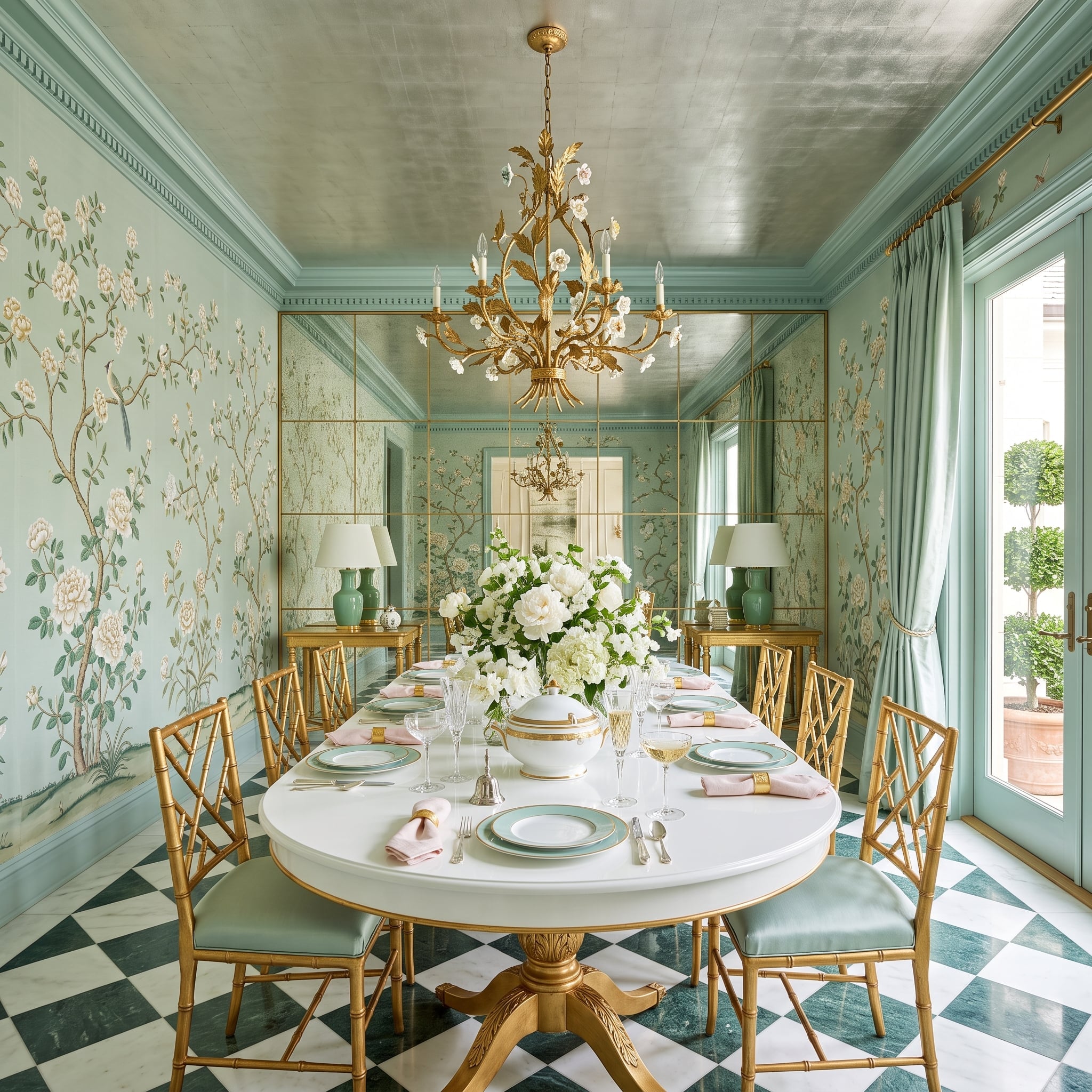
Celadon green links the molding and scenic chinoiserie-style wall covering into one continuous envelope. Flowering branches, birds, peonies, cream, and dusty rose give the walls movement while staying inside a relatively soft palette.
Gold bamboo-motif chairs sharpen the foreground, and the chandelier repeats that gilded finish with porcelain flowers and curling arms. A green-and-white checkerboard floor supplies the hard geometry all those branches and curves need underneath.
Style Note: Chinoiserie emerged in Europe as an imaginative interpretation of Chinese and broader East Asian decorative arts. In a room this patterned, repeating colors from the wall treatment in molding and upholstery can connect the surfaces without reproducing the same motif everywhere.
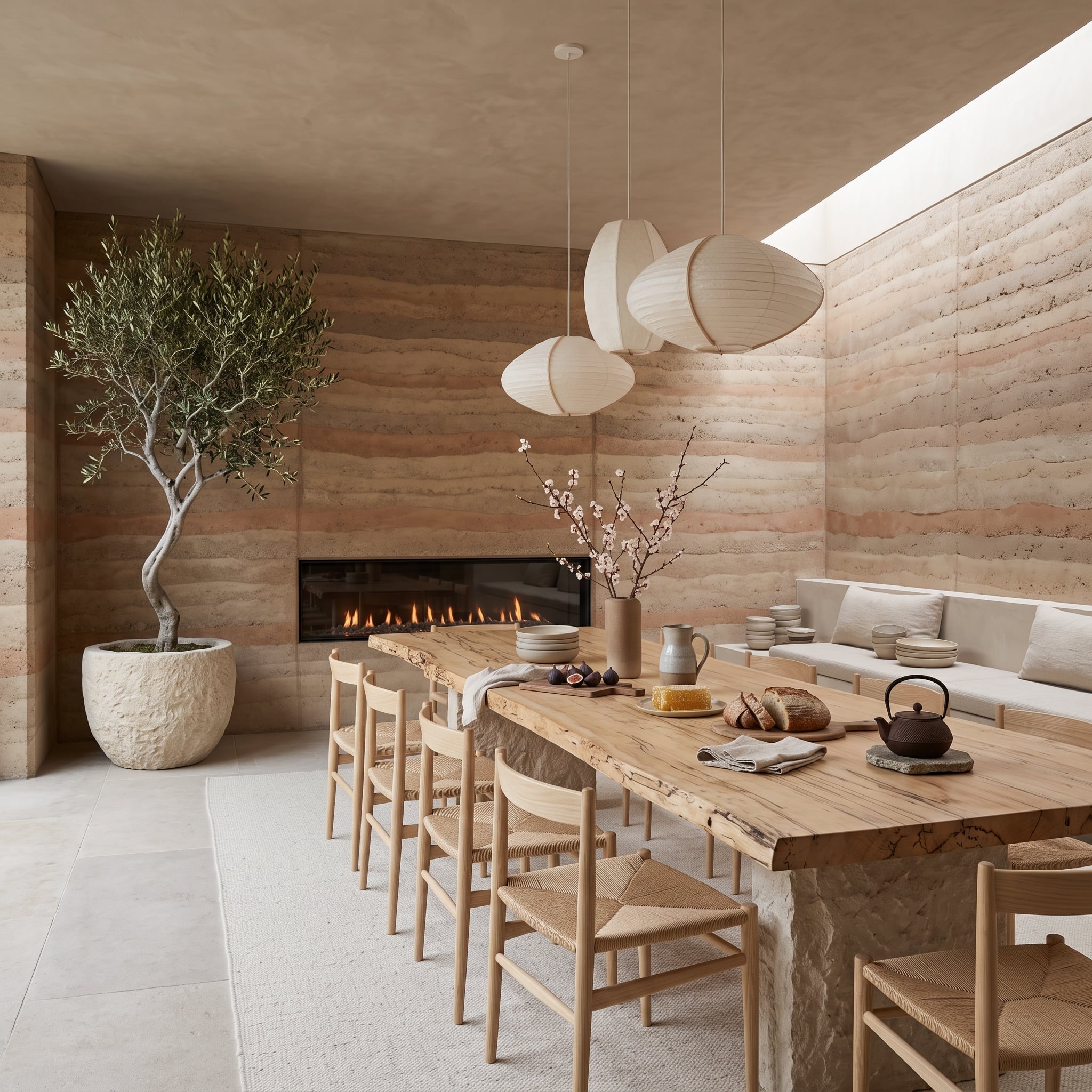
6. Travertine, Raw Wood, and Paper Lanterns Strip the Dining Room Back Down
🔥 Would you like to save this?
Warm travertine runs floor to ceiling, its horizontal striations supplying most of the wall pattern. Against it, a live-edge table keeps fissures and irregular grain visible while pale wishbone chairs introduce woven rush at a much smaller scale.
Three oversized paper lanterns hang at staggered heights, diffusing light rather than turning the fixture itself into a hard metallic object. An olive tree occupies one corner and a low linear fireplace stretches behind the table, adding two very different vertical and horizontal forms to an otherwise quiet room.
Lighting Detail: Translucent paper shades soften the apparent brightness of a bulb by spreading light across a larger glowing surface. Fixture construction, lamp temperature, shade material, and fire-safety rating matter more than whether the shade is specifically rice paper or washi.
5. Portraits and Blue Stone Turn the Dining Room Into a Salon
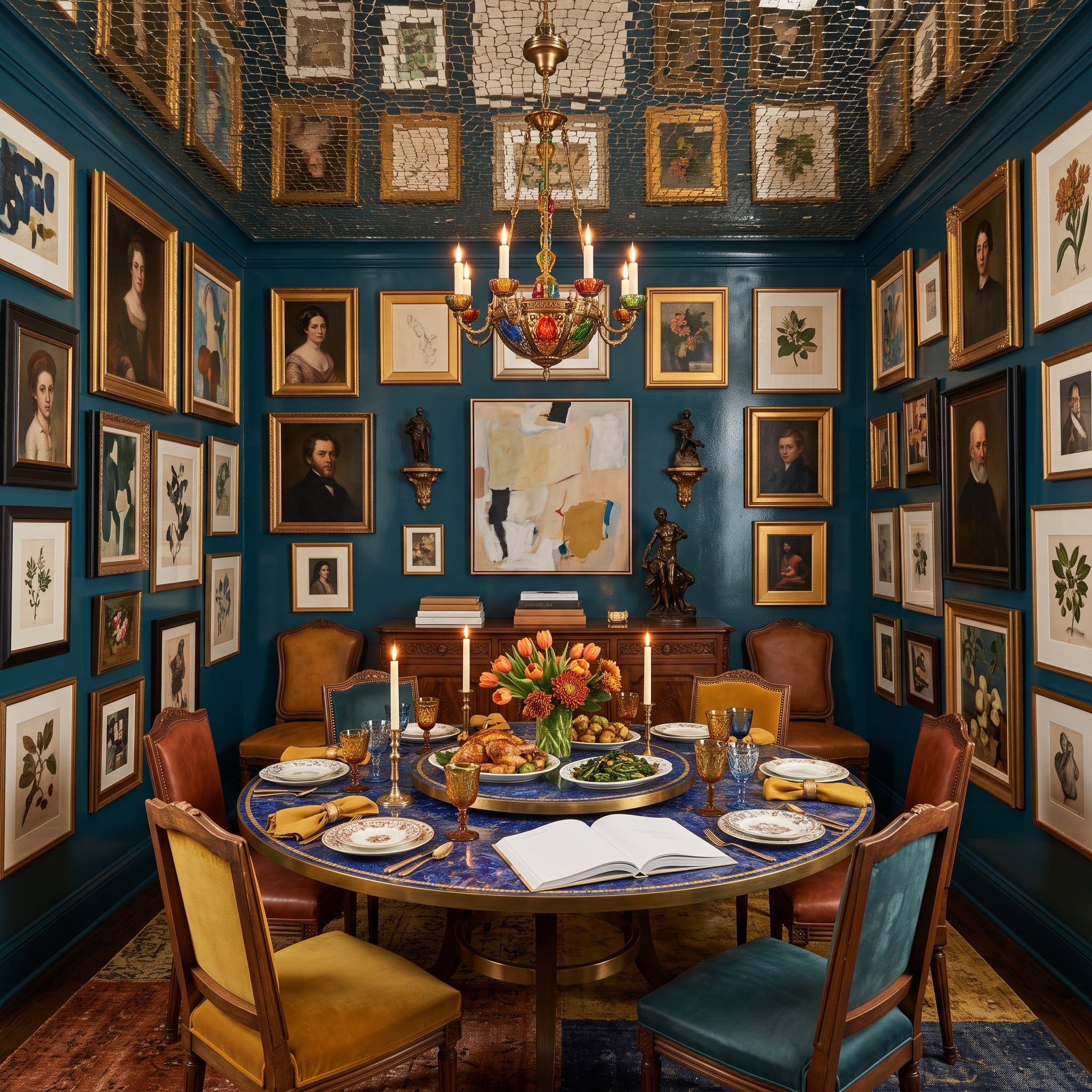
Gold-framed portraits, botanical prints, and paintings climb the teal lacquered walls in dense salon-style arrangements. Rather than leaving blank space between each piece, the composition treats the whole wall as one layered field.
A round blue stone table edged in brass concentrates the strongest color at the center, while mismatched velvet chairs prevent the furniture from becoming too orderly beneath all that artwork. Candlelight picks up gold from both frames and table edge.
4. A Terracotta Alcove Wraps the Table in Leather and Light
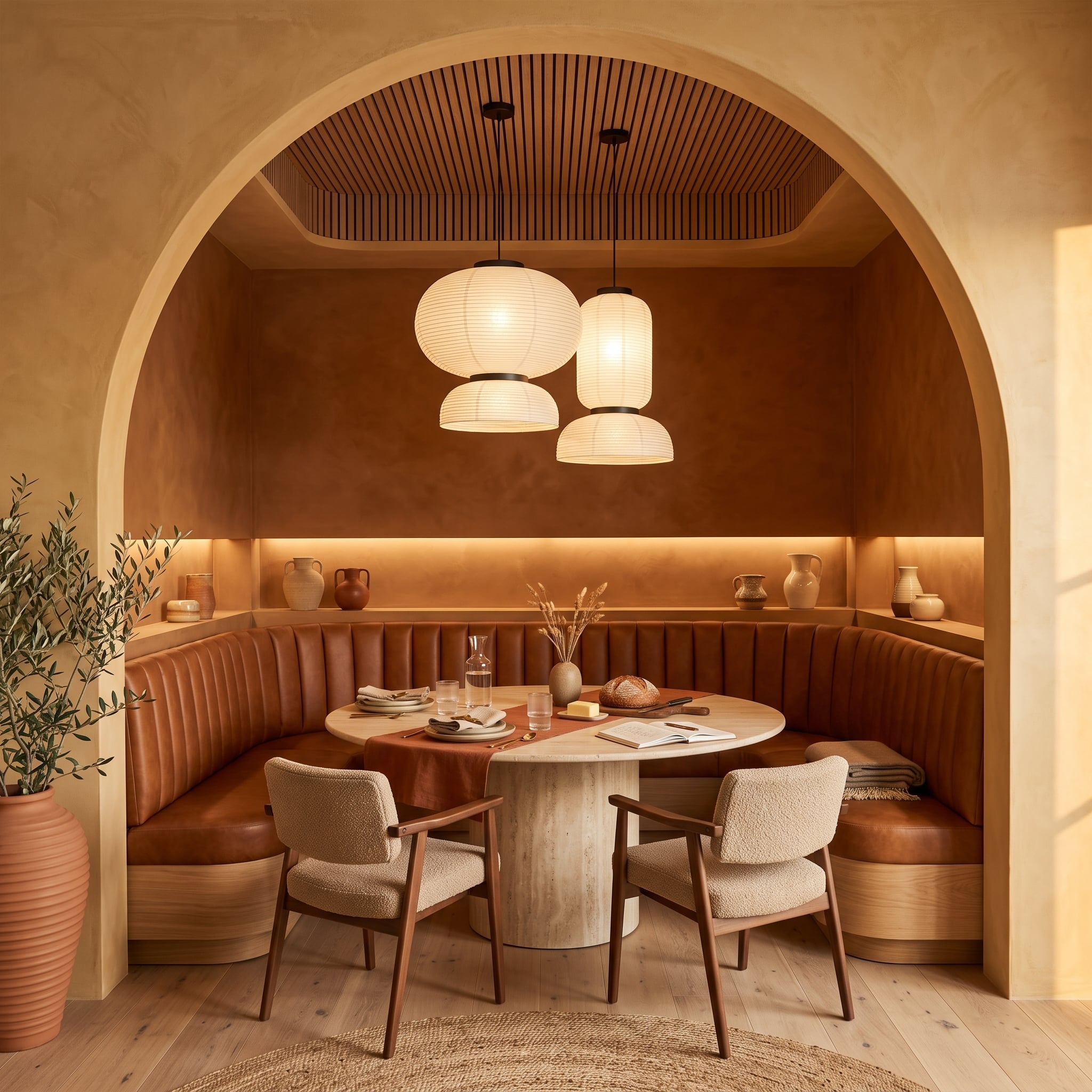
A broad arch carved into terracotta-toned plaster turns the dining area into a room within the room. Cognac leather banquettes wrap the back and sides, their vertical channel tufting pulling the eye upward inside the curve.
A round travertine pedestal table keeps the center pale, while two bouclé-and-walnut chairs break the continuous banquette line. Ribbed paper pendants descend at different heights, and a long illuminated shelf sends a horizontal stripe of light behind the seating. Brown dominates, but almost none of the brown surfaces behave alike.
3. Navy Paneling and Silver Trophies Give Tradition a Darker Backdrop
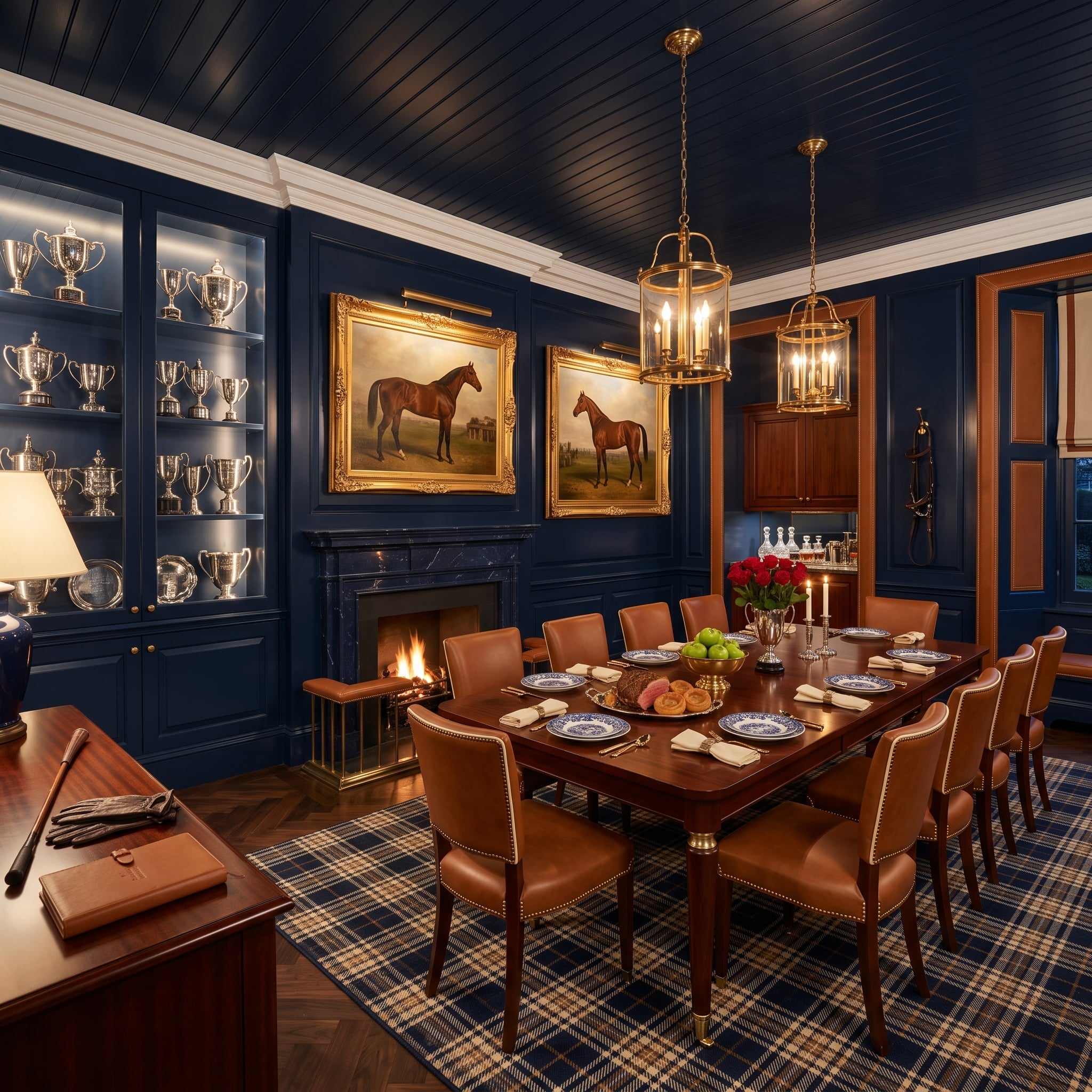
Midnight-blue paneling rises to a darker beadboard ceiling, creating an unusually deep envelope around a mahogany table. Brass lantern pendants puncture that darkness from above while blue-and-white transferware introduces pattern on the tabletop.
Silver trophies supply the brightest reflective surfaces in the room, their cool metal standing apart from the warmer brass lighting and brown leather chairs. The result feels traditional without relying on pale walls to signal formality.
2. An Illuminated Wine Cellar Hides Directly Beneath the Dining Table
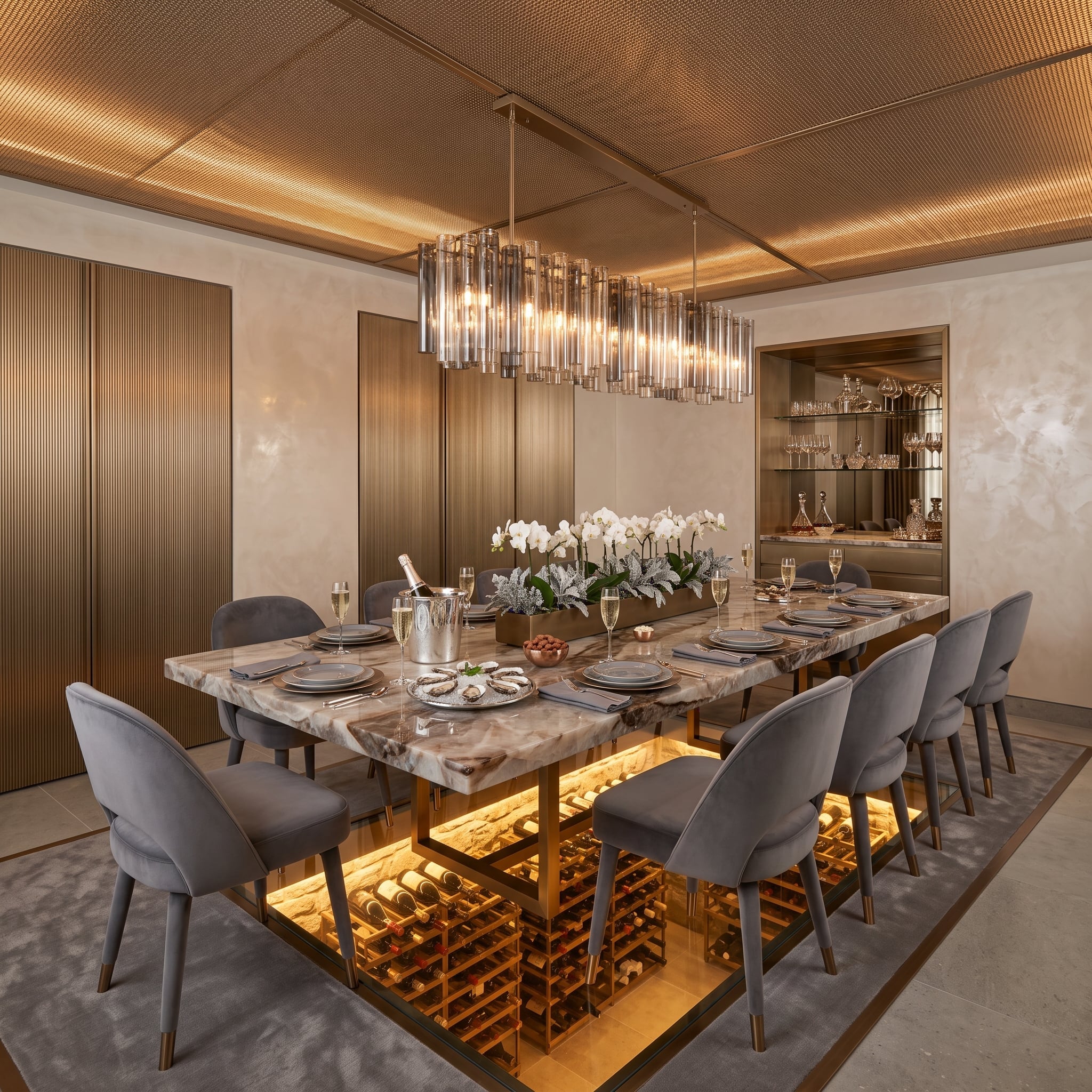
The floor becomes storage here. Beneath the dining table, bottles sit inside an illuminated glass-covered wine display, sending amber light upward around the brass base and turning the area directly under dinner into part of the spectacle.
A pale stone tabletop and gray velvet chairs keep the seating itself comparatively restrained. Above, a rectangular chandelier made from cylindrical glass elements introduces another transparent layer, while Venetian-style plaster and bronze-toned ceiling panels extend the warm reflections outward.
1. Dark Green Walls and Leather Wingbacks Make the Dining Room Refuse a Single Job
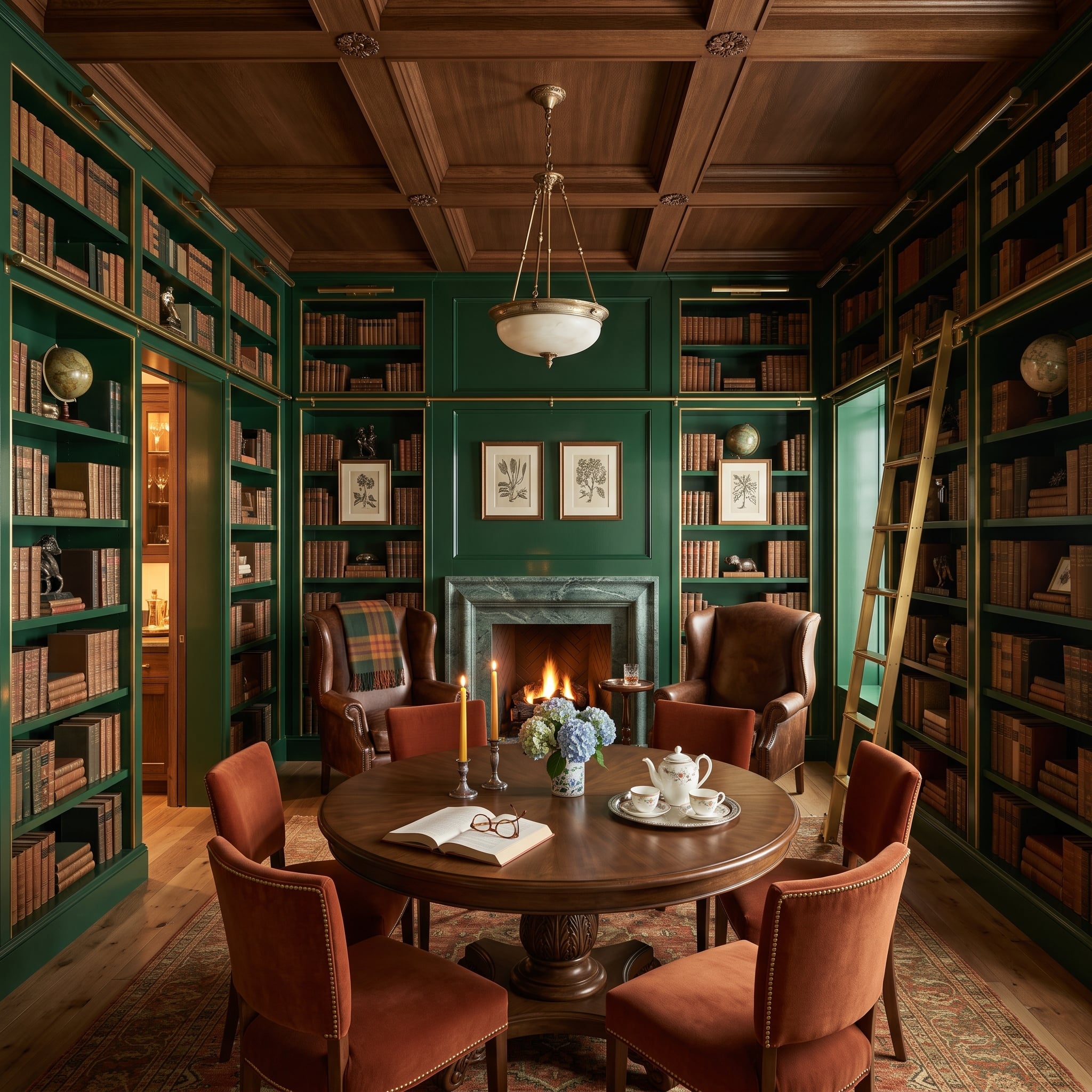
Forest-green paneling rises into a coffered walnut ceiling while bookcases consume the walls instead of stopping politely at dining-room height. A rolling brass ladder turns that storage into another strong vertical element, and tan leather wingbacks bring the warmest color down around the table.
The appeal is not that the room disguises itself as a library. It is that dining and reading are allowed to occupy the same architecture without either one becoming an afterthought. After 29 rooms built around murals, wine, stained glass, color, fire, stone, gardens, and sculptural ceilings, this may be the clearest argument for giving dining its own room: once four walls exist, they do not have to serve only dinner.