🔥 Would you like to save this?
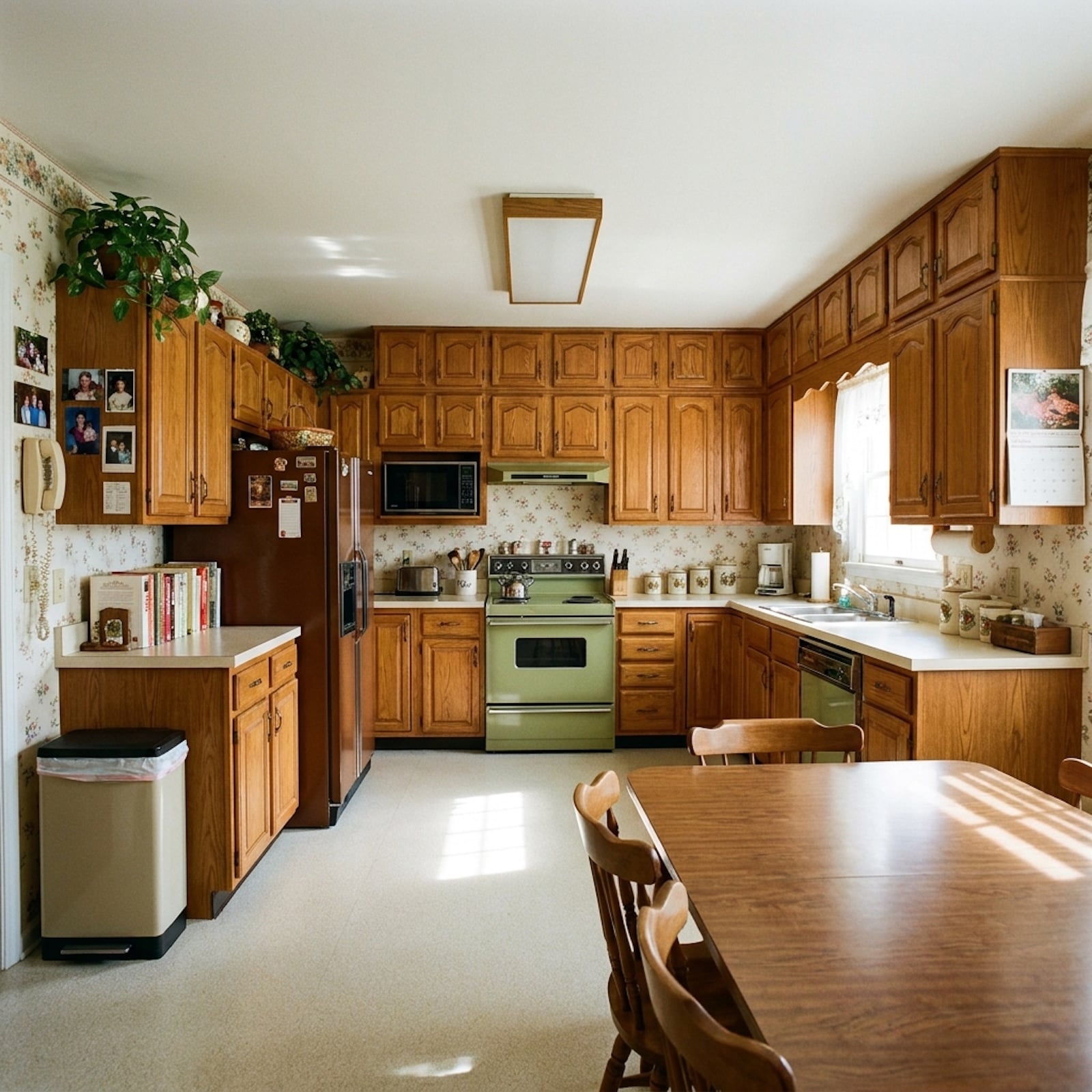
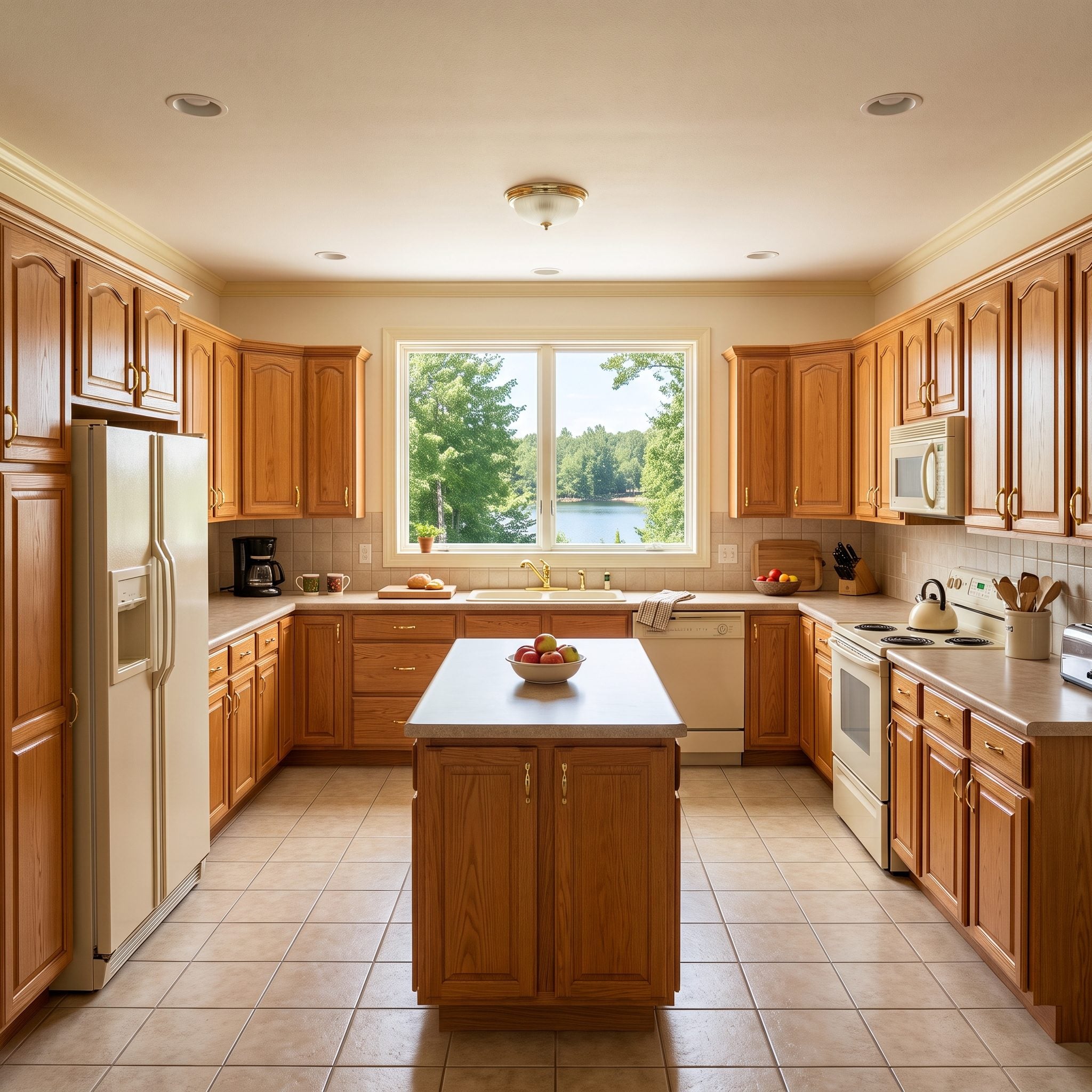
The oak cabinets weren’t ugly. That’s the trap. They were perfectly respectable in the way a rental car is respectable: nothing offensive, nothing memorable, and absolutely no desire to spend more time with them than necessary. Beige walls met beige countertops. Brass pulls had lost their shine sometime during the Clinton administration. Overhead, a fluorescent fixture delivered the sort of light normally reserved for administrative hearings. The kitchen functioned perfectly well. Unfortunately, functionality appeared to have been its entire personality.
But look past the finishes and the room has possibilities. The window provides a natural focal point, the proportions offer room for architectural intervention, and that uninterrupted cabinetry gives a designer considerable territory to work with. What happens when walnut replaces honey oak? When an island stops behaving like a storage box and becomes sculpture? When the backsplash climbs the entire wall, appliances disappear into architectural cabinetry, or a single saturated color changes the room’s relationship with daylight? A kitchen transformation worth examining goes considerably further than choosing prettier cabinet doors.
In order to come up with the very specific design ideas, we create most designs with the assistance of state-of-the-art AI interior design software. Also, assume links that take you off the site are affiliate links such as links to Amazon. this means we may earn a commission if you buy something.
So we gave the same starting kitchen 29 entirely different futures. Some retain the original room’s straightforward organization and change everything about its material character. Others rethink the layout with curved islands, consolidated appliance walls, dramatic stone installations or a completely different architectural vocabulary. From French-inspired limestone and restrained Italian modernism to extravagant bookmatched stone and aubergine cabinetry, these are conceptual redesigns of the same original space rather than cosmetic renovations with identical floor plans. Same starting point. Twenty-nine arguments about what the room could become.
Planning a kitchen, bathroom, or bigger home project? Check current home equity rates before deciding how to finance it.
29. Modern Coastal Trades the Beige Box for White Oak and Soft Stone
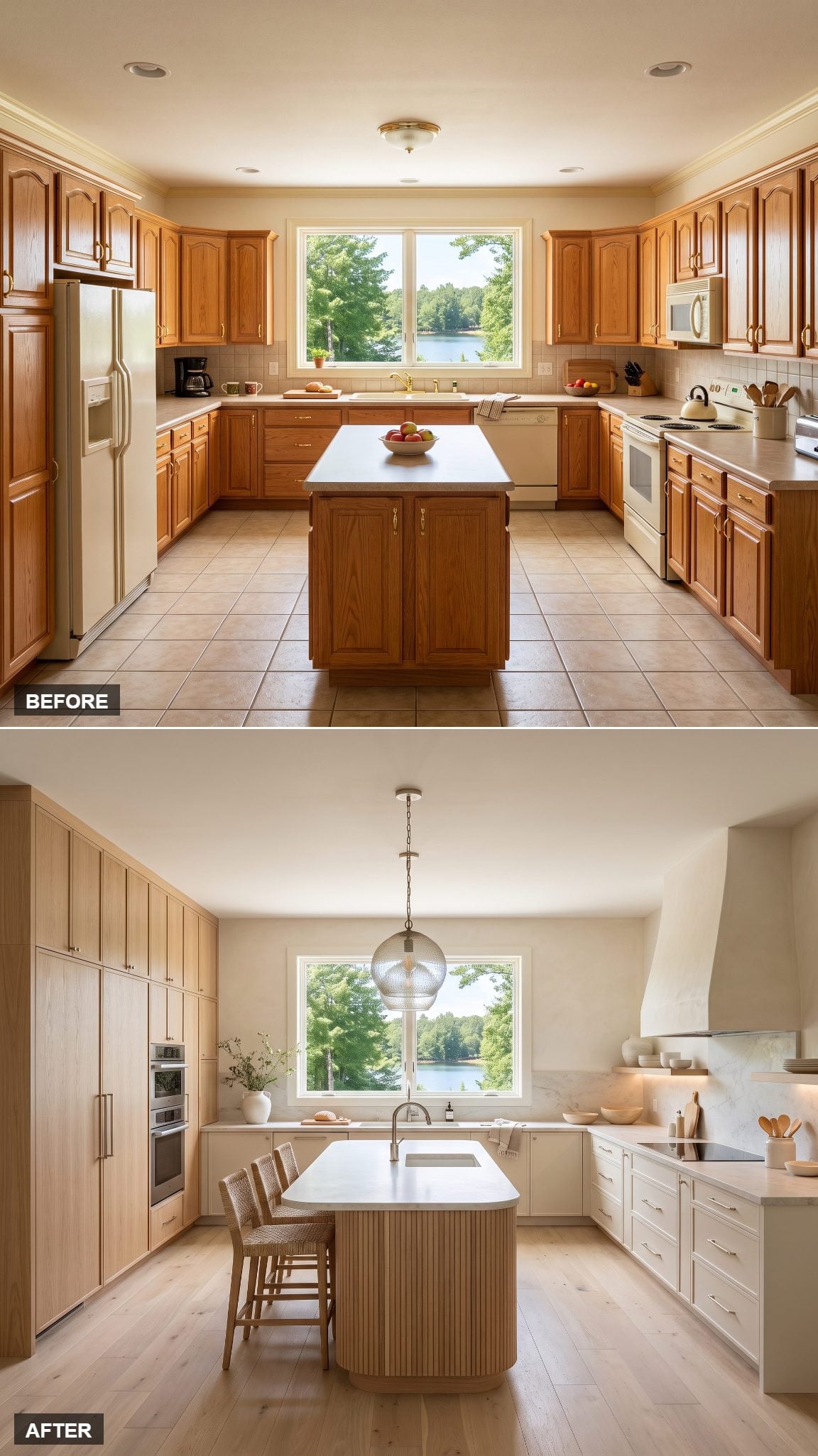
Our first transformation practically opens the windows for you. Pale white oak, honed stone and chalky neutral surfaces replace the original kitchen’s relentlessly beige interior with a much lighter composition. The substantial oak cabinetry provides architectural structure, but the palette prevents that storage from appearing visually heavy.
Good coastal design has considerably more to do with material character than decorative references. Weathered-looking timber, matte stone and natural textiles suggest the atmosphere without introducing a single anchor or miniature sailboat. A linen runner, a bowl of lemons and a little ordinary evidence of cooking are sufficient. The room should feel like somewhere near the coast, not somewhere selling souvenirs from it.
28. Art Deco Returns With Fluted Cabinetry and Brass Architectural Lines
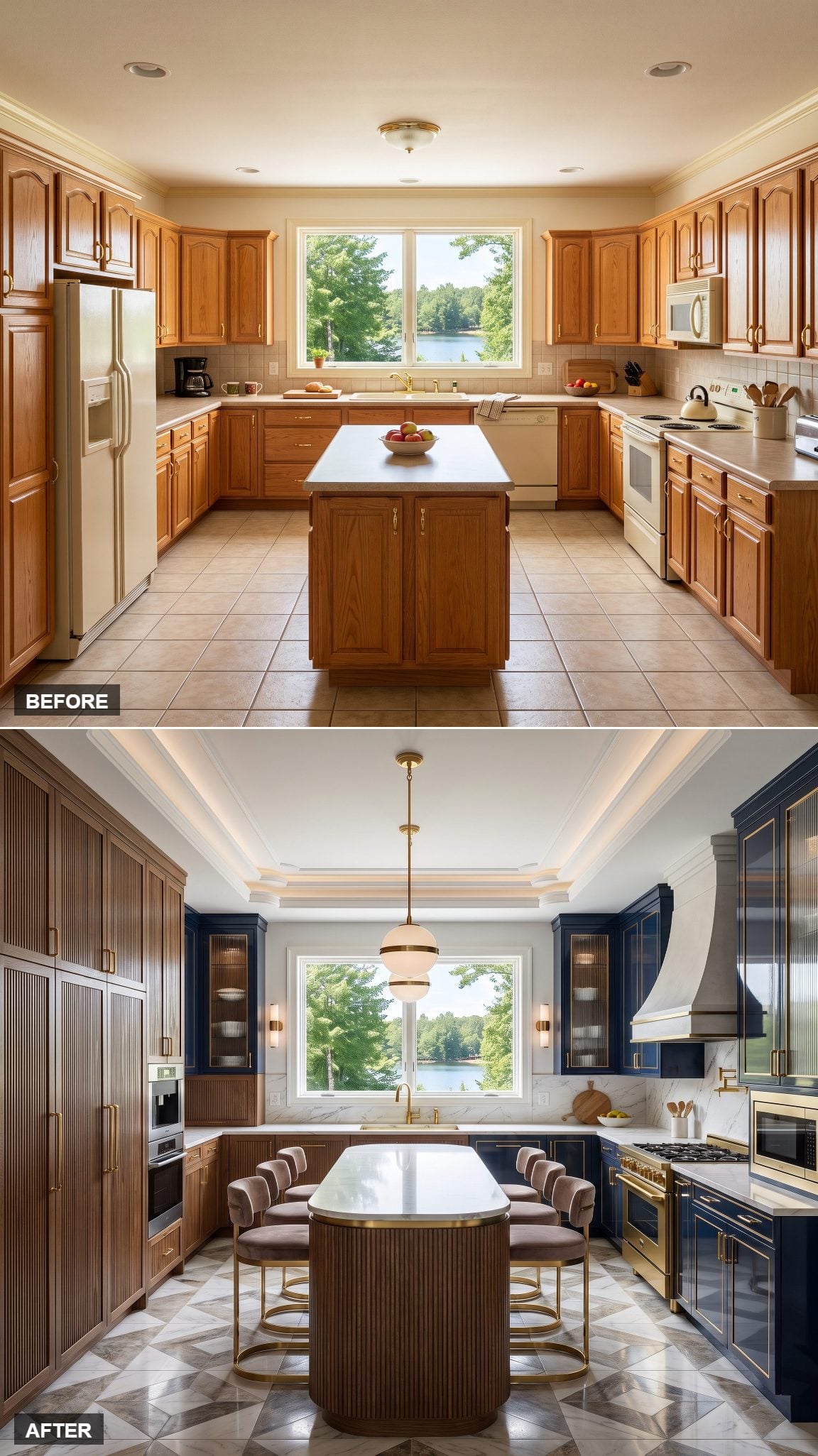
The kitchen has apparently acquired excellent taste in 1920s hotels. Ribbed cabinet fronts, geometric detailing and disciplined brass lines introduce a decorative vocabulary the original room never possessed. What makes the transformation interesting is the repetition: vertical fluting establishes rhythm across the cabinetry, while the metal accents emphasize the architecture instead of scattering decoration around it.
The danger with an Art Deco interpretation is treating every available surface as another opportunity for ornament. Here the cabinetry carries most of the decorative responsibility. Keep the surrounding materials controlled, let the fluting catch the changing light, and use polished brass cabinet hardware to reinforce the composition. The result has theatrical ambitions without requiring the entire kitchen to dress for opening night.
27. Blush Walls Meet Walnut in a Kitchen That Takes Color Seriously
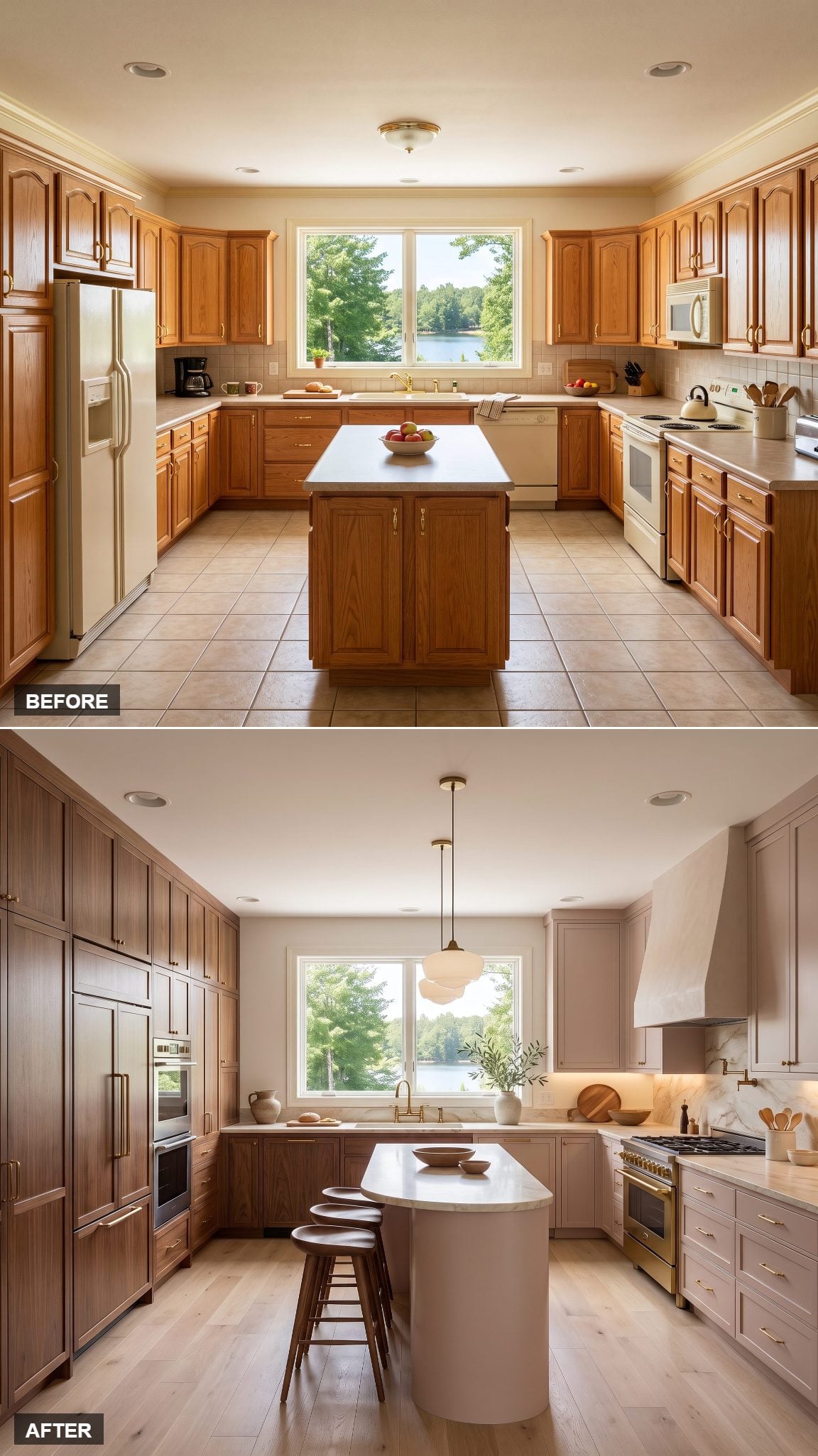
Dusty pink and walnut have a rather unexpected understanding. The blush introduces a muted warmth that would feel completely different beside white cabinetry, while the darker walnut gives the palette depth and a strong architectural presence. Neither material needs to dominate the other.
Undertone matters here. A pink leaning toward clay or muted rose will interact differently with walnut than a cooler, brighter pink. The useful move is to test the wall color against the actual timber in both daylight and artificial light. A beautiful paint chip can become an entirely different proposition once it covers the walls surrounding several feet of cabinetry.
26. Oxidized Bronze Gives This Kitchen an Unmistakable Patina
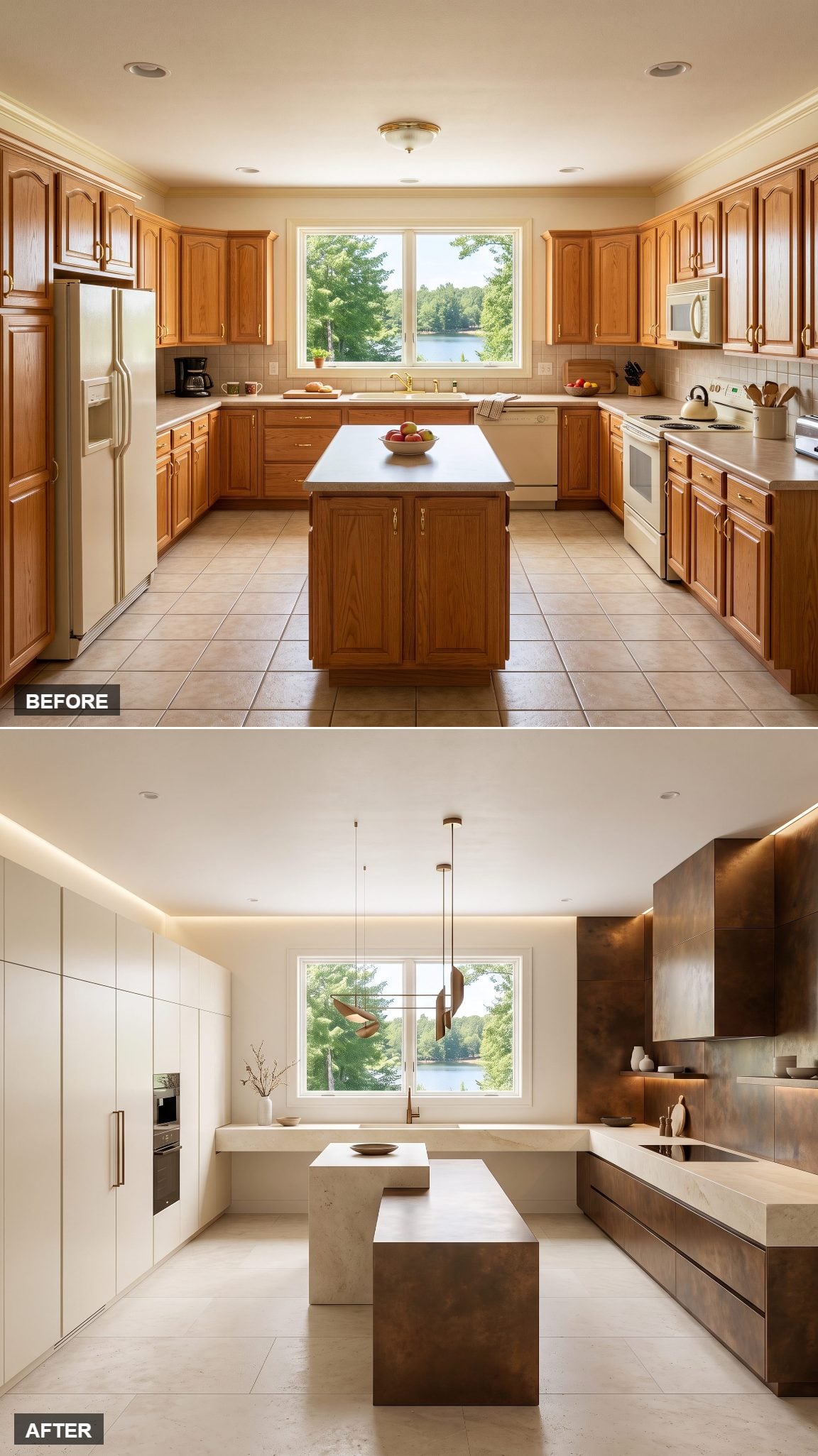
Now the material palette takes a considerably more experimental turn. Oxidized bronze introduces a mottled surface of coppery browns and greenish tones, set against cream cabinetry restrained enough to let the metal occupy center stage. The patinated panels become the room’s defining architectural feature, while everything around them has the good sense to remain comparatively quiet.
The interesting distinction is between natural weathering and a controlled patina. Real bronze can develop different surface colors through oxidation and environmental exposure, but architectural metalwork may be treated and sealed to stabilize its finish. That choice matters enormously in a kitchen, where consistency, cleaning and long-term maintenance deserve as much attention as appearance.
25. Champagne Oak and Ivory Abandon the Straight Line
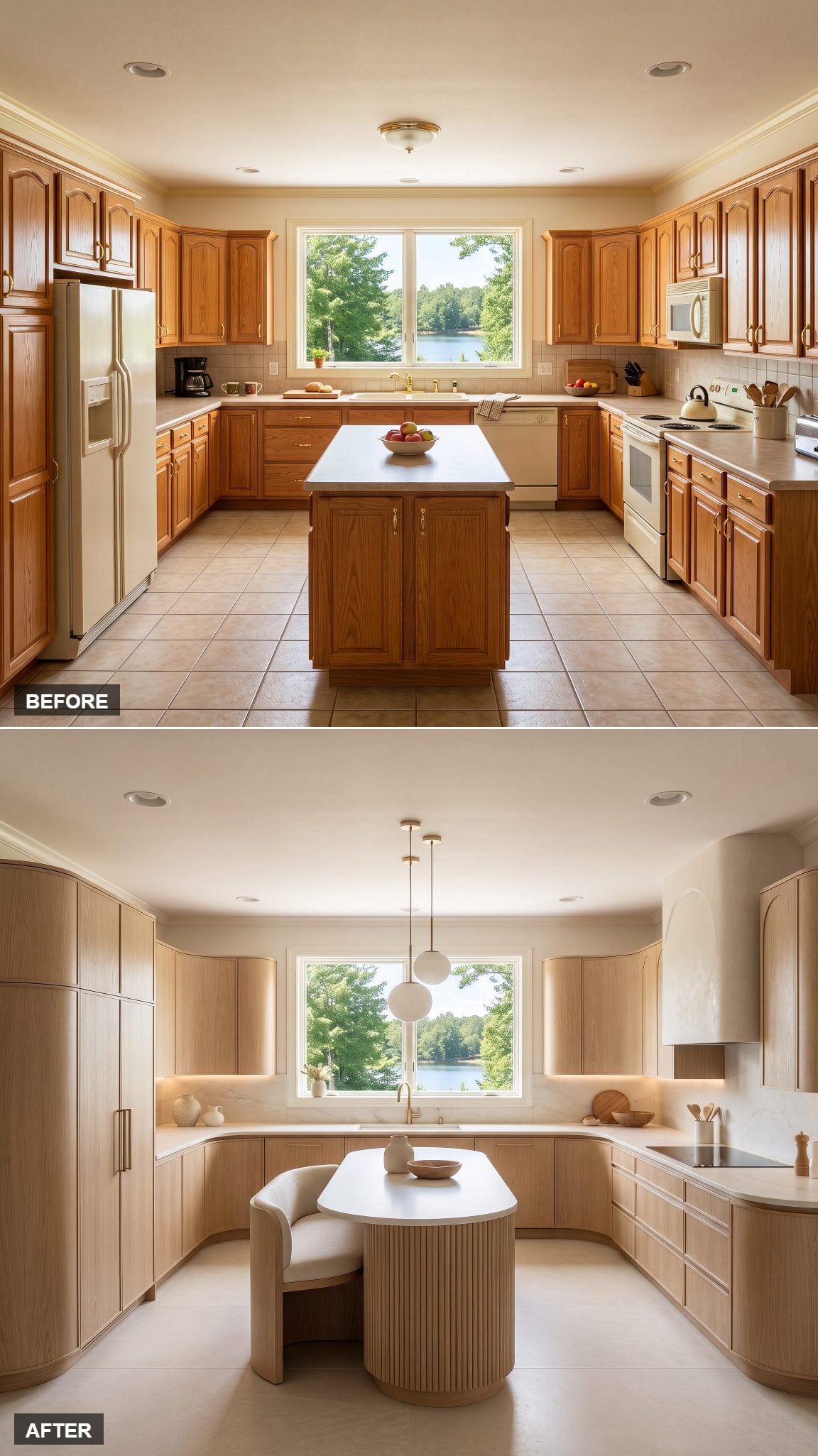
Enough rectangular cabinet boxes. This redesign takes a much more interesting approach to the room’s geometry, introducing rounded cabinet ends and a curved island finished in pale champagne oak. Against the ivory surroundings, the timber catches the daylight without creating another heavy block in the center of the kitchen.
The curve changes how the island occupies space. Rather than presenting a sharp corner to everyone moving through the room, its perimeter creates a gentler transition between circulation and seating. That advantage depends on having adequate clearances, but the design principle is convincing: a curved oak island can be a spatial decision as well as a sculptural one.
24. Black and Natural Oak Split the Kitchen Into Two Strong Contrasting Layers
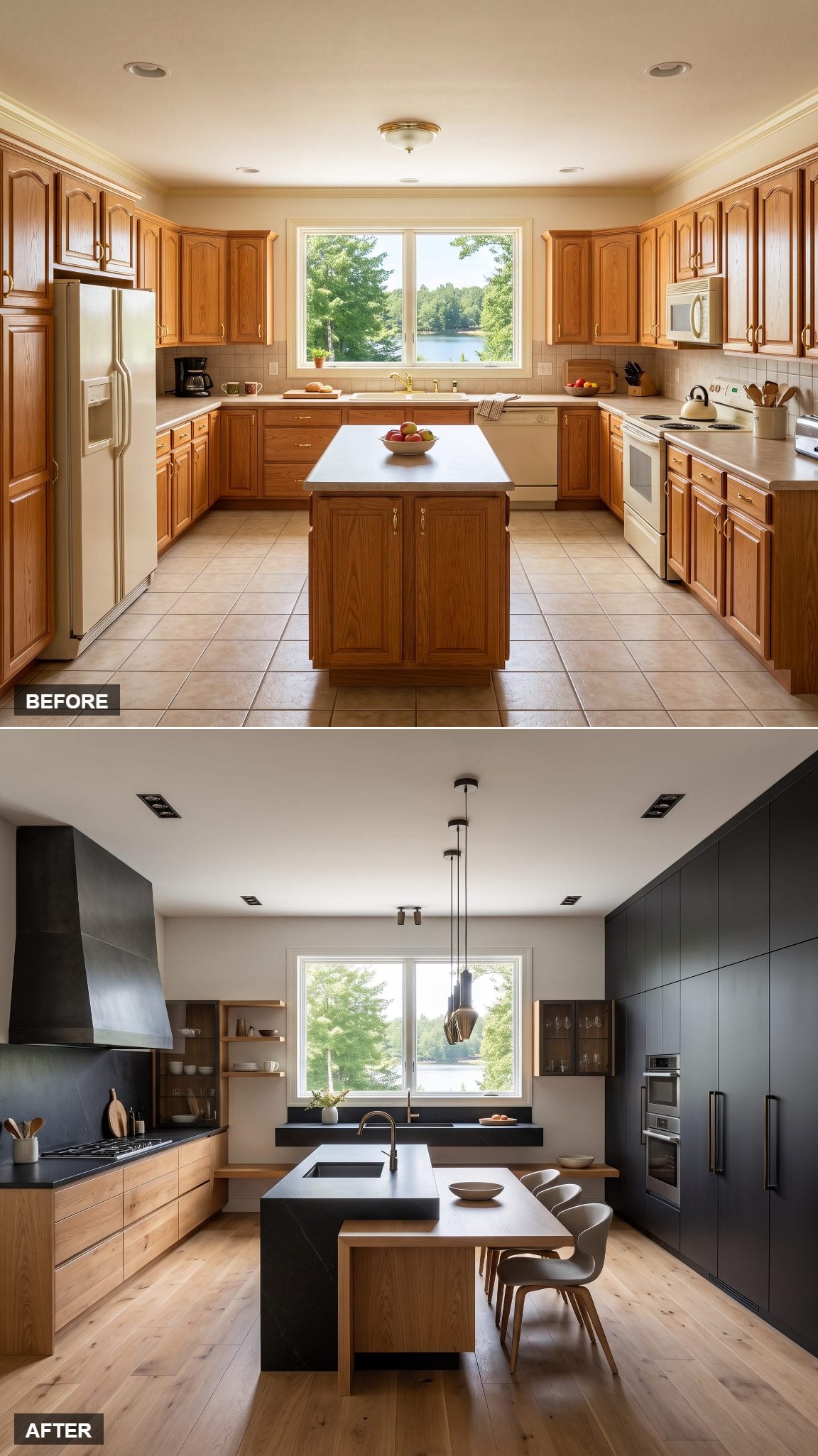
Black below. Natural oak above. The relationship is wonderfully straightforward, but the resulting transformation is anything but ordinary. The darker lower cabinets establish a substantial base, while the pale upper cabinetry preserves warmth and prevents the entire wall from becoming one uninterrupted block.
This is a useful example of distributing visual weight rather than simply selecting contrasting colors. The two cabinet finishes create separate horizontal layers and give the eye a clear route around the room. Compared with the original kitchen’s barely distinguishable surfaces, the new composition makes every major element more legible. It is a bold kitchen makeover without a complicated decorative vocabulary.
23. French-Inspired Limestone Gives the Original Kitchen an Architectural Promotion
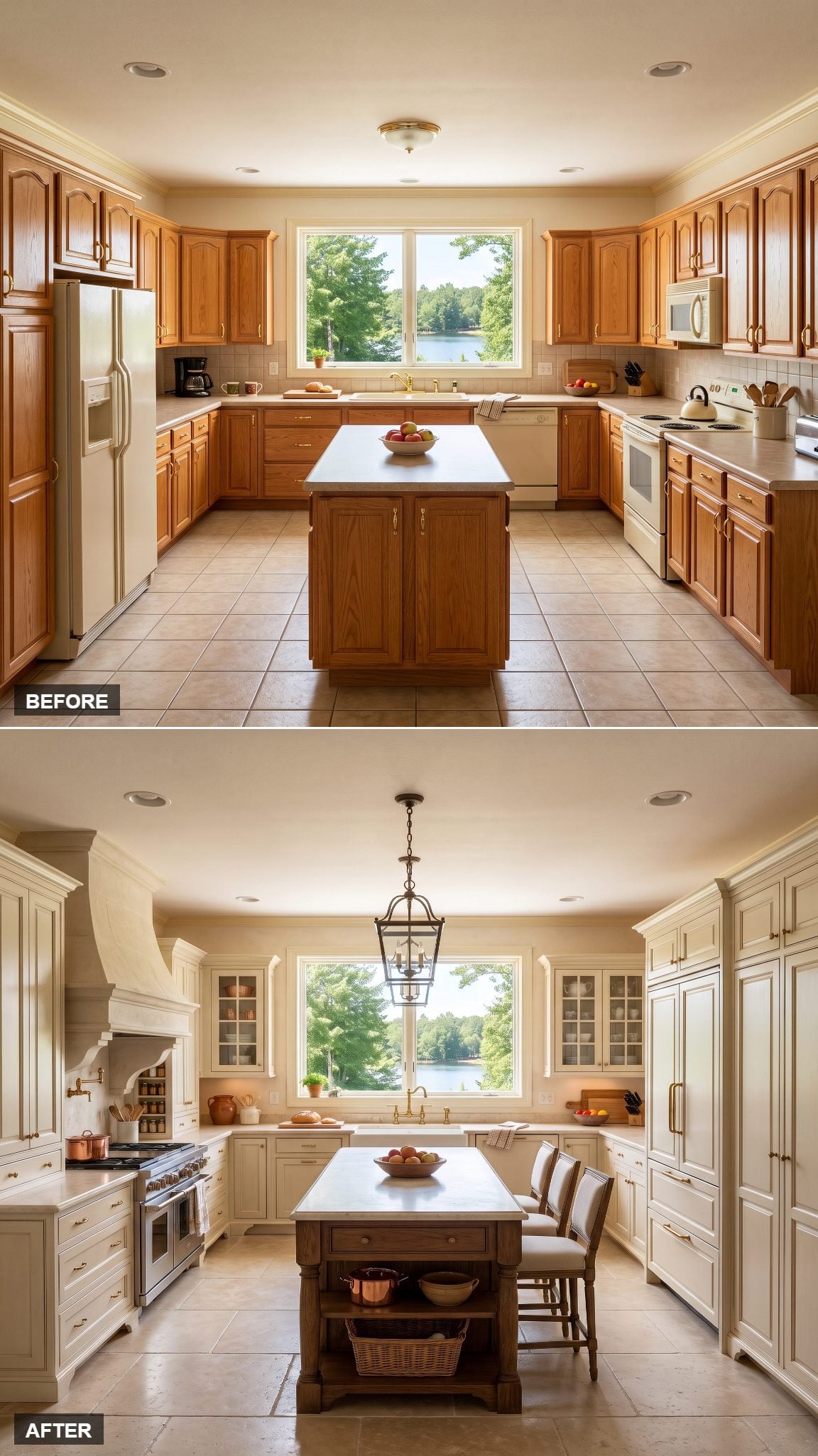
This kitchen has no interest in looking newly fashionable. Limestone tones, restrained traditional cabinet detailing and subtly aged hardware establish a vocabulary associated with established European interiors. Instead of reproducing every decorative convention of French country style, the design concentrates on materials and architectural proportions.
The plaster-finished range hood enclosure provides the decisive intervention. Where the original kitchen had little to interrupt its flat cabinetry, the hood introduces a strong central form above the cooking area. It feels integrated into the architecture rather than attached as another appliance. A well-designed hood enclosure can completely change a kitchen’s appearance, even when the surrounding cabinetry remains relatively restrained.
22. Green Marble Takes Command of an Entire White Oak Kitchen
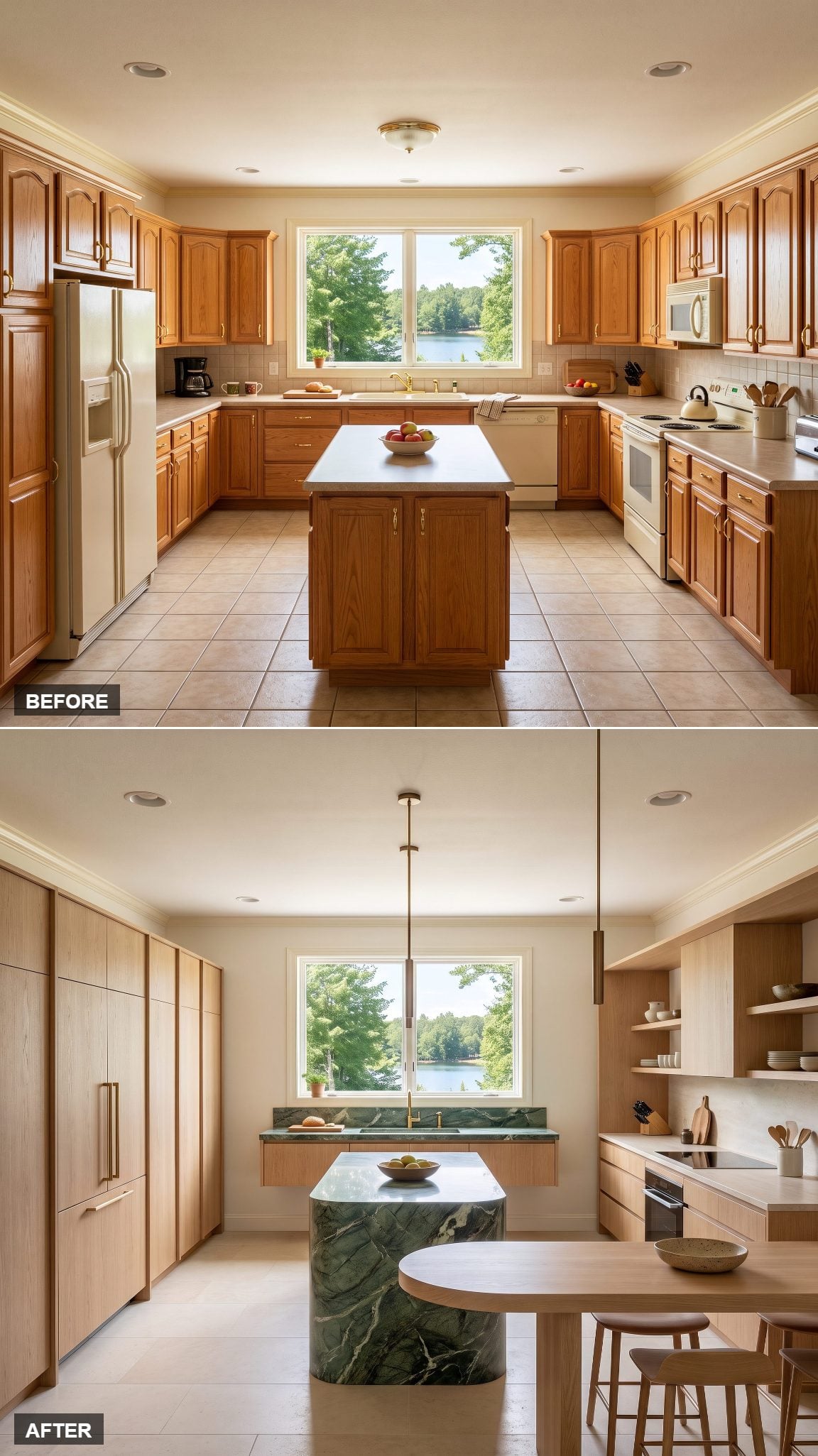
There are expensive materials, and then there are materials capable of reorganizing an entire room around themselves. Deep green marble belongs firmly in the second category. Against the pale grain of white oak, the stone introduces dramatic movement, saturated color and a focal surface that needs very little decorative assistance.
Equally important is the more continuous cabinetry arrangement. Bringing storage together into a coherent architectural plane allows the stone to command attention without every cabinet becoming another separate object. The green marble countertop supplies the spectacle; the timber supplies the discipline.
21. Silvered Oak and Dusty Blue Bring European Cottage Character Into the Room
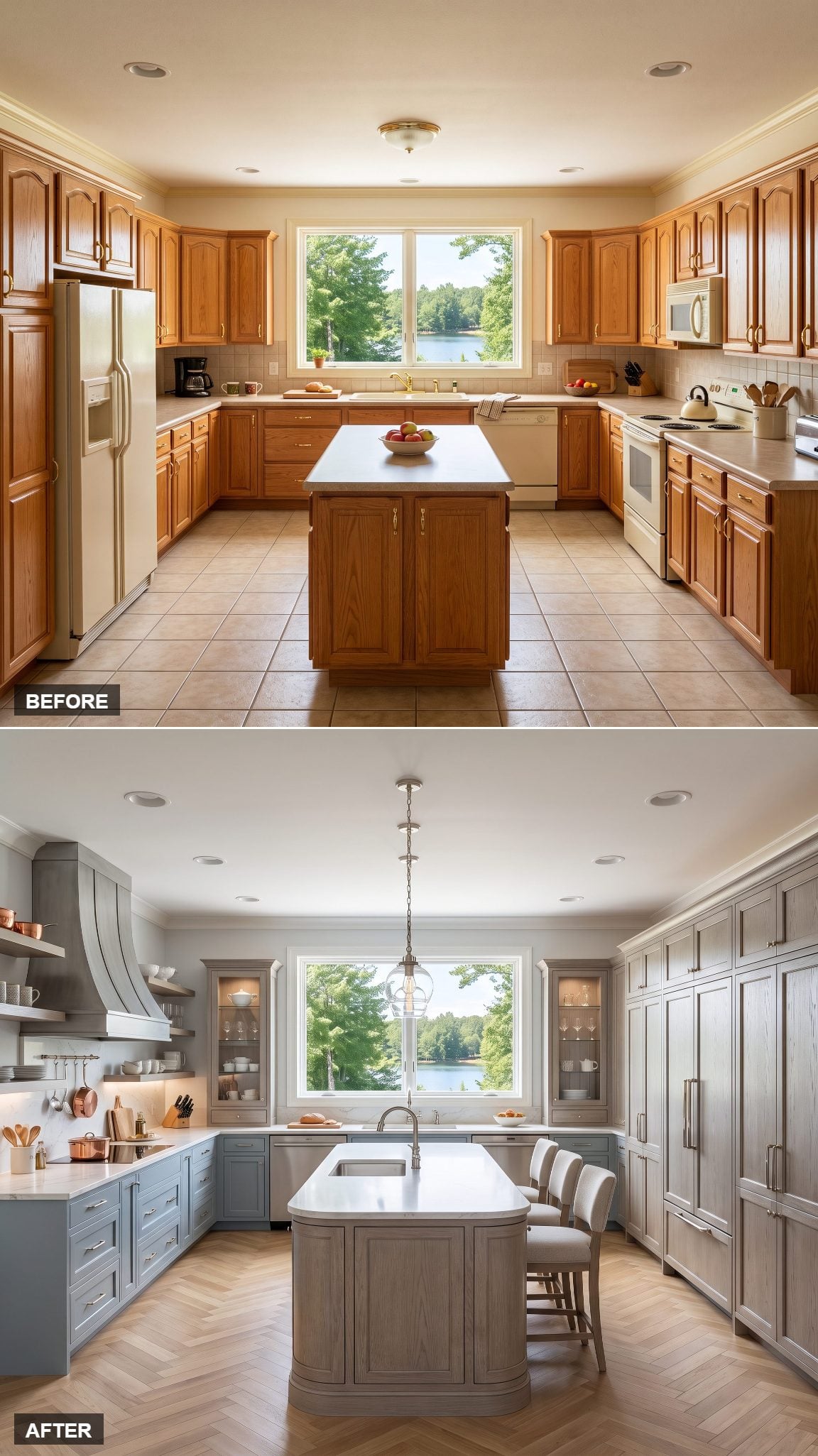
Silvered oak has the weathered character of timber that has spent years absorbing daylight, even when the cabinetry itself is new. Pair it with dusty blue and the kitchen moves toward a softer European cottage interpretation without relying on decorative antiques or an elaborate collection of country accessories.
Rather than allowing the two finishes to compete across every available surface, the design gives them separate responsibilities. The oak supplies texture and the appearance of age, while the painted cabinetry introduces a softer color that keeps the kitchen from becoming a wall-to-wall timber installation. The interest lies in their relationship: one material looks weathered and familiar, the other deliberately fresh.
20. Dark Walnut and Dramatically Veined Marble Turn Cooking Into Gallery Space
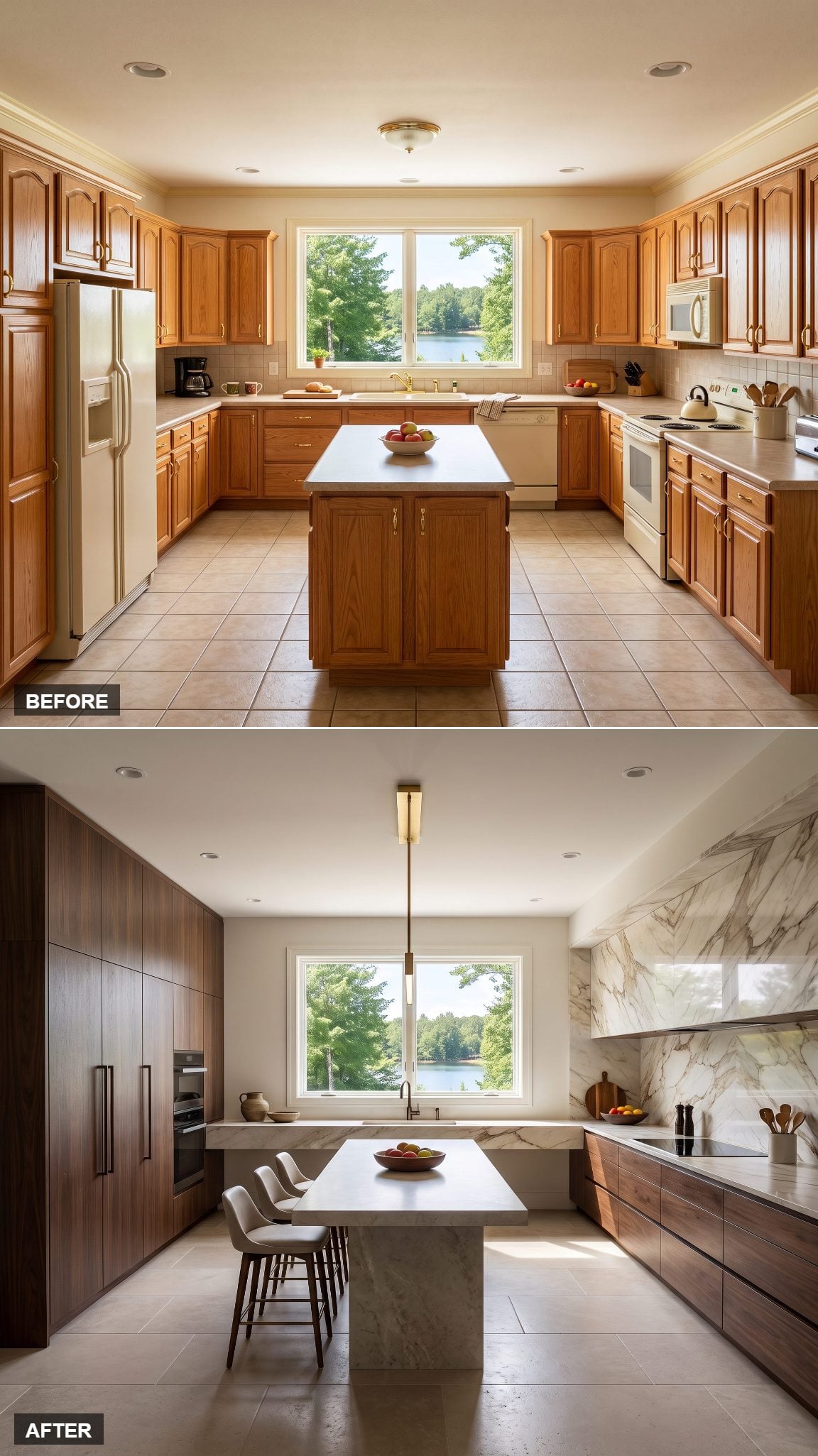
Dark walnut establishes the room’s considerable architectural mass. Then the marble arrives and steals the exhibition. Dramatic veining climbs the wall in a full-height installation, creating a surface with enough movement to make conventional decorative objects seem almost unnecessary.
The challenge is keeping two expressive natural materials from overwhelming each other. The cabinetry presents long, controlled planes of dark timber, while the marble introduces an unpredictable pattern. Slim brass cabinet pulls and carefully positioned lighting provide the finishing detail without competing with the stone. Anyone choosing a slab this distinctive should view and approve the actual material before fabrication; its veining will become one of the room’s defining architectural features.
19. Muted Sage and Natural Stone Create a Kitchen Built Around Calm Continuity
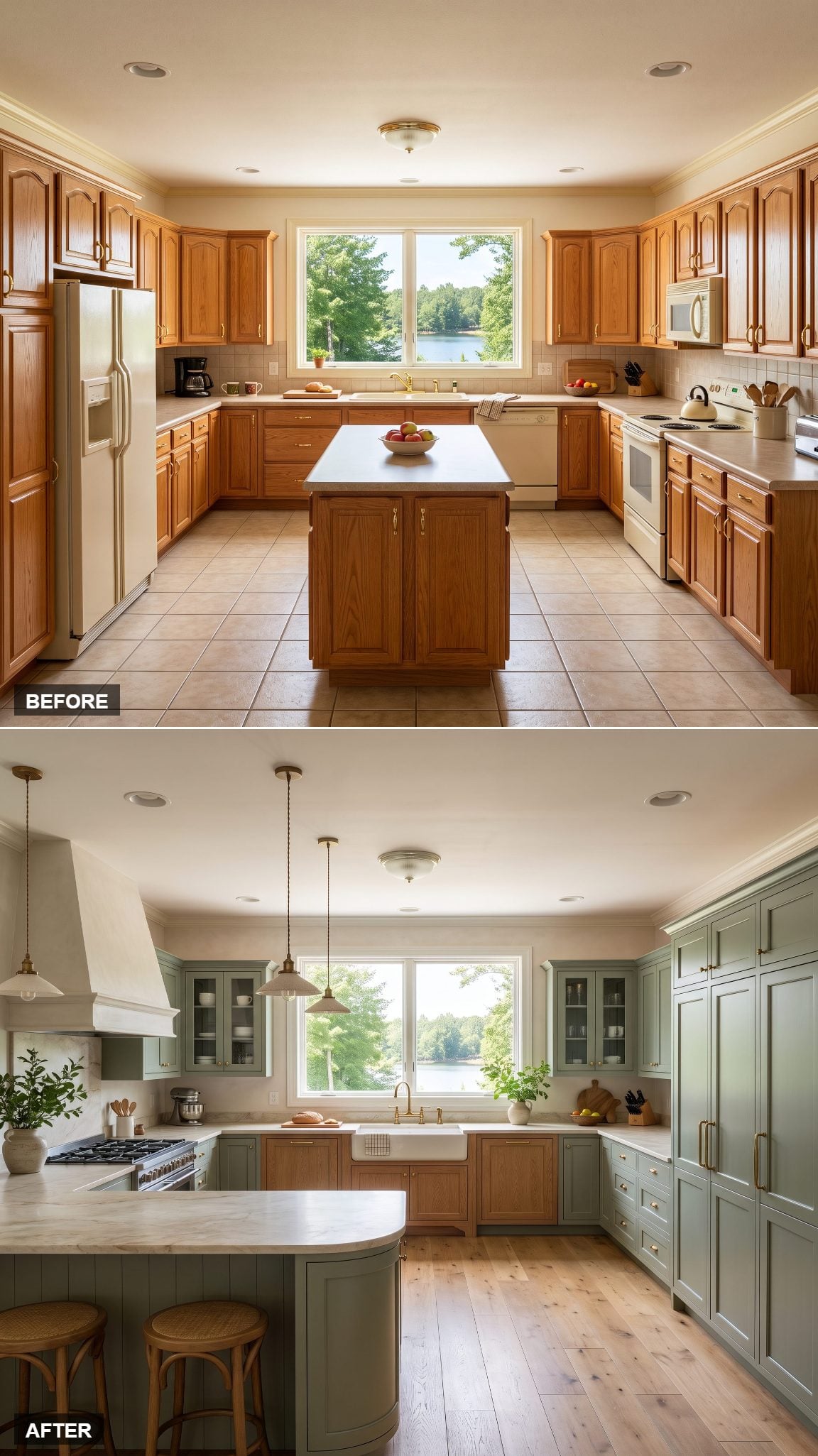
Sage gives the room a relationship with color without turning every cabinet into a headline. Full-height painted cabinetry creates a continuous architectural surface, while natural stone introduces movement through its veining and subtle tonal variations. The restrained palette allows those differences in material texture to become more noticeable.
The real design opportunity is the integrated storage. Tall sage green cabinetry can conceal appliances and consolidate storage, removing the cluttered appearance created when several different cabinet heights and exposed appliances interrupt the same wall. Instead of individually framing every appliance and cupboard, the redesign brings them together into a more unified arrangement.
18. Two Islands and Ebonized Oak Completely Rethink the Floor Plan
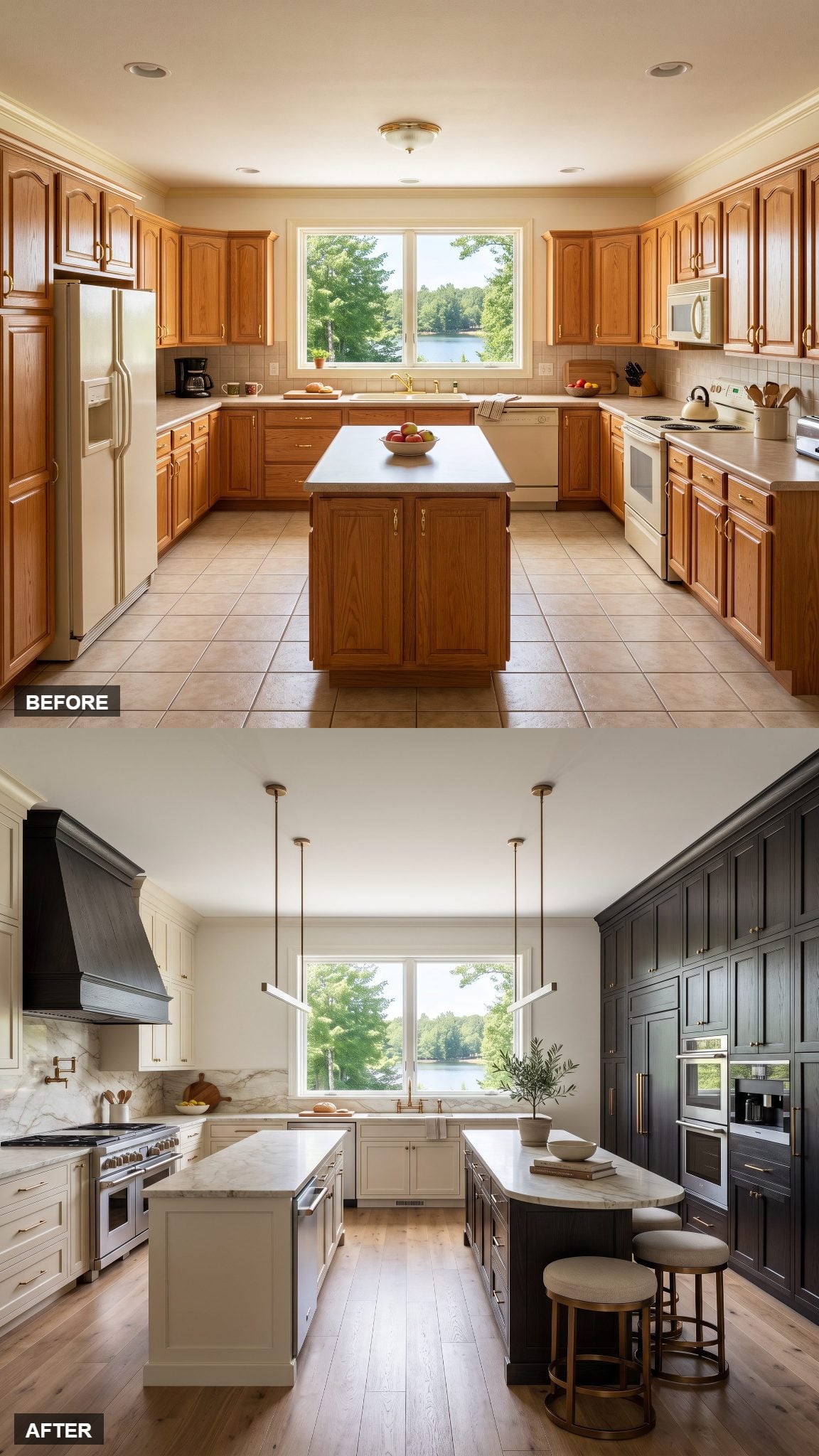
Two islands are an architectural proposition, not merely an expensive upgrade. Instead of allowing one enormous block to occupy the middle of the kitchen, this design separates the central furniture into two elements. The arrangement creates the possibility of distinct preparation and dining areas, with circulation passing between and around them.
Whether the strategy works in a real renovation depends entirely on dimensions. The islands need sufficient clearance for people to pass, appliances to open and cooks to operate without colliding. Here the contrast between ebonized oak and ivory also distinguishes the darker dining element from the surrounding cabinetry. The material difference reinforces the functional separation rather than decorating two identical islands.
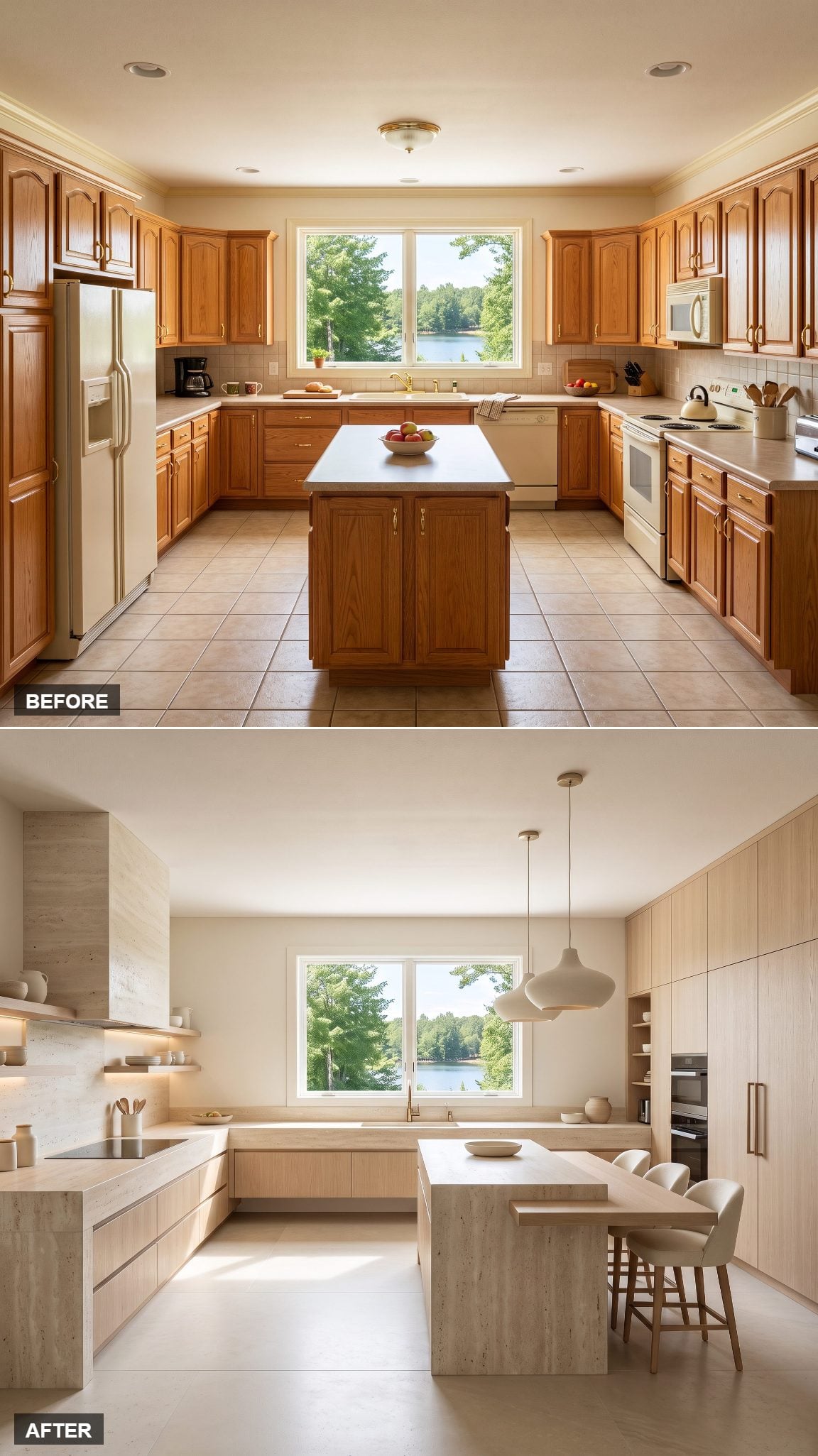
17. Cream Travertine and Rift-Cut Oak Make a Case for Sophisticated Neutrals
🔥 Would you like to save this?
Here is what the original beige kitchen might have achieved with better materials and a considerably stronger understanding of proportion. Cream travertine and rift-cut white oak sit close together tonally, but their textures are entirely different. Travertine introduces natural variation and movement, while the relatively straight grain of rift-cut oak creates orderly linear rhythm.
Because the palette is restrained, every transition matters. Countertop thickness, cabinet proportions, grain orientation and the relationship between vertical and horizontal surfaces become much more conspicuous. This kind of neutral kitchen needs careful detailing; color cannot distract from an awkward joint or an ill-considered change in material.
16. Charcoal Cabinetry and Champagne Brass Deliver Controlled Drama
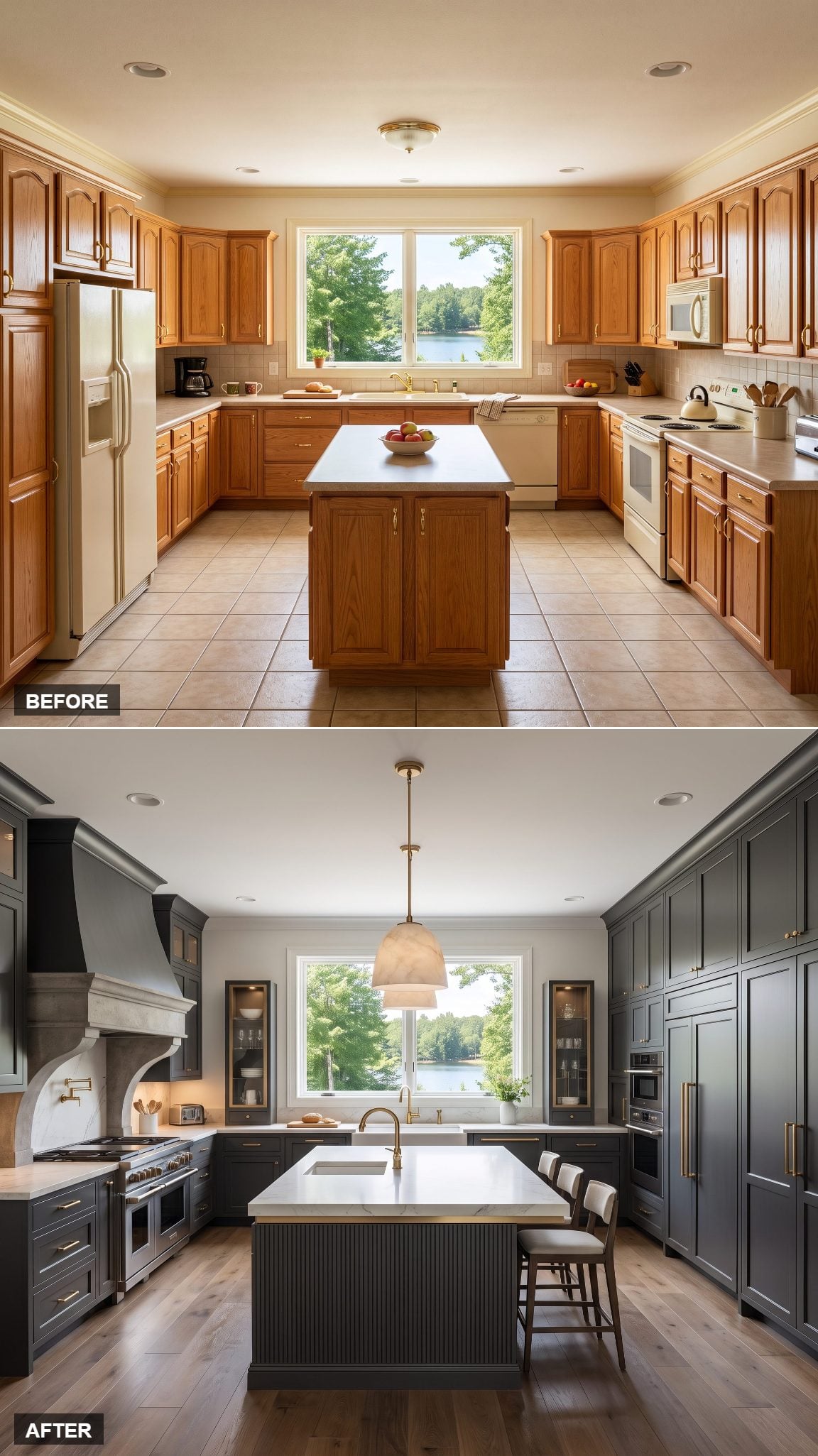
Charcoal cabinetry covers the wall with the presence of dark architectural paneling. Against that uninterrupted depth, champagne brass appears as a series of small, warm highlights rather than the dominant decorative feature. The metal has a much more restrained relationship with the cabinetry than the original kitchen’s conspicuous polished brass.
Dark kitchens need a lighting strategy as carefully considered as their material palette. Pale counters and appropriately positioned task lighting keep the work surfaces practical, while the charcoal cabinets establish the mood. Here the hardware is punctuation. It does not need to become the entire sentence.
15. Rosso Levanto Stone and Fluted Taupe Turn Up the Architectural Drama
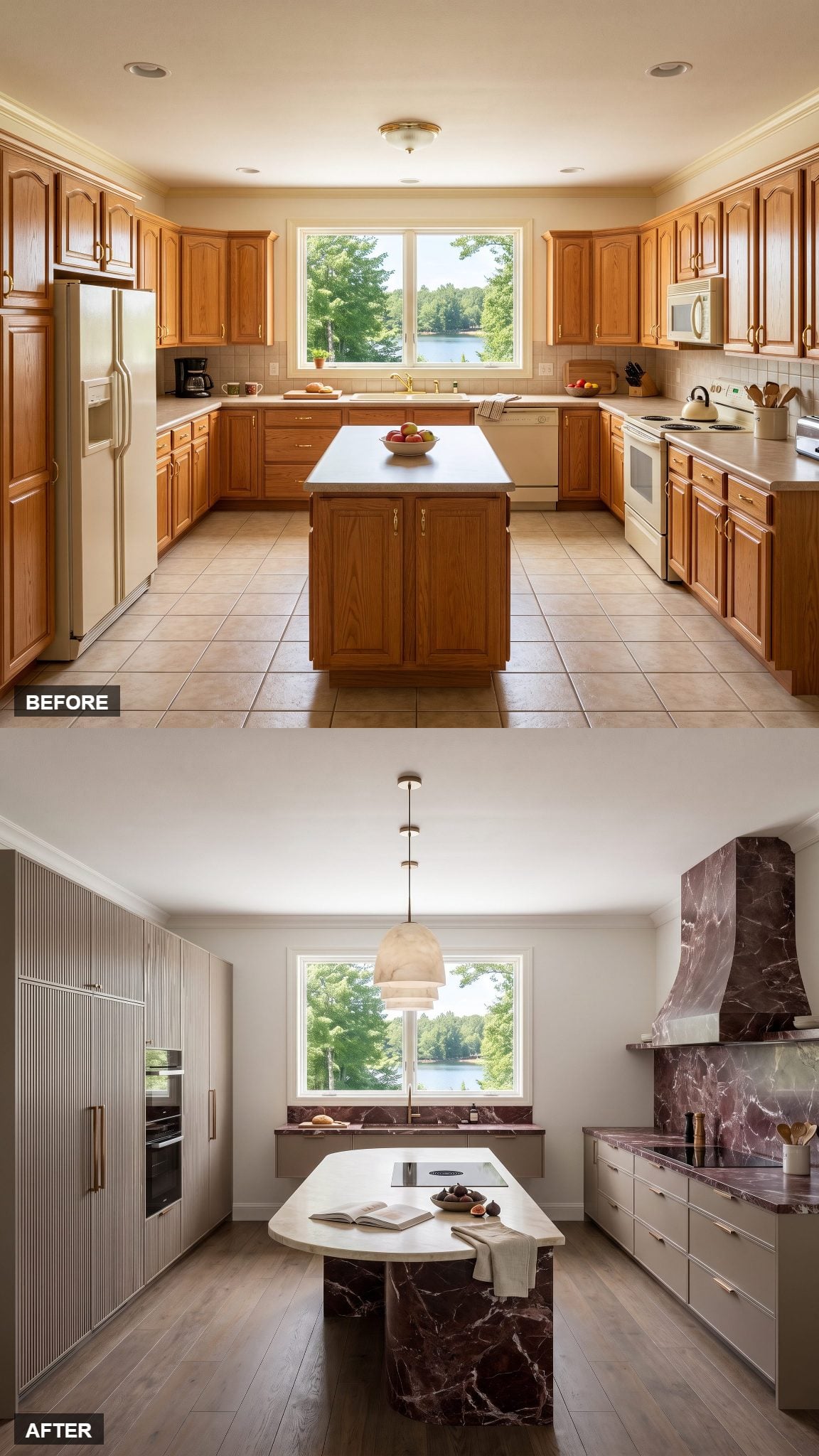
The stone is impossible to ignore. Rosso Levanto, commercially sold as marble, introduces a dramatic burgundy surface that travels through the kitchen’s architectural features. Against fluted taupe cabinetry, its irregular veining becomes even more expressive because the neighboring surfaces maintain such disciplined linear rhythm.
Then the curved island changes the equation again. Its crescent form interrupts the repetition of straight cabinet lines and offers a softer transition toward the seating area. The stone provides the spectacle, but the combination of fluting, curvature and material contrast is what makes this a genuinely different architectural proposition rather than another expensive backsplash.
14. Blue-Gray Cabinetry Gives White Marble a Tailored Companion
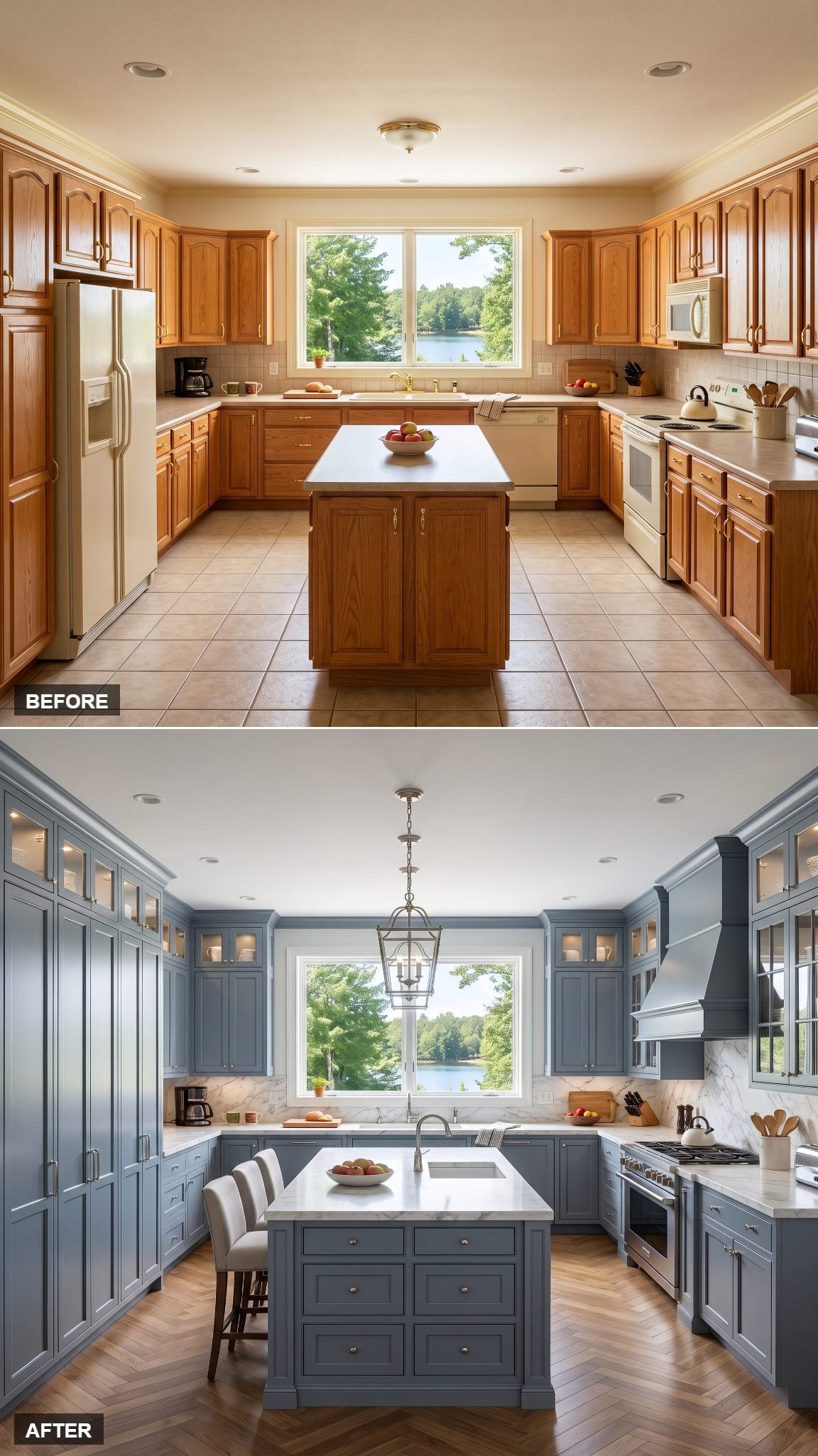
Blue-gray shaker cabinetry introduces color through an exceptionally controlled architectural framework. Against white marble, the cooler painted surfaces give the stone a crisp boundary. Polished nickel reinforces the cooler palette while supplying small reflective accents around the cabinetry.
The interesting feature is the precision of the relationships. Cabinet proportions, hardware placement and carefully aligned surfaces allow a relatively traditional door style to feel contemporary. Blue-gray can shift noticeably under different lighting conditions, so samples should be tested in the actual room rather than selected solely from a photograph.
13. Burgundy and Walnut Give the Old Kitchen an Entirely Different Personality
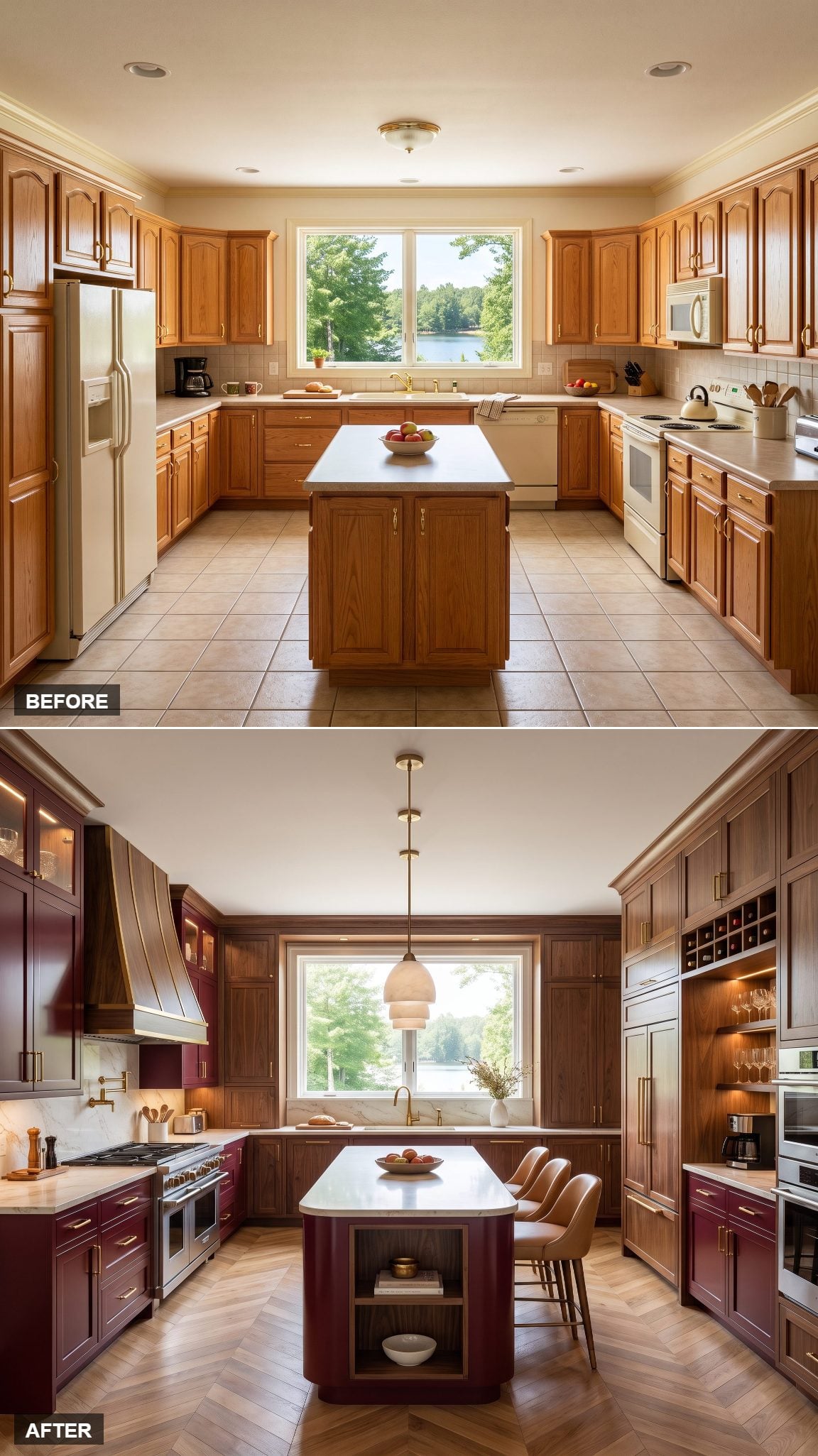
Some renovations politely update a room. This one stages a takeover. Deep burgundy lower cabinetry introduces a saturated horizontal band, while full-height walnut brings warmth, substantial grain and a completely different sense of architectural weight. The original kitchen’s safe, uninterrupted beige has been replaced by a composition with distinct foreground and background elements.
The brass is particularly interesting. Rather than banishing the metal because it belonged to the previous decade, the redesign gives it a more deliberate role. Restrained hardware against walnut and burgundy looks very different from prominent polished pulls against honey oak. Add a marble countertop to separate the dark cabinetry from the surrounding surfaces, and the entire room develops a much richer material hierarchy.
12. Italian Modern Combines Walnut and Stainless Steel With Almost Surgical Precision
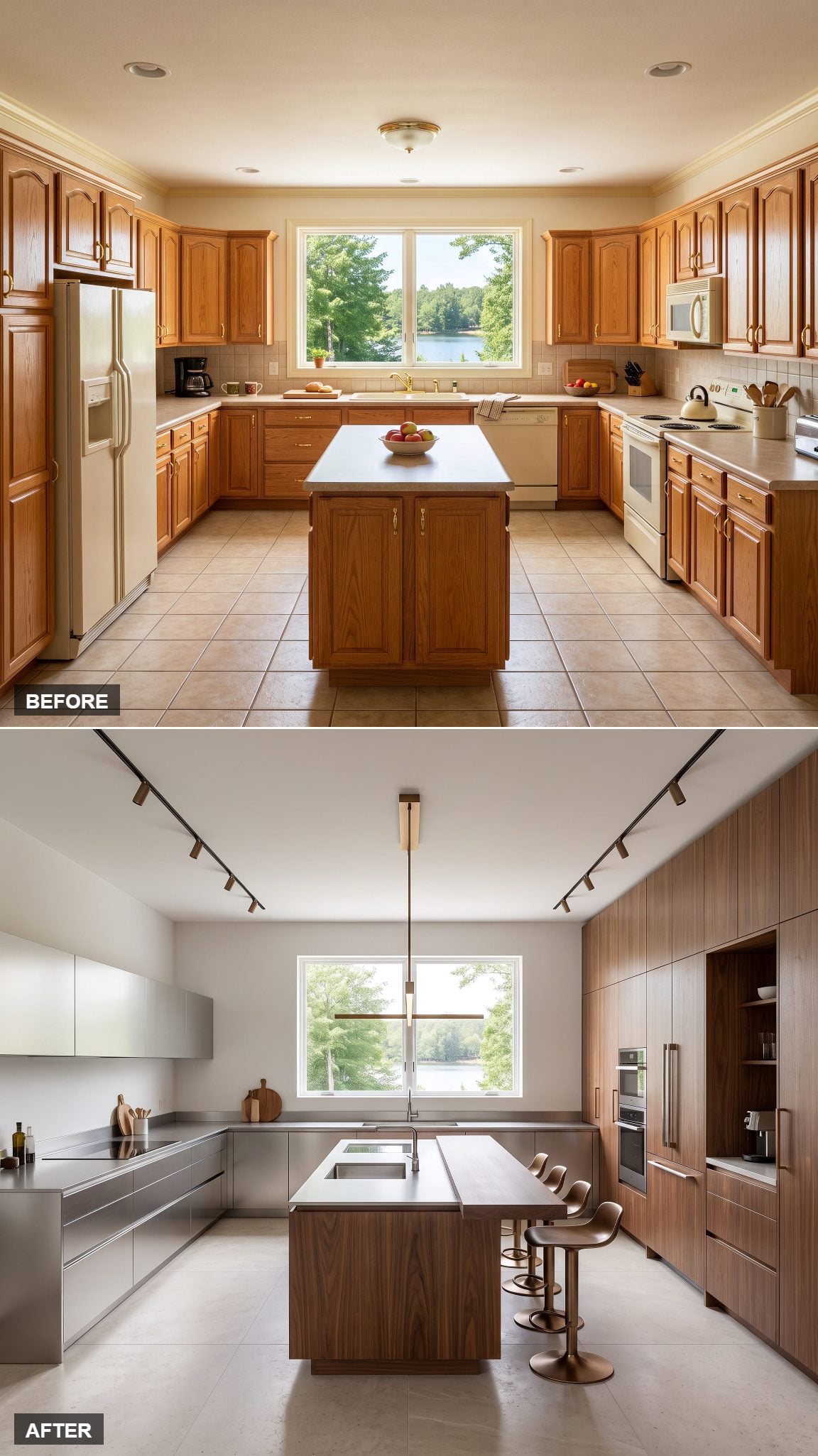
The kitchen has become an exceptionally handsome piece of furniture that happens to contain an entire cooking operation. Long walnut slab fronts create an uninterrupted grain pattern, while stainless steel counters introduce a distinctly professional material character. The combination feels precise without surrendering the warmth of natural timber.
Integrated or handleless cabinetry is essential to the composition. Depending on the specified system, doors may use recessed channels, concealed pulls or push-to-open hardware. What matters visually is the absence of conventional projecting handles interrupting the grain. This is a bold kitchen makeover built through restraint, fabrication and careful alignment rather than decorative excess.
11. Terracotta and Oak Bring Mediterranean Warmth Without the Decorative Luggage
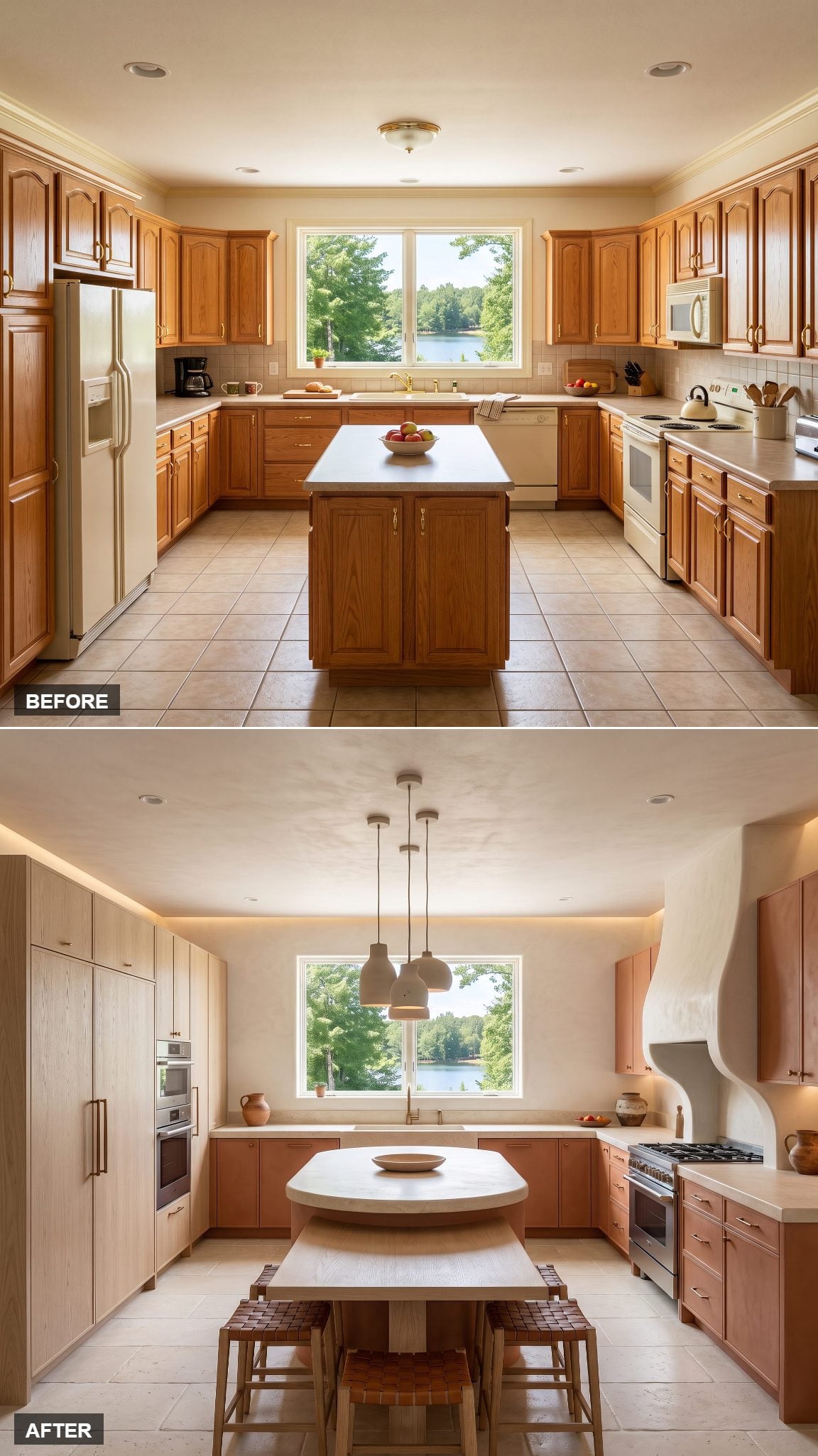
This kitchen practically demands an open window and an inconveniently long lunch. Terracotta introduces the earthy warmth associated with Mediterranean interiors, while pale oak provides a lighter architectural counterpoint. The palette carries the reference without requiring elaborate tiles, ornamental ironwork or an entire collection of decorative olive branches.
Full-height oak cabinetry keeps the visual organization contemporary. Appliances can sit within one substantial storage wall while the terracotta surfaces supply color and atmosphere elsewhere. That distinction prevents the kitchen from becoming a period pastiche. It borrows the warmth of the Mediterranean without borrowing every object traditionally associated with it.
10. Mushroom Cabinetry and Blackened Oak Hide an Entire Wall of Appliances
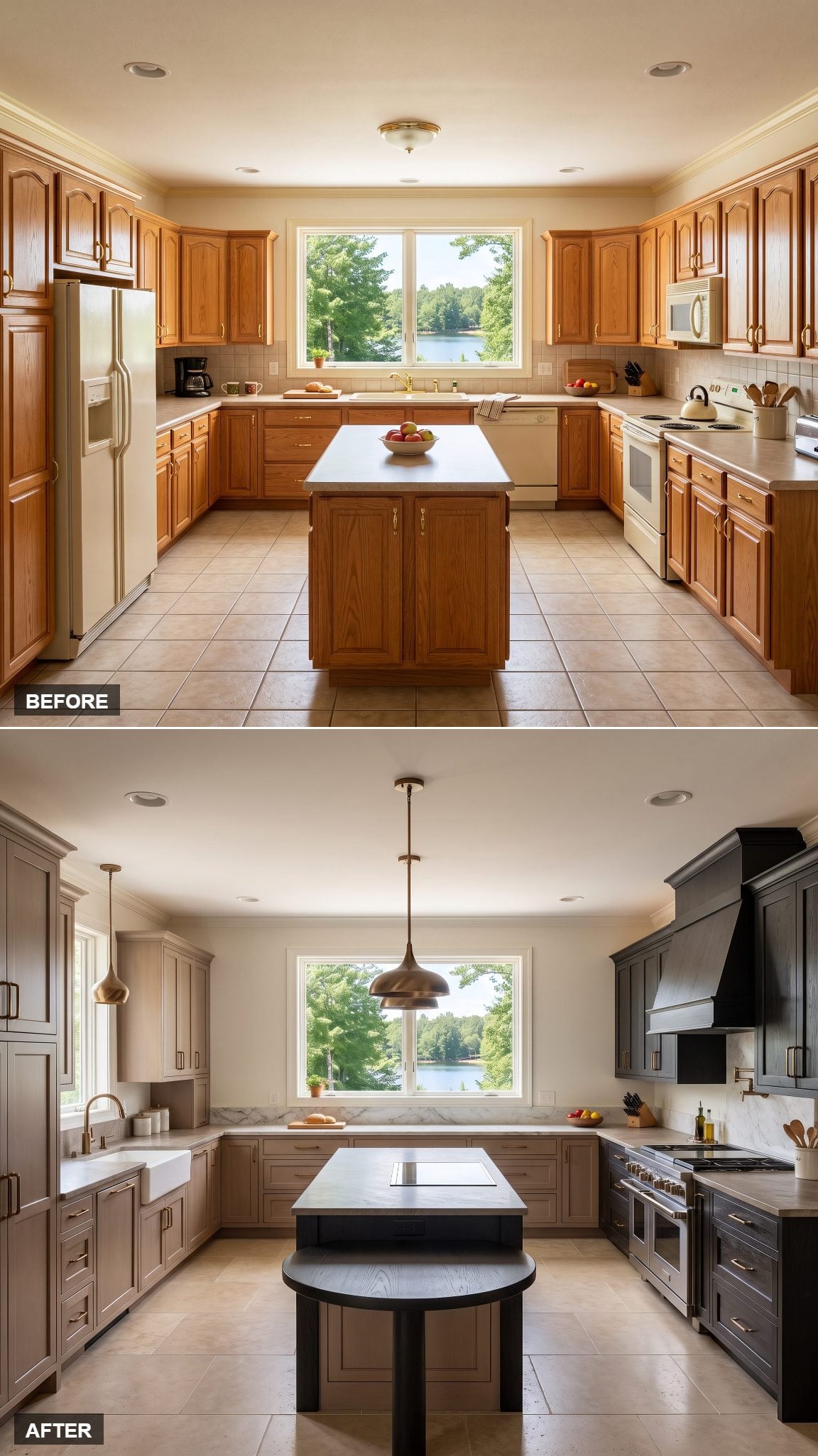
The most significant move here isn’t the color. It is the consolidation. A substantial wall of blackened oak brings appliances and storage into one strong architectural plane, while mushroom-toned cabinetry creates a softer foreground. The contrast helps distinguish the major functions without fragmenting the entire kitchen into separate cabinet groups.
Integrating appliances into tall cabinetry requires proper specifications for ventilation, access and installation, but the visual payoff can be considerable. The darker wall recedes behind the lighter work surfaces, while a honed marble countertop provides another material transition. The kitchen gains clarity because the storage has been reorganized, not simply repainted.
9. Warm White and Walnut Give the Original Cabinet Layout a Serious Upgrade
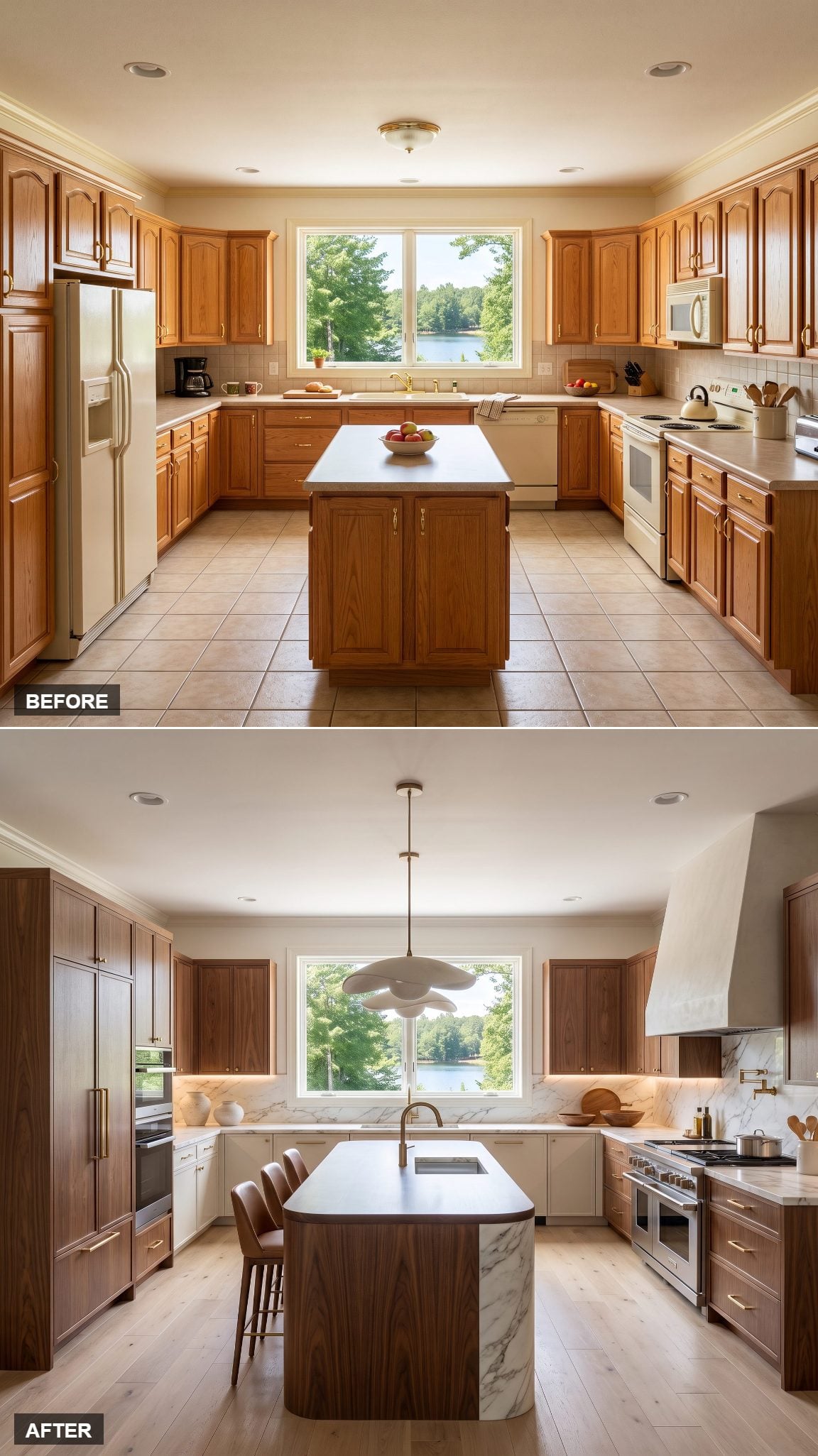
Not every successful transformation needs to dismantle the entire floor plan. Warm white cabinetry, walnut shelving and more carefully considered countertop materials can give the original kitchen a completely different character while retaining much of its straightforward organization.
The greatest improvement may be overhead. Replace the dominant fluorescent fixture with a properly planned combination of ambient and task lighting, and the materials acquire more depth while the work surfaces become easier to illuminate appropriately. Walnut shelving introduces a warmer, more tactile element against the pale cabinetry. Here the renovation is less about architectural bravado than getting an entire series of relatively ordinary decisions right.
8. Forest Green and Dark Oak Create a Kitchen With Heritage Character
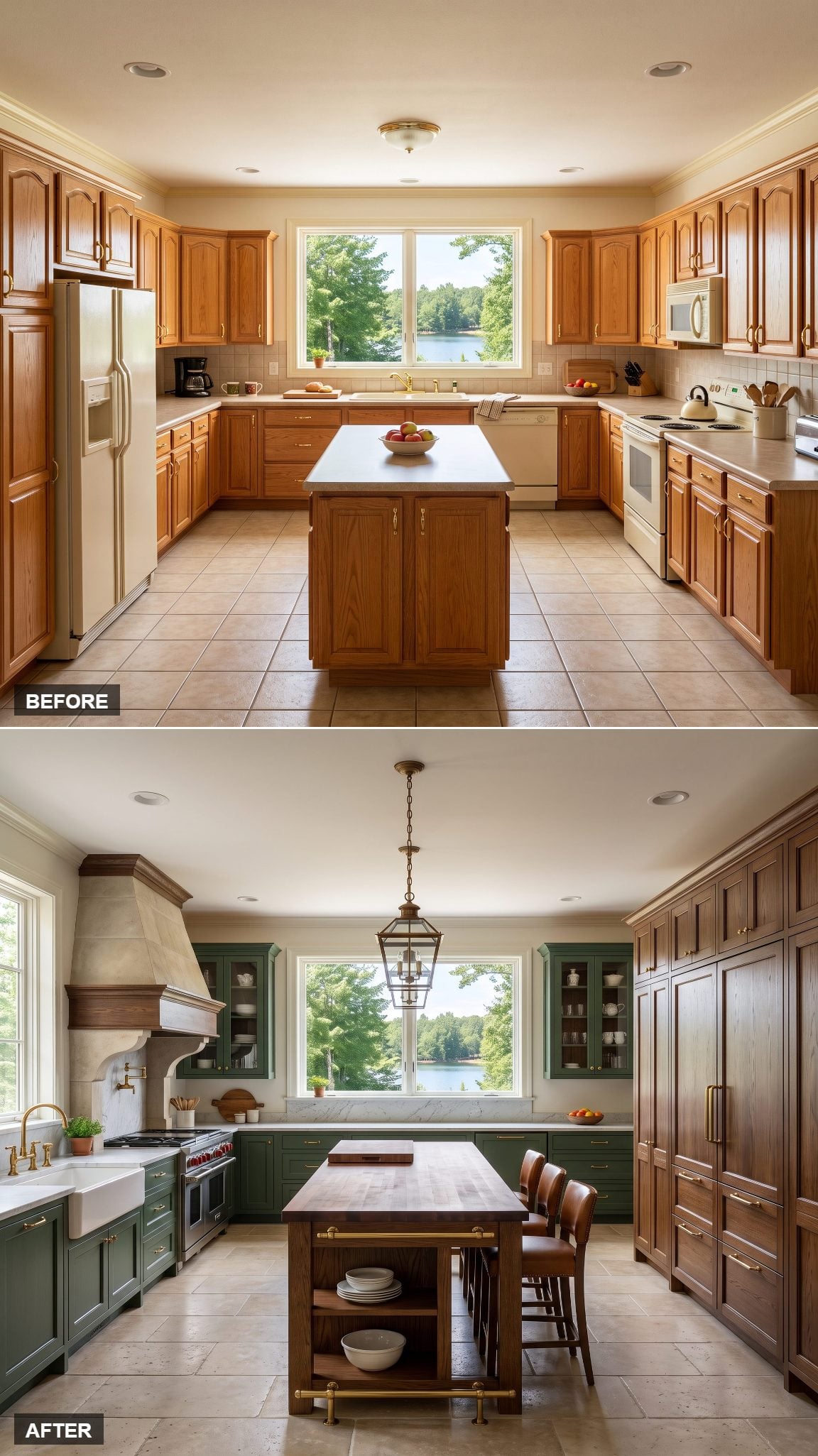
Deep forest green changes its character dramatically with the light. In shadow, the cabinetry approaches black. Where daylight strikes it, the green becomes unmistakable. Dark oak shelving reinforces that depth, while brass-rail detailing brings an association with traditional fitted interiors.
The combination succeeds as a heritage-inspired interpretation because it focuses on substantial materials and architectural details rather than treating age as a collection of decorative objects. The same principle appears in many a bold kitchen makeover: carefully chosen color can transform the architectural character of cabinetry without requiring every surrounding surface to compete.
7. Greige and Smoked Oak Give Quiet Luxury Something More Substantial to Say
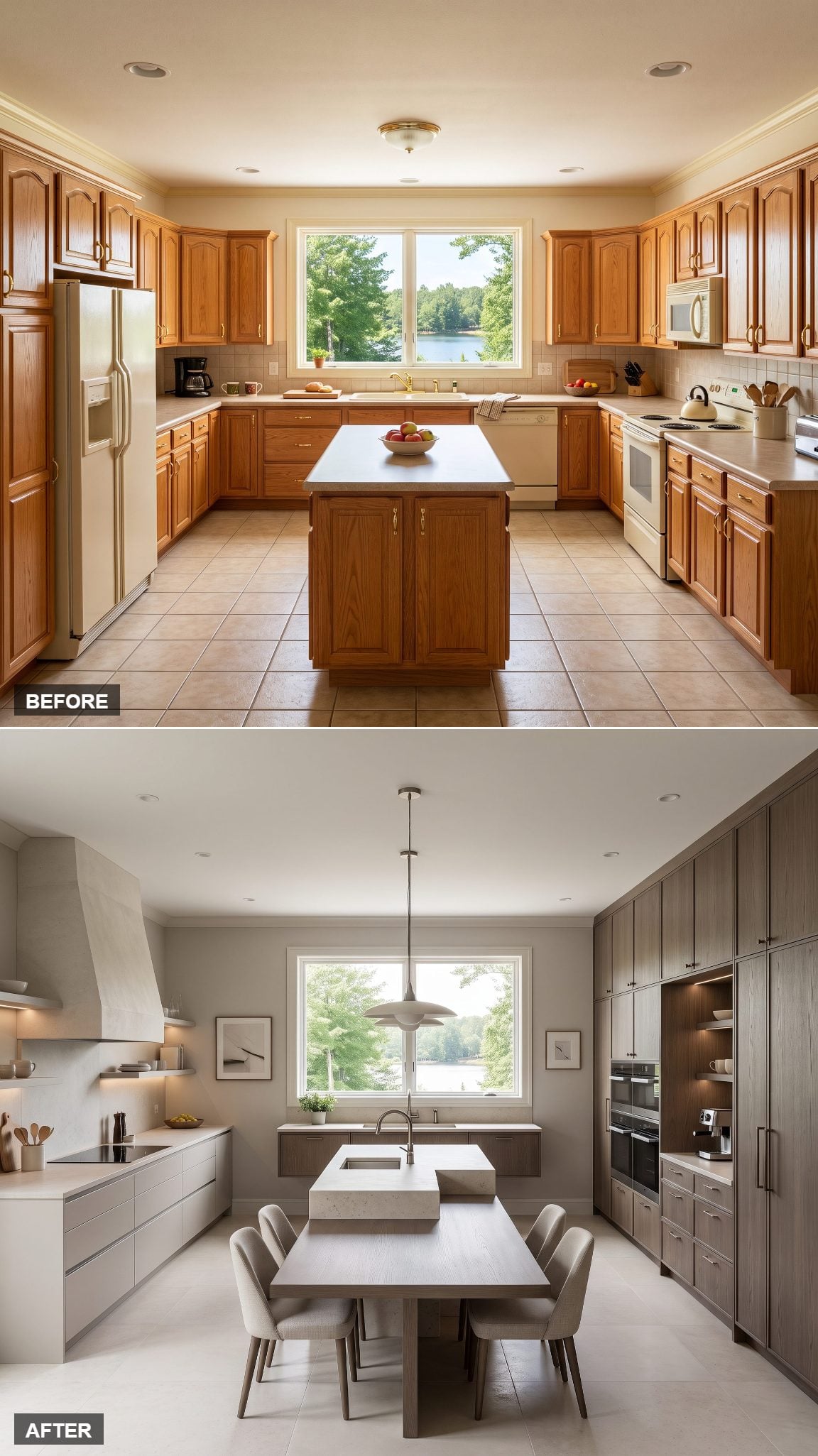
Quiet luxury can become a rather expensive way of saying very little. This kitchen avoids that problem through material variation and a more considered arrangement. Soft greige cabinetry supplies the neutral envelope, while smoked oak introduces darker grain and an architectural element that interrupts the original room’s repetitive cabinet arrangement.
The asymmetry deserves as much attention as the finish selection. Breaking the cabinetry into deliberately different volumes can prevent a small kitchen from resembling a solid wall of matching boxes. The palette remains controlled, allowing differences in texture, proportion and cabinetry organization to become the actual design.
6. Cream and Deep Navy Reinterpret the English Country Kitchen
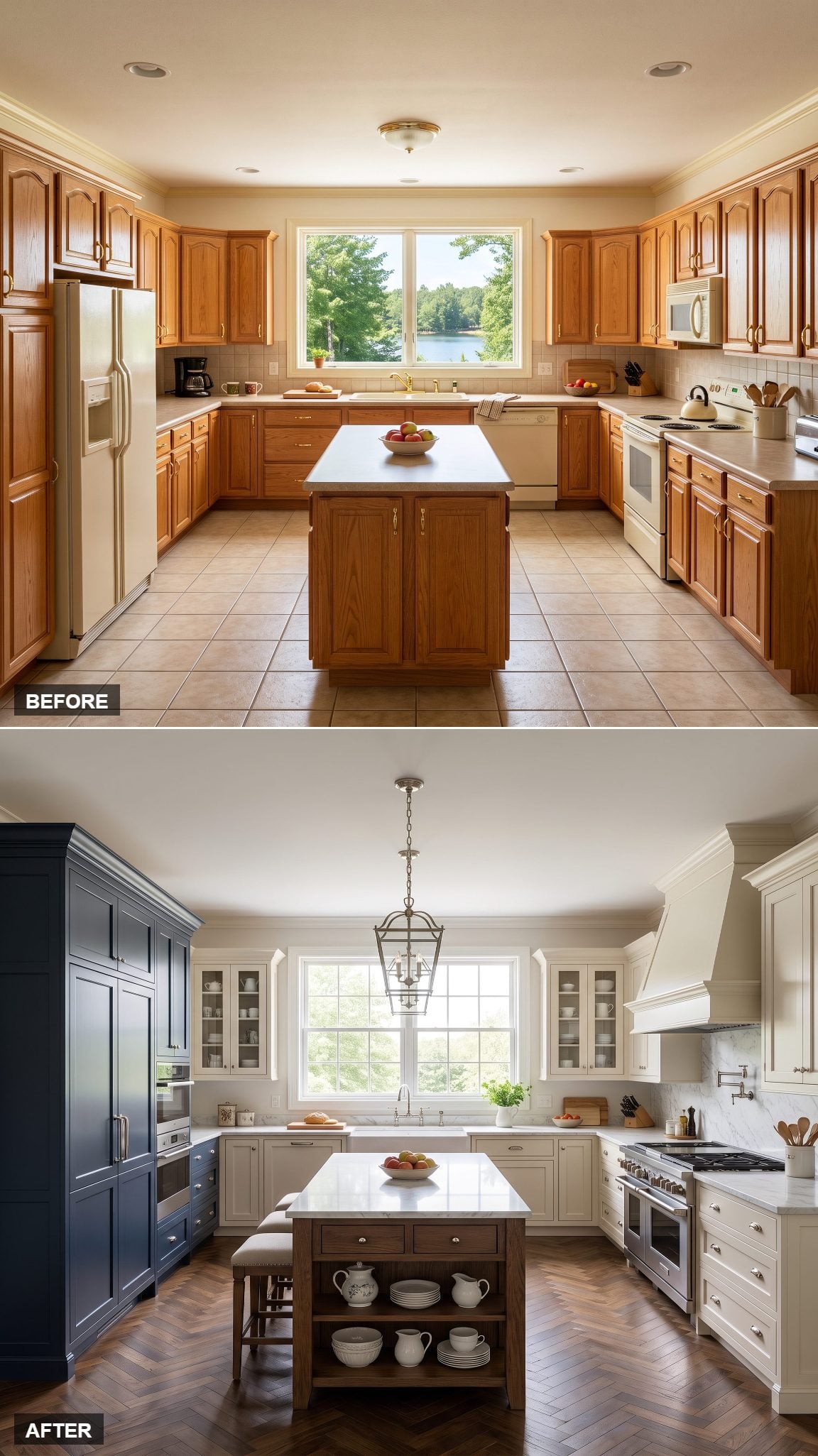
Traditional proportions do not require a timid palette. Deep navy cabinetry establishes a substantial architectural presence, while warm cream walls and lighter work surfaces prevent the composition from becoming uniformly dark. The result draws on familiar English country detailing without turning the kitchen into a museum of painted furniture.
Shaker cabinetry gives the color an orderly framework. Brass fixtures introduce warmth, while a carefully selected marble surface provides movement and visual separation. The navy shaker cabinets are substantial enough to define the room, but the surrounding materials keep the scheme connected to daylight and domestic practicality.
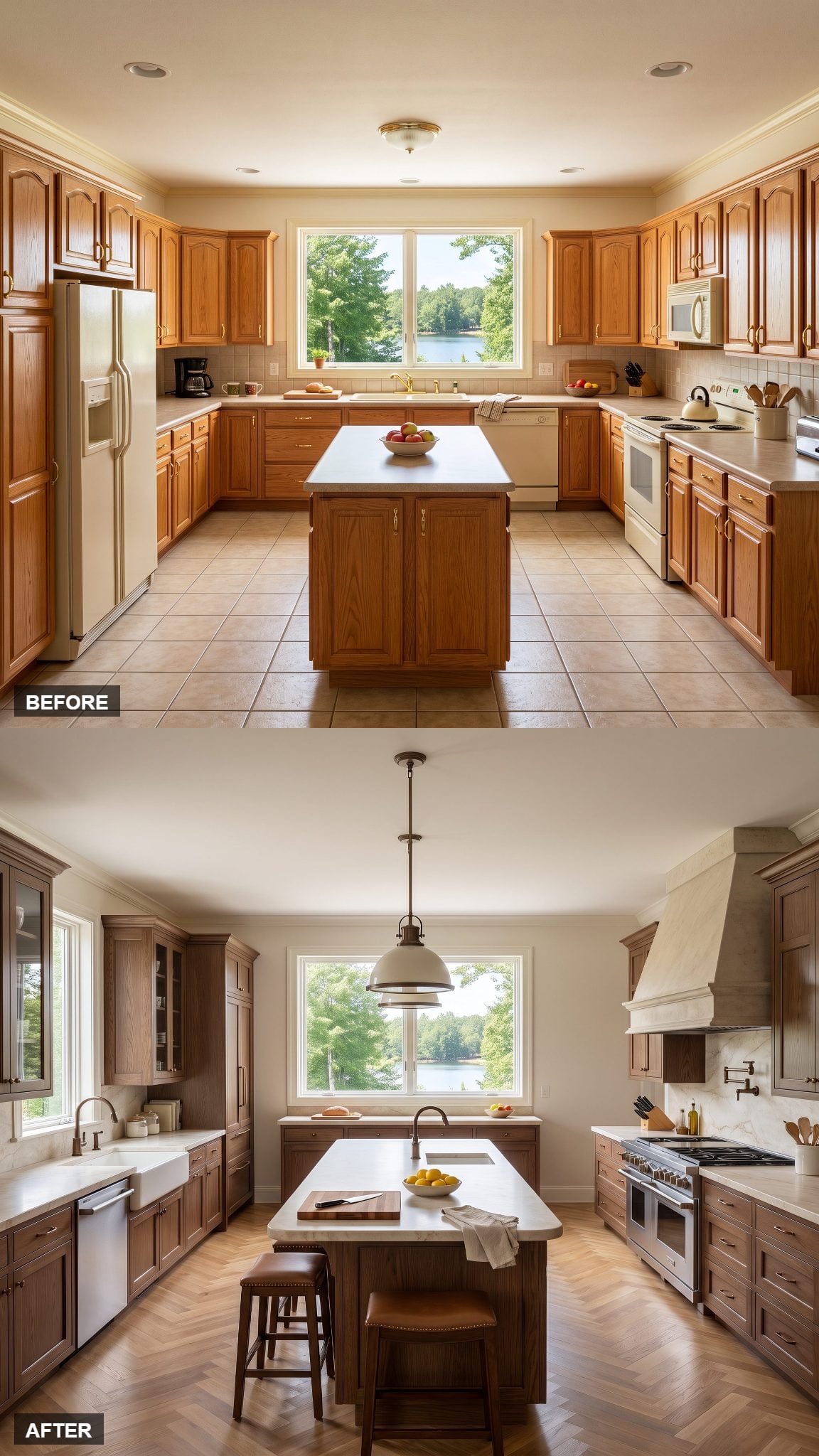
5. Taj Mahal Quartzite and Mocha Oak Give the Working Kitchen Some Architectural Muscle
🔥 Would you like to save this?
Taj Mahal quartzite introduces the soft, flowing appearance associated with pale marble, while mocha oak supplies a distinctly darker architectural frame. The combination creates a sophisticated material relationship, but the most consequential change may be the island’s orientation. Turning it crosswise alters how the room is divided and creates a different relationship between preparation space and the surrounding cabinetry.
Genuine quartzite can offer strong resistance to the kinds of acidic substances that readily etch calcite-based marble, although it is not indestructible and performance varies with the actual stone. Verify the selected slab rather than relying solely on its commercial name. Add herringbone oak flooring and the kitchen gains another layer of directional texture, creating a bold kitchen makeover that is as concerned with organization as appearance.
4. Chocolate Brown and Cream Stone Make a Richer Kind of Neutral Kitchen
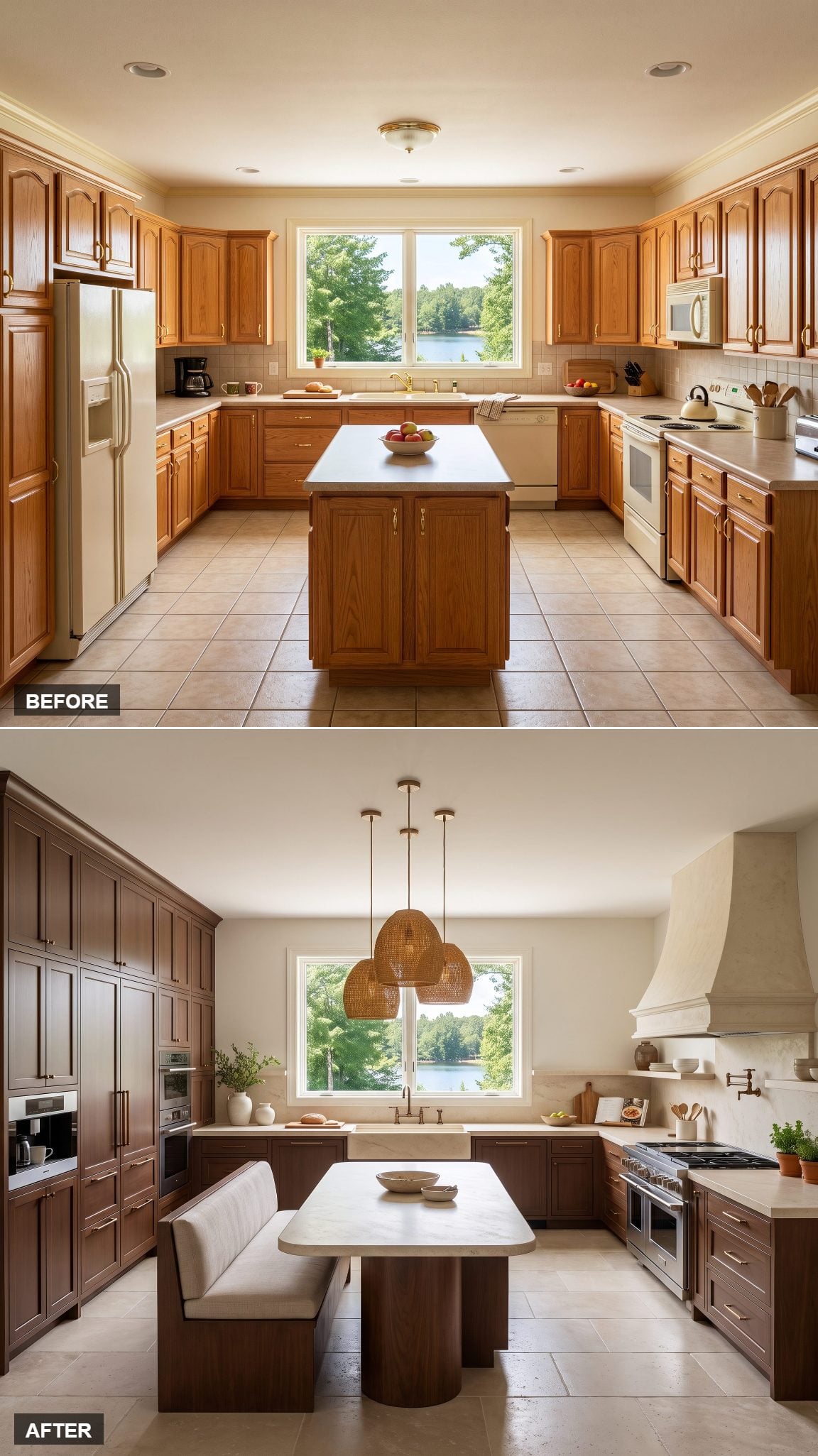
Chocolate cabinetry introduces the depth of dark wood without quite entering black-kitchen territory. Cream stone countertops provide a lighter working surface, creating a substantial contrast while keeping the overall palette warm. The relationship depends on carefully balanced tones rather than dramatic color.
Bronze hardware completes the material story with a relatively subdued metallic finish. Compared with the conspicuous polished brass of the original kitchen, slim bronze cabinet pulls become part of the cabinetry instead of sitting visibly on top of it. The bronze gives the dark finish just enough definition without cutting across its rich, continuous color.
3. Espresso Oak Below and Crisp White Above Rewrite the Kitchen’s Proportions
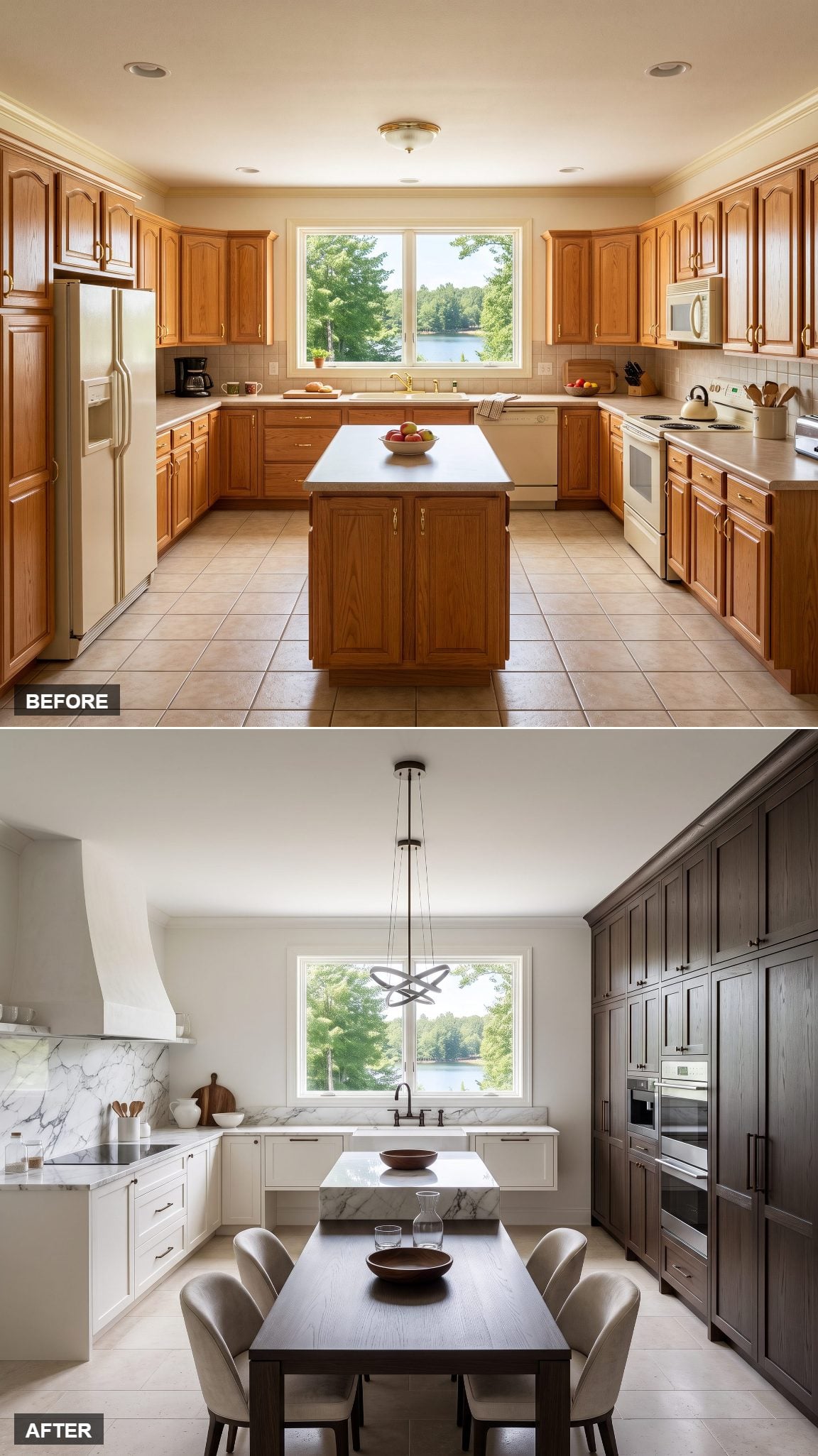
One of the simplest transformations in the gallery also offers a useful lesson in architectural proportion. Espresso-stained oak creates a strong base beneath crisp white upper cabinetry, distributing the darker material where it can supply visual weight without covering the entire wall.
The centered window becomes a natural interruption between the light upper elements, while restrained brass hardware provides detail without dominating the composition. Unlike the black-and-natural-oak kitchen, this design emphasizes a more conventional division between upper and lower cabinetry. Its strength is not the novelty of the materials but the clarity of the arrangement.
2. Aubergine and Pale Oak Take the Kitchen Somewhere Unexpected
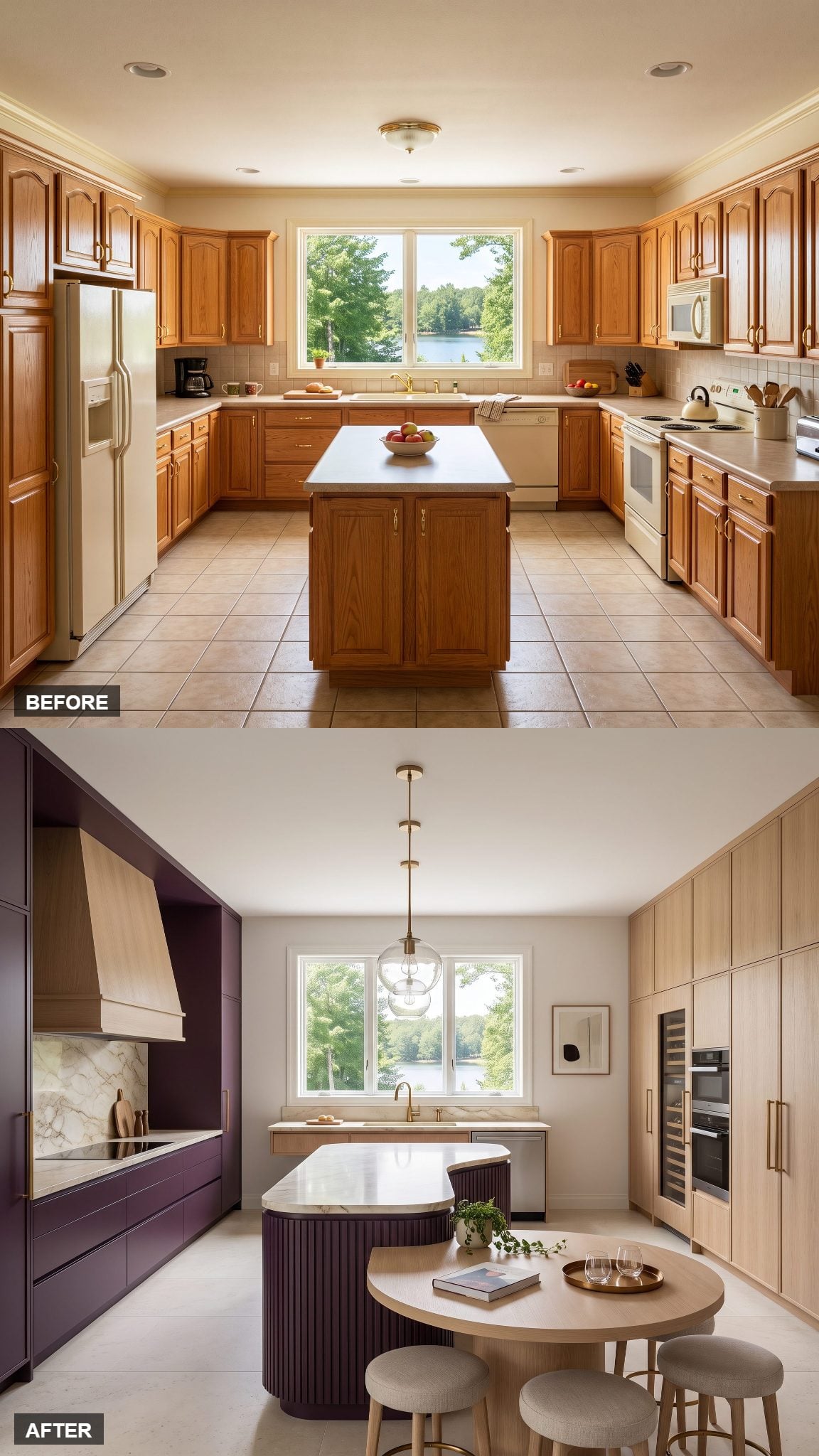
Deep aubergine is a substantial departure from a conventional neutral kitchen, particularly when it covers fluted cabinetry. The ridged fronts create repeated highlights and shadows, giving the saturated color a changing appearance as light moves across the room. Pale oak and limestone flooring provide the counterweight, introducing lighter surfaces without weakening the color’s architectural presence.
Then there is the boomerang island. Its asymmetrical form challenges the rectangular organization of the original room and introduces a much more sculptural central element. The useful distinction is that the island’s unusual geometry should also support comfortable movement and a practical working arrangement. An unconventional shape needs to solve something beyond the desire to appear unconventional.
1. Bookmatched Stone and Fluted Walnut Deliver a Completely Different Kitchen
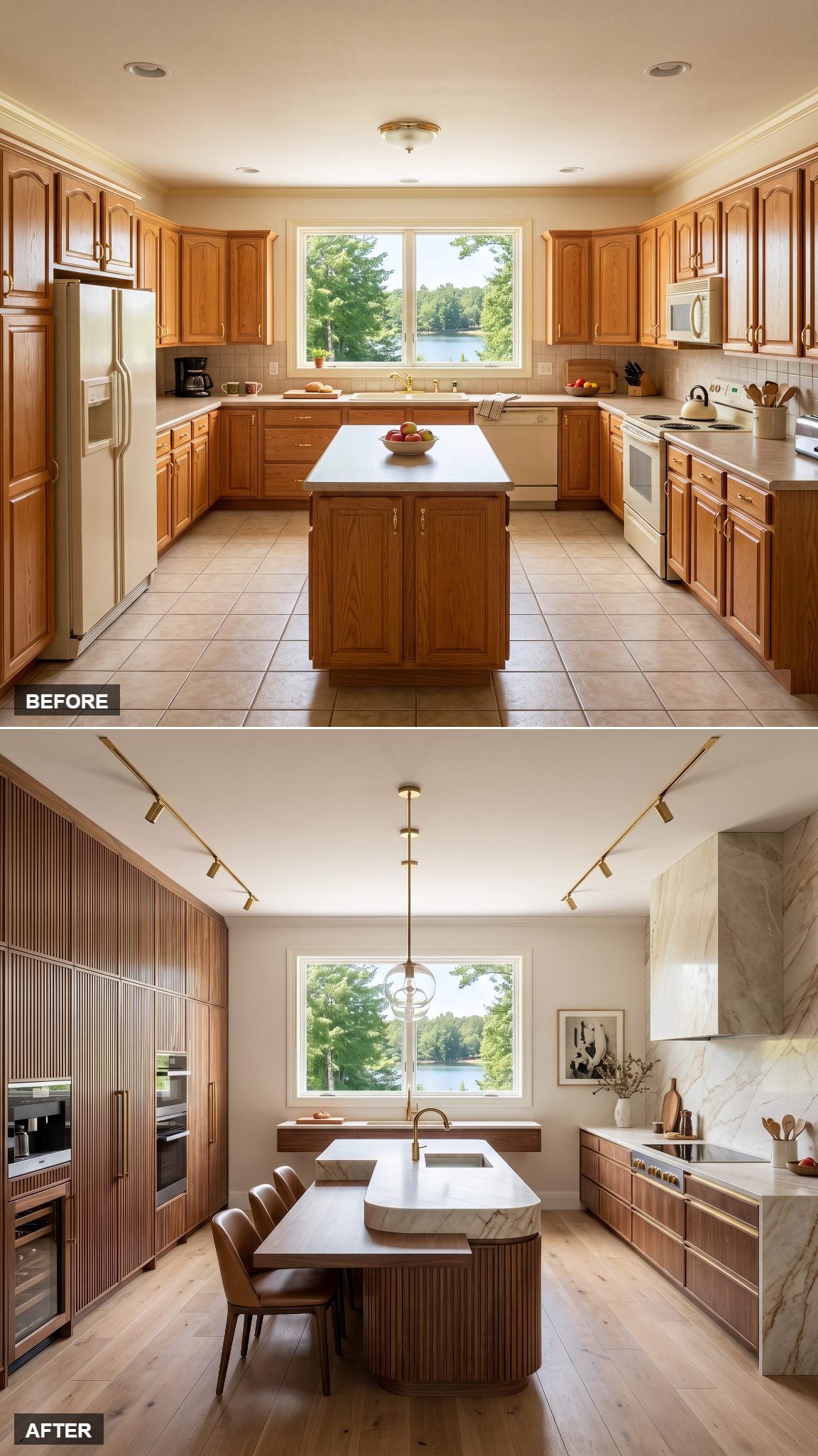
For the final transformation, subtlety has left the building. A dramatic bookmatched stone installation mirrors the slab’s natural veining across the wall, producing a monumental pattern that becomes the kitchen’s principal architectural feature. Fluted walnut beneath and beside it introduces a completely different visual rhythm: ordered vertical ridges against the stone’s irregular, sweeping movement.
Bookmatching requires careful slab selection and fabrication because the mirrored composition depends on the natural pattern of the actual stone. The cabinetry demands similar discipline. Fluting only looks effortless when its spacing, alignment and transitions have been considered throughout the design. Together, these materials produce something considerably more substantial than a simple change of finish.