🔥 Would you like to save this?
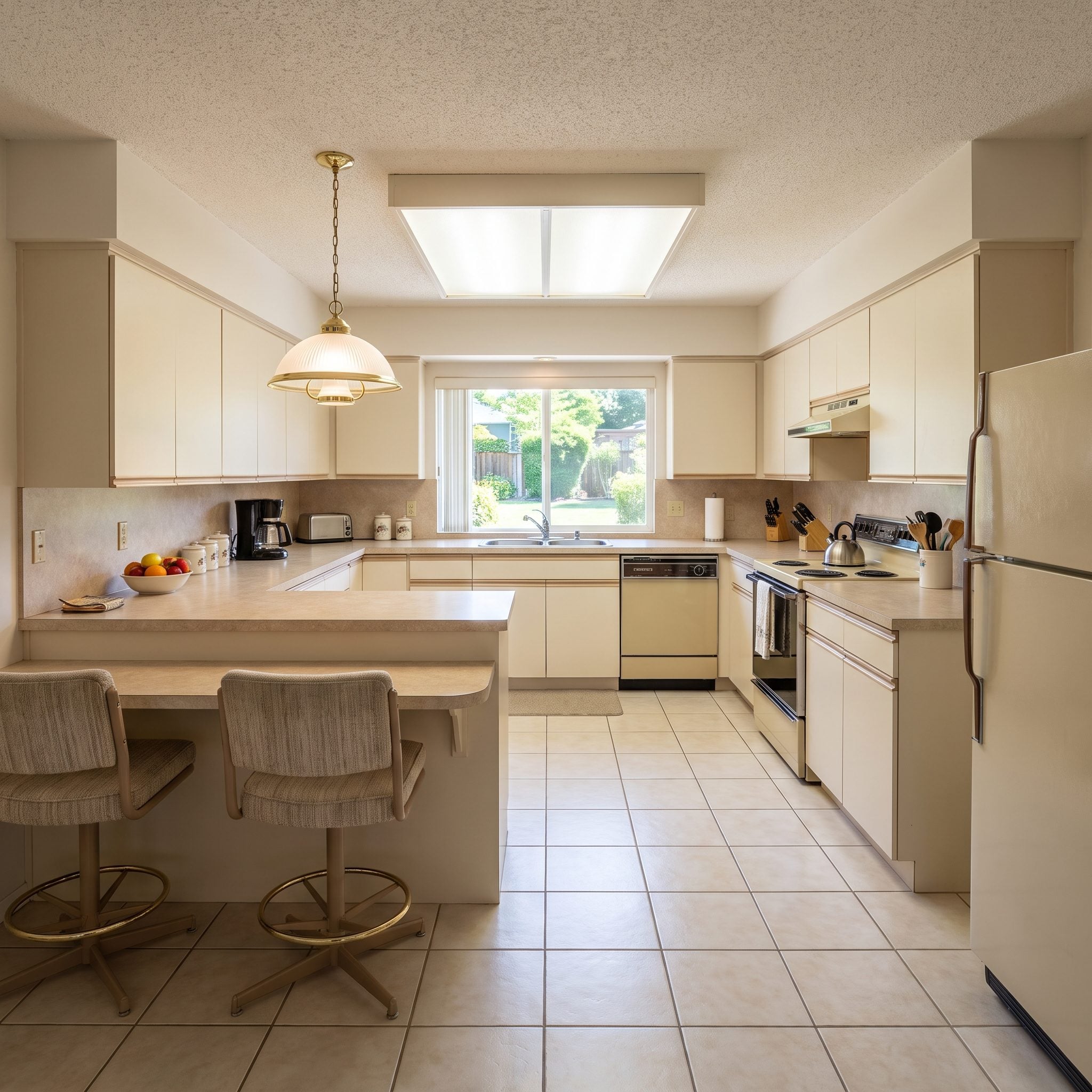
The peninsula is doing more than dividing this 1980s kitchen. It pinches the main circulation route, interrupts the sightline across the room and leaves a generous footprint behaving as though every square foot has already been spoken for. Beige laminate, honeyed oak and a fluorescent ceiling box finish the job: plenty of kitchen, surprisingly little freedom.
Take away that projecting counter and the architecture changes before a single cabinet door does. Suddenly the center can breathe. Storage can consolidate along the perimeter. An island can float rather than barricade, appliances can disappear into full-height millwork, and materials that once would have fought for attention have enough space to make a point.
In order to come up with the very specific design ideas, we create most designs with the assistance of state-of-the-art AI interior design software. Also, assume links that take you off the site are affiliate links such as links to Amazon. this means we may earn a commission if you buy something.
That opens the door to something far more interesting than a cosmetic update. Pale oak can meet green quartzite. Blackened wood can make emerald stone glow. Burgundy lacquer can behave like tailoring, travertine can become sculpture, and illuminated onyx can turn a work surface into architecture after dark. The real luxury isn’t any one finish. It’s finally giving the room a layout capable of handling them.
27. Dusty Blue and Walnut Bring In the Soul of a European Flat
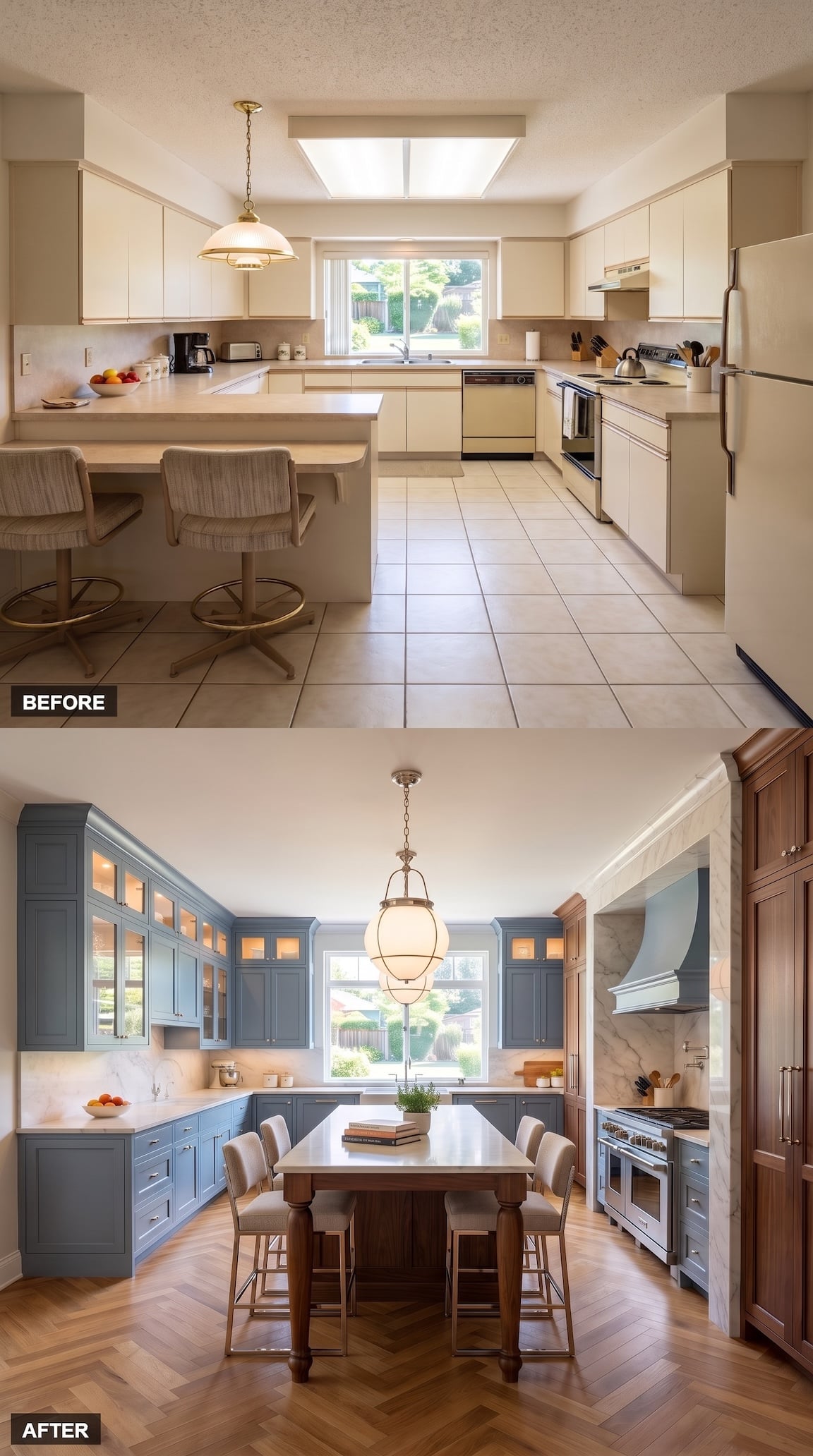
The walnut island changes the character of the room because it doesn’t behave like conventional fitted cabinetry. Legs rather than a solid plinth make it read more like a table that belongs in the room than a box permanently attached to the floor.
Dusty blue cabinetry provides the quieter counterpoint: muted enough to sit comfortably beside walnut, but substantial enough not to disappear. For more restrained blue kitchen ideas, the inset cabinet construction is worth noticing. That’s where much of the custom character comes from.
26. Oxblood Lacquer Meets Arabescato in a Couture Kitchen
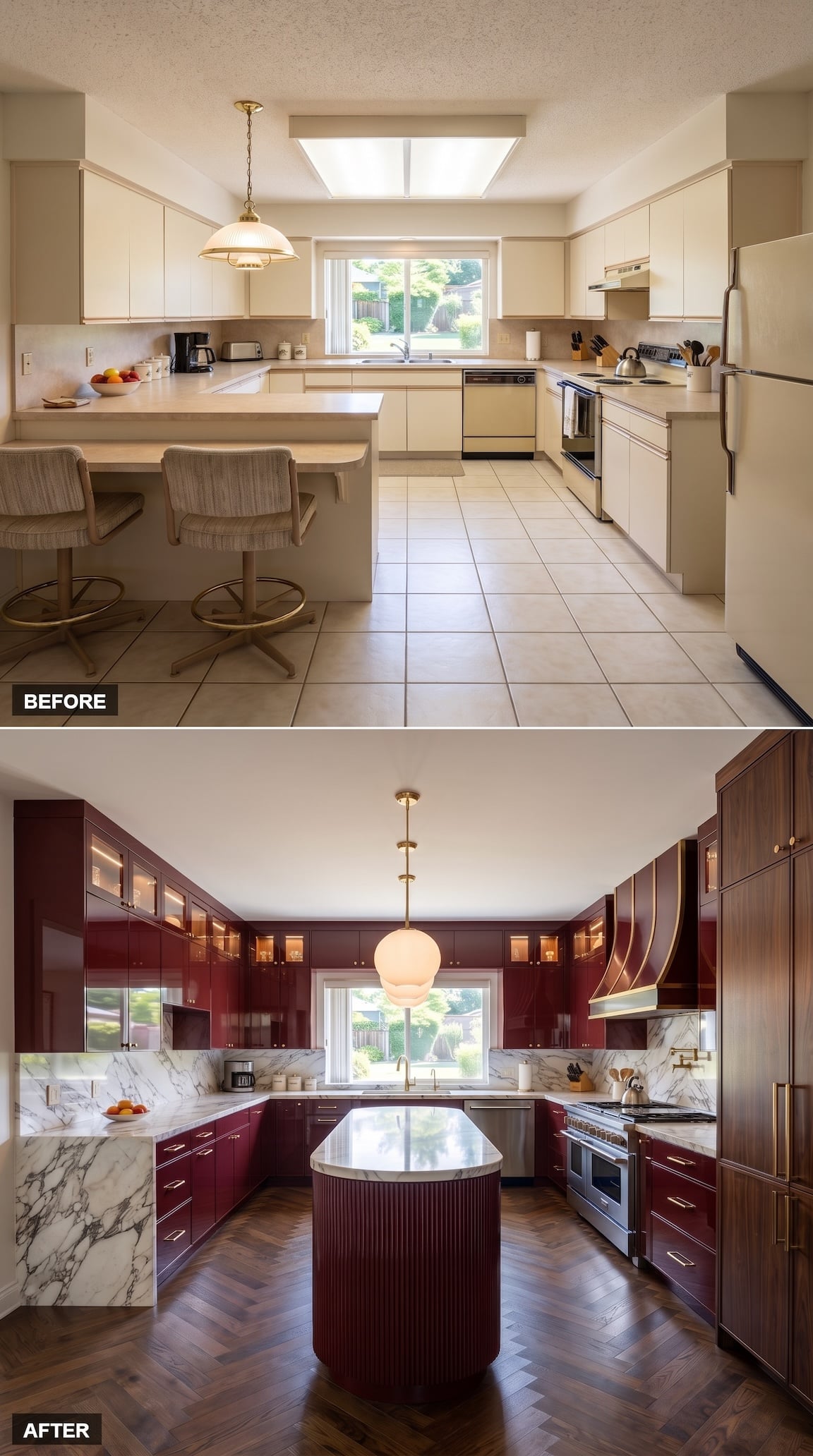
High-gloss burgundy lacquer climbs from floor to ceiling and catches every shift in the light. Dark walnut towers interrupt the red before it becomes overwhelming, giving the cabinetry a deeper, more furniture-like rhythm.
Arabescato marble introduces white and gray veining against all that warmth. The result lands somewhere between tailored and theatrical — a glam kitchen renovation with no interest in apologizing for itself.
25. Pale Oak and Green Quartzite Let the Room Exhale
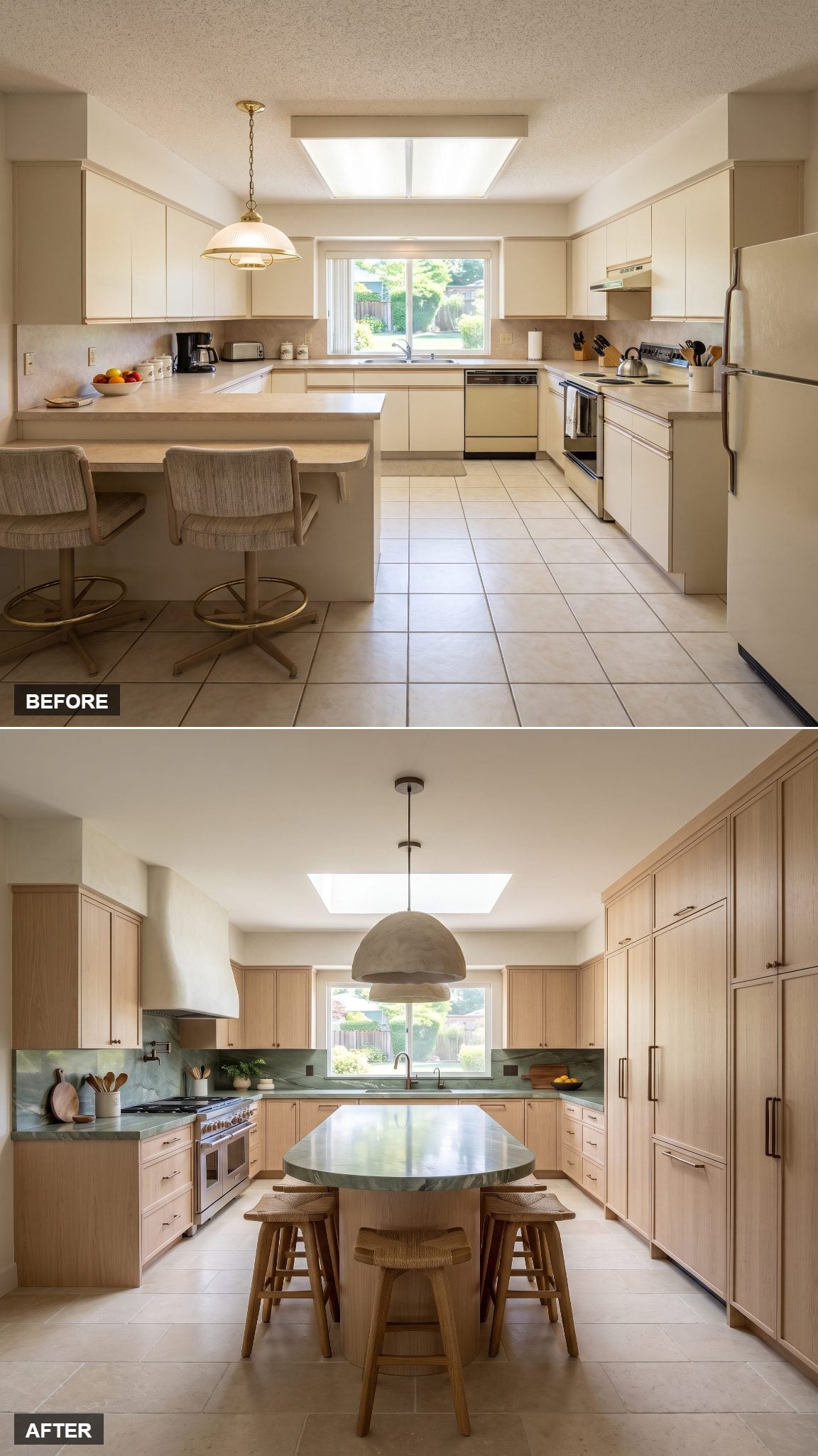
With the projecting counter gone, floor-to-ceiling rift-cut oak can run calmly along the perimeter instead of competing with cabinetry reaching into the room. The refrigerator and pantry disappear behind matching panels, turning storage into one continuous wall.
The green quartzite island takes the center. Green veining against warm oak gives the natural-material palette some necessary tension, while a low woven pendant light brings the scale back down toward the work surface.
24. Art Deco Black and Champagne Brass Bring the Theater
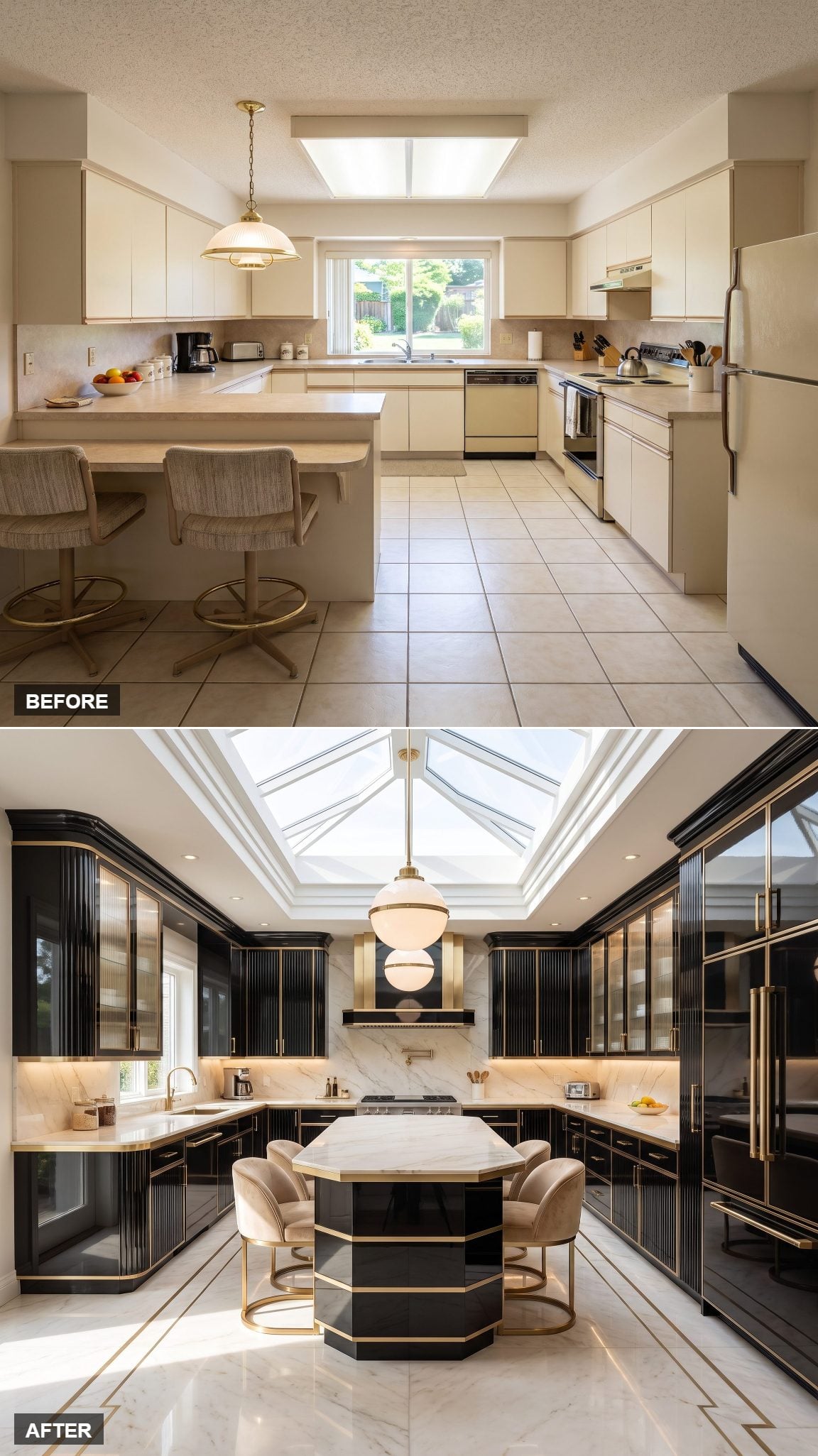
High-gloss black cabinetry, vertical ribbing and champagne-brass trim take the full Deco swing. This is the kitchen that wants a cocktail at five.
The ribbing prevents the black surfaces from becoming flat expanses, catching narrow bands of light along each vertical line. Champagne brass does the rest, warming the darkness without softening its attitude. Almond tile never stood a chance.
23. Travertine Goes Monolithic and Warm
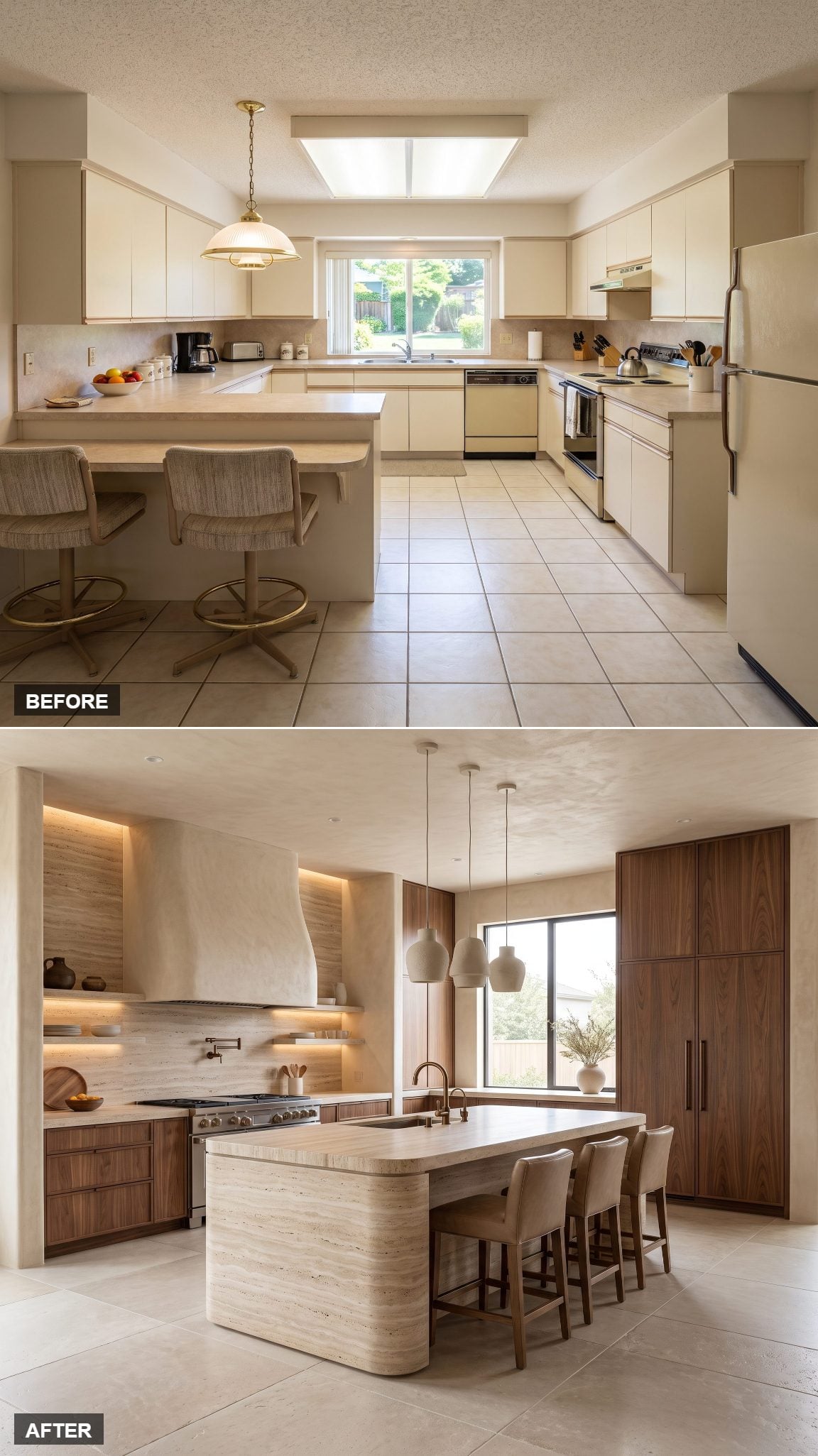
Vein-cut travertine, walnut and textured plaster stay within a narrow family of warm mineral tones. Rather than reading as a collection of cabinets, counters and walls, the kitchen begins to feel carved from a small handful of materials.
The horizontal veins in the travertine are especially important. They give the stone direction and movement without relying on another color or decorative finish. No fluorescent box, no almond laminate, no visual static left over from the old room.
22. Deep Teal and Ribbed Limestone Make Texture the Architecture
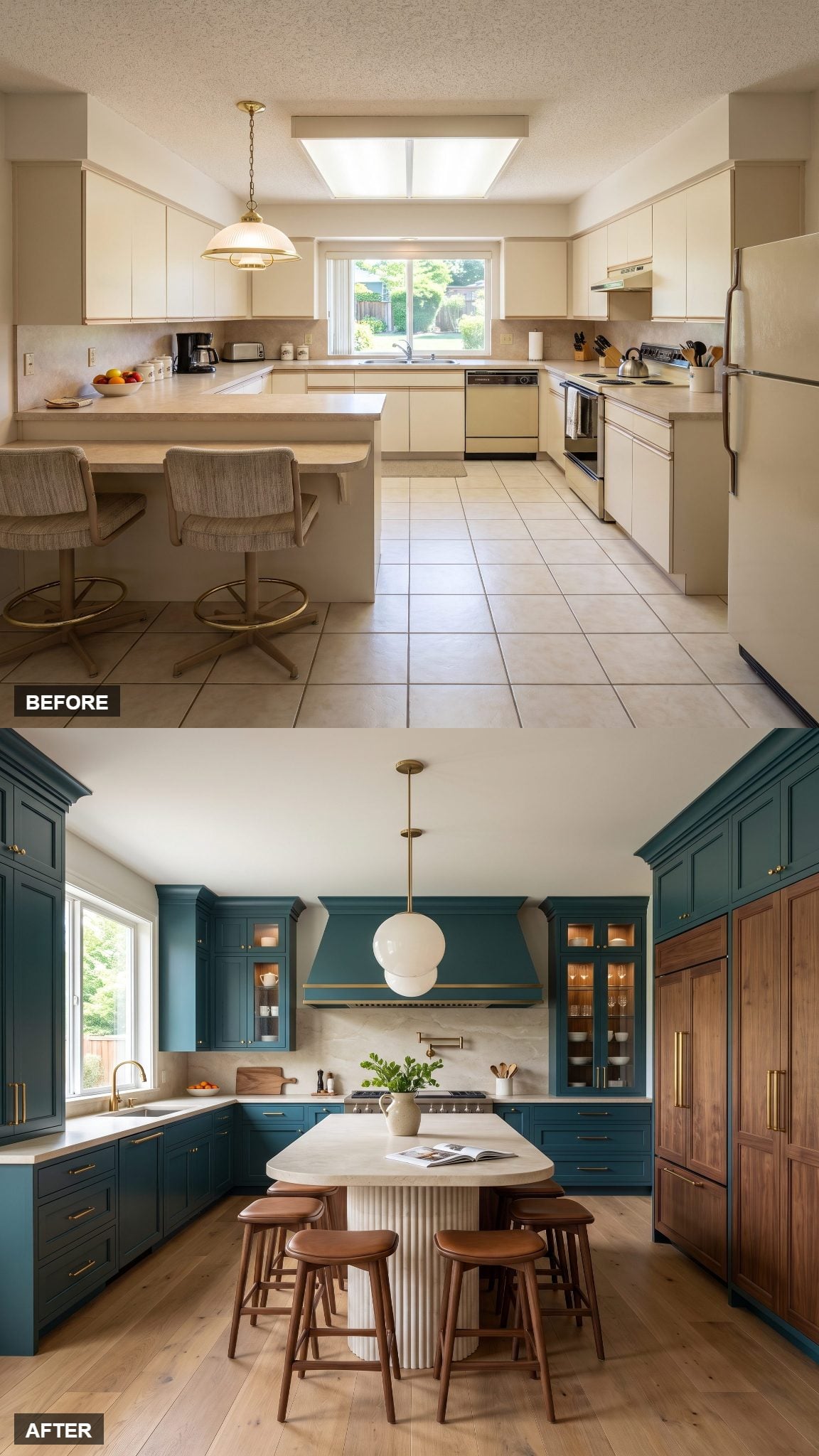
Deep teal cabinetry saturates the perimeter, but warm walnut prevents the blue-green from becoming chilly. Against those smooth surfaces, the ribbed limestone island introduces something the color alone couldn’t provide: shadow.
Every groove catches the light differently, so the island changes subtly as daylight moves across it. More blue kitchen inspiration may start with paint, but this room shows how much stronger color becomes when texture enters the argument.
21. High-Gloss Rosewood and Cream Onyx Turn Up the Decadence
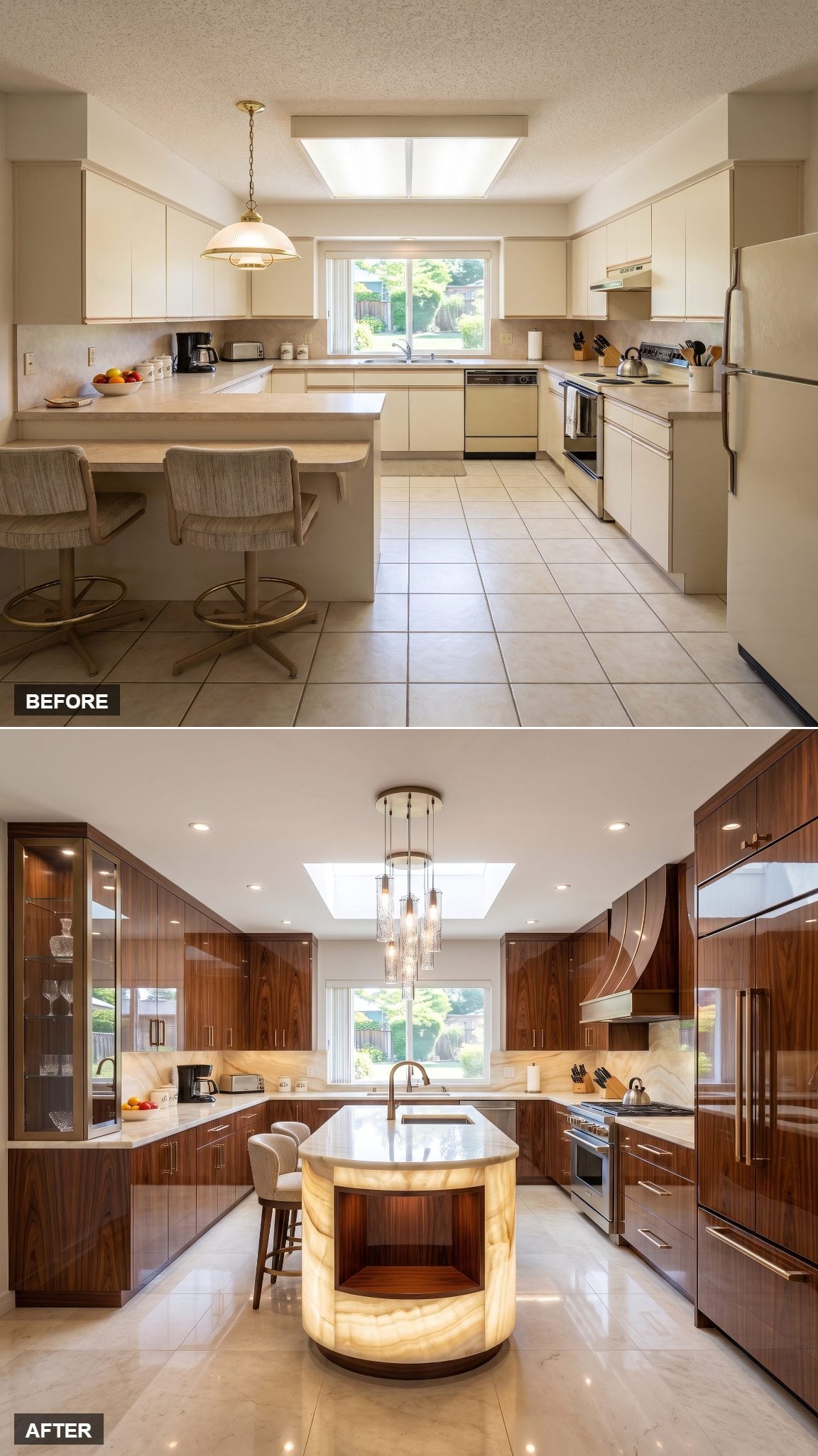
Rosewood veneer brings a reddish grain that shifts as the light crosses its glossy surface. Bronze-framed display towers intensify that depth, glowing against the darker wood rather than interrupting it with another opaque finish.
The round cream-onyx island is the counter-move. Its pale stone and curved form soften the hard cabinetry lines exactly where the old peninsula once tightened the room. Reflection supplies much of the glamour; shape keeps it from becoming severe.
Gloss changes the way dark veneer handles light. Instead of absorbing every reflection, the surface sends parts of the room back at you.
20. Silvered Oak and Blue Quartzite Cool Everything Down
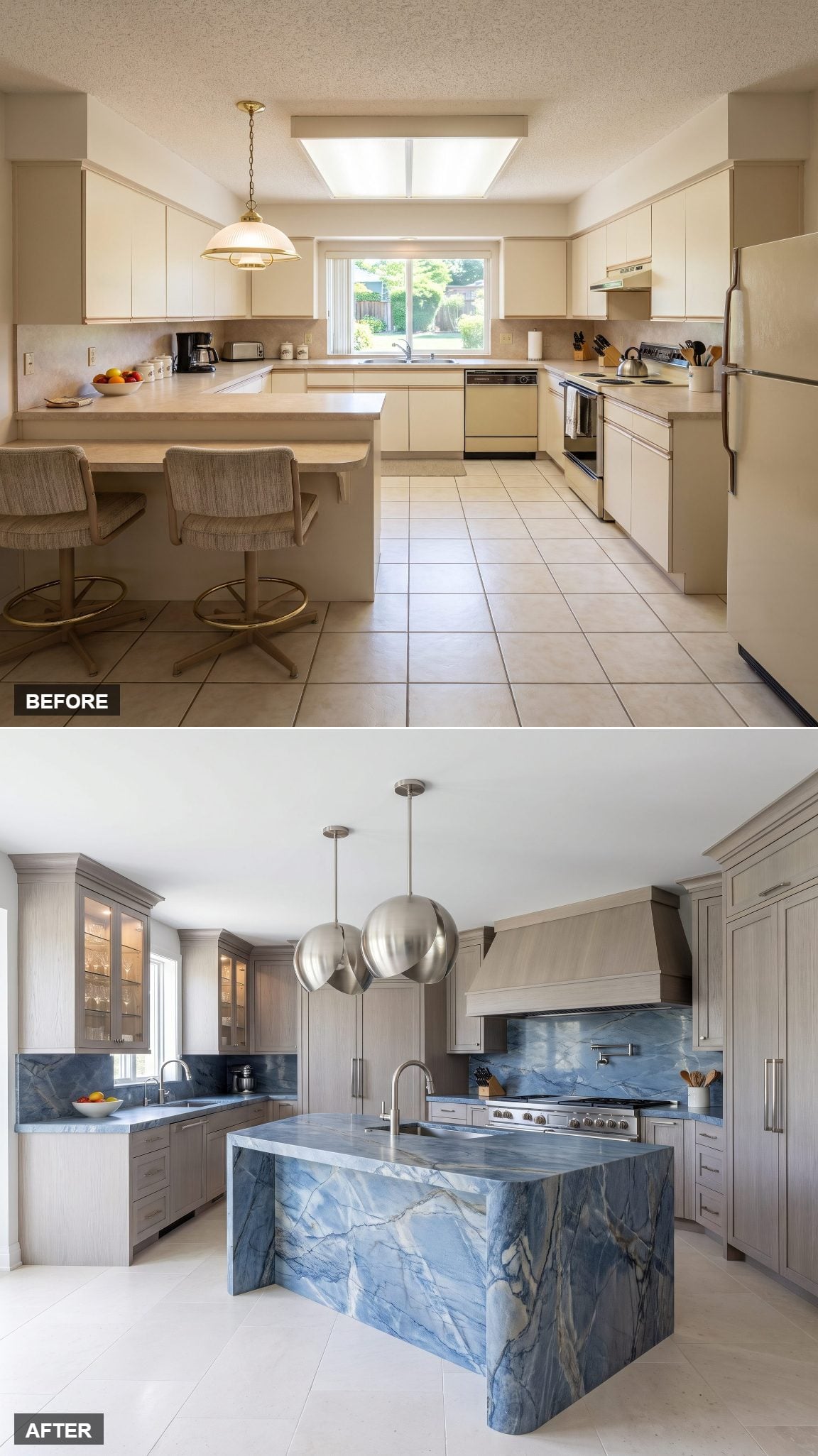
Silvered-oak millwork has the softened character of weathered timber rather than freshly installed cabinetry. Integrated refrigerator towers disappear into the grain, leaving the walls calm enough to support a much louder center.
The blue quartzite island provides it. Natural veining moves across the stone in irregular bands, turning the island into the obvious focal point without adding ornament. For anyone considering blue quartzite, the slab rather than the cabinet door can carry the color.
19. Warm White Cabinetry Gives a Bronze Island the Entire Stage
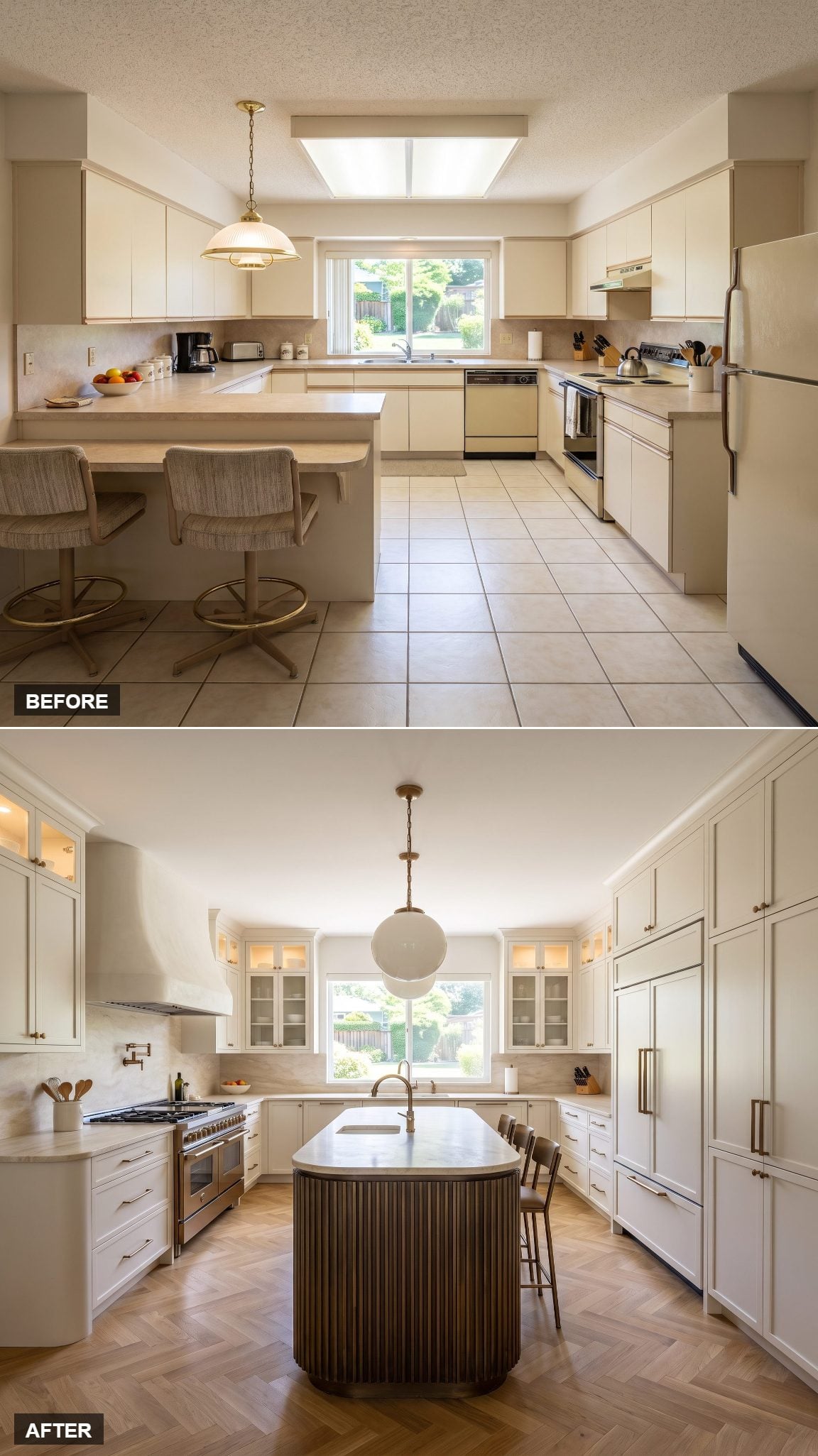
Warm-white cabinetry runs floor to ceiling, absorbing the refrigerator and pantry into one restrained perimeter. With so little visual interruption around the walls, the sculptural bronze island can take over the middle without making the kitchen feel crowded.
Bronze has a different character from polished brass: darker, weightier and capable of developing surface variation with age. Against soft white cabinetry, the island reads less like another cabinet and more like a substantial piece of furniture.
18. Blue-Black Cabinets Make Breccia Marble Look Almost Volcanic
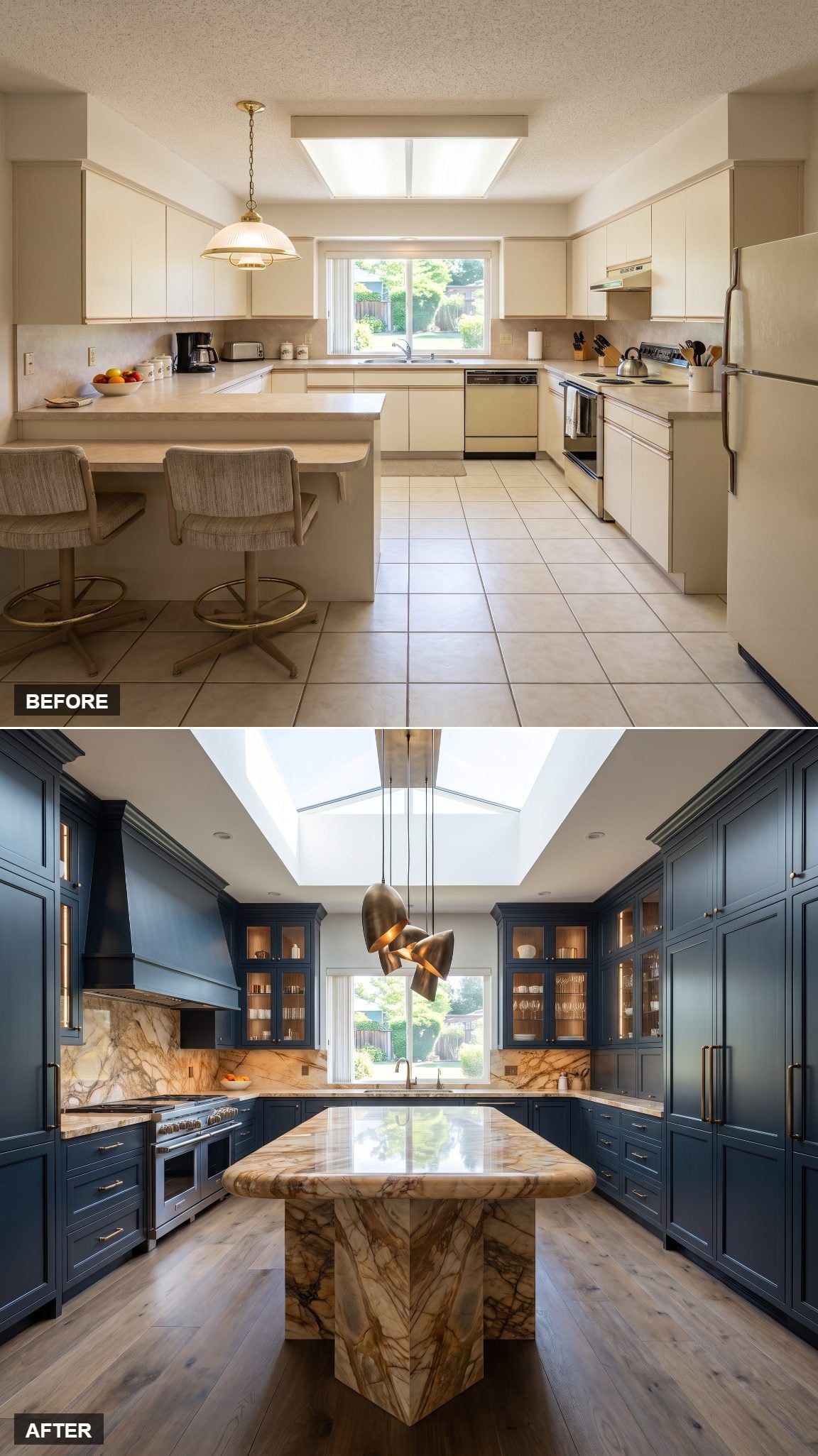
Blue-black cabinetry shifts between navy and charcoal depending on the light, creating a deep background without settling into ordinary black. Appliances disappear behind panels so the color can hold together as one field.
The breccia marble brings rust, cream and irregular fragments into the island. The collision is immediate: dark, cool cabinetry against stone full of warm geological chaos.
17. White Oak and Terrazzo Give the Center Something to Say
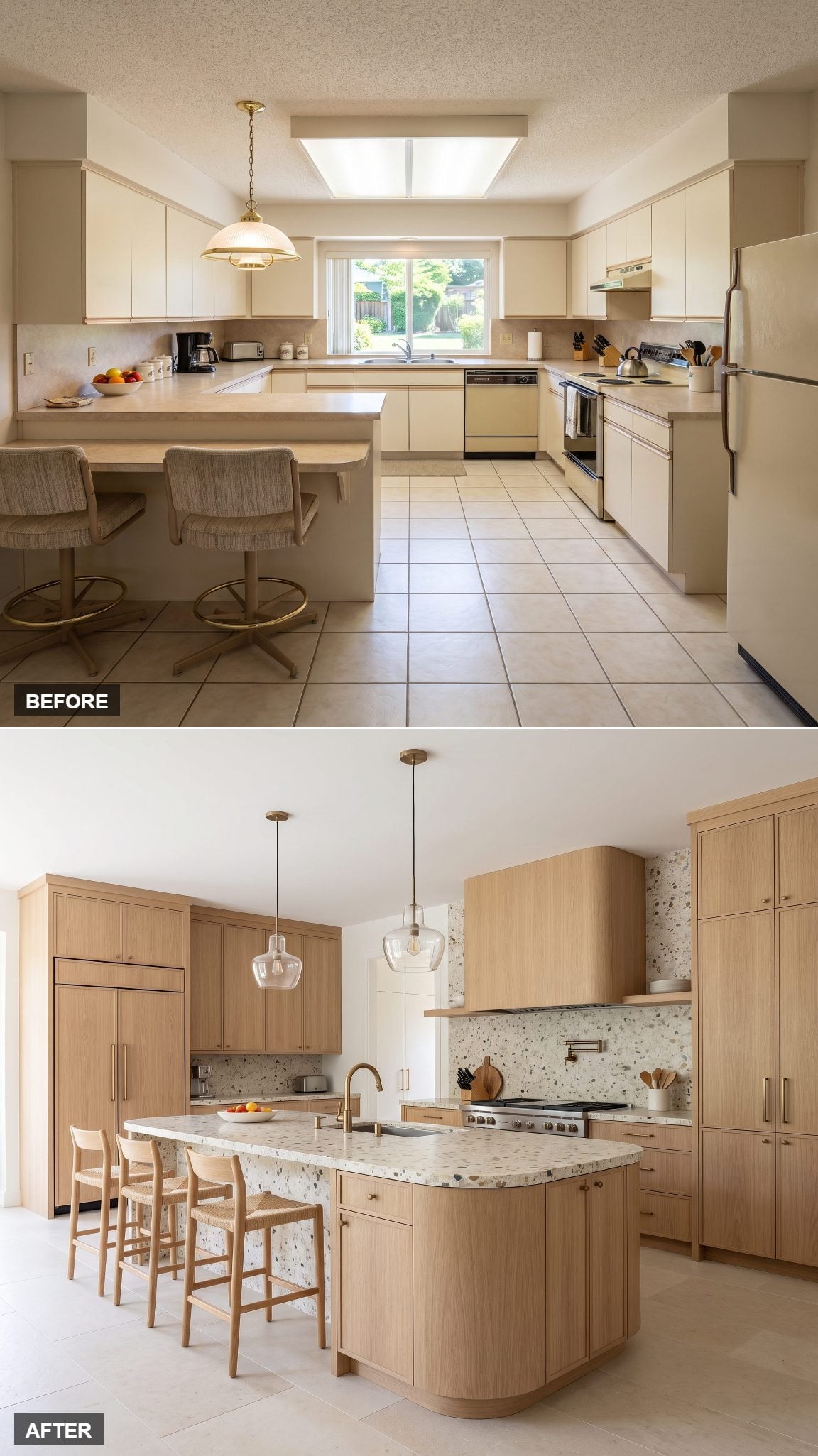
White-oak cabinetry stays deliberately quiet, with integrated appliances and full-height pantry storage reducing the number of interruptions around the perimeter.
That restraint clears the stage for a sculptural terrazzo island, where aggregate and color provide all the pattern the room needs. In a small kitchen makeover, one expressive surface can be far more effective than scattering decorative moments everywhere.
16. High-Gloss Espresso and Champagne Onyx Go Full Penthouse
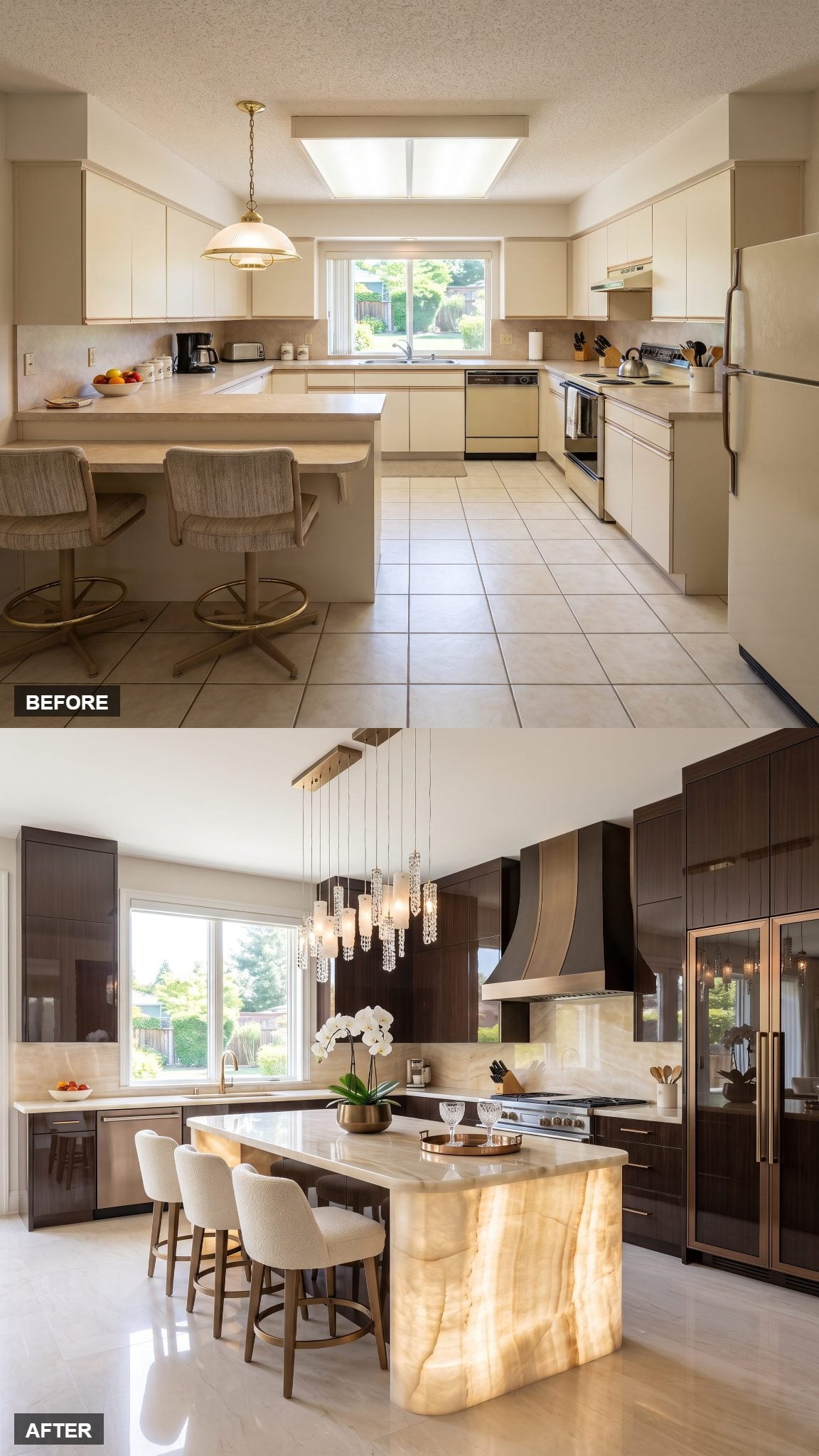
High-gloss espresso cabinetry creates a dark reflective envelope, while the champagne-onyx island appears almost weightless by comparison. Illuminate translucent stone from within and a countertop stops behaving like a countertop. It becomes a lamp the size of a piece of furniture.
Clear circulation around the island allows that luminous form to stand on its own rather than becoming another appendage attached to the cabinetry. Restraint is what keeps the spectacle expensive rather than excessive.
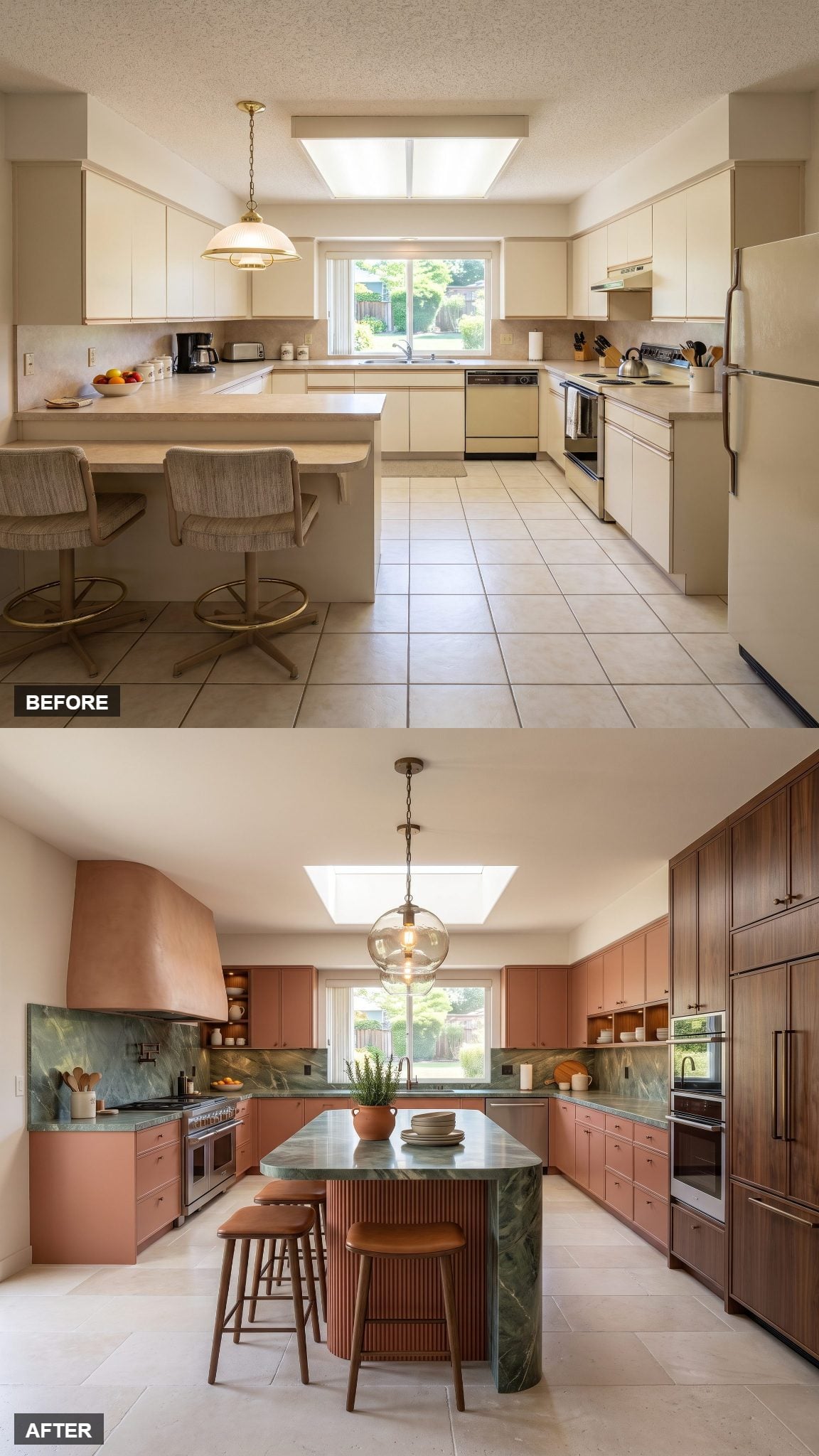
15. Terracotta and Verde Marble Take the Kitchen Somewhere Warmer
🔥 Would you like to save this?
The open walkway does more for the room than any finish could. Against that cleaner circulation, terracotta cabinetry and Verde marble get enough space to register as a palette rather than another layer of visual clutter.
Earthy red-orange and deep green create a natural counterpoint, with the warm cabinetry pulling the stone away from formality. The veining keeps the green from becoming a flat block of color, while the terracotta gives the whole composition a sun-baked quality. Villa rather than hotel lobby.
14. Belgian Limestone and Dark Oak Keep Their Voices Down
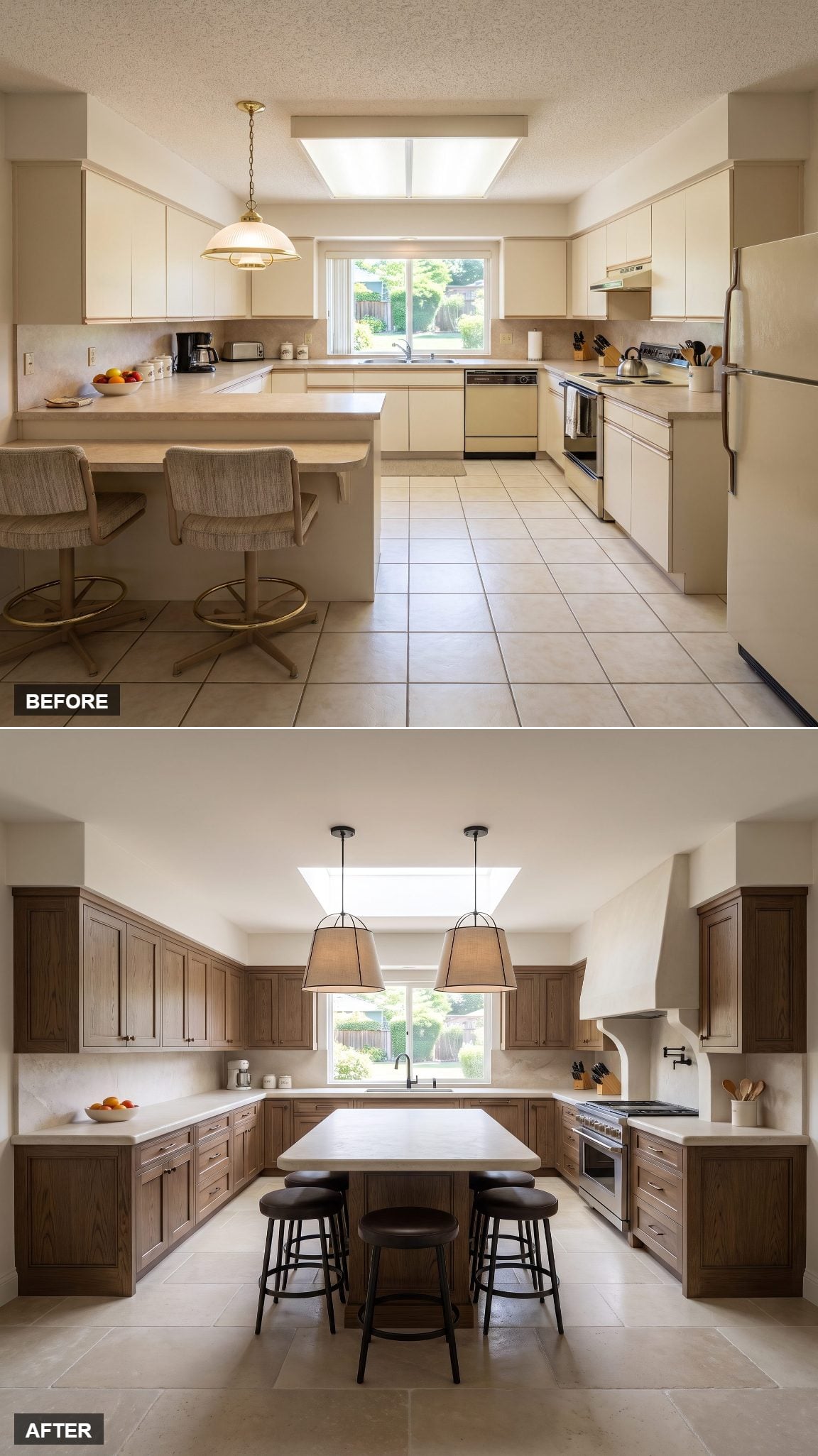
Monumental pale limestone over dark-oak cabinetry. That’s almost the entire move, and adding much more would weaken it.
The freestanding stone island occupies the center without constricting circulation, while integrated appliances let the dark perimeter remain uninterrupted. A single brass faucet, a wooden board, folded linen: small objects against large surfaces. The restraint is where the luxury lives.
13. Champagne Metal and Smoked Glass Dress for Dinner
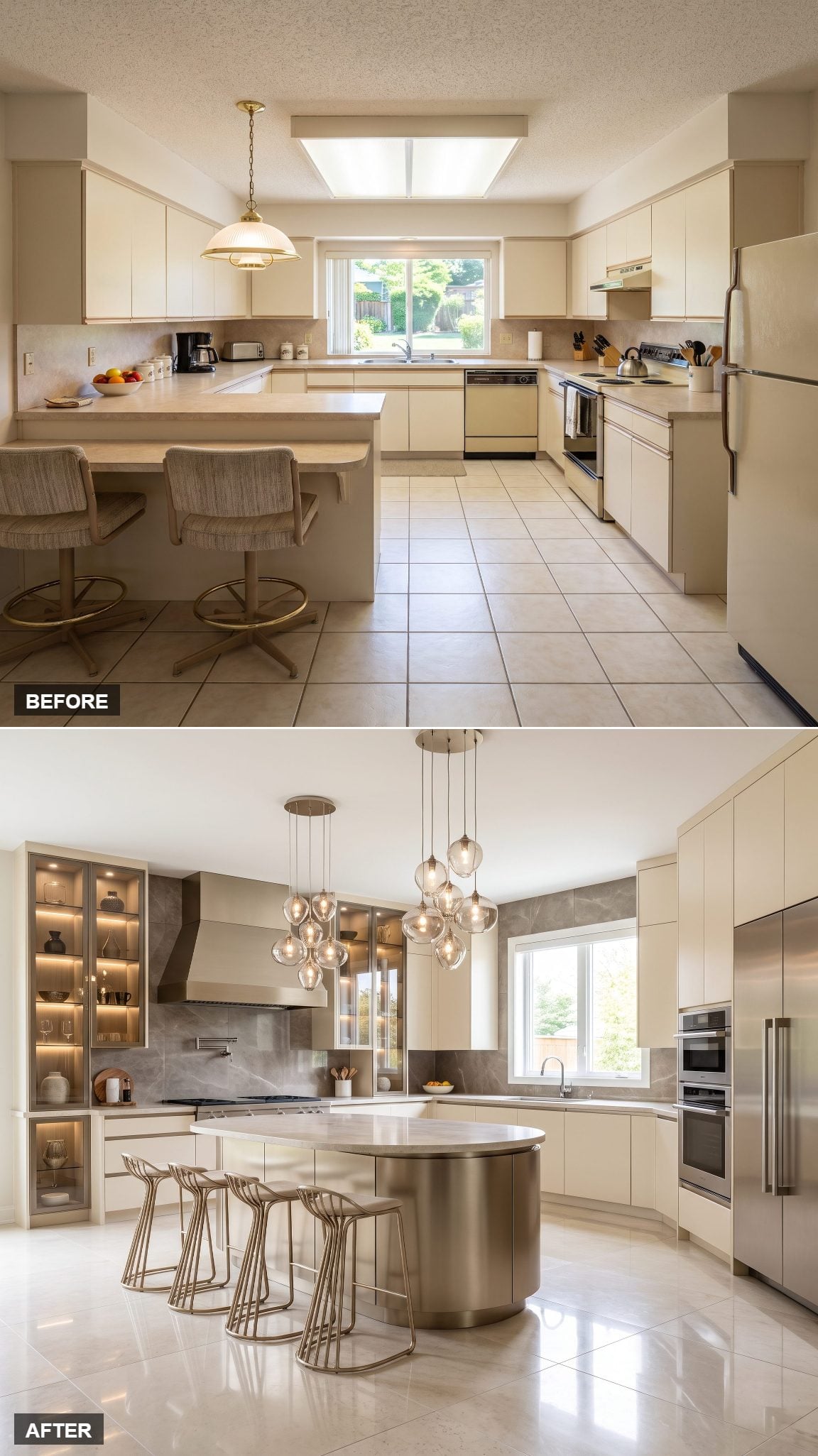
Warm ivory cabinetry establishes the quiet background. Champagne-metal appliance towers and illuminated smoked-glass display cabinets turn the perimeter into something closer to evening architecture.
The smoked-glass cabinets obscure their contents more than clear glass would, giving the room depth without putting every plate on full display. A champagne bar cart pushes the idea further. This kitchen has considerably better evening plans.
12. Deep Navy and White Marble Bring the Grandeur
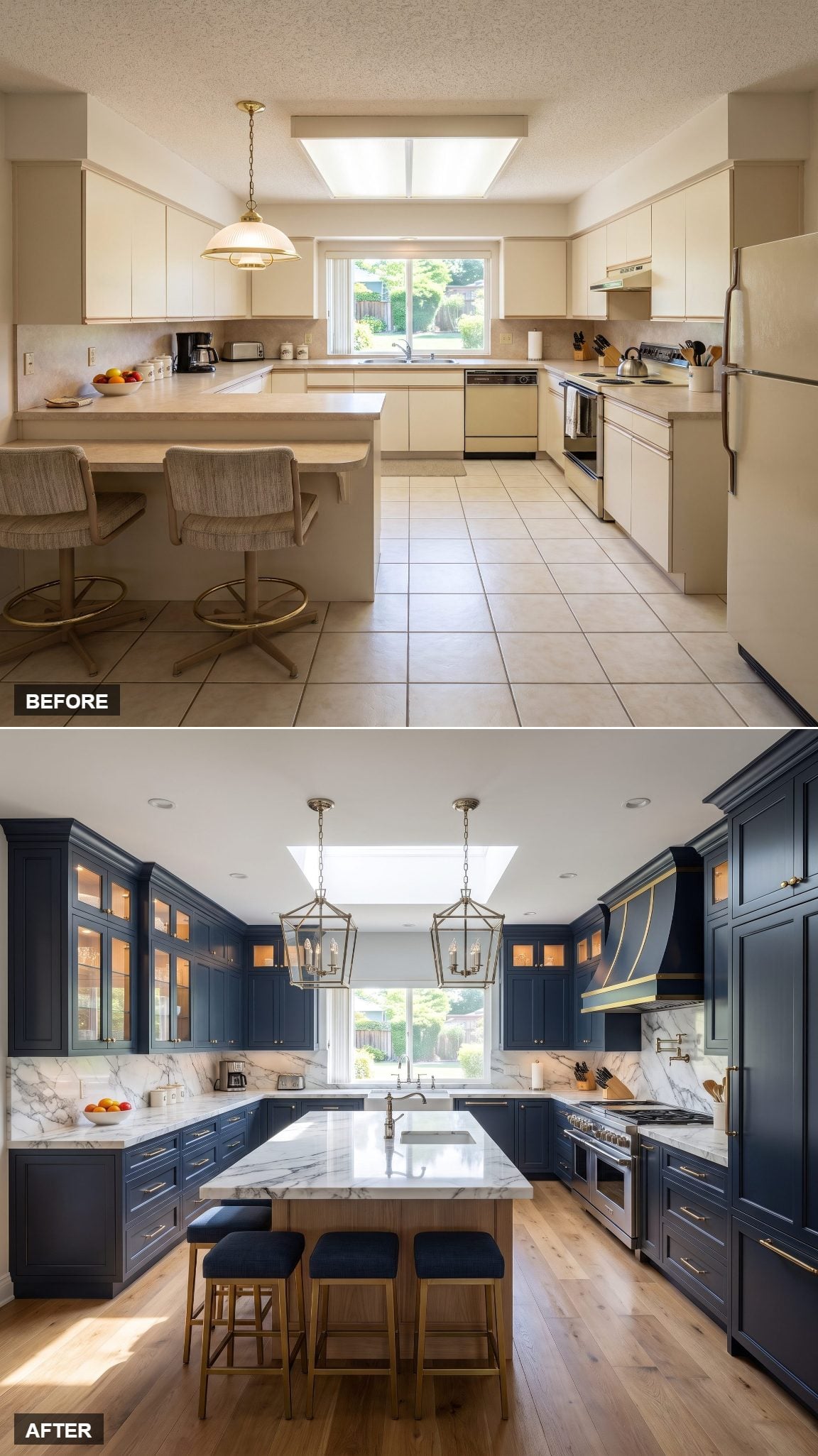
Deep navy custom cabinetry wraps the perimeter, with integrated refrigeration allowing the color to run uninterrupted across the tallest elevations. White marble counters and backsplash cut through the darkness with a much brighter horizontal plane.
Inset cabinet doors sit within their frames rather than overlaying them, a small construction detail with an outsized effect on the finished room. The construction gives this blue kitchen a tailored, furniture-like character rather than a nautical one.
11. Bronze and Cream Travertine Turn the Island Into Sculpture
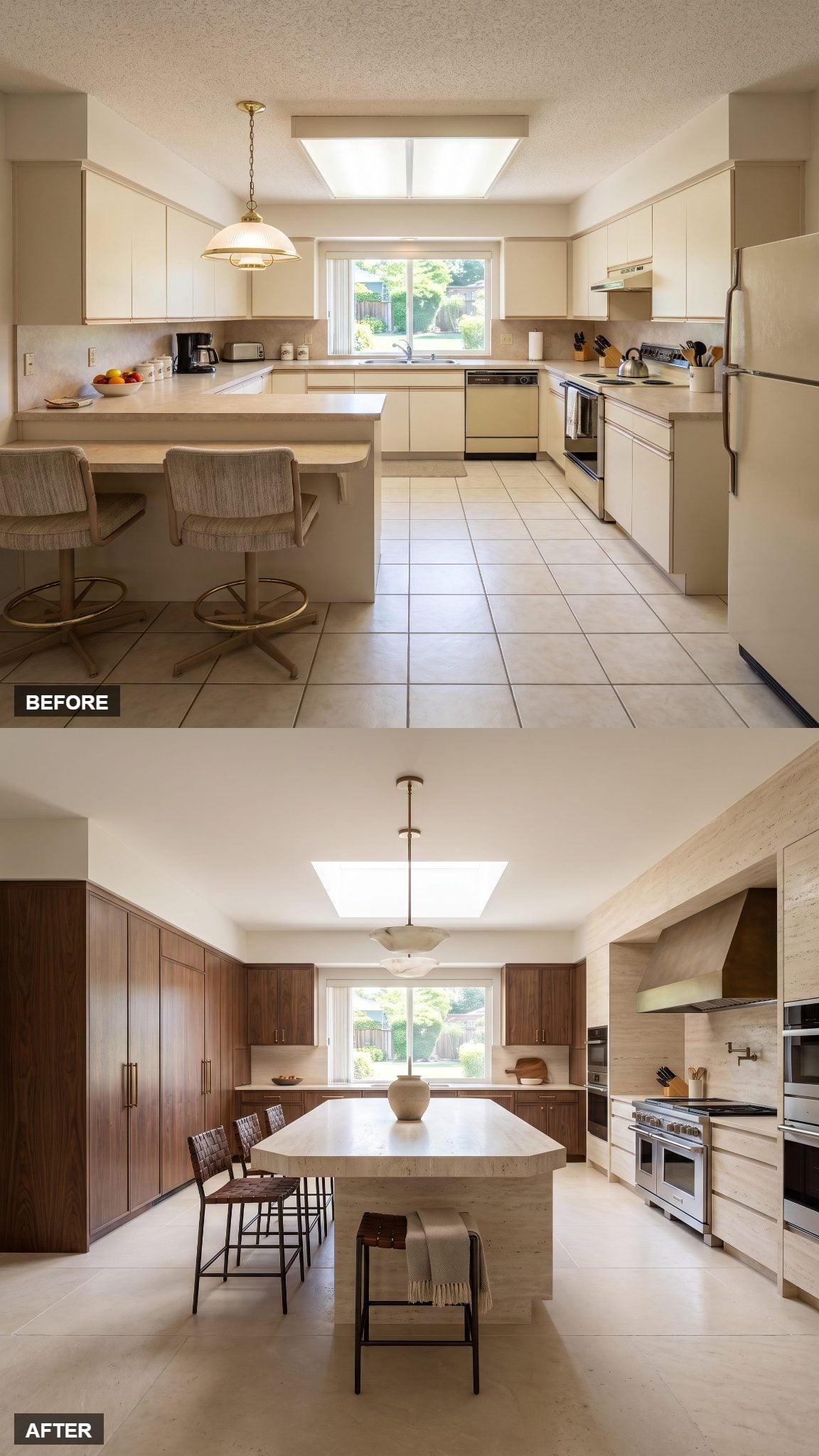
Some kitchens want their cabinetry to disappear. This one gives the center of the room something worth staring at.
Chamfered corners and a recessed base change the travertine island from a heavy rectangular block into a deliberately shaped object. Bronze millwork gives the perimeter enough visual weight to answer it. The old builder-grade oak and beige laminate were background noise; this composition has a foreground.
10. Italian Minimalist Walnut Erases Every Handle
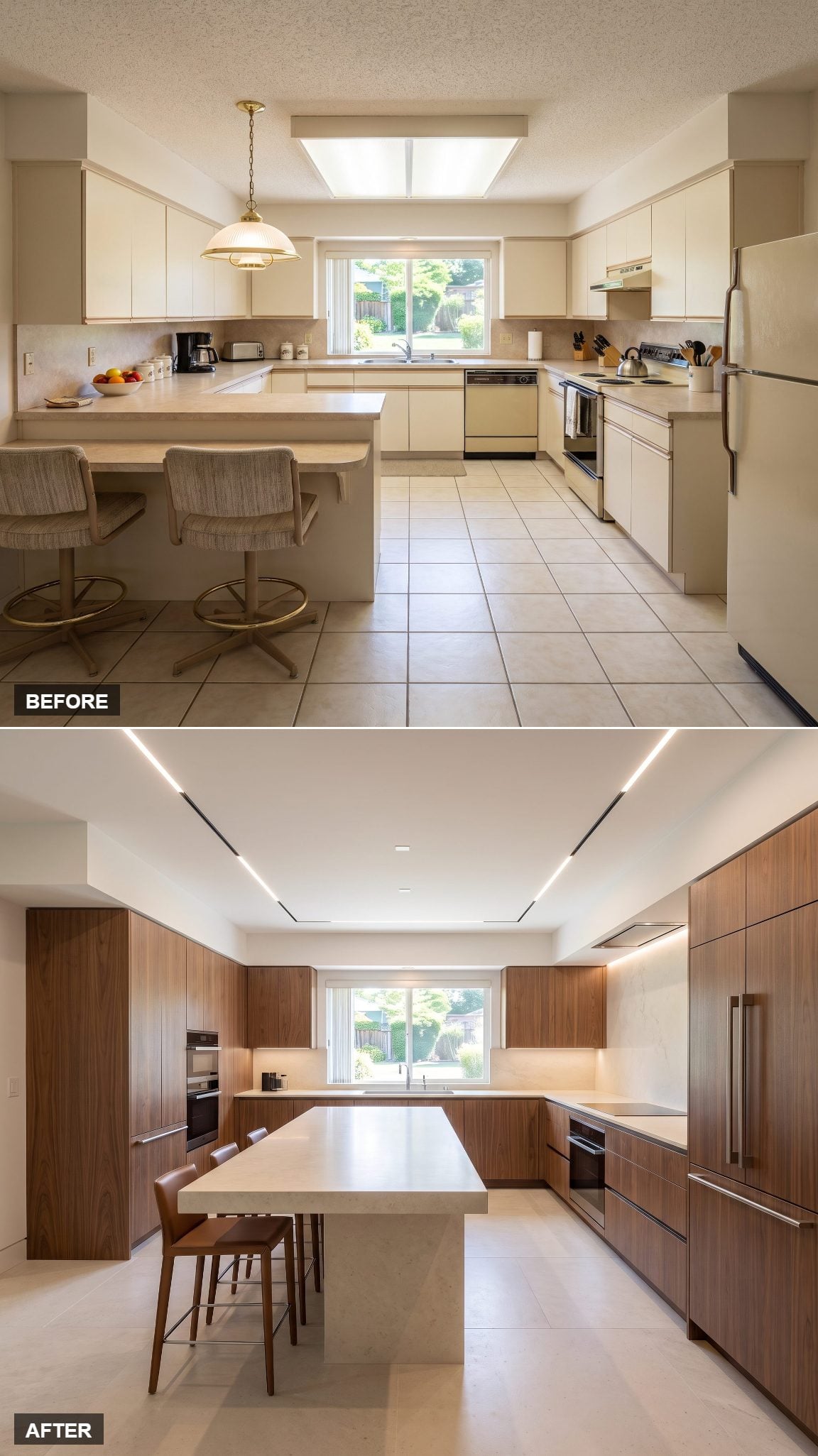
Seamless full-height walnut removes almost every familiar cabinet cue. No visible pulls. No refrigerator door breaking the run. No dishwasher face announcing itself beneath the counter. Push-to-open hardware and integrated panels allow the millwork to read as architecture.
This kind of minimalism is unforgiving. Reveals, panel alignment and junctions become more noticeable precisely because there is so little decoration to distract from them. When the detailing is precise, the restraint becomes the luxury.
9. Red Travertine Gives Ivory Minimalism a Pulse
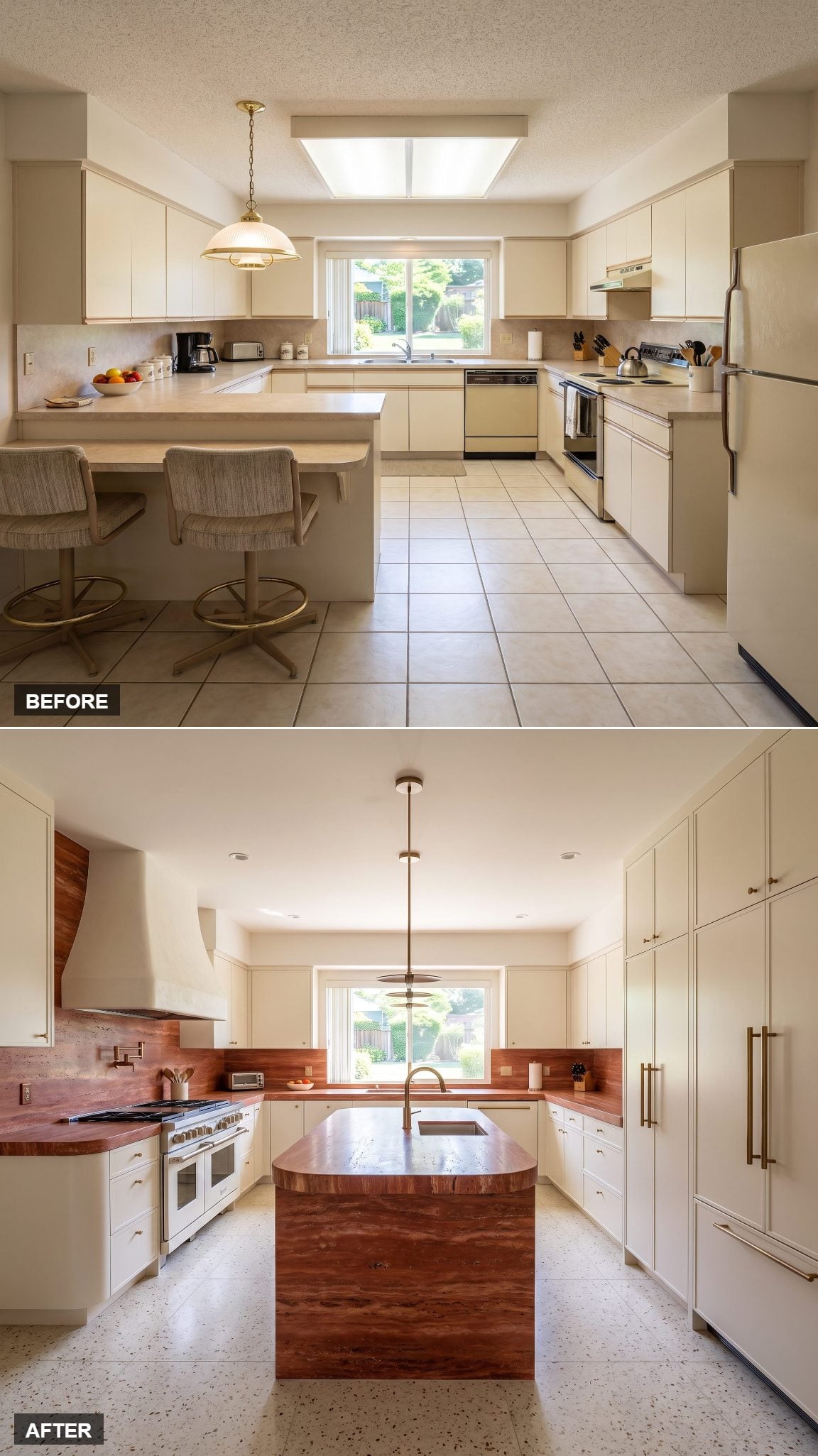
Ivory cabinetry with concealed pantry storage could have drifted into clinical territory. The red-travertine island prevents that immediately, bringing rusty mineral color into the middle of an otherwise exceptionally controlled room.
The contrast is the entire strategy. Pale cabinetry gives the eye somewhere to rest; veined stone gives it somewhere to stop. Remove either half and the composition loses its tension.
8. Fluted Limestone and Espresso Oak Go Deep Without Going Dark
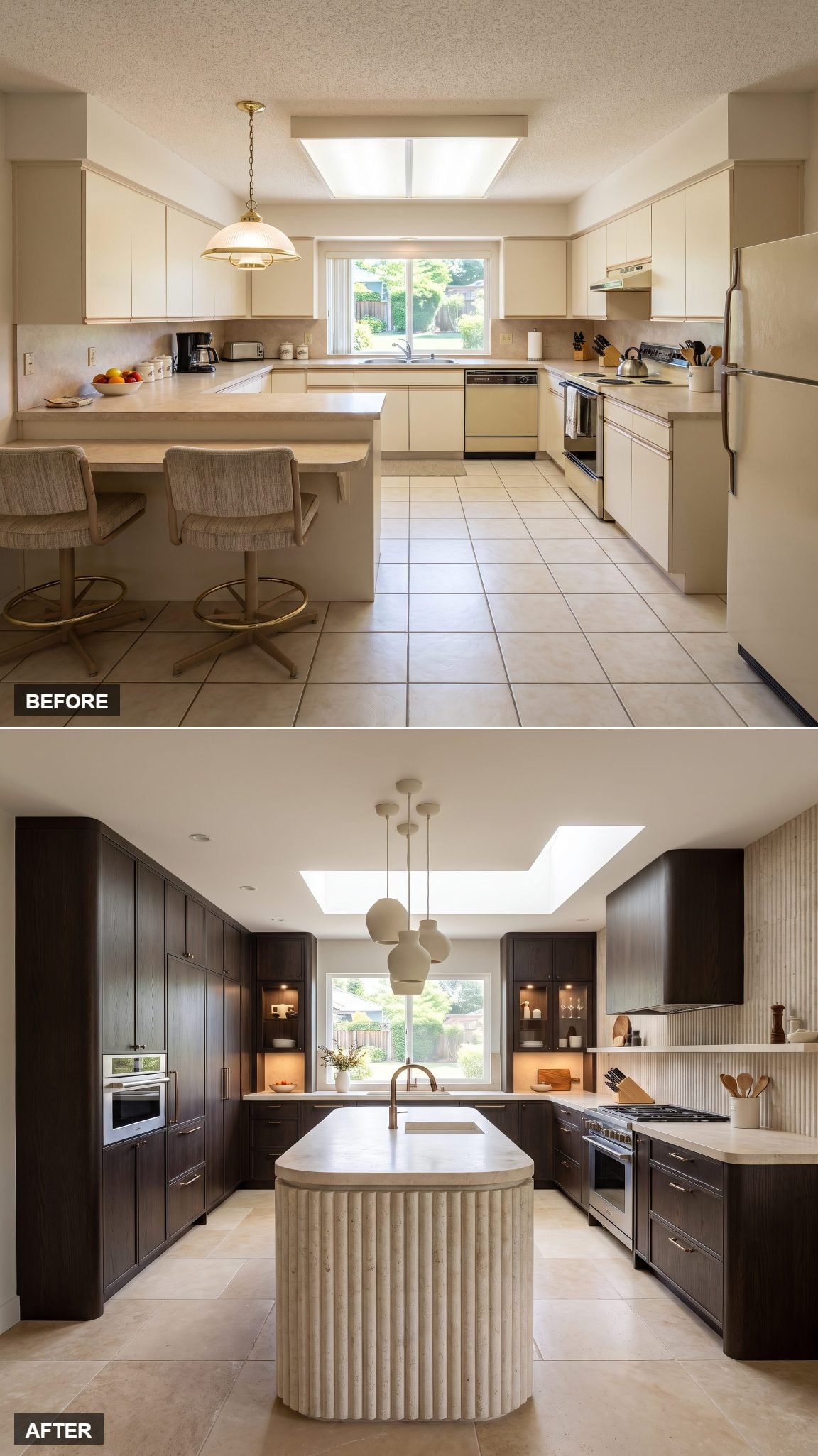
Espresso-stained oak gives the perimeter a depth the honeyed cabinetry never approached. Illuminated display niches puncture that darkness with small pools of warm light rather than another contrasting cabinet finish.
The fluted limestone island is the surprise. Vertical ridges produce alternating strips of light and shadow across a material that would otherwise read as one heavy block. Texture, not another color, provides the movement.
7. Olive Burl Wood Makes Quiet Marble Look Almost Restrained
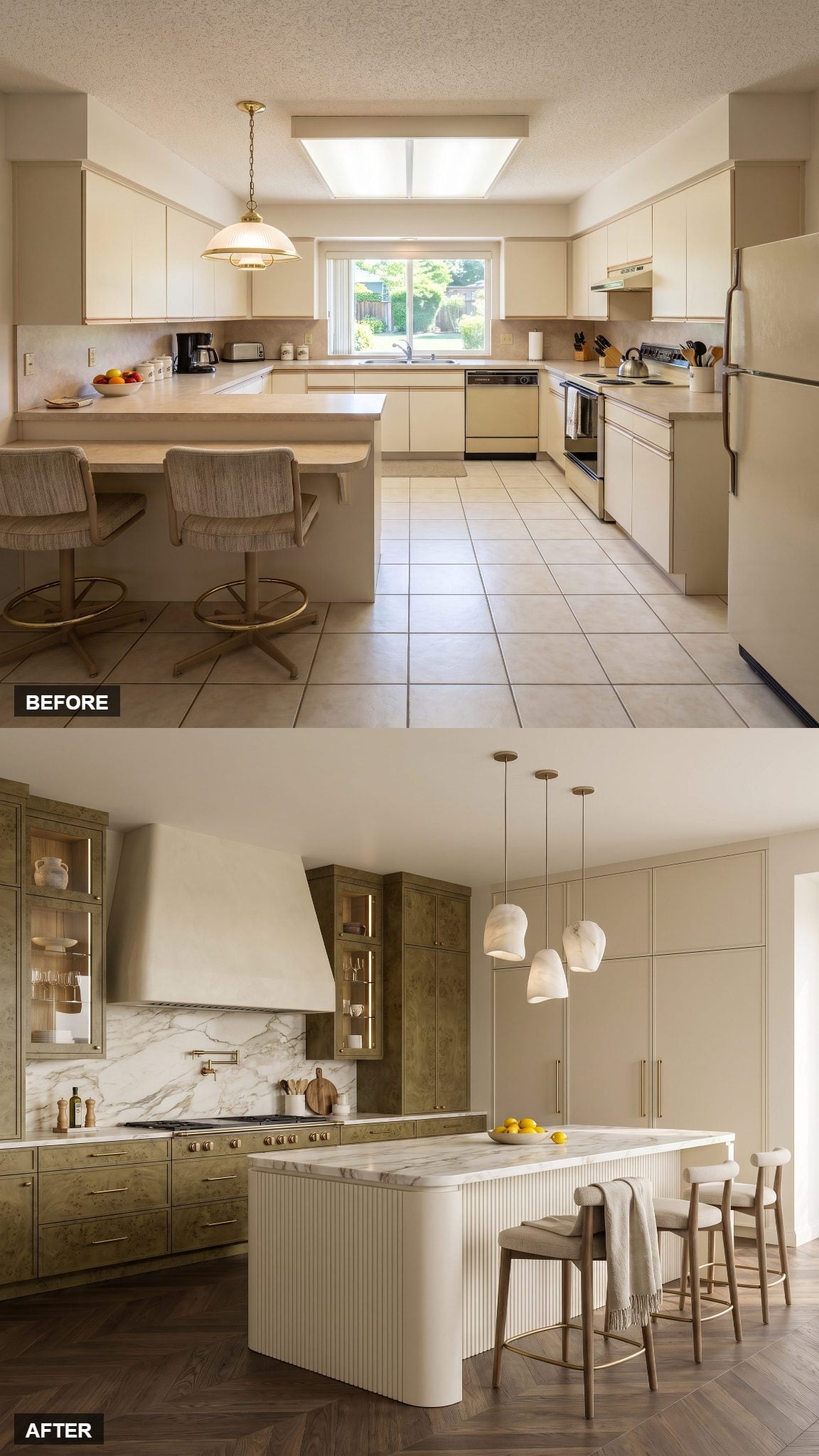
Burl wood doesn’t need help attracting attention. Its swirling grain can become visually frantic in large doses, but the muted olive tone here pulls it back from the edge.
A cream-marble island with a ribbed base supplies the calmer counterweight. Busy grain meets quiet stone; muted green meets warm cream. For a glam kitchen makeover that wants richness without gloss, this is a very different route to luxury.
6. High-Gloss Mocha and Cream Marble Catch Every Scrap of Light
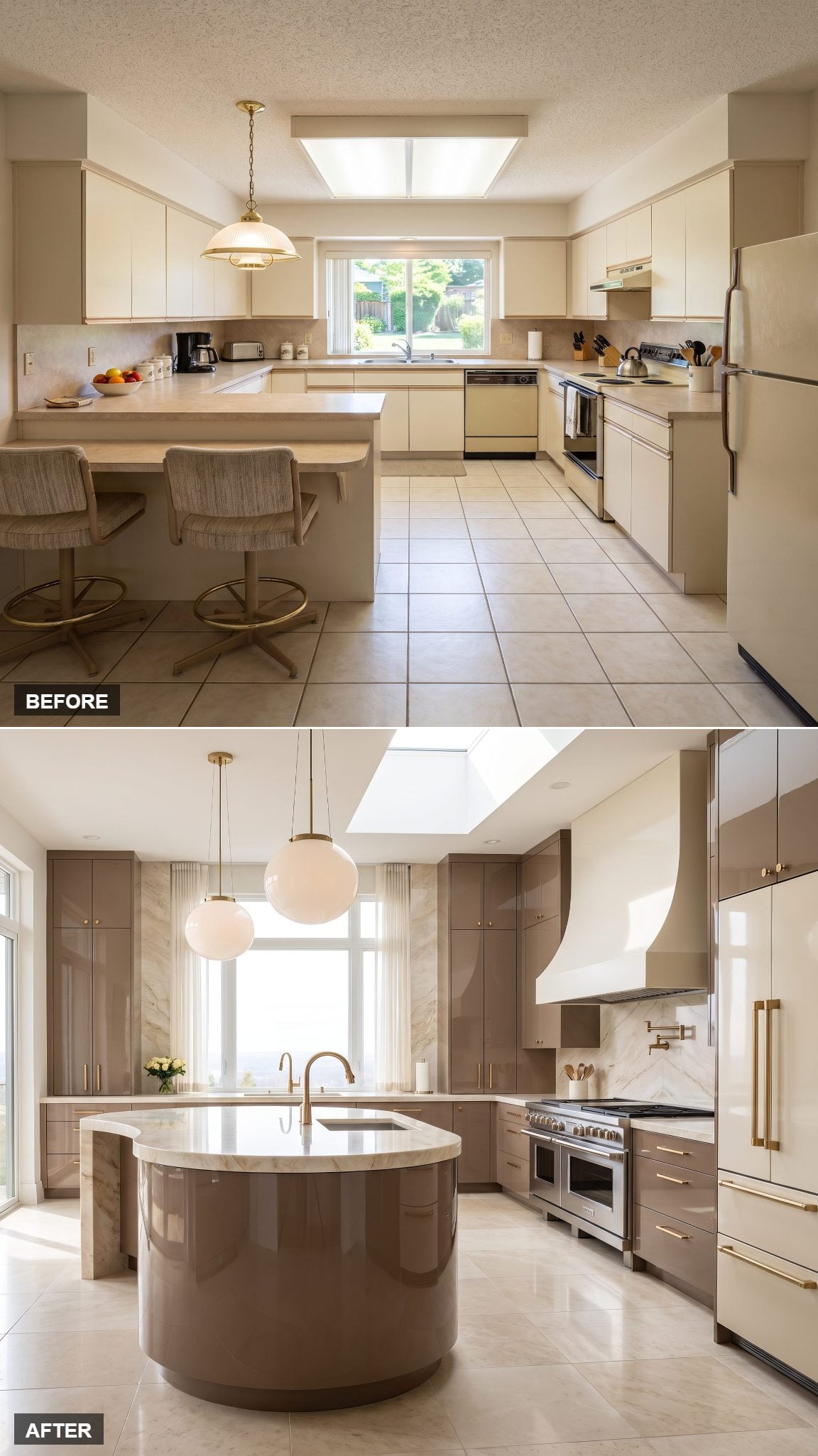
Mocha lacquer climbs to the ceiling, but its reflective finish prevents all that brown from reading as a dead wall of color. Ivory appliance towers interrupt the darker cabinetry while a cream-marble island occupies the open center.
This cool kitchen makeover comes with one practical trade-off: high-gloss surfaces make smudges, dust and water marks easier to see. The reflection is the beauty and the maintenance bill.
5. Espresso Oak and Ice-Blue Quartzite Reverse the Temperature
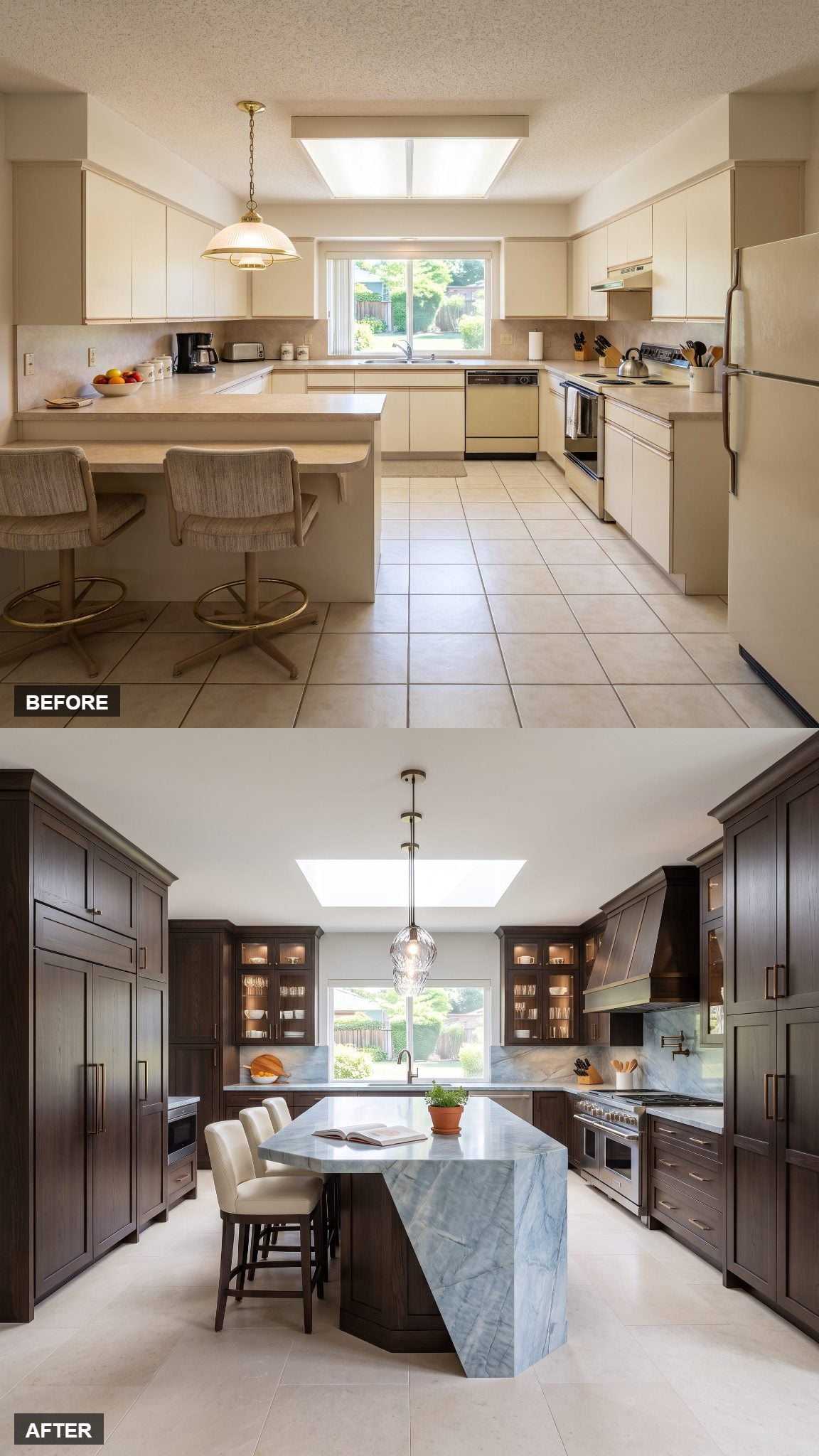
Espresso oak sits close to black, making the ice-blue veining in the quartzite island appear brighter and cooler than it would against pale cabinetry. Warm wood and icy stone pull in opposite directions without breaking the room in two.
The freestanding island also makes the spatial logic easy to read: clear circulation on all four sides instead of a counter ending in a dead stop. The layout makes its case before the stone gets a chance to show off.
4. Cognac Oak and Rosso Levanto Marble Make Red Look Inevitable
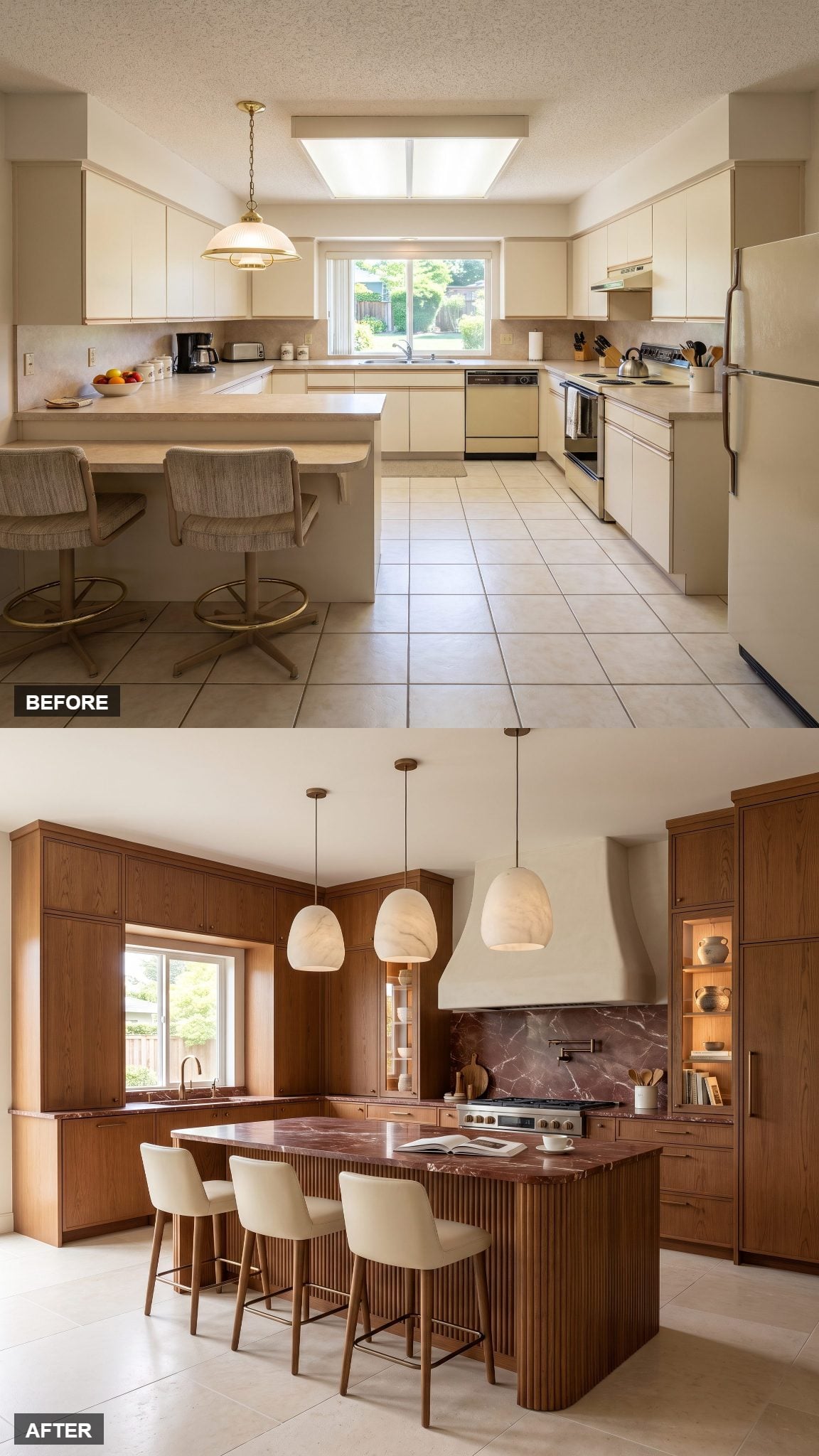
Rosso Levanto marble brings enough deep red and pale veining to dominate almost any room. Pairing it with warm cognac oak rather than bright white cabinetry changes the effect completely: the marble still commands attention, but it no longer looks stranded in the middle of a contrasting box.
That’s what makes this glam kitchen renovation convincing. The materials aren’t competing to see which can shout louder. Wood and stone are speaking roughly the same warm language at very different volumes.
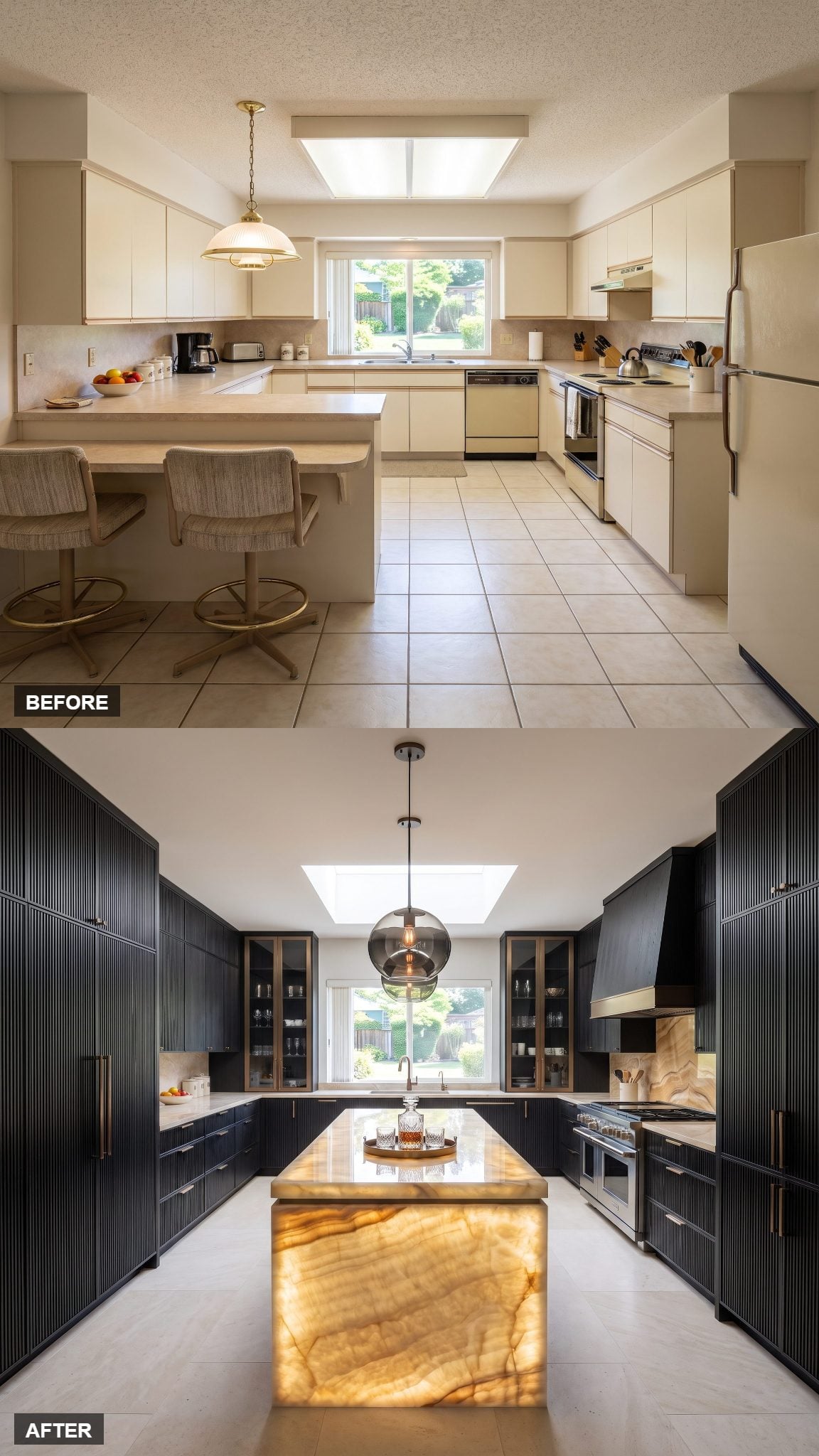
3. Fluted Black Oak and Honey Onyx Turn the Island Into a Lantern
🔥 Would you like to save this?
A translucent honey-onyx island changes completely when illuminated from behind. Instead of merely reflecting light from above, the stone itself becomes a source of warm glow at the center of the room.
Fluted black oak provides the necessary darkness around it. Bronze detailing keeps the contrast from becoming stark, but the central idea remains wonderfully simple: let one material absorb the light and another release it.
2. Emerald Stone and Blackened Oak Find the Light in the Dark
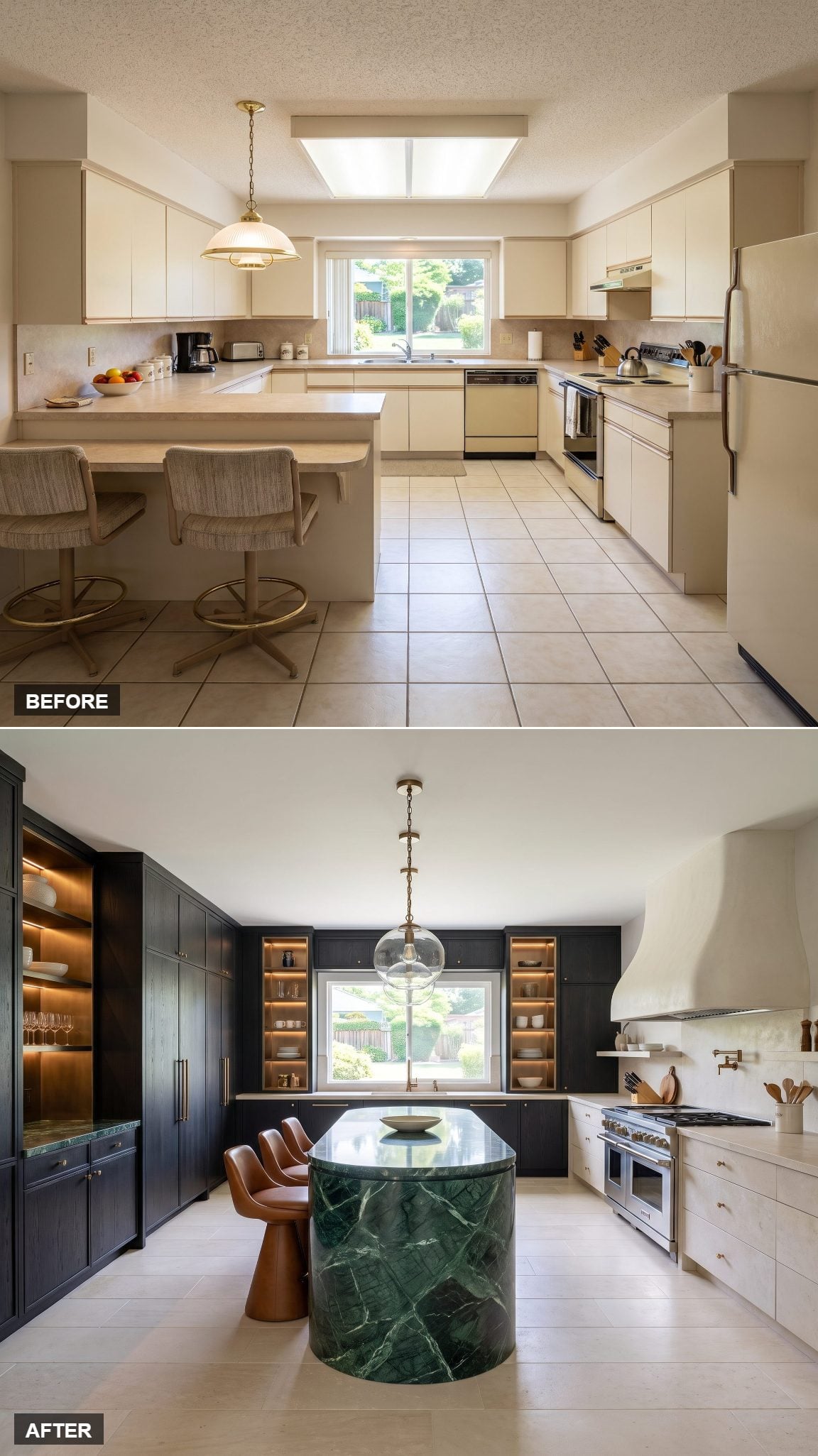
Blackened oak runs full height, with integrated refrigeration and concealed appliances reducing the number of visible breaks across the cabinetry. Emerald stone brings color into the composition without making the perimeter any busier.
The illuminated bronze-lined display cabinet is the interruption the darkness needs. Instead of brightening the entire room indiscriminately, it creates one concentrated pool of warm light against green stone and nearly black wood.
1. Bronze, Ribbed Walnut, and Calacatta Green Steal the Show
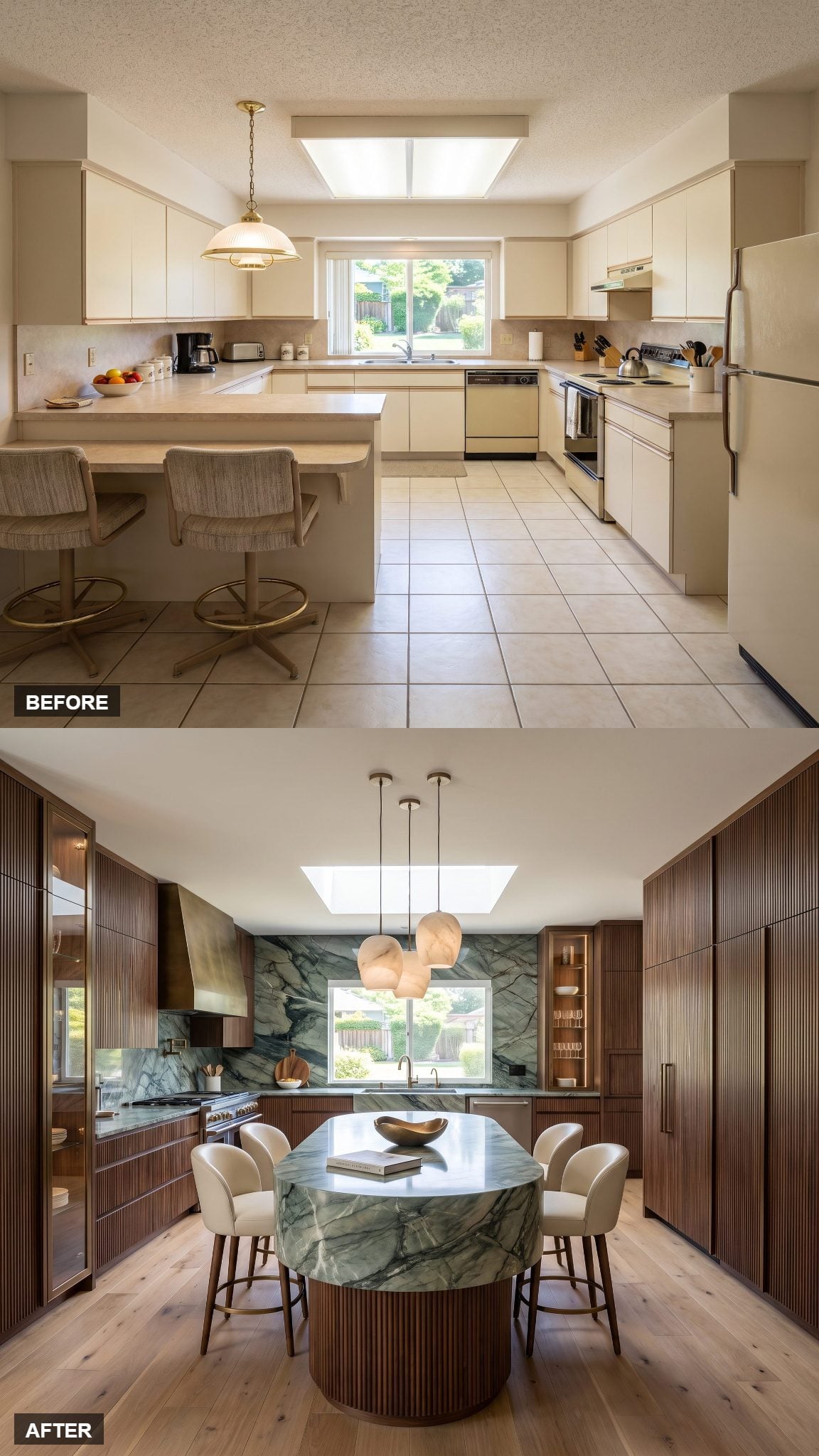
Ribbed walnut runs across the perimeter, bronze flashes between the darker surfaces, and a Calacatta Green island shaped like a river stone occupies the center. The rounded mass keeps the middle of the room sculptural without rebuilding the visual barrier that the more open layout was meant to eliminate.
Green stone with this much movement could become chaotic if it were chopped into smaller pieces. Carved into one confident oval, the veining reads as part of a single object. Walnut supplies warmth, bronze supplies the glint, and generous clearance around the island lets all three materials register without crowding one another.
The strongest move isn’t the marble, the bronze or even the ribbed walnut. It’s the space around them. Once circulation becomes part of the composition rather than whatever floor area remains between cabinets, the entire kitchen starts behaving like architecture.