🔥 Would you like to save this?
Your screened-in sunroom has been quietly begging for an intervention since the Reagan administration. That popcorn ceiling isn’t “retro,” it’s a hostage situation, and the wicker has opinions about your life choices. Here’s the glow-up: retractable glass walls, pools that seem to flow straight into your living room, and enough natural wood to make a forest jealous. Consider this your permission slip to stop apologizing for the ceiling fans and start living like the canal is your backyard.
In order to come up with the very specific design ideas, we create most designs with the assistance of state-of-the-art AI interior design software. Also, assume links that take you off the site are affiliate links such as links to Amazon. this means we may earn a commission if you buy something.
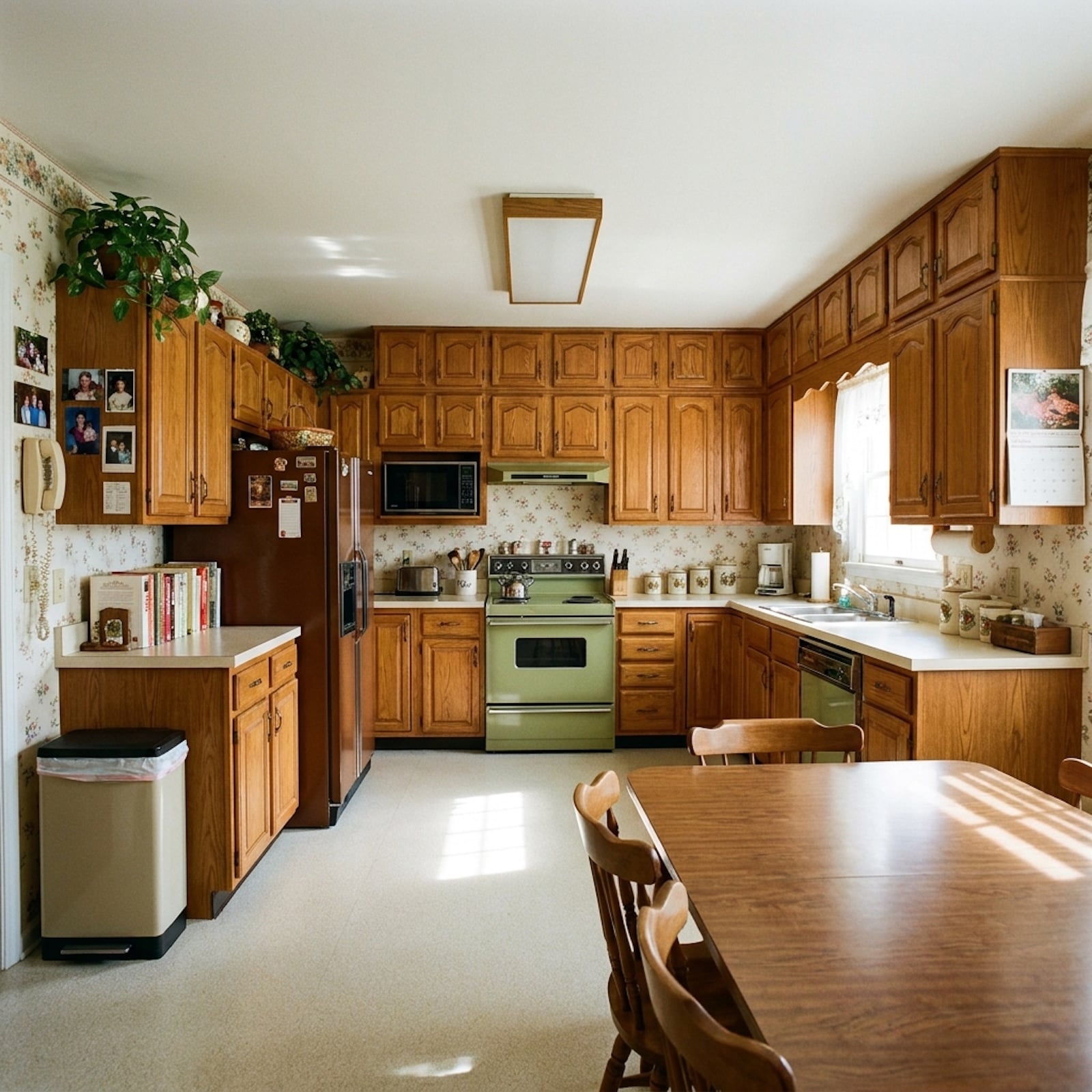
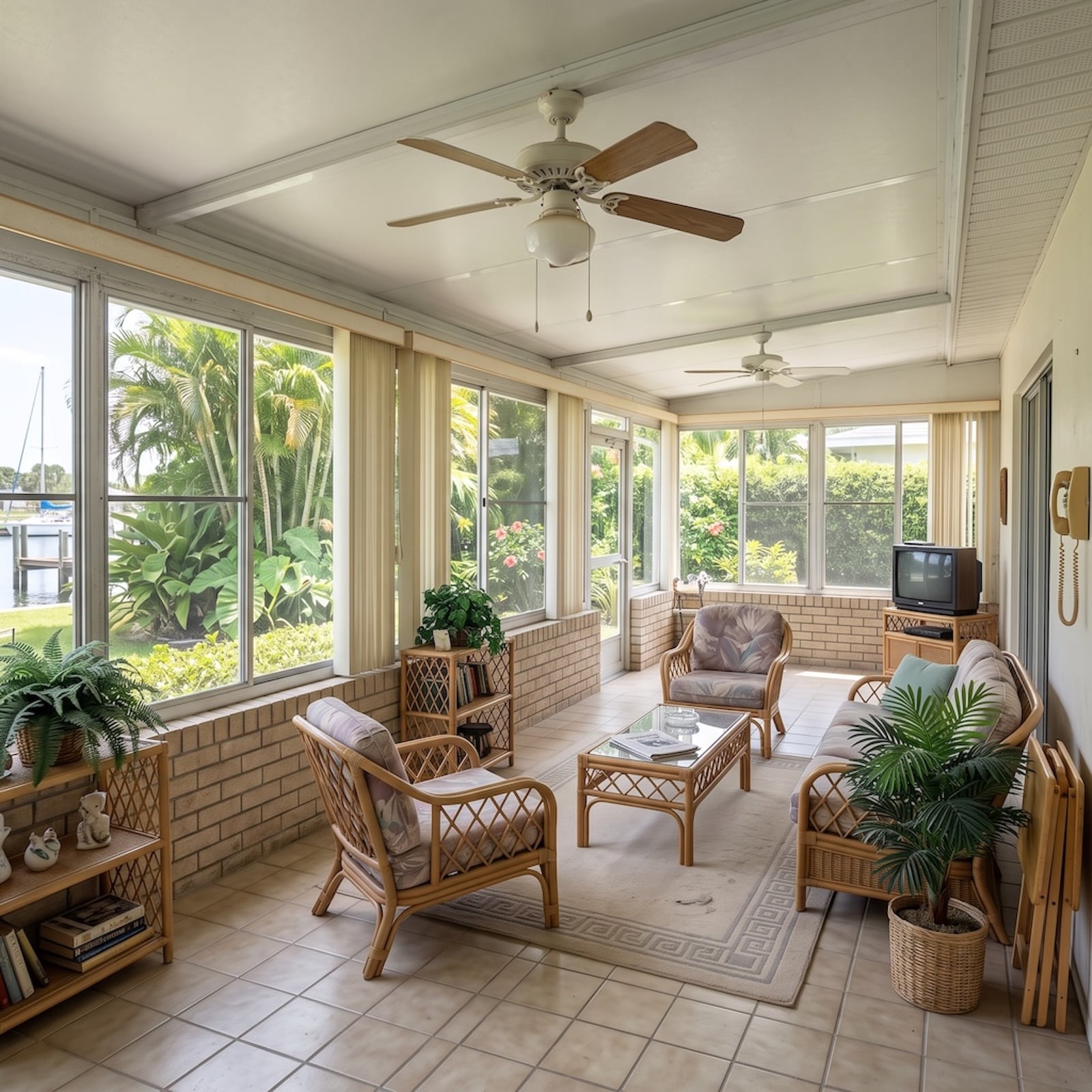
How long does a room have to look bad before someone finally decides to do something about it? In Florida sunrooms built in the 1980s, the answer is often decades. Faded jalousie windows, chalky white wicker, and sun-bleached cushions the color of old receipts tend to accumulate quietly until the whole space just stops getting used.
What makes this collection worth paying attention to is the specificity of the problem. A sun-damaged Florida sunroom from that era isn’t a blank canvas; it’s a room fighting its own bones. Each of the designs here takes that same deteriorated starting point and pushes it somewhere different, from breezy coastal updates that don’t lean on nautical clichés to darker, more dramatic interiors that most people wouldn’t dare try in a room with that much glass. Some of these choices are going to divide people. That’s fine.
Thirty-eight before-and-after looks, one stubborn room, and a genuinely wide range of directions worth borrowing from.
38. A Wall of Glass Lets Rattan and the Pool Take Over
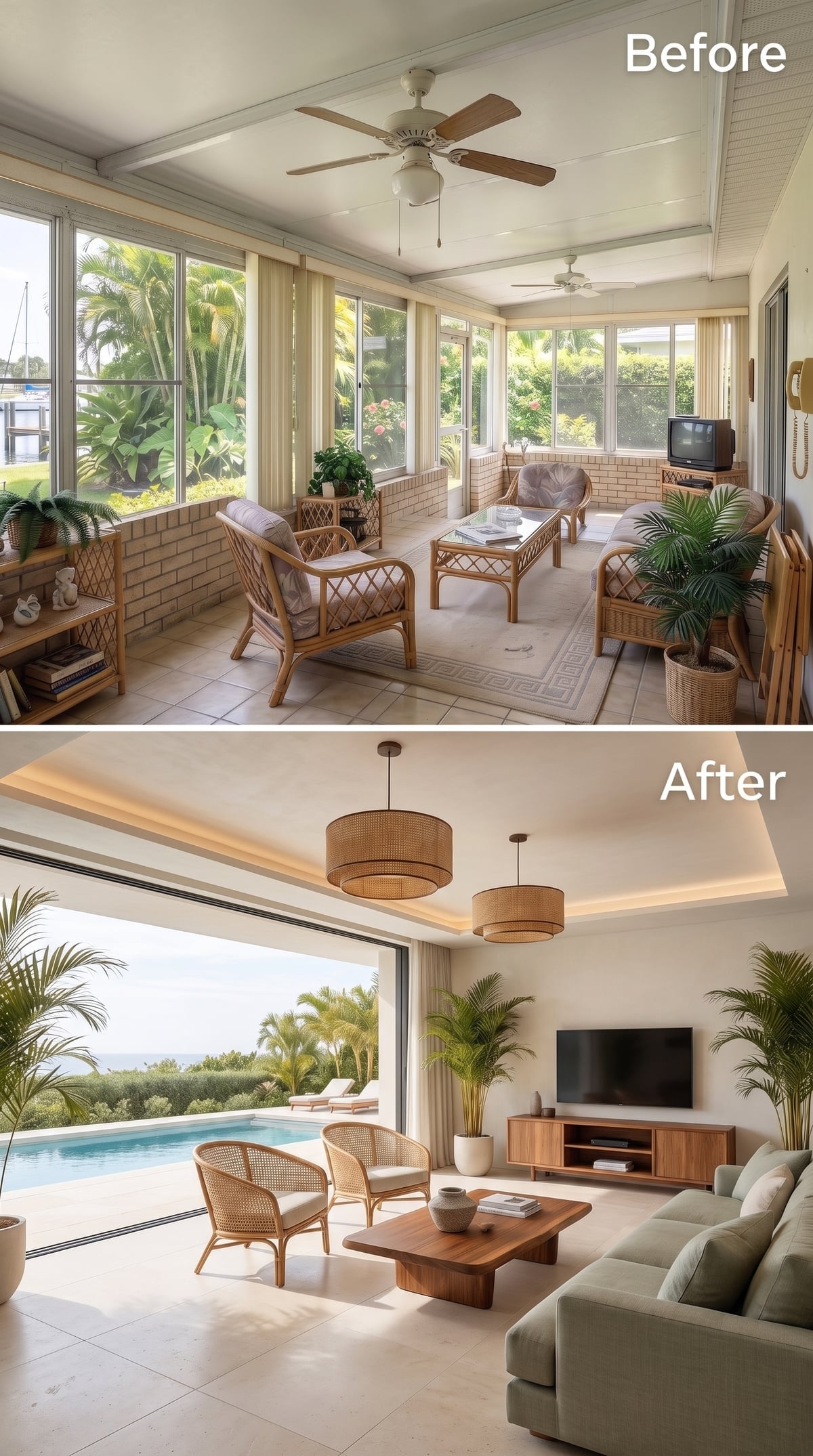
Sliding glass panels now span nearly the entire exterior wall, pulling a pool terrace and palm canopy directly into the room’s sightline. Gone is the enclosed, slightly pressured feel of jalousie windows. What replaced it is open sky.
Pendant lights with woven drum shades hang from a tray ceiling with recessed uplighting along its perimeter. The furniture keeps pace: cane-back chairs with ivory cushions sit across from a sage linen sofa, all arranged around a solid wood coffee table with a thick, flat profile. It’s a room that finally knows where it is.
37. Oak Window Trim and Terracotta Warm Up Every Edge
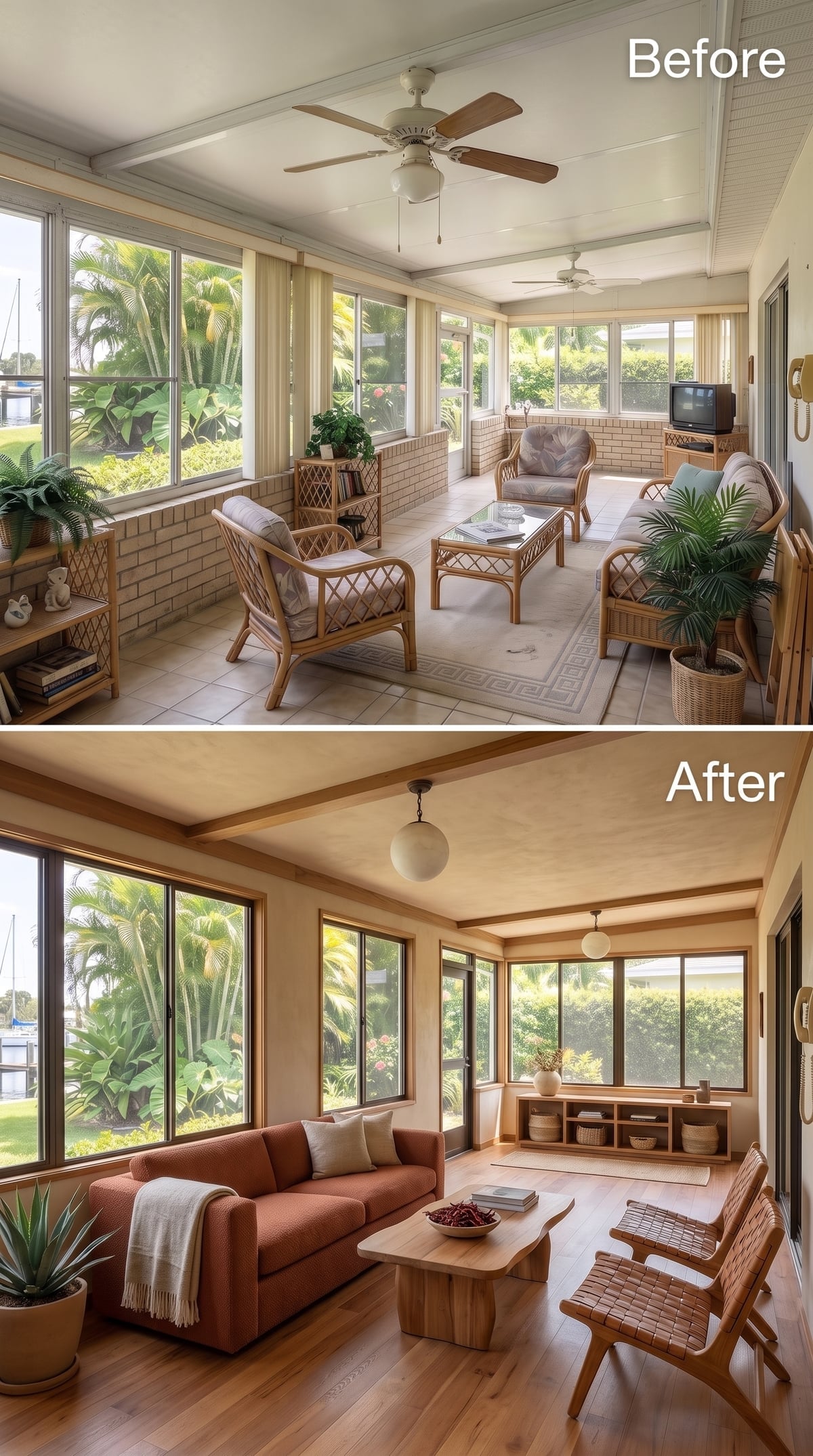
Hardwood flooring runs the full length of the room, and the oak trim framing each window keeps the palette grounded without going heavy. A terracotta sofa brings warmth to the seating area without making the palette feel forced. The ceiling fan is gone. A globe pendant takes its place, and the room reads completely differently for it.
Built-in shelving along the back wall replaced the old television arrangement with something that actually earns its square footage. Low-profile chairs with woven leather seats pull toward a solid wood coffee table with a softened silhouette.
Why the Window Trim Does More Work Than It Looks Like It Does
Matching the window trim tone to the flooring is a detail many renovations skip because it takes extra coordination. Here, the continuous oak color carries the eye around the perimeter rather than letting each window read as a separate interruption. Rooms with this much glazing can feel disjointed if every frame competes for attention. Tying them together with consistent trim keeps the view outside as the focal point, not the architecture holding it in.
36. Sage Beams Frame the Pool Instead of Fighting It
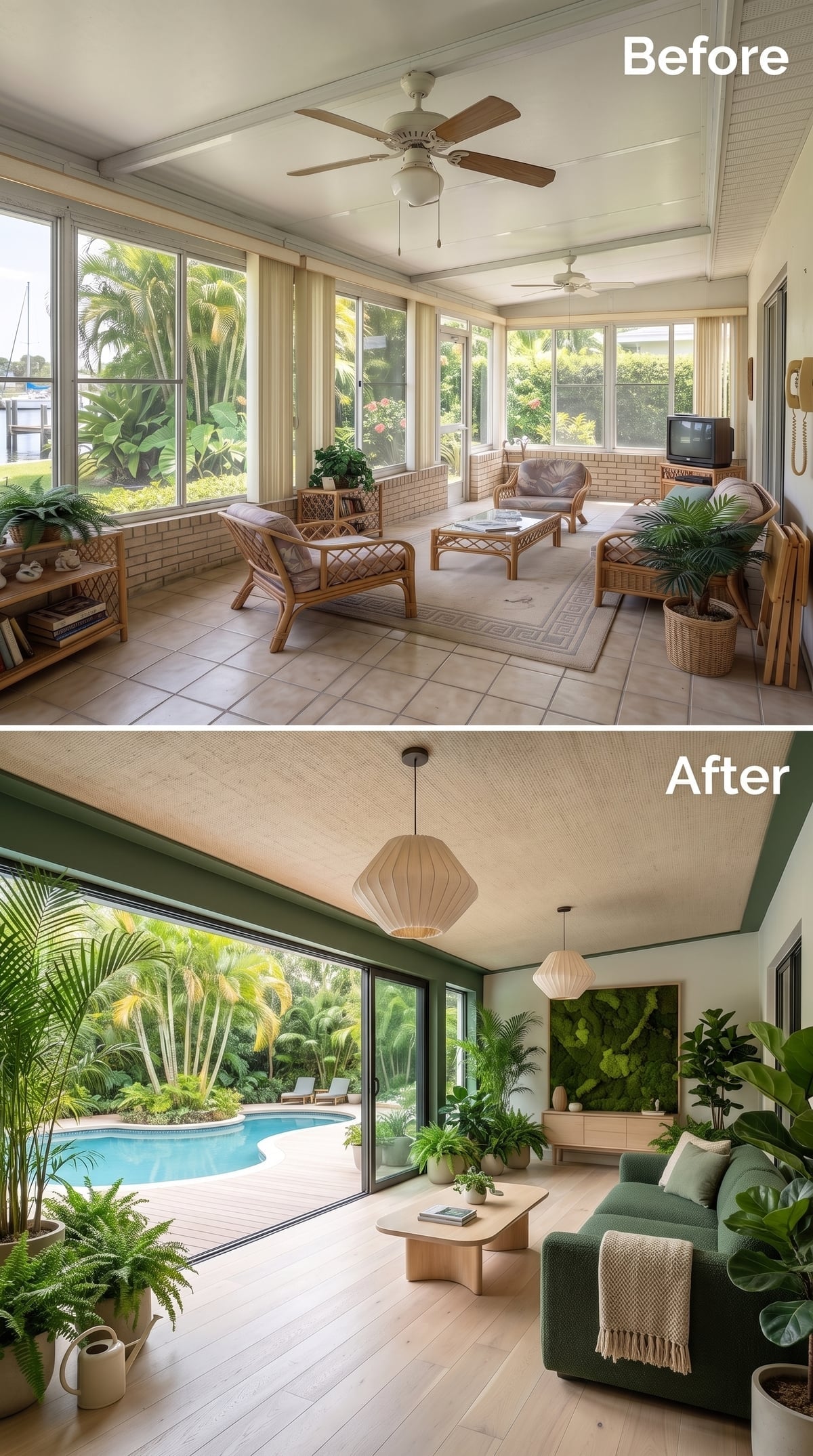
Sage-painted beams frame a vaulted ceiling finished in a natural woven-grasscloth look, and that combination alone shifts the room’s entire mood. Wide-plank blonde wood flooring runs the length of the space, and a low-profile maple coffee table sits at the center without crowding anything. The green sofa holds the seating area together without fighting the wall of glass behind it, which opens directly onto a pool deck lined with palms.
Designer’s Secret: Repeating a muted beam color across the ceiling creates a rhythm without turning every structural line into a separate event. Here the sage frame is distinct enough to register, but soft enough that the pool and palms still win the argument. In a room with this much glass, that restraint matters more than trying to make every architectural detail shout.
35. Navy, Cane, and Brass Make the Water View Feel Deliberate
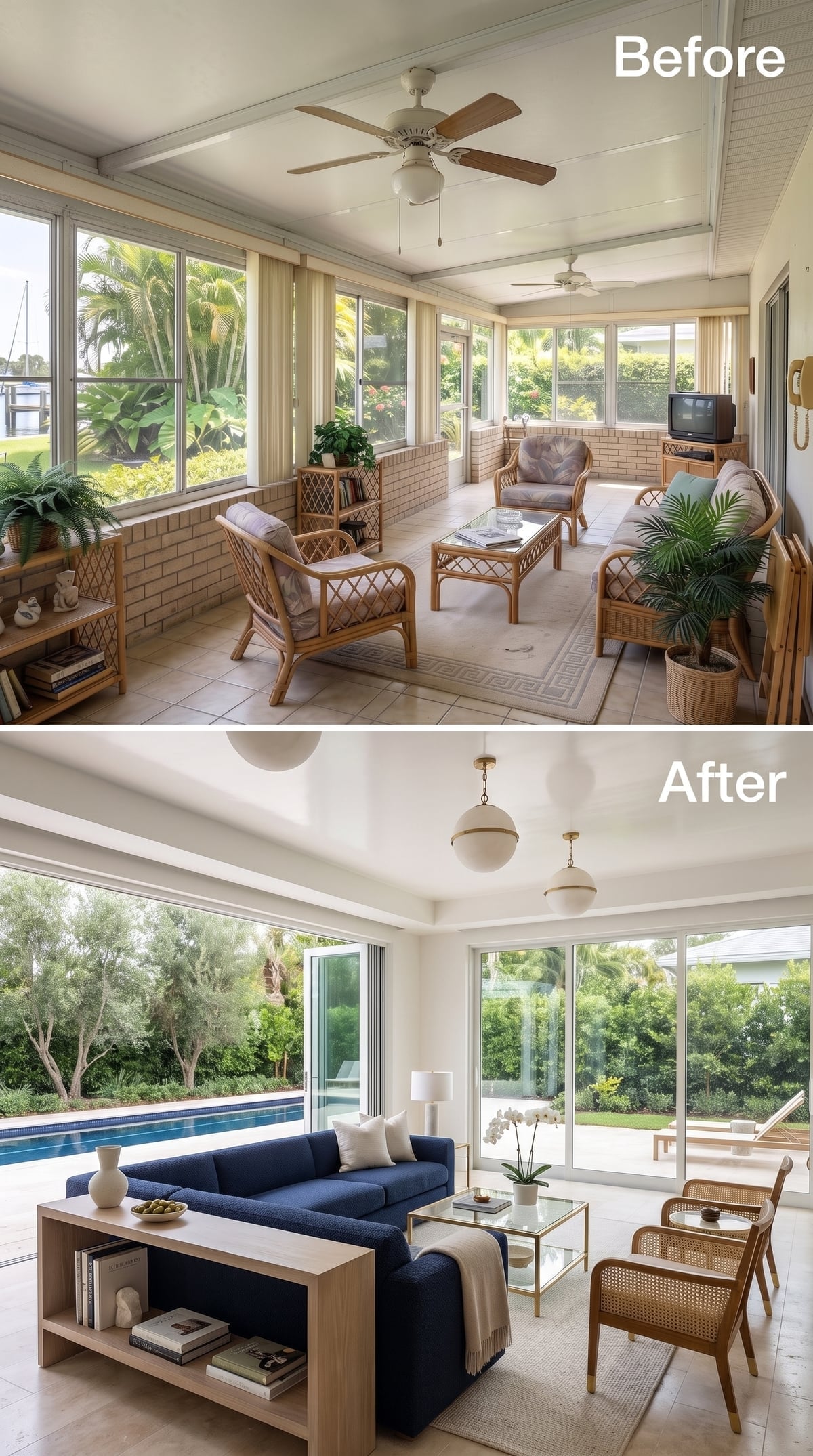
Globe pendants in brass hang from a clean white ceiling, giving the overhead plane a purpose the old fan never had. The navy sofa gives the room a steady visual base against the wall of glass behind it, which opens onto a pool and a canopy of mature trees. Cane-back chairs in honey-toned wood keep the seating arrangement from feeling too formal. A console shelf behind the sofa holds books and ceramics without cluttering the sight lines.
- Natural cane brings lightness and airflow to a sunroom, but humidity still affects plant-based fibers, so finish, ventilation, and care matter
- Globe pendants in brushed brass read as both vintage and contemporary, which can make them easier to carry through future style shifts
- A navy sofa can act almost like a neutral in a room with strong natural light, shifting character as the daylight changes
34. Black Window Frames and Bouclé Strip the Room Back
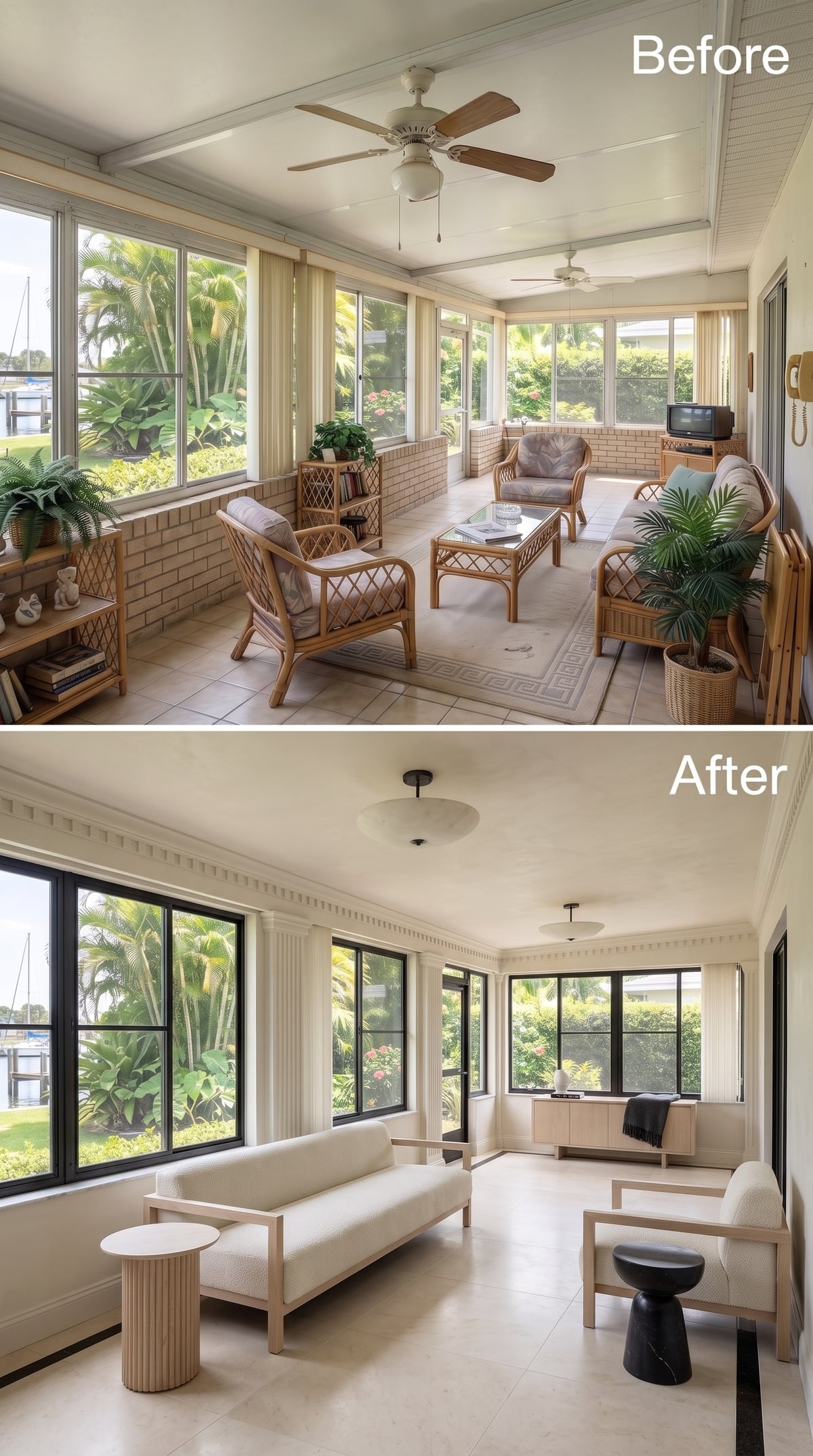
Black-framed windows establish most of the room’s graphic structure. Replacing the original louvered panels with clean picture-style glazing pulls the tropical greenery into the room without any visual noise between inside and out.
The furniture follows suit: a low bouclé sofa on a natural wood frame, a fluted pedestal side table in matte white, and a sculptural black accent stool that gives the far end definition without demanding attention. Crown molding runs the full perimeter, and it reads quieter than expected against the cream walls. Spare, but not empty.
33. Dark Coffers and Amber Wood Give the Ceiling a Reason to Exist
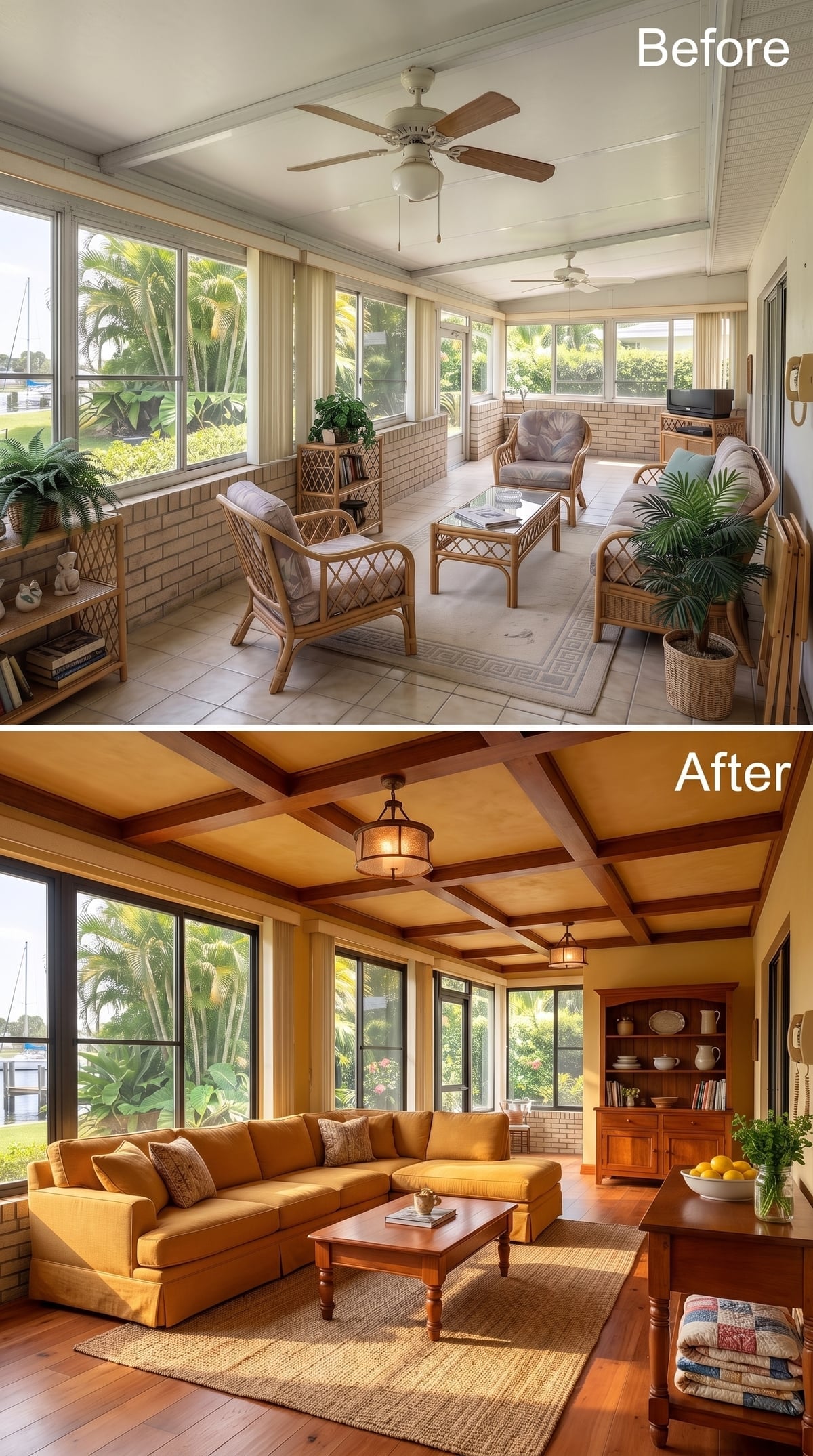
Dark cherry-toned beams form a coffered grid overhead, while golden-ochre ceiling panels give the room its amber warmth. Pendant fixtures with drum shades hang at the intersections, casting the kind of light that makes the space feel evening-ready even in the afternoon. The windows were updated with black-framed casements, which snap the tropical greenery outside into sharp focus.
A sectional sofa in mustard upholstery holds down the seating area, paired with a turned-leg coffee table in medium walnut. The jute area rug underneath reads as casual without looking careless. Built-in shelving along the right wall holds ceramics and books without feeling cluttered.
32. Cedar Overhead Makes the Whole Room Feel Warmer
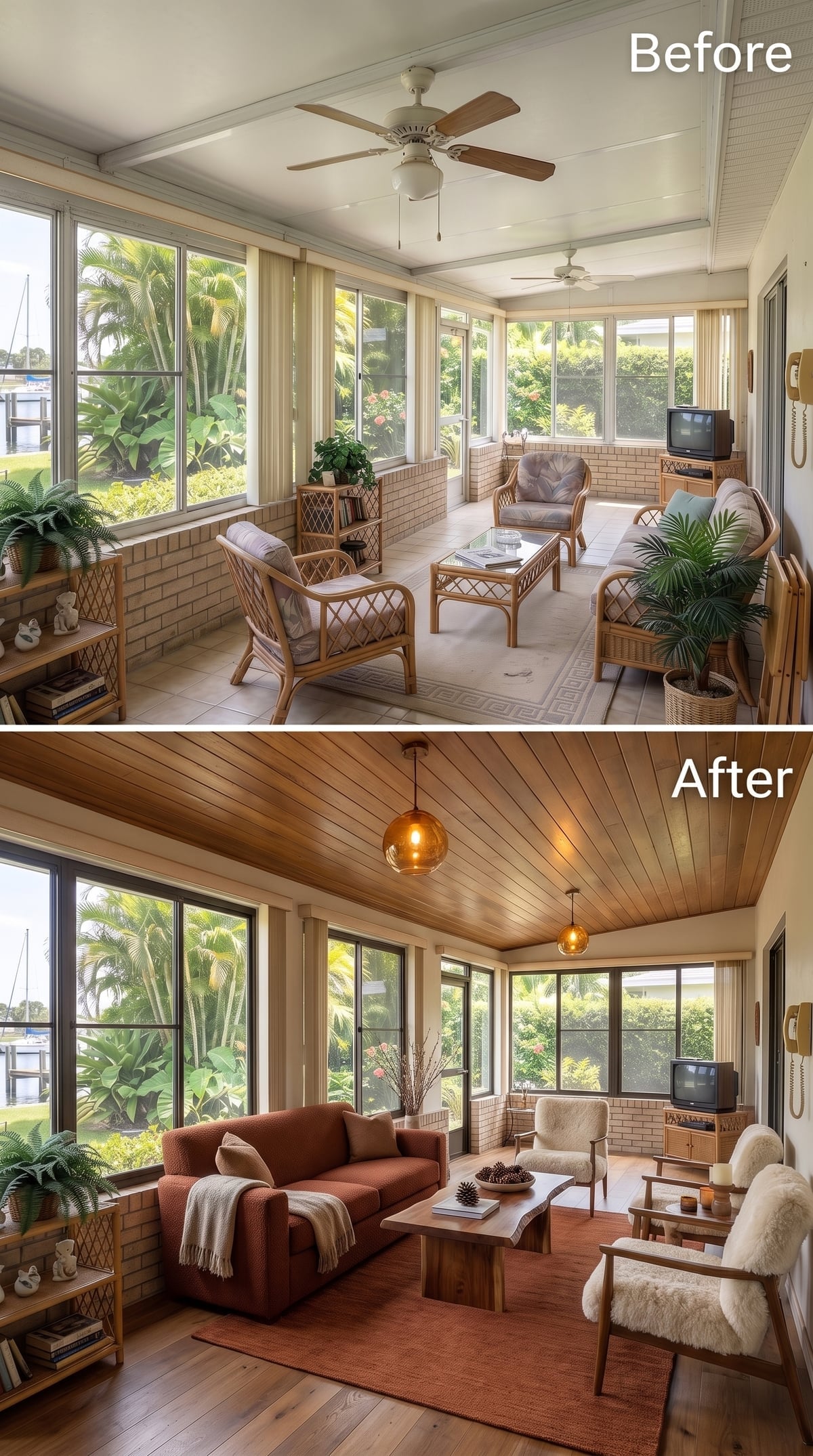
Warm cedar planking runs the full length of the ceiling, and it pulls the room’s temperature in a direction no fan blade ever managed. Amber globe pendants hang low enough to feel deliberate. Below, a rust-colored sofa settles onto a jute rug while cream shearling chairs hold their own across a live-edge coffee table.
Material Matters: Tongue-and-groove wood ceilings bring grain and shadow into rooms that otherwise have a lot of hard reflective glass. Cedar is often chosen for exterior-adjacent spaces because of its natural durability and relative dimensional stability, though it still needs proper finishing, detailing, and humidity control. Running planks diagonally can also change how a narrow room is perceived without moving a wall.
31. Vaulted Shiplap and Linen Sofas Keep the Coastal Side Quiet
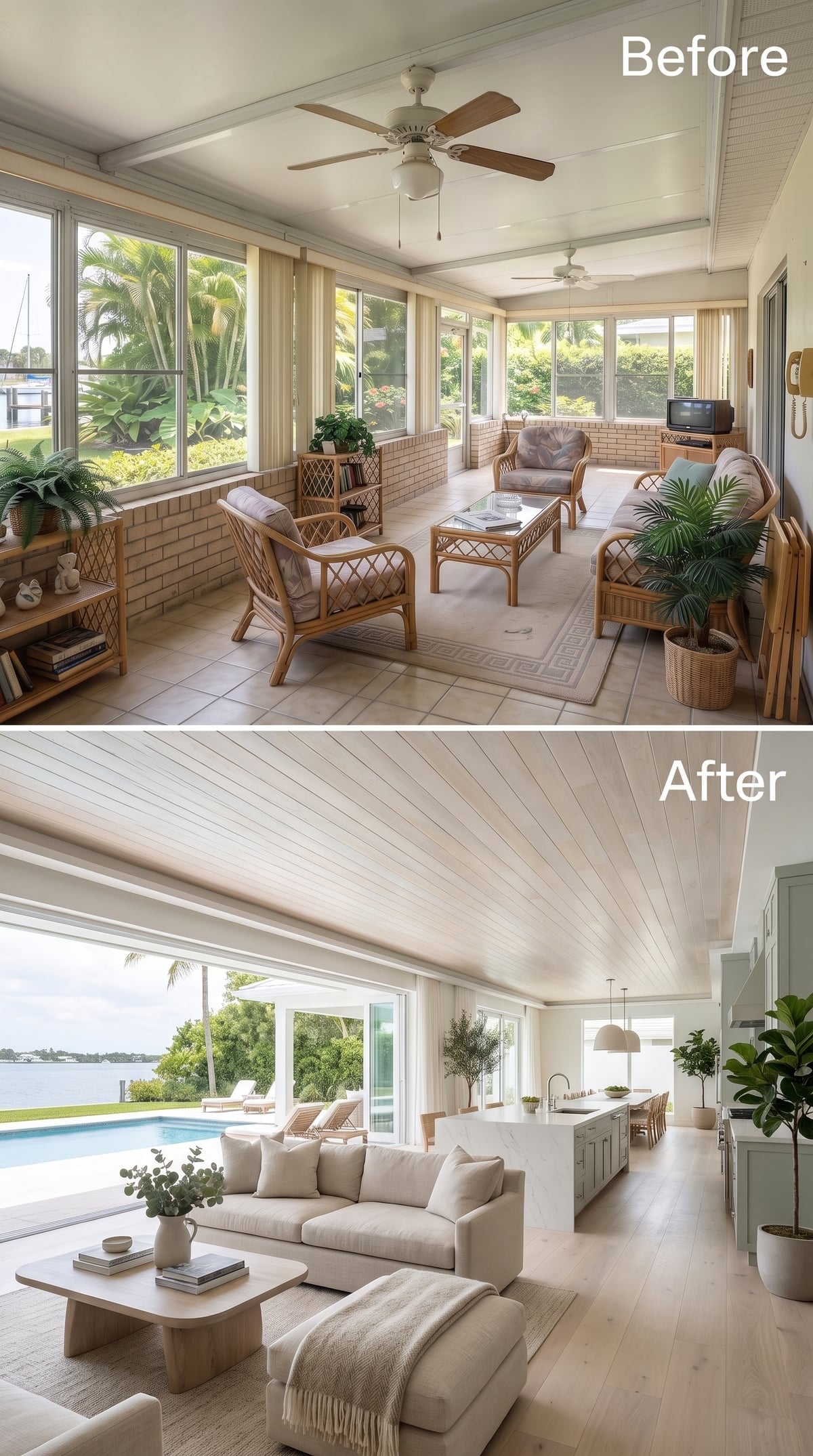
Painted shiplap runs the full length of the vaulted ceiling, and it does something unexpected: it makes the room feel longer without making it feel lower. Below it, a pair of linen sofas face each other across a low oak coffee table, the fabric loose and unstructured in the best way.
The kitchen runs open along the right wall with sage cabinetry and what reads as a marble waterfall island. Pendant lights hang above the island rather than a ceiling fan. Outside, an unobstructed pool view sets the tone.
Worth Knowing: Shiplap and beadboard are often confused, but the difference is in the joint. Shiplap boards have a rabbet cut along each edge so they overlap slightly, creating a shadow line rather than a groove. That shadow line is what gives painted shiplap its texture in bright light, creating more visible rhythm than a flat drywall ceiling.
30. Coffered Mahogany Tones and a Chesterfield Go Traditional
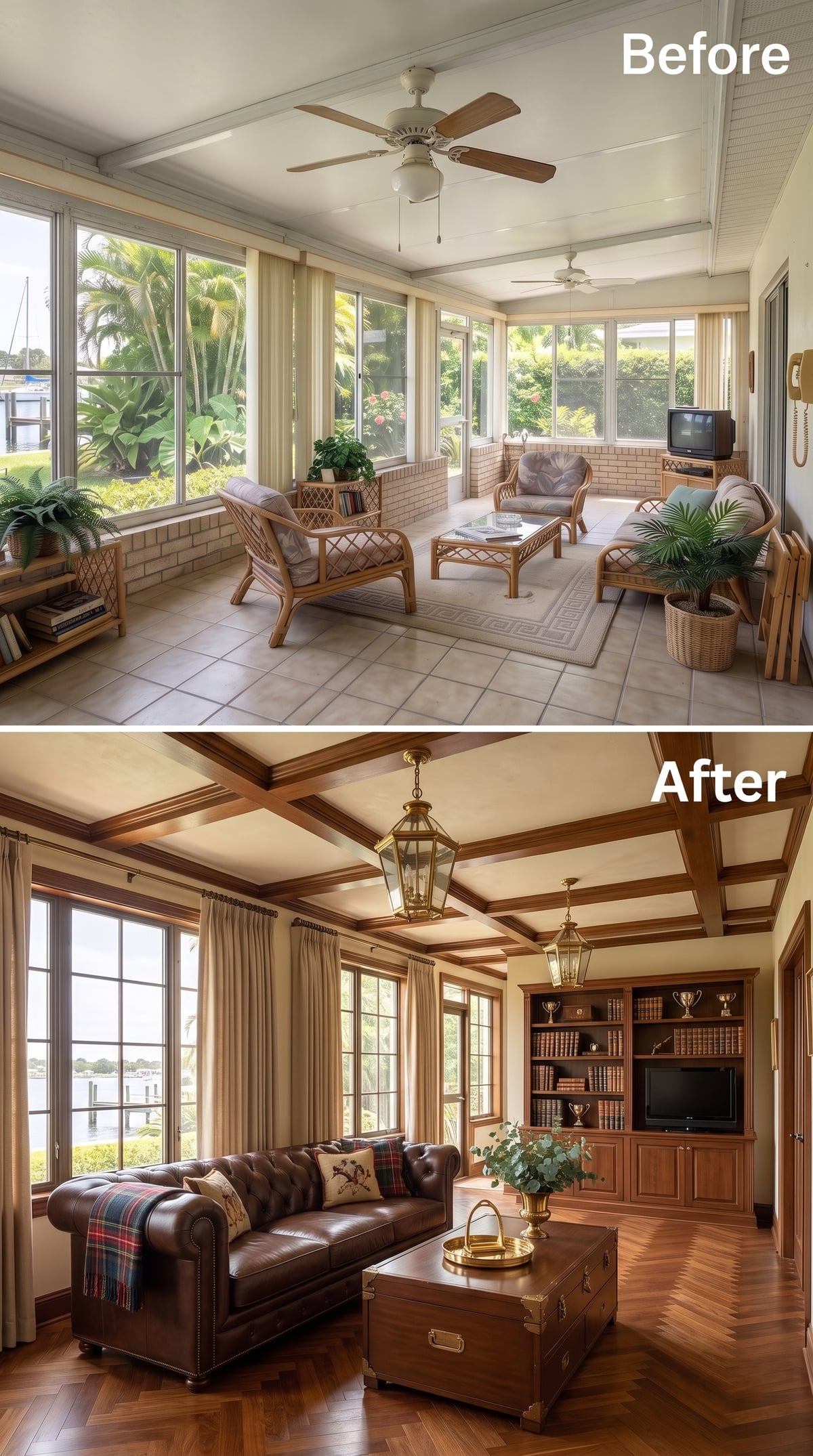
Dark wood coffered ceilings don’t whisper sophistication — they announce it.
Rich mahogany-toned beams form a grid across the ceiling, and the brass lantern pendants hanging from that grid do exactly what a ceiling fan never could: they make the room feel considered. A tufted Chesterfield sofa in deep espresso leather commands the seating area, paired with a wooden trunk as a coffee table that’s doing double duty as storage. The built-in bookcase along the back wall runs floor to ceiling, and the warm cabinetry below it ties the whole room to a single material story. Herringbone hardwood floors seal it.
29. Paper Lanterns and Herringbone Oak Pull the Room Toward Quiet
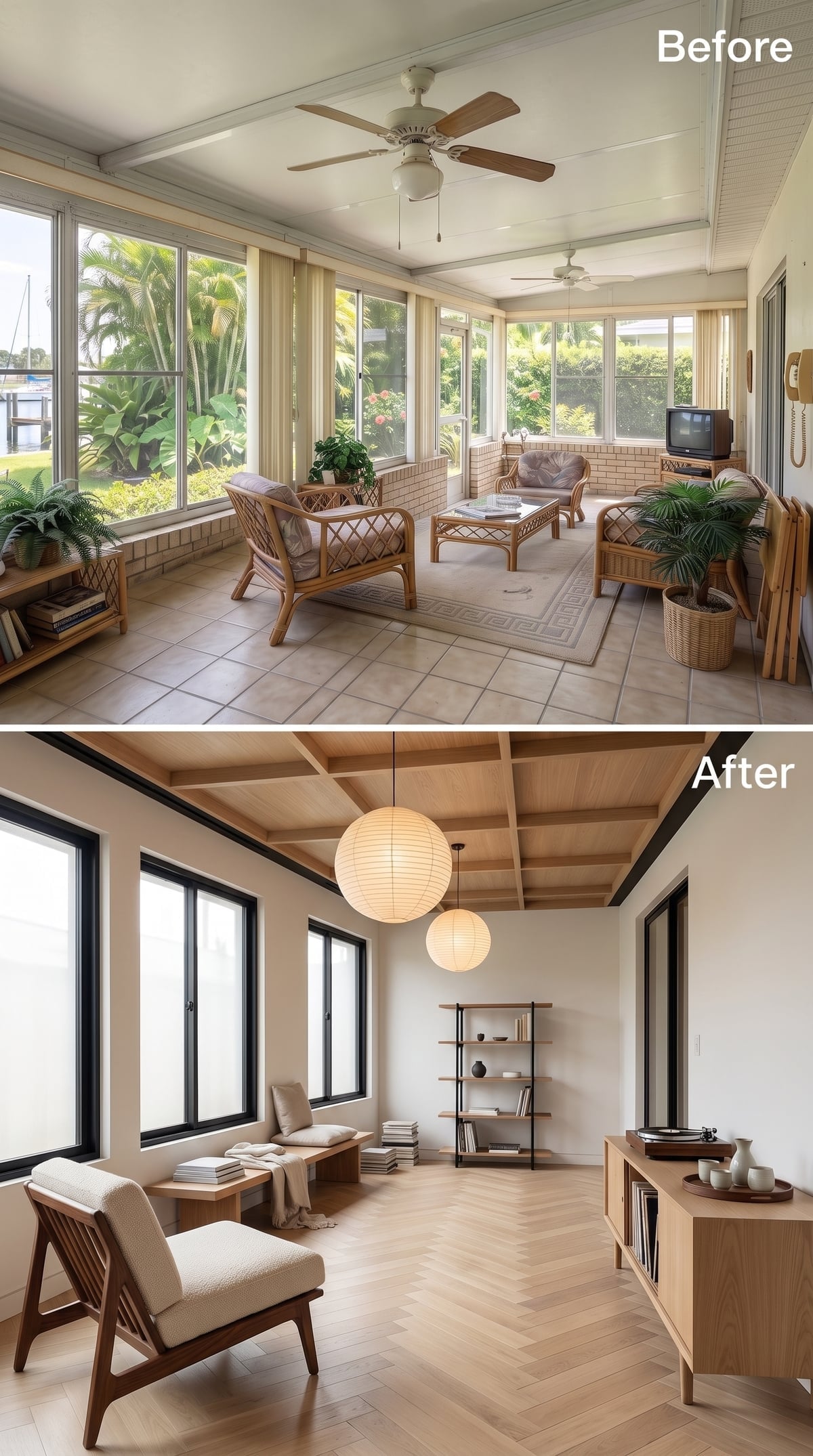
Two globe paper lanterns hang from a wood-slat coffered ceiling, and that pairing establishes the room before the furniture even gets a vote. Light oak laid in a herringbone pattern runs wall to wall, giving a space that’s now more study than sunroom a clear sense of order. A mid-century lounge chair in bouclé fabric sits near a low oak credenza holding a turntable. Black-framed windows keep the exterior views without the visual clutter of old curtain hardware. It’s calm. Genuinely calm.
Ask Yourself: Swapping ceiling fans for pendant lighting is one of the fastest ways to signal a room has changed direction. If paper lanterns feel too casual for your taste, consider a rattan or washi shade instead. The goal is softness overhead, not brightness.
28. Cedar Rafters and a Fire Table Make the Pool Room Feel Year-Round
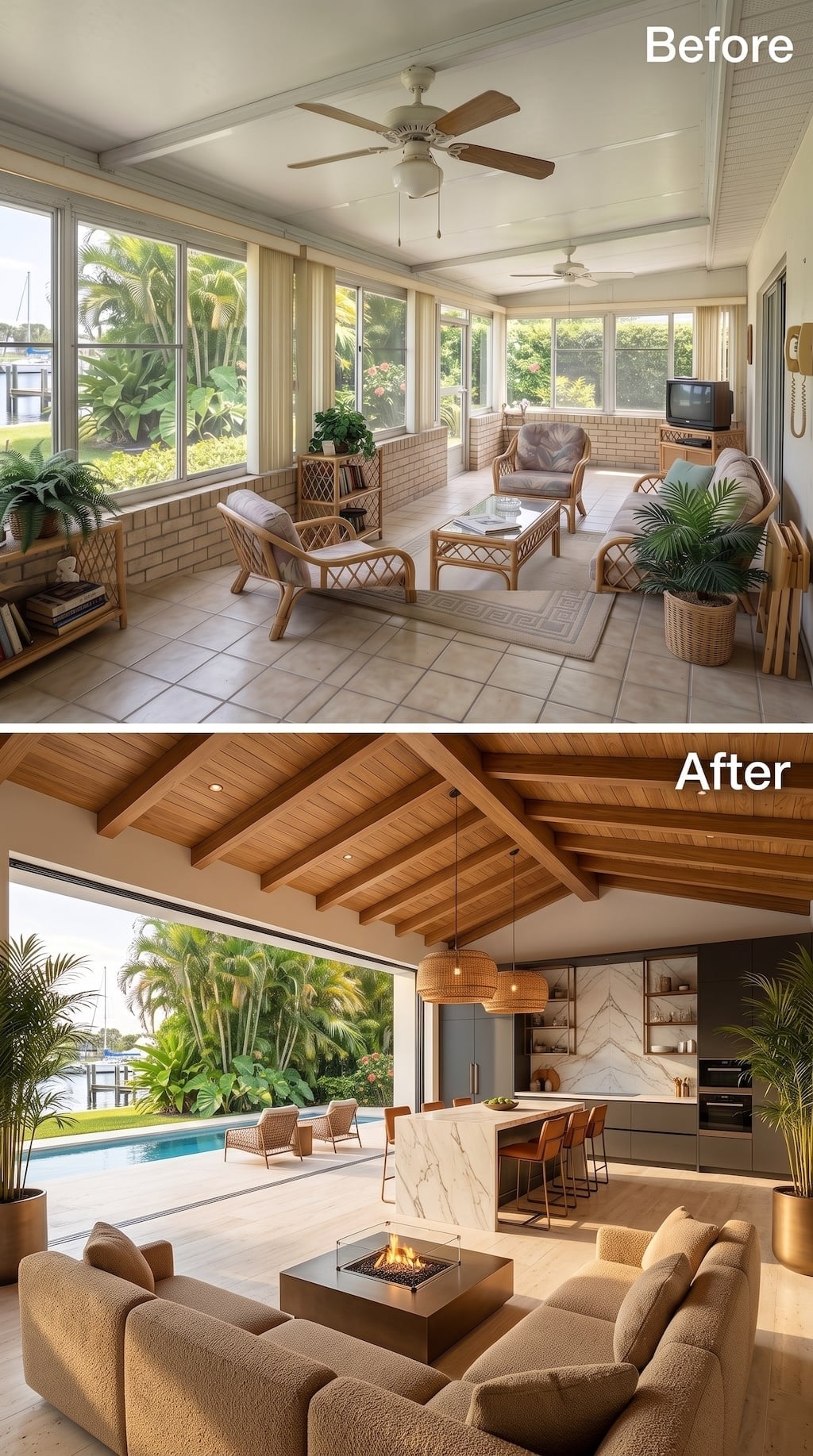
Diagonal cedar beams run the full length of a vaulted ceiling, paired with tongue-and-groove wood decking between each rafter. The combination gives the ceiling real visual weight without feeling heavy. Below it, a pair of bouclé sectionals face a low fire table instead of a television.
The marble-look kitchen island defines the back of the room, its veining sitting comfortably beside the warm tone of the beams. Woven pendant lighting hangs low over the island. And the folding glass wall opens wide enough that the pool terrace reads as part of the floor plan rather than a separate destination.
27. Cobalt Coffers and Gold Light Make Blue Feel Architectural
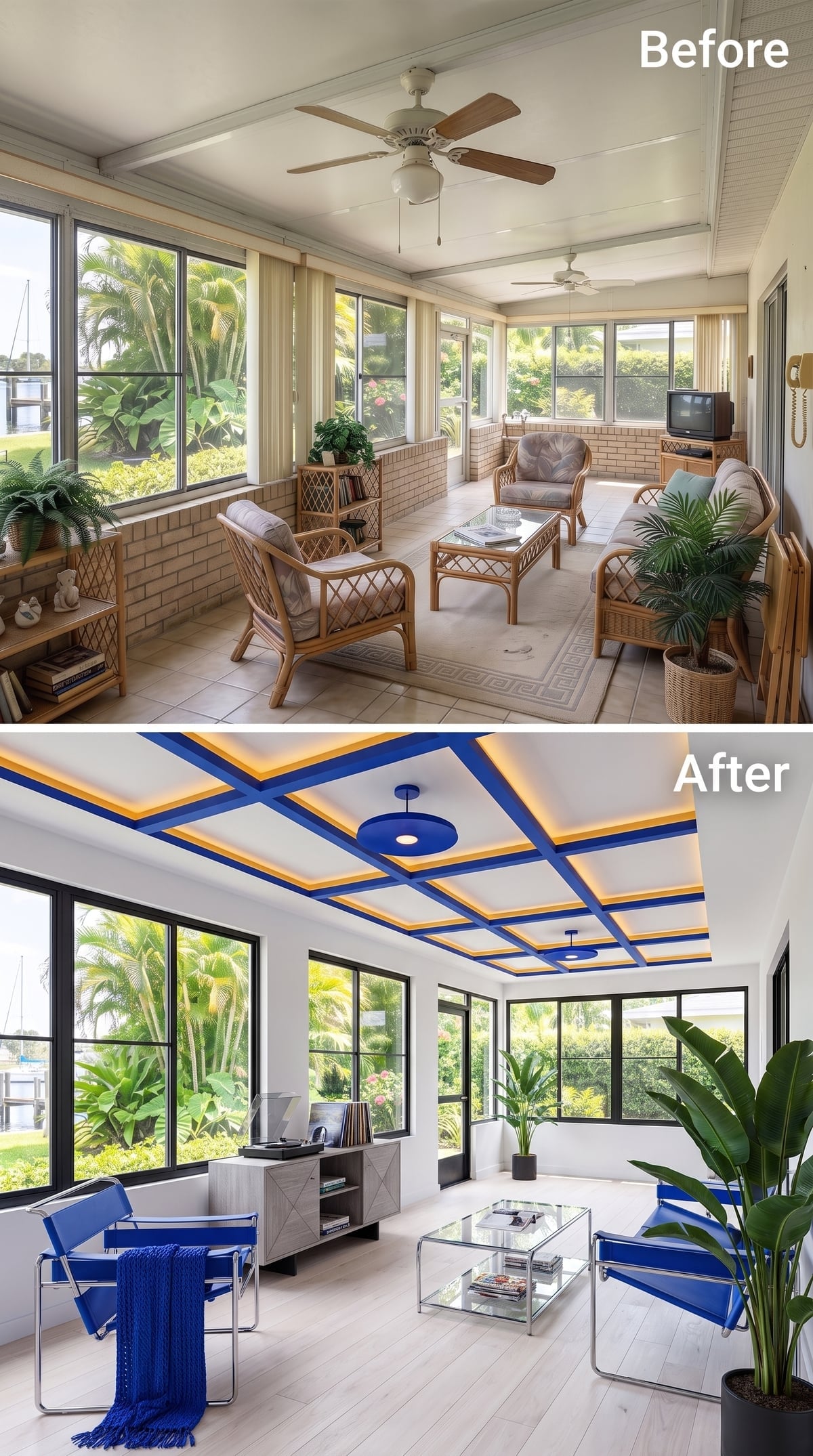
Coffered panels painted white get edged in cobalt blue with a gold-lit reveal running along each recess, and the combination reads bold without feeling overdone. A pendant in matching blue marks the center of the grid.
Below, chrome-frame chairs upholstered in the same royal blue bring the ceiling color down to floor level. White-painted wood floors and a glass coffee table leave enough breathing room that the color never crowds the space.
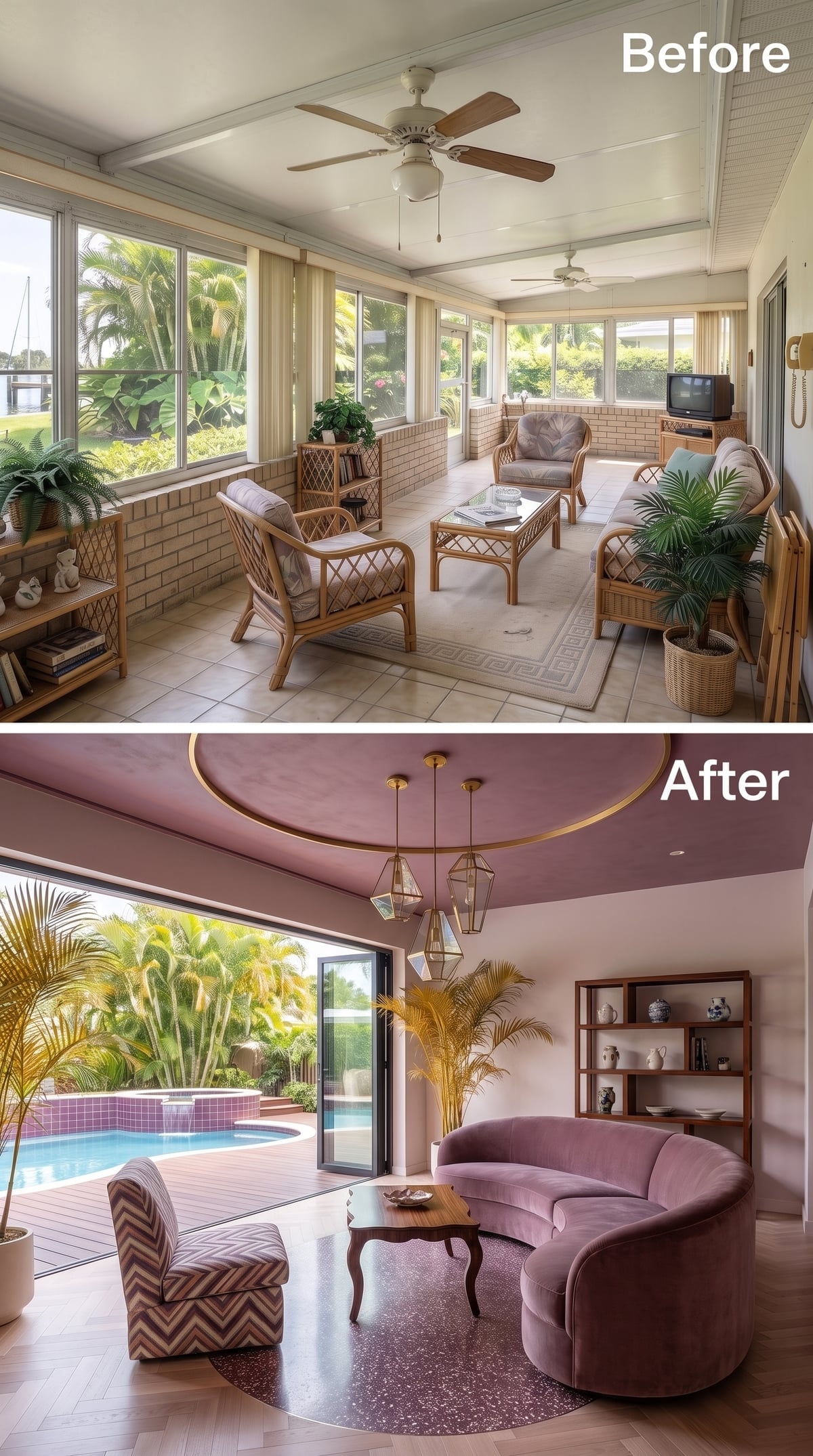
26. Dusty Mauve, Terrazzo, and Brass Push the Room Into Glamour
🔥 Would you like to save this?
Pink doesn’t usually read as sophisticated, but the dusty mauve plastered across the ceiling here earns it. A curved tray detail edged in gold breaks the plane overhead, and three geometric brass-framed pendants hang from it in a loose cluster, giving the ceiling its own rhythm.
Below, a curved velvet sofa in the same muted rose claims the middle of the room without apology. It sits across from a chevron-patterned armchair that keeps the palette from going monotone. Terrazzo flooring runs underfoot, speckled in burgundy and cream. And through bifold glass doors, a pool deck opens up completely, which changes how the whole room feels in afternoon light.
Try This: Terrazzo is a durable flooring option when properly specified and maintained, which makes it worth considering in a high-traffic sunroom. Many terrazzo and terrazzo-look tile assemblies can also be used over compatible radiant-floor systems, but the complete installation has to be designed for it. If poured or precast terrazzo is out of budget, terrazzo-look porcelain tile can deliver a similar visual effect.
25. Oxblood Lacquer Turns the Ceiling Into a Reflective Canopy
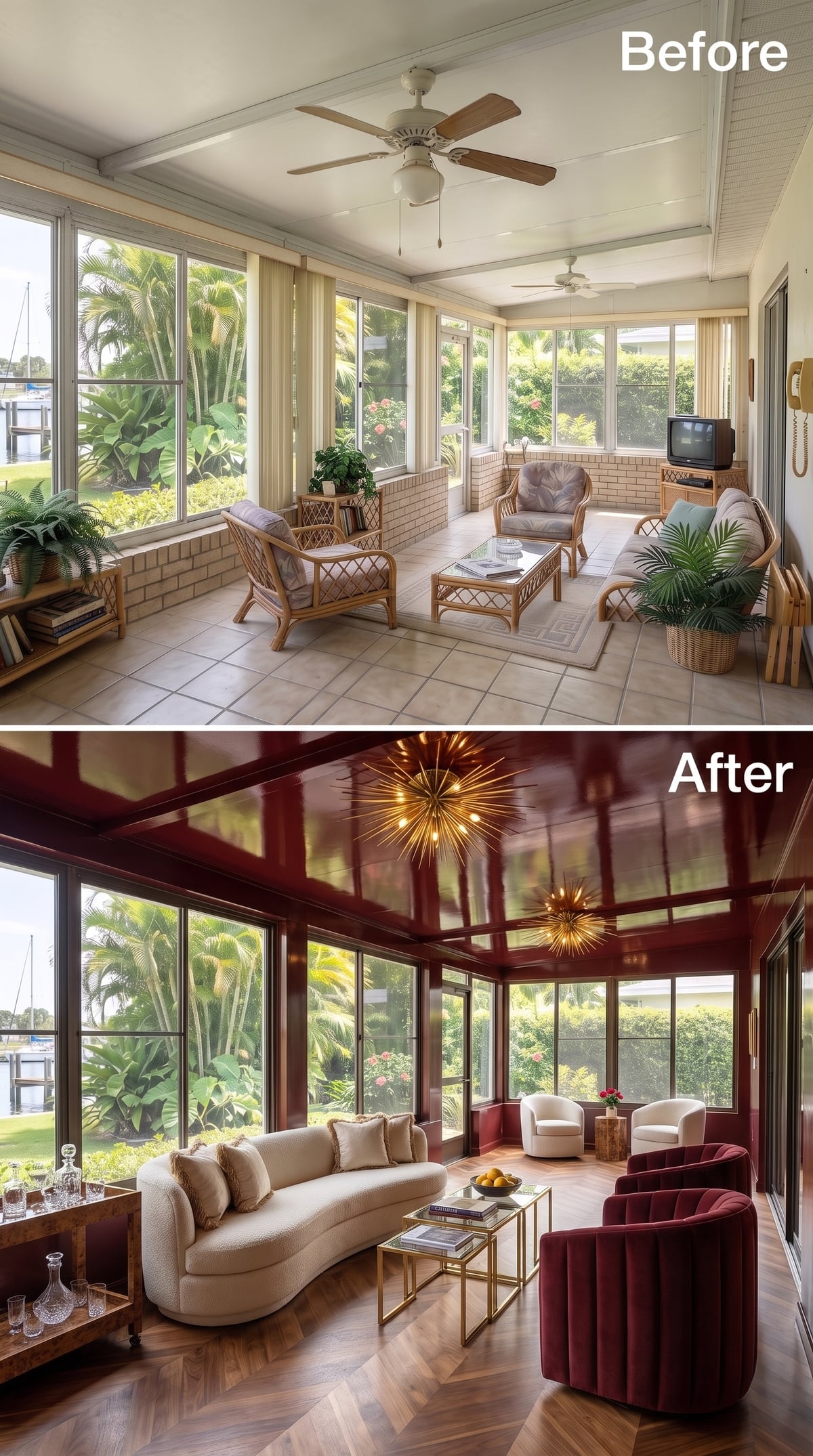
Oxblood red lacquer coats the ceiling and upper walls in a finish so glossy it reflects the palm trees outside. That reflectivity matters here, throwing highlights around a space that could easily feel closed in. A curved bouclé sofa brings a soft ivory counterpoint against velvet armchairs in a deep burgundy that matches the ceiling almost exactly. The gold sputnik chandelier earns its place: it’s the right scale, and it warms the darker tones without overreaching. Herringbone hardwood floors replace what was once flat tile, adding directionality underfoot that leads toward the windows and the water view beyond.
Oxblood red lacquer coats the ceiling in a finish so glossy it reflects the palm trees outside.
24. Black Overhead and Red Leather Give the Room an Edge
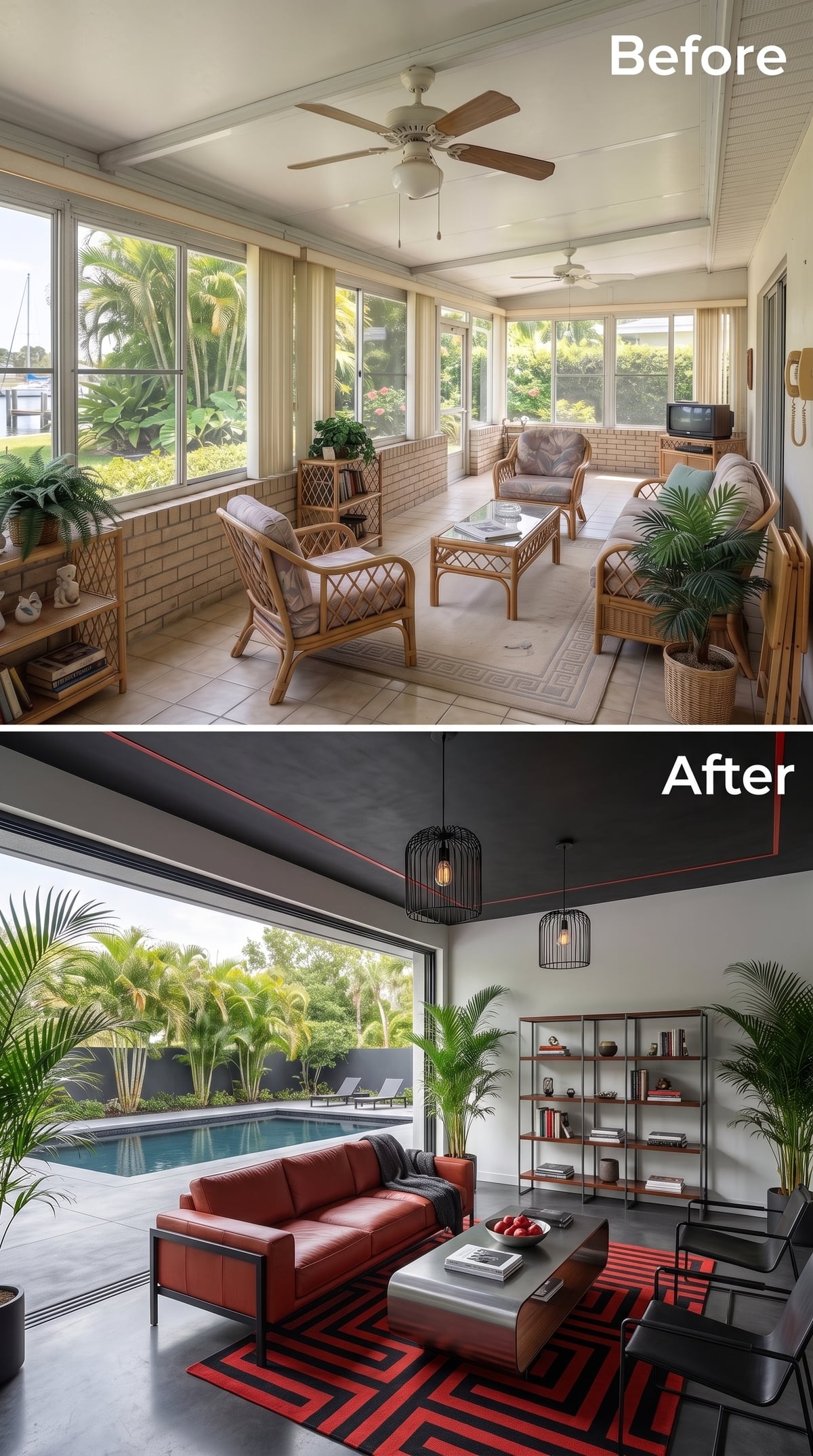
Charcoal paint covers the entire ceiling plane, with a single red accent line tracing the perimeter where it meets the wall. It’s a deliberate move, and it sends the eye around the room rather than letting it drift upward and disengage. Two cage-style pendants with exposed filament bulbs hang low enough to define the conversation area without blocking the pool view beyond the open glass wall.
The seating is rust-red leather on a black metal frame, paired with a graphite ottoman. Underfoot, a chevron rug in the same red-and-black palette locks the whole thing together without being subtle about it. Open steel shelving lines one wall, and a tall palm keeps the room from reading as too hard-edged.
Pro Tip: Dark ceilings tend to feel more intentional when at least one other element in the room repeats the color, even partially. Here, the rug and sofa frame echo the ceiling tone, which prevents the dark overhead plane from feeling like an isolated design decision dropped in from a different room entirely. Without that repetition, a black ceiling can read as a mistake rather than a choice.
23. Emerald Gloss and Gold Lines Build a Cocktail Lounge Around the View
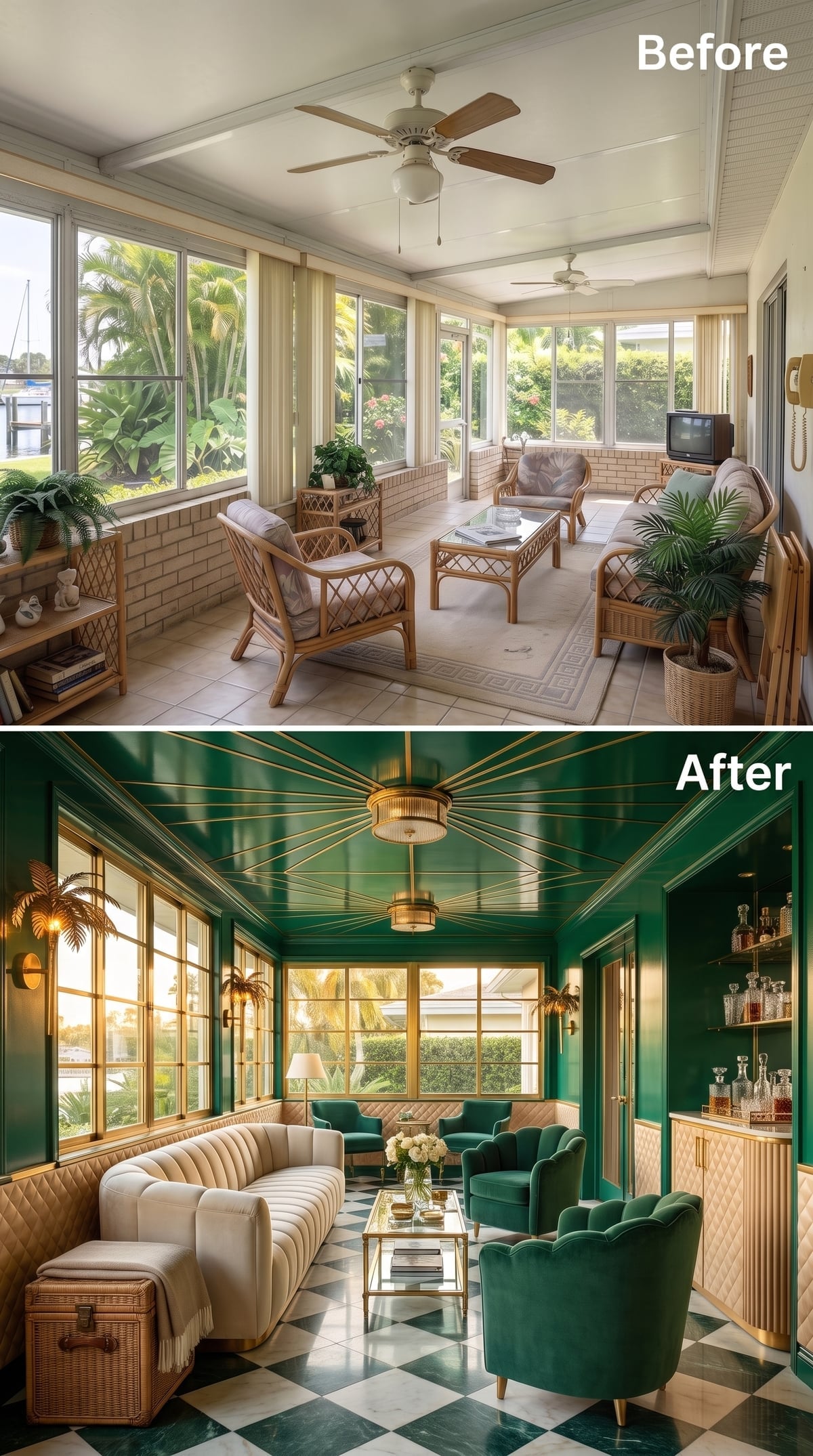
Jewel-toned walls in a high-gloss emerald finish catch the warm sunset light and make the windows feel even more prominent instead of closing the room in. Gold radiating lines on the ceiling send every sightline toward the brass flush-mount fixture at center, giving the whole composition a deliberate focal point.
On the floor, a green-and-white marble checker pattern picks up the wall color without repeating it exactly. A curved cream channel-tufted sofa stands up beautifully to all that saturation, and the pair of scallop-edged green velvet chairs keep the seating arrangement from feeling too studied. The built-in bar tucked into the right corner, stocked with decanters and lit from above, makes this feel less like a renovated sunroom and more like a room that always knew what it wanted to be.
Editor’s Note: High-gloss paint changes how strong natural light behaves, throwing sharper reflected highlights across the walls and ceiling than a flat finish would. That reflected light gives the emerald surface movement rather than turning it into one dark block. With this much saturation, the cream sofa is the necessary pause — one large neutral shape surrounded by color that has no intention of behaving quietly.
The lacquer isn’t trying to make the room disappear; it gives the view a darker frame.
22. Dusty Rose and Geometric Light Pull the Room Into Soft Focus
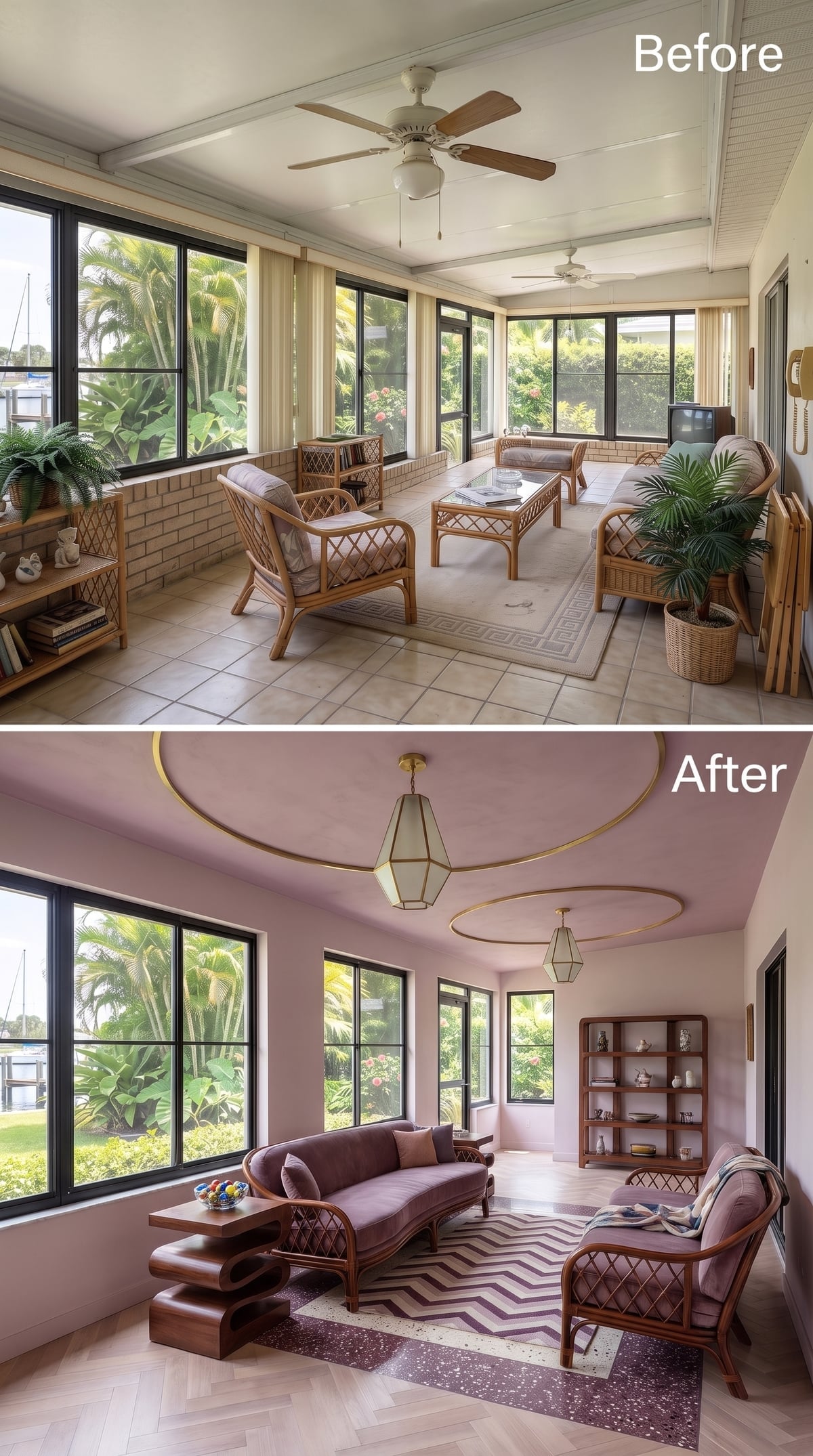
Overlapping gold rings sweep across the dusty-rose ceiling, framing two faceted pendants that turn the overhead plane into the room’s main ornament. The geometry keeps the pink from drifting sweet, while a chevron rug below gives the floor an equally decisive pattern. Instead of relying on tropical greens outside to provide all the energy, this version builds its own atmosphere indoors — softer than the lacquered jewel-tone rooms, but nowhere near timid.
21. A Moss Wall Turns the Sunroom Into an Indoor Garden
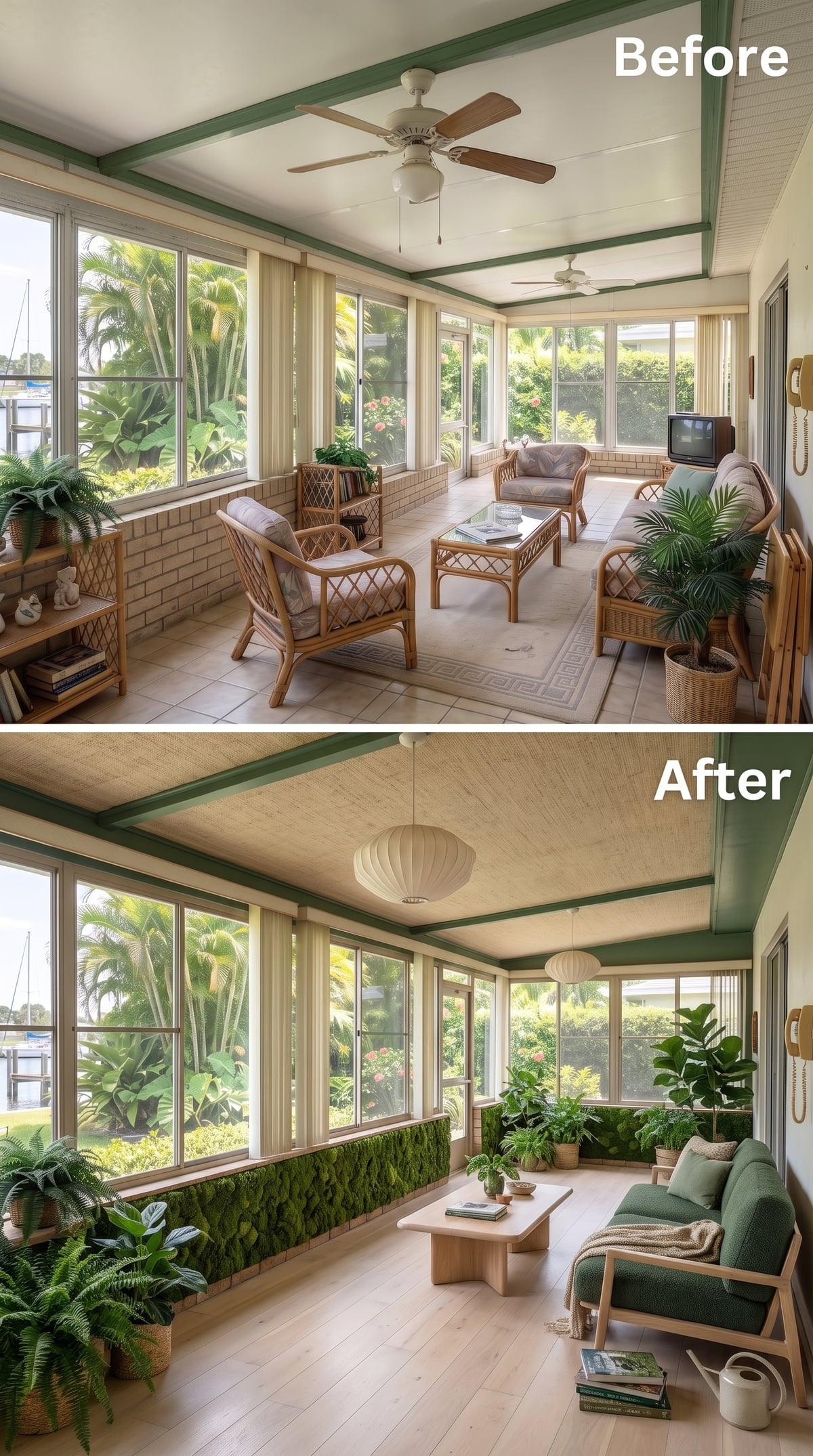
Natural wood planks replaced the tile underfoot, and the shift from hard, cold surfaces to something warmer reads immediately. A moss-covered wall runs the full length of one side, framed by potted ferns and a fiddle-leaf fig that push the boundary between indoors and out. Two paper lantern pendants hang where the ceiling fan used to be. Simpler. Better.
The sofa is upholstered in deep forest green, which picks up the painted trim without matching it exactly. A low travertine-finish coffee table gives the middle of the room just enough visual weight. Wicker baskets hold the plants at floor level, keeping the whole arrangement grounded rather than precious.
Color Story: Green in this room isn’t a single shade but a range that moves from the near-black of deep fern shadow to the bright lime of new leaf growth. That spread keeps the palette alive without introducing a second color family. Pairing it with natural wood tones prevents the green from reading as cold or formal.
20. Ochre Plaster and Citrus Trees Make the Pool Feel Mediterranean
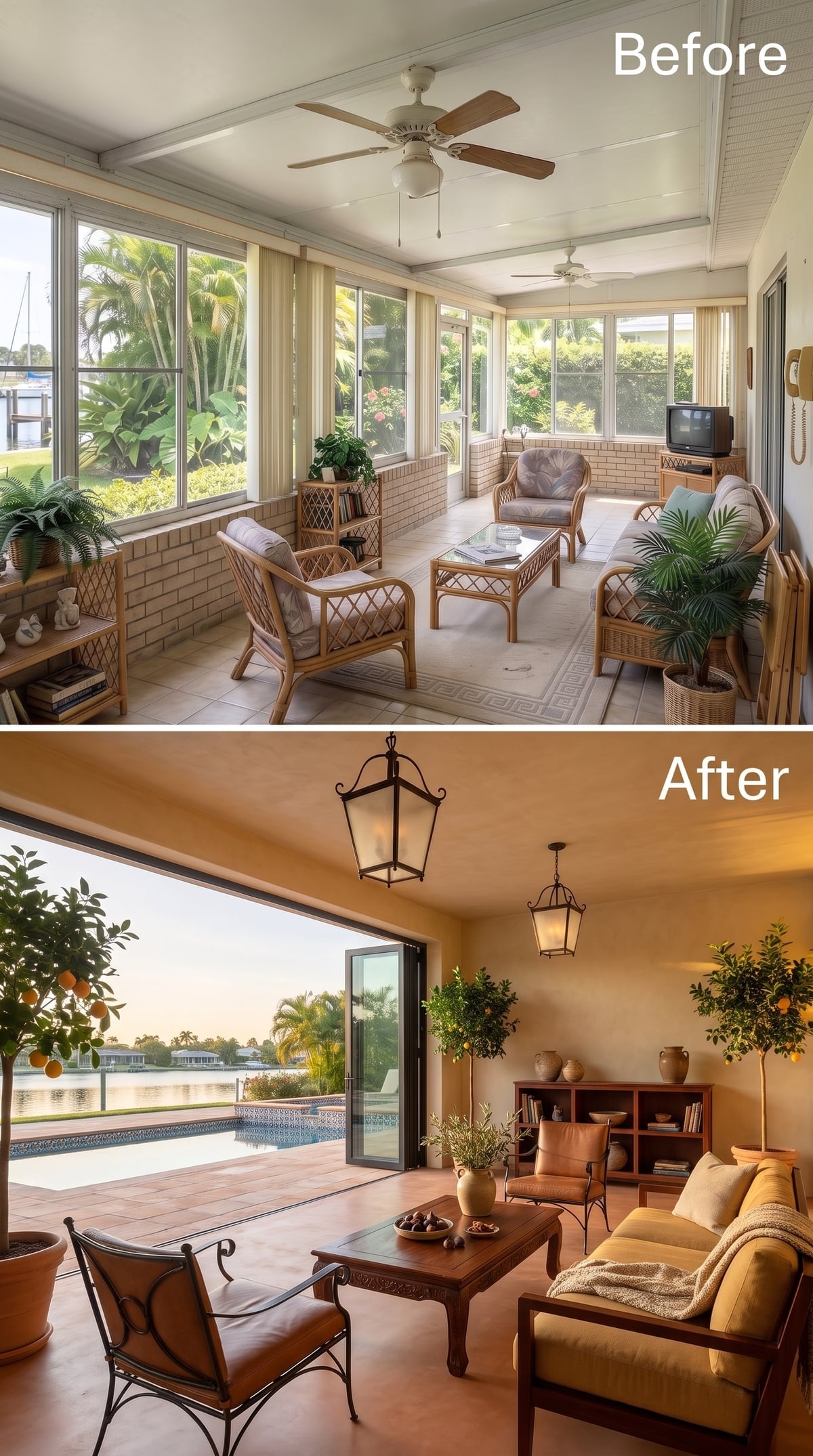
Warm ochre plaster walls set the tone here, pulling the room away from anything beachy or tropical-lite and into something closer to a Mediterranean courtyard. Two wrought iron lantern pendants hang from an unadorned ceiling, and their scale sets the room faster than an elaborate lighting scheme would. The furniture follows suit: a carved wood coffee table, leather-cushioned iron chairs, and a linen sofa draped with a woven throw.
Potted citrus trees with visible fruit repeat through the space at different heights, which keeps the greenery from feeling like a nursery display. The big move, though, is the folding glass wall that opens completely to a pool terrace at golden hour. That view isn’t decoration. It’s the reason the room exists.
By the Numbers: Folding glass walls and multi-slide systems are different mechanisms, but both can create a much wider opening than a conventional patio door when the architecture allows it. The visual boundary between indoors and out nearly disappears, which is why rooms like this often feel larger with the panels open. Furniture still has to work when the glass is closed — otherwise the renovation only makes sense on perfect-weather days.
19. Rough Beams and Rust Bouclé Push Florida Toward Oaxaca
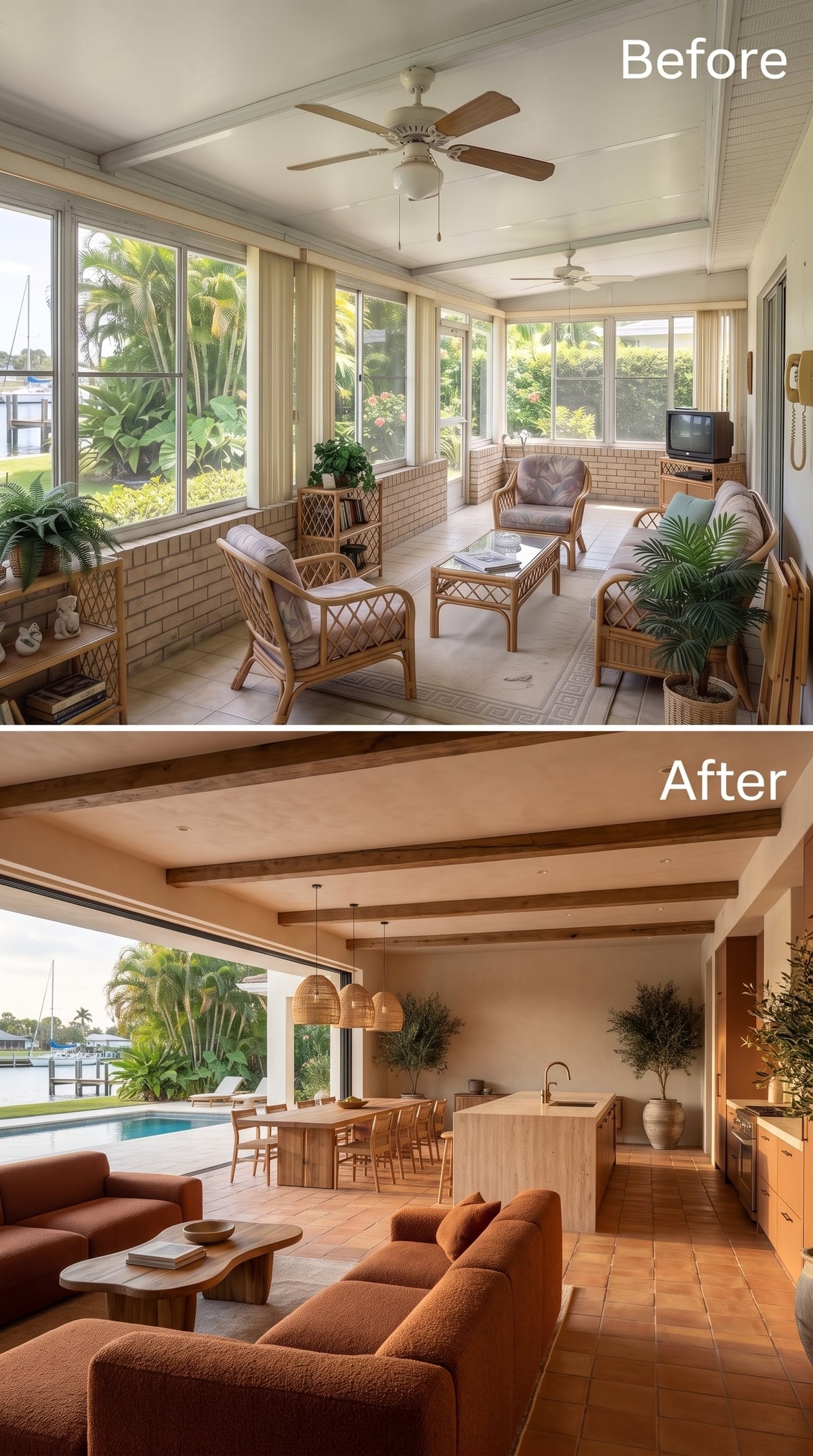
Rough-sawn wood beams run the length of the ceiling against a plaster finish in warm terracotta beige, and the combination leans Oaxacan in spirit more than Floridian. That’s not a complaint. Below them, a pair of deep rust bouclé sofas bring soft curves against the harder geometry of a live-edge coffee table.
Woven rattan pendants hang over a dining table that flows toward a kitchen island clad in what appears to be limestone or honed travertine. The wall on the pool side has been opened entirely with sliding glass, pulling the water and palms directly into the sightline. Potted olive trees flank the island, giving the space vertical greenery without crowding it.
In The Details: Travertine is a type of limestone, but its characteristic pits and voids give it a different surface character from many other limestones. On a high-use counter or island, a filled-and-honed travertine finish can be easier to maintain than an open-pored surface. Other limestones vary widely in density, porosity, and suitability, so the specific stone matters more than the category name.
18. Limewash, Paper Lanterns, and Sliding Glass Keep Everything Airy
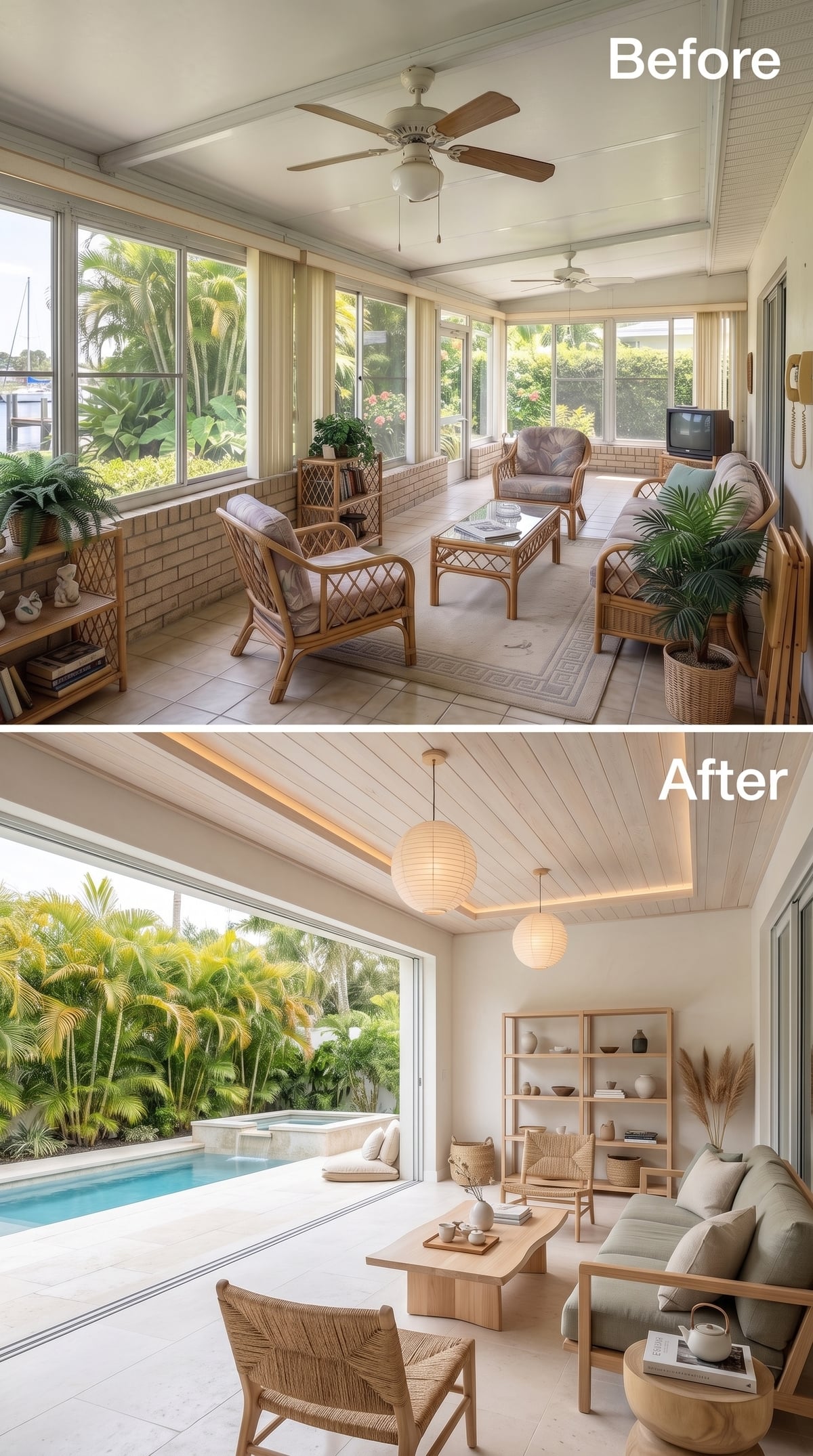
Two paper lanterns hang at different heights from a shiplap ceiling with cove lighting tucked behind a recessed tray, and that layering is what makes the room feel finished rather than fussy. The furniture is light oak with rope-woven seat backs, paired with a linen sofa in warm sage. Limewashed walls soften the daylight rather than sharpening every edge, while the broad sliding-glass opening leaves the pool almost visually flush with the room. Nothing fights for attention, which may be the boldest move in the entire space.
17. Terracotta Plaster and Rust Bouclé Turn Up the Heat
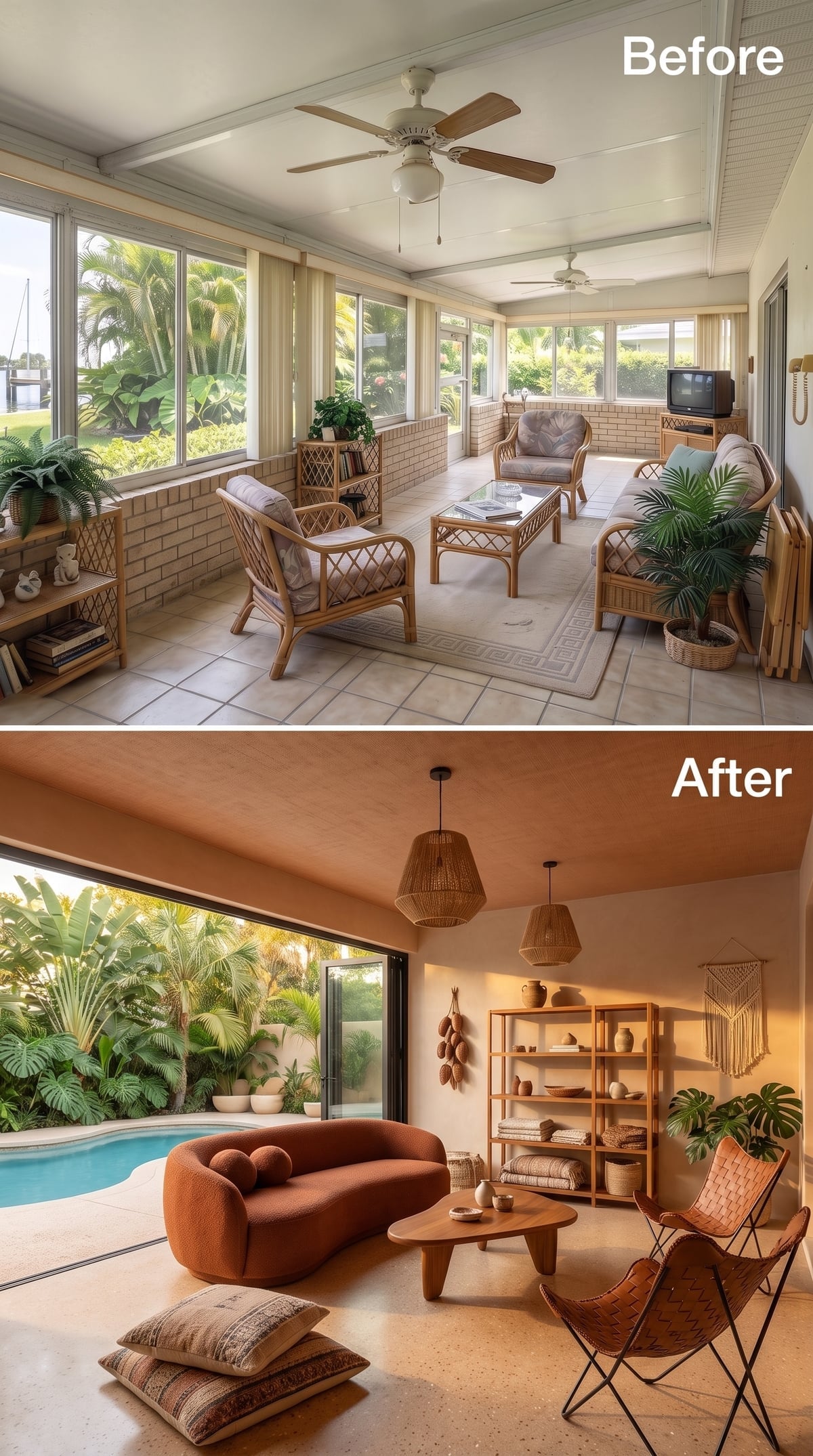
Woven rattan pendants drop from a terracotta-plastered ceiling, and the warmth is immediate. A curved rust bouclé sofa takes the soft route while leather butterfly chairs bring a sharper, lighter silhouette across from it. The palette stays almost stubbornly earthy — clay, rust, leather, wicker — so the open glass wall becomes the cool counterpoint rather than just another luxury feature. Palm green and blue water outside are the only colors the room needs to borrow.
16. Wood Slats, Green Stone, and a Living Wall Blur Every Boundary
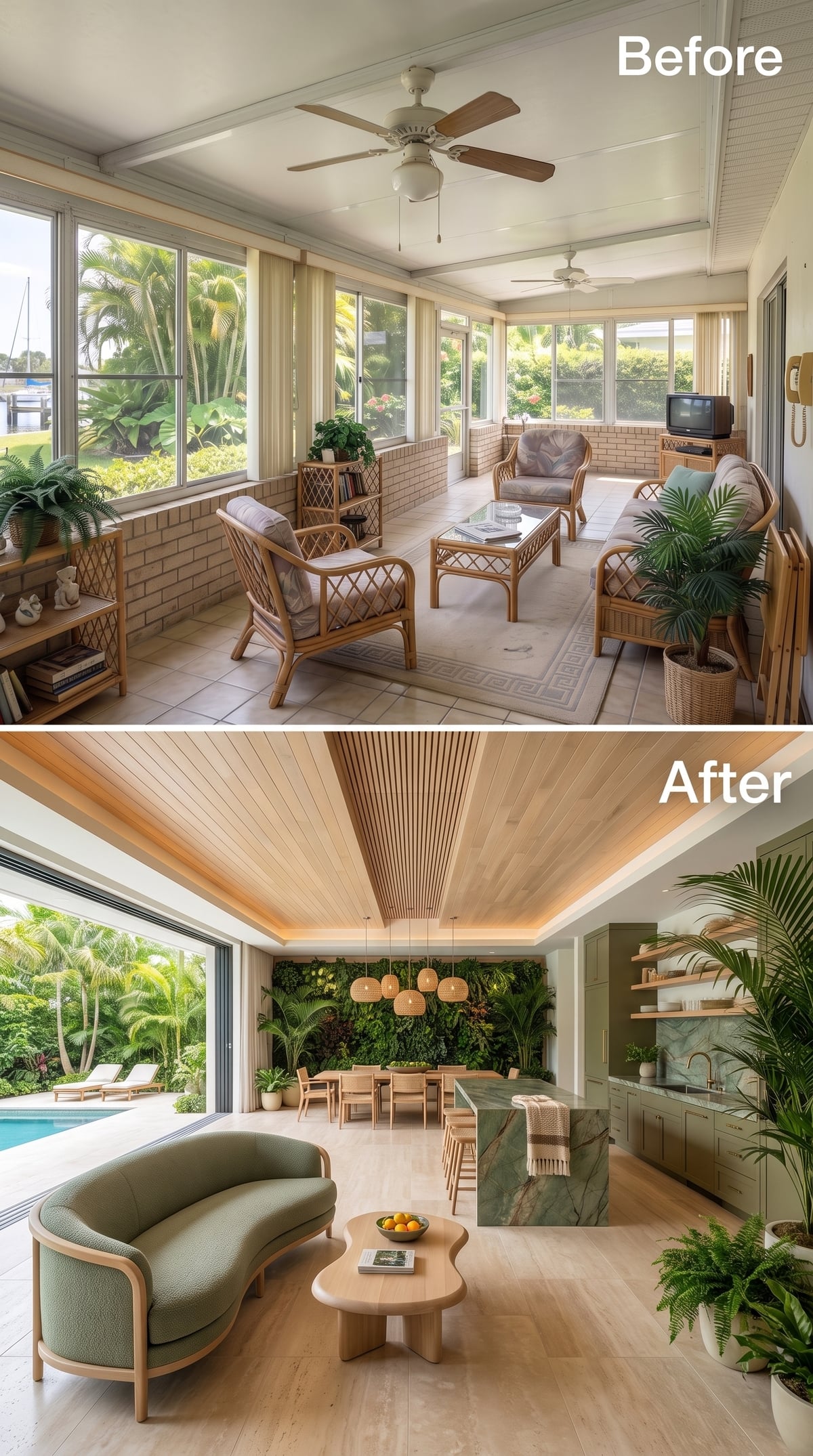
Tongue-and-groove planks run the full ceiling length, but the real move is the recessed tray that drops down the center, framed by LED cove lighting that glows warm without competing with the view outside. The result is a ceiling with actual architecture.
Below it, a curved sage-green sofa defines the living zone while a green marble-look island draws a clear line between kitchen and dining. Rattan pendants hang over a light wood dining table, and a full living wall of ferns and tropical foliage closes the far end. It’s lush without being loud.
Why It Works: Dense planting, substrate, and backing can help soften some sound reflections in hard-surfaced rooms, but the acoustic effect depends on how the living-wall system is actually built. Here the bigger payoff is visual: the plant wall gives the far end of an open-plan room a destination without needing another piece of furniture or another color story.
15. A Sunken Conversation Pit Changes the Floor Plan Completely
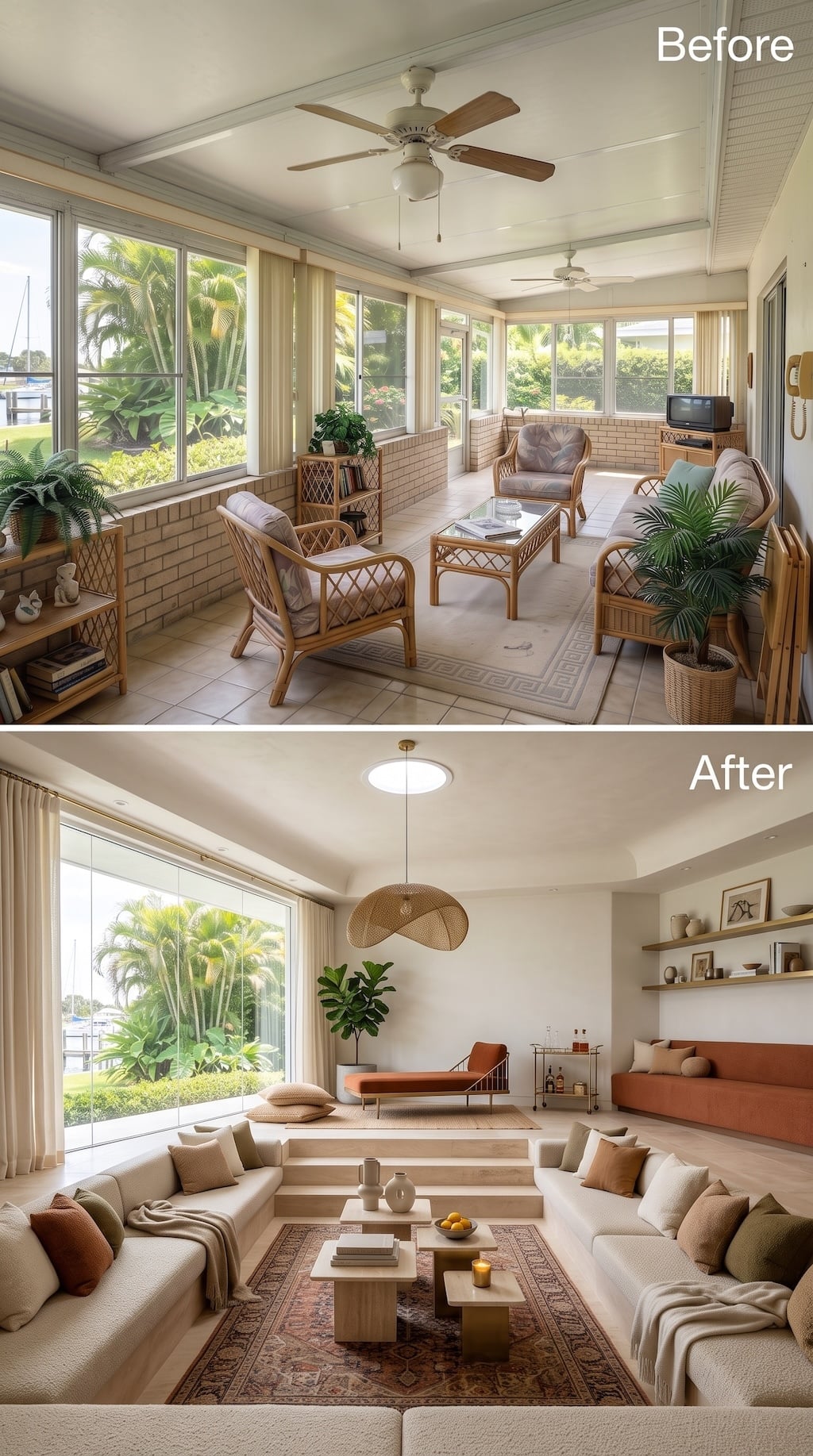
Cream bouclé sectionals wrap what appears to be a recessed conversation pit a few steps below the surrounding floor plane, a move that changes the room more dramatically than any paint color could. The travertine-look stepped platform gives the seating area its own territory without walling it off, and a woven rattan pendant hangs low enough over the arrangement to make the ceiling feel intentional rather than just tall. An overdyed Persian rug brings in pattern and warmth.
Earth-toned cushions in rust and olive keep the palette from reading too soft. Open wood shelves on the right wall carry ceramics and a framed print without crowding. The fiddle-leaf fig near the window earns its spot. And floor-length linen curtains frame the tropical view outside without competing with it.
14. Charcoal Beams and Pocket Glass Turn the View Into Architecture
🔥 Would you like to save this?
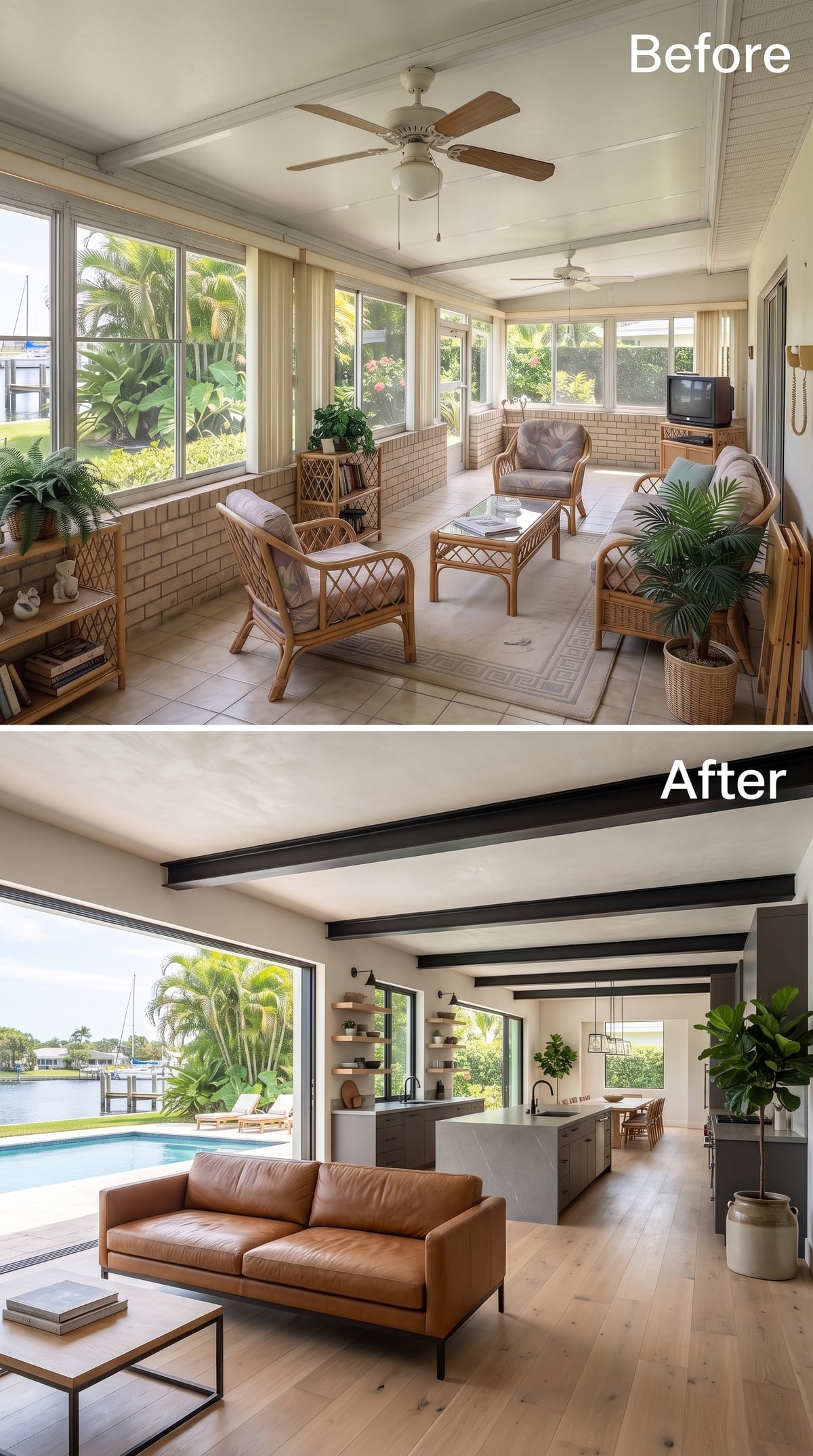
Exposed beams painted charcoal against a white plaster ceiling send the eye toward the waterway view beyond a full-width sliding glass opening. The oak hardwood floor runs long and uninterrupted, and a caramel leather sofa gives the living area weight without crowding it. Behind it, a concrete island establishes the kitchen zone with open shelving in the same dark finish as the beams.
- Matching beam color to cabinet finish creates visual continuity across an open-plan space without additional design work
- Pocketing multi-slide and folding glass systems solve the opening differently; coastal performance depends on the specific hardware, finish, drainage, seals, installation, and maintenance rather than the operating style alone
- A fiddle-leaf fig placed near a corner window gets the indirect brightness it needs while softening what would otherwise be a hard architectural edge
13. Walnut Coffers and a Marble Island Merge Sunroom and Kitchen
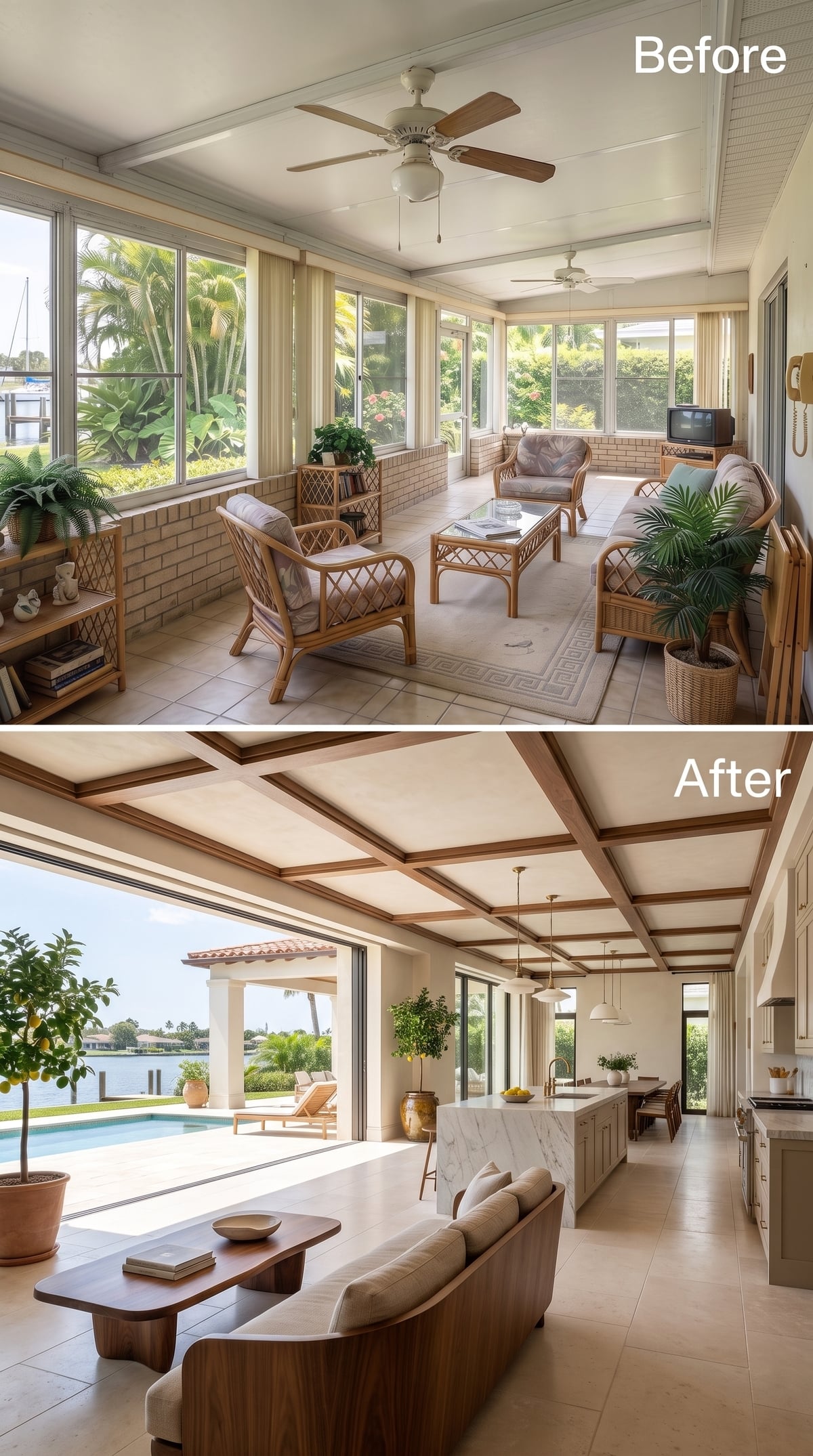
Walnut-trimmed coffered panels span the ceiling, and that detail alone shifts the entire room’s register from casual porch to something that feels considered. Below it, a curved sofa in linen-toned upholstery faces a low walnut coffee table, while a waterfall marble-look island behind it blurs the line between living room and kitchen. Pocket glass doors disappear entirely, putting the pool and waterway directly in conversation with the interior.
Budget Tip: Decorative coffers can be created over an existing flat ceiling with applied trim or lightweight built-up members rather than a fully structural coffered system. MDF is one possible material in suitable dry interior conditions, but layout, fastening, ceiling flatness, electrical work, and finishing still drive labor. The useful lesson here is visual rather than financial: shallow applied geometry can change a plain ceiling dramatically.
12. Radiating Brass Lines Turn the Ceiling Into a Graphic Device
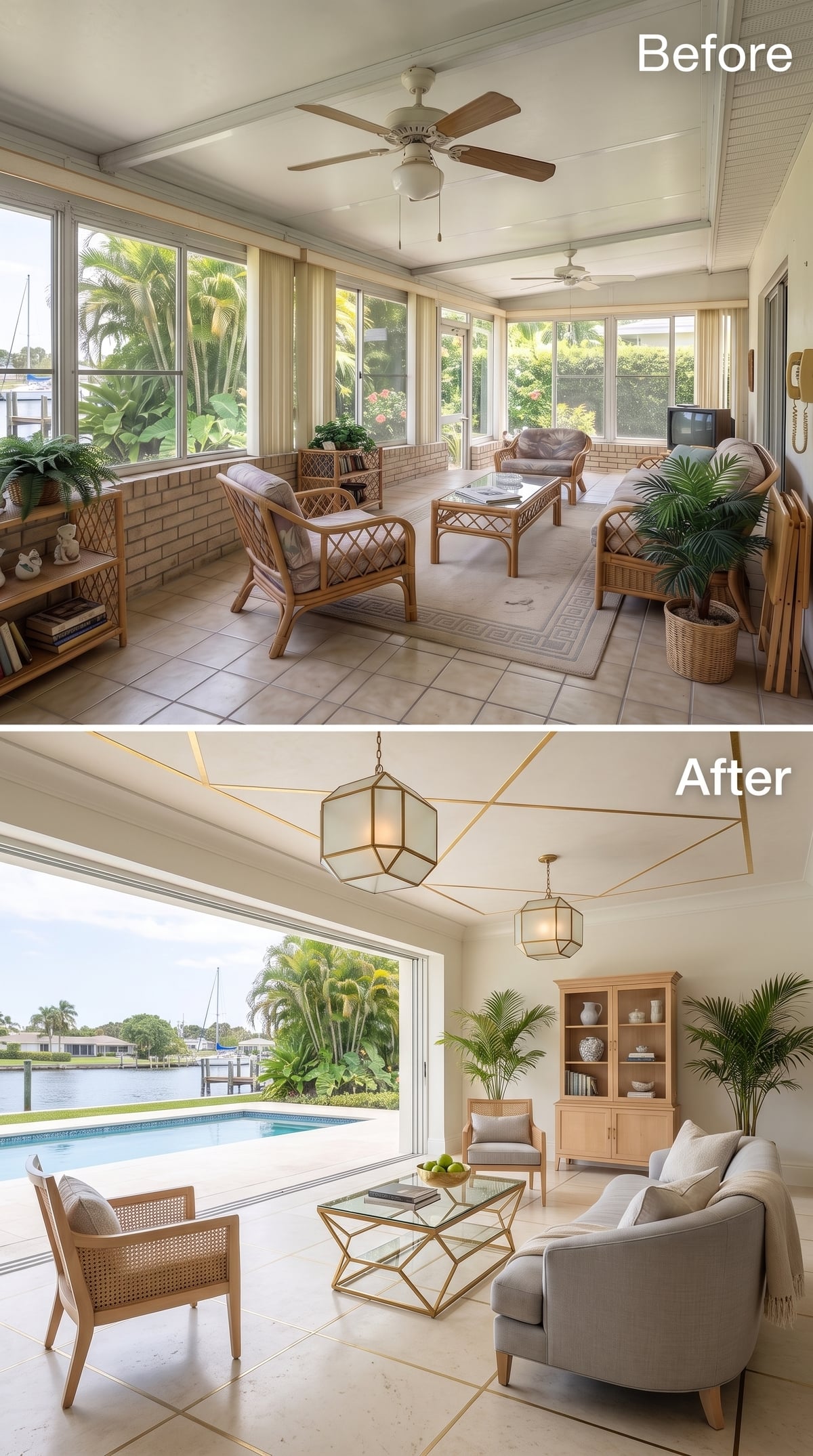
Brass inlay lines radiate across the ceiling like spokes, drawing attention toward two frosted geometric pendant lanterns hung at different heights. Instead of treating the ceiling as leftover drywall, the design turns it into a diagram. The old segmented window wall gives way to a broad glass opening, so all that geometry overhead has a clean horizontal counterweight: pool, waterway, sky. Furniture can stay relatively quiet because the architecture is already doing the talking.
11. Rounded Windows and Terracotta Curves Change the Architecture
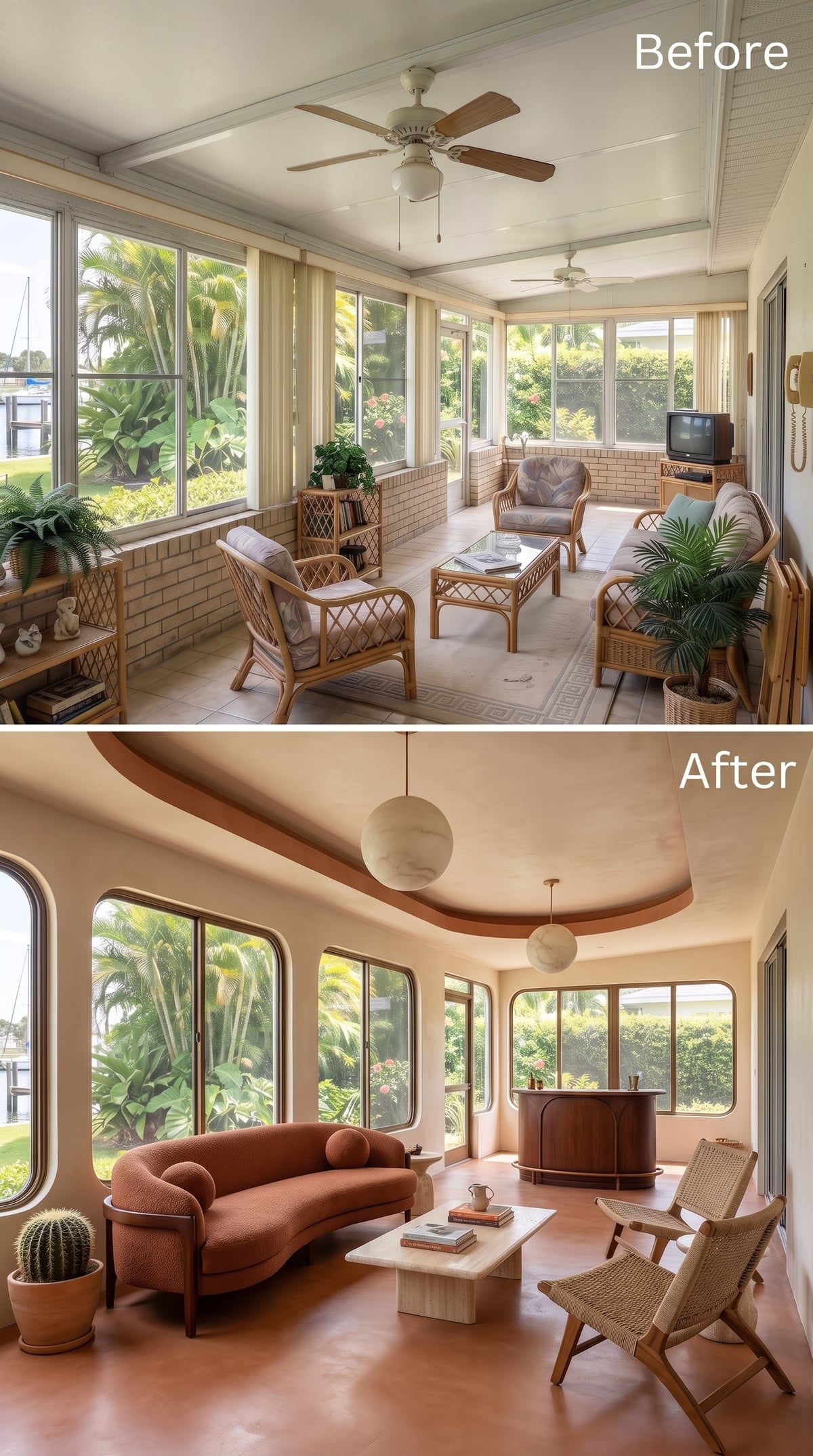
Rounded window frames replace the standard rectangles, and that single choice sets the tone for everything else. A curved plaster soffit runs the length of the ceiling, outlined in terracotta trim that picks up the warm red of the polished concrete floor below. The sofa is a rust bouclé cloud shape, low and wide. Two woven rope chairs face it across a travertine-look coffee table, and a cylindrical dark walnut bar console commands the far wall. Pendant globes hang in pairs, matte and moon-like.
10. Bauhaus Leather and Cobalt Blue Take the Sunroom Off Script
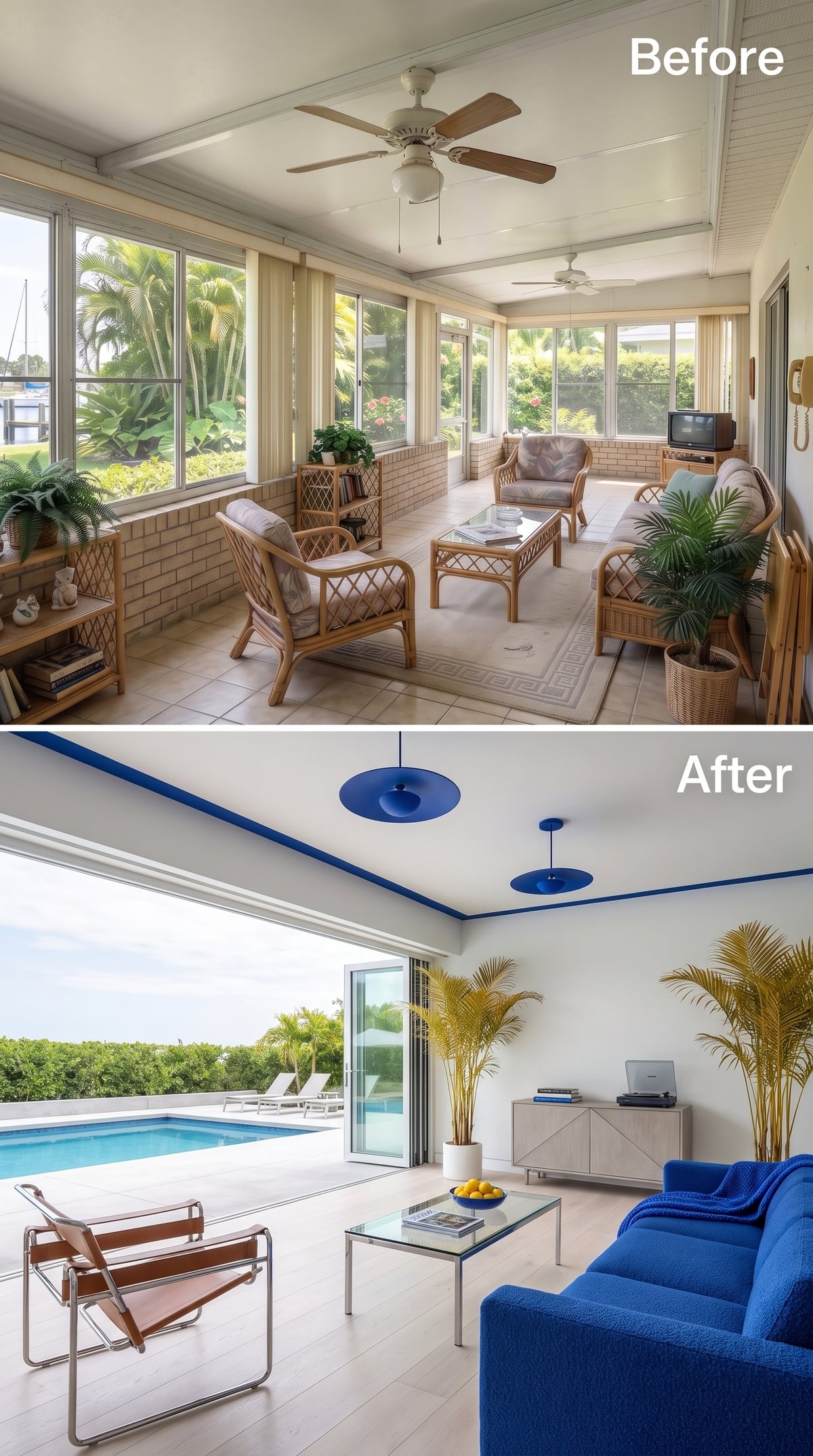
Cobalt blue runs along the crown molding and repeats in a pair of pendant lights that hang low over the seating area, giving the upper half of the room color without covering the entire ceiling. The sofa picks up that same saturated blue in a terry or bouclé-adjacent fabric, dense enough to hold its color in strong Florida light.
A Wassily-style chair in brown leather and chrome sits across from a glass-and-chrome coffee table. It’s a genuinely unexpected pairing. The room opens completely toward a pool terrace, and that view outmuscles every decorative detail.
The room opens completely toward a pool terrace, and that view outmuscles every decorative detail.
9. Raw Concrete and Cognac Leather Sharpen the Sunroom
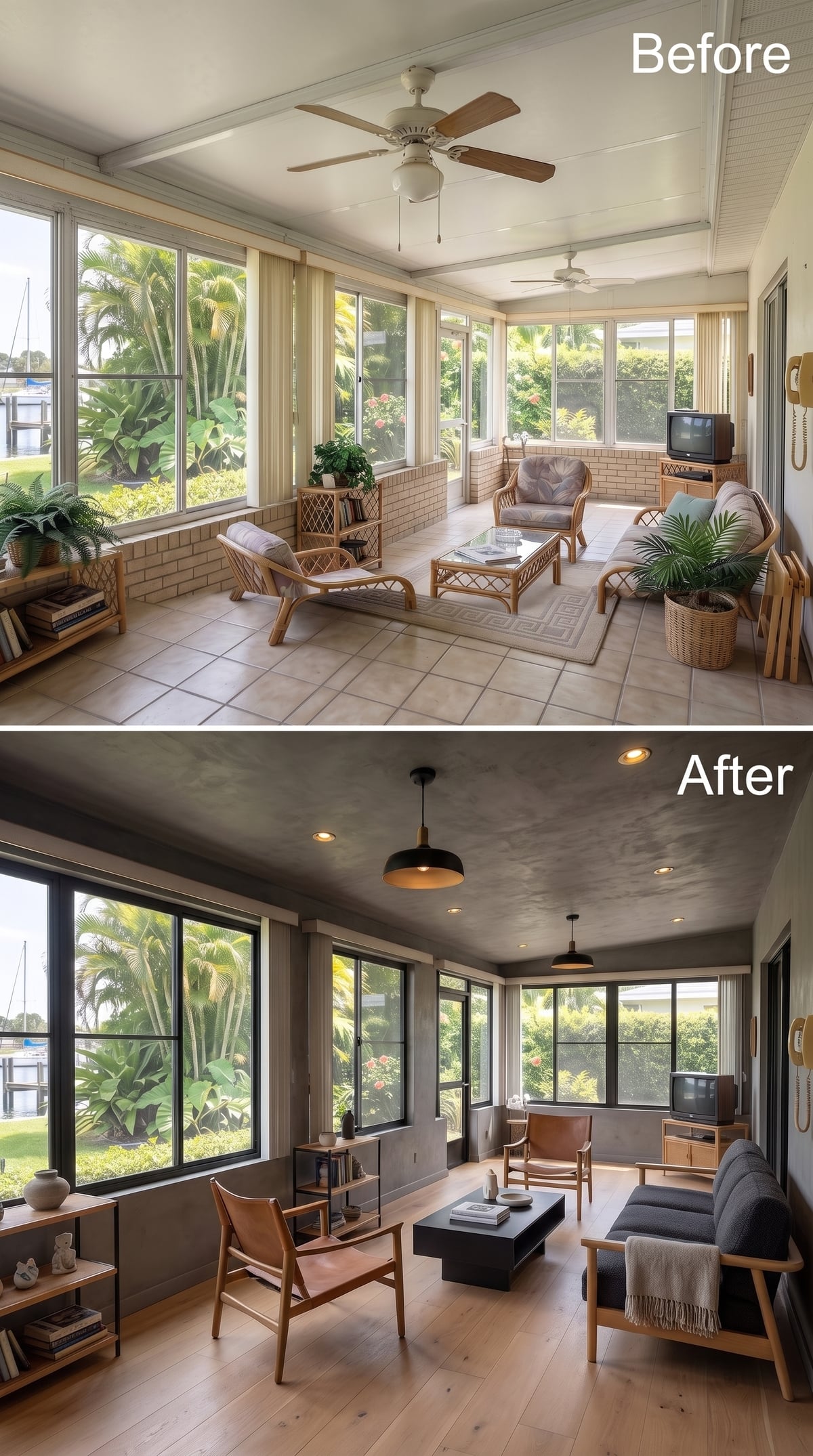
Polished wood floors replaced the old tile entirely, and the shift sets a different tone before anyone even looks up. The ceiling is finished in raw concrete, paired with matte black pendant lights that drop at two different heights. Leather chairs in cognac sit across from a charcoal sofa, keeping the room warm without matching anything too deliberately.
Trend Alert: Mixing seating in two distinct materials, like leather and upholstered fabric, prevents a living space from reading as a showroom set. The contrast between the cognac chairs and the dark sofa works because neither piece is trying to coordinate with the other. Rooms that don’t match too hard tend to feel more lived-in and less staged.
8. Navy Lacquer and an Op-Art Rug Refuse the Safe Option
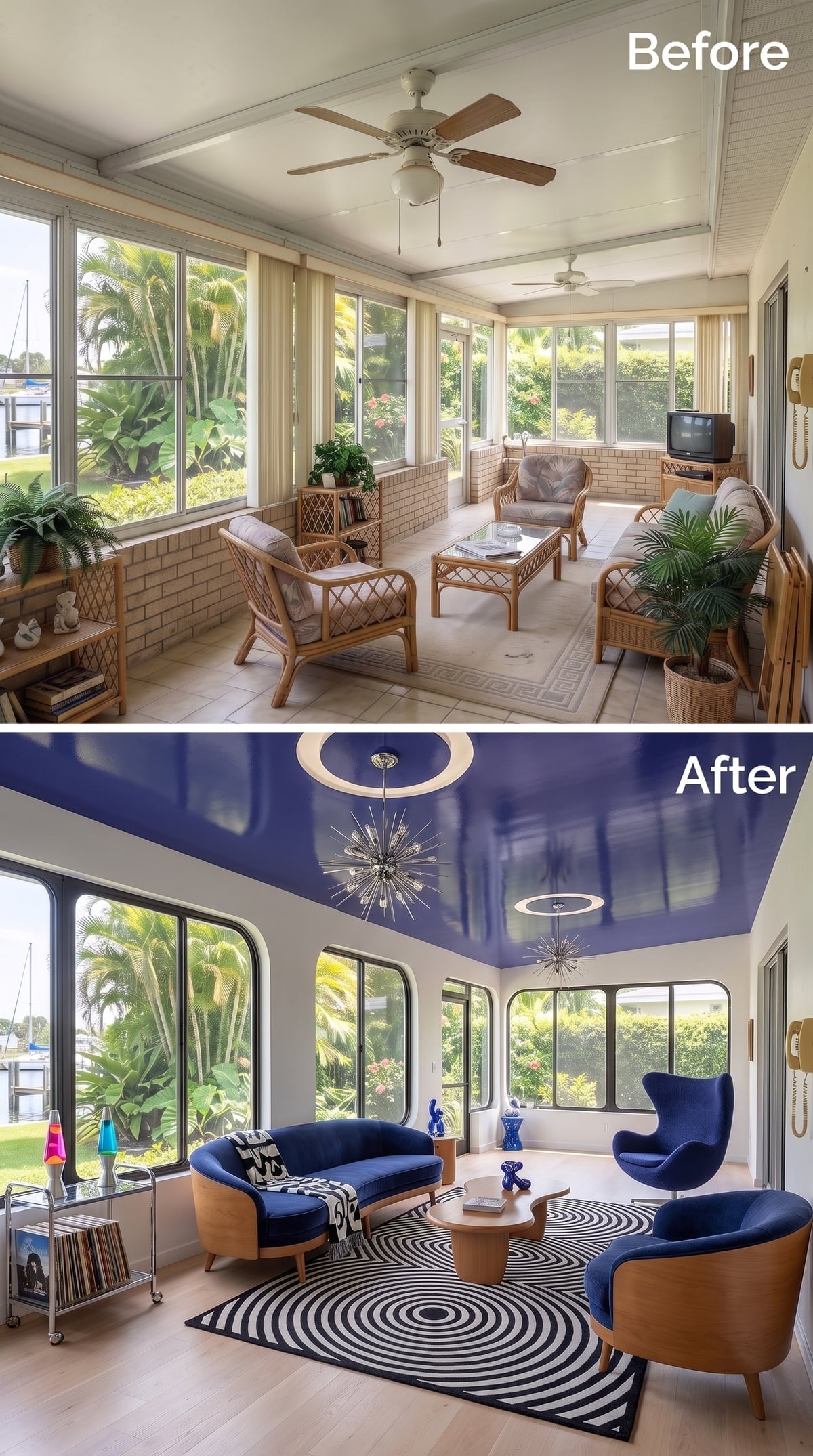
Royal blue lacquer covers the entire ceiling in a high-sheen finish that reflects the Florida light pouring through the arched windows. It shouldn’t work. It absolutely does.
Below it, a curved sofa in navy velvet commands the room alongside egg chairs with cognac wood bases. The black-and-white concentric rug snaps everything into focus without trying to imitate the ceiling.
Did You Know: East Asian lacquer traditions stretch back thousands of years, and European makers were imitating Asian lacquer finishes through techniques such as japanning centuries before the 1970s arrived. Modern high-gloss architectural coatings vary widely in chemistry, sheen, cure time, and emissions, so the product specification matters more than the catchall word ‘lacquer.’ The lava lamp on the chrome cart is pure mischief — and exactly the kind of detail this room can absorb.
Even at its darkest, the ceiling leaves the floor free to carry the graphic punch.
7. Cobalt Lacquer and Gold Discs Go All In on Color
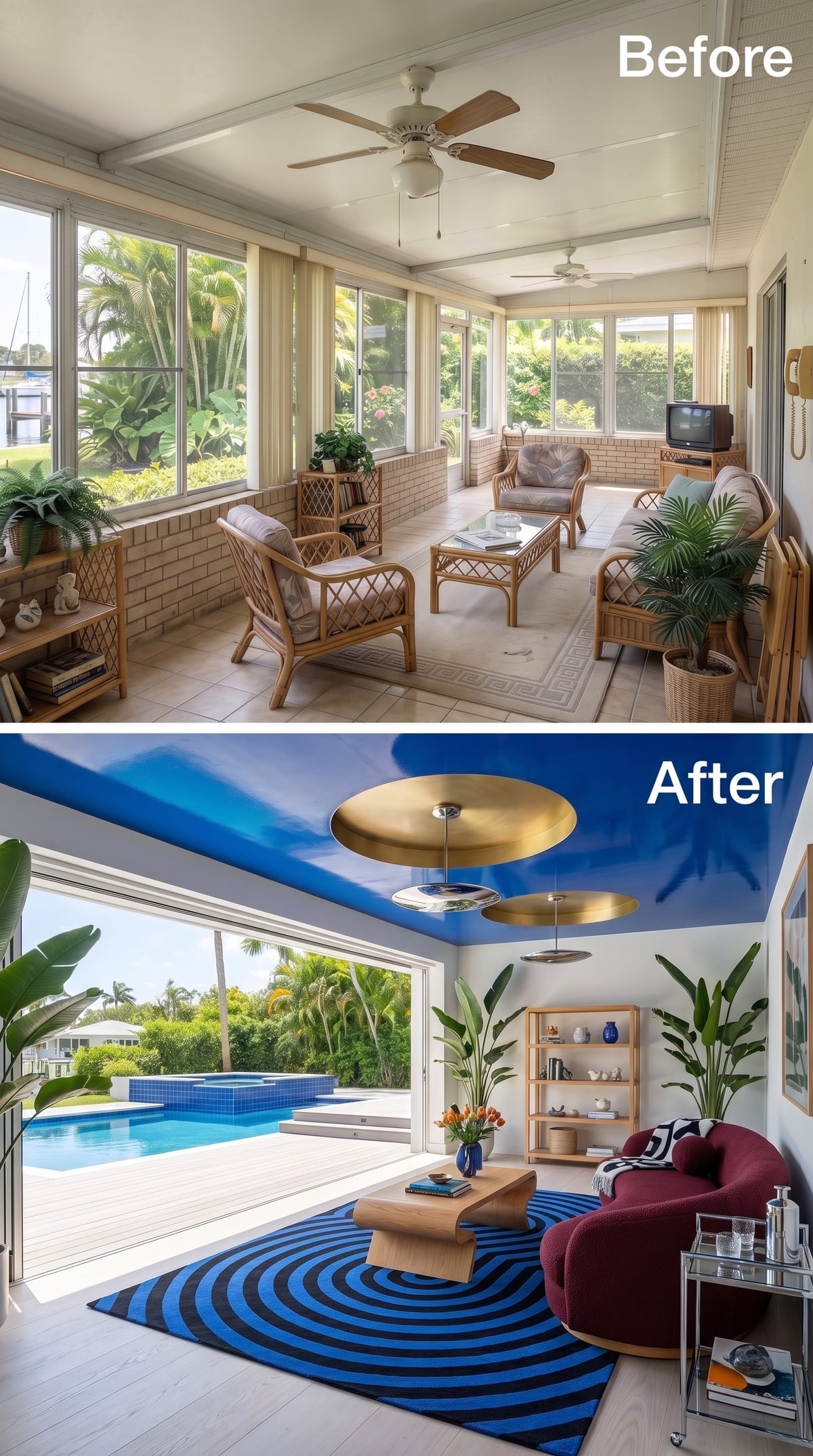
Gold disc pendants hang from a high-gloss cobalt ceiling, their flat circular forms looking almost graphic against all that saturated blue. Below, a blue-and-black concentric rug doubles down on the geometry while a burgundy bouclé sofa deliberately refuses to match. The contrast is risky, which is exactly why the room has a pulse. Nothing here was chosen to disappear politely into the background.
6. Concrete Overhead and Tufted Leather Give the Water View Weight
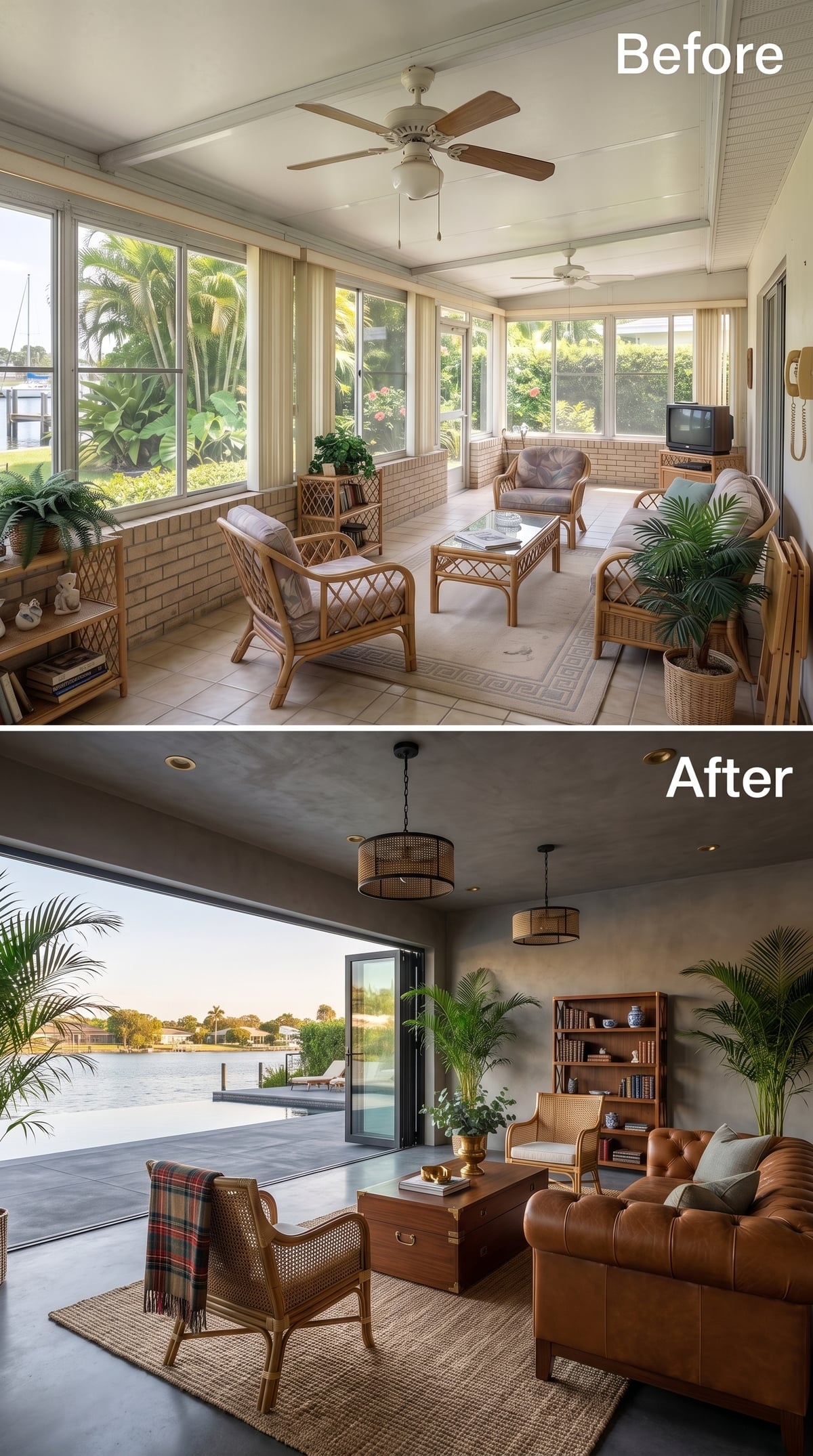
Concrete plaster on the ceiling pulls the whole room darker, so the waterway glimpsed through the folding glass wall reads almost like a painting. A tufted cognac leather sofa warms that severity, paired with a cane chair draped in a plaid wool throw. The pairing works because the room never commits completely to industrial coolness: concrete overhead, leather and cane below, moving water beyond the glass. It feels weighty without feeling sealed off.
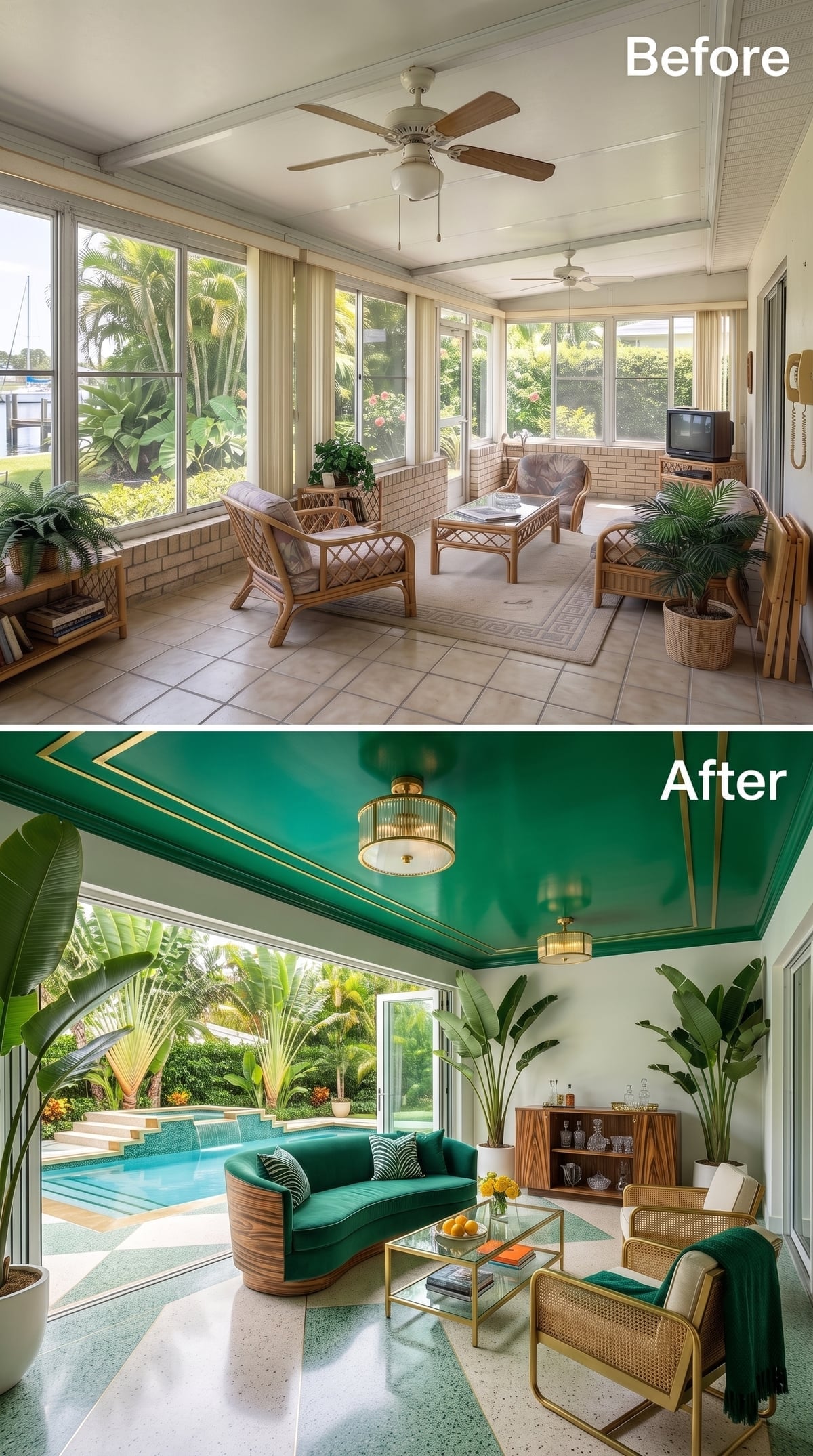
5. Kelly Green Lacquer and Terrazzo Make the Garden Part of the Palette
🔥 Would you like to save this?
Kelly green lacquer on the ceiling, trimmed in gold, pulls the lush garden outside directly into the room. Terrazzo underfoot scatters the palette into smaller chips rather than repeating one solid green plane, while a curved velvet sofa gives the seating area a quieter center. This is the brighter, brasher cousin of the earlier emerald lounge: less cocktail bar, more tropical salon, with the garden acting as part of the color scheme instead of scenery beyond the glass.
4. Navy Upholstery and White Shiplap Give the Marina View a Cleaner Frame
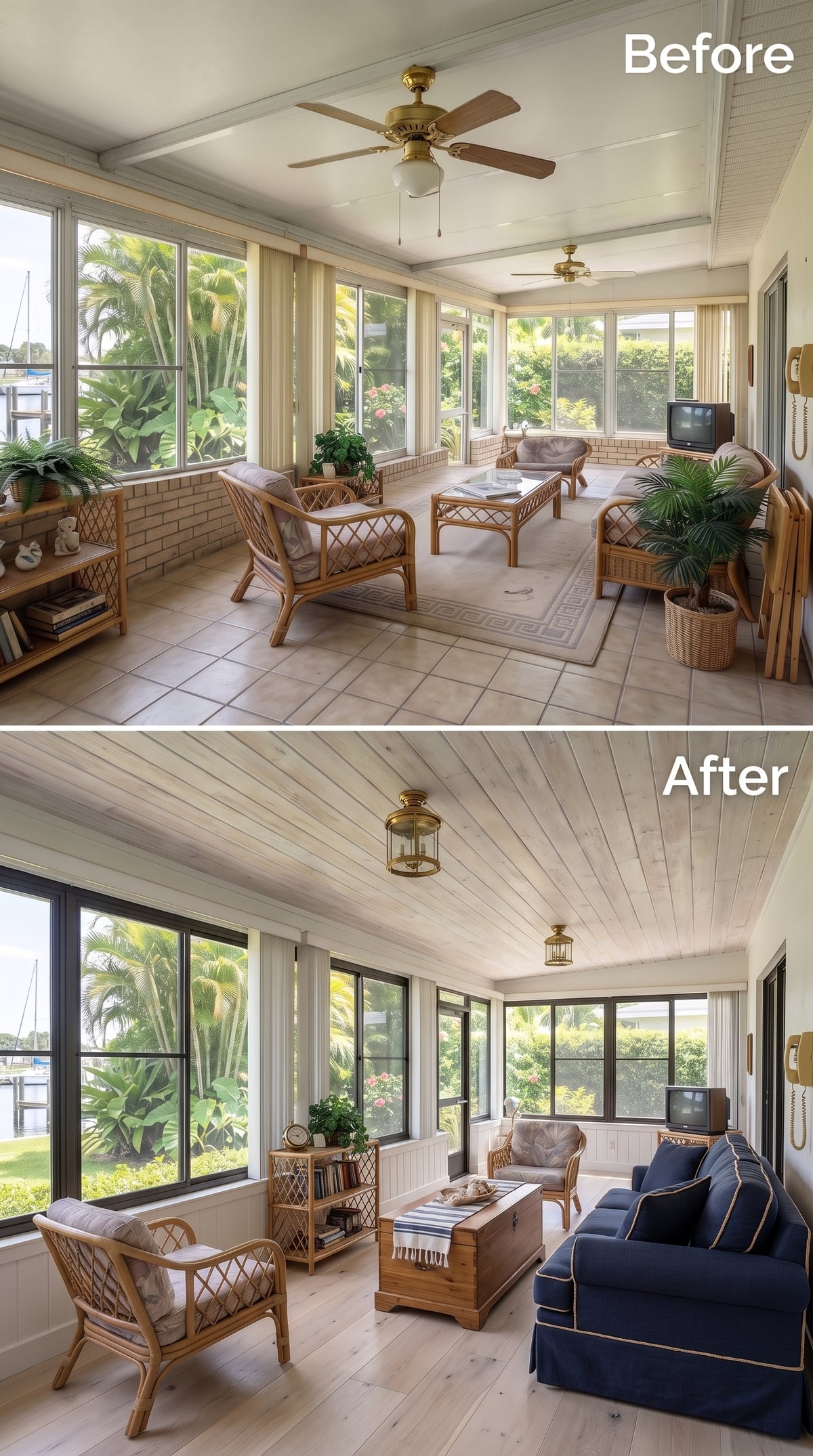
Whitewashed wood plank ceiling runs the full length of the room, and the lantern-style pendant hanging from it reads more nautical than rustic. That’s not an accident. Navy upholstery on the sofa, piped in a lighter contrasting trim, gives the seating area definition against the cane chairs without crowding them.
A cedar chest serves as the coffee table, which keeps the center of the room from feeling too formal. Light hardwood flooring replaces what was likely tile, and the black window frames send attention outward toward the palms and marina beyond.
3. Blush Bouclé and Sculptural Brass Give the Sunroom a Softer Side
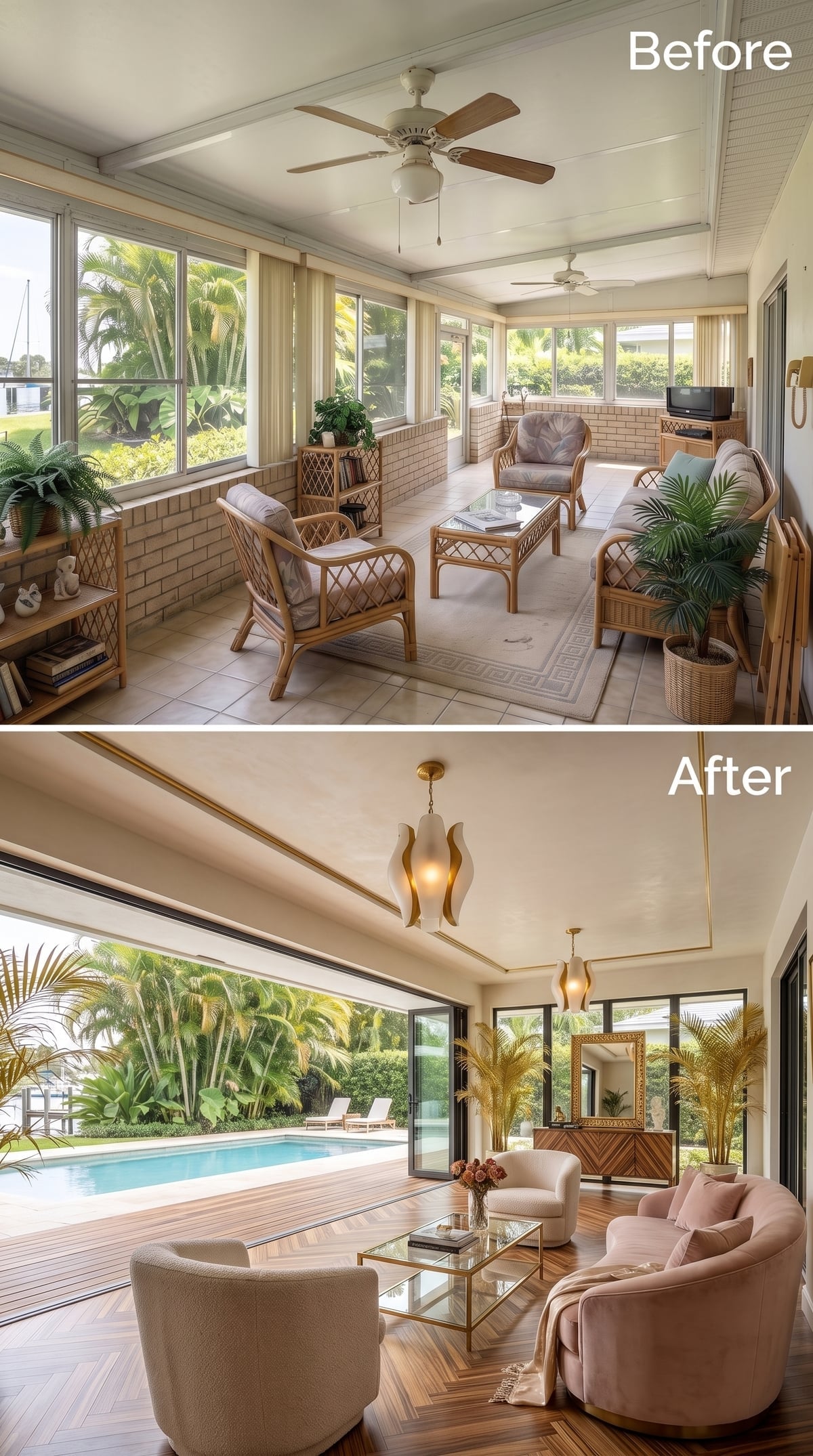
Rounded bouclé sofas in a soft blush sit low and wide, giving the room a shape that feels more like a lounge than a sunroom. Gold-framed glass coffee table, warm wood flooring laid in a herringbone pattern, an ornate gilded mirror on the back wall. Each piece pulls in a different direction, and somehow it holds together.
Floor-to-ceiling sliding glass panels replace what were once segmented windows, opening the entire wall to a pool and lush tropical landscaping beyond. An organic sculptural pendant in frosted glass and brass drops from the ceiling, and a second one echoes it deeper in the space. That echo gives the room continuity without turning the pair into a matched set.
Fun Fact: Bouclé upholstery uses looped yarns that create the nubby surface associated with so much mid-century seating. Its durability varies enormously by fiber and construction, so the smart move is to check the actual abrasion rating rather than assuming every bouclé can take the same punishment. Visually, though, the texture has a rare trick: it can look relaxed or polished depending on what surrounds it.
2. Burgundy Overhead, Cream Curves Below: The Room Goes Full Drama
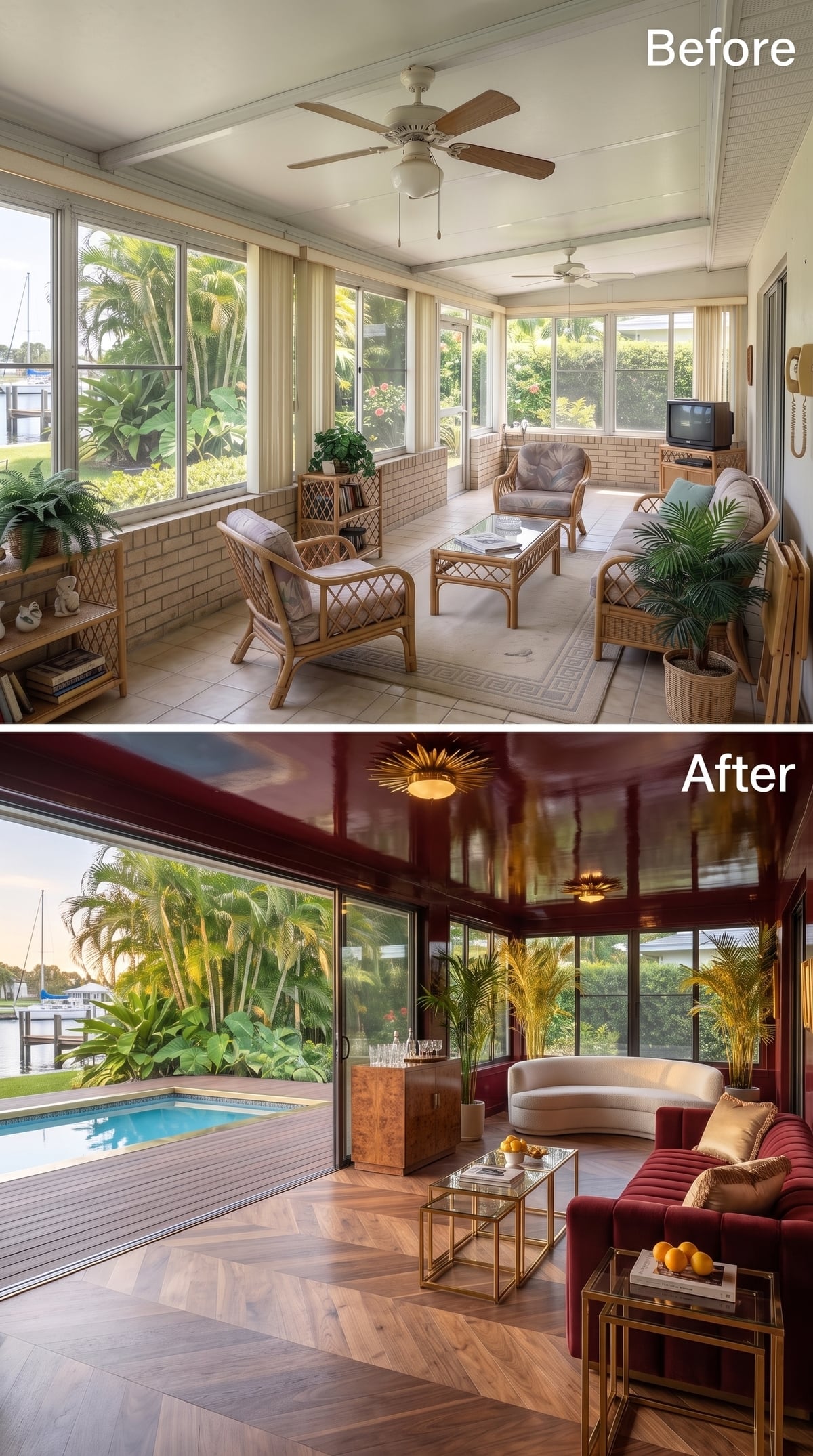
Glossy burgundy coats the ceiling and wraps into the upper walls, reflecting the pool light back into the room. The color is dense enough to make the pale furniture look almost illuminated by comparison, turning a familiar cream-and-gold combination into something much sharper.
Why a Curved Sofa Works Better Here Than a Standard Sectional
Curved sofas follow the eye around a room rather than pinning the seating to one wall, which matters in a sunroom where the sightlines compete with large windows on multiple sides. The cream upholstery on this particular piece stands up to the deep burgundy overhead without fighting it. Pair that with gold-frame glass tables and you get a color story that stays composed rather than chaotic.
1. A Fireplace and Vaulted Shiplap Save the Biggest Surprise for Last
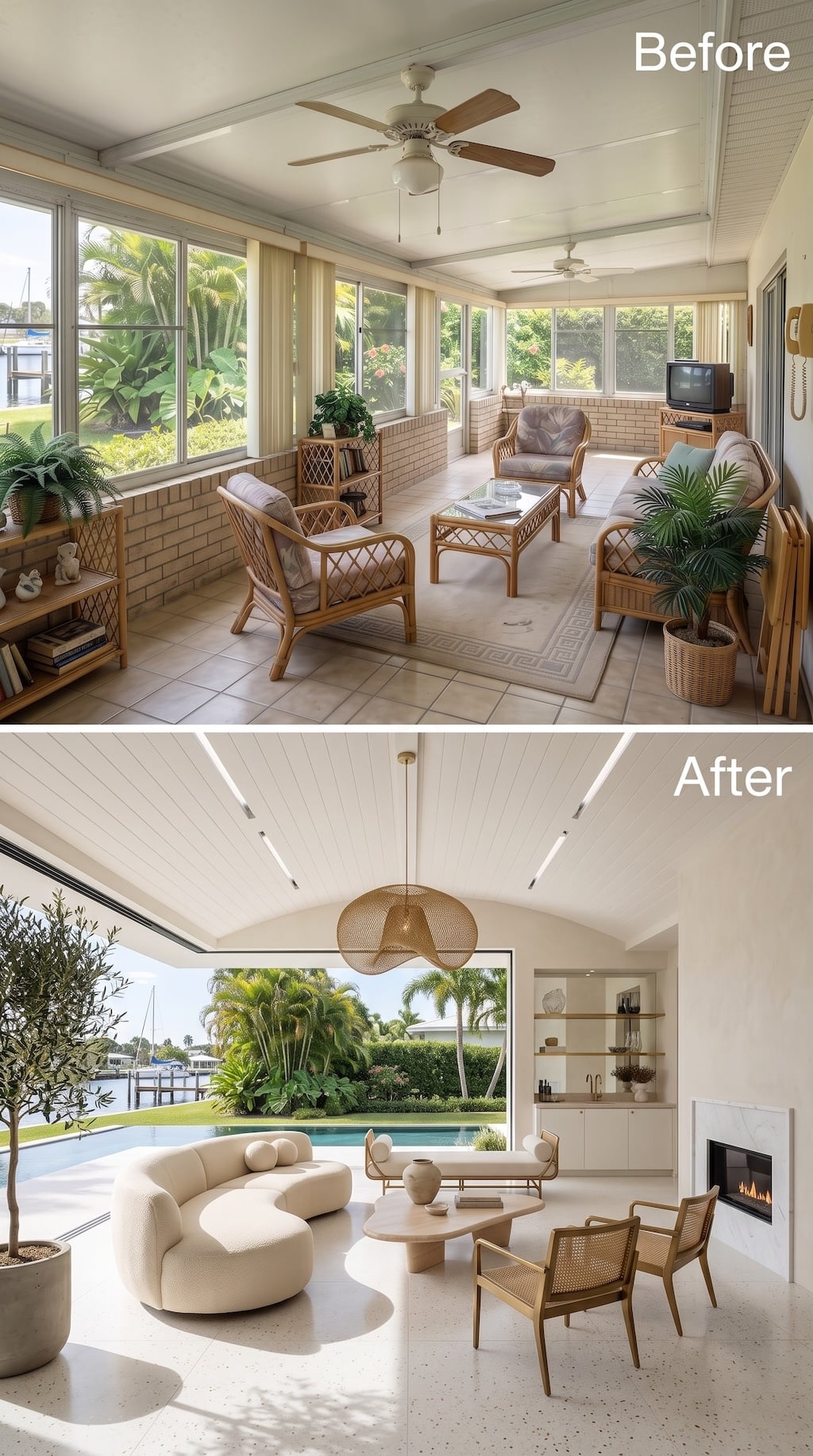
Someone made a bold call adding a fireplace to a Florida sunroom, and it works. Set flush into a white plaster surround with a linear opening, it gives the right wall real presence without competing with the pool view that now fills most of the opposite side. Linear LED strips run along the vaulted shiplap ceiling, replacing the old ceiling fans with something that actually suits the architecture.
The furniture brings the personality. A curved, s-shaped bouclé sofa in warm cream pairs with cane-back chairs in a lighter wood, and the mix keeps the seating area from feeling too precious. Terrazzo floors run throughout, and a rattan pendant hangs low over the stone coffee table. Built-in shelving beside the fireplace handles storage without making it obvious.