🔥 Would you like to save this?
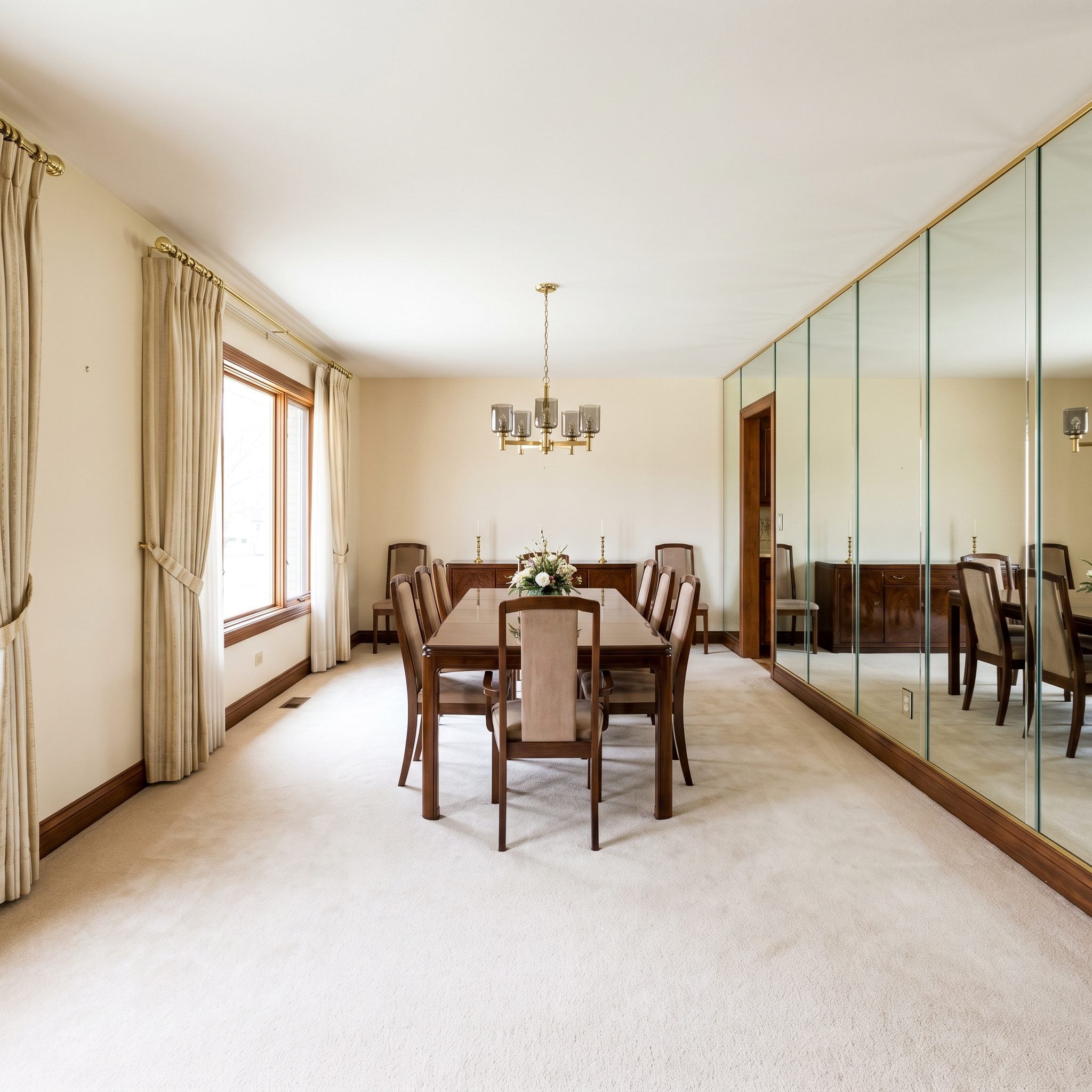
The mirrors were supposed to make the room feel larger, brighter, more glamorous. Instead they multiplied everything the room already had too much of: beige carpet, brown furniture, a lonely chandelier and the unmistakable feeling that the party ended sometime around 1987. The room itself was never the problem. The surfaces are simply doing it no favors.
That makes this an unusually good design experiment. Across 33 transformations, the window, doorway and basic proportions stay recognizable while almost every other decision is reconsidered: stone instead of glass, lacquer instead of beige paint, walnut instead of carpet, shelving instead of reflection, sculptural lighting instead of one apologetic fixture hanging in the middle.
In order to come up with the very specific design ideas, we create most designs with the assistance of state-of-the-art AI interior design software. Also, assume links that take you off the site are affiliate links such as links to Amazon. this means we may earn a commission if you buy something.
The interesting part is not watching one dated room become “modern.” It is seeing how many completely different rooms were hiding inside the same box. Some go pale and architectural. Others turn dark, glossy, earthy, bookish, Mediterranean or almost cinematic. The mirror wall disappears every time. What replaces it is where the real story starts.
33. Italian Travertine Glamour That Finally Gets the Glamour Right
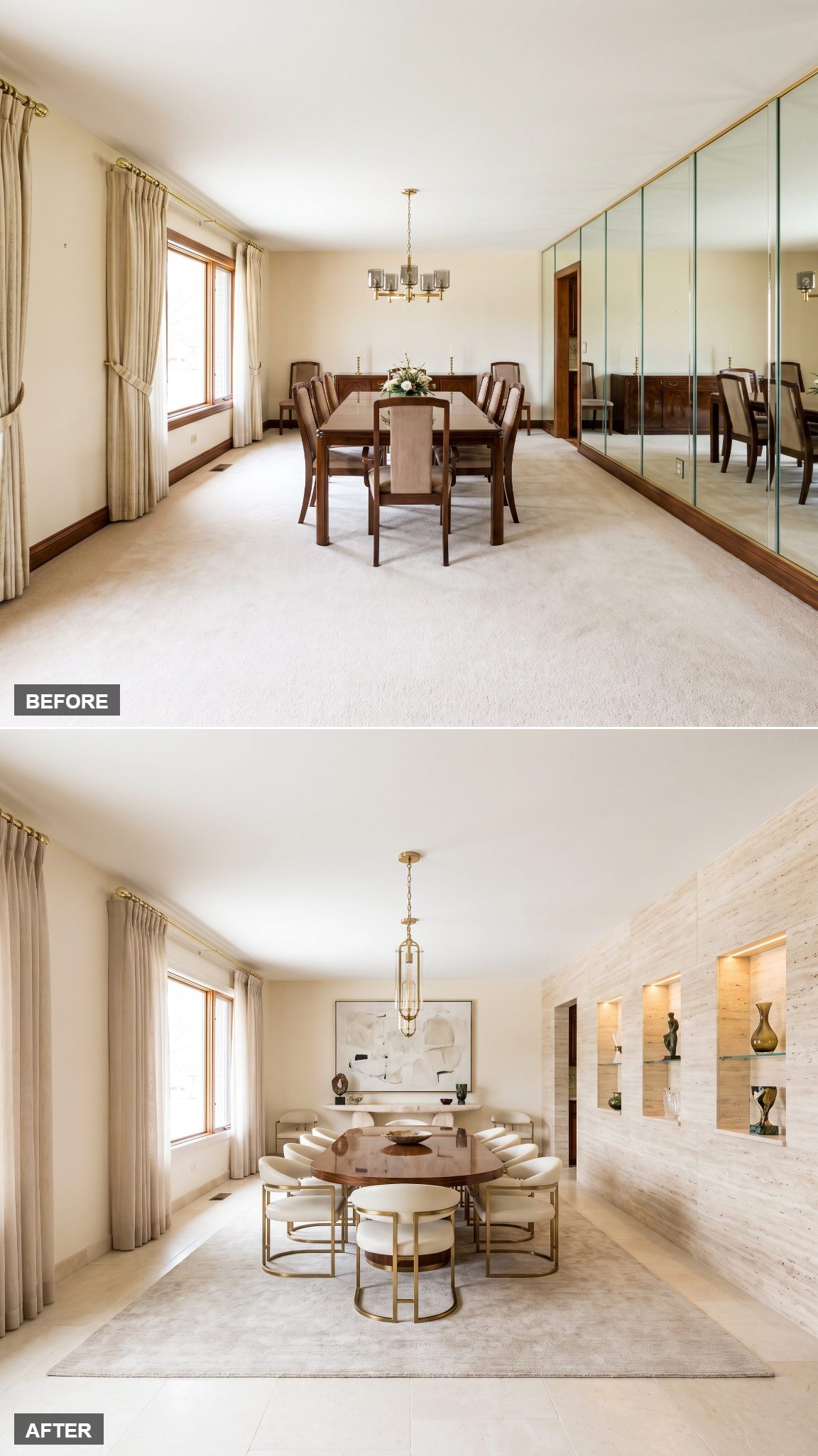
Start with stone and let the room show off properly. Warm travertine wraps the feature wall, its horizontal veining giving the long room a calmer, more architectural rhythm than the vertical seams of the old mirrors ever managed.
A round pedestal table loosens the geometry, caramel leather chairs bring warmth, and a cluster of frosted glass globes gives the ceiling some presence without recreating the old chandelier’s fussiness. Brass appears in small doses. The effect is polished but not precious — Milan on a Tuesday rather than a showroom waiting for velvet ropes.
32. Emerald Marble Jewel Box
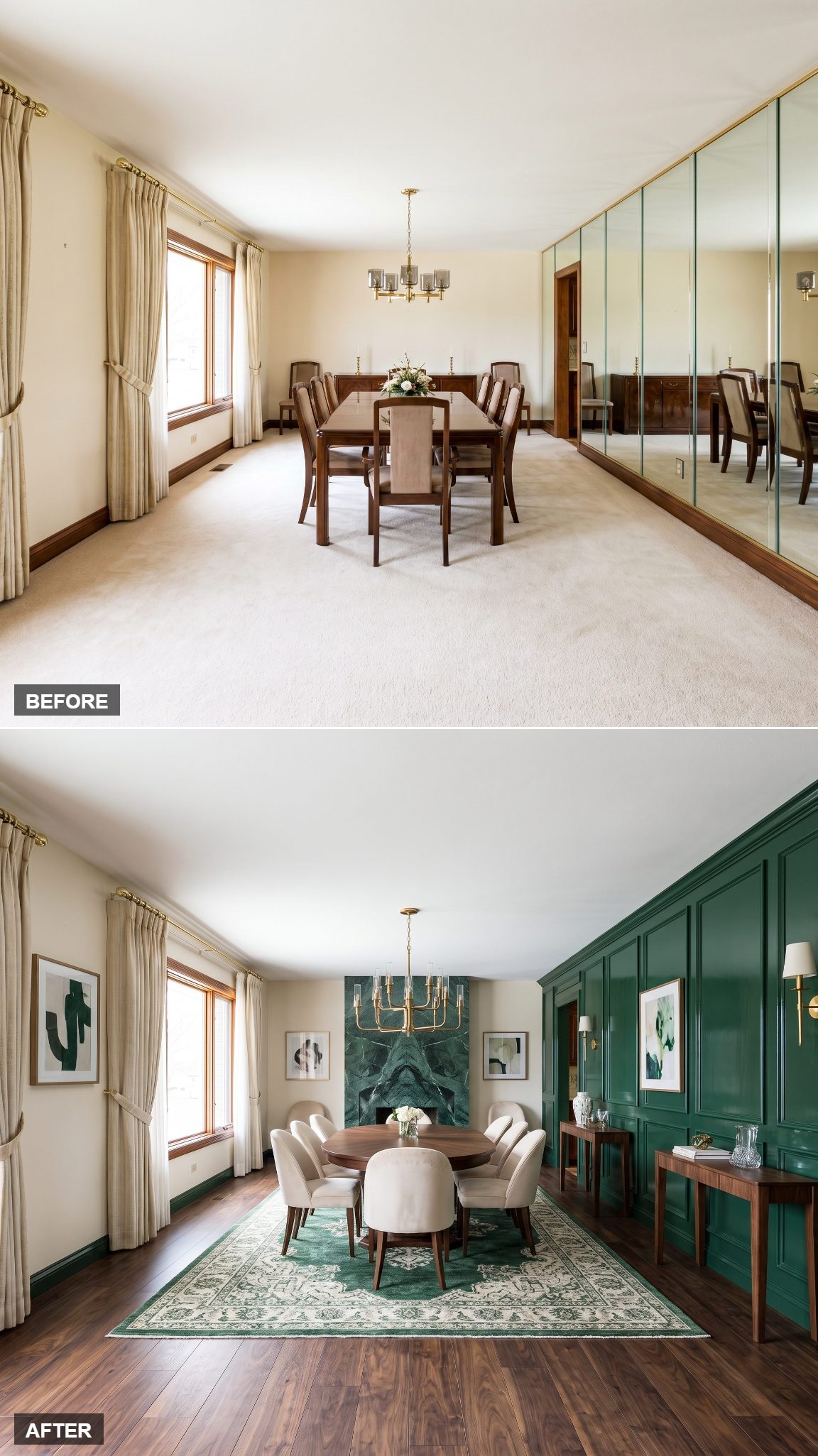
From pale travertine straight into the deep end. Forest-green lacquer takes over the former mirror wall, polished enough to catch light without turning the room back into a hall of reflections.
The green marble table doubles down on the color instead of trying to neutralize it, while brass sconces and a low brass bar cart add warmer notes around all that saturated green. Candlelight would have plenty to work with here. The room has gone from accidental shine to deliberate glow.
31. Soft Contemporary Cream, All Light and No Weight
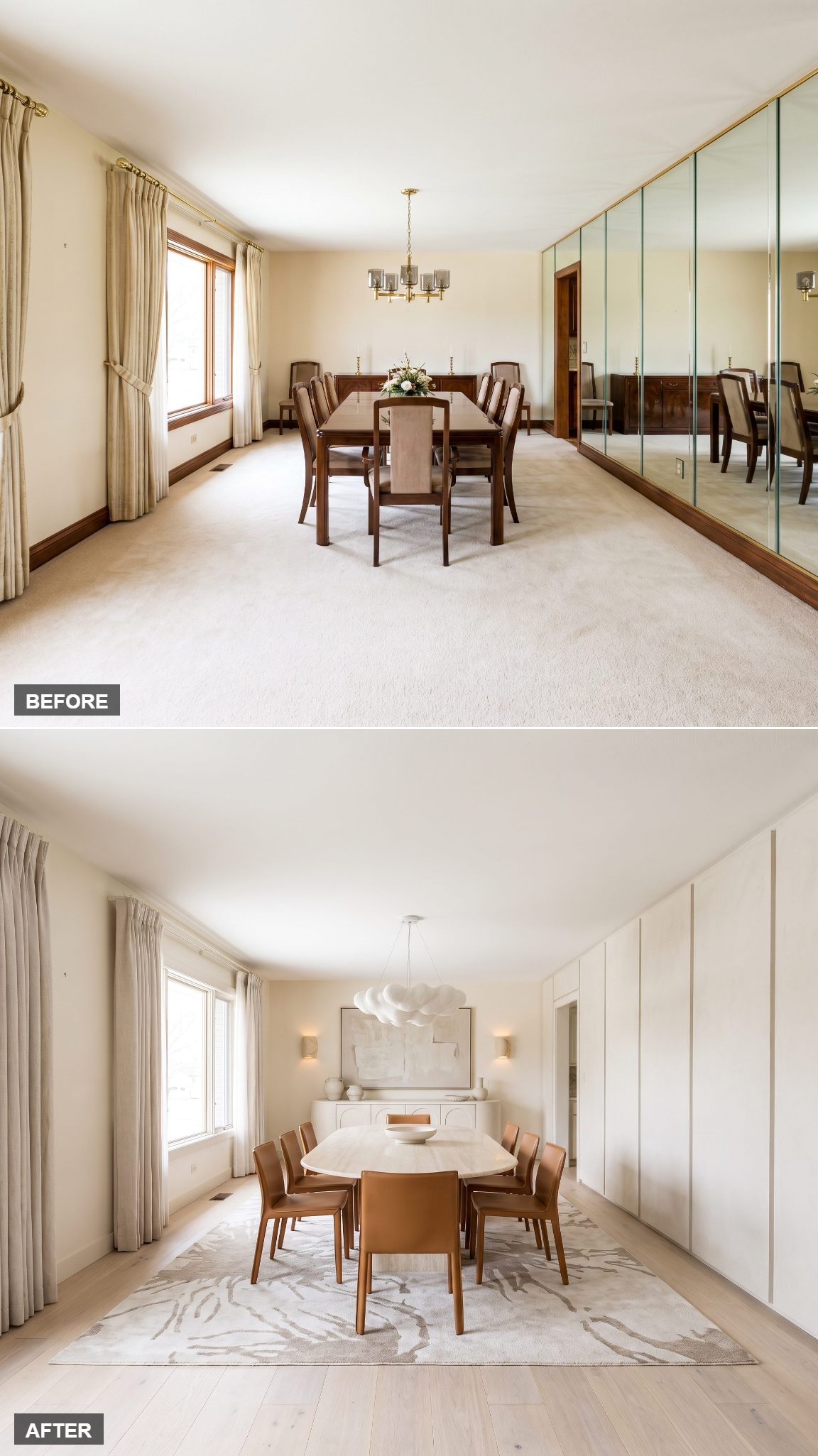
After emerald lacquer, this almost feels like opening the curtains. Warm white walls, pale oak, ivory upholstery and a softly rounded plaster pendant strip the room back to light, texture and proportion.
The trick is keeping all that cream from going flat. Oak adds grain, upholstery adds softness, plaster adds a chalkier surface, and greenery supplies just enough interruption. Nothing is competing with the daylight anymore. The room gets quieter without becoming anonymous.
30. Modern Art Deco Revival, With the Glamour Redirected
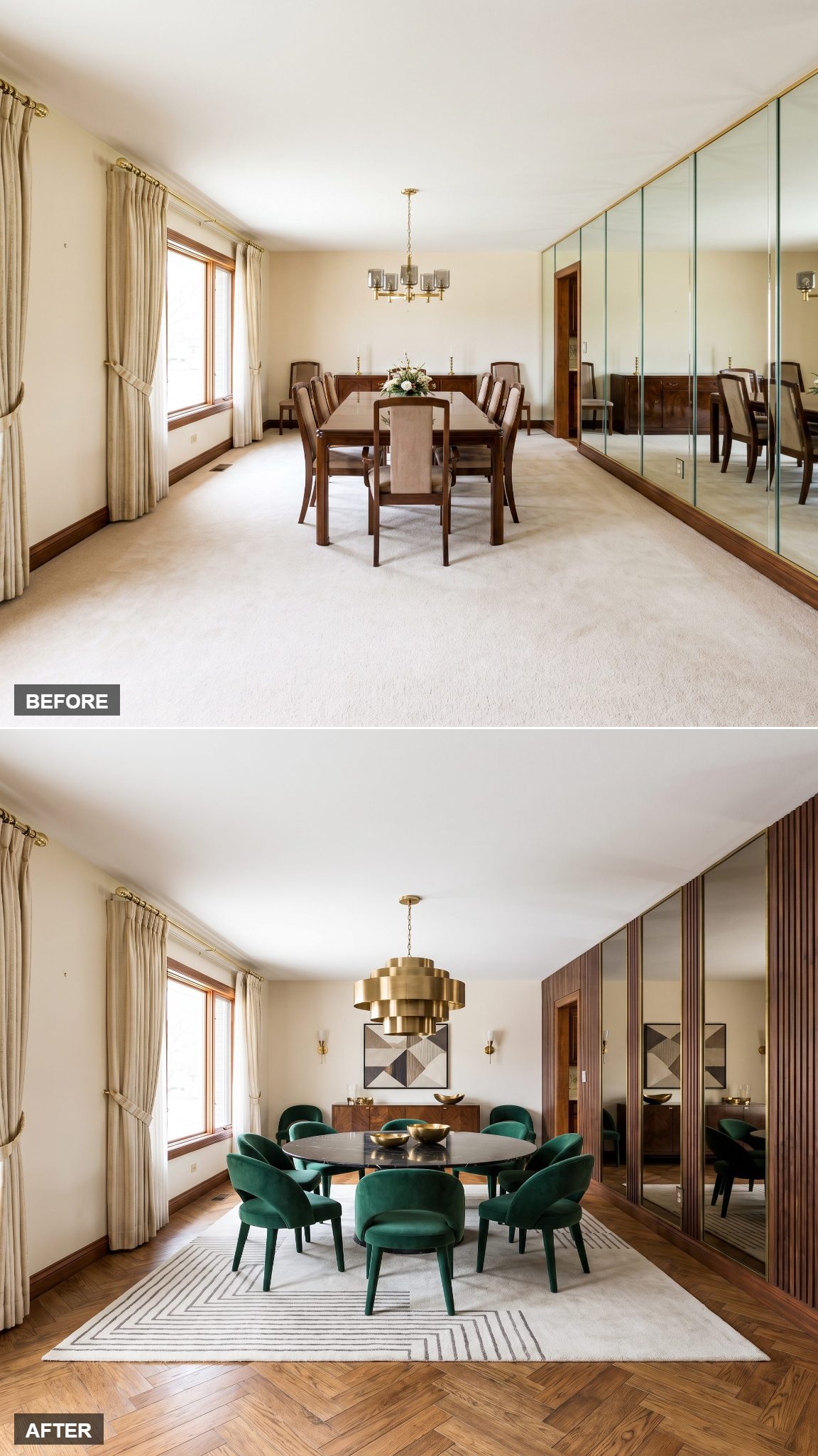
The original room clearly wanted glamour. This version simply gives that impulse better references.
Deep emerald fluting, black lacquer, brass inlay and velvet fan-back chairs push the room toward a contemporary Art Deco vocabulary without trying to recreate a 1920s interior literally. A geometric chandelier supplies the sparkle the mirrors used to chase, only now the light has somewhere intentional to land.
29. Coastal European Ease, Zero Effort Showing
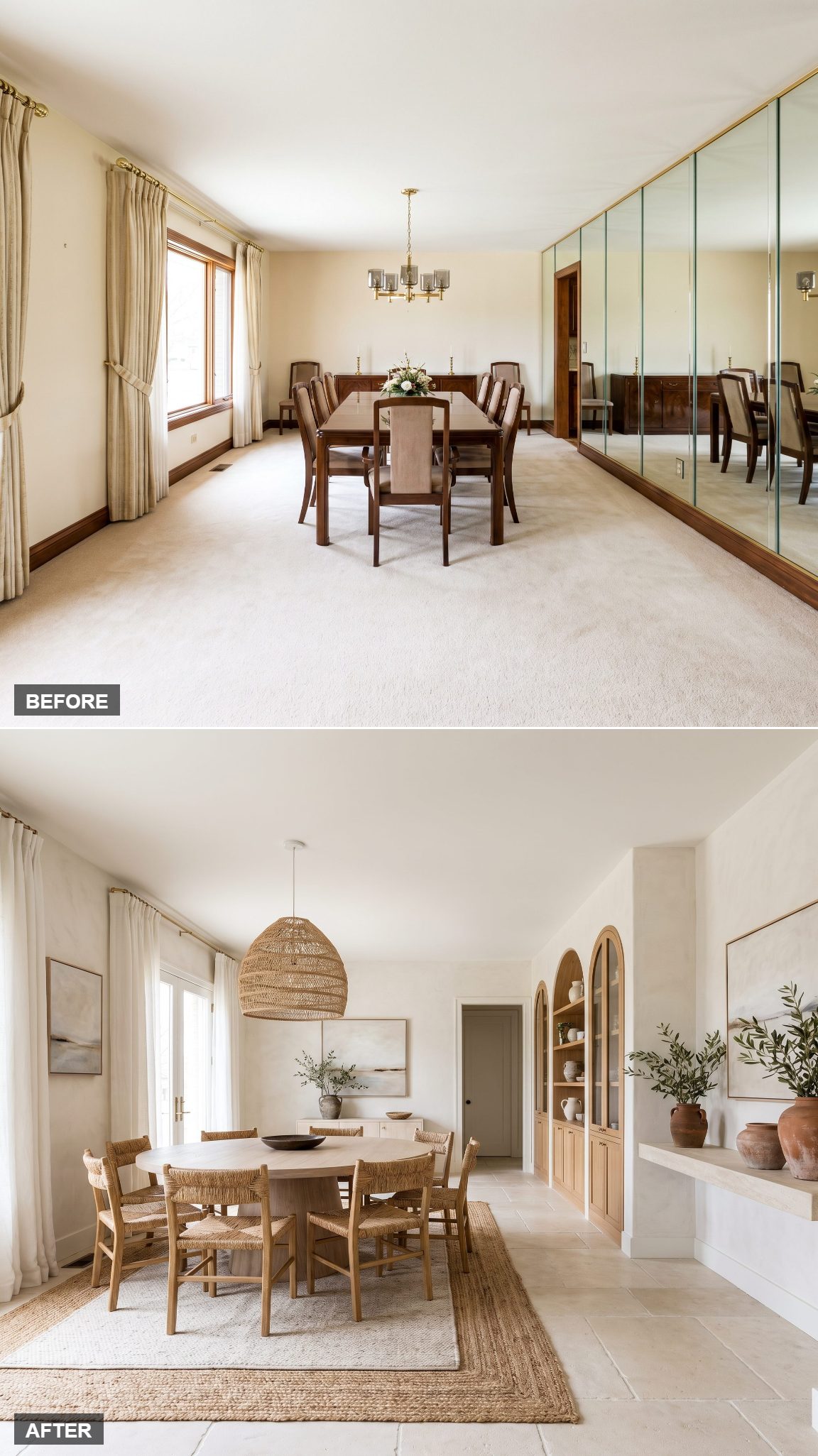
Now take the same room somewhere much less dressed up. Plaster the color of sun-warmed sand replaces the glare, then woven rush chairs, bleached oak and loose linen bring in the relaxed material mix associated with older coastal European interiors.
An olive tree in terracotta, a bowl of lemons and softly rumpled table linens keep the composition from becoming too perfect. The appeal is precisely that nothing looks recently unboxed. Lunch could start in ten minutes or two hours. The room is not keeping score.
28. From Disco Mirrors to High-Fashion Monochrome
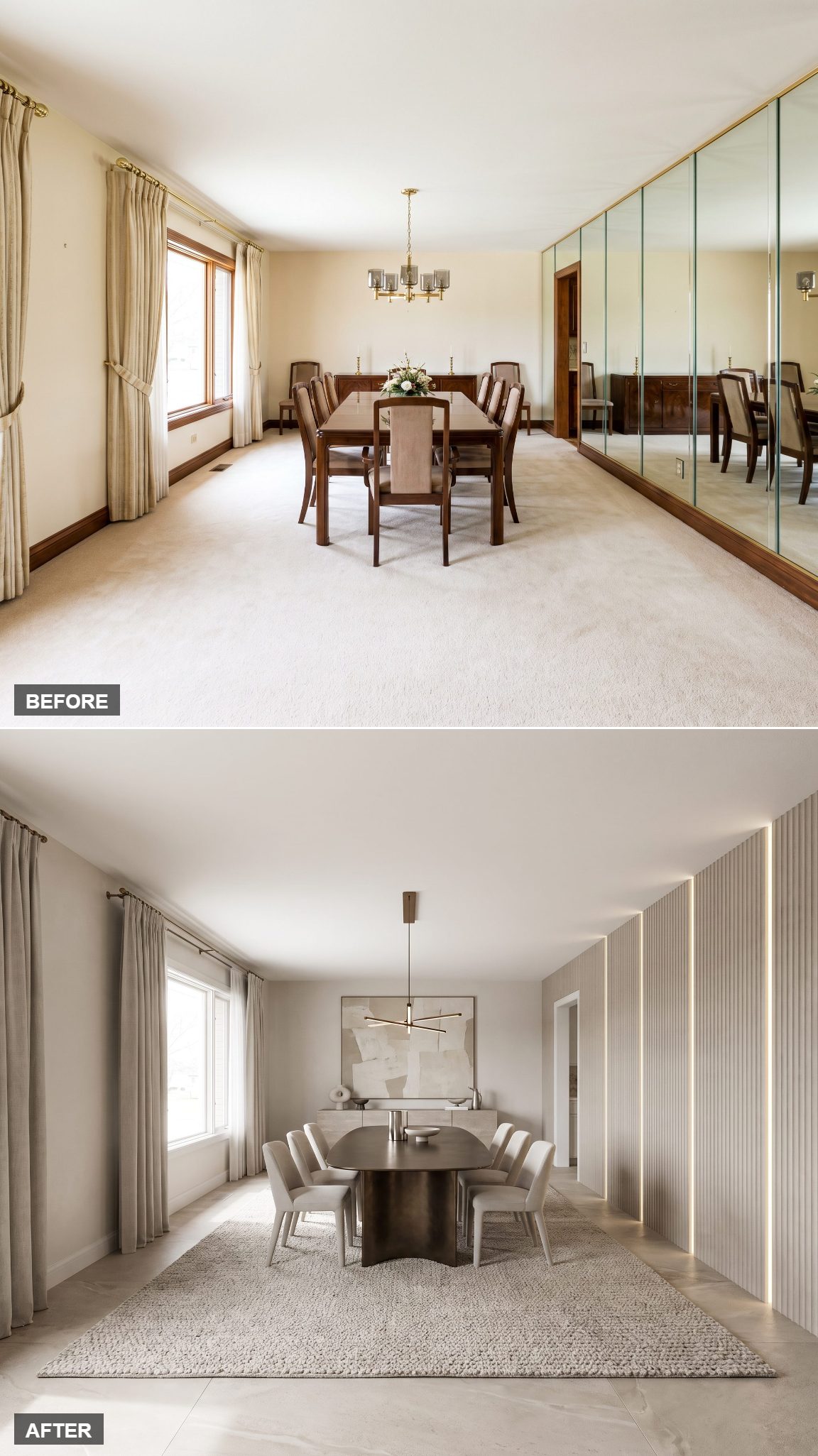
Then the color disappears almost completely. Matte charcoal takes over the feature wall, honed black stone anchors the table and pale gray wool keeps the chairs from vanishing into the background.
A single brass arc floor lamp curves through the darker palette like punctuation. One white vase, one branch, done. Limiting the color shifts lets silhouette, finish and value contrast do more of the visual work. The room feels edited rather than empty.
27. Contemporary Glass Display Dining Room
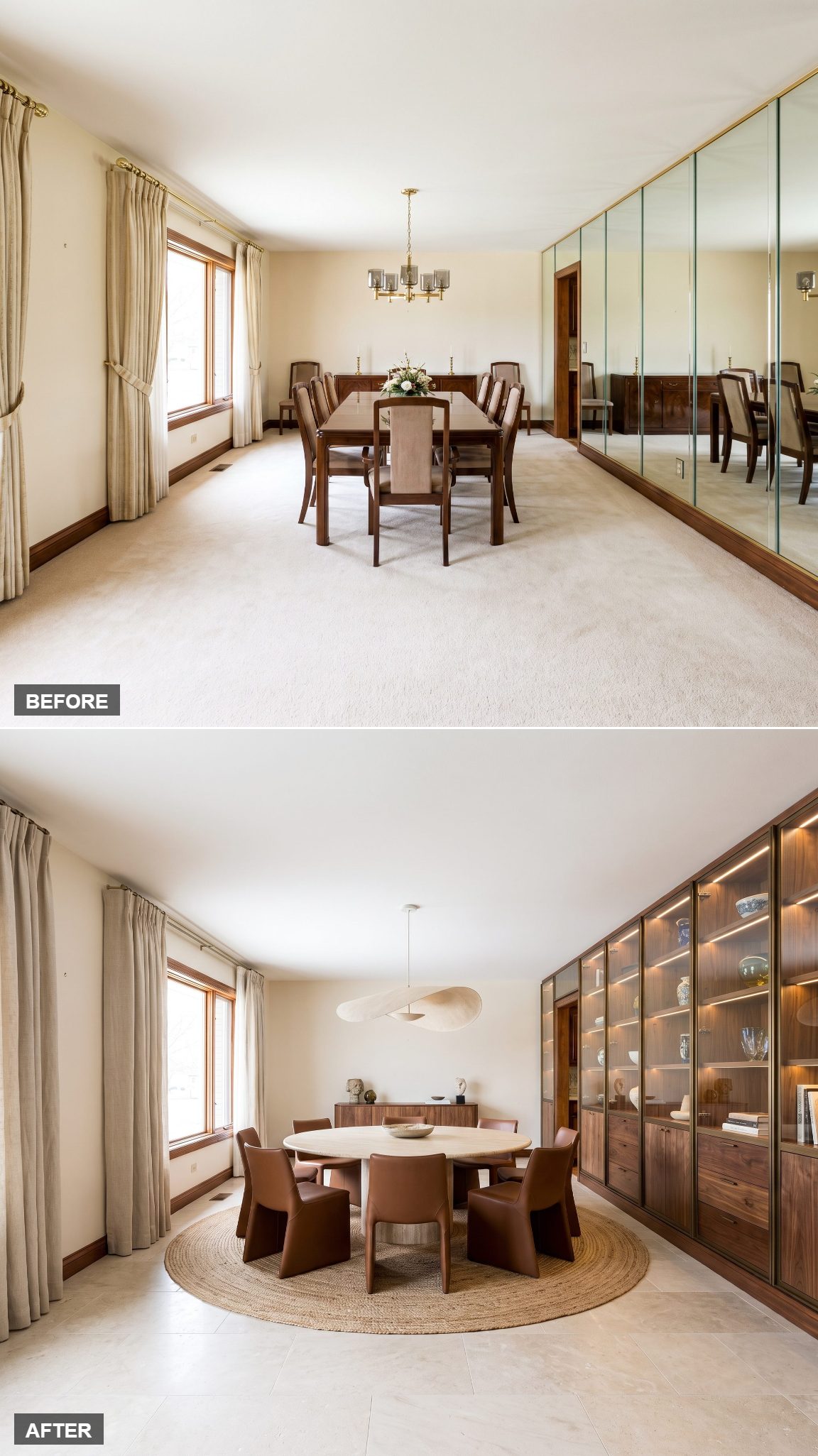
This one does not reject glass. It gives glass a job.
The former mirror wall becomes floor-to-ceiling display cabinetry, backlit and filled with stemware, ceramics and books. Reflection remains part of the composition, but now it comes with depth, storage and actual usefulness. A slim oak table on blackened-steel legs keeps the center comparatively spare, while tan leather prevents the room from turning chilly.
26. Plum and Cream Dramatic Luxe
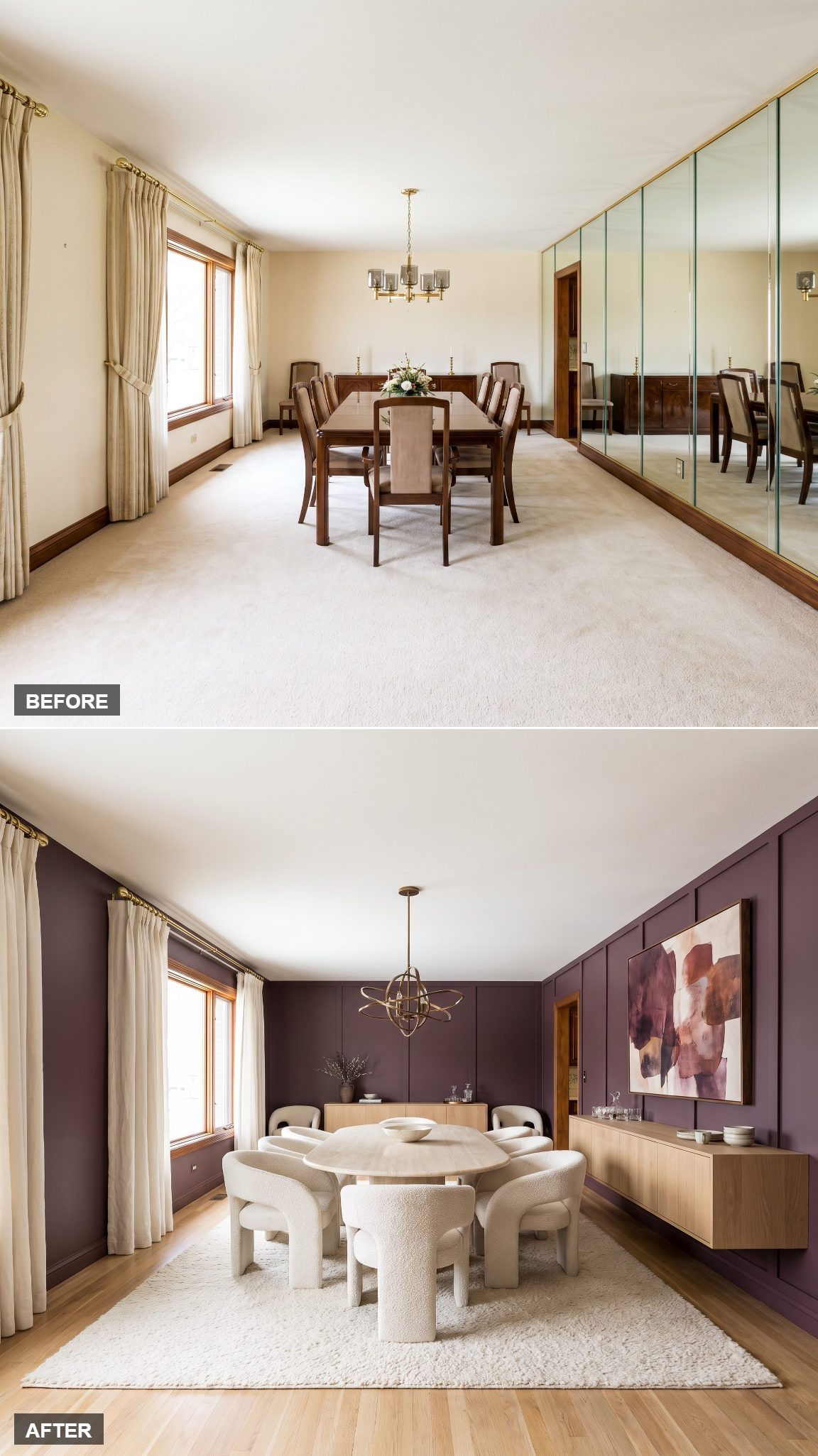
Deep muted plum sounds like a large commitment until cream enters the room and gives it somewhere to breathe. The former mirror wall becomes plum paneling, while a cream lacquer table and cream velvet chairs keep the lower half comparatively light.
A mirrored tray survives as one small wink at the room’s past rather than the organizing principle for an entire wall. Brass, crystal and velvet supply the glamour. The plum supplies the nerve.
25. Quiet Japandi Luxury You Could Sit In for Hours
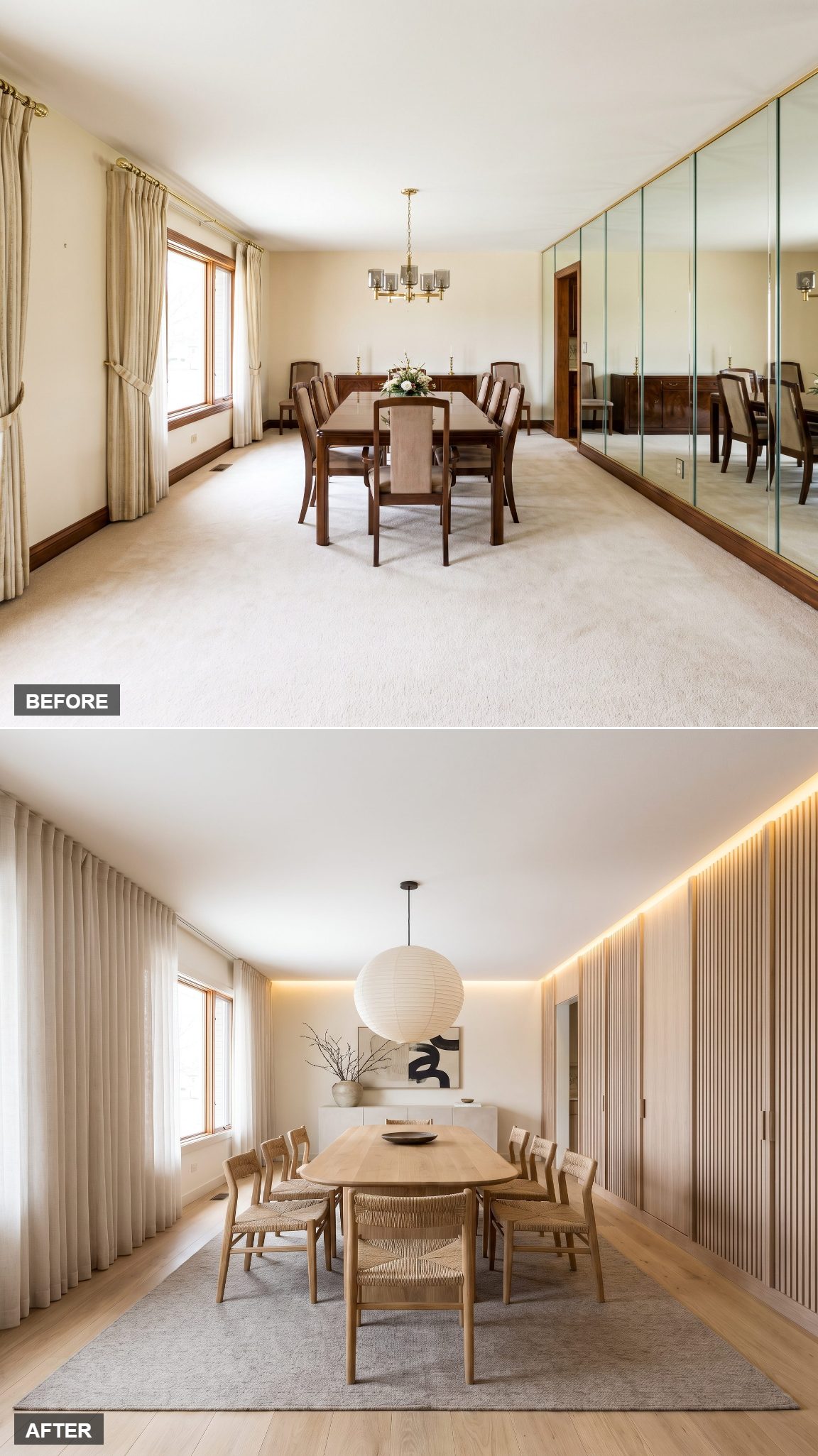
Strip it back. Then strip it back again.
Pale oak, warm white plaster, a low blond-wood table and rush-seat chairs leave almost nothing for the room to hide behind. One ceramic bowl, one branch, one paper pendant. The restraint works because the few remaining materials are allowed to register fully: grain, weave, paper, plaster, daylight. Empty space becomes part of the composition instead of something waiting to be filled.
24. Burnished Bronze and Oak Dining Room
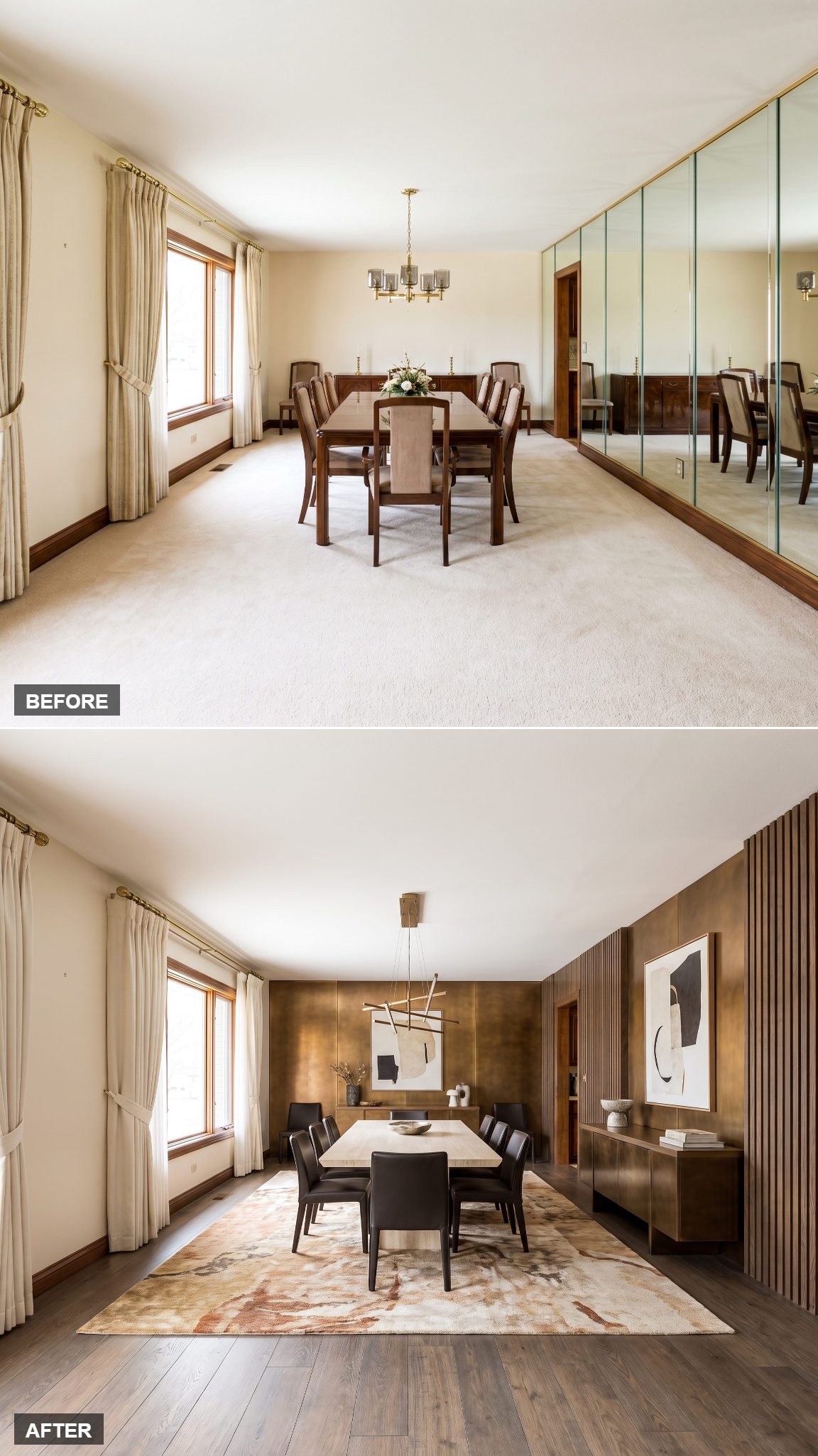
Bronze and oak make an immediate case for depth. The mirrors disappear behind vertical smoked-bronze panels and timber slats, so the wall still catches light without returning the entire dining table to you in duplicate.
A thick oak table and dark leather chairs give the room weight, while the bronze pendant adds a warmer metallic note overhead. The rug softens all those hard surfaces and keeps the palette from collapsing into brown-on-brown. Compared with the before image, this feels less like decoration applied to a box and more like the box itself was redesigned.
23. Modern Regency Dining Salon
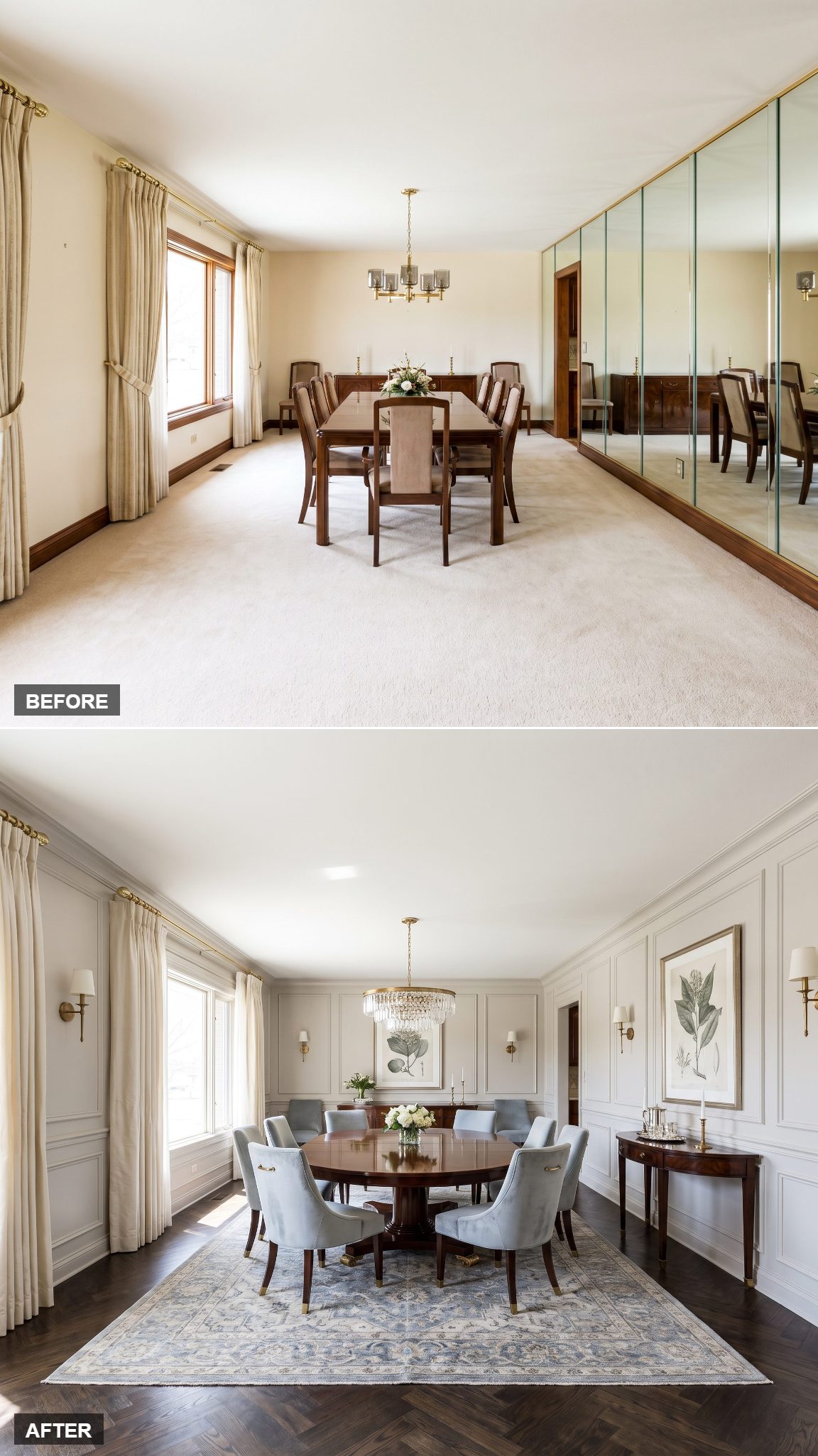
Pale blue walls and applied molding give the room an architectural rhythm the original mirrors never supplied. Painted in one tone, the paneling creates shadow lines without turning the walls into a pattern.
A polished walnut pedestal table sits underneath a slim brass chandelier, with ivory linen chairs keeping the room lighter than the traditional references might suggest. A footed bowl of green apples is about as decorative as the table needs to get. Regency manners, contemporary volume.
22. Forest Green Limewash, Organic and Grounded
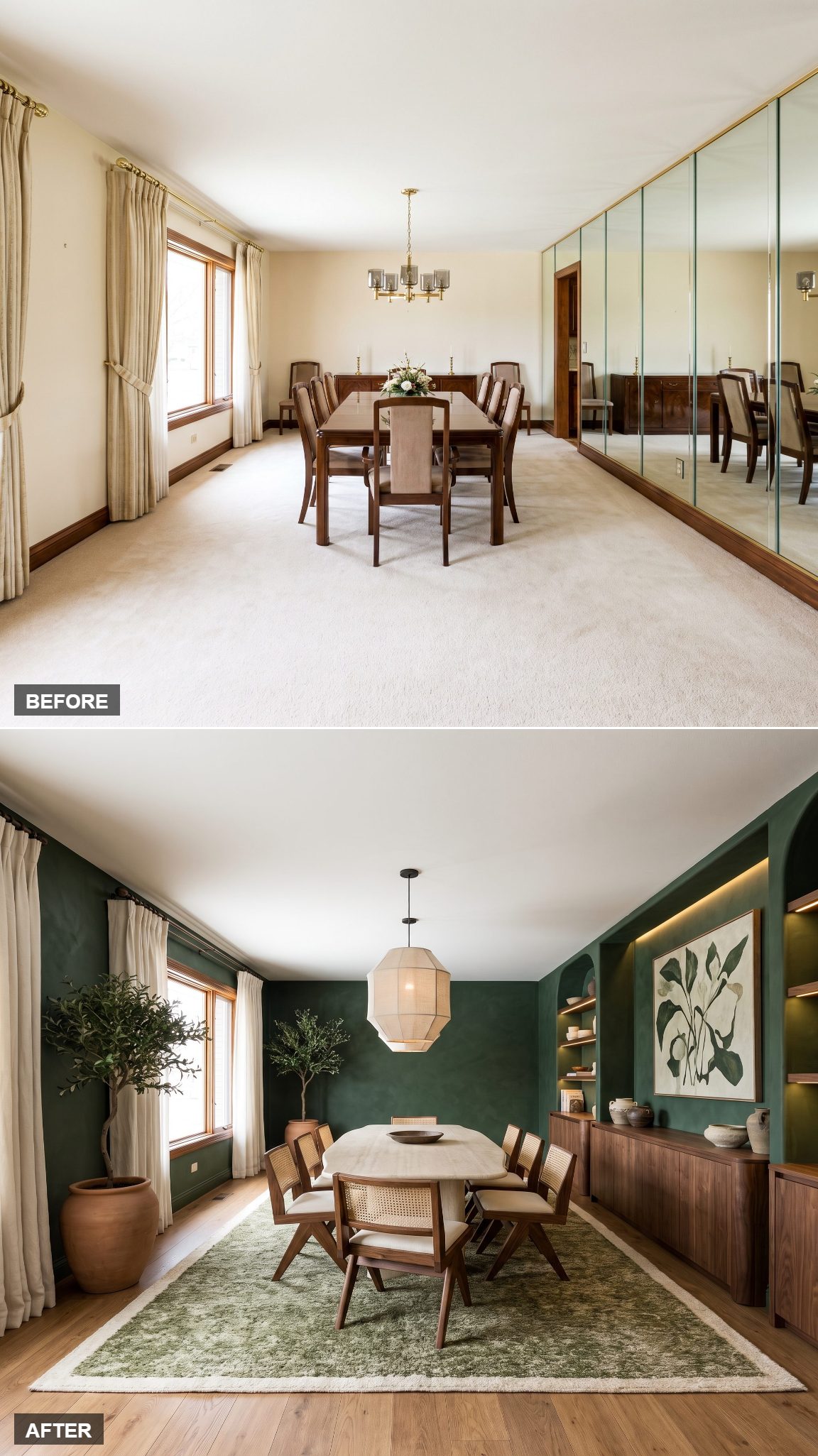
Forest-green limewash gives the old mirror wall almost the opposite surface quality: matte, mottled and visibly imperfect. Instead of a hard reflection, the wall changes subtly as daylight moves across it.
A live-edge table, woven pendants and trailing greenery push the texture further. The palette is dark, but the finish keeps it from becoming slick. The last of the disco has been composted, and something considerably earthier has taken root.
21. Black-and-Ivory Graphic Luxe
🔥 Would you like to save this?
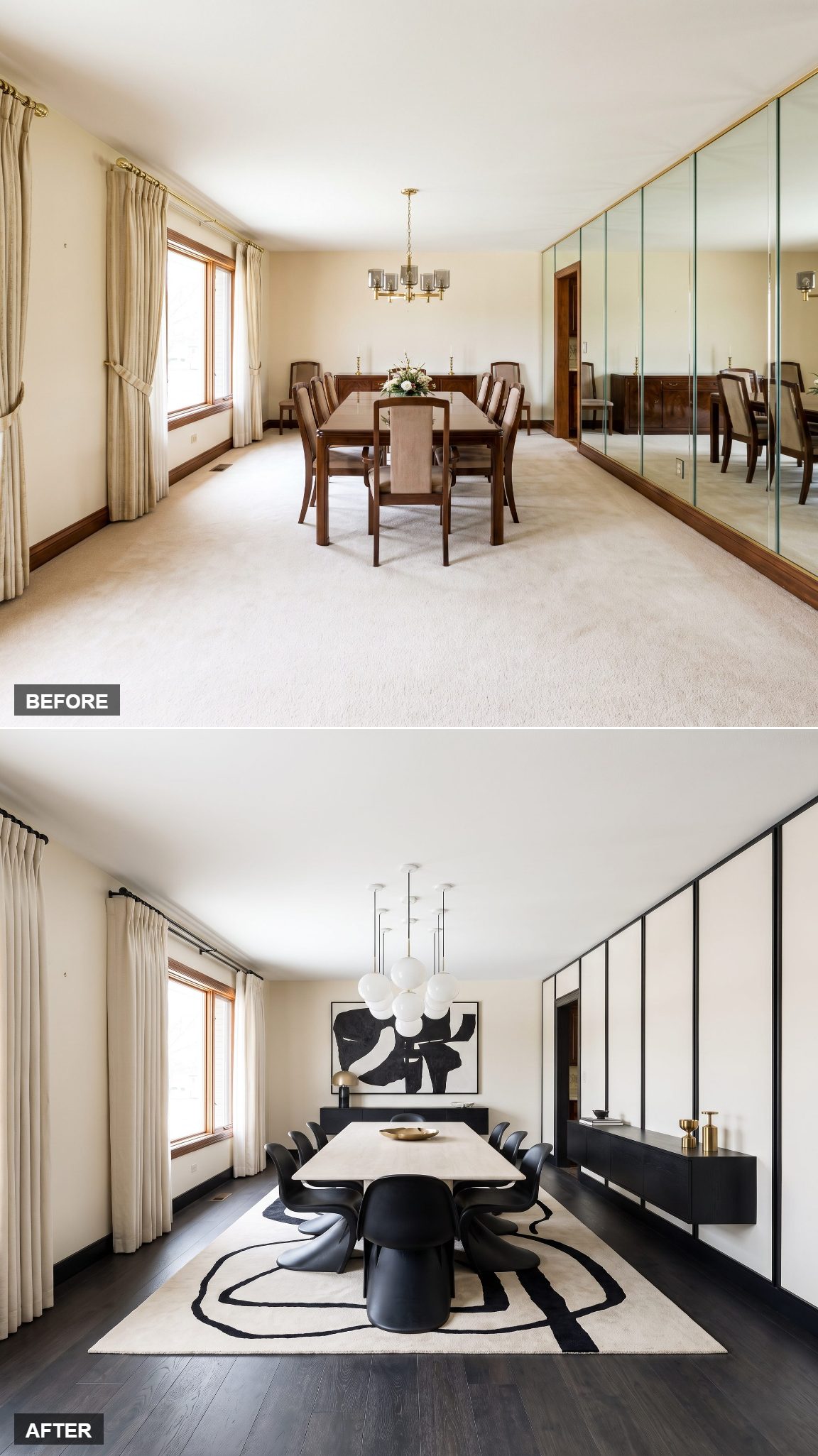
After limewash and live-edge wood, precision feels almost shocking. Ivory paneling with black inlay turns the wall into a crisp graphic plane, while a sculptural light fixture repeats the dark lines overhead.
A black lacquer table, ivory upholstery and one stem of white blooms keep the palette nearly binary. The room is dressed like a tuxedo without needing to say so twice.
20. Half Dining Room, Half Library, All Restraint
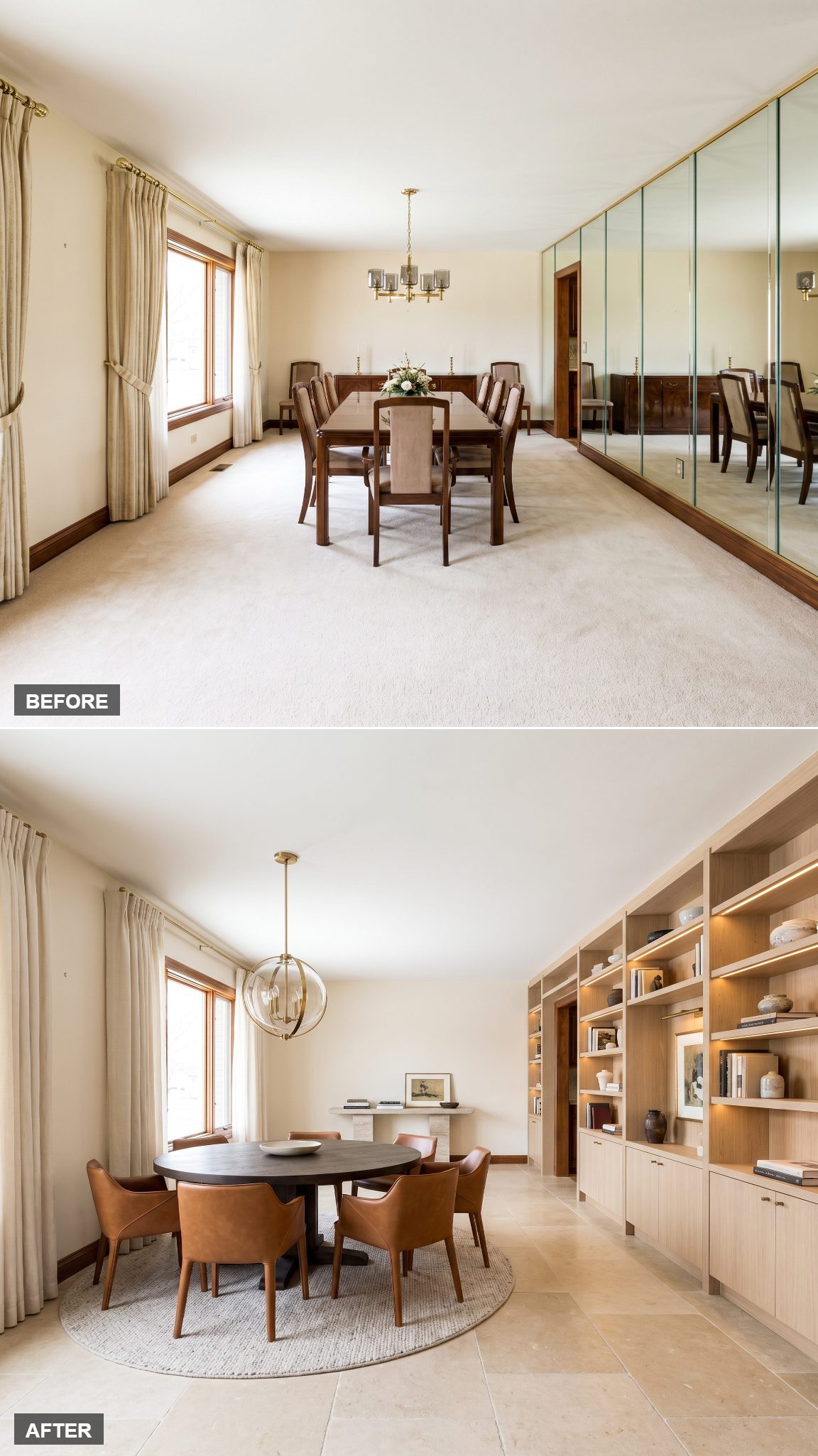
This is one of the few transformations that changes not just the look of the room, but what the room can do. The mirrored wall becomes floor-to-ceiling white oak shelving, giving books, objects and a reading lamp an architectural home instead of treating the wall as pure decoration.
A pale travertine table on a blackened-steel base keeps the center clean, while two leather dining chairs at the ends can just as easily serve a late-night reader as a dinner guest. Suddenly the dining room has a second shift.
19. Terracotta Mediterranean Modern
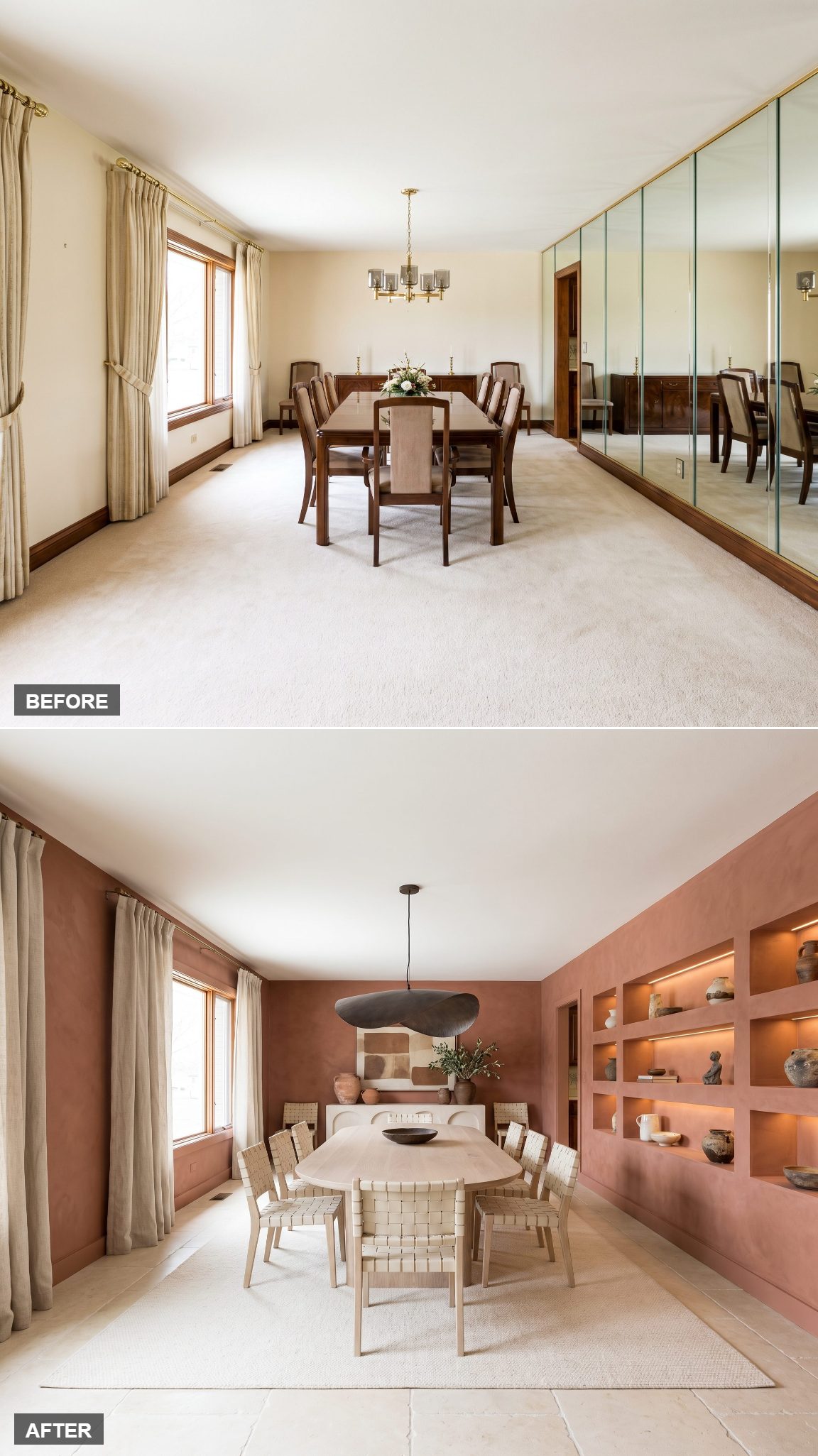
Warm terracotta plaster turns the former mirror wall into something tactile. The slight tonal variation keeps the color from behaving like a flat painted block, while the matte finish softens the daylight instead of firing it straight back across the room.
A chunky oak table, rush chairs, clay pottery and an olive tree build on that warmth without becoming thematic. The result hints at southern Europe through material and color rather than through props. Even on a gray suburban afternoon, the room has a little Puglia in its bloodstream.
18. Deep Navy Lacquer, Contemporary and Cool
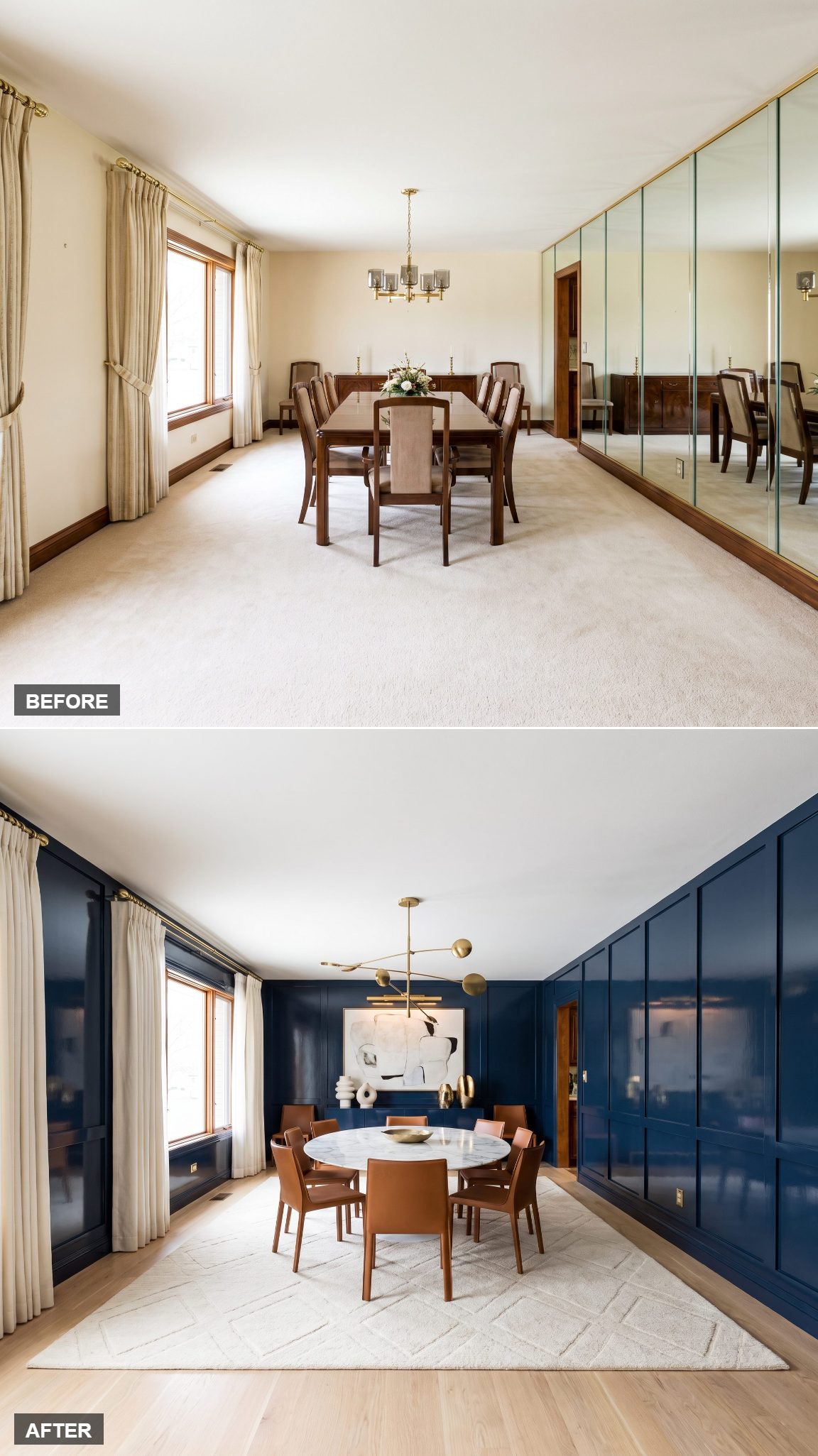
Navy lacquer swallows the old mirror wall whole, then gives back only controlled highlights. Against it, pale marble and slim brass legs suddenly read with much more definition.
That contrast is the point. White flowers, crystal glassware and a framed print become brighter against the dark field, while a navy velvet chair keeps the color moving into the furniture. The room understands that dinner sometimes ends much later than planned.
17. Parisian Modern Classic With Grown-Up Restraint
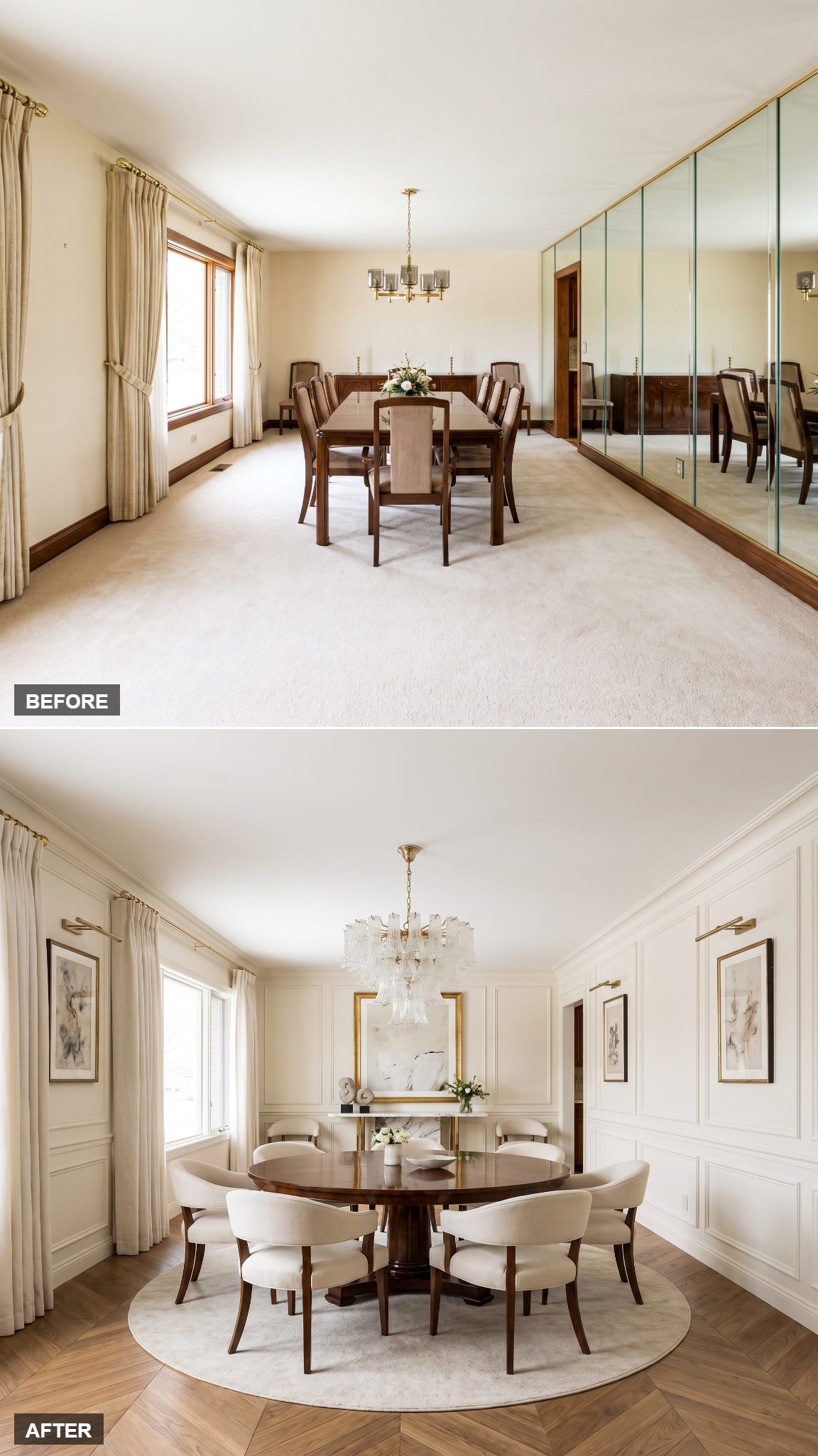
Parisian interiors have long made a persuasive case for mixing architectural formality with furniture that does not take itself quite so seriously.
Soft gray walls gain slim applied molding, a pale marble table sits beneath a restrained chandelier and ivory bouclé chairs introduce texture without adding more pattern. A few books and ranunculus are enough. The room can dress for dinner without putting on a costume.
16. Modern Rustic Oak and Stone
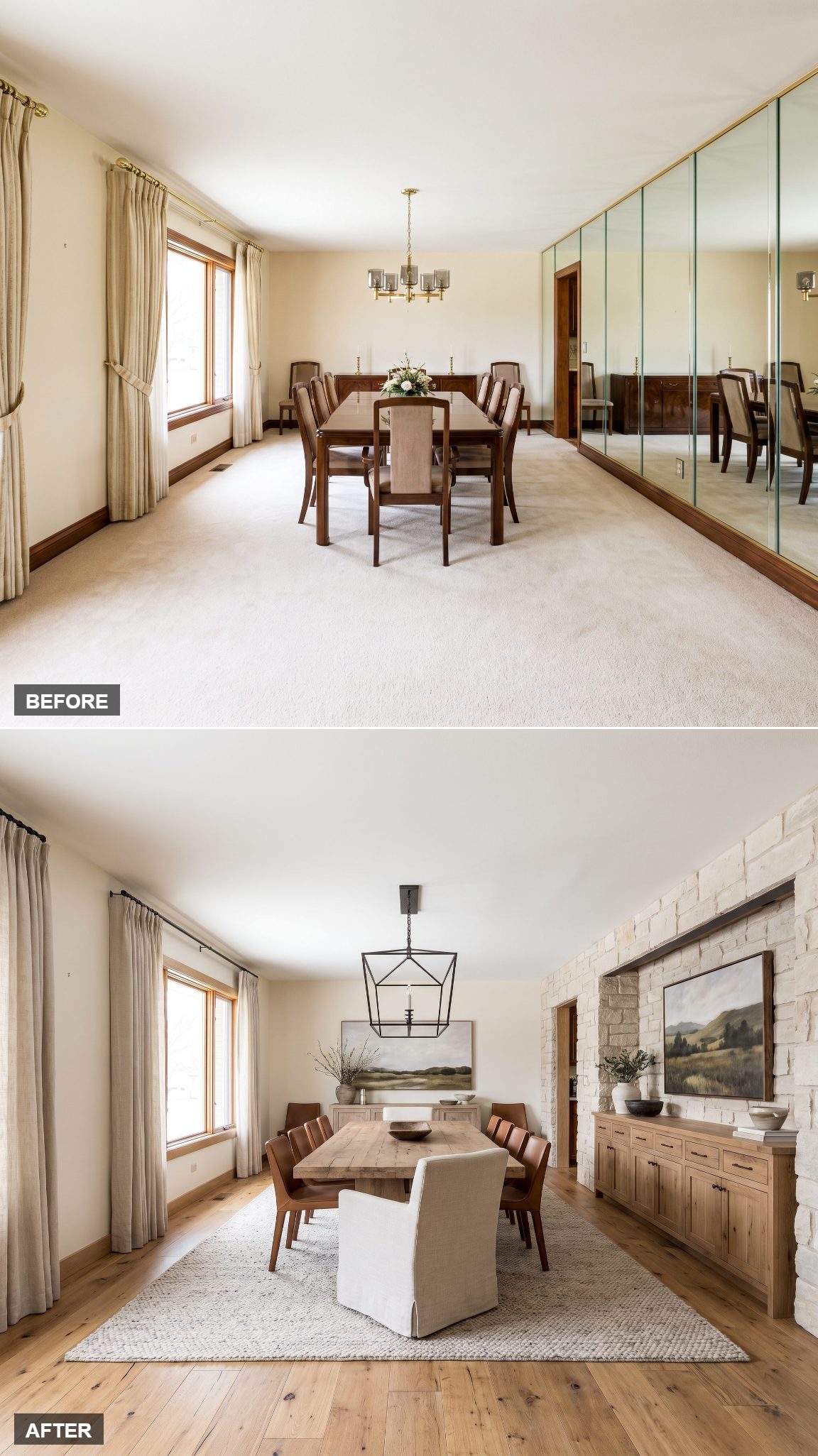
Here the answer to a room full of reflection is texture you can practically feel from the doorway. Reclaimed-looking oak, rough stone and a substantial slab table replace sheen with grain, irregularity and weight.
Woven pendants, a wool runner and a ceramic pitcher of wildflowers keep the hard materials from becoming austere. Stone and unfinished-looking timber absorb and scatter light very differently from mirror, so the room feels visually denser and more grounded. Farmhouse, perhaps, but one with an excellent architect.
15. Champagne Silk and Soft Glamour
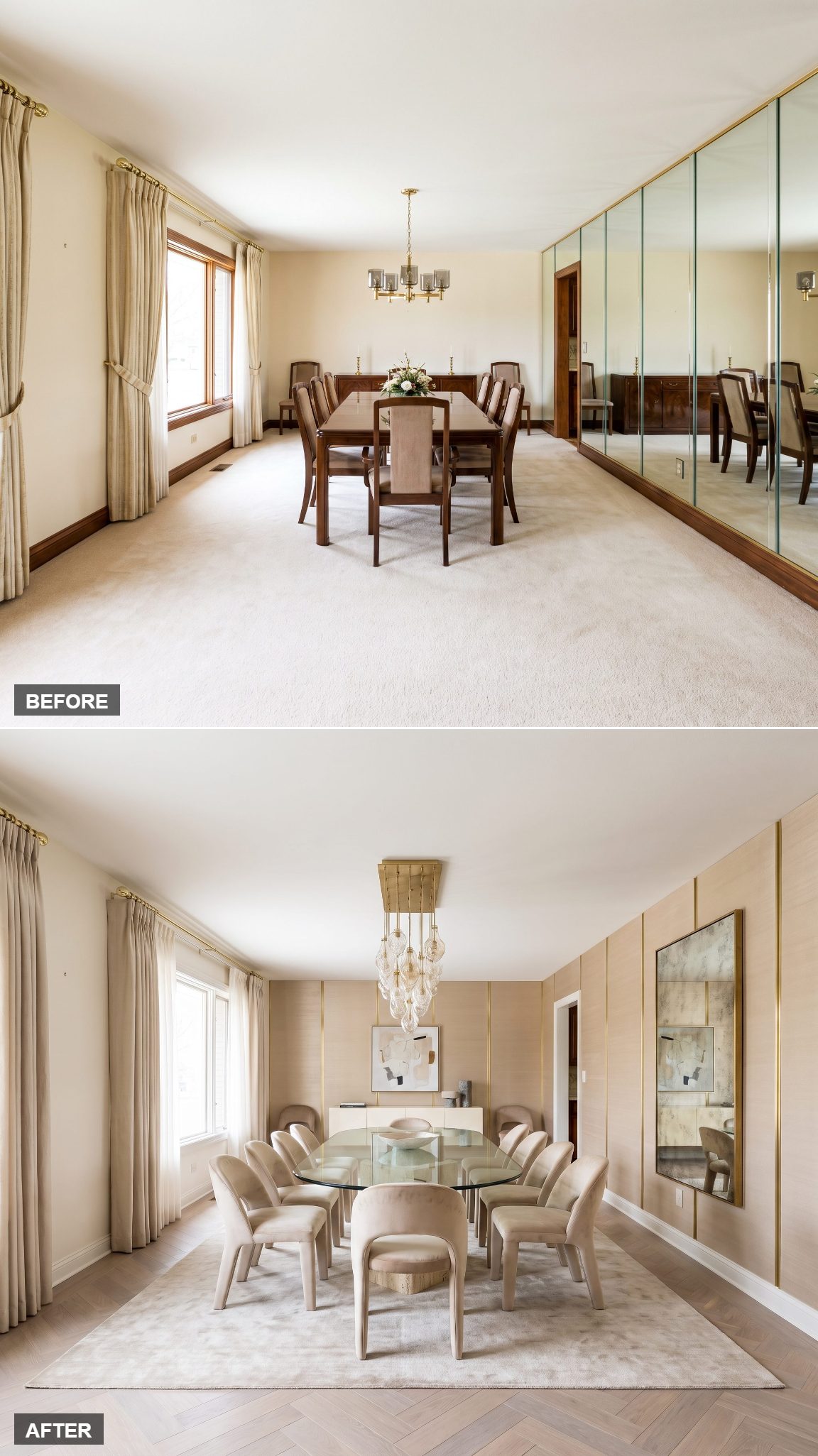
The 1980s room wanted glamour. This version keeps that instinct and lowers the volume.
Champagne silk-textured walls, a glass table on a sculptural base and muted gold details create shimmer without reconstructing another mirror wall. Warm reflection appears in fragments instead of taking over the room. Books, pale roses and glassware keep the polish from feeling ceremonial.
14. From Disco Mirror to Sculptural Gallery Calm
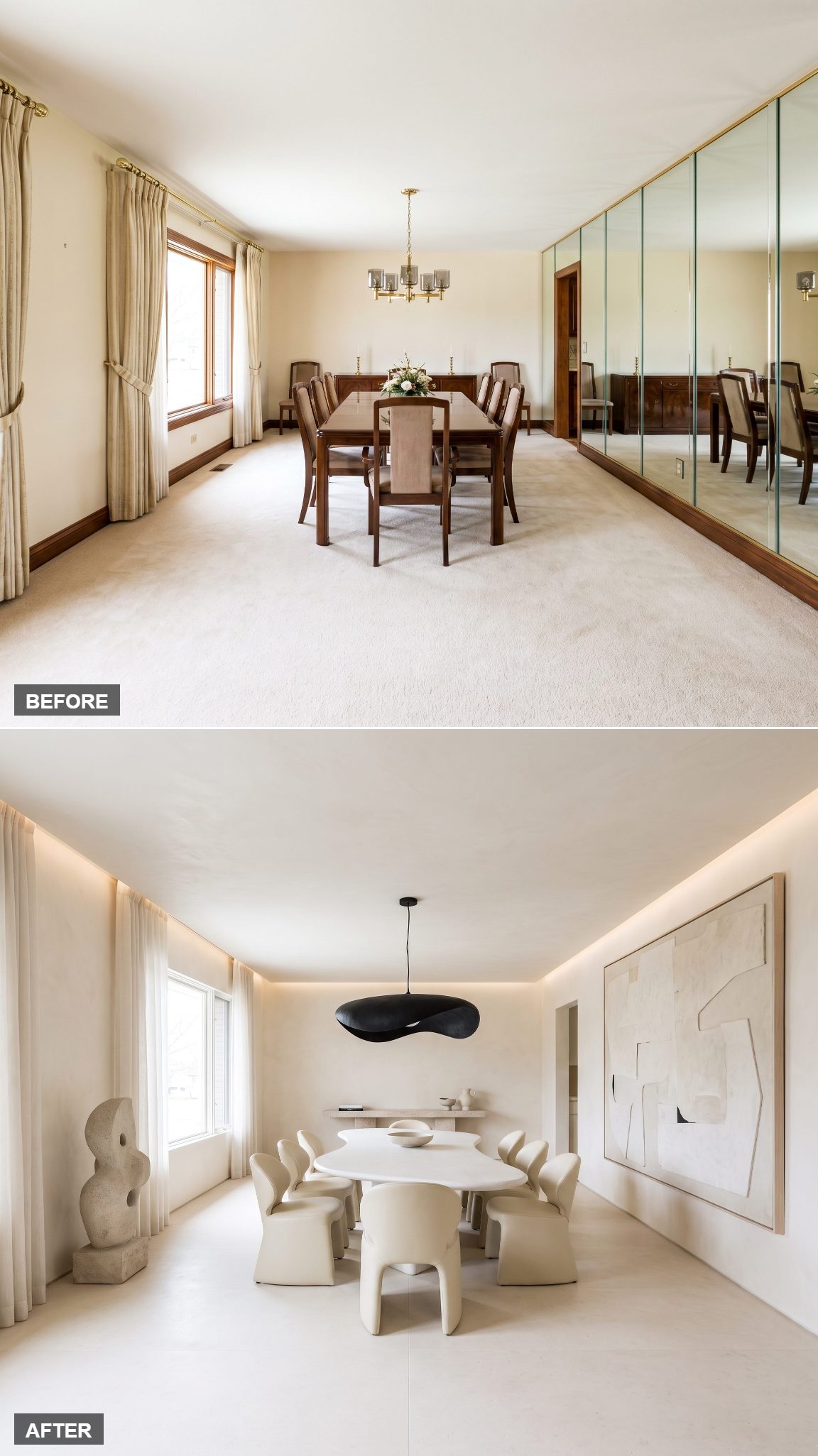
Warm-white plaster replaces the glass, then one oversized abstract canvas takes over the wall instead of thirty-three reflected versions of everything else in the room.
A pale oak table and sculptural chairs leave generous negative space around the artwork. That is the real move here: not minimalism for its own sake, but a clear hierarchy. One wall, one major gesture, furniture quiet enough to let it hold the room.
13. Burgundy Lacquer and Walnut Drama
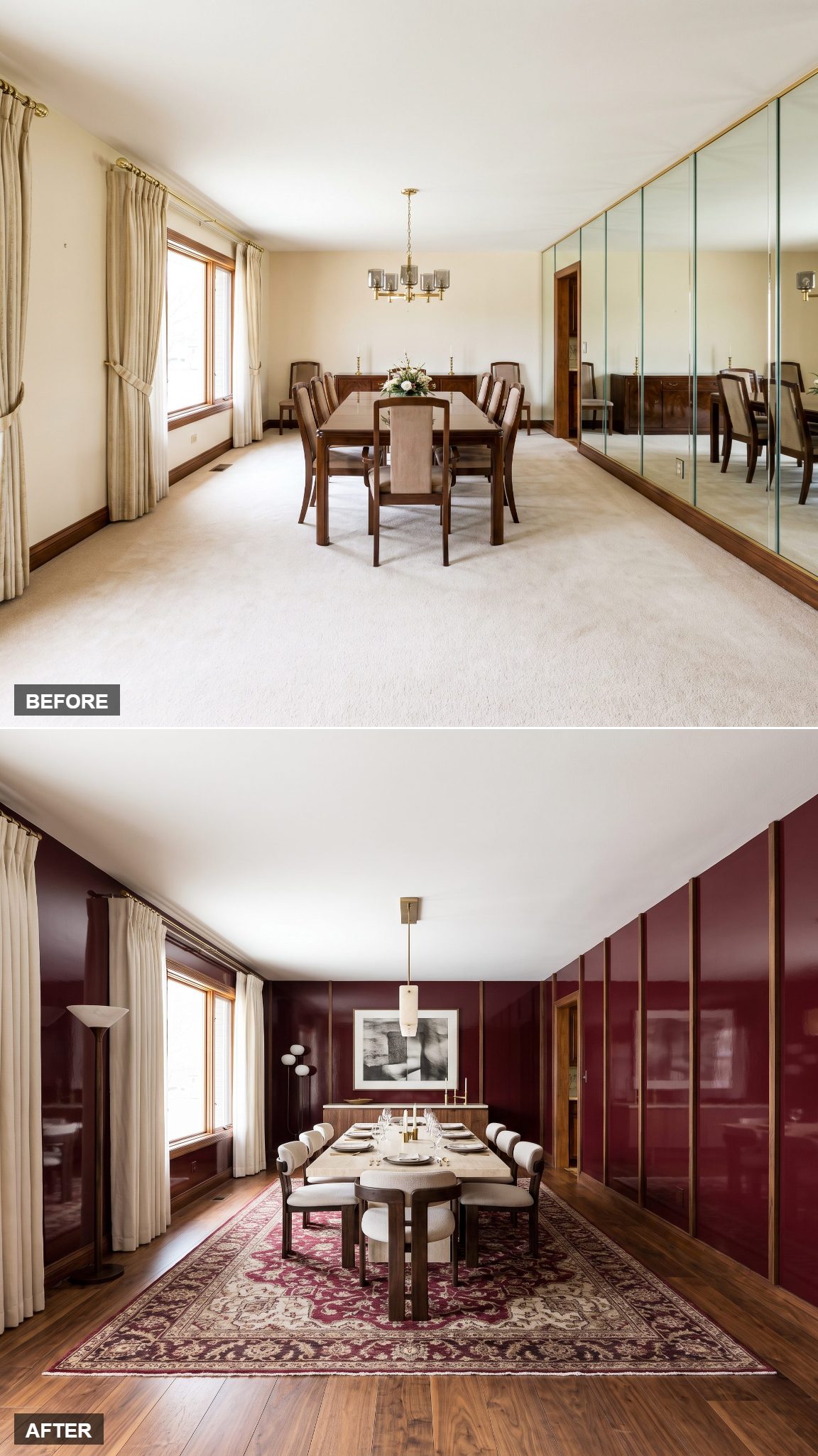
The room was always trying to be dramatic. Burgundy lacquer simply gives it better material.
The walls are glossy enough to catch candlelight, but warm walnut prevents the sheen from becoming brittle. A walnut dining table sits beneath low amber glass pendants, with leather and glass supplying smaller shifts in texture. It photographs like a wine list you cannot afford and want anyway.
12. Soft Sage European Dining Room
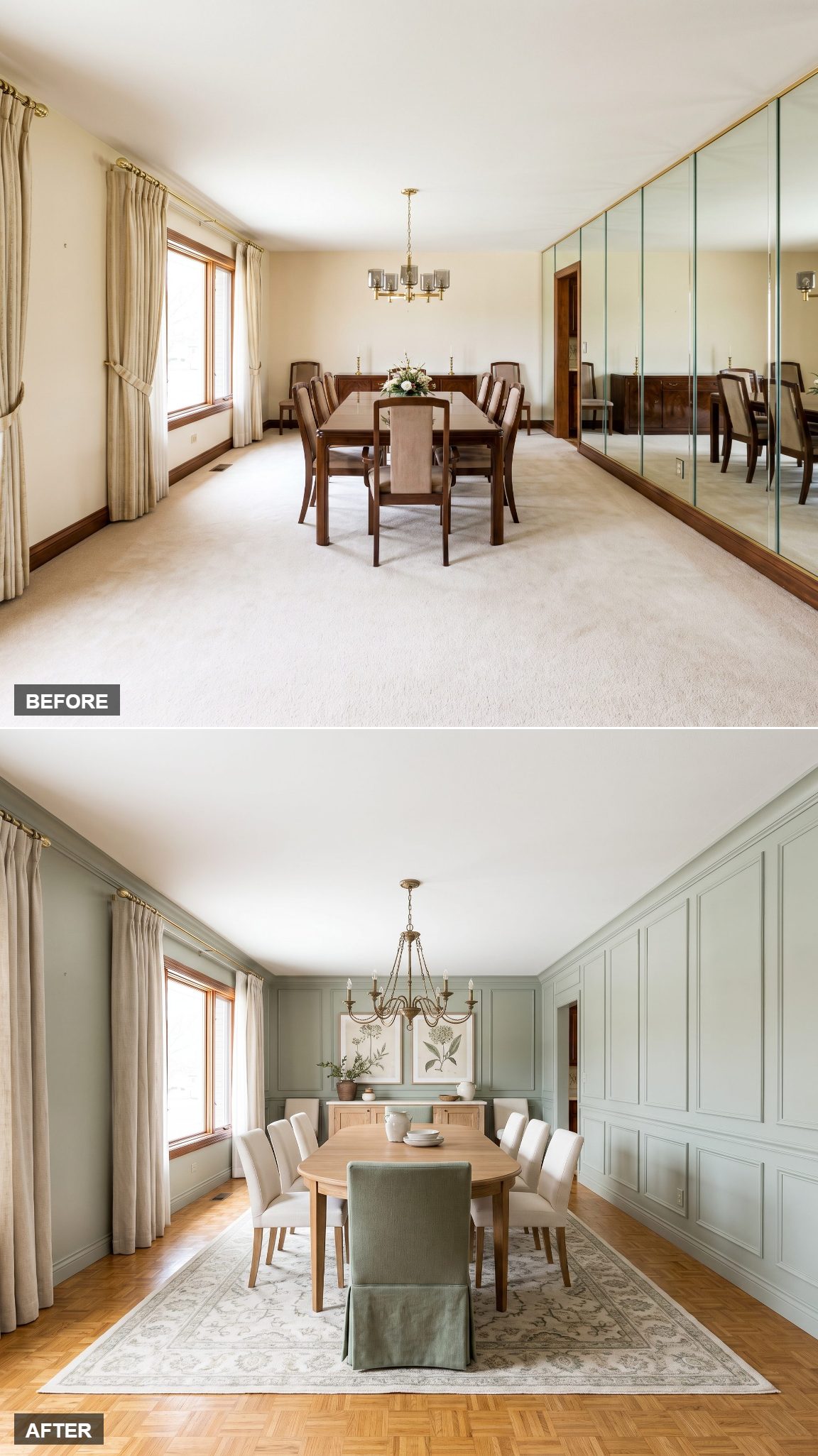
Sage-painted oak paneling is the color equivalent of lowering your shoulders. The mirror wall becomes something quieter but more architectural, with muted green changing subtly as daylight moves across the raised profiles.
A raw oak trestle table, spindle-back chairs and an oatmeal runner keep the palette earthy. A brass picture light and small botanical print sharpen the wall just enough. This is the room where dinner drifts into another bottle and nobody notices the time.
11. Dark Contemporary Stone With a Sense of Drama
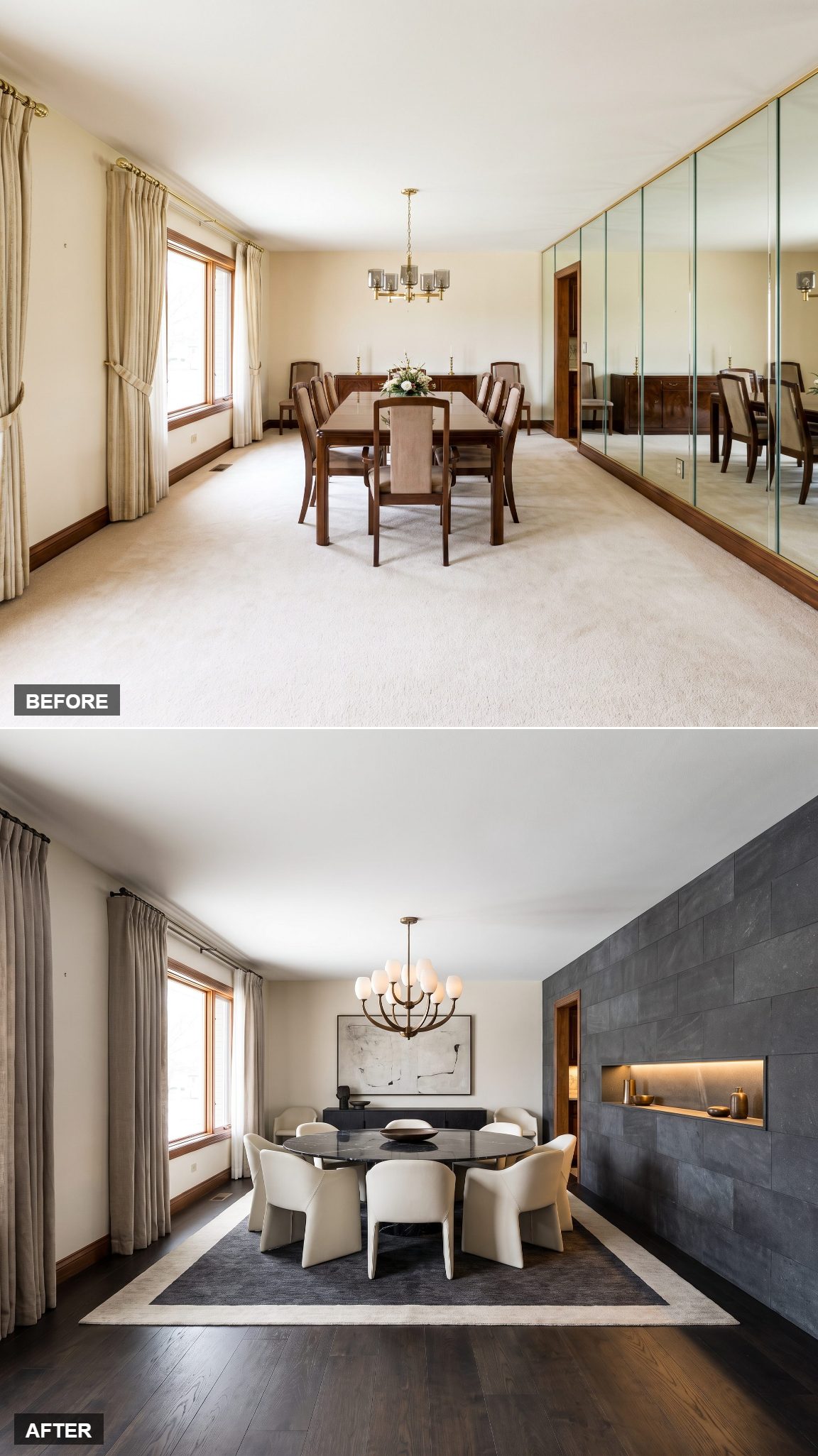
If the original mirrors were trying to turn dinner into an event, this is the grown-up version of the same ambition.
Charcoal stone clads the feature wall, a monolithic dark marble table occupies the center and a linear brass pendant drops a concentrated band of warm light over it. Floor-length linen keeps the window softer by comparison. The room is theatrical, but every dramatic move points toward the table rather than toward its own reflection.
10. Luxury Mid-Century Reinterpretation
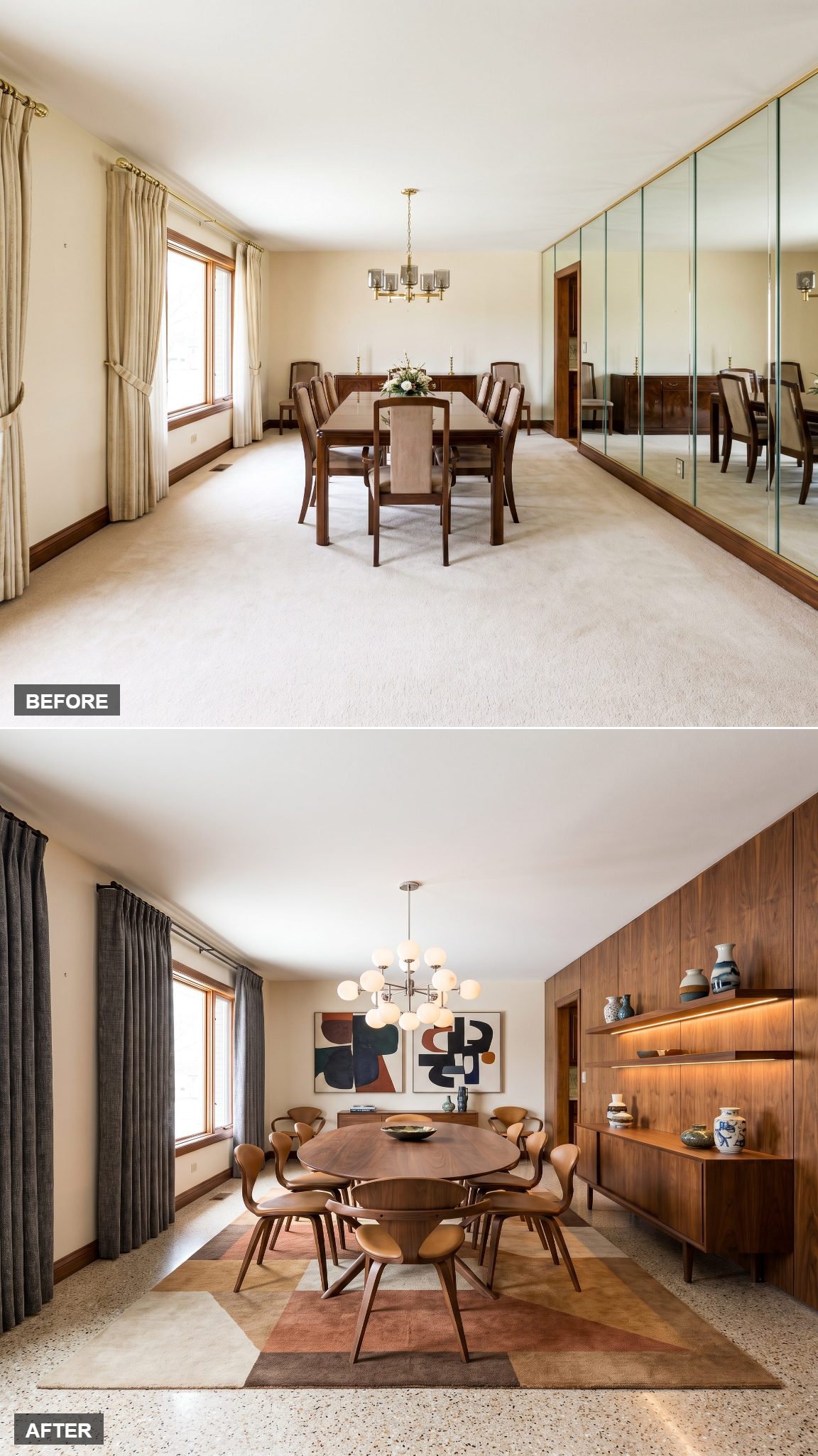
Not a museum piece. A modern take.
Warm walnut wraps the former mirror wall in slim vertical slats, a tulip-base table loosens the center and a globe pendant gives the ceiling a clean period reference without turning the room into a set. Mustard bouclé on tapered-leg chairs brings the color. The silhouette nods mid-century; the scale and finish keep it contemporary.
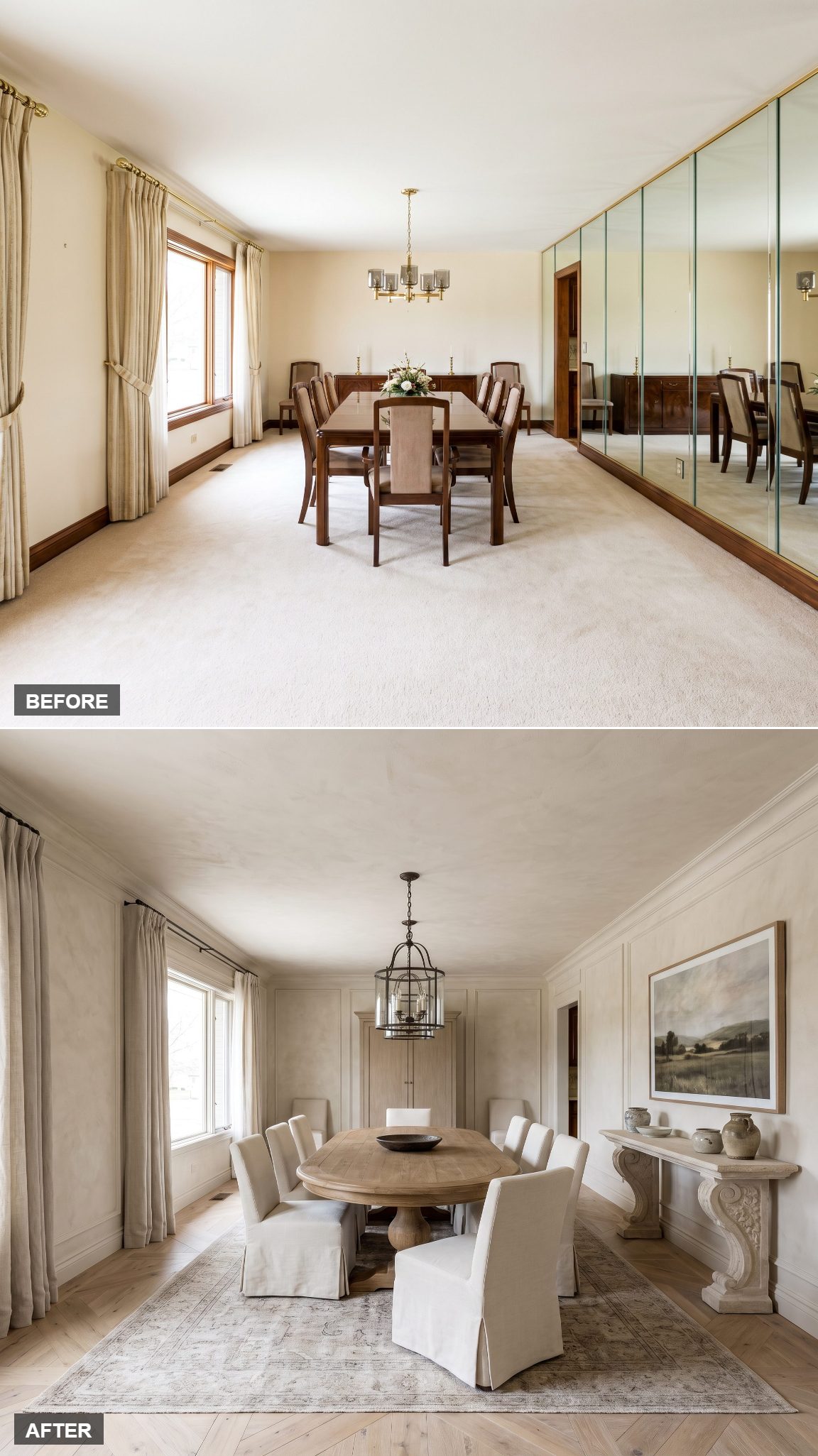
9. Contemporary French Limestone Restraint
🔥 Would you like to save this?
This one gets its character from the tension between polished architecture and furniture that looks as though it has already lived a life.
Limestone-toned walls and a pale stone floor create the quiet envelope. Against them, an old wooden table keeps its scars instead of being refinished into submission. Linen chairs, eucalyptus and a stone urn stay within the same subdued register. Even the mirror returns in miniature, leaning casually against the wall instead of colonizing it.
8. Ivory Architectural Paneling With Red Marble
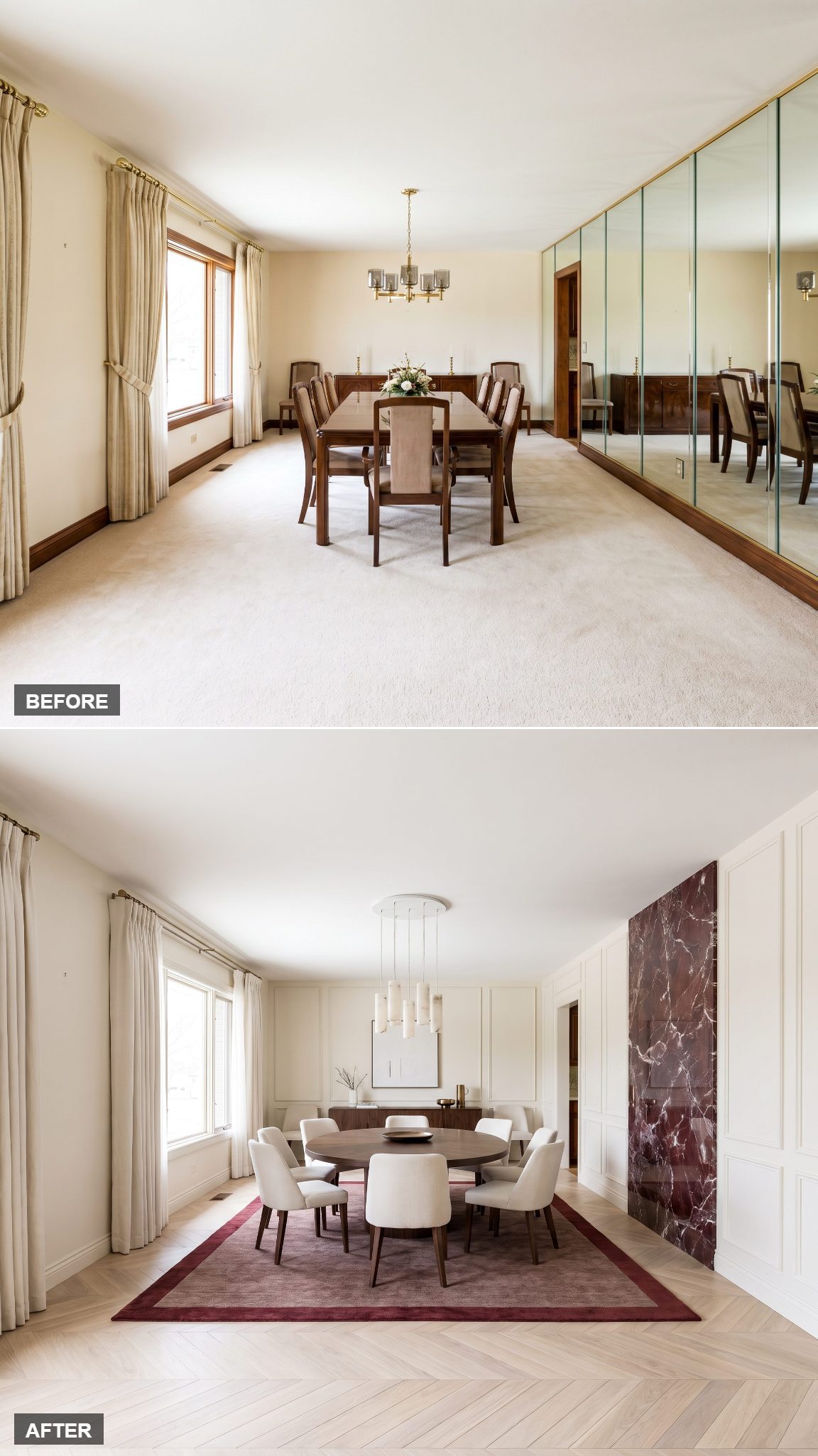
Ivory paneling from floor to ceiling turns the former mirror wall into actual architecture: recessed fields, controlled shadow lines, one warm neutral carrying the entire background.
Then the red marble arrives and breaks the peace beautifully. Deep veining runs through the tabletop while ivory linen chairs refuse to compete. One brass candlestick, one folded napkin, enough. The table has already entered the room wearing the statement piece.
7. Moody Walnut and the Case for Going Dark
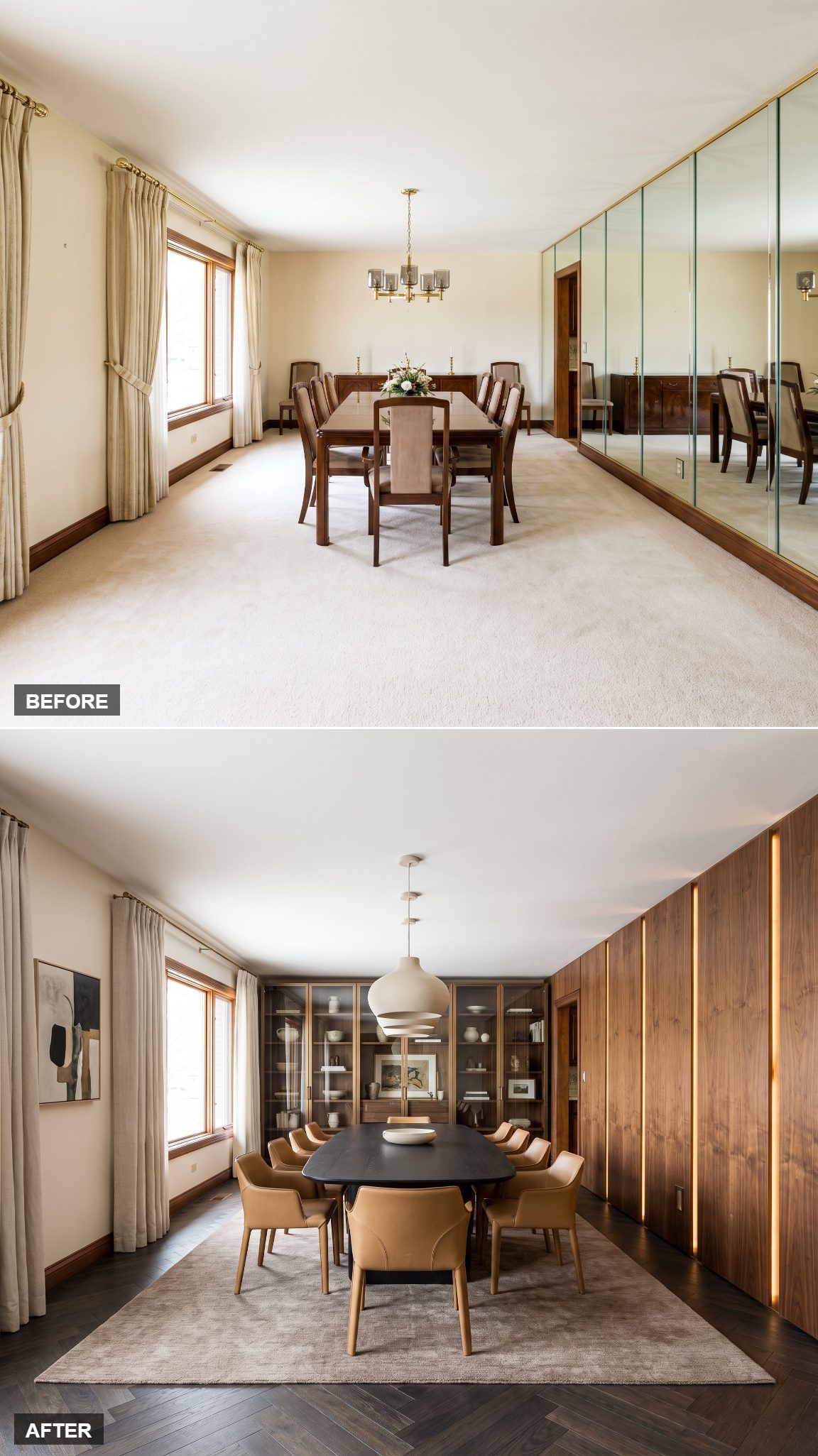
A smaller dining room does not automatically need pale walls. Here, walnut paneling creates a darker envelope that feels intimate rather than cramped because the lighting, table and metallic details are all working with it.
A rich walnut dining table, low warm light and restrained brass turn the room toward the atmosphere of a very good restaurant booth. Darkness becomes depth because the materials and illumination are layered rather than simply dim.
6. Organic Modern, Where Nothing Has a Hard Edge
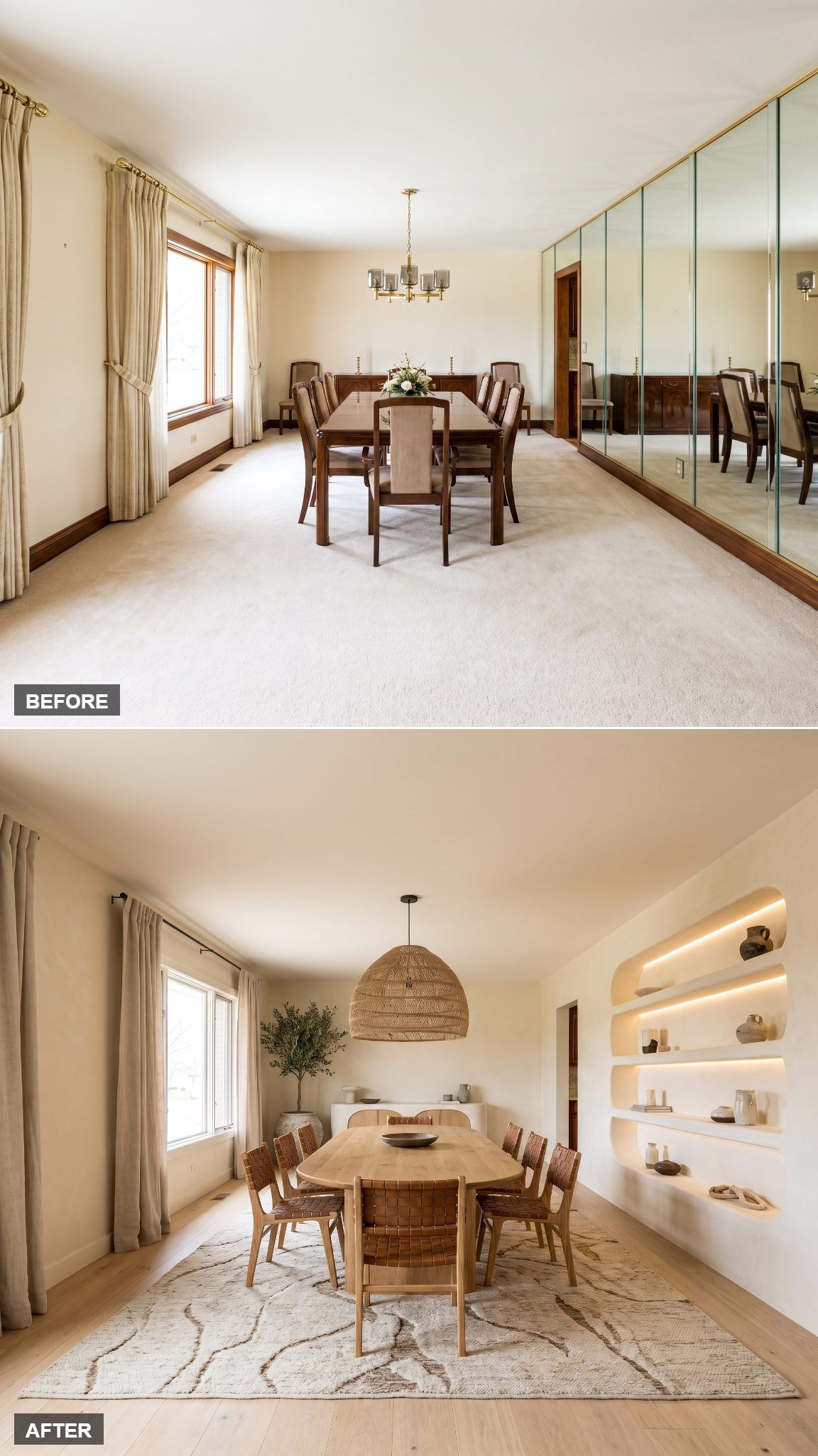
The original room had enough straight lines to run an accounting department. This version rounds almost everything it can.
Warm sand plaster, a live-edge table with a curved base, rounded bouclé dining chairs and a woven pendant replace hard reflection with softness at every scale. An olive tree anchors the corner. Even the light seems to arrive with fewer elbows.
5. Stone Arch Gallery Dining Room
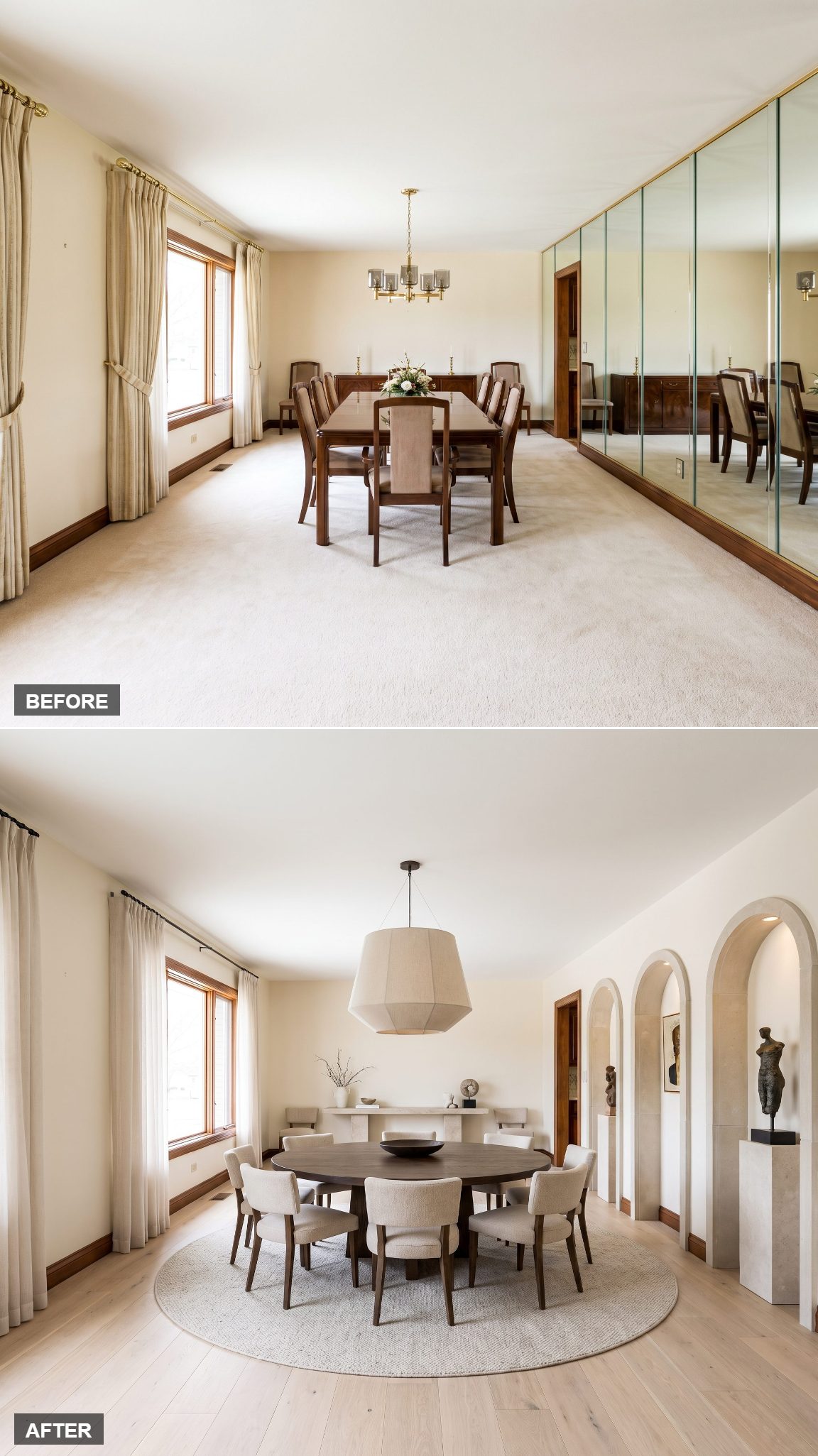
Then comes the monumental move. The mirror wall becomes limestone with a deep arched niche, turning what was once a reflective plane into something that appears carved into the architecture itself.
A long stone-topped table on a sculptural plinth sits beneath a linear alabaster pendant, while pale bouclé chairs keep the mass from becoming too severe. Inside the arch: one urn, one stack of books, no panic styling. The room suddenly has the gravity of a gallery without losing its ability to host dinner.
4. From Smoked Mirrors to Warm Modern Limestone Luxury
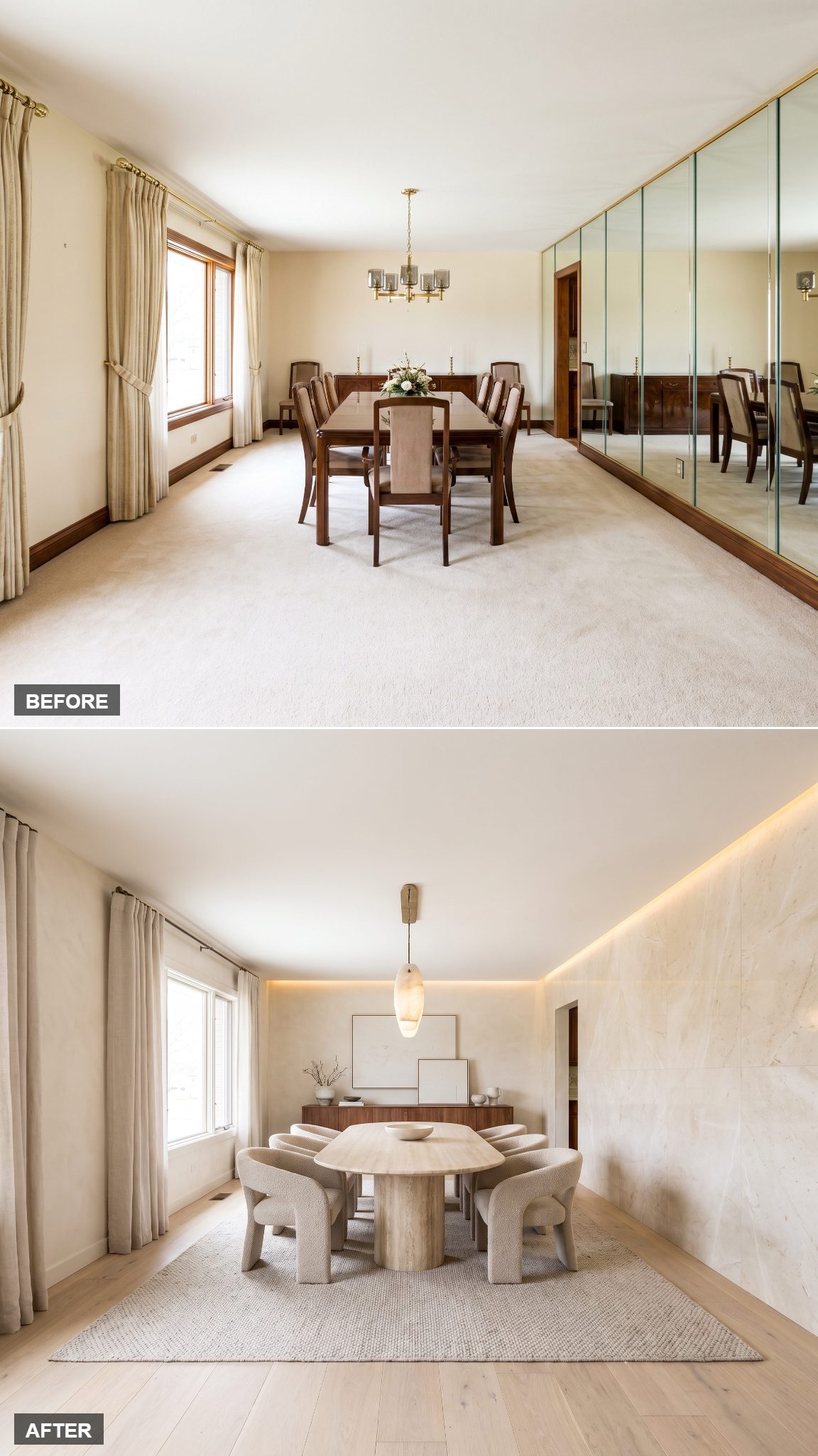
Here the transformation is quieter. Honeyed limestone replaces the mirror wall, shifting the room from high reflection to low sheen without asking the architecture to become theatrical.
An oval travertine table, oatmeal linen chairs and a plaster pendant keep everything within a warm mineral palette. The interest comes from surface: porous stone, woven linen, matte plaster, soft grain. Neutral stops meaning blank when every material behaves differently in the light.
3. The Mirror Comes Down, and the Room Finally Grows Up
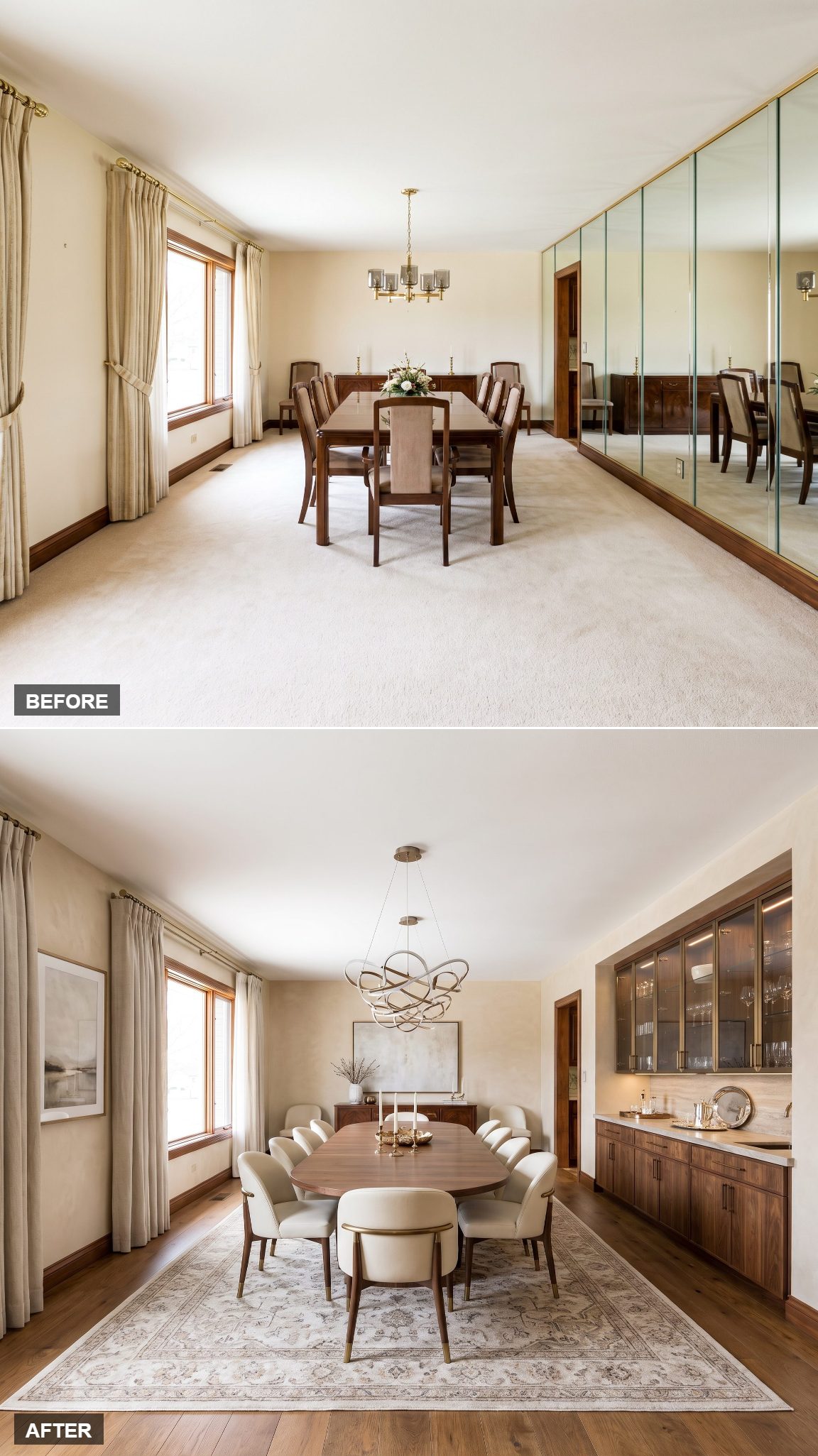
This transformation is less about a style label than about giving the room a proper center of gravity.
Warm limestone paneling replaces the mirror wall, and a long walnut buffet finally gives serving pieces, drinks and dinner-party clutter somewhere to go. A single brass linear chandelier tracks the length of the table while oatmeal upholstery keeps the heavier finishes from closing in.
The difference is functional as much as visual. The wall no longer duplicates the room. It supports it.
2. British Contemporary Heritage With a Backbone
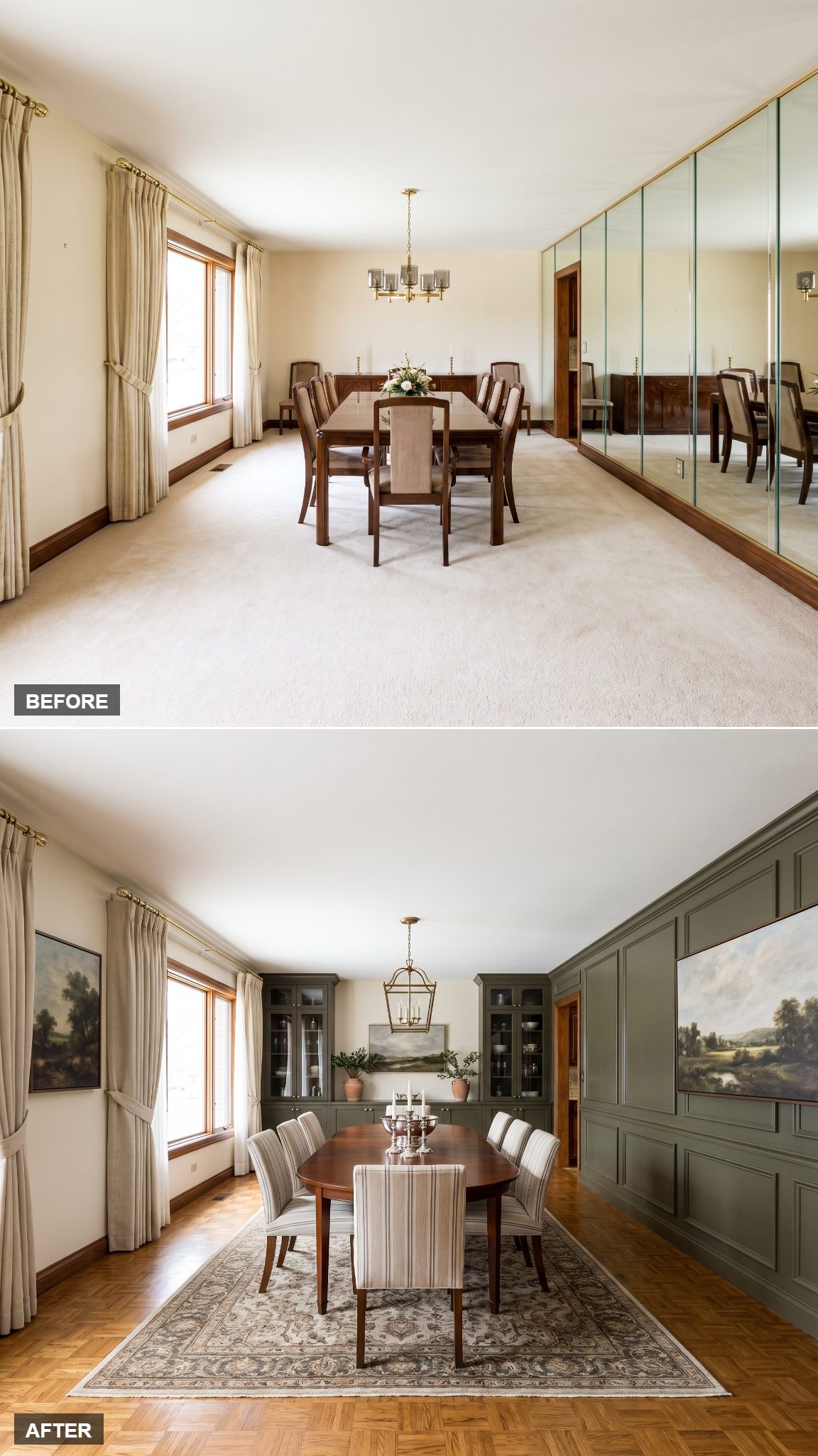
Think converted London townhouse rather than country-house costume. Deep inky blue covers paneled walls, a dark timber table sits underneath a heritage-style pendant and the chairs deliberately refuse to arrive as a matching set.
Leather beside upholstery, books beside ceramics, brass beside dark wood: the room feels collected rather than installed in a single afternoon. The original pale beige envelope avoided commitment. This one makes a decision and keeps making it all the way around the room.
1. From Disco Relic to Sculptural Showpiece
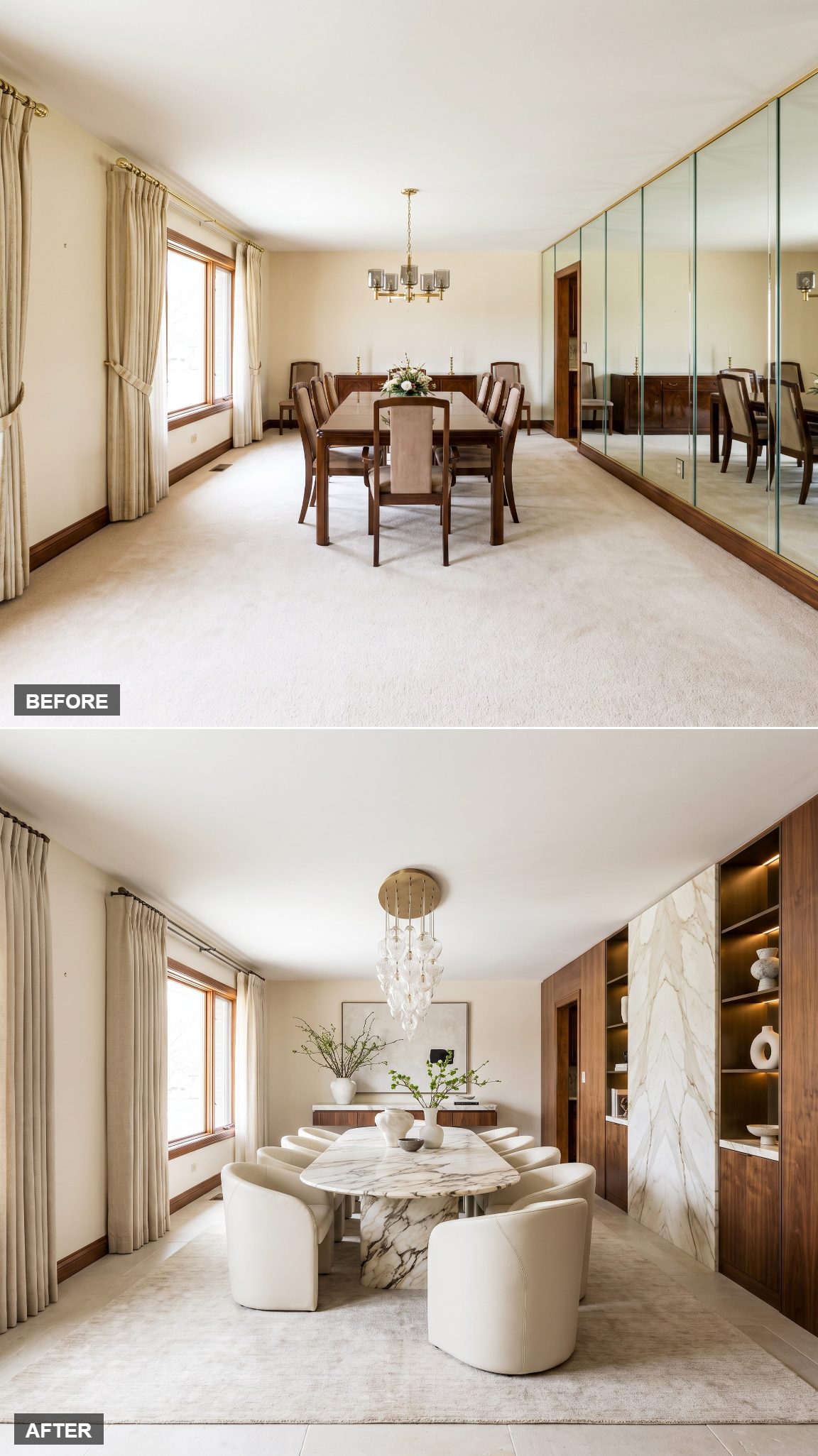
This is the swing-for-the-fences version. The original mirror gave the room drama by multiplying whatever happened to be standing in front of it. This one builds drama into the materials themselves.
Fluted plaster walls in warm greige catch daylight in narrow vertical bands. A marble table carries dramatic gray veining, deep-olive velvet curves around it, and stacked alabaster discs drop soft light directly over the center. Nothing is timid, but nothing is fighting for a separate storyline either.
That is the real distance traveled across these 33 rooms. The old dining room tried to create impact with one enormous reflective trick. The strongest transformations do something much harder: they use proportion, texture, color, light and material to make the architecture interesting enough that the room no longer needs a trick at all.